Home Blog Page 1616

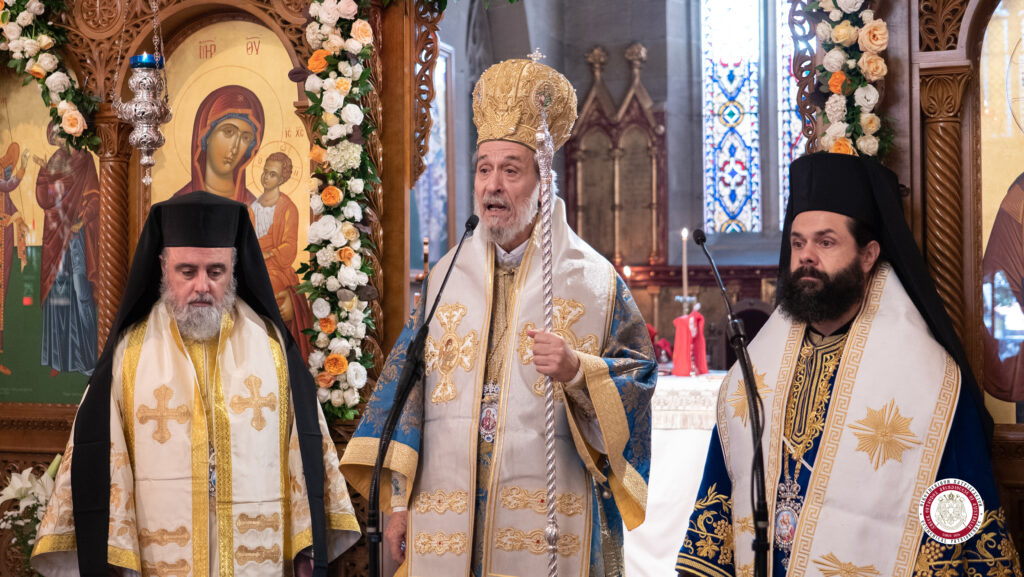
Archbishop Makarios of Australia sends message marking double celebration of March 25

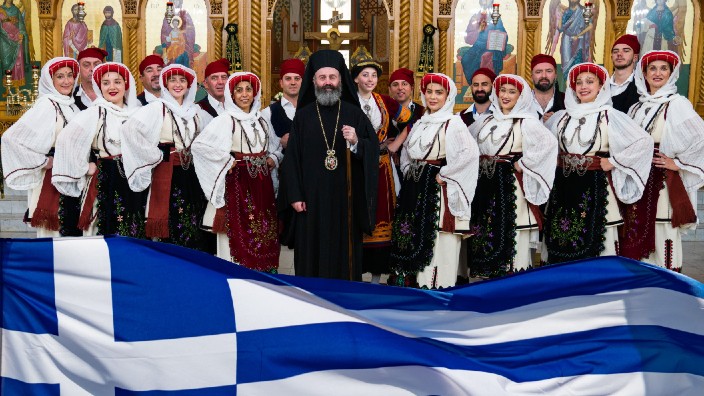
His Eminence Archbishop Makarios of Australia has issued a message to the Greek Australian community to mark the March 25 double celebration – the Annunciation of the Theotokos and Greek Independence Day.

Full Message in English:

“God-loving Brethren, beloved fathers and my beloved children,

Today, our Church celebrates the momentous event of the Annunciation of the Theotokos, that is, the announcement to the Virgin Mary by Archangel Gabriel of the joyful message of the Incarnation of our Lord. We refer to a joyful message precisely because we know that the Incarnation of God was the starting point for the salvation of humanity.

But what were the feelings that gave rise in Panagia when she heard from the Archangel the words: “Behold, you will conceive in your womb and bring forth a Son, and shall call His name Jesus”? We are given the answer by Luke the Evangelist, who presents to us, on the one hand, the perplexity and bewilderment that Panagia felt upon hearing that she would conceive the Son and Word of God and, on the other hand, Panagia’s redemptive phrase that she is ready to accept the will of God: “Behold the maidservant of the Lord! Let it be to me according to your word.”
This dialogue confirms that Panagia’s obedience to the will of God was not from coercion but the result of free will and, at the same time, deep faith. While once, Eve’s disobedience, also the result of free will, led people away from God and enslaved them to sin, on the contrary now, the Virgin Mary consciously chooses obedience and grants eternal life to fallen humanity.

It is not a coincidence that this significant ecclesiastical event is celebrated together with the start of the Greek Revolution. We praise God who has counted us worthy, today, to celebrate the 200th anniversary of this historic day, noting what has been indelibly engraved in the collective consciousness of our people – the inseparable relationship of our Hellenic Nation with our Orthodox Faith and Christ’s Church. Let us never forget that the blood of the martyrs, who died for our Faith, and that of the heroes of our Nation, runs through our veins.

Furthermore, we note that the enslaved Greeks, despite their understandable hesitation, concern or unrest that they must have felt at the announcement of the proclamation of the Revolution, nevertheless, they participated in the uprising of their own free will and obeyed the voice of their Greek Orthodox conscience. Because of them, the following generations of Greeks were able to live with liberty and free of the Ottoman yoke, just like, because of Panagia, humanity was freed from ancestral sin and could re-enter the door of Paradise once again.

My beloved friends,

If there is something that we must reflect on during this double celebration, it is that we ought to hold high in our conscience, and pass on to future generations, the ideals of our Faith and Nation. The best way of honouring the Virgin Mary and the struggles of our ancestors is none other than to prepare our hearts so that in every difficult decision that we are called to make in our lives, we always put forward our love and our dedication to God and our Homeland.

In Sydney, on the 25th day of March, 2021, with fervent paternal prayers, † Archbishop MAKARIOS, Primate of the Greek Orthodox Archdiocese of Australia.
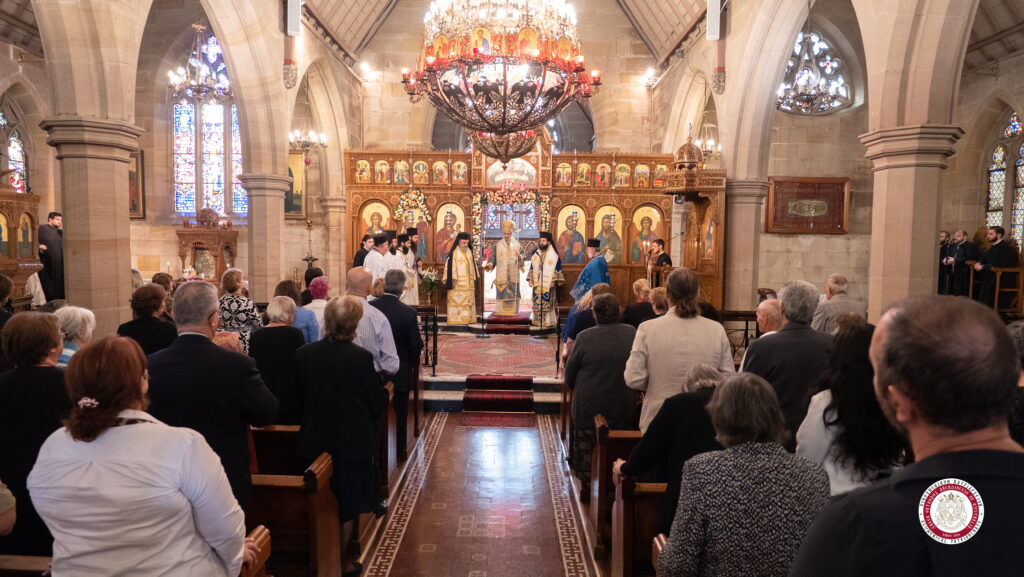
The Feast of the Annunciation in Sydney:

The Annunciation of the Theotokos was celebrated today at the Cathedral of The Annunciation of Our Lady in Redfern, Sydney. The Divine Liturgy was preceded by the Most Reverend Metropolitan of Sevastia Seraphim, supported by Bishop Iakovos of Miletoupolis and His Grace Bishop Emilianos.

At the end of the Divine Liturgy, the Hierarchical Head of the Cathedral, His Eminence Archimandrite Fr. Christoforos Krikelis, read the message of His Eminence Archbishop Makarios of Australia for the double celebration of March 25.

In the same spirit, His Eminence Seraphim, addressing the congregation, spoke of a double celebration, the freedom from the slavery of the devil with the Annunciation of the Virgin and the redemption of the Greek Nation from Turkish slavery.
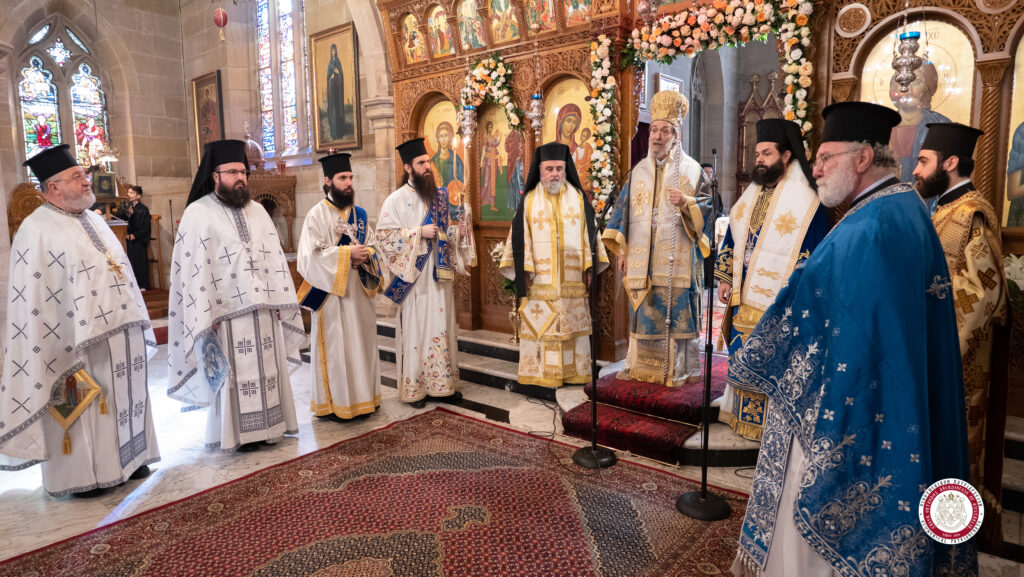
“We celebrate spiritual freedom, but also national freedom today,” he underlined and wished: “May God allow us to celebrate these days with pride, praising the One who gave us the spiritual rebirth, but also honouring the Heroes of ’21 who gave us freedom with their blood.”

It is noted that the official celebration of the national anniversary in Sydney will take place on Sunday, March 28 at 10am. A doxology service will be held at the Cathedral of The Annunciation of Our Lady in Redfern, Sydney, followed by a memorial service and wreath-laying at 1pm at the Martin Place Cenotaph.

READ MORE: Sydney to commemorate Greek Independence bicentennial with Doxology and Memorial Service.

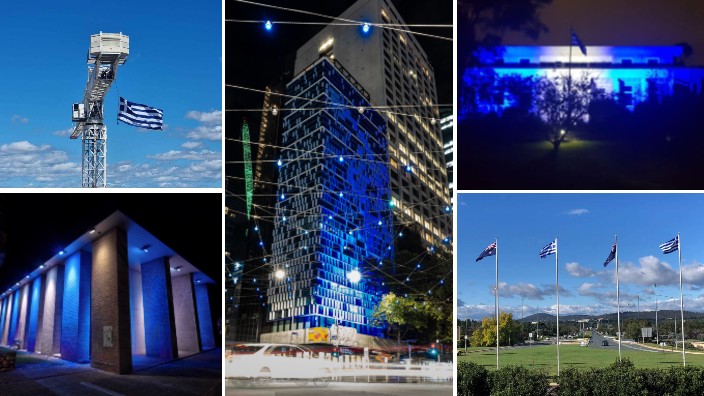
Greek pride on display across Australia to celebrate bicentenary of the Greek Revolution

From Melbourne to Canberra, Darwin, Perth, Adelaide, Brisbane and Sydney, the whole of Australia is celebrating the 200th anniversary of the Greek Revolution by proudly displaying Greek flags and lighting their iconic monuments blue and white.

Here is the The Greek Herald’s list of which buildings are going Greek this Independence Day.

Canberra:

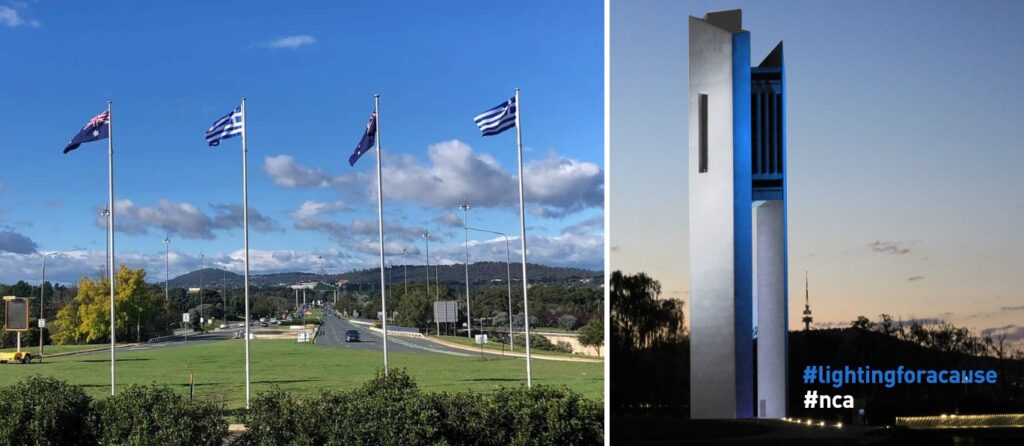
Under the initiative of the Greek Orthodox Community and Church of Canberra, Greek and Australian flags are proudly flying in various locations across the Canberra CBD today, including at the Vernon Circle, Allara and Nangari Streets, Petrie Plaza, Gold Creek Village and Canberra Shopping Centre.

Tonight, a number of buildings will also be illuminated in blue and white such as the National Carillon Bell Tower, Questacon, the National Capital Authority, Ian Potter House, Black Mountain (Telstra Tower), the National Museum of Australia, The Hellenic Club of Canberra and the Greek Embassy in Australia.

Greek pride is on full display in Canberra. Photos: John Loukadellis / Facebook.

On Wednesday night, the Embassy had a test run of the lights, with President of the Greek Orthodox Community and Church of Canberra, John Loukdellis, writing on social media: “Lights being tested and looking magnificent. The Ambassador of Greece in Australia, H.E Mr George Papacostas, has given it the ‘blue light’ of approval.”

READ MORE: Greek colours to light up Canberra monuments in celebration of 200th Independence Day anniversary.

Melbourne:

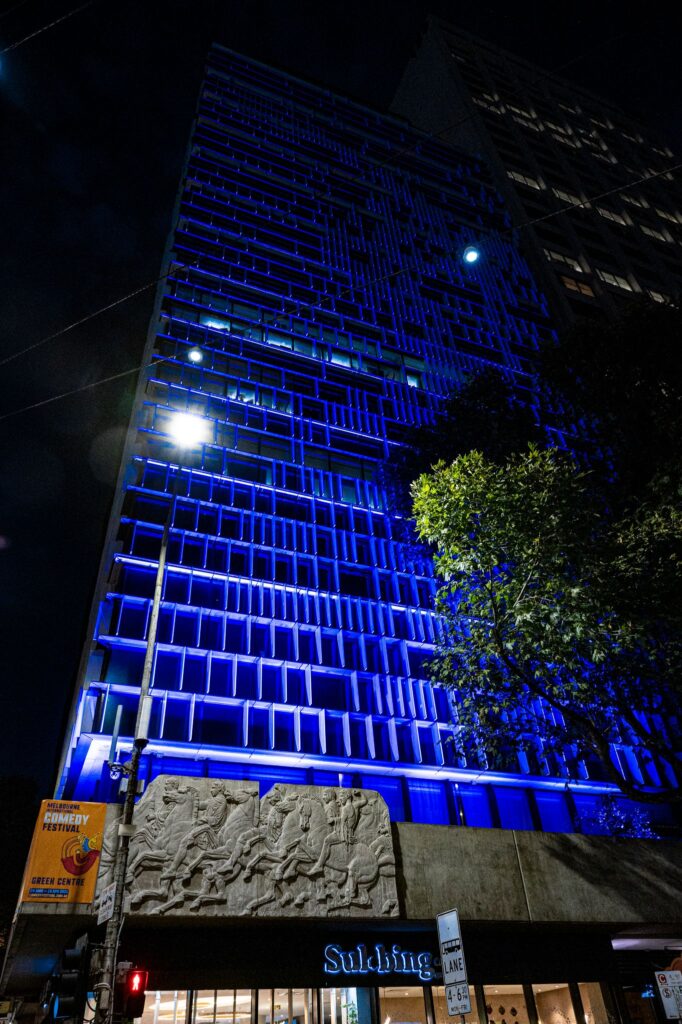
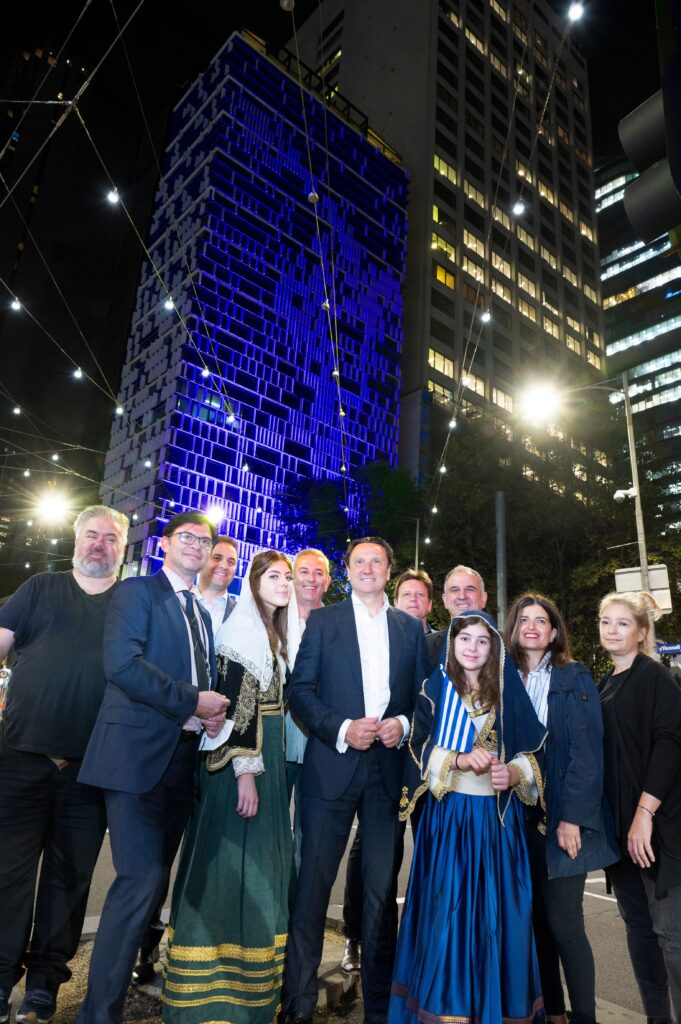
In recognition of the 200th anniversary of the 1821 Greek Revolution, the Greek Community of Melbourne has lit up its 15-storey cultural centre in blue and white. 

“The spirit of 1821 now shines bright on the 15-storey Greek Cultural Centre. It is important that our message of independence, heroism and resistance is broadcast as far and wide as possible,” President of the Greek Community of Melbourne, Bill Papastergiadis, says. 

READ MORE: Greek Community of Melbourne lights up cultural centre for Greek Revolution bicentenary.

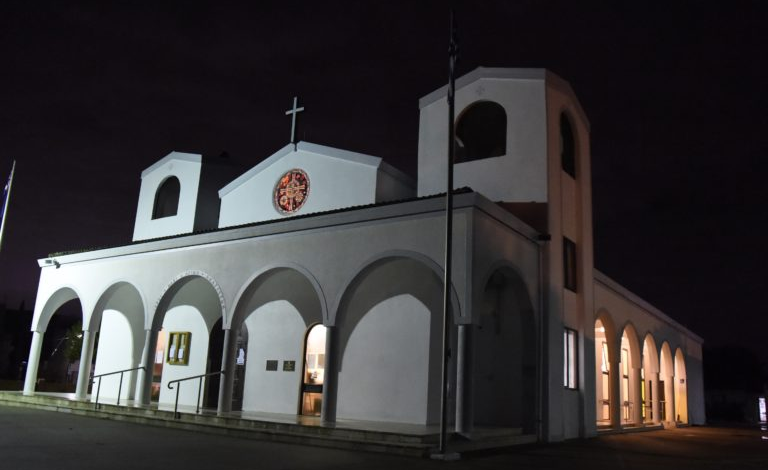
In addition to the Greek Centre, the Greek Orthodox Community of Oakleigh and District (Community), Parish of Saints Anargiri and Oakleigh Grammar will pay tribute towards 200 years of Greek Independence by respectfully and reverently lighting up Saints Anargiri Church.

The lighting effect will take place at 8.30pm on March 26, 2021 and will shine brightly until 12am. Pending weather, the display will be repeated on Saturday, March 27, 2021 from 8.30pm – 12am.

Saints Anargiri Church will also be lit tonight.

This will provide the Hellenic and Orthodox faithful of Melbourne the opportunity to drive by and observe with pride and respect the blue and white flag and heroes from the revolution.

The display will also mark the commencement of The Evzone Collection: A photographic exhibition, to be held at 77-81 Willesden Road, Oakleigh from Saturday, March 27 to Sunday, April 4, 2021.

Adelaide:

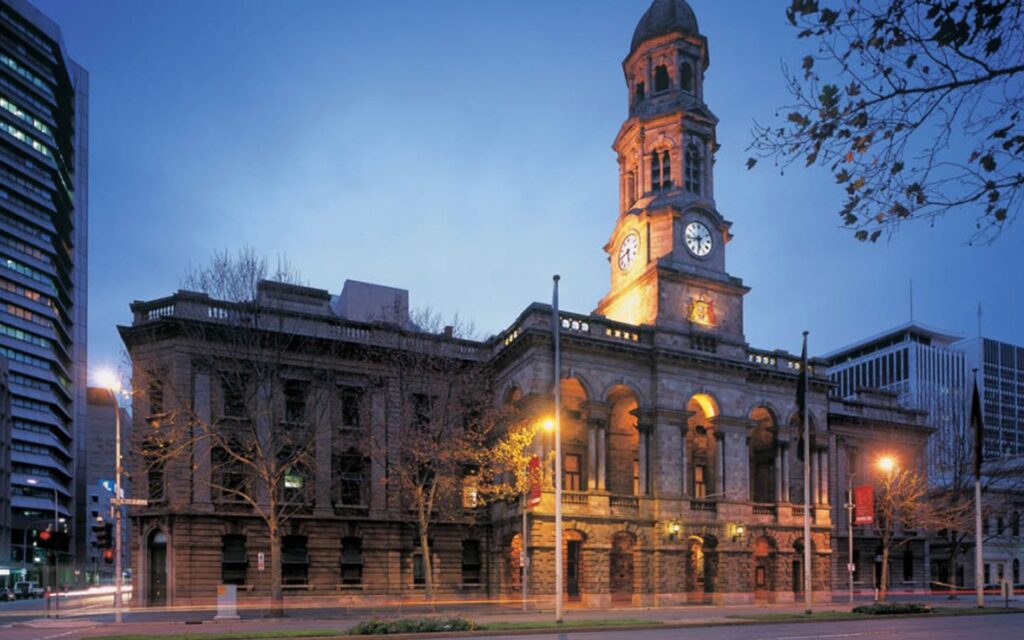
Adelaide’s Town Hall will be lit blue and white and the Greek flag will be flying proudly at the front of the building today to mark the 200th anniversary of the Greek War of Independence.

Adelaide Deputy Lord Mayor, Mary Couros, told The Greek Herald she’s delighted by the news as it recognises South Australia’s “long-established Greek community.”

“Independence Day is very significant to the community and to support the Greek community is a commitment to the multicultural country that we are built on and sending a message that through unity, we should never forget the importance of freedom and democracy,” Ms Couros says. 

The City of West Torrens is also planning a flag raising ceremony on March 25 to acknowledge the Greek community’s contribution.

READ MORE: Adelaide Town Hall goes Greek for the bicentenary of the Greek War of Independence.

Darwin:

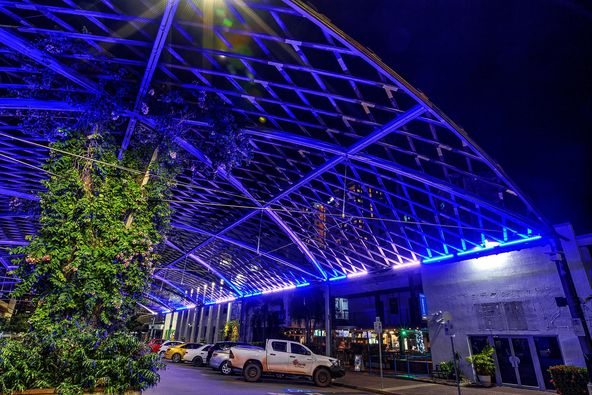
Darwin’s Civic Centre has been lit blue and white this week to celebrate the 200th anniversary of the Greek Revolution.

In a post on social media, the City of Darwin also got into the spirit of Greek Independence Day by sharing a quick fact.

Outside of Darwin’s Civic Centre. Photo: Facebook.

“Melbourne may be the ‘Greek-est city outside of Greece’,” the post writes, “but did you know that Darwin has the largest population of Kalymnians? Kalymnos and Darwin signed a sister city agreement in 1982.”

Perth:

The Consulate of Greece in Perth has proudly announced that Perth will also be “dressing up” in blue and white to honour the important bicentennial for Hellenism worldwide.

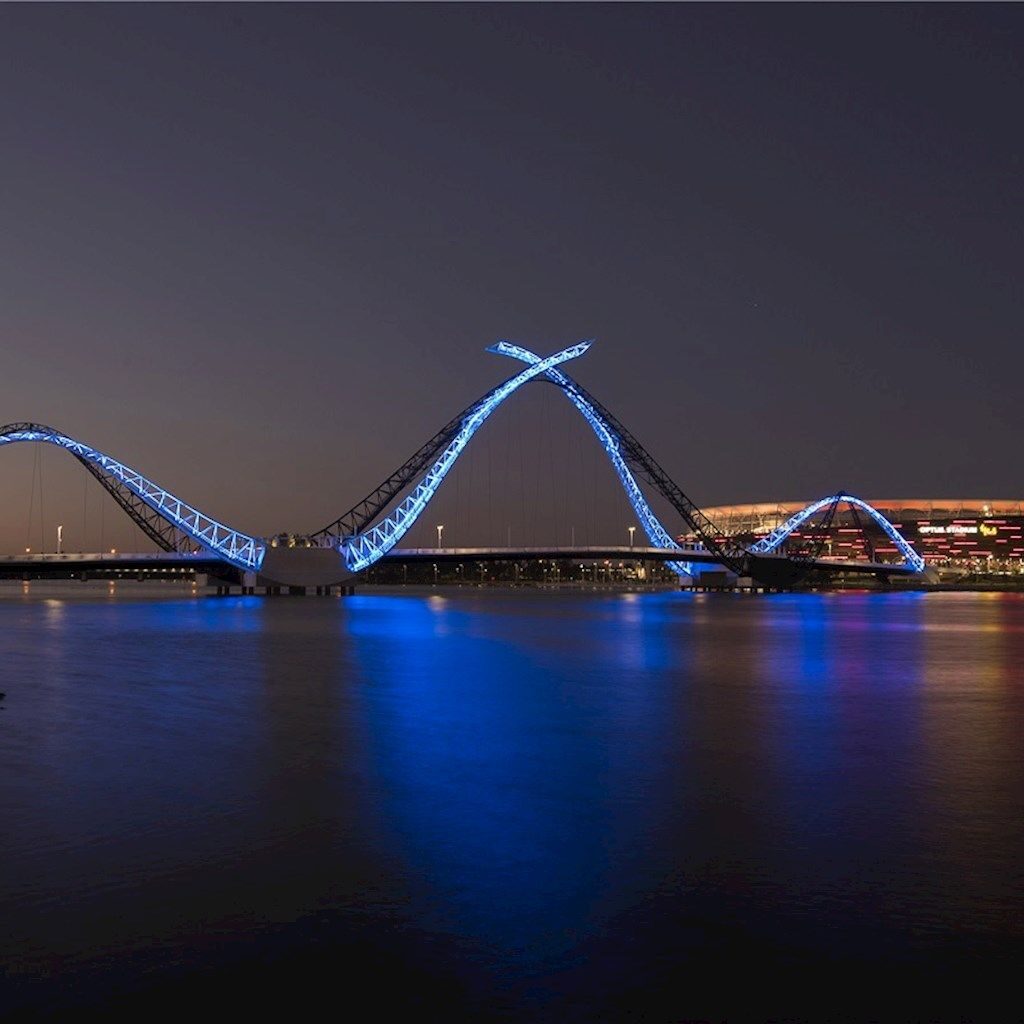
The Council House, Matagarup Bridge, Mount Street Bridge, Sky Ribbon, Joondalup Drive Bridge, as well as the Northbridge Tunnel entry artwork, will all be lit in the colours of the Greek flag.

The Matagarup Bridge in Perth. Photo: Facebook.

“Special thanks to the City of Perth and Lord Mayor of Perth, Basil Zempilas, as well as Mainroads WA, for making it happen. Just enjoy a beautiful night stroll around the City this Thursday!” the Consulate wrote on social media.

READ MORE: March 25: A double celebration of Greek Independence Day and the Annunciation.

Brisbane:

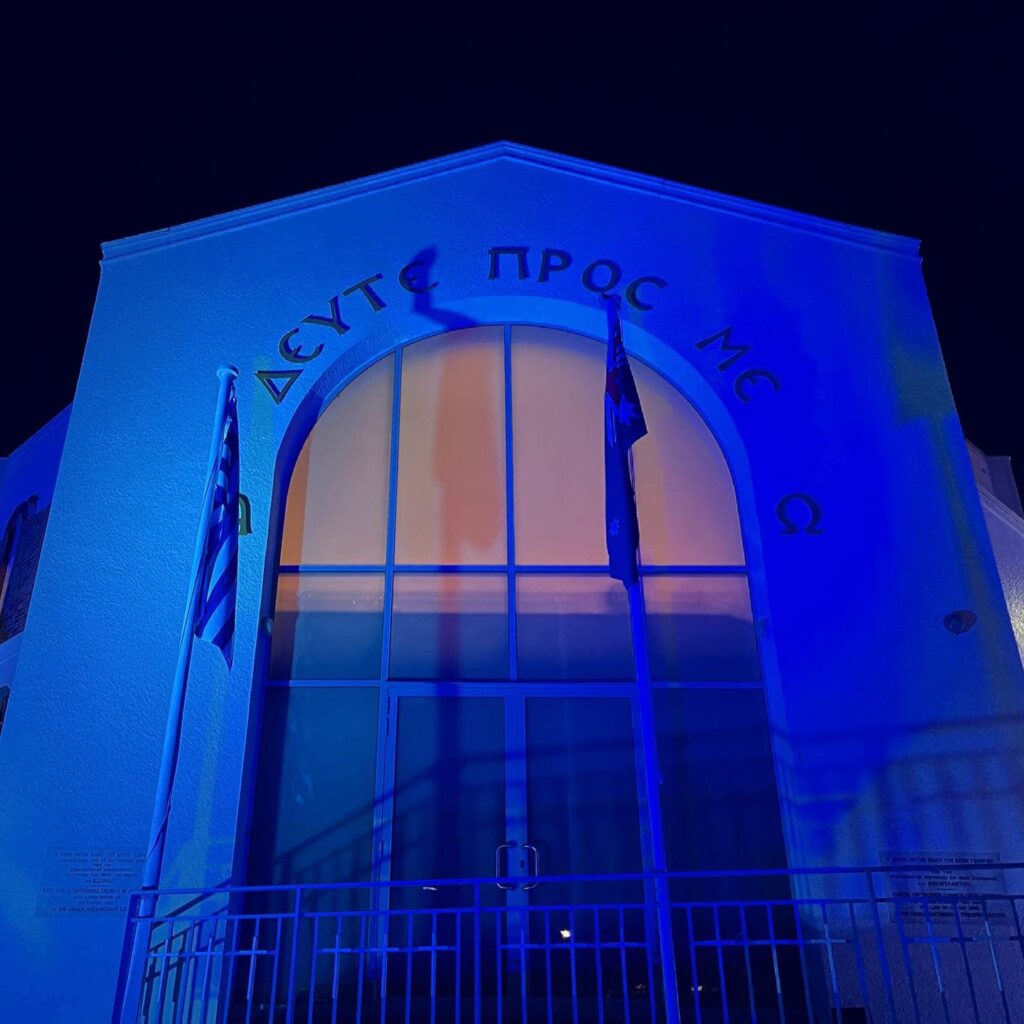
On Wednesday night, St George Greek Orthodox Church in South Brisbane, Queensland was lit up in blue and white, and the Greek flag was flying, to mark the bicentenary.

The Hellenic Dancers of St George Brisbane also performed at the Greek Club to celebrate the momentous occasion.

Sydney:

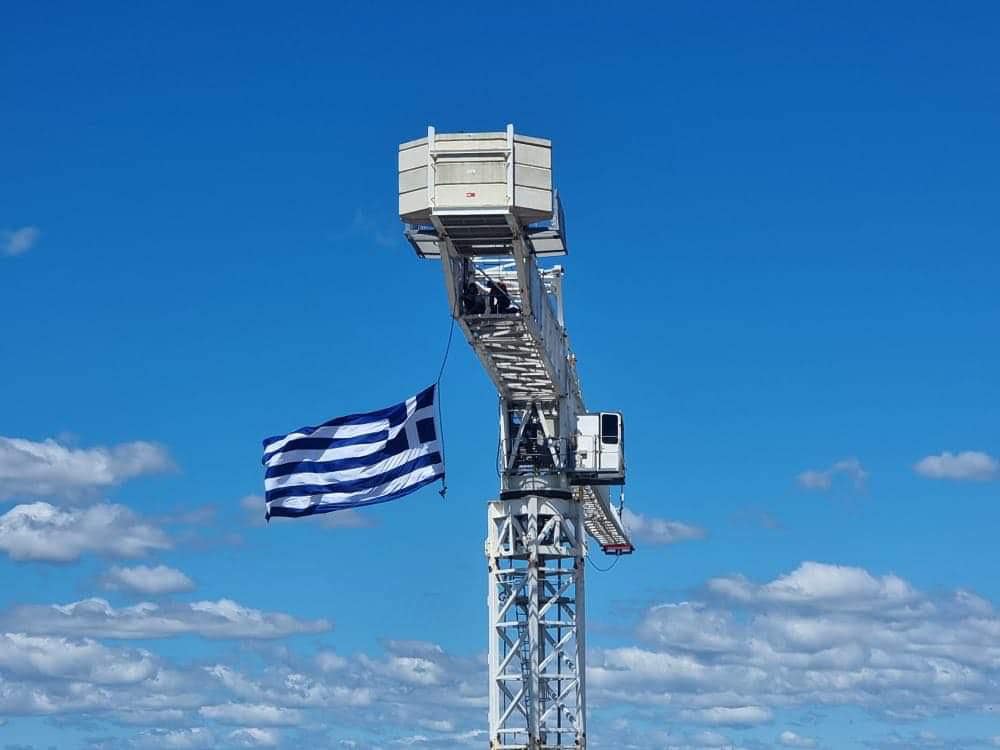
The Greek Herald launched its #GreekFlagWeek campaign, asking people to share on Twitter, Facebook and Instagram how we proudly Fly, Share and Post our Greek flags. The movement was a success, with one reader, Titan Cranes, even sending in a photo of his Greek flag flying proudly on a huge crane!

Titan Cranes sent this photo as part of our #GreekFlagWeek.

Across town in the Randwick and Canterbury Bankstown Council regions, the Greek flag was raised at the Town Hall and Earlwood Senior Citizens Centre respectively.

Tonight, the Sydney Opera House will also be lit up in blue and white to mark the 200th anniversary of the Greek Revolution.

Ζήτω η Ελλάδα, Ζήτω η Ελευθερία!

READ MORE: Greek flag colours to be projected on the Sydney Opera House for Greek Independence Day.

Immigration Minister, Alex Hawke, joins with Greek community to mark Revolution bicentennial

Alex Hawke MP, the Federal Minister for Immigration, Citizenship, Migrant Services and Multicultural Affairs, has sent a message of unity to the Greek Australian community to mark the bicentenary of the Greek Revolution today.

In his message, Mr Hawke reflects on his Greek heritage and thanks the community for continuing to strive for the ideals of democracy, freedom and justice.
Full Message in English:

“I join with the more than 400,000 Australians of Greek heritage in commemorating the 200th anniversary of Greece’s victory against the Ottoman Empire, and its achievement of Independence.
As the proud first generation son of a Greek migrant mother, this important milestone provides me a unique opportunity to acknowledge and celebrate the contributions of Greek Australians to our great nation.

The history of Greek migration to Australia is closely tied to the War of Independence, with the first Greek settlers arriving in Australia not long after the beginning of the War in 1821. This day allows us to celebrate this rich history, and the significant contributions made by the Greek community.

Whether it be the principles of democracy, freedom and justice, or the works of the ancient Greek philosophers – the contributions of the Greek nation and its culture are forever linked to the development of modern human civilisation.

Even in a year of unprecedented challenges, the Greek community has continued to strive for these ideals – with your strength, resilience and community spirit on full display – something I thank and commend you for.

I extend my best wishes to all Australians commemorating the 200th anniversary of Greek Independence.”

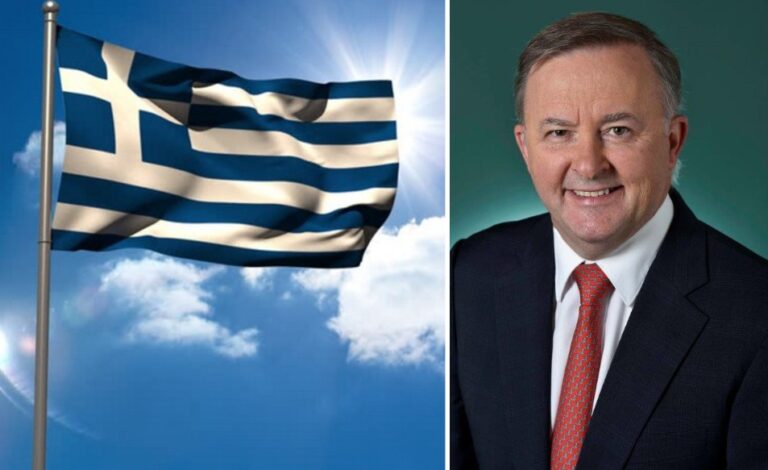
Anthony Albanese: ‘Today, is a proud day to be Greek’

The Leader of the Opposition and the Australian Labor Party, Anthony Albanese, has sent a message to the Greek Australian community to mark the 200th anniversary of the Greek Revolution.

In his message he speaks about his own electorate of Grayndler having a “thriving Greek community”.

Full Message in English:

Today, is a proud day to be Greek.
 
As leader of the Australian Labor Party, I take great pleasure in wishing the Greek Australian community a very special 200th anniversary of the Hellenic Republic and the establishment of Modern Greece.
 
Australia is home to the third largest Greek population outside of Greece. My own electorate of Grayndler has a thriving Greek community.
 
The Greek community, wherever they are in the world, are strong, proud and flourishing. This is because Greeks today want to pay respect and celebrate the sacrifices of their mothers and fathers.
 
So today, we celebrate the 400 years since the beginning of the end of the Ottoman Empire’s occupation of Greece and the 200 years since the great Greek revolt in the Peloponnese.
 
I wish our Greek community well as they celebrate the bicentennial of the Greek War of Independence.
 
Ελευθερία ή θάνατος, Freedom or Death, has lost none of its meaning, its resonance, or its power in the two centuries since.
 
Zito i Ellias! Long Live Hellas!

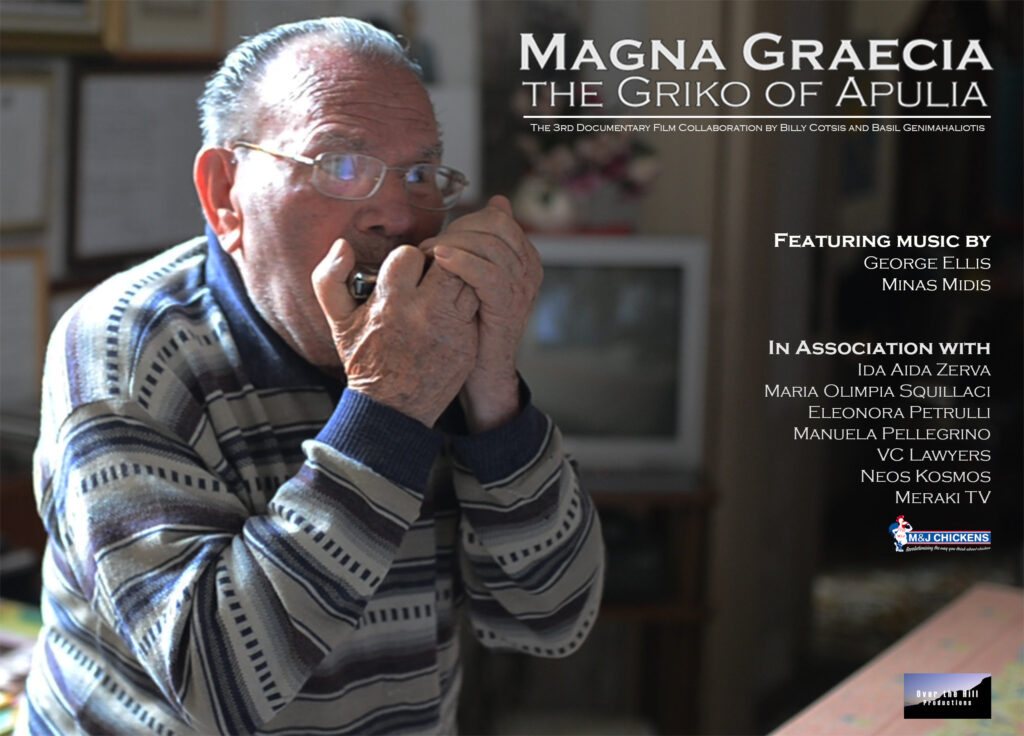
Greek Australian filmmakers to launch new series about Greeks of Magna Graecia

0

Greece’s Independence Day reminds us that millions of Greeks have been living abroad for the past 3,000 years.

This has prompted filmmakers Billy Cotsis and Basil Genimahaliotis to seek out these Greek community pockets and document how they remain in touch with their Greek heritage.

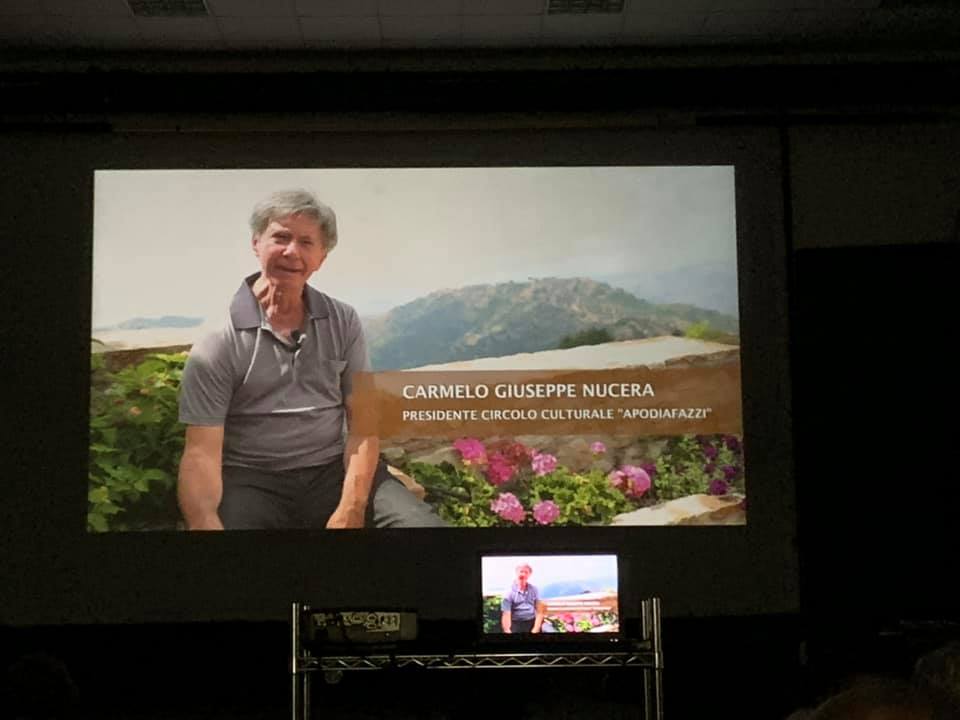
The Pallaconian Brotherhood announced that they will be joined by Billy Cotsis and Basil Genimahaliotis on the March 26 at 7PM to discuss their careers in international documentary filmmaking, with a particular focus on their work related to the Greek people (Greko/Griko) of Southern Italy (Magna Graecia).

Cotsis has visited almost 60 countries to see the Greek communities, 80 Greek islands, written over 350 articles, five books, and has (since 2012) created 18 short film and documentary projects, as well as managing his own blog https://herculean.wordpress.com/.

“The Pallaconian Youth have a passion for supporting the stories, ideas and people that help make Hellenism thrive around the world, and we see a great story in the work of Billy and Basil that needs to be told,” Miltiadis Paikopoulos, president of Pallaconian Youth said.

“Their work, promoting the vivid culture and history of the Greeks of Southern Italy (Magna Graecia) is a part of the living fabric of Hellenism that our ancestors fought so hard to preserve in 1821.

“The freedom to be Greek, and to spread Hellenism, is a gift that we must nourish and grow; I certainly feel that these two have helped grow Hellenism, and am proud to support them and their future projects, and I hope all who listen to our interview on the 26th feel the same way”.

The Palloconian Youth will chat with the filmmakers and play some samples of their recent work via zoom and Facebook. The public will be welcome to ask additional questions.

This is a prelude to an onsite presentation of Magna Graecia: the Greko of Calabria in Melbourne in September by the Palloconian Brotherhood.

As Australians reflect on what it means to be a Greek and the importance of 25 March, Mr Paikopoulos goes on to say:

“Although not discussed as widely or often as I’d like, the contributions of the Laconians and the region of Laconia were instrumental to the declaration of Greek Independence, and our successful liberation from the Ottoman Turks.”

“From 1453 – 1821, the Laconians had been involved in almost every major attempt at rebellion or independence and epanastasi was declared at Areopolis by the Laconians on the 17th of March 1821, over a week in advance of the 25th of March.

“Hopefully through the lectures, interviews and events that our association has organised, the Laconian efforts for Greek freedom will be made accessible to a broader range of people.”

Zoom link here: https://bit.ly/3tX9fTZ

Greece’s Ambassador to Australia sends joyous message on bicentenary of Greek Revolution

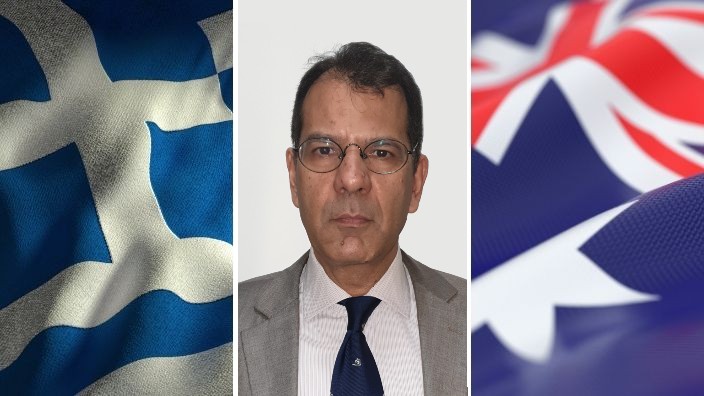
Greece’s Ambassador to Australia, George Papacostas, has sent a message of thanks to the Greek Australian community to mark the 200th anniversary of the Greek Revolution.

Ambassador Papacostas writes that the Greek Australian community is a “bridge between Greece and Australia” and thanks them for their contribution to the homeland.

Full Message in English:

“Dear compatriots,

It is an honour and a privilege for me to address you on the occasion of the Bicentennial celebration of the commencement of the Greek War of Independence.

The 25th of March, 200 years ago, marked a new era in the Nation’s fight for regaining democracy, freedom and independence.

The emblematic heroes of the 1821 Revolution taught us, with their example, the values of fighting for the noble causes of the nation and for the keeping and promotion of the national conscience, identity and heritage.

Thanks to their sacrifice, Greece is a modern, prosperous, democratic nation today, a member of the European family and a pillar of stability and peace in the Balcans and the wider Mediterranean region.

Greece is also a reliable partner in the international arena, promoting a positive and dynamic cooperation agenda in international relations and abiding by the international Law rules.  Additionally, its economy resists the shock of the COVID-19 pandemic and offers a wide range of opportunities for those wishing to invest in it.

Dear Compatriots,

You are the bridge between Greece and Australia with which our country shares strong bonds of blood and maintains excellent bilateral relations in all fields.

I would like to thank you, not only for keeping the Greek civilization, culture, history and language alive in Australia, but also for your valuable and very important contribution in maintaining and promoting the exemplary bilateral relations for the benefit of both nations and countries.

Χρόνια πολλά, Ζήτω το Ελληνικό Έθνος, Ζήτω η Ελλάδα, Long live Hellas!

Georges Papacostas, Ambassador.” 

Celebrations get underway in Greece for bicentenary of Greek Revolution

0

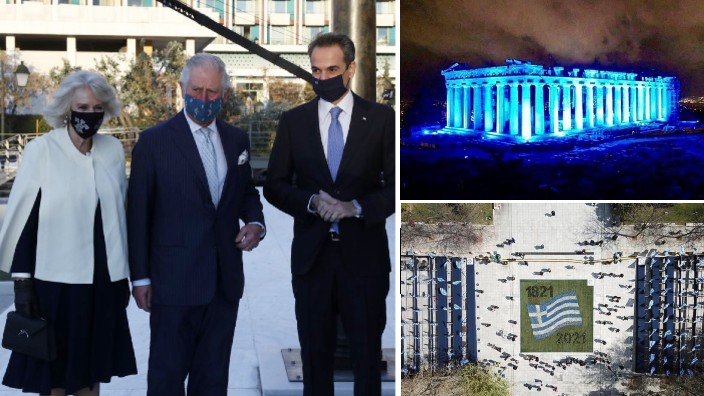
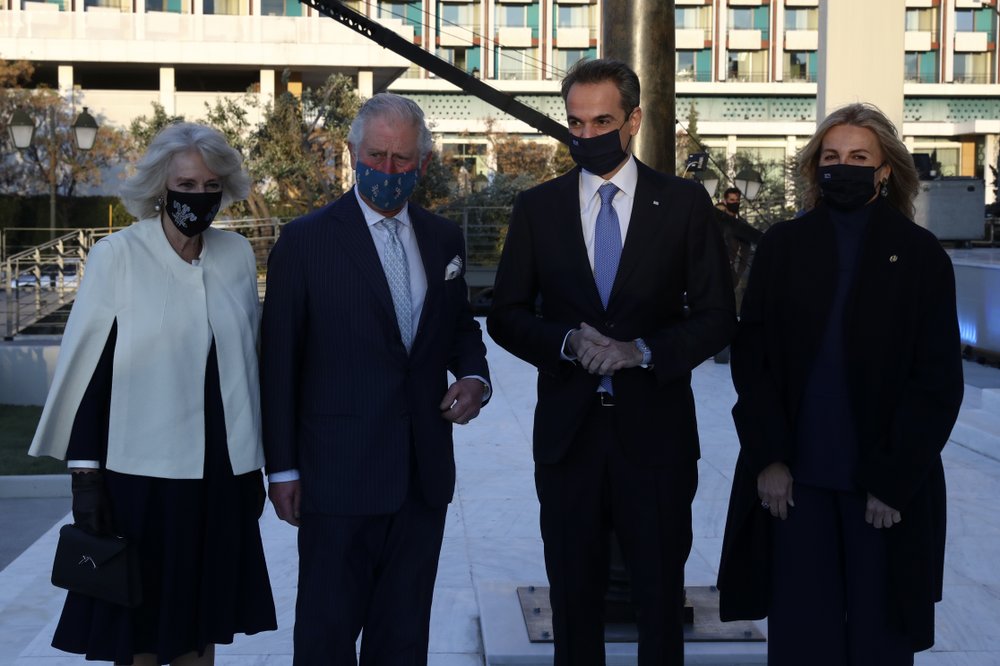
Greek Prime Minister, Kyriakos Mitsotakis, and his wife, Mareva Grabowski-Mitsotakis, welcomed Britain’s Prince Charles and Camilla, Duchess of Cornwall along with their other dignitaries, to the newly refurbished National Gallery, as celebrations to mark the 200th anniversary of the Greek War of Independence in Athens got underway on Wednesday night.

The PM, Culture Minister, Lina Mendoni, and National Gallery Director, Marina Lambraki-Plaka, all gave a small speech, followed by a tour of the gallery and a relevant exhibition marking the anniversary.

In his speech, the Mitsotakis stressed that the National Gallery “belongs not only to Greeks. It also belongs to our friends from abroad who join us on this anniversary.”

“Today’s event sends a renewed message of dynamism at the dawn of the third century of Greek liberty, because the National Gallery has never been a mere repository of artistic creation. On the contrary, it is a living organism that has followed the nation’s progress,” he added.

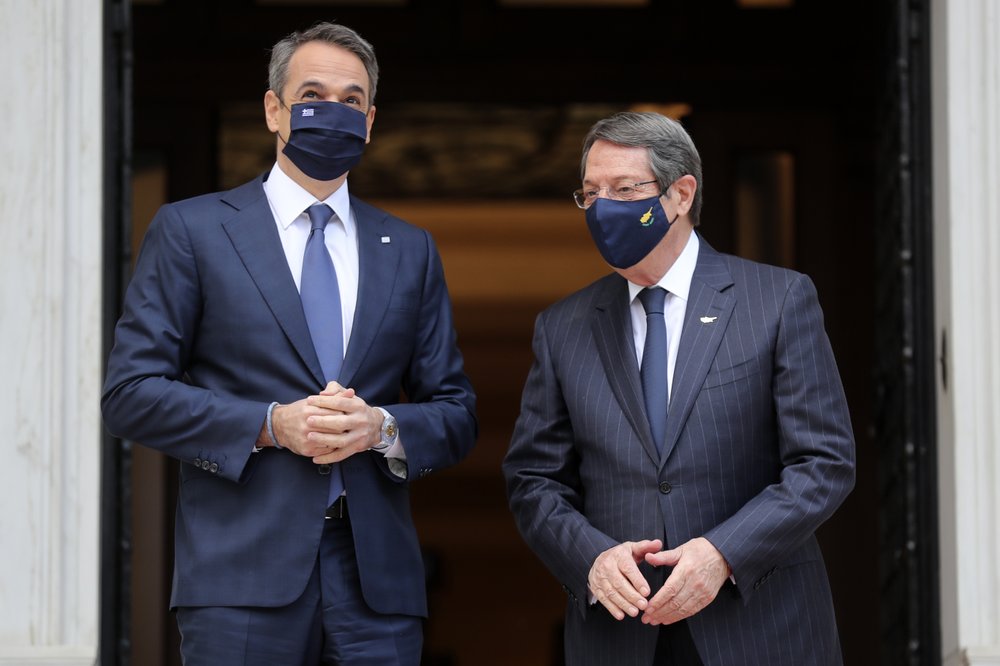
The event was also be attended by President Katerina Sakellaropoulou, Cypriot President, Nicos Anastasiades, French Ambassador to Greece, Patrick Maisonneuve, British Ambassador Kate Smith, the President of the Greece 2021 committee, Gianna Angelopoulos-Daskalaki and her spouse Theodoros Aggelopoulos, and Louvre Museum President, Jean-Luc Martinez. 

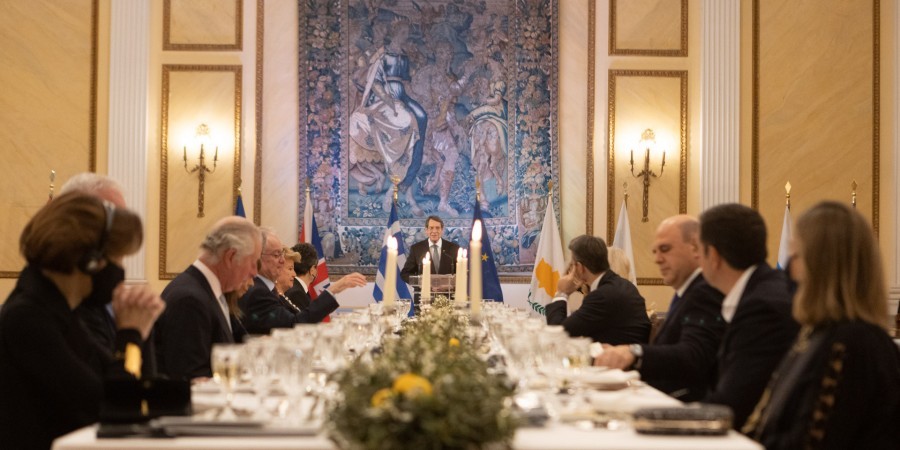
The day’s proceedings concluded with an official dinner at the Presidential Mansion at 8.30 pm.

During the official dinner, Sakellaropoulou told foreign dignitaries that the legacy of the Greek Revolution of 1821 in which Greeks sought their independence from Ottoman rule is “universal.”

The night concluded with a formal dinner, where speeches were given by some of the dignitaries. Photo: Sigma Live.

“The legacy of 1821 is not only Greek. On the contrary, it carries the universality of the ideas and values of its time,” she said in her speech.

“We return to this acquis on the occasion of the 200th anniversary. To the challenges we face today, starting with the pandemic, which is testing our health and freedom, but also in other critical issues, such as climate change and the dialogue of cultures,” she added.

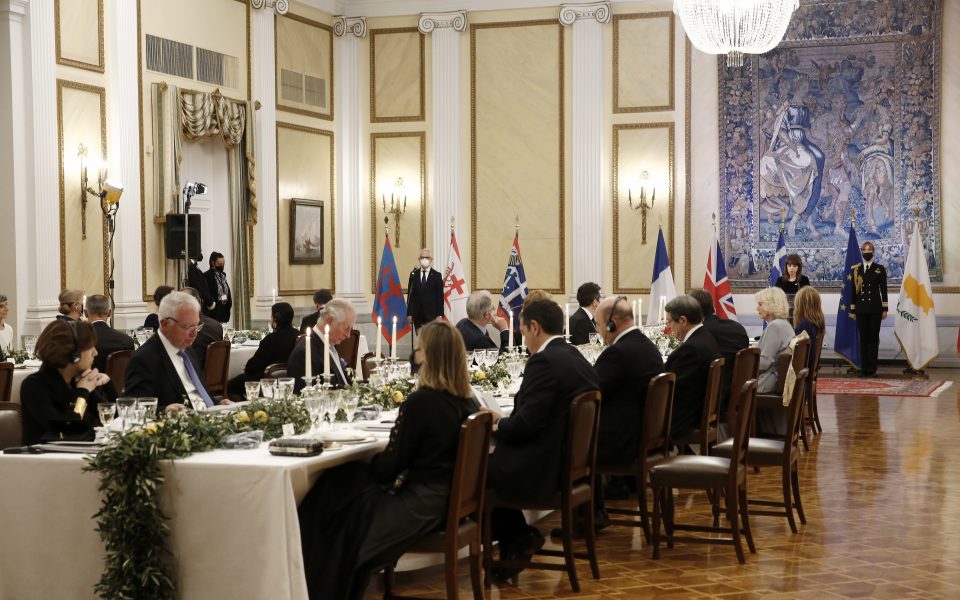
The official dinner. Photo: Ekathimerini.

Military parade and 200 Greek flags at Syntagma Square:

This event comes as celebrations are set to culminate in a military parade, accompanied by air force overflights, in central Athens on Thursday, Greece’s Independence Day.

But with Greece struggling with a renewed surge in coronavirus cases and deaths, the public will not be allowed to attend the parade, which will be broadcast live by state television.

Major avenues in the center of the capital will be closed to traffic for the parade, while thousands of police were being deployed for security. Authorities have banned seven rallies and protests that had been planned in Athens on Thursday.

The parade is to be attended by Russian Prime Minister, Mikhail Mishustin, Britain’s Prince Charles and his wife Camilla, the Duchess of Cornwall, French Defense Minister, Florence Parly, and Cypriot President, Nicos Anastasiades.

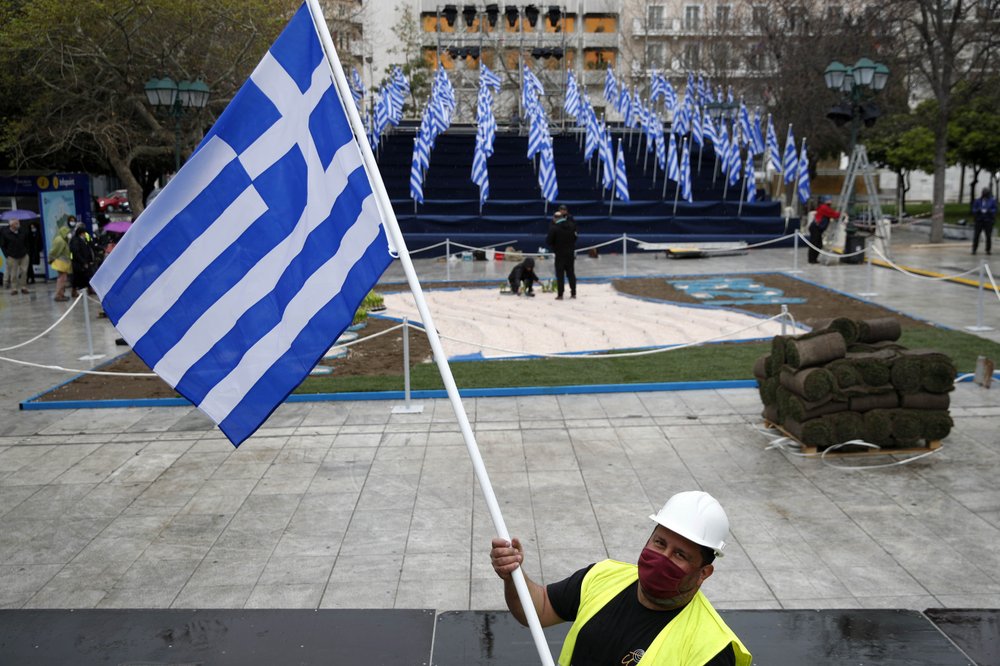
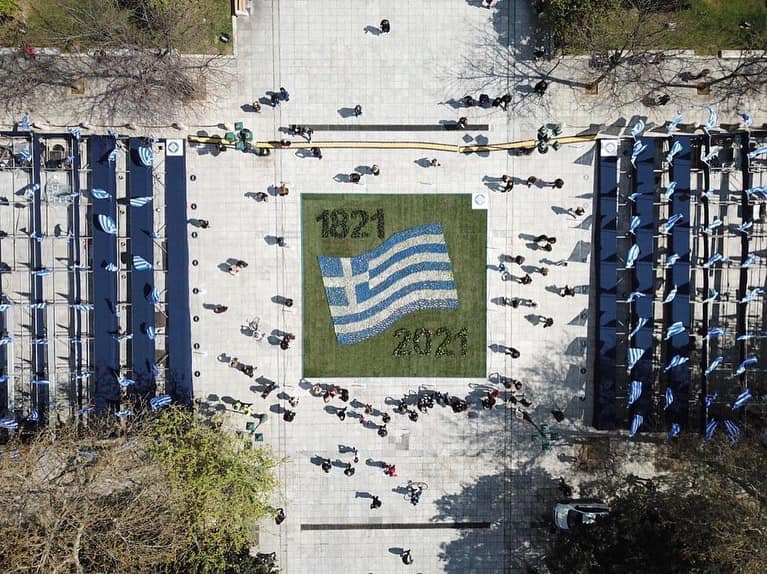
Syntagma Square has already been decorated for the occasion with 200 Greek flags, as well as a garden mural with the words 1821-2021.

Artists join the celebrations as buildings light up blue:

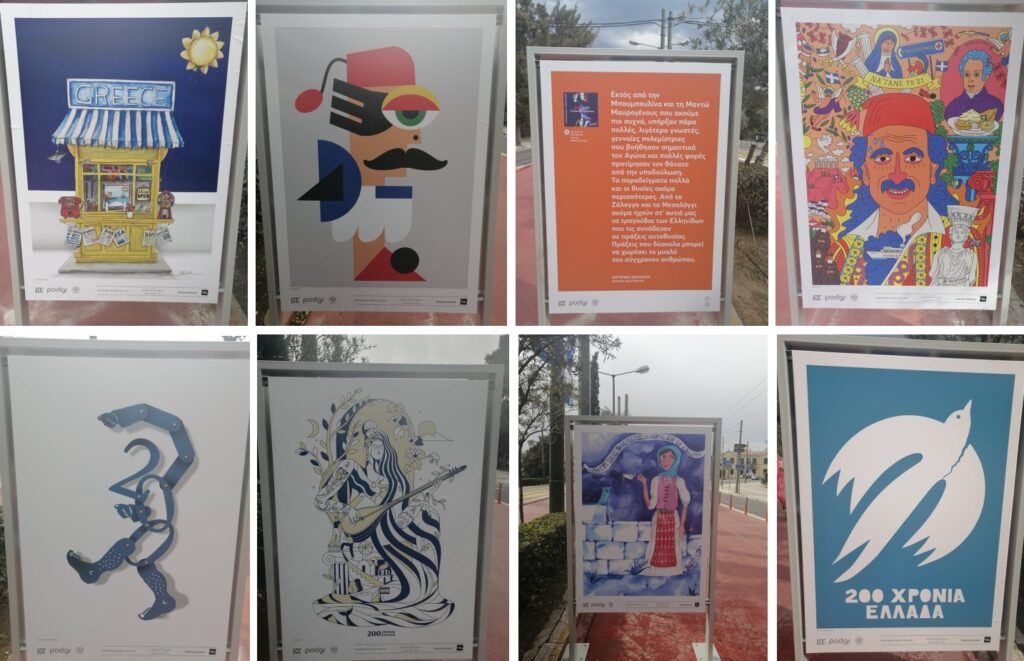
On Wednesday at 12pm, 21 writers and 21 artists also left their mark along the Grand Promenade in Zappeion, Athens, by leaving their creative works of art around the area.

Some of the artworks on the Grand Promenade. Photos: The Greek Herald / Ilias Karagiannis.

The pieces range from graphic art of Greek heroes and heroines, to poems and literature. The Greek Herald’s correspondent, Ilias Karagiannis, captured some of the beautiful pieces.

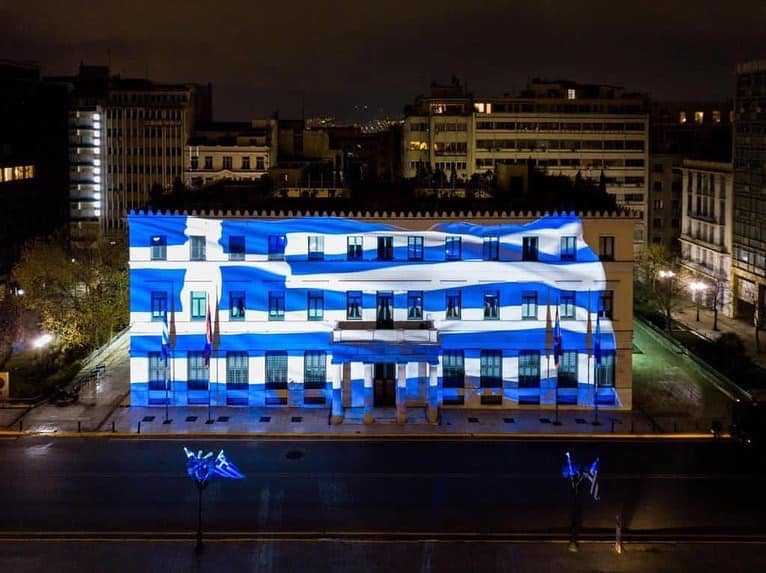
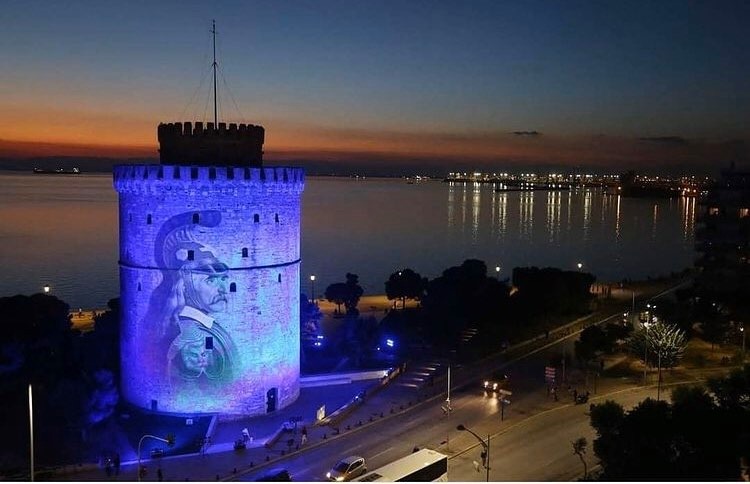
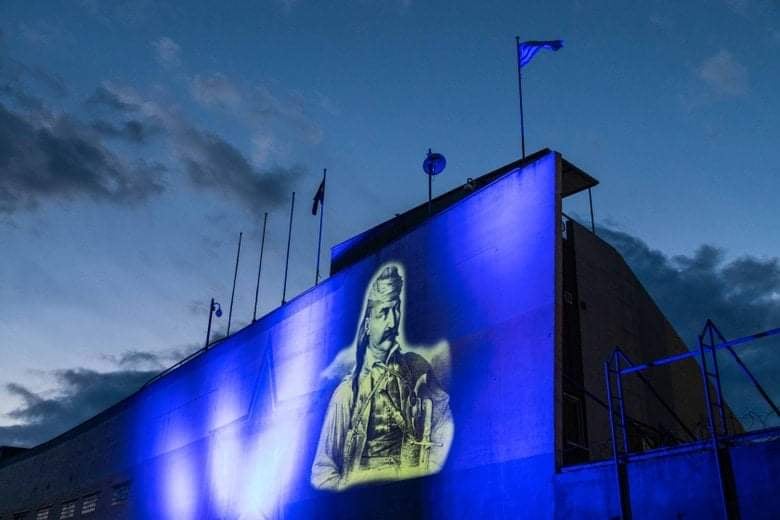
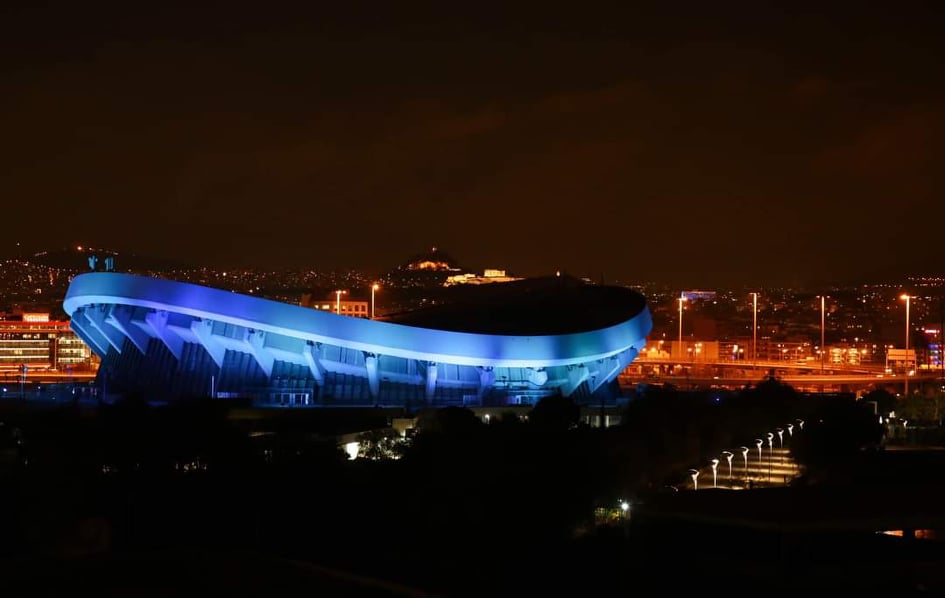
This comes as the Acropolis, Greek Parliament Building, the White Tower of Thessaloniki, the Theodoros Kolokotronis Stadium and the Peace and Friendship Stadium (SEF) have all been lit in blue and white to add to the celebrations.

March 25: A double celebration of Greek Independence Day and the Annunciation

March 25 has a special meaning to Greeks around the world as it is a double celebration of the Annunciation of the Theotokos (Virgin Mary) and Greek Independence Day. To mark the occasion, we take a look back at the history of this significant day.

The Annunciation of the Theotokos (Ευαγγελισμός της Θεοτόκου):

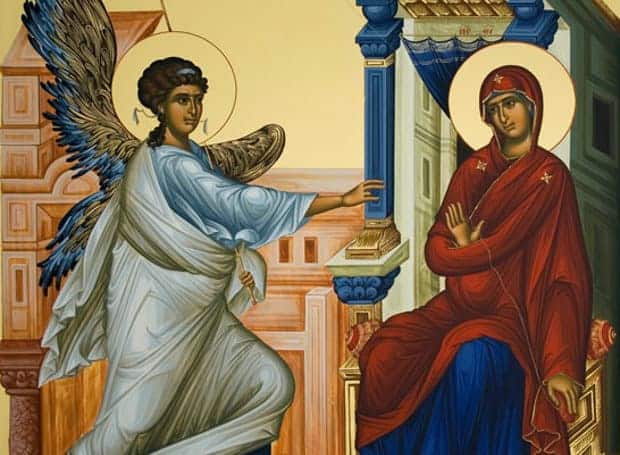
On March 25 every year, the religious event of the Annunciation of the Virgin Mary is celebrated. The day celebrates the moment when the Archangel Gabriel appeared to the Panagia and told her she would be the mother of Jesus, the Son of God.

On this day, anyone with the name Evan or Evangelia celebrate their name day.

The Annunciation of the Theotokos.

Greek Independence Day (Η Μέρα της Ανεξαρτησίας):

The Empire of Byzantium ended in 1453 when its capital, Constantinople (now called Istanbul), fell to the Ottomans. Since then, Greece was under Turkish Muslim rule and for the next 400 years, deprived of their human rights.

READ MORE: ‘Fight for Faith and Country’: The revolutionary declaration of Alexandros Ypsilantis.

Over the years, many attempts were made by the Greeks to gain their freedom, but they were unsuccessful. From the 18th century, Greeks living or studying abroad got more organised and dreamt of the liberation of the Greek people and the creation of the New Hellenic State.

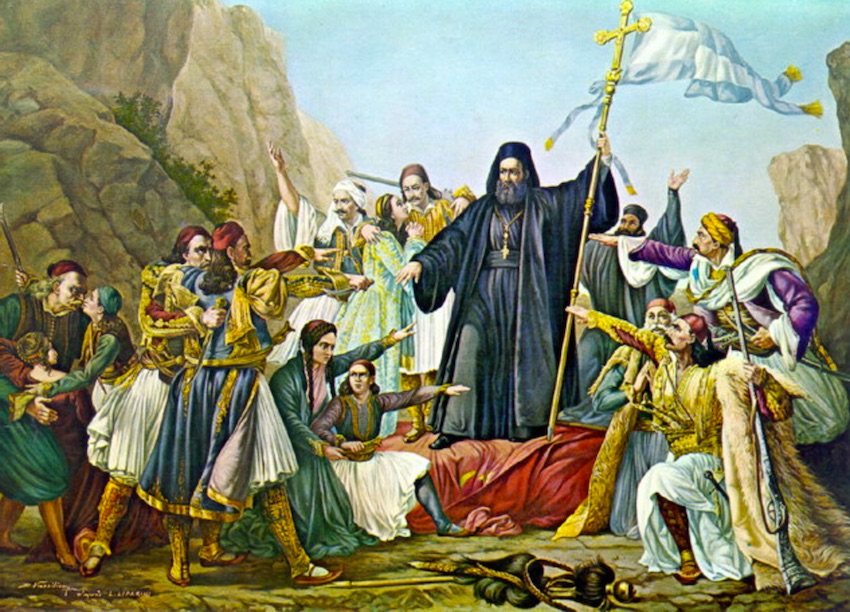
Finally, after 400 years under Turkish rule, on March 25, 1821, Bishop Paleon Patron Germanos raised the flag of the Greek Revolution at the Monastery of Agia Lavra.

Bishop Paleon Patron Germanos raised the flag of the Greek Revolution at the Monastery of Agia Lavra.

From that moment on until 1830, Greeks all over Greece started to fight for their freedom and were able to finally get rid of their conqueror.

How do Greeks celebrate March 25 today?

March 25 is an official public holiday in Greece and Cyprus.

In most Greek cities, it usually includes parades and other festive events. The main events are the military parade in Athens in the morning of March 25th, as well as many school parades all over the country.

It is also a tradition to gather with family and friends and eat fish. Since this day is also a religious celebration, and it always falls in the “fasting period” before the Easter celebration, most people will avoid eating meat. That’s why the traditional menu for March 25 is the so-called “bakaliaros skordalia.” It is fried cod accompanied by a strong garlic sauce. Delicious!

READ MORE: Bakaliaros Skordalia: The traditional dish of Greek Independence Day.

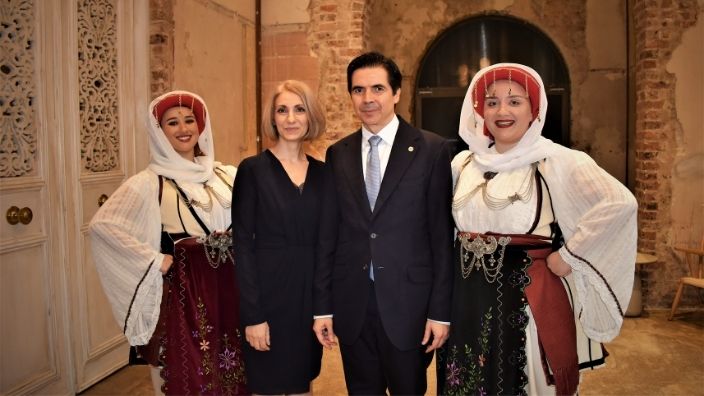
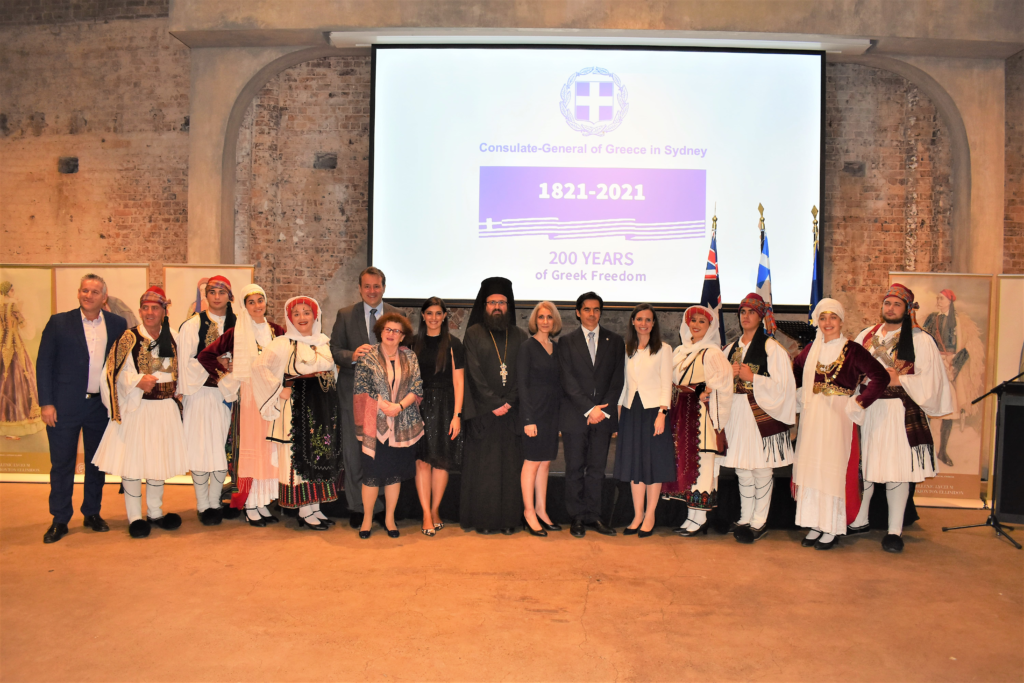
Greek consulate of Sydney commemorates 200th Anniversary of Greek Independence with reception

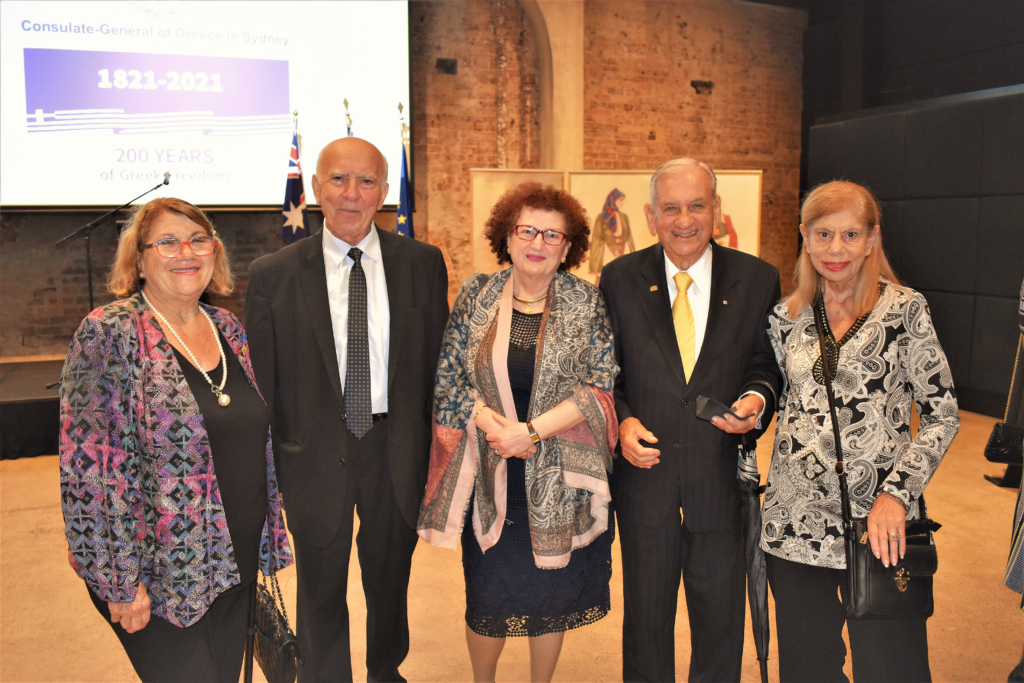
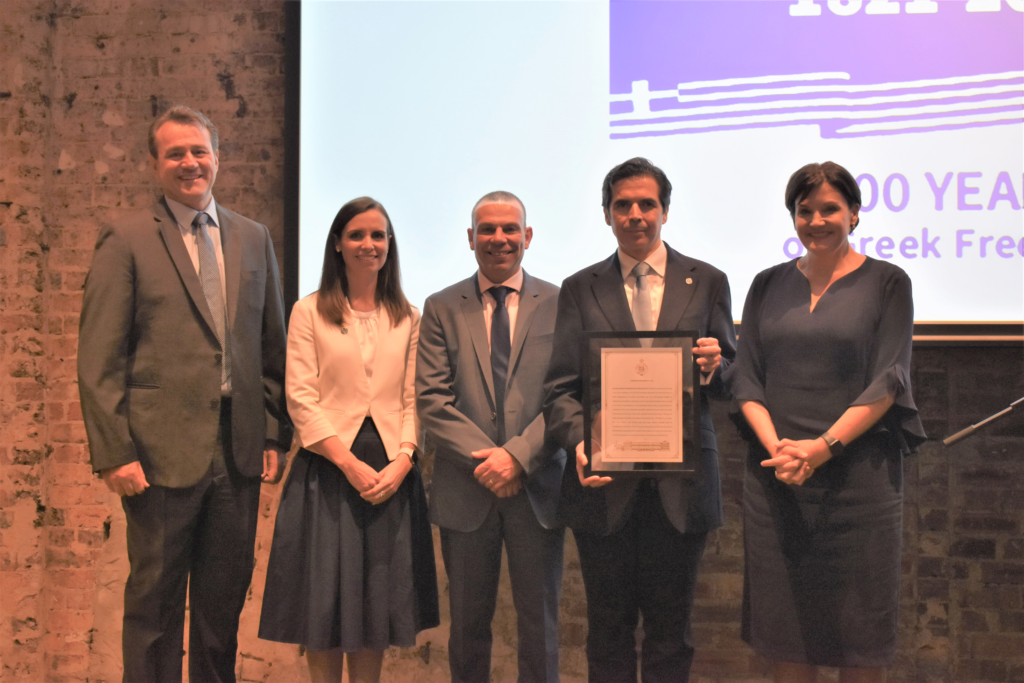
With a reception held at the Hellenic Club and hosted by the Consul General of Greece in Sydney, Christos Karras, in presence of 100 political, religious and community leaders the state’s Greek consulate commemorated the 200th Anniversary from the beginning of the Greek Revolution.

“For the Greek Diaspora here in Australia and living abroad, Greek Independence Day takes on a special meaning. It is a celebration commemorating the start of the Greek war of Independence and reminds us of what our ancestors fought and died for. The Greek bicentenary is a once in a lifetime event for Greeks in Australia and abroad,” said the MC for the night, Director of the Business Leaders Council at the Australian Chamber of Commerce and Industry, Paul Nicolaou.

Photo: The Greek Herald/Vasilis Vasilas

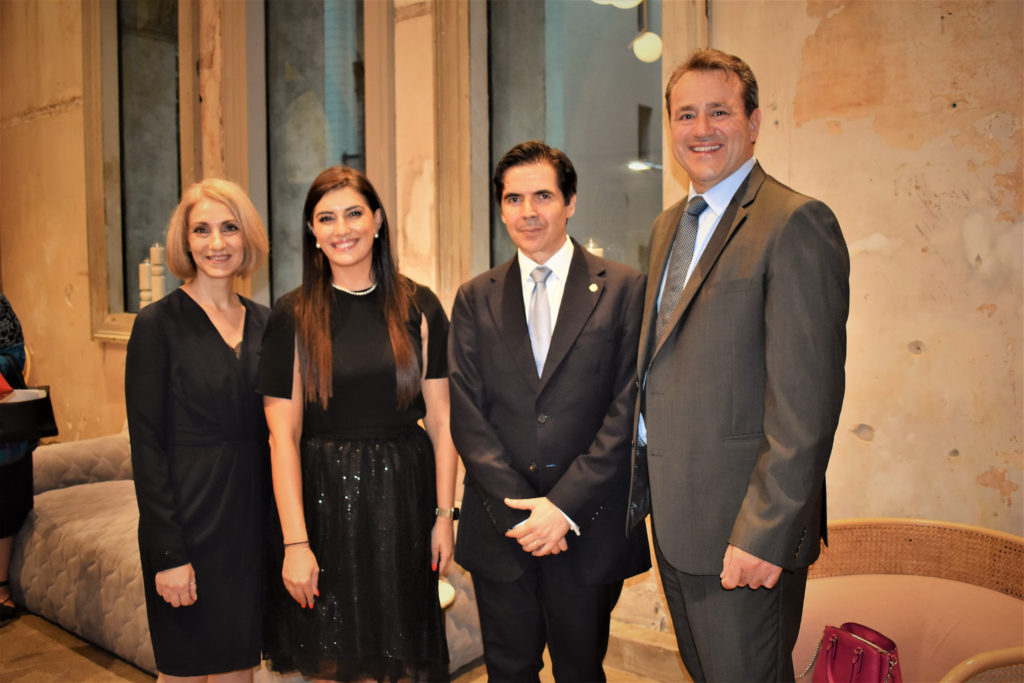
The list of distinguished guests included: Rev. Father Christophoros Krikelis representing His Emminence Archbishop of Australia Makarios, the Official Secretary to the Governor of NSW Colonel Michael Miller representing the Governor of NSW Margaret Beazley, Eleni Petinos member for Miranda representing the Premier Gladys Berejiklian and Minister for Multiculturalism Geof Lee, Jodi McKay member for Strathfield and Leader of the NSW opposition, the High Commission of Cyprus in Australia Martha Mavrommatis, City of Sydney Councillor Mr Robert Kok representing the Lord Mayor of Sydney, Mrs Clover Moore, Courtney Houssos MLC, Mark Buttigieg MLC, Steve Kamper MP, Consul Generals of consulates from at least 17 countries, Trade Commissioner Katia Gkikiza and representatives of the Greek Orthodox Community of NSW.

Photo: The Greek Herald/Vasilis Vasilas

“Today we are celebrating the 200th anniversary of the start of the Greek Revolution of 1821, the start of a long struggle, against the odds, which lead to the birth of the modern Greek state, in a region of course where Greeks had existed for thousands of years, speaking more or less the same beautiful language that we Greeks speak today, with the long polysyllabic words and the rich etymology,” Mr Karras said, explaining that the bicentenary anniversary is also an opportunity to celebrate the common bonds between Greece and Australia and the contribution of the Greek diaspora to Australia’s multicultural character. 

Photo: The Greek Herald/Vasilis Vasilas

In his speech, the Official Secretary to the Governor of NSW, Colonel Michael Miller, whose father fought in some of the battles that took place in Greece during WW2, referred to the Greek connection with NSW through their common resistance to the German occupation.

Member for Miranda Eleni Petinos, said that the NSW government is proud to join in the celebrations for the momentous occasion by lighting up the Opera House sails in blue and white colours on Thursday.

Photo: The Greek Herald/Vasilis Vasilas

“On Thursday the NSW Parliament will be suspending standing orders and will be moving a motion in bipartisan support of the 200th Anniversary and it gives me great pleasure to say that we will be doing this with Steve Kamper and Sophie Cotsis,” Ms Petinos said.

Addressing the attendees, Opposition Leader Jodi McKay read a speech that she recently gave at the Parliament of NSW.

Photo: The Greek Herald/Vasilis Vasilas

“We have our Greek members in Parliament but there are many of us who are not Greek, but are very proud to represent the Greek community, like I am,” she said and went to present the Consul General with the speech, on behalf of the Labor Party.

Photo: The Greek Herald/Vasilis Vasilas

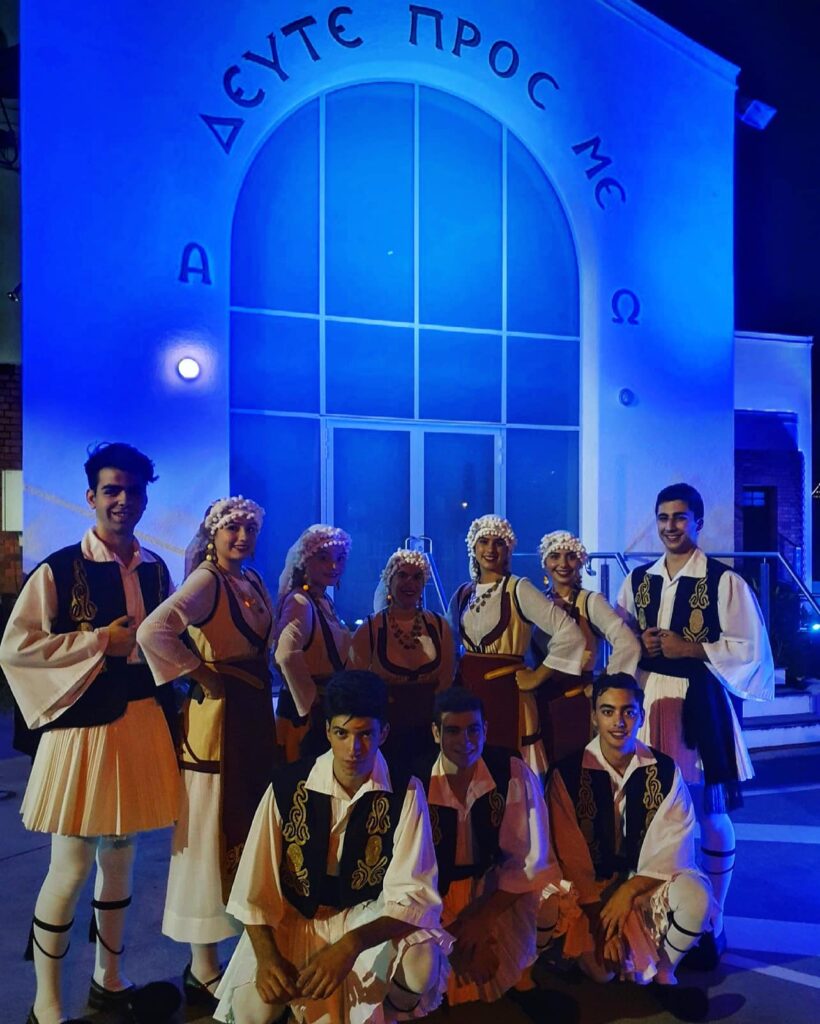
The evening continued with a speech from academic Vrasidas Karalis and the attendees were entertained with songs from the Hellenic Choir and traditional dances from the Hellenic Lyceum of Sydney.

Dr Panayota Nazou on the unsung heroines of the Greek War of Independence

0

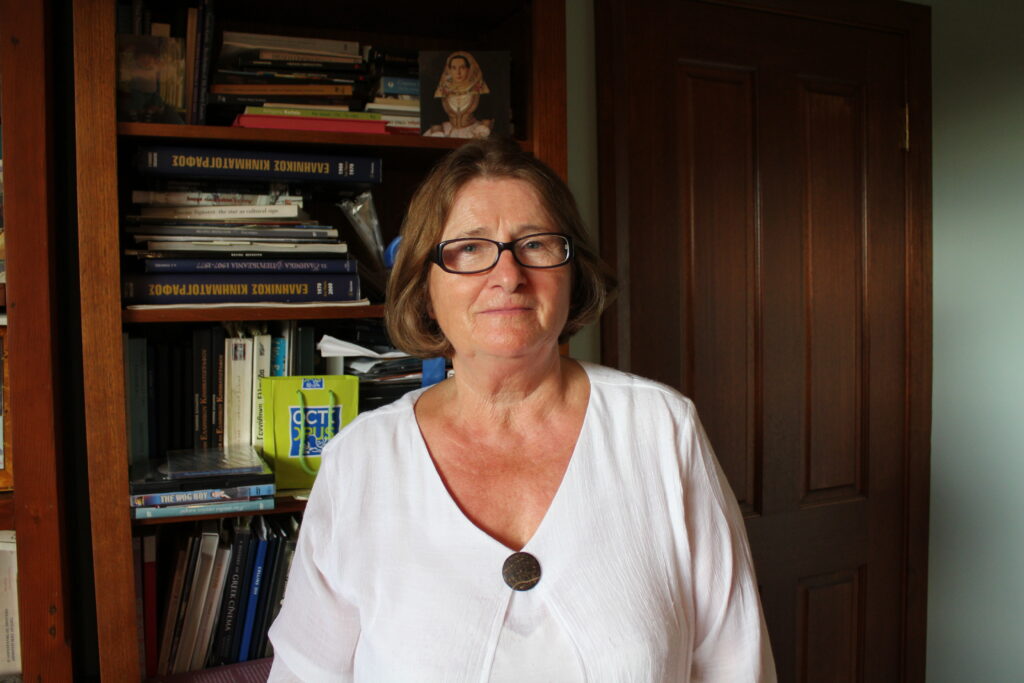
“Although we can’t support that women played the leading role in the Greek War of Independence, it would be very wrong to say that they didn’t make important contributions. In some cases, they contributed as much as men, and sometimes even more than men,” Dr Panayota Nazou tells The Greek Herald at the start of our insightful interview.

Most of us know something about Greek women contributing to the War of Independence, but not much. Luckily for Dr Nazou, when she conducted research for a lecture she gave to commemorate the bicentenary of the Greek Revolution titled Women of ’21, she was able to uncover much more detailed information.

The Affiliate Academic at the University of Sydney’s Department of Modern Greek and Byzantine Studies, says while it was difficult at first to find primary sources describing the role of Greek women during the 1821 Revolution, she never gave up and this persistence paid off in the end.

Dr Panayota Nazou. Photo: Andriana Simos.

“The main information on Greek women during the war came from folk songs, poems from Greek and non-Greek poets, travel texts, written pieces from Philhellenes, and also artworks,” Dr Nazou tells The Greek Herald.

“But of course, the main sources which brought these heroines to light were women. Educated women who, during the second half of the 19th century, were involved in Greece’s women’s movement and the education of women in Greece and began to publish periodicals and newspapers.”

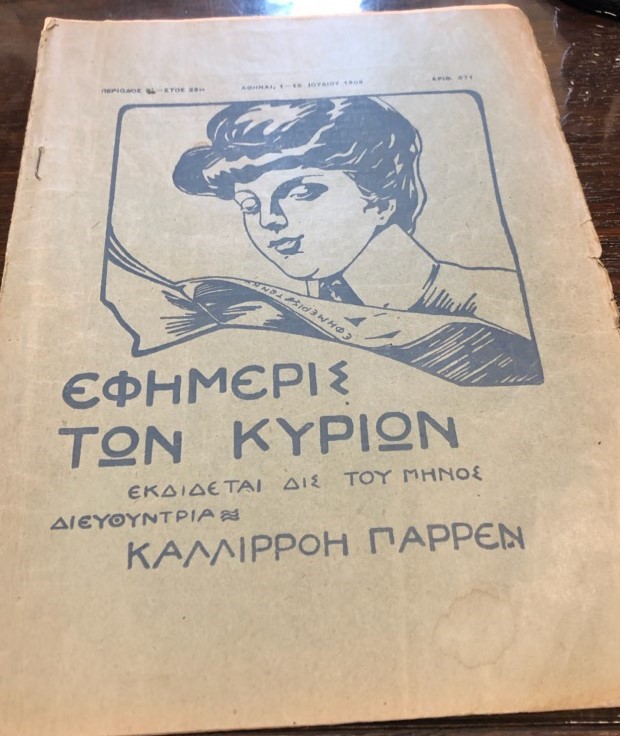
Callirrhoe Parren was one of these educated women who released the first Greek women’s newspaper, ‘Εφημερίς των Κυριών,’ in 1887. Several women wrote about the heroines of the Greek Revolution in this newspaper including Sotiria Aliberti, who released the first book in Greece titled ‘Heroines of the Greek Revolution’ in 1933. Another woman, Koula Xeradaki, also dedicated 50 years of her life to uncovering the role of Greek women during the Revolution and published her book ‘Women of 1821’ in 1995.

Callirrhoe Parren released the first Greek women’s newspaper, ‘Εφημερίς των Κυριών,’ in 1887.

“There were also some men who say something about women, but it’s kind of like a ‘by the way this happened as well.’ These dates show that we properly started to learn about the women’s role during the Greek Revolution quite late,” Dr Nazou says.

The Souliotisses were like ‘Spartan women’:

One group which appeared consistently in all of Dr Nazou’s research were the Souliotisses. The Souliotes were a ‘warlike people’ who were involved in two wars with Ali Pasha in 1792 and 1800 – 1804 and consequently, were said to inspire the actions of many women during the Greek Revolution in 1821.

“The Souliotisses were like Spartan women. They were trained to use weapons and during the war, they took up their armour,” Dr Nazou says.

In one account of the first war between the people of Souli and Ali Pasha’s army, this bravery became especially clear through the actions of the little-known Souliotisses, Moscho Tzavela and Haido Giannaki Sehou.

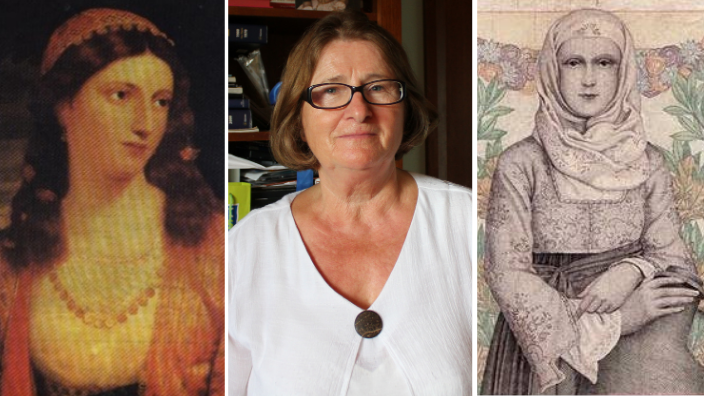
Moscho Tzavela (left) was a well-known Souliotissa.

“In the middle of the battle, the sounds of fighting stopped. The Souliotisses thought everyone had died so they charged the battleground, with Moscho at the front and Haido at the back, some carrying rocks and others carrying weapons. The men were given courage and together they slaughtered the Ottomans. About 2-3,000 Turks died that day and only 74 Souliotes,” Dr Nazou explains.

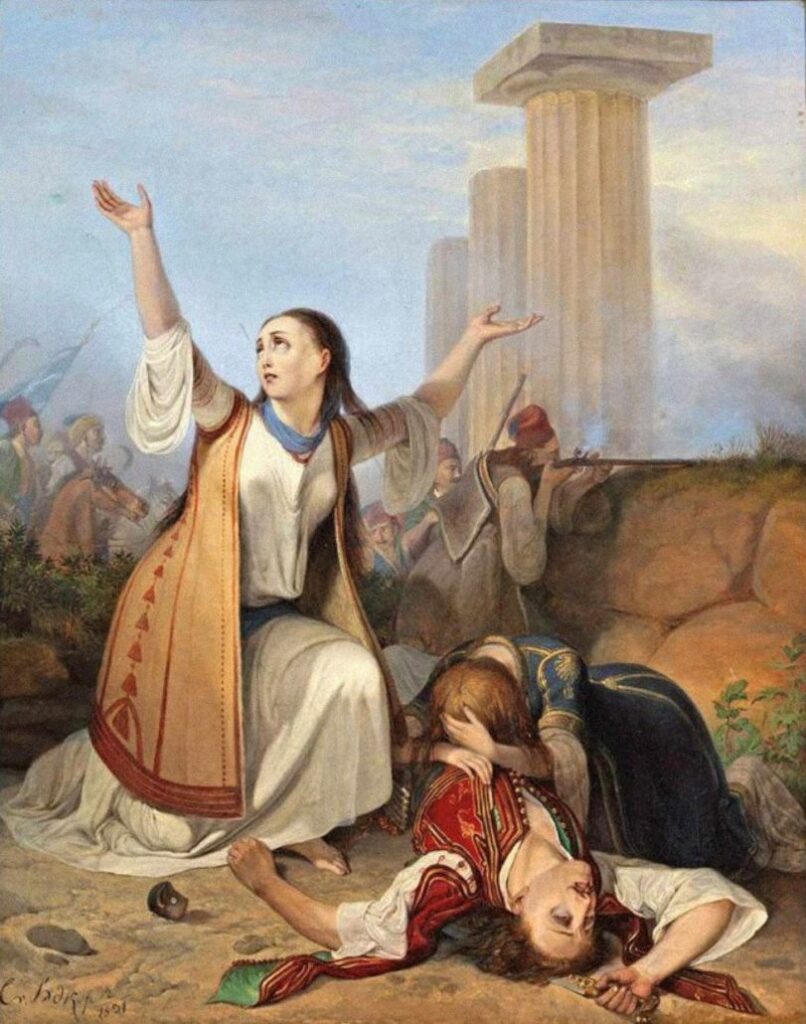
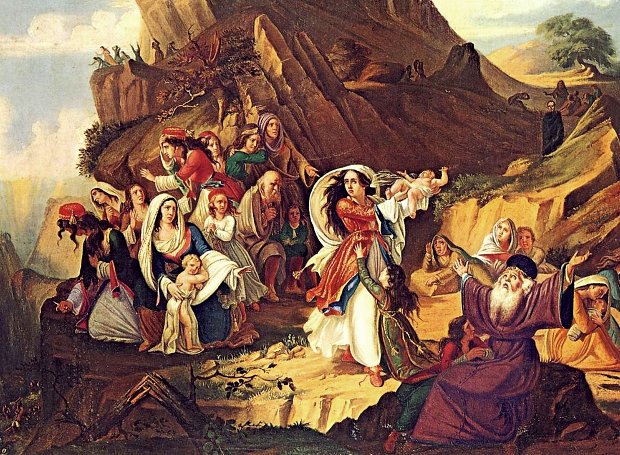
The heroic actions of the Souliotisses didn’t stop there. In fact, the ‘Dance of Zalongo,’ which the Souliotisses performed to avoid capture by the Ottomans in 1803, has also been immortalised in history by a Turkish writer, Ibrahim Manzour efenti, who was told the story by a Turkish army officer who witnessed the dance.

“Ibrahim wrote that the women held hands and danced as, one by one, they threw their children from the cliff of Zalongo before jumping after them themselves. So this event was written and heard throughout Europe and these women became a symbol of self-sacrifice for their country,” Dr Nazou says.

The Dance of Zalongo.

But interestingly, Dr Nazou adds that there are two other ‘Zalongos’ which are not as well documented.

“200 women and girls feel from a cliff at Riniasa (Souli) and we don’t even know much about it. There’s also a third instance in Naousa at the Falls of Arapitsa in 1822. These were all recorded in folk songs,” she says.

The Filiki Eteria and 1821 Greek Revolution:

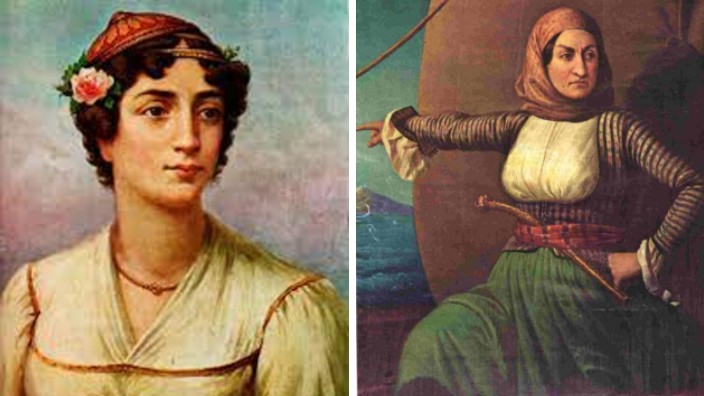
Just as well known as the Dance of Zalongo are two popular Greek heroines who fought in the 1821 Greek Revolution – Laskarina Bouboulina and Manto Mavrogenous. Both spent all their fortune for the Hellenic cause, with Bouboulina becoming a naval commander and Mavrogenous providing a number of ships for the war.

“These two are so well-known not only because they gave everything for the Greek Revolution, but because they were also personalities. They were rich women, they had power but also courage and determination. Other women didn’t have those advantages,” Dr Nazou says.

Manto Mavrogenous (left) and Laskarina Bouboulina (right).

One such woman was Panoria Xatzikonstanti the Psorokostaina. According to folk tradition, Panoria was the wife of a merchant from Asia Minor (Kydonies). One day, the Ottomans killed her husband and took her four children, but she escaped and went to Nafplio, where she became a beggar.

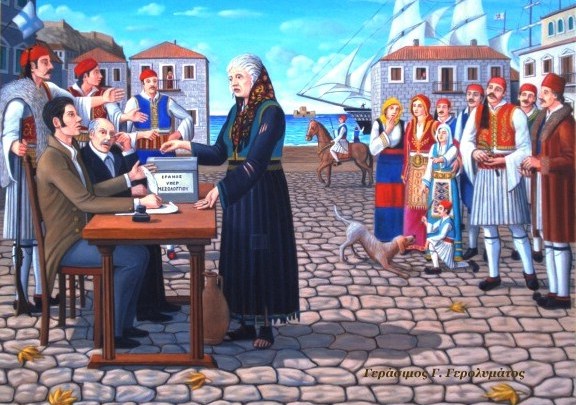
“With the money she collected from begging, she would feed and care for the orphans from the war in the Peloponnese. When Ioannis Kapodistrias arrived in Greece, he quickly built an orphanage and ‘Psorokostaina’ asked him if she could work there, without being paid, to take care of the orphans,” Dr Nazou explains.

“She gave whatever was most valuable to her, her love and care, as well as her silver wedding ring, for these orphans and for the liberation of Greece.”

Panoria Xatzikonstanti the Psorokostaina also gave away her wedding ring.

And she wasn’t the only one. Dr Nazou lists a number of other well-known, rich Phanariot women and unknown Greek women, such as Elizabeth Ypsilantis and Magiro Zarafopoula, who were members of the Filiki Eteria – a secret organisation which was tasked with overthrowing Ottoman rule of Greece and establishing an independent Greek state.

“These women contributed in many ways, such as organising secret meetings for members of the Filiki Eteria, organising fundraising appeals and also distributing secret and official documents to members. It was a very dangerous and important role,” Dr Nazou concludes.

Important enough for these women to be memoralised in our article as a means of celebrating their leadership, courage and determination during the Greek War of Independence.