Home Blog Page 1647

NUGAS and GCM lectures celebrate anniversary of the Greek War of Independence

Yianni Cartledge will present a two-part series of lectures entitled “Greek War of Independence (1821-1832): Between history and ‘mythistory” as part of the Greek History and Culture Seminars offered by the Greek Community of Melbourne and in collaboration with National Union of Greek-Australian Students (NUGAS). The first part will be presented on Thursday 18 February 2021 at 7.00pm.

This two-part series looks at the Greek War of Independence from a range of critical perspectives. Part I examines the relevant background knowledge of the Revolution, establishing Greece and the Greek people’s place in the Ottoman Empire, Europe and the world during the eighteenth and early-nineteenth centuries. These include important periods, such as the Modern Greek Enlightenment, as well as the rise of revolutionary ideas and nationalism in the Balkans. The question of ‘who is a Greek’ is also unravelled, helping contextualise the beginnings of the Uprising. Part I then explores the beginnings of the Revolution and the initial outbreak.

Part II will then deal with the War of Independence itself, including, but not limited to, the massacres, the civil war, the Egyptian invasion and Navarino. It will then cap the study off with the aftermath of the war and its modern legacy. Although much is covered, this series hopes to provide a diverse range of perspectives, ideas and meanings, and to help build a constructive discussion of the War on its 200th anniversary.

Yianni Cartledge is a candidate for PhD at Flinders University, South Australia. Having a passion for Greek, Ottoman, British and Australian histories, as well as migration and diaspora histories, his current project aims to combine all these areas. The thesis, titled ‘Aegean Islander Migration to the United Kingdom and Australia, 1815-1945: Emigration, Settlement, Community Building and Integration’, will investigate the cases of the Chiots of London and Ikarians of South Australia.

His 2018 honours thesis explored the 1822 Chios Massacre under the Ottoman Empire and the ways in which it affected British attitudes towards the Greeks, leading to Christian-humanitarian intervention. An article deriving from his thesis, titled ‘The Chios Massacre (1822) and early British Christian-humanitarianism’, was published in February 2020 in Historical Research. He recently published a biographical entry of South Australian fisherman and seafood merchant George Angelakis in the Australian Dictionary of Biography.
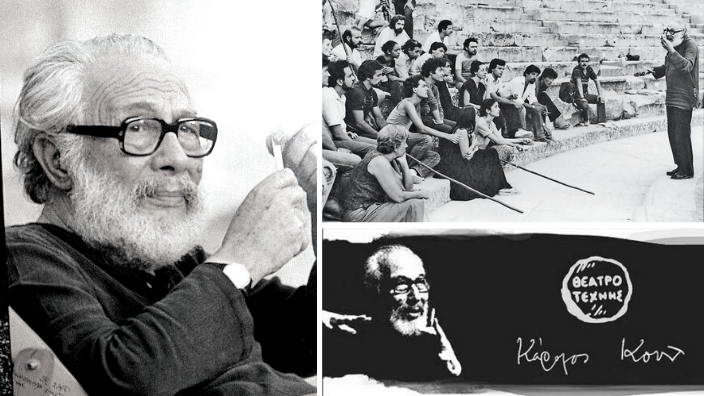
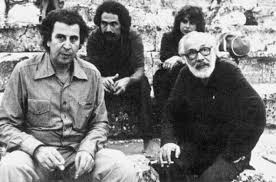
On This Day: Greek theatre director, Karolos Koun, dies

Karolos Koun was a Greek theater director. His real name was Karolos Koen and he was born in Bursa in 1908.

He completed his secondary education at Robert College in Istanbul and later studied aesthetics at University of Sorbonne. In 1929, he became a professor of English language at the College of Athens.

Along with his students at the college, he staged many works of Aristophanes (including The Birds, The Frogs, Cyclops and Plutus) and Shakespeare (A Midsummer’s Night Dream). He founded the People’s Theatre in 1934 and collaborated with various troupes.

In 1942, he founded the Art Theatre, where he staged works by Ibsen, George Bernard Shaw, Pirandello, and for the first time in Greece after the liberation from the German Occupation, Lorca, Tennessee Willilams, Arthur Miller, etc. In the same year, he also founded the Drama School at his theatre, in which studied some of the most important directors and actors of the post-war Greek generation.

Due to financial difficulties, the Art Theatre had to close down in 1949, and reopened in 1954 in the form of a theatre in the round.

Between 1950 and 1953, Koun collaborated with the National Theatre, directing works by Anton Chekhov (Uncle Vanya, The Three Sisters), Pirandello (Henry IV), etc.

After the reopening of the Art Theatre, Koun also decided to introduce the new trends of the foreign post-war theatre to the Greek audience, including Brecht, Ionesco, Beckett, Pinter and Dario Fo. He also staged the work of Greek authors, like Kampanellis, Kechaedes, Skourti, Anagnostakis and Efthimiadis, as well as the classic works of the Ancient Greek tragedians and Aristophanes.

In 1959, he staged Aristophanes’ The Birds at his theatre, causing a lot of controversy due to the progressive form in which it was presented. He later staged ancient drama in various festivals, such as in Athens and Epidavros, and later participated in the “Theatre of Nations”, staging plays in Paris, London, Zurich, Munich, Moscow, Leningrad, Warsaw, and Venice.

In 1984, the Greek government offered a lot in Plaka, in order to inaugurate the Karolos Koun Theatre.

He received various awards, including the Phoenix, the Silver Award of the Academy of Athens, and the Award of the Theatre of Nations.

Koun died at the age of 78 on February 14, 1987.

In his will, he bequeathed the title Art Theatre to three of his colleagues, asking them to continue their collaboration at the Karolos Koun Art Theatre.

Traditional Greek Recipes: Kariokes (Chocolate Walnut Cakes)

Soft and with an unexpected crunchy bite, these delicious treats are very popular among chocolate lovers all year round.

Best part? They’re simple to make and no baking is required!

Ingredients

  • 100 g walnuts 
  • 220 g tea biscuits 
  • 120 g butter 
  • 1 teaspoon(s) vanilla extract
  • 150 g sweetened condensed milk 
  • 10 g brandy 
  • 15 g cocoa powder 
  • 350 g chocolate couverture, melted 
  • 1 tablespoon(s) honey 
  • 1 level teaspoon(s) cinnamon

Method

  • In a saucepan, add the butter and melt over medium heat.
  • In a food processor, add the cookies and walnuts.
  • Beat to break them up into pieces but you don’t want to finely ground them.
  • Transfer the mixture to a bowl and add the melted butter along with the sweetened condensed milk, ground cinnamon, cocoa powder, cognac, vanilla extract and honey.
  • Mix with a wooden spoon until all of the ingredients are completely combined.
  • Press down on the mixture with your hands to make it more compact and place it in a sheet of plastic wrap.
  • Roll it with your hands so it takes on the shape of a salami and wrap in the plastic wrap.
  • Lay out another 2 sheets of plastic wrap making sure they are touching each other and place the carioca roll on it.
  • Wrap it in the plastic wrap very tightly.
  • Refrigerate for 2-3 hours to chill or in the freezer for 1 hour.
  • When ready, remove the plastic coverings and cut into 1 cm slices.
  • Pick up each slice with a fork or a pair of tongs and dip it into the melted couverture.
  • Place on a sheet of parchment paper.
  • When the karioka is chilled, the couverture will harden but you can refrigerate again.
  • Wrap in aluminum foil and serve.

Kali Epitichia!

*Looking for another delicious Greek traditional recipe? Check out this easy to make Portokalopita (Greek Orange Phyllo Cake)

Greek tennis player, Michalis Pervolarakis, tests positive for COVID-19

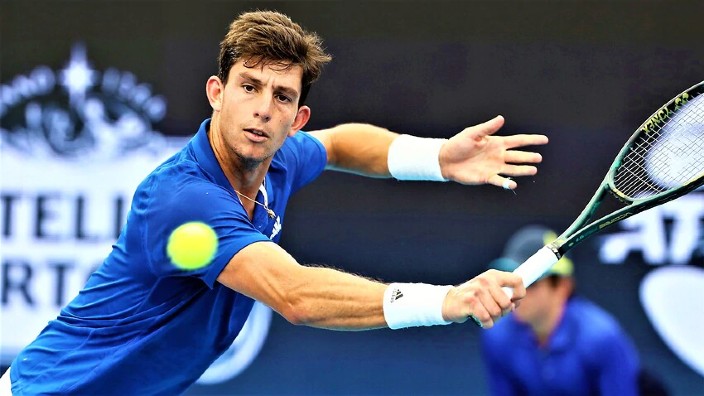
Greece ATP Cup player, Michalis Pervolarakis, has revealed he’s tested positive for COVID-19 after travelling from Australia to South Africa.

“I am being patient for this to pass… I am feeling well and I have no symptoms,” Pervolarakis told The Greek Herald, adding that the plan is to go to Cyprus after his quarantine period is finished.

Pervolarakis lost both of his singles matches last week against Australia’s John Millman and Spaniard Pablo Carreno Busta at Melbourne Park. His last match was on Friday last week against Spain.

Tennis Australia confirmed to the Herald Sun that the 24-year-old tested negative for the coronavirus on Tuesday, February 9, when he flew out of Melbourne.

It’s unclear exactly when the 24-year-old left Melbourne, but he first broke the coronavirus news on his personal Instagram account.

Pervolarakis first broke the coronavirus news on his personal Instagram account.

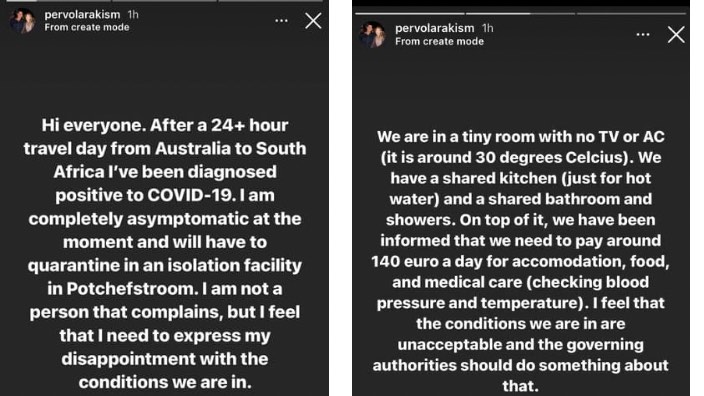
“After a 24-plus hour travel day from Australia to South Africa I’ve been diagnosed positive to COVID-19,” Pervolarakis posted.

“I am completely asymptomatic at the moment and will have to quarantine in an isolation facility in Potchefstroom.

“I am not a person that complains, but I feel that I need to express my disappointment with the conditions we are in.”

Pervolarakis’s teammates in the ATP Cup last week were world No. 6 Stefanos Tsitsipas – who is into the last 16 at the Australian Open – Petros Tsitsipas and Markos Kalovelonis.

Pervolarakis is ranked 461 in the world in singles and did not compete in the Australian Open.

Tennis Australia has been contacted for comment, the Herald Sun says.

Source: Herald Sun.

Kyrgios and Kokkinakis combine to conquer Australian Open doubles opponents

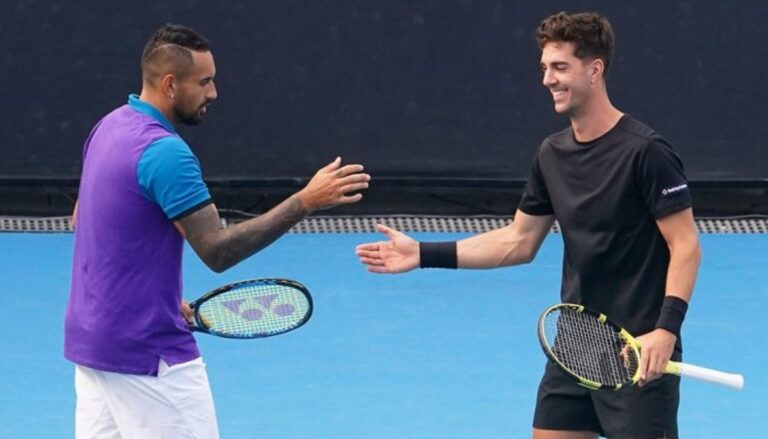
The iconic Aussie duo of Thanasi Kokkinakis and Nick Kyrgios combined to take on Lloyd Harris and Julian Knowle, winning in straight sets 6-2 6-4.

A quiet arena isn’t normally what Kyrgios and Kokkinakis would prefer to play under, but as the state went into stage-four lockdown, the pair had no choice. Nevertheless, the two performed very strong together.

It didn’t help the two Australians coming in late to the match, receiving a code violation and disappointing looks from the umpire.

Despite this, they came out swinging. Kokkinakis and Kyrgios were helped by a poor service start from Harris and Knowle, who at the end of the first set had 6 double faults.

Gaining a double break point lead, it was a clear road to a first set victory. The first set wasn’t without a few trademark style shots from Kyrgios, who got to show them again after a disappointing exit to Dominic Thiem last night.

As the two entered the second set, their Austrian and South African opponents came in just as hard. The two pressured the Australians, but again were no match for the expert returns delivered by Kyrgios.

Kokkinakis and Kyrgios managed to claim a break point, holding their lead until the end of the second set. The Greek Australians wrapped the match up after only 62 minutes, winning 6-2 6-4.

Call for Greek-Australian community to evaluate dementia films

The first generation of Greek Australians is ageing, and concurrently dementia rates are increasing.  Currently there are 447,115 Australians living with dementia and this number is expected to surpass 1 million by 2058.

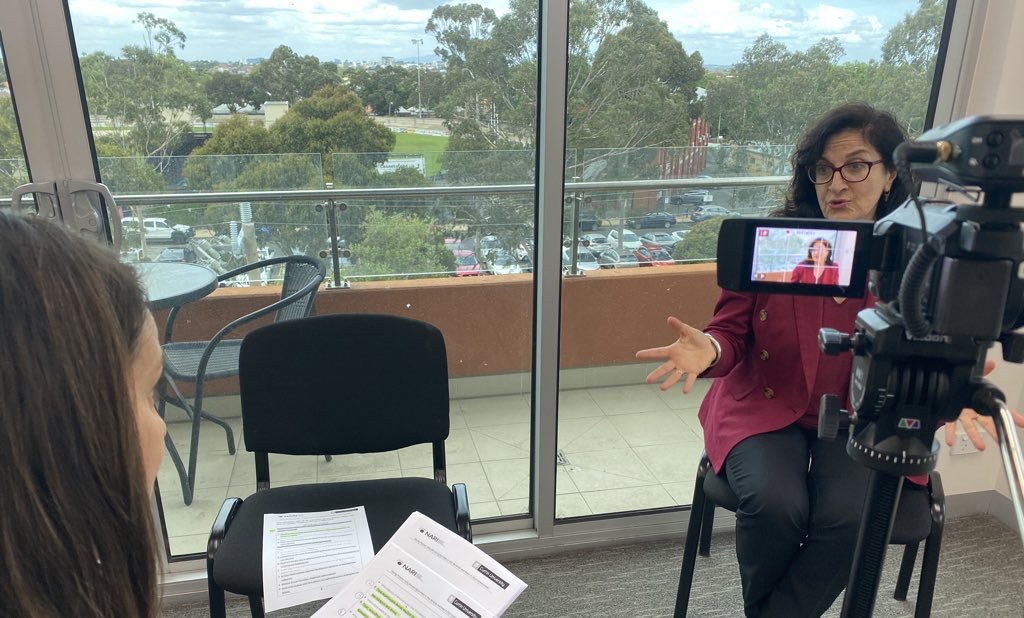
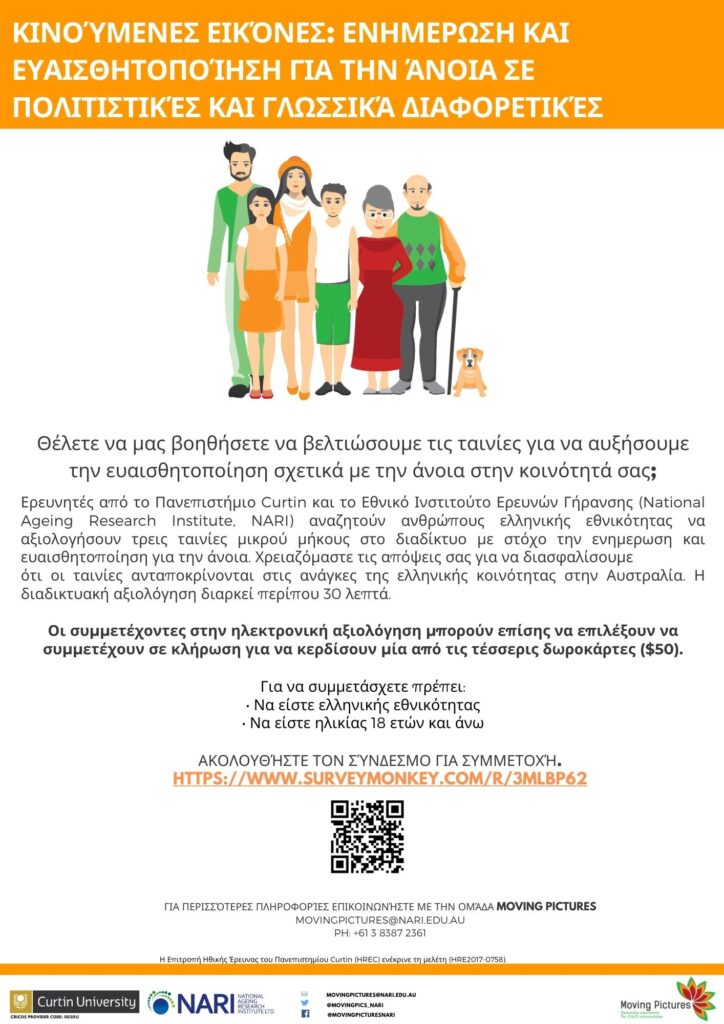
National Ageing Research Institute (NARI) is calling for assistance from the Greek-Australian community to evaluate three new Greek-language short films about dementia.

The films, developed by NARI’s Moving Pictures project, look to inform the first generation Greek-Australians on the first steps of the process of diagnosis.

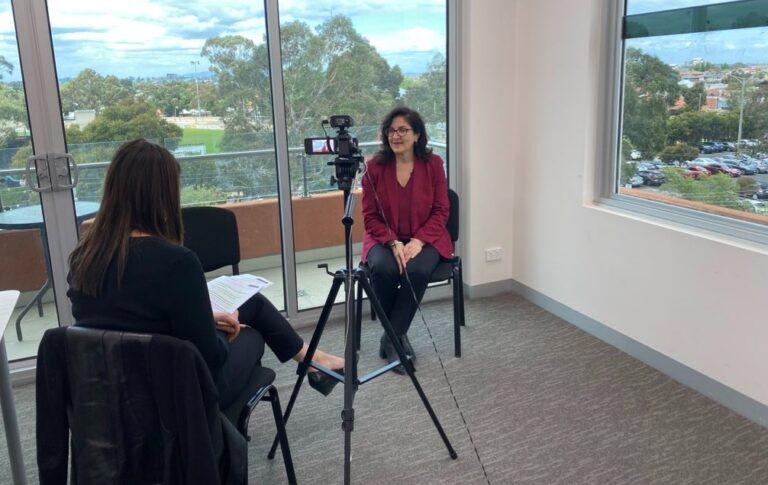
“Dementia is a massive issue in the general community and but also in CALD communities. So when I say CALD, I refer to culturally and linguistically diverse communities… Unfortunately, CALD communities frequently receive a diagnosis late, seek out services late, and those things really lead to poor prognosis,” Dr Josefine Antoniades, the Moving Pictures Project Manager, said to The Greek Herald.

“A lot of the resources that are available for CALD communities and the Greek community. Although the Greek community is very well served, (resources) are often really disjointed and hard to find.”

Photo: Supplied

“So we wanted to try and address this issue by working with local communities.”

Moving Pictures have already developed films for five different multicultural communities, including the Italian, Spanish and Vietnamese communities, looking to add five more to the roster. While other dementia-information films are already available, as Dr Antoniades said, what distinguishes Moving Pictures is the fact that they interview the carers of people living with dementia and service providers in-language.

“So the films are actually the carers talking about their experience, the service providers talking about their experiences and also some general advice,” Dr Antoniades said.

“It serves two purposes: To normalise it, and it provides some really heartfelt stories, so people can really connect with these films.”

The first film, Detection and Diagnosis, observes the moments where dementia is noticed and how it is managed by the patient. The second film then focuses on what the patients did when they realised there was a problem. The final film, the Carer Journey, explores the role and health of the carer.

“What we noticed in the interviews is that carers are not very good at taking care of themselves,” Dr Antoniades explained.

“So they’ll put their loved ones first and they tend to forget about themselves because they get so busy with taking care of someone else that they just forget about themselves.

“So in that particular film, we sort of focus on the carer and saying that it’s really important to take care of yourself. There are services available. Some communities are better than others to have uptake of those services, but it’s also a matter of availability.”

In the past, Moving Pictures has gone out and screened it with community groups to get instant feedback. Due to the pandemic, this is no longer possible.

“This time around we’ve decided to run it online and so our evaluation covers a few questions before and after, to gain information around whether people actually learn anything from the films and if they change their attitudes based on the films.

“Because there can be some stigma around it, often based around misconceptions of what dementia might be.”

The films will be free to watch online, with Dr Antoniades saying they only wish to raise awareness of dementia and ensure people obtain health equity.

Below are links to the evaluation:

Facebook: https://fb.watch/3nc4UMU3ef/
Direct to evaluation in ENGLISH
Direct to evaluation in GREEK  

Stefanos Tsitsipas dominates Mikael Ymer in straight sets to fly through Australian Open

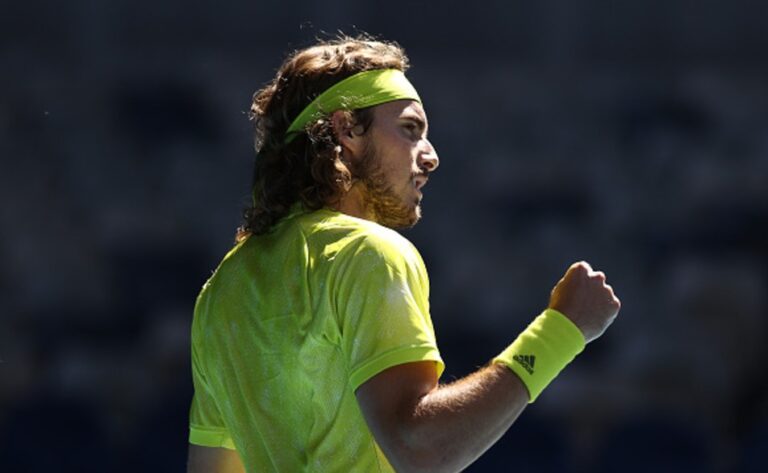
Fifth seed Stefanos Tsitsipas has taken a convincing victory against Swedish tennis professional Mikael Ymer, winning in straight sets 6-4 6-1 6-2.

Silence filled the Melbourne Arena as the two faced each other on the hard court, footsteps echoing to the empty ceiling. The players were often pitted against each other as juniors, with Tsitsipas describing Ymer as “someone I’ve known since he was a baby.”

Strong serves by Tsitsipas showed early positive signs for the Greek. More experienced in a grand slam setting, Tsitsipas clearly had the advantage with regards to his strategic ball placement. Ymer rarely had a chance to try and gain a break point.

Photo: Getty Images

Meanwhile, Tsitsipas punished the Swede for every soft shot. The Greek had multiple opportunities for a break point early on, but Ymer managed to claim his points until his penultimate service game, where Tsitsipas blistered the balls and made it extremely difficult for the Swede. Tsitsipas took the first set 6-4.

Ymer came into the next set with some more intensity, finally using his strong forearm to his advantage. Despite pushing him to a deuce in Tsitsipas’ first service game, Ymer didn’t carry that strength into the following games.

The Greek managed to take two break points to clean up the second set 6-1.

While the Greek managed to take an immediate break point in the start of the third set, Ymer shocked Tsitsipas to take the following game and keep the two players at a level competition.

This didn’t last for long, however, with Tsitsipas getting back on his feet and claiming a return break point. The Greek continued this hot-streak to the end of the set, winning the match 6-4 6-1 6-2.

Compliments need to be given to the 5th seed player, who showed no signs of fault throughout the course of the match. The Greek kept calm and composed after every set win, treating every game as important as the last.

“I see every day as an opportunity to get closer to winning a slam,” Tsitsipas said in a post-match interview.

On this day in 1899, Greek businessman Andreas Syngros died aged 68

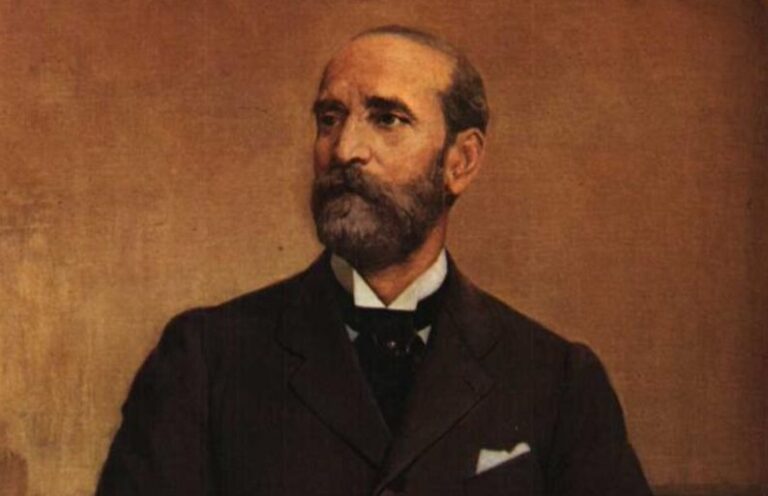
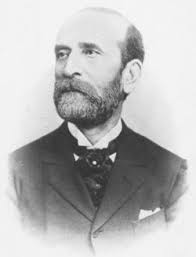
One of the important personalities of Greece in the 19th century, Andreas Syngros was considered the most powerful man of his time, after King George I .

Andreas was born in the Stavrodromi (Pera) district of Istanbul on October 12, 1830. He studied at the famous school of Theophilos Kairis in Andros, later completing his studies in Ermoupolis of Syros in 1845.

Immediately after graduation he started working as an apprentice in the shop of the merchant Theodoros Rodokanakis in Ermoupolis. He quickly rose through the ranks and in 1849 became the manager of the newly formed company ‘Vouros, Damianos and Sia‘, which imported and exported products from the Ottoman Empire.

In 1863, he began to engage in banking and quickly formed a respectable fortune. His business almost went bankrupt in 1871 due to the economic crisis caused by the Franco-Prussian War of 1870-1871 and the sharp fall of Turkish bonds.

With a series of risky stock market manoeuvres, Syngros saved a large part of his fortune and together with Georgios Koronios, Stefanos Skouloudis and Antonios Vlastos, founded the Istanbul Bank.

In 1872, he returned to Athens and, together with Ioannis Skaltsounis, founded the General Credit Bank. After the integration of Thessaly and part of Epirus, Syngros together with other capitalists founded the Bank of Epirus. This merged only two years later with the National Bank of Greece.

Syngros left a mark on his name for his extremely generous charitable work, with his donations totally an estimated 5,000,000 drachmas. For his philanthropic work he was honoured with the highest medals of the Ottoman Empire and the Kingdom of Greece.

Andreas Syggros died in the early morning hours of February 13, 1899 from a heart attack. 

“Such a crowd never accompanied the dead in modern Greece, but never has modern Greece ever had such a large funeral to bury, because ‘such men’ as one author very aptly said are not just individuals, but ‘are humanity in the slightest’!” wrote a newspaper the day after his funeral.

Sourced By: San Simera

Insight or Perspective: A solution for the continuation of Modern Greek Studies in Sydney

By Eleni Elefterias

On Tuesday 9th February it was International Greek Language Day.

So who is celebrating? Hardly anyone!

At least not in Greece at the moment due to Covid and definitely not in Australia. With an origin of more than 3.500 years old, it is one of the oldest continuing languages on earth, Chinese being the other.

In this, the 200th year since the beginning of the War of Independence, maybe this day should have been added to the Calendar of the Greek Festival of Sydney. An opportunity lost. 

But where do our major organisations stand as far as our Universities are concerned? 

All modern languages, and especially Community languages are suffering in Australia. Numbers are down compared with 20 years ago. One big problem is the Australian government’s complete disregard for the importance of languages study.

Unlike our counterparts in Europe where three languages are compulsory, our students get a small taste of a language in primary school of only 100 hours. Lack of funding for languages at University level is therefore one important issue.

Because of this, another issue affecting Modern Greek study is that it is not centralised in one university but offered at three different universities. This means that any funding via benefactors, fundraisers or government sponsorship is divided into three.

Since there are not the students there once were, surely they would consider amalgamation to create one large department. This would only strengthen the position of Modern Greek languages study. 

Off the grapevine, I have recently heard that the Greek Archdiocese is planning to create a big Theological Institute that will also teach Classical and Modern Greek.

At first, and if this is true, it sounds like a great idea. However, as far as Modern Greek is concerned it further withers away the numbers from our current universities.

Wouldn’t it be better to integrate their language learning course with that of one of the major Modern Greek Departments such as that of Sydney University?

It seems obvious and we can only hope that there is some cooperation between the two. 

More, in next week’s column.

READ MORE: Insight or Perspective: What should the Associations be doing to help Modern Greek?

*Eleni Elefterias-Kostakidis is a teacher of Modern Greek and University lecturer. 

This image has an empty alt attribute; its file name is Untitled-2020-11-15T185819.367.jpg

Read Eleni Elefterias’ column ‘Insight or Perspective’ in Greek, every Saturday in The Greek Herald’s print edition or get your subscription here.


Victorian florists scramble as Valentine’s Day turns to shambles

Florists in Victoria are scrambling to figure out how to deal with extra stock as the state enters a stage-four five-day lockdown.

Valentine’s Day, along with the day prior, is one of the busiest times of the year for florists. Hundreds of people typically seen lining up to buy roses or other flowers for their significant other.

February 13, 2021; Silence. Streets are empty as florists sit wondering how to sell their fresh stock of flowers.

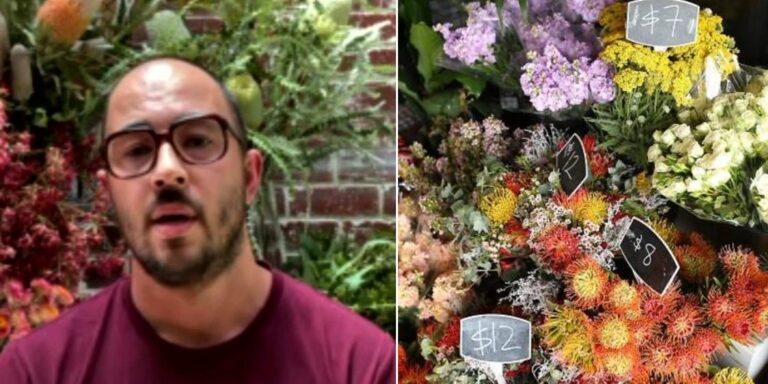
“We’re just in a state of shock and disbelief. The timing couldn’t be any worse,” Florist Michael Pavlou, who has two stores in Melbourne, said to ABC News.

Azalea florist owner Michael Pavlou. Photo: South Melbourne Markets

“We’re holding so much perishable stock, it’s potentially shattering for a lot of Victorian small businesses. We’re holding so much value of red roses and perishable items. If they don’t find homes, it will put us back years.”

He said he hoped to be able to sell some of his stock online.

“Valentine’s Day, it’s a big thing. People are working on it for at least a month out, we have been ready, preparing all of our arrangements for a couple of days. A team of 10 people every day,” he said.

“So, it’s not just the loss of the goods, it’s the labour that’s already been invested. You can’t recover that and I am concerned for a lot of my friends who might not survive this,” he said.