A well-known Greek stage actor and director has been arrested on rape charges, police say.
Dimitris Lignadis, 56, turned himself in Saturday afternoon at Athens police headquarters, Greek Police spokesman, Theodoros Chronopoulos, told the Associated Press.
On Sunday, Lignadis appeared before a court in Athens and was given until Wednesday to respond to charges of multiple rapes by an examining magistrate. He will remain jailed until then, court authorities said.
The magistrate and a prosecutor will jointly decide later whether he will be kept in jail or released pending his trial.
According to court sources, Lignadis is accused of rape by two men who were minors when the events occurred in 2010 and 2015. He has denied any wrongdoing.
Rumors of his alleged sexual misconduct swelled in recent weeks, leading to Lignadis’ resignation two weeks ago as Artistic Director of Greece’s National Theater, a post he had held since 2019.
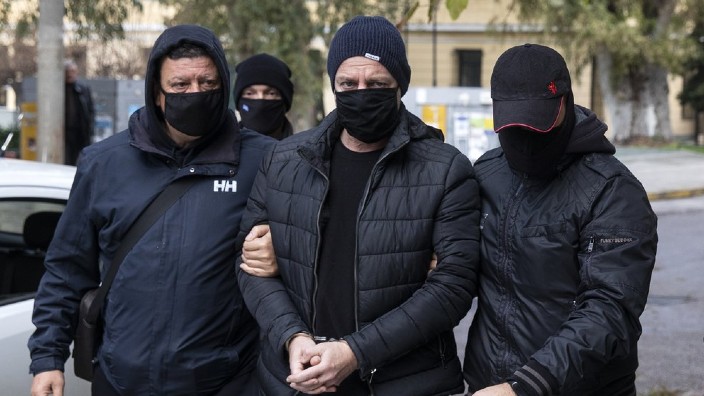
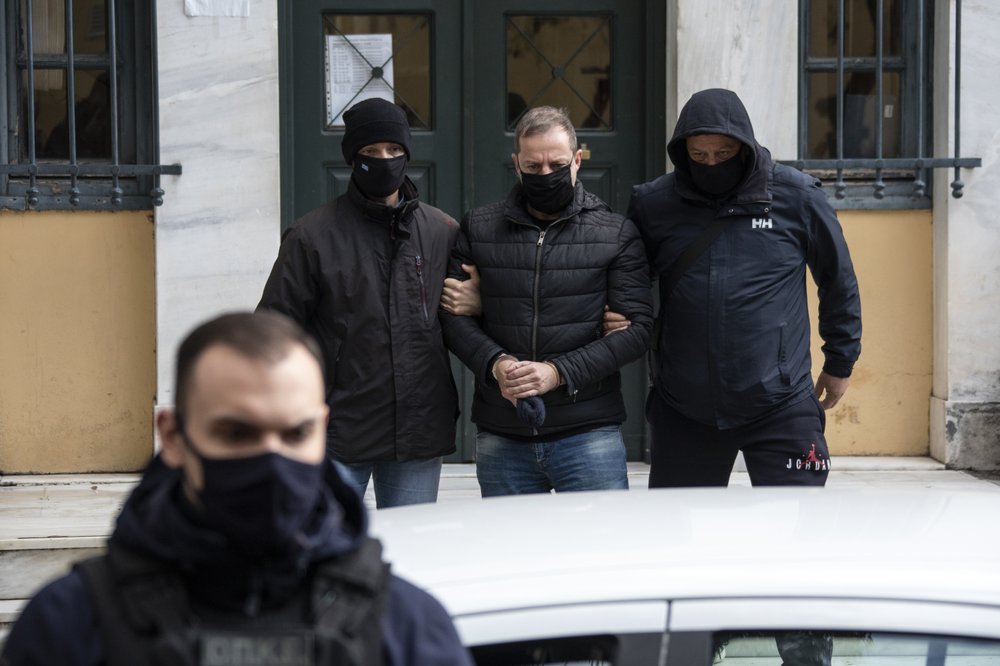
Plain clothed police officers escort handcuffed well-known actor and director, Dimitris Lignadis, center, as they leave a magistrate’s office in Athens, Sunday, February 21, 2021. Photo: AP Photo/Yorgos Karahalis.
Revelations earlier this year by an Olympic gold medalist that she had been raped by a sailing federation official back in 1998 have sparked a #MeToo movement reckoning in Greece.
People have come forward to accuse well-known figures in the entertainment industry of sexual harassment, assault and rape. Well-known actors and directors have come under fire, but Lignadis is the first to be arrested.
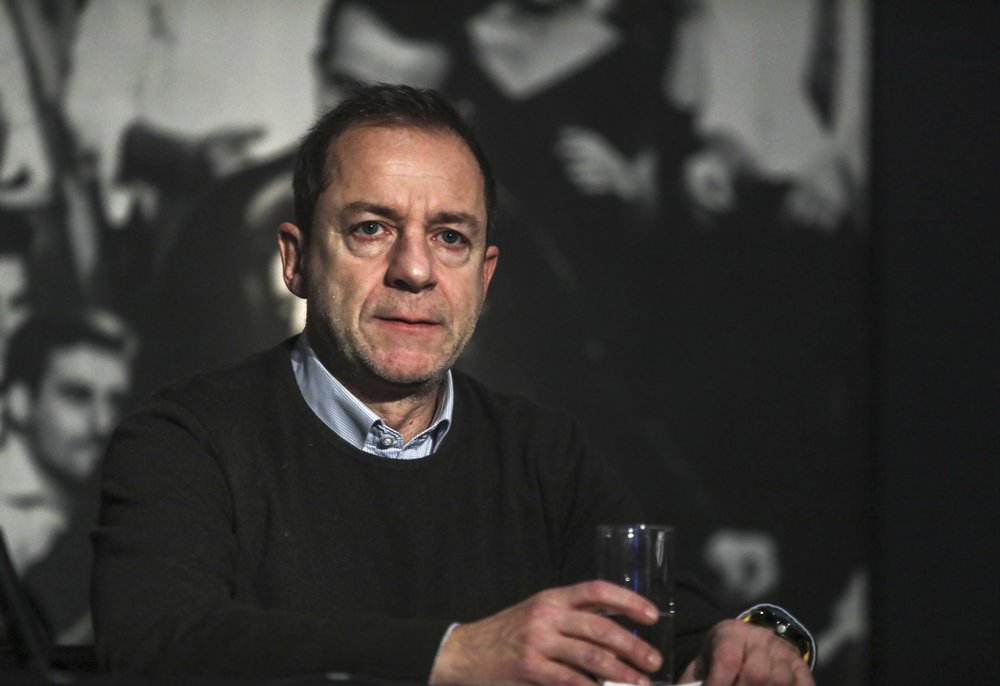
in this Tuesday, January 21, 2020, file photo, Dimitris Lignadis, actor and director, attends a news conference in Athens. Photo: Dimitris Kapadais/InTime News via AP, File.
The case has taken on political dimensions. The political opposition accused the Greek government of failing to follow up on complaints, while the Culture Minister, Lina Mendoni, responded on Friday by accusing Lignadis of being a “dangerous man” who had “deceived” her with his acting ability.
Ms Mendoni said she asked a Supreme Court prosecutor to investigate all abuse allegations in Greece’s theater community.
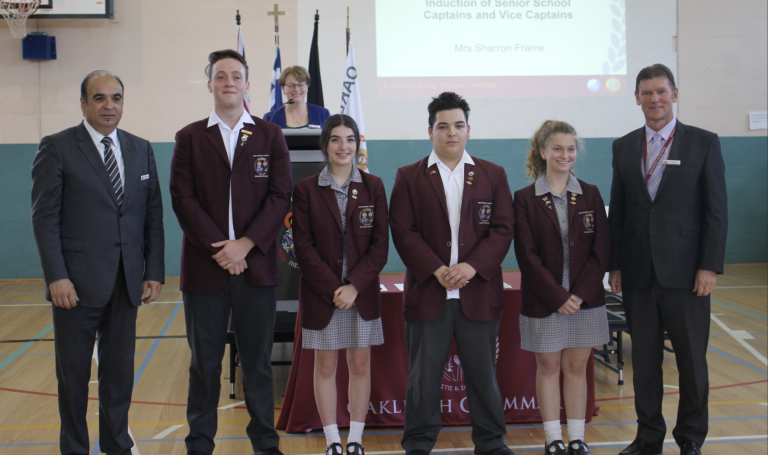
Oakleigh Grammar’s Principal Mr Mark Robertson was delighted to conduct the annual Student Leadership Induction Assemblies on Campus on Friday 19 February 2021.
This year, rather than one Whole School Leadership Assembly, Oakleigh Grammar held three sub-school Assemblies in line with its adopted COVID-cautious approach.
It was a special occasion not only for the students who were inducted, but also for the inductee’s parents who were in attendance, and more broadly, for the wider School community.
The School’s 2021 theme “I Can. We Will” resonated with their student body, as it reflected the smooth transition between On-Campus Learning and the Oakleigh Grammar Remote Learning Model. All students were delighted to be back on Campus to celebrate with their peers at these important Leadership Assemblies.
The culture of Leadership within the student body at Oakleigh Grammar has been a hallmark of the strategic priority of valuing all students and providing student agency in a meaningful way.
The Leadership Program commences in the Junior School with Steven Covey’s Leader In Me (7 Habits of Highly Effective People) Program, which is accredited at Lighthouse Status, the highest level of accreditation offered in this framework. Indeed, Oakleigh Grammar is the only Independent School in Australia to have achieved this honour.
The leadership culture extends through to the Middle and Senior Schools affirming the notion that all Oakleigh Grammar students have the inherent potential to demonstrate leadership.
The School’s Captains, Angelica Athanasakis and Alexander Logan, who were inducted this morning were quoted as saying “We are grateful for the Leadership opportunities afforded by our School within a nurturing and encouraging culture.“
At the outbreak of the First Balkan war, the Army of Epirus was rendered mainly defensive, since most of the Greek military units were sent to reinforce the Macedonian Front.
Following Thessaloniki’s annexation, the Ottoman Empire sought truce with the Balkan Allies.
The Greek government conceded to participate in peace deliberations but clarified that since Epirus had not yet been liberated, Greece would be at war with the Ottoman Empire until the final peace Treaty.
On October 19th 1912, the Army of Epirus abandoned its defensive role and attacked the Turkish Army under the leadership of Major Sapountzakis. Even though the Greek Army was outnumbered, Preveza was conquered and an Ottoman attack at Pente Pigadia was repulsed.
Still, there were enormous difficulties preventing the Liberation of Ioannina.
The Ottoman Army’s numerical superiority and the fact that it had moved to the forts of Bizani,-which historians describe as “strongly fortified”-, combined with the extreme cold and the lack of supplies, prevented the Greek Army from initiating an offensive.
Victories in Macedonia allowed the main bulk of the Army of Thessaly to move south and reinforce the Army of Epirus. Crown Prince Constantine assumed the Command of the Army and demanded a peaceful surrender of the city. Essat Pasha did not accept the Crown Prince’s offer and prepared for attack.
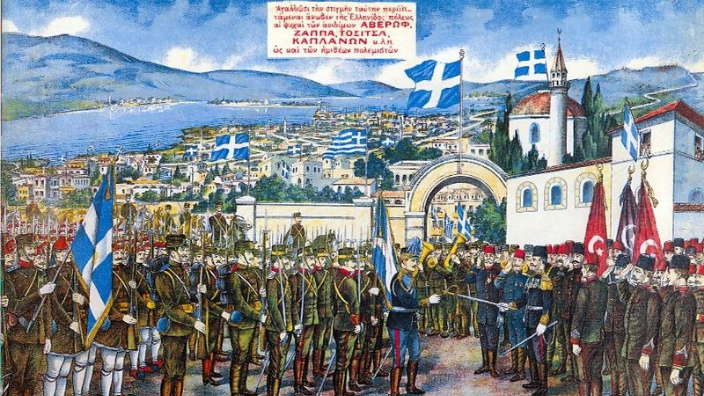
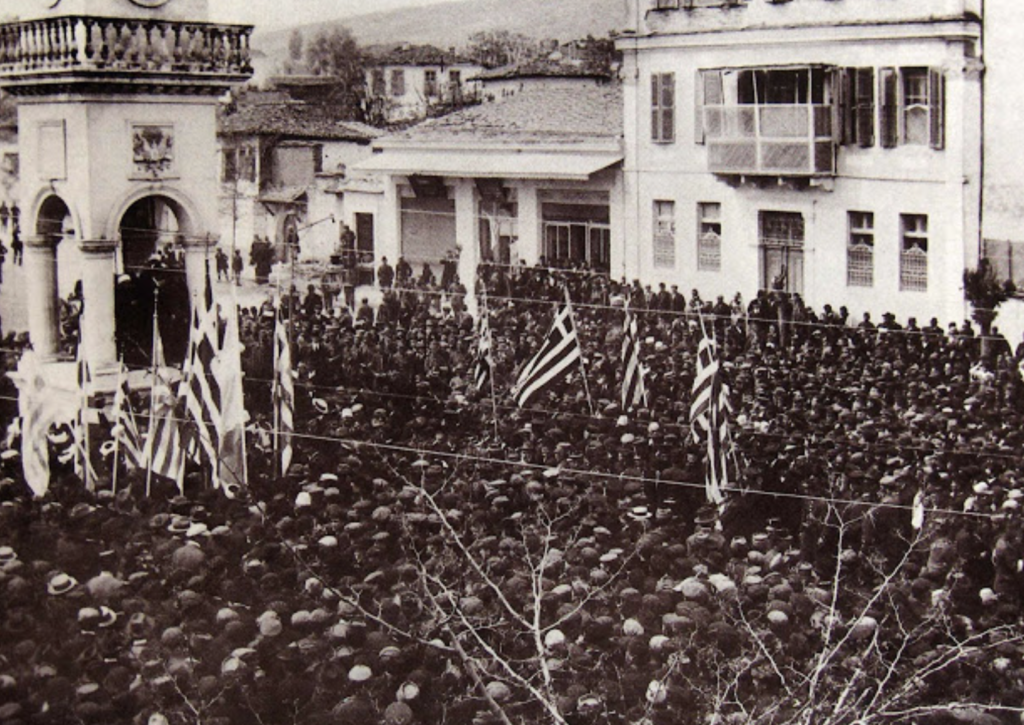
With careful strategic maneuvering and astounding heroism, the Greek Army conquered Bizani and forced Essat Pasha to surrender the city of Ioannina on February 21st 1913.
He translated his dreams into incredible works of art fusing modernism, Byzantine aesthetics and surrealism with his own love of the Mediterranean sun and sea, classical antiquity and the Greek ideal. He was an outstanding artist and painter.
Sadly, Samios passed way on 4 February 2021 at the age of 72 after a short illness. His loss is profound and almost unbearable such was the depth and aura of his prodigious artistic output.
Pavlos Samios was the son of an Athenian cobbler (who had returned from Smyrna). His mother was from Lefkada.
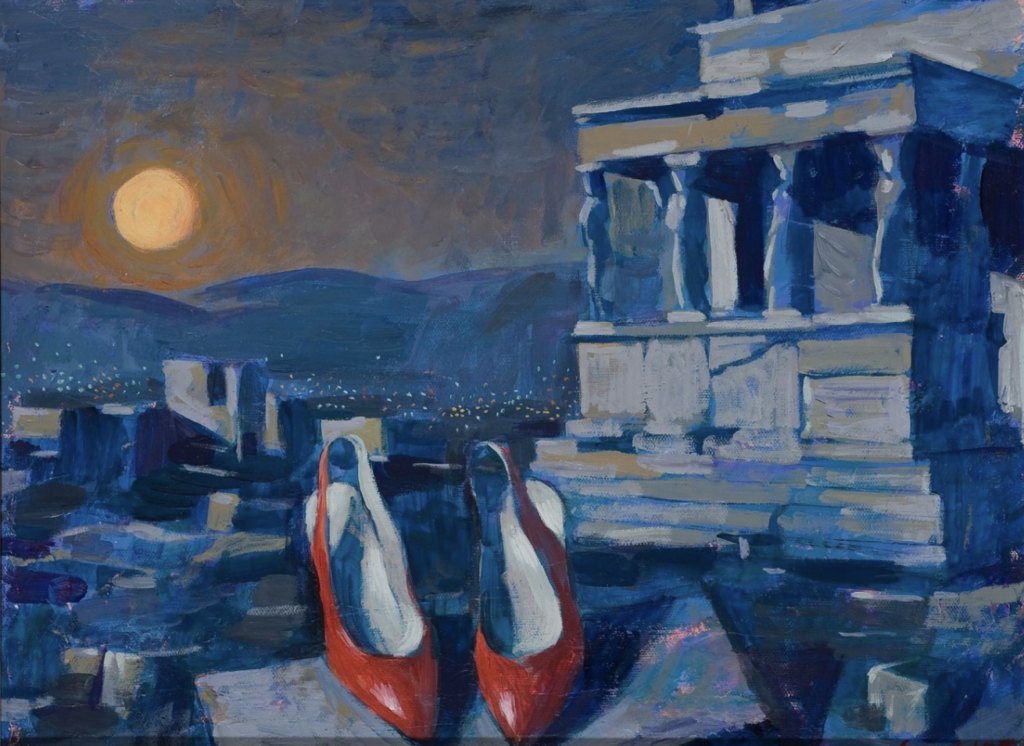
From an early age young Pavlos helped his father in making shoes and, more importantly, visiting shoe stores in downtown Athens to sketch the latest styles in women’s shoes for his father to emulate. As Pavlos would later confide, shoes became a sort of “fetish” for him and many of his works are graced by high heel shoes. Red shoes in particular, as red was the colour of uprising.
One painting from this genre stands out for me. In 2009 he painted a pair of red shoes in the moonlight by the Caryatids of the Erechtheion on the Acropolis. For me, it was almost a case of desperately seeking the missing but forlorn Caryatid in the British Museum.
Pavlos had an incredible artistic upbringing.
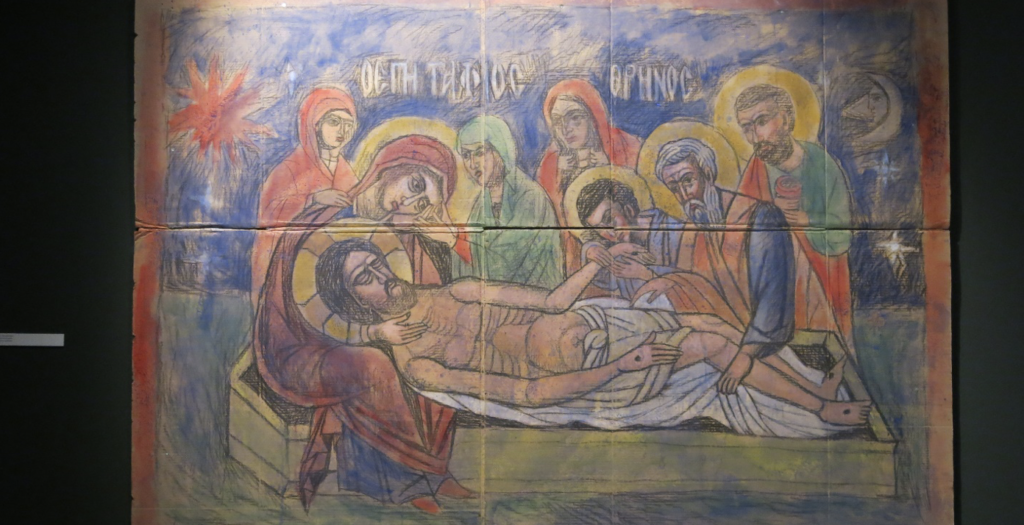
At the age of nine he drew El Greco paintings. As a young man he spent time on Mount Athos where he discovered Byzantine art and mastered what he referred to as his “innate passion” of icon painting.
The colours of Byzantium were to become a central element of his creative identity: “If you know Byzantine, you know all painting,” Pavlos would elaborate with admiration.
Whilst at school he visited Paris and was inspired by the works and particularly the colours of Picasso, recalling that upon his return he stared to paint “like Picasso”
At the age of 18 he was accepted into the prestigious Athens School of Fine Arts where he had some great mentors. One of his early masters, Nikos Nicolaou, whose work was generally based on the tradition of Classical Greek Art, spoke of that tradition, drawing and rhythm and how works are painted but then the great visual and impressionist artist Yannis Moralis (whom Samios would come to refer to as his “spiritual father”) would later add “and after that smash it all up, liberate yourself, find your own form, represent contemporary life”.
Pavlos Samios indeed acknowledged that he “inherited” his love of the ancient world from Nikolaou and the European way of looking at colors and nature from Moralis. Pavlos’ artistic imagination was to know no bounds.
From 1978 to 1992 he lived and worked in Paris where he met the great painter Yannis Tsarouchis who would also mentor Pavlos. In 2000 he was appointed Professor at his beloved Athens School of Fine Arts in the discipline of Traditional Painting Workshop: Fresco – Byzantine icons – Manuscripts. Pavlos in fact painted many chapels using the fresco technique.
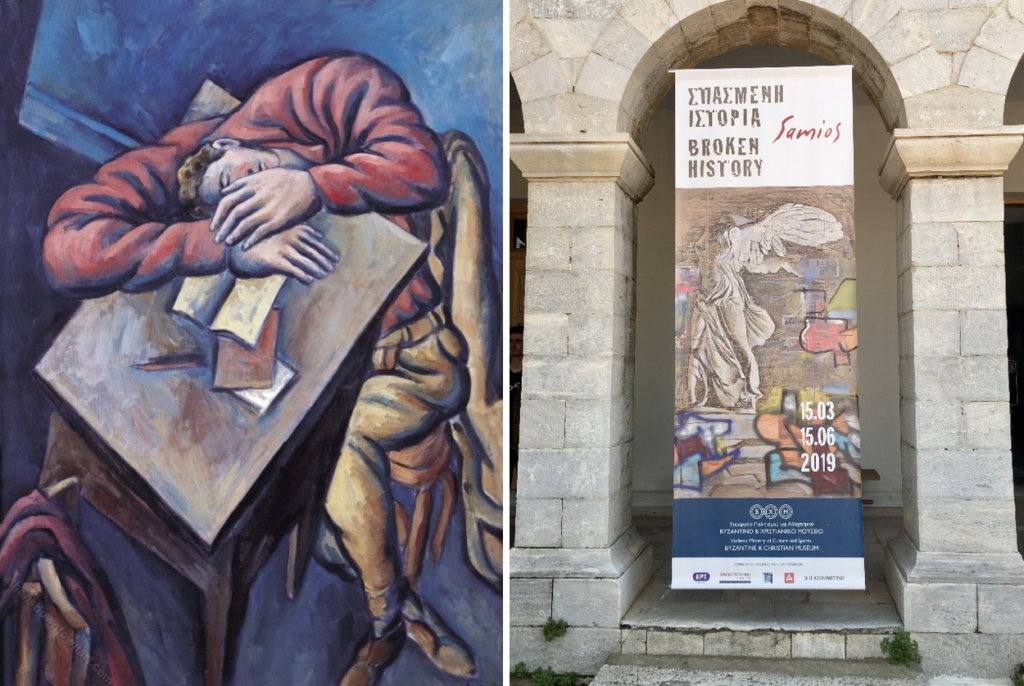
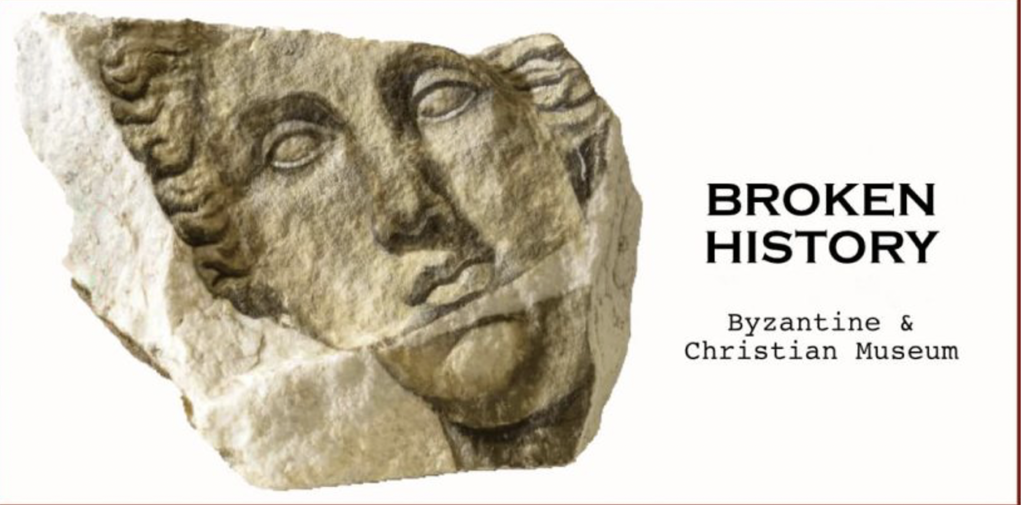
Broken History
I never met Pavlos Samios but I feel as though I knew him well through his works and writings. In April 2019 I managed to catch his new exhibition, with the superbly symbolic title “Broken History”, at the Byzantine and Christian Museum in Athens.
Broken history and dismembered sculptures. As one critic noted Samios “absorbs the patterns of modernity and the shapes of antiquity”.
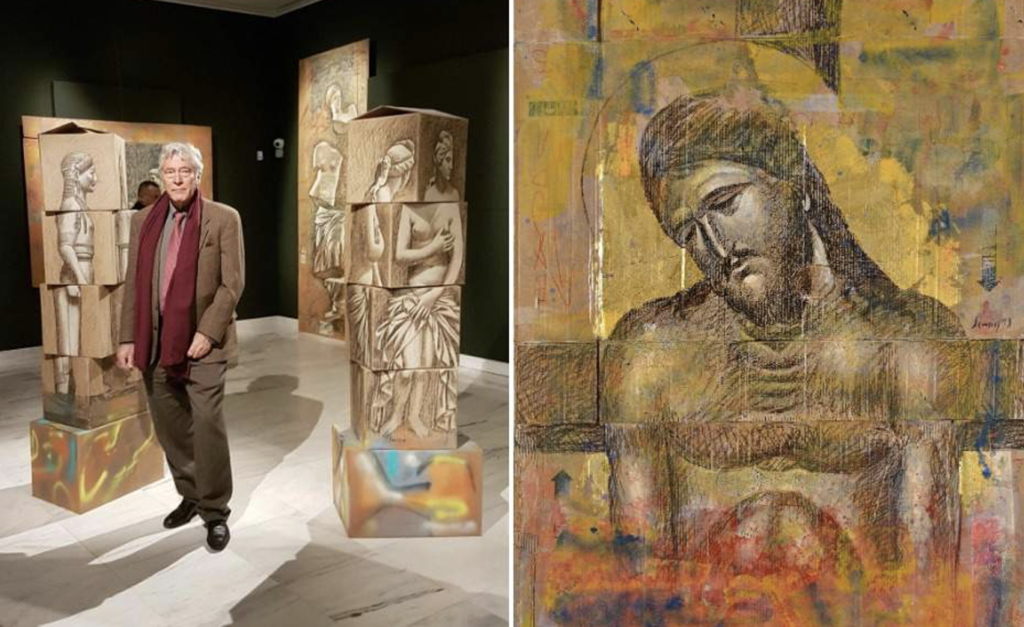
The renowned painter had chosen in this exhibition a different medium, including cardboard boxes and blocks of stone, as his canvas, to project, in his own words, the contemporary Greek reality and its colourful, aniconic graffiti, using spray paint to finish his works so as to convey the feeling of the streets of Athens.
As another commentator observed, this dynamic material, synonymous with movement and change of place, became the “canvas of ancient symbols” and functioned as a bridge from the past to the present.
According to the director of the Byzantine and Christian Museum, Katerina Dellaporta, Pavlos had selected a dialogue of emblematic works of ancient Greek art with Byzantine and post-Byzantine Christian depictions, interspersed with Classical idols, ancient kouroi, kore and sphinxes, classical sculptures from the Parthenon and statues such as the Winged Victory of Samothrace and the Aphrodite of Milos, which he had rendered in a bold new manner in ‘installations’ that combined painting, sculpture and graffiti; where the fragmented pieces are in a process of reconnecting until they find themselves again.
Or as Pavlos Samios himself wrote about this exhibition, he was simply inspired by a verse from the Noble Laureate George Seferis’ poem Κίχλη (“Thrush”): “The statues are no longer fragments. We are”.
Pavlos Samios and the Parthenon Frieze
This is no more evident than in the case of the iconic Parthenon Sculptures, separated in time and space between the British Museum in London and the Acropolis Museum in Athens.
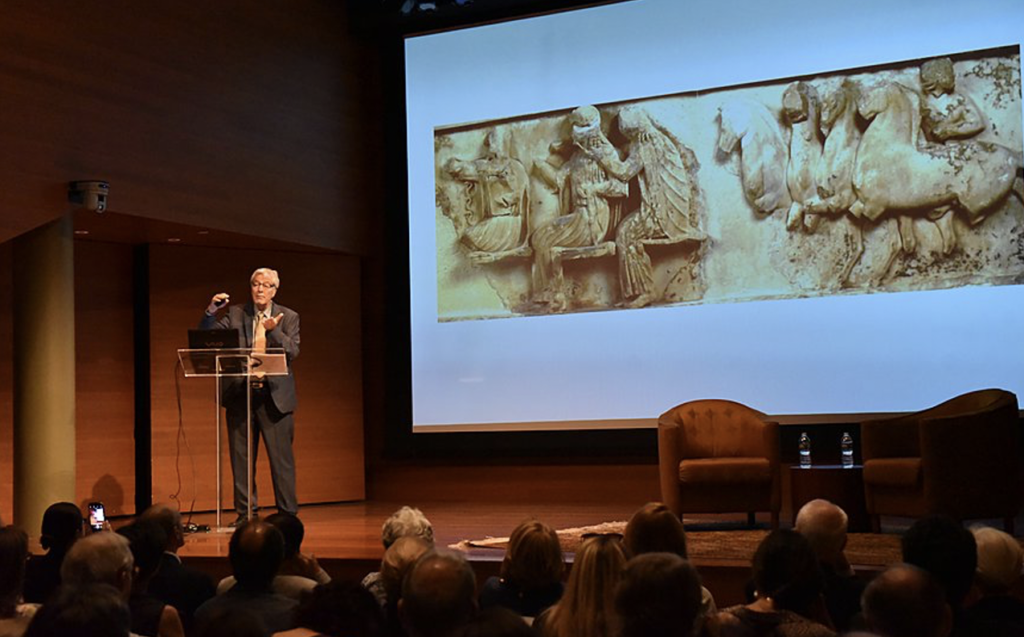
In 2019 Pavlos gave a presentation in New York in 2019 entitled Re-envisioned: The Colour and Design of the Parthenon Frieze” during which he presented his ideas on the composition, colours, scale and techniques used in the creation of the Parthenon frieze which he had studied for many years and how, based on his research, the Greeks envisioned and created the decoration of the Parthenon.
Pavlos also lamented the continued fragmented and dismembered state of the iconic Parthenon Sculptures, torn between London and Athens. This too was a central theme of “Broken History”.
At the Paradise Café
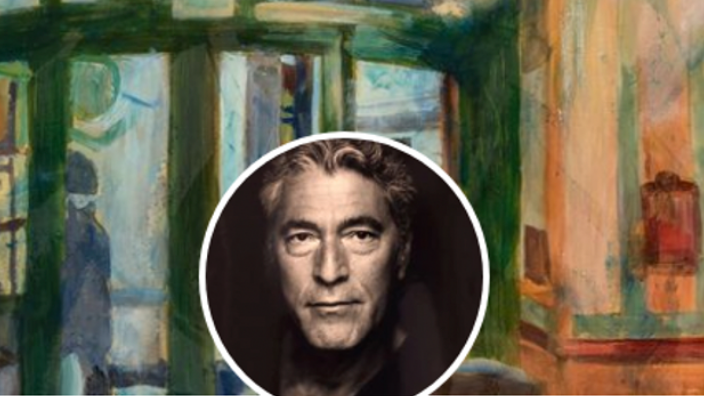
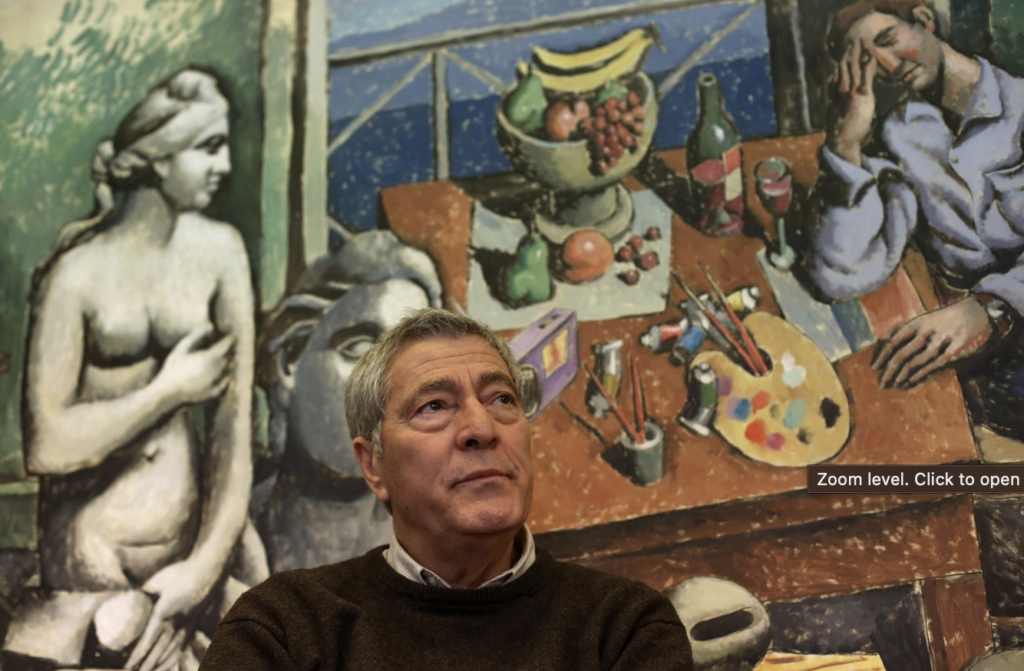
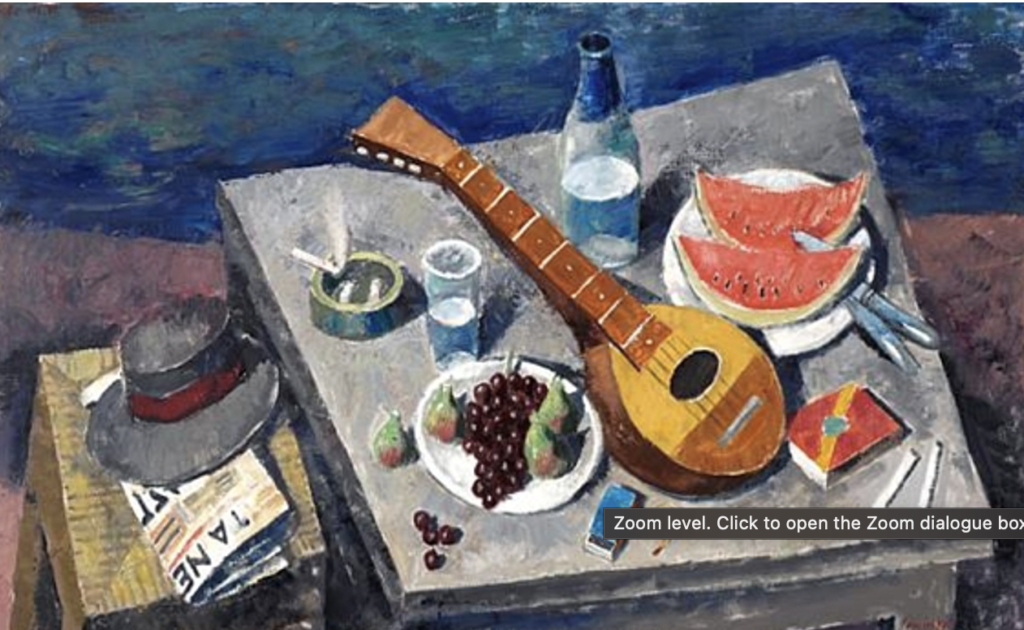
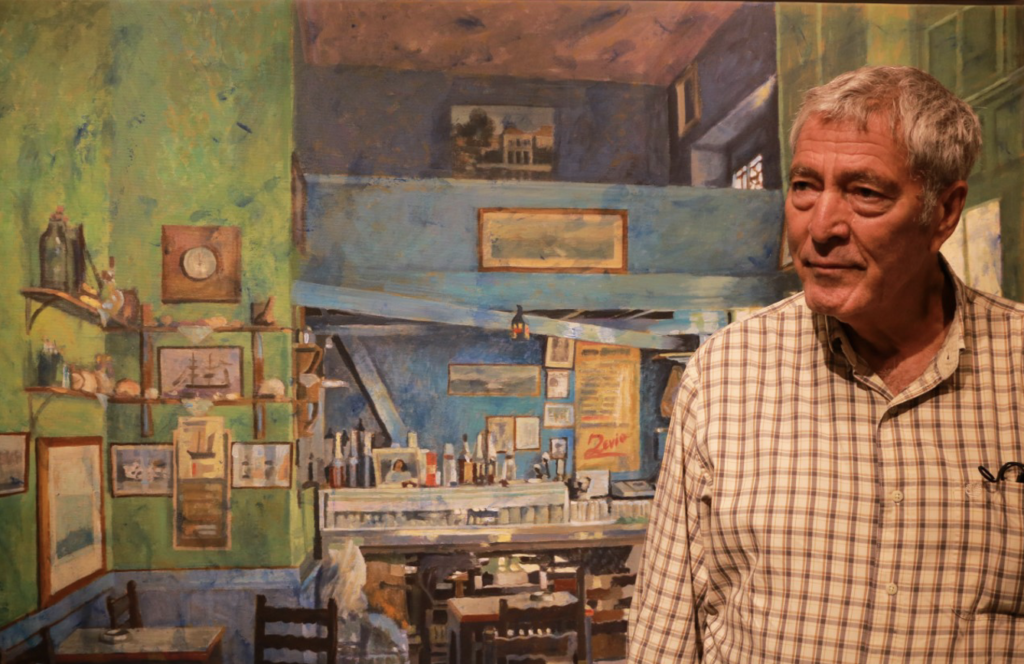
In his last solo exhibition held in Athens in 2020, Pavlos Samios took us into his world of Parisian and Athenian cafes of the 1980s and later. For Samios, the traditional café or kafenion no longer existed except in our imagination. Through his paintings we returned to Pavlos’ favourite haunt, a café named “O Paradeisos” at Platia Attikis, for a nostalgic reunion.
According to the Greek art historian, George Mylonas, “O Paradeisos” encompassed all the beauty of the post-neoclassical tradition, all the joy and misery of the whole of Greece.
Moments of sensuality, of joy, a light that shone from the faces of the people themselves and in the afternoons the old men drinking coffee without talking, just passing through.
In the French cafes the heels and suitcases are circulating under the gaze of the city nightlights. In Greek cafes, on the other hand, there is usually an open window with a view to the sea.
The table also dominates many of his works. According to Samios, “it is the concept of the base: you place things on a table – your ideas, desires. You place your imagination.”
Pavlos Samios was a very significant painter. He illuminated the Greek artscape and produced a prolific and diverse body of work that remains a tribute to his artistic creativity. Sadly, he had already started painting the works in his next exhibition, entitled “Broken Reality”, trying to make a connection with the exhibition of “Broken History”.
Perhaps the Parthenon Sculptures would have been a central theme of that fractured reality?
Pavlos Samios’ death was felt by many.
The Greek Culture Minister, Lina Mendoni, wrote that Pavlos is now in Café Paradise. The Minister of Education, Niki Kerameos, farewelled her dear friend and fondly recalled how in his works “realism constantly meets and flirts with the dream”.
And the former Tourism Minister, Olga Kefalogianni, best described Pavlos Samios as one of the most beautiful people she had ever met: an “outstanding artist, philosopher, painter who never stopped searching, inspiring, creating … Pavlos has left us suddenly, leaving behind a huge gap”.
Pavlos Samios is survived by his wife, Maria Xanthakos, and his two daughters from his first marriage, Pandora and Aphaea.
But Pavlos Samios’ memory will also live on through his art and his observations of life in the Greek world and beyond.
Petros Damianos, Director of the school at Greece’s Avlona Special Youth Detention Center, was devastated when he heard his school would be closed due to the coronavirus lockdown.
The Avlona detention center, a former military prison, holds nearly 300 young men aged 18-21, and sometimes up to 25. The school Damianos founded there in 2000 now teaches primary grades through to college, following the national curriculum and awarding graduation certificates equivalent to any Greek school.
While attendance is voluntary, the prison school has grown in popularity and saw record enrollment in September, when up to 96% of inmates signed up.
“Essentially, our students are those who … before they got to prison, the education system expelled them,” Damianos told Ekathimerini. “These kids are kids we didn’t catch in time.”
But with internet devices banned in their cells, the prison’s students had no way to continue learning when the lockdowns cancelled classroom lessons.
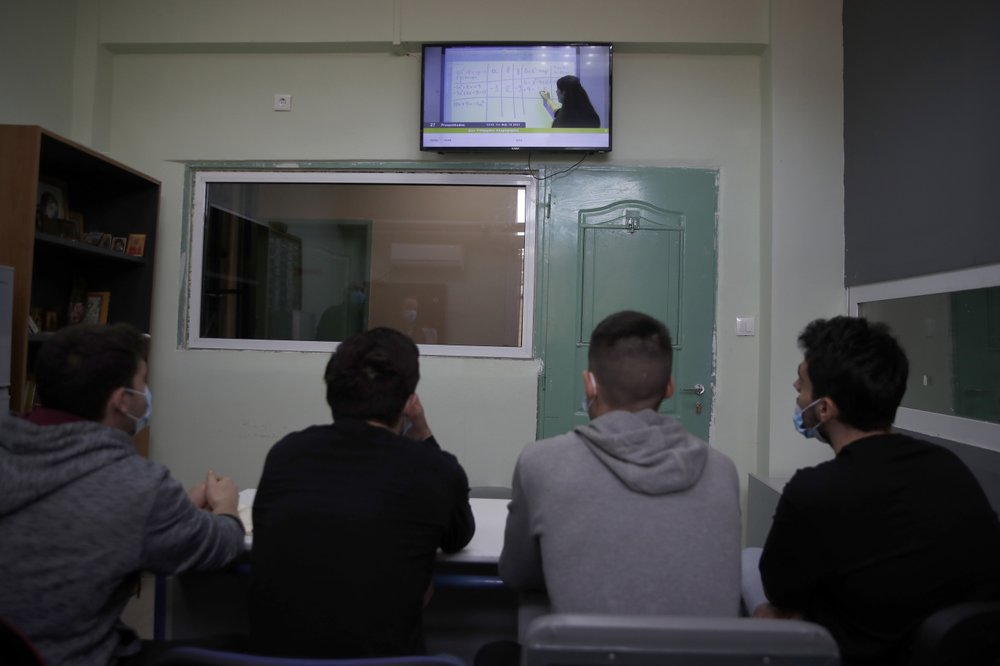
Inmates watch mathematics on “Prospathodas TV,” or “Trying TV,” the channel of Avlona’s prison school, north of Athens, Wednesday, Feb. 10, 2021. Photo: AP Photo/Thanassis Stavrakis.
“Our teachers couldn’t reach the kids like they reach all other kids in Greece,” Damianos said. “This was a big problem, a very big problem that seemed almost insurmountable.”
Desperate for a solution, Damianos had an idea: he could reach his students through the televisions in their cells if he could figure out how to create a dedicated TV channel to broadcast their classes.
Technician friends told Damianos it was possible with the necessary equipment. The next hurdle was obtaining the equipment with shops also closed during the nationwide lockdown. Then the school’s staff had to learn how to use it.
The school’s music teacher, Nikos Karadosidis, took on the role of technician, using experience from occasional concert tech work and guidance gleaned from YouTube tutorials.
“I very quickly realised – and this is the magic of it, too – that this whole thing is essentially DIY,” Karadosidis said. “Do it yourself, with whatever materials you have, with whatever tools you have, to try to do the best you can.”
Through donations, volunteers and online orders, the staff cobbled together what they needed. A critical piece of equipment – a modulator to transmit the TV signal – ran into delivery delays, so a store lent them an older one. Two hundred meters (feet) of cable arrived, and inmates helped run it from the school to the prison’s central aerial.
One prison classroom was converted into a rudimentary studio, with a cheap hand-held video camera taped to a tripod. Multicolored Christmas lights served as a makeshift recording light, warning those outside to keep quiet during recording sessions.
On January 8, about a month after Damianos had the idea, the channel was ready. They named it Prospathodas TV, Greek for “Trying TV.” Through word of mouth, they got inmates to re-tune their televisions to capture the new channel.
The pilot program was a half-hour math class. Now the channel operates 24 hours a day, running six hours’ worth of pre-recorded lessons on a loop on weekdays, and eight hours of content on a loop on weekends.
The teachers record new lessons daily: from math and handicrafts to economics and music. Karadosidis edits into the night and broadcasts the classes the next day, since live broadcasts are still beyond their technical capabilities.
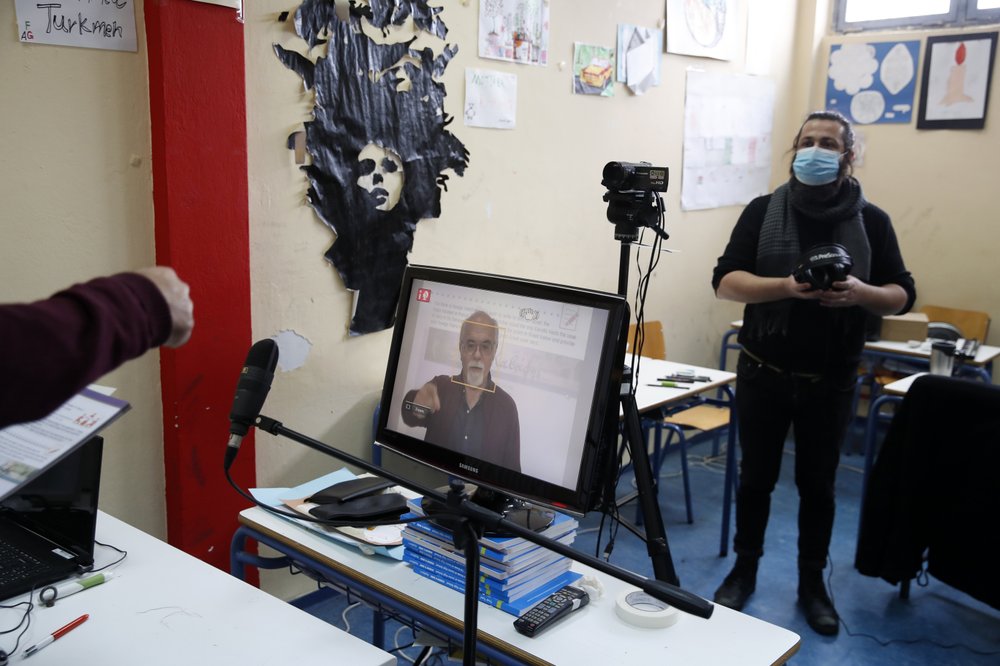
Music teacher, Nikos Karadosidis, right, listens to prison school director Petros Damianos before recording lessons at a classroom of Avlona’s prison school, north of Athens, Wednesday, Feb. 10, 2021. Photo: AP Photo/Thanassis Stavrakis.
A 21-year-old prison inmate, who earned his high school diploma in Avlona, says the TV channel has become quite popular.
“You run out of (cigarette) filters and you go into the next cell to ask for a filter, and you see five big guys battling with their little paper strips trying to make purses,” M.S, an inmate who can only be identified by their initials under prison regulations, said.
“Then you go to the next cell later, and someone’s trying to solve an equation.”
Once the pandemic is over, Damianos would like to expand the channel to include documentaries and other worthwhile programs. But while it’s plugging a hole in education and maintaining contacts between students and teachers, he stresses that televised lessons can’t deliver what in-person classes do.
“Let’s be honest, the channel can’t replace the education that takes place in school,” Damianos said. “It is very important, but it’s not enough.”
Are you craving a healthy, flavour-packed Greek prawn recipe for dinner tonight? The Greek Herald has the answer for you and it can be prepared in 30 minutes or less!
Here’s our recipe for Greek prawns with tasty tomato sauce, feta and a splash of lemon juice.
Prawns with Tomato and Feta Recipe:
Serves: Up to 6 people.
Time: 10 minutes to prepare, 20 minutes to cook.
Ingredients:
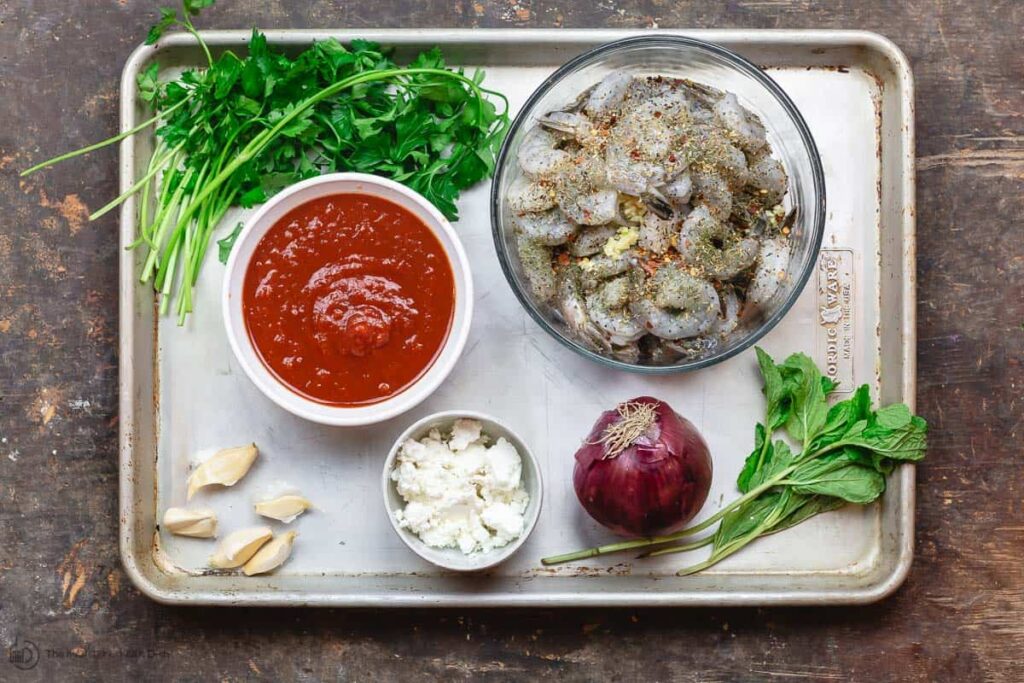
Recipe ingredients. Photo: The Mediterranean Dish.
1 ½ lb large prawns (21/25), fully thawed, peeled and de-veined.
Kosher salt.
Black pepper.
1 ½ tsp dry oregano, divided.
1 ½ tsp dry dill weed, divided.
Pinch red pepper flakes.
6 garlic cloves, minced, divided.
Greek extra virgin olive oil.
1 large red onion, chopped.
1 26-oz/737.088 g canned diced tomato, drain only some of the liquid.
Juice of ½ lemon, more for later if you like.
Chopped fresh mint leaves, a generous handful.
Chopped fresh parsley leaves, a generous handful.
2 to 3-oz/56 g crumbled Greek feta cheese, more if you like.
6 or more pitted Kalamata olives, chopped (optional).
Directions:
1. Pat prawns dry and place in a large bowl. Season with kosher salt, pepper, ½ tsp dry oregano, ½ tsp dry dill weed, pinch red pepper flakes, and about ½ tsp of minced garlic. Drizzle with extra virgin olive oil, and toss to combine. Set aside for now.
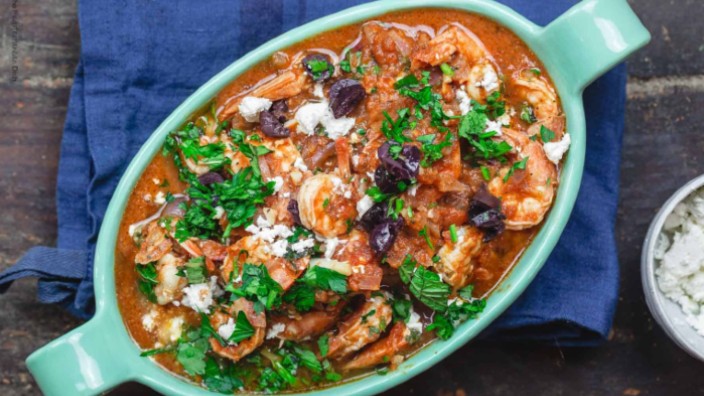
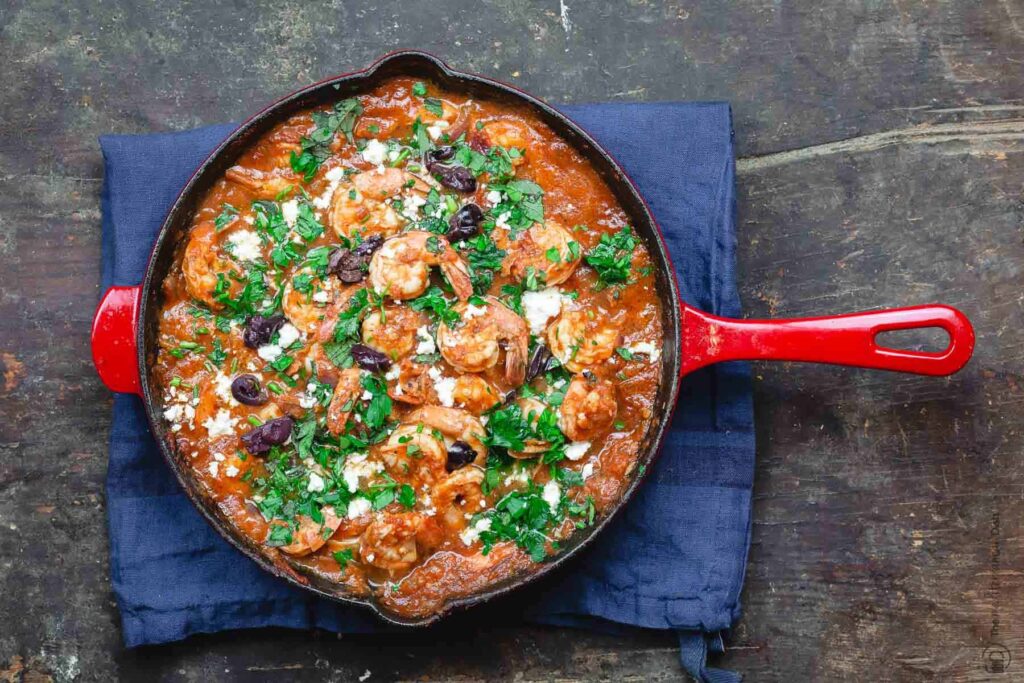
Greek shrimp with tasty tomato sauce, feta and a splash of lemon juice. Photo: The Mediterranean Dish.
2. In a large heavy skillet, heat about 2 tbsp extra virgin olive oil over medium heat until shimmering but not smoking. Add the chopped onion and remaining minced garlic, cook briefly until fragrant (stir regularly). Add tomatoes and lemon juice, and season with pinch of salt, pepper, and remaining dry oregano and dill. Bring to a boil, then lower heat to medium-low and let simmer for 15 minutes.
3. Now add the marinated prawns. Cook for about 5 to 7 minutes or until pink, do a little stirring if needed (do not over-cook shrimp).
4. Stir in fresh mint and parsley leaves. Finish with sprinkle of feta and black olives. If you like, add a splash more lemon juice or more red pepper flakes to your taste.
5. Serve over plain orzo, your favorite grain, or your favorite crusty bread to sop up the delicious sauce. Enjoy!
Even today, most Greeks believe that China is covered by a magical haze… An ancient civilization, developed in harmony with today’s all-powerful “dragon country,” which seems like an elusive dream for most.
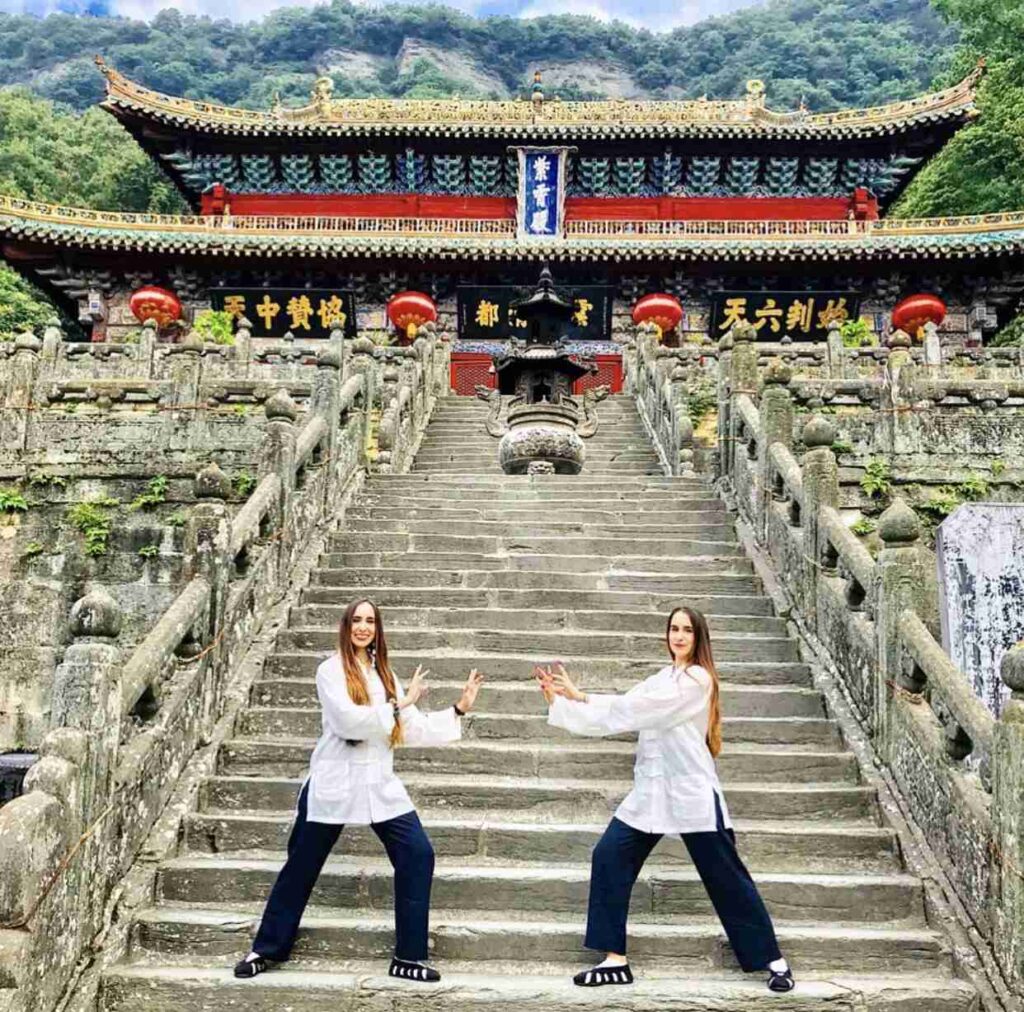
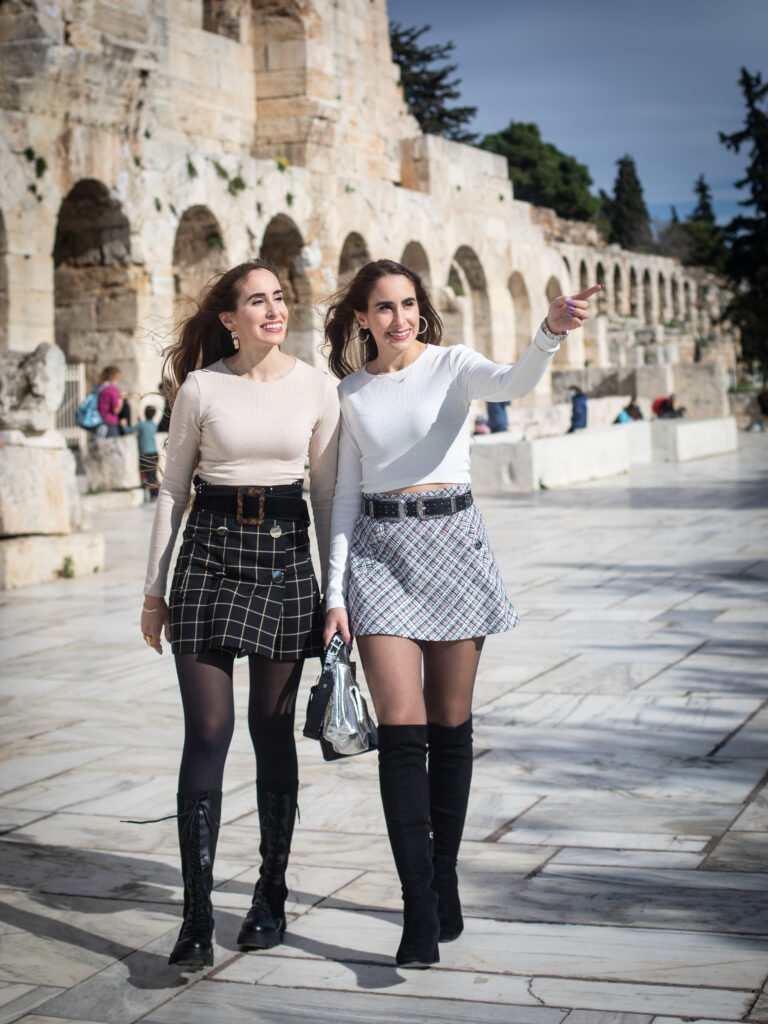
But not for the twin sisters Marianna and Sofia Erotokritos, who made an unusual decision six years ago: To study in China in the field of international trade and economics.
“China is the cradle of Eastern civilization and that is what attracted us to discover this beautiful country. We admired from a very young age its vast culture and history,” they both say in their exclusive interview with the Greek Herald.
“So we decided to go a step further and study in China. Of course China’s enormous economic achievements have increased our curiosity.”
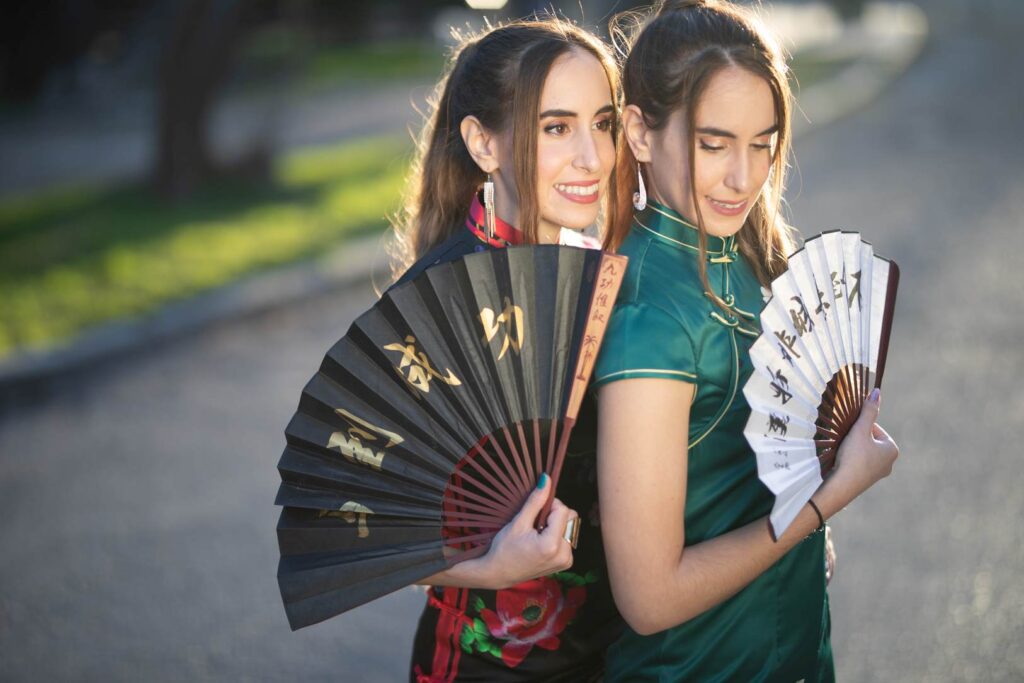
Twin sisters Marianna and Sofia Erotokritos. Photos supplied.
The reason: their recent award by the Minister of Tourism, Charis Theocharis, who declared them ambassadors of Greek tourism in China.
“When we started to deal with the promotion of Greece in China it did not occur to us that we could be awarded such a title,” they say.
“It’s a huge honour, but at the same time a huge responsibility to carry such a title. We will continue with greater zeal and now officially promote our beloved country, Greece, to Asia’s largest country, China.
“After all, in the modern world of social media that we live in, we as @greek_twins with hundreds of thousands of followers on the social media of China, have a big role, with the creation in Chinese of authentic videos with moments of everyday life in Greece, the culture of our country, as well as thematic videos from leading Greek destinations.
“For those of your readers who want to see our business, they can visit our www.greektwins.gr.
“By the way, we would like to thank from the bottom of our heart the Minister of Tourism, Mr Charis Theocharis, for the tremendous recognition of our work.”
Pandemic, China and Greece:
The “Greek Twins,” the Erotokritos sisters, create excitement among their Chinese followers when they post a new video on their page. At the time of the pandemic, with the restrictive measures, ties were further strengthened, although Mariana and Sophia spent those difficult days in Greece and not in China.
“The truth is that we found ourselves lucky in our misfortune! We returned to Greece in January 2020 in order to stay a month and finally while we were here a year, we do not yet know when we will return to China,” they say.
“Greece and China took action against the virus quite early compared to other countries. We can see, however, that there were a number of different ways of dealing with the pandemic.
The “Greek Twins,” the Erotokritos sisters, create excitement among their Chinese followers when they post a new video on social media. Photos supplied.
“China, when it was in a strict “lockdown,” did not allow people’s movement. Only one person from each family was allowed to leave the house and only to go to the supermarket or get packages from courier companies. Similarly in Greece, even in the strict “lockdown” we see a more relaxed treatment. The truth is we really want to go back to China because we left quite suddenly.”
Of course the positive impact that has been created in China – on Greece – has a name: «Greek Twins»!
“In every video we upload to social media, in most of their comments our followers tell us “I want to go to Greece.” In general they ask us to learn about tourist destinations, especially our islands. Of course we don’t spoil them! It goes without saying that the most popular destination is Santorini,” they explain.
Greek language courses in Chinese:
With International Greek Language Day celebrated on February 9th, it is of great interest that the Erotokritos twin sisters aim to spread it to China as well.
“There is a lot of interest from the Chinese in the Greek language, especially in recent years where many invest in Greece, buy real estate and many choose to live permanently in our country,” they say.
The Erotokritos twin sisters aim to spread the Greek language to China as well. Photos supplied.
“That’s why we decided to fill this gap with videos/lessons, which we do online to about 2,000 Chinese. In Greece when someone speaks and they can’t understand him they say “he speaks Chinese.
“For a Chinese man whose mother tongue is completely different from ours, they are certainly having a hard time learning it. We personally believe that Greek is a more difficult foreign language than Chinese because of its grammar.”
The two girls have felt the excitement of the Chinese with various incidents having taken place.
“What we will never forget is the first time we took a taxi in China, in Nanjing City. The guide asked us where we were from and we replied with great enthusiasm “Sila” (xila) which means Greece. Our guide looked at us with a strange face and asked us: Is “Sila” in Africa?”
“Also, when we hosted friends from China to Greece, they asked us to go to a pharmacy because they wanted to buy… olive oil.
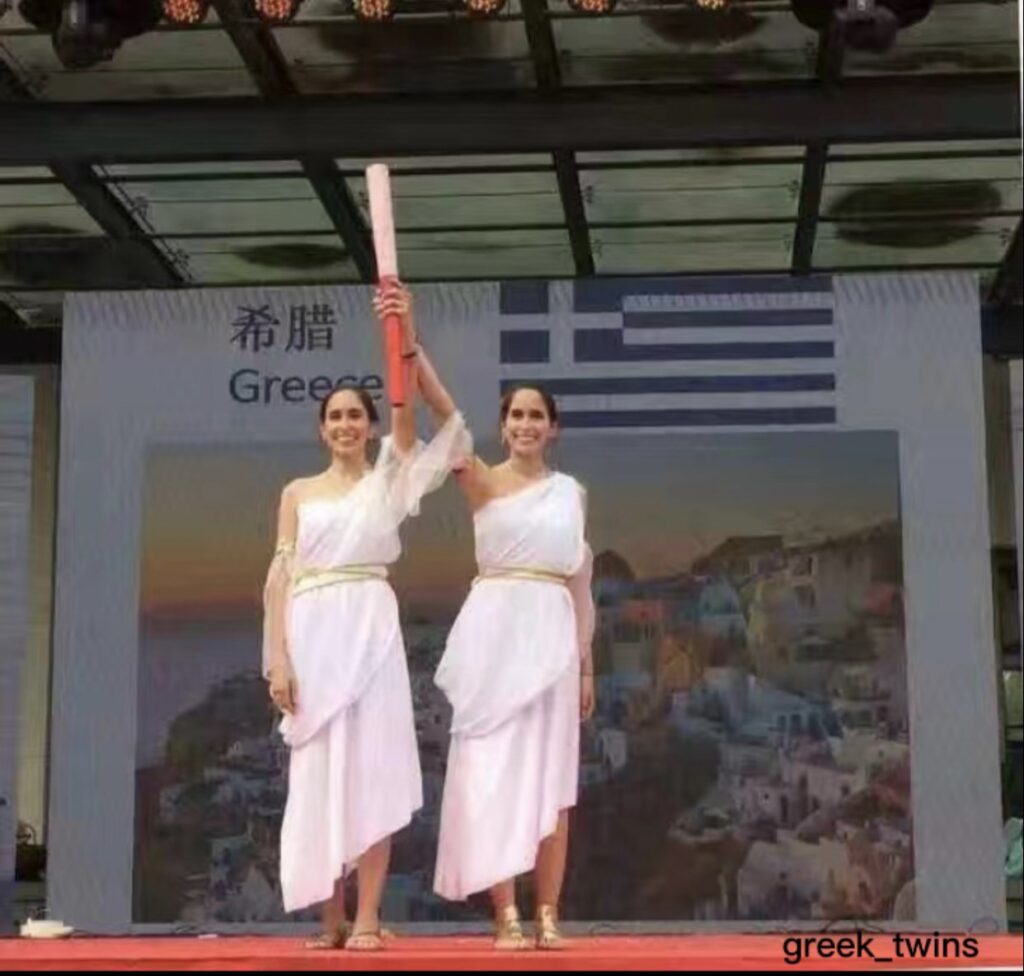
The Erotokritos twin sisters. Photo supplied.
“Of course in recent years olive oil has become quite well known in China and many Chinese know that in addition to medicine is also used for … food!”
Food and future plans:
The Erotokritos sisters also introduce us to their culinary habits in China.
“The truth is that in our first year in China we only chose Chinese food,” the say.
“We wanted to try as many dishes as we could. But in recent years we cook Greek food at home, because Greek gastronomy is the best in the world!”
However, they plan to return to Greece in the near future.
“This year is the year of Culture – Tourism Greece – China and our program in China will definitely be full. Then we intend to return permanently to Greece, to offer as much as we can in our country.”
The first Greek Australian Dialogue Series for 2021 is kicking off via Zoom on Tuesday, March 2, with Social Entrepreneur and Founder of Wise Greece, Ms Melina Taprantzi.
During the conference, organised by the Australian Chamber of Commerce and Industry, Melina will present “Wise Greece” and its social entrepreneurship business model aiming to inspire young people to create their own social enterprise.
Melina will also talk about social entrepreneurship as an alternative way of doing business and giving back to society.
Following her presentation, there will be an opportunity to ask Melina a question in the Q&A session.
What is ‘Wise Greece’?
“Wise Greece” is a social enterprise that supports small Greek food producers to promote their products through its network and converts its profits into food supplies for people living in poverty.
To date, it cooperates with 100+ small food producers, promoting 2,500+ products and has distributed 50+ tons of food to Orphanages and Soup Kitchens across the country.
“Wise Greece” is a highly decorated organisation that has received important awards, including the prestigious award from the President of the Greek Republic “Models of Excellence,” as well as the Start Up award for sustainability and social contribution, the European Social Challenge Award 2018, the Innovative Fundraising Award by the British Council and the BeMed Award by the Prince Albert II of Monaco Foundation.
A live military hand grenade found under a bed in a Para Hills home, in Adelaide had to be deactivated by the Australian Defence Force, a court has heard.
The occupants and live-in couple of more than three years, Christopher John Radomanski, 34, and Bianca Despine Anne Mouhalos, 31, appeared in the Elizabeth Magistrates Court by video link on Wednesday charged with taking steps in manufacturing an explosive.
They were also charged with two counts of dishonestly receiving, and one count of dishonestly dealing, with property without consent.
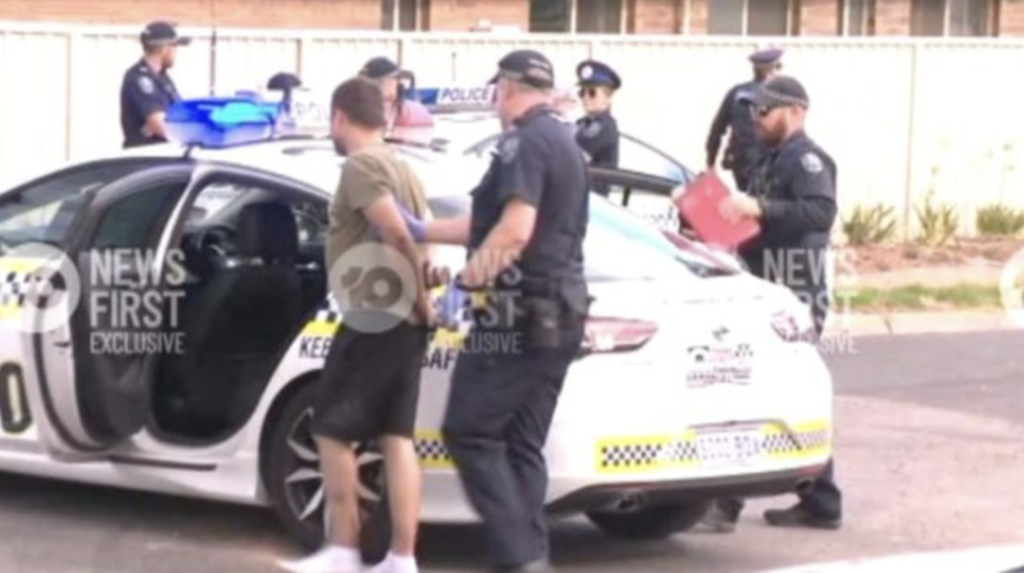
Christopher John Radomanski was arrested after police raided the Para Hills home. Picture: Ten News First
A third person arrested at the property, Crystal Simone Agius, 34, also appeared and is facing two counts of dishonestly receiving, and one count of dishonestly dealing, with property without consent and failing to answer questions or identify the driver or owner of a vehicle.
On Wednesday, police prosecutor Brevet Sergeant Jennifer Switala said the grenade, a “very dangerous device”, was “capable of causing death or serious harm”.
Magistrate Terence Forrest granted both women bail but Radomanski did not apply for early release.
All three will next appear in Adelaide’s Elizabeth Magistrates Court in April.
Guards who saw Dimitrios ‘Jim’ Mavris in the hours before he was found dead in his jail cell thought he seemed fine and was even in positive spirits.
But an inquest into his 2018 death has revealed the alleged cocaine importer actually spent his final hours openly making arrangements to kill himself, even getting his cellmate to help him, while unsuspecting corrections officers watched TV, The Sydney Morning Herald report.
The mechanic turned millionaire property developer and alleged drug importer had been arrested at Sydney airport just 48 hours earlier. He’d just returned from a wild South American escapade that saw him kidnapped in rural Colombia, where he is thought to have spent a week in captivity before being rescued by local police.
According to federal police, Mavris had hightailed it to Colombia to find out what happened to 59 kilograms of cocaine he was expecting to arrive in a shipment of frozen Peruvian fish in March.
What he didn’t realise after finding the drugs missing from the shipping containers was that they had been seized by Australian Border Force officers. On his arrival home, he was met by Australian Federal Police officers who charged him with importing a commercial quantity of cocaine. He was facing a maximum sentence of life in prison if found guilty.
The recent inquest heard that as early as 12pm on the day of his death, CCTV from inside his cell showed Mavris attempting to make preparations for his death. Footage also revealed Mavris was choked by his cellmate, who told the inquest Mavris asked him to do so.
The cellmate, who cannot be named for legal reasons, told the inquest he stopped because he didn’t want to be charged with murder. However, he didn’t notify guards of Mavris’ intentions until it was too late.