A renewed debate around language, identity and belonging within the Greek Orthodox Church in Australia has emerged following recent comments by His Eminence Archbishop Makarios of Australia on the role of Greek in liturgical worship.
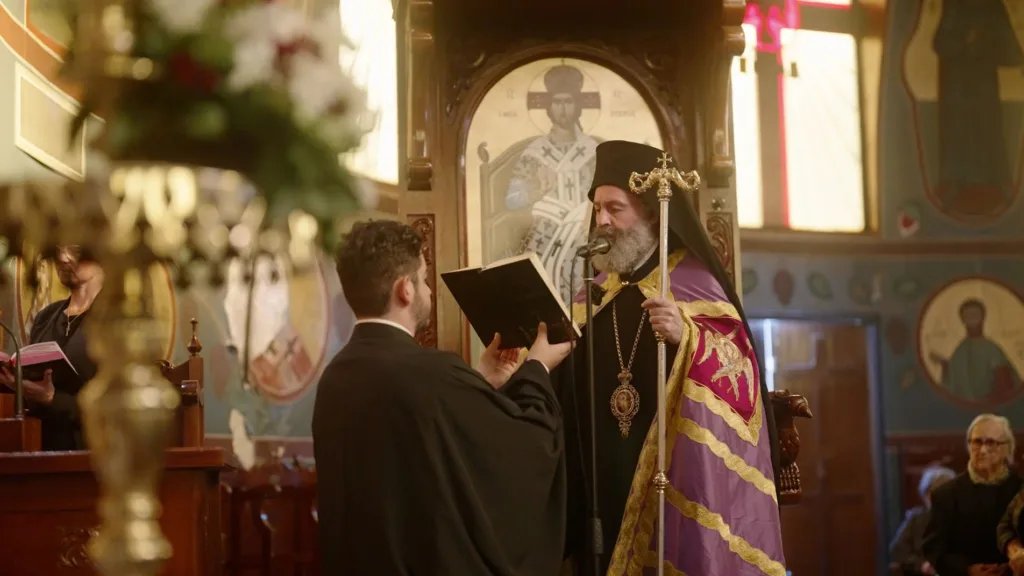
Speaking at the Church of Saint Nektarios in Fawkner, Melbourne, Archbishop Makarios delivered a strong message about preserving Greek identity within the life of the Church.
“If the Church loses its Greek identity, then we are lost. We must hold firm!” he said.
While acknowledging practical needs within parishes — including attracting more chanters and encouraging youth participation — he maintained that Greek must remain central to worship.
“We have needs,” he said, “but we will find chanters to chant in Greek. And we may include some English for our children, to bring them closer to the Church, but not half and half. We do not forget our identity.”
The comments have sparked a wide-ranging discussion among Greek Australians, converts and parishioners about the balance between preserving heritage and ensuring accessibility for future generations.
A question of preservation
For many older members of the community, the Archbishop’s comments reflect a broader concern about maintaining cultural continuity in diaspora life.
One woman in her 70s said Greek remains essential to preserving tradition and ensuring older generations continue to feel spiritually connected. However, she also suggested a practical middle ground.
“Maybe 7am to 9am Greek and 9am to 11am English?” she said, explaining that such an approach would allow older parishioners to worship in the language they understand best, while giving younger families, mixed marriages and those less fluent in Greek the opportunity to fully engage with the liturgy later in the morning.
Rather than forcing a single approach across all congregants, she believes this kind of structure could preserve tradition without excluding those trying to participate more meaningfully.
Others strongly defended the Archbishop’s position.
Spiro Troubetas argued in a comment that declining Greek fluency among younger generations is not a church issue but the result of changing family and educational priorities.
“Orthodoxy is not a tradition,” he said.
“We have a responsibility to our faith, customs, and traditions of the Church, our Greek heritage and roots from where we have come from. We must hold on to them tight as our very existence depends on it.”
Troubetas said many families stopped prioritising Greek language education over the years, making it easier for English to dominate at home.
“We are now seeing the results of ignorance and laziness of two generations to learn and study the Greek language,” he said.
He also pointed to what he sees as growing efforts by schools and the Archdiocese to strengthen language retention among younger students.
Christiana Fidirikkos also supported the Archbishop’s position, saying that preserving Greek identity remains important for diaspora communities living outside Greece.
“Absolutely, we must be firm and not lose our Greek identity,” she said. “It doesn’t matter if we don’t understand the Divine Liturgy in Greek. God will enlighten us with His grace.”
She added that hearing liturgy in Greek carried an emotional and spiritual significance she felt could not be replicated in English.
“There’s a feeling of emptiness in a foreign language,” she said.
Calls for greater accessibility
Others, particularly younger Greek Australians and converts, say language remains one of the biggest barriers to participation.
Several Greek Australian couples in their 30s said they felt disappointed by the suggestion that liturgies should not be divided between Greek and English. While many said they understand conversational Greek to varying degrees, they explained that liturgical comprehension is different.
For these parishioners, understanding the meaning of prayers and scripture in English creates a stronger sense of engagement rather than distancing them from tradition.
They also noted that mixed marriages are increasingly common within the Greek Australian community. Many families include partners from non-Greek backgrounds who still wish to participate meaningfully in the Church.
In a multicultural society like Australia, they argued, a predominantly Greek-only liturgical approach may unintentionally create barriers for families attempting to raise children within Orthodoxy while navigating multiple cultural identities.
Kelly Marie Capodieci, who is not Greek-born but regularly attends Greek Orthodox churches, said some English within services is essential for families like hers.
“I want to pass the rich faith on to my children, but taking away the English will make it harder for me and my children as they are being raised bilingual,” she said.
“Learning the language is one thing, but it’s time consuming and as a mum and worker trying to keep the faith in the family without knowing Greek will make it extremely difficult.”
Peter, another respondent, said preserving Greek remains important, but accessibility should remain central to Orthodoxy’s broader mission.
“Orthodoxy should be accessible to everyone, regardless of what language we speak or what cultural background we have,” he said.
He referenced Colossians 3:11, which speaks of unity in Christ beyond ethnic distinctions: “Where there is neither Greek nor Jew, circumcised nor uncircumcised, barbarian, Scythian, slave nor free, but Christ is all and in all.”
The convert experience
Among those who responded were converts who said language played a decisive role in their spiritual journey.
John, an Anglo-Saxon convert who began exploring Orthodoxy in the 1980s, said English-language services first introduced him to the faith.
He explained that Antiochian and Russian Orthodox churches offered English-language liturgies, allowing him to understand and engage with worship. He later attended Greek Orthodox churches that also included English services.
In response to Archbishop Makarios’ comments, John said reducing English-language liturgies risks excluding converts and those without strong Greek language skills.
“I don’t agree that English should be removed,” he said.
“The only way people can hear the liturgy in their language is if there are some churches that are fully in English, and then others could be fully in Greek.”
He argued that while preserving Greek identity remains important, the Church should also consider its missionary role in Australia.
“The church is not a Greek school. It’s not just there for Greeks,” he said.
John also pointed to demographic shifts within parishes, suggesting many congregations are ageing.
“The future of Orthodoxy in this country is dependent on having some services in English,” he said.
He added that if English-language worship were no longer available, he would likely return to Antiochian or Russian Orthodox communities.
“If the Greeks don’t offer services in English anymore, then there’s no point going there,” he said.
Another respondent, Andrew — an Australian of Italian and German heritage currently exploring Orthodoxy and Catholicism — said language can influence whether newcomers feel comfortable entering a church community.
Still on a spiritual journey, Andrew said his initial reaction to hearing that Greek should dominate liturgy was hesitation. He said newcomers may wonder whether participation requires learning an unfamiliar language before fully belonging.
A continuing conversation
As discussion continues, Archbishop Makarios’ broader position remains clear: while some English may be included to support younger generations, Greek must remain central to liturgical worship.
He also expressed his opposition to services being divided equally between Greek and English, stating that “we are Greeks” and warning that if the Church loses its Greek identity, “then we are lost.”
The debate highlights a longstanding question faced by diaspora churches around the world: how to preserve ethnic identity while remaining accessible to future generations and broader communities.
For some, Greek is more than language – it is a vessel of faith, history and continuity.
For others, accessibility through English is viewed not as a rejection of heritage, but as a way to ensure Orthodoxy remains understood, lived and passed on.
As discussions continue, the issue appears to touch not only on language, but on what it means to belong to a Church shaped by both migration history and modern Australian identity.
