As The Greek Herald enters its 100-year centenary, the milestone marks a rare achievement – a century of continuous publication serving the Greek Australian community.
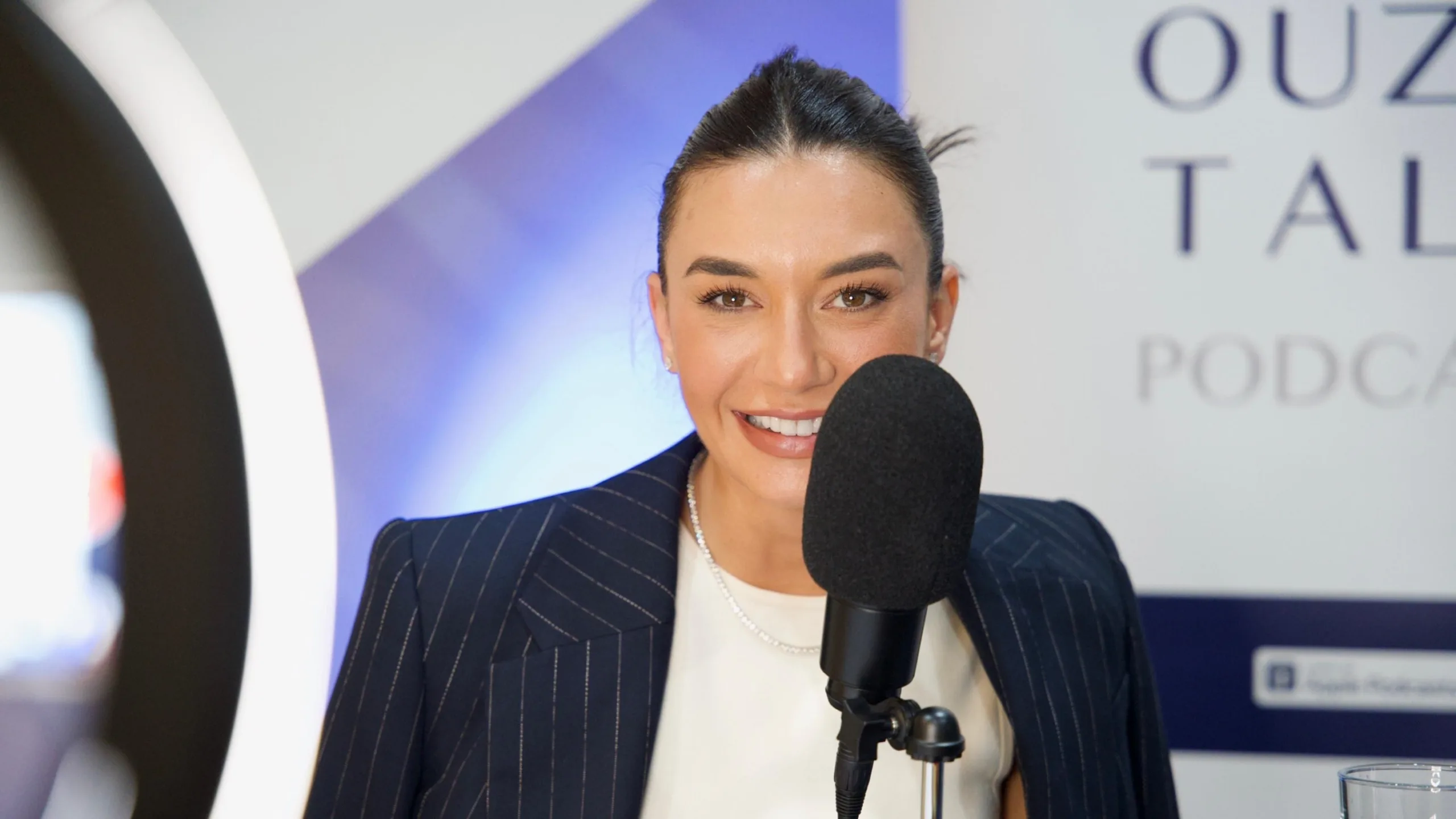
In a wide-ranging and candid conversation on the Ouzo Talk podcast with hosts Tom Skolarikis and Nick Athanassiou, Publisher and Managing Director Dimitra Skalkos reflected on the paper’s legacy, the pressure of leading it, and the realities of publishing in a media environment defined by speed, noise and, increasingly, misinformation.
There were laughs, a few hard truths, and at least one story that raised eyebrows.
From the story behind her father’s rise in publishing, to stepping into the role at 28, to the tension between digital reach and editorial integrity, the discussion moves across the past, present and future of one of the Greek diaspora’s longest-running institutions.
“We’re really proud of the milestone,” she said.
“But for the history of the paper, it’s huge. And the community – unbelievable.”
Founded in 1926 as Panellinios Kiryx, The Greek Herald was established to inform and connect Greek migrants in Australia. A century on, it continues in that role – and remains the only Greek-language newspaper printed daily outside of Greece.
Built through resolve
Much of the paper’s modern identity is tied to the late Theodore Skalkos, whose four decades as publisher left a lasting imprint on its development and direction.
As Dimitra explained during the podcast, her father’s entry into publishing was not strategic – it was instinctive, and largely unplanned.
After building a small printing operation – beginning with business cards, wedding invitations and commercial jobs – a dispute over advertising placement in The Greek Herald became the turning point.
“He went and opened his own newspaper to compete,” she said, referring to her father.
What followed was not simply competition, but expansion and eventual control – a trajectory shaped by persistence and what she described as a distinctly “Spartan” resolve.
It is a story that continues to define the paper today: one built, not inherited.
Leading under pressure
That legacy became personal in 2019, when Dimitra stepped into the role of publisher following her father’s passing at just 28 years old.
There was no gradual transition – only expectation, responsibility and visibility.
“I had no idea what I was doing,” she said.
“But I never thought I didn’t have to do it. It was just – we have to continue the paper.”
In the days that followed, readers across Australia reached out with a consistent message: continue.
“That was it,” she said. “Decision made.”
What followed was a period of adjustment – leading a multi-generational team, navigating internal and external pressures, and doing so within a community where the line between audience, subject and stakeholder is often blurred.
“We’re accessible,” she said.
That accessibility brings scrutiny, particularly when reporting on matters that are not always welcomed by those involved.
But the paper’s position, she made clear, does not shift.
“If it’s fact and it’s unfavourable, well, I’m not your publicist,” she said.
“We’re here to do a job in public interest journalism.”
Media, misinformation and trust
A central theme of the Ouzo Talk discussion was the changing nature of media itself.
Speaking with Skolarikis and Athanassiou, Skalkos acknowledged a shared concern around the volume of unverified content now circulating online, and the erosion of traditional filters that once defined journalism.
In that environment, she argued, the role of established mastheads becomes more critical – not less.
“If I read it in The Greek Herald, someone’s made sure that what I’m reading is correct,” she said.
The process, she explained, is deliberate: verification, attribution and accountability remain non-negotiable, even as digital platforms push speed and volume.
The conversation also touched on the pressure to adapt – balancing audience growth online with maintaining editorial standards, and resisting the pull of content designed purely for clicks.
While digital reach has expanded significantly, print continues to hold its place, particularly as a permanent record of the community’s story.
“It creates a historical archive,” she said.
“You are always, always, always going to be in history.”
Looking ahead
As The Greek Herald approaches its centenary, preparations are underway not only to mark the milestone, but to document it.
This includes a special commemorative keepsake edition, as well as a forthcoming publication developed in collaboration with Professor Anastasios Tamis, which will chronicle the newspaper’s 100-year history in depth.
But beyond the celebrations, the focus remains forward.
At its core, Skalkos said, the publication continues to serve the same purpose it always has – giving the community a voice, and ensuring its stories are recorded with accuracy and independence.
In a moment that captured both the weight and personal connection attached to the paper, she added:
“I have a kid… Ellinikos Kiryx is her name.”
“She’s turning 100.”
A century on, The Greek Herald is not simply reflecting on its past – it is continuing to define its place in the present.
The full Ouzo Talk episode featuring Dimitra Skalkos, hosted by Tom Skolarikis and Nick Athanassiou, is available to listen to online.
