South Australian judges and magistrates have earlier this week adopted a new policy targeting inappropriate workplace conduct by judicial officers.
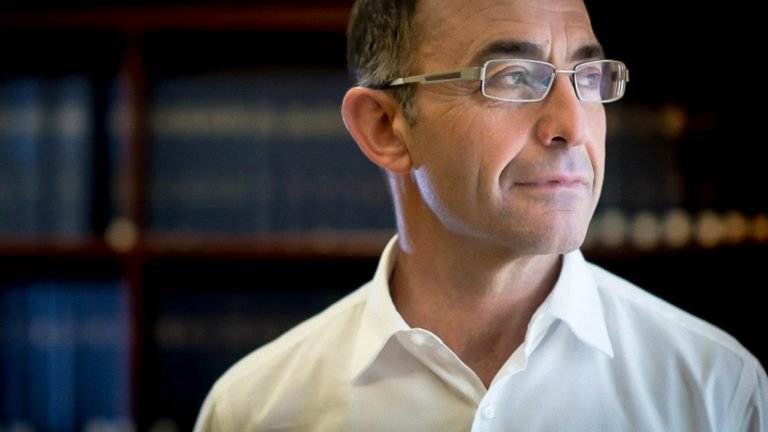
In a statement, the Honourable Chris Kourakis, Chief Justice of South Australia’s Supreme Court, has said the ‘Judicial Officer Appropriate Workplace Conduct Policy’ demonstrates a commitment to “providing a safe, respectful and supportive workplace for all.”
Kourakis CJ went on to say the South Australian judiciary at all levels “will not tolerate inappropriate workplace conduct by judicial officers.”
“The authority assumed with taking judicial office comes with a responsibility to lead by example in court, in our workplaces and in the community,” he said.
Chief Justice Chris Kourakis supports the WE'RE EQUAL campaign, led by the Office of the Commissioner for Equal Opportunity #WeAreEqualSApic.twitter.com/7pO7fS8vYp
The new policy outlines what behaviours constitute inappropriate workplace conduct and defines bullying, discrimination, harassment, sexual harassment and victimisation.
It also calls on judicial officers to “recognise the significance of any power imbalance in a personal relationship in the workplace, including by reason of seniority in position or age,” mandating that sexual relationships with colleagues be disclosed.
As reported by ABC News, the new policy comes after a 2021 report by the Equal Opportunity Commissioner revealed widespread sexual and discriminatory harassment in South Australia’s legal profession.
Forty-two per cent of respondents said they had experienced sexual or discriminatory harassment at work, with one-third claiming to have experienced it on multiple occasions.
Predatory behaviour and unwanted advances were also recorded, with 41 respondents saying they had received requests or pressure for sex or other intimate acts.
The new policy was adopted by a resolution of South Australia’s Heads of Jurisdiction of the Supreme Court, District Court, Magistrates Court, Coroners Court and Youth Court.
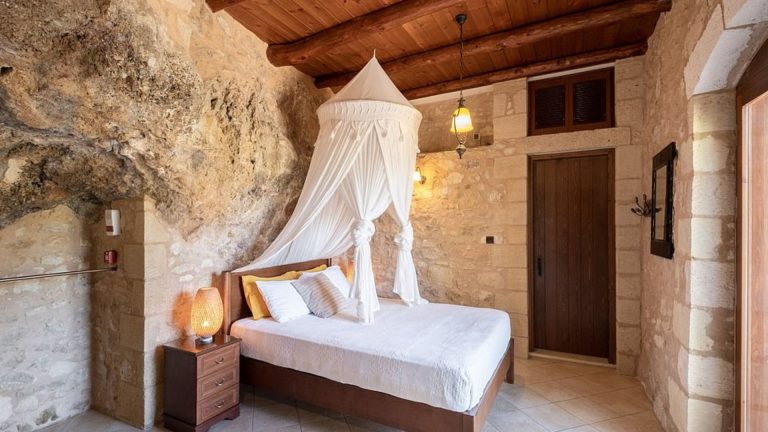
A luxurious villa in the small village of Kalivani, Chania in Crete has been placed on Airbnb’s list of eight all-time most wish-listed ‘unique homes’ around the world.
The list of one-of-a-kind properties include a ‘magical treehouse’ in the Santa Cruz Mountains in California, a grand 15th century castle in the west of Ireland and a rainforest treehouse in Costa Rica.
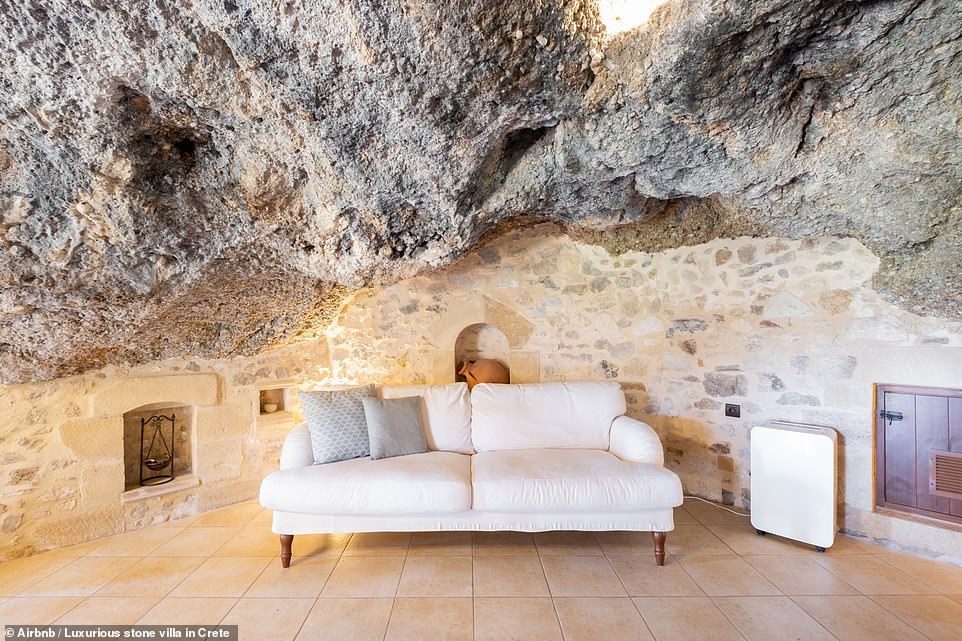
The unique apartment in Crete is housed in a natural cave that at one time was used as a family home and then later used as an agricultural storage space.
Following a renovation in 2007, the stone villa was turned into a luxurious studio with a balcony that looks over the stunning Kissamos Bay.
Guests can enjoy this beautiful villa that sleeps three and is priced from roughly $300 a night.
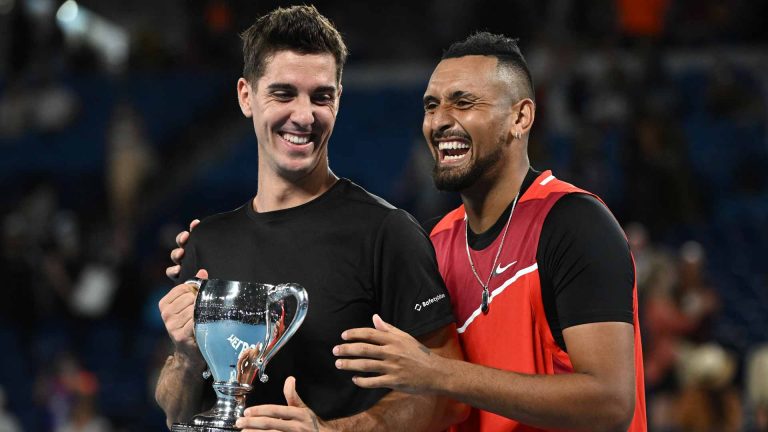
The US Open draw has been revealed, with friends and double partners, Nick Kyrgios and Thanasi Kokkinakis set to face off in a bittersweet first-round men’s singles encounter.
The Australian Open and most recent Atlanta Open-winning duo have been dubbed by the ATPas one of the most exciting double teams on the circuit this season, however only one can advance to the second round of the men’s singles in the US tournament.
Whilst the pair will be seeking their third title of the year together in the men’s doubles, they have never played against each other on main tour.
Kyrgios, seeded 23rd, is one of the world’s most in-form tennis player’s, showcasing his skills this year in his run to the Wimbledon final in July and subsequent victory in Washington earlier this month.
If he beats Kokkinakis, he will likely play France’s Ugo Humbert in the second round and 16th seed Spaniard, Roberto Bautista Agut in the third, before a possible blockbuster with Medvedev.
The draw announcement comes as early this morning, Novak Djokovic announced he will not be competing in the American grand slam, with US rules disallowing his entry to the country due to his COVID-19 vaccination status.
Sadly, I will not be able to travel to NY this time for US Open. Thank you #NoleFam for your messages of love and support. ❤️ Good luck to my fellow players! I’ll keep in good shape and positive spirit and wait for an opportunity to compete again. 💪🏼 See you soon tennis world! 👋🏼
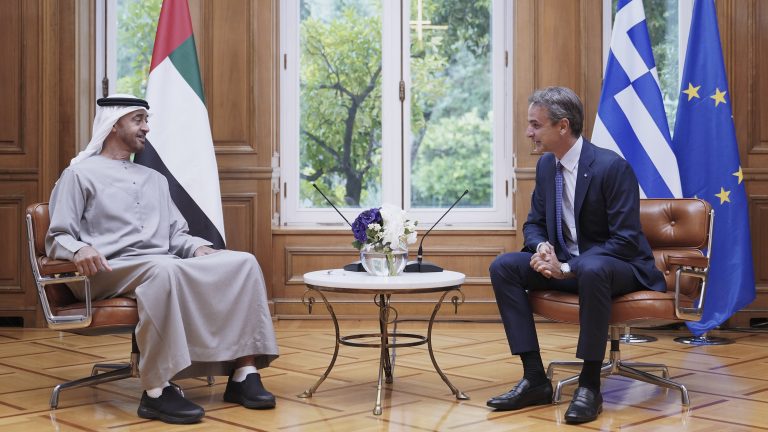
Greece’s Prime Minister, Kyriakos Mitsotakis, met with the President of the United Arab Emirates (UAE), Sheikh Mohamed bin Zayed Al Nahyan, at Maximos Palace on Thursday, to deepen bilateral relations and strengthen areas of common interests.
Mitsotakis referred to the “excellent bilateral relations” between the two countries, stressing that the UAE is a stable strategic partner of Greece, with an important role in both the Gulf region and internationally.
Al Nahyan, who is visiting Greece for the first time in an official capacity since his election as President in May this year, said the relationship between Greece and the UAE is “very important” and that his main concern “is to see that relationship bear fruit.”
“We have worked to build a bridge between our countries. I am very happy that in the last two years we have made great progress and our relationship is at a point where it can be upgraded even more,” he said.
During his visit to Abu Dhabi in November last year, Mitsotakis signed two agreements forging strategic alliances with the UAE in the field of economic cooperation, as well as in defence and foreign policy.
Οι υποδομές που δημιουργούνται στην Ελλάδα στον τομέα της εισαγωγής, αποθήκευσης και επαναεριοποίησης Υγροποιημένου Φυσικού Αερίου, σε συνδυασμό με την στρατηγική γεωγραφική της θέση, την καθιστούν πύλη εισόδου ενέργειας προς την Ευρώπη και γέφυρα σύνδεσής της με τη Μέση Ανατολή. pic.twitter.com/oXSO15KxzN
In Thursday’s meeting, the pair discussed energy at length, with Mitsotakis informing the UAE President of the important infrastructures being created in Greece for the import, storage and regasification of natural gas.
The Greek Prime Minister noted that Greece occupies a strategic geographical position, making it not only a hub and gateway for energy to enter Europe, but also a bridge connecting Europe to the Middle East.
The Prime Minister also underlined the need to ensure stability and peace in the Southeast Mediterranean, maintaining it is the last thing the region needs when the consequences of the Russian invasion of Ukraine are testing European and international security.
Kyriakos Mitsotakis expressed his satisfaction over the fact that the United Arab Emirates will be the honoured country at the 86th International Exhibition of Thessaloniki next month and extended an invitation to the President to attend.
He’s the man everyone credits with ‘saving’ rugby league in Australia during the COVID-19 pandemic; and the man who recently announced that the NRL Grand Final would return to Sydney this year in a move praised by many sport fans.
But as I sit down for a Zoom interview with the Chairman of the Australian Rugby League (ARL) Commission and CEO of Racing NSW, Peter V’landys, I can instantly tell there’s more to the man than just sport.
Beneath the tough boss veneer is a man who worked hard to assimilate into Australian society and make his Greek migrant parents proud.
Becoming ‘one of them’ through sport:
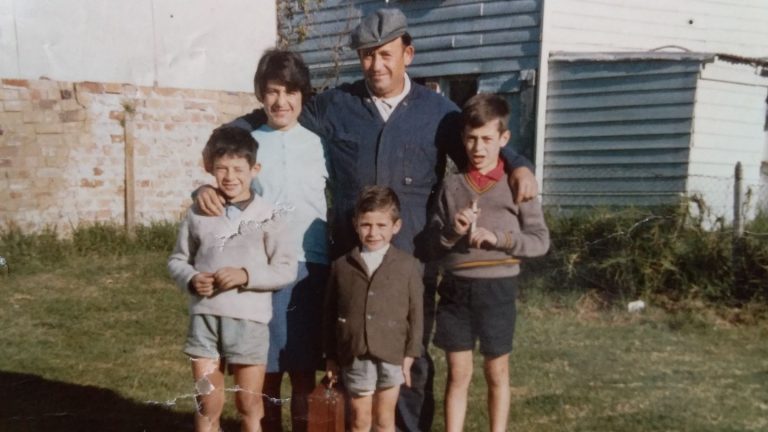
Born on the Greek island of Kythera, V’landys migrated to Australia in 1965 with his two brothers and mum, to join his dad in Wollongong, south of Sydney. At the time, V’landys was only three years old and life was difficult.
Peter V’landys’ parents. Photo supplied.
“We grew up in a typical Greek house. We spoke Greek. My dad would work from 6am until 3pm but then, in order to earn extra money, he would do what they call a ‘doubler’ and work until midnight,” the rugby league boss says.
“My mum would leave before we’d go to school and work in my aunt’s café and she’d be there until 6 or 7 o’clock at night. So, myself and my two brothers had to look after ourselves to a great degree.”
This wasn’t always easy though. As the children of Kytherian migrants, V’landys and his siblings were easy targets for bullies.
“I went to school pretty early because we couldn’t afford childcare… and it was pretty hard because you couldn’t speak English, you were sort of an alien to these young Aussie kids. They didn’t accept us. To them we became ‘wogs’,” V’landys explains.
Luckily for him, V’landys says he ‘found sport’ and was able to assimilate and ‘become one of them’ through rugby league.
Peter V’landys says rugby league helped him assimilate in Australia.
“It’s weird because when I was a kid, you’d run to the fence and they’d pick two captains and then they would pick their teams. The biggest fear I had was not being picked in one of those teams,” V’landys says with a laugh.
“But if you’re a good sports person, people wanted to befriend you. So, I had to be good at it [rugby league] so I was part of that team and they would rely on me. That’s how I assimilated.”
‘Kythera is special’:
Despite this assimilation, it’s clear V’landys still maintains a deep connection to Kythera.
The ARL Commission Chairman openly shares memories of his return visits to the Greek island, including one involving his late grandfather.
“I was a picky eater and my grandfather used to give me almonds… and that’s all I’d eat. When we left [Kythera], I can remember him saying to me ‘I’m going to plant an almond for you so when you come back, it will be this massive almond tree’,” V’landys says with a smile.
“So, when I finished university I returned and sure enough, there was the biggest almond tree you’ve ever seen in front of our house. It was surreal.”
Later, V’landys also pulls out a Greek Orthodox icon of Saint Paraskevi from his wallet and proudly shows it through the Zoom screen.
Icon of Saint Paraskevi in Peter V’landys’ wallet.
“When we visited Kythera the second time, we visited our house. I was born in that house and under the bed was this icon and so I picked it up and kept it,” he says.
“So, now I always keep it in my wallet. I’ve lost my wallet twice and twice I’ve got it back with her in it.”
The inspiration of his parents:
Another thing V’landys has never truly lost is his passion and determination for racing and rugby league.
He’s grown from a young man helping out at Harrold Park Paceway with the harness racing, to being headhunted for the role of CEO at Racing NSW.
Later, V’landys says he took on the Chairmanship at the ARL Commission because he felt he had ‘a debt to repay’ to rugby league after it helped him assimilate.
Peter V’landys is also the CEO of Racing NSW.
“I’ve spent most of my career in sport really, although I’ve owned some businesses along the way as well. But it’s mainly been racing and rugby league. With Aussies, that would be the dream. Have your two favourite passions… but it’s not a dream. It has its moment,” he says.
Despite these ‘moments,’ V’landys’ profile has surged over the last two years thanks to his handling of the COVID-19 pandemic and its impact on rugby league and racing in Australia.
When I ask him what the key to this success is, he admits it’s tied to his Greek upbringing and shares some words of wisdom for the next generation.
“I take it back to my Greek parents. I’ve always followed my parents lead and really worked hard,” V’landys concludes.
“Here’s this Greek immigrant kid… getting bullied in the playground, not the greatest student on earth but worked hard all his life to get here. That comes with determination and not giving up.
“For me, what I like about where I am is if I can do it, anyone can do it.”
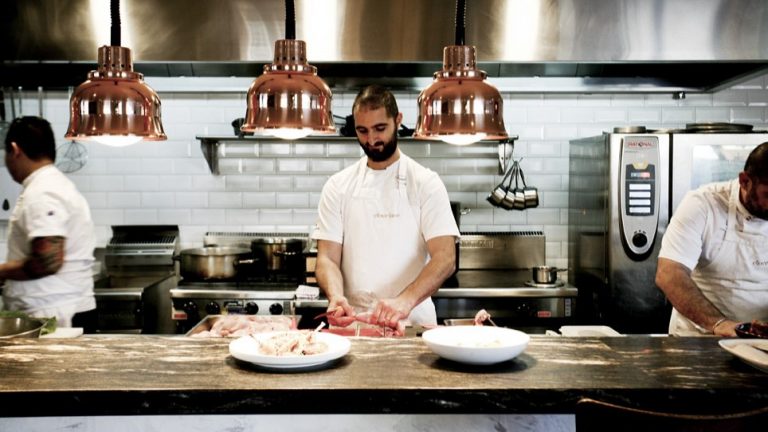
Clove Lane in Sydney’s eastern suburbs, which is owned by Emile Avramides, has won the ‘People’s Choice Award’ in the delicious.100 list.
The bistro in Randwick was ranked in 100th place when the initial rankings were released by delicious.100 earlier this month but after the wider public were invited to vote, Clove Lane jumped into first place.
“Just to be included in the delicious.100 in the first place was incredible,” he said.
“It’s overwhelming to find out we’ve been voted as number one. We’re a small neighbourhood bistro so to see that support from the community has blown us away.”
The delicious.100 review for Clove Lane praised the restaurant for bringing the fine-dining experience to the suburbs with reasonable pricing.
Close behind in the 2022 delicious.100 People’s Choice Award was Lankan Filling Station, a Sri Lankan diner in Darlinghurst which was named the second best restaurant in NSW.
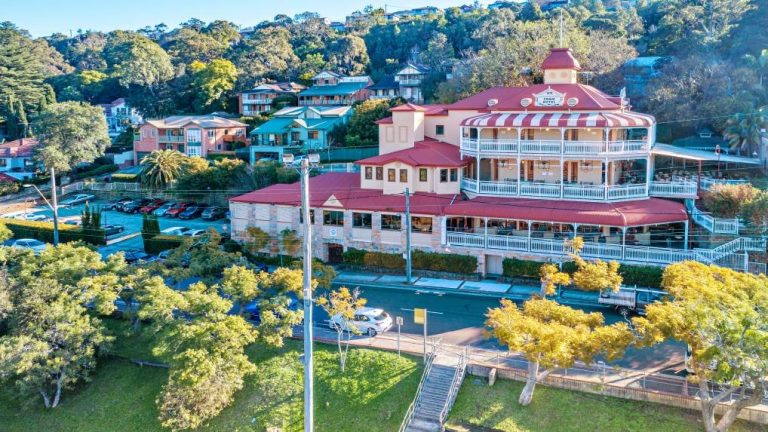
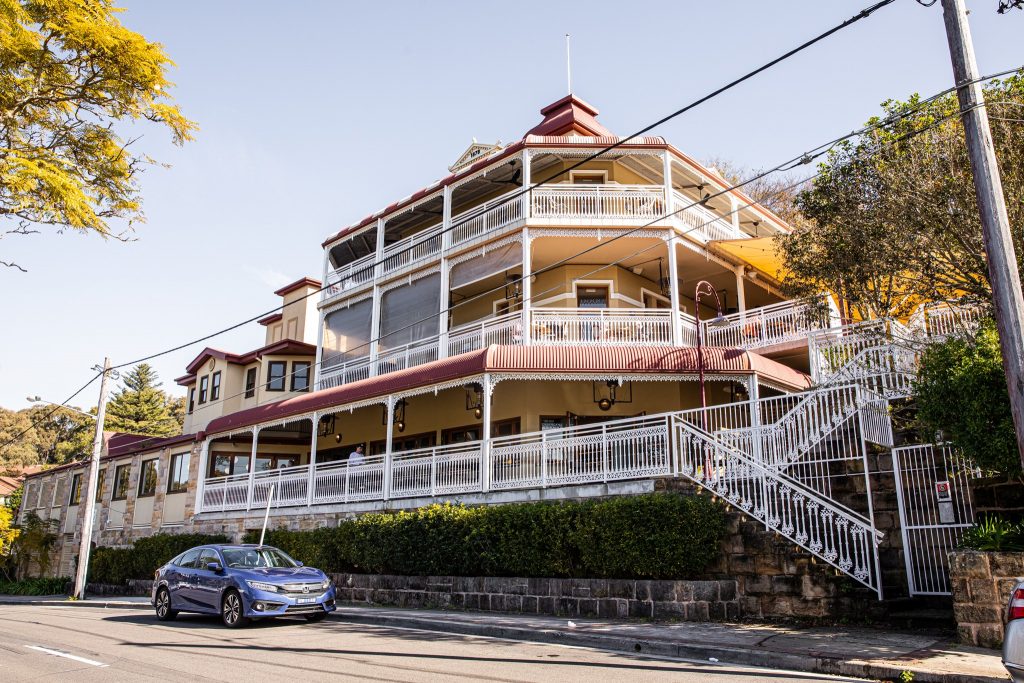
High-profile hotelier brothers, Bill and Mario Gravanis, have put one of the oldest buildings in Sydney’s Sutherland Shire on the market.
The Como Hotel is being sold exclusively through Sydney CBD-based HTL, a boutique brokerage business owned and operated by leading hotel specialists.
Perched high on 3000 square metres, the iconic property is sprawled across four levels and has panoramic water and park views.
HTL Property’s Dan Dragicevich, who is one of three listing agents, told The Leader the pub is “a rare listing for Sydney.”
The Gravanis brothers have put The Como Hotel up for sale.
“You see a lot of heritage-looking pubs around, but it’s one of the better looking pub buildings in Sydney,” Mr Dragicevich said.
The Gravanis brothers of Oscars Hotels first bought the property in late 2016 for about $5.6 million from businessmen Geoff Dixon and John Singleton’s then Australian Pub Fund.
Expressions of interest for the property close at midday on September 15 unless sold prior.
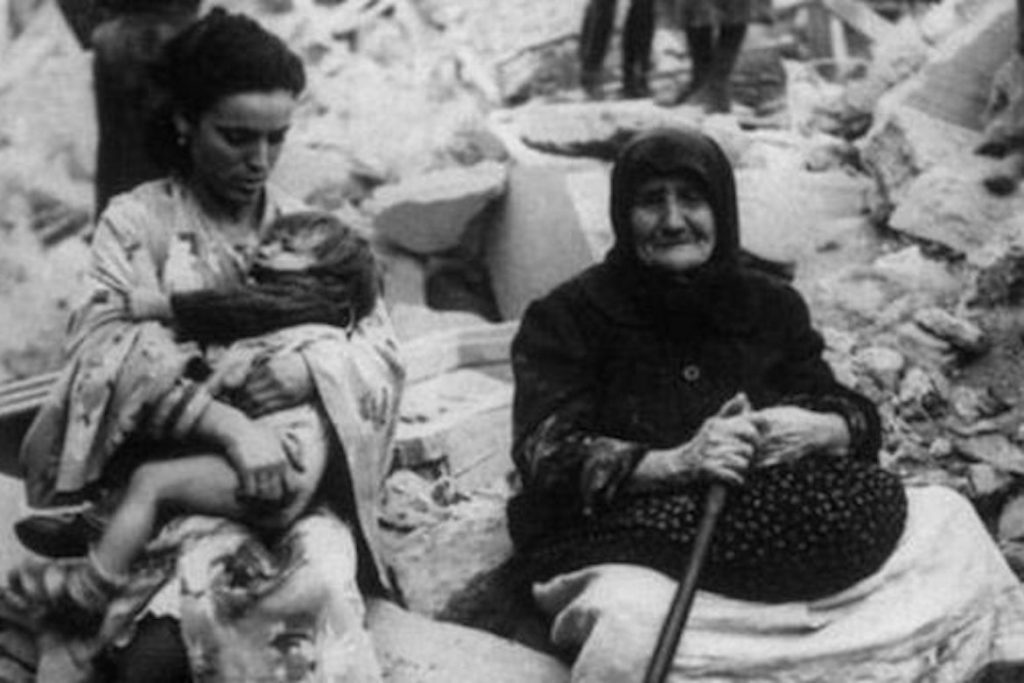
The massacre saw the near-extermination of the male population and the total destruction of the Greek town of Kalavryta by the Nazi forces during World War Two on December 13, 1943.
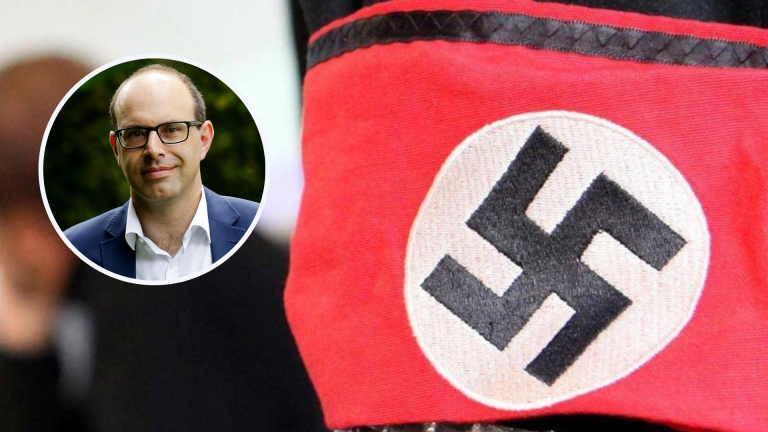
Almost 80 years later, this event played an influential role in the decision of Greek Australian Parliamentary Secretary for Wollongong and the Illawarra, Peter Poulos MLC, to take a lead role in the NSW Government’s push to ban the public display of Nazi symbols without a reasonable excuse across the state.
Speaking before the NSW Legislative Council earlier this month, Mr Poulos detailed how his dad witnessed “some of the most reprehensible acts on display by the Nazi regime” at Kalavryta during WWII.
Women and children from Kalavryta.
“There were a number of villages in close proximity to that town [Kalavryta]. My dad as a little boy witnessed Nazi soldiers entering the village looking for males to round up. In his set of circumstances, they were unsuccessful,” Mr Poulos explained.
“To be able to reflect on the meaning of the symbol, to know someone so close to me personally who recognised what it signified and to identify that in a town nearby occurred one of the worst episodes within occupied Greece of the extermination of practically an entire male population, is noted but not forgotten.”
Mr Poulos also touched on the “strong historic links” between Greece and the Jewish community, and their unjust treatment at the hands of the Nazi regime.
“That community has basically been eradicated from Greece as a result of the most reprehensible course in human history,” he said.
NSW has made it a criminal offence to knowingly display a Nazi symbol in public without a reasonable excuse.
“I pass on my strong sympathies to the Jewish community, who experienced that first-hand or through the relayed experiences of those who are no longer with us.”
Ultimately, in a historic moment for NSW, a new law making it a criminal offence to knowingly display a Nazi symbol in public without a reasonable excuse passed Parliament on August 11.
At the time, the NSW Minister for Multiculturalism, Mark Coure, said the passing of the Bill was a victory for the rich multicultural society of the state.
“This Bill shows that our Government stands against the Nazi symbol and the hateful ideology it represents,” Mr Coure said.
The new offence in the Crimes Act 1900 will carry a maximum penalty of 12 months’ imprisonment or a $11,000 fine or both for an individual; or a fine of $55,000 for a corporation.
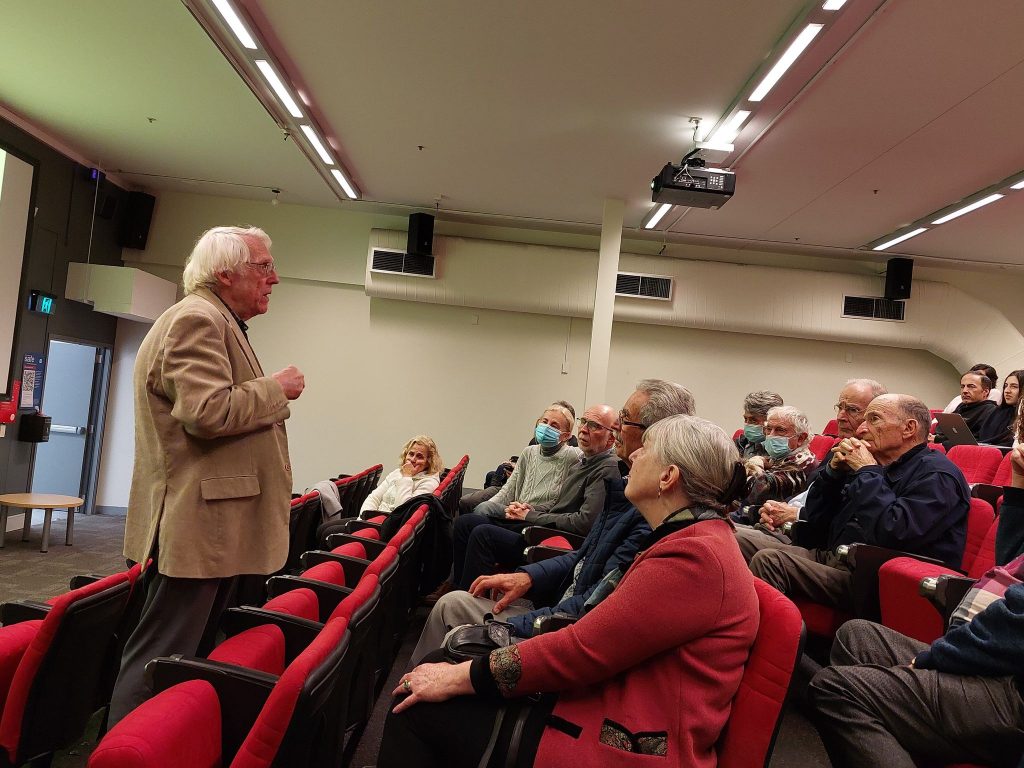
The cuisines of the Mediterranean lands, and of Greece in particular, was the topic of a talk given by Dr Alfred Vincent at an event organised by the Hellenic Society of the University of Technology Sydney (UTS Hellenic).
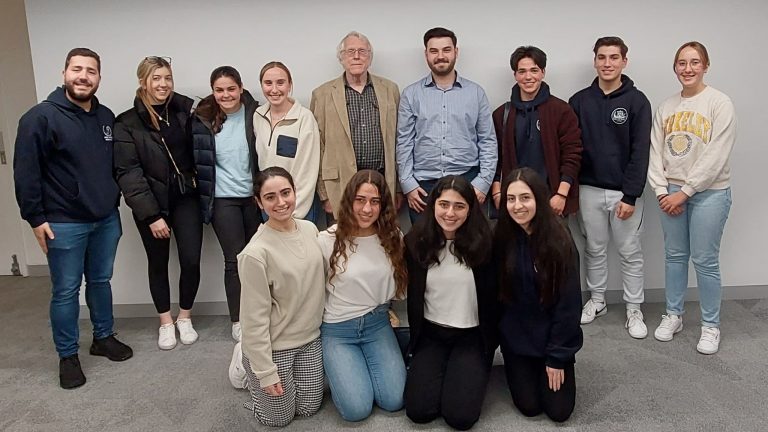
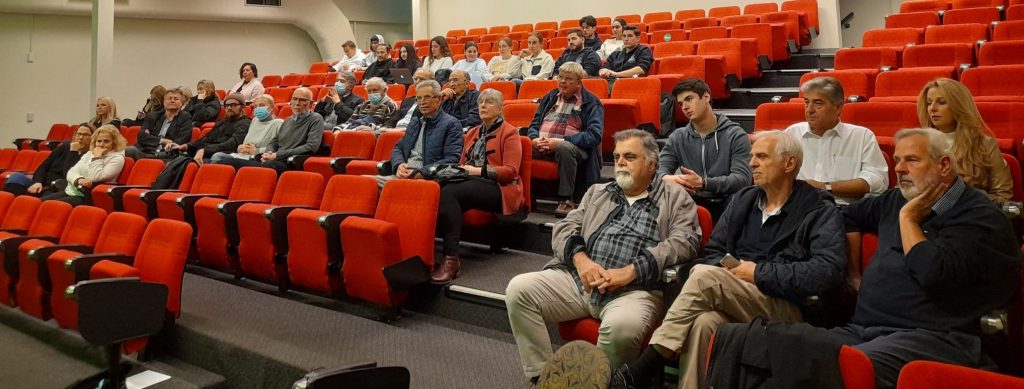
The event took place at the University’s Ultimo campus on Thursday, August 18 and attracted students, members of the education community, representatives of Greek Australian organisations and people from the community at large.
The title of the talk was How traditional is the ‘Mediterranean Cuisine’? Food and drink in the Greek lands before the 20th century.
Dr Vincent reminded attendees that “before the advent of refrigeration and rapid, economical transport, food cultures in Greece and elsewhere depended much more than nowadays on local ecosystems.”
Dr Vincent talking to the crowd.
He highlighted the fact that “in the Mediterranean region, despite the great differences between local cuisines, some common features have been provided by three basic types of plant cultivated in the area: the olive, the grape vine, and grains such as wheat and barley.”
“All of these have been characteristic of Greek food culture from ancient times to the present day,” Dr Vincent added.
Nevertheless, Dr Vincent emphasised that “some foods, such as potatoes and tomatoes, which we might regard as fundamental to the Greek cuisine, are actually quite recent additions, and were little known before the Revolution of 1821.”
Dr Vincent concluded with the highlight that “this may remind us of the fact that cultural traditions are not fixed in stone, but continually evolve, as people respond to changing situations and new possibilities.”
Attendees at the UTS Hellenic lecture.
It should be noted that Dr Vincent, who taught Modern Greek studies for 25 years at the University of Sydney, continues in retirement to research on the society and culture of the Greek world. His publications include an annotated edition of the memoirs of Tzouanes (Ioannis) Papadopoulos (1618-c.1700), which contain a wealth of information on food and drink.
UTS Hellenic President, Dimitri Kallos, welcomed the attendees, saying that the society is seeking to enhance its involvement with initiatives related to Greek culture and traditions and, at the same time, boost its connections with the Greek Australian community and the wider Australian society.
Among the attendees were Associate Professor Anthony Dracopoulos and other educators; Ms Artemis Theodoris, President of the Afternoon and Saturday Schools of the Greek Orthodox Community of NSW; Dr Michael Kotis, President of the Greek Atlas League; Ms Barbara Zantiotis, President of Kytherian Association of Australia; Mr Kosta Plegas, President of the Sydney University Greek Society; representatives from the Hellenic Society of the University of NSW; members of the committee of UTS Hellenic; and members of the Greek language media.
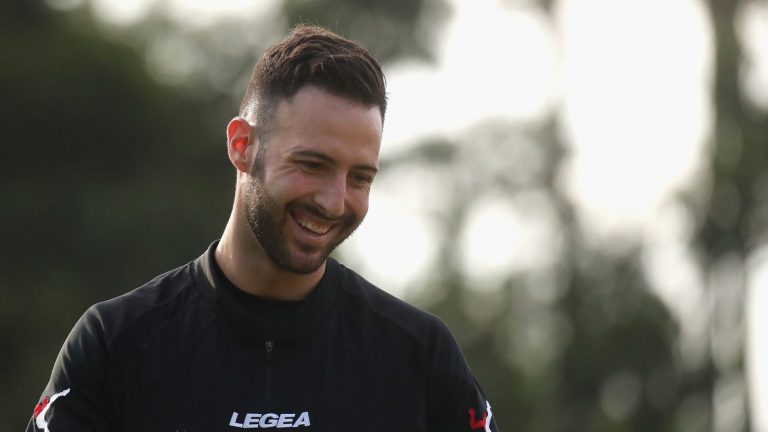
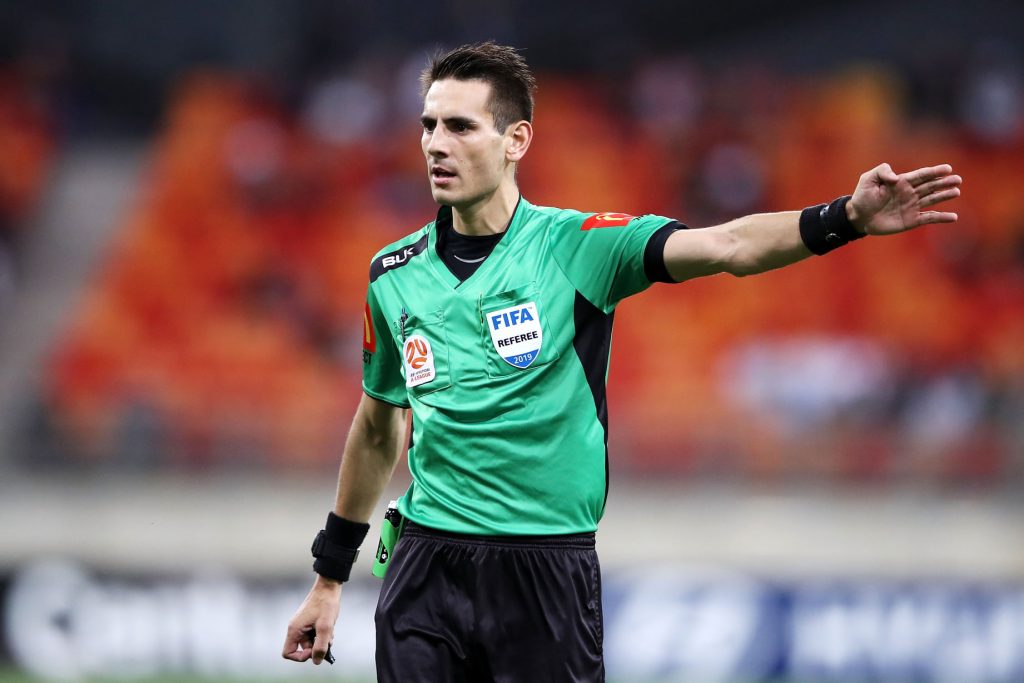
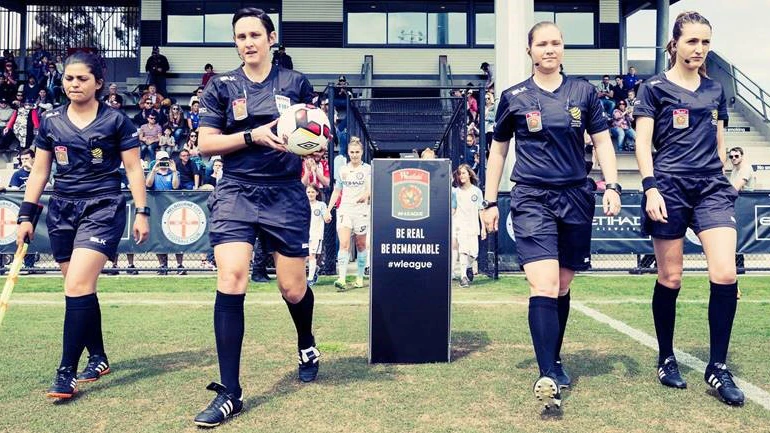
The Football Australia Referees Committee have finalised the match official panels for the upcoming 2022/23 A-Leagues seasons and among the names are five people of Greek heritage.
In the match official panel for the A-League Women matches, Charaktis will be joined by Anastasia Filacouridis from NSW as assistant referees.
Charaktis has also been appointed to the FIFA U17 Women’s World Cup 2022 scheduled to take place in India during October.
In a statement following the appointments, Football Australia Head of Referees, Nathan Magill, congratulated everyone on their selections.
Assistant referee Joanna Charaktis (right). Photo: Football Victoria.
“The next 12 months is shaping to be an exciting time for Australian match officials, and I am looking forward to seeing what our team will achieve on the domestic and global stage,” Mr Magill said.
The new A-Leagues 2022/23 seasons will kick off on Friday, 7 October for Isuzu UTE A-League Men, with the Draw for the Liberty A-League Women to be released by the Australian Professional Leagues (APL) in the near future.