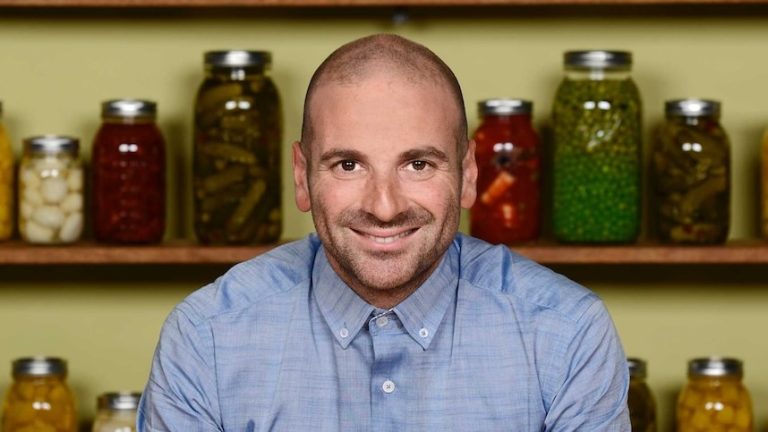
In an interview with The Herald Sun, Calombaris said the new Greek restaurant was inspired by a recent family trip to Greece where his passion “to get back into hospitality to feed people’s souls” was reignited.
The Hellenic House Project will be located at Highett Road, Highett and Calombaris said it will mirror a typical Greek home with four separate spaces.
There will be ‘The Good Room’ upstairs where homestyle Greek cuisine will be served; ‘The Kitchen’ downstairs with takeaway souvlas, hot chips and cold beer; ‘In The Backyard’ decorated with lemon and olive trees to drink and snack; and a ‘Balcony’ drinking spot.
The new restaurant will have Anthony Thalassinos as kitchen lead, and former The Press Club and Gazi staffer, Frederico Bianco, will head up front of house.
“Modern Greek cuisine is in my blood, it’s what I know, and there was never any doubt that I would find my way back into ‘home’ territory,” Calombaris told The Herald Sun.
Since then, the chef works as Hotel Sorrento’s culinary director, which he will continue to do whilst overseeing The Hellenic House Project. Calombaris also returned to TV last year, hosting Channel 10 food show Hungry with MasterChef contestant Sarah Todd.
Greece’s Prime Minister, Kyriakos Mitsotakis, has pledged to extend the existing wall at Evros across all of the country’s land border with Turkey if re-elected in the upcoming national elections.
Mitsotakis made the election pledge during a ceremony on Friday where he signed off his centre-right government’s decision to nearly double the length of the existing steel border wall over the next year.
The wall currently spans 37.5 kilometres and the government plans to extend it by 35 kilometres over the next 12 months. More than 100 kilometres of wall will be added to that by 2026, government officials said.
At the ceremony, Mitsotakis accused his political opponents from the left-wing SYRIZA party of trying to undermine the project and to block the government’s attempt to obtain European Union (EU) funding for it.
A recent amendment was tabled by SYRIZA MEP Dimitris Papadimoulis for the EU to stop the financing of such fences.
“The opposition must take a stand: Will it tear down the fence by returning to open border logic? There is no room for half-truths here,” Mitsotakis said.
“If we do not manage to find European resources to finance it [the border wall extension], we will finance it with national resources, because it is a national necessity.”
SYRIZA officials accused the government of misrepresenting the opposition’s position, adding that the EU’s executive commission already ruled out providing direct funding for border walls.
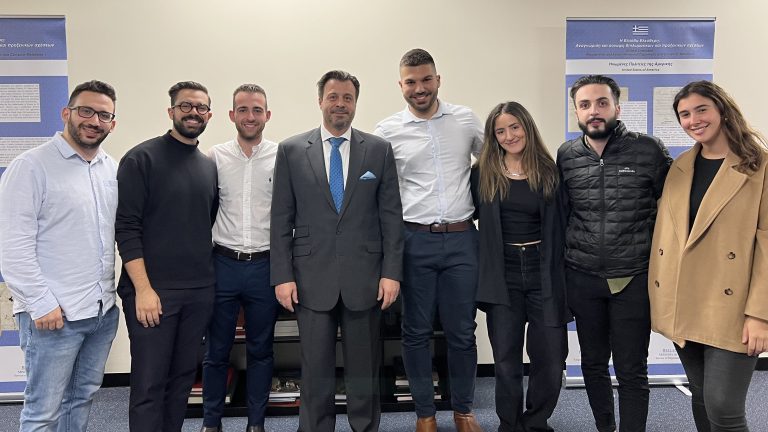
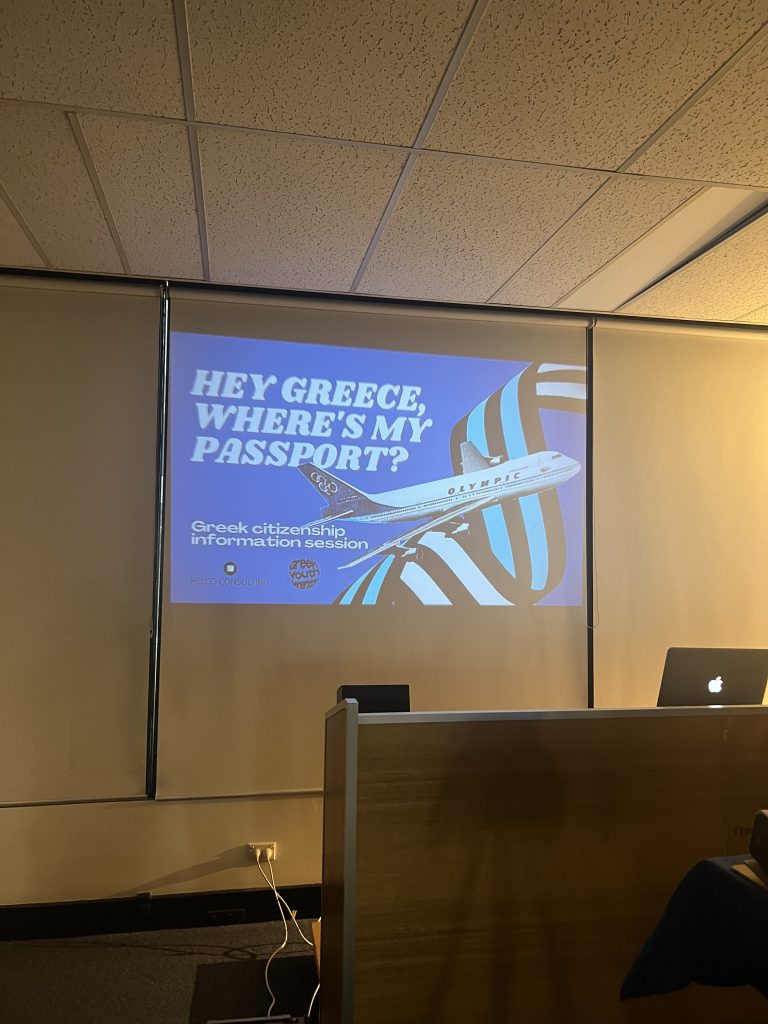
Greek Youth Generator, in consultation with the Greek Consulate General in Melbourne and Helco Consulting, hosted an information session on Thursday night titled ‘Hey Greece Where’s my Passport.’
The event was focused on providing Greek youth with the tools they need to successfully obtain their Greek citizenship.
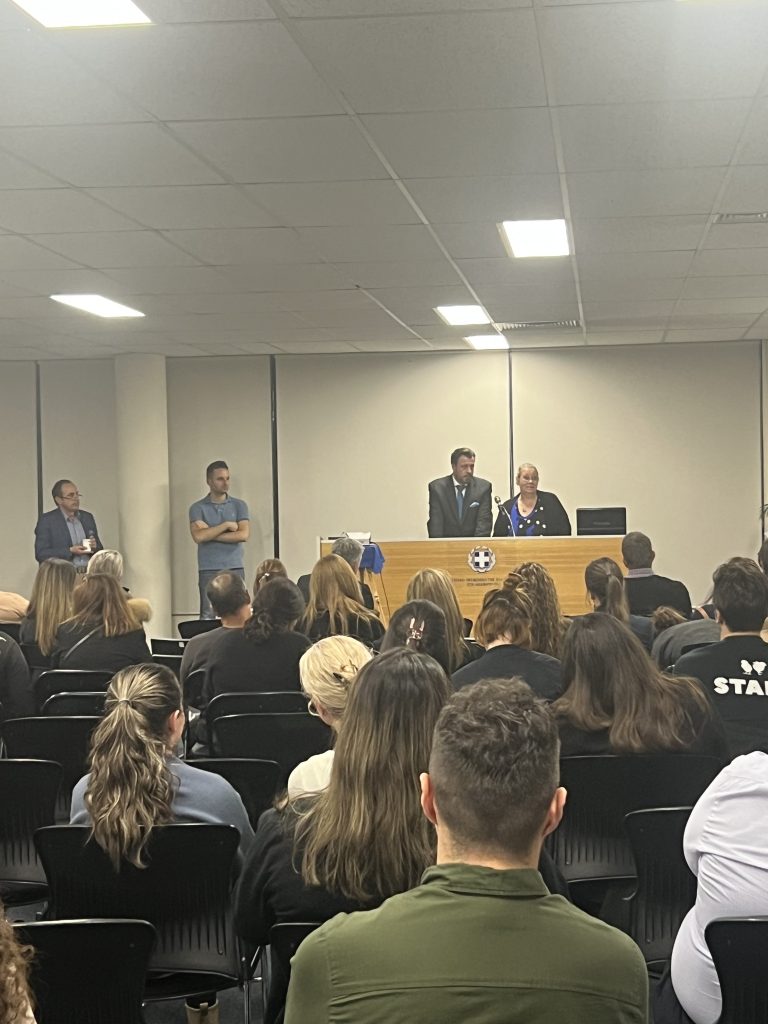
The Greek citizenship information session.
65 people attended the information session.
Luka Theodorou from Helco and Katerina Douka from the Consulate offered clear and concise information on many ambiguous parts of the Greek citizenship process and how to navigate Greek law.
Luka and Katerina spoke for around 1.5 hours and answered all questions asked by the attendees.
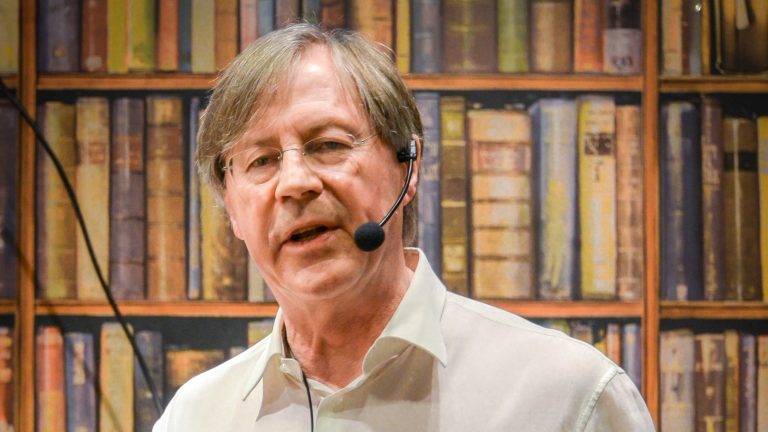
Renowned historian and author, Professor Paul Cartledge, will be speaking on the topic of ‘Hellenistic and Roman Sparta: a tale of two cities’ on Thursday, April 6 at 7 pm, as part of the Greek History and Culture Seminars, offered by the Greek Community of Melbourne (GCM). The event will be streamed live on Facebook and YouTube.
During his presentation, Professor Cartledge will delve into his book Hellenistic & Roman Sparta: A Tale of Two Cities, which highlights the importance of post-Classical Sparta. He will discuss the differences between “Hellenistic” Sparta (roughly the last 3 centuries BCE) and “Roman” Sparta, which were so distinct that they are best understood as two separate entities.
Hellenistic Sparta marked the end of the famous, powerful, Classical Sparta with its distinctive Helot-based social, political, and economic regime. Roman Sparta, on the other hand, became a “theme park” for tourists, trading on its glorious past with no Helots, Perioeci, or agoge.
Professor Cartledge is the AG Leventis Senior Research Fellow of Clare College and formerly the inaugural AG Leventis Professor of Greek Culture at the University of Cambridge. He has authored, co-authored, edited, or co-edited 30 books, including Democracy: A Life and Thebes: the forgotten city of ancient Greece. His field of study is Athens and Sparta in the Classical Age, and he has been described as a Laconophile. He was also the chief historical consultant for the BBC TV series The Greeks and the Channel 4 series The Spartans, presented by Bettany Hughes.
Professor Cartledge is an Honorary Citizen of modern Sparta and has recently been awarded the Commander of the Order of Honour for his contribution to enhancing Greece’s stature abroad.
This is a unique opportunity for anyone interested in ancient Greece and its history to hear from one of the leading experts in the field. To attend the event, please visit GCM’s Facebook or YouTube page at 7pm on Thursday, April 6.
Event Details:
When: Thursday, April 6, 2023, at 7pm.
Where: Online via GCM’s Facebook and YouTube pages.
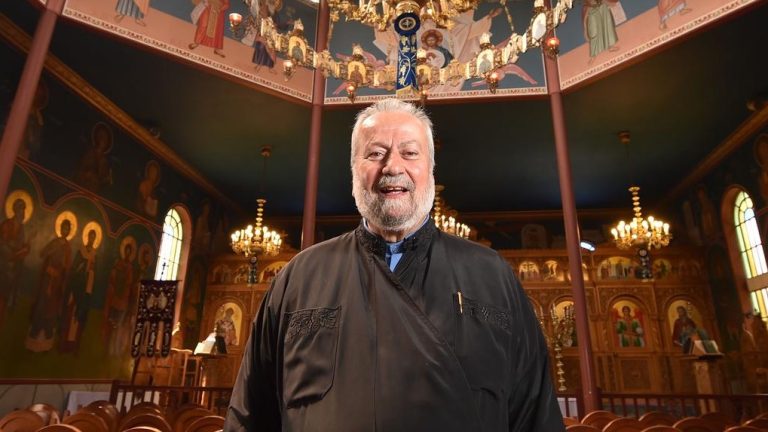
Former parish priest at the Holy Monastery of Panagia Kamariani in Red Hill, Victoria, Father Eleftherios Tatsis (Papa Lefteris), has been defrocked.
According to a statement by the Greek Orthodox Archdiocese of Australia (GOAA), the decision to defrock Papa Lefteris was made by the Ecumenical Patriarchate due to “a series of ecclesiastical and canonical offenses he committed.”
“The defrocked cleric by decision of the Orthodox Church has returned to the rank of the laity and has lost the privilege of wearing priestly vestments, as well as the right to perform the Holy Sacraments and other divine services,” the statement reads.
This defrocking comes after Papa Lefteris announced his resignation from the GOAA on October 2 last year.
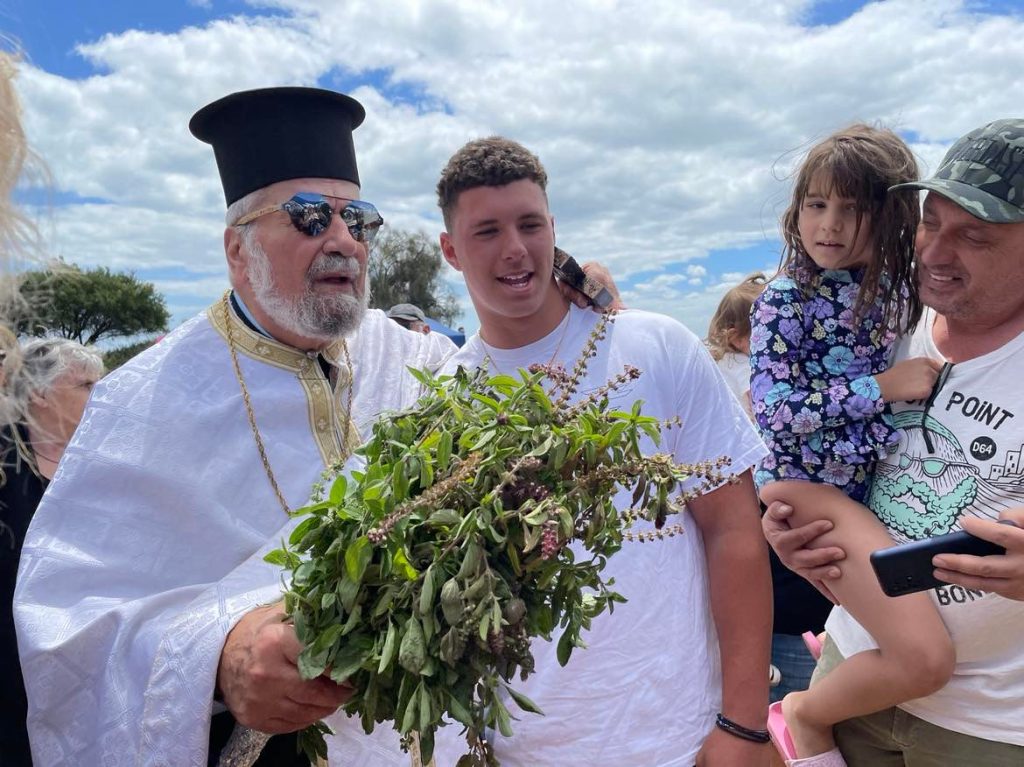
Papa Lefteris at Rye. Photo: The Greek Herald.
Papa Lefteris resigned after the Archdiocese issued a statement in August 2022 expressing its disapproval of the priest for his “belligerent rhetoric” towards the church and Archbishop Makarios of Australia.
Following his resignation, the GOAA suspended Papa Lefteris on October 5 last year and said, “from this point forth, every service and every sacrament that possibly may be performed by the said clergyman does not have validity” and is not recognised by the Archdiocese.
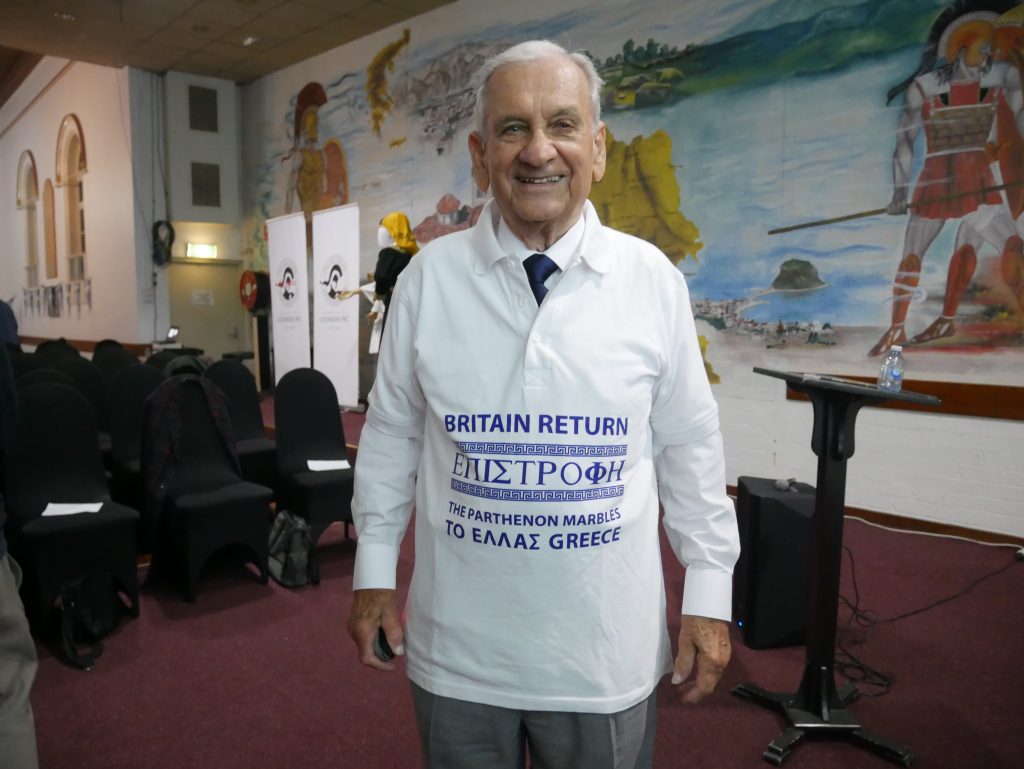
“Whatever I have done until now, I have done it with my soul and I am sure that one day these marbles are going to get back to Greece. I don’t know when but for sure they will get there,” Emanuel J. Comino tells The Greek Herald after his lecture in Brunswick, Victoria.
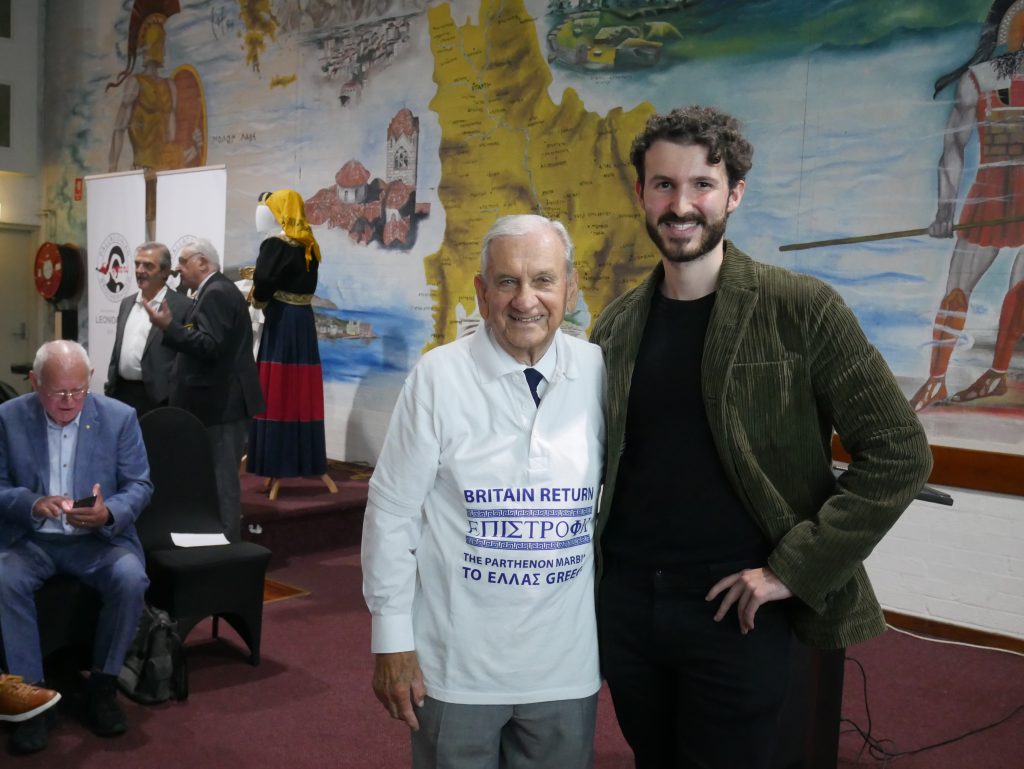
Emmanuel J. Comino.Emmanuel with Pallaconian Brotherhood President Miltiadis Paikopoulos.
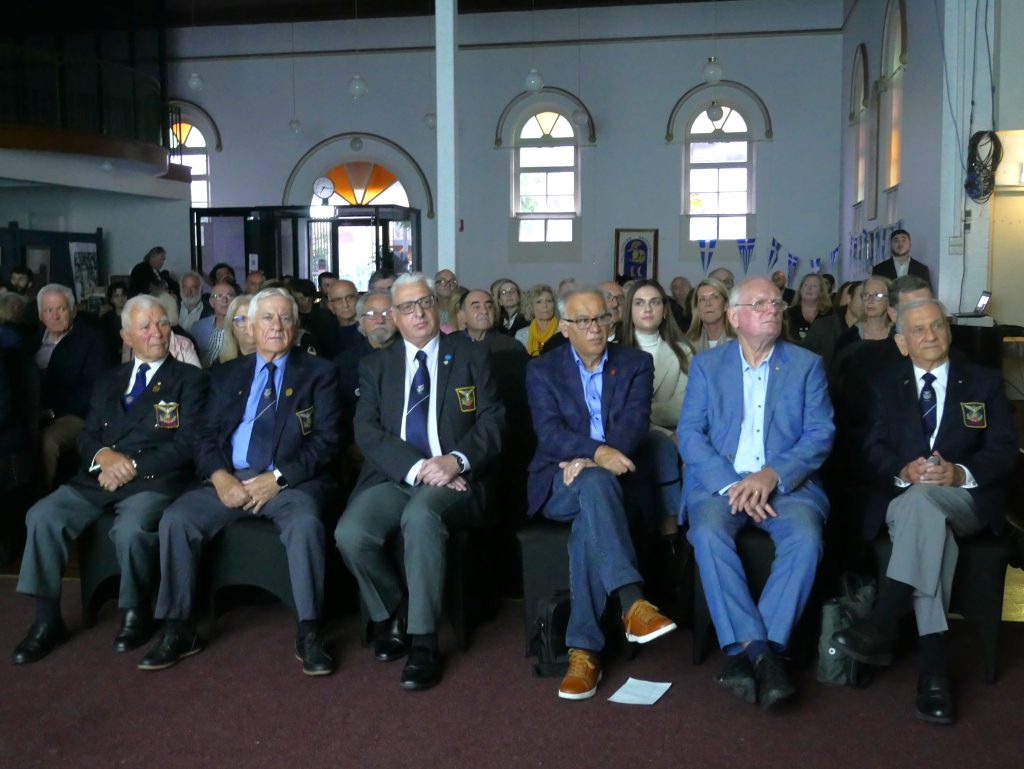
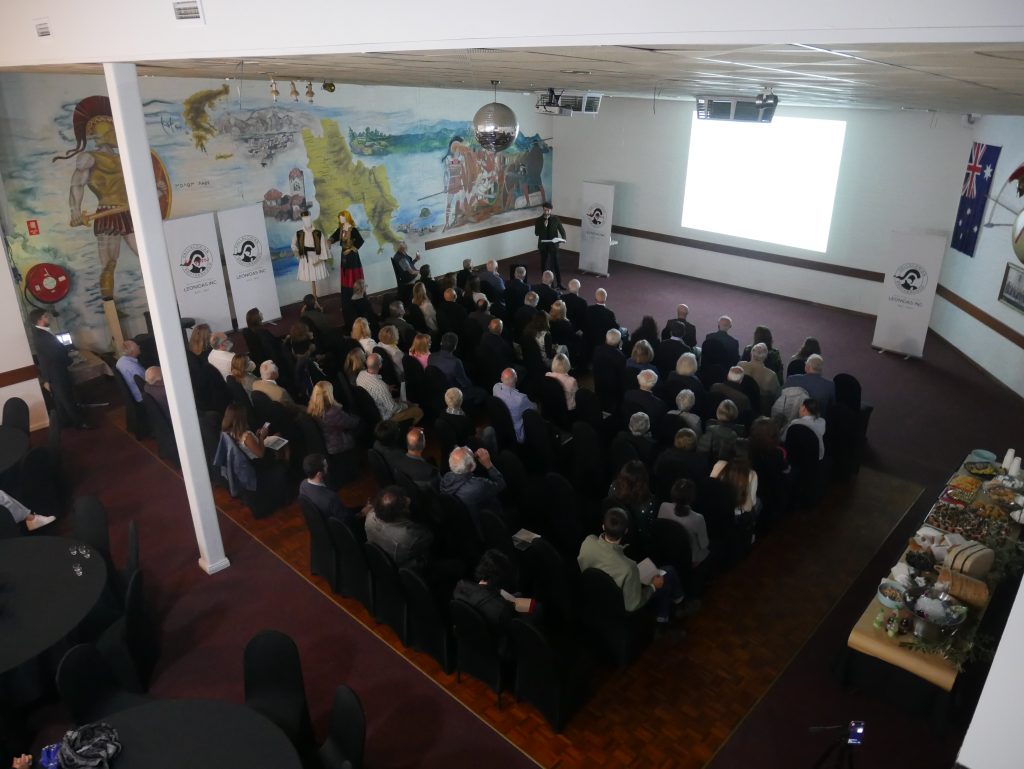
More than 100 guests filled the Brotherhood’s hall in Brunswick on Wednesday, March 29. Among them were Dr Tim Read MP; Russell Darnley OAM; Chair of Classics at Melbourne University, Professor Tim Parkin; as well as Dr Roslynne Bell, Professor Lieve Donnellan and Professor Andonis Piperoglou from the University of Melbourne. The President of Hellenic Writers, Roma Siachos, and members of AHEPA also attended the event.
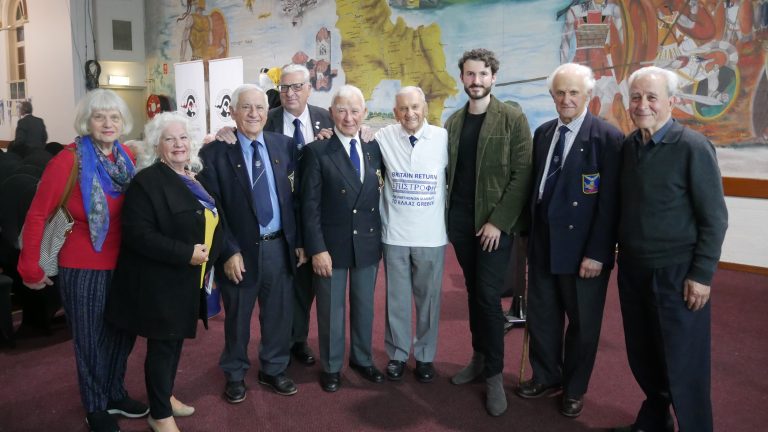
Official guests.Emmanuel with guests at the event.The event was filled with people.
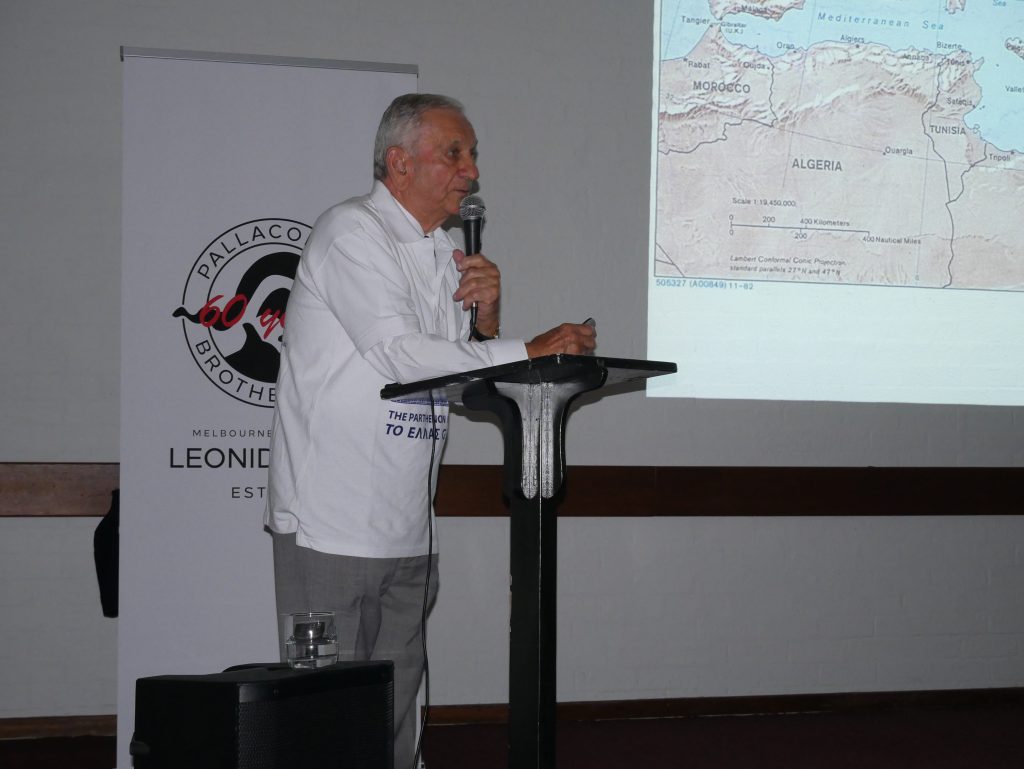
After a warm introduction by the Pallaconian Brotherhood President, Miltiadis Paikopoulos, Mr Comino stepped on stage and gave an impressive and passionate lecture about the Parthenon marbles – starting from their creation to the moment they were stolen by Lord Elgin. He also gave insights into the latest situation with the British Museum, where the Parthenon Marbles are currently.
Emmanuel giving his lecture.
The 90-year-old first started the international campaign for the return of the Parthenon Marbles to Greece. He is the founder and Chairman of the International Organising Committee – Australia – For the Restitution of the Parthenon Sculptures (IOC-A-RPM) and is also the Vice-Chairman of the International Association for the Reunification of the Parthenon Sculptures. He was awarded the Medal of the Order of Australia (OAM) in the Australia Day Honours List in 1985.
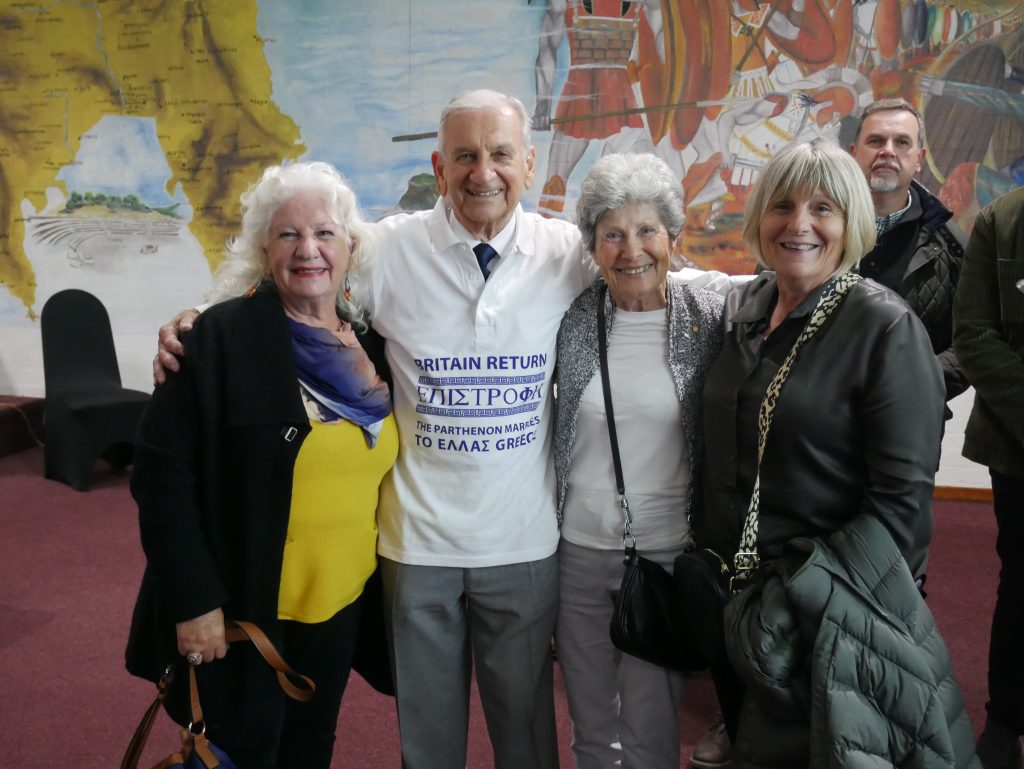
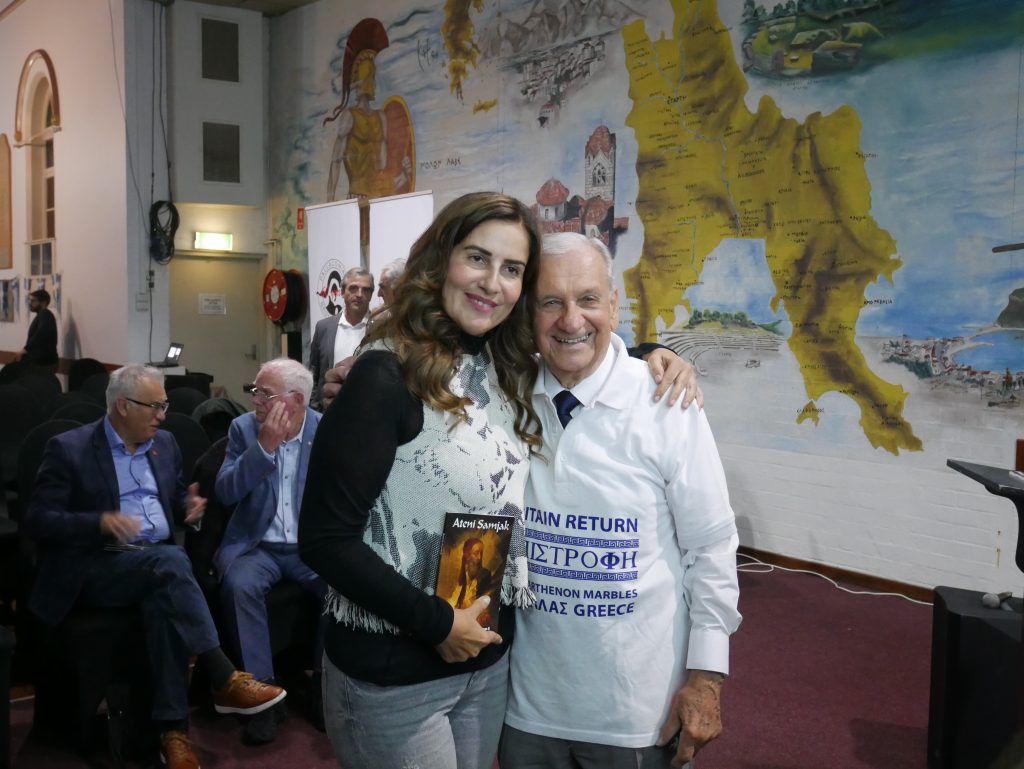
Emmanuel with a guest.
His life-long contribution to the restitution of the Parthenon Marbles to Greece is considered to be admirable and the lecture which took place on Wednesday evening, showcased exactly that. His devotion to his goal is still there and louder than ever.
*All photos copyright: The Greek Herald / Giorgos Psomiadis.
The Greek-Australian Cultural League has announced this year’s Literary Competition. This competition is now an established annual event in the cultural and literary scene of the Greek community in Australia.
The Literary Competition can include works written in the Greek or English language, by writersresiding in Australia and over 18 years of age, in the following categories: Poetry and Short story.
The winning entries in each category in each language will be published in Issue No. 69, 2023 of the annual bilingual periodical of the GACL, ANTIPODES.
The results of the Literary Competition will be announced at a special function incorporating the launch of the periodical in October 2023.
To enter, submit your works by Friday, June 30, 2023. Request the Rules of the Literary Competition and the Application for Participation from e-mail: gaclitcomp@gmail.com.
2023 LITERARY COMPETITION RULES
The Literary Competition covers work written in either Greek or English in the following categories: poetry and short stories, by writers residing in Australia and over 18 years of age.
Participants are required to complete a registration, entry form which can be downloaded from the Greek-Australian Cultural League website (www.gacl.com.au) and should be emailed to the Literary Competition address: gaclitcomp@gmail.com
The adjudication will be separate for each language.
Participants may submit work in one or all the categories and in one or both languages, with only one piece in each category they choose.
Works that do not comply with the limits of content, as prescribed below, will be automatically rejected, and will not be forwarded to the Judging Panel.
Submissions with many grammatical and syntactical mistakes will be rejected.
Content limits: Poem 100 verses (lines); Short story 2000 words.
All submissions should be the original work(s) of the authors and should not have been submitted in another competition or have been previously published.
Each work submitted should be signed by a pseudonym (nom de plume) and the same pseudonym should be used in signing all the entries submitted by the same person.
Each competition entry should be sent only electronically (Word document attachment) to the competition email address: gaclitcomp@gmail.com. Additionally, in a separate text sent to the same email address, participants are required to forward their particulars, including the pseudonym, the full name, address, telephone numbers, the number of verses in their poems and the number of words in their short stories (The entry or Application form).
The Literary judges reserve the right to preclude an entry if it is considered to have too many syntactical or orthographical mistakes.
The First Prize in each category and in each language will receive a commemorative certificate and a monetary prize. The Second and Third Prizes and any Commendations will receive a commemorative award certificate and books.
In all categories and languages, the works awarded First Prize will be published in the latest issue of the periodical Antipodes which will be launched on the same day as the announcement of the results.
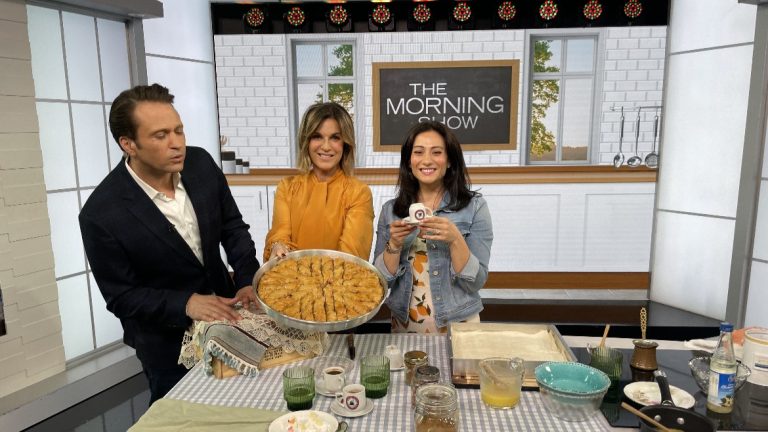
If you’ve ever seen a Cypriot foodie on Channel 7’s TV program The Morning Show, it was most likely the energy-filled Nikoletta Nicolaou – the mastermind behind Instagram page Nikoletta’s Kitchen.
From 9 to 5pm, the Instagram food blogger works as a creative advertiser and with the rest of her time, she’s in the kitchen cooking for her family and friends all whilst capturing the recipes for her thousands of followers.
“I really, really love food. And I love how the kitchen just brings people together in so many different levels,” Nikoletta tells The Greek Herald exclusively.
Nikoletta’s Kitchen began almost 13 years ago on Instagram when Nikoletta was in London, the United Kingdom and the social media platform was a lot quieter and not as polished.
“I was training for my first ever London Marathon and to raise funds I’d do bake sales. My friend goes: ‘you should just take pictures and share them on Instagram’,” Nikoletta explains.
Initially called Nikoletta’s Bakes, she eventually transitioned the page to Nikoletta’s Kitchen after moving to Australia in 2015 and wanting to delve into more Cypriot recipes.
“I think as we grow older, we appreciate that side of our life a little bit more, where we have those feelings of nostalgia and want to hold on to the way our mothers and grandmothers cooked and sort of preserve the cuisine that we come from,” she says.
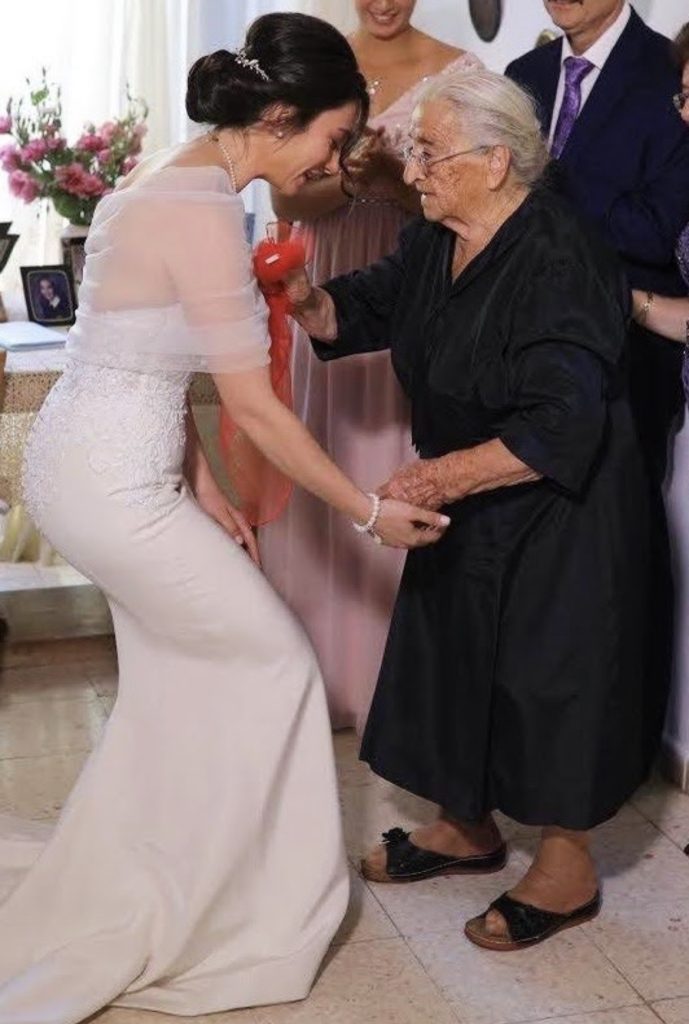
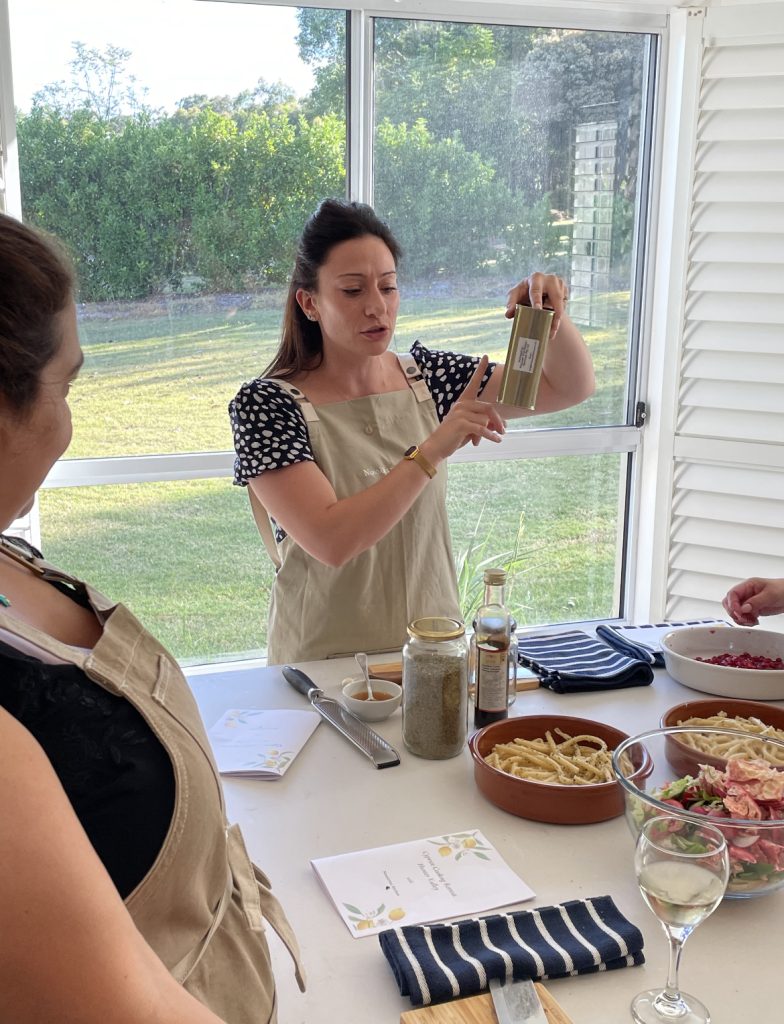
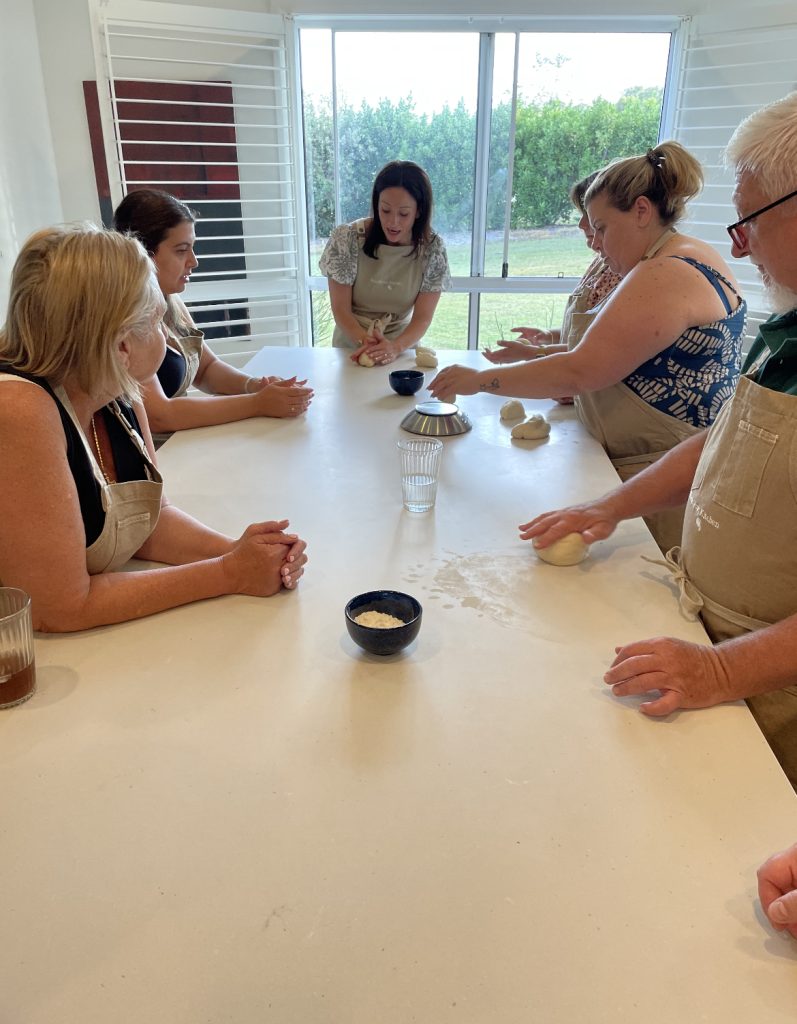
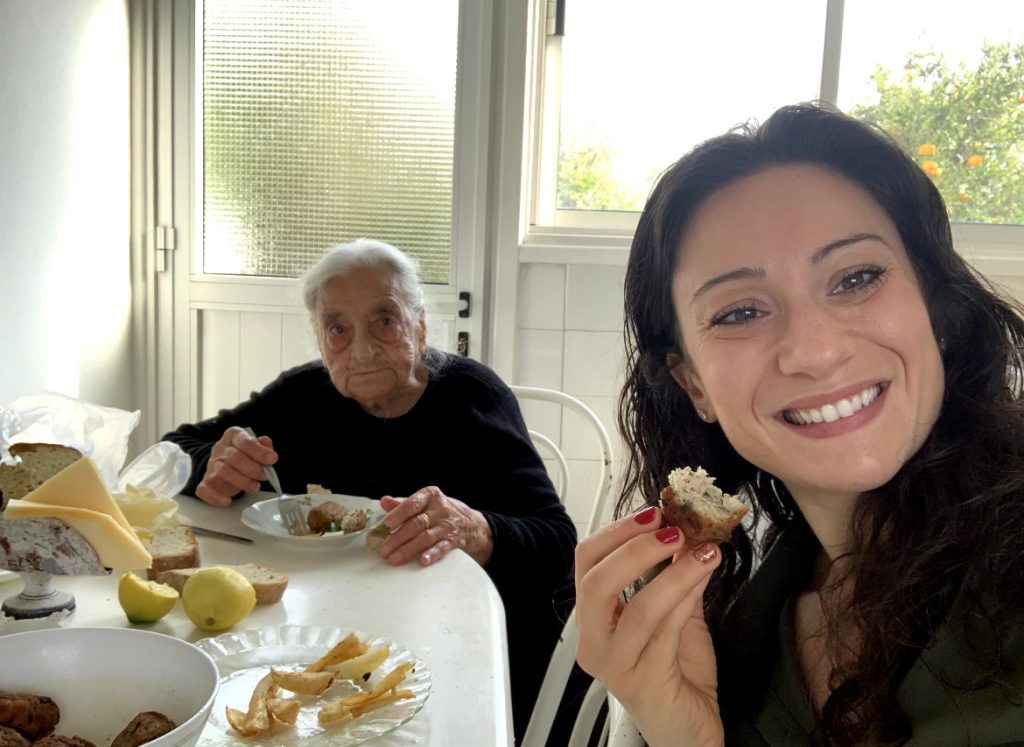
Nikoletta Nicolaou with her yiayia. Nikoletta Nicolaou at a cooking retreat she hosts, teaching people about the Cypriot cuisine.
Keeping the Cypriot culture alive:
Raised in London, Nikoletta says she was always “really close” to her Greek-Cypriot culture.
“I grew up in Palmers Green which was sometimes called Palmer’s Greek for the number of Cypriots and also Turkish Cypriots,” she says with a chuckle, whilst adding that she would spend all her summers in Cyprus because it’s only a four hour flight from London.
Nikoletta’s passion and love for Cyprus and its culture is undeniable. Her Instagram page is filled with vibrant pictures of Cypriot food and wholesome cooking (and sometimes dancing) videos, emphasising that food is about culture, family and friends.
“It’s not just a recipe and it’s more than just food,” she says.
“When someone messages me on Instagram and they’re like, ‘Nic, I made one of your recipes and it took me back to when my mum, who has passed, would make it’… it is so heartfelt.”
Using social media as a conduit to make people feel through food, whether that is feelings of nostalgia or happiness, is what drives Nikoletta to share her recipes.
Nikoletta is a self-taught cook bringing the a taste of Κύπρος-Cyprus, Mediterranean and Middle Eastern flavours through in person and online cooking experiences and recipes.
“I want to continue to share those nostalgic moments and keep preserving the Cypriot cuisine but also having fun with it as well – doing modern takes on traditional recipes and playing around with those flavors,” she explains.
Getting people confident in the kitchen with traditional food is another driving factor for her passion project.
“There’s this Cypriot food called ‘flaounes’ that everyone’s scared of making but when someone messages me and says they made them and they turned out great, I’m so happy!” she says.
Speaking with Nikoletta, I can see why over 14,000 people follow her content. Whether her followers are Cypriot or not, her desire to keep Cypriot culture alive emboldens one to get in the kitchen and make traditional recipes.
Nikoletta with her yiayia. Photo: Supplied.
“A few years ago, I used to teach cooking classes to Aboriginal foster kids and the elder there would explain how important culture is. She told me that, ‘if you look after culture, our culture will look after you’, Nikoletta says.
This mantra has stuck with her and her passion for preserving Cypriot food and culture has made it to TV screens and mobile phones across Australia and the world.
“I think it’s really important for us to really hold on to our culture, because that’s what makes us unique,” she concludes. “That’s what makes us different.”
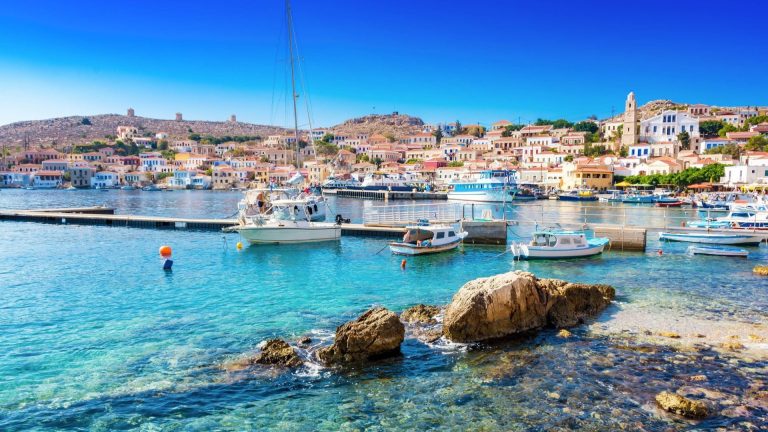
Halki has become the first Greek island to successfully produce the electricity it consumes, as part of the Greek Government’s “GR-eco Islands” national initiative.
The initiative aims to transform Greek islands into models of green economy, energy autonomy, digital innovation and ecological mobility.
The initiative allows members to offset the energy produced by the polar park with the actual consumption of their electricity bills.
According to AMNA, the total savings made by Halki residents exceeded 200,000 euros in the last year.
Meanwhile, the polar park has contributed to the reduction of carbon dioxide emissions in the atmosphere by 2,246 kilograms.
Five Greek projects have been short-listed for the 2023 Innovation in Politics Awards, according to Ekathimerini.
The awards recognise innovative projects based on values of social balance, democracy and human rights.
There are two Greek finalists in the Climate Protection category:
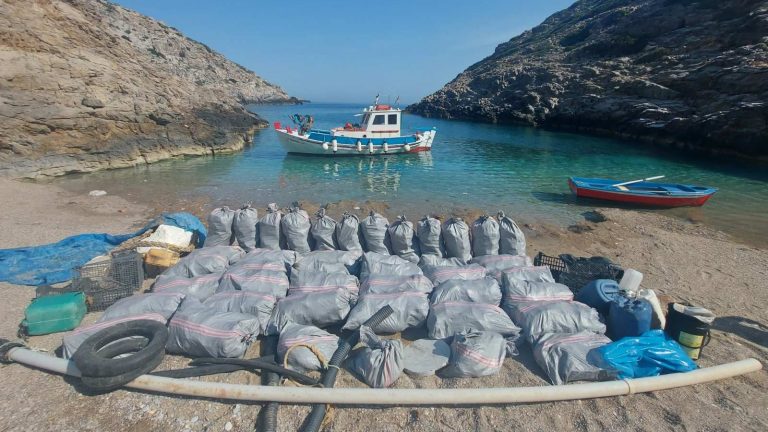
Amorgorama: A project by the Professional Fishing Association of Amorgos, which aims to find a sustainable approach to tackle increasing plastic pollution and overfishing in the Aegean Sea, and
Just Go Zero Tilos: a waste free initiative from the island of Tilos.
The Greek government’s ‘Housing and Work for the Homeless’ program, launched in 2017, is a finalist in the Social Cohesion category. The program aims at strengthening the possibility of social reintegration of individuals and families living in homeless conditions.
A finalist in the Local Development category is the municipality of Halandri’s project ‘Cultural H.ID.RA.N.T’ (Cultural Hidden IDentities ReAppear through Networks of WaTer), which aims to re-introduce Hadrian’s Aqueduct from the Roman period to the contemporary urban life of Halandri.
The Municipal University of Ilion’s ‘Paving the way towards a sustainable learning city,’ has been nominated as a finalist in the Education category.
The winners will be announced in Warsaw, Poland on May 11.