The results of the Certificate of Attainment in the Greek Language 2023 exams were released on Friday, 28 July, after completing the evaluation and grading of all the candidates’ written and oral exams.
Individual candidates have access to their results through the webpage of the Centre for the Greek Language http://www.greek-language.gr/certification/results/index.html with the use of: a) the code number of the exam centre (61006), b) the candidate’s registration code, and c) the candidate’s surname (as in the candidate’s card).
Rescoring of exam papers: Candidates who have not passed the exams may have their exam rescored by submitting a written request to the Centre for the Greek Language. Rescoring requests will be submitted by email at ellinomatheia@komvos.edu.gr by 31st August 2023. After submission of the request, the candidate will have to deposit 60€ to the bank account that CGL will give.
All successful candidates will be informed about the Award Ceremony of the Certificates of Attainment in Greek Language, which will take place in early 2024.
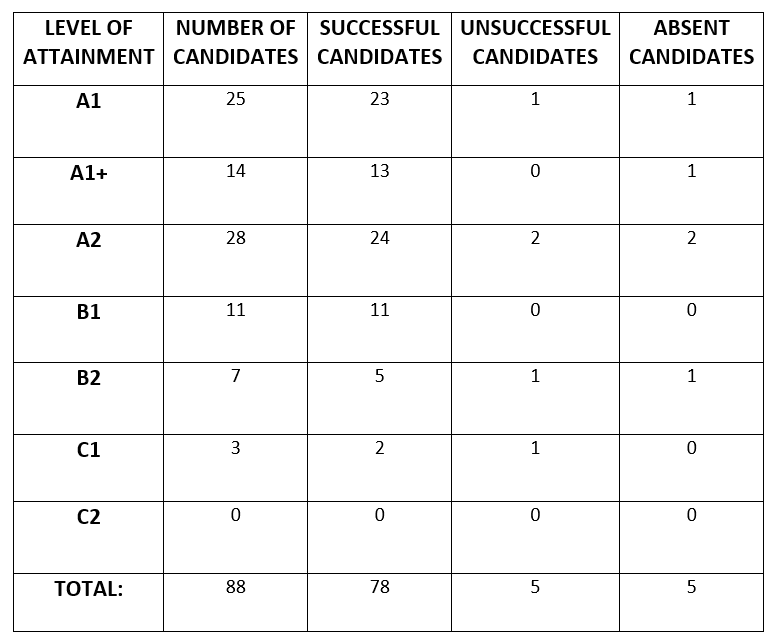
The statistical data of the Exams for the Certificate of Attainment 2023 that took place at Macquarie University in Sydney are the following:
The results.
Dr Patricia Koromvokis, Head of the examination centre and Director of the Modern Greek Studies Program at Macquarie University, stated: “In the Exams for the Certificate of Attainment 2023 that were held at Macquarie University, Sydney’s examination centre, we had a 94% success rate on the overall number of the participants, (6% absence rate).”
“The high success rate reflects the hard work that the Greek teachers and students put into teaching and learning the Greek language,” Dr Koromvokis added.
“My warmest congratulations to all the candidates who took part in the exams, to the parents who supported them and, of course, to all the teachers who effectively prepared the candidates for the exams!
“I would like, through my role as Head of one of the largest Greek language examination centres in the world, to encourage students to take exams in the Greek language as the Certificate of Attainment in Greek Language is a globally recognised title that proves the level of proficiency of its holder in the market and is considered a prerequisite for the practice of various professions in Greece. It enables foreigners with a B2 level certificate to enrol in a Higher Education Institution in Greece.”
The Exams for the Certificate of Attainment 2024 will be held on 14-16 May at Macquarie University.
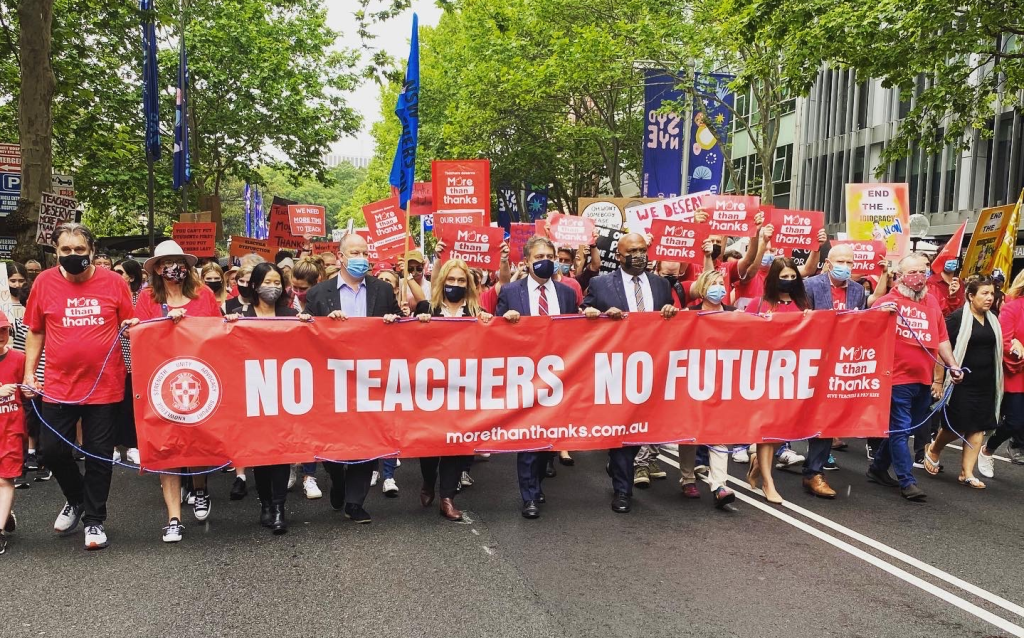
The NSW Teachers Federation (NSWTF) has accused the state government of an “act of betrayal” after a breakdown in pay negotiations after a one-year agreement was withdrawn on Wednesday.
NSWTF president Angelo Gavrielatos said negotiations with the Minns government began in April, with an agreement reached on May 31 at a meeting with the NSW Education Minister Prue Car and Treasurer Daniel Mookhey.
The agreement included a commitment to increase the starting salary for a teacher by nearly $10,000, and raise the maximum teaching salary by about $9,000, Mr Gavrielatos said.
Mr Gavrielatos said the deal was reaffirmed in June, but on Friday last week the government said it had decided not to proceed.
Public school teachers in NSW have been calling for fair pay.
“This is unheard of. This is unprecedented. In my decades of experience, never before has a government walked away from a deal in the way that we are experiencing now. This is an act of betrayal,” Mr Gavrielatos said.
In response, Ms Car said negotiations were ongoing.
“We have reached many agreements with the Teachers Federation… but there are some things we haven’t yet reached agreement on,” she said.
“I’m pretty disappointed about where we have landed today, but I urge the federation to continue negotiating with the government.”
Fair pay for teachers was one of Labor’s key election promises in the lead-up to the 2023 state election.
Dr. Alexandra Dellios, historian and Senior Lecturer in the Centre for Heritage and Museum Studies at the Australian National University, will present a lecture entitled Greek-Australian women and welfare advocacy in the 1970s, on Thursday 10 August, at 7pm, at the Greek Centre, as part of the Greek History and Culture Seminars
The seminar will investigate the significant contributions of Greek-Australian women to the field of social welfare during the transformative 1970s.
As migrant and ethnic-minority communities demanded changes in the welfare system, these women emerged as pivotal figures in welfare rights, health interpretation, welfare work, and advocacy. Their dedicated efforts took place on the frontline of multicultural service delivery, addressing the previously neglected needs of migrant and non-English-speaking communities.
From positions within various organizations such as Greek Orthodox Communities, the Australian Greek Welfare Society, the Ecumenical Migrant Centre in Richmond, and state-funded multicultural information and health centers, these pioneering women played a crucial role in shaping the welfare landscape.
The seminar will draw from archival work, personal testimonies, and oral histories, offering valuable insights into their experiences and challenges.
Dr. Alexandra Dellios
Dr. Alexandra Dellios, in her capacity as a distinguished historian, will explore various aspects of this history. Some of the questions she will address include:
What issues did they tackle in this period?
For example, what role did Anglo-Australian stereotypes from within the health, legal and social service systems play in how they navigated their clients’/community’s needs?
How did they operate within the evolving bureaucratic and discursive context of multiculturalism, first proposed in the early 1970s?
What new perspectives can these women provide to histories of migrant social service delivery and the welfare state in Australia?
The social and health issues they tackled were complex and, in many ways, remain prescient nearly fifty years since the introduction of a national multicultural policy, and state multicultural bureaucracies.
Dr. Alexandra Dellios is a historian and Senior Lecturer in the Centre for Heritage and Museum Studies at the Australian National University. Her expertise lies in cultural heritage management and oral history. She has published extensively on topics such as popular representations of multiculturalism, immigration centers and hostels, migrant, industrial, and labor heritage, as well as migrant public history practices.
Details about the event:
When: Thursday 10 August 2023, 7 pm
How: Greek Centre (Mezzanine, 168 Lonsdale St., Melbourne)
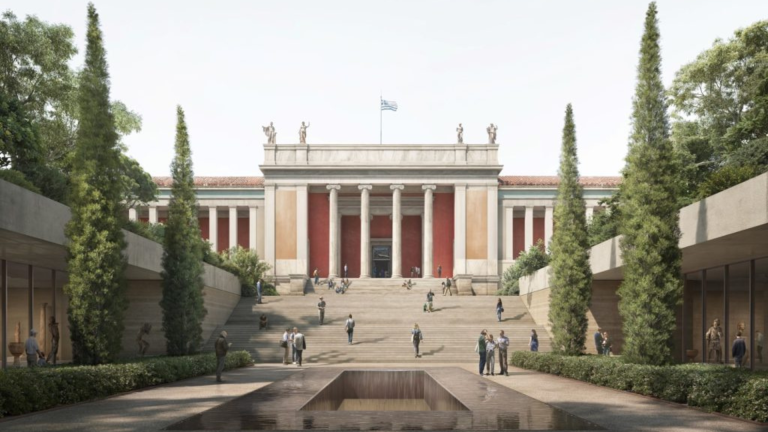
The planned upgrade to the National Archaeological Museum in Athens has claimed second spot in the international list for cultural projects for its expense.
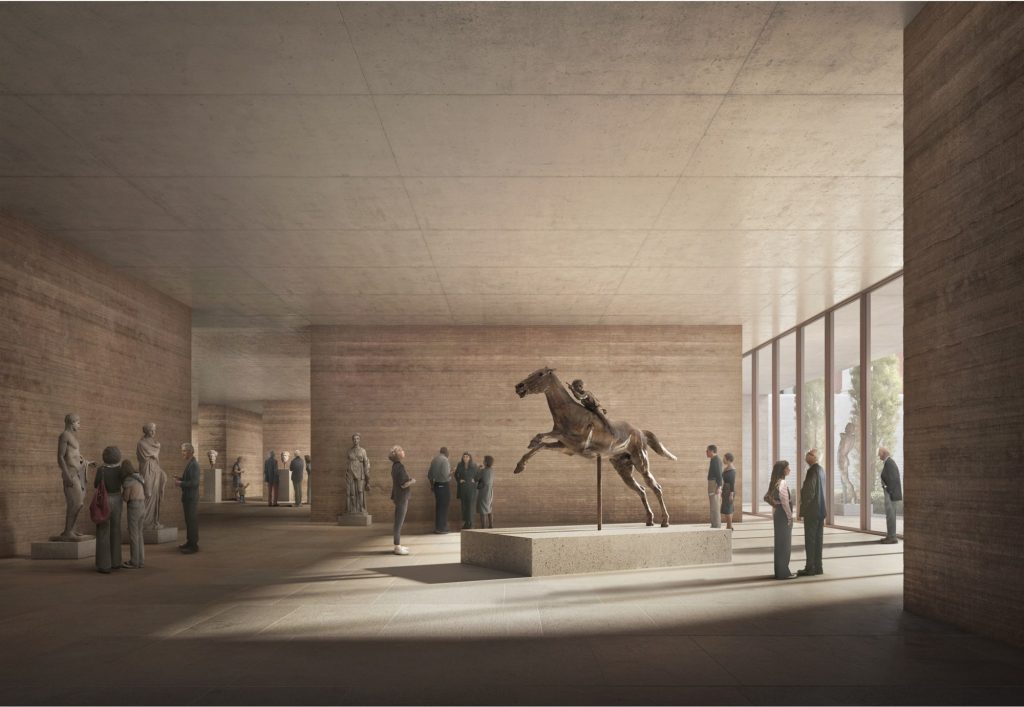
At the start of 2023, an announcement was made that the museum would be upgrading its appearance, with a focus on promoting Ancient Greek culture.
The new plans for the museum.
Currently, the upgrade has a budget of $329 million and is behind the planned renovations for the Powerhouse Museum in Sydney which is currently on top spot at $335 million.
According to the Greek Ministry of Culture and Education, the project including exhibition and public spaces, will change the fabric of the city and revive the neighbourhood.
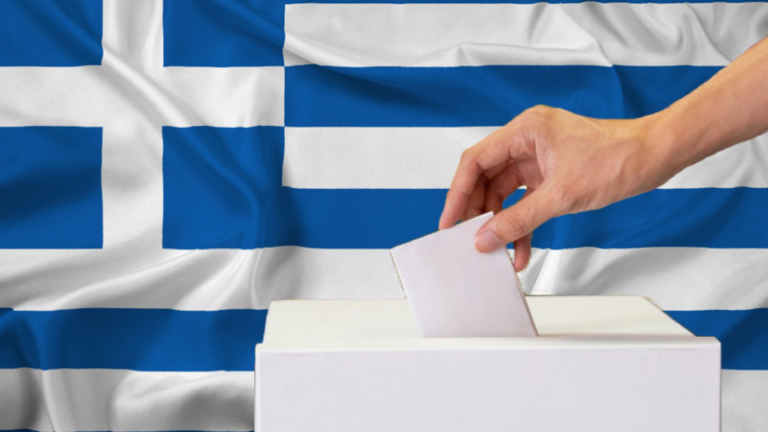
The first bill brought to the Greek Parliament (25.7.2023) by the government of Kyriakos Mitsotakis concerned the Vote of Expatriates (Law 4648). This is a revised version of the same proposal-bill that was finally voted in Parliament in 2019, but without being able to convince expatriate Hellenism. On the contrary, the expatriates justifiably discredited this restrained expression of care towards the Hellenic Diaspora by the government of Greece.
At the same time, the expatriates showed their disappointment with regard to the content and restrictions set by the first bill, such as, for example, only those expatriates who had lived permanently in Greece for at least two years in the last ten years had the right to vote. So, while they expected more than 300,000 expatriates to go to the polls, in the end fewer than 30,000 voted, of which the Greeks of the USA, Canada and OCEANIA did not even exceed 3,000 voters. The restrictive provisions of the law made the exercise of the right to vote almost impossible for expatriates of the new countries.
These restrictions of the law were modified by the Government when, on July 10, the Ministry of Interior consulted on the new bill, expanding the potential pool of voters to all expatriate Greek citizens registered in the electoral rolls.
The main objective of the Government and all the opposition parties that voted in favour of the bill was for the Greek metropolis to embrace the global Greek diaspora, i.e. expatriate Greeks not only of the first but also of the second and third generation, linking them inextricably with the political and social life of Greece.
One of the first and most essential steps to be taken for the interconnection of the Greek diaspora with Greece is its identification, i.e. the compilation of a list of all Greek expatriates, regardless of voting rights. With the demographic identification of expatriates, the Government believes that in this way the Greek diaspora can be transformed into a crucial factor of influence and exercise of soft power of the Greek state through cultural diplomacy.
The identification of the Hellenes residing in the diaspora is once again left to the Embassies and Greek Consulates, with the assistance of the mechanisms of new technology, even robotics! Splendid! In other words, once again, metropolitan Greece, in its effort to identify demographically the Greek Diaspora, i.e. to record all Greeks living in 190 countries of the world, entrusts the identification of the diaspora, that is the numerical and nominal registration of citizens of the Diaspora of Greek origin, to the official bodies of the Greek state.
But how are ambassadors and consuls and consular officers able to register and identify the Greeks of the Diaspora? What qualifications, methods and mechanisms do our diplomatic authorities have to undertake such a task? Have they been trained appropriately and adequately in statistical data methods, cross-tabulations of specific demographic data, do they know the social variables (language, religion, origin) that they will choose to verify their exact number?
During the last thirty years, dozens of books have appeared compiled by historians, demographers, statisticians, anthropologists, sociologists, polar scientists, referring to the identification of the Greek diaspora. These books record the presence, the immigrant experience, the social and community organisation, the identity of unions and community organisations, their demographic status. These books were published and cover almost all neighbourhoods of the world and provide abundant and sufficient information regarding the identification of expatriates at an intergenerational level.
And I ask simply without intending to personally offend any of our Excellencies diplomats. How many of these ambassadors and consuls and officials who staff embassies and consulates have read or have knowledge of the countries in which they are called to serve, before coming to assume their responsibilities? How many know the bibliography of the Greek diaspora? Who and how many, frankly, showed substantial and systematic interest in the Greeks of the Diaspora, the expatriate Greeks, so that even in 2023 they assign to them the responsibility of identifying the Hellenism of the Diaspora? How many diplomats and consular officers were interested in learning, studying, or acquiring knowledge and opinion about the data of Greeks in the countries of dispatch and responsibility?
Certainly, their opinion, their advice, their opinion is necessary and imperative. But that’s about it.
With the exception of a few of our diplomats abroad (I am in a position to know after 40 years of thorough field research throughout the Eastern Hemisphere), that the vast majority of our diplomats do not have direct contact and relationship with the diaspora. Besides, this may not even fall within their jurisdiction and responsibility. Their responsibility is essentially limited to the representation of Greece and the Greek State in their country of appointment, and not to Greeks residing in that country.
And most importantly, who do they consider “Greeks” and “Expatriates” in the Diaspora? After the first generation of immigrants/settlers, with the percentage of inter-ethnic marriages in most countries of the world standing at 80% and 90% for Greeks of the second generation and 90% of the third generation, what “Greekness” do legislators talk about and what “Greekness” do they have in mind? There is no a specific “Greekness.” There are hundreds, maybe even thousands of “Greeknesses.” Greekness is not a measurable phenomenon, it is dynamic one. How do our technocrats and techno-politicians define it?
Dozens of historians and demographers, Greeks and foreigners, Greeks and philhellenes have referred to the demographics of expatriate Hellenism. Will we burn these books, the fruit of scientific research, mash them and go back into the unknown, even aiming at the colonisation of the Hellenism of the Diaspora?
*Professor Anastasios M. Tamis taught at Universities in Australia and abroad, was the creator and founding director of the Dardalis Archives of the Hellenic Diaspora and is currently the President of the Australian Institute of Macedonian Studies (AIMS).
The former Adelaide United defender and Melbourne City head coach is now tasked with awakening a sleeping giant of Israeli football.
According to KEEPUP, Hapoel has won 13 Israel Premier League titles, but their last victory was 13 years ago. Their last season resulted in a 10th-placed finish in the 14-team competition.
״אני אוהב גישה התקפית, זה בטבע שלי״
בואו להתרשם מהמאמן החדש מייקל ולקאניס, שהתארח בפודקאסט הרשמי שלנו 🎙️
— Hapoel Tel Aviv FC (@HapoelTelAvivFC) June 17, 2023
The Tel Aviv-based side have also competed in the UEFA Champions League and celebrated European wins over Chelsea, AC Milan, Paris Saint-Germain and Celtic.
Valkanis told KEEPUP that his vision is for the club to one day “be up there competing with arch-rivals Maccabi Tel Aviv, playing the sort of football that will excite our fans.”
“I see a team that’s attacking, brave and a team that makes a supporter base really proud and they work really hard,” Valkanis said.
“Hapoel means the working and there’s only one thing, we need to work, work, work, run, run, run, play football, attack, be a team all as one.”
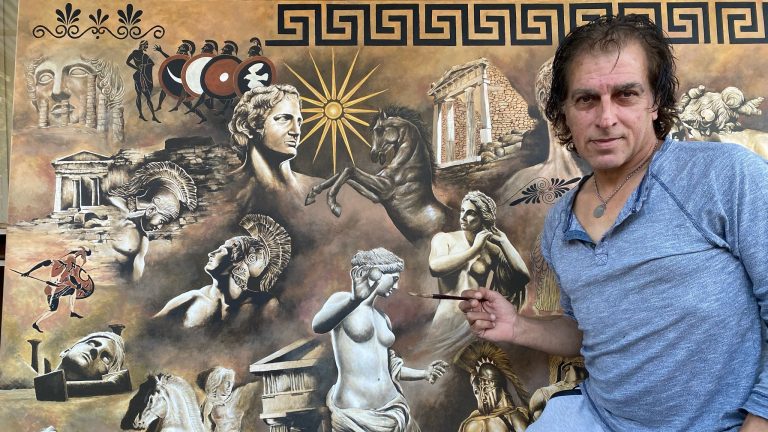
Nick Bonovas is an exceptionally talented self-taught artist based in Sydney. From a tender age, he discovered his inherent artistic inclination and eagerly delved into the world of drawing and experimenting with various paint and art mediums. His creative journey has been infused with an ardent passion for Greek art, which serves as his primary source of inspiration. Imbued with the essence of Ancient Greece and complemented by his unique artistic vision, his works also explore other diverse genres, showcasing the breadth of his artistic versatility.
Nick’s artistic prowess has earned him commendable recognition, leading to numerous commissions to paint, draw, design, and create murals for a myriad of cafes, restaurants, and private residences, both within Australia and across international borders.
A highlight in Nick’s career has been the honour of exhibiting his captivating artworks at esteemed venues such as the Greek Embassy in Canberra. His works have also graced the walls of The Hellenic Club in Canberra and the ‘Hellenic Inspirations’ Tap Gallery exhibition in the artistic hub of Sydney.
Painting by Nick Bonovas.
For Nick, art is not just a mere hobby or profession; it is an inseparable part of his very existence. His passion to create is beautifully evident in the intricate murals he has painted, two of which now grace the walls of café restaurants in Greece, a testament to the far-reaching impact of his creative spirit.
More recently, Nick has been working on a mural-size canvas that encapsulates the richness of ancient Greece and the vivid portrayal of people from that era. It is a commissioned piece that will be on permanent display at ‘The Great Taste of Greece’ restaurant, Sydney. The magnitude of this project reflects his dedication to preserving and celebrating the cultural heritage that continues to inspire him.
While Nick’s expertise spans various artistic expressions, figurative art holds a special place in his heart. Through his brushstrokes, he skilfully captures essence and emotion as depicted in in these images.
Mural in progress.
In addition to being an accomplished artist, Nick is counted among the many Greek Australian artists who have taken part in the GAAD (Greek Australian Artist Directory). An initiative by the Greek Australian Cultural League (GACL), the GAAD was designed to celebrate Greek Australian artists. It serves as a platform to showcase their exceptional artwork and contribution to the Australian arts landscape. The directory also embraces artists from different backgrounds, both past and present, whose artistic expressions have been influenced by Greek culture. It is an important resource for curators, collectors, researchers, and art enthusiasts eager to explore Greek Australian art.
At its core, the GAAD stands as a guardian of cultural identity and historical significance. By preserving and promoting the artistic legacy of Greek Australian artists, the directory ensures that their talents are duly acknowledged and cherished. It cements their place in Australia’s artistic narrative and bolsters the enduring connection between the Greek Australian community and the wider cultural landscape of the country.
Interested artists can register their profiles by visiting www.gacl.com.au and clicking on the dedicated GAAD section.
For any inquiries related to the GAAD, individuals can reach out to GACL President Cathy Alexopoulos at 0428 968 715 or GAAD Co-ordinator Vasy Petros at 0412 242 557.
For a glimpse into Nick’s ongoing artistic endeavors, visit his website http://www.nickbonart.com/ or on Instagram @nick.bon.art
*Written by Vasy Petros. This is a Greek Australian Cultural League Initiative supported by The Greek Herald.
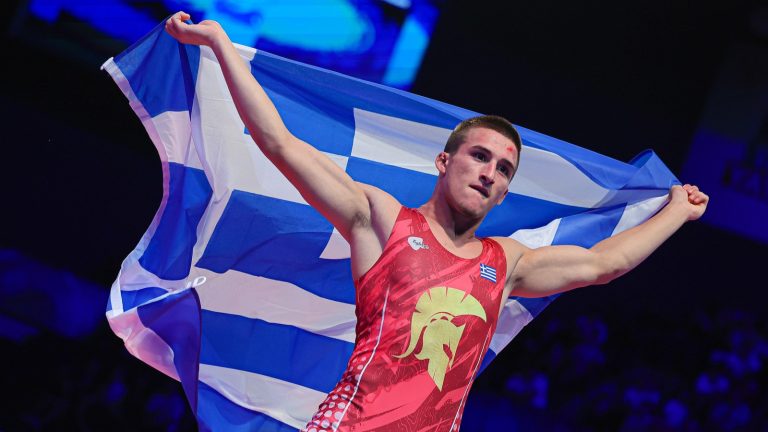
Arionas Kolitsopoulos made history on Wednesday, becoming the first wrestler from Greece to win a gold medal in the U17 World Wrestling Championship in any style.
According to United World Wrestling, while six wrestlers from Greece had secured seven world titles in different age groups and styles, none had achieved it at the U17 level.
Kolitsopoulos victory in Istanbul came after defeating U17 Asian champion Ahmadreza Mohamadian in the 71kg final, winning the gold medal on the third day of the U17 World Championships.
Kolitsopoulos’ also secured wins over Cristian Risca in the opening round, Seongmin Jang in the pre-quarterfinals, Dias Seitkaliyev in the quarterfinals, and U17 European champion Abdurakhman Abdulkadyrov in the semi-finals.
The Greek wrestler tied his historic win to his father and coach, Alexios, a former Greco-Roman wrestler who competed at the 2004 Athens Olympics.
“I made history because my father was a talent. So I am talented but why not be better than him,” Kolitsopoulos said after his win.
“I have dreamed it like thousand times… I am feeling great and I hope kids out there in Greece start training more to become like me or better.”
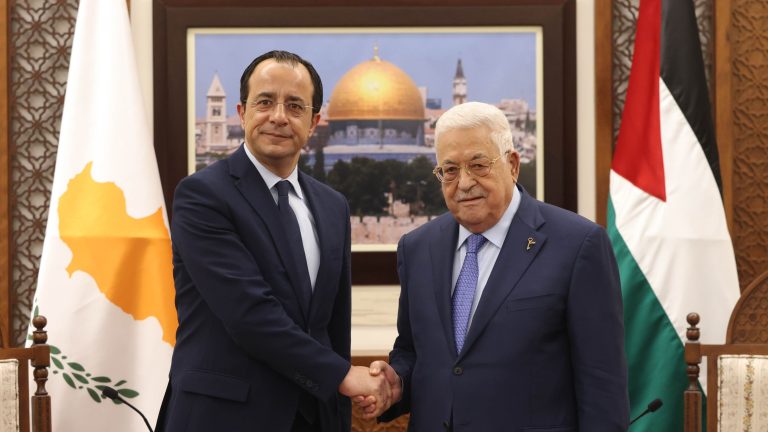
Cypriot President Nikos Christodoulides embarked on a historic visit to Palestine, becoming the first Cyprus president to visit the region in eight years, according to Cyprus Mail.
Accompanied by a delegation of top officials, Christodoulides met with Palestinian President Mahmoud Abbas in Ramallah and agreed to a trilateral summit with Greece.
According to an official announcement, Christodoulides went to Ramallah from Jordan, where he is on an official visit, in the morning, in the first visit of a Cyprus president to Palestine since 2015.
“We welcome you as a beloved visitor to Palestine, your visit is an important opportunity to enhance the relations of friendship and mutual cooperation between our two countries and friendly people in various sectors, such as trade and tourism as well as various aspects of economic cooperation,” Abbas said.
Ο ΠτΔ @Christodulides πραγματοποίησε σήμερα επίσημη μονοήμερη επίσκεψη στη Ραμάλα της Παλαιστίνης, όπου συναντήθηκε με τον Πρόεδρο της χώρας κ. Μαχμούντ Αμπάς.
Ακολούθησαν διευρυμένες συνομιλίες με τις αντιπροσωπείες των δύο χωρών.
“We also appreciate Cyprus’ effective political role within the EU which we hope will continue to support the Palestinian state for its full integration into the UN, as well as its recognition by most European countries in the context of the last opportunity for a two-state solution based on international law.”
For his part, Christodoulides said that he supports a two-state solution for Palestine based on the relevant UN votes of 1967.
In turn, he thanked Abbas for Palestine’s long-standing support for resolving the Cyprus problem within the agreed UN framework.
“Today’s visit shows the historic and strong bonds between Palestine and Cyprus,” Christodoulides said, adding that they discussed key topics.
Those included closer cooperation in the cultural, financial and tourism sectors, along with a trilateral cooperation with Greece.