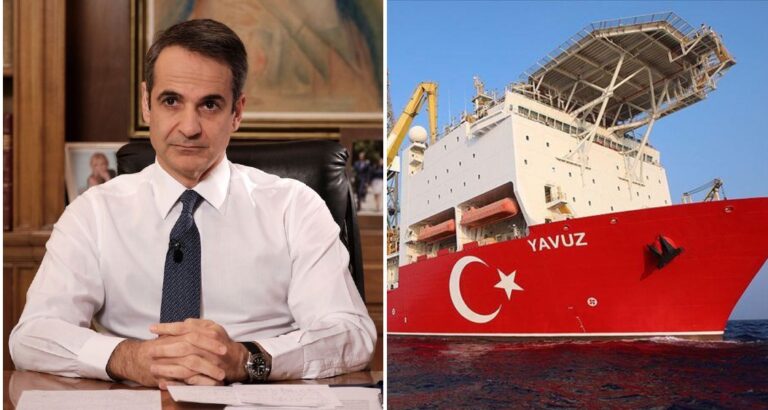
Turkey has extended a navigational telex (Navtex) reserving an area southwest of Cyprus for drilling activities until October 12.
The move was criticised on Wednesday by Greece’s Prime Minister, Kyriakos Mitsotakis, and the European Commission.
In an interview with The Economist, Mitsotakis said he was concerned by Turkey’s move to extend the operation of its Yavuz energy drill ship in disputed Mediterranean waters.
“Turkey has a choice – engage with Europe in a constructive way or continue its unilateral actions and face consequences,” the Prime Minister said.
European Commission spokesman for external affairs, Peter Stano, added that the move “will fuel further tensions and insecurity in the Eastern Mediterranean.”
“This decision comes at a moment when there is an opportunity to pursue immediate de-escalation, and resume dialogue and negotiations, which is the only path towards lasting solutions,” Mr Stano said.
He did welcome however, the withdrawal of the Turkish research vessel Oruc Reis, describing it “an important step paving the way for a meaningful dialogue between Greece and Turkey.”
The EU also calls for a similar decision as concerns Cyprus, he added.
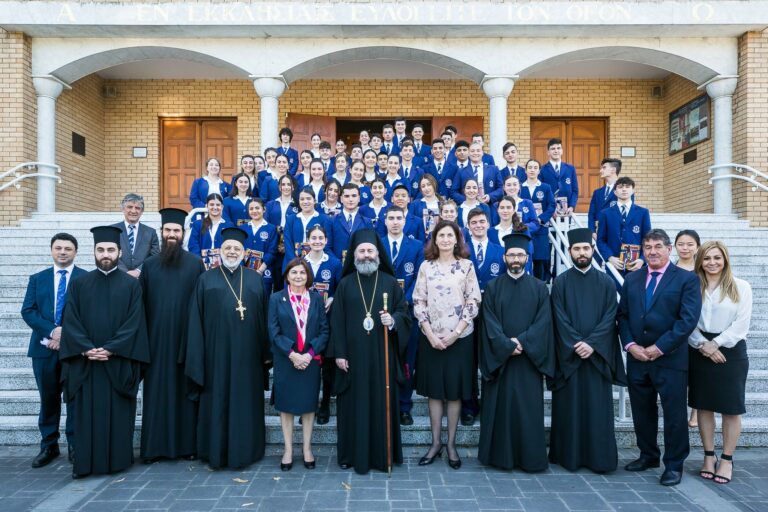
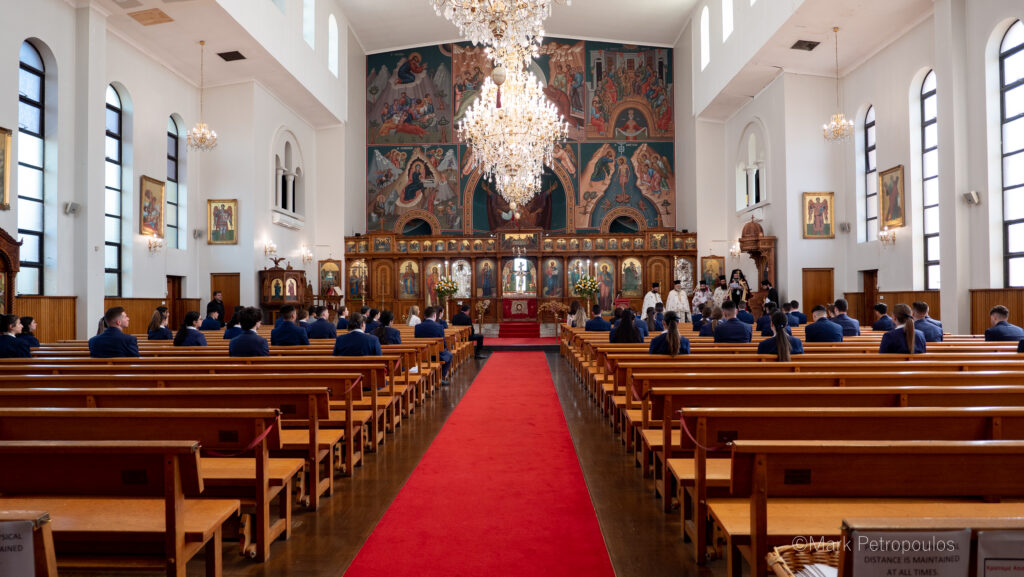
In a heart-warming church service on Wednesday, Year 12 graduates from St Spyridon College in Sydney received the blessing of his Eminence Archbishop Makarios of Australia.
This year’s cohort listened carefully to the paternal advice of His Eminence, as they celebrated their graduation and discussed their future after high school.
“No matter how well or poorly you perform in your exams, your academic life, your career and your work environment, the real measure of success is how you are close to Christ,” His Eminence said in a speech.
Year 12 graduates from St Spyridon College in Sydney received the blessing of his Eminence Archbishop Makarios of Australia.
“Without Him, all worldly achievements mean nothing.”
The service, conducted with the help of Parish priest Father Steven Scoutas, finished with His Eminence presenting graduates with a copy of the Orthodox Study Bible.
“An exciting new chapter is beginning for you,” he said, wishing: “May God bless you all!”
Earlier, the College also held a special, socially distanced graduation ceremony for Year 12 students.
Speeches were given by Head of College, Mrs Stefanou, as well as the College Captain and Vice Captain. This was followed by a ‘walk of honour’ as students left the assembly hall.
FAREWELL TO OUR BRAVE AND BEAUTIFUL YEAR 12 CLASS 2020"It has been a privilege to have been a part of your journey here…
Head of College, Mrs Stefanou, later released a comment on Facebook, wishing students all the best for their upcoming HSC exams.
“It has been a privilege to have been a part of your journey here at St Spyridon College, my brave and beautiful students. I have every confidence that you will go out there and make this world a better place,” Mrs Stefanou said.
“I wish you every success in the coming HSC Exams. May St Spyridon the Wonderworker and our Panayia, watch over you and keep you. We pray for your future happiness, and ask to be remembered kindly in your prayers.”
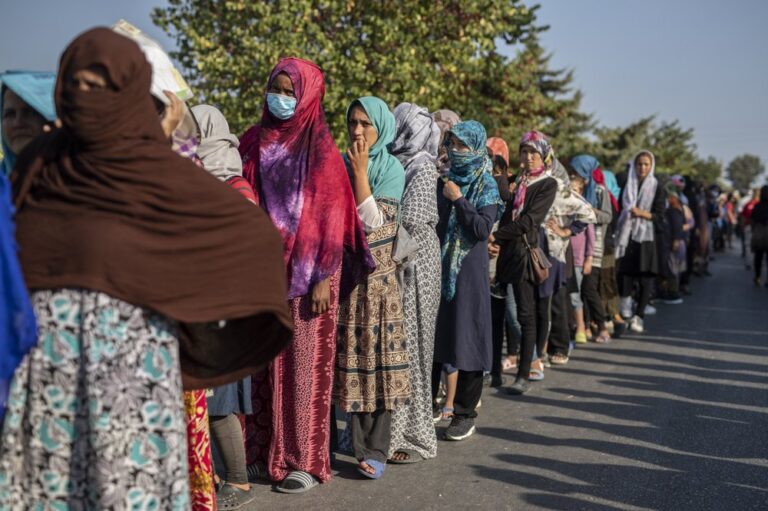
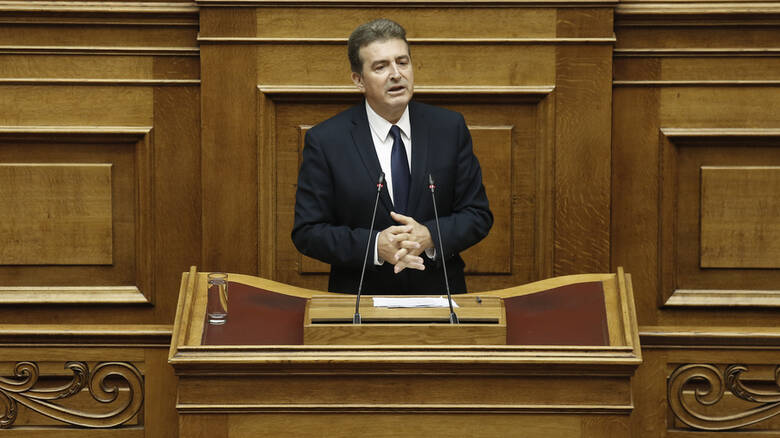
In an exclusive interview with The Guardian, Greece’s Civil Protection Minister, Michalis Chrysochoidis, has vowed that the island of Lesvos will be emptied of refugees by next Easter.
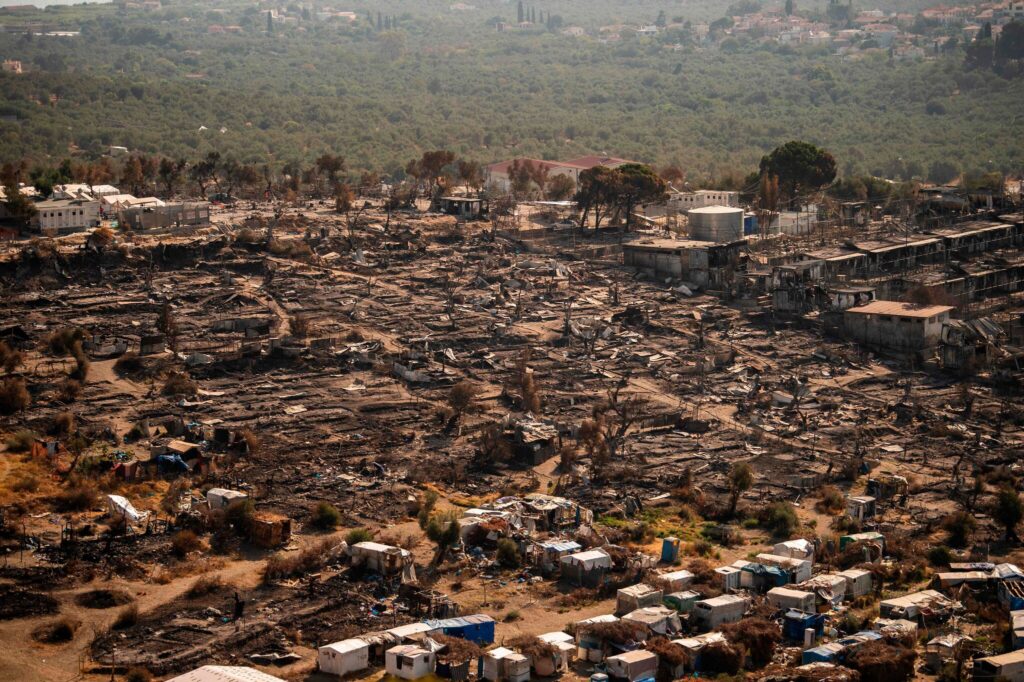
Following the devastating fires that destroyed the notoriously overcrowded Moria facility last week, Greece’s top public order official added plans would be accelerated to decongest the outpost.
“They will all leave,” Mr Chrysochoidis told The Guardian.
“Of the roughly 12,000 refugees here currently, I foresee 6,000 being transferred to the mainland by Christmas and the rest by Easter. The people of this island have gone through a lot. They’ve been very patient.”
Greece’s Civil Protection Minister, Michalis Chrysochoidis, has vowed that the island of Lesvos will be emptied of refugees by next Easter.
About 70 percent of asylum seekers on Lesvos were Afghans who would be awarded refugee status and given travel papers, he said. Recognised refugees can move to another EU member state for up to three months using the documents.
Chrysochoidis, who flew into Lesvos to help oversee relief efforts, also welcomed reports that Germany was prepared to take in as many as 1,500 people from Moria.
The German coalition government on Tuesday agreed to take in a total of 1,553 people from 408 families whose protected status has been confirmed by Greek authorities, Angela Merkel’s spokesperson said.
“It’s very generous, very brave,” Chrysochoidis said of the goodwill gesture.
The remains of the Moria camp on the Greek island of Lesbos on Wednesday. Credit: Angelos Tzortzinis/Agence France-Presse — Getty Images.
“All over Europe, countries have their own internal political problems around this issue but I also think they [EU states] can see we are protecting the bloc’s borders, we have greatly minimised flows.”
Merkel insisted on Monday any transfer of migrants to Germany would need to go hand-in-hand with a broader European initiative, emphasising her support for Greek plans for a new reception centre on Lesbos.
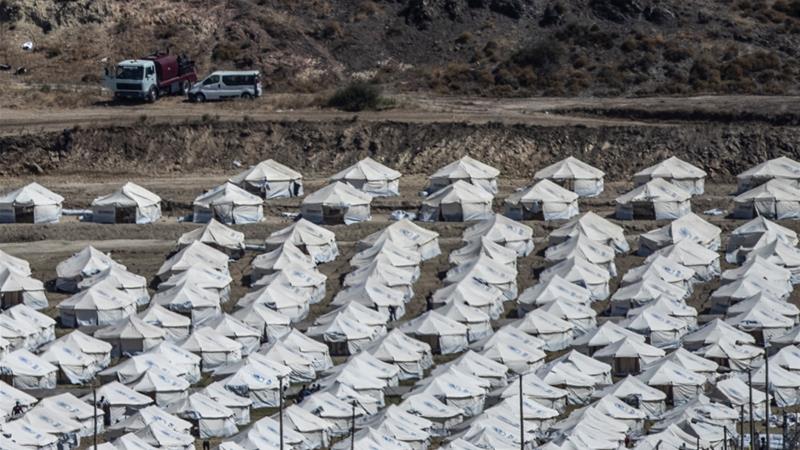
The Greek government has pledged to build a new structure on the island that will be co-managed by EU agencies, but says construction of the camp in a place that has yet to be decided will require at least six months.
A general view of the temporary camp for refugees and migrants near Mytilene town on Lesvos, Greece. Photo: Petros Giannakouris/The Associated Press.
Chrysochoidis said movement into this camp was “non-negotiable.”
“There are groups of Afghans and I am afraid even some human rights organisations who are encouraging thousands of people not to go in,” said Chrysochoidis, who is seen as the face of the centre-right government’s tough public order policies.
“It’s non-negotiable. They will leave the island but they have to go through this new facility and get the requisite legal documents first.”
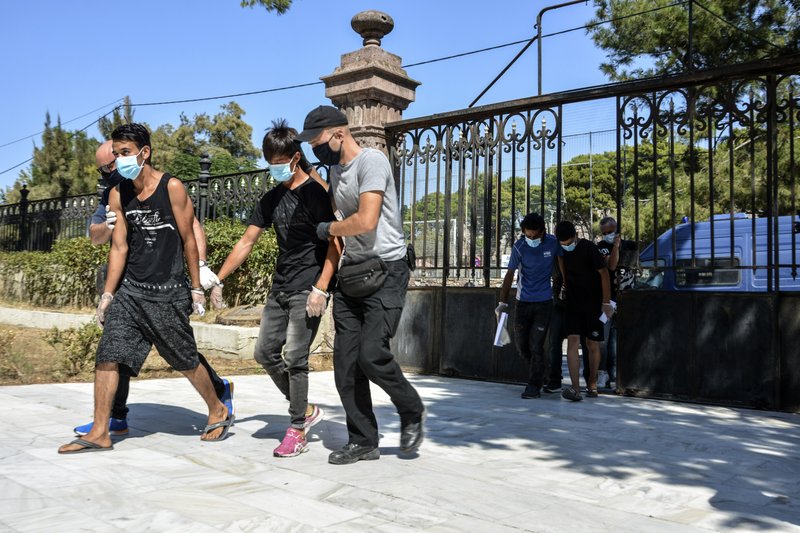
Greek police charged four Afghan migrants with arson on Wednesday for their alleged involvement in the fires which destroyed most of the camp.
Suspects, all from Afghanistan, arrive at a court in Mytilene, the capital Lesvos, Greece. Photo: AP Photo/Panagiotis Balaskas.
Efforts will be launched in the coming days to clear the charred remains of what had once been Europe’s largest refugee camp.
Designed to host no more than 3,000, Moria accommodated almost 10 times that number at its height and was regularly condemned by aid groups for its deplorable conditions.
“It was a camp of shame,” the politician admitted, denying that the government was also forcibly pushing back other refugees who were trying to get to Greece.
“Now it belongs to history. It will be cleared up and replaced by olive groves.”
Greek migrants have been thanked by politicians, past and present, many times throughout the course of history for building the foundations upon which Australia was built. Yet while collective thanks is highly appreciated, there is nothing more special than an engraved record of the achievements of migrants.
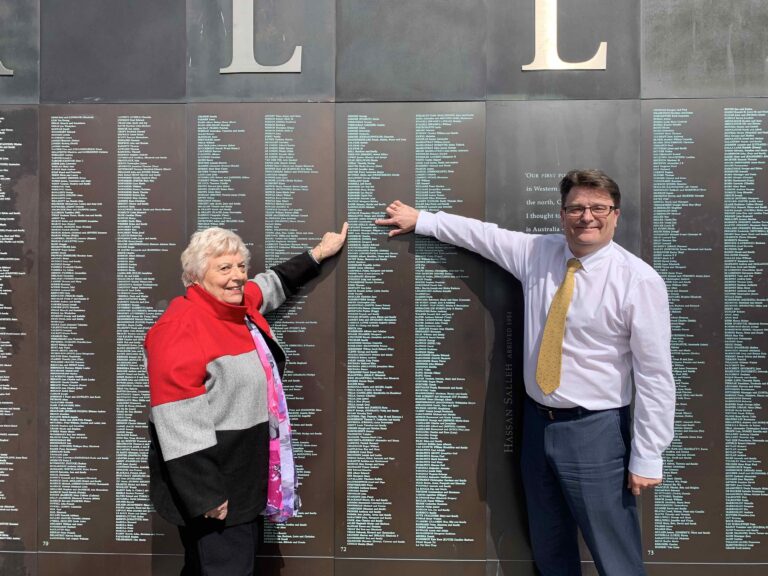
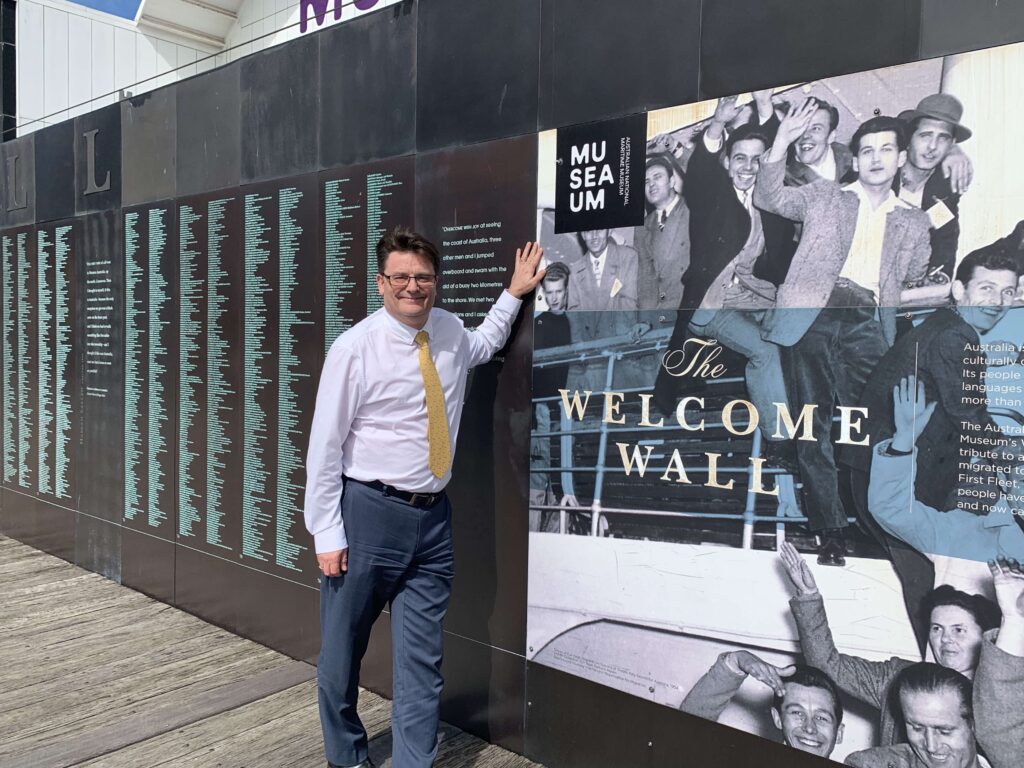
The Welcome Wall, developed by Australia’s National Maritime Museum, is home to over 30,000 names of migrants on 81 bronze panels, stretching across the northern promenade of the museum in Sydney.
Australian National Maritime Museum CEO Kevin Sumption expresses to The Greek Herald his honour in sharing the incredible achievements of migrants who built Australia from the ground-up, with Greeks playing a integral part in this incredible piece of history.
“If you look at the 30,000 names, there’s over 1200 who have made their way from Greece,” Kevin says to The Greek Herald.
“The Greek community, particularly in Sydney, underpins so many businesses and so much of the rich cultural fabric of the city.
Australian National Maritime Museum CEO Kevin Sumption at the Welcome Wall. Photo: Peter Oglos/The Greek Herald
“To be able to get more Greek names and families on the Welcome Wall would be fantastic.”
The Welcome Wall was constructed and revealed for the first time on 24 January 1999, by the then Governor-General Sir William Deane. It is Australia’s only national memorial to one of history’s great migrations.
“Our nation is the sum of us all, all those who came here, all those who were born here, all those who are or have been Australian. And that is the great lesson of this Welcome Wall … our diversity has led to our unity,” Sir William Deane said at the launch.
Now, over 20 years later, Kevin Sumption is working tirelessly to protect and add to the growing list of migrants featured on the wall.
“We see it as a national monument to migration,” Kevin says.
“To a country who, particularly after the second world war, has benefited so enormously from the influx of so many different cultures.
“We like to think that something like that would become bigger and more acknowledged, because it’s a fundamental attribute that’s unique to Australia.”
Many of Australia’s early migrants tirelessly dedicated their time and resources ensuring their children were able to build a better life. Tales of family sacrifice and hard decisions stretch across over 20 metres of metal wall, looked at by over 1.1 million tourists and residents each year.
Migrating across the globe after growing up in Cyprus for over four years, Kevin knows all too well how unique the stories of migrants are.
“It’s a beautiful way to mark and honour those really hard decisions to start a new life.
“They made a conscious decision to do that, not for themselves but for their very young children.
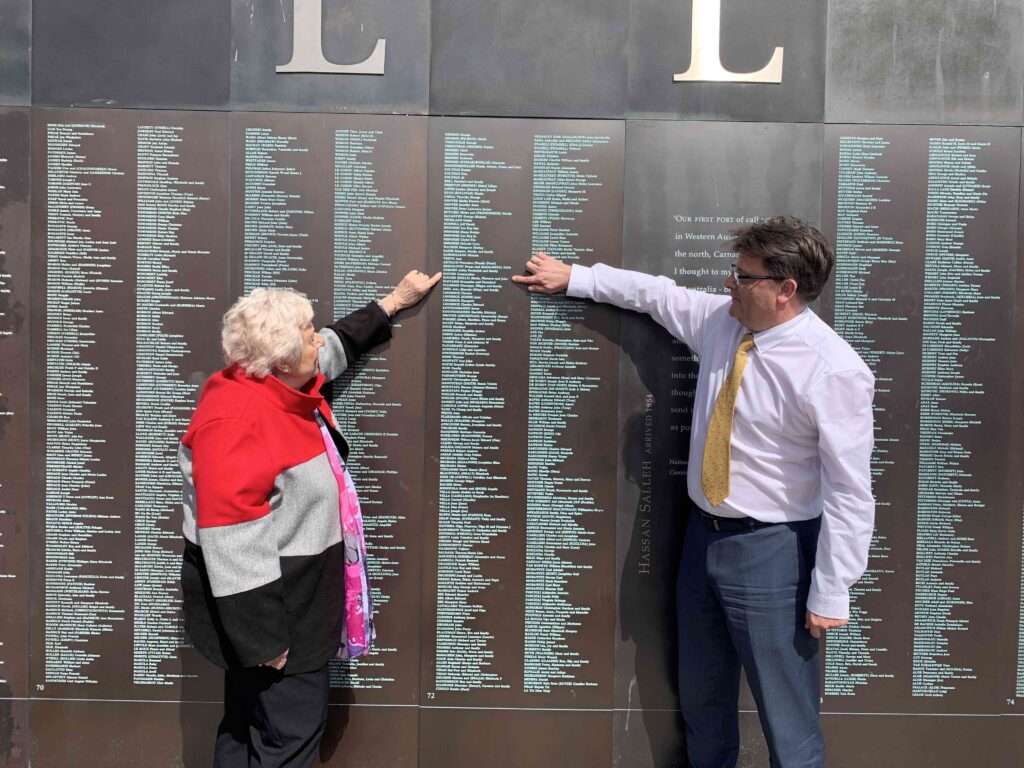
Australian National Maritime Museum CEO with Bessie Dounis at the Welcome Wall. Photo: Peter Oglos/The Greek Herald
“Making sure they have a life of opportunity, a life that they themselves could not see during that time.”
A touching tribute to the thousands of migrants that have been lucky to call Australia home, Kevin eventually hopes to be able to dedicate more exhibitions to the history of migrants. The CEO revealed that the “bigger vision” is ultimately to create a national migration museum at the Royal Maritime Museum as well.
“I feel these stories, their time is now. They need to be told,” Kevin stresses.
“This isn’t distant history, this is very close. But we’re losing it.
“We’re in the memory business. The memory business is to capture those important memories, especially for school students, so they can understand that there is something very unique about migration in Australia.”
As a national history museum, much of the Maritime Museum’s resources are spent maintaining artefacts brought to Australia almost 100 years ago. With over 140,000 objects in their possession, Kevin reveals that over 10,000 alone are missing pieces to Australian migrant stories.
“We capture those artefacts and the idea for us is that we keep that object in perpetuity.
“We make sure that in 100, 200 and 300 years’ time, that object is in as good condition as it can be.
“They tell the stories of individuals.”
Any Greeks who wish to put their family’s names on the Welcome Wall can do so by going to their website and applying before November 1 to see it’s grand unveiling on January 10, 2021.
Bessie Dounis: Family history that spans three centuries
Bessie Dounis was one of the thousands of migrant children who decided to put her parents on the Welcome Wall around 5 years ago.
Speaking to The Greek Herald, Bessie says that she felt it was important to share her parents’ achievements and story with the Maritime Museum.
“I hadn’t heard about it until I came to the maritime museum one day. I saw the Welcome Wall and I wanted to do it straight away,” Bessie says.
Bessie’s mother, Maria, and father, Con, were born before 1900 in Evia, from the village of Raptei. Childhood sweethearts, the pair gave birth to two children before Con moved to Australia with his brother Stylianos and cousin, leaving his family behind in Greece.
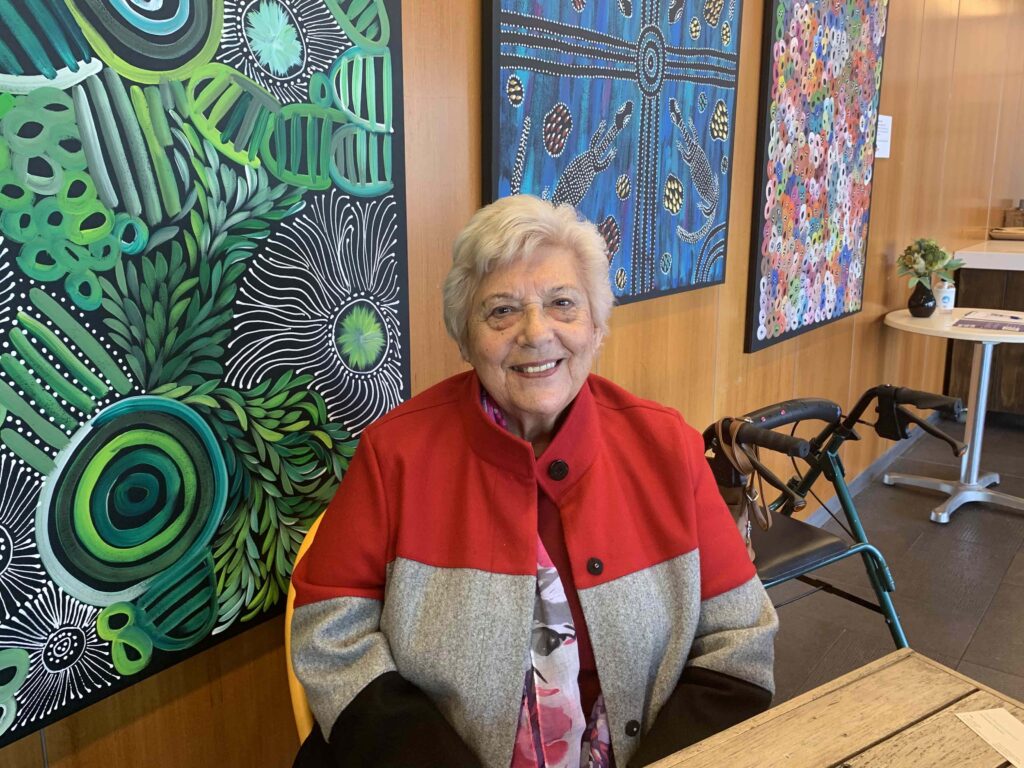
Bessie Dounis was one of the thousands of migrant children who decided to put her parents on the Welcome Wall around 5 years ago. Photo: Peter Oglos/The Greek Herald
Con spent eight years working in the fishing industry off the Great Australian Bright before he saved enough money to bring his family over from Greece on 26 January 1936 – Australia Day.
Almost exactly nine months later, their daughter Bessie was born in Sydney. In quick succession, another four children followed: Nicholas in 1938, Michael in 1940, Steve in 1942 and George in 1944.
“It’s lucky she came out because only three years later, World War II had started,” Bessie says.
Bessies family settled in Kings Cross after sailing over from Greece, with her father running a fruit shop in the district. Selling the shop in Kings Cross to buy another in Bondi Junction, Bessie explains that Eastern Suburbs business didn’t last too long, with her family being “stuck in the Cross” for most of their lives.
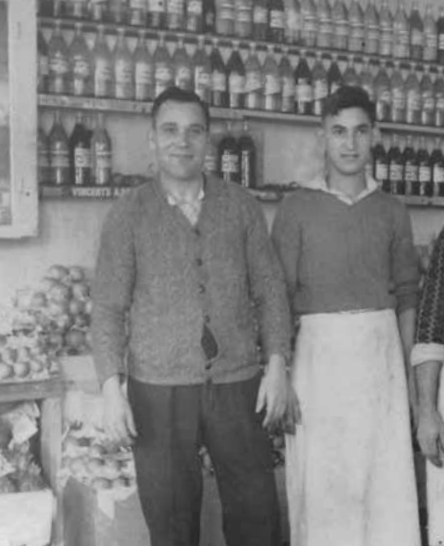
Con and his nephew John Dounis in the fruit shop, 1930s. Photo: Australian National Maritime Museum
“Dad sold the Kings Cross shop to an Italian. But it was then announced that the Italians had to be interned. So dad had bought the shop back from him,” Bessie said.
While Bessie’s father was renowned for his fruit shop in the Kings Cross area, her mother, Maria, was a beloved member of the community.
“If something went wrong on Palmer’s street or in the area, they would always call her to do her old fashioned remedies. She was loved by everyone.”
While her parents collected many stories during their time in Australia, at 84 years old, Bessie has been blessed with many once-in-a-lifetime opportunities. One of these experiences includes her involvement in the Greek Orthodox Millennium Choir; The second choir in history to sing the millennium hymn in Greek at the Olympics, outside of Greece.
“I’ll tell you what. Magic.”
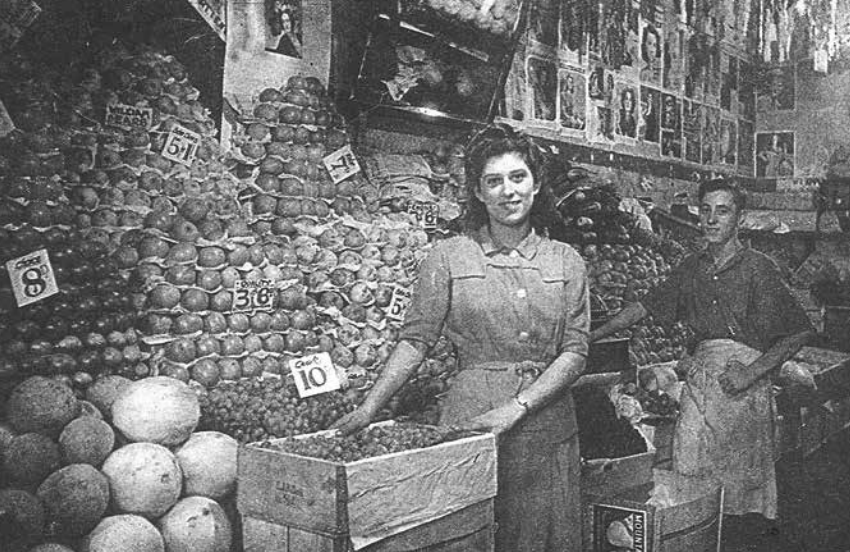
Eldest daughter Florence and her brother John inside the shop, 1942. Photo: Australian National Maritime Museum
“We had to go to Kingsford church and George Ellis was the conductor. We had the best seat in the whole house of the Olympic stadium for the opening ceremony.
“It’s funny because my parent’s names are on the wall, but my name is on the Olympic Park.”
Bessie’s father Con tragically died in April 1970 and was remembered by many of the migrant Greeks and local Kings Cross community as a “good man” who always helped other new arrivals to the country.
Maria lived to an impressive 96 years of age and is still fondly remembered by Bessie for her generous soul and loving nature.
“My mother was a truly special woman,” Bessie concludes.
At 84 years old, Bessie continues to tell her parents’ stories, honouring their legacy as a piece of national history on the ‘Welcome Wall’.
Honour our Greek immigrants on Australia’s National Monument to Migration at the Australian National Maritime Museum. Register by 30 June 2022 to be part of the next ceremony in October. To register please visit
Rugby League Review publisher and Greek Rugby League advocate Terry Liberopoulos has sent a callout to all female Greek Australian Rugby League players, hoping to establish a Greek National team here in Australia.
Speaking with former NRL women’s player Maria Nikolopoulou on GreekGirlsCan, Terry says he’s “always been on the lookout” for Greek heritage female players in Australia, looking to help grow the Women’s game in Greece.
“It wasn’t until one of the Greek girls that plays for South Sydney emailed me to express her interest in playing for Greece,” Terry says.
“She told me there were four girls at Souths that had a Greek background.”
Asked about the requirements for joining the prospect national side, Terry says they will accept any girl as long as they are aged 17 years and over, and must either have been born in Greece or have one parent or grandparent that was born in Greece.
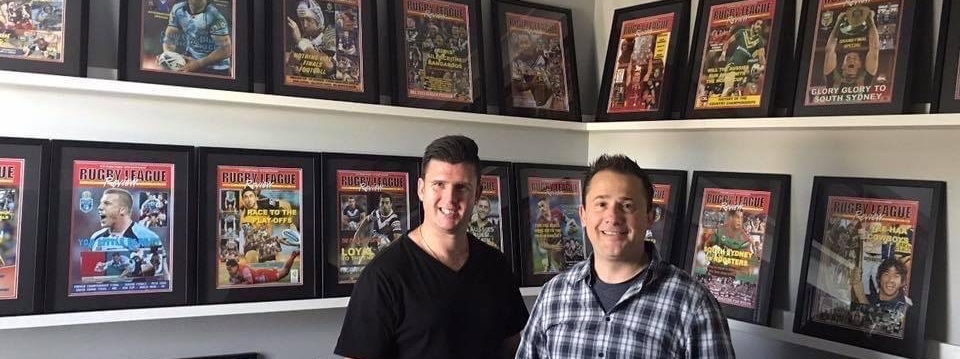
Rugby League Review publisher and Greek Rugby League Association advocate Terry Liberopoulos. Photo: Everything Rugby league
“We would like them to be playing some kind of Rugby League, be it tackle, Oztag or Leaguetag,” Terry adds.
“We are looking at girls from all over Australia but Sydney looks like being the base as most will come from Sydney or nearby areas such as Illawarra, Central Coast, Newcastle and Canberra.”
Terry revealed he will be employing the help of Canterbury Bulldogs interim head coach Steve Georgallis to help form and train the women’s side, along with former Greek head coach Stuart McLennan.
“We will follow the same path as the Men’s, meaning we will get the girls playing here and then having them go overseas to help promote, develop, train and play with the girls in Greece,” Terry says.
“The enthusiasm I have seen from the girls in Greece is incredible and the introduction of some experience from Australia will grow the game in Greece.”
Any girls wanting to involved are asked to contact Terry Liberopoulos from the Greek Rugby League Association at terryliberopoulos@hotmail.com.
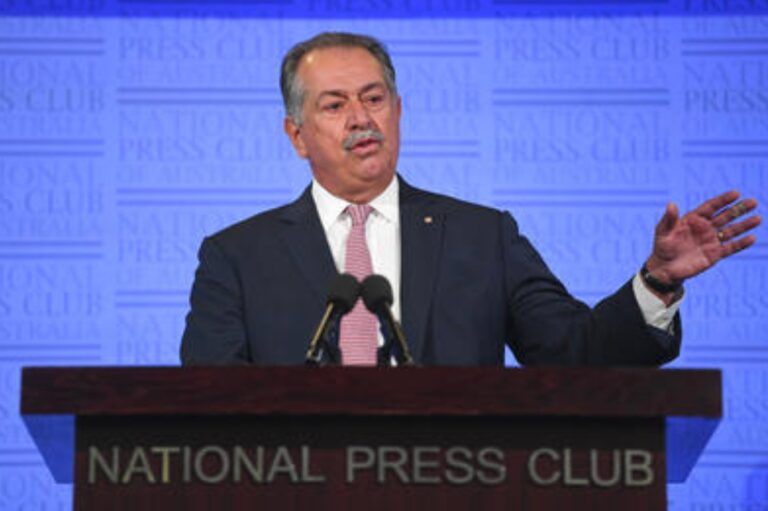
Former Chairman of The Dow Chemical Company, Andrew Liveris AO spoke about Australia’s opportunity for manufacture expansion during a National Press Club address Wednesday afternoon.
Known globally for advocating the criticality of manufacturing worldwide, Liveris spoke about Australia’s need to diversify their manufacturing strategy, urging that the country has to be a “leader” in the global market.
The Greek Australian businessman argued that the first step in this plan is the transition from coal to gas as part of its energy transition.
“I know that’s not a popular thing to say in some parts of the political establishment,” he says. “But unless you do carbon sequestration, you need to find way to get gas into the mix.”
Andrew Liveris: “Nobody saw the retreat of the United States coming. The power vacuum that this has created is profound and there is really only one country ready and determined to fill it.” 1/2 @SBSNews#auspol#npcpic.twitter.com/stXLF6QFMY
“I warned that we were going to kill our manufacturing sector if we exported all of our gas as LNG,” he says. “Well, we almost got there. We almost killed it all. We have rendered our natural gas supply as unreliable, inaccessible.”
“We can’t get massive amounts of gas in the basins around the country to market because we have limited infrastructure. It’s like buying airplanes and having no airports. Where do you land?”
Liveris recommended four objectives for Australia in pursuit of a sustainable economy.
1. Build a manufacturing centre with technological capabilities worthy for the 21st century.
2. Diversify economic interests.
3. Invest in sustainable technologies and investment centre.
4. Restructure and reset skill base of Australian citizens.
Financial Review‘s political editor Phil Coorey asked Mr Liveris about Australia’s relationship with China, and whether the government may need to temper its public comments towards Beijing in the interests of the economic relationship.
“I never put myself in the position of a leader of a country because that’s a hard job. I’ve been around a lot of leaders. It is a difficult balancing act, in terms of what your population needs to hear, versus the competing positions of a different country,” Mr Liveris says.
“If you look at environmental standards, labour standards, all the thing we care about, we should set the highest bar. Code of conduct should be the highest bar.
“Whether other countries respond to that, it’s their choice but I don’t believe we should necessarily call them out on that. I think we should actually spend our time trying to help them if they want to be helped.”
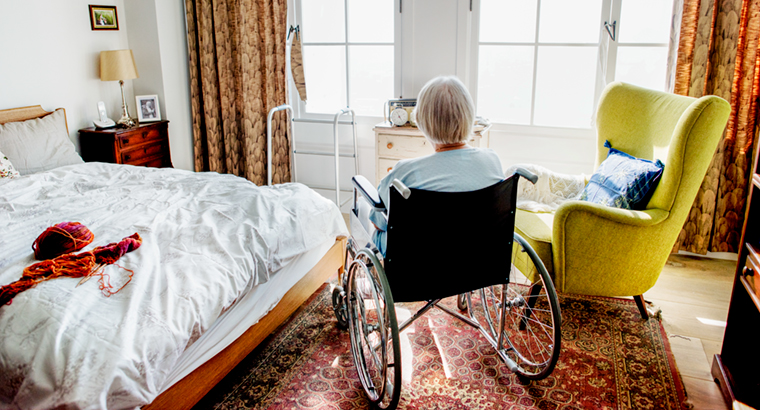
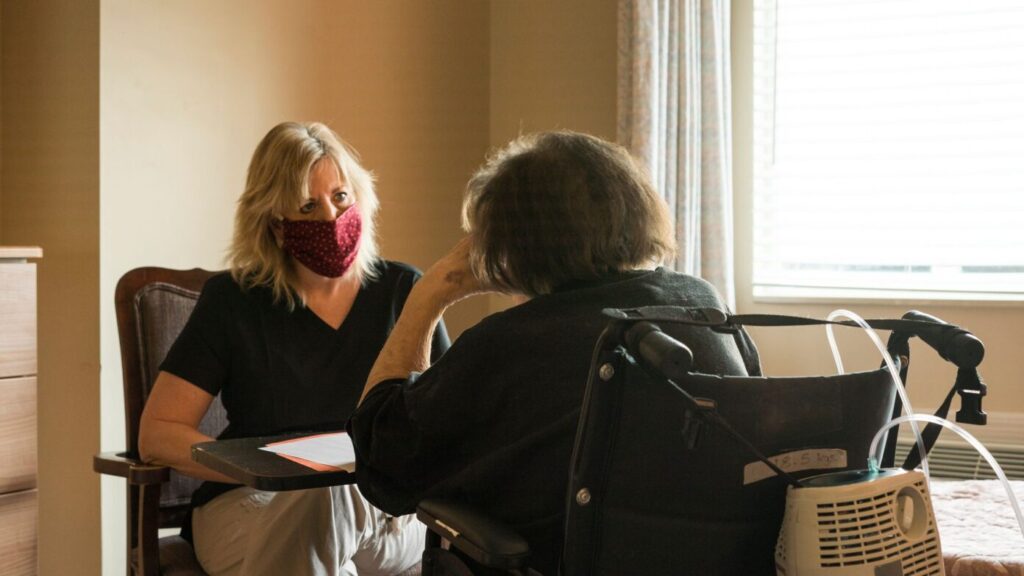
Fears have been sparked by nurses sent in to help Melbourne’s coronavirus-ravaged aged care facilities who claim that aged care residents are on the verge of giving up due to COVID-19 isolation procedures.
Speaking on ABC 7:30 Tuesday night, Western Health Clinical Nursing Consultant Shane Durance said he fears there will be a long tail of ongoing deaths in nursing homes due to the pandemic, unrelated to COVID-19 infections.
“We’ve got people who aren’t COVID-positive, whose mood is severely depressed, who are not eating well, who are not drinking adequately, who are prominently locked in their rooms, not able to go out for any activities, no leisure activities, and their mobility is declining and their mood is declining,” he told 7.30.
Photo: WANDERLUSTER VIA GETTY IMAGES
“And for someone who’s already elderly, already has a mood disorder, already is mildly malnourished — it’s very hard to come back from that.”
Mr Durance says aside from the devastating effects of the virus, isolation is bringing even more detrimental effects to patients mental and physical wellbeing.
“It affects their mood. It affects their desire to eat, their desire to drink,” he said.
“They go to bed, they stop walking, progressively they lose the ability to walk.
“My concern is that, although the death rates in residential care patients will start to slow, then we’ll see a very long tail of ongoing death rates.
“And they won’t be attributed to COVID and they’ll drop off the front page of the newspapers.”
Mr Durance said he feared governments and the broader public would lose sight of the issue and would fail to properly review what went wrong.
Mary-Louise McLaws from the World Health Organisation’s Experts Advisory Panel predicted that a quarter of Victorian aged care cases will die from COVID-19. The health expert says the public should remain vigilant, as the aged-care death toll is likely rise.
“It will continue sadly because Victoria has had a very large number of aged care cases and I expect at least a quarter of them to die,” she said.
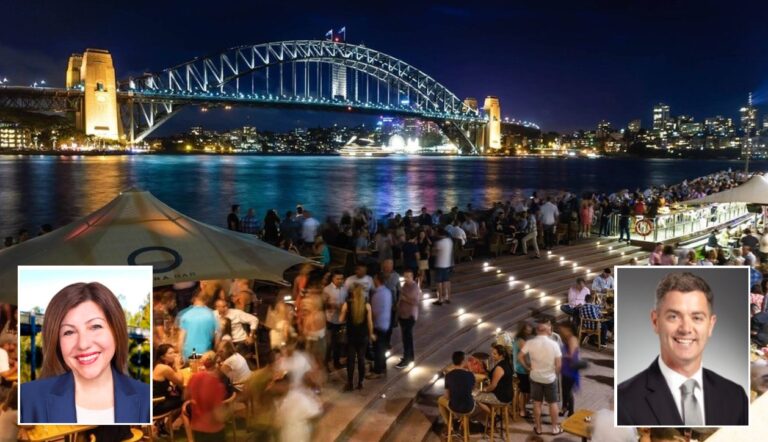
NSW Labor is urging the Minister for Planning and Public Spaces, Rob Stokes, to fast-track a plan for Sydney’s after-dark economy as businesses struggle to recover from lockouts and lockdowns.
Labor Shadow Minister for Better Public Services Sophie Cotsis said a roadmap detailing the next steps is crucial.
“Labor has been calling for more to be done in Sydney at night since the election,” Ms Cotsis said.
“Safety must be the priority for patrons and staff. Hospitality businesses are working very hard to ensure they stay open, provide opportunities to staff and of keep their doors open to trade in a safe environment.
“Hospitality businesses have faced months of confusion and chaos because of this Government. As we look to revitalise Sydney, they need certainty and confidence.”
Labor MP’s Sophie Cotsis and John Graham are pushing for a structured plan to aid Sydney’s nightlife.
The Shadow Minister for Music and the Night Time Economy, John Graham said: “My fear is this is an old set of answers to an old set of problems. The impact of the lockdown on night time businesses and jobs has swamped the previous impacts of the lockouts.”
Mr Graham said the proposals, which include longer opening hours, more outdoor dining, fewer restrictions on live performances and late night public transport must be rolled out urgently.
“Mr Stokes needs to use his ministerial powers to keep entertainment and hospitality workers in jobs by supporting outdoor dining and performance and later trading. These are the same powers he used to keep truckies in work, delivering to supermarkets – or tradies in the construction business. Now they should be applied to support musicians and hospitality workers,” Mr Graham said.
“This sector needs financial support. These businesses are drowning in the face of an economic tidal wave. There is no fiscal life boat from the Government.”
Greek Super League side PAOK are one step closer to qualifying for their first ever Champions League campaign after a surprise victory against former Portuguese champions Benfica.
A shock 2-1 victory for the Thessaloniki team means they will face a two-legged playoff against Russians Krasnodar.
An own goal by Jan Vertoghan saw PAOK lead in the second half, with players Dimitris Giannoulis and Chuba Akpom linking up to create great opportunities for the Greeks.
A shock 2-1 victory for the Thessaloniki team means they will face a two-legged playoff against Russians Krasnodar. Photo: Ekatherimini.
Benfica, who won Europe’s premier club competition in 1961 and 1962, saw last season’s woes spill over into this term as Serbia winger Andrija Zivkovic scored against his former club a week after leaving them.
Only 15 minutes to come back, the Portuguese side managed to secure a consolation goal in the fourth minute of time added-on via Rafa Silva.
Having seen the domestic league and cup double go to Porto last term, Benfica missed a string of chances against PAOK in a one-sided first half as they enjoyed 72% of possession.
PAOK will face Krasnodar next Tuesday in Russia and the return in Thessaloniki on September 29 or 30.
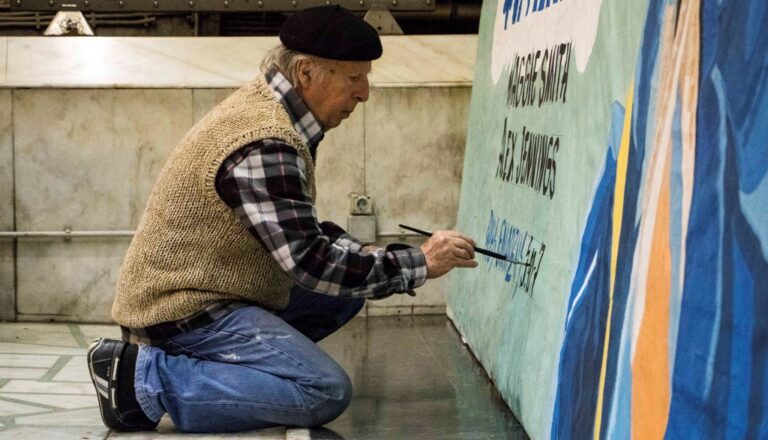
Vasilis Dimitriou, an artist who sought to prevent Hollywood’s painted billboard art from disappearing, died aged 84 from Parkinson’s disease on September 6.
Vasilis created more than 8,000 works for Greek theatres that practically told the story of cinema since WWII.
Mr. Dimitriou was a self-taught painter from a poor family who survived the Nazi invasion and the Greek military junta. For more than six decades, he painted one to two billboards per week featuring stars ranging from Gary Cooper to Leonardo DiCaprio.
Using homemade paints soaked in glue to keep billboards from leaking in the rain, Mr. Dimitriou created beautiful romantic images. “The Exorcist” was ominously illustrated in chiaroscuro, with blood dripping from the Greek letters of the title.
In recent years, as digitally drawn and mass-produced movie posters became the norm, Mr. Dimitriou made it his mission to prevent the art form from dying, while acknowledging that it represented a period to what he called the “golden age” of cinema.
“Back then, you went to the movies in a suit and tie,” he told the New York Times in 2014.
“Women wore nice dresses. There was an intermission and half of the theatre went to the foyer to have a drink and discuss the film. Now let’s go.”
He vowed to keep the craft running as long as he could raise his arms to paint.
His work left an indelible mark on the Greek capital, where Athenians grew up seeing his posters. They were a particularly heartwarming sight during Greece’s recent financial crisis, when unemployment hit nearly 25% and consumer confidence plummeted.
“People saw me putting up my posters and giving me a big smile,” Dimitriou said. “Or they would ask to shake my hand and say ‘thank you’ for giving them joy.”
Mr. Dimitriou said he was sad knowing that he was among the last to work to perpetuate an almost extinct art. But he had no regrets.
“Painting is in my blood”, he said in 2014. “When I stop breathing, it’s when I stop painting.”