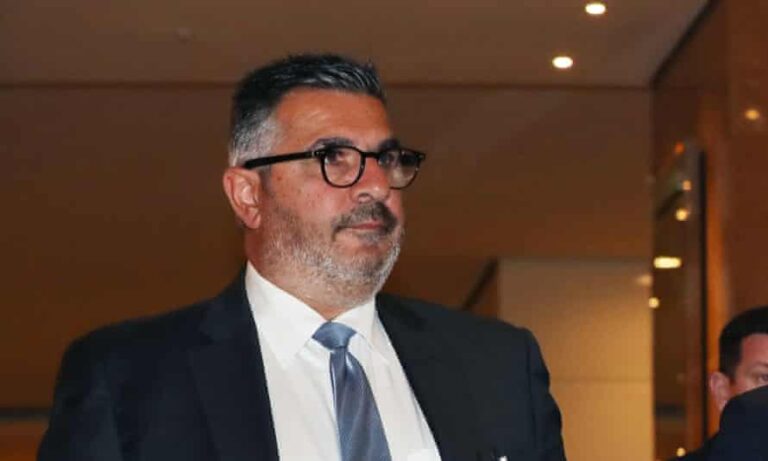
Crown Resorts director Andrew Demetriou has resigned from the board of the embattled gaming giant but has vowed to defend his reputation.
In a statement, Mr Demetriou said it was not an “easy decision” to step down and he had thought “carefully about taking this step”.
“I have always been a team player and supported the greater good. I will therefore step down from the Crown Resorts board to give Crown the best possible chance of becoming suitable to the NSW Regulator,” he said.
Two representatives of major shareholder, James Packer, resigned from Crown’s board on Wednesday, after the independent report highlighted the billionaire’s harmful influence over the group as a key reason it was unfit to hold the licence to its casino at Barangaroo.
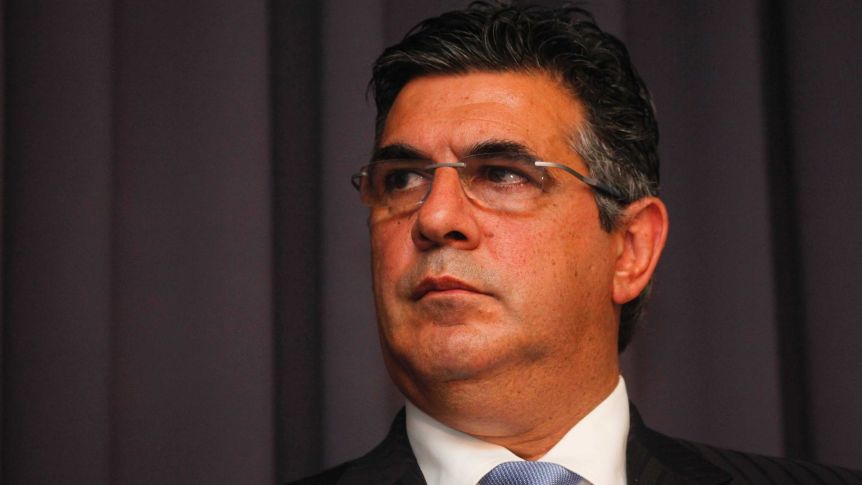
Andrew Demetriou sat on the Crown board since 2015.(AAP: Lukas Coch)
Commissioner Bergin’s report into Crown Resorts – released on Tuesday following an explosive 18-month public inquiry – found that Crown had facilitated money laundering at its Melbourne and Perth casinos, partnered with figures linked to organised crime, and disregarded the safety of staff in China before 19 were arrested there in 2016.
Mr Demetriou said it had been an “honour” to serve on the Crown board and had confidence a licence for the new casino would eventually be granted.
“Crown is a great company, with outstanding people who serve the company well. Barangaroo will be a magnificent addition to the Sydney landscape and I look forward to when it is fully operational,” he said.
World No. 5 Stefanos Tsitsipas has made a narrow victory against Greek-Australian Thanasi Kokkinakis 6-7 6-4 6-1 6-7 6-4 in what was an intense ‘Battle of the Greeks’.
The match reached an incredible fifth set after Kokkinakis pushed two sets into tie-breakers. Despite having the crowd on his side tonight, Kokkinakis was unlucky to come up short against the highly experienced Greek tennis professional.
Kokkinakis and Tsitsipas arrived at the arena on another scorching Melbourne day, hitting 32 degrees celsius. Tsitsipas came out decked in his regular yellow apparel and Kokkinakis, who made headlines two days ago for winning his match in a K-mart t-shirt, styled a white branded shirt.
Despite Tsitsipas’ overall stronger serve power, taking a few aces early, the two players were quite evenly matched early in the first set.
CLEAN BOWLED! 🏏
Tsitsipas takes a massive swing at Kokkinakis' serve and misses the lot!
Kokkinakis was unlucky not to take a break point and capitalise on a few uncharacteristic missed hits from Tsitsipas. Putting some pressure back on Kokkinakis, the Greek almost wrapped up the set early on a 5-4 advantage lead, yet Kokkinakis brought it back to a final two service games, and eventually a tie-breaker.
After an intense tie-breaker game, Australian Thanasi Kokkinakis took the set and put increased pressure on the World No. 5.
Coming into the second set, Tsitsipas managed to break the Australian gain an early game lead. This lead continued on through the set, with Kokkinakis unable to come back and put any real pressure on the Greek. The second set finished 6-4.
Repeating his unfortunate start in the last set, Kokkinakis was again unlucky to give away a break point to Tsitsipas in the opening game. Despite the Greek-Australian still hitting an average serve, Tsitsipas’ return game was on another level in the third set, not wasting reckless points as seen in the last two hours.
Tsitsipas went on to claim two more break points, absolutely dominating the third set 6-1.
The fourth set saw Kokkinakis bounce back and give Tsitsipas some competition for the match. The Australian hit a few aces and pressured the Greek at moments, battling hard to stay alive.
Photo: Australian Open.
The game reached a sixth deuce as the two players battled with Tsitsipas holding 5-4 lead, looking to finish the match on a break point. The screams of Kokkinakis, however, fuelled the Australian into another game.
In a thrilling tie-break game like no other, the World No. 5 was bested by World No. 267 Thanasi Kokkinakis. A nail biting 10 minutes, Kokkinakis almost blew a four point lead, yet secured the game and set.
The fifth decider set saw neither player give out. The third game reached an incredible eight deuces with Kokkinakis finally taking his service game. Kokkinakis, similar to his Greek-Australian friend Nick Kyrgios, fuelled off the energy from the crowd who rallied behind their Australian competitor.
Thanasi Kokkinakis stays in the match. Photo: Getty Images.
Kokkinakis was unlucky to give away a crucial break point in the decider set, bringing him into a chase with Tsitsipas.
Kokkinakis was unlucky to not gain a break point against the Greek, losing the set and match.
Speaking in the post-match press conference, Tsitsipas said he is glad the match had the presence of such a supportive crowd.
“He has huge potential, he knows it himself… I really enjoyed showing the world some high quality tennis today,” Tsitsipas said.
“I’m very happy to see him back competing at a high level.”
The Cook Community Award is given to selfless volunteers in the Cook area who are actively involved in community groups or are simply giving back to make the area a better place for all. Proud Kytherian, Linda Cassimatis, is one of these volunteers.
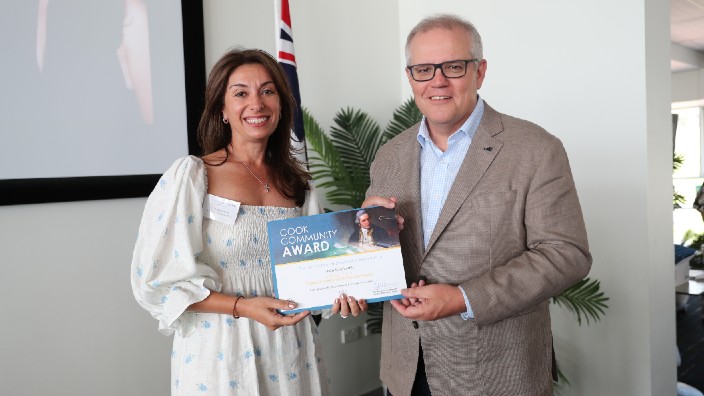
On December 12, 2020, Linda was handed the Cook Award by Australia’s Prime Minister, Scott Morrison, for being an active volunteer on four public school P&C executive committees, including Sans Souci Public School, Baldface Public School, Port Hacking High School and Caringbah High School.
“The parents at Caringbah High School nominated me for the award and it felt great. I got a lot of rewards and satisfaction out of volunteering, and I was just really thrilled that other people would want to say thank you for that,” Linda tells The Greek Herald.
Linda Cassimatis and other Cook Award recipients with Australian Prime Minister, Scott Morrison. Photo supplied.
It’s not surprising that parents wanted to thank Linda for her service. The Sydney mum-of-two had been volunteering on the P&C committees of her children’s schools ever since 2005, when her son William first started primary school at Sans Souci Public School.
“What started as a way to better understand school life to support my children and to meet and connect with their families, lasted for the whole of my children’s schooling years,” Linda says.
“I have a greater shared history with William and Caitlin of this precious time in their lives thanks to being an active member of their school communities.”
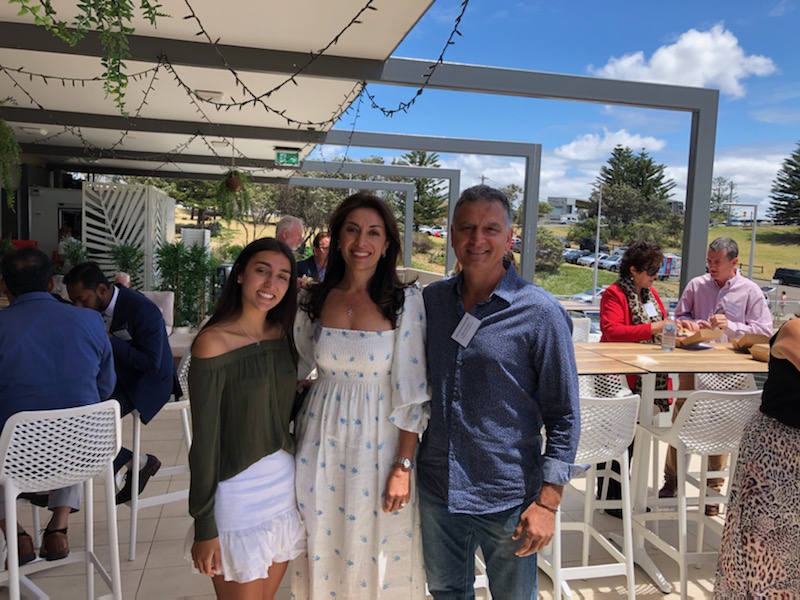
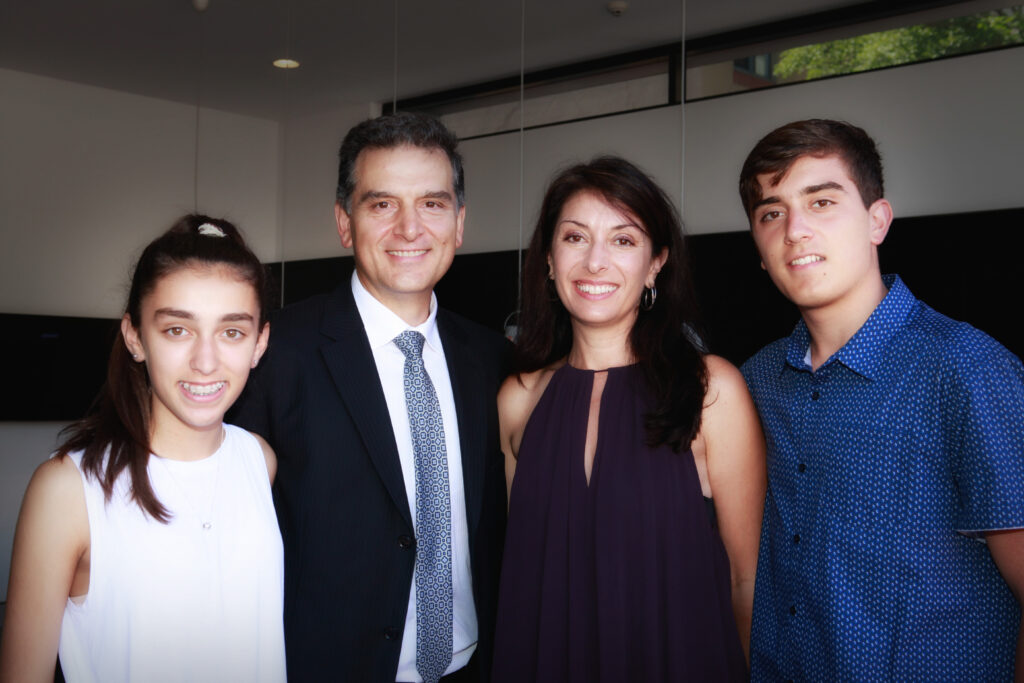
Linda, her daughter Caitlin and husband John at the Cook Community Awards. Photo supplied.
But for Linda, being an ‘active member’ didn’t just mean supporting her own children through their schooling. It also meant implementing initiatives which would benefit other school parents, students and teachers as well.
In fact, during her tenure as President of the P&C committee at Caringbah High School (CHS), Linda established an internal grant program, which has delivered a range of benefits to the school community from new digital microscopes for senior science students, to electronic whiteboards and new staging for the school hall.
“The internal grant program gave every member of staff a direct channel to advocate for resources they wanted to acquire to enhance the educational experience of their subject for their students,” Linda explains.
Linda has always been supported in her volunteering work by her family. Photo supplied.
“Teachers came forward with more ideas than we could fund in the first year, but that helped parents see where their voluntary contributions were going and gave them confidence to donate.”
Linda says the grant program also encouraged the committee to find other funding sources to deliver things for the school which could not be covered by the P&C budget. For her part, Linda decided to apply for the NSW Government’s Community Building Partnerships grant program and in November 2020, Caringbah High School was awarded $23,000 to fund its new staging.
Applying for this grant was one of Linda’s final acts as President of the school’s P&C committee after she decided to retire in mid-2020. Although her retirement saddened many parents, Linda says ‘the timing couldn’t have been any nicer’ because it aligned with her daughter’s graduation from Year 12.
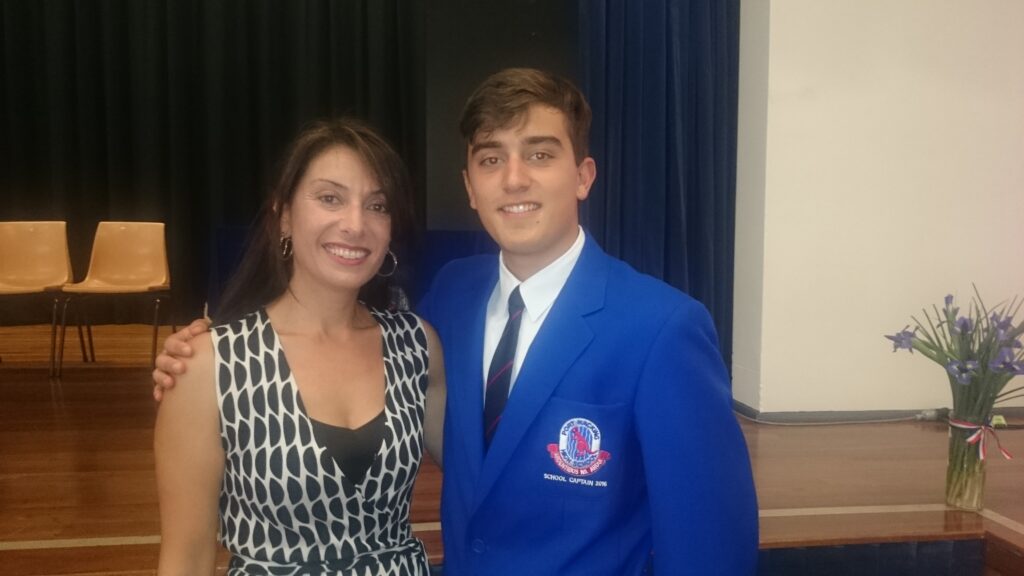
Linda and her son William at a Presentation Day at Port Hacking High School in 2016. Photo Supplied.
“It was just a logical end to that chapter of family life for me. I mean I would always say to the school principals, ‘when I’m not working, they’re my service days to the school.’ So it’s definitely been a lot of the way that I’ve structured my life,” Linda says with a laugh.
“It’s a part of my life that after 15 years I really got used to having and I’m sitting there thinking to myself now, ‘I have to find something else to do with my service days’.”
With such an impressive volunteering resume under her belt, we’re sure Linda won’t have any trouble finding her next exciting project.
A warning has been issued for churchgoers from the Saint Constantine & Helen Greek Orthodox Church in Newtown after a worshipper was diagnosed with meningococcal infection, according to a 7 News report.
Anyone who attended the parish in Sydney’s inner west is urged to watch for symptoms of the disease.
The infected person attended the church for a service on February 5 from 10.30am-11am.
Sydney Local Health District’s Director of Public Health, Dr Leena Gupta, said while the risk is low, it’s important for the community to be aware of the signs and symptoms.
“Meningococcal disease usually begins with the sudden onset of fever, often with headache, nausea and drowsiness,” Gupta said.
“Neck stiffness, dislike of bright lights and a rash of reddish-purple spots or bruises may develop rapidly.
“If you attended this church service and are feeling unwell or have any of the above symptoms, please see a doctor immediately or go to an Emergency Department if symptoms worsen.”
In NSW, the disease is uncommon and occurs most often in winter and spring. Early treatment of the infection is vital.
A small memorial service for the late Father Nicholas Vrettakos was held at St Demetrios Parish in Queanbeyan, NSW, on Wednesday by the Very Reverend Prochoros Anastasiadis, Archepiscopal Vicar of Canberra.
Father Prochoros was holding a Divine Liturgy at the parish to celebrate the feast day of St Haralambos, when he decided to conduct a trisagio for the late Father Nicholas, who is known as the first-ever priest of Queanbeyan.
Later, a procession of the holy relics of St Haralambos, which were given to the parish by Father Nicholas, took place around the church with the help of current parish priest of St Demetrios, Father Iakovos.
After the service, parishioners were treated to coffee from the ladies of the St Demetrios Philoptochos, and they were also given an icon of St Prochoros as a memento of Father Prochoros’ first church service at the parish.
The night before, another church service to celebrate St Haralambos was held and attended by the Ambassador of Greece to Australia, Georges Papakostas, the High Commisioner of Cyprus, Mrs Martha Mavrommatis, as well as other community leaders from the local Greek and Cypriot community.
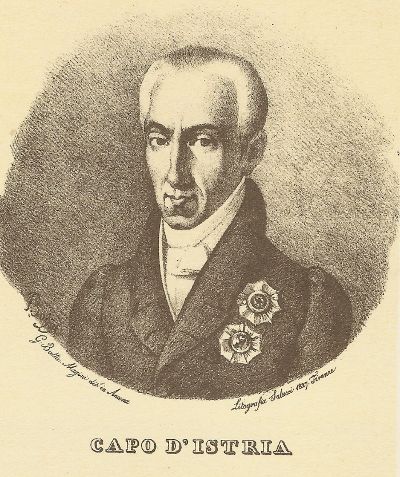
Ioannis Kapodistrias is a well-known Greek politician and diplomat. He served as Minister of Foreign Affairs of Russia and became the first Governor of the independent Greek State.
Early Life:
Ioannis Kapodistrias was born in Corfu on February 11, 1776 during the Venetian occupation. His father, Komis Antonio Capo d’Istria, came from a noble family, as one of his ancestors had received the title of Earl from the Duke of Savoy Carlos Emmanuel II.
Kapodistrias studied medicine, philosophy and law at the University of Patavia (Padua) in Italy. In 1797, he settled in his hometown of Corfu and practiced the profession of doctor-surgeon.
In 1799, Russia and Turkey drove the French from the Ionian Islands and organised them into the Septinsular Republic. Kapodistrias participated in writing the new state’s second constitution (adopted 1803) and became its secretary of state (1803) at just 25 years of age.
Diplomacy for Russia:
France regained control of the Ionian Islands in 1807 and Kapodistrias entered the Russian foreign service two years later. He became an expert on Balkan affairs, which earned him a post with the commander of Russia’s armed forces on the lower Danube River in 1812.
After the army marched north to oppose Napoleon’s invasion of Russia (1812), Kapodistrias was assigned as a diplomat to the army staff and was later sent by Tsar Alexander I on a special mission to Switzerland in 1814.
After attending the postwar Congress of Vienna as one of Russia’s representatives (1814–15), Kapodistrias became a highly influential adviser of the emperor. After January 1816, he was also given equal responsibility with Karl Robert Nesselrode, the director of the Ministry of Foreign Affairs, for the conduct of Russia’s foreign policy.
His return to Greece:
When Tsar Alexander I refused to support the Greek revolt against Turkey (begun March 1821), Kapodistrias, who had a deep sympathy for the cause of Greek independence, although he had earlier refused to lead the major Greek revolutionary organisation, found himself in an intolerable position.
In 1822, therefore, he took an extended leave of absence from the Russian service and settled in Geneva, where he devoted himself to supplying material and moral relief to the Greek rebels until April 1827, when he was elected provisional president/Governor of Greece.
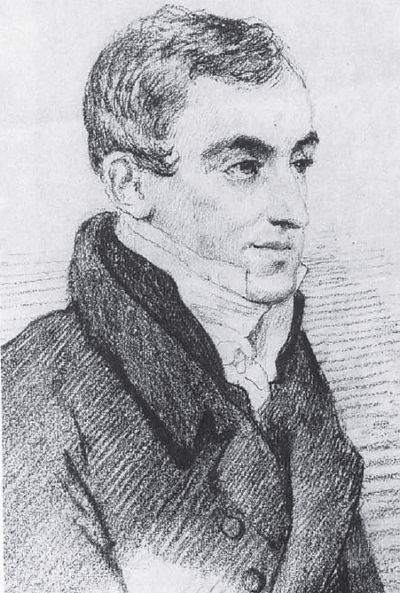
Lithograph of 1827.
Resigning from the Russian service, he then toured Europe seeking financial and diplomatic support for the War of Greek Independence and arrived at Nafplion, Greece’s capital, in January 1828.
He subsequently directed his energies toward negotiating with Great Britain, France and Russia (which had all joined the war against the Turks) over the settlement of Greece’s frontiers and the selection of its new monarch.
Kapodistrias’ domestic policies as Governor:
As Greece’s first Governor, Kapodistrias founded the National Financial Bank, even though it did not prosper for long.
He regulated the monetary system, as Turkish and foreign currencies were still circulating within the territory.
On July 28, 1828, he established the Phoenix as the national monetary unit and founded the National Mint. On September 24 that same year, he organised Greece’s first postal service and later, established the Statistical Service, which carried out the country’s first census.
Death and Legacy:
Kapodistrias’ political moves eventually provoked the dissatisfaction of both the supporters of the constitutional regime, as well as some nobles and sailors. But it was Kapodistrias’ rivalry with the Mavromichalides, the strongest family of Mani, which proved fatal.
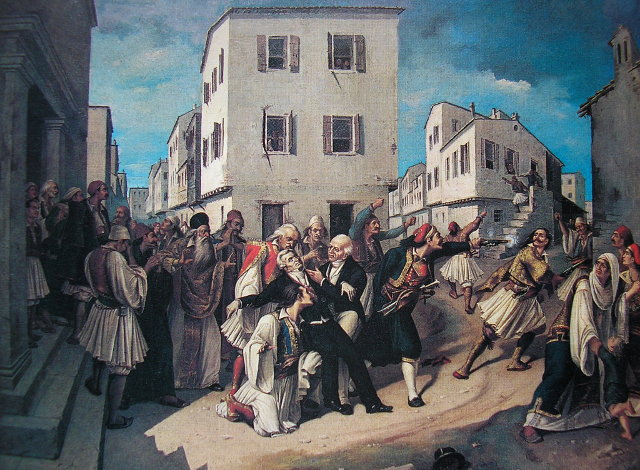
The murder of Kapodistrias.
At 5.35am on September 27, 1831, Kapodistrias was murdered by Konstantinos and Georgios Mavromichalis outside the church of Agios Spyridon.
For a short tie, Kapodistrias’ brother Augustine was appointed to replace him, but the country ended up in chaos and anarchy. Authorities took the opportunity to establish a monarchy, fearing the rise of a liberal movement.
Greece honored its first Governor by giving his name to public places and institutions, such as the University of Athens, whose official title is the National and Kapodistrian University of Athens.
Kapodistrias is also depicted on the 20-cent coin of the Greek version of the euro, while the administrative reorganisation plan of the country, proposed by the Simitis government, was named the “I. Kapodistrias Program.”
The Greek Herald takes a look back at the top five female Greek scientists and philosophers you should know about.
1. Themistoclea, Teacher of Pythagoras:
Also called Aristoclea or Theoclea, Themistoclea (6th century BCE) was a priestess at Delphi. She was one of the teachers of the famous Greek philosopher and mathematician Pythagoras, who claimed to have learned all his moral doctrines from her. Unfortunately, not much information about her has survived.
2. Aspasia of Miletus:
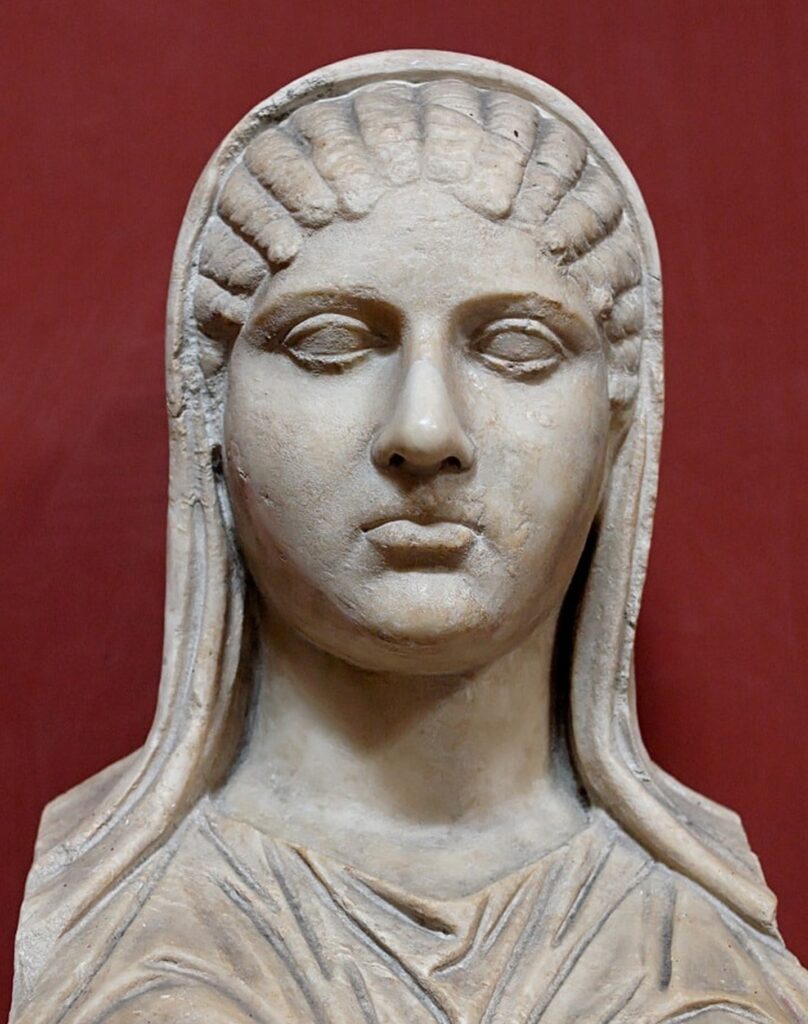
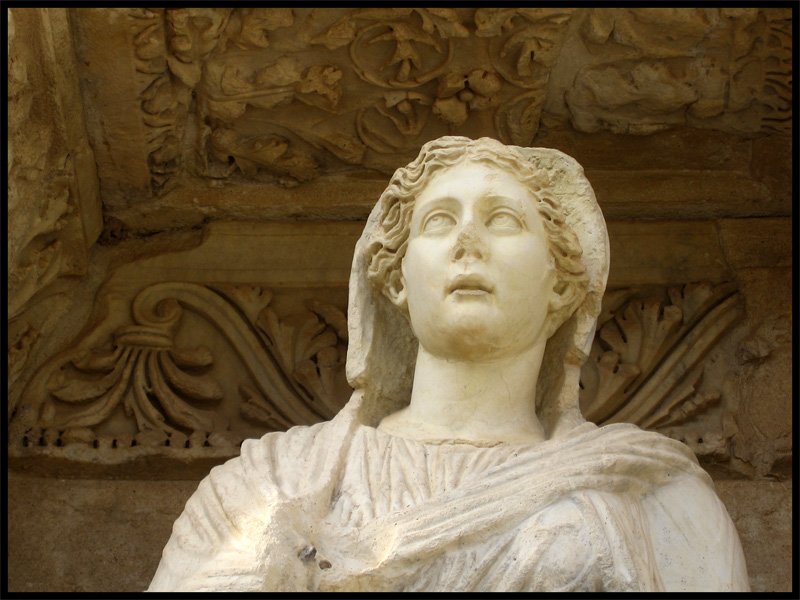
Bust of Aspasia, identified through an inscription. Photo: Public Domain / WikiCommons.
Born in Miletus in Asia Minor, Aspasia (470-410 BCE) was an important figure in Classical Athens. While few sources can tell us how she immigrated to the city state, she was known as the partner of Pericles, a local statesman, and mother of Pericles the Younger.
The Greek historian, Plutarch, recounts that her home in Athens was an intellectual center that attracted many great thinkers and philosophers, including Socrates and Plato.
Aspasia is also said to have established a girls’ school, surpassing the limitations imposed on women.
3. Hypatia of Alexandria:
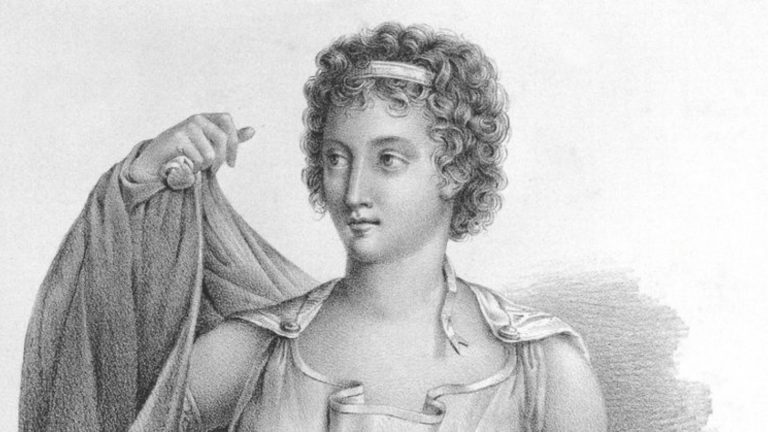
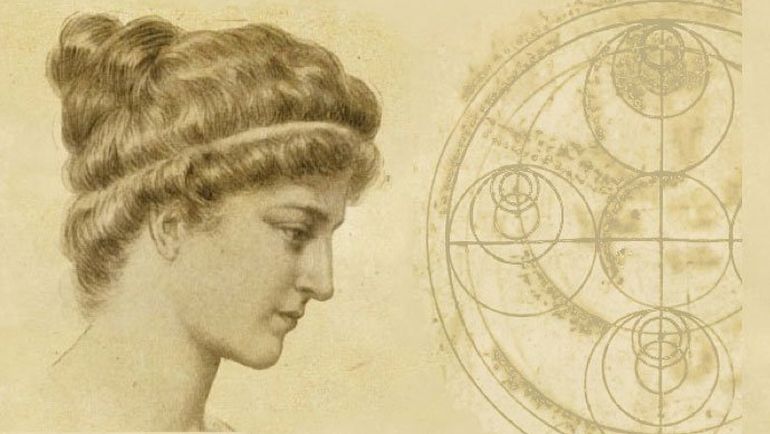
Hypatia of Alexandria (350-415 CE) was a philosopher, astronomer and mathematician in Alexandria. She is the earliest known female mathematician and was the last head of the Philosophical School of Alexandria, as well as the keeper of the famous library.
Hypatia (350-415 CE) was a philosopher, astronomer and mathematician in Alexandria.
The daughter of Theon of Alexandria, a mathematician and astronomer, she was a popular teacher and lecturer on philosophical topics, and is credited as the inventor (or at least, the perfecter) of the astrolabe.
Her belief in Neoplatonism caused her to be considered a pagan, which led to her being stoned to death after being accused of witchcraft.
4. Arete of Cyrene:
Daughter of Aristippus of Cyrene in modern-day Libya, Arete (5th–4th century BCE) is known as the first female philosopher. She learned this from her father, a former student of Socrates, and passed teachings on to her son, Aristippus the Younger.
It is said that she took over the School of Cyrene after her father’s death.
While none of her teachings have survived, she is mentioned by several historians and philosophers, including Diogenes Laërtius, Aelius, Clement of Alexandria and Aristocles.
5. Agnodice of Athens:
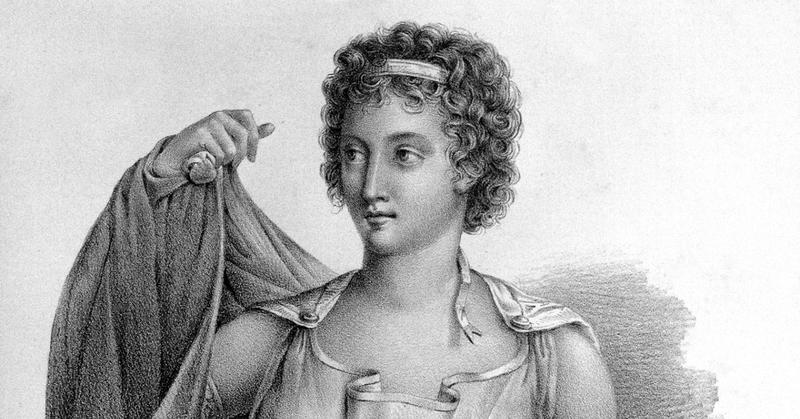
Born into a wealthy Athenian family, Agnodice (c. 4th century BCE) was actually the first female midwife known to history.
Her story is told by Roman author, Gaius Julius Hyginus, who recounts that she studied medicine under Herophilus disguised as a man, as women were not allowed to practice medicine.
She started practicing in Athens still disguised as a man, and specialised in helping women during labor, as men often refused to do this. In one instance, she had to reveal to a patient that she was a woman in order to proceed.
Jealous of her success among women, her male colleagues accused her of seducing women. She was even tried, and defended by the wives of leading statesmen of Athens, she was acquitted.
Thanks to her, the law against female physicians practicing in Athens was overturned.
The head of the NSW gambling regulator has today declared unequivocally that Crown Resorts CEO, Ken Barton, and independent director, Andrew Demetriou, must step down from their roles after a damning report into the company’s suitability to operate its Sydney Casino.
Two representatives of major shareholder, James Packer, resigned from Crown’s board on Wednesday, after the independent report highlighted the billionaire’s harmful influence over the group as a key reason it was unfit to hold the licence to its casino at Barangaroo.
But despite James Packer heeding the criticism of the report directed at him, Mr Barton and Mr Demetriou have so far refused to resign, according to a report in The Australian.
In response, NSW Independent Liquor & Gaming Authority (ILGA) chair, Philip Crawford, was speaking on ABC Radio National this morning and when asked whether Mr Demetriou and Mr Barton should resign, he answered: “Yes… yes.”
“There need to be changes in the top and in senior management,” Mr Crawford said. “A lot of board changes, and that’s started already and we look forward to seeing a bit more of that.”
Commissioner Bergin’s report into Crown Resorts – released on Tuesday following an explosive 18-month public inquiry – found that Crown had facilitated money laundering at its Melbourne and Perth casinos, partnered with figures linked to organised crime, and disregarded the safety of staff in China before 19 were arrested there in 2016.
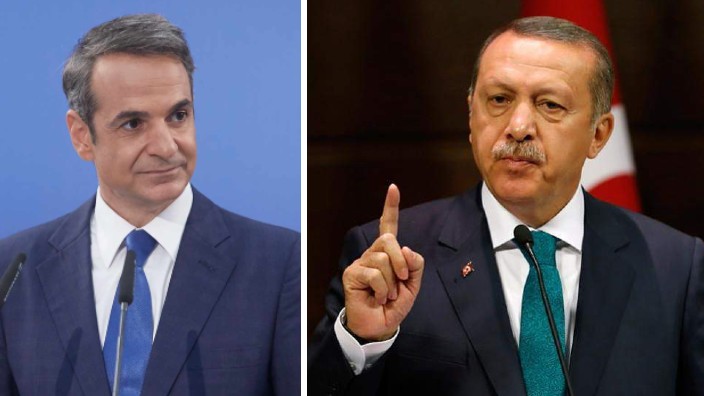
Turkish President, Recep Tayyip Erdogan, launched a fierce attack against Greece and Prime Minister Kyriakos Mitsotakis on Wednesday.
Speaking in Parliament, Erdogan told lawmakers from his AK Party that he could not meet with Mitsotakis, despite a resumption of talks between the two NATO members over their maritime disputes.
Erdogan said Mitsotakis had “challenged” him and called on the Greek PM to “know his limits.”
Speaking in Parliament, President #Erdogan hurled threats against #Greece today, said Greek Prime Minister does know his place, deserted by allies, made it clear #Turkey would respond to Greece with whatever necessary when needed, and ruled out a unified #Cyprus option for good. pic.twitter.com/FI9y9HhCZ8
“Even though we agreed to continue explanatory talks with Greece in March, Mitsotakis targeted us once again. Now, how can we continue our talks?” Erdogan said.
The remarks came in response to Mitsotakis saying on Monday that the only viable solution to the Cyprus issue is the creation of a unified state on the island.
“Ending Turkish occupation and finding a viable solution are a fundamental Greek foreign policy priority,” Mitsotakis said after a meeting with Cyprus President, Nicos Anastasiades, in Nicosia.
“The only viable solution is a bizonal, bicommunal federation with political equality.”
The Turkish president dismissed Mitsotakis’ proposal on the issue and further stated that: “The Greek side has not made the slightest change in its stance disregarding the existence of Turkish Cypriots on the island.”
“Two-state solution is the sole option for Cyprus, a federal system is no longer an option on the agenda,” Erdogan added.
Mathias Cormann and Anna Diamantopoulou are one of four candidates left in the race to lead the Organisation for Economic Co-operation and Development (OECD) after a second cull of candidates.
Ulrik Vestergaard Knudsen, currently serving as Deputy Secretary-General of the OECD, withdrew from the race on Wednesday.
The Greek and Australian leaders are now up against Swiss nominee Philipp Hildebrand, as well as Sweden’s candidate Cecilia Malmström, for the role of OECD Secretary-General.
According to The Sydney Morning Heraldand The Age, sources at the Paris-based OECD have told them that Cormann and Malmström have the strongest support.
“Further consultations will take place in February, with a view to identifying collectively the candidate around whom consensus can be built,” the OECD said in a statement.
The Greek and Australian leaders are now up against Swiss nominee Philipp Hildebrand, as well as Sweden’s candidate Cecilia Malmström.
Established in 1961, the OECD is a Paris-based international organisation of 37 member states with market economies that aim to promote economic growth, prosperity and sustainable development.
A Cormann victory would be the first time the OECD has been led by someone from the increasingly important Asia-Pacific region. If Diamantopoulou was to claim the top job, she would become the first female to do so.