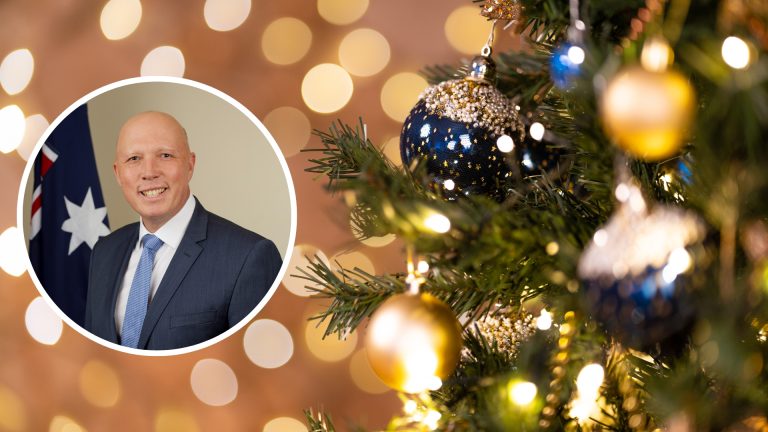
Australia’s Leader of the Opposition, Peter Dutton MP, has praised the contribution of the Greek community to Australian society in his 2022 Christmas message.
In the message, Mr Dutton also commended The Greek Herald on its “respected” reporting on the Greek community this year.
Full Message:
On behalf of the Coalition, I thank the Greek Australian community for all your contributions to our nation this year in so many fields of endeavour.
Australians of Greek ancestry are one of the largest groups within the global Greek diaspora.
The first Greeks who migrated to Australia arrived in the 19th century. It was the interwar period of the 20th century which saw a major increase in Greek migration. Indeed, the founding of The Greek Herald in 1926 helped to bring Australia’s growing Greek diaspora together. As larger numbers of Greeks settled in Australia following the Second World War, the newspaper’s appeal broadened even further.
For almost a century now, The Greek Herald has been providing timely and newsworthy content to Greek Australians and its growing readership. In 2023, the newspaper inches closer to its centenary celebration as it marks its 97th anniversary.
I congratulate and commend The Greek Herald for its reporting this year which has been widely respected and appreciated, particularly within the Greek community in Australia comprising almost 425,000 people with Greek ancestry. To the entire team at The Greek Herald and to your loyal readership, I wish you and your families a Merry Christmas and a Happy New Year.
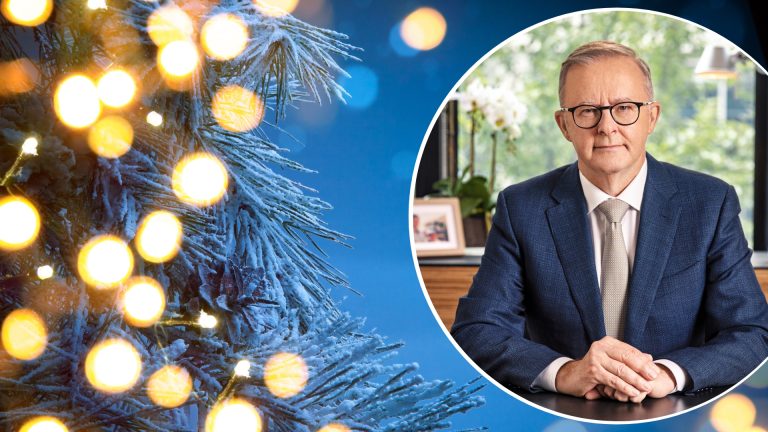
Australian Prime Minister, Anthony Albanese, has sent a Christmas message to Australians in the lead-up to Christmas Day.
In the message, Mr Albanese encouraged everyone to “spread a bit of Christmas goodwill to those who are doing it tough” this year.
Full Message:
I’m delighted to send warm Christmas greetings during this great festive season.
For Christians, this special and holy time celebrates the birth of Jesus Christ, and the gospel of peace, love, and justice. It is a season of hope and joy, as we reflect on the year we have shared and dream about what is to come.
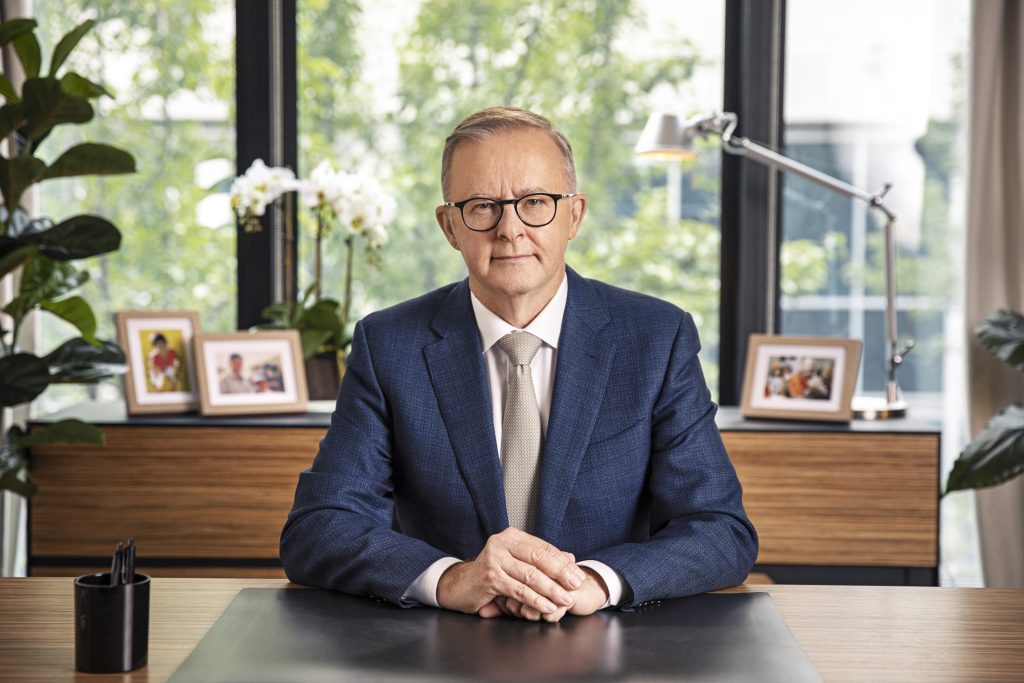
Australian Prime Minister, Anthony Albanese.
Christmas is a wonderful time to share precious moments with family and loved ones. But for some Australians, it will be hard this year. Some will be facing Christmas while trying to rebuild their lives and homes after the terrible tragedy of floods.
We can all spread a bit of Christmas goodwill to those who are doing it tough. Whether you volunteer or donate, reach out to a neighbour or make a long-postponed phone call to a friend, acting with kindness and compassion is what Christmas is about.
Australians are courageous and resilient, committed to each other and their communities. In the same spirit, may your celebrations this Christmas bring the joy of family and friendship to you all.
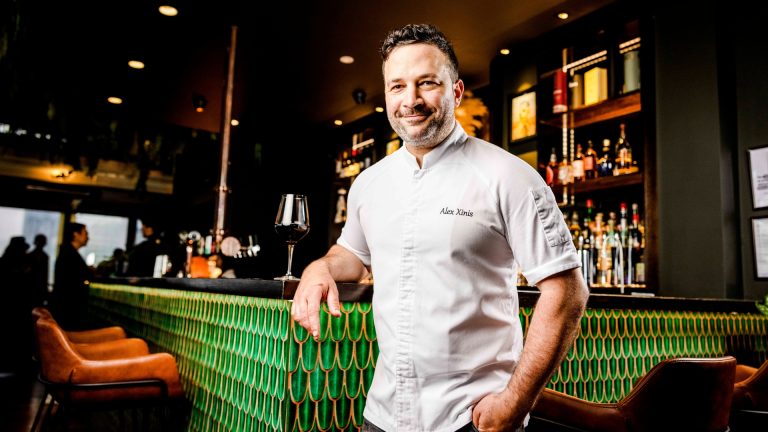
Many words come to mind when we think of Greek cuisine, but ‘gluten-free’ and ‘vegan’ don’t usually top the list. Luckily, chef Alex Xinis knows just how to combine the two.
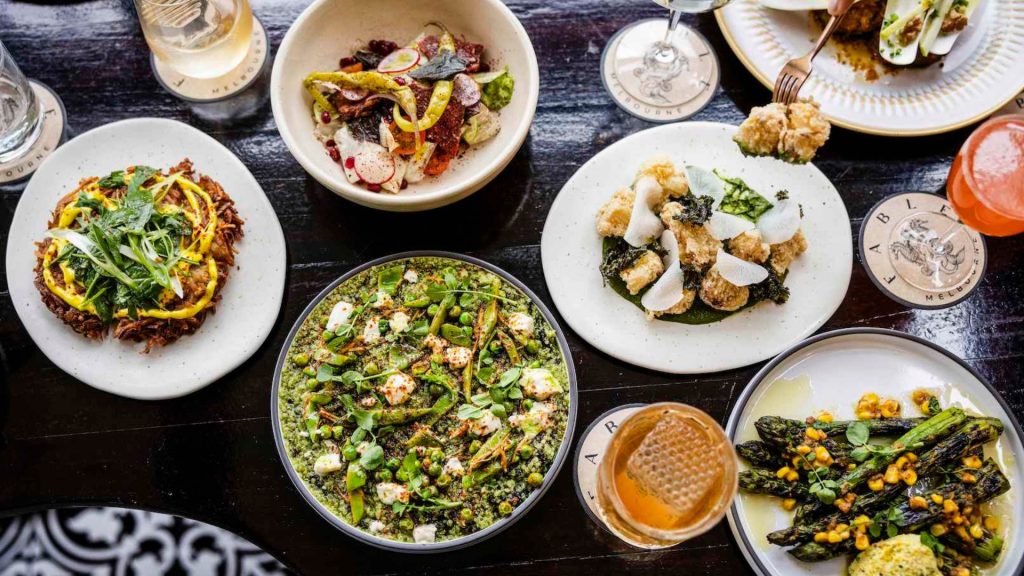
With his Michelin star background and fine dining experience from working in one of Athens’ most renowned staples, Funky Gourmet, Alex’s latest challenge has been to create an entirely gluten-free and vegan-friendly Greek inspired menu at Melbourne’s popular rooftop restaurant, Fable.
“We do two menus a year, there’s an autumn/winter menu and a spring/summer menu, and I try to keep a bit of Greek food on both menus,” Alex tells The Greek Herald.
This year’s new spring/summer menu is driven by fresh produce and seasonality with an emphasis on sustainability.
The menu features new, innovative vegan twists on iconic dishes, such as a quinoa risotto with feta, aleppo and flash-fried snow peas, and orange sherbet churros served with salted date caramel.
Sustainable dining at Fable. Photo by Nicole Cleary
“It’s 100 percent gluten-free, the menu. It’s a good challenge but I think we can pull it off,” Alex says, whilst adding that not everything was possible.
“We tried to do gluten-free loukoumades, we just couldn’t do it.”
Alex’s culinary journey:
For Alex, his culinary journey began when he was 19 years old, studying a degree of Applied Science at the University of Queensland in Australia. He soon realised his real passion in life was to be in the kitchen.
“I found myself loving food and I was watching cooking shows, reading cookbooks more than my actual university books, so I jumped into cooking as an apprentice,” he says.
“My grandparents are Greek, so I went over to their place [in Brisbane] and got to experience the food and the culture, as well as a little bit of the language.”
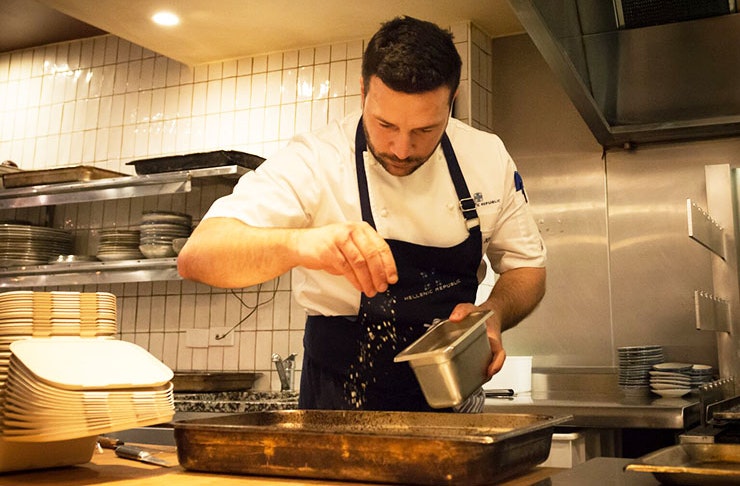
Chef Alex in the kitchen. Photo credit: The urbanist
Alex finished his apprenticeship in Brisbane, but it wasn’t long before he discovered he had a particular longing for his Greek heritage.
He decided to move to Athens, Greece in 2012 to get back in touch with his Greek roots. Once there, he travelled to his grandfather’s island of Ithaca.
“We stayed in Vathy for a while, it was really nice there. All the locals knew me,” he recalls.
Upon his return to Australia, Alex decided to move to Melbourne to work with the largest Greek hospitality group at the time, which was George Calombaris’ Made Establishment.
There, he furthered his skills as Head Chef at The Press Club, and afterwards at the Hellenic Republic.
“I worked with George for seven years and I learnt a lot, with lots of different cooking styles,” Alex says.
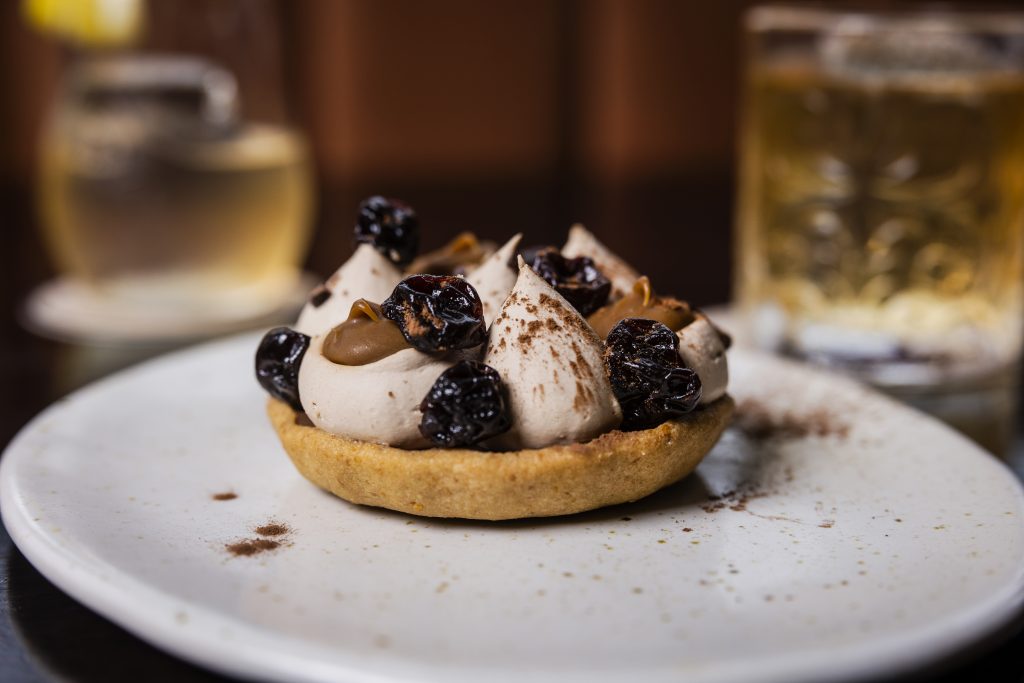
Greek-inspired dessert at Fable, Melbourne. Photo by Nicole Cleary.
The chef then brought these new skills with him to Fable, where he incorporated his fine dining background into a modern Greek inspired menu.
With this extensive career repertoire under his belt, we were itching to know one thing: what is Alex’s favourite Greek food?
The answer is much simpler than we anticipated.
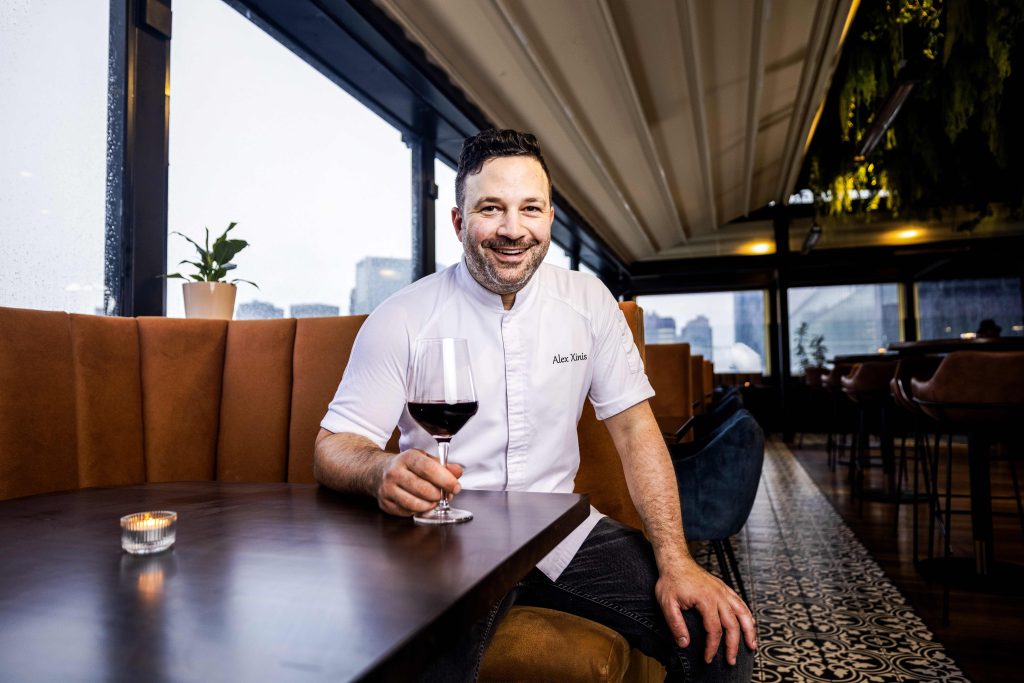
Chef Alex at Fable, Melbourne. Photo by Nicole Cleary
“Any sort of good-quality meat that is marinated well and cooked over charcoal,” he says. “Once you’ve got a nice piece of meat with a bit of seasoning and some open flame, nothing can beat that really.”
From his early days as an apprentice in Brisbane to his fine dining escapades in Athens, and his current journey as Fable’s Executive Chef in Melbourne, Alex teaches us one very important lesson – living in the present without embracing our culture and heritage is dull and tasteless – just like loukoumades without gluten.
Early generations of Greek and Cypriot Australians did not entertain the thought of marriage outside their culture. For this reason, early Christmases were homogenous affairs with the aromas of lamb with tzatziki and salads, and offerings of kourabiethes and melomakarona.
By the 1980s, a new generation of Greek and Cypriot Australians emerged. More integrated and adapted to Australian mainstream society, they began to marry outside their culture but still held on to the traditions.
Slowly, new elements began to creep into the Christmas table… prawns, panettone and pudding entered the multiracial mix.
George and Eileen – Vasilopita and Hogmanay
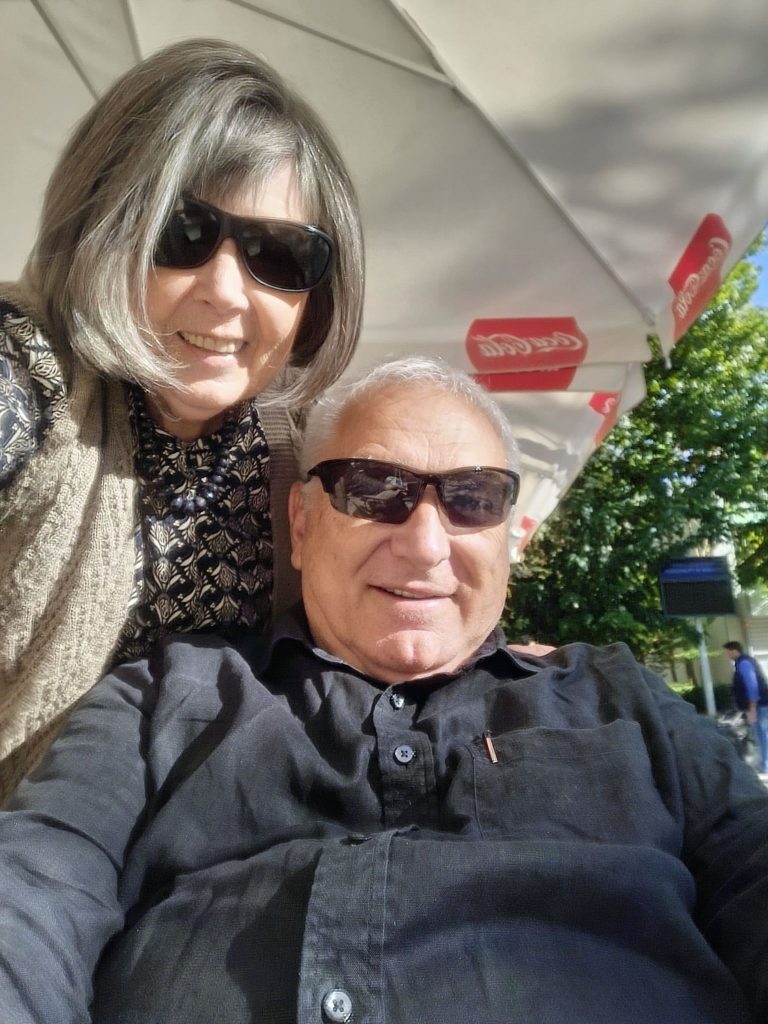
George and Eileen Bouzidis from Perth are now aged in their seventies and got married at a time when bicultural families were not the norm.
Eileen and George.
It was through George that Eileen, who is of Scottish descent, discovered the Orthodox faith and grew to embrace it. Initially they practiced their faith in the Greek Orthodox Church, but in recent years moved to the Serbian church where they practice Orthodoxy in a more fastidious way.
“It reminds me of how the Greek Church was a few decades ago,” Eileen says.
Brought up Presbyterian, Eileen remembers “jolly” childhood celebrations with all the trimmings.
“Growing up, we baked shortbread and went over-the-top with decorations, and being Scottish, my father would practice Hogmanay customs (the Scottish tradition of first-footing and whisky-drinking rooted in Viking tradition). That was news to my husband who was all about Saint Basil and vasilopita. We’d give presents at Christmas and my Greek family would ask, ‘What’s with all this buying of Christmas presents?’”
Eileen remembers “becoming Greek” by watching her mother-in-law make Greek sweets, such as galaktoboureko, a staple at her Greek family’s Christmas table.
“As I became more Orthodox, I began to tone down the jolliness and decorations, but we continued to have shortbread and kourabiedes – the best of both worlds,” she said.
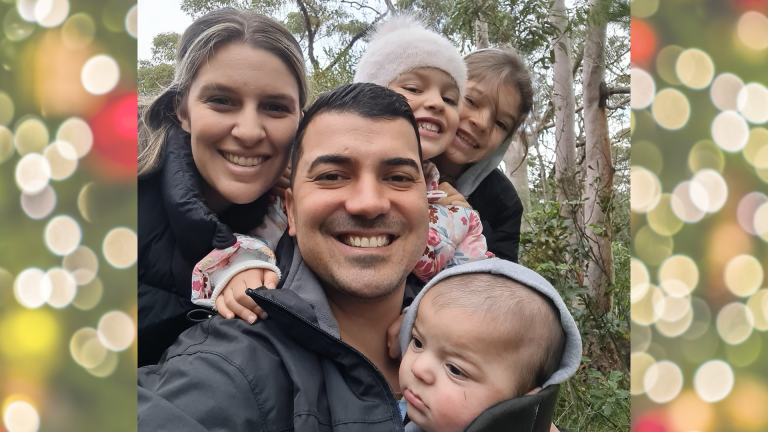
George and Eileen have four adult children, nine grandchildren and two grandchildren and biculturalism has shifted to multiculturalism as their children have married outside the Greek culture but still keep Greek elements in their Christmas celebrations.
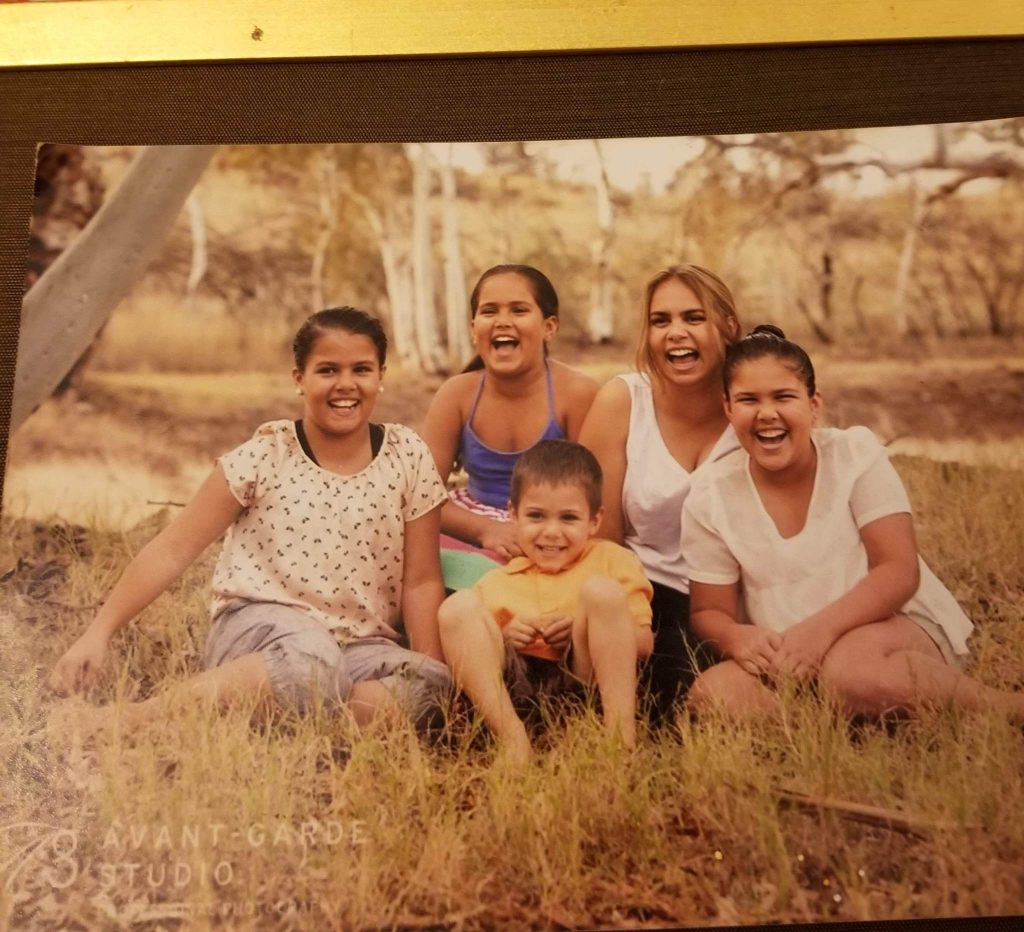
Eileen and George’s Aboriginal grandchildren.
“My eldest daughter lives up north and there are no Orthodox churches but she does everything my mother-in-law did, and that’s why I gave her my mother-in-law’s Christmas platters,” Eileen said. “My middle daughter is married to an aboriginal and they have divine-looking children, whereas my eldest married a Muslim Malaysian who would enjoy Christmas trees and the food, and my younger son is in China ready to get engaged to a Chinese girl.”
Christmases these days are large family gatherings filled with Greek food but they also include other cultural elements.
“You have to love and share and make people of other cultures also feel welcome,” she said. “That’s the spirit of Christmas.”
Yigit and Georgina – Dolmades and baklava
Yigit Gunduz met his wife Georgina Erisiotis at Saturday language school in Sydney where he was studying Turkish and she was studying Greek. Both had heritage from Asia Minor, but came from different sides of the political fence. This, however, did not stop them from falling in love and bringing their families together – though this was not easy at first as there was suspicion from both sides.
As time went on, politics and prejudices were put to the side and the birth of three grandchildren brought the family closer together. So much so that last winter, Yigit used his Turkish language skills to find the family of one of pappou’s long lost cousins in Asia Minor.
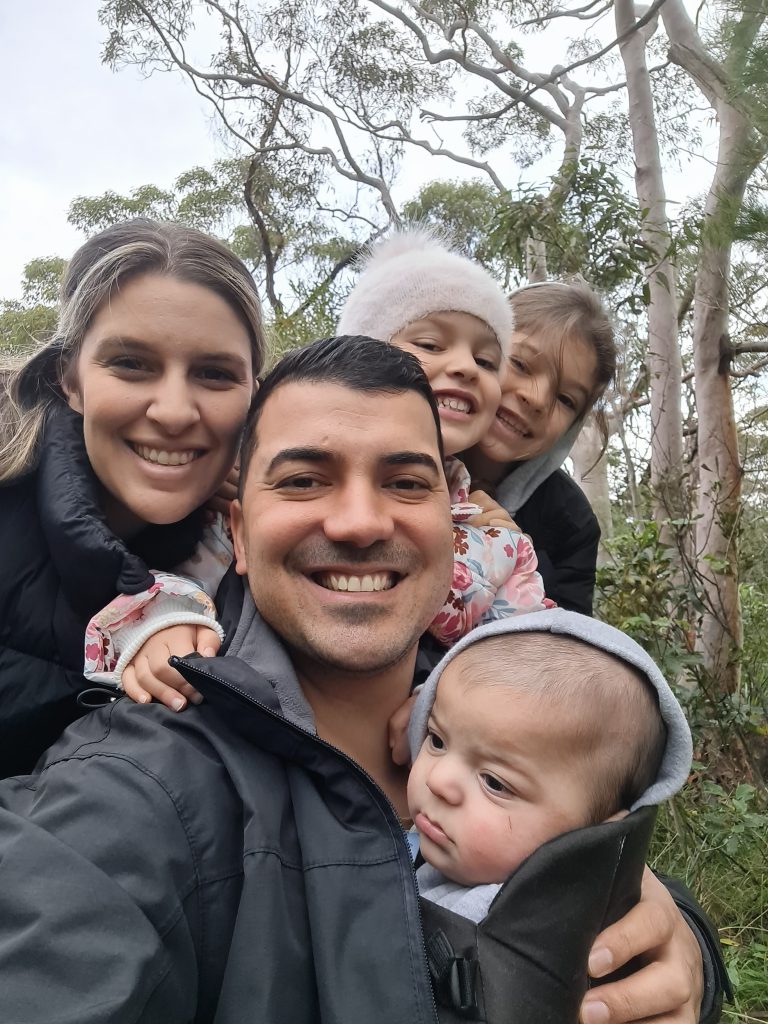
Yigit and Georgina with their kids.
Christmas in the Gunduz-Erisiotis family is filled with savoury tastes and traditions.
“Most people in metropolitan centres of Turkey put up a tree and give presents to each other despite not being Christians. Don’t forget that we still believe in Mother Mary and respect Jesus Christ as a prophet, though the popularity of Christmas in Turkey today is mainly due to popular culture,” he says.
“Over Christmas, we go to Church as a family and visit the in-laws, and then we have a turn where someone hosts the extended family. Last year was our turn and all our relatives came over for a big barbeque and lamb on a spit, food, drinks and presents while the kids played.”
No longer sceptical of each other, the two sides of the family – Greek and Turkish – get on well.
“Our foods are very similar, with dolmades and baklava, and my mum and in-laws make the same dishes with some variations,” he says.
“We also have Vasilopita coin cutting and enjoy the traditions.”
He adds that the family, including his in-laws, also participate in Ramadan. “I would celebrate Diwali too if there was an Indian in the family,” Yigit says. “Cultures just add value to our lives.”
He said that the trick to a bicultural family is having respect. “My wife is Greek Orthodox and I’m Turkish Muslim and we’ve never tried to persuade each other that one way is better than the other and celebrate all celebrations that are meaningful to each other.”
Farrah and Spiros – Koupepia and Asian salad
Farrah (nee Tan) came to Australia from Malaysia to Melbourne to study engineering before meeting her Cypriot husband, Spiros Savva. She was brought up Buddhist but converted to Greek Orthodoxy after she married Spiros in a civil wedding ceremony.
Her journey into Orthodoxy was due to her desire to be part of his community and family.
“Initially, it was to belong, but I did religious studies before I converted and grew to understand what the faith is all about,” the mother of two young boys says, adding that her husband never “pushed or pressured” her.
“It was nice to have the same religion as a family as this unifies the household.
“Buddhism is less a religion and more a way of life which embraces other religions and is not confrontational… Interestingly, there were a lot of similar beliefs with Christianity around loving and making family a priority. The red eggs of Easter are similar to the red eggs we have, and we also celebrate the 100 days after the death of a loved one in Asian cultures.
“There are some small similarities but I also learnt more about Orthodoxy before I made the decision to convert.”
Initially, both sides of the family would celebrate Christmas together, however soon the “Greek side got too big” – especially after more grandchildren came into the mix – and now they have two Christmas celebrations – Malaysian and Greek.
“Everyone is dispersed so we catch up with the Greek side of the family on Boxing Day, and there’s a lot of Cypriot cuisine to enjoy such as Koupepia (stuffed grape leaves), keftedes, lambs on skewers, souvla and the mix,” Farrah says, adding that the difficulty of getting such a large family together has meant that they cut the vasilopita on Christmas instead of New Year’s Eve, purely for practical reasons.
“My aunt lives in Geelong and we visit her separately for Christmas. She happens to be a cooking teacher, and her husband is Australian/English so we have traditional ham or chicken or a Turkey but she also brings out Asian cuisine like salmon with curry crust or a summery Asian salad with lots of coriander and parsley. She also makes her own bread, and that’s something my husband likes.”
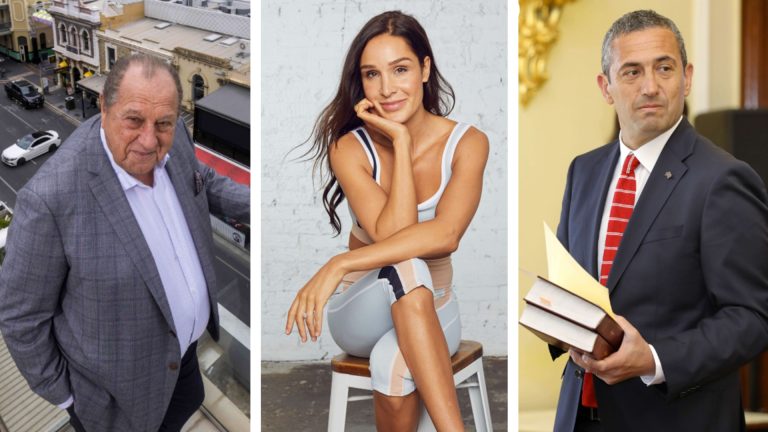
Kayla Itsines, Tom Koutsantonis MP and Theo Maras have been named among South Australia’s top 50 most influential people by The Advertiser.
Holding significant positions in business, politics and entrepreneurship these Australians of Greek heritage influence the South Australian community and broader Australian society.
Taking the highest rank among the three is Kayla Itsines, the Sweat app co-founder. The Sweat app is a fitness guide and generated $100 million in revenue in 2020. Itsines sold the app last year for $400m and continues to work closely with the brand.
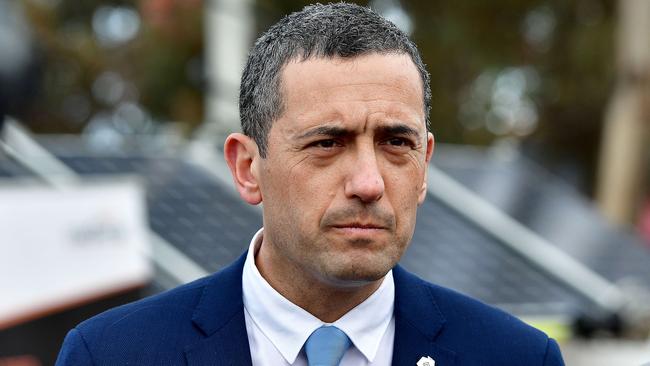
Coming in 29th place is SA Minister for Infrastructure and Transport and Minister for Energy and Mining, Tom Koutsantonis. Mr Koutsantonis is new to the top 50 most influential people list.
Theo Maras came in 32nd place on the list. He is known as the patriarch of The Maras Group, a commercial and retail property investment and development company.
Currently, Mr Maras is developing his legacy residential project on the corner of Hutt Street, and continues to be significantly engaged in the east end and other urban areas such as Prospect Road alongside his son Steve.
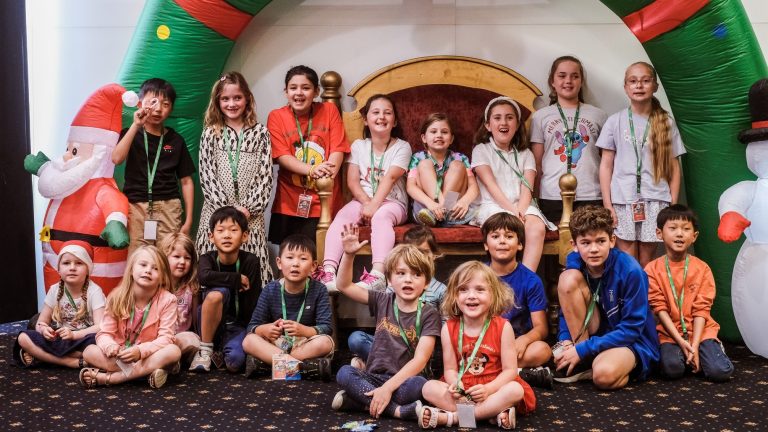
Young kids from Kindergarten to Year 6 had a chance to get creative at the Hellenic Club of Canberra’s annual Christmas workshops on Wednesday, December 21.
Around 60 kids took part in the festive workshops on the Club’s premises at Woden, whilst Greek Christmas carols could be heard playing softly in the background.
On the day, the kids made Christmas wreaths out of pretzels, reindeer out of chocolate scrolls and Santa Claus figures with smarties and marshmellows.
In the end, the kids were also lucky enough to meet and greet Santa Claus, and have their photo taken with him.
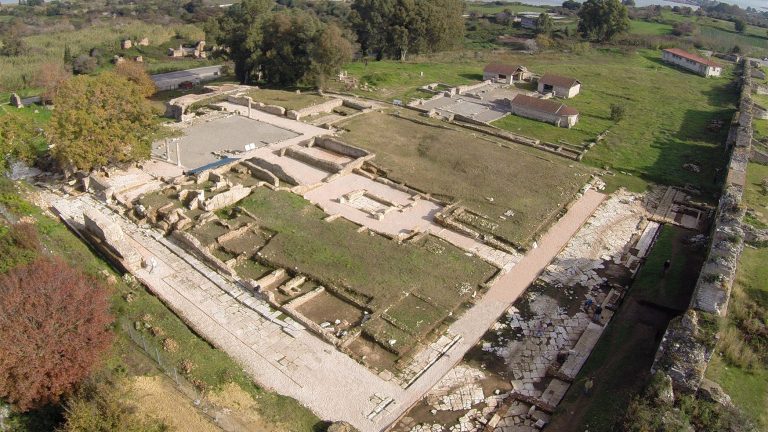
The submission of the candidacy of Nikopolis for a spot on the UNESCO World Heritage Sites list is ready, Greece’s Culture Minister Lina Mendoni has revealed.
Ms Mendoni said in a statement that the “holistic promotion of Nikopolis, an extensive and particularly important archaeological site with a special cultural heritage,” is a top priority.
The ancient city of Nikopolis is located in Epirus in western Greece.
📌Η ολιστική ανάδειξη της Νικόπολης, προτεραιότητα για το #ΥΠΠΟΑ.
Πραγματοποιήθηκε σύσκεψη της Υπουργού Λίνας Μενδώνη, με τον @RegionofEpirus Αλέξανδρο Καχριμάνη και τον Δημάρχο Πρέβεζας Νίκο Γεωργάκο.
— Υπουργείο Πολιτισμού και Αθλητισμού (@cultureGR) December 16, 2022
The city was founded following the victory of Gaius Julius Caesar Octavianus (Augustus) in the naval battle of Actium in 31 BC. The city is associated with the effort to “Romanise” Greece.
Ms Mendoni said the Ministry of Culture is already implementing restoration projects on specific monuments, with a total budget of approximately 4 million euros from the resources of the Regional Development Program of Epirus 2014-2021 and the EU Recovery Fund.
“We are creating a single archaeological site, universally accessible, with restoration and promotion of the monumental wealth of the Roman and early Christian period,” she said.
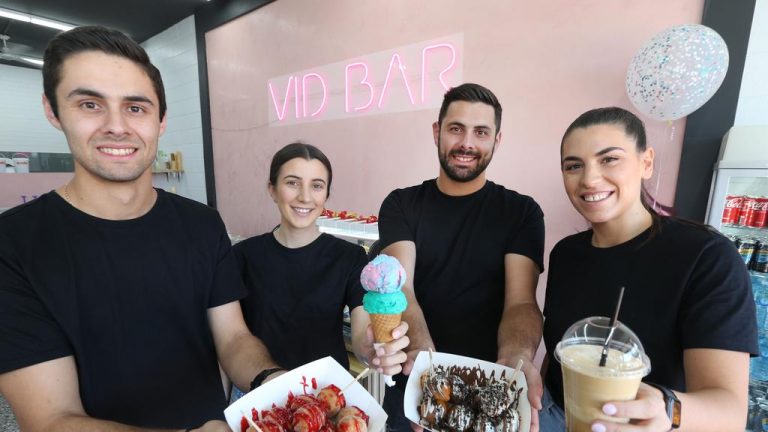
A dessert bar named VID Bar (Village Ice-cream Dessert Bar), has just opened in Highton, Victoria, by two Greek brothers, Spiros and Nicholas Alesios, TheGeelong Advertiser reports.
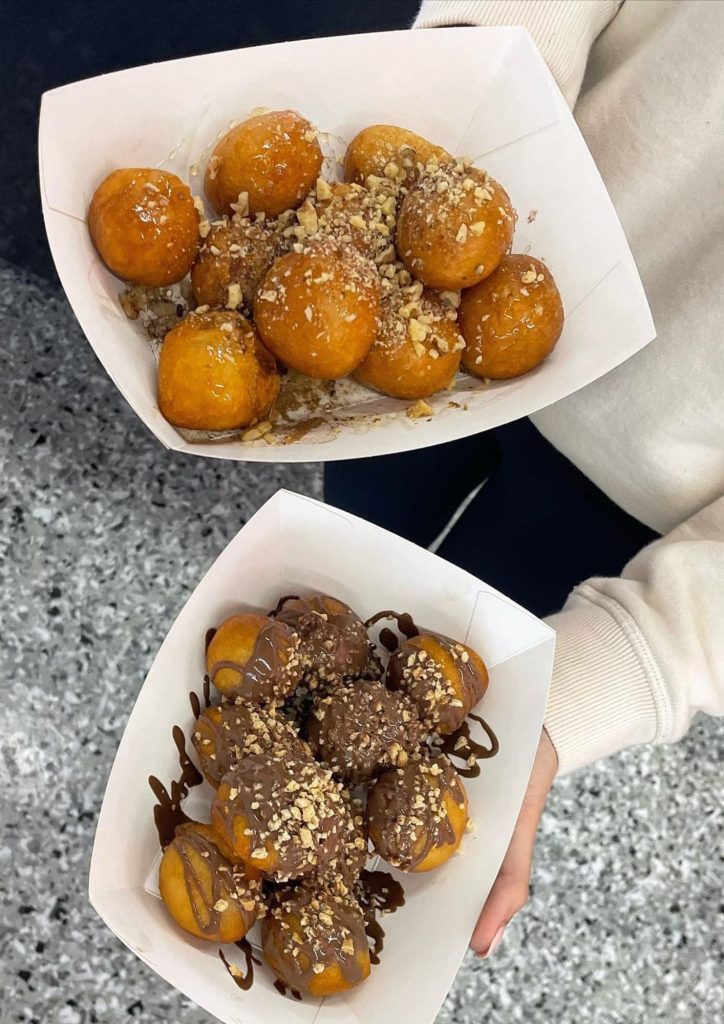
The bar, which serves 31 flavours of ice creams, Greek doughnuts and sweets such as loukoumades and galaktoboureko, brings a taste of Greece to sweet lovers.
For the owners, the business is a way to pay tribute to their home traditions and their past.
“Our sister has an ice cream shop in St Leonards, we thought we might go in our own direction and create something a little bit closer to home,” Spiros told TheGeelong Advertiser.
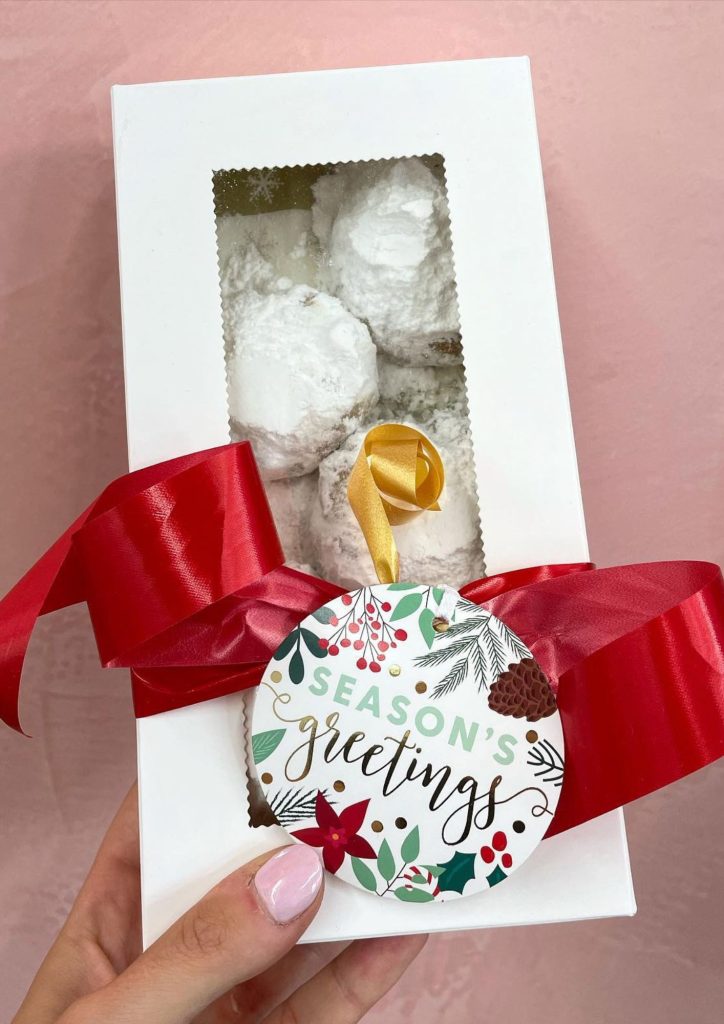
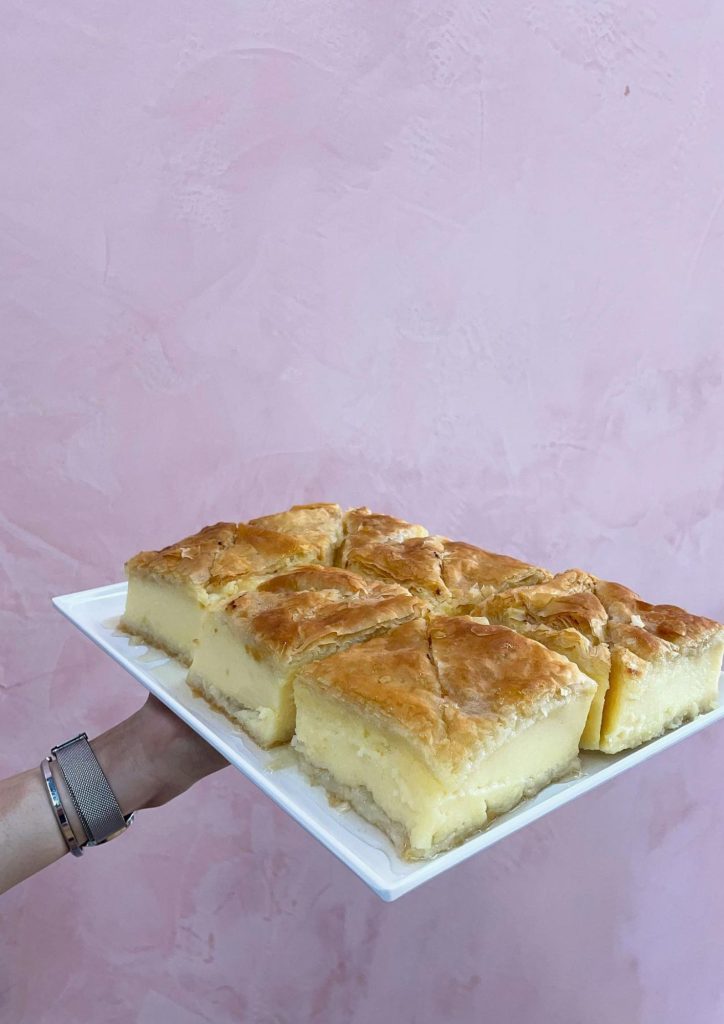
LoukoumadesKourabiedesGalaktoboureko
The brothers, who love desserts and ice cream, believe that Greek doughnuts are something new to the market and they aim to fill this gap with their recent business move.
“There’s nothing really that’s been done like that here,” Spiro said and stressed his plans to expand the bar’s dining space.
“Our bar has something sweet, but something that is also different. It will appeal to most,” he concluded.
My first encounter with the archaeological site of Ancient Rokka took place at night, accompanied by my two small children, a crowd, and an orchestra. It was the night of the August full moon, when Greece celebrates the summer with special events, including a live outdoor musical performance on a steep, rocky hillside above a village in northwestern Crete.
My children, my husband, and I struggled to find our way on the rough ground as night fell, but once the orchestral music engulfed me and I considered our unique position below the remnants of an ancient town and across the gorge from dramatic cliffs, I realised I needed to return by day. (This time lapse photography gives you some idea of the 2021 version of a similar event, but I remember more darkness and mystery at an earlier edition of it.)
Years later, I was visiting a beloved olive mill destination, Biolea, with my brother Dean in the same part of Crete. We had toured the updated version of an old-fashioned stone mill and hydraulic press on another visit; that day, we sampled Biolea’s organic extra virgin and flavored olive oils and drank coffee at their café. (On a different occasion, I enjoyed a fresh lunch there with Canadian friends who deemed the salad the best they’d had on their entire visit to Greece).
Photo by Lisa Radinovsky.
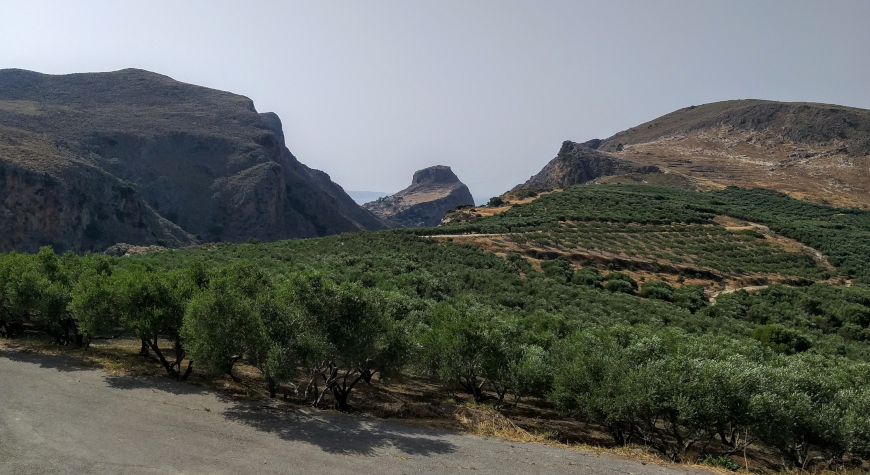
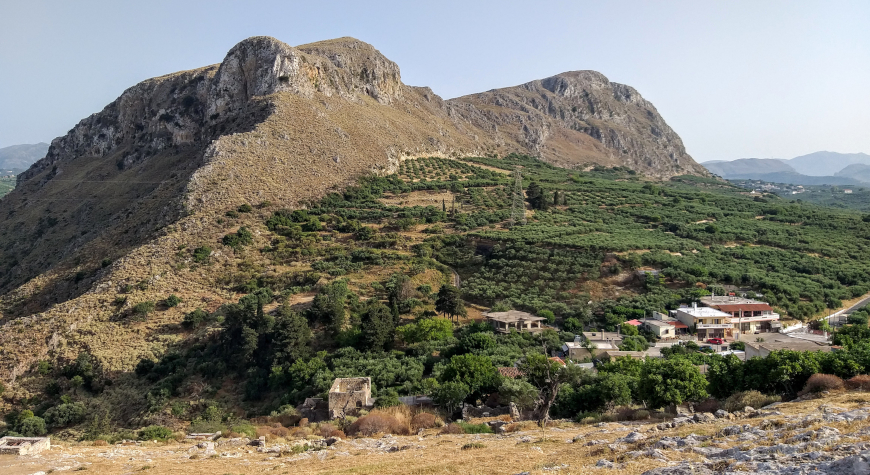
Looking beyond Biolea’s olive groves, which extend toward two rocky hills and seem to disappear into the deep gorge between the hills, Dean and I were struck by a particularly intriguing hill on the far side of the gorge, with a wide open slanted space cut off by descending cliffs on the long side facing us and a vertically ascending rocky ridge at the other end. This is the hill called Trouli, home of the archaeological site of Rokka.
Photo by Lisa Radinovsky.
We debated whether to visit the sculpturesque ancient olive tree of Ano Vouves on our way back to Chania, because the intricate design and rough texture of its 3,000 to 5,000 year old massive hollow trunk has fascinated us since we first saw it. This time, we decided to head the other way, to Ancient Rokka. Dean’s GPS surprised me by accurately directing us along tiny village lanes, past a church with remnants of very old frescoes, up and down scenic olive-covered hillsides, and over narrow dirt roads through olive groves to the little village of Rokka. Once there, we asked friendly villagers how to find the archaeological site.
Photo by Lisa Radinovsky.
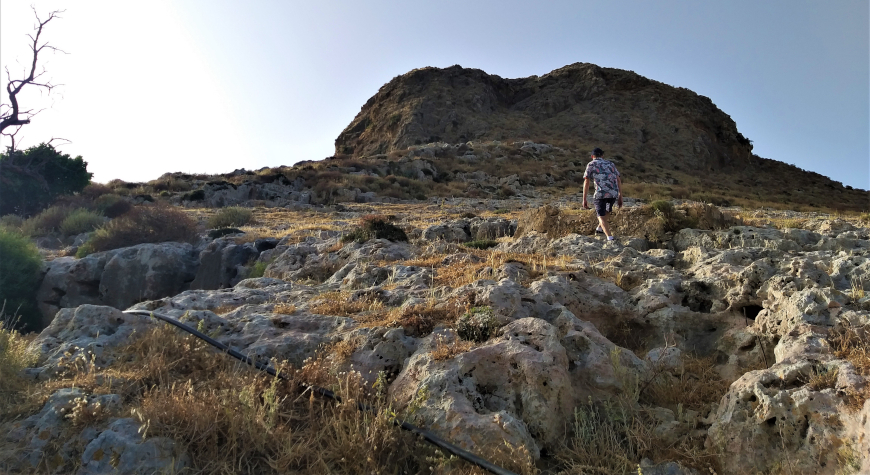
Αs we climbed the steep, rocky hill that June evening, we were glad to be wearing good walking shoes and relieved that we had avoided the midday sun. We wondered if we should venture all the way to the top, beyond the ruins we could see initially. There is even more to explore, including the remains of the acropolis and Byzantine fortress, as well as a stunning view of the surrounding landscape and the sea, as I learned from this drone video. However, at about 265 meters above sea level, the fortress appears very difficult to access, and we were adequately fascinated by what we found below it.
Photo by Lisa Radinovsky.
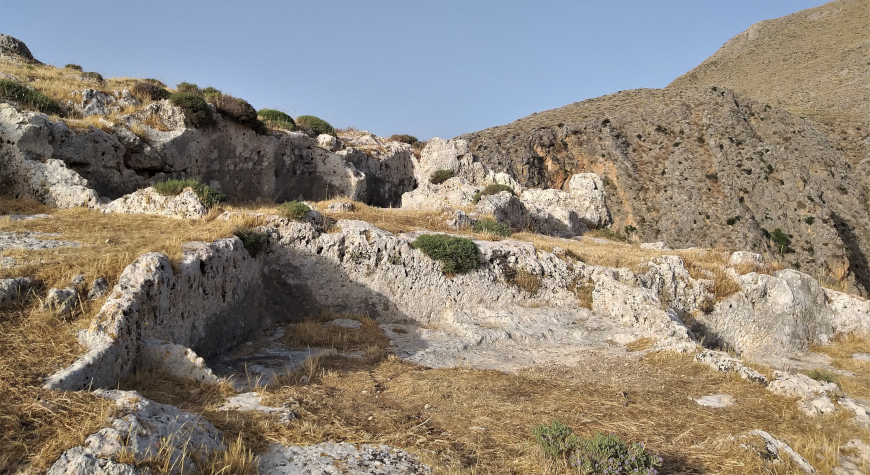
Remnants of walls carved into the rock of the hillside mark the boundaries of age-old rooms, some with doorsteps very close to the edge of the gorge. Their residents do not appear to have suffered from a fear of heights; a misstep could lead to a precipitous drop off nearly vertical cliffs.
Photo by Lisa Radinovsky.
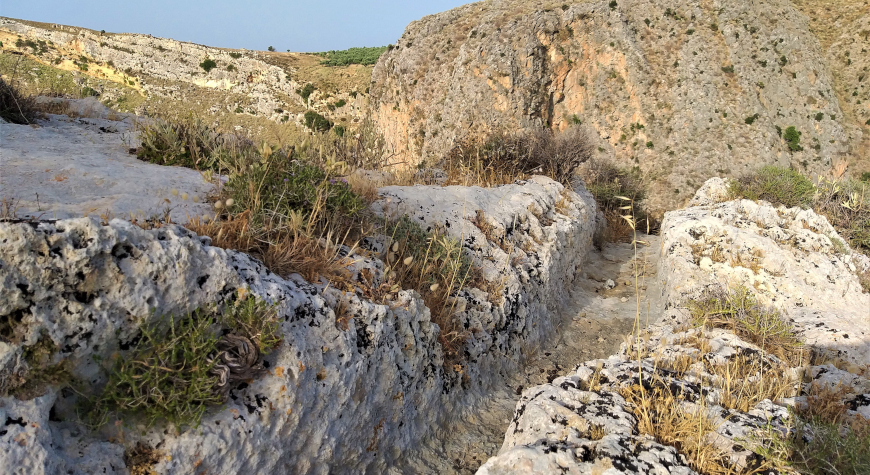
Grooves cut into the stone must have channeled water toward the gorge that runs between cliffs, heading back toward Biolea. A stone step or two remain here and there. According to Angelfire, “objects have been unearthed here that date from the 5th to the 2nd century BC.”
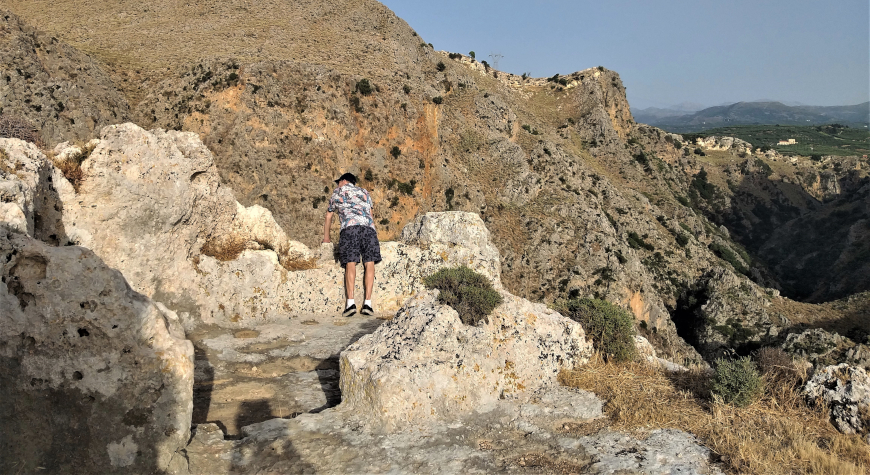
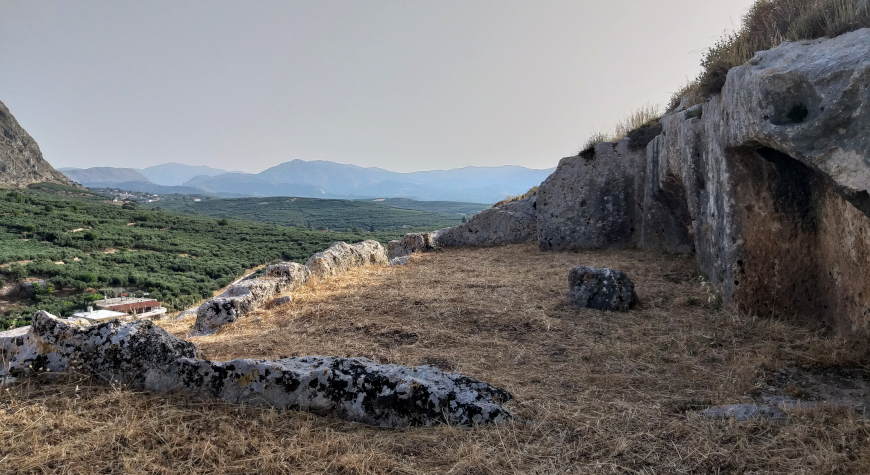
Higher up, we find small rectangular indentations and caves—very low-ceilinged little rooms, or animal shelters?–carved into the hillside. A curiously low doorway and wide rectangular opening are cut into the rock below dry grasses and wild shrubs that grow up to the edge of the stony ridge.
Photo by Lisa Radinovsky.
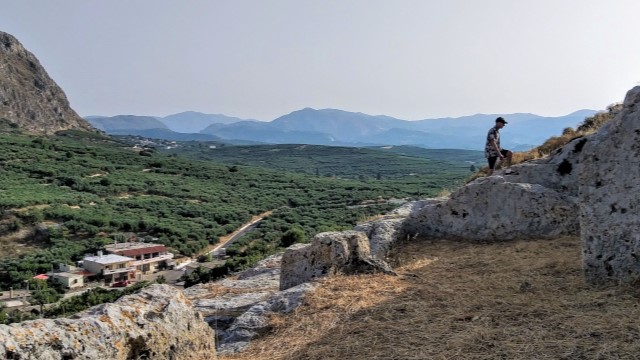
However it was used millennia ago, the flat area in front of the cave room and indentations now forms a wonderful observation deck. It offers a panoramic view of the steep, dry rocky hills across the deep gorge from us (to our left and in front of us), and below us to the right, plains covered with olive groves stretching beyond the handful of village houses toward the foothills of the White Mountains that fade into the distant south.
Photo by Lisa Radinovsky.
Earth tones predominated on that June evening: shades of brown, green, off-white, gray, black, and rusty orange beneath the pale blue sky of early evening, with a few delicate wildflowers adding tints of pink and purple and the slanting sun diffusing a warm glow. Consider visiting Ancient Rokka in the early evening on a clear, calm day if you appreciate the way the sinking sunbathes vistas of hills, cliffs, and olive groves in its gentle light.
*Originally published on Greek Liquid Gold: Authentic Extra Virgin Olive Oil (greekliquidgold.com). See that site for recipes with olive oil, photos from Greece, agrotourism and food tourism suggestions, and olive oil news and information.
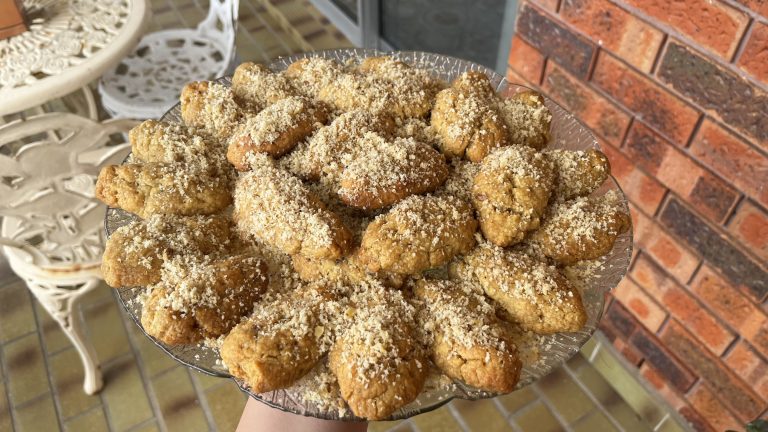
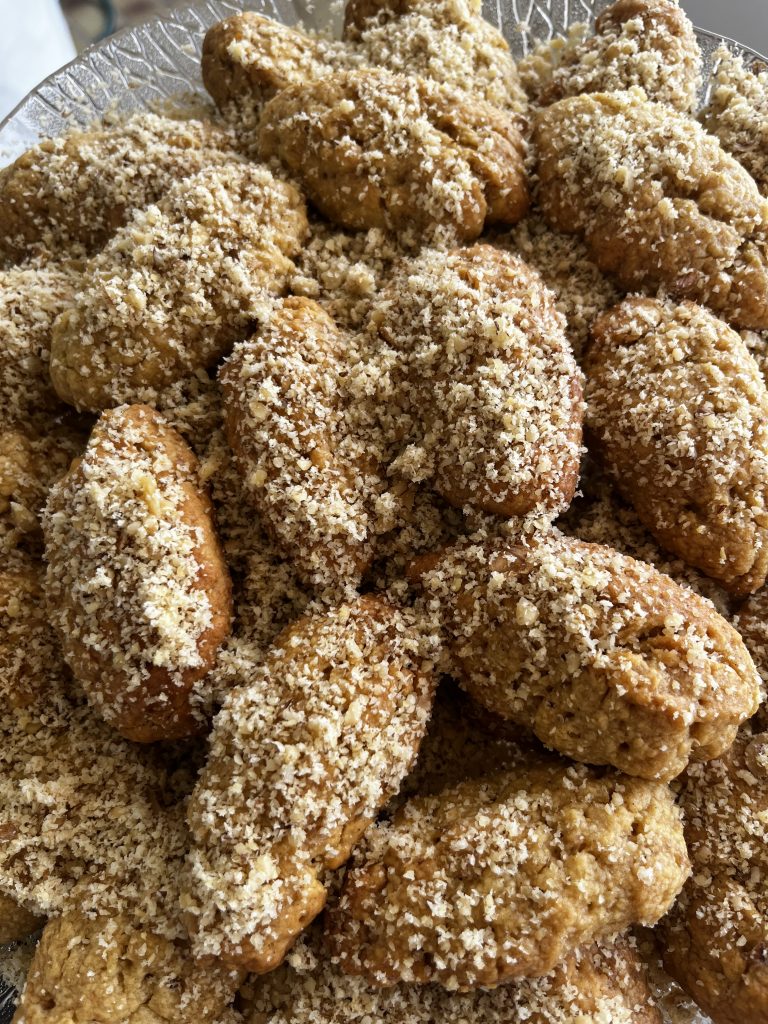
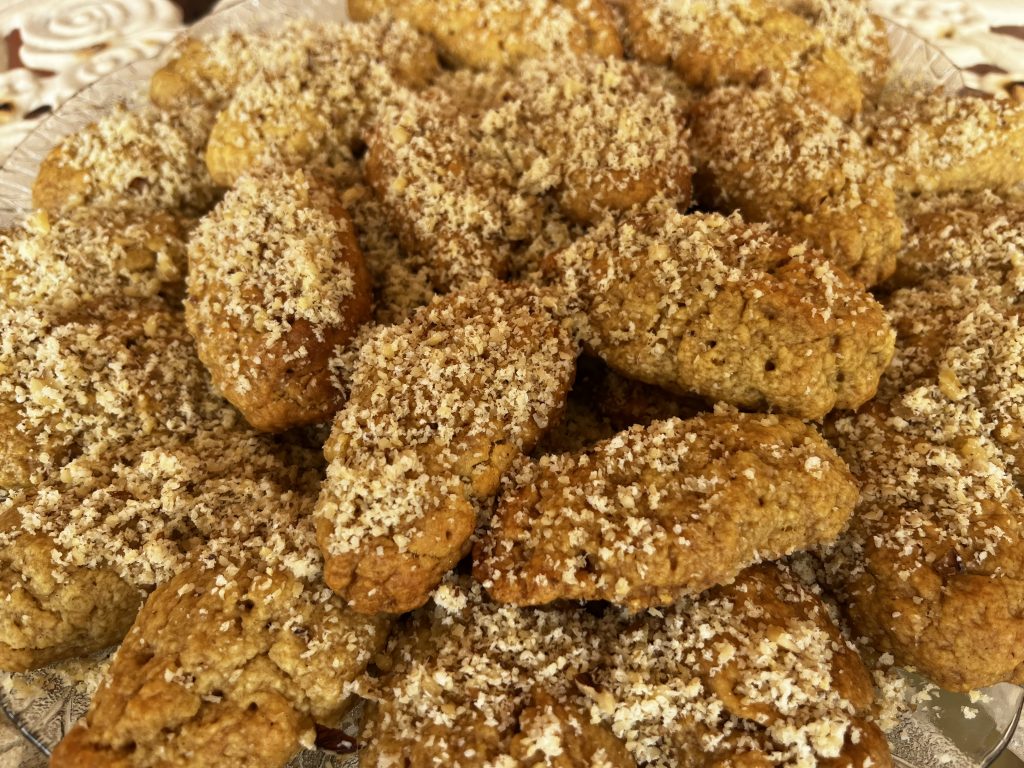
Melomakarona – the staple Greek Christmas cookie! This dessert is often served throughout the Christmas period as they have no egg or dairy and are perfect as a treat for those fasting.
The cookie’s name is a fusion of the Greek words “meli” meaning honey, and “makarona” which stems from the word “makaria” meaning blessed.
To make melomakarona, follow the recipe below. Check out our Instagram reel for a visual guide too @thegreekherald.
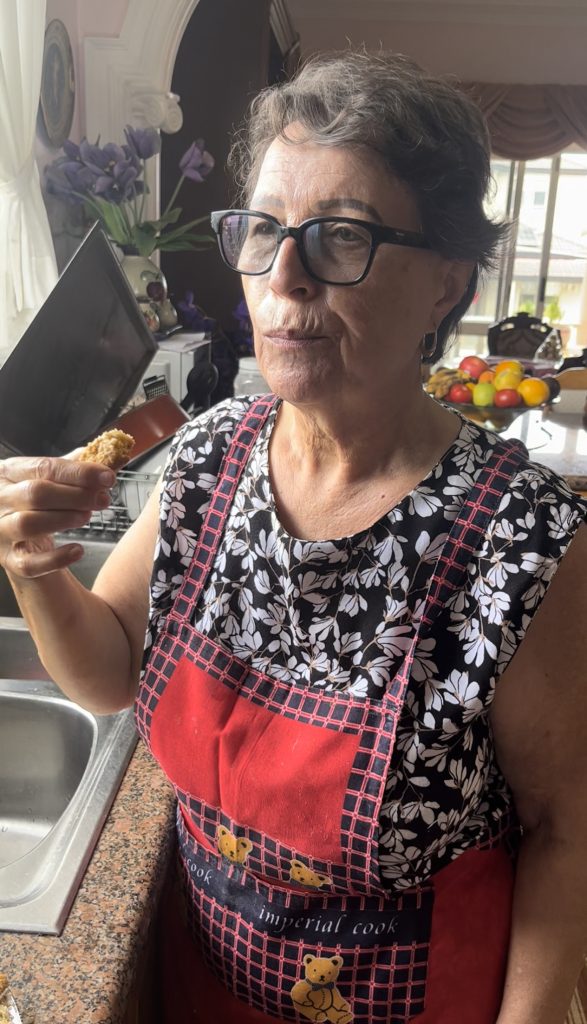
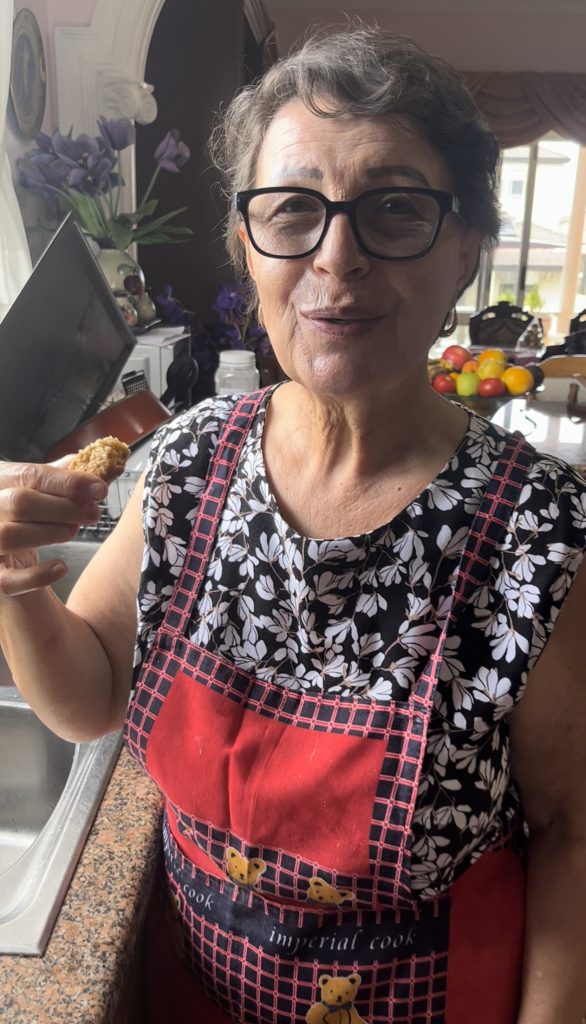
Yiayia Zoe enjoying a melomakarona. All photos: Pamela Rontziokos
Melomakarona Recipe:
Serves: 40
Cooking Time: 1hr 30 minutes
Ingredients:
Melomakarona mix:
½ cup of fine semolina
4 cups self-raising flour
1/2 tbsp baking powder
1/3 cup sugar
1 flat tbsp powdered cinnamon
1 tsp vanilla
1 tsp baking soda
1/3 cup of brandy
1/2 olive oil
1/2 cup vegetable/sunflower oil
Juice of 1 orange
Zest of 1 orange
Syrup:
1 1/2 cups water
1 cup sugar
1 cinnamon stick
A quarter of a lemon
Half an orange
1 cup honey
Decorating:
1 2/3 cups chopped walnuts
Method:
First, make the syrup. Add water, sugar, cinnamon sticks, lemon and orange in a pot and boil for 3-4 minutes (until the sugar has dissolved).
Remove the mixture from the stove. Then add the honey. Set outside so the syrup mixture can cool.
For the melomakarona dough, add olive oil and vegetable oil together. In a separate bowl squeeze one orange and add baking soda. Then pour the foamy mixture into oil.
Add semolina, cinnamon, vanilla, honey, orange zest and whisk together.
Pour flour and baking powder in a bowl and combine.
Start kneading the dough using your hands, until the dough is smooth and soft and slightly sticky. Make sure to not overwork the dough as it will become tough.
Preheat the oven at 180. Layer 4 baking trays with baking paper.
Let the dough rest for 30 minutes.
Pinch a portion of dough about the size of a walnut, 30g to be exact. Shape with your palms into a smooth oblong shape – similar to a small egg. Place on the baking tray, push lightly the top with a fork and pierce three times on top about halfway through the dough. Repeat.
Bake for 15-20 minutes, until the melomakarona are lightly and evenly browned and cooked through.
Once melomakarona is out of the oven, dip them immediately in the cold syrup, flipping them with a slotted spoon to absorb the syrup for approx. 10-20 seconds – depending on how syrupy you like them.
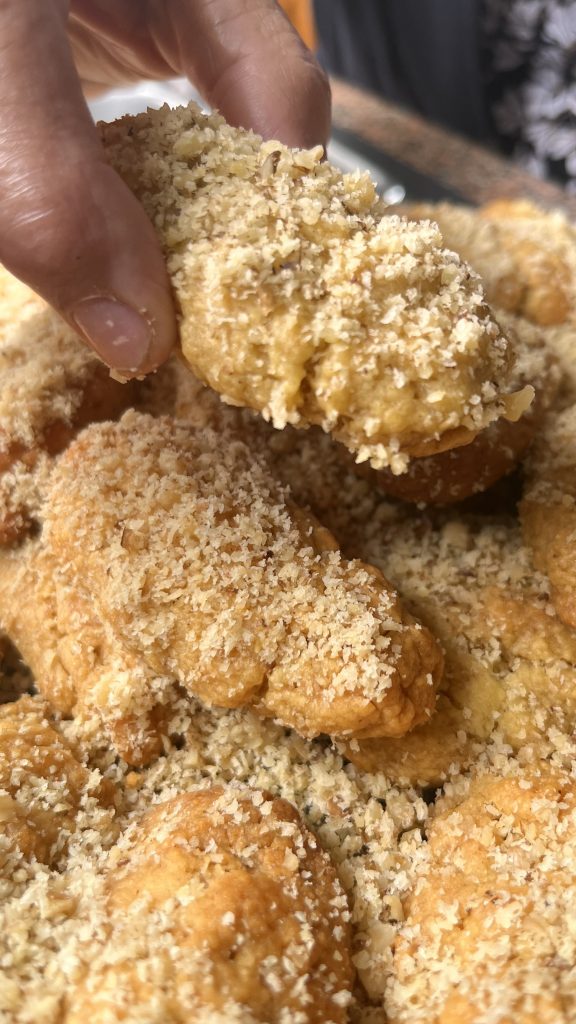
Remove the cookies using a slotted spoon, place on a platter and sprinkle with chopped walnuts.
Store your melomakarona at room temperature in an airtight container and they will last for all your Christmas holidays!