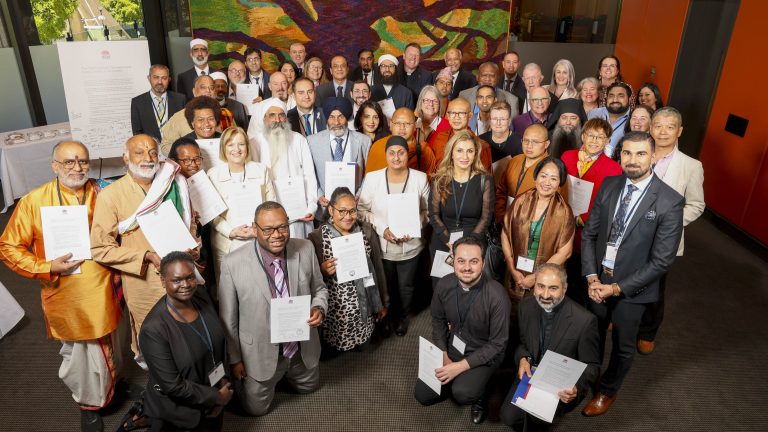
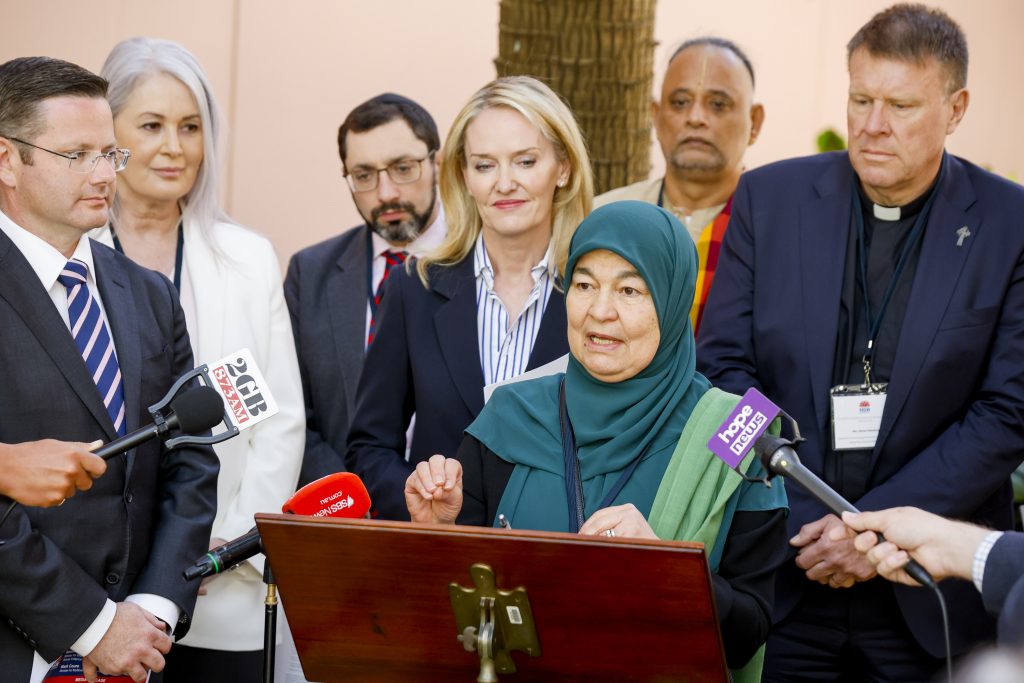
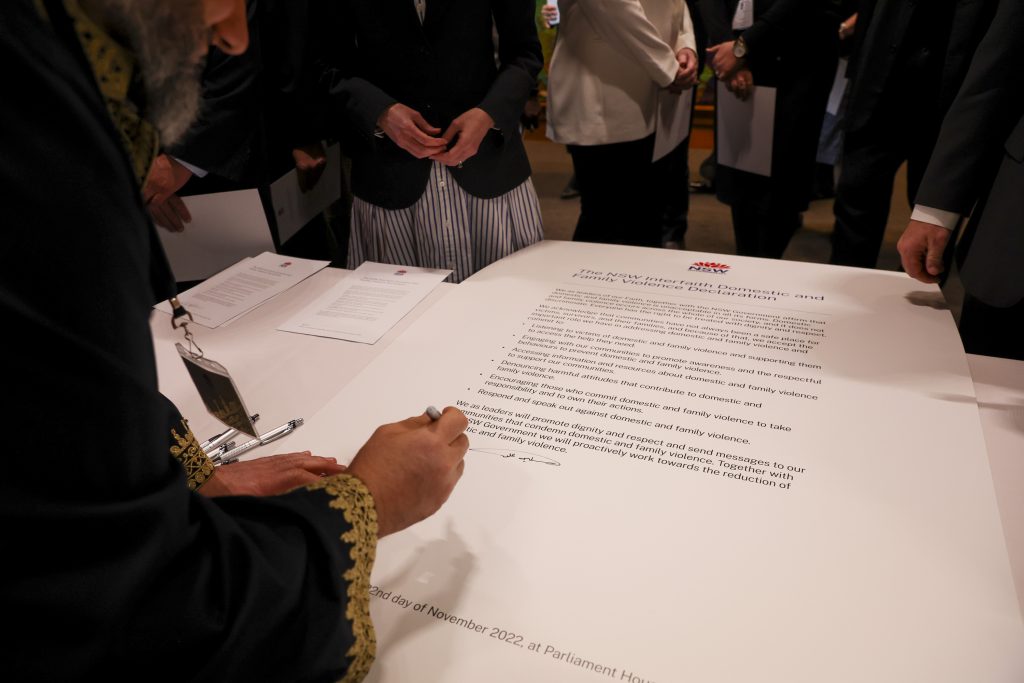
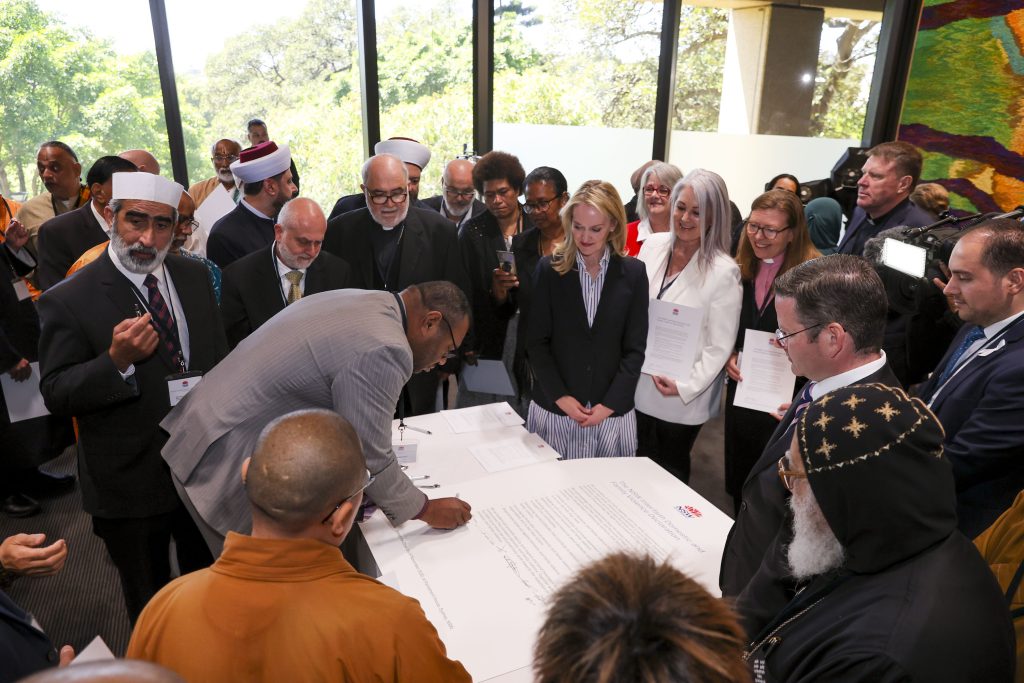
More than 70 prominent religious leaders representing all major faiths signed a declaration on Tuesday with the NSW Government to help end domestic violence.
Archimandrite Eusebios (Pantanassiotis) signed the declaration on behalf of the Greek Orthodox Archdiocese of Australia.
The declaration, which was developed in consultation with leaders from the Christian, Muslim, Jewish, Hindu, Buddhist and Sikh communities, included a number of commitments drafted and agreed to by the interfaith group to address, respond to and speak out against acts of domestic violence and better support victims.
Minister for Women’s Safety and the Prevention of Domestic and Sexual Violence Natalie Ward said the declaration demonstrated a whole of community response to domestic and family violence.
“This declaration by senior faith leaders has helped create a united sense of purpose, ownership and commitment to reduce the prevalence of domestic and family violence,” Mrs Ward said.
“Everyone can make a difference and be a part of the change in ensuring domestic and family violence is neither excused nor ignored in our community.”
Minister for Multiculturalism Mark Coure said when community and religious leaders and the NSW Government work together, everyone benefits.
“We know these leaders play an incredibly important role within their respective communities and are looked to for guidance and information,” Mr Coure said.
“The NSW Government recognises this and our partnership with them is the key to connecting with communities more effectively, especially when it comes to important issues like domestic and family violence.
“We have been actively working with these leaders to provide them with the skills and information they need to help people when they are approached or engaging with their communities.”
Reverend Simon Hansford from the Uniting Church said the signing of the declaration signified a momentous occasion, bringing together a diverse group of faith leaders to formally commit to working with the NSW Government in ending family violence.
“Domestic and family violence occurs across the whole of society, and it does not discriminate,” Reverend Hansford said.
“We acknowledge that communities have not always been a safe place for victims, survivors, and the families of those who experience domestic violence and as such we accept the important role that we as leaders have in addressing domestic and family violence in all its forms.”
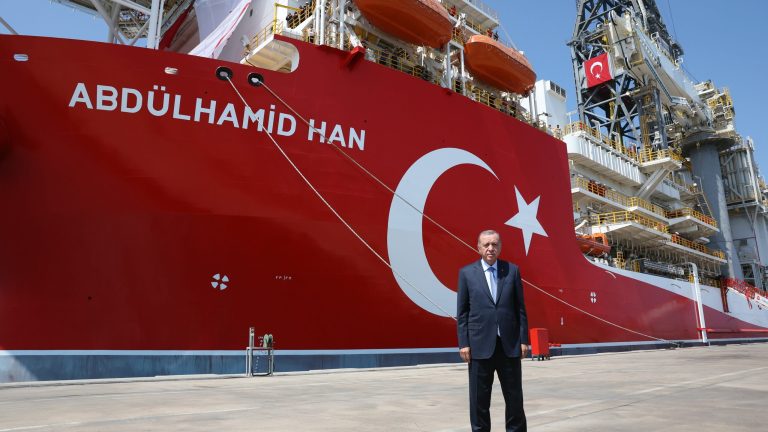
The foreign ministry of Turkey on Tuesday expressed Ankara’s intention to press on with controversial energy plans in the eastern Mediterranean, Ekathimerini reports.
The report accused the European Union, and “other third parties,” of undermining stability in the region by taking a biased approach towards EU members Greece and Cyprus.
“On this continental shelf, where we have sovereign rights, hydrocarbon exploration activities will continue with Turkish-flagged seismic survey and drilling vessels,” it said.
“No platform or plan in the region that seeks to ignore our country will succeed.”
The Turkish Foreign Ministry also pointed the finger squarely at Greece for the spike in tension in the Aegean and the eastern Mediterranean.
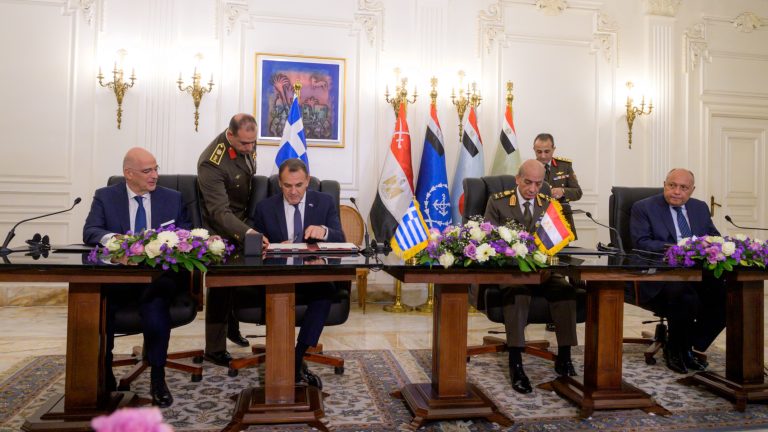
Greece and Egypt signed a Memorandum of Understanding (MoU) on Cooperation in the fields of Aeronautics and Maritime Search & Rescue in Cairo on Tuesday.
The agreements were signed by Greece’s National Defence Minister Nikos Panagiotopoulos and his Egyptian counterpart Mohamed Zaki.
The signing was attended by Greek Foreign Affairs Minister Nikos Dendias and Alternate Foreign Affairs Minister Miltiadis Varvitsiotis.
Η Συμφωνία μεταξύ των Κυβερνήσεων 🇬🇷 & 🇪🇬 για Συνεργασία στους Τομείς Αεροναυτικής και Ναυτικής Έρευνας & Διάσωσης, δίνει σημαντική ώθηση στην κοινή προσπάθεια για περαιτέρω εμβάθυνση των διμερών σχέσεων και της διμερούς συνεργασίας. pic.twitter.com/GCf2SZlVLZ
“Our goal is to create a framework to help save precious human lives,” Dendias told reporters after the signing.
Later in the day, Varvitsiotis also signed an agricultural deal with the Egyptian Foreign Affairs Ministry’s Ambassador for European Affairs Ihab Nasr, allowing up to 5,000 seasonal farm laborers from Egypt to remain in Greece for up to nine months.
There are many things Greek families pass down from one generation to the next. For Charlotte Markson, her love of fashion and textiles was passed down by her yiayia at an early age and she’s never looked back.
Ahead of showcasing her latest collection at the UTS Runway Fashion Show on Tuesday, November 29, Charlotte shares with The Greek Herald how her family and Greek heritage inspires her work.
Tell us about your journey to design:
Being a fashion designer is something I have always known I wanted to pursue. I was first introduced to sewing back in Year 7 where I took co-curricular dressmaking classes after school. Textiles was always my favourite subject at school and I recall spending every spare minute of my HSC year working on my Major Work; a white silk gown with blue hand painted and embroidered Greek inspired motifs.
Charlotte Markson.
I was accepted to study a Bachelor of Design in Fashion and Textiles and a Bachelor of Arts in International Studies (Italian) at the University of Technology Sydney in 2017, which is where I’m currently completing my Honours year. This final year of study requires the creation of a six-look graduate collection alongside a supporting research paper, with an open scope to choose whatever concept is of interest to you.
In 2018, I had the opportunity to travel to Bangalore, India for one of my electives at university. It was there that I was introduced to slow processes of printmaking, and was lucky enough to learn the craft of hand block printing by local artisans.
I have undertaken various internships to gain as much hands-on industry experience as I can while studying, including Carla Zampatti, Camilla, and Nevenka.
How would you describe your new clothing collection?
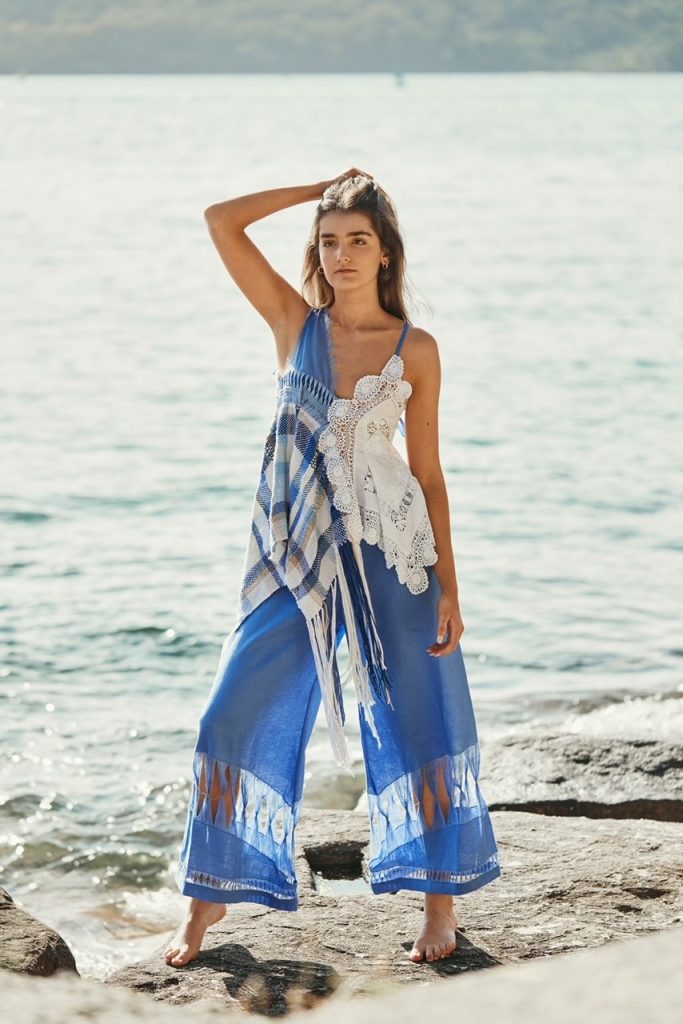
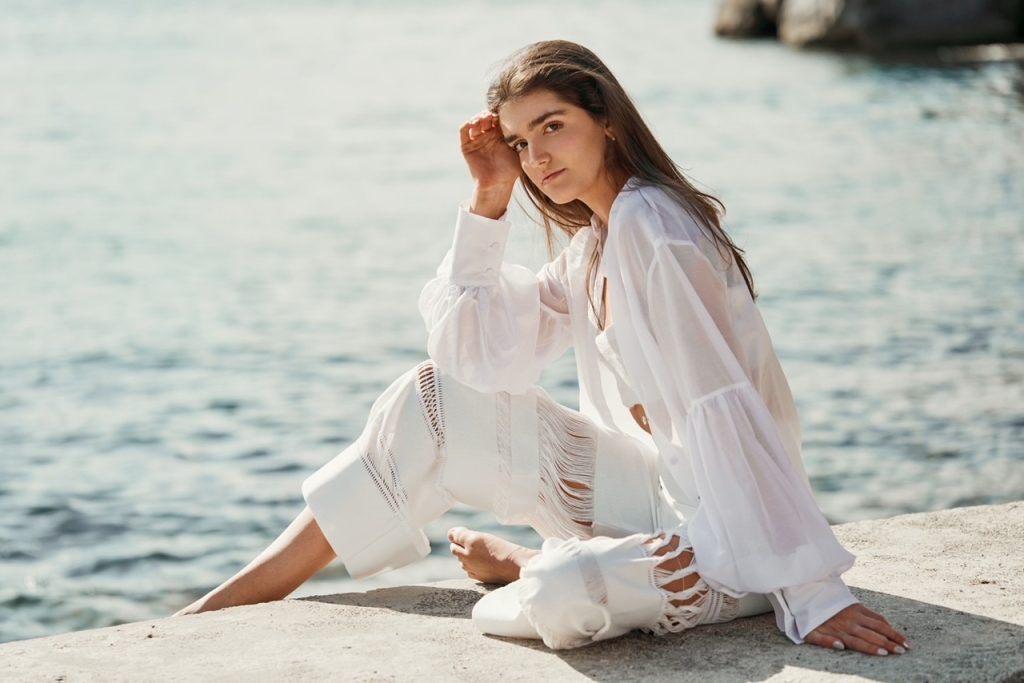
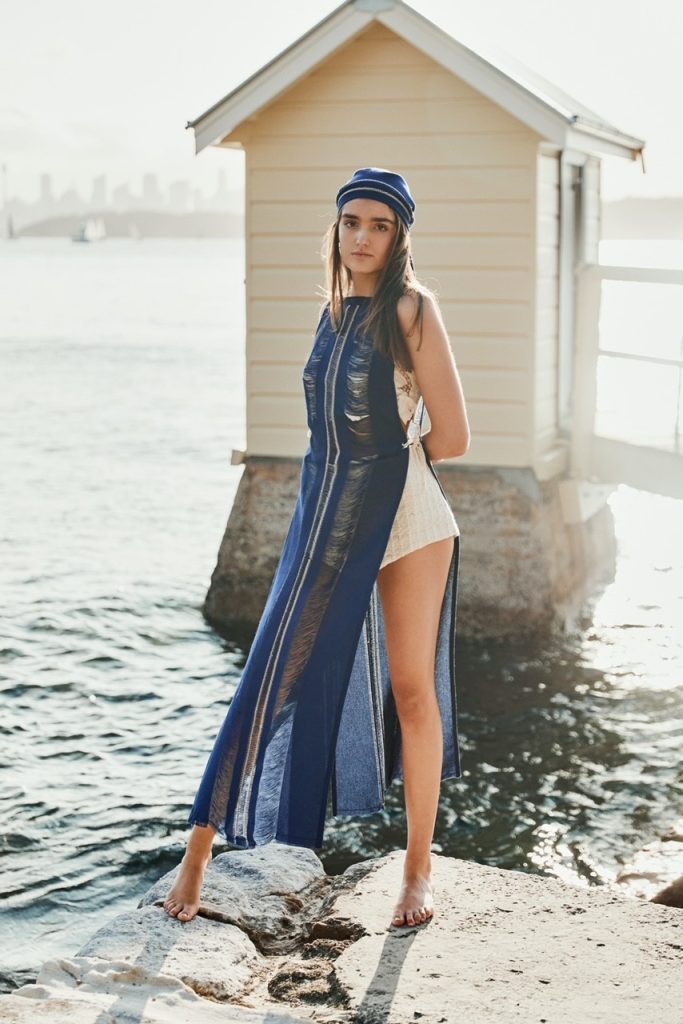
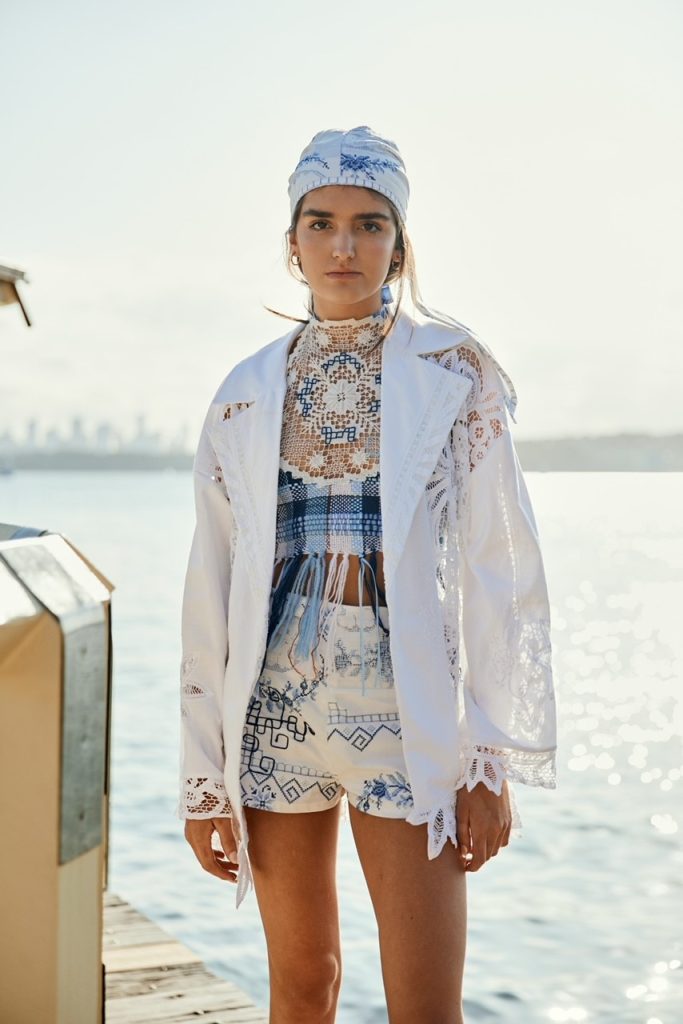
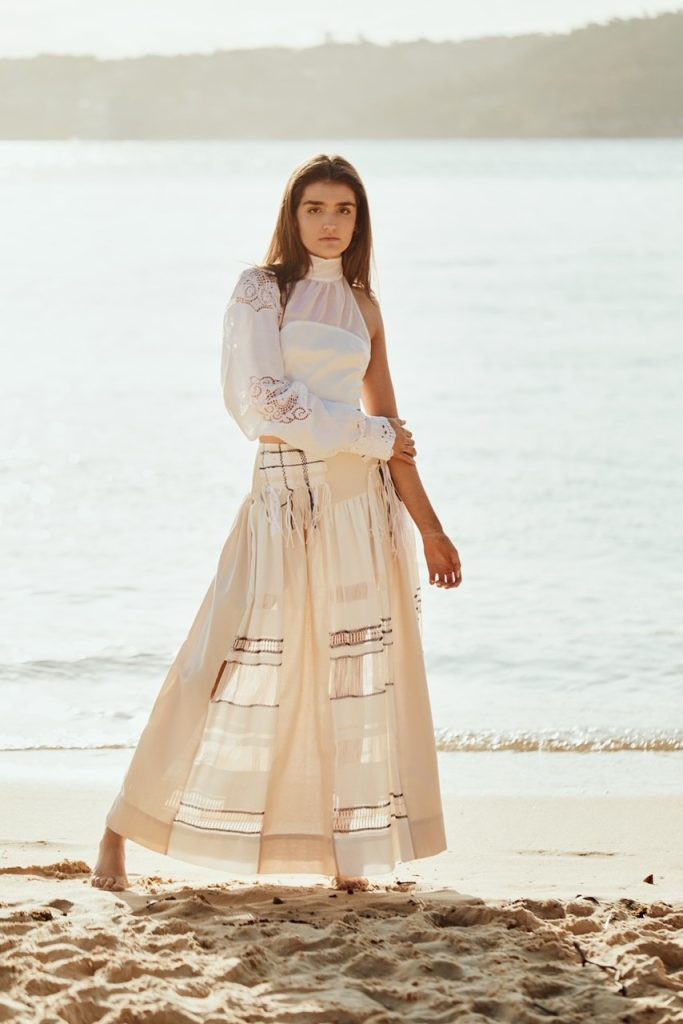
I have created a six-look luxury womenswear resort collection titled ‘A Handcrafted Place’ that focuses on the connections between place and handcraftsmanship. This collection has been generously sponsored by AWET (Australian Wool Education Trust) and has allowed me to incorporate various shades of white and blue merino wool to capture the essence of place; the Greek island landscape.
This collection is soft, sophisticated and breezy; yet fun, fresh and feminine. There is a strong sense of materiality and a richness in handcrafted processes. Some silhouettes are reminiscent of traditional Greek outfits, however the most significant nod to Greece is explored through both my choice of and creation of fabrics alongside my handcrafted work.
The collection captures the colour palette of the Greek island landscape through various tones of fresh whites and deep blues. I have experimented with the creation of my own fabrics by following the traditional method of weaving on my own loom, all by hand. Weaving each yarn one by one is a long and tedious process but definitely rewarding. I am able to create one-of-a-kind, unique textile pieces that are then transformed into garments.
Another significant part of the collection is my experimentation with drawn thread needlework. This is a meticulous technique that involves removing individual threads from cloth one by one, by hand. It is often left loose and distressed, or regrouped with twists and hand-stitching. I have self-taught myself this traditional technique and experimented with it in such a way to be suitable for a contemporary fashion context.
I have also incorporated various vintage sourced tablecloths, and doilies which my yiayia has passed down to me. The intricate hand stitching on these pre-existing tablecloths adds a unique sense of materiality to my work and perfectly captures a white and blue Greek design aesthetic.
What was the inspiration behind it?
I have always been inspired by travel and my Greek culture, and I often find myself designing pieces that have a personal connection and sentimental meaning. I wanted to create a collection that was just completely and utterly me, whilst paying tribute to tradition and heritage. I was interested in specifically focusing on the idea of place, with Greece carrying such a rich sense of tradition and history alongside a unique and beautiful landscape which I will always feel connected to. I collated and collaged various photos from my own trips to Greece as a starting point of reference. I wanted to honour my heritage and the intricate handcrafted textile techniques that are a part of Greek culture yet make them contemporary to appeal to a modern fashion context.
What techniques did your grandmother pass onto you?
Like many other yiayias I’m sure, both my maternal and paternal grandmothers have an extensive collection of doilies and delicate lace tablecloths lying around the house that decorate almost every piece of furniture and ornament. To me, these beautiful pieces are the epitome of Greek textiles and I was intrigued to rework them into components of fashion garments for my collection, transforming them from something seen in the household, to something that can be worn on the body.
Growing up, my yiayia would always tell me stories about her life in Greece before she migrated to Australia. She would often recall how many of the girls in her village would spend their evenings crocheting after a long day of working on the farms, or they would hand weave larger trousseaus pieces such as bed linen. This sense of slow handmade textiles in Greece forms a part of tradition and culture, and is something I am very much interested in.
You can follow Charlotte’s work on Instagram @charlotte.markson and website www.charlottemarkson.com.
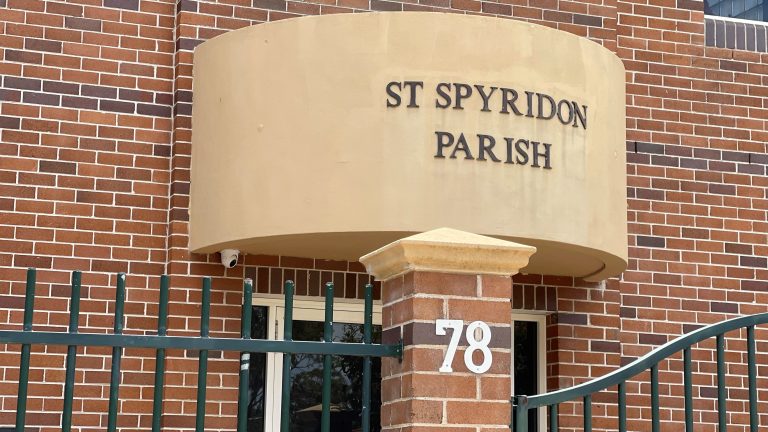
The Board of St Spyridon Parish in south east Sydney held its Extraordinary General Meeting (EGM) on Monday, November 21 for members to vote on: (1) Change of company name from ‘The Greek Orthodox Parish of South East Sydney’ to ‘The Greek Orthodox Parish of St Spyridon Sydney,’ and (2) the repeal of existing Constitution and adoption of a new Constitution.
According to The Greek Herald‘s sources, the first motion of a change to the company name was passed by members with over 90 percent agreement. The second motion for a new constitution was also passed with 85 percent support.
Parish member George Savoulis told The Greek Herald a number of questions were raised by members on the night around proxy voting and the fact that people under the age of 21 were ineligible to cast their vote.
Concerns were also raised about members having to put their full names on voting papers, ensuring their vote was not anonymous.
Mr Savoulis said that he accepts the result but he is unsure of what the future holds.
“The membership has voted. We presented our side with dignity and moral integrity and the other side had an advantage and they won in the end,” Mr Savoulis said.
“The Archdiocese has now received control over a parish with an estimated value of over $400 million to do with and to manage as they please.”
The Greek Herald first reported last week the concerns of St Spyridon College parents around the proposed changes to the Parish’ constitution and the ultimate deciding power they give to Australia’s Greek Orthodox Archbishop.
Parents were concerned the changes would impact on educational standards for students.
In a statement to The Greek Herald at the time, Parish President Elia Economou said the proposed changes “will have no noticeable impact upon the day-to-day management and operations of the College.”
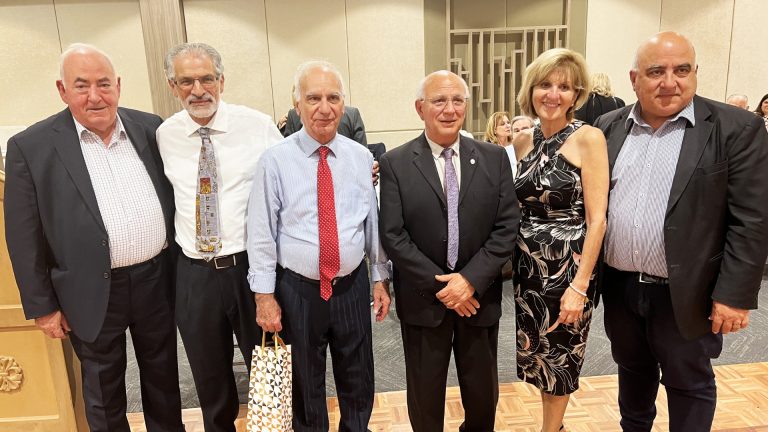
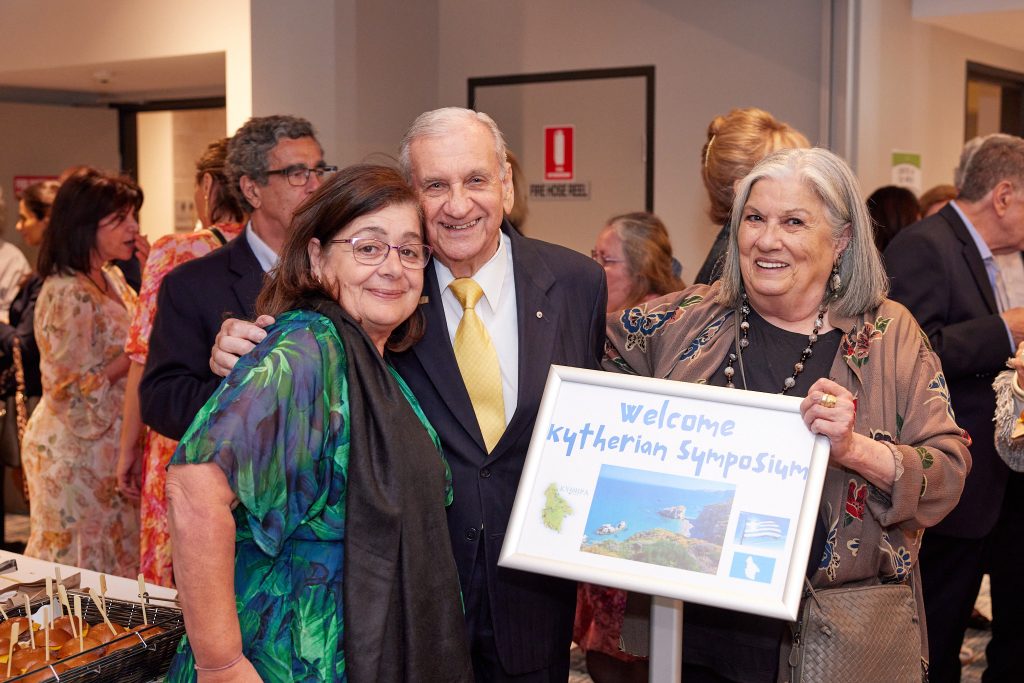
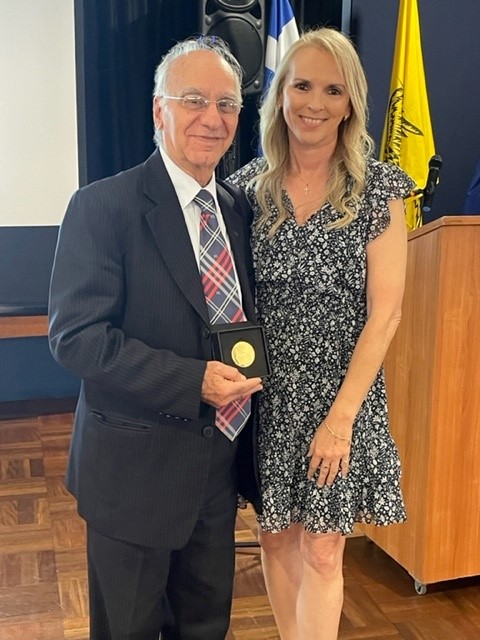
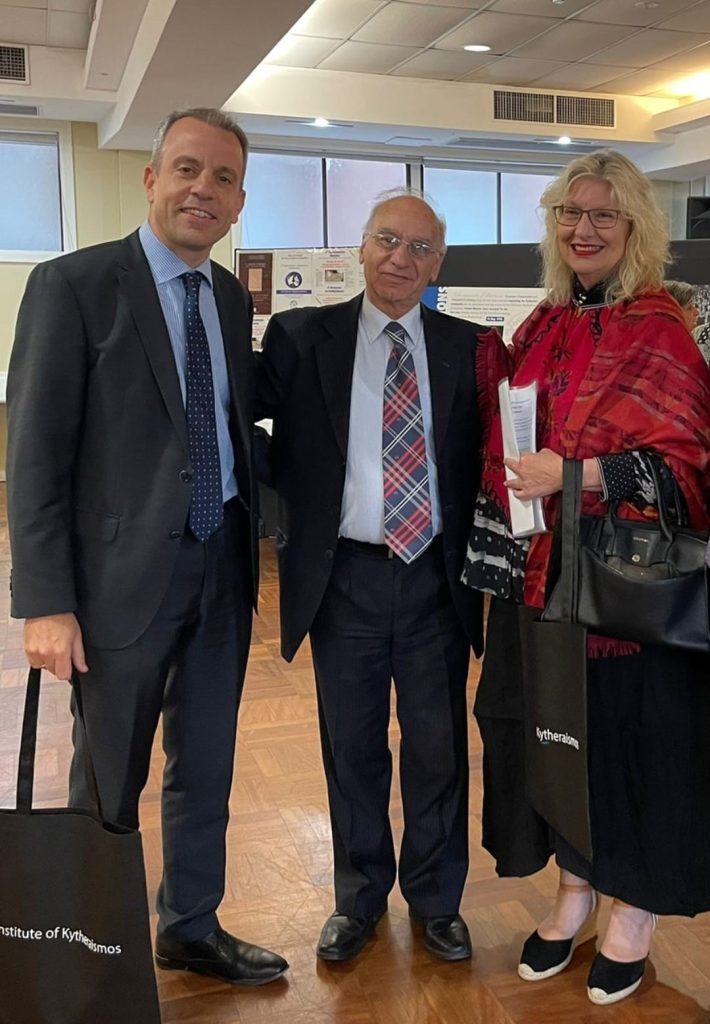
Kytherians of the world gathered in Sydney from November 17 to November 20 at the 9th International Symposium of Kytheraismos to celebrate the Kytherian Association of Australia’s (KAA) centenary this year.
The symposium was attended in person by people from Greece, the United States, Sydney, Brisbane, Canberra and regional New South Wales, as well as global participants via Zoom from Kythera, Athens, California and the United Kingdom.
Held over four days, the event launched with a Cocktail Party on Thursday, November 17 at the Coogee Legion Club attended by about 80 people.
Formalities commenced on Friday, November 18 at the church hall of St Spyridon Parish in Kingsford. The symposium was officially opened by the Mayor of Waverley City Council Paula Massellos, with an opening address from the Consul General of Greece in Sydney, Ioannis Mallikourtis.
Also in attendance on the day, and giving a number of presentations, were: Chairman of Kytheraismos International, Professor Elias Marsellos; Chairman of the Institute of Kytheraismos (Sydney), John Comino; the President of the KAA, Barbara Zantiotis; His Eminence Archbishop Serafim of Kythera; and Australian Ambassador to Greece Arthur Spyrou; among many others.
Photo: Bourdo Photography
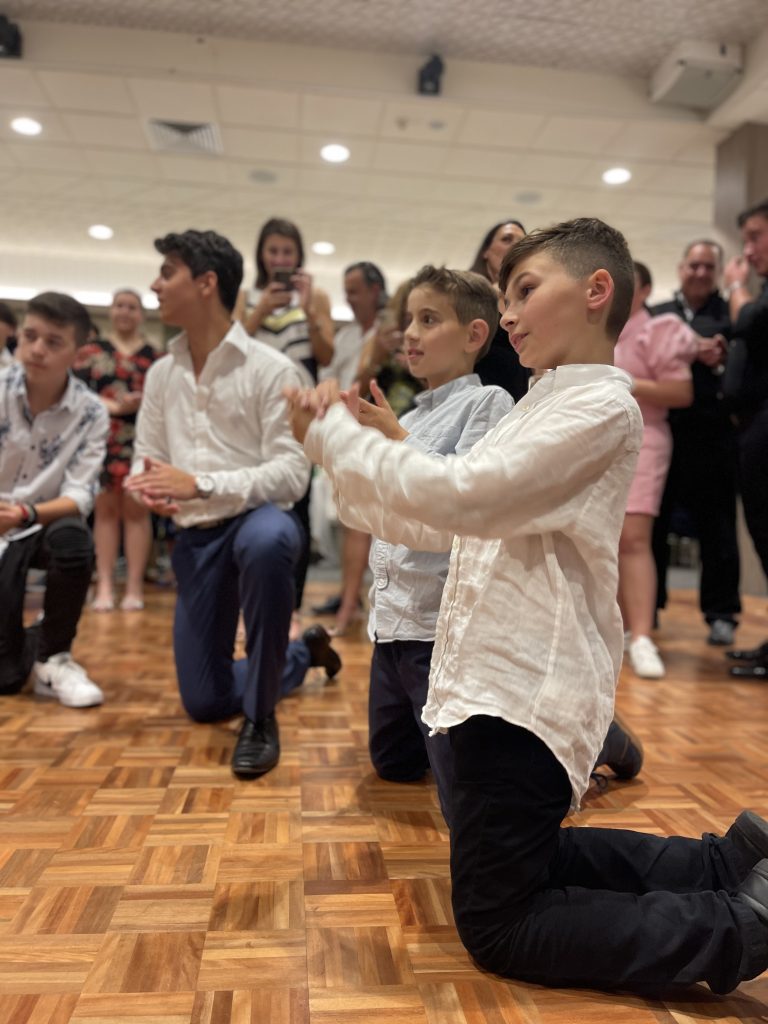
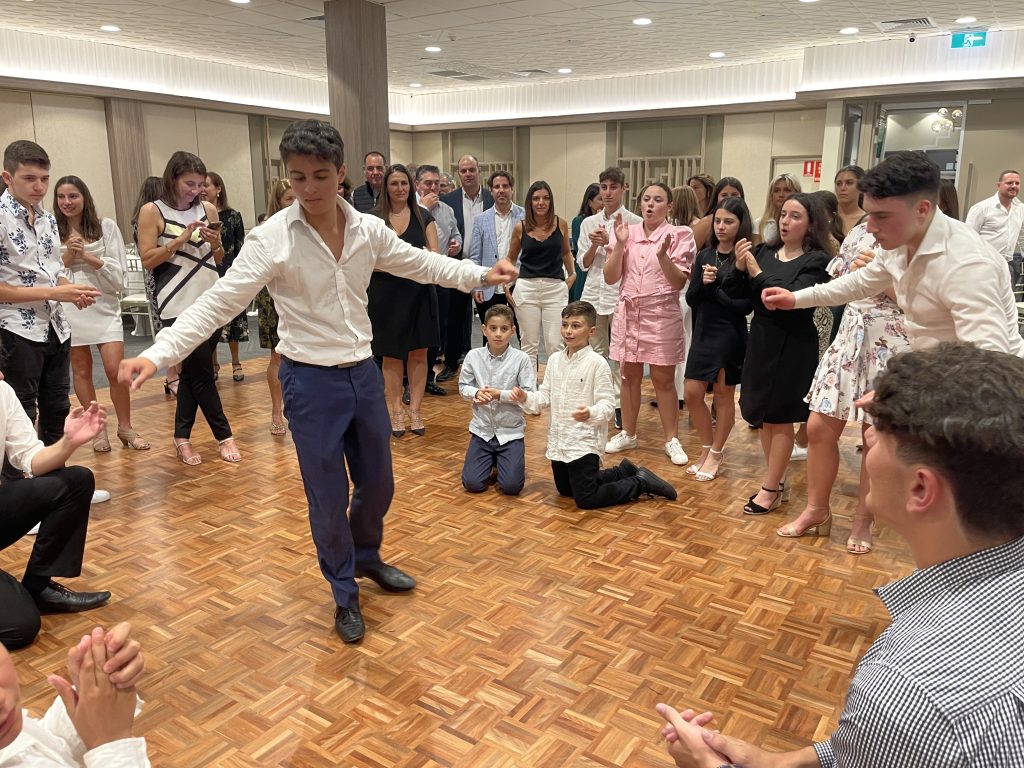
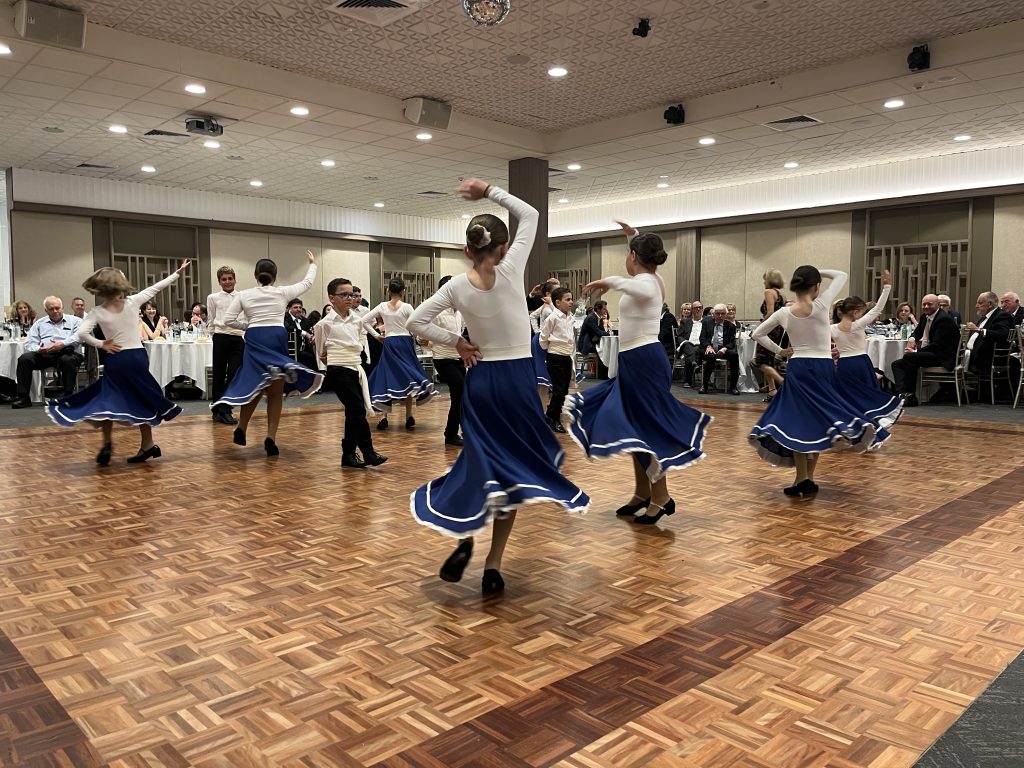
Official proceedings concluded with a memorable Dinner Dance held at the Hermes Lounge in Kogarah.
The closing ceremony for the symposium was held at St Spyridon, where during the regular Sunday service the Symposium proceedings were highlighted and an icon paraded around the church by Kytherian Committee current director John E. Comino and former director Theo Poulos.
A morning tea was held after the church service followed by closing remarks from Professor Marsellos and Mr Comino.
The three outcomes of the Kytheraismos Symposium 2022 were: (1) reach out to Kytherian diaspora in Australia, the US and Greece to establish strong links via electronic means; (2) for the KAA to create a forum with the Hellenic Club Ltd Sydney and the Cyprus Association with the purpose of creating a united voice of Greek Kytherians in Australia; and (3) to work with the younger generations of Kytherians to build the Kyth-e-Regions of the world and the global Kytherian community.
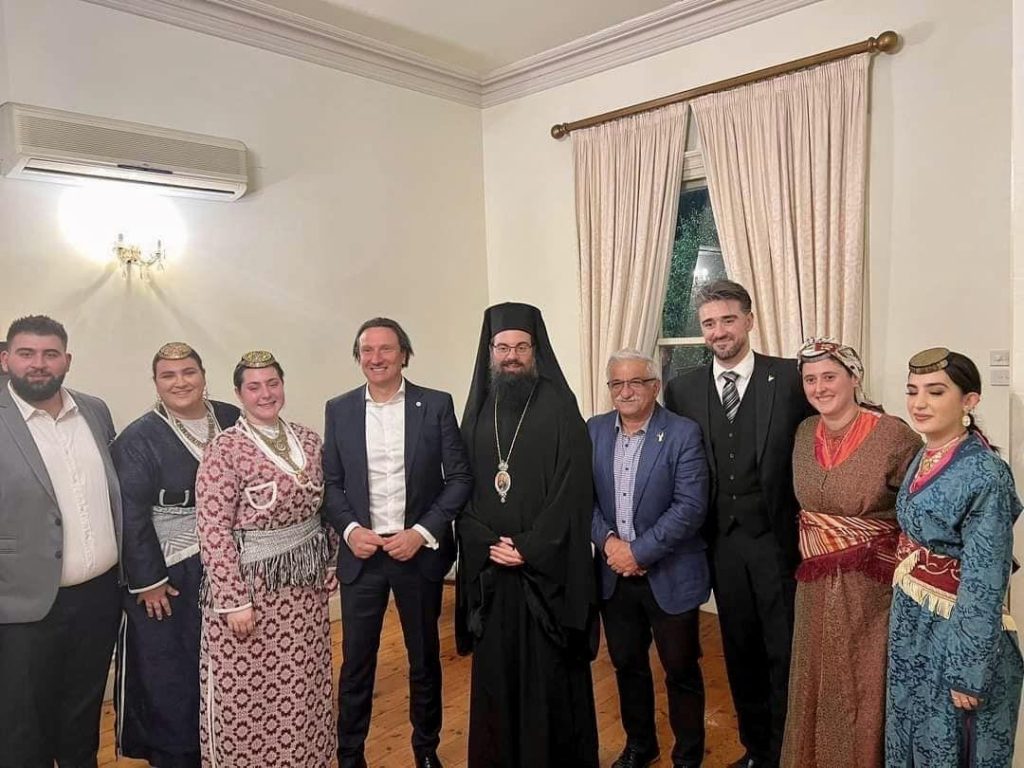
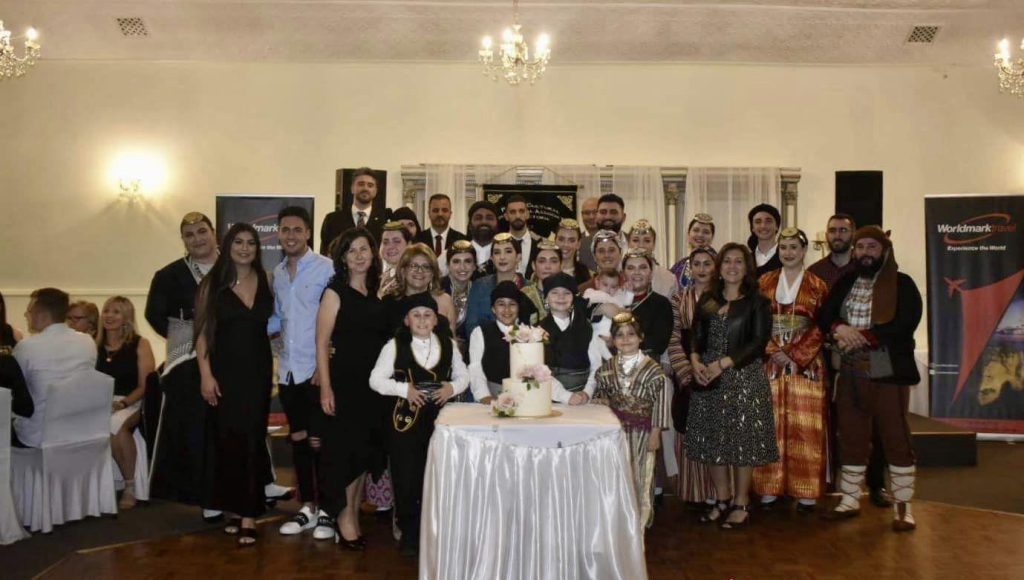
On Saturday 12 November, Akrites tou Pontou and friends gathered at Normanby House in Thornbury to celebrate the 10th anniversary of Melbourne’s newest Pontian association.
Over 220 guests were joined by His Grace Bishop Evmenios of Kerasounta, President of the Greek Orthodox Community of Melbourne & Victoria, Mr Bill Papastergiadis, Mr Peter Stefanidis President of the Federation of Pontian Associations of Australia, representatives of the Consul General of Greece, resident of the Justice for Cyprus Committee (SEKA), Mr Tony Kyriakou, as well as representatives from fellow Pontian associations of Sydney and Adelaide, the Assyrian community and also Armenian cultural associations.
Master of Ceremonies for the evening was former footballer and media personality, Mr Andrew Paschalidis, who gracefully reflected on his own links to the Pontian community in Sydney as well as his personal connection to the Federation of Pontian Associations of Australia.
Akrites’ young president, Mr Harry Tsairis, reflected on the successes of his club and his rise from dancer to president of Akrites Tou Pontou. His sentiment was echoed by Mr Bill Papastergiadis who remarked on the special collaborations and performances of the Akrites dance group at the Lonsdale Street Greek Festival over the years. Such performances have transformed the Festival as Mr Papastergiadis himself, expressed the importance of the collaborations with Australia’s First Nations people, Armenians, Assyrians and Maoris.
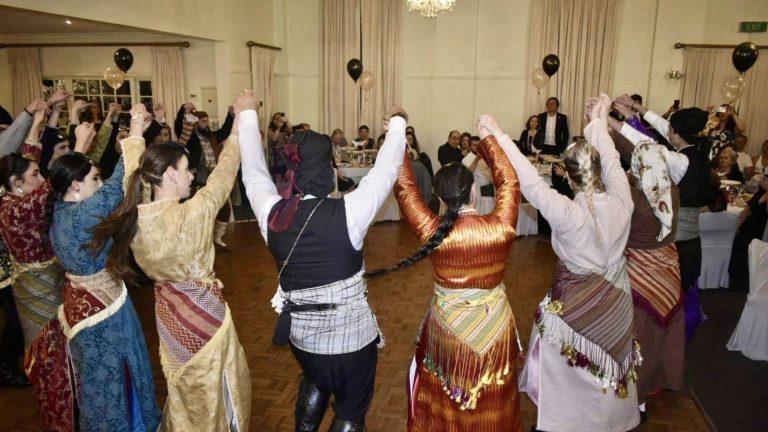
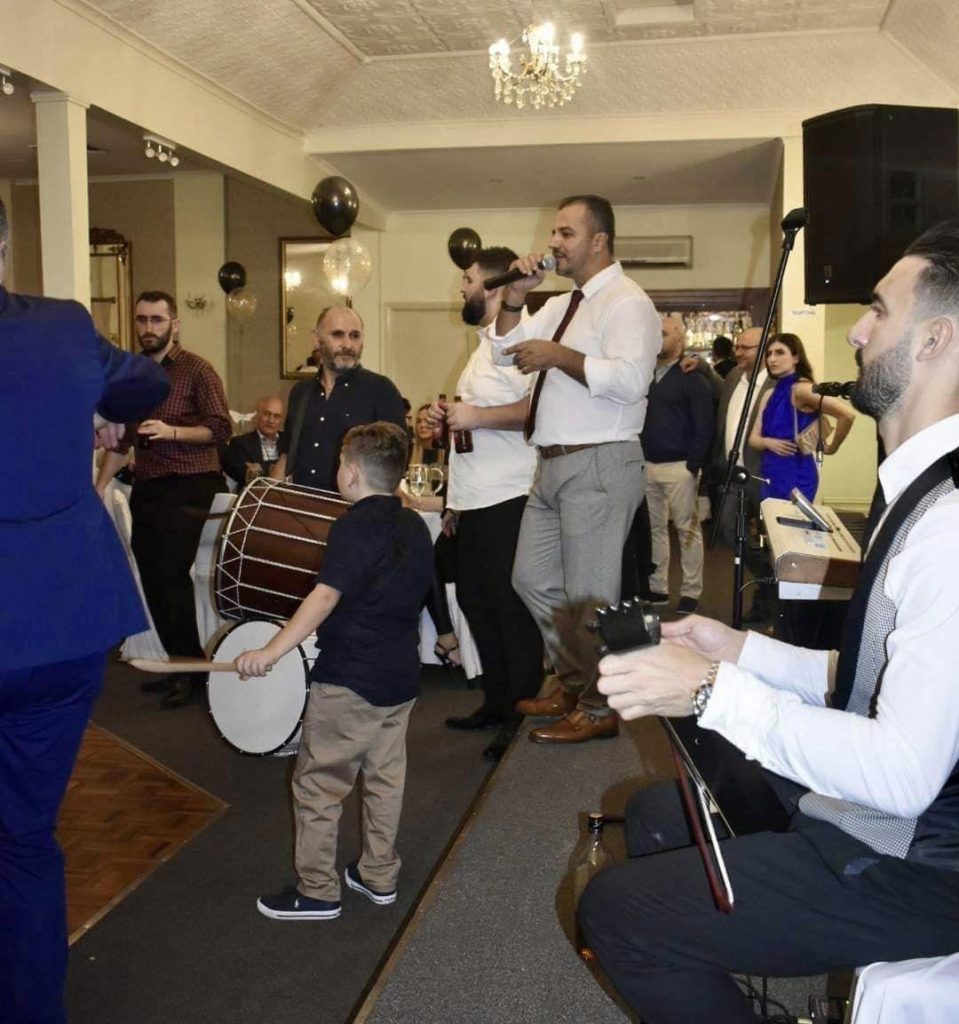
Guests were entertained by the Akrites tou Pontou Senior and Junior Dance Group, as well as two exceptional guest musicians from Greece, Mr Vasilios Topalidis on vocals and Mr Rafail Alexandridis on the lyra who kept the large crowd entertained and their talents ensured the dance floor was at capacity all through the night. They were joined by Melbourne’s own George Bletas on keyboards and Theodoros Kostidis on daouli.
Akrites Tou Pontou was established in 2012 aiming to unite people with a passion for Pontian culture here in the Greek diaspora of Australia. What started as a small club consisting of a handful of family friends has seen a significant growth in the last 10 years.
Since its inception, Akrites Tou Pontou has continued to express their passion for Greek Pontian culture through traditional dancing, and although they seek to keep the traditions alive and honor them, they simultaneously aim to challenge the way in which Pontian dancing is viewed and performed from the perspectives of 2nd, 3rd and 4th generation Greek-Pontian immigrants.
Every performance is unique, often surpassing people’s expectations. Having successfully worked with various cultural groups at Antipodes Festivals, including the Aborigines in 2016, its most standout performance to date, “Phoenix of Dreamtime”.
This was the beginning of an era of cross-collaboration with various cultural groups; Melbourne Georgian Choir in 2017 and with a Maori group in 2018 in “Argonauts of the Pacific ”, a narrative-based performance. Connections were made in shared tragic histories of genocide and uprooting as well as shared experiences of diaspora.
Akrites Tou Pontou is also very active in participating in the commemoration of the Greek Pontian, Assyrian and Armenian Genocides that occurred in the early 20th century, through attending lectures, ceremonies, conventions interstate and various commemorations every year.
As one of the major Pontian clubs of Melbourne, there is immense focus not only on preserving the Pontian culture and traditions but also to teach the dance group members valuable life skills that they can translate into all aspects of their every day and professional lives. Each individual’s skills are encouraged in relation to their culture and identity. Akrites is constantly seeking to grow our family through our dance group and our cultural collaborations, ensuring that the vibrancy of Pontian culture is shared with all.
If you are interested in joining Akrites Tou Pontou and learning to dance Pontian, Akrites offer Junior and Senior Dance lessons on Thursdays 7pm to 7.30pm for Juniors and 7.30pm for Seniors. Find us at 317 Victoria rd, Thornbury.
Contact us at @Akrites_aus or info@akrites.org.au.
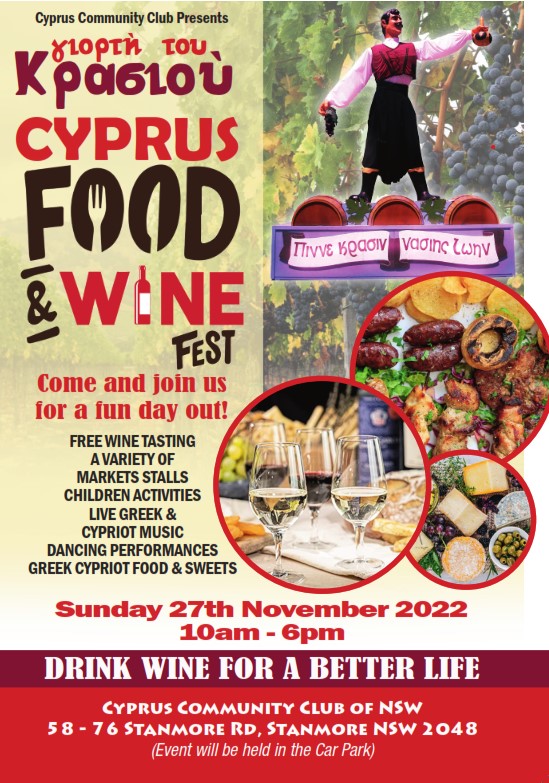
After a two-year forced absence due to COVID-19, the longest running and largest community organised Food and Wine Festival is back on November 27, 2022.
Organised by the Cyprus Community of NSW Ltd, the Festival continues the tradition of the Ancient Greek world – the festival of Dionysus – that was held annually in honour of the wine god in Limassol, Cyprus.
The Festival Director and member of The Cyprus Club Board, Andrew Paschali, said: “Our ancestors brought ancient traditions, culinary and other customs to their new homeland and introduced the delicacies, foods, and beverages which over the decades have become part of this nation’s fabric.”
Since 1989, the festival has been held at The Cyprus Club in Stanmore.
The Festival’s opening is scheduled for Sunday, November 27 at 10.30 am with the Inner West Council Mayor, and a welcome to country ceremony from local Indigenous elders, and the Cyprus Community’s dancing school paying homage “dance of the wine harvest.”
This year’s festival will showcase local talent, Australian producers of food, wine, beverages, and young and up-and-coming Australian producers supplying the local and export markets.
With a day-long entertainment cultural and artistic program on stage, sample bags, magazines, children’s rides, games, Cypriot and Greek street food stalls, boutique wines, beverages, conserves and much more, it is a foodies and wine lovers paradise! All welcome, entrance free.
As Athenians move around their city, they almost seem oblivious to the magnificence of the Parthenon – a backdrop to the multitude of small and large dramas in their daily lives.
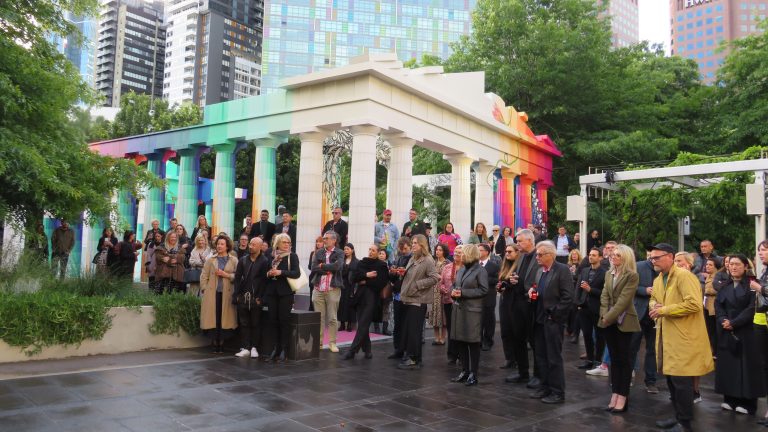
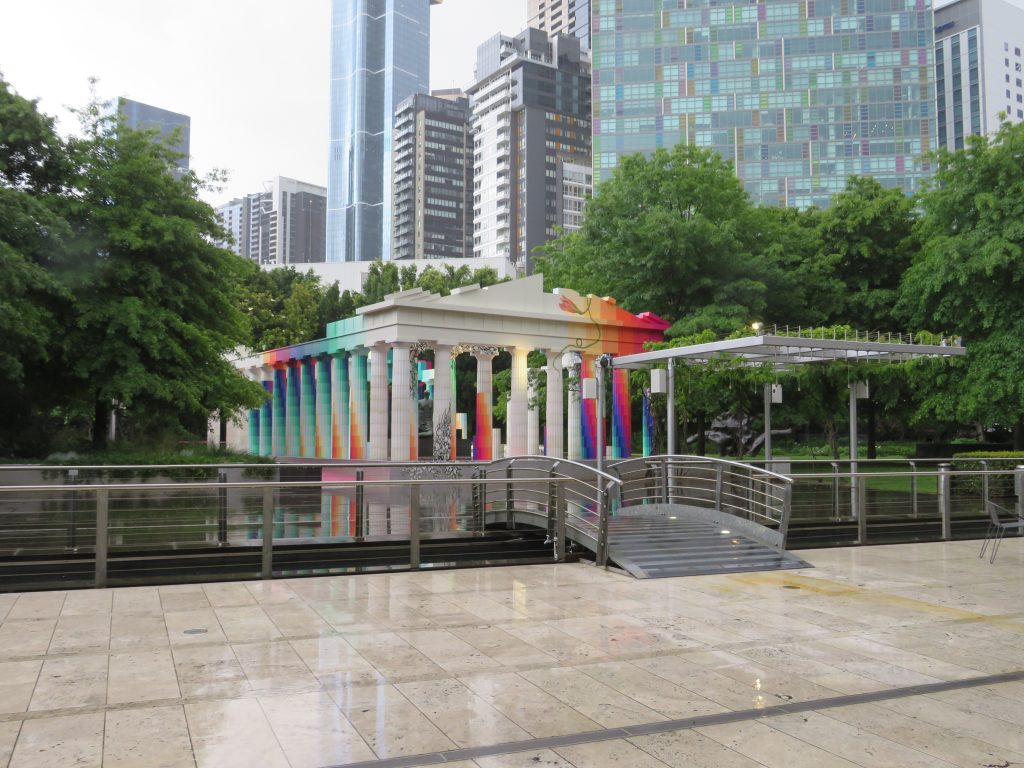
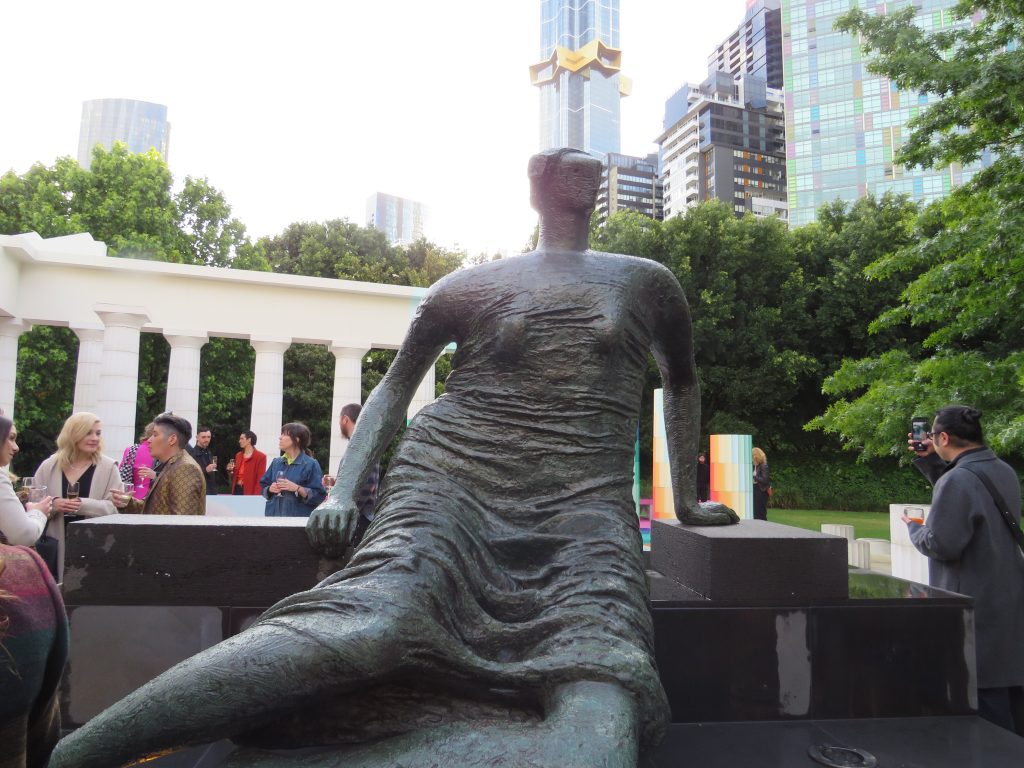
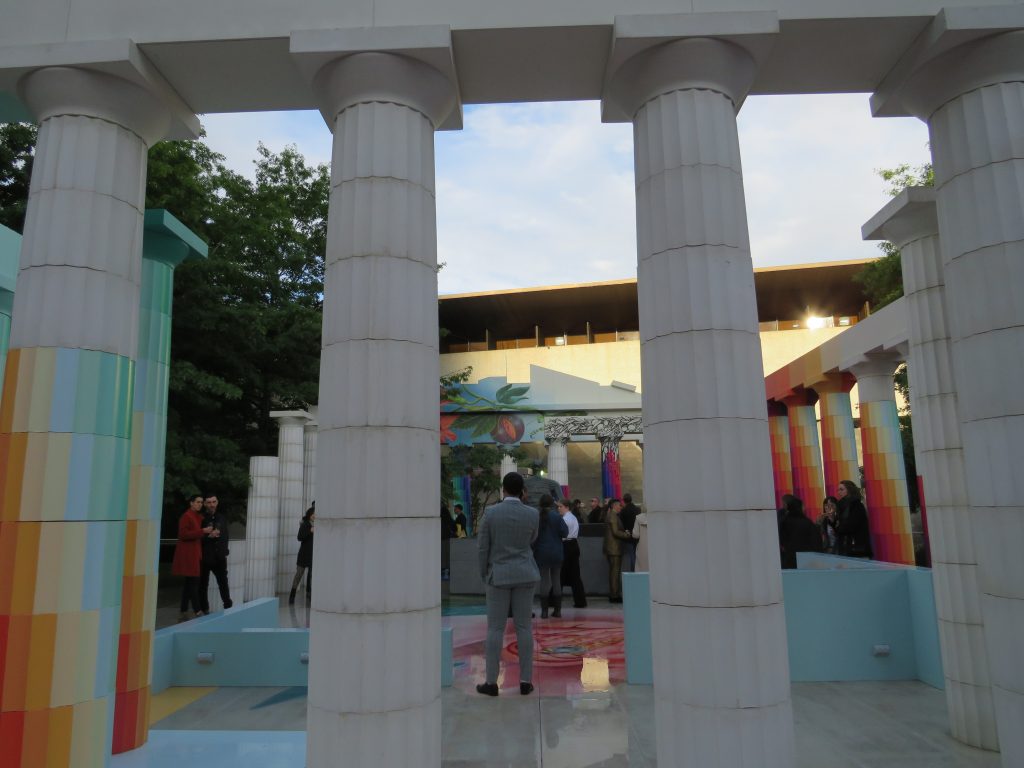
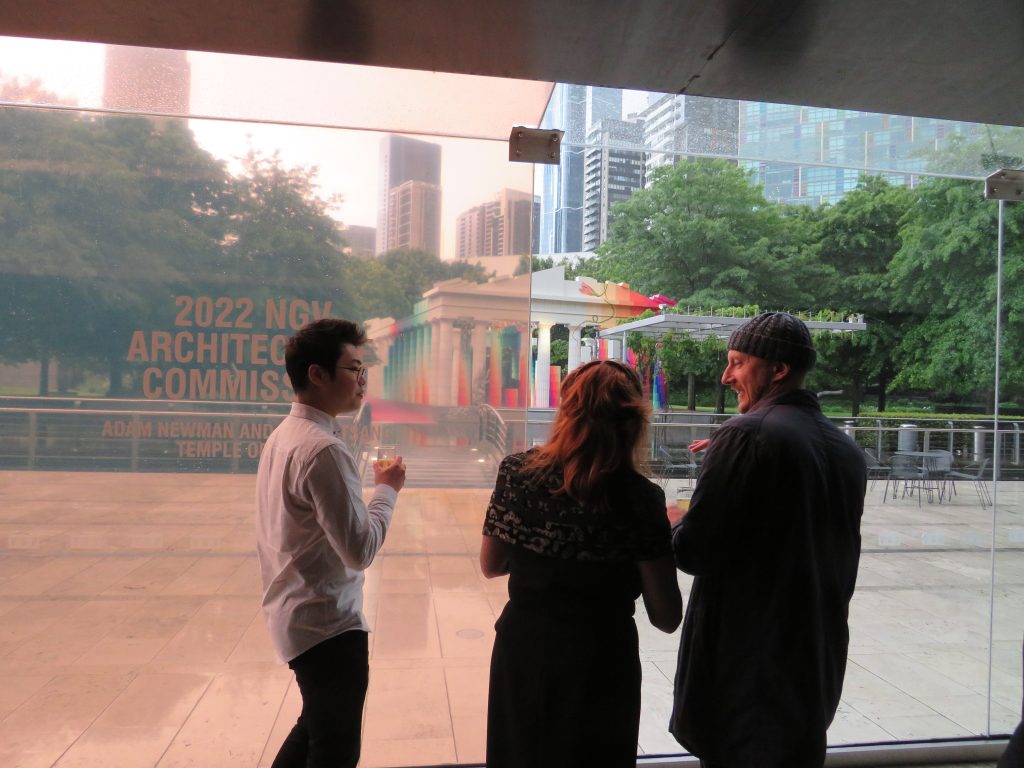
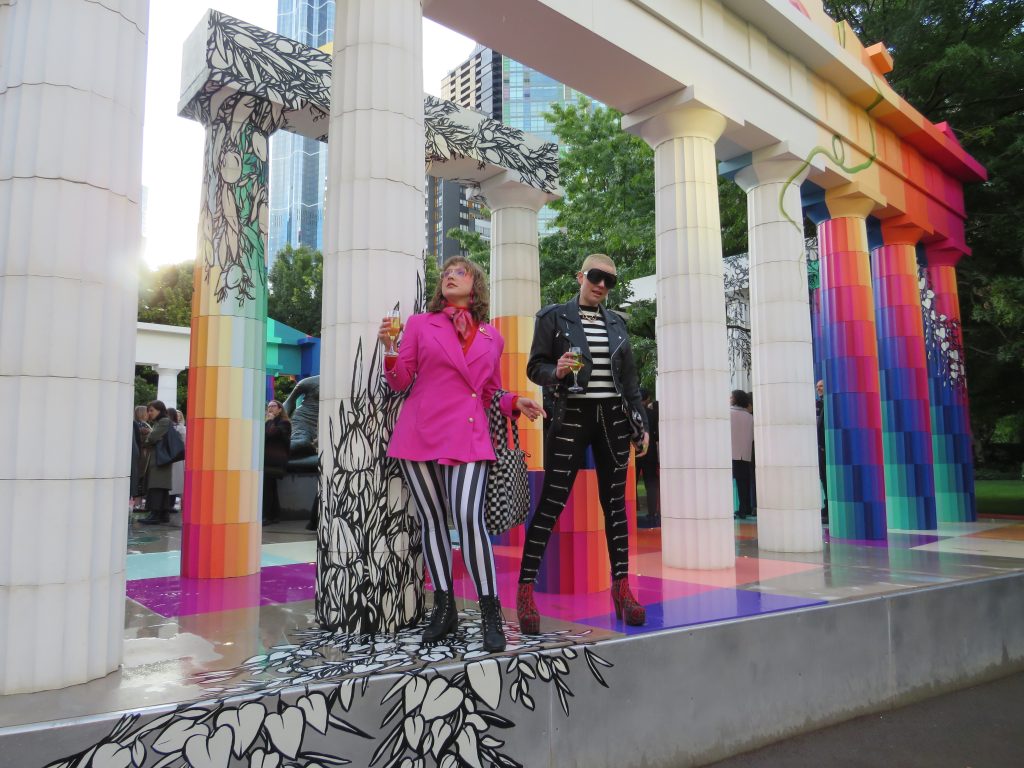
In contrast, Adam Newman and Kelvin Tsang – the architects of the winning design of the 2022 NGV Architecture Commission – have never seen the Parthenon up close, but their academic quest to discover its secrets have led to the National Gallery of Victoria’s Temple of Boom which winks at Indiana Jones while paying homage to the architectural wonder of Greece.
Hearing I’m from The Greek Herald, the creators of the work ask me when the best time to visit the Parthenon might be. Their plans to view the building that inspired their art were cut short by the start of COVID-19, and that’s when they laid the foundations of their Temple of Boom, fuelled by their own imaginings of seeing a building they’d missed out on.
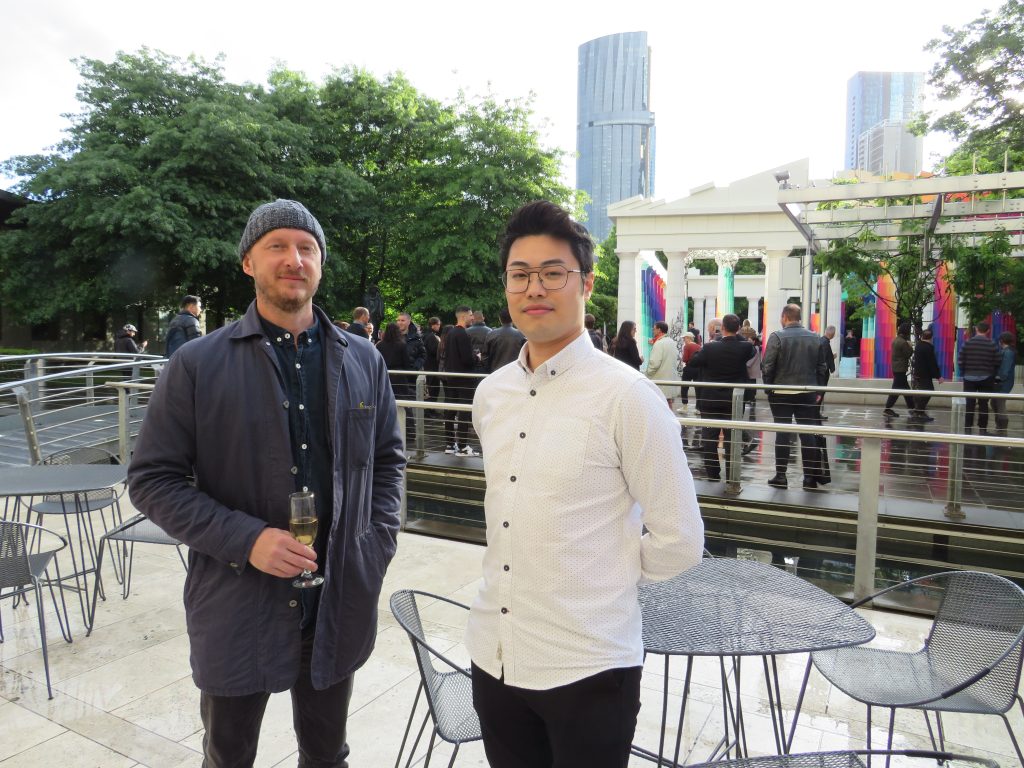
The two met at Monash where Mr Tsang was Mr Newman’s student, and they now work together in Brunswick’s NWMN – a two-man practice with a strong focus on the reusability of materials and sustainability as they take on small residential projects.
Despite the success of their practice, they say they’re both still students when it comes to the Parthenon. “Thirty years I’ve been learning about the Parthenon, and you keep learning about the building and the history. It is endless,” Mr Newman said.
Mr Tsang told The Greek Herald that “studying architecture, it is one of the best buildings to research. The more you research the ingenuity of the Ancient Greeks, the more you fall in love with it.”
The architects wanted to respect the history of the building. “It’s a very potent symbol of democracy and civilisation and, in our opinion, it is the most recognisable building in the world. The most copied in the world. It is loaded with history and has so many different meanings to different people,” Mr Tsang said.
“Another layer to this is – ‘what if we bring this symbol and place it onto country, in Australia, Wurundjeri country, and bring about the conversation?’- What does this mean when we do this? My interpretation is different to your interpretation and it’s about getting the conversation started.”
He stops short of sharing an opinion on the long-standing conversation of whether the Parthenon Marbles should be returned to Greece. “I will not take a stand. I have my opinions, but it is about bringing about conversations and bringing awareness,” Mr Tsang said.
We rein in on other controversies – those of cultural misappropriation, for instance.
“There was some early robust conversation once the winners were announced,” Mr Newman said. “But (the work) is actually about the Parthenon, the history of it, its symbolism, geopolitics, the extraordinary technological prowess of the building and every sort of link that we currently have as a society back to 2,500 years ago. It is about everything. It is about human civilisation.”
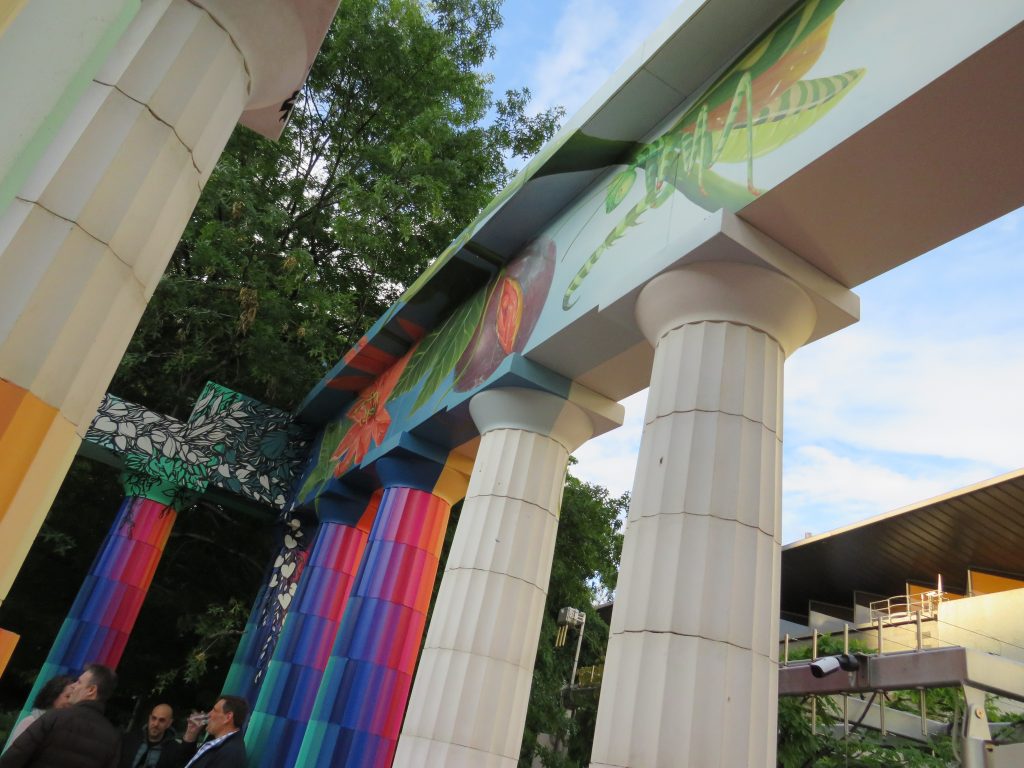
They stop for a moment and look at the rays of sun striking the Temple of Boom just moments after a downpour, and how different the building looks from different angles. “Do you see the olive tree mural that is homage to the goddess Athena?” I am asked.
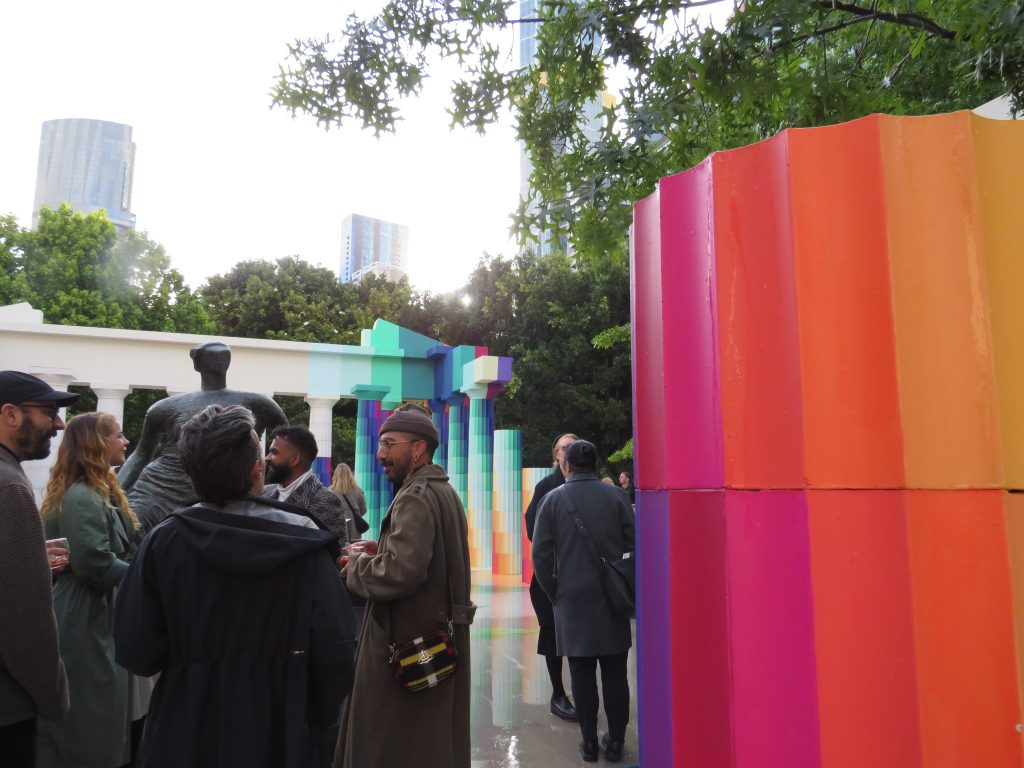
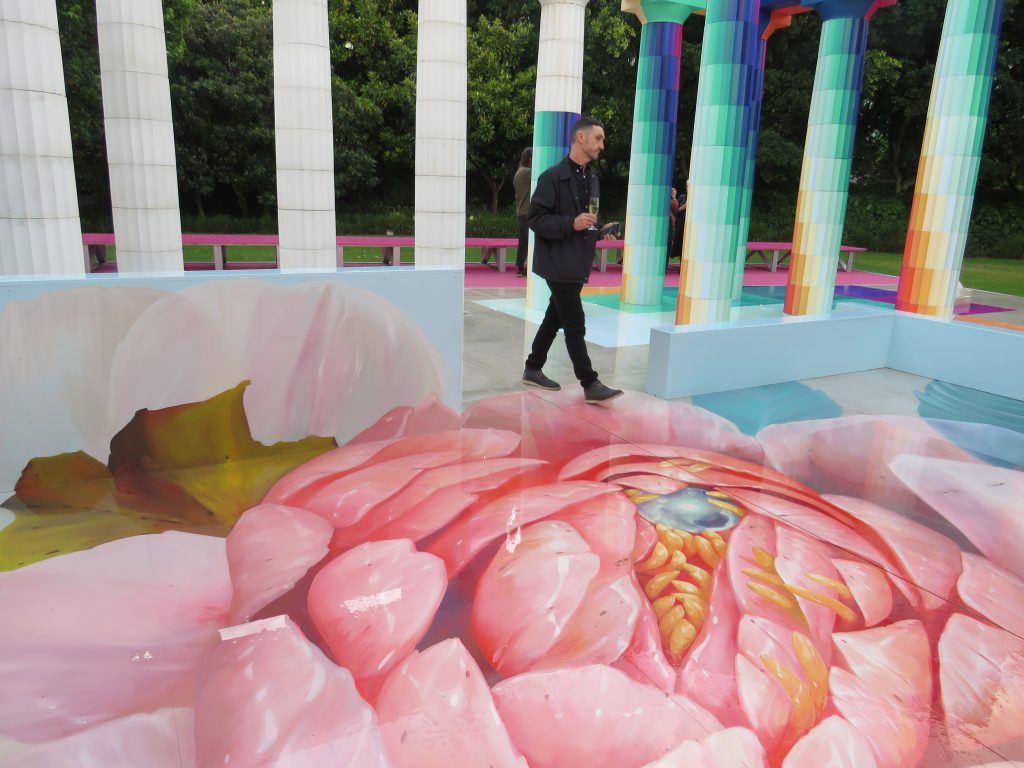
People present walk between the columns, gain different perspectives of the building, and do what they are meant to do in their interactions to the installation. Tim Marshall, Deputy Vice Chancellor of RMIT, said, “When this 2,000-year-old icon is transplanted, in a sense, to present-day Melbourne, we suddenly begin to look at the subject in a whole new way.”
Mr Newman said he and Mr Tsang are still reviewing and appreciating their own work as different elements and people interact with it.
Made of glass-reinforced concrete, the Temple of Boom sits on a platform, an homage to the acropolis and the procession to the Parthenon. It invites people to make what they will of it and keep revisiting as artists layer it with colour and bring their own interpretations to enhance the work – a symbol of continuity but also very much of the present.
“This dynamic mural celebrates the history of the building, while simultaneously imbuing it with a contemporary sensibility which is very Melbourne,” Mr Marshall said. “As the building evolves before our very eyes, it asks us to consider the effect of time on all architecture and the notion of permanence.”
This is, indeed, a concern of all architects, whether it be Ictinus and Callicrates – the creators of the actual Parthenon – or Newman and Tsang.
By chance, architect Angelo Candalepas, passed by in the previous week. Inspired by ancient Greece in his own creation of The Fox, the NGV Contemporary which will extend from the current NGV site, the work caught his fancy. “We took him on a tour and showed him the details,” Mr Tsang said. “He was amazed.”
The architectural duo has been in talks with the Hellenic Museum and there will be VR tours on offer, as well as a number of theatrical performances, dances by the Manassis Dance Troupe, and of course DJs at the artwork as other artists add their own strokes onto it. It is hoped that the artwork can be a meeting place, an agora so to speak.
The 28-year-old beat out other Victorian finalists including Ronith Arlikatti, Oliver Garrioch, Saavni Krishnan, Sriram Aditya Suresh and Cameron Tay-Yap.
“The award is what I’ve been working towards my whole career,” Deligiannis said after winning the award. “I’m hospo through and through.”
Deligiannis began his career aged eight, spinning pizza at his family’s business. He later did his apprenticeship at Jacques Reymond Restaurant (and then Bistro Gitan), before flying to London to gain experience.
On his return to Victoria, gigs in Melbourne and on the Mornington Peninsula culminated last year in a head chef role at seafood-focused restaurant Audrey’s.