
By Giorgio Apostolopoulos
My ancestry traces back to Greece, a heritage that intertwines with my Australian upbringing, making me a crossbreed of Greek and Aussie.
My grandparents migrated to Sydney, driven by hopes for a better life.
They hailed from Peloponnese, Kalymnos, and Tripoli, arrived in their twenties, brought all the diverse idiosyncrasies that Greece had to offer and by some miracle found each other and made one big fat Greek family.
However, Sydney was alien to them. Their arrival delivered a spectrum of varying experiences, from a flourishing lifestyle, to the dark exposure of ostracism and at times racism.
So I raised the question; How can we build a sustainable multicultural community, whilst overcoming cultural xenophobia such as ‘a big Australia’?
Immigration has woven a vibrant cultural tapestry within urban cities like Sydney, giving rise to neighbourhoods with diverse restaurants, shops, and centers that reflect the rich heritage of their residents.
For instance, the suburb of Earlwood resonates with me as my ‘little Greek Town’, a homestead for my extended family. Earlwood is dotted with Greek restaurants and Orthodox churches, emblematic of our cultural identity.
With Australia’s growing diversity since 1945, where approximately seven million migrants from over 270 ancestries contribute to 30% of the national population, these ethnic havens foster holistic multiculturalism and national diversity.
Merging my personal experiences and cognitive research has revealed the developmental benefits of growing up within a multicultural environment.
My upbringing melded together European academic discipline with the support of Australia’s nurturing culture, which forged an educational journey during my formative years. Constant exposure to the Greek language, which I attribute to my family’s poor ‘volume management’, has facilitated my proficiency across many European languages.
This linguistic prowess has enabled me to correlate Greek, French, and Spanish which has created advantages in a language school.
Considering my future, it’s clear that my proficiency in foreign languages, European work ethic and Australian empathy will enhance my employability and broaden my academic horizons.
Ultimately, my early exposure to languages and diverse cultural approaches to education has augmented a cognitive flexibility which will benefit me socially and professionally.
Multicultural festivals serve as vibrant platforms to celebrate diversity and to share heritages. Greek Orthodox Easter holds a special place in my heart. From solemn Good Friday rituals to the Midnight Mass illuminating Christ’s resurrection, the lighting of candles and the succulent lamb feast creates a surreal unifying atmosphere. The battles of cracking red-dyed eggs evokes laughter and a feisty competitive spirit – I still yearn to seek revenge for last year’s defeat at the hands of my grandfather.
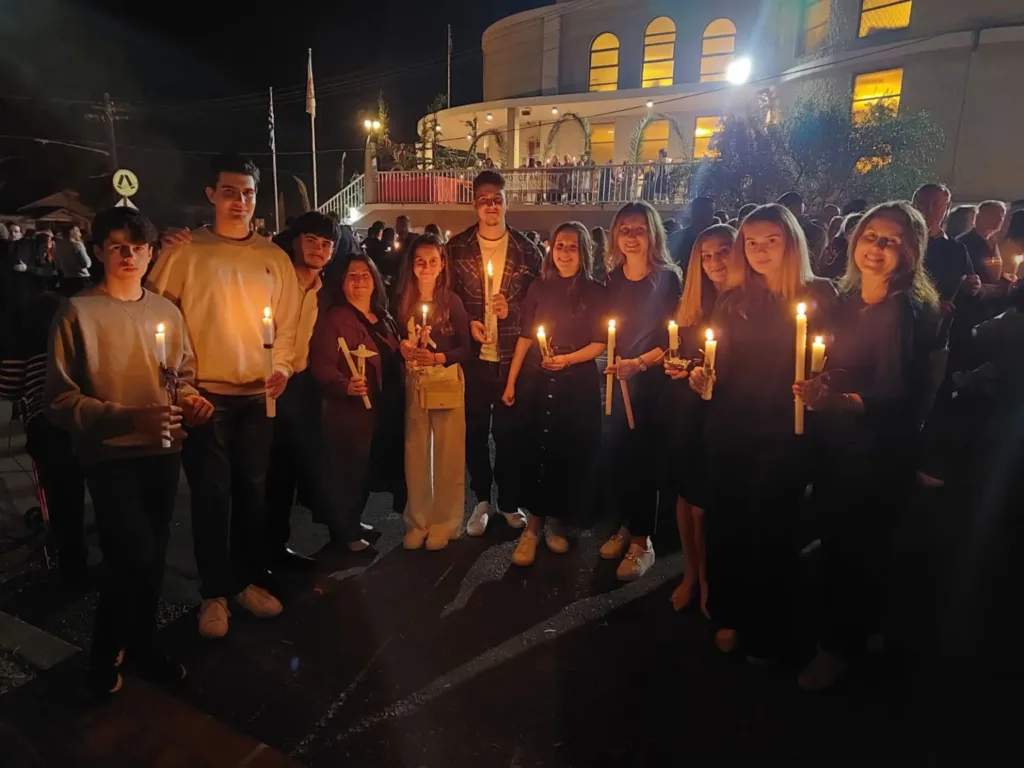
Participating in festivals such as these encapsulates the essence of multicultural celebrations, creating connections between the spirituality, history, and community of a new home and old heritages. I’m still counting down the days for next year’s Greek Orthodox Easter.
On the other hand, it has been a struggle to balance mainstream immigration without creating concerns regarding resource sustainability. As such, immigrants have faced challenges in achieving cultural acceptance. Growing beyond my formative years has foregrounded an awareness of Australia’s underlying social prejudices.
My parents have disclosed tales about facing ostracism, which has allowed me to characterise the mumbled biases I’ve witnessed my whole life as “quiet racism”. Criticisms for our names, language, and food choices flew over my head as a child, but ate away at me as a young man. I blamed it on jealousy for my cultures’ complexity, seeing as modern Australia is only a few 100 years old – and not the best 100 years either.
My grandparents too were unjustly accused of ‘stealing jobs’, despite accepting demanding hours, cruel conditions and unforgiving pay. Looking back, I wonder why those who complained never worked alongside them in the sweltering factories in Fairfield and cold seamstress basements in Liverpool.
This structural lack of acceptance extended beyond social courts to policy-makers, having been noticed by the former Prime Minister Julia Gillard’s critical vision of a larger immigration-charged population. She spouted that it would reduce crucial resources like housing, healthcare, transportation, and education, articulating the ‘big Australia’ notion in 2010.
After the national population was projected to rise from 22 million in 2010 to 35 million in 2050 I can’t blame people for agreeing with her. Immigration-driven population growth raises resource consumption and carbon emissions. Increased energy, water, and resource use heighten environmental concerns, especially in the face of climate change.
The link between cultural diversity and sustainable resource allocation presents a paradox in mainstream immigration. It’s impossible to fully analyse immigration’s cost-benefit balance, thus cannot completely invalidate either side of this debate.
Truthfully, I believe the introduction of Greek food is enough to value cultural diversity.
Regarding the ostracism that clouded this conversation and impacted my grandparents, it is both unfounded and socially out of date.
My relatives came here with such little money you could count it with your fingers.
Seeing where I am now, at university, living with a big family in a comfortable home, my family’s culture of immigration is not an anchor but an inspiration.
At the end of day we’re even. We come and fill up your country, and you return the favour on your annual European summer trip. Thank you.
