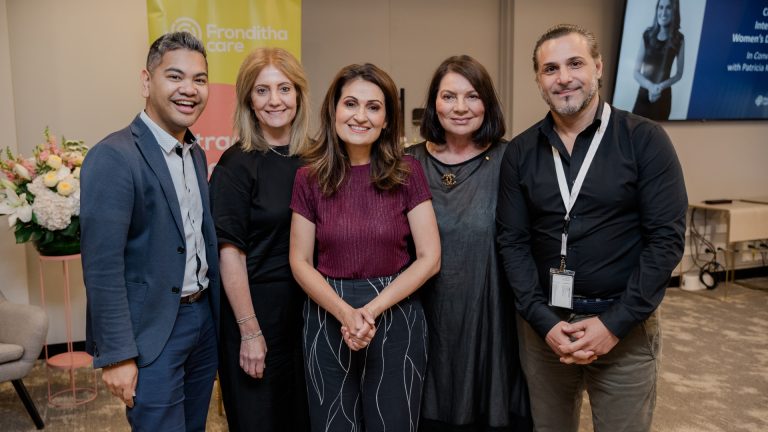
Fronditha Care, a leading provider of aged care services, had acclaimed journalist Patricia Karvelas as its special guest celebrating International Women’s Day 2024.
Faye Spiteri OAM, Fronditha Care CEO, hosted the event with over 60 guests, who were captivated by the hour-long conversation that covered a range of topics from the origins of IWD to the ‘controversy’ over the annual theme of IWD and exploration of the progress made over the years in areas of women’s empowerment and leadership, gender equity, representation and inclusion.
Ms Karvelas, emphasising the significant strides made over the last 100 plus years, shared stories and reflections of her personal and professional journey. She paid homage to the generations of women that came before, who paved the way for the rights and privileges of many women today.
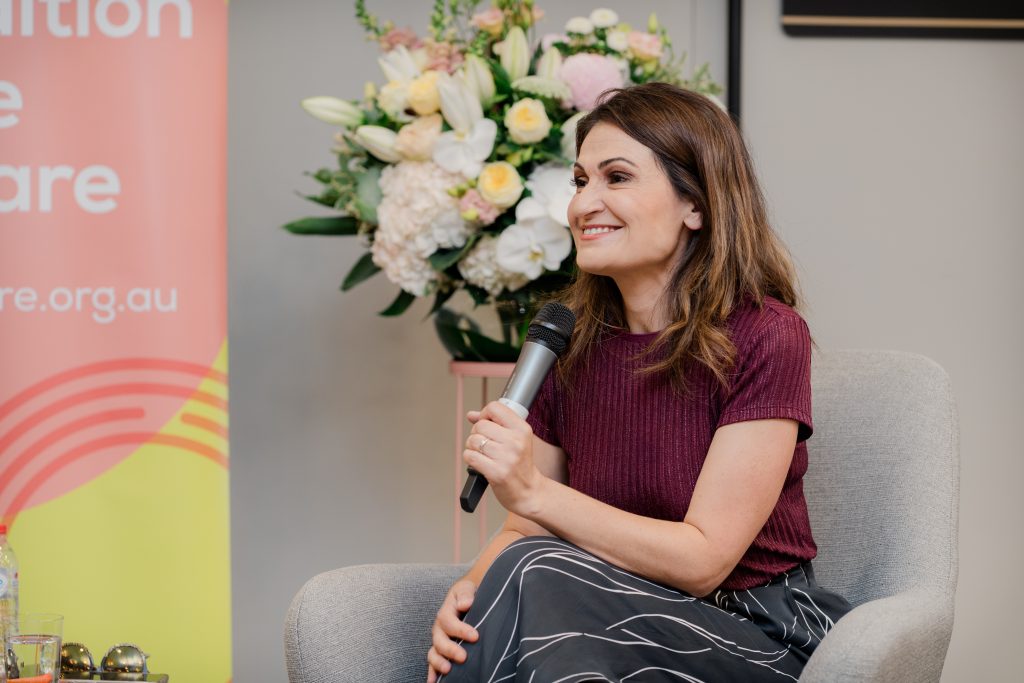
Patricia Karvelas. Photo: Supplied.
“We must never forget the struggles of previous generations, especially the women who grew up under very different conditions and who fought hard against their circumstances for a better society and future. And the challenges and inequality many women especially in areas of conflict across the world are currently facing. We must remember too that no right is guaranteed, and we must continuously fight for our rights because long held women’s rights, as we have witnessed in the USA, can be reversed”, she said.
Discussing the voices of women whose lived experience has been marginalised because of their social class, their sexual orientation or gender identity, disability, their cultural identity, Ms Karvelas recognised the women of migrant and First Nations backgrounds who navigated and overcame desperate conditions alongside societal pressures to rise above the accepted social mores of their time.
Speaking about the recent Workplace Gender Equality Agency (WGEA) report on the Gender Pay Gap data, Ms Karvelas noted its profound implications for societal cohesion and progress.
She articulated the benefits of wage equality, not only as a matter of fairness but also as a catalyst for economic growth and social stability.
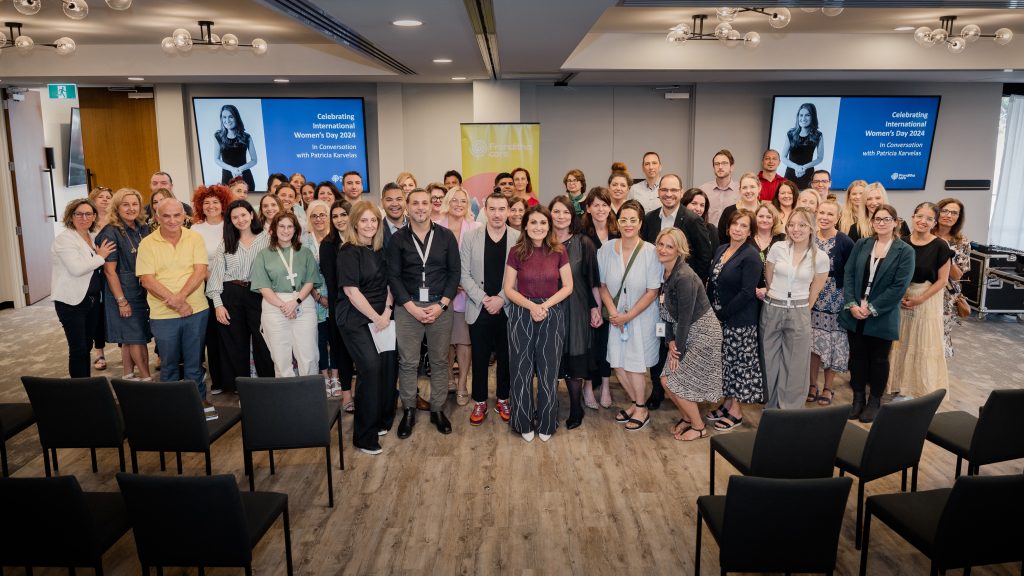
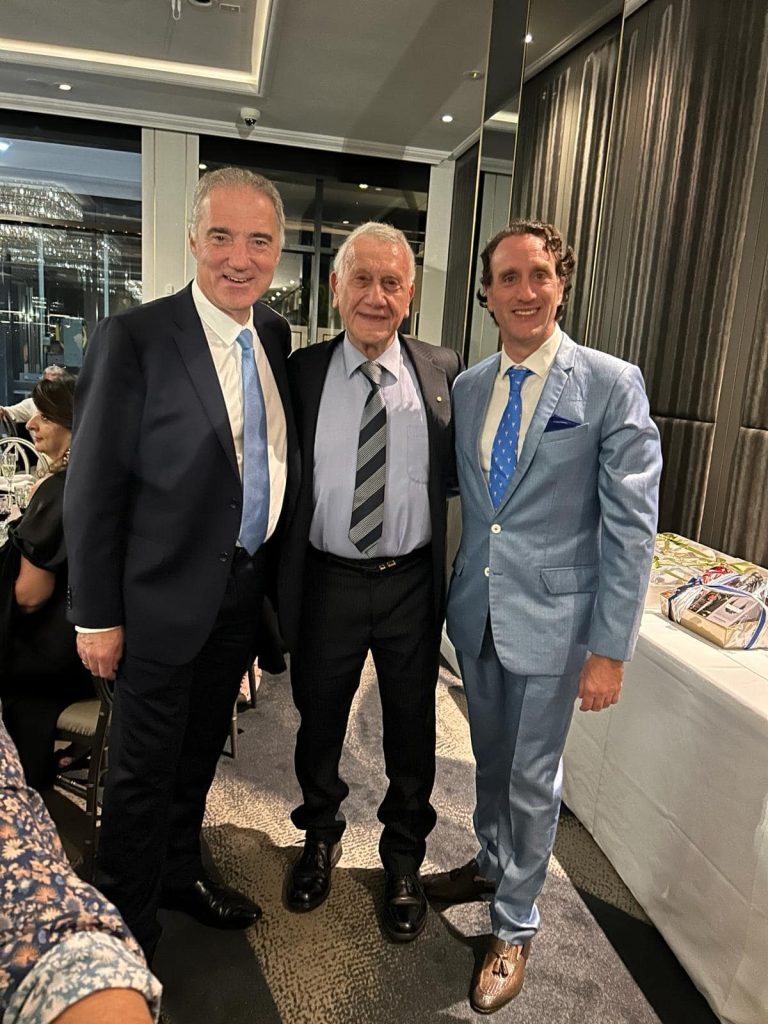
Patricia Karvelas with Fronditha Care team members and other stakeholders. Photo: Supplied.
She emphasised the transformative power of diversity, particularly within organisational contexts and noted how in her observations, inclusive workplace environments foster innovation, creativity and collaboration.
“When you have people women and men from different backgrounds, you have different perspectives and opinions, so you broaden your horizons and this benefits everyone – not just women,” she said.
Ms Karvelas also spoke to her strong connection to her Greek cultural heritage, how her identity was shaped by the indelible influence of her older sister and grandparents who raised her after the loss of her parents at a young age. Ms Karvelas also addressed questions from the audience in relation to her professional journey as a journalist and the future of the media landscape and shared her thoughts on how to gain work life balance.
“It was such a pleasure to have Ms Karvelas with us – her candour, passion and enthusiasm impressed us all. She is a true influencer and her drive, determination and dedication to her profession, her family and community will continue to be a source of encouragement and inspiration for many women and men,” Ms Spiteri said in her closing remarks.
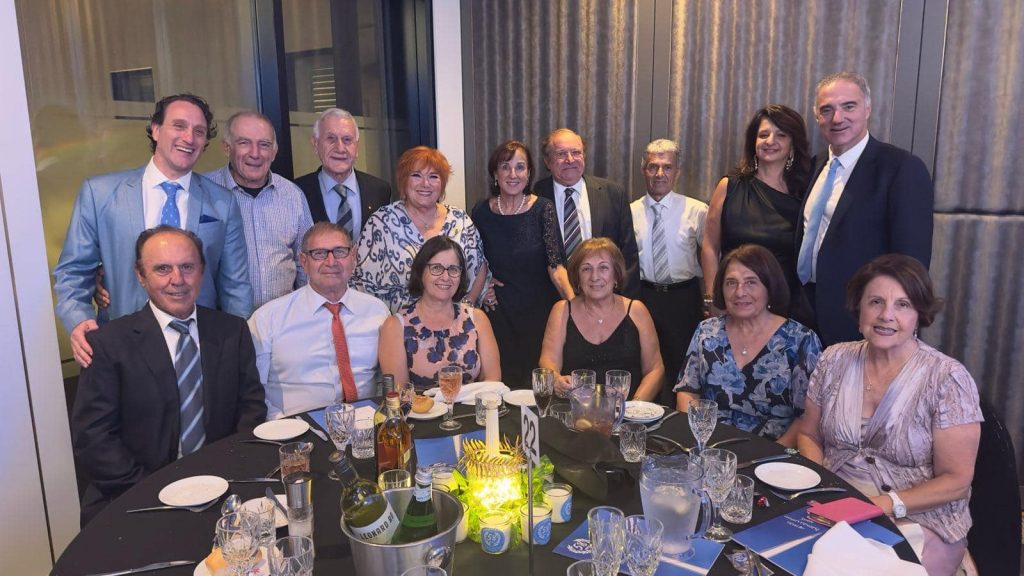
On Friday, March 8, the HellenicSociety of the University of New South Wales (Hellsoc UNSW) marked a special milestone celebrating its 50th anniversary.
Held at Le Montage in Lilyfield, Sydney, past and present members and guests gathered to commemorate the fifty year celebration of the university organisation.
With lots of delicious food and plenty of Greek dancing, the event also featured special presentations and speeches.
Jonathon Cremen, the current president of Hellsoc UNSW congratulated all who attended the Golden Jubilee.
Football Victoria has launched an investigation into an incident of fan violence that forced the abandonment of an NPL match between the Oakleigh Cannons and Dandenong Thunder on Friday night.
Disturbing footage from the match revealed at least one fan being knocked unconscious in the carnage.
After security attempted to control the brawl, police were then called to take over and de-escalate the situation and many fans were then removed from the pitch.
Police reported that three people were left injured following the incident. Photo: The Herald Sun.
It was reported that around 500 people attended the football match, some of which threw items at the police and other people within the area.
The incident took place when the Oakleigh Cannons were leading 2-0. The tensions rose when some of the Dandenong Thunder fans became triggered with the celebration from the Oakleigh striker Stef Valentini in the 42nd minute, which caused the game to be paused.
Referees then attempted to restart the match after a half-time break, but they ceased the match after fans began to come onto the pitch.
Football Victoria has since released a statement following the incident.
“Football Victoria is aware of a serious incident that took place at the Round 5 fixture between Oakleigh Cannons FC and Dandenong Thunder FC,” the statement read.
“FV condemns all forms of anti-social behaviour and violence, in line with FV’s rules of competition and spectator code of behaviour.
“FV has contacted both clubs, who join FV in condemning the behaviour and will fully co-operate with the investigation. FV is engaging with all relevant stakeholders to collect detail on the incident. FV will share further detail on sanctions in due course.”
Information provided by Victoria Police further revealed that three people involved in this brawl were reported injured, however did not need to be hospitalised.
“The exact circumstances surrounding the incident are being investigated, but no one has made a police report at this stage,” a police spokesperson said.
Greece’s Alternate Interior Minister, Theodoros Livanios, will be in Australia from March 21 this year to meet with the Greek communities in Melbourne and Sydney.
“Being the first time visiting Australia, I am thrilled and looking forward to meeting with the Greek Australian community, one of the largest groups of the global Greek diaspora…” Mr Livanios said in his statement.
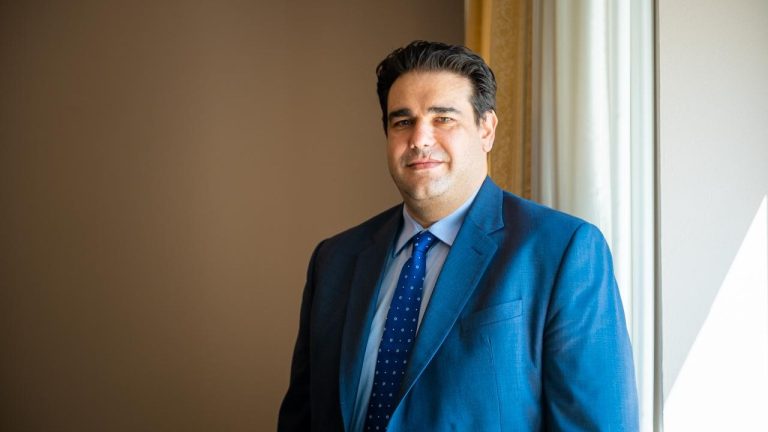
Theodoros Livanios.
The Minister also said that during his visit, he wants to hear from the Greeks in Australia how bonds between Greece and the diaspora can be strengthened.
“Bearing in mind that Greeks all over the world, especially the ones who live thousand miles away from the motherland, like you, face a particular difficulty when willing to vote, we recently enacted the law allowing postal voting for the European elections as well as the referendums. We are therefore happy to share with the Greek Australians details on how to register in the epistoliki.ypes.gov.gr platform to vote at the forthcoming European elections in June,” Mr Livanios said.
“Of course, hearing back from all of you about ways that could facilitate and strengthen the bonds between Greece and the Greek diaspora is, and has always been, a main concern for our government.”
The 47-year-old politician will visit Melbourne from March 21 – 23 and Sydney from March 24 – 27.
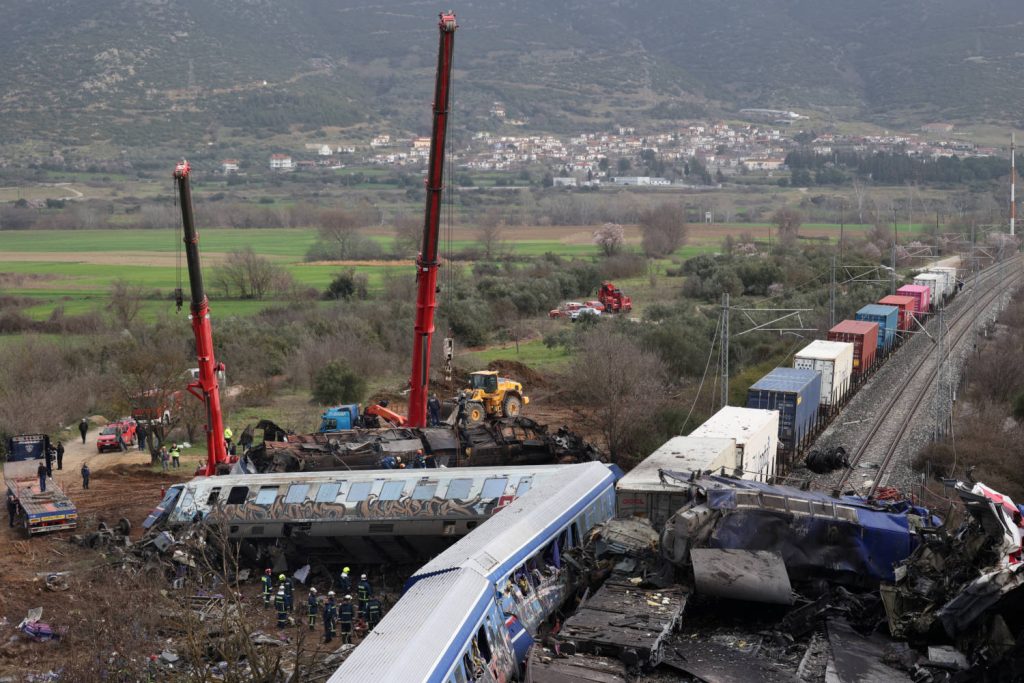
Greece’s political landscape is ablaze with debate and accusations following the Tempi train crash, the nation’s deadliest rail incident on record.
With 57 lives lost and many more injured in the February 2023 collision, both the ruling New Democracy (ND) party and the main opposition SYRIZA have presented their findings to the Investigative Committee of Parliament.
ND’s parliamentary majority has submitted a report on Sunday, pointing fingers at violations of the General Railway Regulation, highlighting seven instances where adherence to these regulations could have prevented the catastrophic accident.
57 people lost their lives in the Tempi train collision. Photo: In Cyprus.
Witnesses corroborated these claims, emphasising the importance of following established safety protocols. The report also aims to dispel any notions of a cover-up, stressing transparency in operational decisions made post-accident. Meanwhile, a separate judicial inquiry is already underway.
On the other hand, members of the SYRIZA party within the parliamentary committee investigating the Tempi tragedy have directed blame at the former ND political leadership of the Transport Ministry. They allege a government cover-up and argue that implementing Convention 717, which mandates upgrades to the signalling and remote control systems in Greece’s railway network, could have averted the disaster.
SYRIZA representatives demand accountability, accusing former ministers of neglecting safety standards and potentially being culpable for manslaughter.
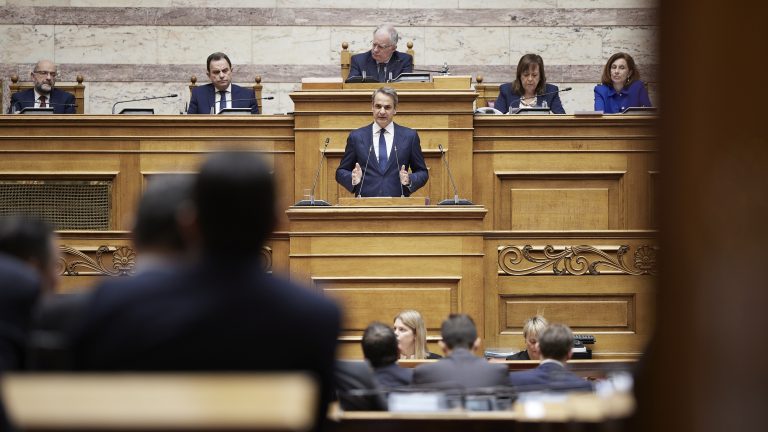
The Greek parliament has approved a bill paving the way for the establishment of private universities in the country.
The legislation, titled ‘Reinforcing State Universities – Framework for the operation of non-profit branches of foreign universities,’ secured majority support in a late-night session on Friday, largely backed by the ruling New Democracy party.
Despite the government’s assertion of a transformative shift in the educational landscape, the bill faced staunch opposition from all other political parties. Prime Minister Kyriakos Mitsotakis championed the move as a radical reform, while critics expressed concerns over the potential erosion of state universities.
Το θεμέλιο αυτής της μεταρρύθμισης είναι η ανάταξη και η ενίσχυση του δημόσιου πανεπιστημίου, με σκοπό να απελευθερωθεί από την αγκύλωση της γραφειοκρατίας και της ιδεοληψίας. Γι’ αυτό το 85% των άρθρων του νομοσχεδίου αναφέρεται στο δημόσιο πανεπιστήμιο. #Βουλήpic.twitter.com/js8liusyk5
— Prime Minister GR (@PrimeministerGR) March 8, 2024
In a heated three-day debate preceding the vote, opposition voices warned against the perceived threat posed by private institutions to the traditional public university system.
During the decisive vote, a total of 299 members of parliament participated. The bill’s principles were endorsed by 159 MPs, predominantly from the New Democracy party, along with an independent MP, X. Katsivardas. However, 129 lawmakers voted against the bill, with 11 abstaining by declaring themselves ‘present.’
The passage of this legislation marks a significant shift in Greek education policy, stirring both hope and apprehension within the academic community and the broader public.
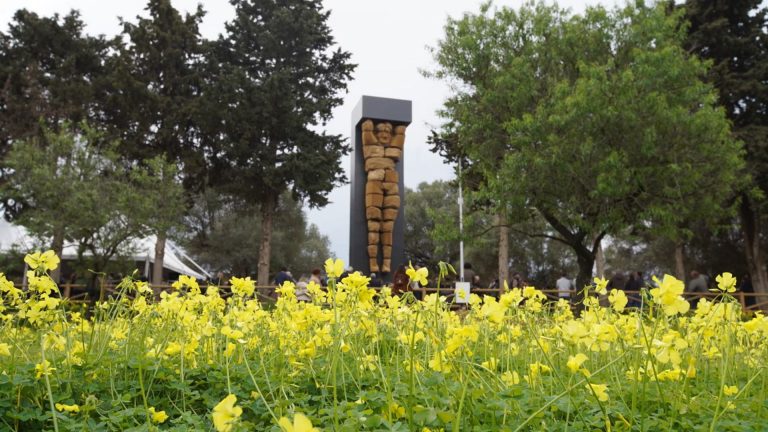
A monumental restoration project spanning two decades led to the resurrection of an ancient marvel: a colossal Atlas statue dating back to the fifth century BC, now proudly displayed in the Valley of the Temples in Sicily’s Agrigento.
Once buried among the ruins of the Temple of Zeus, this eight-meter-tall figure, one of nearly 38 adorning the temple, now stands tall as a testament to ancient craftsmanship and mythology.
According to the guardian, the statues were discovered in 1812 by Charles R Cockerell, a young British architect who was visiting Agrigento to study the ruins of the ancient city of Akragas, founded in about 582BC.
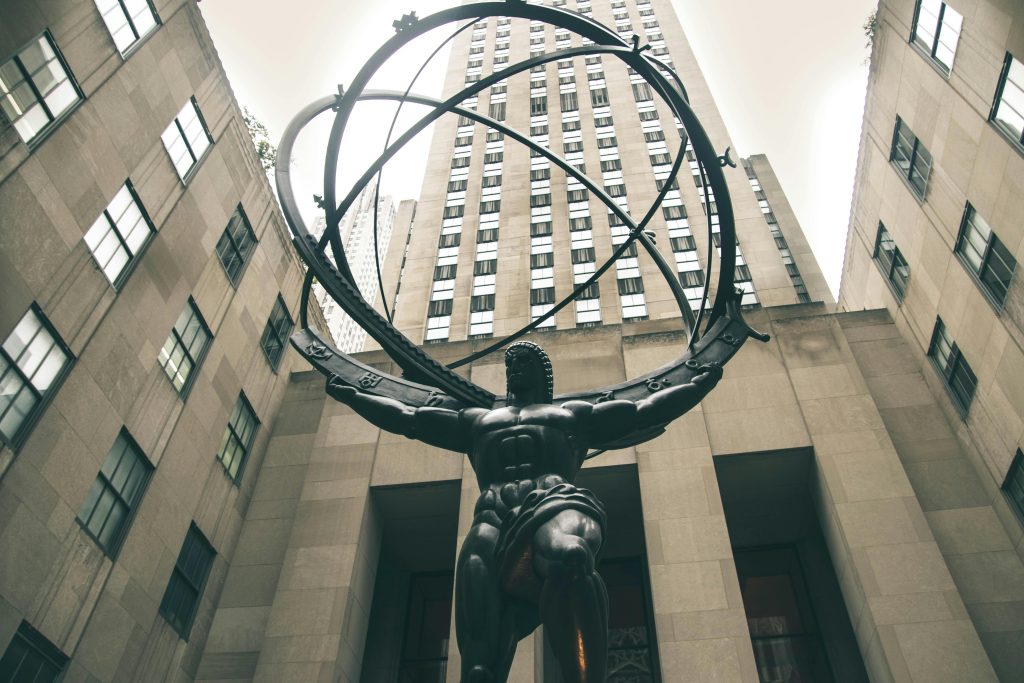
In Greek mythology, Atlas was a Titan or god, who was forced to bear the sky on his shoulders after being defeated by Zeus, one of the next generation of gods called Olympians.
Photo: Paula Nardini
In 1920, the archaeologist Pirro Marconi unearthed various artefacts that led to the reconstruction of the first Atlas, which is preserved inside the Archaeological Museum of Agrigento.
The reconstruction process involved stacking blocks of sandstone meticulously, utilizing a metal structure to ensure stability. This meticulous effort, overseen by the German Archaeological Institute of Rome, resulted in not only the resurrection of the Atlas but also the cataloging of fragments from at least eight others.
In 2004, the Valley of the Temples park launched an extensive research campaign led by the German Archaeological Institute of Rome and overseen by Heinz-Jürgen Beste.
The study led to the meticulous cataloguing of 90 more fragments linked to at least eight distinct Atlases. Consequently, the decision was made to reconstruct a new Atlas, assembling it methodically, fragment by fragment, and positioning it proudly in front of the Temple of Zeus.
In a bid to counteract the proliferation of misinformation about the nation, the ministries of Foreign Affairs and Digital Governance in Greece are reportedly planning to introduce a new digital platform which will use AI technology.
According to ekathimerini.com, the platform will aim to pinpoint false narratives that undermine the country’s interests and take necessary measures to refute it.
What is different is that the AI to be deployed not only recognizes keywords, as it did with older forms of technology, but now perceives entire meanings. This way it will be able to check the veracity of information in a more comprehensive manner.
Photo: Lex Photography
Moreover, the government also plans to upgrade the studies at the Hellenic Diplomatic Academy, with the inclusion of technology content.
For this reason, presentations will be held at the academy regarding the use of social media and their tools, such as the ability to address a targeted audience, so embassies can communicate news and useful information to a specific target group.
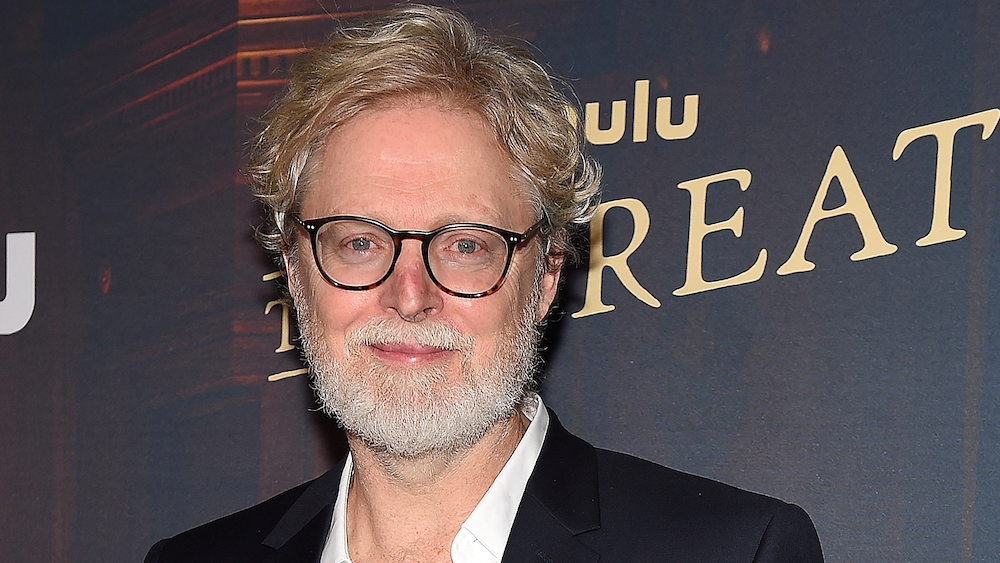
An Australian screenwriter, Tony McNamara, is behind the script for Poor Things, the latest Yorgos Lanthimos movie which has broken the $100-million-box-office milestone.
According to ABC, he didn’t anticipate the widespread appeal of “Poor Things,” despite his own admiration for the project.
As anticipation builds for the 2023 Academy Awards, “Poor Things” is nominated for Best Adapted Screenplay among 10 other categories.
Ranked as the fourth-highest-grossing nominee for Best Picture, trailing behind “Barbie,” “Oppenheimer,” and “Killers of the Flower Moon,” McNamara notes the achievement is even more significant considering the film’s $35 million budget.
“Poor Things” marks McNamara’s second collaboration with director Yorgos Lanthimos, known for their previous work on the dark comedy “The Favourite”.
“I’d worked with Yorgos before, so I knew he’s brave,” McNamara said to ABC.
“He just wants to make something unique. I loved working with him and he was keen to do it again. But it was really Bella Baxter’s character [that drew me in].”
Photo: Frank Micelotta/Hulu/PictureGroup
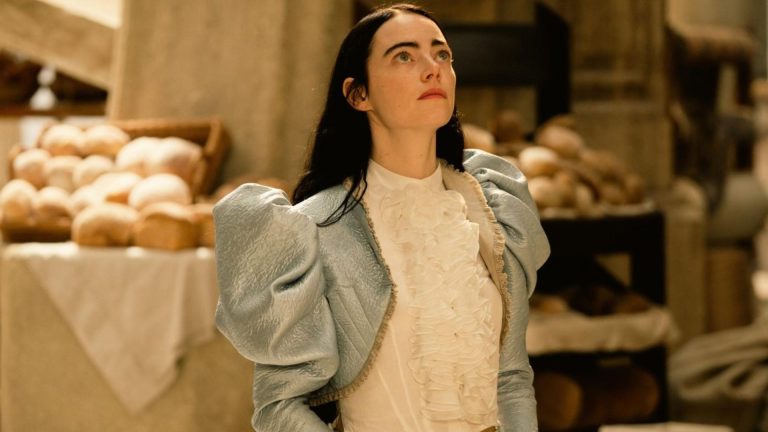
Adapted from Alasdair Gray’s 1992 novel of the same name, Poor Things follows Bella Baxter (Emma Stone), a fully grown woman born in Victorian London from a Frankenstein-esque experiment by oddball surgeon Godwin Baxter (Willem Dafoe).
Across the film, Bella learns to be human: To walk, talk and think, as well as discover the pleasures of living — from Portuguese tarts, to philosophy, to “furious jumping” (her term for sex).
McNamara’s themes such as coming-of-age and control are evident not only in “Poor Things” and “The Favourite” but also in his involvement in the Disney villain origin film “Cruella,” starring Emma Stone.
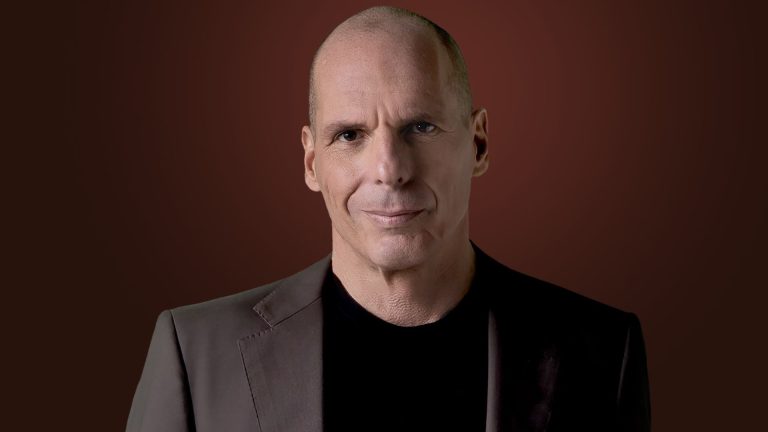
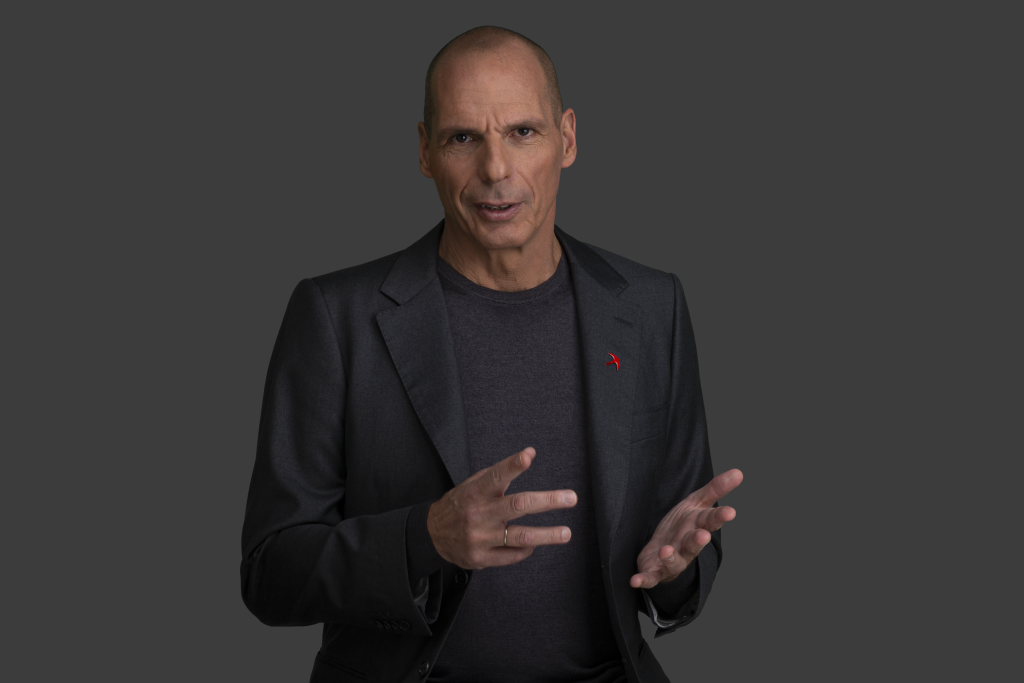
Yanis Varoufakis speaks exclusively to The Greek Herald shortly before his lecture at the University of Sydney on the occasion of the publication of his new book through which he explains why techno-feudalism is the biggest threat to democracy.
By Panagiotis Dalatariof
Yanis Varoufakis has returned to Australia this year and to the University of Sydney, accepting the invitation from his old haunts to deliver a lecture to the students of the department where he was a professor (he taught economic theory and political philosophy until 2000).
The founder of MeRA25 spoke to The Greek Herald about his impatience to be back in the classrooms where he was a professor, referred to the postal vote for the Greek diaspora, while also commenting on Green Senator Nick McKim’s proposal to nominate him for next chief of Australia’s Central Bank.
In your book it says that capitalism is dead. Some of your intellectual adversaries will claim that capitalism, however, has the stubborn ability to consistently appear.
You remind me of the advice given by the great Scottish philosopher David Hume to prevent this kind of argument: ‘The goose that thinks it will never be eaten because it has been fed every day is surprised when one day its head is cut off.’ So we too today would be wrong to think that capitalism is immortal because it has survived so far for almost three centuries overcoming a thousand crises.
Yanis Varoufakis
What makes you think capitalism is no longer relevant?
It is not a matter of relevance but of the two foundational pillars on which it rests – pillars that have been toppled without us noticing. Which pillars? Markets and profit. These were the two foundations of capitalism. Markets, the medium through which the most important commodities (from food and machinery to labour) were traded, and profit, the fuel that drove capitalism. What broke them? A mutation of capital (which I call cloud capital) that – like a mutation of a virus into something more toxic that kills the organism in which it lives – killed capitalism and replaced markets with digital platforms (e.g. amazon.com or alibaba.com) and profit with a form of rent (cloud rent).
How would you describe ‘technofeudalism’ as described in your book?
Let’s take for example the moment you enter amazon.com. At that moment you are out of capitalism. Why am I saying this? Isn’t it another market, albeit a digital one? No, it is not. Yes, inexperienced buyers and sellers crowd in there. Yes, Amazon is a trading platform. But, no, it’s not a market. Yes, it belongs to a man named Jeff. But, no, it’s not a monopoly. It is much, much more than a monopoly market.
Jeff does not own the factories that make the products you buy on his platform. He owns something much more important: The algorithm that is trained to know you perfectly, so that it “pairs” you with a seller, whom it also knows perfectly, in order to maximise the probability that each such “pairing”, each such transaction, will yield, for Jeff, the highest annuity he can charge the seller for what you’re buying. Up to 40 per cent of the price you pay is pocketed by Jeff.
So the same algorithm we help train in real time to know us inside and out, this same algorithm modifies our preferences and manages the selection and delivery of merchandise that will satisfy those preferences.
Consider this: If you and I type in “electric bikes” or “binoculars” while on amazon.com, you and I will get completely different recommendations. In a traditional market, in a mall, it would be like walking side by side, with our eyes pointing in the same direction, at the same window, but seeing different things depending on what Jeff’s algorithm wants us to see.
As you browse amazon.com, you are in algorithmically constructed isolation where, unable to see each other, we only see the algorithm that sees everything. In fact, we only see what Jeff’s algorithm allows us to see in order to maximise his cloud rent – today’s version of the land rent that feudal lords extracted from their vassals and colleagues.
This is not capitalism. Welcome to technofeudalism!
Yanis Varoufakis
Why do you consider it as the biggest threat to democracy?
Let’s remember Aristotle’s definition according to which a democracy is a regime where the poor decide, as the poor make up the majority of any society. In a techno-feudal society, where internationally a dozen techno-feudal lords own not only enormous wealth (greater than the combined market value of all the companies in Australia, Canada, Britain, France, Japan and China) but also the algorithms where they make huge profits by poisoning public debate (eg, X, Facebook, Instagram, etc), democracy is less possible than it was in Medieval Europe.
How does it feel to be in Australia where you have lived and taught as a Professor of Political Economy at the University of Sydney?
It is the first time since 1988, when I immigrated to Australia escaping Britain, that I have been away for so long. In fact, the last time I was in Australia was a few days before the lockdown in February 2020. So, it’s no secret that I can’t wait to set foot on Australian soil again. And since you’re referring to the University of Sydney, I’ve just been delighted to be invited back to the old stomping grounds to deliver a lecture to the students of my old department – but it will be open to the general public (on Monday 11th March at 10am).
Do you have an opinion on the centre-left Albanese government that succeeded Scott Morrison’s Liberal Party?
It’s a better government, but that wasn’t too difficult to achieve.
How does Mera25 judge/comment on postal voting for the Greek diaspora?
In MeRA25 we demand that expatriates have the right, without exception, not only to vote but also to be elected. The postal vote gives the possibility to vote but not to choose their own people to represent our communities in the Hellenic Parliament. This is unacceptable. You should not be forced to vote for the candidates in Patras for example, when you live in Melbourne or Hobart.
For this reason, as of 2019, MeRA25 submitted a Law Proposal that would essentially restore the right of expatriates both to vote and to be elected. How? By creating overseas constituencies – for example, South East Australia – with full equivalence of seats and registered people both inside and outside of Greece. Unfortunately, none of the other parties voted for it because they are afraid of homogeneity – because they want you voters but not co-formators of the collective decisions of Hellenism.
Regarding the postal vote, MeRA25 insists on paper voting at the ballot box. For two reasons: First, without a screen, the privacy of the vote is removed (eg: someone can demand to see what you’re voting on, which is not possible at a polling station). Secondly, the argument that many expats are not close to a Consulate to vote is bogus as MeRA25 proposed that polling stations should also be set up in communities, churches and even parish cafes – something that would energise our communities across Australia.
What about the influence of the Indigenous Australians?
Not interested. Really! Having lived for twelve years in Australia, having listened to the pain of my fellow citizens for the way they are treated and exploited by the Greek political system, I am interested in one thing: that you are finally given your political rights. If you then decide that MeRA25 deserves your vote, that would be a welcome bonus for me – nothing more.
The fight for the release of Julian Assange continues, while the suspense over his extradition to the USA is prolonged.
Julian is a personal friend of mine, and so his slow assassination, which is being deliberately carried out today by the British and American states (with the perennial complicity of the Australian state), touches me personally, not just politically. His only “crime” is exposing crimes committed by our governments in our name. His ongoing torture has one goal: To intimidate you, and every journalist, into self-censoring if you come across evidence of our rulers’ crimes against humanity.
How optimistic are you about this case and are you satisfied with the efforts of the Australian government?
I’m not optimistic at all. British judges have time and again proven themselves to be inferior to the circumstances. As for the Australian government, Prime Minister Albanese’s promise to pressure US President Joe Biden to end Julian’s prosecution has proved empty. If he wanted to, he could easily make Julian’s release a condition of continuing the… AUKUS deal, which funnels many billions into US coffers. He chose not to.
Senator Nick McKim had nominated you for the role of chief at Australia’s Central Bank. How did you take this prospect and, would it be a challenge you would be interested in?
I am honoured by the Senator’s proposal and I thank him for it. Although central banking matters interest me deeply, and I follow them closely, the position of Central Banker is not for me. That’s because, once you take up such a position, you have a moral and professional obligation not to communicate the truth to the world – or at least, to borrow Malcolm Turnbull’s expression, to “save the truth” – which I neither can nor do.