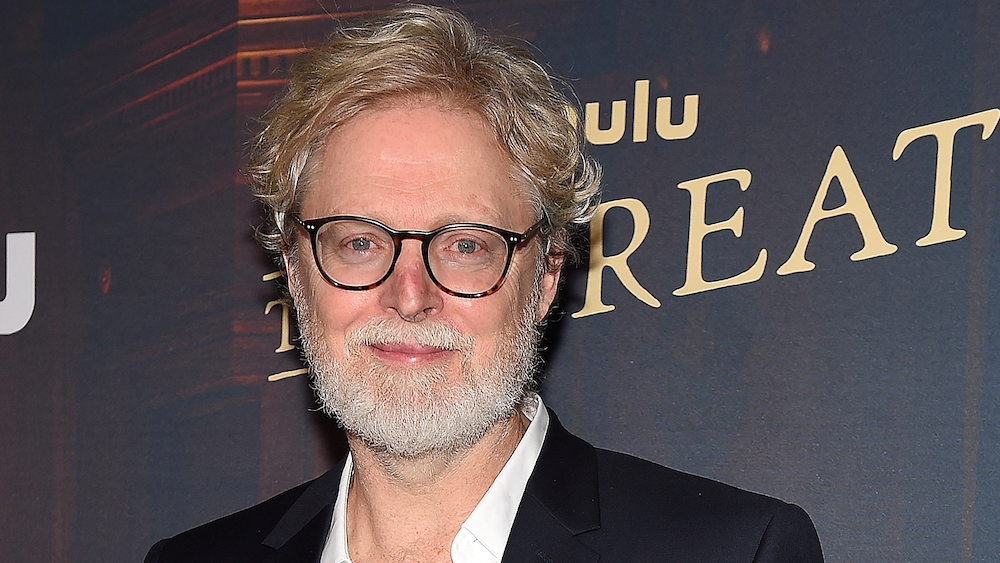
An Australian screenwriter, Tony McNamara, is behind the script for Poor Things, the latest Yorgos Lanthimos movie which has broken the $100-million-box-office milestone.
According to ABC, he didn’t anticipate the widespread appeal of “Poor Things,” despite his own admiration for the project.
As anticipation builds for the 2023 Academy Awards, “Poor Things” is nominated for Best Adapted Screenplay among 10 other categories.
Ranked as the fourth-highest-grossing nominee for Best Picture, trailing behind “Barbie,” “Oppenheimer,” and “Killers of the Flower Moon,” McNamara notes the achievement is even more significant considering the film’s $35 million budget.
“Poor Things” marks McNamara’s second collaboration with director Yorgos Lanthimos, known for their previous work on the dark comedy “The Favourite”.
“I’d worked with Yorgos before, so I knew he’s brave,” McNamara said to ABC.
“He just wants to make something unique. I loved working with him and he was keen to do it again. But it was really Bella Baxter’s character [that drew me in].”
Photo: Frank Micelotta/Hulu/PictureGroup
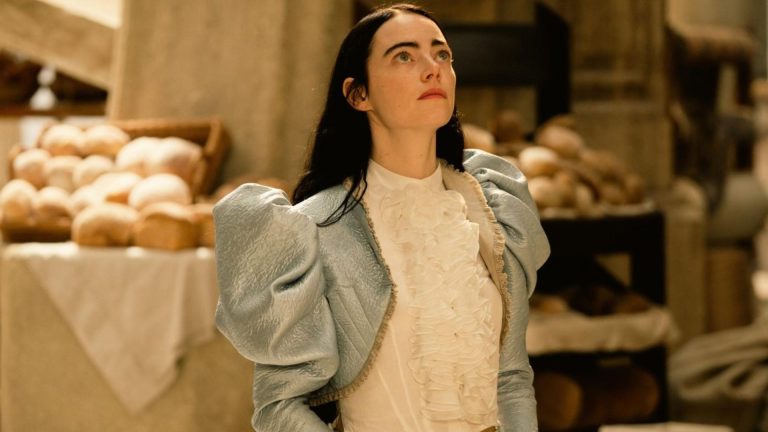
Adapted from Alasdair Gray’s 1992 novel of the same name, Poor Things follows Bella Baxter (Emma Stone), a fully grown woman born in Victorian London from a Frankenstein-esque experiment by oddball surgeon Godwin Baxter (Willem Dafoe).
Across the film, Bella learns to be human: To walk, talk and think, as well as discover the pleasures of living — from Portuguese tarts, to philosophy, to “furious jumping” (her term for sex).
McNamara’s themes such as coming-of-age and control are evident not only in “Poor Things” and “The Favourite” but also in his involvement in the Disney villain origin film “Cruella,” starring Emma Stone.
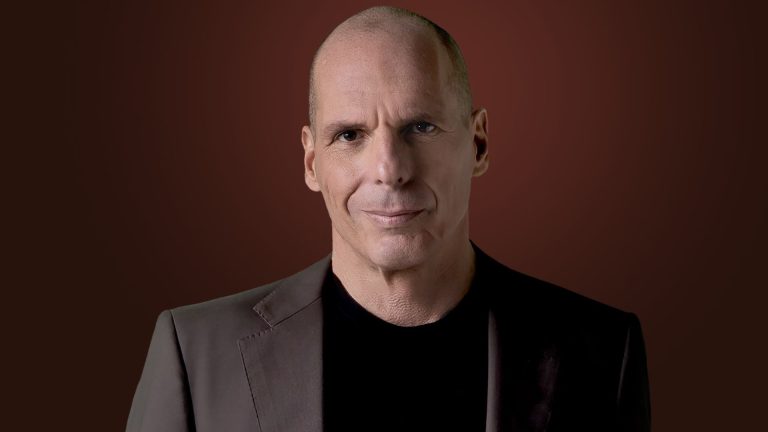
Yanis Varoufakis speaks exclusively to The Greek Herald shortly before his lecture at the University of Sydney on the occasion of the publication of his new book through which he explains why techno-feudalism is the biggest threat to democracy.
By Panagiotis Dalatariof
Yanis Varoufakis has returned to Australia this year and to the University of Sydney, accepting the invitation from his old haunts to deliver a lecture to the students of the department where he was a professor (he taught economic theory and political philosophy until 2000).
The founder of MeRA25 spoke to The Greek Herald about his impatience to be back in the classrooms where he was a professor, referred to the postal vote for the Greek diaspora, while also commenting on Green Senator Nick McKim’s proposal to nominate him for next chief of Australia’s Central Bank.
In your book it says that capitalism is dead. Some of your intellectual adversaries will claim that capitalism, however, has the stubborn ability to consistently appear.
You remind me of the advice given by the great Scottish philosopher David Hume to prevent this kind of argument: ‘The goose that thinks it will never be eaten because it has been fed every day is surprised when one day its head is cut off.’ So we too today would be wrong to think that capitalism is immortal because it has survived so far for almost three centuries overcoming a thousand crises.
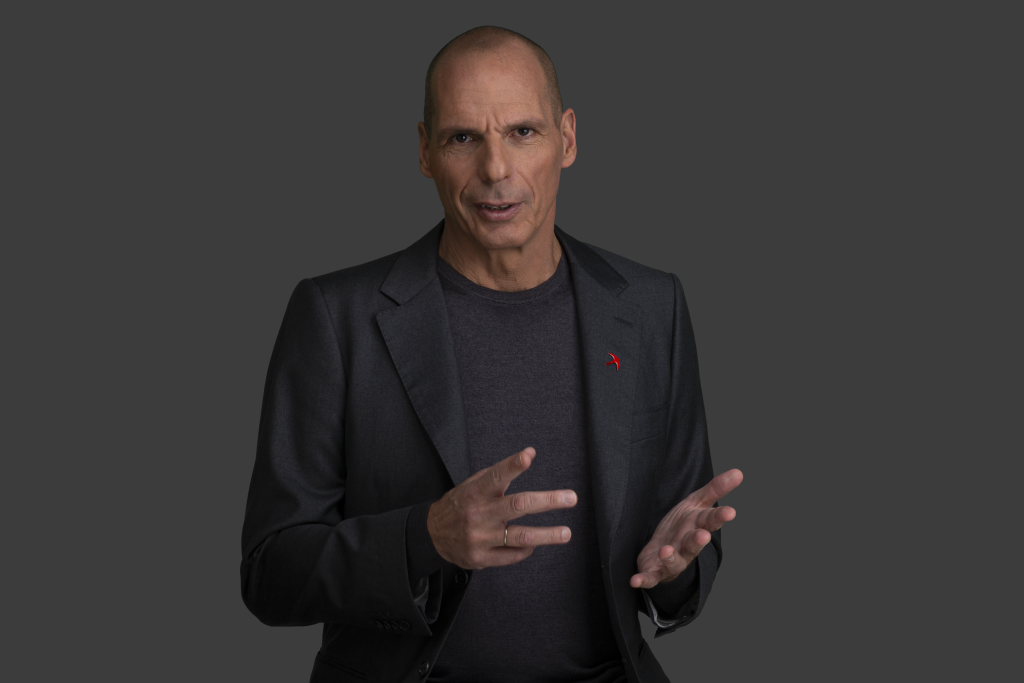
Yanis Varoufakis
What makes you think capitalism is no longer relevant?
It is not a matter of relevance but of the two foundational pillars on which it rests – pillars that have been toppled without us noticing. Which pillars? Markets and profit. These were the two foundations of capitalism. Markets, the medium through which the most important commodities (from food and machinery to labour) were traded, and profit, the fuel that drove capitalism. What broke them? A mutation of capital (which I call cloud capital) that – like a mutation of a virus into something more toxic that kills the organism in which it lives – killed capitalism and replaced markets with digital platforms (e.g. amazon.com or alibaba.com) and profit with a form of rent (cloud rent).
How would you describe ‘technofeudalism’ as described in your book?
Let’s take for example the moment you enter amazon.com. At that moment you are out of capitalism. Why am I saying this? Isn’t it another market, albeit a digital one? No, it is not. Yes, inexperienced buyers and sellers crowd in there. Yes, Amazon is a trading platform. But, no, it’s not a market. Yes, it belongs to a man named Jeff. But, no, it’s not a monopoly. It is much, much more than a monopoly market.
Jeff does not own the factories that make the products you buy on his platform. He owns something much more important: The algorithm that is trained to know you perfectly, so that it “pairs” you with a seller, whom it also knows perfectly, in order to maximise the probability that each such “pairing”, each such transaction, will yield, for Jeff, the highest annuity he can charge the seller for what you’re buying. Up to 40 per cent of the price you pay is pocketed by Jeff.
So the same algorithm we help train in real time to know us inside and out, this same algorithm modifies our preferences and manages the selection and delivery of merchandise that will satisfy those preferences.
Consider this: If you and I type in “electric bikes” or “binoculars” while on amazon.com, you and I will get completely different recommendations. In a traditional market, in a mall, it would be like walking side by side, with our eyes pointing in the same direction, at the same window, but seeing different things depending on what Jeff’s algorithm wants us to see.
As you browse amazon.com, you are in algorithmically constructed isolation where, unable to see each other, we only see the algorithm that sees everything. In fact, we only see what Jeff’s algorithm allows us to see in order to maximise his cloud rent – today’s version of the land rent that feudal lords extracted from their vassals and colleagues.
This is not capitalism. Welcome to technofeudalism!
Yanis Varoufakis
Why do you consider it as the biggest threat to democracy?
Let’s remember Aristotle’s definition according to which a democracy is a regime where the poor decide, as the poor make up the majority of any society. In a techno-feudal society, where internationally a dozen techno-feudal lords own not only enormous wealth (greater than the combined market value of all the companies in Australia, Canada, Britain, France, Japan and China) but also the algorithms where they make huge profits by poisoning public debate (eg, X, Facebook, Instagram, etc), democracy is less possible than it was in Medieval Europe.
How does it feel to be in Australia where you have lived and taught as a Professor of Political Economy at the University of Sydney?
It is the first time since 1988, when I immigrated to Australia escaping Britain, that I have been away for so long. In fact, the last time I was in Australia was a few days before the lockdown in February 2020. So, it’s no secret that I can’t wait to set foot on Australian soil again. And since you’re referring to the University of Sydney, I’ve just been delighted to be invited back to the old stomping grounds to deliver a lecture to the students of my old department – but it will be open to the general public (on Monday 11th March at 10am).
Do you have an opinion on the centre-left Albanese government that succeeded Scott Morrison’s Liberal Party?
It’s a better government, but that wasn’t too difficult to achieve.
How does Mera25 judge/comment on postal voting for the Greek diaspora?
In MeRA25 we demand that expatriates have the right, without exception, not only to vote but also to be elected. The postal vote gives the possibility to vote but not to choose their own people to represent our communities in the Hellenic Parliament. This is unacceptable. You should not be forced to vote for the candidates in Patras for example, when you live in Melbourne or Hobart.
For this reason, as of 2019, MeRA25 submitted a Law Proposal that would essentially restore the right of expatriates both to vote and to be elected. How? By creating overseas constituencies – for example, South East Australia – with full equivalence of seats and registered people both inside and outside of Greece. Unfortunately, none of the other parties voted for it because they are afraid of homogeneity – because they want you voters but not co-formators of the collective decisions of Hellenism.
Regarding the postal vote, MeRA25 insists on paper voting at the ballot box. For two reasons: First, without a screen, the privacy of the vote is removed (eg: someone can demand to see what you’re voting on, which is not possible at a polling station). Secondly, the argument that many expats are not close to a Consulate to vote is bogus as MeRA25 proposed that polling stations should also be set up in communities, churches and even parish cafes – something that would energise our communities across Australia.
What about the influence of the Indigenous Australians?
Not interested. Really! Having lived for twelve years in Australia, having listened to the pain of my fellow citizens for the way they are treated and exploited by the Greek political system, I am interested in one thing: that you are finally given your political rights. If you then decide that MeRA25 deserves your vote, that would be a welcome bonus for me – nothing more.
The fight for the release of Julian Assange continues, while the suspense over his extradition to the USA is prolonged.
Julian is a personal friend of mine, and so his slow assassination, which is being deliberately carried out today by the British and American states (with the perennial complicity of the Australian state), touches me personally, not just politically. His only “crime” is exposing crimes committed by our governments in our name. His ongoing torture has one goal: To intimidate you, and every journalist, into self-censoring if you come across evidence of our rulers’ crimes against humanity.
How optimistic are you about this case and are you satisfied with the efforts of the Australian government?
I’m not optimistic at all. British judges have time and again proven themselves to be inferior to the circumstances. As for the Australian government, Prime Minister Albanese’s promise to pressure US President Joe Biden to end Julian’s prosecution has proved empty. If he wanted to, he could easily make Julian’s release a condition of continuing the… AUKUS deal, which funnels many billions into US coffers. He chose not to.
Senator Nick McKim had nominated you for the role of chief at Australia’s Central Bank. How did you take this prospect and, would it be a challenge you would be interested in?
I am honoured by the Senator’s proposal and I thank him for it. Although central banking matters interest me deeply, and I follow them closely, the position of Central Banker is not for me. That’s because, once you take up such a position, you have a moral and professional obligation not to communicate the truth to the world – or at least, to borrow Malcolm Turnbull’s expression, to “save the truth” – which I neither can nor do.
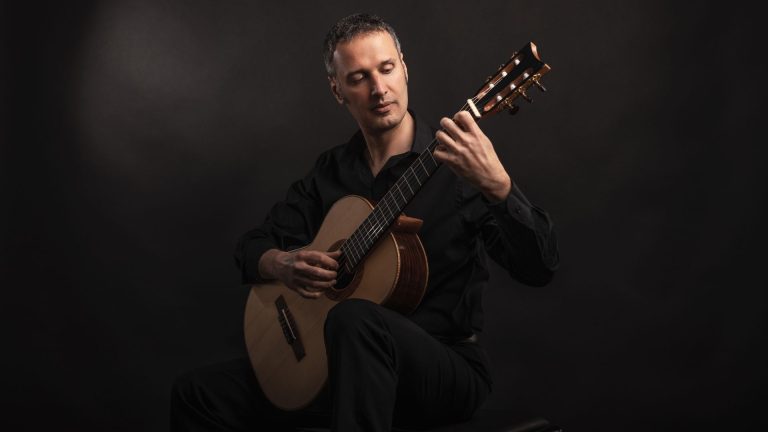
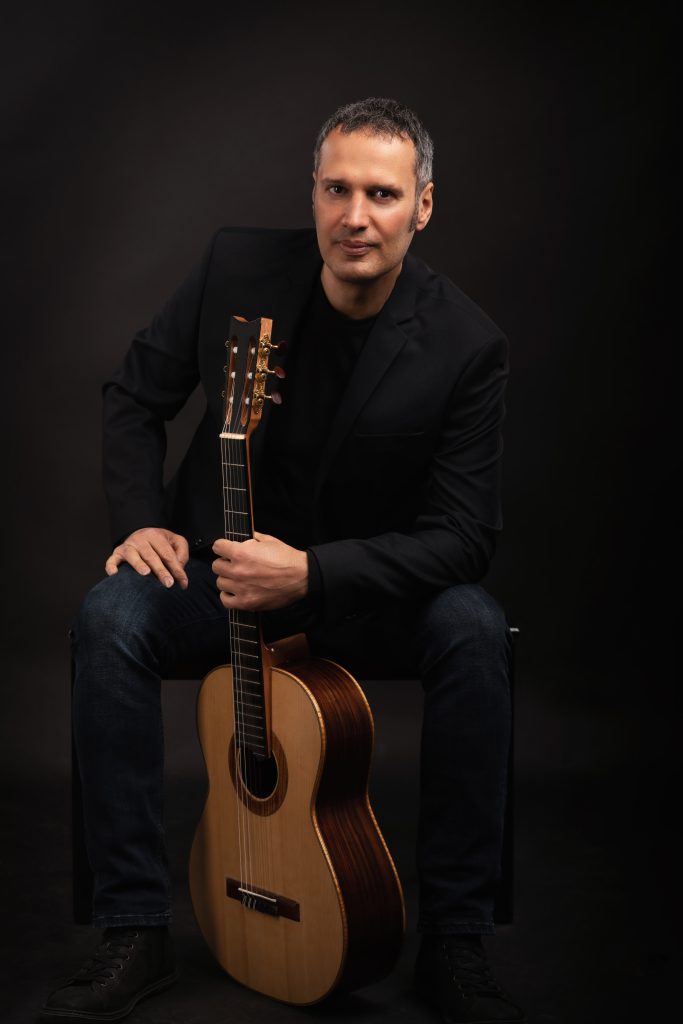
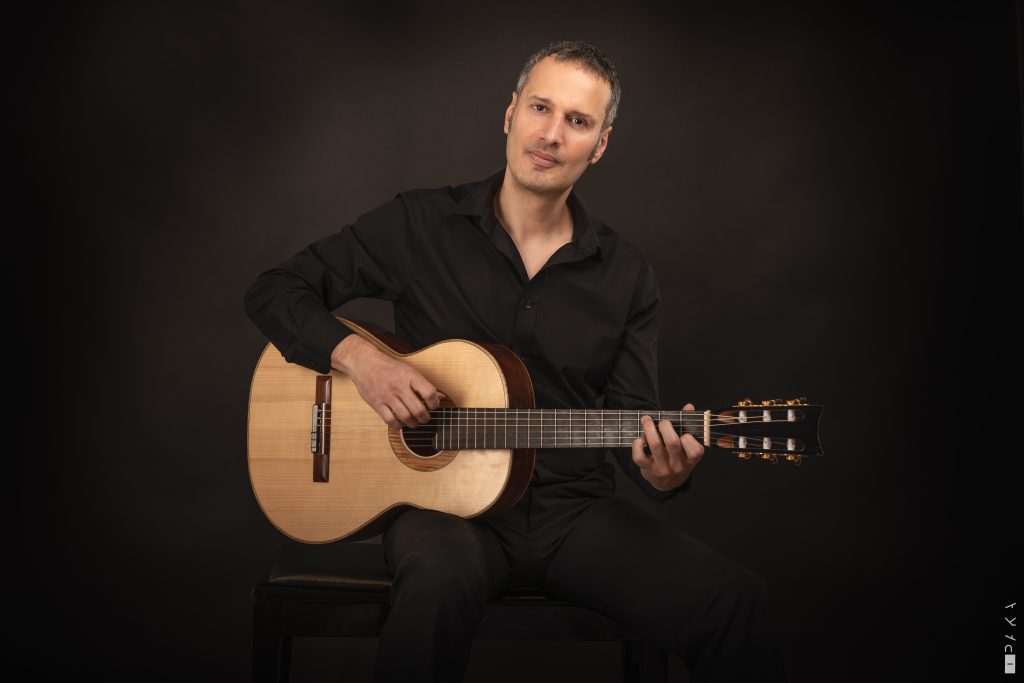
When you read his biography, you can’t not be impressed. A multifaceted musical personality, a young man who has managed to work with musicians that others would simply dream of, Manolis Androulidakis boasts that he has achieved a lot so far in his career in music, but his dreams continue and he aims for more in the future.
He studied guitar, Musicology and composition at the Aristotle University of Thessaloniki. He taught for three years at the Department of Music Studies at the Aristotle University and one year at the Department of Folk and Traditional Music of the Technical Educational Institute of Εpirus.
As a composer, guitarist and conductor, he has collaborated with composers such as the one and only Mikis Theodorakis (among others he conducted the honorary concert for his 90 years at the Petra Theatre) and many more. Maria Dimitriadis, Manolis Mitsias, Eleni Vitali, Miltos Paschalidis, Giannis Kotsiras, Vasilis Lekkas, Rita Antonopoulou, Gerasimos Andreatos and many more have recorded his songs.
Manolis Androulidakis
In the last three years, he returned more strongly to classical guitar, with original techniques and exceptional adaptations and compositions, resulting in the creation of important musical performances and recordings. In this context, he had the honour of working on Mikis Theodorakis’ official record collection, “Myrtia”, with works by the composer adapted for solo guitar. His resume is huge.
Manolis will be in Australia this year to take part in two performances for the Greek Festival of Sydney. He will be performing ‘Echoes of Freedom: A tribute to the songs of struggle’ at the Greek Community Club in Lakemba on Friday, March 15 from 7pm, and ‘Greek Music on Six Strings’ at the Sydney Conservatorium on Sunday, March 17 from 5pm.
Ahead of his performances, Manolis spoke to The Greek Herald about his music, his journey to Australia and what the community can expect from his presence.
How did you choose to play the classical guitar?
There was a guitar in the house and I felt as a child that I would play in the future. I listened to a recital by Evangelos Asimakopoulos when I was a primary school student in Rethymno, Crete. It’s a friendly instrument and I feel it as a continuation of myself.
How your studies influenced your profile as a musician and songwriter?
Everything we experience affects us. Studies, in particular, allow you to feel free in your choices. No technical issues concern you, and study and consistency open the horizons. Now, to a large extent, I operate with similar processes either by writing a symphonic work, or a zeibekiko. I try to create with all the “weapons” I have in my arsenal and the teaching of my teachers, Noti Mavroudi, Kostas Kotsiolis and Christos Samaras, is important.
We would like you to tell us about your collaboration with the great Mikis Theodorakis. Not many artists had that privilege.
I had participated several years ago as a conductor in the re-performance of the album “Ta Pikrosavvata” and I had conducted the concert at Petra Theatre to mark 90 years of Theodorakis’ contributions to music. So when I was offered (by Michalis Koumbios and Nikos Kourtis of FM Records) to work on a collection of Theodorakis’ work using the guitar, I accepted with joy feeling great honour. The eleven tracks of the collection “Myrtia” were prepared, recorded and released within a month, a sample of how the music of Theodorakis is a unique element of our Greek DNA, in me and in us.
What collaboration defined your career in the music scene?
All collaborations, more or less, define us as artists. I think that on stage, I was influenced by Maria Dimitriadis, in the studio by Giannis Spathas, in the creation of songs and seeing how they work by Christos Leontis and Dionysis Savvopoulos. You cannot fail to be influenced by collaborations with composers with greatness, humour and deep knowledge of music such as Mikis Theodorakis and Nikos Mamagakis – I spent many hours recording in his studio and he always insisted on making Greek coffee – and Leo Brouwer, with whom I had a brief but substantial acquaintance and stage collaboration thanks to my teacher, Kostas Kotsiolis.
The current era is considered good for Greek music.
Good things are done, but, in the end, music is projected, which, in my opinion, lacks inspiration, depth and sincere source intent. Trapp, neodemotics and imitations of American pop are unworthy of our conversation. In the rest of the Greek music landscape, young children with beautiful references to tradition have their audience and move away from the illusory television image.
Otherwise, I find, every day, that the cultural level is not high and that is why we do not have an identity, as we had in the 1960s, where there was an export of music, often of a folkloric character but also of a very high level from the great composers. Regurgitations, amateurisms, overly melodramatic performances by singers and record companies without knowledge, love and vision are addressed to an audience that finds it difficult to find somewhere to touch, having lost its sense bombarded with a plethora of mediocrity. All these are factors that deprive the “artful” song of freshness and source e.g. the 1990s.
As far as words are concerned, music is entrenched and I fear it appeals to fewer and fewer people. Few inspired composers, little support from the official state and only a few who have good relations with major institutions, are promoted. However, we do not lose our fighting spirit to raise the cultural level, because there is our hope for a better society.
How did you decide to come to Australia in March?
I wish I could come often, but that’s not always possible. Now, thanks to the warm invitation of Nia Karteris, it has become possible and my joy is great.
What can the Greek community expect to hear from you at the Greek Festival of Sydney?
I try to combine my two loves, the classical guitar and the Greek song, creating adaptations with completeness and technical requirements and what I will present, I hope to be able to give joy to the Greeks there. A performance with our most favourite songs are rendered with six chords and short stories, which I hope will end up with the listeners humming what they hear from the guitar.
Manolis Androulidakis
What is next for you?
On record, I am in the process of composing and recording the CD “Talking to myself”, a collection of my compositions for two guitars (I play both on the recording). Already the first two, “Rondo” and “Baby born,” are released by FM Records. Also released is the album “Window to infinity” with my music, with lyrics by Alkis Alkaios and interpretation by Giannis Kotsiras from MINOS EMI. As for appearances, I am preparing an interesting performance on the F.G. Lorca for the Heptapyrgion Festival, with texts and art curation by Anna Mykoniou and direction by Athanasios Kolalas.
I continue my sporadic guitar-voice appearances with my good friends and collaborators Dimitris Basis, Pantelis Thalassinos, Kostas Thomaidis and Rita Antonopoulou, each separately in very interesting, I think, thematic programs. At the same time, I continue to write songs, works of music scholars and a book about my philosophy on the instrument.
Finally, a message you would like to send to the Greek community of Australia in view of your trip.
With a little anxiety and a lot of impatience, I can’t wait to get together.
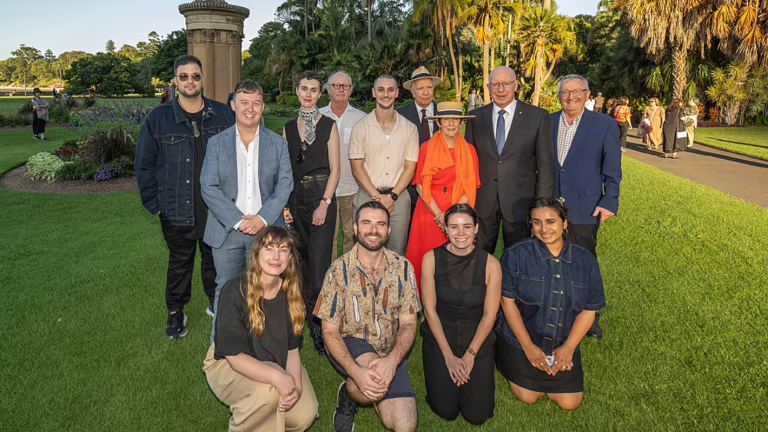
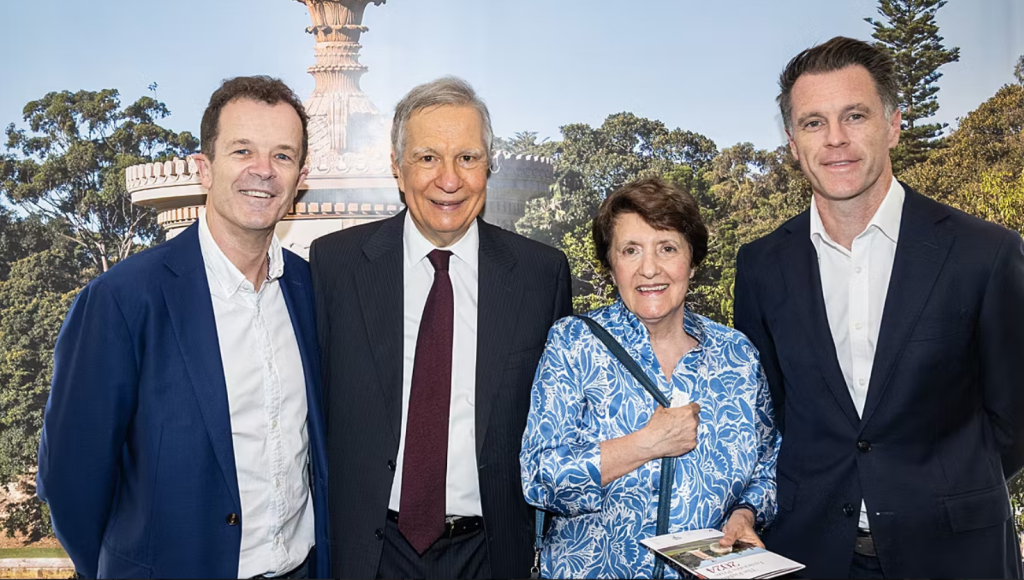
The 2024 Lysicrates Prize took place on Sunday, 25 February 2024. A packed audience including many guests of honour had a wonderful afternoon and evening of enjoyment and fun.
The afternoon began with our traditional Didgeridoo welcome by Tu Wai.
After a welcome by John Azarias, Co-Founder of the Azarias Foundation, the Premier of NSW, The Hon Chris Minns gave his opening remarks.
Compere, Hayden Tonazzi, then introduced the first of the three plays which turned out to be the subsequent winner. Once all three had been performed the audience filed out and placed their voting token in one of the three urns in the foyer. They then made their way down to the area in front of the Lysicrates Monument in the Botanic Gardens.
Here drinks and food were available and the Greek Out of the Blue Trio consisting of Anthony Kekatos playing the bouzouki, Peter Kalandranis on guitar and Dimitri Vouros on flute entertained the guests and set the right ambience for the occasion.
Brett Summerrell, Acting Chief Executive of the Botanic Gardens, welcomed everyone to the Gardens.
His Excellency General, The Hon David Hurley and Her Excellency Mrs Linda Hurley then took the stage. There was a murmur of expectation and then great jubilation when Jacob Sgouros with his play “Ripple” was announced the winner.
Mrs Hurley then gave a rousing rendition of the Ballad of Lysicrates and everyone joined in. She then followed up with an impromptu chorus of “you are my sunshine.”
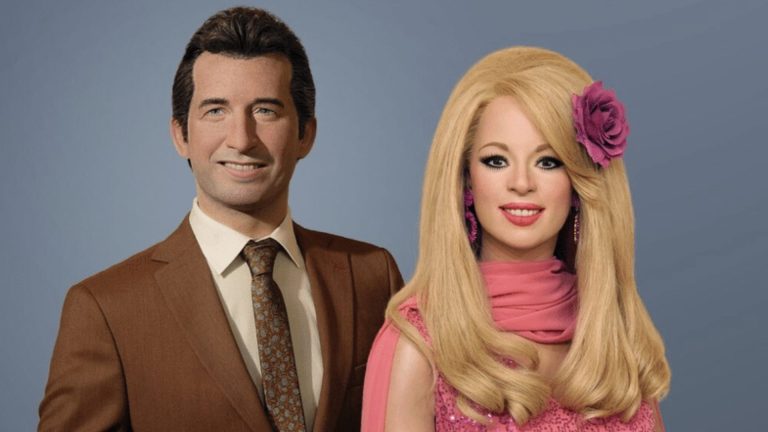
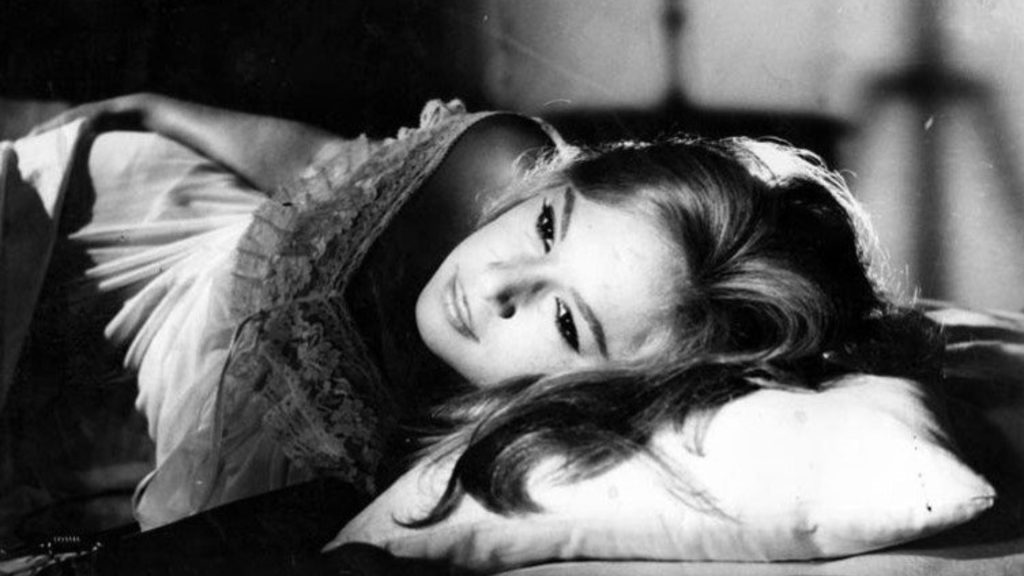
Impressive Wax Sculptures of Prominent Greeks and Global Icons Featured at Theodoros Kokkinidis Museum in Kavala, and two of the favorite Greek actors are among them. Aliki Vougiouklaki and Dimitris Papamichail.
According toEleftheros Typos.gr, the wax sculpture of the beloved actor Dimitris Papamichail has now been completed.
The collection reflects various stages of their lives, with depictions ranging from the colorful films era of 1967-1969 to significant moments in their careers. Notably, the latest sculpture of Theodoros Kokkinidis is placed alongside that of Aliki Vougiouklaki, symbolizing a beloved duo cherished by audiences across cinema, theater, and life itself.
Aliki Vougiouklaki
The process of creating the sculptures began in March 2022 with Aliki Vougiouklaki’s, culminating in September 2022, and the unveiling took place in the spring of 2023.
According to news247, since its opening in 2010, Theodoros Kokkinidis Museum has showcased wax sculptures of notable figures such as Andreas Papandreou, Konstantinos Karamanlis, Melina Mercouri, Aliki Vougiouklaki, Dimitris Papamichail, Jenny Karezi, and Maria Callas, alongside international celebrities like Michael Jackson, Madonna, Elvis Presley and others.
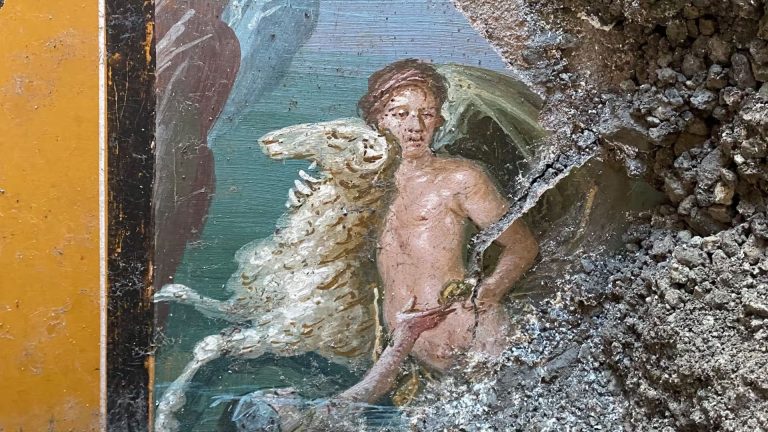
A remarkable discovery has been made during an excavation in the ancient city of Pompeii of a lavish painting portraying mythological Greek siblings, ABC has reported.
Dating back over 2,000 years, the painting, which was found among several frescoes during restoration work around the mansion of the House of Leda, is still colourful.
Pompeii, photo: James Frid
“Among the IV Style decorations that cover the back walls, the mythological painting depicting Phrixus and Helle fleeing on the ram of the Golden Fleece stands out,” the Pompeii Archaeological Park wrote in a statement on its website.
In the scene, Phrixus rides the ram while his sister, Helle, is portrayed falling into the water. The imagery captures a moment from the Greek myth, showcasing the siblings’ escape from their stepmother, Ino.
Remarkably, the fresco is depicted as if it were a framed picture, hanging on a yellow wall.
Carnival celebrations in Greece vary notoriously across the country. Different regions, ascribe significance to various aspects of the celebration, from the historic, cultural, and symbolic elements of it, rendering it, one of the most motley festivals of the country. The highly inhomogeneous population of Greece confers to the variance for the ways we celebrate the Carnival and anticipate the Holy Easter.
Some common elements that run through most celebrations, are the Carnival’s origin from god Dionysus, the custom of disguise into imaginary, animal or real entities, the evasion from social courtesy, the abolition of social norms and boundaries, the upheaval of the status quo, which also summarises the ritualistic spirit of the celebration.
In Ancient Greece, god Dionysus, the child of Zeus and Semeli – who, according to the legend, was born twice, the first time as a semi-god and the second time in fully divine status – was honored in the temple of Zeus. The celebration was accompanied by meat-eating coming from the sacrifices to the God, and abundant wine.
The theatrical element is pronounced in the celebration of Dionysus. During the Greek Dionysia, the holiday in honour of the god Dionysus, apart from strictly ‘religious’ rites, theatrical performances were also organised.
Mask is the fundamental element of the celebration
The spirit of Dionysus was propagated and survived, preserving the fundamental element of the celebration: the mask. This was the case until the Christian times, when it was renamed as Apokrea: the word means the repudiation of meat at the reception of the Lent. Many scholars believe that Christmas and Carnival traditions were based on the Roman Saturnalia. Carnival, as the fun time preceding the Christian period of the Lent, was popularised in Europe during the Middle Ages.
Disruption of social status
The antithetic behavior of the carnivalesque festivals, intends to dissolve social conventions, only to fortify them later. The cultural props that accompany the Carnival, are masks, disguises, and the maypole. The carnival season lasts three weeks: the first, is the Propone (from ‘prophono,’ to address, to announce), as carnival is announced. The second is the ‘Meat week,’ and the last one, the ‘Cheese week,’ an introduction to the Lenten fast.
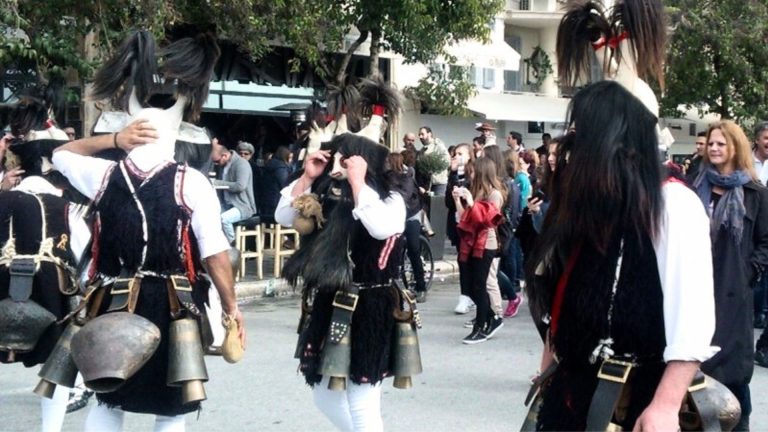
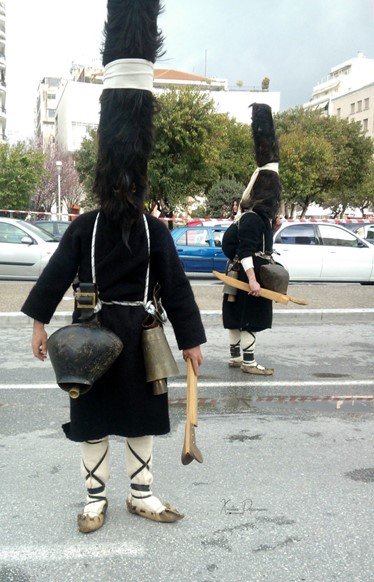
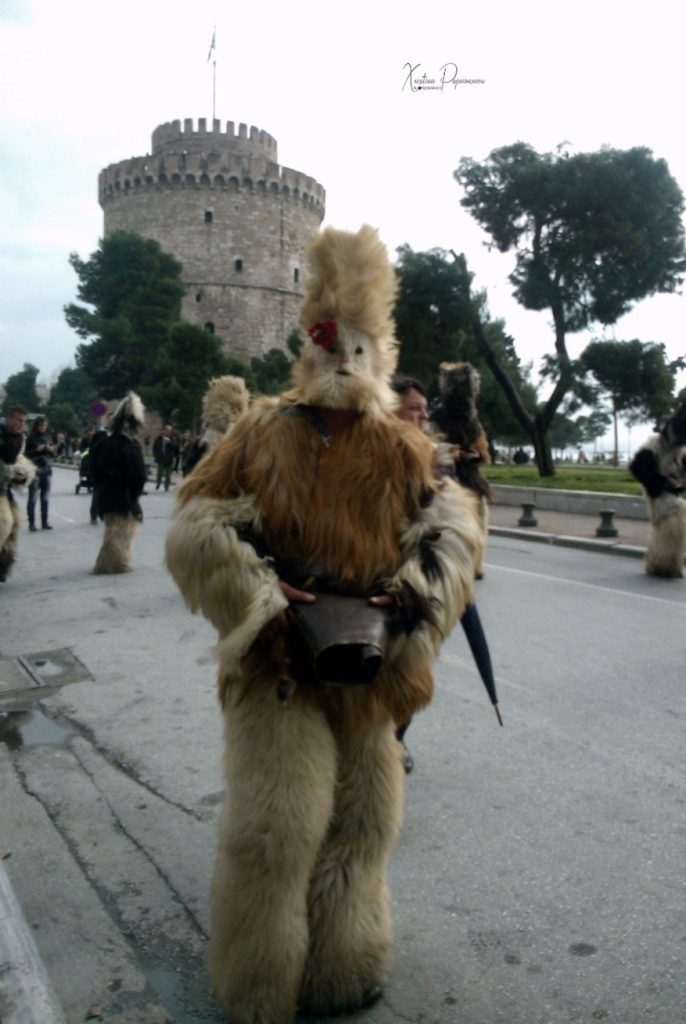
Masqueraders of Ragkoutsaria marching in Thessaloniki. Photo courtesy: Christina Papaioannou
Thrace, ‘The burning of Jaros’
The land of god Dionysus, Thrace, becomes a vibrant Carnival destination with talented masqueraders, and a sequence of traditional rites and rituals, skillfully dramatised. In the traditional town of Xanthi, people preserve the age-old custom of “Jaros burning.”
It seems that burning, holds a unique symbolic place in the celebration. It may signify the will to leave the past behind and clear the path for the new that is to come. The “Jaros” is a figurine that is burnt upon a pile of holly oaks. The ritual is performed to scatter the evil, in this case the flees that used to plague rural Greece during the summer. The custom dates back to the village of Samakov, Eastern Thrace, and is reenacted every year in the homonymous village.
‘Kiopek Mpehis (Κιοπέκ Μπέης)’
In the Kiopek Mpehis custom, the elements of satire and the humiliation of the Ottoman conqueror are prevalent. In reenacting the custom, the tyrant, personified by the wealthy lord, the “Mpehis,” is met with resistance and sedition, raised by the locals.
Satire and swindle are the core functions relived in the folklore ritual of Kiopek Mpehis and the Monks, Houhoutos or the King, which are essentially the same practice, in several other places, emphasising the injustice plagued by the conqueror, on the one side, and to the skillful resistance, on the other side. The incarnated functions are left intact, despite any superficial additions and regional differentiations – the name, the roles (dramatis personae), the disguises.
Kiopek Mpehis is bequest by refugee ancestors and survives as an active memento of the Thracian peoples’ strong social unity, as is evidenced through history.
Rooted in ancient Dionysus’ rituals, the traditional event of “Janissaries and Boules” is revived during the Apokrea in the city of Naoussa.
According to historical records, 1706 has probably been the first time the ritual was held. It narrates a story of resistance against the inhumane practice of the devshirme, the massive kidnapping of young boys by the Ottoman army across the Balkans. The people of Naoussa, resisted the devshirme by killing the sultan’s emissary. Then, most men became kleftes, inhabiting the mountains. The custom was established as part of the carnival as the time of the rebellion took place during the Apokrea. The following year, the young men returned to the city of Naoussa, masked, so that they wouldn’t be recognised by the Turks and armored by silverware to protect their pectoral area. This dressing habit instilled the exquisite aesthetic and the neat appearance of the disguised.
The custom of “Janissaries” is honoured, accompanied by the traditional zurna and the davul. Early in the morning of Sunday of Apokrea, the participants rise to get ready for the march. The gathering of the village is signaled by the solemn sound of the zurna and the heavy beating of the davul.
The importance of tradition
Of the many customs bequeathed from our ancestry, eventually only a few survive. Others fade away, whereas others are systematically repressed by the collective memory. The rituals by which communities negotiate symbols of itself in the Carnival is complex and intriguing. Carnival is about shared stories and only the stories that are substantial to our contemporary narrative survive.
Cudny, W. (2014). The Phenomenon of Festivals: Their Origins, Evolution, and Classifications. Anthropos, 109(2), 640–656. http://www.jstor.org/stable/43861801.
Halland, E.J. (2012). From Modern Greek Carnivals to the Masks of Dionysos and other Divinities in Ancient Greece. Nar. Umjet. 49/1,2012,p.p.113-130.
Σαν Σήμερα. Το Έθιμο του Μπέη. Αφιερώματα. Λαογραφία. Το έθιμο του Μπέη – Αφιέρωμα –sansimera.gr.
The 11th International Kids’ Art Contest by the Museum of Cycladic Art has the title “Today’s stories on ancient vases” and invites little friends aged 4-15 to draw images of their everyday lives that they would like to leave as a personal footprint to future generations.
This year’s contest starts on February 15 and ends on April 22, 2024 while the children’s artwork will be presented in September 2024 as part of the major exhibition during the 2nd Cycladic Kids Festival.
The International Kids’ Art Contest is one of the most successful initiatives of the Museum of Cycladic Art where thousands of children from Greece and abroad participate every year, special schools and refugee reception and integration centers. This year, through the Art Contest, we explore the permanent exhibition “Scenes from Daily Life in Antiquity” located on the 4th floor of the Museum of Cycladic Art. As we explore various themes and objects exhibited, we learn about the private and public life of ancient people in Classical and Hellenistic Greece.
One of today’s richest sources of information about antiquity is the painted clay vases. Since prehistoric times, people depict on these vases’ images of their everyday lives and scenes from mythology. Today, we find similar images mainly through internet and social media.
In this year’s Kids’ Art Contest, we invite children to recreate a scene from their everyday life, using painting, collage, photography or mixed media and include their creation into the vase outline.
What would you like people to know about your life?
What do you choose to share with others?
Which images are the most typical of your life and era?
The Contest’s results will be announced in June, just before the school year ends.
Members of this year’s jury:
Nikos Aliagas – Journalist / Photographer
Panos Giannikopoulos – Curator of Contemporary Art
Nadia Kontogeorgi – Actress
Theodoros Papakostas – Archaeologist
Erato Hatzisavva – Rector of the Athens School of Fine Arts
Heidi Holder – Chair of Education at The Metropolitan Museum of Art
Participate in the Contest by following the steps below and send your artwork by April 22, 2024:
[1] Download the template and print it on A4 paper size.
[2] Choose the materials, colors, and technique you love and create a Daily Life scene within the vase outline. (You may use collage, photography, or mixed media)
[3] Scan your work in color and high resolution.
[4] Ask an adult to fill in your details in the entry form and upload your work to https://kidscontest.cycladic.gr/en/ File size should not exceed 5 MB.
[5] To participate at the exhibition organized in September within the framework of the 2nd Cycladic Kids’ Festival, it is further required to send your original artwork by post to the Museum of Cycladic Art until May 31, 2024: Museum of Cycladic Art, 4 Neophytou Douka Street, 10676 Athens To the Attention of the Kids’ Art Contest
The online submission process should be done for each project separately. Each child or adult must fill in the entry form, attach their project electronically and receive a unique code. Works sent by post without having received a code will not take part in the process.
[6] You can only submit a single drawing.
Good luck!
The 11th International Kids’ Art Contest and the digital platform kidscontest.cycladic.gr/en are implemented with the support of Eurolife FFH, Strategic Partner of the Museum of Cycladic Art and RAYCAP, Supporter of the Educational Programs of the Museum of Cycladic Art. The International Kids’ Art Contest is held under the auspices of the Ministry of Foreign Affairs.
An interesting lecture entitled “Biculturalism, acculturation, and the Greek women of diaspora” will be presented by Eva Boleti, at the Greek Centre, on Thursday 14 March 2024, as part of the Greek History and Culture Seminars offered by the Greek Community of Melbourne.
Within the Greek households in Australia, the grandmother, “yiayia” in Greek, holds a profoundly influential position in nurturing and perpetuating cultural heritage and identity among subsequent generations. Their significance extends far beyond familial roles, as they serve as custodians of tradition and guardians of the collective memory of their community. Through their unwavering devotion and profound socio-emotional support, yiayiades create an environment where younger family members feel encouraged to explore and cherish their cultural legacy.
Beyond mere caretaking, yiayiades offer a sense of continuity and stability amidst the challenges of adapting to a new and often unfamiliar environment. Their presence not only preserves cultural practices but also imbues immigrant families with a profound sense of pride in their heritage. This pride serves as a resilient anchor, providing individuals and families with the choice of cultural assimilation and ensuring that their connection to their roots remains unyielding – if they wish to.
Eva Boleti in Western Australia.
Eva is a graduate of French Philology of the Kapodistrian University of Athens. Later she completed two masters – one in Portugal, and one in Sydney. The first in culture and art studies, and the second in the secondary education part (specialising in Greek, French, English language, and culture studies). She is presently a PhD candidate in the field of Greek Culture at the University of Sydney and concurrently working as a high school teacher of Greek and French, while experimenting with clay and ceramic art – as a hobby.
When: Thursday 14 March 2024
Ώρα: 7:00 pm
Where: Mezzanine Level, The Greek Centre, 168 Lonsdale Street, Melbourne
The Greek- Australian Cultural League has announced the Book Awards for books written by authors active and residing in Australia.
Book Award rules:
The books may be written in Greek or English, bilingual or translations. The GACL Book Prize 2024 will cover books published in the years 2022 and 2023.
Only books submitted by their authors or translators will be judged. The authors are requested to use the appropriate application form posted on the GACL website and submit three (3) copies of each book before Friday 12 July 2024. In the caseof bilingual publications, it is up to the author to designate the language of the publication that they wish to submit for consideration. The publications will not be returned.
The number of prizes is limited to ten, one in each category and each language, provided there is a book worthy of a prize. The categories are: (a) Poetry, (b) Prose, (c) Theatrical play, (d) History/Study, and (e) Book for children.
The prize in each category consists of: Monetary amount, as well as a certificate and a gift.
The announcement of the results will be organised at a special function towards the end of the year.
For further details please contact the Coordinator Vasiliki Laiou on telephone 0407 542 089, email: vasilaiou@gmail.com, or infogaclm@gmail.com