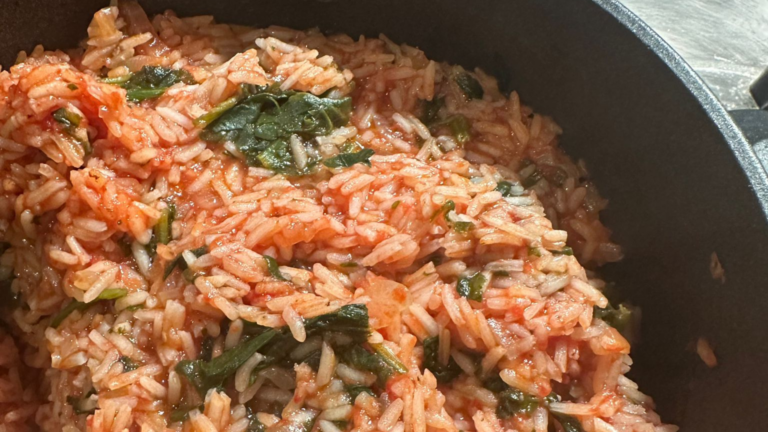
Niki Louca from My Greek Kitchen shares her favourite recipe for spanakorizo (spinach rice pilaf) with The Greek Herald. You can follow her on Instagram @mygreekkitchen for more!
Spanakorizo is a quick and versatile dish which can be eaten as a meal on its own or as an accompaniment with lamb, chicken or pork. It is a quick and easy mid-week meal that can be done in about 35-40 minutes. This recipe serves 4 – 6 people.
Ingredients:
11/2 cups of white rice
500 gm fresh or frozen spinach or silverbeet
1 medium onion finely diced
Salt to taste
2 cups chicken or vegetable stock
500ml passata
¼ cup olive oil
Water as needed
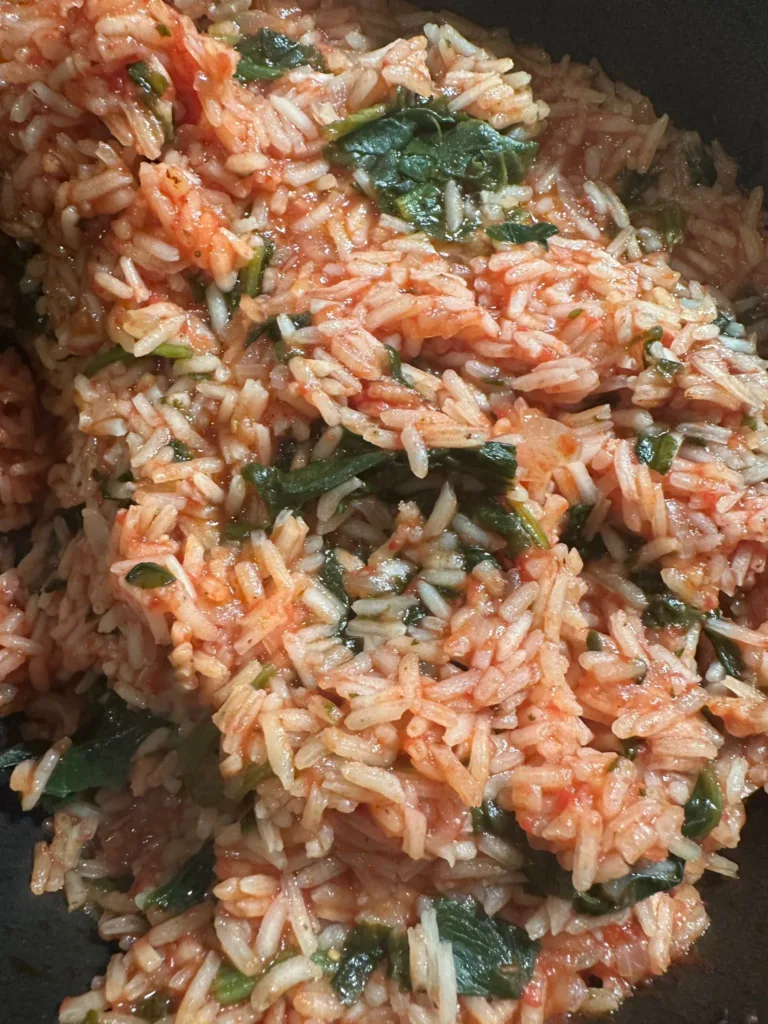
Spanakorizo
Method:
Saute the onion in the olive oil in a heavy based saucepan.
Add your rice and stir making sure the rice is covered with the oil. Keep stirring the rice for a couple of minutes.
Add you stock, passata sauce and cook till it starts to absorb the liquid. Add water a little at a time till it absorbs it again. Important to note – do not leave it to dry out. Add water whilst still “wet”. Treat it as you would risotto.
When it is ¾ of the way cooked, add your salt, and spinach or silverbeet and stir through. If you are using frozen spinach, stir every couple of minutes to make sure the spinach has thawed and fully mixed through. Check if it needs any further water and if not, put the lid on and turn heat off. Leave it to absorb any extra liquid and to finish cooking (approx. 10-15 minutes).
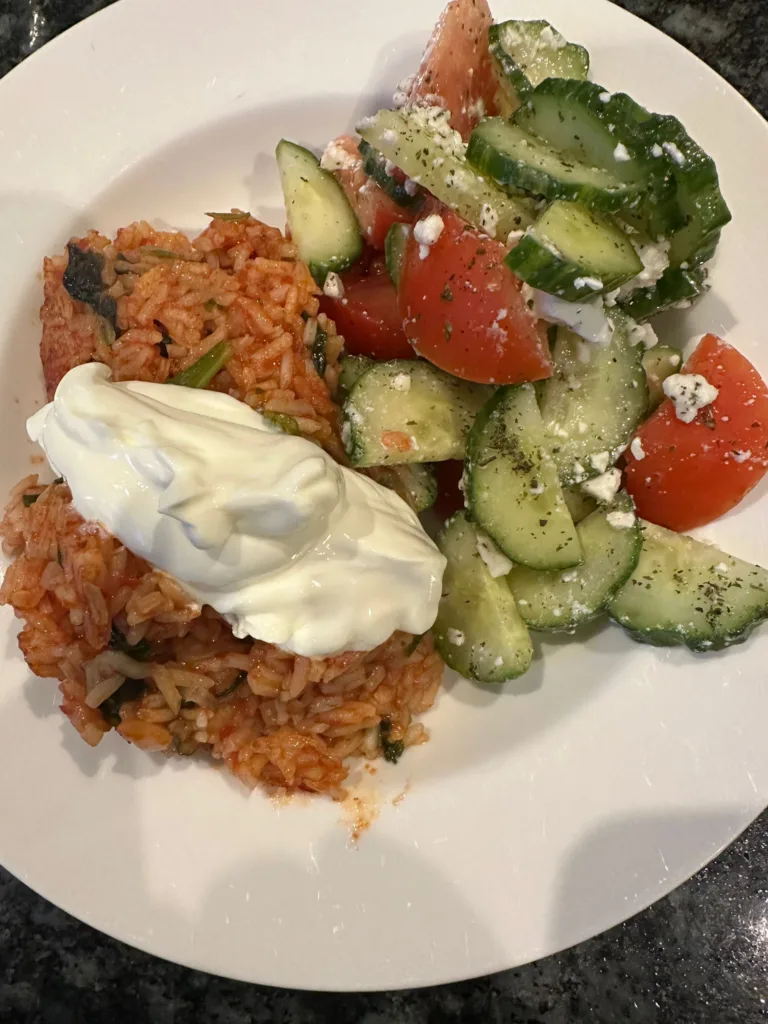
Serve and enjoy whilst hot and with a dallop of Greek yoghurt and Greek salad.
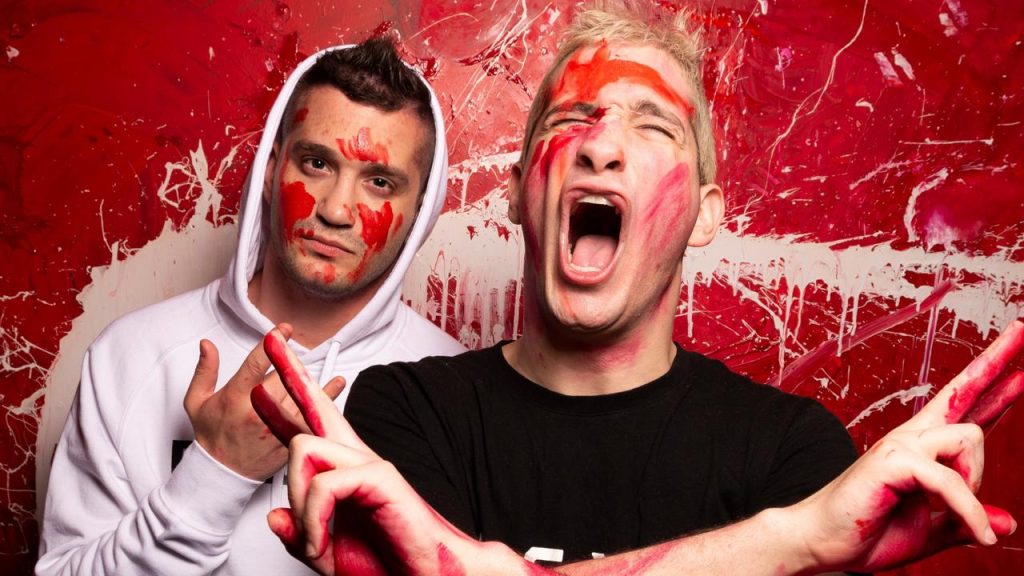
Adelaide’s filmmaking duo, Michael and Danny Philippou, have secured their next project, a new horror movie following the success of their previous hit, “Talk To Me.”
According to the Advertiser, the award-winning twins from Pooraka have signed on to direct original horror movie Bring Her Back, which will star two-time Oscar nominee Sally Hawkins (The Shape of Water).
Plot details have not been released but the film will begin production this American summer, according to Deadline.com.
The brothers, who made their name on YouTube, took to social media to confirm the good news, proudly declaring on Instagram: “We’re shooting another horror movie!”.
Backing the project are producers Samantha Jennings and Kristina Ceyton of Causeway Films, the same team behind “Talk To Me,” “The Babadook,” and “The Nightingale.” The Philippou brothers also revealed their plans for a sequel to “Talk To Me,” their debut feature that swept eight awards, including Best Film, at the previous year’s AACTA Awards.
Michael and Danny Philippou are also known as Adelaide Youtube sensations for their channel, RackaRacka.
Talk to me not only raked in significant box office earnings exceeding $90 million worldwide but also found a place on Netflix’s streaming platform.
The North American movie rights were sold to New York City-based film company A24 – who recorded a movie studio high 18 Oscar nominations last year.
The brothers have also signed on to direct the big screen adaptation of popular video-game ‘Street Fighter’, though it’s still unclear when production will begin.
Michael and Danny first made a splash on YouTube as RackaRacka, with their online pranks – which included driving a car filled with water through a bottle shop – attracting more than a billion views.
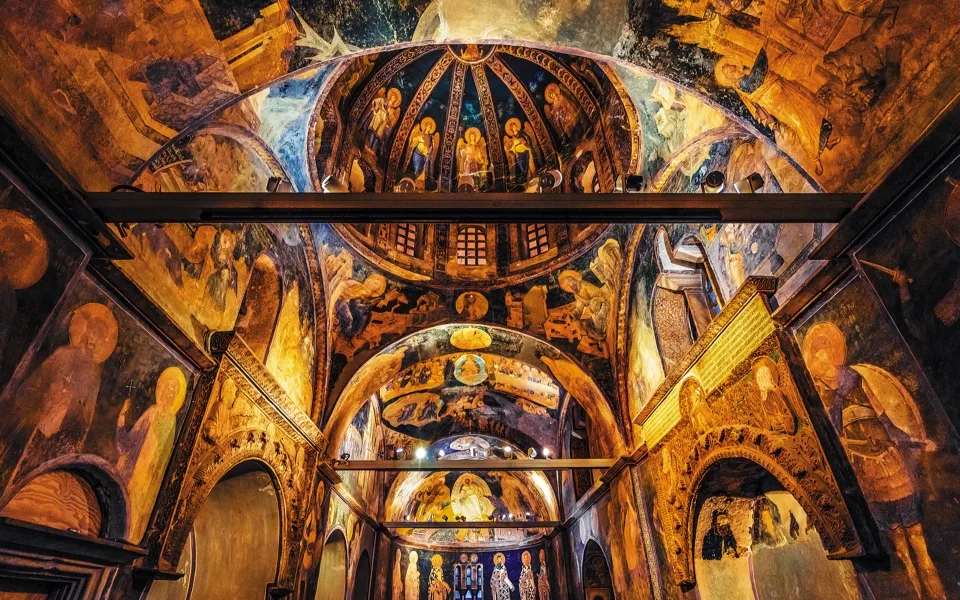
The church of Agios Sotiros in Chora – the most beautiful monument of Christianity according to Art Historians and Byzantinologists, which was simply the katholikon of the former monastic complex in Constantinople, and whose construction dates back to the 6th century AD, while its unique mosaics and frescoes were created in the 14th century, from 1305 to 1320, during the reign of Palaiologos – was converted by the exponents of neo-Ottomanism, from a Museum and a World Heritage Site into a mosque.
Turkey’s President, Mr. Erdogan, again inspired by his long-standing nationalist and Islamocentric policy, decided to push his country and its society, beyond and away from the secularism that Turkey enjoyed, perhaps uniquely and exclusively in the Muslim world, as a country with a Western-style cultural character. Erdogan, retaining for himself the ambition to put his own photograph on public buildings instead of the photograph of Kemal Pasha, shattered yet another bastion of secular political legacy that the Kemalists gave to the Turks after the establishment of their new state, Turkey, in October 1923.
After twenty years of rule and having tasted for the first time the heavy electoral defeat in the recent elections, the Turkish President again resorted to neo-Ottomanism and the Islamisation of museums and Christian bequests to humanity, in order to soften the heavy blow of defeat, in the form of revenge against the West, but also against his pro-secular compatriots. Also, this vindictive turn against civilisation and Christianity may be a desperate attempt to placate the nationalist Islamist Devlet Bahçeli (Mr. Velopoulos of Greece) and his followers, who support him.
The conversion of the monument into a mosque is celebrated, apart from Islamic fundamentalists and nationalists, and by Turkey’s mainstream media, whose journalists attempt to convince the Erdogan regime that they are siding with his decisions, perhaps to escape possible persecution or incarceration in one of the overcrowded prisons, now flooded with strains of “anarchists” of the regime.
Erdogan’s decision to Islamise, by means of arms, a Christian church, a World Heritage Site, and even provocatively characterise the historic Chora Monastery as his ancestral heritage, less than a week before he will be meeting the Greek Prime Minister, Kyriakos Mitsotakis, is also an insult to his visitor, but also to the Greek people. It is also a sign of hypocrisy and trafficking of religion, what is recently called the instrumentalisation of religion on the part of the Turkish President.
Photo: Ekathimerini.
When anarchists or radicalised and bigoted youths in Europe take on the Koran or some of the Islamic mosques, Erdogan tears his clothes. He goes out in anger in front of the television cameras, and in a style dressed in the phonology of the mullahs, he recites curses and makes threats because his religion is reviled and the Koran is trivialised. When a mosque is humiliated or desecrated in civil unrest, Erdogan lashes out at impious Europeans or Jews and teaches them respect for the Divine.
Erdogan’s Islam centric regime, after the failed coup against him eight years ago, turned to a policy of projecting Turkey as a regional power of the Islamic world, as a country that supports and defends the interests of weak Islamic countries. He is the Zorro of the Islamic world, the big hug for all Muslims, even the leaders of Hamas.
At the ceremony held on Easter Monday, Erdogan stated that “in the last 21 years, we have restored 5,500 monuments of ancestors in our country and throughout the geography of our hearts. I see this important ceremony today as another sign of our sensitivity to heritage protection.” His statement concerned the completion of restoration and conservation works of 201 historical monuments by the General Directorate of Vakoufs (Public Benefit Foundations) across Turkey and in Pristina, Kosovo.
This action of the Erdogan regime to abuse the historic church for Christianity and Hellenism, covering with curtains the mosaics and frescoes of the Church of the Savior of the Chora Monastery in Istanbul, was responded not only by the West and Christianity but also by Greece in lukewarmly fashion, almost toothlessly. Greece’s Ministry of Foreign Affairs issued a statement in which it consciously avoided mentioning Christianity.
Chora Church. Photo: ekathimerini
Specifically, the Greek protest states: “The decision of the Turkish authorities to open the Chora Monastery as a mosque constitutes a provocation to the international community as it alters and insults its character as a UNESCO World Heritage Site belonging to humanity. The preservation of the universal character of monuments and the observance of international standards for the protection of religious and cultural heritage is a clear international obligation that binds all states.”
Photo: Essanews.
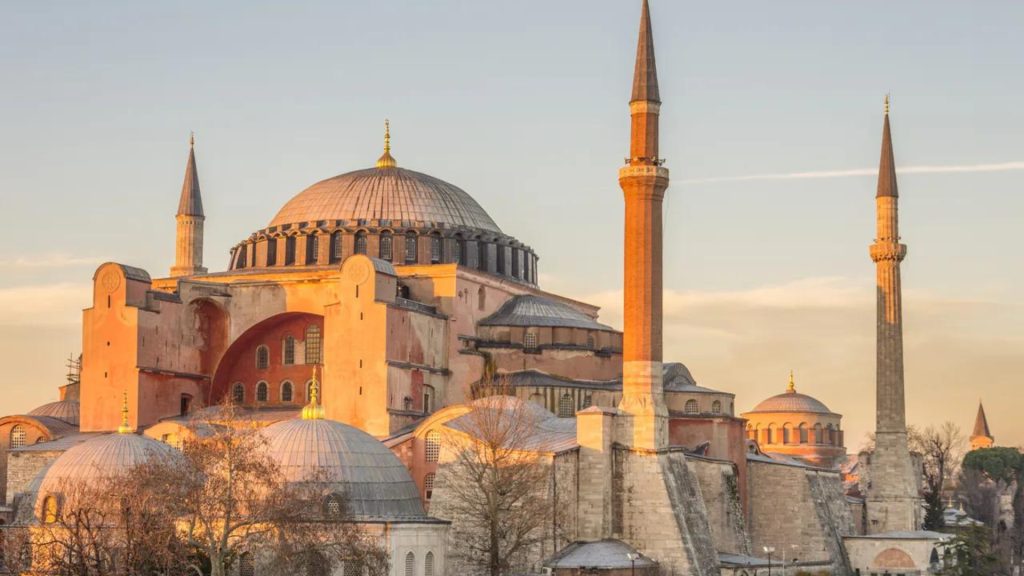
The mosque will operate on the model of Hagia Sophia. The mosaics on the walls in the prayer area were covered, while an area was designated for tourists to visit with a guide. The church of Agios Sotiros in Chora, the katholikon of the former monastic complex, dates back to the 6th century AD, while its unique mosaics and frescoes were created in the 14th century, from 1305 to 1320, during the reign of Palaiologos. This vindictive and morally lawless act of Erdogan’s Islamocentric regime not only does not contribute to the creation of a climate of friendship with the West, but raises once again the question of whether Turkey can really function as a European state, as its ancestor, Kemal Pasha, envisioned 100 years ago. This road is obviously rough and long.
*Professor Anastasios M. Tamis taught at Universities in Australia and abroad, was the creator and founding director of the Dardalis Archives of the Hellenic Diaspora and is currently the President of the Australian Institute of Macedonian Studies (AIMS).
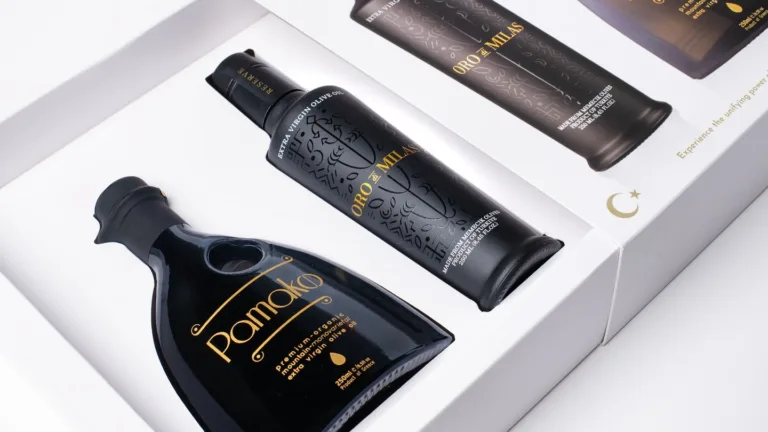
The olive tree and olive oil have symbolised peace and reconciliation for millennia, as well as playing key roles in the cuisine of the people of the Mediterranean region. Two producers of extra virgin olive oil from both sides of the Aegean Sea are now honoring these symbols with a collector’s case featuring extra virgin olive oils from Greece and Turkey.
After a year-long collaboration, Eftychis Androulakis from Crete and Emine Colin from Turkey are presenting a collector’s edition that includes a bottle of organic high phenolic Pamako extra virgin olive oil from Greece and a bottle of Oro di Milas extra virgin olive oil from Turkey.
The idea of creating a commemorative box that includes the two olive oils as an act of friendship and collaboration began with a discussion of the remarkable improvement in the quality of the two countries’ olive oil, the value of collaboration, and the unique ability of olive oil to unite people of different countries, religions, and cultures.
Anita Zachou, agricultural engineer, expert olive oil taster, and production and quality consultant for the Oro di Milas brand, and Eftychis Androulakis, producer, master miller and bottler of Pamako, were discussing these points. With great love for Greece, Emine Colin from Turkey (a resident of America for the last 40 years) and her husband Mark Colin embraced these ideas.
Produced from the ancient Tsounati olive variety, multi-awarded Pamako organic extra virgin olive oil comes from mountain olive groves in the region of Agrile in Chania, Crete. It is the first olive oil to be internationally certified as a food supplement because of its healthy high phenolic content. Oro di Milas is produced from olives of the famous Turkish variety Memecik in a privately owned olive mill in the mountains of the historic region of Milas. It stands out for its intense aromatic character, and in the first year of its release it won nine gold awards in some of the most prestigious international olive oil competitions.
The gift box showcases two of the finest extra virgin olive oils, oils meticulously crafted by artisans who have mastered the art of olive cultivation and state of the art milling techniques. With Greece and Turkey renowned for their olive cultivation and production, this collaboration embodies a union of expertise and tradition, offering a sensory journey through the flavors and aromas of the Mediterranean.
Photo by Pamako.
Both extra virgin olive oils pair perfectly with the flavours of Greek and Turkish cuisine. On the occasion of this collaboration between two producers, the famous award-winning Greek executive chef Michalis Marthas created two recipes that emphasise the harmonious pairing of flavors between the two cuisines.
He created two seafood recipes that are beloved in both countries: a recipe for steamed mussels with vegetables, Greek ouzo and Pamako extra virgin olive oil, whose intense character elevates the dish, and a recipe for marinated sea bass with tangerine, lemon, artichoke and Oro di Milas extra virgin olive oil, whose low bitterness and complex aromatic fruitiness combine harmoniously with the sea bass for a unique taste experience.
The gesture of the two producers reminds us that olive oil is a product that unites us and that invites us to collaborate creatively, with acceptance and respect for what makes us different. As consumers indulge in the exquisite flavors of these award- winning olive oils, they are invited to reflect on the enduring bond between the two sides of the Aegean Sea, celebrating not only the richness of their culinary traditions, but also the spirit of peace and friendship that unites them.
Part of the proceeds from the sale of this collector’s box will be allocated to support organizations involved in the promotion of peace and research on children’s health. Pamako has been used for three years in European studies on the beneficial effect of high phenolic olive oil on children suffering from autism. Both Eftychis and Emine, a mother of four children and a former athlete, are particularly aware of the positive effects of olive oil on human health.
The love for high quality extra virgin olive oil knows no borders.
The collector’s case is available for sale in the online store www.elenianna.com.
*Originally published on Greek Liquid Gold: Authentic Extra Virgin Olive Oil (greekliquidgold.com). See that site for recipes with olive oil, photos from Greece, agrotourism and food tourism suggestions, and olive oil news and information.
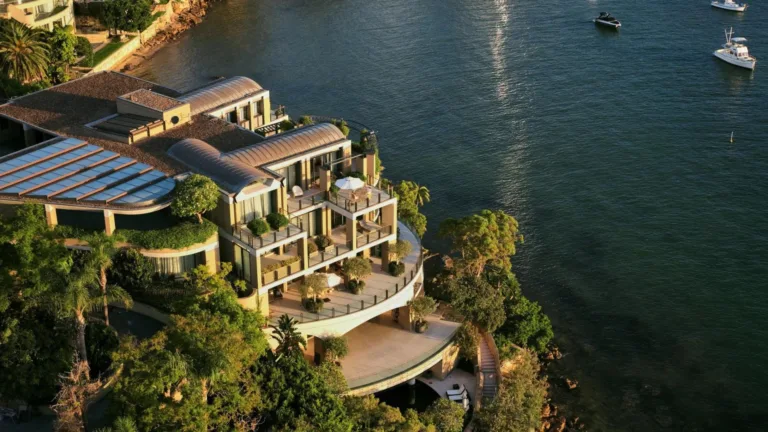
Nestled in Sydney’s esteemed Point Piper neighborhood, ‘Wingadal,’ a sprawling mega-mansion, has been the family residence of John Symond, founder of Aussie Home Loans, and was crafted by renowned architect Alec Tzannes.
According to forbes.com, it is about to smash the Australian property record.
It took eight years to construct from its inception in 1999 and has never been sold. Spanning 2,676 square meters—an equivalent of four standard residential blocks—offers an unparalleled view of Sydney Harbour, with the Opera House and Harbour Bridge framing its 98-meter waterfront.
In addition to the pool, there’s a 22-seat movie theatre, an eight-car garage and a lift. And in case one commercial-grade kitchen isn’t enough, Wingadal boasts a second that has seen some of Australia’s most prominent celebrity chefs showcase their skills across years of charity events held at the property.
The listing of the property is through Ken Jacobs, Director – Australia Pacific of Forbes Global Properties in association with leading Sydney agent Brad Pillinger.
“The estate is Australia’s most iconic residence and ranks amongst the best in the world,” Jacobs said while Pillinger mentioned that there is no comparable property in Australia. “We expect Wingadal will be the first sale to surpass the $200-million barrier in this country.”
Photo: forbes.com
“The result showcases the foresight, passion, vision and meticulous attention to detail of both Mr Symond and Mr Tzannes, and as there is no comparable property in Australia, we expect Wingadal will be the first sale to surpass the $200-million barrier in this country,” it was stated.
The $200-million price guide would comfortably smash the current house record held by Atlassian co-founder Scott Farquhar who spent $130 million on his Point Piper mansion last year.
It is a palace that symbolised the golden age of antiquity, bore witness to the assassination of King Philip II and the crowning of his 20-year-old son King Alexander the Great.
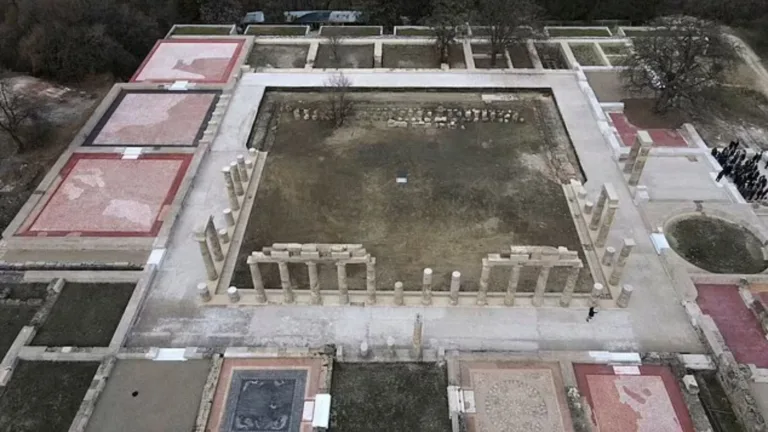
Located in the ceremonial heart of the ancient Macedonian kingdom, Aigai palace spans an impressive 15,000 square meters, rivaling the size of the Parthenon. This grand complex includes fortified city walls, courtyards, temples, sanctuaries, a theatre, a palaestra (boxing school), and tombs.
The latest discovery, revealed in the final episode of Channel 4’s Bettany Hughes’ Treasures of the World series, sheds light on the palaestra and bathing area where, as mentioned in the Dailymail, Alexander the Great and his companions, including Hephaestion, reportedly bathed together.
According to the Dailymail, despite the absence of Alexander’s specific bedroom, the archaeological team has meticulously restored 1,400 square meters of banqueting hall mosaics, marble floors, and palace colonnades over a 16-year, €20 million project.
Photo: Sandstone Global Productions
The son of King Philip II of Macedonia and Queen Olympias of Epirus, Alexander was one of the most ambitious military commanders of all time.
From his reign in 336 BCE until his death 13 years later, he built one of the largest empires the world has ever seen, stretching from Greece to Egypt and deep into the Indian subcontinent.
Bettany was also granted access to the tomb of Alexander’s sister Thessaloniki, who was buried at Aigai, which was looted in antiquity.
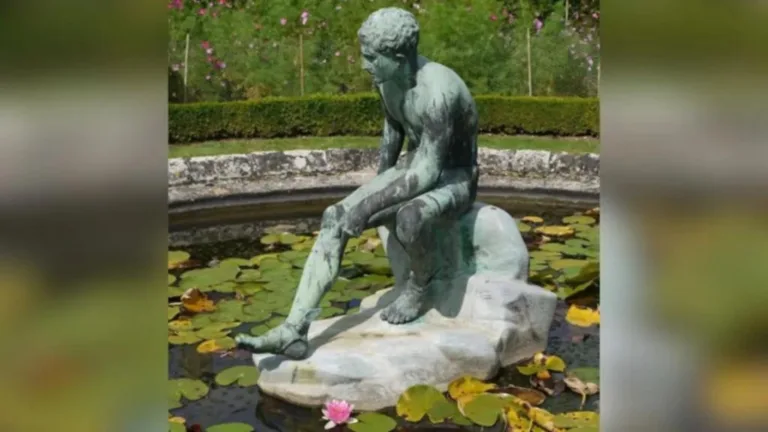
A large bronze statue of a Greek god has been stolen from the garden of an Elizabethan stately home.
According to BBC, the sculpture of the deity Hermes, has sat in a pond in the grounds of Holdenby House near Northampton for more than 100 years.
James Lowther, the estate owner, expressed deep distress over the theft, stating, “”His theft is almost unbearable for us, and everyone at Holdenby – and we – are praying for his return.”
It is believed thieves gained access via the A428 with a vehicle.
Mr Lowther said: “Mercury (the Roman name for the Greek god Hermes) has been such an important icon for Holdenby and something I have loved since I was a child.
“It is heart-breaking to see this much-loved piece of public art so crudely and cruelly cut from his pedestal. “Those who stole him saw only a piece of metal that could be absconded with for private profit.” He added: “We live in hope that he will be returned home and urge anyone with information to come forward.”
Photo by Pixabay
The estate spokesperson lamented the loss, emphasizing that the statue was a significant replica of the renowned Seated Hermes, unearthed from Herculaneum in 1758.
“His theft is a loss not only of an important historic work of art, but of a landmark feature much loved by the family, the community and Holdenby’s visitors.”
A Northamptonshire Police spokesperson said: “Officers are now appealing for anyone who saw anything suspicious in the area during the stated times, or who has any information about the theft, to get in touch.”
This year’s rankings of the Most Beautiful Beaches in Europe assembled by the European Best Destinations (EBD) organization, have been revealed.
Based on the votes of 103,224 worldwide travelers from 116 countries, the 15 beaches selected range from secluded spots ideal for romantic getaways to popular destinations perfect for family adventures.
According to forbes.com, Greece has five beaches on the list: Canal d’Amour, Porto Timoni, St Paul Bay, Porto Katsiki and Vai beach, making it the the most awarded country in this year’s ranking.
Canal d’ Amour Beach is one of the most famous ‘secret’ beaches in the village of Sidari on Corfu Island.
The beach is surrounded by unusual sandstone formations that make a long, narrow channel to which it owes its name.
Photo: Catherine Bailey
For the second time, Porto Timoni in Corfu rises to the rankings of the Best Beaches in Europe. It also appears as one of the most beautiful beaches in Greece.
Located in Corfu, one of the best-known Greek islands and among its greenest thanks to abundant winter rains, Porto Timoni “hides” in a secluded location and offers two beaches — one open to the sea, the other to a lagoon.
One of the most beautiful secret beaches in Greece, St Paul Bay beach in the Southeast of Rhodes, is one of the most popular beaches in the Greek island.
With crystal clear waters, protected from winds and waves and offering many amenities, it’s a lovely beach for families.
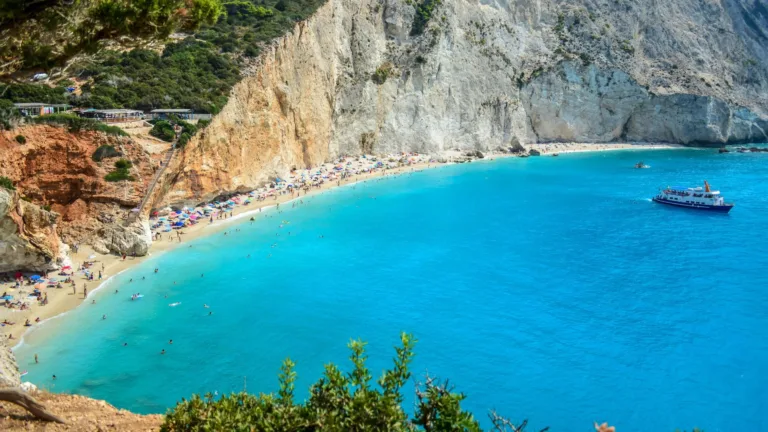
Located on the Ionian island of Lefkada, Porto Katsiki beach is also on the list of the most beautiful beaches in Greece. Known as the “goat beach” because in the past, the area was only accessible to goats, the only creatures able to climb the steep rocks. Today, paths and stairs allow travelers to to get to the beach, famed for its landscape and clear blue sea.
Vai (“palm,” in Greek) is a region of east Crete between Cape Sidero and Cape Plaka. The beautiful Vai beach of fine sand and pebbles is located at the far eastern tip of Crete. What makes this place unique is its luscious palm forest.
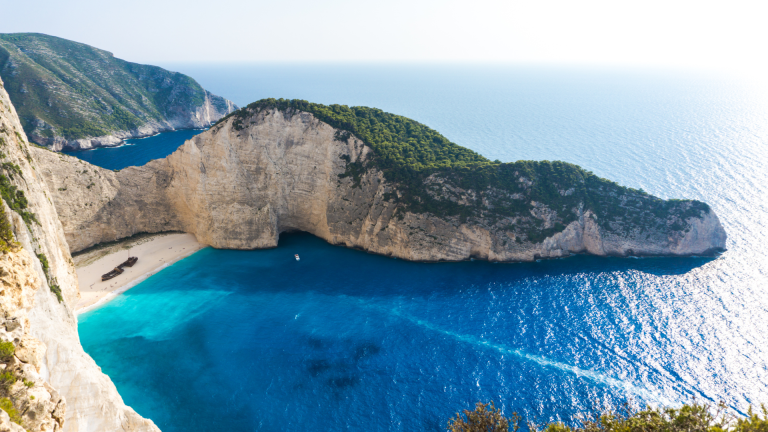
Zakynthos’ Navagio beach, a popular tourist destination famous for its signature shipwreck, will remain closed to tourists for a second summer this year by ministerial order.
According to ekathimerini.com, the ministers of citizen protection, island policy and tourism decided to prohibit access to the Navagio beach on the recommendation of a team of experts from the Anti-Seismic Planning and Protection Organization (OASP).
The ministerial order bans vessels from approaching or anchoring near the beach from the sea and people from swimming in the cove within the northern and southern ends of the bay.
Visitors must also remain 10 meters away from the top of the rocky slope overlooking the bay.
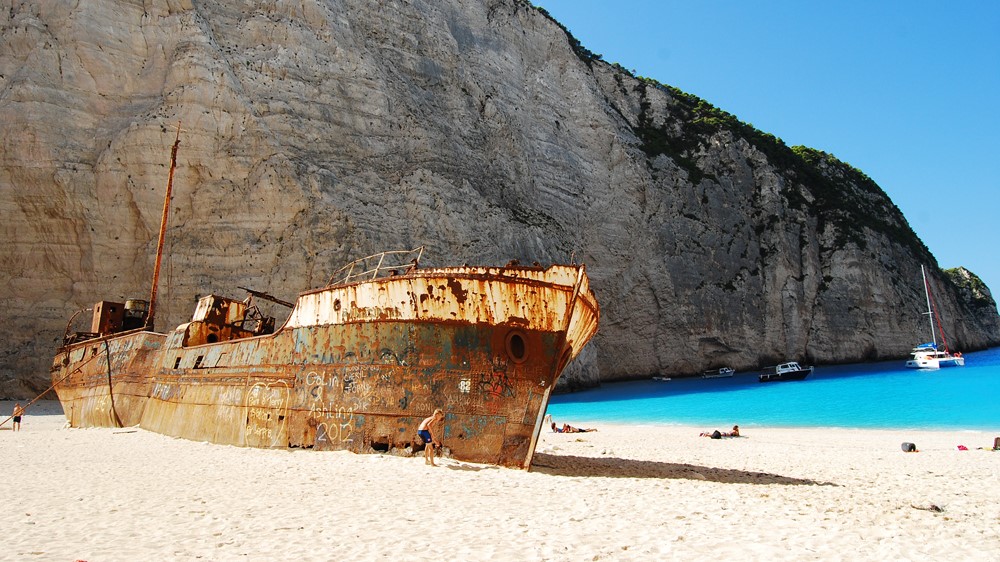
The famous shipwreck is on Navagio beach, Zakynthos.
The OASP team has previously said there was significant risk of landslides due to the erosion of the surrounding cliffs.
The beach was closed off in September 2022 after a 5.4-magnitude earthquake caused large rocks from the surrounding cliffs to fall into the bay.
Last January it was reported that the wreck of the MV Panagiotis, which ran aground in October 1980, has suffered extensive damage and is at risk of vanishing altogether.
In August 1977, Peter Triantis remembers hearing the news that Elvis Presley had died on his pocket radio while at school in Year 5. He recalls the profound impact it had on him.
“Everyone remembers where they were when they heard the news that Elvis died,” Peter tells The Greek Herald.
What young Peter didn’t know at the time was that 47 years later, he would emerge as one of Australia’s most talented and sought after Elvis tribute artists, meticulously preserving the legacy of the king of rock and roll.
“I had no premonition that I would grow up to be an Elvis tribute artist or even enter show business,” Peter says, adding his older brother was a talented musician with Melbourne’s well-known Levendes band – booked out years in advance. Occasionally, Peter would perform a couple of Greek songs, but that was all.
As for Elvis, he had admiration but was not obsessed.
“Growing up I was more interested in kickboxing, and I later became a computer engineer. My hair was cut short at the back and sides, and I didn’t even know I could sing professionally until one day an Elvis tribute artist handed me the microphone to sing a couple of songs with him,” Peter says.
The audience was captivated.
“They came up to me and said I should do this for a living,” he adds.
An idea was born and Peter was captivated by the allure of emulating the iconic performer.
Becoming Elvis
With the support of his wife Effie Triantis, a Greek dance teacher, Peter got to work shifting his career focus to reinvent himself as an Elvis tributer at the age of 37.
Effie says she knew that Peter could sing from their karaoke nights when they first began to date. But it was a latent talent, and music hadn’t been on the professional radar.
“I was supportive of his career change because Peter is a perfectionist and I knew he would do it well,” she says.
Through singing lessons and a meticulous study of Presley’s performances, Peter endeavoured to authentically embody the essence of the legendary artist. For Peter, the commitment to his craft extends beyond mimicry as it encompasses a reverence for Presley’s artistry.
“If you don’t do it 100% genuinely, it’s better not to do it at all. That’s my motto,” Peter says. “If you want to pay tribute to Elvis, then do it the right way otherwise you are making a mockery of him.”
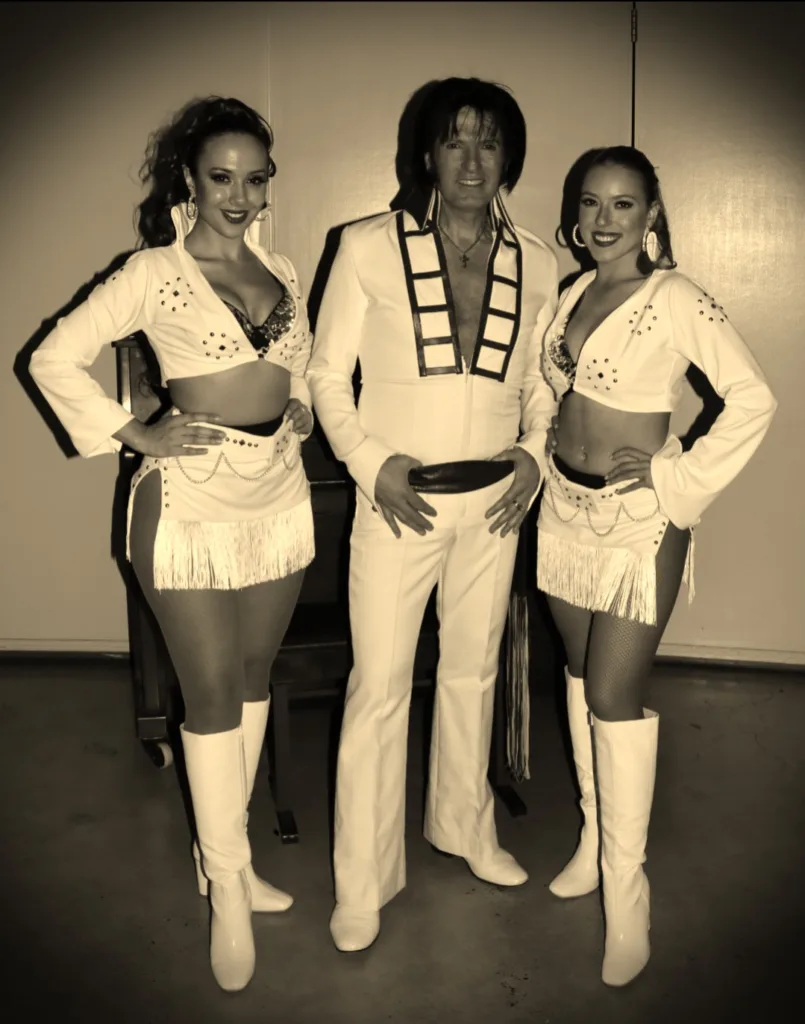
There are no cutting corners with unique garments made by B&K costume company, licensed by Elvis Presley Enterprises to recreate costumes under the supervision of the original designers.
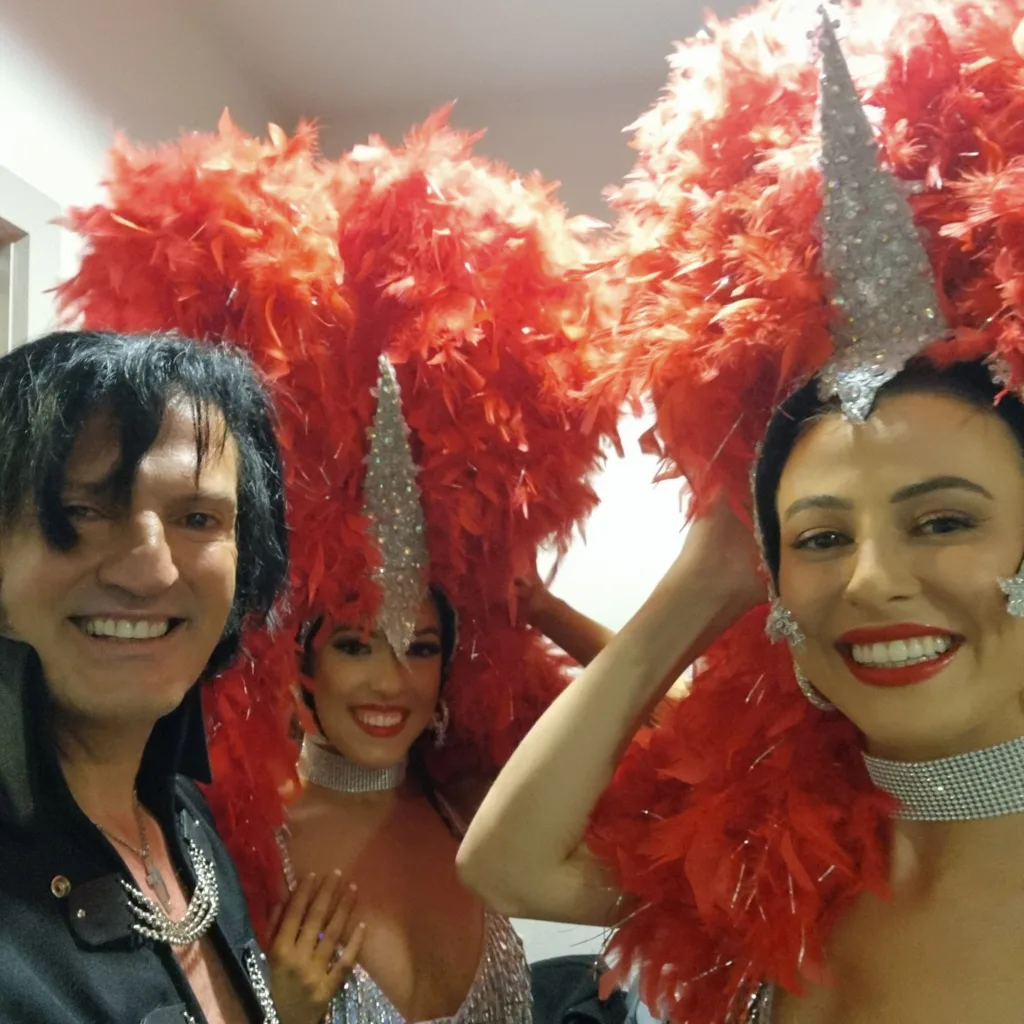
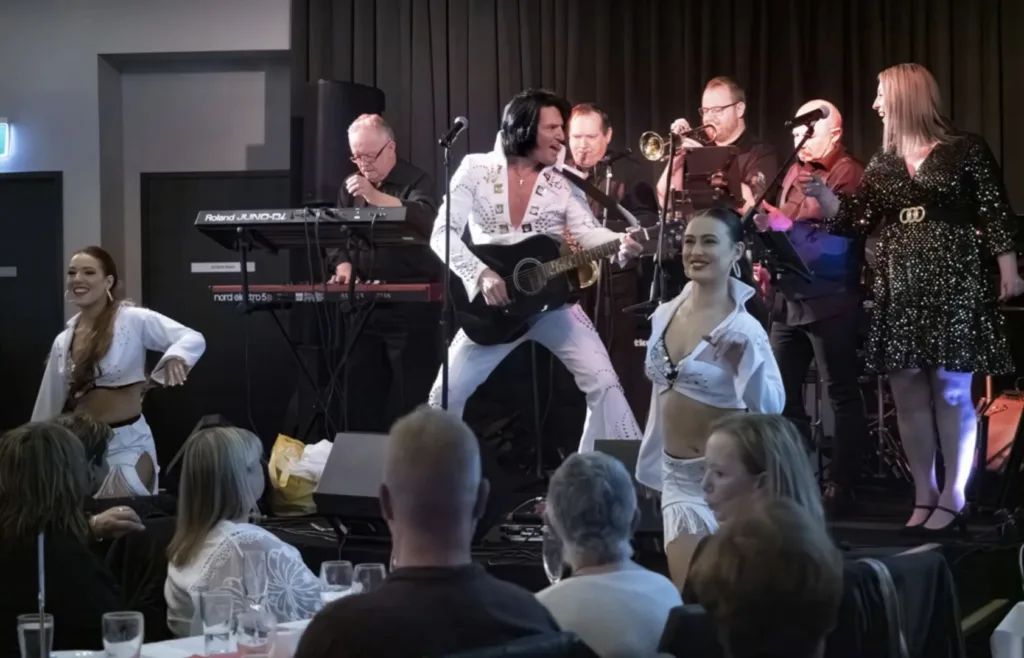
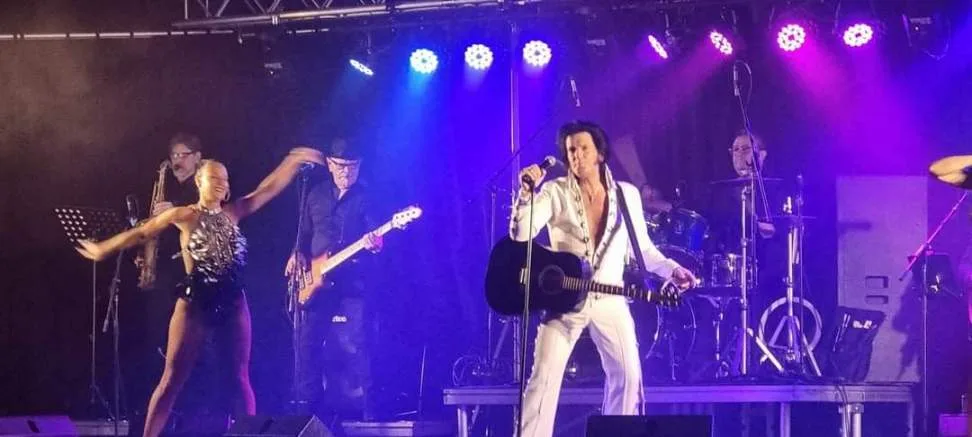
“They send me the suit, and I readjust it and resend it back and then they send it back again. It takes around three-to-six-months for every suit at six grand for each. I have 15, and then there are the boots at $600, the gold belt at $800,” he says, adding the showgirls, jewellery, speakers and light shows making for an incredible show.
Though Peter doesn’t do it for the money alone, he needs money to ensure that the performances are of the caliber Elvis would deserve.
“I know I’ll never be Elvis, but I want to be the best I can,” he says. “When I am on stage, I become him. But when the performance ends, I’m Peter again.”
Sometimes people in the street comment on the hair and sideburns which linger even as the rest of the Elvis persona is put to rest. Elvis had also endured comments from random people during his lifetime.
“I find that a lot of people hate you for being Elvis, and say, ‘what does he think he is doing?’ and there may even be jealousy behind that. But others admire you and enjoy the tribute,” he explains.
Peter says being a tribute artist isn’t always easy.
“When I put the Elvis costume on, the girls become delusional. And can you blame them? Even I want to scream when I see an Elvis guy on stage,” he says.
“During one show, a girl rushed up to kiss me and her boyfriend gestured he would slit my throat. I’ll never forget this. He then slapped his girlfriend and security had to take him away. I’m always cautious in shows about whether a girl has a boyfriend.”
Reviving the king
Peter says the hype was always present since he first began to emulate Presley, however Baz Luhrmann’s biopic “Elvis” and the musical of the same name created a revival.
“The Elvis movie has blown us away. When it was up and running I was invited to cinemas and was booked solid every day almost,” he says. “I used to perform for people aged in their 50s and 60s, and now I’m doing shows at 21sts, 30s and 40s with young people still singing Elvis songs.”
The Parkes Elvis festival, where Peter has won awards, drew 40,000 people in January 2024 with record crowds showing that the younger generation is as interested as ever in the myth and legend of the great star.
Elvismania in Greece
While Elvis never performed outside North America, Peter brought Elvis to Greece in the year prior to COVID-19 when he want to visit his relatives in Kalamata and his wife’s island, Lesvos.
“I went for a visit and took my Elvis costume with me. People saw me and thought I dressed like Elvis and that was it,” Peter says.
His wife adds, “When he sang, they were blown away.”
At Molyvos, Lesvos, a hotelier got him to tour the village as people rushed to take photos.
“She said, ‘forget where you are staying, you can come and stay here for free’,” Peter explains.
In Athens, he was not allowed to wear the Elvis costume to the Parthenon on account of it being considered ‘sacred land.’ The security guards may have forbidden it but Zeus, the king of the gods, smiled on him as he drew the crowds outside.
Peter doesn’t believe that the latest Priscilla movie will cause much of a stir as far as Elvis tributes are concerned.
“She was a fool to have left him,” he says. “I know he was having affairs and that was hard for her, but Tom Jones’ wife stayed, and they had a happy marriage.”
Effie, his wife, disagrees. “He didn’t touch her after she had a baby. She was right to leave.”
Peter with his wife Effie (right). Photo: The Greek Herald / Mary Sinanidis.
Like Elvis and Priscilla, Peter and Effie have a daughter who recently got married. At the reception at the Crown, Peter sang for her due to popular demand.
“There was not a dry eye,” Effie says.
The two chat away about their life and Peter is now Peter and has most definitely left Elvis on the stage. Now he’s just a Greek Australian husband with his lovely wife.
“Someday I’ll stop being Elvis,” he says. “When my hair begins to fall and I get fat.”