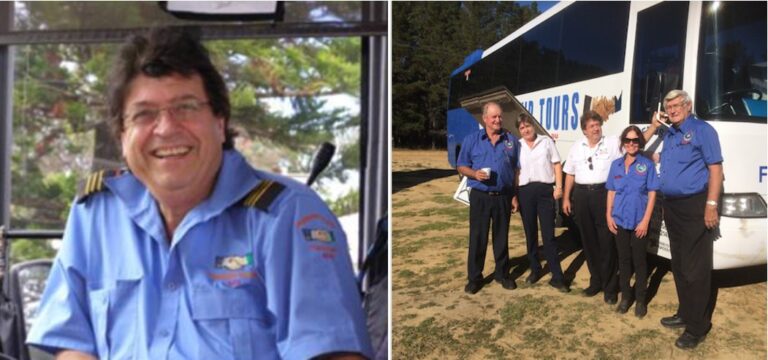
Home Blog Page 1825

Spathis Friendship Tours: How Giannis Spathis turned his love of travel into a profession

Travel agencies in Australia and around the world have been hit hard by the coronavirus pandemic, but as Giannis Spathis, director and owner of the Sydney-based travel agency Spathis Friendship Tours, tells The Greek Herald, we must adapt to the new situation and remain optimistic.

This, after all, is what Mr Spathis has been doing since he arrived in Australia. He does not give up despite the difficulties that arise.

From Zakynthos to Australia:

Giannis was just eighteen years old when he immigrated to Sydney from Zakynthos in May 1964, following his nine brothers who had come to Australia in search of a better life.

“I am the 17th of 18 siblings, of whom only 12 lived. As soon as I arrived in Australia I started working. At first, for a few months, I stayed with my brothers in Sydney and then left and went to the countryside. I always preferred it to the city,” Mr Spathis tells The Greek Herald.
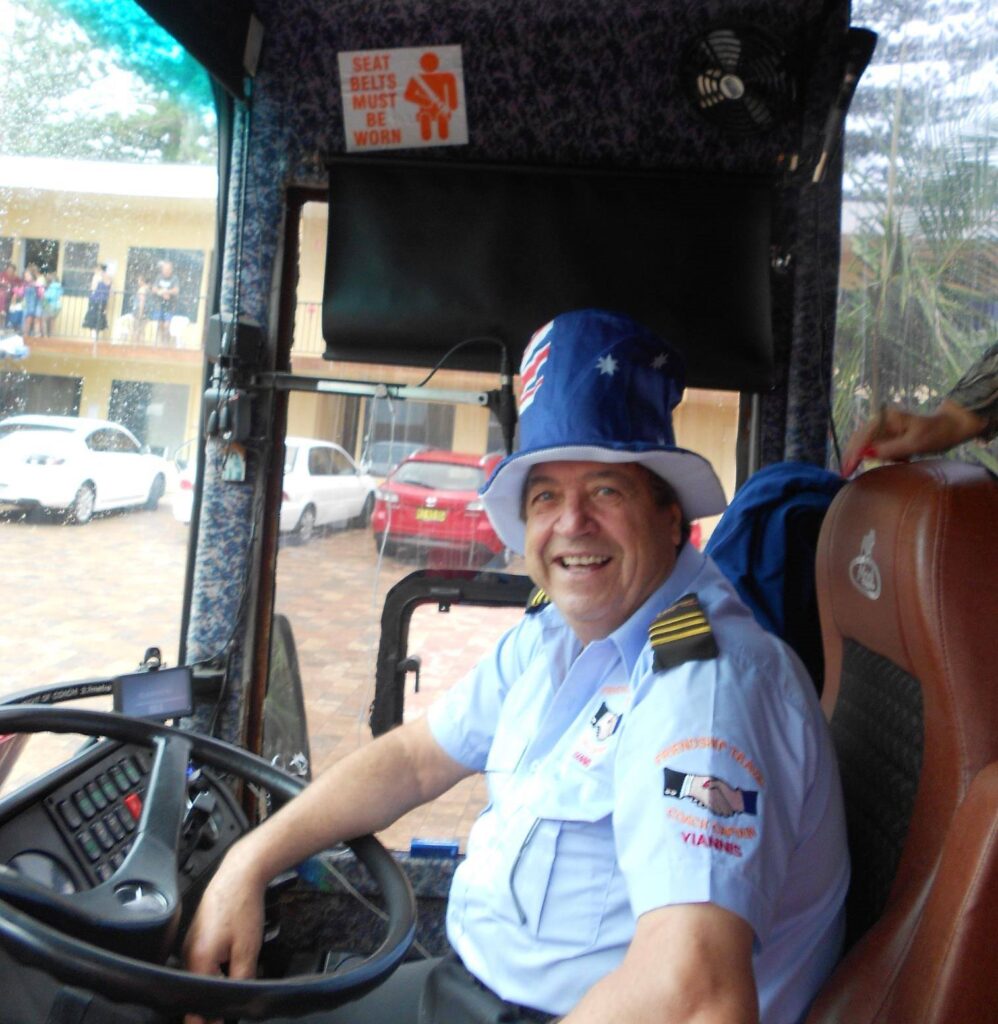
Mr Spathis always preferred the countryside over Sydney. Photo supplied.

In search of a profession that best suited him in his new homeland, the then young Giannis was employed in various jobs. He first worked as a labourer in the quarry where one of his brothers worked and later started his own business, first as a restaurant owner in Singleton in NSW and later as a supermarket owner in Sydney.

“I only knew the words ‘Yes’ and ‘No’ from English. For the first few months, the people I worked with asked what my name was and I answered ‘Yes.’ But I knew I wanted to do something on my own because I did not like being given orders,” he confesses.

The travel agency Spathis Friendship Tours:

The idea for the travel agency came about by chance about twenty years ago.

“As a human being, I can not stay indoors. I had gone on an excursion with a friend who had a bus in Adelaide, with the Zakynthian Brotherhood. This trip gave me the idea to start my own business and so I started renting buses and started the trips,” says Mr Spathis, who during each trip, in addition to the role of driver, also takes on the role of guide.
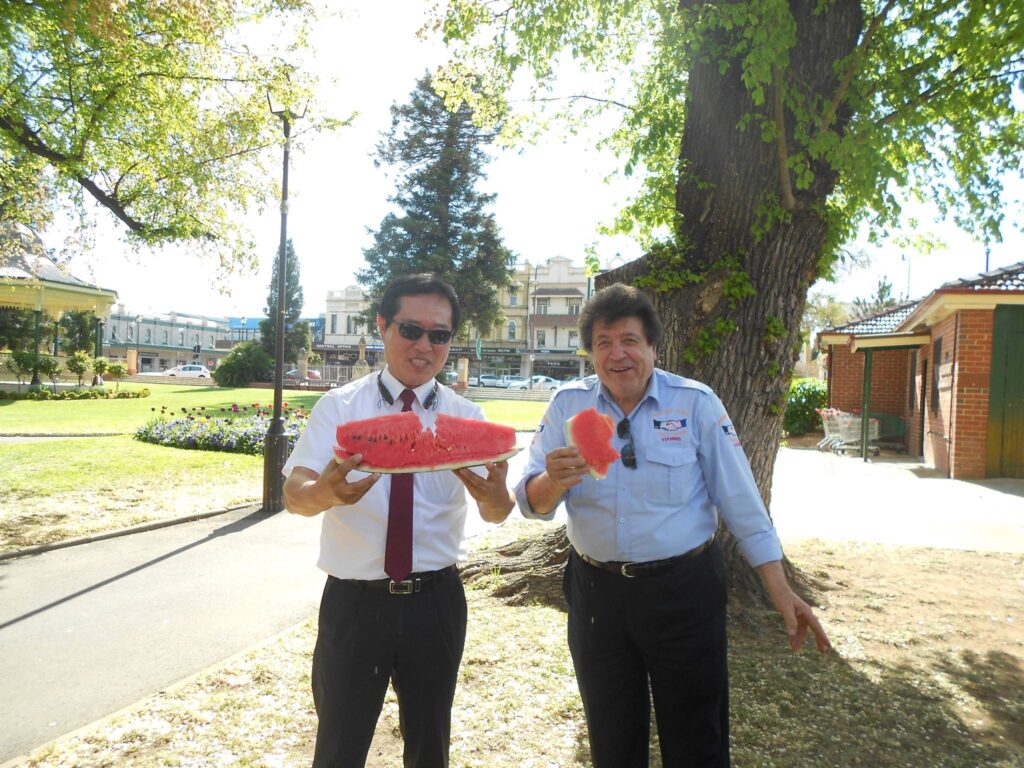
During each trip, Mr Spathis takes on the role of driver and tour guide. Photo supplied.

“I like to make people laugh but guided tours are an art that takes time and study. For every trip, especially the longest ones, I have to study the trip up to a week in advance. But we always have a good time and I do not remember in all the years I’ve done this job, any problem I’ve had with my clients,” emphasises the expatriate businessman and continues, “my clients loved me as I loved them. When there is an appreciation, the rest comes second.”

In addition to trips within Australia, which range from day trips to one-month trips, Spathis Friendship Tours also travels abroad.

“My wife travels abroad because I do not like airplanes,” says Mr Spathis with humor, as he recognises the valuable help and support of his beloved wife, Voula.
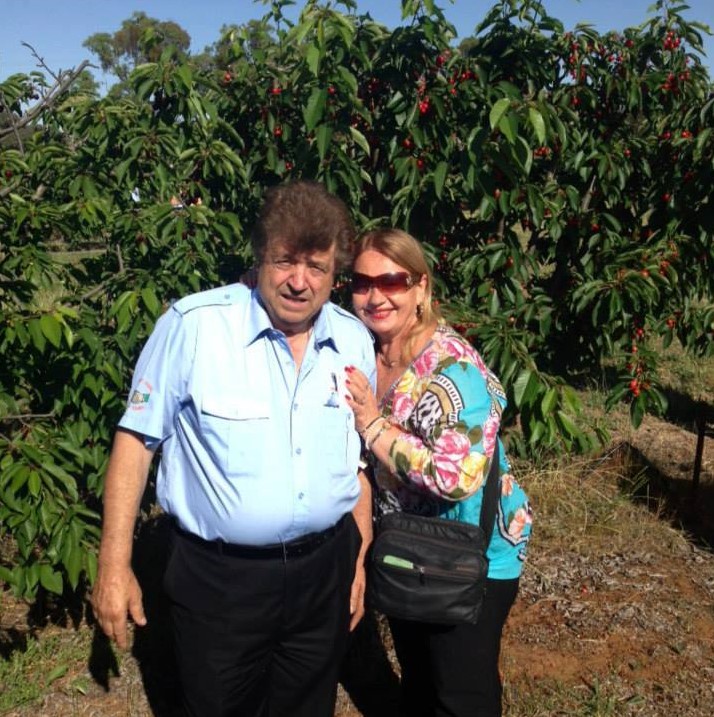
Mr Spathis recognises the valuable help and support of his beloved wife, Voula. Photo supplied.

Among the destinations that Giannis Spathis think stand out are the 36-day tour of Australia and the trips to South Australia.

“Australia has many beautiful places to see but at the moment we can not go beyond the borders of NSW. So we discover the beauties of our state by adhering to all the health and safety regulations,” concludes the Greek Australian owner of the travel agency Spathis Friendship Tours.

Spathis Friendship Tours is planning the following excursions in New South Wales: 

• September 26 & 27: Dubbo, Two-day pilgrimage to Panagia Mytidiotissa, cost: $ 250 / person

• October 31 & November 1: Tamworth, Two-Day Pilgrimage to the Church of St. Dimitriou, cost: $ 250 / person

• Day Trip to Queanbeyan at St. Demetrius Church, cost: $ 50 / person

Contact: 9799 4931, 0401 740 126 (Voula)

Professor Vasso Apostolopoulos wins spot in the Educator Top 50 List

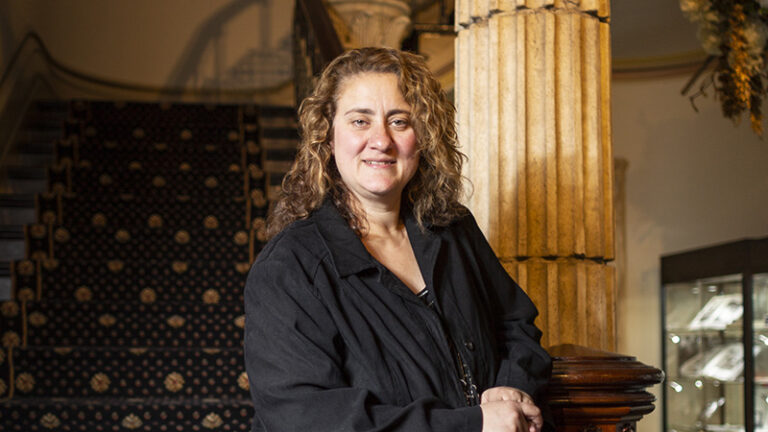
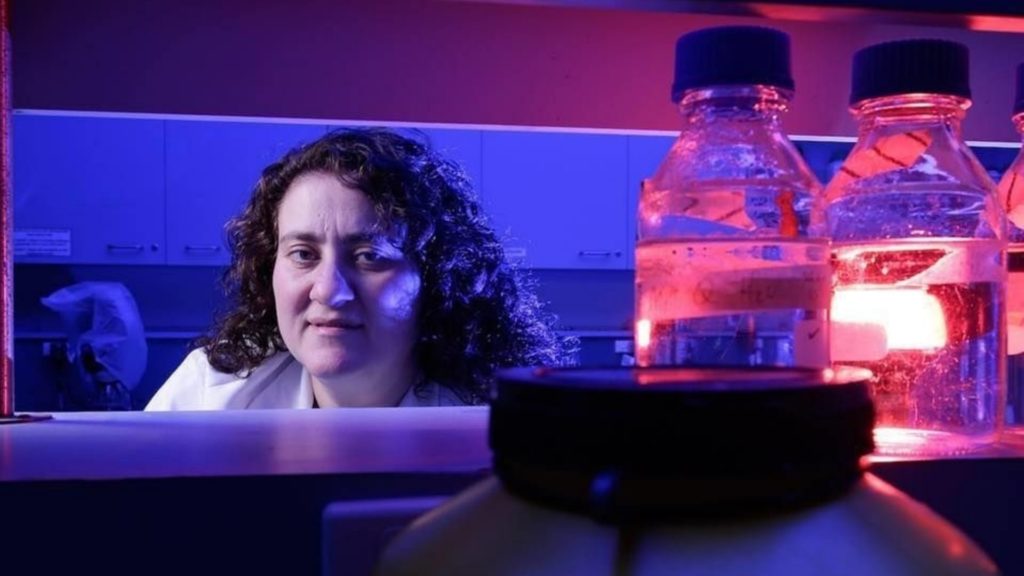
World-renowned researcher and immunologist from Victoria University, Professor Vasso Apostolopoulos, has made The Educator Higher Education ‘Hot List’ 2020.

The Educator Higher Education recently announced its second annual Hot List, with 50 professionals around the country making the rank.

Professor Apostolopoulos was singled out for her outstanding contribution to higher education over the last twelve months, as well as for her work as a researcher with expertise in immunology, x-ray crystallography, medical chemistry and cellular biology.

Professor Vasso Apostolopoulos has made The Educator Higher Education ‘Hot List’ 2020.

“I’m very proud that my work has been acknowledged by The Educator. It has been a difficult year, but I think my team and the wider university will continue to rise to the challenges ahead,” Professor Apostolopoulos said in a statement.

The Greek Australian and her team are also currently working on a vaccine to prevent COVID-19, using a unique vaccine technology recently established in Victoria University’s lab.

READ MORE: TGH Exclusive: The Greek Australian researcher behind Australia’s first potential coronavirus vaccine.

Some of the other awards Professor Apostolopoulos has received include Premier’s Award for Medical Research, Victoria’s Young Australian of the Year, Greek Australian of the Year, and Woman of the Year.

She was named as one of the most successful Greeks abroad by the prestigious Times magazine.

John Mavroudis is the artist behind the powerful new TIME magazine cover

John Mavroudis’ cover for the latest issue of TIME magazine pays tribute to all 200,000 Americans who have lost their lives to COVID-19 this year.

Mavroudis’ concluding ellipses serve as a stark reminder of what will only continue during the pandemic in the absence of true leadership at the highest levels.

“I really hope this cover awakens the consciences of those who stand apathetically in the face of this catastrophe. Science and common sense are the answer to this crisis,” the Greek artist told local Greek media.

My latest cover for TIME magazine. This is a slow, steady march of death… with little flash or pizazz to rivet the…

Posted by John Mavroudis on Thursday, 10 September 2020

“This is a slow, steady course of death. How many more before we finally wake up?” he added on Facebook.

This cover is Mavroudis’ third for the magazine, however, it is one of his most important as it marks the first time since September 2001 that TIME has featured a black border.

The only other time the magazine included a black border was after the 9/11 attacks.

Greek President visits Kastellorizo on the 77th anniversary of its liberation

0

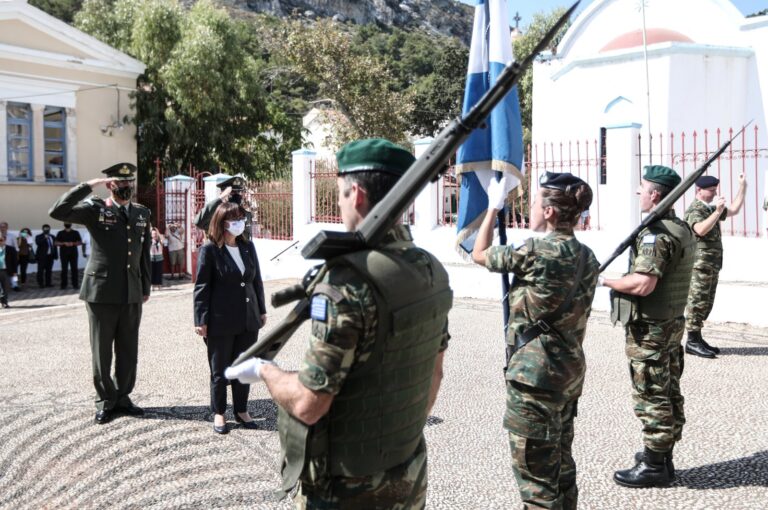
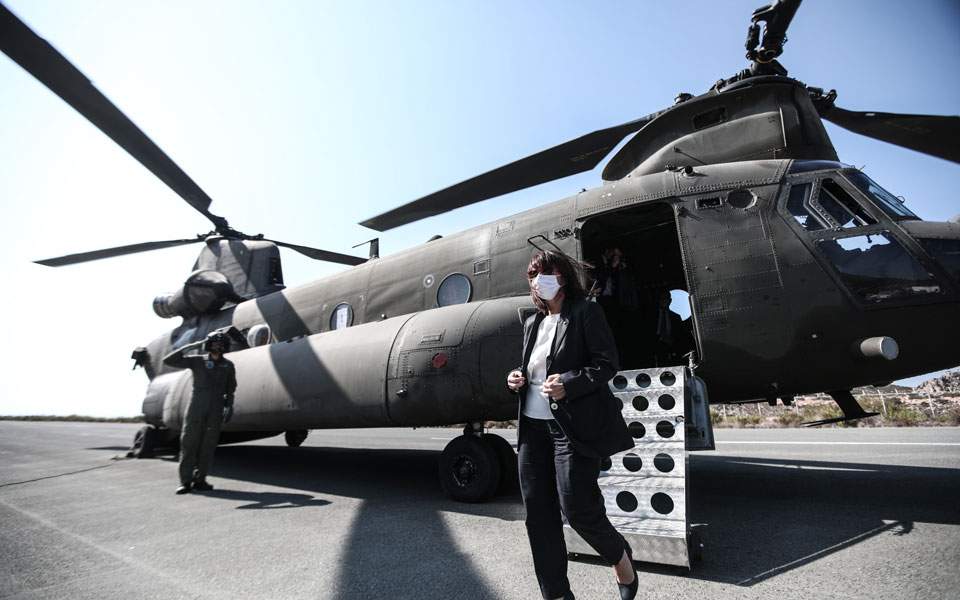
Greece’s President, Katerina Sakellaropoulou, visited the Greek island of Kastellorizo on Sunday to mark the 77th anniversary of its liberation.

During her visit, she accused Turkey of undermining good neighborly relations with the citizens of the island and of Greece more generally.

“We are going through a difficult and dangerous period. The Turkish leadership is intensifying the pressure on our country, proceeding to make aggressive statements,” Sakellaropoulou said.

“Kastellorizo is a valuable part of our country,” Katerina Sakellaropoulou said during her visit. Credit: Thodoris Manolopoulos/Greek President’s Office via AP.

“The escalation of this aggressive rhetoric by the Turkish leadership is raising barriers between the peoples, creating suspicion and hostility, threatening the ties between them.

“Kastellorizo is a valuable part of our country. It is not just strategic for shaping and claiming the rights of Greece. It has even greater moral significance.

“It is the place that embodies the concept of patriotism, in its highest expression. The place that remained Greek, in defiance of any threat.”

Sakellaropoulou also visited the war museum on the island and claimed that Athens will follow a “path of diplomacy of dialogue,” even though Greece has refused Turkey’s calls to sit down at the table and solve the matter through dialogue.

Her visit to Kastellorizo was later criticised by Turkey’s Defense Minister, Hulusi Akar.

“As if there is no other island left for celebration, they come to these. These (acts), of course, disturb us,” Akar said as he paid a visit to Turkey’s southwestern Kaş district, across from the Greek island of Kastellorizo.

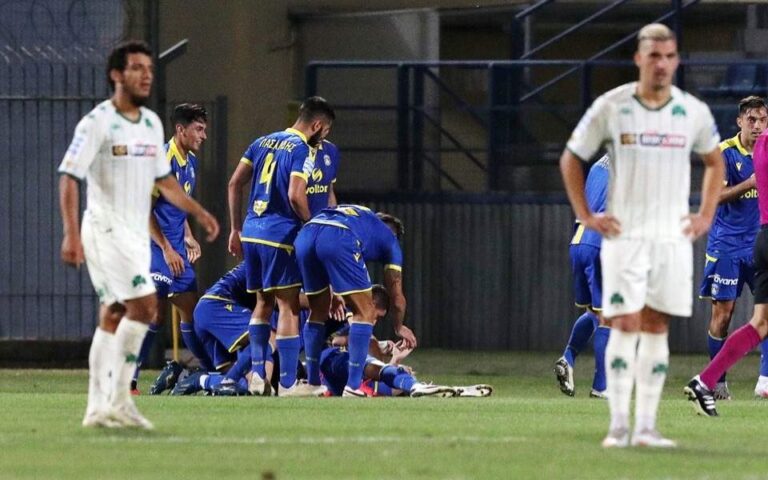
Panathinaikos falls at the first hurdle of the Greek Super League

The new Super League season kicked off this weekend with PAOK and Aris winning at home, while Panathinaikos began its campaign with a reverse on the road.

The two Thessaloniki clubs started off on Friday, due to their midweek European fixtures to come. Aris came from behind to beat visiting Lamia 3-1, while PAOK had teenage sensation Christos Tzolis to thank for its 1-0 victory over Larissa.

Panathinaikos suffered a 1-0 loss at Asteras that scored through Adrian Riera on Sunday to get a well deserved win in Tripoli.

OFI drew 1-1 at home against Panetolikos on Saturday, while Volos upset host Atromitos at Peristeri winning 2-0 on Sunday, with both goals coming after Atromitos was left with 10 men.

The match between the two promoted teams, Apollon and PAS Giannina will take place on October 21, after their request to begin their games in the top flight a little later.

The derby between AEK and Olympiakos, the teams that contested the Cup final on Saturday, will meet on December 16.

Source: Ekathimerini.

National Remembrance Day for the Genocide of the Greeks of Asia Minor

The National Remembrance Day for the Genocide of Asia Minor Greeks by the Turkish state was established by a unanimous decision of the Greek Parliament on September 24, 1998 and is celebrated every year on September 14. 

The initiative was taken by three PASOK MPs of Asian Minor descent, Giannis Kapsis, Giannis Diamantidis and Giannis Charalambous, who submitted the relevant bill on May 12, 1997.

To mark the national day, we take a look back at the events leading up to the tragic genocide.

Hellenism in Asia Minor:

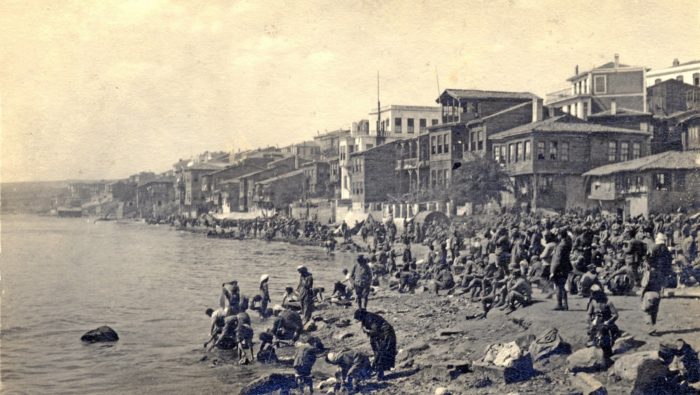
Smyrna, the modern-day city of Izmir on the Turkish coast of the Aegean sea, was undoubtedly one of the wealthiest cities of the Ottoman Empire.

Smyrna was undoubtedly one of the wealthiest cities of the Ottoman Empire.

It was home to one of the largest populations of Greeks and Armenians in the Empire. Together, they constituted the Christian community of the city, which lived peacefully side by side with the Muslim and the Jewish communities for centuries.

However, politics, and the competing interests of the main global powers, alongside the rising tide of nationalism and the outbreak of the First World War, were the factors that determined the fate of Smyrna and its citizens for the rest of the twentieth century and beyond.

The Genocide of Greeks in Asia Minor:

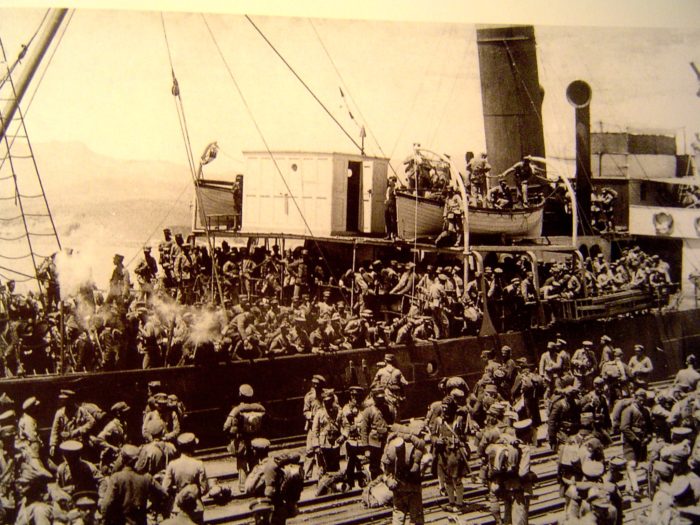
As part of the Greco-Turkish War, which raged from 1919 to 1922, Greece’s armed forces went to Smyrna on May 15, 1919. For a brief time, it appeared that the extermination of the Hellenic race had ceased.

But after major military and political errors made by the Greek government, the Turkish army regained control of the city on September 9, 1922.

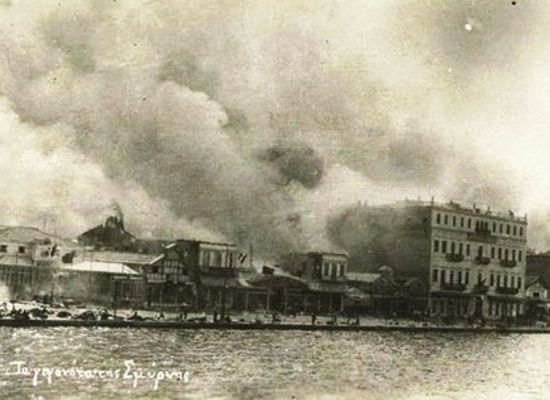
The great fire of Smyrna began on September 13, 1922, and lasted for approximately nine full days, until September 22.

Eyewitness reports state that the great fire of Smyrna began a few days later on September 13, 1922, and lasted for approximately nine full days, until September 22.

The fire’s results were catastrophic – Over 100,000 Greeks and 30,000 Armenians were killed.

The number of refugees who were forced to leave the city and its surrounding countryside was between 25,000 and 100,000.

Churches, ornate villas, and mansions of great architectural importance, as well as schools and entire market areas, were gone forever without a trace.

The city suffered such enormous damage to its infrastructure that much of it literally had to be rebuilt from the ashes.

Today, the area is an enormous park, known as Kültürpark in Turkish, which serves as Turkey’s largest open-air exhibition center. There are no reminders there of the glory which once was Smyrna.

Turkish gas exploration ship leaves the east Mediterranean

0

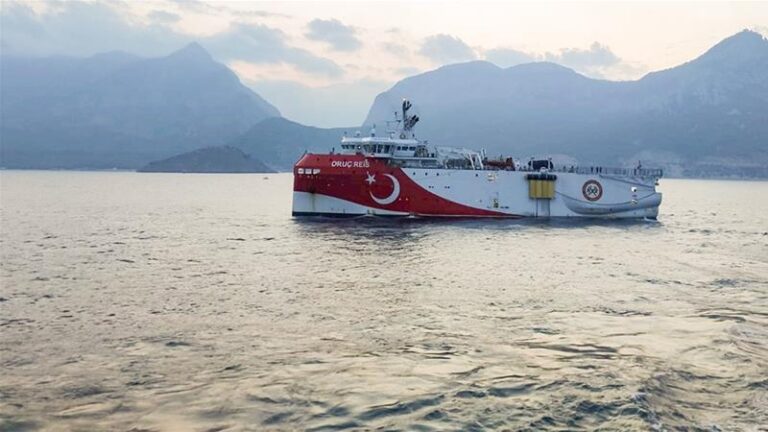
Turkish seismic research vessel Oruc Reis returned to Turkey’s Antalya port on Sunday, a move that Greece said was a positive first step to ease tensions over gas exploration rights in the East Mediterranean.

“The return of the Oruc Reis is a positive first step, I hope there will be continuity. We want to talk with Turkey but in a climate without provocations,” Greek Prime Minister, Kyriakos Mitsotakis, told reporters in Thessaloniki.

But Turkish Defence Minister, Hulusi Akar, played down the significance of the move, saying the ship had returned to shore as part of scheduled plans and insisted it did not mean Ankara was “giving up our rights there.”

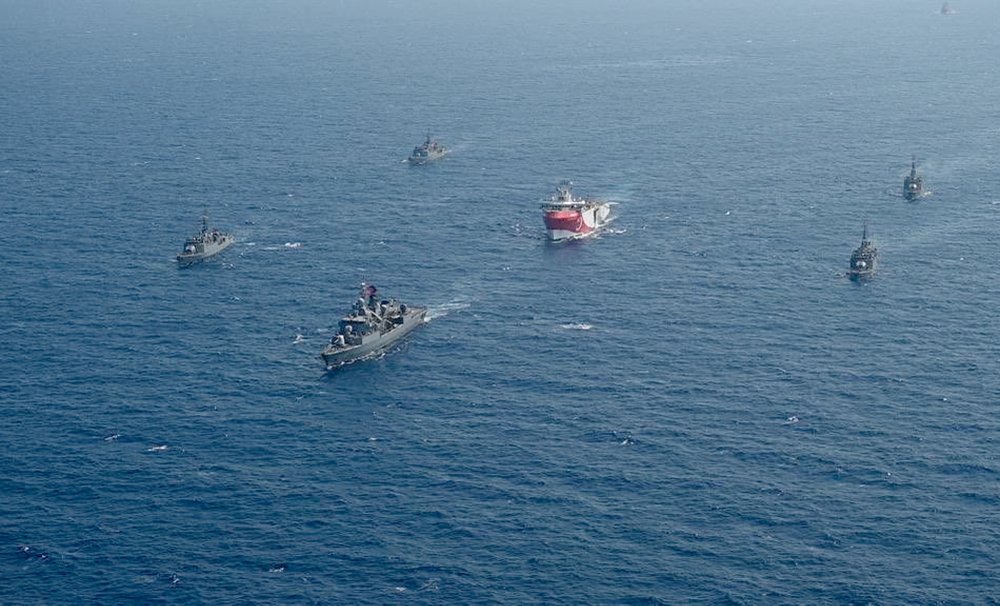
In this photo taken Monday, Aug. 10, 2020, Turkey’s research vessel, Oruc Reis, center, is surrounded by Turkish navy vessels as it was heading in the west of Antalya on the Mediterranean, Turkey. Photo: IHA via AP.

“There will be planned movements backwards and forwards,” Akar told state news agency Anadolu in Antalya, southern Turkey, on Sunday.

Tensions flared last month between Turkey and Greece after Ankara sent Oruc Reis to map out possible oil and gas drilling prospects in waters claimed by Greece, Cyprus and Turkey.

Ankara faces potential sanctions from the European Union, which fully supports member states Greece and Cyprus, over the dispute. But many states, including Germany, want to defuse the stand-off through dialogue.

“A sanctions list exists as an option [against Turkey]. Our desire is not to see it implemented but it will be done if we see that the other side is not returning to the path of logic,” Mitsotakis said.

READ MORE: EU threaten Turkey with sanctions if ships don’t withdraw from Greek waters.

Greece to build permanent migrant centre on Lesvos to replace Moria

0

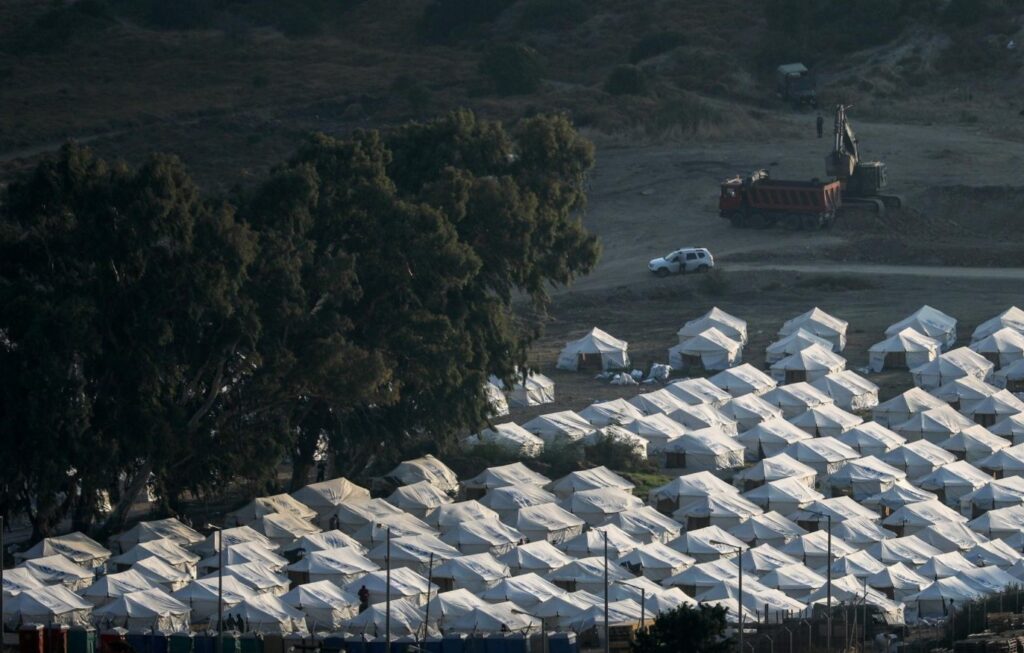
Greece will build a permanent migrant reception centre on Lesvos to replace the overcrowded refugee camp destroyed by a fire last week, Greek Prime Minister, Kyriakos Mitsotakis, said on Sunday.

The fire at the Moria reception centre last week left more than 12,000 people without shelter, forcing most to sleep out in the open without proper sanitation or access to food and water, and pushed the migration issue back up the European agenda.

RELATED: Moria ‘completely destroyed’ as fire tears through migrant camp.

Mitsotakis said the construction of a new reception centre on the island to replace the notoriously squalid and overcrowded Moria facility would be the chance to reset the policy behind handling migrant arrivals.

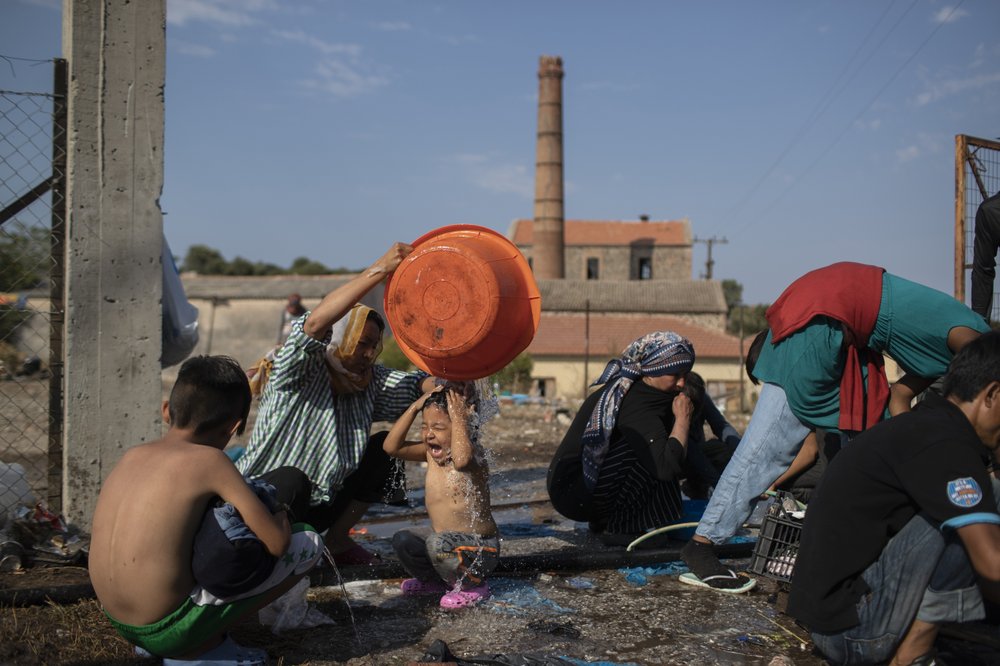
A woman washes a girl as migrants gather near Mytilene town, on the northeastern island of Lesbos, Greece, Saturday, Sept. 12, 2020. Credit: AP Photo/Petros Giannakouris.

“We want to turn this problem into an opportunity,” Mitsotakis said.

“Europe should be a lot more involved in the management of the new centre wherever we finally decide it should be.”

RELATED: Europe scrambles to address fate of homeless refugees after Greek camp fire.

He appeared to dismiss protests by Lesvos residents who have opposed the creation of a new centre, as well as by migrants demanding to be resettled away from the island.

“I want to say with absolute certainty that there will be a permanent reception and identification centre – I want to send this message in all directions,” he said.

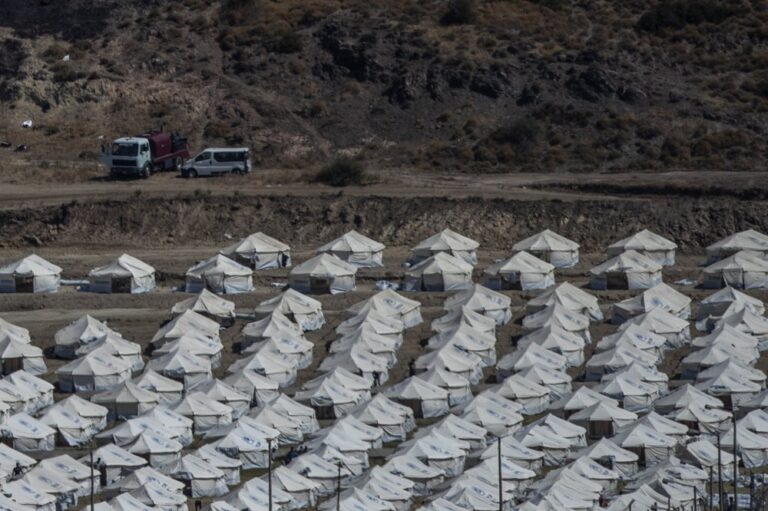
Greek authorities began admitting migrants to temporary tent accommodation outside the main port of Mytilene on Saturday. In a concerning development, they identified what Mitsotakis said were “dozens” of cases of COVID-19.

Migrants were admitted to temporary tent accommodation outside the main port of Mytilene on Saturday. Photo: Reuters /

Officials had been worried about the potential for an uncontrolled spread of the disease from the Moria camp, which had been placed under quarantine before it burned down following the discovery of at least three dozen positive cases.

RELATED: First ever coronavirus case reported in Moria refugee camp on Lesvos.

In the chaos following the fire on Wednesday, authorities lost sight of 35 people who had tested positive, deepening fears of an outbreak among migrants sleeping closely together without proper sanitation.

Earlier, Migration Minister, Notis Mitarachi, said he expected around 1,000 people could be settled in the new tented shelter on Sunday and more would be able to come in over the coming days.

“We want to ensure that everybody has a tent, food and water,” he told reporters.

Source: Reuters.

Traditional Greek Recipes: Yiayia’s Rizogalo (Rice Pudding)

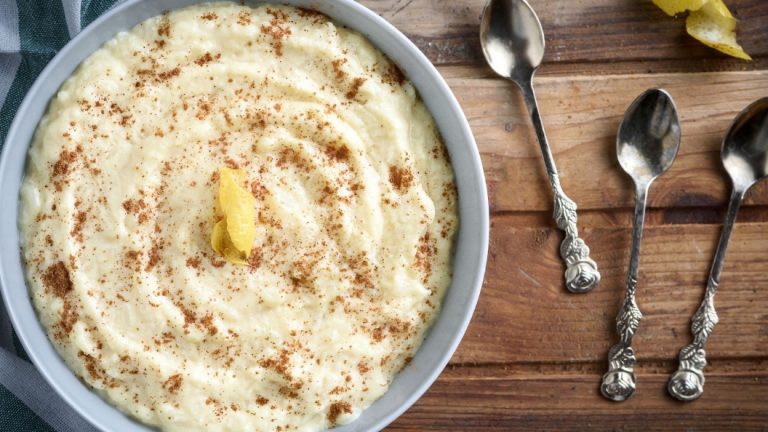
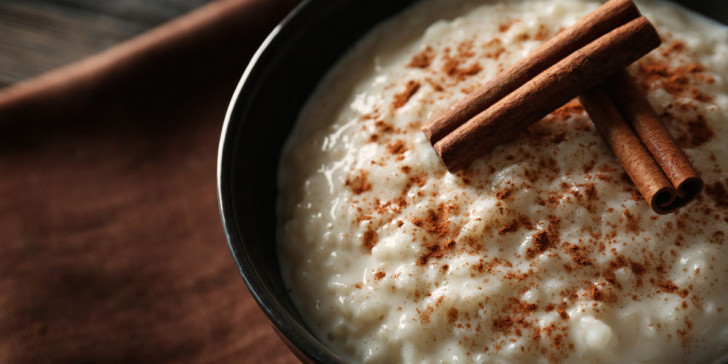
Rizogalo is a traditional Greek style rice pudding flavored with vanilla beans and cinnamon. Rizogalo simply translates to “rice milk”; rizo means “rice” and galo is “milk” in Greek.

Apart from a great dessert, rizogalo is a comfort food and it can be served warm in winter and chilled in summer.

HOW TO MAKE RIZOGALO

The variety of rice used in making a rice pudding is very crucial. Even though its preparation and flavor hugely vary, the end product is always the same – rich and creamy. In order to get this consistency and texture, short-grained white rice is used.

Rizogalo is traditionally prepared using a Greek short-grain rice variety called glacé. The grains of this rice become soft and tender when cooked. They also stick to each other during cooking making the rizogalo thicker and creamier. This type of rice is also suitable for soups. The next best substitute is the Arborio rice, which has similar properties.

Key to making a decadent rizogalo is to stir it constantly to get the creamier texture. Slow cooked rice absorbs more starch and makes the pudding more luscious.

INGREDIENTS (Serves 4)

  • ½ cup round rice
  • 2 cups water
  • 2 cups milk
  • ½ cup caster sugar
  • 1 tablespoon cornflour
  • 1 vanilla pod
  • ½ teaspoon ground cinnamon

INSTRUCTIONS

  1. In a non-stick pot, bring the rice and water to a boil and cook on low heat until the rice is cooked through (about 25 minutes)
  2. At this stage, only very little water remains, and the result is like a kind of porridge. Mix everything.
  3. Reserve a little milk and dilute the sugar and cornflour with a whisk.
  4. Pour the rest of the milk into the rice and add the vanilla pod.
  5. Heat slightly over medium-low heat while stirring, then pour the mixture of milk, sugar and cornflour.
  6. Bring to a boil over low heat, stirring constantly.
  7. Pour into cups and sprinkle with cinnamon.
  8. Enjoy hot or cold.

Kali Oreksi!

Australia-Greece Parliamentary Friendship Group discuss East Med tension and Independence Day Anniversary

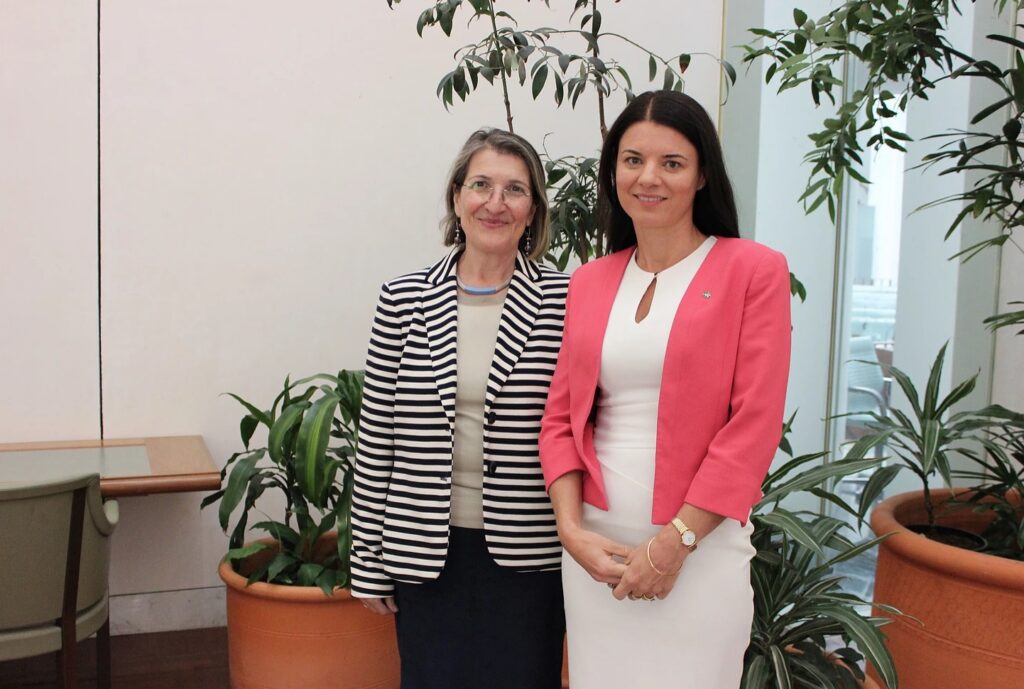
The tension in the Eastern Mediterranean, next Year’s 200th anniversary of the beginning of the Greek Revolution and the way Greece has tackled the coronavirus pandemic were some of the issues discussed in a recent online meeting between Chair and Deputy Chair of the Australia-Greece Parliamentary Friendship Group Dr Fiona Martin and Ms Maria Vamvakinou respectively, the Consul General of Greece in Australia Mr Christos Karras as well as the Australian Ambassador in Greece Mr Arthur Spyrou.

“We discussed bilateral issues concerning Greece and the Greek Diaspora in Australia. It was a very good, informative and constructive conversation that will strengthen our efforts to build on the Greek Australian relationship,” Dr Fiona Martin, told The Greek Herald referring to her Greek background.

“There is a number of federal employees in parliament with Greek heritage like Michael McCormack and Alex Hawke and of course, my paternal grandparents were from the island of Kastellorizo . My full name is Fiona Barbouttis – Martin and in Greek I’m known as Fotini”.

Dr Fiona Martin, Liberal federal member for the Sydney seat of Reid is the daughter of veteran Panhellenic (now Sydney Olympic) football player George Barbouttis and granddaughter of Markos Barbouttis, who had immigrated to Australia from Kastellorizo ​​before World War II.

“Being the member for Reid is like traveling around the world in one day. We have migrant communities from China, Korea, India, Italy, Greece, Lebanon and so many more, and the diversity of our people is visible in our streets. I have great admiration for those who, like my grandparents, uprooted their lives to make a go of it in this lucky country,” Martin said almost a year ago, at her first Parliament speech. 

“I think Australian Greeks have contributed significantly to Australian society and culture and this should be recognised”.

Maria Vamvakinou MP:  ‘Australia – Greece relationship have always been healthy and active’

Speaking to The Greek Herald, Ms Vamvakinou, the Parliamentary Friendship Group’s Deputy Chair and Labor Federal Member for the Melbourne seat of Calwell, explained that Australia and Greece have always shared a “good and active relationship” and the purpose of the Group is to strengthen them further.

Ms Vamvakinou, the first Greek-born woman to be elected to the Parliament of Australia, has been a long advocate for Australia-Greece bilateral relations and has served as the Parliamentary Friendship Group’s Chair and Deputy Chair in previous parliaments. 

“We have many federal MPs who have Greek-speaking communities in their electorates. For these MPs, this group is important so they can be in contact with the issues that concern their voters, ” said Ms Vamvakinou.

“We are all looking forward to the celebration of the Anniversary of the Greek War for Independence. We discussed the importance of this Anniversary for the Greek Diaspora and the way we can celebrate here with the same splendour that will be celebrated in Greece. 

“We hope to hold an event in Parliament, in the presence of the Prime Minister, the Leader of the Opposition and other MPs,” Vamvakinou said, expressing the belief that “the Greek Church under the leadership of Archbishop Makarios will play an instrumental role in the preservation of the Greek language and culture especially for Greek-Australians third and fourth generation”.