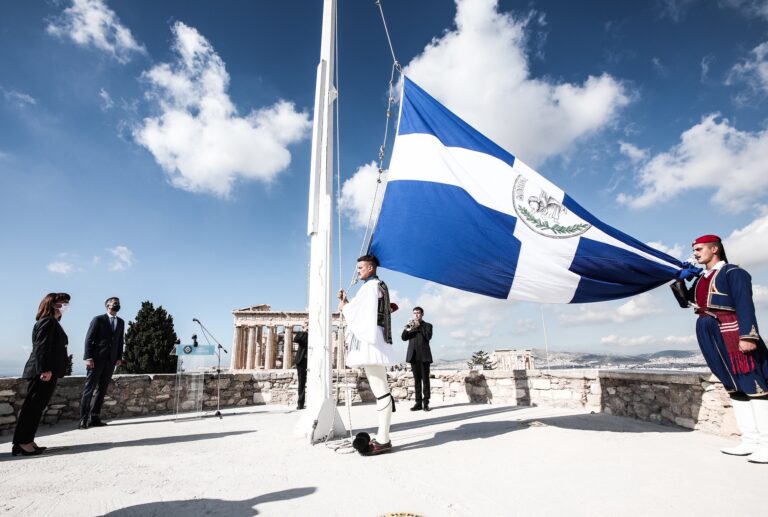
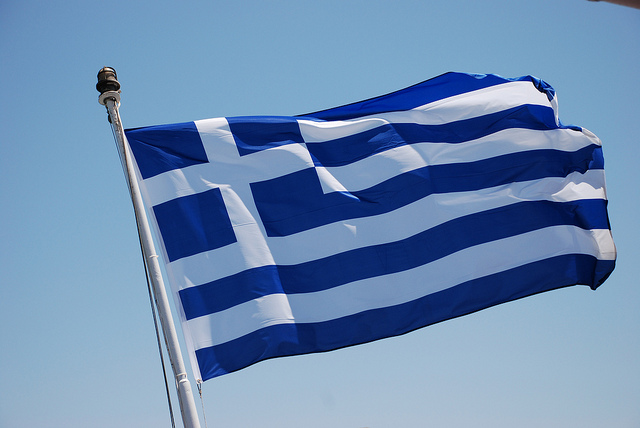
On Monday, Greek President, Katerina Sakellaropoulou, attended the ceremonial raising of the Greek flag on the Acropolis in honor of the 76th anniversary of the liberation of Athens from the Nazis on October 12, 1944.
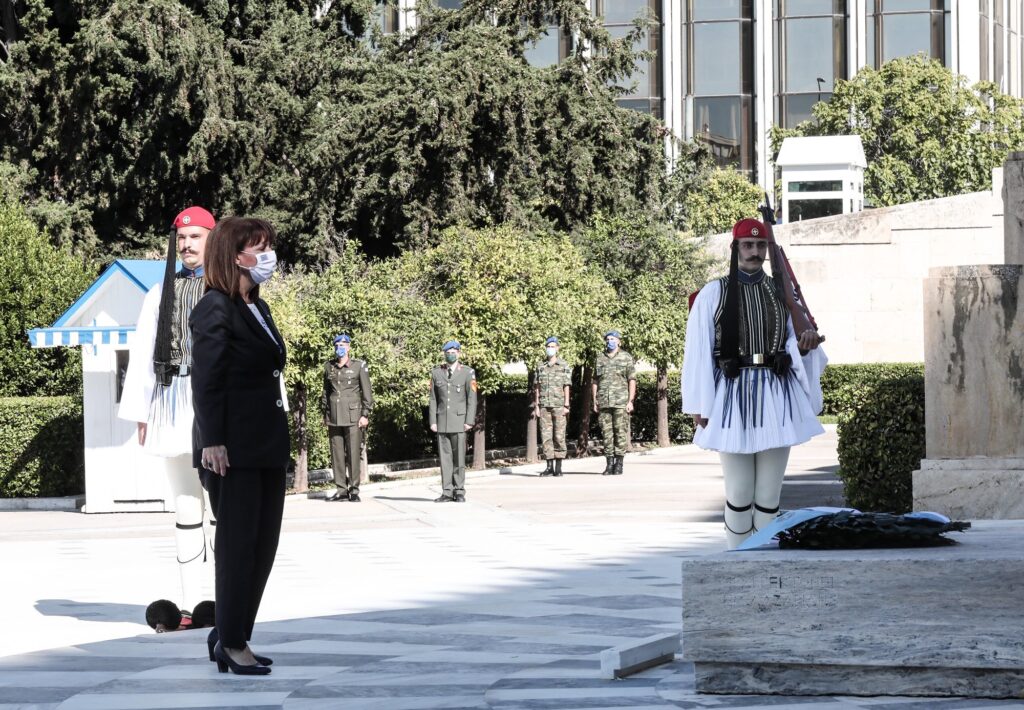
President Sakellaropoulou also visited the Tomb of the Unknown Soldier outside of the Greek Parliament building.
President Sakellaropoulou laid a wreath at the Tomb of the Unknown Soldier outside of the Greek Parliament building. Credit: President GR / Twitter.
In her speech, Sakellaropoulou made reference to the recent trials of the neo-Nazi party Golden Dawn, which ruled that the fascist group had indeed been a criminal organisation fronting as a political party.
She strongly denounced the criminal organisation and its ideology, while honoring those who fought for freedom so long ago.
“On this day, 76 years ago, Athens was liberated from the Nazi yoke. It was a day of national exaltation, of collective joy and returning hope. A day that justified the struggle and the sacrifices of the Greek people during the years of the German Occupation,” the President said.
“We bow with respect to the memory of those who fought for freedom, with the hope that we will never see again in our homeland, in the country that gave birth to democracy, those who are nostalgic for ideologies that steeped the world in blood, or those who express the ideas of, and support, Nazism and fascism.”
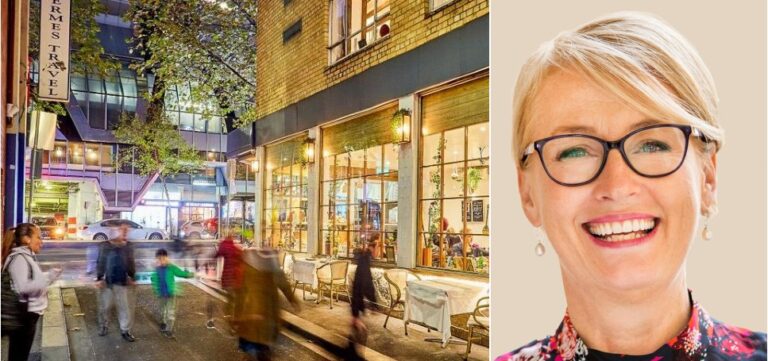
An additional $100,000 will be provided to the Greek precinct on Lonsdale Street over the next two years, according to Melbourne Mayor Sally Capp.
The Mayor of Melbourne has promised that if she is re-elected in the upcoming municipal elections, she will offer the additional financial assistance to promote the Greek precinct on Lonsdale Street and encourage Melburnians to return to the city center again.
The Lonsdale district is one of nine areas to receive financial support.
The Greek precinct on Lonsdale Street has been around since the 1940s.
“The unique and different areas are what really make our city,” Mayor Capp said in a media release.
“We can find pasta on Lygon Street or ‘yum cha’ in Chinatown, have a coffee and enjoy art in the downtown streets, enjoy a spinach pie on Lonsdale Street, dine on the waterfront in the Docklands or on the Yarra River in Southbank, stroll through the funky shops of Kensington or check out the latest deals from North Melbourne.
“I want to ensure that these areas are revitalised as we prepare to reopen. A $50,000 boost this year and next year will be just what we need to get these areas back on track. We want more people to support local businesses, supporting local jobs and local providers of goods and services.
“With extra money for marketing, partner clubs will be able to communicate their unique stories and remind Melbourne residents of what we lacked during the COVID restrictions.
“Councilor Kevin Louey, who leads my advisory ballot, is also a big supporter of the special areas. If we are both re-elected, Kevin will work with District Representatives to give them a stronger voice and the support they deserve from the City of Melbourne.”
Councillor Louey added that it has “never been more important to be proactive in supporting local areas and businesses.”
“As Sally says, we want Melbourne to be a ‘Yes’ town… We have experienced an economic downturn and I know how difficult it can be for businesses to get back on track. My priority, if re-elected, will be to work closely with each of the regions to do what I can to support every business, every job and every local craftsman,” Mr Louey said in a statement.
The President of the Greek Community of Melbourne, Bill Papastergiadis, welcomed the statement of the Mayor.
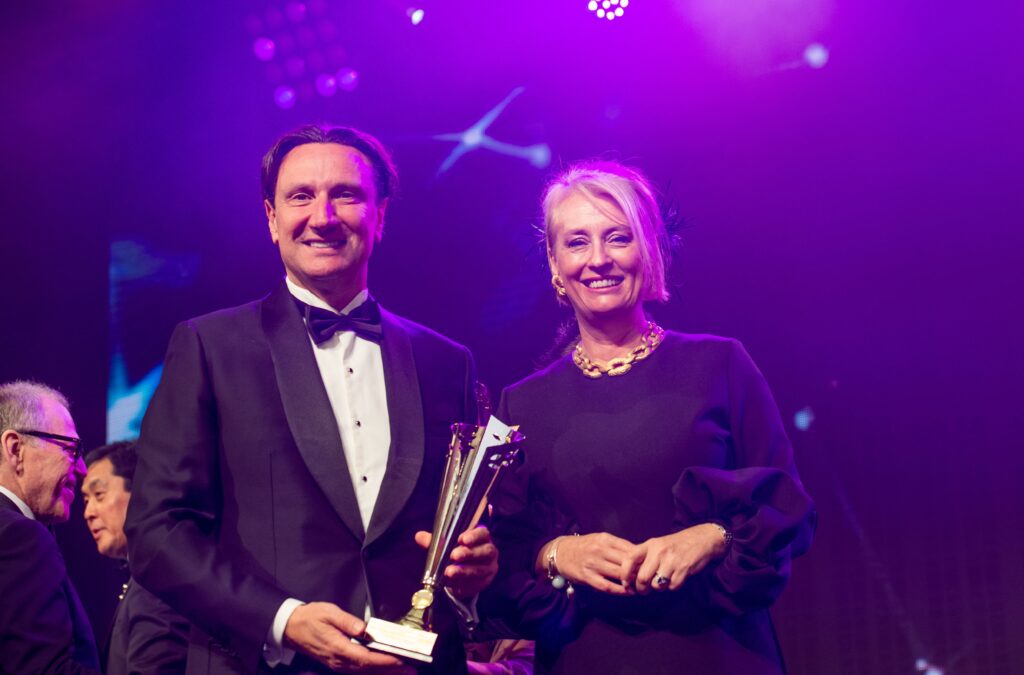
Bill Papastergiadis with Melbourne Mayor Sally Capp. He was given an award by the Asian Executive Group before 1000 people at the Palladium for leadership in the property industry.
“For the last two years, the Community and I personally have worked closely with Mayor Sally Capp,” he said.
“She is always by our side, as a Community and as a Greek region. Her goal is to constantly help us in our projects. She attends our events and communication with her is always direct and effective.
“We thank her for the promise to keep the small piece left on Lonsdale Street, Greek. Because as we all know, the great migratory flow started from there in the 60s and 70s. We know that the Greek quarter around Lonsdale Street has shrunk, but we can never forget the history and the role that this Greek quarter played in our community and in the wider society in general.”
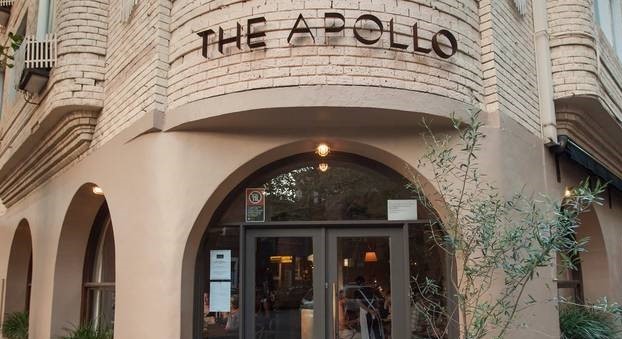
The Apollo restaurant in Potts Point has been fined over a new coronavirus breach three months after being at the centre of one of Sydney’s biggest COVID-19 clusters.
During a routine business inspection on Saturday, Kings Cross police found the up-market restaurant in McLeay Street was in breach.
“It was established that the restaurant was using an outdated COVID Safety Plan and was not up to date with the current requirements under the Public Health Act,’’ NSW police said in a statement released today.
“Further, the manager was unable to locate a copy of the venue’s liquor licence, as required under Liquor Regulation 2018.”
The manager was issued with a $5000 fine.
In July, the restaurant was closed down for two weeks after a staff member tested positive to COVID-19. A further 22 cases, including diners, were linked to the restaurant.
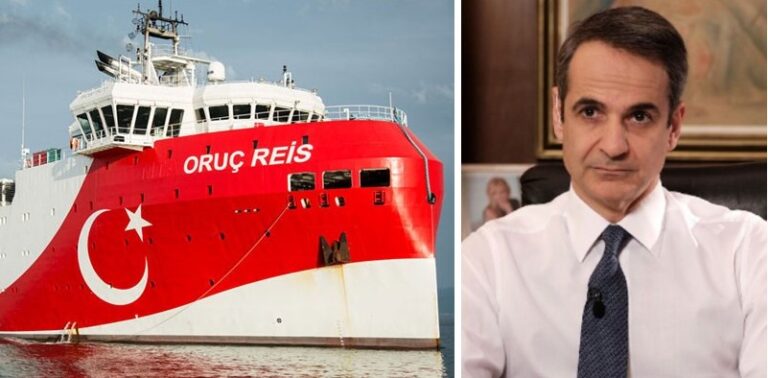
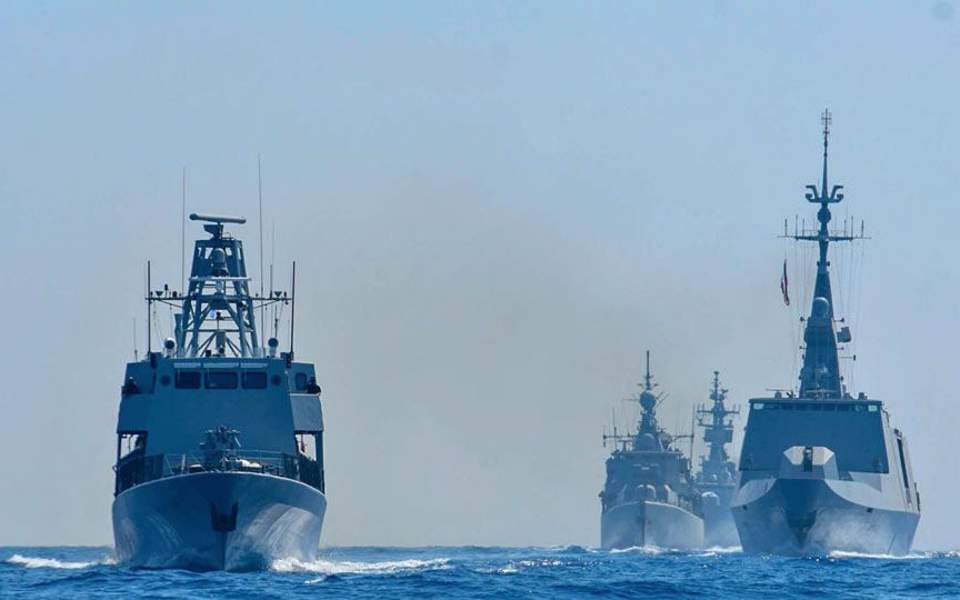
Greece accused neighbour Turkey of undermining efforts to ease a crisis over eastern Mediterranean drilling rights on Monday, after Ankara redeployed a survey vessel for new energy exploration near the island of Kastellorizo.
The Turkish search vessel, Oruc Reis, left the port of Antalya on Monday for a mission ending October 22.
Turkish Defense Minister, Hulusi Akar, said the vessel was continuing with its “planned and scheduled activities,” adding that the Turkish navy would provide “support and protection” if necessary.
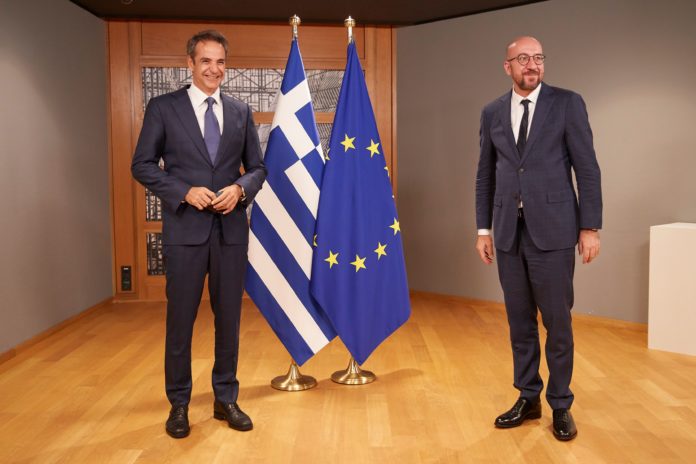
Greek Prime Minister, Kyriakos Mitsotakis, discussed the development on the phone with European Council President, Charles Michel, saying he would bring it up at the next council meeting on October 15-16.
Mitsotakis has discussed the developments with European Union President, Charles Michel. Credit: Greek Government
“This new unilateral act is a severe escalation on Turkey’s part,” a government statement quoted Mitsotakis as saying.
Turkey said Greek objections were “unacceptable,” insisting that the research vessel was operating within Turkey’s continental shelf — an area just 15 kilometers (nearly 10 miles) from the Turkish coast and 425 kilometers (about 265 miles) from mainland Greece.
“It is unacceptable for there to be opposition against our country, which has the longest coastline to the Eastern Mediterranean, operating 15 kilometers from its mainland,” Turkey’s Foreign Ministry said in a statement, adding Greece’s criticisms were “baseless accusations with no standing in international law.”
Greece’s Iraklio Navtex station on the island of Crete, issued a counter-Navtex on Monday.
In response, Greece’s Iraklio Navtex station on the island of Crete, issued a counter-Navtex on Monday.
According to the Greek notice, an unauthorised station has broadcast a Navtex inside a Greek Navtex service area for “unauthorised and illegal activity in an area that overlaps the Greek continental shelf.”
It added that the Iraklio Navtex station has the authority to broadcast Navtex messages in the area.
Turkey also faces the threat of sanctions from the European Union, to which both Greece and Cyprus — an island republic off which Turkey has sent drilling ships — belong.
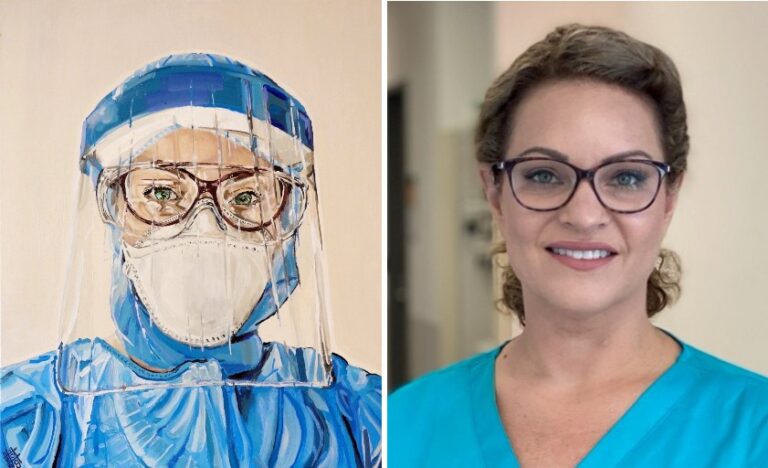
An exquisite portrait of Greek Australian nurse, Helen Zahos, will feature in a special art exhibition called the ‘Salon des Refusés’ from October 9 to November 1 this year.
The exhibition is held in conjunction with the Brisbane Portrait Prize and the Royal Queensland Art Society (RQAS).
Painted by renowned artist, Ben Fuog, the detail of Helen’s blue nurse uniform is a sharp contrast to the face mask she is wearing, reminding the viewer of the important yet dangerous role played by healthcare professionals during the coronavirus pandemic.
“Given the current circumstances, I couldn’t have had a more pertinent subject to paint. Helen is an impressive representation of so many who put others before themselves and an example of what humanity should aspire to be,” Ben Fuog tells The Greek Herald exclusively.
For her part, Helen Zahos says that although she thought the request was “unusual” at first, she was still “flattered that an artist of Ben’s calibre wanted me as his subject.”
“As the painting was being done and [I saw] what Ben was capturing, I realised the significance of this painting,” Helen tells The Greek Herald.
“History is being written. This global pandemic will be spoken about for years to come and there are frontline workers that have risked their lives to serve others, thousands of which lost their lives serving their community.
“2020 is also the Year of the Nurse and Midwife, and I think coupled with the historical moment captured in the painting, I feel really honoured and privileged to be the subject.”
If you would like to see Helen’s portrait, or even the work of other artists, you can do so by simply visiting the gallery between Tuesday – Sunday 10am-3.30pm. Exhibition attendance is free and tickets are not required.
A new ‘miGRant’ survey has been announced by a group of academics who want to help create a better Greek language education for Greek children in Australia.
As part of the survey, researchers from Macquarie University in Australia, Aristotle University of Thessaloniki and the University of Hamburg in Germany, will investigate adolescent digital literacy practices to design a better approach to Greek language education for the youth of new migration background.
To do this, they are looking to talk to new Greek migrant families who have children between the ages of 11-15 years, have moved to Australia between 2010-2018 and at least one parent speaks Greek as their first language.
Two one-hour interviews using Zoom (or similar technology) will be conducted between November and mid-December 2020.
If you are interest in participating or would like more information, please contact Associate Professor Panos Vlachopoulos from Macquarie University at panos.vlachopoulos@mq.edu.au or the MIGRANT team at Aristotle University of Thessaloniki at migrant@auth.gr.
In 2021, Greece will be celebrating the 200th anniversary of the uprising of Greek revolutionaries against the Ottoman occupation in the Greek War of Independence, also known as the Greek Revolution.
An international calendar of events has been endorsed by the Greek Government to acknowledge this anniversary.
In South Australia, the Foundation for Hellenic Studies is launching ‘Gr2021’ as the promotional platform for events commemorating the bicentennial. All community groups and individual organisers are invited to send their details and event information to media@gr2021.com.au for inclusion on the website.
In Australia, one of the earliest Greek diaspora communities will be establishing a permanent monument on Rose Street Thebarton, between St George Church and St George College, Thebarton, which has been made possible with the support of members of the SA community.
Additional events will be announced over the coming months, with the following events confirmed:
The official unveiling of the permanent memorial at a community event on 25th March 2021, to honour in perpetuity those who made the ultimate sacrifice to secure freedom for Greece.
The launch of the inaugural St George College Biennial Art Prize with a prize pool of $11,000 and the 2021 theme of “Revolution – what Independence means for the World.” The prize winners for sculpture and work on canvas/paper will be judged by a panel of acclaimed artists and critics, presenting the judges’ selection of first, second and third prize, and a Democratic (People’s) Choice award. The prize winners will be announced at a twilight event on July 2, 2021 at the opening of the public exhibition to be held in the St George College Art Gallery. Entry forms will be released via Gr2021.com.au and www.sgc.sa.edu.au on October 15, 2020. Art will be available for purchase.
A return visit of the Evzones for ANZAC Day (subject to COVID19 restrictions).
A Bourdo Photography exhibition and projections chronicling the Spirit of the Evzones, in late April.
A lecture series including one by Dr George Frazis for students of all ages on May 27, 2021.
Book launch of books written by people of Greek origin or with a Hellenic theme in June 2021.
Interested participants can sign up online to receive news, announcements and invitations to attend events, including the unveiling of the Memorial and the Art Prize and Exhibition.
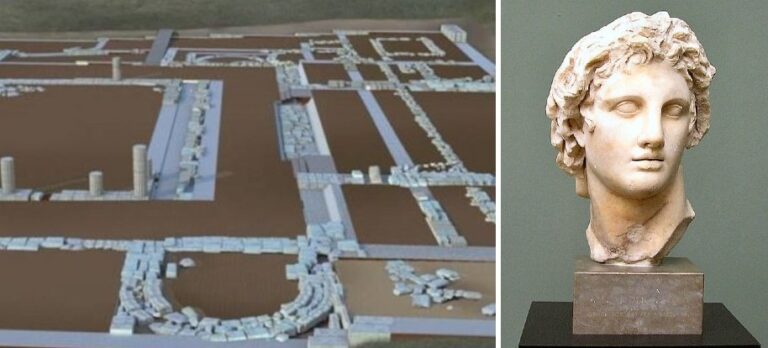
Greece’s Ministry of Culture estimates that the palace in Pella where Alexander the Great was born will be open for visitors next summer, according to an Athens-Macedonian News Agency (AMNA) report.
When the relics of the building were excavated in 1957, no one knew it was the palace where the future King was born. Nearby there was an arena where Alexander played sport with the children of the aristocracy and exercised in a huge swimming pool.
“The palace had a public character and inside was the room where the banquets took place, or the room of the throne, if I am allowed to use this expression,” the director of Pella Ephorate of Antiquities, Elisavet Tsigarida, told AMNA.
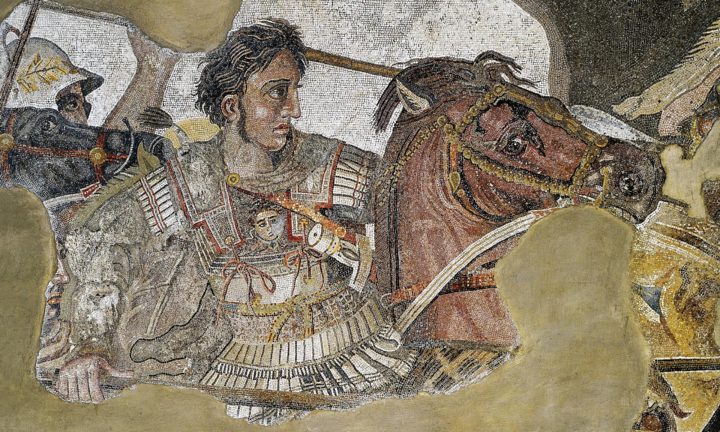
Alexander the Great: Mosaic from the House of the Faun, Pompeii. Credit: Wikipedia.
The Ephorate Director emphasised that the works, funded by the European Union, are currently in full swing and notes that the site could be open to the public in the summer of 2021 if everything goes smoothly.
Visitors will be able to see the palace floor plan at the foundation level while the goal of the Pella Ephorate of Antiquities is to present a digital tour at the visitor center which is expected to be built in 2023.
In the center, visitors can watch a digital representation not only of the palace where the Macedonian king was born, but of the building ensemble which consisted of seven huge buildings with inner courtyards, corridors, stairwells and galleries that were connected to each other.
“The total area is around 70 acres. These dimensions can be understood if we take into account the fact that Pella was the capital of the Macedonian Kingdom at the time. The original palace was smaller, but it was expanded after the campaign of Alexander the Great,” Tsigarida said.
“The period from 320 to 250 BC was a time of great prosperity for Macedonia, while the wealth of the palace was also known. Let’s not forget that throughout the third and second century BC, Pella was the center of the Macedonian Kingdom, one of the most important states of the time.”
These were, after all, the reasons why the palace was looted by the Romans when the Macedonians were defeated in 168 BC. The victorious army went straight to Pella.
“The Romans did not destroy the city but looted the palace, where of course, there were treasures. They even took the king and his family as slaves in Rome, showing their triumph,” Tsigarida explained.
The fate of the royal family was very hard while the palace was no longer in use. However, the city continued to exist during Roman times, as the Egnatia Highway, a road that connected the east and west, passed through it.
Catching coronavirus on a flight is less likely than being struck by lightning, according to the International Air Transport Association (IATA).
Research published by IATA said that between January and July this year, there have been just 44 cases where coronavirus is thought to have been transmitted during a flight. This number includes confirmed, probable and potential cases.
At the same time, the industry association said that 1.2 billion passengers have travelled by air, representing a one in 27 million probability of catching COVID-19 on a flight – significantly less than the chances of being struck by lightning, which is around one in 500,000 according to the US Centers for Disease Control and Prevention.
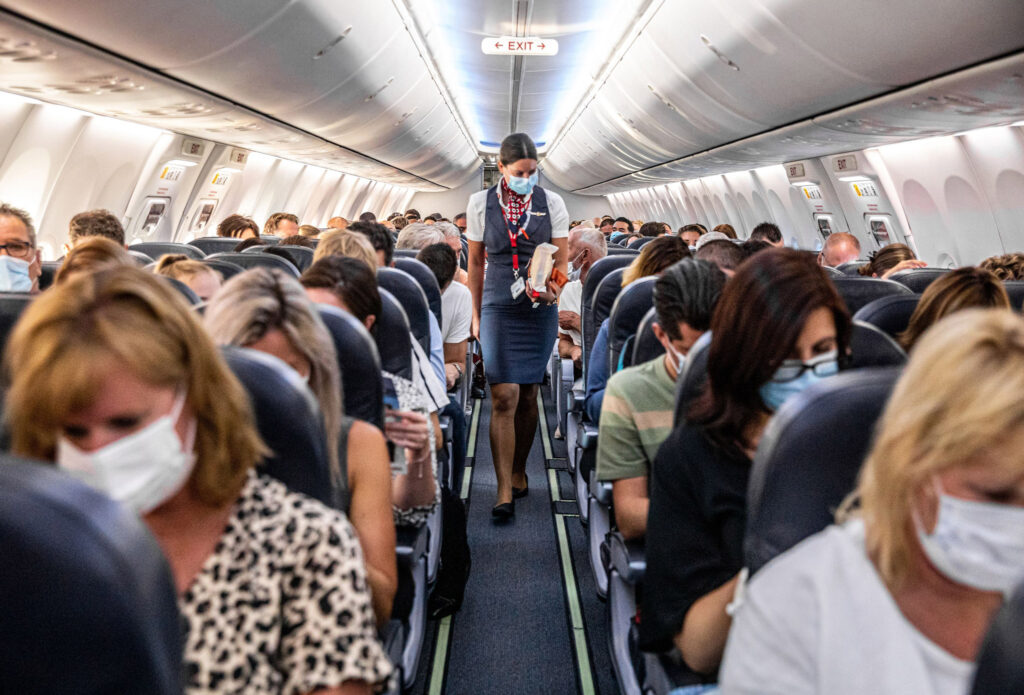
Catching coronavirus on a flight is less likely than being struck by lightning, according to the IATA. Photo: Jeffrey Groeneweg and Hollandse Hoog, REDUX.
Of the 44 cases cited, the highest number was on a London to Hanoi flight, where 15 people were thought to have contracted the virus – the cases are listed as probable.
A flight from Sydney to Perth had 11 cases of transmission on board, eight of which were confirmed and three are probable.
As the data period of the report runs up to July, it doesn’t include some of the recent cases, such as the 16 people who tested positive for coronavirus following a Tui flight from Zante to Cardiff in August.
In the case of the Tui flight, it’s not clear how many people had caught COVID-19 while in Greece and how many subsequently contracted it due to the flight.
Australia’s international travel ban likely to remain until 2022:
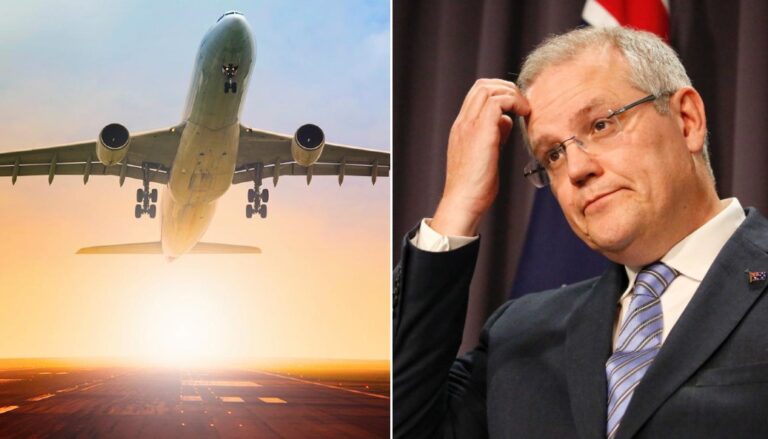
This new data comes as Australia’s Prime Minister, Scott Morrison, has cast doubt on when Australians will be able to travel internationally again.
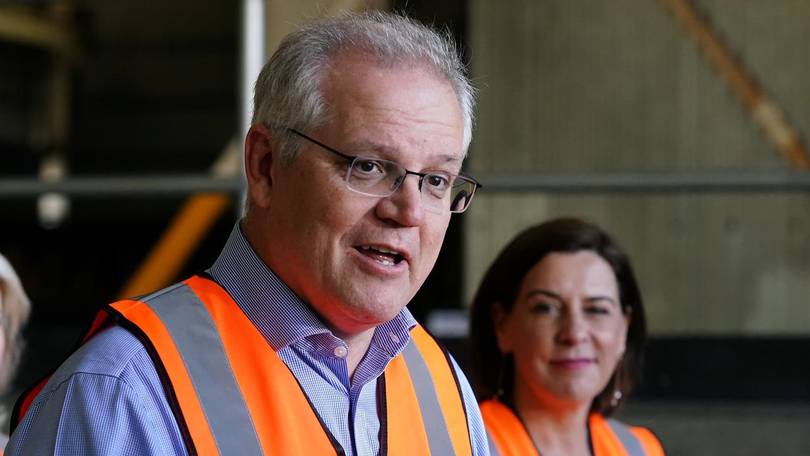
Scott Morrison is currently in Queensland campaigning with the state’s Liberal National party leader, Deb Frecklington.
Morrison has confirmed Australia will move “very cautiously” to reopen quarantine-free travel with a “handful” of countries, raising the prospect Europe and the United States will be excluded until 2022 unless a COVID vaccine is available.
The Prime Minister made these comments at a doorstop in Redbank, campaigning with Queensland’s Liberal National party leader, Deb Frecklington.
He told reporters New Zealand would be the “first step” and very soon New Zealanders “will be able to come to New South Wales, the ACT, and the Northern Territory.”
“The reason they won’t be able to come to Queensland is there is still a requirement for a two-week quarantine in Queensland,” he said, explaining that allowing international trips to Queensland would prevent Australians returning home due to the cap on hotel quarantine.
“When that is no longer necessary – great – I think that will be tremendous for the Queensland tourism industry.”
Morrison added that after New Zealand, Australia was looking to establish travel bubbles with Pacific nations, Japan, Singapore and South Korea.
“There are countries that have performed well on the health front and Australia and those countries are one of a handful that have had the same level of success,” Morrison said.
“But we have to go cautiously on this, very, very cautiously. COVID-19 hasn’t gone anywhere, it’s still there – it’s no less aggressive today than it was six months ago. We need to keep the habit of COVID-safe behaviours.”
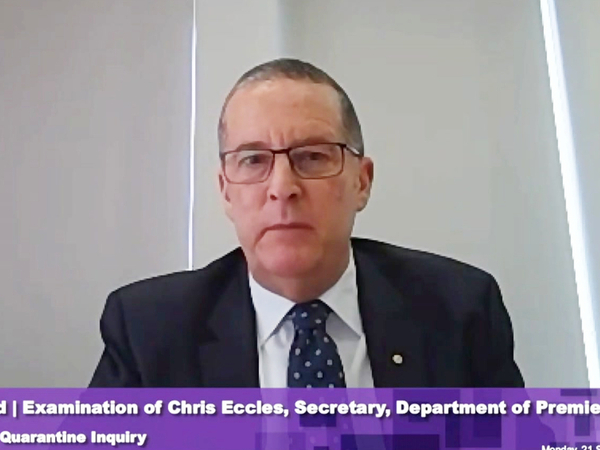
Mr Eccles fronted the state’s hotel quarantine inquiry in September.
Mr Eccles fronted the state’s hotel quarantine inquiry in September, and said neither he nor the Premier’s department made the decision to use private security in the program.
The inquiry heard that on March 27, the day the hotel quarantine program was set up, then chief Police Commissioner, Graham Ashton, texted Mr Eccles at 1.16pm and that the senior bureaucrat could not recall calling him back.
But in his resignation statement today, Mr Eccles revealed that phone records showed he called Mr Ashton for two minutes at 1.17pm that day.