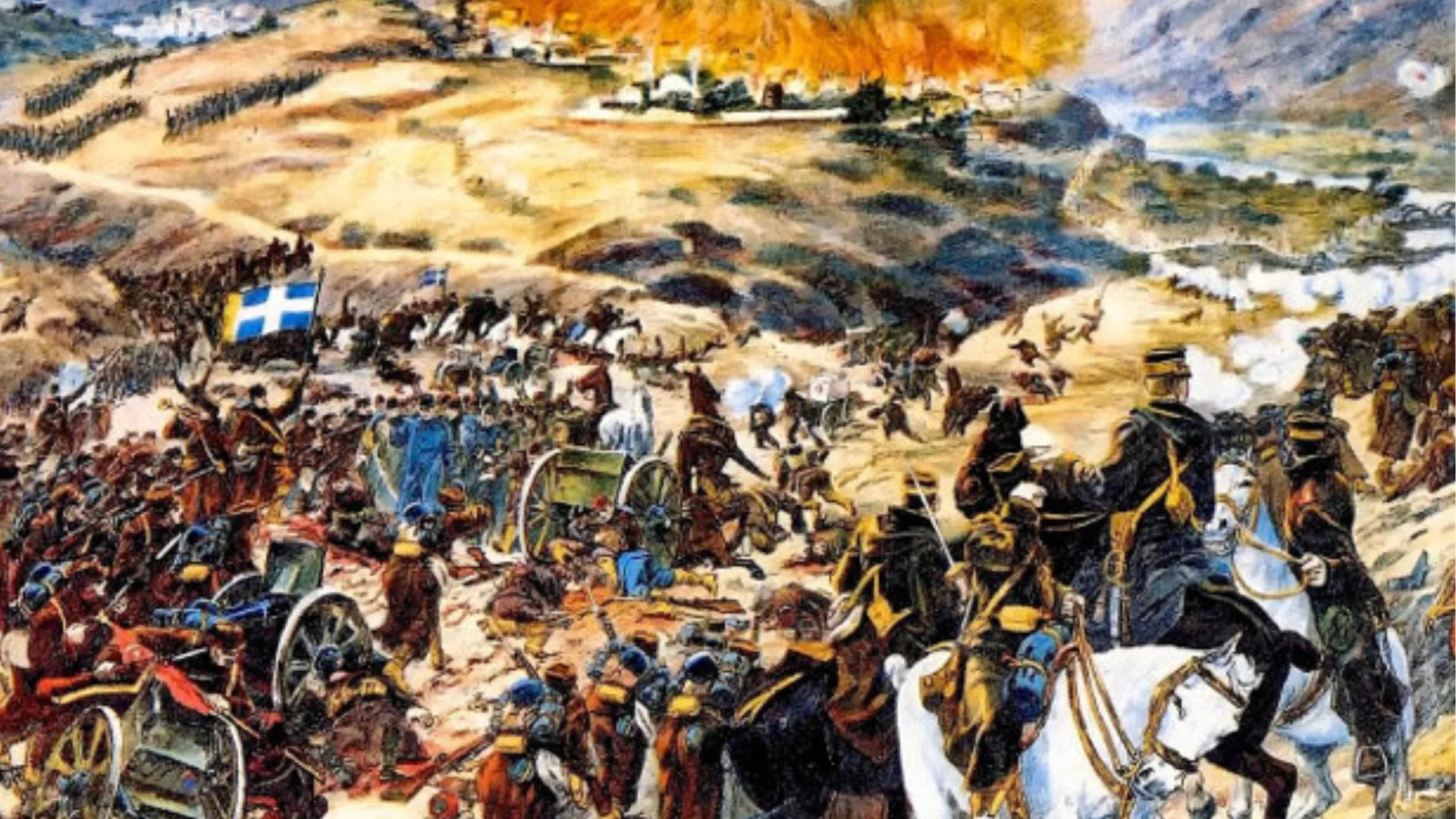
The Battle of Giannitsa, fought on 19 and 20 October 1912, was one of the most significant battles of the First Balkan War. It took place in Giannitsa (then known as Yenidje-i Vardar by the Ottomans) in today’s Pella region, between the Greek army under Crown Prince Constantine and the Ottoman forces commanded by General Hasan Tahsin Pasha. The Greek victory paved the way for the liberation of Thessaloniki on 26 October, according to sansimera.gr
Following the unexpected triumph at Sarantaporo, the Greek army secured control over Western Macedonia and advanced toward Central Macedonia and Thessaloniki. Anticipating a major threat, Tahsin Pasha fortified Giannitsa, a city sacred to local Muslims because it was the burial site of Gazi Evrenos, a distinguished 14th-century Ottoman general.
The battlefield offered significant strategic advantages, flanked to the north by Mount Paiko and to the south by the marshy Giannitsa Lake (drained in 1932), famously described in the Macedonian Struggle and Penelope Delta’s novel The Secrets of the Swamp.
By 18 October, Tahsin Pasha’s army, comprising five incomplete divisions, 13 infantry battalions, 8 cavalry squadrons, and seven artillery batteries, had entrenched on a 130-meter height, controlling the surrounding plain. The Greek army, with five divisions and a cavalry brigade totaling roughly 80,000 men, advanced from the northeast.
On 19 October, frontal attacks by the Greek 2nd and 3rd Divisions, combined with flanking maneuvers by the 4th and 5th Divisions, eventually outmaneuvered the Ottomans. Facing encirclement, Tahsin Pasha ordered a retreat, leaving a rear guard to delay the Greeks. By the morning of 20 October, the rear guard was overcome, marking the Ottoman defeat. Greek forces entered Giannitsa at 11 a.m., burning the Muslim quarter while sparing the Christian neighborhoods.
Greek casualties totaled 188 dead and 785 wounded, while the Ottomans suffered 250 dead, 1,000 wounded, and 3,000 captured. Eleven enemy cannons and numerous flags were seized. Soldiers endured heavy rain, often storming enemy positions with bayonets.
Crown Prince Constantine praised the victory: “The victory at Giannitsa completes that of Sarantaporo and constitutes a new title of honor and glory for the Greek Army.” The Skrip correspondent called it “the grandest and most tenacious battle fought so far,” while King George described it as “unprecedented in magnificence, determination, and bravery.”
Source: sansimera.gr
