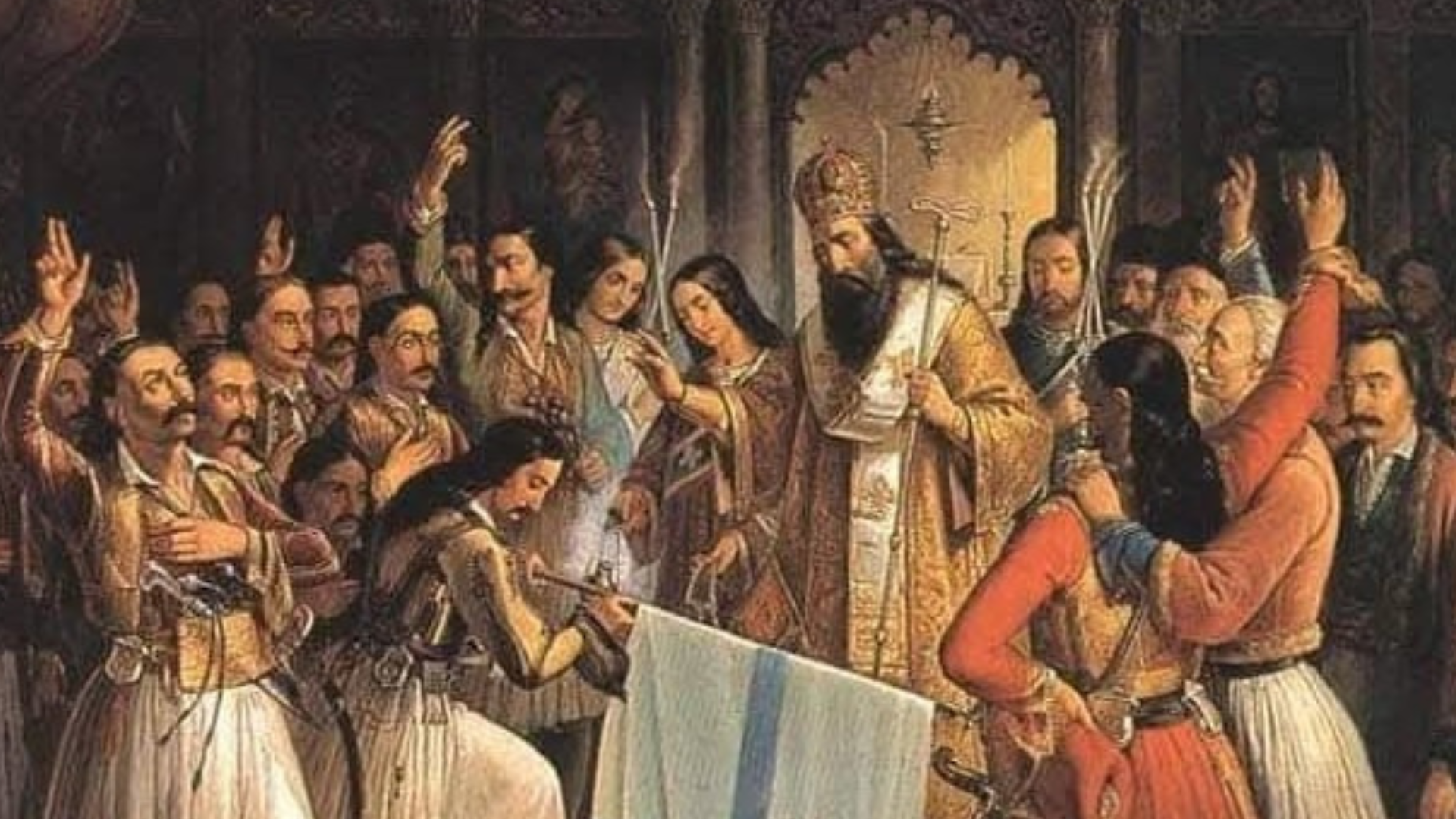
Growing up in Greek school, the history of the War of Independence in 1821 was ever-present. Portraits of revolutionaries lined the hallways, their faces solemn and familiar, almost like the icons of saints in an Orthodox church. Names such as Kolokotronis, Karaiskakis, Diakos, and Bouboulina were learned from an early age, recited in poems, commemorated in parades, and embedded in school and community celebrations each March.
Underlying this story was my own paternal heritage from Mani, a region closely associated with the early stages of the uprising. Over time, that familiarity gave way to deeper curiosity about how the revolution unfolded, the political dynamics that sustained it, and the people who shaped it.
Each year, 25 March is commemorated as the national anniversary of the Greek War of Independence from the Ottoman Empire. It is also one of the most important feast days of the Orthodox Church, the Annunciation of the Theotokos. The association of these observances has long shaped how the origins of the Greek Revolution are understood and remembered.
Yet the uprising of 1821 unfolded across different regions and moments, drawing on political ideas, religious meanings, inherited social structures, and long-standing armed traditions.
The significance of 25 March lies not in marking a single precise beginning, but in symbolising the moment when sustained rebellion and collective independence became conceivable.
Empire, Society, and the Conditions for Revolt
The Ottoman Empire in which the Revolution unfolded was a multiethnic, multireligious empire governed through differentiated legal and communal structures. Through religious governance arrangements later described as the millet framework, Orthodox Christian communities retained a degree of autonomy in matters of religion, education, and local administration, mediated through ecclesiastical and communal authorities. At the same time, Christians were legally unequal subjects within the imperial order, subject to fiscal burdens, legal inequalities, and social restrictions. This combination of communal autonomy and structural inequality shaped both the possibilities and the limits of everyday life under Ottoman rule and the conditions under which demands for reform or independence later emerged.
In the decades before 1821, an intellectual movement shaped by Enlightenment ideas articulated a new language of freedom, law, and self-rule, while a parallel social world rooted in armed traditions and local authority supplied the capacity for action.
From the late eighteenth century, new political ideas circulated among Greek intellectuals, particularly in commercial and cultural centres such as Paris, Vienna, Bucharest, Odessa, and Constantinople. Influenced by the American and French revolutions, figures such as Adamantios Korais and Rigas Velestinlis, also known as Rigas Feraios, articulated arguments about liberty, education, law, and collective self-government. Classical antiquity occupied a central place in this intellectual world, providing a language of continuity and legitimacy while also serving as a powerful reference point for European audiences. However, literacy was limited, education irregular, and the distance between intellectual centres and the Ottoman countryside was substantial.
Among the most influential Greek elites within the Ottoman world were the Phanariots of Constantinople. Their administrative roles within the Ottoman system, high levels of education, and trans-imperial connections helped facilitate the circulation of reformist thought and political ideas, even though many remained closely tied to the structures of imperial governance. These networks also connected to wider intellectual and commercial circles in which revolutionary organisation began to take shape.
In 1814, the secret society known as the Filiki Eteria (Friendly Society) was founded in Odessa, on the Black Sea coast of present-day Ukraine, by Greek merchants and intellectuals who sought to coordinate a broader uprising against Ottoman rule. Operating through clandestine networks that extended across the Ottoman world and the Greek diaspora, the society helped circulate revolutionary ideas, cultivate contacts among military leaders, and prepare the ground for coordinated revolt.
The first significant revolutionary move occurred in February 1821, when Alexander Ypsilantis, a Phanariot officer in Russian service and a leading member of the Filiki Eteria, crossed the Prut River into the Danubian Principalities and called for a general uprising against Ottoman rule. Although this revolt ultimately failed, it signalled that the revolutionary project had entered an active phase and helped set the stage for uprisings in southern Greece soon afterwards.
Enlightenment concepts shaped elite discourse and later constitutional projects, but they did not by themselves mobilise the wider population. In practice, the possibility of revolt depended not only on intellectual movements but also on longstanding traditions of armed organisation and local leadership.
Armed Traditions and the Road to Revolution
Alongside these intellectual currents existed long-standing traditions of armed autonomy. For generations, klephts and armatoloi operated across much of the Greek countryside. Armatoloi held recognised authority under Ottoman rule, charged with maintaining order in specific regions, while klephts lived outside formal structures and relied on resistance, protection, and force. For many involved in these arrangements, participation in Ottoman administration or security structures was not a sign of ideological loyalty so much as a strategy of local survival.
These armed leaders were not national revolutionaries in advance of 1821. Their loyalties were often pragmatic and local, and their relationships with imperial authority were complex. Georgios Karaiskakis exemplified this pattern. In his early career, he operated within the military world shaped by the semi-autonomous regime of the Ottoman Albanian ruler Ali Pasha of Ioannina, whose authority relied heavily on Christian armatoloi while balancing rival Ottoman power holders in the region.
Karaiskakis’ later prominence in the Revolution reflected shifting political and military conditions. The conflict also revealed broader fractures within the empire itself, as regional power holders pursued their own interests, at times alongside the sultan and at other times in open defiance of him.
Revolt became possible not only because of ideology, but because many Greeks concluded that imperial rule no longer guaranteed security, dignity, or meaningful local autonomy, and that continued accommodation had become more dangerous than resistance.
The Revolution Erupts
In the Peloponnese, the role of Mani was especially significant. Long characterised by strong local leadership and substantial self-rule, Mani retained a high degree of autonomy and was incorporated only loosely into Ottoman administrative structures. Under the leadership of Petrobey Mavromichalis, Maniot forces played a central role in the early stages of the uprising. On 23 March 1821, Maniot leaders and allied revolutionary figures captured Kalamata, an early coordinated success that helped give the Revolution territorial substance and momentum.
Soon after, revolutionary leaders in the area established a provisional governing body known as the Messenian Senate at Kalamata, with Petrobey Mavromichalis elected as its president. These early events signalled an attempt to translate uprising into political authority and external legitimacy.
Theodoros Kolokotronis became the dominant commander in the Peloponnese, combining strategic insight with a keen understanding of local conditions. In Central Greece, Karaiskakis emerged as a decisive leader in later phases of the war, known for his forceful temperament and commanding presence. His authority rested less on formal hierarchy than on personal charisma, military effectiveness, and an ability to command loyalty among irregular fighters. Other commanders, including Odysseas Androutsos, Markos Botsaris, and Nikitaras, achieved early successes through guerrilla tactics and local alliances, while also becoming enmeshed in rivalries that arose from the absence of unified command.
Early in the war, Athanasios Diakos became emblematic of sacrifice. At the Battle of Alamana in April 1821, Greek forces were defeated and Diakos was captured. Later tradition holds that he was offered his life on condition that he renounce his Orthodox Christian faith and enter Ottoman service, an offer he refused. He was executed soon after, and his death quickly entered revolutionary memory as a moral and religious touchstone during the first months of the uprising.
While many Orthodox clergy supported or participated in the struggle for independence, with figures such as Papaflessas among the most prominent, others exercised caution, aware of the devastating reprisals that could be inflicted on Christian populations. The execution of Ecumenical Patriarch Gregory V in Constantinople in 1821, despite his public condemnation of the uprising, underscores the perilous and constrained position in which Church leaders operated.
Naval power proved equally critical. Island communities with maritime traditions supplied ships, crews, and leadership. Andreas Miaoulis coordinated naval operations, while Konstantinos Kanaris became emblematic of daring through his use of fireships. These actions disrupted Ottoman supply lines and helped sustain the Revolution at moments when control on land remained uncertain.
The Revolution was sustained not only by battlefield leadership but also by networks of finance, logistics, and social mobilisation in which women played visible and consequential roles. Laskarina Bouboulina of Spetses financed and commanded her own vessels, participated in early naval operations, and took part in the siege of Nafplion. Manto Mavrogenous devoted her fortune to equipping ships and supporting revolutionary forces, later receiving formal recognition for her contributions. Other women fought and led alongside their male counterparts; among them, Domna Visvizi served aboard the ship Kalomoira, and after her husband’s death in 1822 assumed command and continued supporting revolutionary operations.
Earlier acts of resistance also shaped revolutionary memory. The women of Souli participated directly in armed struggle against Ali Pasha in the years preceding 1821, while the Dance of Zalongo on 16 December 1803, in which, according to tradition, dozens of women and children chose death rather than capture, became a powerful symbol in later commemorations and inspired subsequent generations.
The experience of the war itself also helped consolidate collective national consciousness. Shared struggle, sacrifice, and the necessity of cooperation across regions gradually fostered new forms of political identification, even as older local loyalties remained influential. At the same time, the conflict could be brutal at the local level, with reprisals, destruction, and violence affecting civilian populations as control shifted across towns, villages, and regions.
Ioannis Makriyannis, a revolutionary general with little formal education, embodied this convergence in his memoirs, bringing together the language of patriotism, faith, and popular experience.
The Greek Revolution also unfolded within a broader international context. From its early stages, the uprising attracted foreign supporters who viewed the Greek cause through classical heritage, liberal opposition to imperial rule, and religious solidarity with Christian populations under Ottoman authority. Among the most famous was Lord Byron, whose presence in Greece and death at Missolonghi in 1824 became a powerful symbol of European sympathy for the Greek cause. Philhellenic committees across Europe and the United States raised funds, organised supplies, and facilitated the arrival of foreign volunteers who joined the struggle.
The Struggle for Unity
The struggle for independence was not accompanied by immediate unity. During the war itself, internal divisions emerged among Greek factions, culminating in two civil conflicts between 1823 and 1825. These disputes reflected competing visions for authority, regional leadership, access to resources, and the organisation of the emerging state.
Such tensions continued into the early years of independence. Under the governorship of Ioannis Kapodistrias, efforts to impose central authority, fiscal discipline, and administrative order brought the emerging state into conflict with regional power holders. In Mani, these policies provoked strong opposition from the influential Mavromichalis family.
When Petrobey Mavromichalis was imprisoned by Kapodistrias in 1831, the conflict intensified. On 9 October 1831, Kapodistrias was assassinated outside the Church of Saint Spyridon in Nafplio by Konstantinos Mavromichalis, Petrobey’s brother, and Georgios Mavromichalis, his son. The killing reflected not simply a personal vendetta but the deeper tensions between efforts to consolidate a centralised state and the entrenched authority of regional power.
Religion, Symbolism, and the Meaning of 25 March
Religion provided one of the most powerful frameworks through which most people understood their world. Orthodox Christianity was central to Greek communal life and identity. It not only structured everyday life but provided a moral vocabulary through which suffering, endurance, and obligation were interpreted. The Annunciation, commemorated on 25 March, was already one of the most important feasts in the Orthodox calendar, giving the date deep religious resonance.
The selection of 25 March as the national anniversary occurred after independence as part of an effort to provide the new state with a shared symbolic foundation. By royal decree in 1838, the date was formalised, aligning revolutionary commemoration with the Feast of the Annunciation and embedding the memory of the uprising within a sacred temporal framework.
In this way, the date came to represent more than a historical marker. In Christian belief, the Annunciation signifies the beginning of salvation: the moment when divine promise enters human time. In national memory, the Revolution came to symbolise the beginning of a long struggle for Greek political freedom and renewal.
The commemoration of 25 March came to symbolise a moment of national revelation — the point at which freedom appeared not only attainable, but inevitable. That sense of destiny was not simply felt by those who fought for it; it was constructed, layered, and renewed by the generations who came after them. The revolution endures, not in history books or national commemorations alone, but in the silent gaze of the revolutionaries whose portraits continue to shape the historical imagination of new generations.
*Dr Themistocles Kritikakos is a Greek-Australian historian and writer. He holds a PhD in History from the University of Melbourne. He is the author of Armenian, Greek, and Assyrian Genocide Recognition in Twenty-First Century Australia: Memory, Identity, and Cooperation (Palgrave Macmillan, 2026).
