Over the last forty years, Australia has emerged as the world’s earthly paradise in terms of security, stability, quality of life, ideal environment with the cleanest air and water, a country with the highest index of quality and contribution in the fields of education and health, to mention some of the firsts it maintains in world rankings.
Australia for 250 years since 1770, when it met first the “armada” of Captain Cook, has lived the geopolitical and demographic absurdity, to be a country-island-continent in the space of the southeastern hemisphere, cut off from Antarctica, in the armpit of Asia, but dominated demographically by Europeans and having been developed on the basis of Western civilisation.
This green continent of the South and its “satellite”, New Zealand, which make up the main body of Oceania, have been consistently and unswervingly in recent decades, the first best, safest, cleanest, environmentally unadulterated countries of Planet Earth.
Australia developed tremendous innovations in the fields of medical science, research related to human health, established the most active Research Centers in the world with pioneering discoveries, established very safe hospital care by building huge hospitals and health centers. Together with the Americans, Australian scientists constitute, on a global level, the crème de la crème of researchers in the field of pharmacy, capable practitioners of medical science.
In the field of education, the quality of education offered deservedly claims worldwide recognition. The fact that it attracts more than 700,000 foreign students from Asian countries and the country generates more than $25 billion annually from these students in its economy, while Australia’s tourism revenues do not exceed $24 billion, attests not only to the high quality of education offered, but also to the dependence of these dozens of Asian countries on Australia and its educational institutions. In the last thirty years, at least five Australian universities have been among the twenty best in the world (Melbourne University, ANU, University of Sydney, Monash and the University of NSW).
In terms of sports and performance, Australia in the last twelve Olympic Games was distinguished as the first country in the world in terms of the number and quality of medals. First in gold and silver, first in bronze, first in total, much more than the behemoths of Europe and Asia. Australia is universally considered the country that combines the values of classical Greece, where sports and education went hand in hand.
Australia remains the country with the most adequate sports infrastructure in the world, in public spaces, stadiums and swimming pools, track and field and practice parks. Many Australian schools, state and independent, exceed in extent, quality, standards and adequacy any sports facilities that exist in economically and socially powerful countries of Europe. The State, educational institutions and the family contribute to this quality situation.
Australian cities offer relatively comfortable and quality living, with less time lost in transportation, comfortable parks and public relaxation areas, with the simplicity and dominance of greenery, with their street layout, wide streets, urban restrictions, the connection of buildings with the environment that provides for the citizen and relaxes him. Over the past thirty years, Melbourne and Sydney have almost annually been among the top ten most livable cities in the world. They offer a noble environment, structured services for improved life, quality of service for citizens.
The latest research into the environment of Planet Earth gives Australia the lead as the country with the best safe level of air pollution in 2023. The findings were released in a report by Swiss air quality technology company IQAIR. The World Air Quality Report,released earlier this year, is based on data from more than 30,000 monitoring stations in 134 countries, states and regions. Of these, 124 were found to breach safe levels of PM2.5 (a type of tiny particle that can penetrate the lungs and bloodstream), according to World Health Organization (WHO) guidelines. These tiny particles have been linked to heart and lung disease, high blood pressure, increased risk of asthma, depression and anxiety, and premature death.
The researchers used a colour scale to indicate pollution levels, with many European countries falling into the green category, suggesting levels up to twice the safe standard. The seven countriesthat met the safe guideline of five micrograms per cubic metre of air (μg/m3) or less were Australia, followed by Estonia, Finland, Grenada, Iceland, Mauritius and New Zealand. Puerto Rico, Bermuda and French Polynesia were also at safe levels.
In Europe, the countries with the least air pollution are Sweden, Ireland, Norway, Portugal, Liechtenstein, Denmark, the United Kingdom, Andorra, Latvia, Ukraine, the Netherlands, Luxembourg, Switzerland, Germany, Belgium, France, Austria, Spain and Russia.
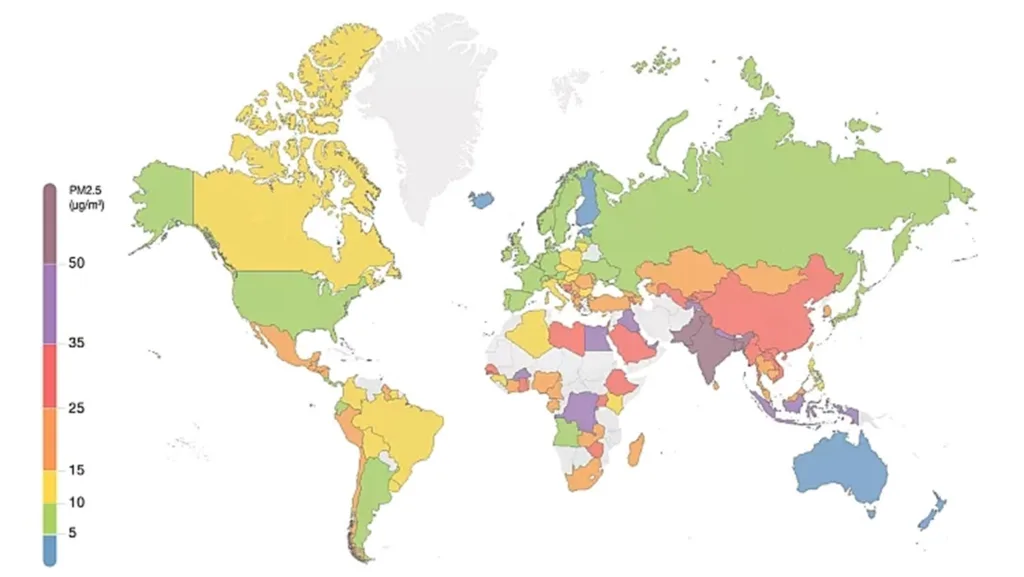
The yellow category – indicating pollution levels up to three times above the safe standard– includes European countries such as Lithuania, the Czech Republic, Hungary, Malta, Slovakia, Bulgaria, Croatia, Poland, Cyprus, Slovenia and Italy.
Croatia showed the greatest progress in 2023 in reducing PM2.5 levels, with the annual average falling by more than 40% compared to 2022. It has achieved this by increasing the use of renewable energy sources, which so far make up more than 31% of the country’s energy mix – well above the EU average of 23%. In the orange category – up to five times above safe levels – Moldova, Romania, Albania, Greece, Turkey, Serbia and Montenegro are located. Bosnia and Herzegovina saw an 18% decrease in PM2.5 levels in 2023 compared to 2022, but remains the most polluted country in the region, followed by North Macedonia – both countries fell into the red category with pollution levels more than five times above the safe standard. Igdir in Turkey is its most polluted city Europe, with PM2.5 levels more than nine times above the safe standard.
We are fortunate, therefore, to live in the country with the highest index of safety, quality of life and clean air.
*Professor Anastasios M. Tamis taught at Universities in Australia and abroad, was the creator and founding director of the Dardalis Archives of the Hellenic Diaspora and is currently the President of the Australian Institute of Macedonian Studies (AIMS).
