Home Blog Page 31

Deputy Premier Ben Carroll marks Good Friday with Melbourne’s Greek community

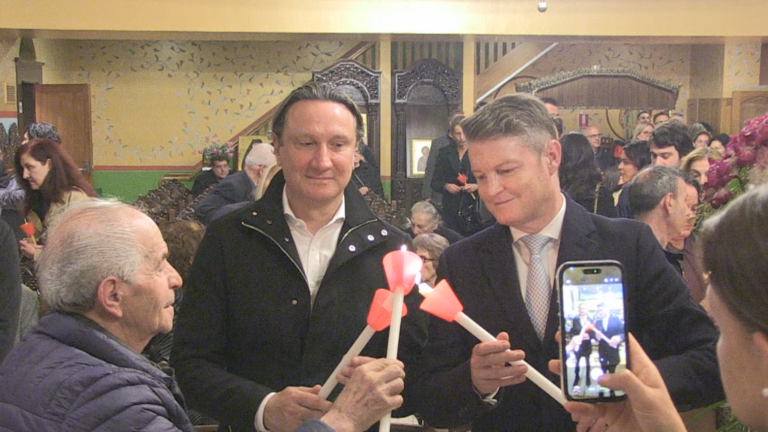
Victorian Deputy Premier Ben Carroll joined Melbourne’s Greek Orthodox community for a Good Friday service at The Annunciation of Our Lady Greek Orthodox Church (Evaggelismo), marking his first attendance at a Greek Orthodox Easter service.

The service, held at the historic East Melbourne church, included the traditional Epitaphios procession through surrounding streets, drawing large crowds of faithful who gathered to commemorate the burial of Christ in one of the most solemn observances of the Orthodox calendar.

Candles illuminated the night as parishioners followed the flower-adorned Epitaphios, reflecting a deeply rooted tradition that continues to unite generations of Greek Australians across Melbourne. As the oldest Greek Orthodox church in the city, Evaggelismo holds a special place within the community, particularly during Holy Week.

Mr Carroll described the experience as both meaningful and symbolic, highlighting the spiritual significance of the occasion.

“Greek Orthodox Easter celebrates the triumph of life over death, light over darkness, and hope over despair,” he said.

“This is my first Greek Orthodox Easter mass and it’s fitting that I was at the oldest Greek Church in Melbourne – Evaggelismo. I thank Bill Papastergiadis for the invitation to be a part of this church service on Friday night and to follow the επιτάφιο through the streets surrounding this historic church.”

His attendance was warmly received by community leaders, reflecting the strong and ongoing relationship between Victoria’s Greek community and public representatives.

President of the Greek Orthodox Community of Melbourne and Victoria, Bill Papastergiadis, said the Deputy Premier’s presence was welcomed by the parish and broader community.

“It was heartening to have Ben Carroll with us at Evaggelismo Church for the Friday service,” Mr Papastergiadis said.

“His presence solidifies our faith with the broader community. Many people in our παροικία, and particularly I have a strong connection with Ben Carroll and we thank him for his ongoing support and commitment to our community.”

The Good Friday service at the Annunciation Church formed part of wider Greek Orthodox Easter commemorations across Melbourne, with parishes throughout the city observing Holy Week through a series of services leading to the celebration of the Resurrection on Easter Sunday.

For many in the Greek Australian community, these traditions remain central to cultural and spiritual life, bringing together faith, heritage and community in one of the most significant periods of the year.

SoulChef Sundays: The Easter Sunday table

By Chef Georgia Koutsoukou – “SoulChef”

As Chef Georgia Koutsoukou — the Kalamata-born chef known as “SoulChef” — continues her SoulChef Sundays series with The Greek Herald, she brings together the defining dishes of Greek Easter, from the moment of the Resurrection to the Sunday feast.

A table of tradition, faith and family

Greek Easter is a journey — from the quiet of the Resurrection night to the abundance of Sunday. It is a time when families gather, traditions are honoured, and food becomes the centre of connection.

Magiritsa – The Resurrection Dish

Ingredients

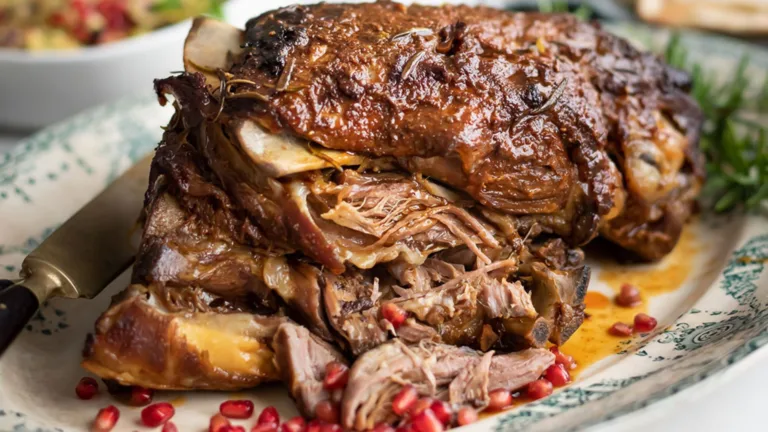
  • 1 lamb pluck (liver/lights, blanched and chopped)
  • 2 lettuces, finely chopped
  • 5–6 spring onions
  • Fresh dill
  • 2 eggs
  • 2 lemons

Method

  1. Sauté spring onions and pluck.
  2. Add lettuce and dill, simmer for 40 minutes.
  3. Prepare avgolemono and add to the pot.

Slow & Low Lamb with Mediterranean Herbs

Ingredients

  • 2 kg lamb (leg or shoulder)
  • 1.5 kg potatoes
  • 3 cloves garlic
  • Oregano, salt, pepper
  • Lemon juice
  • Olive oil

Method

  • Place lamb and potatoes in roasting pan.
  • Insert garlic and season well.
  • Roast at 180°C for 2.5–3 hours until tender.

A Message from SoulChef

Easter is about the people around the table, the memories we create, and the love we share. Oceans may separate us, but the soul of our kitchen is one.

Georgia Koutsoukou – Soul Chef

Connect with the SoulChef


A sea of pink: Peach blossoms draw visitors to northern Greece each spring

0

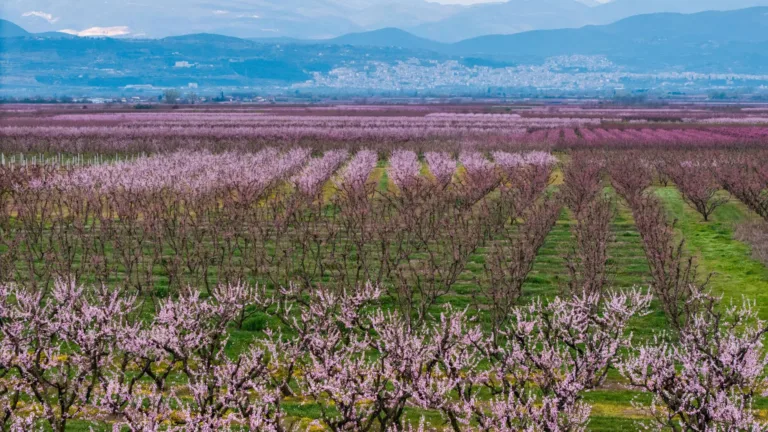
Every spring, vast peach orchards in northern Greece transform into a stunning sea of pink, drawing thousands of visitors, according to Apnews.com. Located around Veria, the country’s largest peach-producing area becomes a seasonal attraction for both domestic and international travelers.

“It’s something that people must experience and see at least once in their lifetime, because it’s a huge area,” said Gianna Pilitsidou, president of the Veria Tourism Club. Spanning around 170 square kilometers, the plains are completely covered in blossoms, creating a striking visual landscape.

To celebrate this natural spectacle, the Veria Tourism Club has introduced a variety of activities in recent years. These include photography events, cycling routes through the orchards, and initiatives promoting local agricultural products.

“Every year we welcome spring with celebrations in the fields, inviting people to visit us and experience it,” Pilitsidou said.

The initiative also aims to raise awareness of lesser-known destinations in Greece. “I want the people in Holland and Belgium to know what amazing spots there still are besides all the places that people already know,” said Dutch travel blogger Wesley van Eijk. “For example Veria. I mean more and more people get to know it, but you have to feel it and be here.”

Local farmers see the events as both recognition and support for their work. “For all of this to happen, it takes a lot of hard work – a lot of effort from us farmers,” said Anastasios Chalkidis.

The blossoming season, typically from mid-March to mid-April, has also boosted tourism, with visitors like Andrea Lachnit from Germany calling it “stunning and beautiful and heavenly.”

Source: apnews.com.

Sifnos ranks among top global destinations for authentic travel in 2026

0

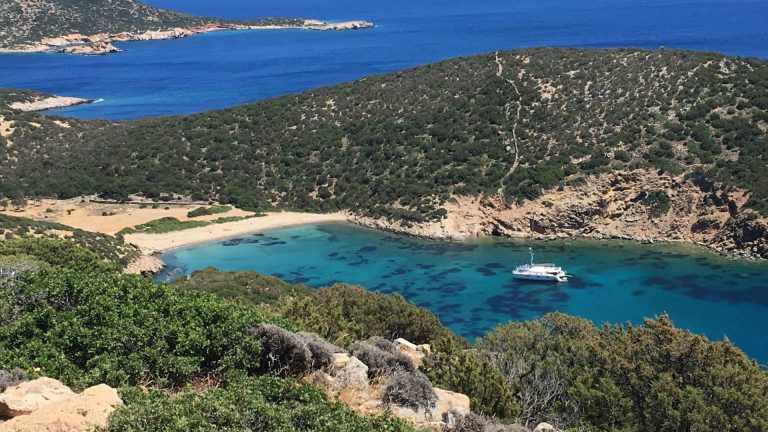
The Greek island of Sifnos has been recognized as one of the top travel destinations for 2026 by the Swedish platform News55.se, which highlights locations that offer authentic experiences away from mass tourism, according to tovima.com. Ranked second on a global list of five destinations, Sifnos stands out for preserving its cultural identity and traditional Cycladic charm.

Known for its unspoiled character, Sifnos has managed to avoid large-scale commercial tourism despite increasing international attention. The island offers a more genuine and relaxed experience, particularly outside the peak summer months. Visitors are drawn to its scenic hiking trails, picturesque villages, and classic Cycladic architecture, with places like Kastro and Apollonia noted for their unique atmosphere.

The report also highlights Sifnos as a major culinary destination, often described as the “gastronomic heart of Greece.” This reputation is rooted in its rich food heritage and the influence of Nikolaos Tselementes, a key figure in modern Greek cuisine. Local traditions emphasize fresh, regional ingredients and artisanal practices, including pottery, which remains closely connected to the island’s cooking culture.

Sifnos joins other destinations such as Basel, Northumberland, Galway, and Kanazawa on the list, all recognized for their strong cultural heritage and preserved environments.

According to local officials, this distinction reflects ongoing efforts to promote alternative tourism, focusing on gastronomy, nature, hiking, and cultural experiences. Increased international exposure, including participation in major travel events, has also boosted interest among travelers seeking more meaningful and less crowded destinations.

Source: tovima.com

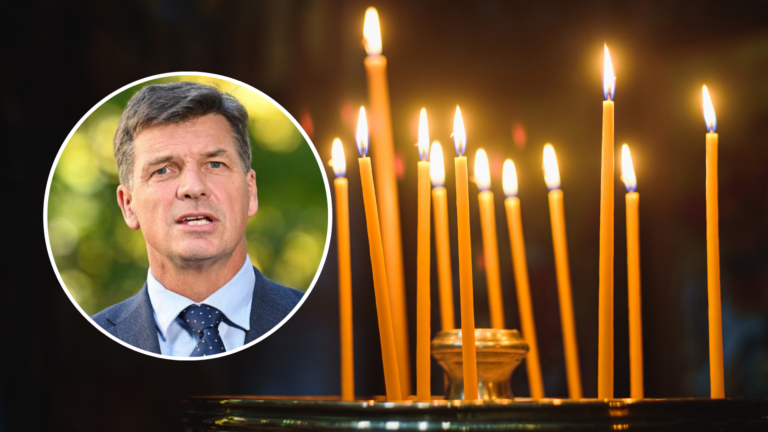
Federal Liberal Leader Angus Taylor sends Easter message to Greek Australians

Federal Liberal Leader Angus Taylor has extended his Easter wishes to Greek Australians, highlighting the importance of faith, family and tradition, while recognising the community’s enduring contribution to Australian society.

Full Message in English:

As Greek Orthodox Easter approaches, I am pleased to extend my warmest wishes to the
Greek Australian community across Australia.

Easter is a time for family, faith, and reflection. It is a moment to come together, honour
long-standing traditions, and celebrate the values that sustain our communities. It reminds us
of the importance of resilience, determination, and the bonds we share with family and
friends.

The Greek Australian community has made extraordinary contributions to our nation through
hard work, enterprise, and strong family values. These are the very principles that protect and
enrich our Australian way of life: the importance of family, the spirit of aspiration, and a
tireless commitment to building a vibrant, cohesive society.

On behalf of the Coalition, I hope this special occasion brings joy, peace, and renewed energy
to your homes.

Καλή Ανάσταση!

Yours sincerely,
ANGUS TAYLOR
Leader of the Opposition

Australian PM Anthony Albanese sends Easter message to Orthodox Christians

Australian Prime Minister Anthony Albanese has extended his Easter message to Orthodox Christians across Australia, acknowledging the deep spiritual significance of the season and the enduring cultural traditions upheld by the Greek Australian community.

Full Message in English:

At Easter, Christians around our nation unite in contemplation of the crucifixion and resurrection of Jesus Christ, and in celebration of the profound grace at the heart of their faith.

For those of the Orthodox tradition, this is a moment of all-encompassing significance. It is a time for gathering in homes and houses of worship to uphold the rituals of an ancient and beautiful culture shared by millions of people around the world.

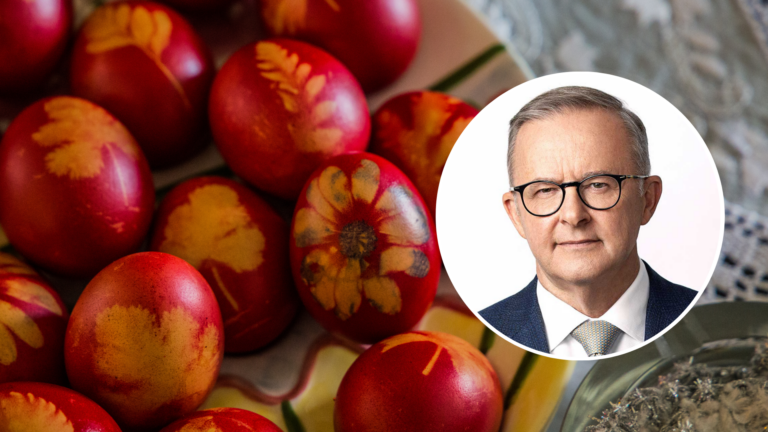
As Australia’s Greek community comes together to share in the treasured traditions of this time – the prayers and hymns, bread and lamb, red-dyed eggs and koulouria – I know you will feel blessed and energised by all that connects you to your history and heritage.

I also join you in celebration for the immense contribution that generations of Greek Australians have made to our nation with your extraordinary drive, hard work, aspiration and love of country. You are a cherished and intrinsic part of the story of our nation.

At this special time of love, joy and peace, I wish you a happy and a holy Easter.

Καλό Πάσχα!

The Hon Anthony Albanese MP
Prime Minister of Australia

Diplomats and politicians from Greece and Cyprus send Orthodox Easter messages

Greek and Cypriot politicians and diplomats have issued messages to Australia’s Greek diaspora to mark Orthodox Easter.

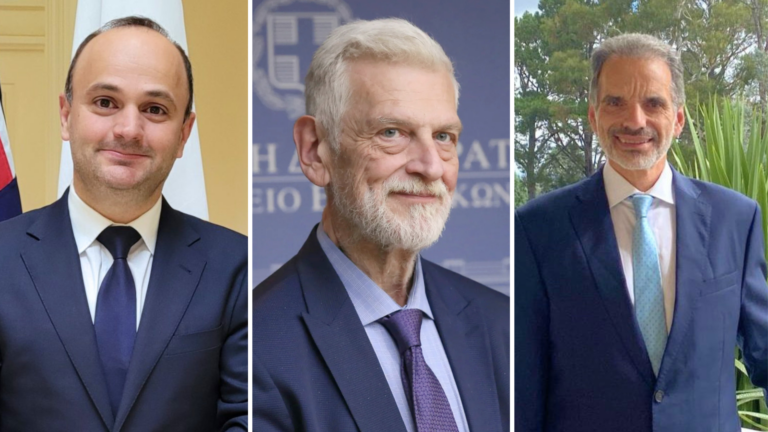
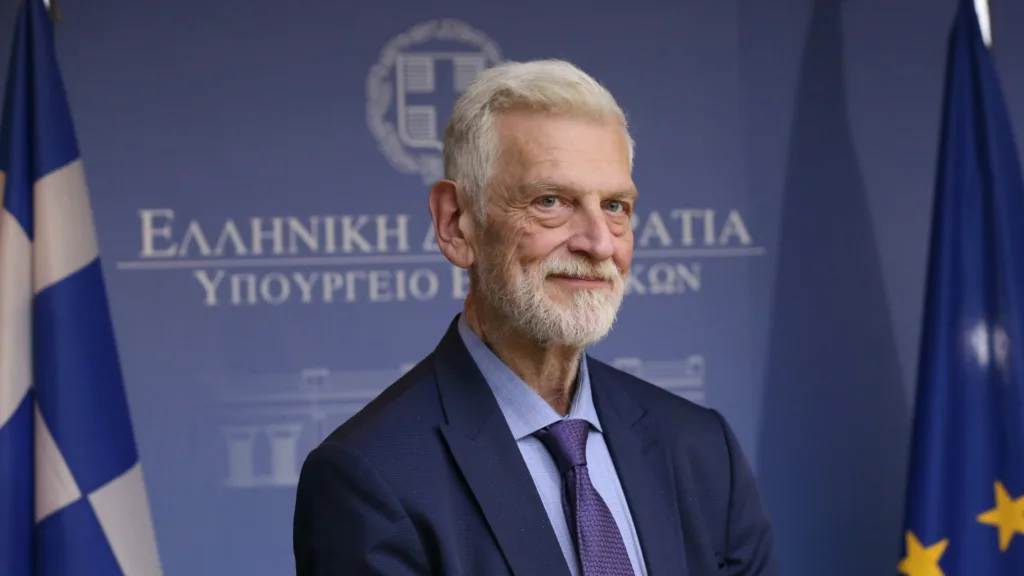
Message by Greece’s Deputy Foreign Affairs Minister for Greeks Abroad, Ioannis Michail Loverdos
Ιοannis Michail Loverdos photo

Dear compatriots,

Although the distance from Greece is great, during my recent visit to Australia I observed that the bonds with the motherland remain alive and strong.

The message of the Resurrection takes on even greater significance this year amid the ongoing conflicts in the Middle East, reminding us of the power of hope, reconciliation and peace.

I wish that the Resurrection of the Lord fills your hearts with hope and optimism, spiritually bringing you closer to our homeland, as love for Greece, our traditions and our values always keep us united wherever we may be during these Holy Days.

Happy Easter to all Greek women and men of Australia!

Ioannis Michail Loverdos
Deputy Minister of Foreign Affairs of Greece

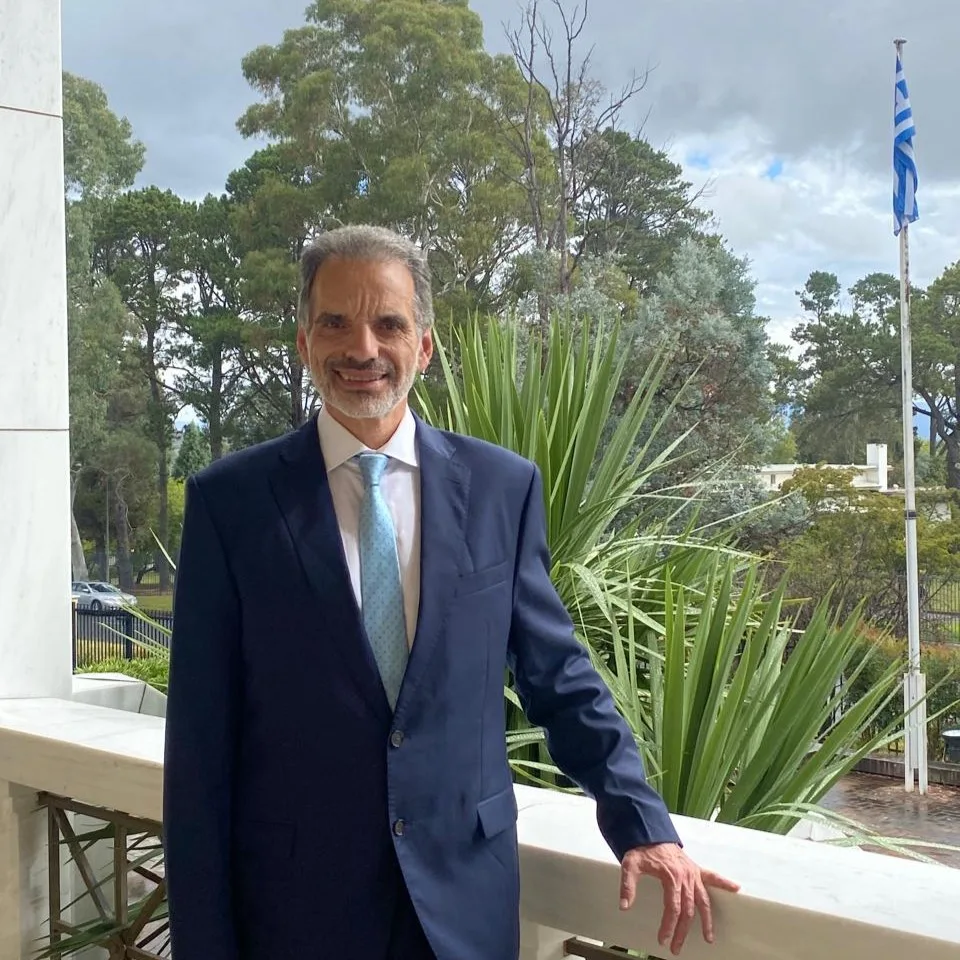
Message by the Ambassador of Greece in Australia, Stavros Venizelos:

I wish that this year’s Easter may give us all strength and joy. Its universal message is first and foremost a message of personal rebirth and love towards our fellow man. The celebration is reviving our hopes for peace and prosperity.

I wholeheartedly wish to all Greek friends in Australia, a Happy Easter with your loved ones. Χρόνια πολλά!

Stavros Venizelos
Ambassador of Greece to Australia

Message by the High Commissioner of Cyprus in Australia, Antonis Sammoutis:

Dear compatriots,

On the occasion of the Easter celebrations — of the Passion of the Lord, the Cross and His three-day Resurrection — I wish you health and family happiness. The relationship of Greeks everywhere with these holy days is unique. It reaches far back, even to the pre-Christian era, with the death and rebirth of the god Dionysus or the return of Persephone from Hades and the coming of spring. For indeed, Easter and the Resurrection of the Sweet Spring are a celebration of spring in our homeland.

Life is not lost but is reborn, faith saves humankind, and love and kindness — which can extend even to sacrifice — give meaning and worth. And the Cross is always followed by the Resurrection! This is what we firmly believe as Greek Cypriots, 52 years after being uprooted from our homes and churches in the occupied part of our island. We firmly believe that the day will come when “Christ is Risen” will be heard again and the bells will ring joyfully in every corner of our small homeland.

Here in distant Australia, our diaspora placed the Church at the centre of its spiritual life from the very beginning. All our great celebrations, after all, are intertwined with our liturgical life. As every year, so too this year, we will ascend with reverence alongside the Crucified to Golgotha on Holy Thursday and accompany Him with the Lamentations on Good Friday to the Tomb. On the night of Holy Saturday, however, we will proclaim “Christ is Risen” and celebrate the Resurrection in radiant joy. And on Easter Sunday, we will all gather around the shared table, with roast lamb, kokoretsi, eggs and tsoureki.

Alongside faith and the lived experience of our Church, we always keep our traditions alive. In this beautiful multicultural country, we preserve our identity in its pure form. This identity, moreover, for centuries has encompassed all the values of your new homeland — love, solidarity, respect and offering to our fellow human beings. And it is this identity that guarantees progress and prosperity for all.

Wishing everyone a joyful Resurrection!

Antonis Sammoutis
High Commissioner of the Republic of Cyprus in Australia

Cyprus Community of NSW to launch major exhibition on liberation struggle

0

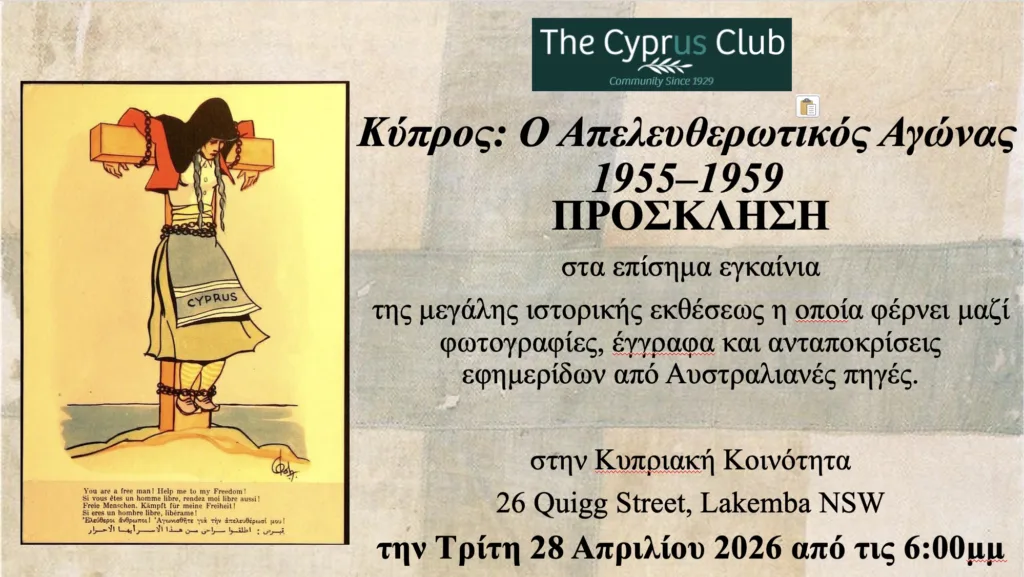
The Cyprus Community of NSW is presenting a major public history exhibition, Cyprus: The Liberation Struggle 1955–1959, presenting an account of one of the defining periods in modern Cypriot history.

The official launch will take place on Tuesday 28 April at The Cyprus Club in Lakemba from 6pm and will include a lecture and guided tour of the exhibition, with a special guest joining via live link from Cyprus to formally open the event. The Community extends an open invitation to the wider public.

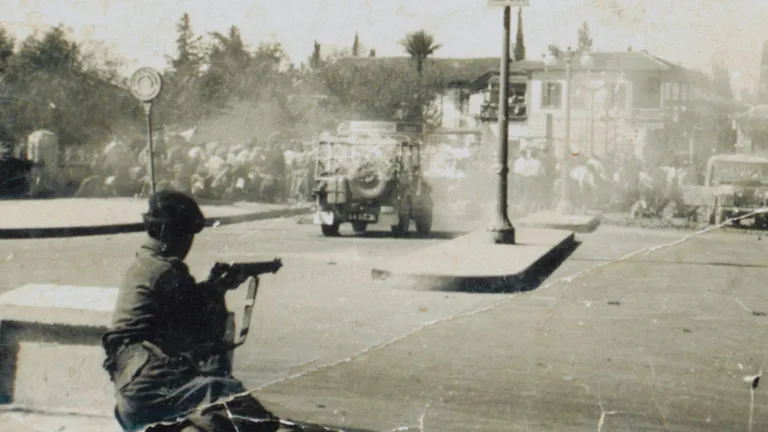
The exhibition draws on Australian archival material to document the events and how they were interpreted through Australian eyes.

Curated by Dr Panayiotis Diamadis, the Community’s Director of Archives and Heritage, the exhibition brings together photographs, documents and newspaper reports from the period 1950-1974 with a special emphasis on Australian sources.

“It’s an important exhibition, for the Cyprus community, for all Greeks, for all Australians, to re-discover the struggle for freedom, the people’s aspiration for independence, and their right to self-government, identity, culture and history,” Dr Diamadis said.

Honorary Community President Michael Kyriacou said the initiative reflects a community evolving with purpose and scale.

“This is what a modern community does – it organises, preserves, educates and shares. It encourages reflection and informed discourse to better understand the past within the Australian context,” Mr Kyriacou said.

The exhibition forms part of the Community’s broader transformation into a modern organisation, a leading centre for heritage, scholarship and public engagement in Australia.

The exhibition experience is enhanced through a digital QR code-guided tour, allowing visitors to engage with each installation through curated commentary and historical context.

Cyprus: The Liberation Struggle 1955–1959 is accompanied by a catalogue produced by the Cyprus Community Archives and Heritage Subcommittee and edited by Dr Diamadis.

Drawing from his foreword, Mr Kyriacou added, “Understanding the past is essential to building a future grounded in dialogue, awareness and respect. This work stands as both a tribute and a responsibility – to honour those who came before us and to ensure their story is properly understood.”

The High Commissioner of the Republic of Cyprus, H.E. Antonis Sammoutis, described the period as a defining moment of sacrifice and national resolve: “Nothing can diminish the magnitude of the sacrifice of our heroes… who shook the foundations of centuries of subjugation and raised the sun of freedom over the island.”

The exhibition reinforces intergenerational engagement. As Youth Committee Honorary President Vasili Panayi writes, the story remains deeply personal within the diaspora.

“History hits different when it’s your own story,” he notes, reflecting on a generation that “believed deeply that their country belonged to its people.”

A strong educational framework underpins the exhibition. Students are encouraged to visit, with structured school programs and bookings available online. Schools, churches and community groups are encouraged to organise visits, with guided tours available and lunch and refreshments offered as part of the experience.

The exhibition will be held at the Cyprus Community’s premises in Lakemba and will run from Tuesday 28 April to Friday 15 May.

To attend any of the scheduled lectures, or organise school, church or community group tours – including guided experiences with lunch or dinner – visit: www.thecyprusclub.org.au/exhibition

Workers allege unpaid super and delayed wages at Big Fat Greek as owner faces court action

An investigation by The Greek Herald has uncovered allegations from multiple former workers of unpaid superannuation and delayed wages at Sydney gyros business Big Fat Greek (Belmore), as the company and its director face ongoing legal action.

The claims emerge as the Fair Work Ombudsman pursues proceedings against Big Fat Greek (Belmore) Pty Ltd and its sole director, Peter Sinadinos, over the alleged underpayment of a “vulnerable” migrant worker.

The proceedings relate to an alleged failure to comply with a compliance notice requiring back-payment of wages and entitlements.

The regulator is seeking penalties of up to $46,950 against the company and $9,390 against Sinadinos personally, as well as orders for back payment, interest and superannuation. The matter remains before the court, with judgment reserved.

Workers describe pattern of delayed pay and missing super

Several former employees told The Greek Herald they experienced ongoing delays in receiving wages and, in some cases, believed superannuation contributions listed on payslips were not paid into their nominated funds.

“In the beginning we were always paid on time,” one former worker said.

“The super was very sophisticated, it didn’t prompt me to check. Then I heard stories from workers that, ‘we are not being paid super’. Once, twice, three times… then I went to check and there was no money in my super.”

Multiple sources alleged that, over time, wages were frequently delayed, with staff required to follow up payments directly.

“You would have to ask to be paid,” another former employee said.

One worker said employees were expected to perform their duties while waiting to receive outstanding wages. One worker claimed they are still owed up to $10,000 in wages and entitlements.

“He always owed you — you were never paid in full,” the source said.

Workers described a recurring cycle in which wages were owed, partially paid, and then owed again.

“There were times when I had no money in my account, no money for fuel to get to work,” one source said.

Some former workers said they believed that raising concerns or resigning could jeopardise their chances of recovering outstanding pay.

Staff also described sending messages, letters of demand, or threatening to leave in order to receive payment.

Multiple former employees described similar experiences across different roles, from kitchen staff through to management.

Business closure and administration complicate recovery

Big Fat Greek (Belmore), which operated from October 2021 until its closure in 2024, has since entered external administration.

One worker told The Greek Herald they attempted to pursue their claim through the Fair Work Ombudsman, but the matter could not proceed after the relevant employing entity was placed into administration.

Former workers said the closure heightened concerns they may not recover outstanding wages or superannuation.

The Belmore store operated alongside a separate Big Fat Greek outlet in Campbelltown, with staff reportedly working across both locations.

Legal context and expert view

Mia Pantechis, an employment Principal Lawyer from Maurice Blackburn, told The Greek Herald employers may delay payments as a “deliberate attempt” to avoid paying employee entitlements pursuant to awards, enterprise agreements, or employment contracts.

Employers may also underpay or delay payments to staff where there is a payroll compliance issue, Ms Pantechis said.

Generally, an employer will be in breach if it fails to pay wages in full, at least monthly according to the Fair Work Act 2009 — a nationwide law.

Ms Pantechis says laws have been strengthened to make intentional wage theft a criminal offence.

Regarding unpaid superannuation, she says it can have a “profound effect” on retirement income, and new laws from 1 July 2026 will deter superannuation theft.

“These changes have strengthened the superannuation system and provide more rights to employees who have been denied superannuation payments,” she said.

Court records show that in August 2025, Big Fat Greek (Belmore) Pty Ltd was found to have contravened workplace laws by failing to comply with a compliance notice, with the court declaring that Sinadinos was involved in the contravention.

Corporate records reveal multiple entities and legal actions

Corporate records reviewed by The Greek Herald show that multiple entities associated with the “Big Fat Greek” name have been registered, deregistered or subject to external administration over time.

These include:

  • Big Fat Greek Pty Ltd, which was wound up following court action initiated by the Australian Taxation Office in 2024
  • Big Fat Greek (Belmore) Pty Ltd, which is subject to Fair Work Ombudsman proceedings and strike-off action
  • Big Fat Greek (Concord) Pty Ltd, which was deregistered in 2023
  • Big Fat Greek Campbelltown Pty Ltd, which remains active under a different company name

Corporate records also indicate that Sinadinos declared bankruptcy in April 2025.

Separately, in 2024, Federal Court proceedings found that Sinadinos and his wife had engaged in insolvent trading in relation to a container freight company, resulting in orders exceeding $6.5 million.

No findings of illegal phoenix activity have been made in relation to any of the entities.

*The Greek Herald has contacted Peter Sinadinos for comment.
Patmos revisited: A journey into culture and faith through Easter traditions

I visited Patmos in the summer of 1994 with my Australian then fiancée now husband, on a whirlwind Greek island tour. We stayed for only two nights and I’m now ashamed to admit that our visit to Patmos — arguably the most holy of islands, was focused on discovering yet another “perfect” Greek beach. In our 20’s then, now in hindsight I in particular — as a Greek Australian — was a deficient visitor and host.

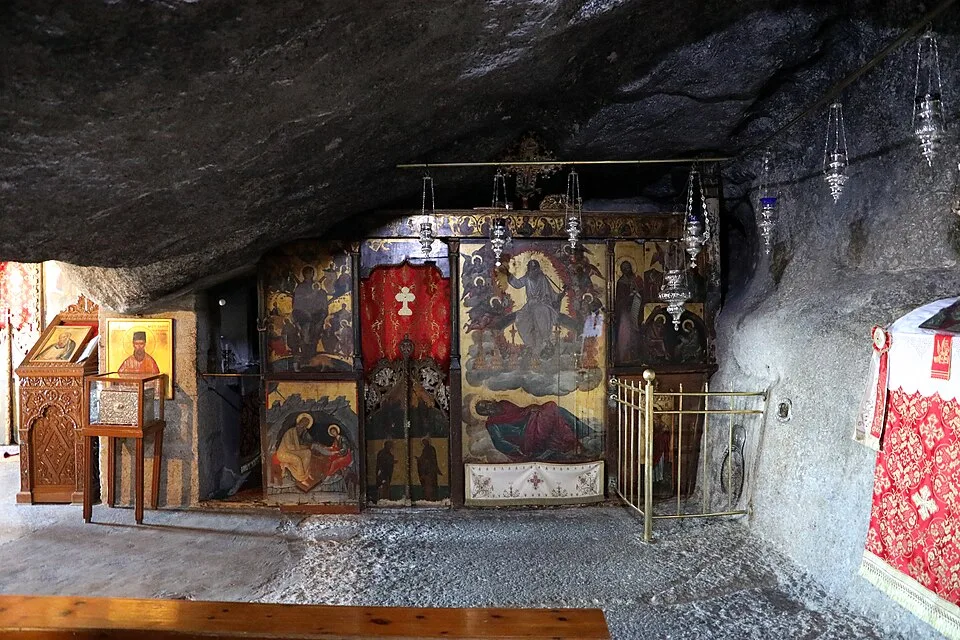
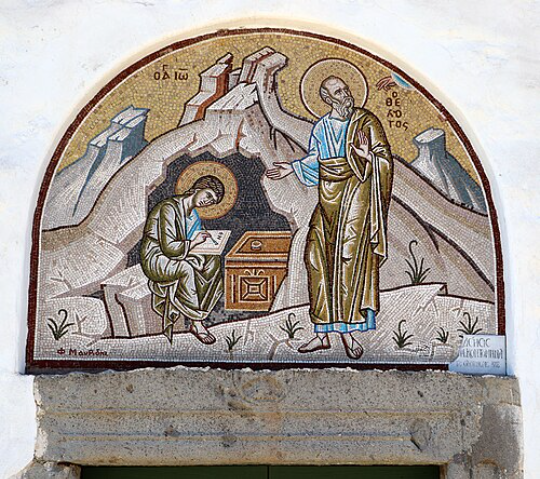
Our visit to the cave of St John’s apocalypse (where the Saint received visions from Christ leading to him writing the Book of Revelation in the late 1st century AD) was brief, as was that to the Monastery of St John the Theologian (built in 1088 by the monk Christodoulos supported by Byzantine Emperor Alexios 1 Komnenos).

The importance of these sites led to UNESCO’s 1999 World Heritage Listing and includes Chora, the island’s capital with its significant Byzantine architecture and two museums. Nor was I aware of Patmos’ reference as the “Jerusalem of the Aegean” or “2nd Jerusalem.”

Over the years, my naivety and ignorance regarding such an important island linking Byzantine Greek Orthodoxy and beyond, has evolved into a desire to learn more. Unfortunately, not having had to opportunity to visit Patmos again, I decided that researching and writing this article about Easter in Patmos would be a perfect place to start and to share with others.

I was fortunate enough to speak with a native of Patmos, Mattheos Melianos, a now retired, former Μayor, as well as teacher of the renown and UNESCO-listed, Patmian School. This school, instrumental in preserving the Greek language, culture and faith, particularly during the Ottoman occupation, was founded in 1713 and is often referred to as the “General School of the Nation.”

Melianos confirms that Easter in Patmos differs from the rest of Greece due to its Byzantine atmosphere.

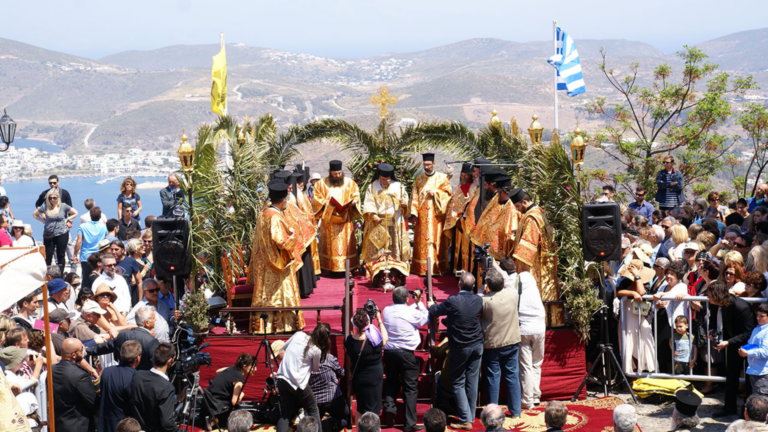
“This incorporates customs taking place from Palm Sunday, throughout the week until Easter Sunday, and beyond,” he says.

For example, on Holy Thursday in Chora, the Abbot of the Monastery, representing Jesus, washes the feet of 12 monks, as Christ did to his disciples. On Good Friday, an intense atmosphere dominates in the re-enactment of the descent of Christ from the crucifixion cross — “the moment Joseph of Arimathea and Nicodemus removed Jesus’ body from the cross, as described in the Gospel accounts of the Passion” — emphasising Christ’s sacrifice and humanity in terms of death, in lieu of his holy manifestation in resurrection.

In the evening, the Epitaph processions in Patmos are quieter and more austere compared to other parts of Greece.

Melianos emphasises that on the morning of Holy Saturday in the parishes of Patmos and in the Monastery, the service of the 1st Resurrection is held: “There’s a pre-ringing of the midnight resurrection bells in the morning, foretelling the Resurrection which begins with the hymn ‘Arise, God’, in a grand and Byzantine atmosphere.”

The Saturday Anastasi (Resurrection) of Christ is then celebrated at midnight as in the entirety of Greece, with festivities such as fireworks and blasting of ship horns in the ports. 

Monastery of St John above Chora.

During the all-important Easter Sunday, with its feasting and celebration, there is an added important element in Patmos.

On Easter Sunday afternoon, the Gospel is read in many languages as part of the Liturgy of Christ and God’s love, highlighting the message of the Resurrection for the entire world, and not just exclusively for the Greek Orthodox faith.

Melianos surprised me by saying that “during the entire week after Easter, there are more Easter commemorations — Monday is likened to day one of Easter for example. On this day, the Municipality holds a feast for all to attend, in the square of the city’s port Skala.”

Of the Tuesday that follows (Easter) he says: “We call it ‘new Tuesday’. Icons are taken out of the churches into the town squares and then into residents homes, extending the celebrations and message of the Risen Christ.”

Continuing, he narrates the Friday (after Easter) as the day of the Zoodochos Pigi, which celebrates the well that gives water to the Virgin Mary, symbolising granting life to the people.

Sunday, of the week after Easter, ends with the feast of St Thomas, the doubter. Melianos says this Saint preached in India too, adding: “Pilgrims still come from there every year.”

I surmise that Patmos’ Easter homage reaches far — spatially and spiritually.

It’s never too late as they say, and now I know that Easter in Patmos is a sacred experience. The combination of history, culture and traditions in Patmos rekindle and reinforce faith, on a level beyond more secular Easter experiences, to say the least.