
I visited Patmos in the summer of 1994 with my Australian then fiancée now husband, on a whirlwind Greek island tour. We stayed for only two nights and I’m now ashamed to admit that our visit to Patmos — arguably the most holy of islands, was focused on discovering yet another “perfect” Greek beach. In our 20’s then, now in hindsight I in particular — as a Greek Australian — was a deficient visitor and host.
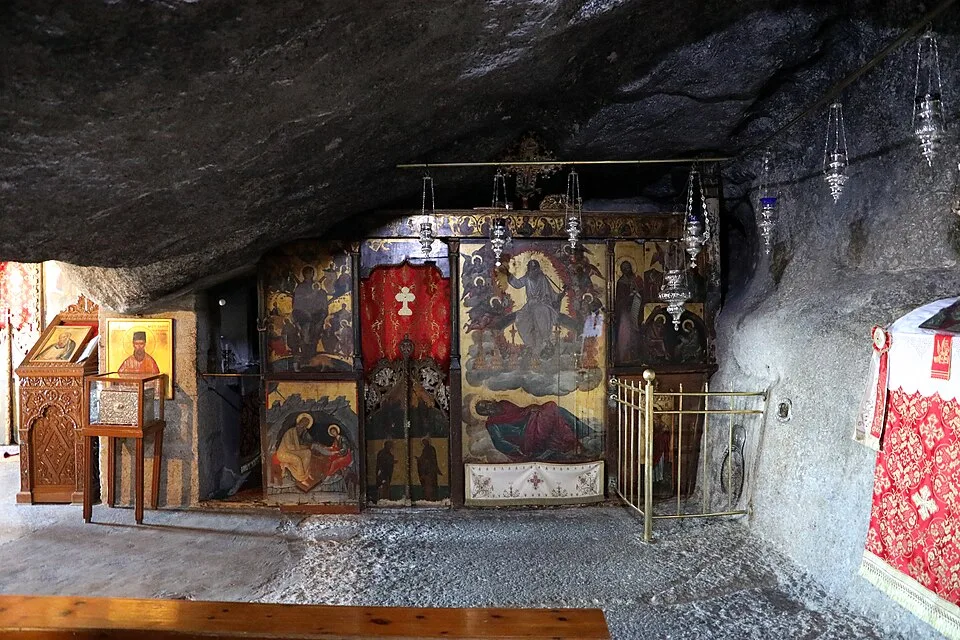
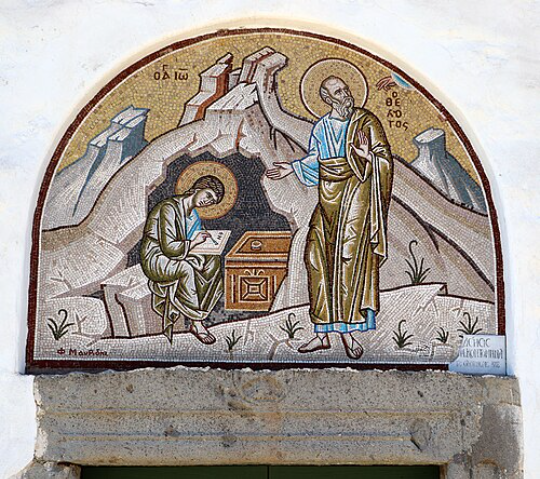
Our visit to the cave of St John’s apocalypse (where the Saint received visions from Christ leading to him writing the Book of Revelation in the late 1st century AD) was brief, as was that to the Monastery of St John the Theologian (built in 1088 by the monk Christodoulos supported by Byzantine Emperor Alexios 1 Komnenos).


The importance of these sites led to UNESCO’s 1999 World Heritage Listing and includes Chora, the island’s capital with its significant Byzantine architecture and two museums. Nor was I aware of Patmos’ reference as the “Jerusalem of the Aegean” or “2nd Jerusalem.”
Over the years, my naivety and ignorance regarding such an important island linking Byzantine Greek Orthodoxy and beyond, has evolved into a desire to learn more. Unfortunately, not having had to opportunity to visit Patmos again, I decided that researching and writing this article about Easter in Patmos would be a perfect place to start and to share with others.

I was fortunate enough to speak with a native of Patmos, Mattheos Melianos, a now retired, former Μayor, as well as teacher of the renown and UNESCO-listed, Patmian School. This school, instrumental in preserving the Greek language, culture and faith, particularly during the Ottoman occupation, was founded in 1713 and is often referred to as the “General School of the Nation.”
Melianos confirms that Easter in Patmos differs from the rest of Greece due to its Byzantine atmosphere.
“This incorporates customs taking place from Palm Sunday, throughout the week until Easter Sunday, and beyond,” he says.


For example, on Holy Thursday in Chora, the Abbot of the Monastery, representing Jesus, washes the feet of 12 monks, as Christ did to his disciples. On Good Friday, an intense atmosphere dominates in the re-enactment of the descent of Christ from the crucifixion cross — “the moment Joseph of Arimathea and Nicodemus removed Jesus’ body from the cross, as described in the Gospel accounts of the Passion” — emphasising Christ’s sacrifice and humanity in terms of death, in lieu of his holy manifestation in resurrection.
In the evening, the Epitaph processions in Patmos are quieter and more austere compared to other parts of Greece.
Melianos emphasises that on the morning of Holy Saturday in the parishes of Patmos and in the Monastery, the service of the 1st Resurrection is held: “There’s a pre-ringing of the midnight resurrection bells in the morning, foretelling the Resurrection which begins with the hymn ‘Arise, God’, in a grand and Byzantine atmosphere.”
The Saturday Anastasi (Resurrection) of Christ is then celebrated at midnight as in the entirety of Greece, with festivities such as fireworks and blasting of ship horns in the ports.

During the all-important Easter Sunday, with its feasting and celebration, there is an added important element in Patmos.
On Easter Sunday afternoon, the Gospel is read in many languages as part of the Liturgy of Christ and God’s love, highlighting the message of the Resurrection for the entire world, and not just exclusively for the Greek Orthodox faith.
Melianos surprised me by saying that “during the entire week after Easter, there are more Easter commemorations — Monday is likened to day one of Easter for example. On this day, the Municipality holds a feast for all to attend, in the square of the city’s port Skala.”
Of the Tuesday that follows (Easter) he says: “We call it ‘new Tuesday’. Icons are taken out of the churches into the town squares and then into residents homes, extending the celebrations and message of the Risen Christ.”
Continuing, he narrates the Friday (after Easter) as the day of the Zoodochos Pigi, which celebrates the well that gives water to the Virgin Mary, symbolising granting life to the people.


Sunday, of the week after Easter, ends with the feast of St Thomas, the doubter. Melianos says this Saint preached in India too, adding: “Pilgrims still come from there every year.”
I surmise that Patmos’ Easter homage reaches far — spatially and spiritually.
It’s never too late as they say, and now I know that Easter in Patmos is a sacred experience. The combination of history, culture and traditions in Patmos rekindle and reinforce faith, on a level beyond more secular Easter experiences, to say the least.
