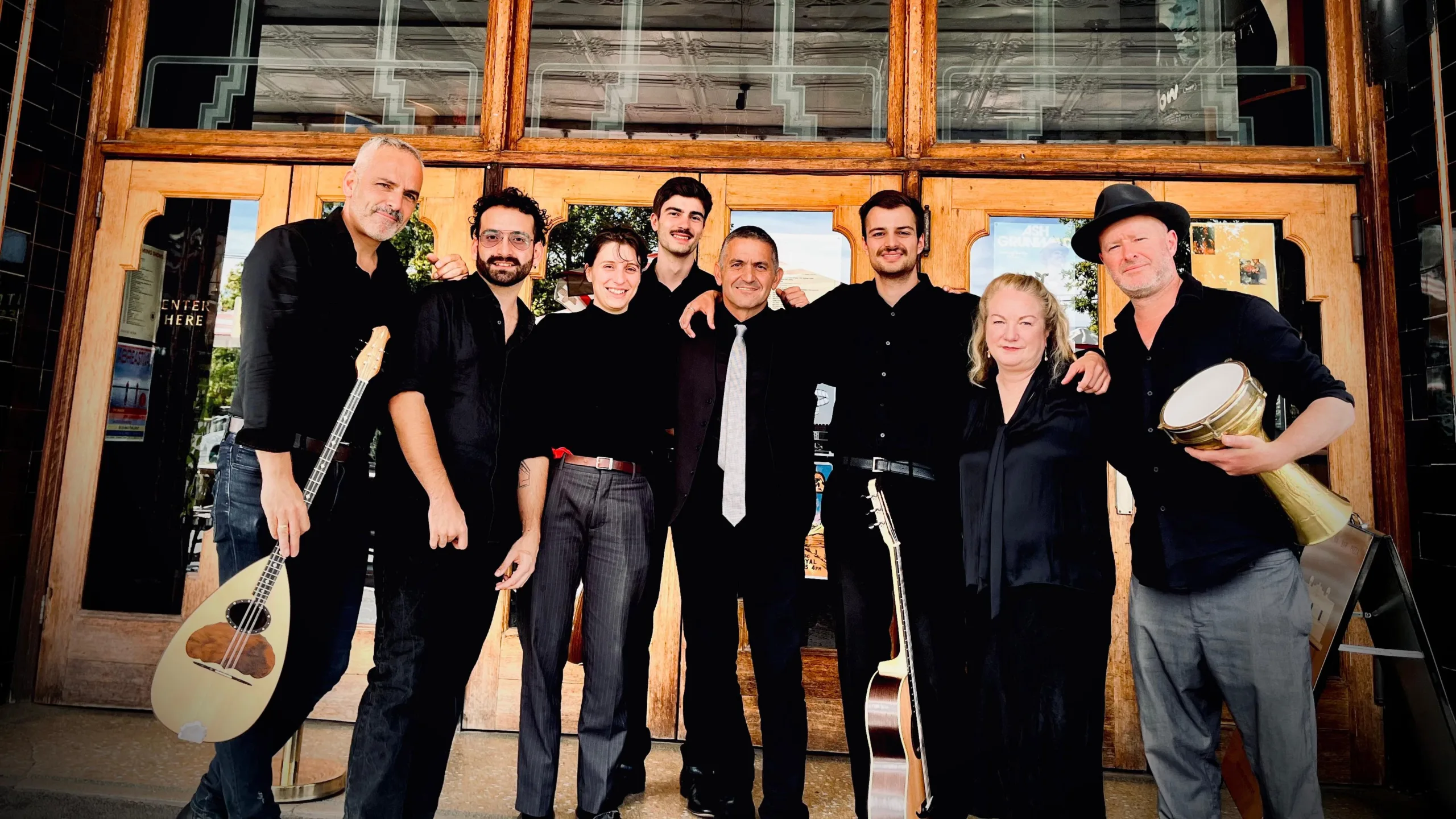
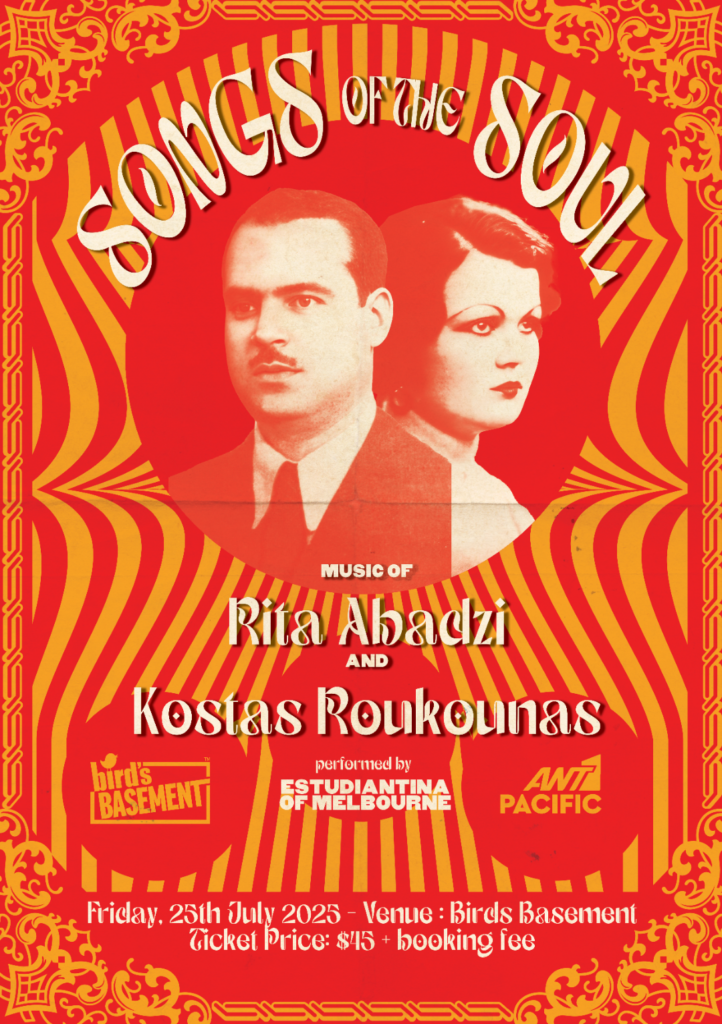
Following a successful East Coast tour and the release of their debut album, Melbourne’s own Estudiantina returns to Bird’s Basement on Friday, July 25 with Songs of the Soul – a moving tribute to two of Greece’s most iconic early 20th-century vocalists, Rita Abadzi and Kostas Roukounas.
In the lead-up to the show, The Greek Herald spoke with Estudiantina member and organiser Con Kalamaras about the legacy of these trailblazers, the power of music to preserve memory, and the ensemble’s evolving place in Australia’s multicultural soundscape.
What inspired you to focus this tribute on Rita Abadzi and Kostas Roukounas in particular, and how did you go about selecting the songs for the program?
We felt that Rita Abadzi and Kostas Roukounas each made a profound and lasting contribution to the musical landscape of Greece, and their legacy deserved to be honoured through a dedicated tribute. Both artists were true musical trailblazers of their era, with Abadzi paving the way for generations of female vocalists. As one of the few women recording during a period when the music industry was overwhelmingly male-dominated, she brought a distinct sensitivity and interpretive power to her performances that resonated deeply with audiences.
Kostas Roukounas, on the other hand, possessed a truly unique vocal style—effortlessly blending folk and urban musical traditions. His voice carried a sense of both strength and emotional nuance, which has continued to influence vocalists well beyond his time. He helped broaden the expressive range of Greek popular song, introducing stylistic elements that shaped the evolution of rebetiko and laiko music.
When it came to selecting the repertoire, we aimed to showcase a cross-section of their most iconic works—songs that not only highlight their technical brilliance but also reflect the emotional depth and cultural richness of their era. We also wanted to include pieces that would allow today’s audiences to connect with the stories and social contexts embedded in the music, whether themes of love, hardship, longing, or resilience. Ultimately, the selection was guided by both historical significance and emotional resonance, to present a balanced and heartfelt homage to these two remarkable artists.
What can people expect emotionally and musically from “Songs of the Soul,” especially those unfamiliar with Smyrneika or Rebetiko?
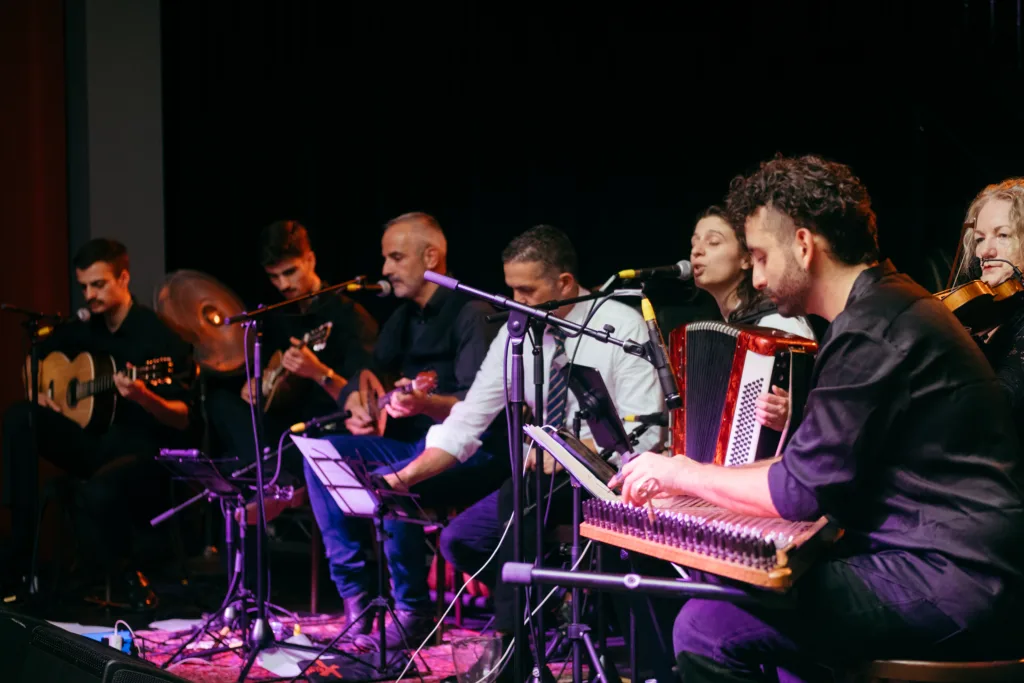
Songs of the Soul offers an evocative musical journey into the rich emotional landscape of Smyrneika and early Rebetiko—genres deeply rooted in the experiences of displacement, longing, and cultural memory. While Rebetiko is often associated with the urban subcultures of mainland Greece, this concert will place particular focus on the Smyrneika tradition, which emerged from the vibrant musical life of Asia Minor, especially the cosmopolitan city of Smyrna (now Izmir), prior to the population exchange of 1922. Musically, audiences can expect an intricate and emotive sound world shaped by instruments that are central to the Smyrneika idiom. The violin and accordion will feature prominently, offering lyrical and melancholic textures, while the oud and lavta—both traditional lutes of the region—will bring an authentic Eastern Mediterranean timbre to the performance. These instruments, played in interplay, create a delicate but powerful soundscape that is both haunting and deeply expressive.
Emotionally, the concert is designed to be a reflective and immersive experience. The repertoire will primarily span the early gramophone era, with songs that chronicle the trauma and upheaval experienced by the refugees who were forced to leave Asia Minor for Greece in the wake of the Greco-Turkish War. These songs are steeped in themes of exile, nostalgia, and a profound sense of cultural loss—of homes, communities, and identities that were suddenly and irrevocably torn away.
Even for those unfamiliar with the genre, the music speaks in a universal emotional language. Through plaintive melodies, mournful harmonies, and poetic lyrics, Songs of the Soul invites audiences to connect with the shared human experience of longing, resilience, and the search for belonging. It’s not only a concert—it’s a tribute to the enduring spirit of a people and the music that gave voice to their memories.
You’ve described Abadzi and Roukounas as trailblazers. How do you think their stories still resonate with audiences today, especially in a multicultural city like Melbourne?
Rita Abadzi and Kostas Roukounas were true pioneers in their time, not only for their musical innovations but for the way their work reflected the cultural, political, and social upheavals of early 20th-century Greece. Their stories continue to resonate today, particularly in a city like Melbourne, where diverse migrant histories form a vital part of the cultural fabric.
Abadzi, as one of the few female voices recorded during the early years of Greek popular music, represents a powerful figure of resilience and artistic integrity. In an era when women faced significant societal constraints, she carved a place for herself through her emotive performances and fearless storytelling. Her journey continues to inspire conversations around gender, voice, and representation in the arts.
Roukounas, meanwhile, is emblematic of the complex identity of the Asia Minor refugees—an identity shaped by displacement, hybridity, and cultural fusion. His ability to sing across styles and traditions, from Smyrneika to Rebetiko and demotic folk, reflects a pluralistic musical language that feels especially relevant in our globalised and multicultural world. His voice captured the emotional weight of exile and the longing for a lost homeland—experiences that still echo in the stories of many migrant communities today.
In Melbourne, where so many people carry their own histories of migration, loss, and adaptation, the music of Abadzi and Roukounas offers more than nostalgia; it offers recognition. Their songs speak to the universal themes of identity, resilience, and belonging. For the Greek diaspora in particular, but also for wider audiences, their work provides a bridge between the past and present, between individual memory and collective history.
Ultimately, honouring artists like Abadzi and Roukounas in a city like Melbourne is not just about preserving tradition—it’s about finding new relevance in their legacy. Their stories remind us of music’s power to hold space for memory, to give voice to the marginalised, and to connect communities across time and culture.
Estudiantina of Melbourne brings together musicians from diverse cultural backgrounds. How does this influence your interpretation of traditional Greek music?
The diverse cultural backgrounds of the musicians in Estudiantina of Melbourne are not just a point of difference—they are central to the way we approach and reinterpret traditional Greek music. While we remain deeply respectful of the original forms and traditions, our ensemble’s multicultural makeup naturally infuses the music with fresh perspectives, creating a dialogue between the old and the new, the local and the global.
Each musician brings their own musical language, experiences, and stylistic nuances to the ensemble, which enriches our interpretation of the repertoire. Whether it’s a subtle rhythmic variation inspired by Middle Eastern traditions, a harmonic approach shaped by Western classical training, or an improvisational flair drawn from jazz or Balkan folk music, these elements contribute to a vibrant and evolving sound. We don’t aim to modernise the music for its own sake, but to explore it through the lens of our collective identities.
In many ways, this approach echoes the very nature of Smyrneika and early Rebetiko, which themselves were born from cultural blending—drawing influences from Asia Minor, the Eastern Mediterranean, and the Ottoman world. The music was, and still is, a living tradition shaped by movement, exchange, and adaptation.
In a multicultural city like Melbourne, where Greek culture exists alongside so many others, our ensemble becomes a reflection of the broader community. Our interpretation of traditional Greek music acknowledges the roots of the genre while celebrating its capacity to evolve and speak across cultures and generations. It’s about honouring the spirit of the music while allowing it to breathe and connect in new and meaningful ways.
You’ve just wrapped up an East Coast tour and released your debut album – how has the response been, and what have you learned about your audience along the way?
The response has been overwhelming, people have been drawn to our music and we’ve even sold some cds/records in Europe, play with your heart and people will notice.
Is there anything else you’d like to say about what exciting things are ahead of Estudiantina of Melbourne?
Absolutely. Estudiantina of Melbourne is entering a very exciting chapter. As an ensemble, we’re committed not only to preserving and performing traditional Greek music, but also to expanding the ways it can be experienced, understood, and celebrated in today’s world.
Looking ahead, we’re planning to explore more thematic concerts that delve into lesser-known corners of the Greek musical tradition—whether it’s highlighting the regional styles of the islands and mainland, reviving rare archival material, or shining a light on forgotten composers and lyricists. We’re also interested in cross-cultural collaborations, working with musicians from other traditions to find common ground and create something truly unique. In essence, our goal is to continue evolving as a living, breathing ensemble—rooted in tradition, but open to new ideas, voices, and stories. We’re excited about building bridges between the past and the future, and sharing this beautiful music with an ever-growing and diverse community. We’re already in the studio recording our new album which will be released early next year!
Event Details:
- What: Songs of the Soul – Rita Abadzi & Kostas Roukounas
- When: Friday, July 25
- Where: Bird’s Basement, Melbourne, Victoria
- Time: Early Doors Open: 6:00 pm I Early Show Starts: 7:30 pm
- Buy tickets here.
