By Dr. Themistocles Kritikakos (Historian)
Across this series, we have journeyed through the Greek settlements of southern Italy, tracing how Hellenic civilisation spread, flourished, and was transformed in a new environment.
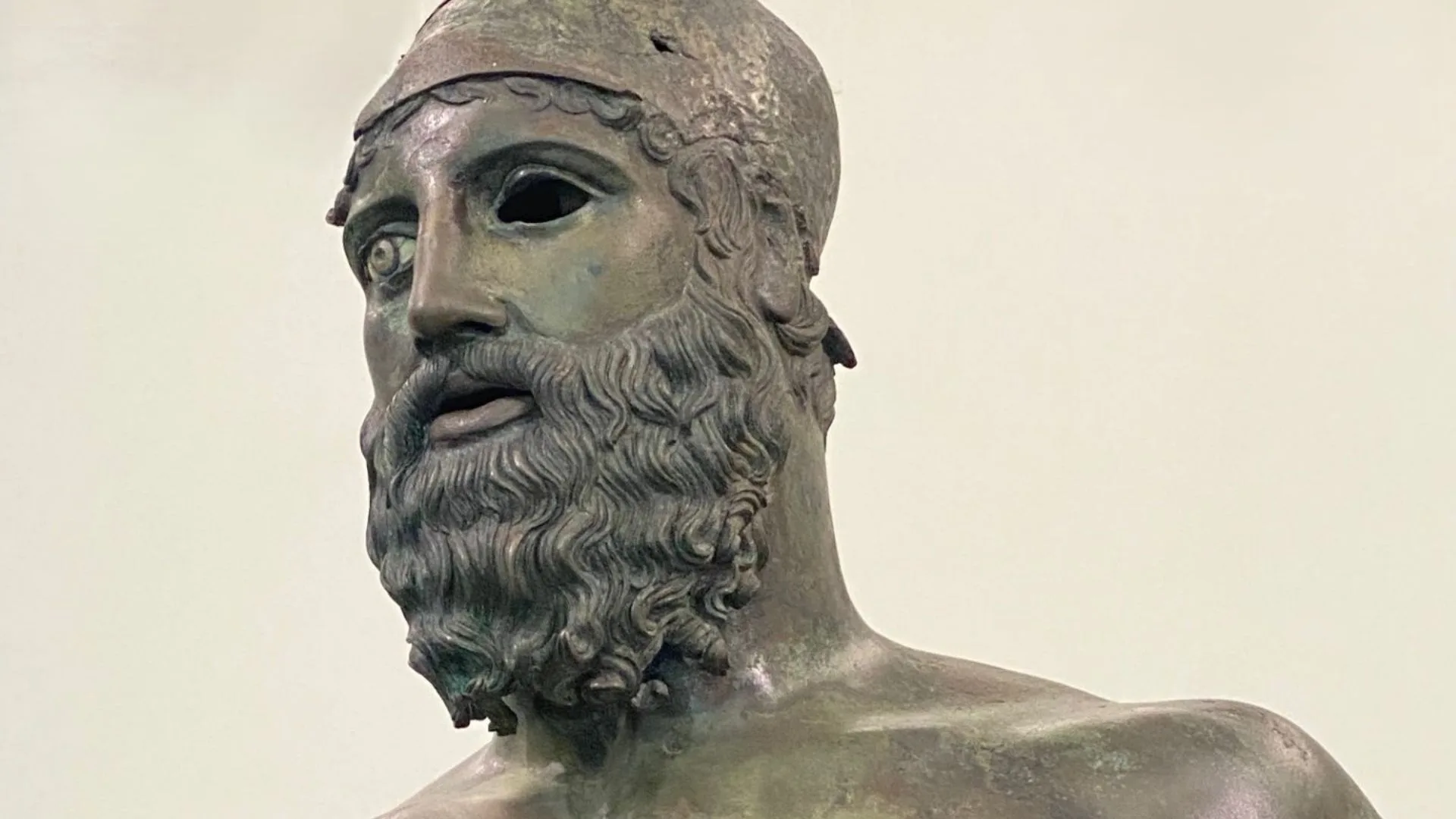
From Parthenope’s mythic shores on the Bay of Naples to the bronze warriors recovered from Calabrian waters in 1972, from Syracuse’s commanding harbour, where the failed Athenian expedition altered the course of the Peloponnesian War, to remote mountain villages in Calabria’s Aspromonte (Greko) and in Puglia’s Salento (Griko), we have seen how the legacy of Magna Graecia endured.
The Greeks founded cities—Neapolis, Syracuse, Kroton, and Taras—that stood as equals to the greatest centres of the ancient world. This was never mere imitation but rather adaptation and transformation. Hellenic civilisation was woven into the very landscape through living myth. Parthenope was the Siren who threw herself into the sea in sorrow, ending her life after failing to captivate Odysseus with her song. The first Greek settlement in Neapolis was named after this mythical figure.
Mythological accounts tell of oracle prophecies influencing Phalanthus, the divine hero, to colonise Taras, named after Poseidon’s son. Other stories speak of the enraged Typhon, imprisoned by Zeus, roaring from beneath Mount Etna near Catania.
The settlements in southern Italy were not merely Greece’s periphery but a vibrant second heart of the Hellenic world. The settlers brought with them language, customs, religious practices, and civic ideals of the mother cities. At times they rivalled their mother cities and even Athens itself, occasionally surpassing them in wealth, innovation, and cultural achievement.
This cultural dynamism attracted some of the greatest minds of the ancient world. Plato travelled three times to Syracuse between 387 and 361 BCE, seeking to guide tyrants Dionysius I and II toward his ideal of philosopher-kings. His visits demonstrated that Magna Graecia had become a true extension of Greek civilisation, firmly establishing the region as a hub of intellectual and cultural influence.
The region was home to philosophical schools that would reshape human thought. Pythagoras established his influential community in Kroton around 530 BCE, revolutionising mathematics and mystical understanding. In Elea, Parmenides and Zeno laid the foundations of logic and metaphysics that would challenge thinkers for centuries. In Sicily, Empedocles at Akragas proposed his theory of four elements (earth, air, fire, and water) that would dominate scientific thought.
Meanwhile, Alcmaeon of Kroton pioneered medical and anatomical study, becoming one of the first to perform dissections and to locate intelligence in the brain rather than the heart. Zaleucus, the lawgiver from Locri Epizephyrii, established one of the earliest written legal codes. His aim was for the laws to be applied consistently and to prevent the arbitrary power of the aristocrats. Archimedes (287–212 BCE) from Syracuse in Sicily transformed mathematics, engineering, and physics; his innovations echo through the ages.
These intellectual achievements were matched by equally bold political and artistic experimentation. Syracuse alternated between tyranny and democracy, achieving its most notable reforms under Timoleon (344–337 BCE), who established democratic laws, citizen protections, and the symbolic destruction of tyrannical strongholds. Taras, originally oligarchic with Spartan roots, saw stronger democratic elements emerge after heavy aristocratic losses. Under Archytas, Pythagorean mathematical and philosophical ideas were blended with practical governance.
In architecture and art, the cities of Magna Graecia transformed Greek traditions into original expressions. The temples at Paestum (Ancient Poseidonia) combined Ionic and Doric elements in unprecedented ways. Agrigento’s Valley of the Temples, recognised by UNESCO as among the world’s best examples of Doric architecture, demonstrated how Greeks could flourish beyond their homeland.
Greek cities often employed more systematic planning than established settlements. Neapolis embodied this rational approach through its carefully ordered grid of streets, and visitors today still walk along routes that follow the ancient Greek thoroughfares that have shaped the city.
Syracuse’s cultural patronage under Hieron I attracted prominent figures of the time. Aeschylus staged tragedies at the Greek theatre, including The Persians and The Aetnaeans. The theatre, where audiences still gather today, became a showcase for Hellenic dramatic achievement.
This cultural and political innovation was supported by extraordinary economic prosperity. The prosperity of Magna Graecia was celebrated. Cities like Sybaris and Metapontum were synonymous with luxury and agricultural wealth. Sybaris became so associated with luxury that “sybaritic” entered the language itself, while Metapontum’s sophisticated agriculture, symbolised by the ear of barley on its coinage, made it a major grain centre of southern Italy. The collective prosperity of these cities created standards of living that struck the ancient world.
Magna Graecia offers profound lessons for our interconnected world. These cities demonstrate how cultural encounter can spark innovation rather than mere imitation. The Greeks who sailed west were not seeking to rebuild Athens; they were bold enough to reimagine what it meant to be Greek among new peoples, under new skies.
As we conclude this series, the Riace warriors offer the perfect metaphor. For over two thousand years, they waited beneath the sea, hidden until the moment came to rise again into the light. They emerged like messengers from antiquity. These bronze guardians remind us that Magna Graecia’s influence was never truly buried. It pulses still in Naples’ restless energy and in Calabria’s ancient voices. It lives in Sicily’s eternal temples and in the memory of Spartan exiles who became Tarentine masters. The legacy endures in Metapontum’s golden grain, in theorems bearing Pythagoras’ name, in Parmenides’ philosophy, and in Archimedes’ innovations.
Today, travellers to Agrigento’s temples, visitors marvelling at the Riace bronzes, students encountering philosophical and scientific insights, or audiences watching performances in Syracuse’s ancient theatre all join that timeless dialogue between past and present. Magna Graecia reminds us that great civilisations never truly disappear—they await rediscovery by each generation.
This article concludes the series on Magna Graecia.
Links to the series:
Magna Graecia – Part 1: Hellenism beyond the homeland
Magna Graecia – Part 2: The Greek foundations of a new city
Magna Graecia – Part 3: Hellenism cast in bronze
Magna Graecia – Part 4: From Colony to Colossus: Syracuse and Hellenism in Sicily
Magna Graecia – Part 5: Exiled Spartans and Forgotten Greek Cities
*Dr Themistocles Kritikakos is a Greek-Australian historian, philosopher and writer. He holds a PhD in History from the University of Melbourne. His forthcoming book explores intergenerational memories of violence in the late Ottoman Empire, identity, and communal efforts toward genocide recognition, focusing on the Armenian, Greek, and Assyrian communities in Australia.
