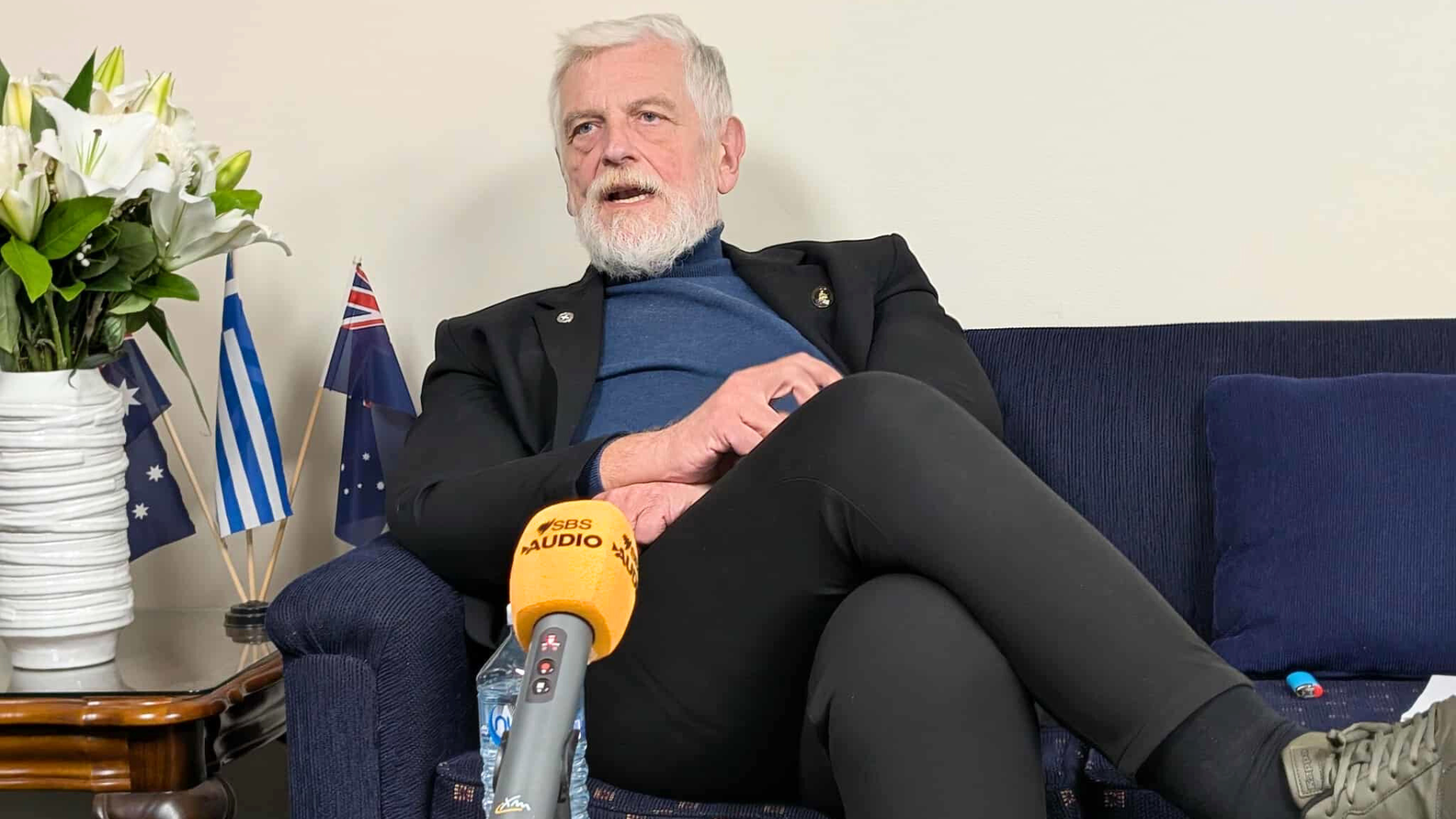
It’s been 10 years since a Minister for Greeks Abroad visited Australia, a decade marked by visits of delegations and broken promises. Yet this time, Deputy Foreign Minister Ioannis Loverdos insists things are different.
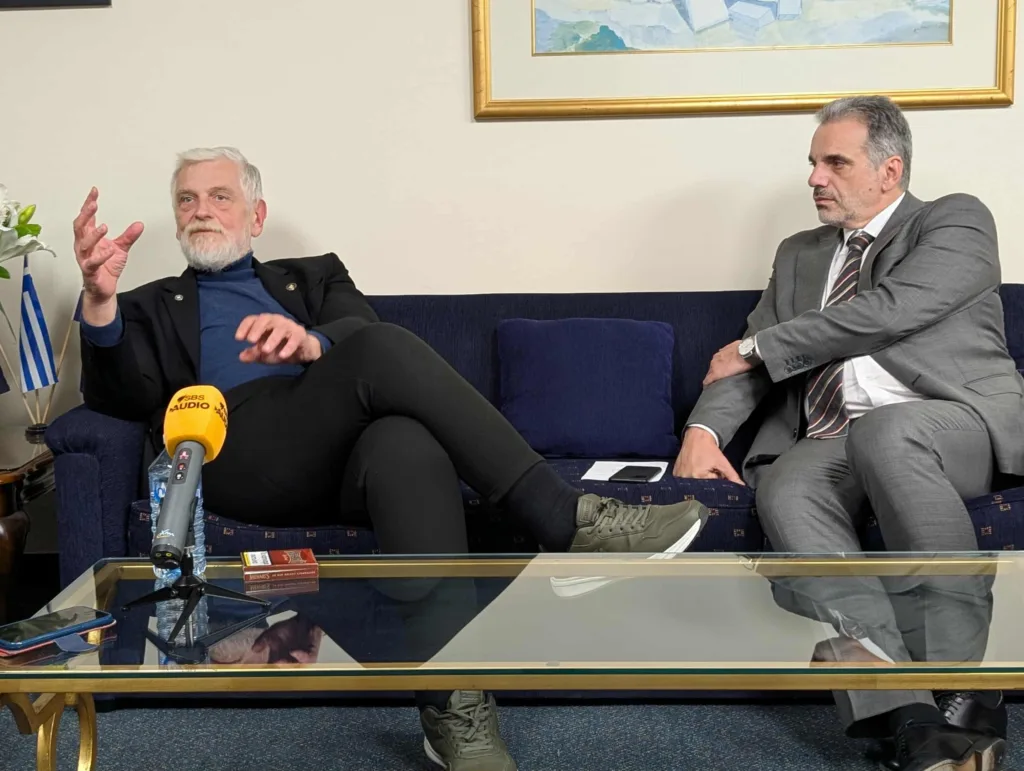
Meeting with Melbourne’s Greek press at the Greek Consulate of Melbourne on Friday, October 17, during what he described as a “military mission” involving 12 domestic flights and dozens of meetings in every capital except Darwin, Loverdos carried a message anchored in three values: “country, family, and church.”
Questions of belonging
In a packed press conference, The Greek Herald was the only outlet to ask questions in English, a deliberate choice to remind the delegation that Greek Australians come in many forms, including those who don’t speak Greek or hold citizenship but still feel an unshakeable bond with their heritage.
Loverdos paused, reflecting on this. “They don’t want to pay tourist levies, they want reduced museum fees, to open a bank account and be treated as Greeks,” we said, referring to the scrapped plans for an Omogenia Card for diaspora Greeks.
He acknowledged that feedback gathered the previous night at the Greek Centre, including from The Greek Herald and other community members, had revived groundwork once laid by Interior Secretary General Athanasios Barlempas.
“A very interesting idea,” Loverdos said. “We haven’t discussed it seriously yet… it’s still a thought brought to the table on this visit, but when we return to Athens, the Interior Ministry may examine it very seriously. It would be a transit stage.”
Why this time is different
The Greek Herald asked for a commitment, a timeline, something tangible, beyond this visit being just about meeting and greeting, and Loverdos stressed realism over rhetoric.
“It’s not a bad thing to have good relations and to love one another. Let’s not undermine the emotional bond… But in substance, I will never promise you something that cannot be done,” he said.
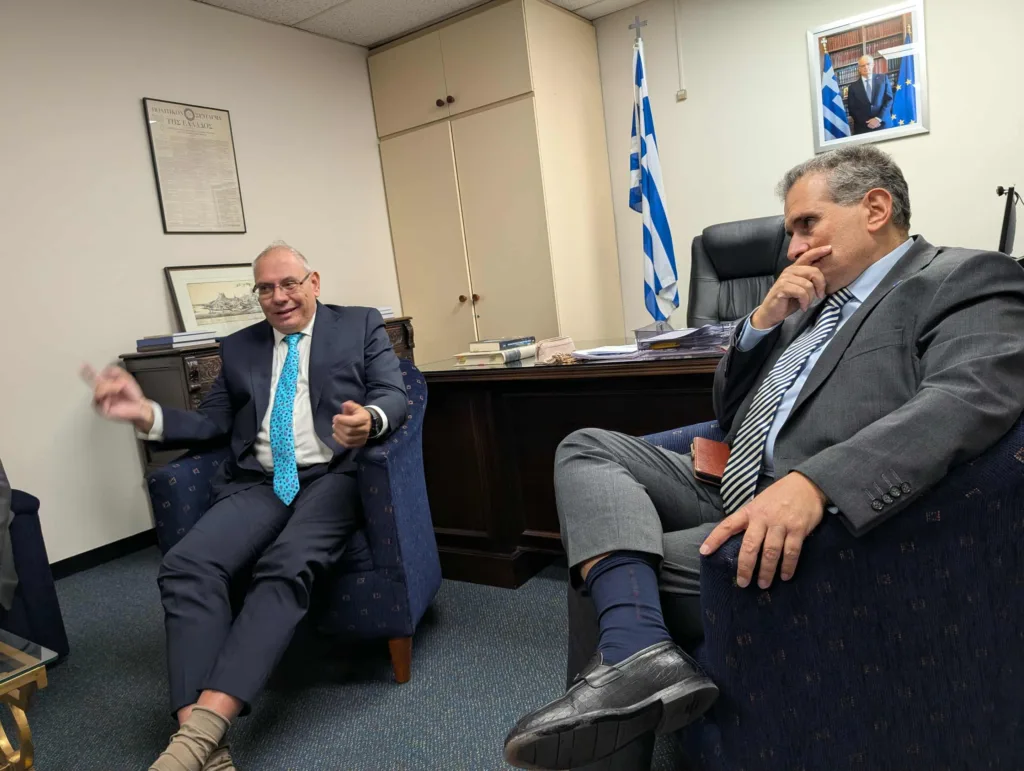
Citizenship General Secretary Dimitrios Karnavos added that the visit had already made a mark.
“The impact has been huge,” he said. “We met with Greeks abroad in Sydney, Melbourne, and many other communities, planting a major seed. The feedback we received is that ithagenia (Greek nationalisation through heritage) serves as an additional bridge with the mother country, one that goes beyond language, religion, culture, and customs,” Mr Karnavos said.
“This is the first time that two ministries (Foreign and Interior) have travelled together, and their cooperation made us far more efficient in delivering services.”
Digital consulates and bureaucracy reform
Loverdos pointed to practical reforms already underway, including the e-Consulate platform, mobile consular units, and a significant pay rise for Foreign Ministry staff abroad from January 2026 to make overseas posts more attractive.
“The first major change is the idea of the digital consulate, which is now being implemented,” he said.
A pilot program in Melbourne will soon allow civil registry acts (births, marriages, and deaths) to be processed entirely online, with digital payments. Biometric passport data, previously sent physically to Athens, will now be transmitted electronically via a new Hellenic Police platform, cutting waiting times by up to a month.
Responding to The Greek Herald’s question, Loverdos also confirmed that the new Citizenship Code will remove the requirement for Greek language proficiency, acknowledging the realities of modern diaspora life and simplifying applications for those of Greek descent.
Language preservation: ‘No magic solutions’
“Saving the Greek language is a priority, but there are no magic solutions,” Loverdos admitted. “It’s extremely difficult. This concerns me greatly because I love the Greek language and want it to survive.”
He noted that language attrition has affected even countries geographically closer to Greece.
“The Greek government’s strategy focuses on funding Greek Studies Chairs at universities,” he said, citing a recent $18,000 grant to the University of Sydney. “It’s not much, but it keeps the Greek Studies Chair alive.”
He also acknowledged the need to renew outdated schoolbooks and develop new teaching materials in collaboration with universities abroad.
Barlempas added that a new seat in Western Macedonia, led by educator Eleni Grivas, is dedicated to teaching Greek as a second language.
Loverdos further announced increased scholarships for Greek Studies abroad and English-language programs in Greece. “Even if youth don’t know Greece, spending a month there and socialising with other Greeks will help them connect.”
Before the press conference, Loverdos met with representatives of Pharos, an organisation dedicated to Greek language preservation. The delegation listened to Pharos’ suggestions, and Loverdos emphasised that his trip was as much about listening as about policy.
“Before coming to Australia, I was asked, ‘What do you expect?’ I replied: ‘I can’t wait to listen to the diaspora’,” he said.
From Shrine to Monastery: devotion and duty
At the Shrine of Remembrance, Loverdos laid a wreath at the Australian Hellenic War Memorial, and shared with the press, voice trembling, a feeling of “awe” during the visit, reflecting on Greeks and Australians fighting side by side.
Later, he moved through Melbourne’s Greek heartlands, from a tyropita at Oakleigh’s Vanilla café to a visit to the Northcote Monastery, greeted by crowds and community leaders at every stop. At night, he had dinner at the Crown with Greek leaders.
Despite his gruelling schedule – “his program was exhausting,” one aide remarked – his warmth never waned.
“Your parents and grandparents came poor and uneducated, and their children thrived. That is Greece,” he said, visibly moved.
Looking ahead
Before departing, Loverdos said he was leaving “satisfied,” having “planted an important seed”, the seed of a renewed, tangible connection between Greece and its faraway children.
Whether that seed blossoms into the revival of the long-discussed Omogenia Card, advocated by The Greek Herald, or other reforms remains to be seen. But one thing is certain: this visit was more than ceremonial – it was a mission of listening and renewal.
“One thing we hadn’t considered before coming was the problems faced by retirees,” he added, referring to those who wish to return to Greece but lack health insurance. “Australia is not willing to enter a mutual agreement, so we need to find solutions.”
As talks continue, there are signs of progress. A Double Taxation Agreement is advancing, with hopes of resolution before Prime Minister Kyriakos Mitsotakis’ planned visit to Australia in early 2026, possibly March, and more work expected when the Greek Foreign Minister visits in November.
“Because we want to prove we care,” Loverdos said.
*All photos copyright The Greek Herald / Mary Sinanidis.
