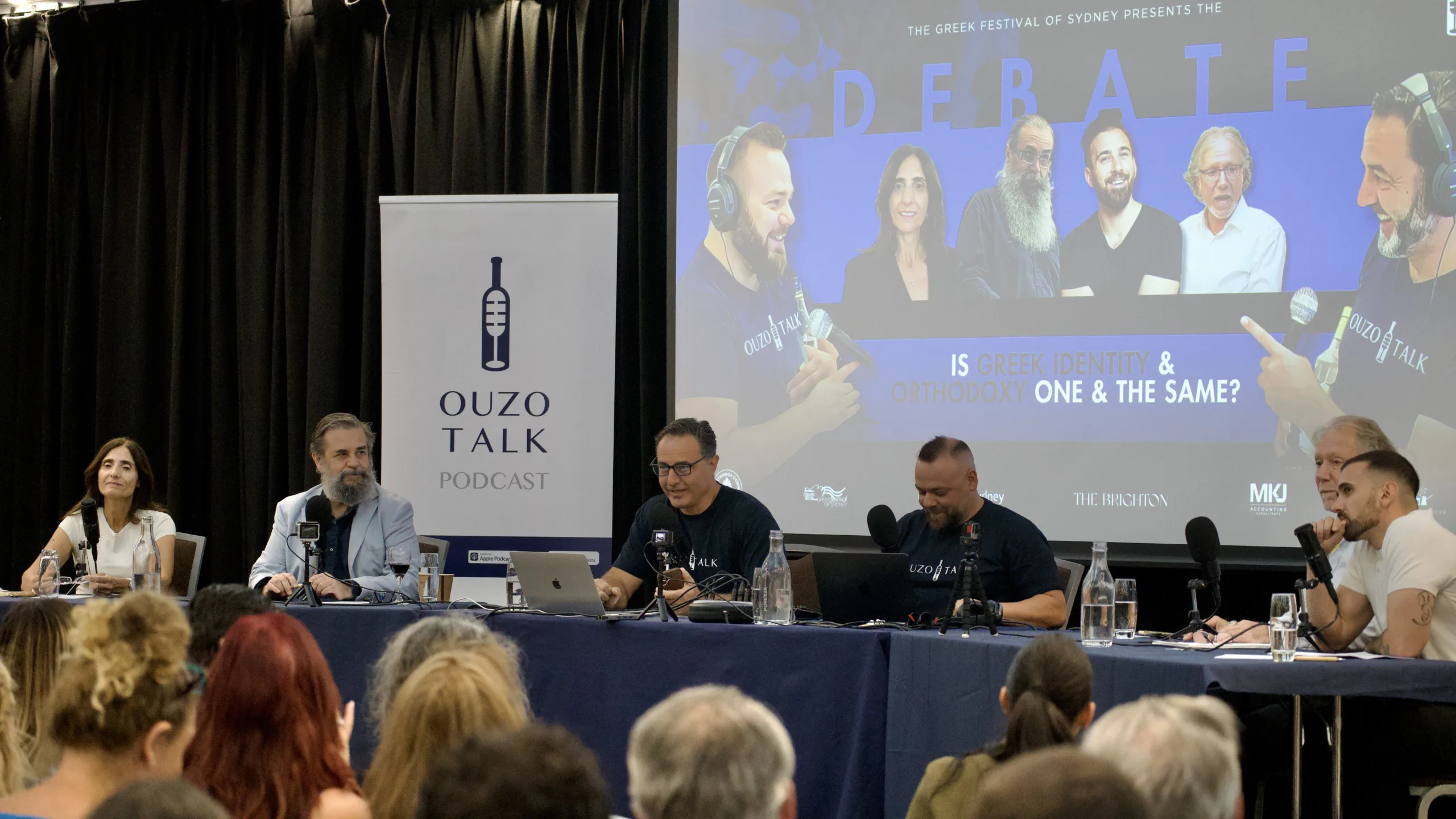
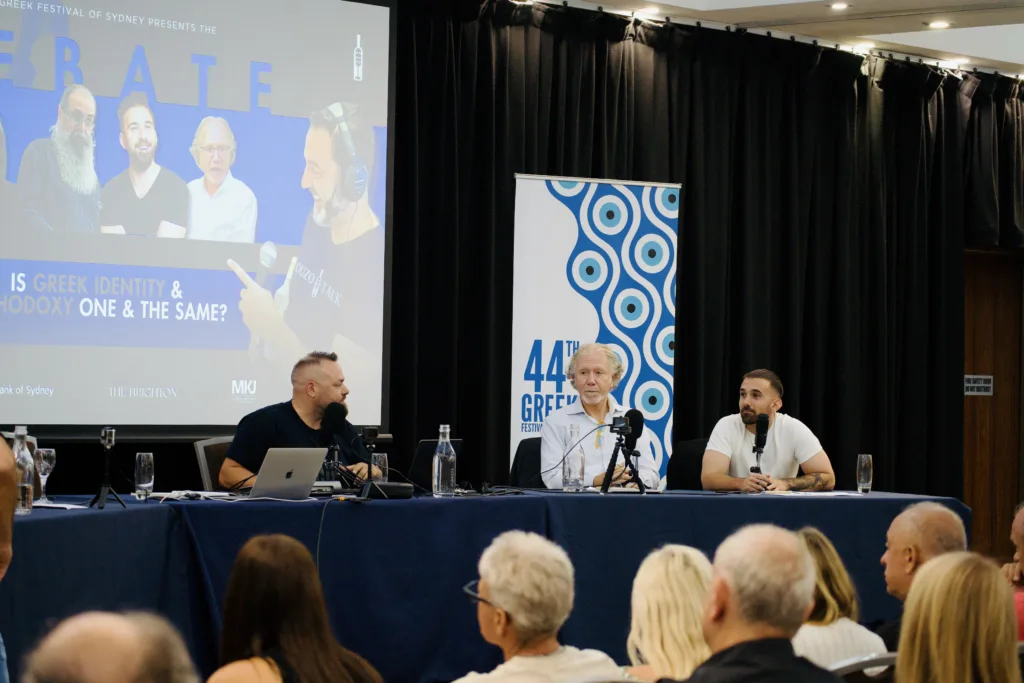
The Brighton Hotel Sydney hosted an Ouzo Talk live debate on Monday night as part of the Greek Festival of Sydney, with panellists taking on one of the most enduring and emotionally charged questions in Hellenism: is Greek identity and Orthodoxy one and the same?
Hosted by Tom Skolarikis and Nick Athanassiou, the event was recorded as a live podcast episode and brought together four speakers from markedly different backgrounds and perspectives: Dr Vasilis Adrahtas and Dr Vicky Petrakis on the affirmative side, and James Arkoudis and comedian Anthony Locascio arguing the negative.
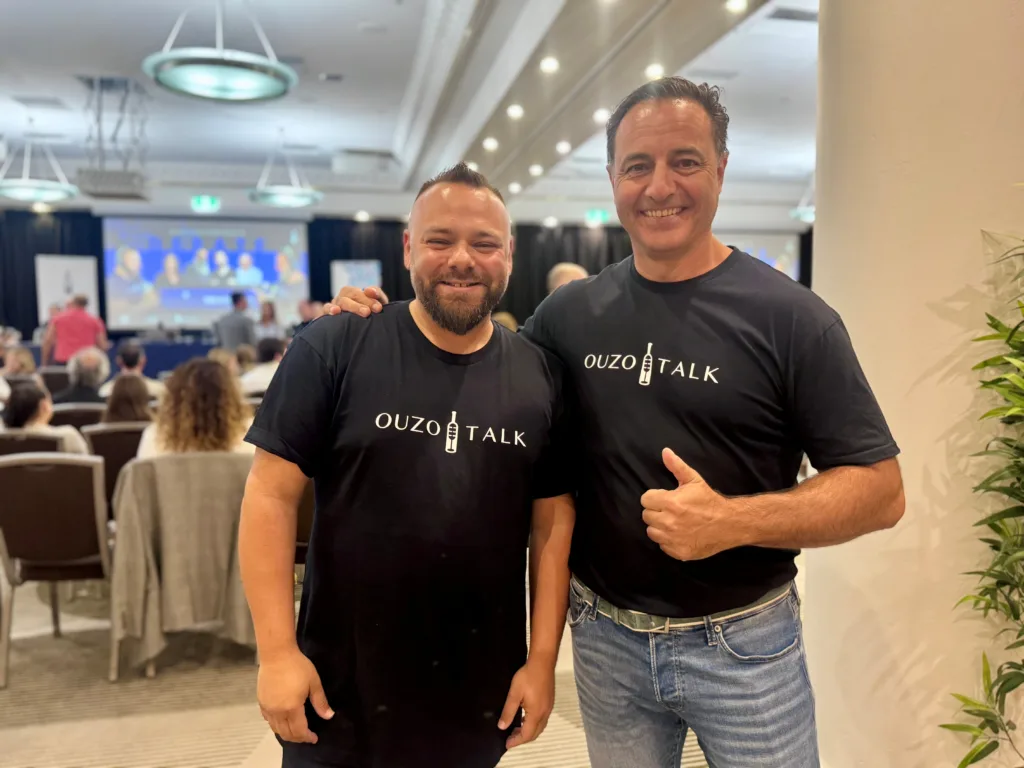
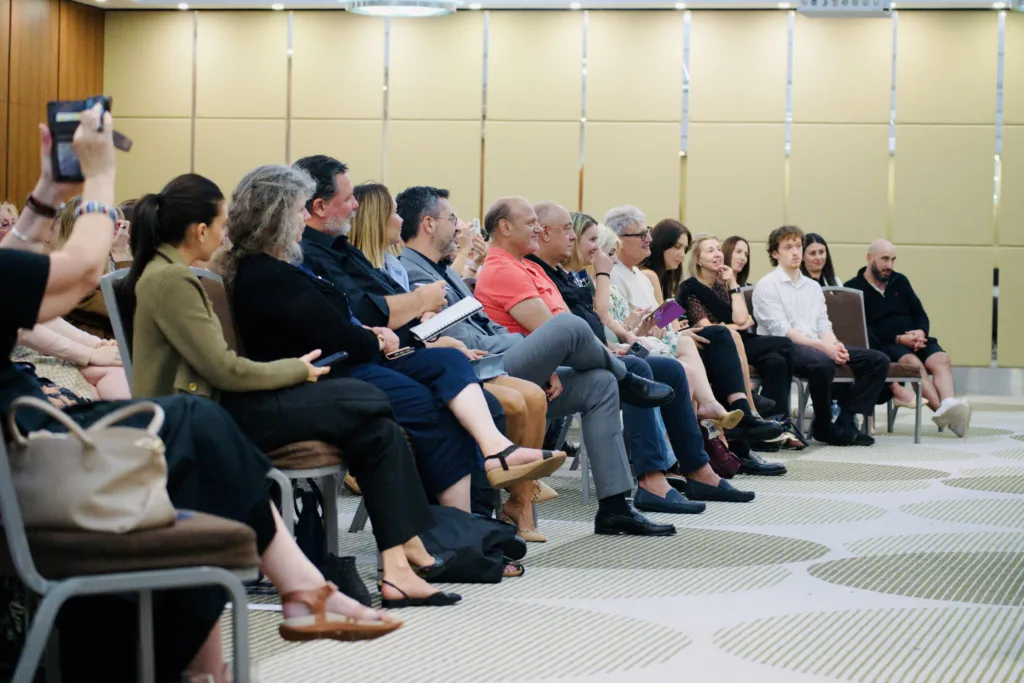
Among those in attendance was the Consul General of Greece in Sydney, Georgios Skemperis, alongside representatives from university Greek societies and the broader community.
From the outset, the debate was framed not as a clash between believers and non-believers, but as a deeper inquiry into history, philosophy, culture and the lived experience of Greek identity, especially in the diaspora.
Skolarikis said the format aimed to revive a long-standing Greek tradition of open dialogue, noting the question remains controversial because of how deeply faith and culture are intertwined in communities outside Greece.
“Debate and argument are part of our Greek heritage and DNA,” he said.
“We know how intertwined faith and identity is when it comes to the Greek diaspora, in particular,” he said. “The church and Orthodoxy have played a huge role in our communities over the years. But can they be separated?”
The case for unity: faith as the foundation of identity
The affirmative case sought to argue that Greek identity and Orthodoxy are inseparable at a foundational level.
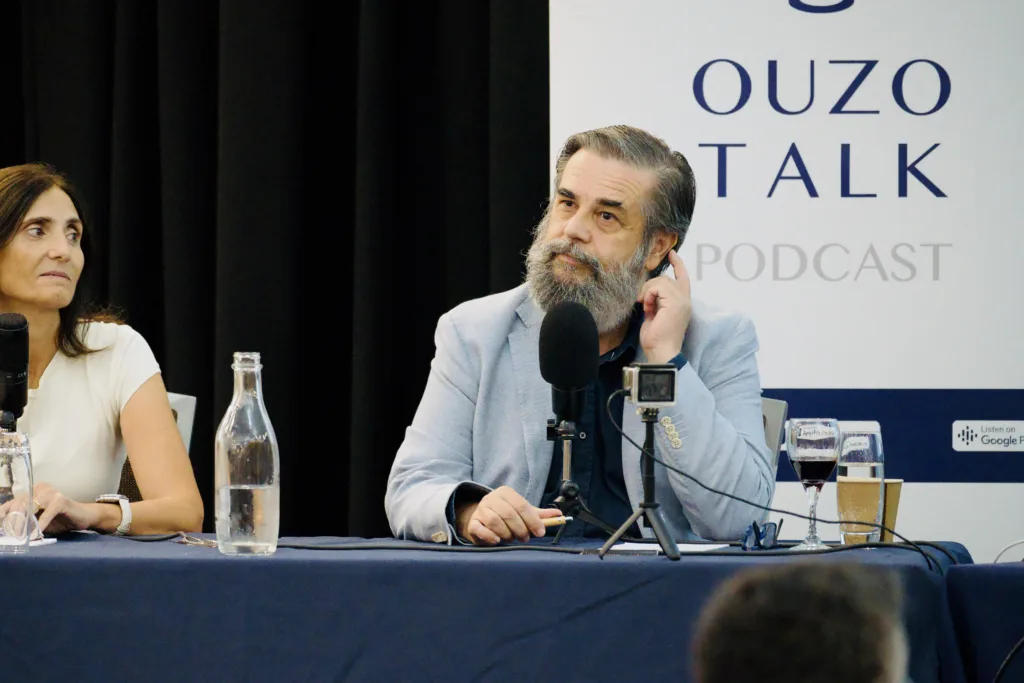
Dr Vicky Petrakis, drawing on Greek philosophy and early Christian theology, argued that Orthodoxy and Greekness are united through the shared ideals of freedom, virtue and reason. She contended that the language and intellectual tools used by the early Church Fathers to explain Christian doctrine were themselves shaped by Greek philosophical thought.
“Orthodoxy and Greek identity mandate us, through their historical connections, to express through our life and works what it means to be a virtuous and free individual,” Petrakis said.
She later argued that while it is possible in a narrow sense to be Greek without being Orthodox, the deeper question lies in what constitutes the essence of Greek identity.
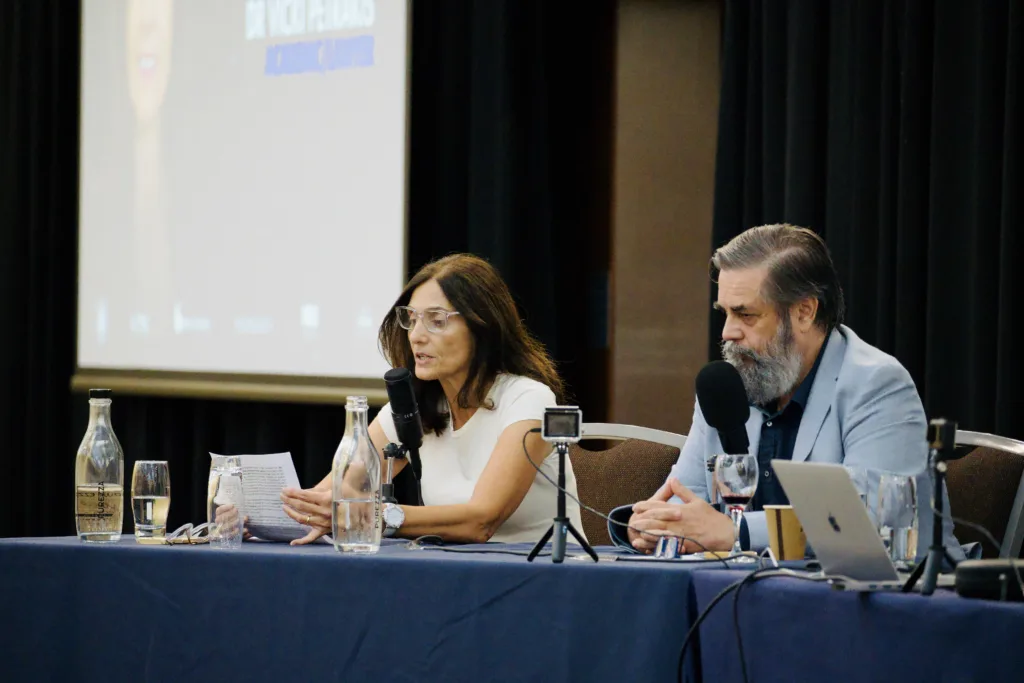
“Orthodoxy is therefore the definition of what it is to be Greek, a free citizen, because the basis of that freedom lives within us,” she said.
Her teammate, Dr Vasilis Adrahtas, took a more dialectical approach, insisting that the debate should focus on present reality rather than what participants might wish Greek identity to become in the future.
“The motion is not about what we would like identity to be in the future… but it’s about facts,” he said.
Adrahtas argued that while Greek identity and Orthodoxy are not identical in a simplistic sense, they remain deeply bound together as a historical and cultural structure, particularly in the diaspora. He described the Church as the only enduring national network of Hellenism in Australia with continuity, discipline and institutional presence.
“The church basically represents the only network of a social body of Hellenism in Australia that is all over the country and has some sort of discipline, stability and viability,” he said.
The case for distinction: identity beyond religion
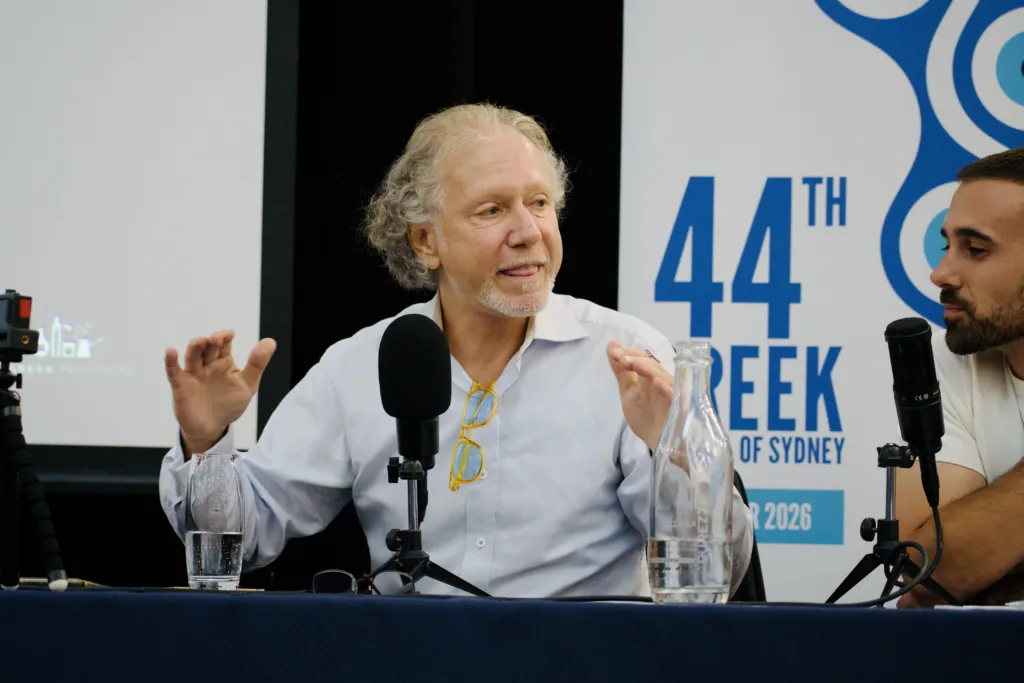
On the opposing side, James Arkoudis argued that Greek identity is far broader than religion and cannot be reduced to Orthodoxy alone. He maintained that religion is transnational, while Greek identity has its own distinct civilisational, historical and philosophical character.
“It cannot be just its religion, because religion is transnational. There are Orthodox Serbs, Bulgarians, Russians and whatnot, but Greeks have their own identity,” he said.
Arkoudis traced Greek identity through ancient ideals, Roman influences and later historical developments, contending that while the Church played an important role during Ottoman rule, especially in preserving communal life, this did not make Orthodoxy synonymous with Greekness.
“Greek culture is bigger than that. It’s not just that,” he said.
He also argued that modern Greek identity had already moved beyond that equation, saying Greece and the diaspora should take greater responsibility for preserving language, history and culture without outsourcing Greek knowledge to others.
Personal experience meets philosophy
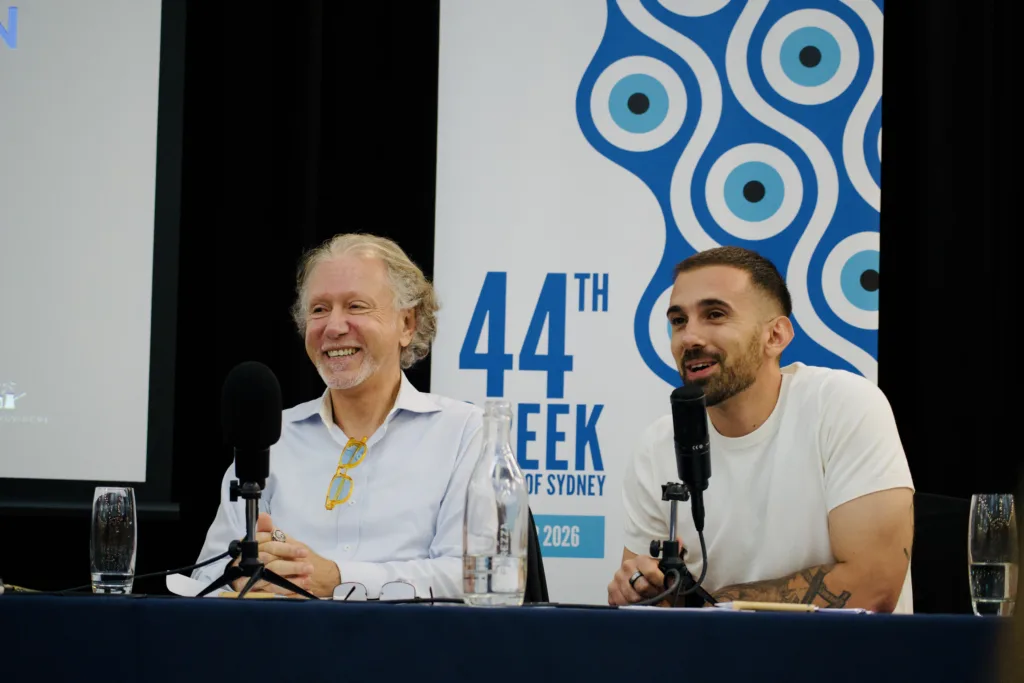
Locascio, the night’s wildcard speaker, brought a more personal and contemporary argument to the negative side. Openly acknowledging he was not an academic, the comedian grounded his case in lived experience as an Australian performer of Greek and Italian heritage.
“I am an Australian comedian with Greek and Italian heritage,” he said. “My very existence belies it. I’m not Orthodox at all… I would love to see whichever of you that decides that the affirmative will win tonight come and look me in the face and tell me that I’m not Greek afterwards.”
In one of the night’s more memorable interventions, Locascio warned against the dangers of basing identity too rigidly on any one ideology.
“A healthy, secure relationship with that ideology allows it to act as a stable base on which to build a more nuanced, complex identity, but an insecure, rigid clinging relationship to that ideology makes it a prison,” he said.
His contributions frequently drew laughter and applause from the audience, blending humour with more reflective moments that resonated throughout the room.
Audience questions spark deeper debate
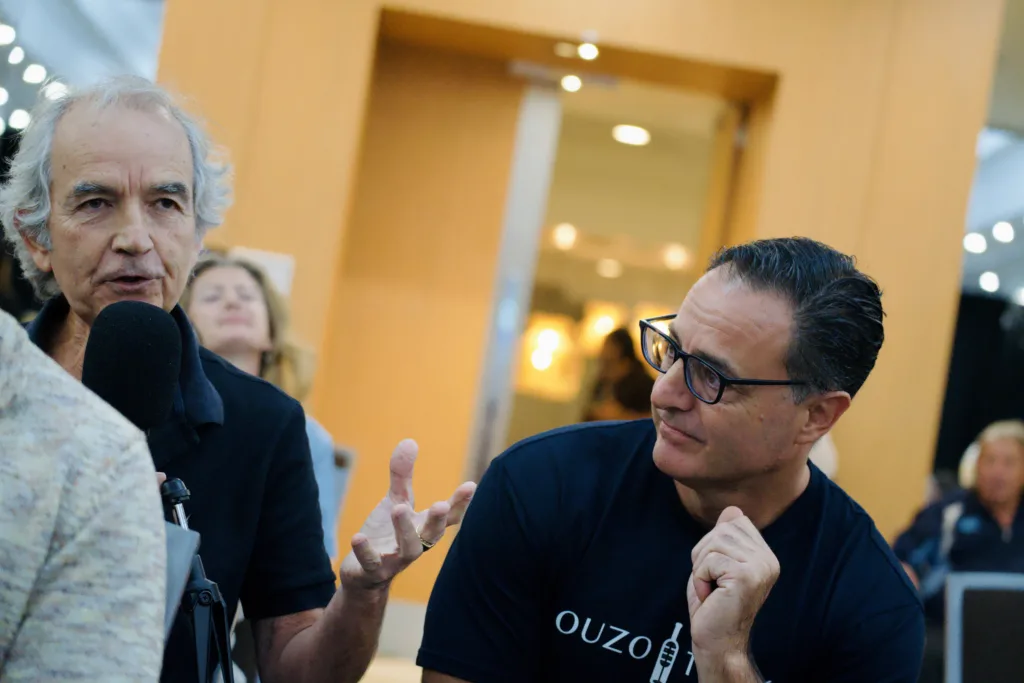
Following the formal debate, the evening opened into an extended and lively Q&A, which in many ways became the most dynamic part of the event.
Questions from the floor moved the discussion from theory into the practical realities of diaspora life in Australia, including the role of Greek schools, weddings, language and music in preserving Hellenism, and whether Greek identity can or should evolve beyond religious structures.
Some audience contributions also challenged the philosophical foundations of the motion itself. One question pointed to the Greek War of Independence and the rallying cry “freedom or death,” arguing that the willingness to embrace death appeared to contradict core Christian teachings and raised deeper tensions between Greek identity and religious doctrine.
Another questioned whether Greek philosophy, which predates Christianity by centuries, suggests that Greek identity exists independently of Orthodoxy, proposing instead that the faith may be an expression of Greek identity rather than its defining feature.
Diaspora realities and the question of what endures
Addressing questions around the role of the Church in the diaspora, Adrahtas acknowledged its continuing centrality in Australia, even while expressing hope that Hellenism might one day flourish more independently in the long term.
Another discussion point focused on whether Greek philosophy predating Christianity suggested that Greek identity existed independently of Orthodoxy. Petrakis responded by arguing that the Church Fathers drew on Greek philosophy precisely because it provided the conceptual framework to explain Christian belief and the Incarnation.
There was also debate over whether language, music, custom and even symbols such as the mati were more accurate markers of Greek identity than faith alone. The exchanges reflected a broad agreement on one point even where disagreement remained on the motion itself: Greek identity is layered, living and still contested.
A close vote, but no clear consensus
At the beginning of the evening, audience members were invited to vote on the motion via QR code, then vote again after hearing the debate. By the end of the night, the affirmative side had made only a slight gain, with support for “yes” rising from 32 per cent to 34 per cent, while “no” fell from 68 per cent to 66 per cent.
The modest shift suggested that while the affirmative team persuaded some, most in the room remained unconvinced that Greek identity and Orthodoxy are truly one and the same.
Still, if the final numbers showed limited movement, the debate itself revealed something more significant: that within the Greek Australian community, questions of faith, culture, language and belonging remain deeply alive and far from settled.
The full debate will be released as an Ouzo Talk podcast episode on major streaming platforms.
