By Michael Peters Kyriacou, Honorary President of the Cyprus Community of NSW
On March 25, we commemorated the beginning of the struggle of 1821 – liberate the lands of the Hellenes and restore dignity, identity, and freedom to a people long under foreign rule. It was a moment of courage, sacrifice, and conviction.
Between the call to arms and the achievement of independence lies another moment when the struggle gave birth to a nation.
That moment is 14 April 1827.
At the ancient town of Troezen, southwest of Athens, the Third National Assembly – having overcome deep internal divisions – moved beyond revolution and into statehood. There, the Hellenes confirmed the mandate of Ioannis Kapodistrias, a Hellene of Cypriot descent, as their leader, to defend, define, and build Greek sovereignty.
He was the son of Adamantia Gonemi, a woman of Cypriot lineage whose life embodied displacement, endurance, and the preservation of Hellenism under foreign rule.
Her family belonged to the elite class of the Greeks of Cyprus prior to the Ottoman conquest of Cyprus in 1571. When Cyprus fell, they were forced into exile – carrying with them not territory, but identity. Their journey from Cyprus to Crete, Epirus, and ultimately Corfu reflects a deeper truth: Cyprus did not vanish from the Hellenic world – it dispersed into it, embedding its influence across regions and generations.
In Corfu, under Venetian administration, this Cypriot lineage became part of a political and cultural environment that fused Greek identity with European governance. It was in this setting that Kapodistrias was raised. His later ability to defend Greek sovereignty – through diplomacy, institution-building, and international engagement – was no accident; it reflected a heritage shaped by his mother’s family experience.
His mother’s family carried the trauma, struggle, aspiration, and vision of a free and sovereign people of Cyprus, of all Hellenes – values she instilled in her son, guiding both his life and the destiny of the new nation.
For Adamantia, sovereignty was not an abstract idea; it was inherited, lived, and understood – it was part of what it meant to be Greek. It is no surprise, then, that Kapodistrias led Greece with Herculean endurance to secure the sovereignty now often taken for granted.
Greece formalised its sovereignty in 1827 under a Hellene of Cypriot descent – carrying the legacy of a mother deeply rooted in Cyprus, whose aspirations were for a people free from foreign domination. Cyprus has continued its own journey to achieve the same into our time.
More than a century later, Cyprus confronted the same fundamental question: the right of a people to govern itself – its right to sovereignty. The 1955–1959 Struggle was a contest over legitimacy, identity, and recognition. Cyprus sought to assert the very principle established at Troezen: that sovereignty belongs to a people united by history, identity, culture and purpose.
Unlike Greece in 1827, Cyprus’ path did not resolve into a clear and unified outcome. Its sovereignty has remained complex, contested, and still evolving.
14 April 1827 was not the end of a story – it was the beginning of a Hellenic principle and tradition. Sovereignty must be asserted, defended, and recognised. Greece achieved this through unity and leadership. Cyprus inherited that same imperative – and its journey continues.
The Cyprus Community of NSW commemorates 14 April 1827 not simply as the founding of modern Greece, but as a moment of enduring significance, for the people of Cyprus in 2026.
Today, Cyprus continues the path to define and defend its sovereignty – a path led by one of its own nearly two centuries ago.
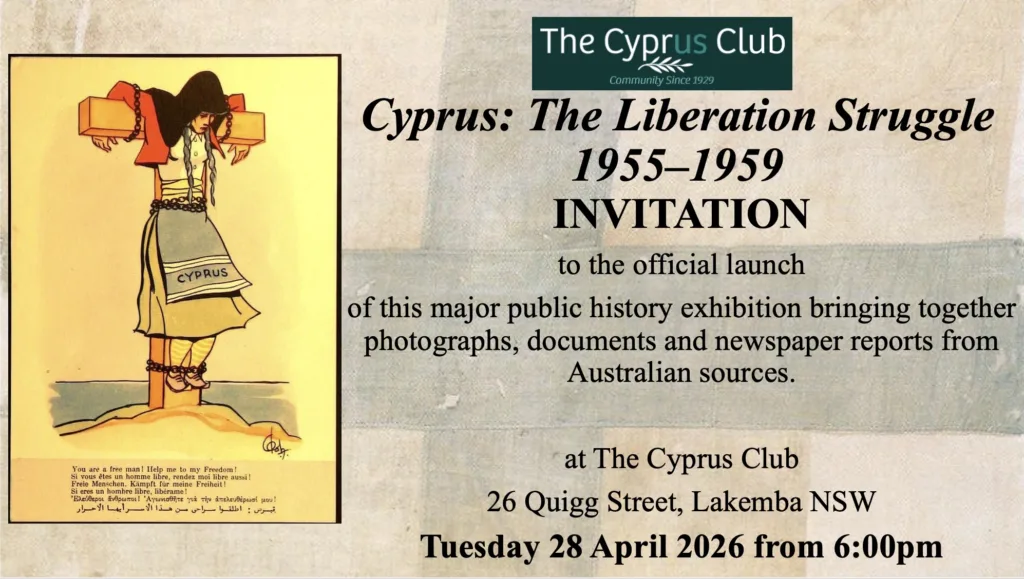
On Tuesday, April 28, the Cyprus Community launches its largest exhibition on the media narrative of Cyprus’ modern history – exploring how sovereignty is shaped, challenged, and contested through perception.
The 1955–1959 Liberation Struggle was part of that journey – drawing inspiration from 1821 and 1827 – not only to assert sovereignty, but to define it, and to ensure Cyprus’ story is told truthfully, not distorted.
A Hellene of Cypriot ancestry helped define Greece’s sovereignty.
Cyprus continues to define and defend its own.
We invite all Greeks and Philhellenes to attend the exhibition launch and reflect on 1827 – just as much as on the continuing story of Cyprus’ struggle for sovereignty.
The exhibition, Cyprus: The Liberation Struggle 1955–1959, will be held at the Cyprus Community’s premises in Lakemba and will run from Tuesday 28 April to Friday 15 May. Find out more details here: www.thecyprusclub.org.au/exhibition
