Home Blog Page 796

The Greek Revolution and New Perspectives

By Kathy Karageorgiou

Growing up in Australia as a 2nd generation Greek Australian in the 70s and 80s, I had a limited knowledge as to what Greek Independence Day, celebrated on March 25th, was really about. I knew it had to do with Greeks in the various dress forms of the day, rising up against their Ottoman oppressors, enacting a Greek Revolution.

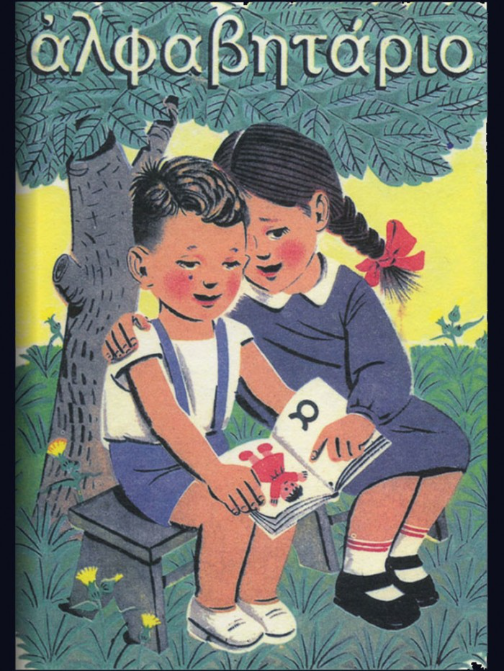
My weekly, four-hour Greek School lessons, did include history. We had textbooks straight from Greece’s Ministry of Education, and I was always fascinated by the Greek text with its intonation marks made up of various symbols, not to mention the grammar rules, and the great joy and pride I felt in my progress towards learning my mother (and father) tongue, Greek. Also imprinted in my mind from these Greek text books were their colourful and informative illustrations. 

The inclusion of these pictures cannot be underestimated as complementary and entertaining, yet important learning tools. It was the pictures that enhanced the content of that first ever Greek school book ‘Alfavitario,’ that was for most of us our ‘official’ introduction in the 70s as Greek Australians to Greek culture through formal education.
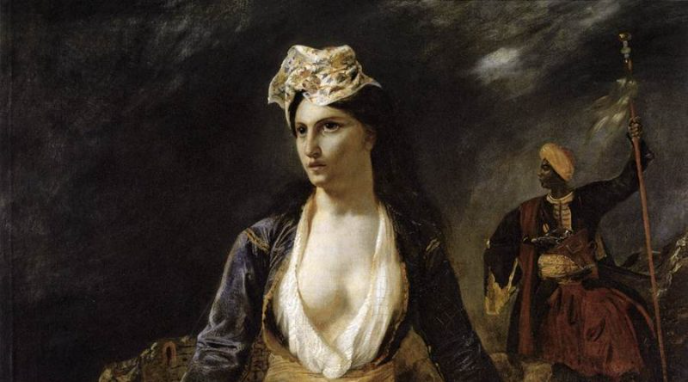
Greece

Later on in higher classes of Greek school, came the history books whose pictures I still recall: The flags and dressed up men with large moustaches in fancy battle gear; Kolokotronis, Rigas Ferraios, Karaiskakis and others, whose names the teacher would painstakingly get us to repeat.

With the same verve, our Greek school teacher would try to explain these heroes’ roles in the Greek Revolution which resulted in Independence Day, and why it was celebrated annually on March 25th. We would recite poems on that day, in the hall of the Greek school and our parents could come and watch us.

I remember my eight-year-old brother hiding in a neighbour’s tree because he didn’t want to attend the celebration one year. We had looked everywhere. The only reason we found him in due time, was from the white foustanella costume he was required to wear for that day in honour of a revolutionary figure. The skirt part of the costume was sticking out amongst the heavy foliage of the tree!

Many decades later, as a mother having lived in Greece for over 25 years now, my sons have taught me more about the Greek Revolution than I recall (though this could be due to my lack of paying enough attention to Greek School teachers back in the day). Speaking to people of various ages in Greece, I realised that the Greek Revolution was taught in a basic, conservative manner which although conveying a sentiment of national pride, seemed somewhat rigid.
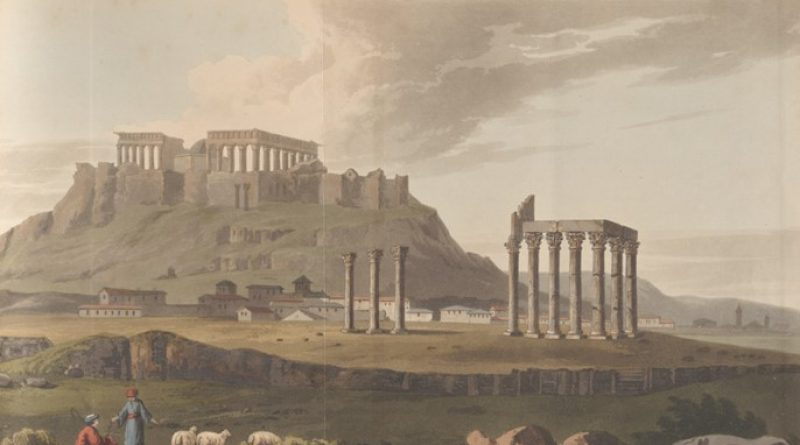
Old Acropolis

The 200-year anniversary of the Greek Revolution in 2021 changed this, thanks to creativity and technology. In my research to enhance my knowledge and appreciation of Greek Independence Day, I discovered an official site called: ‘1821 Observatory.’ This is a constantly updated site with information about the Greek Revolution from many perspectives – globally. Its plethora of interesting information ranges in scope from academic to arts and more. 

Perusing this brilliant website, I discovered broader and more comprehensive views of what our ancestors and their friends – the Philhellenes – contributed to this fight for Greek emancipation from the Ottomans. I also began to see a new perspective; that of Greek Revolution’s significance on a global level.

The 1821 Observatory site directed me to the excellent Greek Community of Melbourne’s extensive online seminar /lectures, made during 2021, the Greek Revolution’s bicentennial.

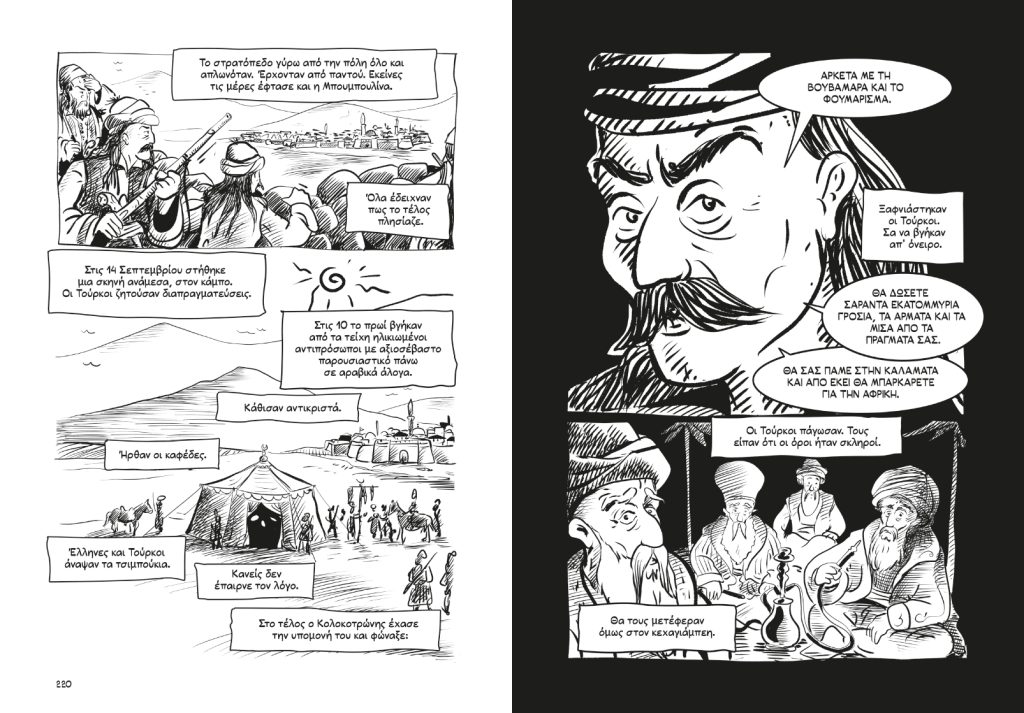
I also came across an over 700-page, graphic novel. It’s titled ’21: The Battle of the Square’ and portrays the Greek Revolution in an interesting, informative and unique way, reminding me of my previous reference to the power of illustrations combined with words. 

To find out more, I spoke with the creator of this graphic novel,’ the popular Greek cartoonist Soloup (real name Antonis Nikolopoulos). 

Apart from ’21: The Battle of the Square,’ Soloup has published many cartoons in local newspapers. He has also written and illustrated other graphic novels, for example ‘Aivali’ regarding the 1922 Asia Minor Disaster, while his latest – ‘Zorba’ is in keeping with the spirit of Kazantzakis’ original novel. 
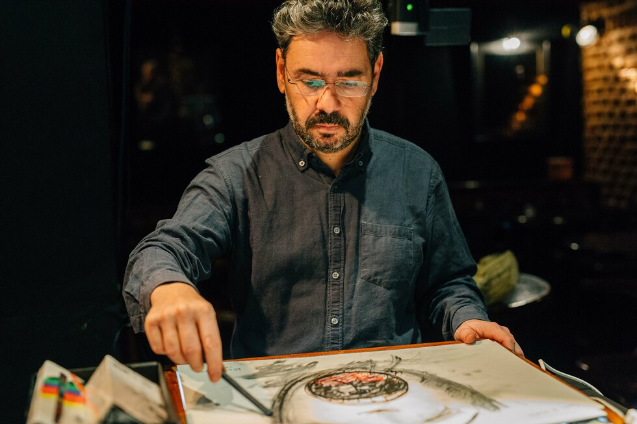
Soloup is also a doctor of the University of the Aegean and a post-doctoral researcher at the Department of Communications and Technology there, while also teaching cartoon design and comics at the National and Kapodistrian University of Athens. 

Smiling, he tells me about Greek Australians he’s met during summer holidays on the island of Kythera.

“They’re friendly, open hearted and always nostalgic for Greece. Having experience with other diaspora Greeks in Brussels, Monaco and recently in Canada, they’ve shown me another, more conscious-level Greece outside her actual physical borders,” Soloup says.

He goes on to describe his recent visit to Canada in February this year, on invitation by the Greek Embassy and Greek communities of Ottawa and Montreal.

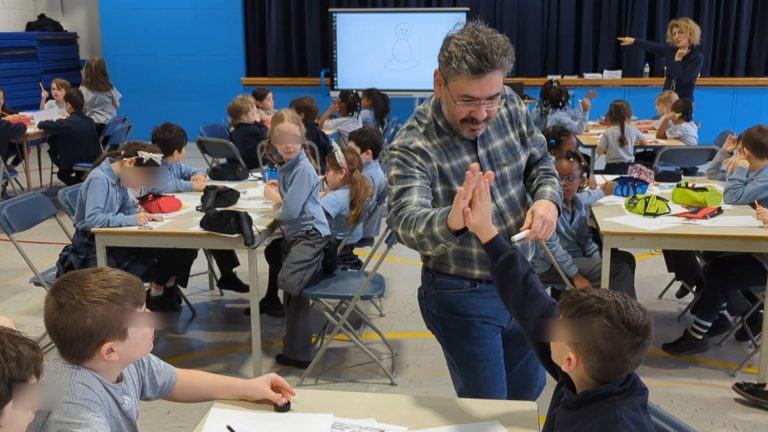
“I did workshops with 1,200 young people there – 2nd and 3rd generation Greek Canadians. And like the Greek Australians I’ve met, I was really impressed at how alive Greece’s presence is for them, including the desire to be involved in all things Greek, even though most of them visit Greece in summer for holidays to see relatives,” he says.

According to Soloup, the many themes in ’21: The Battle of the Square’ did not only teach the young diapora Greeks in Canada about previously unknown aspects of the Greek revolution, he claims that it taught him many things too.

“As the book/graphic novel was supported by the Hellenic Research and Innovation Foundation and the University of the Aegean, under the auspices of the National Historical Museum, I too for example, discovered new facts: Details about the Exodus of Missolonghi, and about the destruction of Chios. The oppressive terms of Greece’s money lenders were revealed to me, as well as the events around the near execution of Kolokotronis during the first period of the Bavarian reign and council of King Otto,” he says.
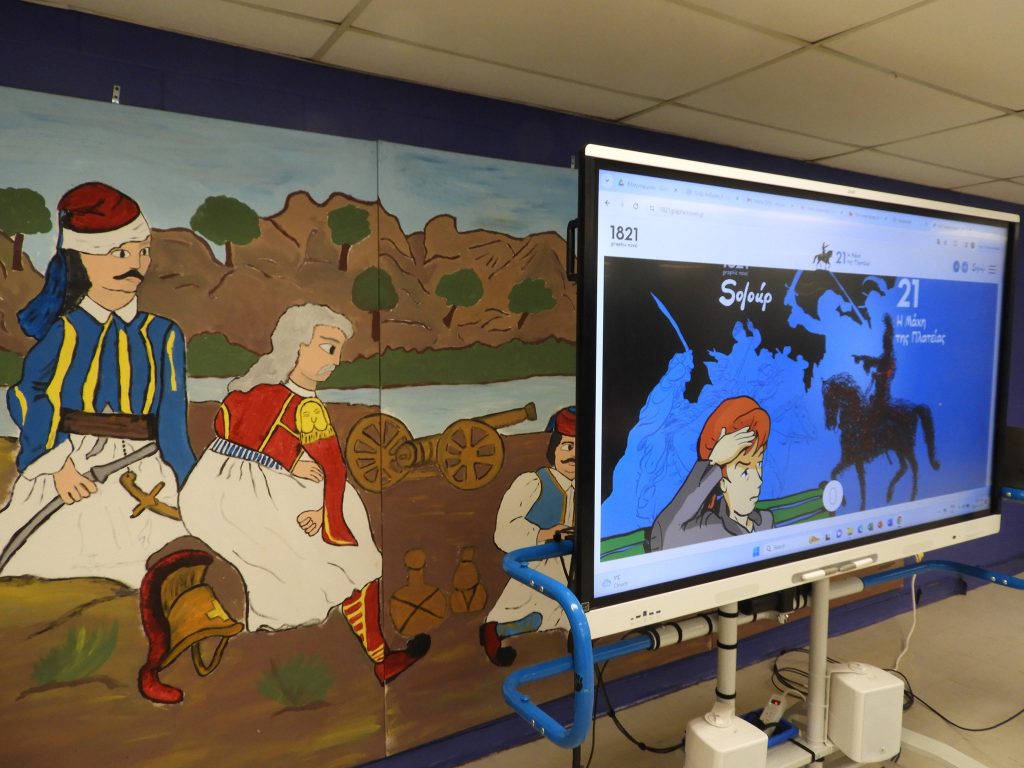
Canada Workshop

“Modern Greeks today have the curiosity and insight to want to see their history without romanticising and glamourising it. This is what my graphic novel does by combining the joy of comprehension through my comic/cartoon illustrations with words – backed by academic researched documentation, in an entertaining and accessible manner for all people regardless of age.”

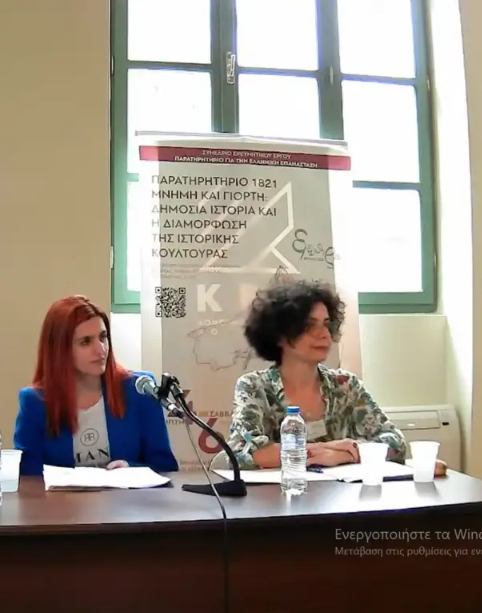
Wanting more information from the ‘1821 Observatory’ site regarding its constantly updated ideas on the Greek Revolution, I also spoke with academic Konstantina Tortomani; a team member of the Observatory.

Konstantina, in her 30’s, is also a University Lecturer at Greece’s Democritus University’s Department of History and Technology.  Her expertise and interest in Philhellenism in the context of the Greek Revolution is what led her to join the 1821 Observatory team headed by Associate Professor Athena Syriatou.

Like Soloup, Konstantina is particularly interested in highlighting new perspectives of the Greek Revolution that may have been ignored in the past. This occurs through the 1821 Observatory’s site collating and disseminating local and international information on the Greek Revolution. The fact that this is an ever-evolving process, suggests both the pivotal role of the Observatory, but also of the Greek Revolution itself, an event prompting continuing thought and debate.

“Bringing up extra information as the 1821 Observatory does is very useful for the public because the Greek Revolution is not dead, not just something in the past, like a statue. Those involved in the Revolution were people, and so our thinking moves away from a black and white restricted interpretation,” Konstantina explains.

“For example, before joining the Observatory, I just considered the 1821 Greek Revolution as the birth of the Modern Greek state, nothing more, nothing less. But since joining the Observatory I realised it had global influence. The Greek Revolution was an idea that not only unified Greeks, but everyone – for equality.”

She stresses that modern historiography doesn’t see the Greek Revolution as an integrated continuation of the American or French Revolutions before it, but as an integral part of the global puzzle and as extremely important and unique in many aspects. 
“The Greek Revolution was a sign-post of the modern world, in which newspapers, pamphlets and literary works played a huge part, as did Philhellenic societies around the world in where women, particularly in the USA, were involved for the first time. Their social and political involvement, such as charity work in collecting funds for the Greeks for example, lead to the beginning of women’s emancipation movements,” she says.

The wide global interest and influence of the Greek Revolution reached nations as far as Haiti, India, Japan and others, apart from the USA where the anti-slavery movement was ignited, Konstantina tells me, adding: “At the end of the day, people don’t always agree with their government’s stance… the international public’s interest in the Greek Revolution then, was like our current interest with Ukraine and Palestine is today. People care about what happens in the rest of the world.”

“Sometimes we think that the global is a threat to the local, but that’s not necessarily true, because in the Greek Revolution, locals fought alongside foreigners whether on the battlefield or on an ideological level for freedom.”
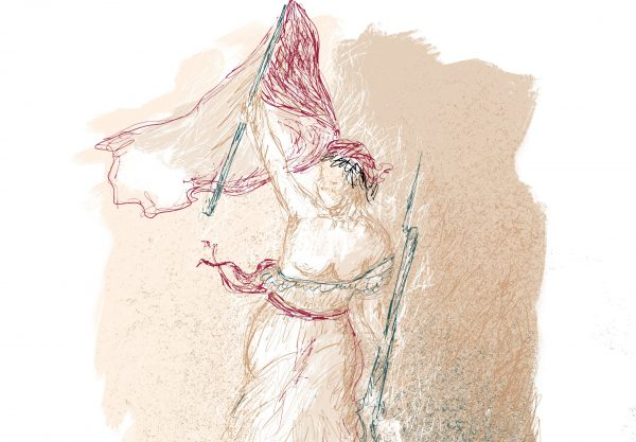
She clarifies that the Greek Revolution was not just nationalistic in scope, but influenced “the so-called Age of Revolution.”

Quoting the renowned British historian Eric Hobsbawn, “The struggle for social justice is a never ending battle, but one worth fighting for,” Konstantina adds: “There are still revolutions in the 21st century such as Black Lives Matter and Me Too.”

As for the Greek Revolution leading to Greek Independence, Konstantina proudly states: “We, the Greeks won, in terms of forming the first modern Greek Nation. Because of the Greek Revolution, Greece became the first nation that freed itself from the Ottoman Empire’s rule. It is unique because we had written Constitutions during the struggle, signifying the will of the people for equality; for a democratic state.”


Yorgos Lanthimos teases his next movie with Emma Stone

Yorgos Lanthimos shared insights into his upcoming film project with Emma Stone, titled “Kinds of Kindness,” which he is currently editing. This collaboration marks the third time the duo has teamed up creatively.

“It’s a very different film,” Yorgos Lanthimos said, according to deadline.com

“It’s three contemporary stories, and there’s a core of actors — seven total — who play one character in each story,”:” he said. “So, they’ll play three different characters.”

The new movie also stars Poor Things‘ co-star Willem Dafoe.

Poor Things
Emma Stone stars in Yorgos Lanthimos’ film, Poor Things. Photo: Vanity Fair.

“We’ll have that for you soon,” Lanthimos promised the press at the Golden Globes, where his other film with Emma Stone, Poor Things, won two trophies: for Best Comedy/Musical Feature and Best Actress Comedy/Musical for Stone, her second after La La Land.

Talking about how she prepped for the role of Bella Baxter, a young woman brought back to life by an unorthodox scientist (played by Dafoe) who discovers her own freedom and sexual independence, Stone said, “I think it was removing life experiences, rather than tapping into life experiences. She was a character unlike anything I’ve ever played, or read, or seen before.”

Yorgos Lanthimos’ film ‘Poor Things’ became a Greek box office hit, selling more than 200,000 tickets in just 15 days. At the 96th Academy Awards, it received 11 nominations, including Best Picture, and won 4 awards.

Source: deadline.com

10 shipwrecks and treasures discovered off the coast of Greece

0

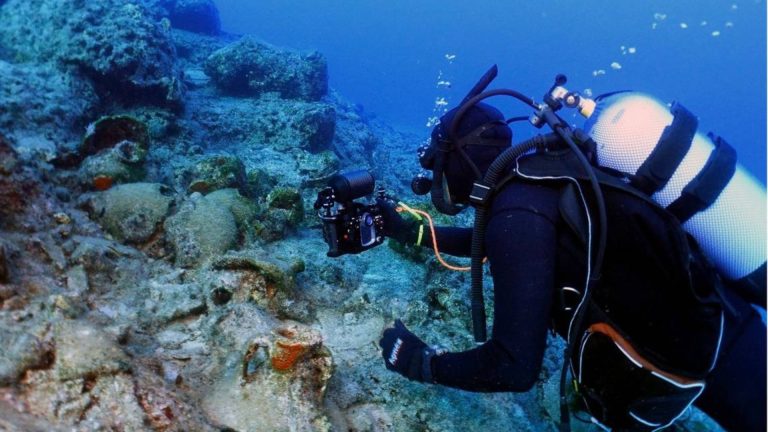
An international team of researchers has made a significant discovery off the coast of Greece, uncovering 10 shipwrecks spanning various historical periods. The findings, announced by the Greek Ministry of Culture, were the result of a multi-year survey conducted around Kasos, a small island in the Aegean Sea.

According to charlotteobserver.com, Kasos, once a pivotal trade hub, hosted merchants selling goods from distant lands.

The oldest of the shipwrecks discovered, dates back to the prehistoric era around 3000 B.C. Others sank during the Hellenistic period (100 B.C. – 100 A.D.), the Roman era (200 B.C. – 300 A.D.), and the Byzantine period (800-900 A.D.).

One of the more recent wrecks, a wooden vessel measuring approximately 85 feet, likely dates back to the World War II era. Numerous artifacts linked to these wrecks were recovered, including an amphora from circa 150 A.D., Roman period flasks, and an ancient stone anchor.

Photo: Greek Ministry of Culture

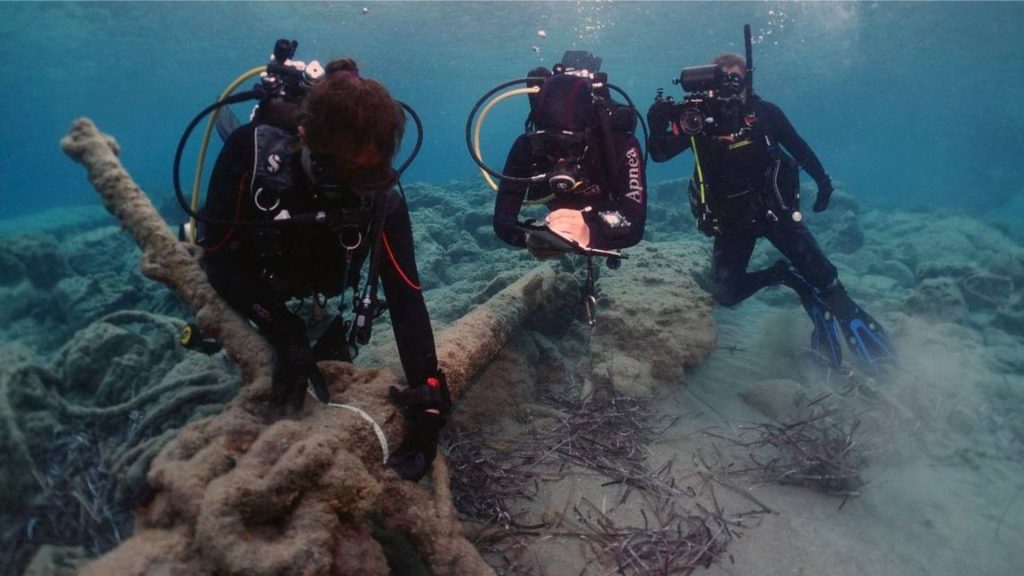
Goods originating from Italy, Spain, Africa, and Asia Minor (modern-day Turkey) were among the discoveries. The wrecks were found at depths ranging from 65 to 155 feet, thanks to advanced research equipment and divers equipped with underwater cameras who captured over 20,000 photos.

The survey project, undertaken by a variety of professionals — including archaeologists, historians and biologists — began in 2019 and wrapped up in October. It was the first systematic archaeological exploration of the seafloor around Kasos.

The research is the subject of a film titled “Diving into the History of the Aegean,” which is available in English.

Source: charlotteobserver.com

A virtual tour of the permanent Greek Revolution exhibition at the Athens War Museum

By Ilias Karagiannis

The years of the Greek Revolution of 1821 are revived through a permanent collection of rare artifacts housed in a wing of the War Museum in Athens, Greece. A visit is enough for the visitor to feel like they are taking a journey through time.

On this national anniversary, The Greek Herald wanted to transport its readers, even mentally, to the honoured era, where our ancestors sacrificed themselves so that we may have our freedom today. And what better way than with a virtual tour by Captain Eftychios Bolierakis, the historian who spoke to us about the permanent exhibition on the 1821 Greek Revolution at the Athens War Museum.

War museum pieces

“Initially, we wish to thank The Greek Herald for supporting the outreach of the War Museum and its efforts to strengthen the bonds of diaspora Greeks with the Motherland and its national history,” Mr Bolierakis says.

Any visitor of the War Museum who wanders through the space where the treasures of the Greek Revolution are housed, will feel like they are becoming a part of history. We are fortunate to have Mr Bolierakis as our historical guide.

War museum pieces

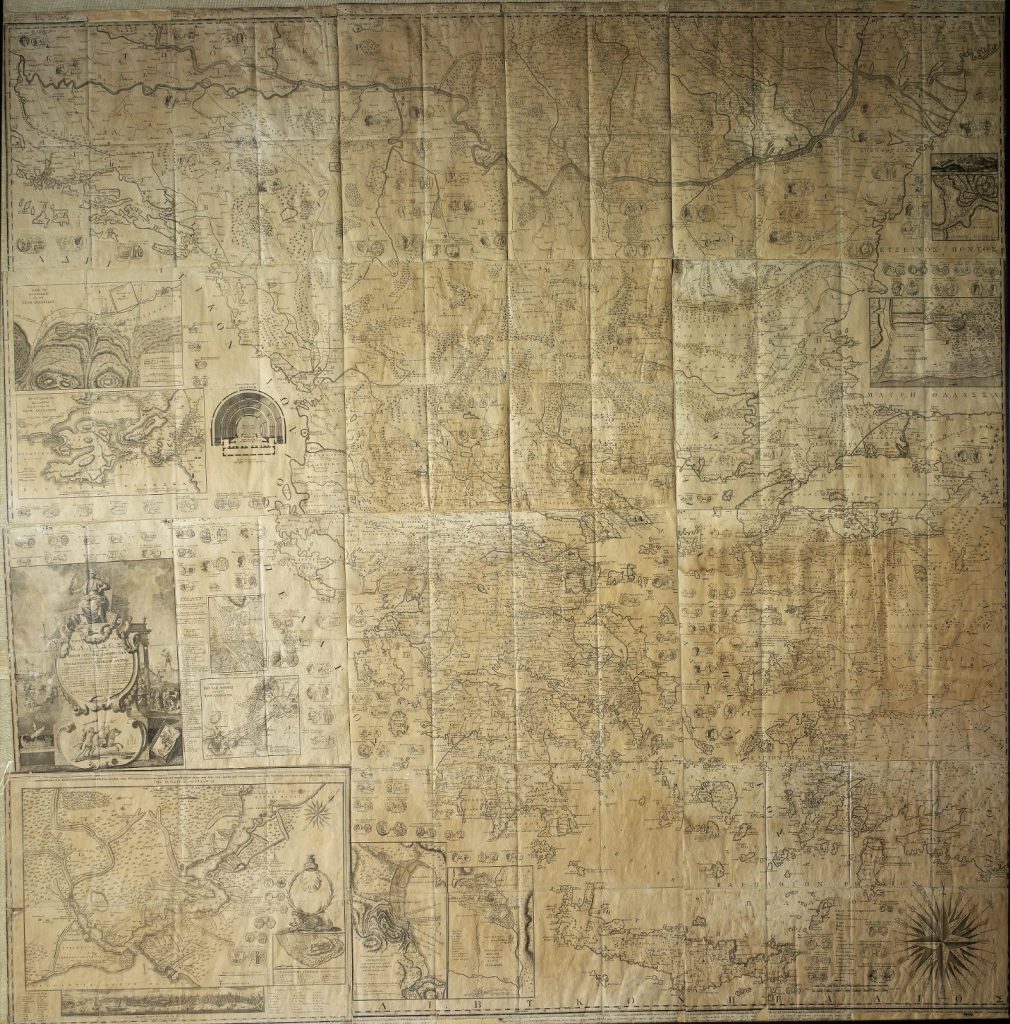
“The French Revolution influenced Greek intellectuals who attempted to awaken the Greeks of the Ottoman Empire and envisioned the creation of a Greek state. One of the foremost among them was Rigas Feraios, who, among his other works, also issued the Charta, a work printed on twelve sheets – a publishing feat for his time – aimed at recalling to the memory of the “ragiades” (slaves) about their ancestral history and glory,” the historian says.

“The work presented the extent and radiance of Ancient and Modern Greek civilisation, aiming to recall historical events, wars, and victories “against the barbarians.” The Charta includes the entire Balkan Peninsula and Asia Minor, i.e., the regions which Rigas had envisioned as theatres of the Revolution. In the Museum, one of the few copies of the work is exhibited.”

The Filiki Eteria (Friendly Society) and weapons as exhibits

The significant role of the Filiki Eteria in organising the struggle for the liberation from Ottoman rule is also highlighted in the permanent exhibition of the Athens War Museum.

War museum pieces

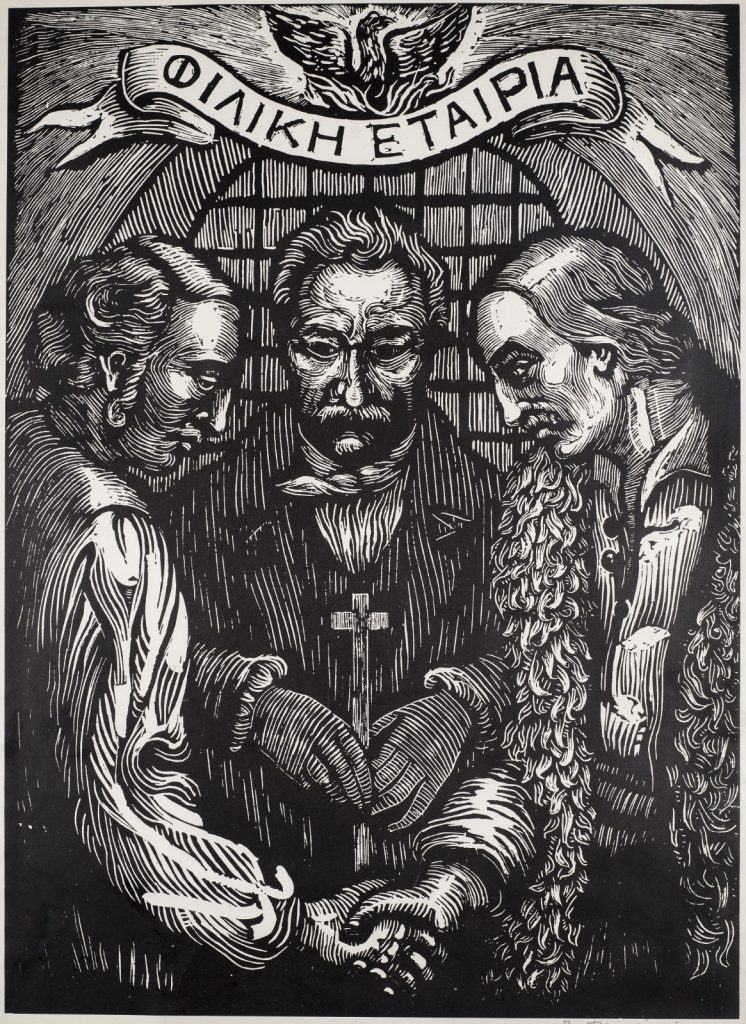
“At the beginning of the 19th century, societies were created with the aim of the Greeks’ Revolution, with the leading one being the Filiki Eteria, which was founded on September 14, 1814, in Odessa by Nikolaos Skoufas, Athanasios Tsakalov, and Emmanuel Xanthos. In the War Museum, among other works related to the society, there is a woodcut by Vassos Faliros depicting the oath of the Filiki Eteria,” Mr Bolierakis says.

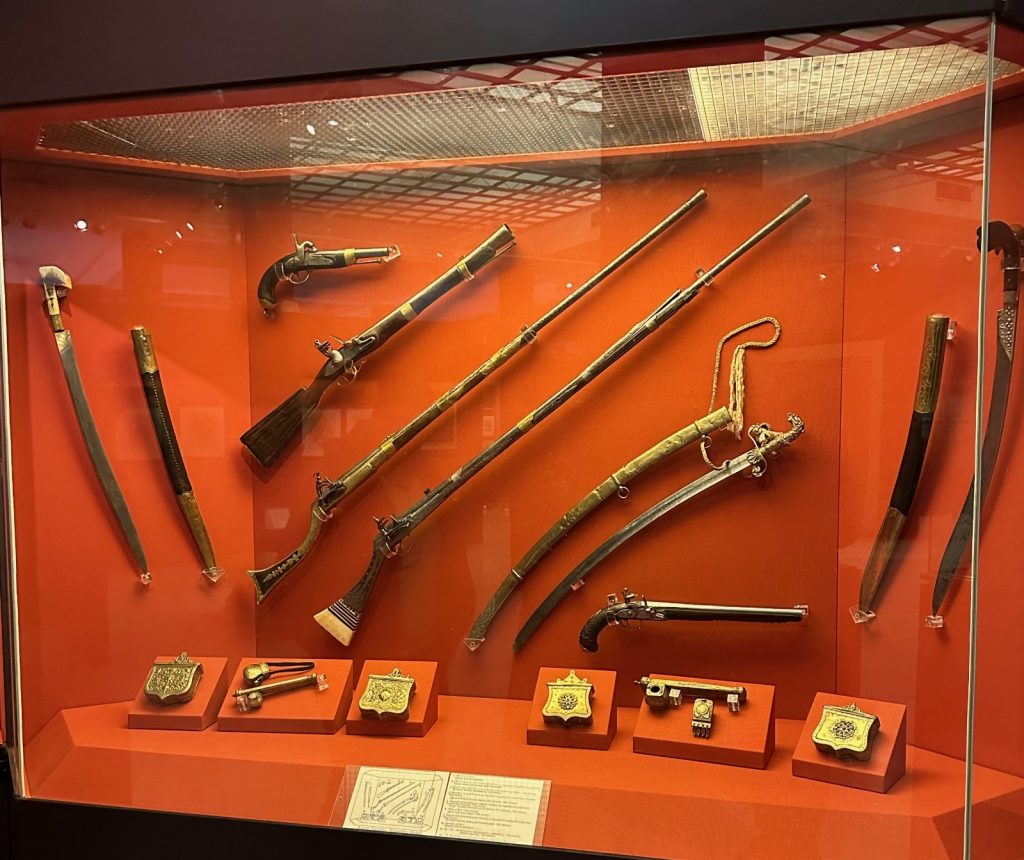
“The Filiki Eteria initiated many Greeks and succeeded in organising the Revolution. The army formed relied on groups of armatoloi and klephts, who used muskets, pistols, swords, and jatagans as weapons. Muskets, their primary firearms, were long-barrelled muzzle-loading rifles, usually adorned with silver or brass plates depicting the Cross, the single-headed or double-headed eagle, and the cypress tree.

War museum pieces

“Pistols (long-barrelled), mainly manufactured in the Balkan region, were mainly used by the military elite and nobles. It should be noted that the pistols from Greek workshops, especially those from Souli, were valuable and rare.

“The more affluent of owners had pistols from European workshops, which were of better quality. Ottoman pistols were usually large in size and their stocks were decorated with silver inlays with semi-precious stones, coloured glasses, and coral. Swords were the main weapon of the fighters and had as their main feature the elongated curved blade, while jatagans were large knives with a slightly curved blade.

War museum pieces

“In the exhibition space of the War Museum, many weapons from the revolutionary period are presented, many of which belong to the international collection of rare weapons by Petros Saroglou.”

Clothing information, paintings, and Kolokotronis

Our tour with Mr Bolierakis continues with information about the clothing of the 1821 Greek Revolution.

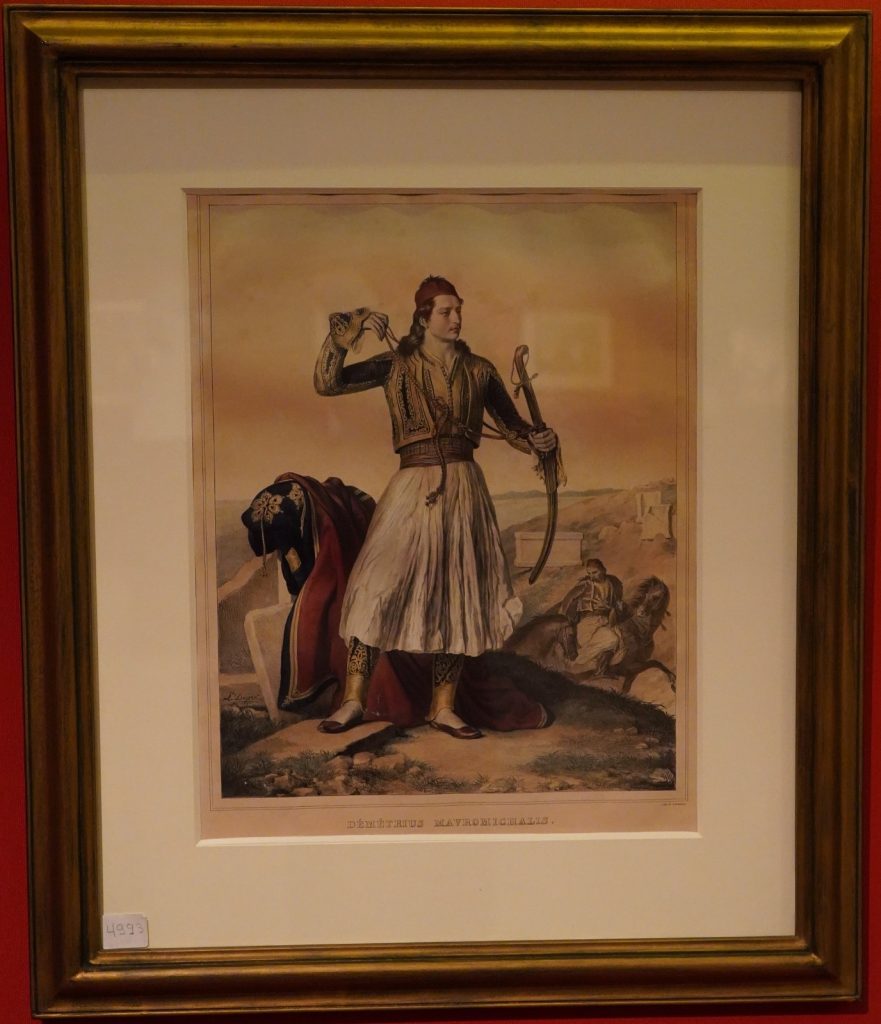
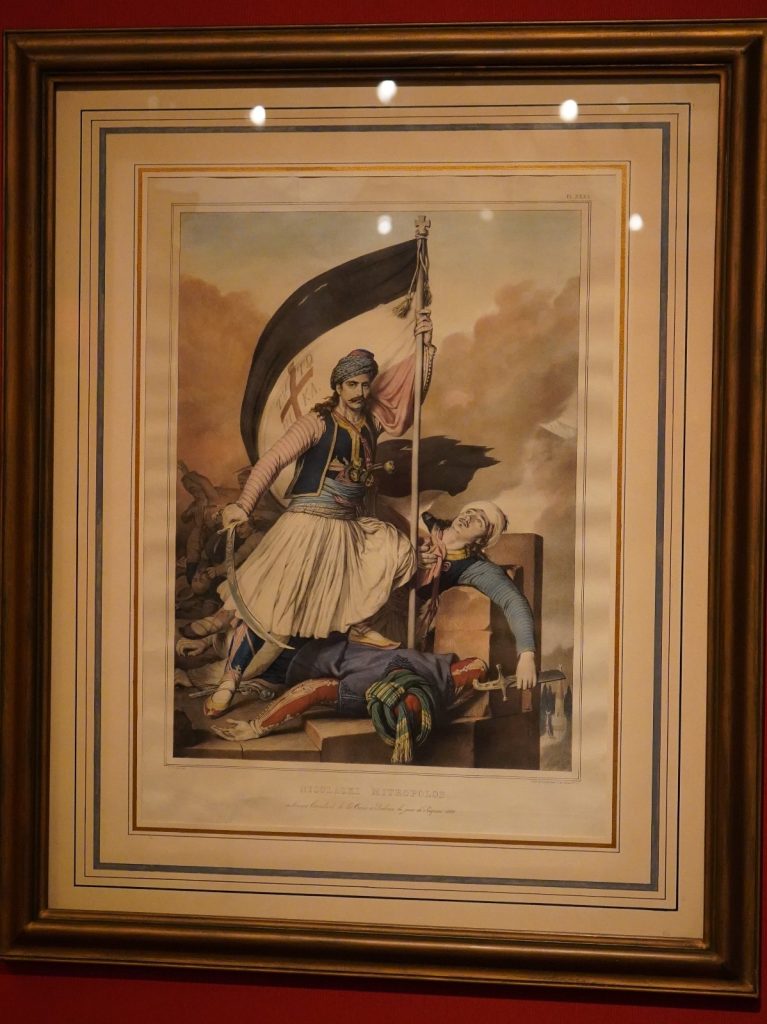
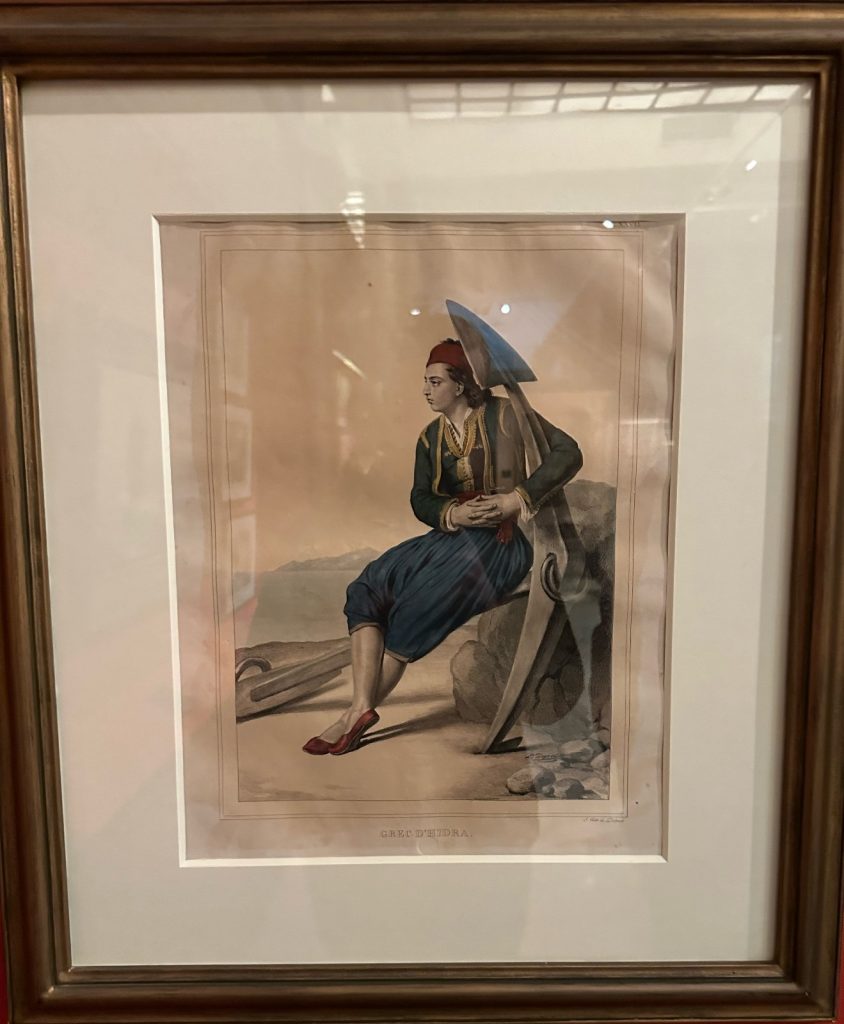
“We mainly draw clothing information for the fighters from the artworks of the era. One of these was the French painter and engraver Louis Dupré, who visited the Greek area, and several lithographs of his are exhibited in the Museum,” he explains.

War museum pieces

Three of these are: a) ‘Nikolakis Mitropoulos,’ in which the fighter is depicted raising the flag with the cross in Salona on Easter day of 1821, b) ‘Greek from Hydra,’ in which a Hydriot is depicted in traditional attire leaning on an anchor, with a contemplative gaze overlooking the sea, and c) ‘Dimitrios Mavromichalis,’ in which a teenager, the youngest son of Petrobey Mavromichalis, later a lieutenant general and defender of Otto, is depicted proudly holding his sword, while the broken marbles next to him remind of Greece’s glorious past.

War museum pieces

“Of course, moments from the Struggle, echoing into eternity, could not be absent,” Mr Bolierakis says.

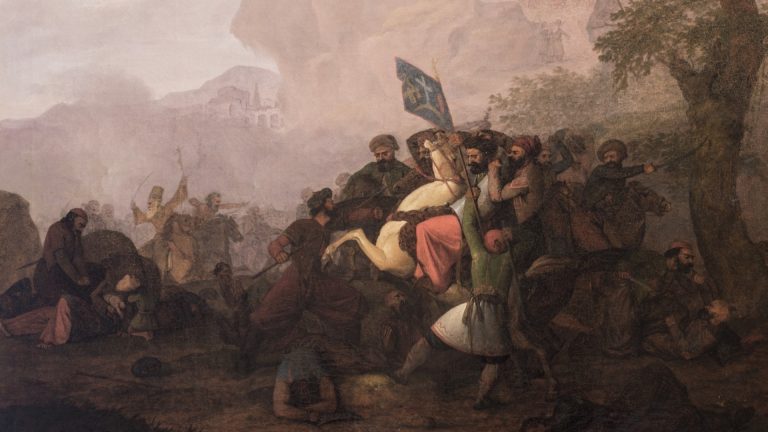
“A significant moment of the Revolution, which mobilised European Philhellenes, was the Exodus of Messolonghi (April 1826). The pinnacle moment was immortalised in the unique surviving work of Stamatis Voulgaris (1774-mid-19th century) ‘The Battle for the Flag,’ with the Greeks defending the symbol.

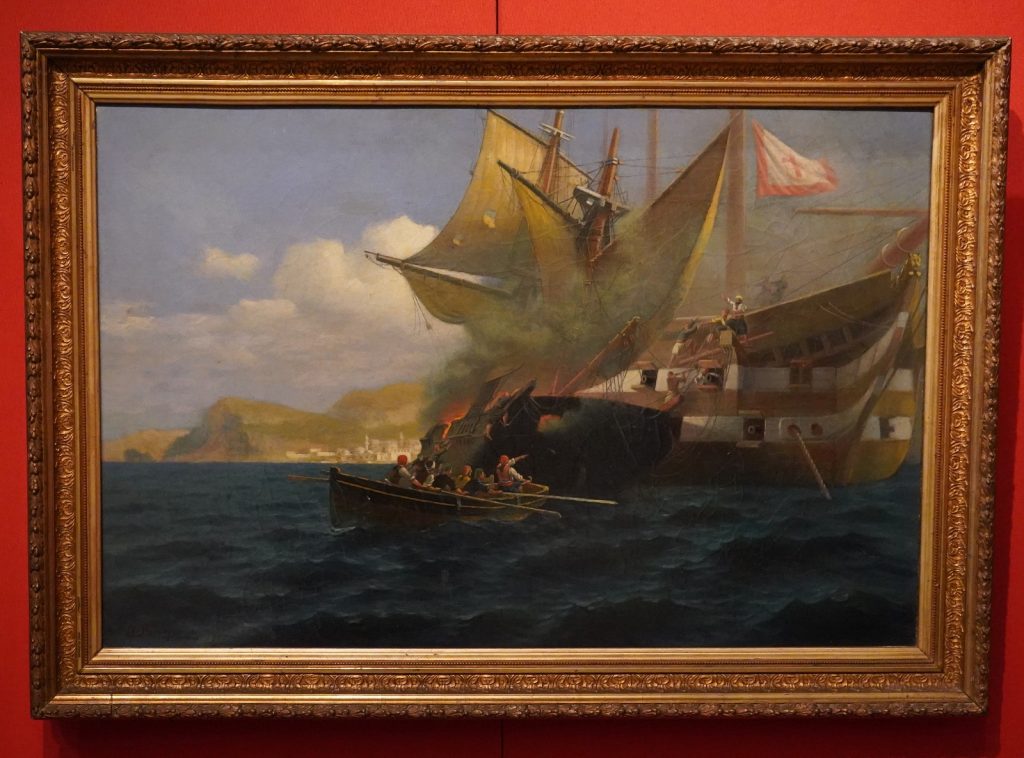
“In the naval struggle, the Greeks mainly used the method of setting fire to enemy ships. In the oil painting “Burning of a Turkish ship” (1905), painter Emile Prosalentis depicts a fire ship that has already been ignited and is attached to the Turkish vessel. Ottoman sailors are struggling to detach the fire ship, while the Greeks are rowing away in a boat, having accomplished their mission.”

The faces of the heroes and heroines are also present in the museum and engage the visitor.

War museum pieces

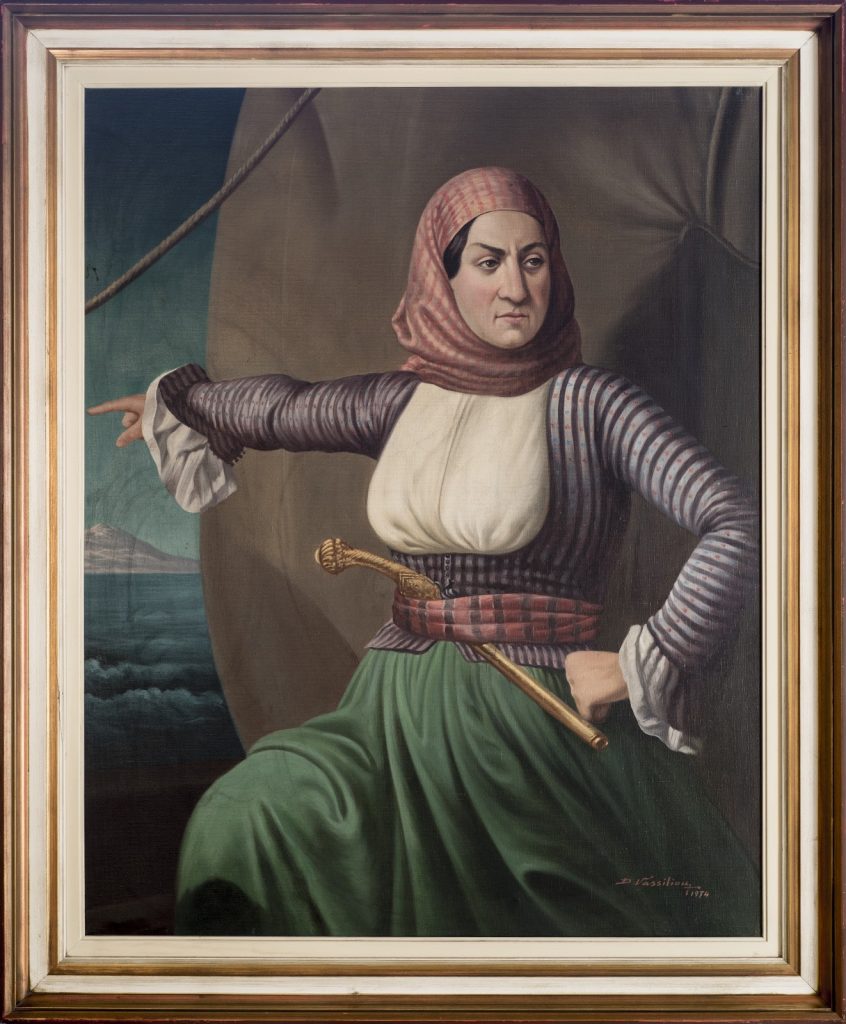
“The War Museum possesses significant works of painting, sculpture, and engravings depicting key figures of the Greek Revolution, one of which is Laskarina Bouboulina. Bouboulina was one of the leading female personalities of the Revolution, significantly contributing through the blockade of Nafplio and the allocation of financial resources for the maintenance of military forces,” he says.

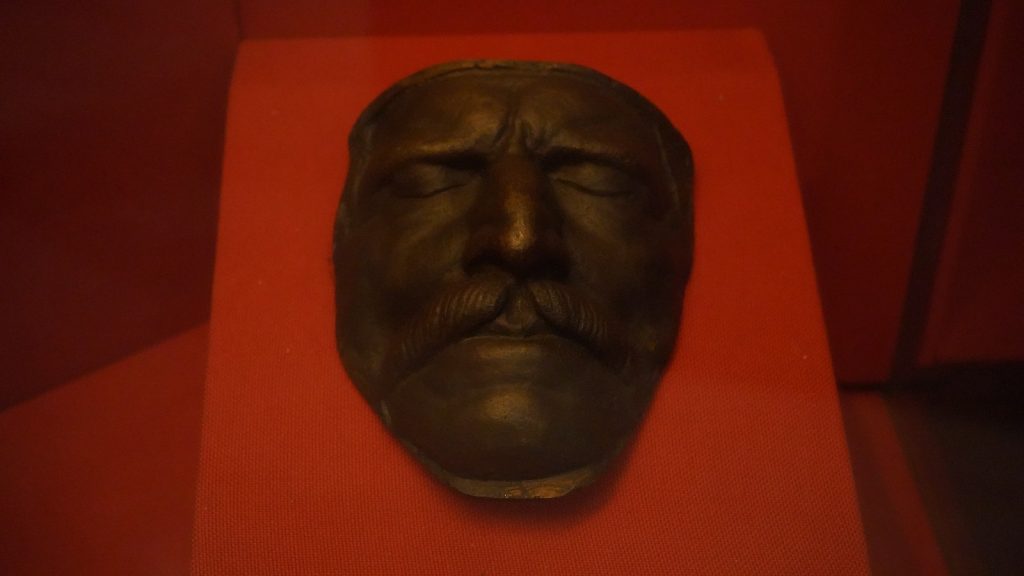
“A paramount figure of the Revolution was Theodoros Kolokotronis, honoured by the War Museum of Athens with a plethora of exhibits, one of which is the bronze replica of his death mask. 

War museum pieces

Kolokotronis (1770-1843) was a klepht in the Morea region before the Revolution and a Major of the Greek infantry of the British-controlled Ionian islands. In 1818, he was initiated into the Friendly Society, and his military activity played a crucial role in the successful outcome of the Revolution, while after liberation, he engaged in political action in the newly established Greek State.”
The War Museum of Athens is accessible for virtual tours through its website: https://www.warmuseum.gr/

Politicians and diplomats send messages ahead of March 25 celebrations

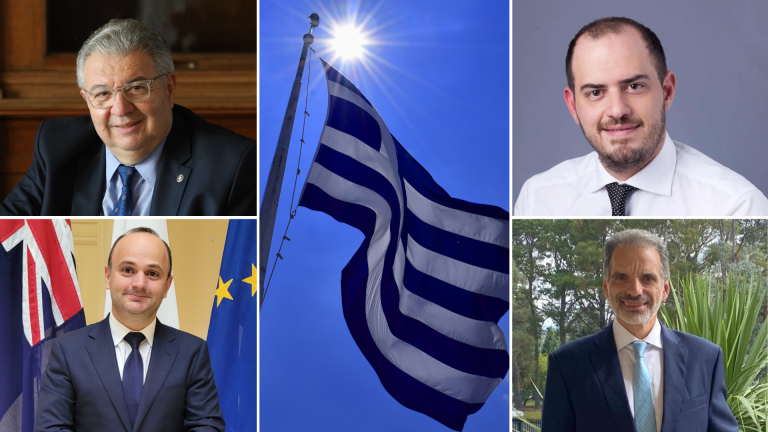
Greek and Cypriot politicians and diplomats have issued messages to Australia’s Greek diaspora ahead of the double celebration on March 25 of Greek Independence Day and the Annunciation of the Theotokos.

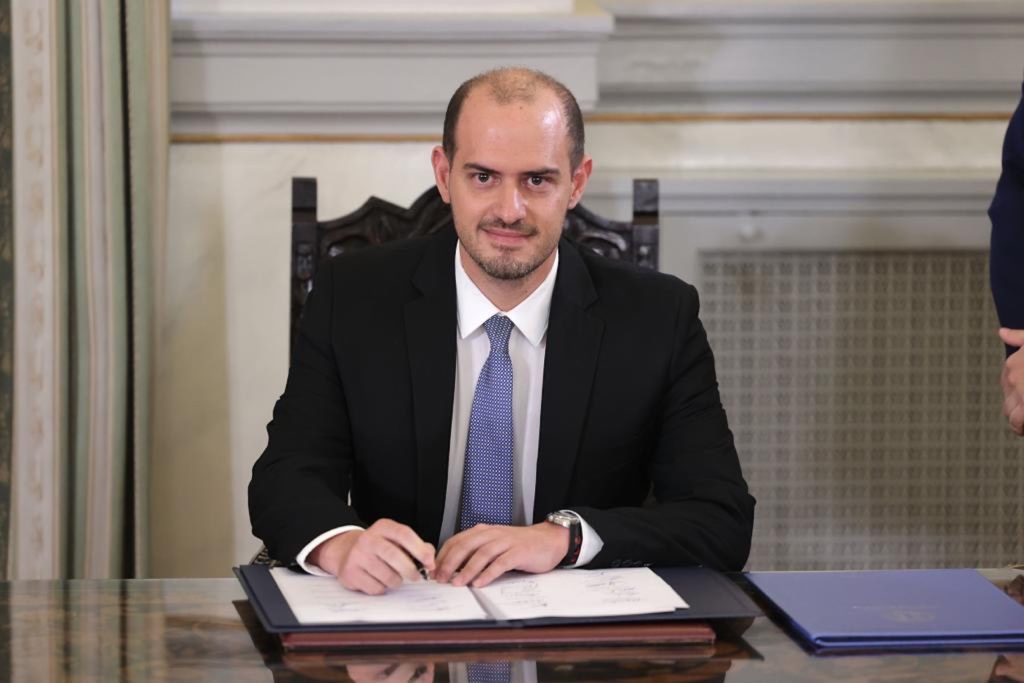
Message by Greece’s Deputy Foreign Affairs Minister Giorgios Kotsiras

giorgos kotsiras
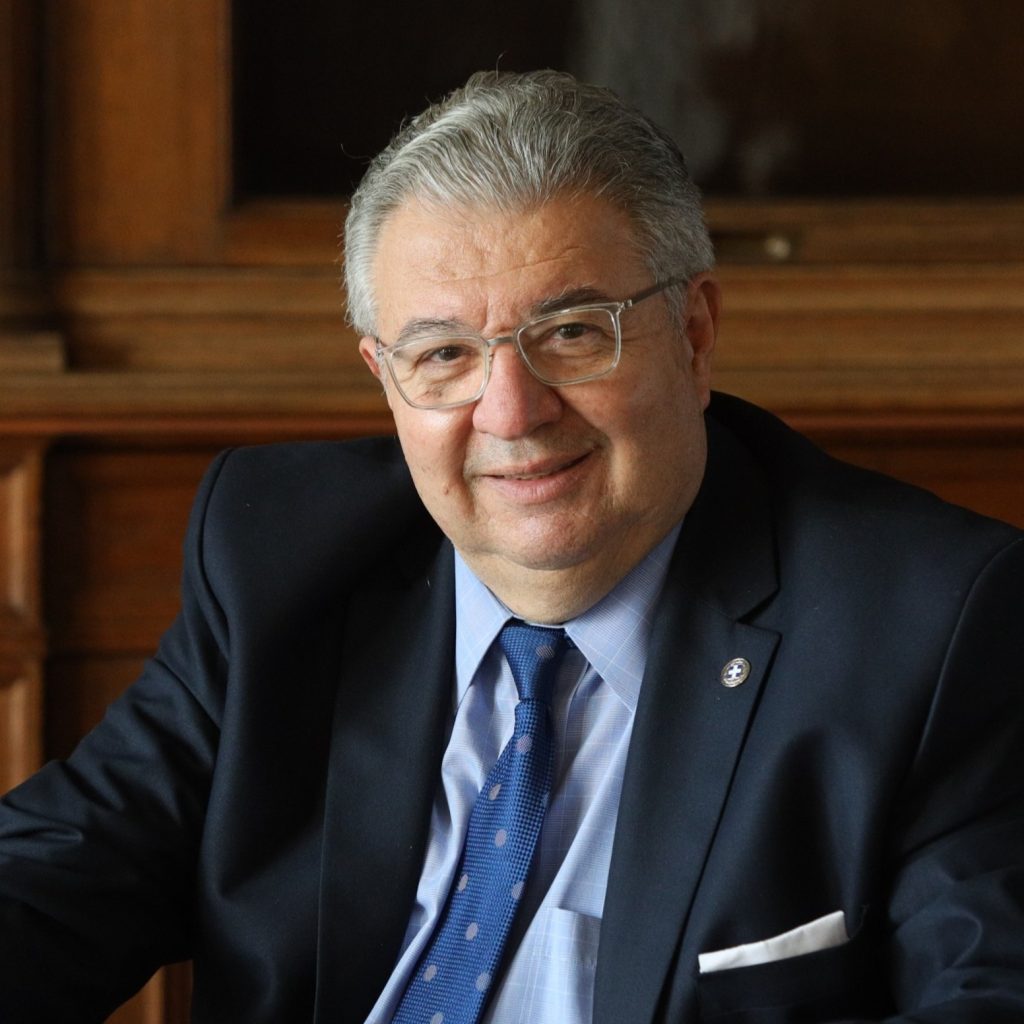
Giorgos Kotsiras.

Dear compatriots,

Greek Independence Day is a day of honour for all Greeks worldwide and a day of celebration for the Orthodox faith. Although more than two centuries have passed, the example of our ancestors is still inspiring. The glorious battle of the Greek revolutionaries defending our freedom, our orthodox faith and our country’s national sovereignty is much more than a historical event. It is our collective memory, it is the solid proof that solidarity and unity can lead us to overcome any challenge.

The Greek Revolution has influenced the public debate and the intellectuals of the time, stimulating the Philhellenism movement and highlighting the struggle of a great people with great strength. Guided by the dream of a free homeland, Hellenism as a whole had a dynamic presence to the national effort, protecting our language, our culture and our faith. And it is true that the Greek Diaspora has always supported our country, contributing decisively to every difficulty.

March 25th, coinciding with the Feast of the Annunciation, is the anniversary of the national rebirth, it is the timeless and always relevant truth of Hellenism. It is a national lesson not only about our common past, but also about a new and clear vision for the future. Hellenism, universal and indivisible, must move forward, setting and achieving common goals.

Happy National Independence Day to all!

Message by Greece’s Secretary General for Greeks Abroad, John Chrysoulakis

john chrysoulakis
John Chrysoulakis.

Dear Compatriots,

We are celebrating this year, as every year, the anniversary of March 25, 1821. We are celebrating the anniversary of a historical event which is a milestone for the past, present and future of Hellenism everywhere.

At the core of the celebrations for our national day is, at the same time, the Annunciation of the Theotokos and the beginning of the Greek Revolution. This historical event, a synthesis of the basic elements of our national identity, is a lesson in modern history which preserves and awakens our common national memory.

It is historically undeniable that the contribution of the Greeks of the diaspora to the Greek Revolution of 1821 was decisive. We can, therefore, easily conclude that this celebration is always a reminder of the role and dynamics that the diaspora can play today – just as 203 years ago – in strengthening and multiplying our country’s capabilities in the present, but above all, in the future.

It is known that under the oppression of the Turks, many Greeks were forced to emigrate. However, they carried the Greek spirit and Greek education around the world and created Greek communities that functioned as centres of national self-awareness throughout Europe: Vienna, Bucharest, Odesa, Trieste, Constantinople and many other cities developed into powerful centres of the Greek community, where the nation’s desire for freedom was cultivated.

Moreover, the Greeks of the diaspora realised very early on that freedom was not an exclusive matter for Greeks living under the Turkish yoke. They themselves accepted much of this responsibility, making it clear that Hellenism of the diaspora would always be one of the most important forces of the nation.

Today, the National Day brings together all Ecumenical Hellenism, which responds united to the dictate of history, claiming its role in the Southeast Mediterranean, Europe, and around the world.

It is everyone’s wish that this double celebration of Greece and Hellenism will once again be a point of reflection on the past and vision for the future. A future common to Greeks everywhere, of the diaspora, but also of friends of Greece. Long live Greece!

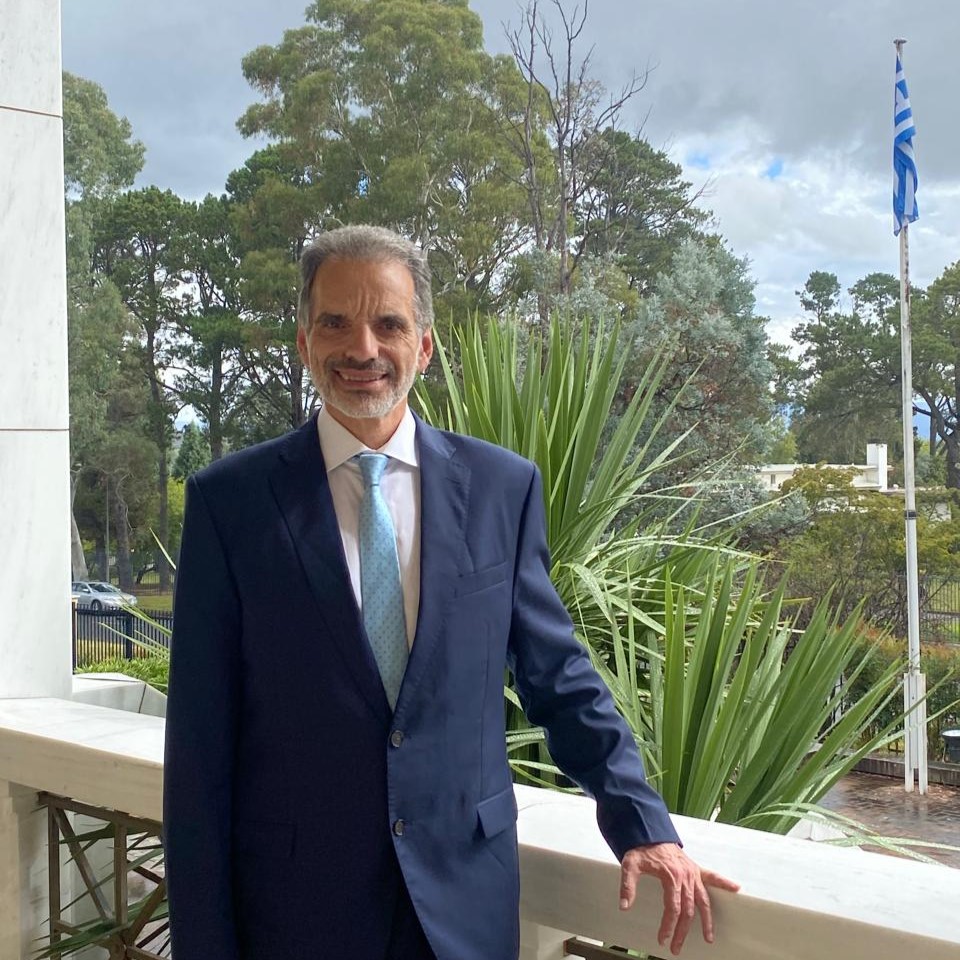
Message by the Ambassador of Greece in Australia, Stavros Venizelos:

stavros venizelos
Stavros Venizelos.

Dear friends, fellow compatriots, Greeks in Australia,

March 25, 1821, the day of the Annunciation of the Theotokos, marks the milestone for the rebirth of the Greek nation and the beginning of the modern course of Hellenism. The Revolution of 1821 succeeded, through particularly adverse circumstances, in paving the way towards national integration and statehood. Today Greece is a modern democratic state, at the core of a united Europe, a force of stability in its region.

This anniversary is celebrated, rightly so, with splendour wherever Greeks live and create, everywhere in the world. This day holds a special place in Australia. It symbolises your continuous bond to Greece, the love and nostalgia with which you cherish the homeland. It is no coincidence that all my acquaintances, during my so far short tenure here, express their enthusiasm and strong emotions about this day.

I feel confident that this year’s Greek Independence Day will be, once again, a source of joy and pride for you and your beloved ones, an occasion for your families, the younger generations of Greek-Australians, to reunite with Greece. Χρόνια Πολλά!

Message by the High Commissioner of Cyprus in Australia, Antonis Sammoutis:

antonis-sammoutis
Antonis Sammoutis.

Dear compatriots,

The double celebration of the Annunciation of the Theotokos and the Rebirth of the Nation, celebrated with splendour by Greeks everywhere, becomes every year a source of joy, hope and national uplift for all of us. Against the logic of numbers and probabilities, against the hostile climate cultivated by the Holy Alliance and against the admonitions of many of the notables of Morea and Roumelis, a handful of Greeks, armatoloi, the rebellious Maniots and the proud shipowners of Hydra, Poros and Spetses, were the first to raise the banner of the Revolution, which soon spread and reached as far as Epirus and Macedonia and as far as the Aegean islands and Crete.

The Turkish oppressors, unable to suppress the Great Rising, soon engaged in massacres of defenceless Greeks in places where the Revolution could not easily reach, such as Polis, the coast of Asia Minor, Chios, Psara and Cyprus. The death toll paid by the nation during the nine heroic years of the Struggle was heavy and many were the areas that, while fighting hard, temporarily remained outside the first Greek state. However, the recognition of a small but independent Greece, in Sterea, the Peloponnese and the Cyclades, in 1830, after four hundred years of slavery, was the reward of the heroism and self-sacrifice shown by our ancestors. Soon, this first Greek state became a pole of attraction for all other enslaved Greeks. Another ninety years would pass until its boundaries extended to Epirus, Macedonia and Thrace, Crete and the Eastern Aegean. The last place where the Greek flag was raised, in 1947, was the Dodecanese.

Two reflections come to mind when I recall the lessons of history from those glorious years. One, of course, is of particular concern, since it is related to the division that prevailed and the civil strife, especially after the first year of the Uprising. Our motto and experience should always be Greece united, never defeated! The other reflection is more optimistic, since it is linked to the radiance of our civilisation over the centuries, to the liberal and democratic spirit of our people that does not tolerate tyrants and inspires all other nations over time. It is the radiance and glamour of Ancient Greece that caused the Philhellenic current and finally pushed the united fleet of England, France and Russia to crush Ibrahim at Navarino.

Since then, Greece has chosen permanent allies with whom it fought common battles whenever needed. Natural allies of Hellenism have been and remain democratic countries, countries that believe in freedom as the supreme good that ensures happiness, as defined by Pericles and as praised by our national poet Dionysios Solomos. Among the free and democratic countries, of course, is the hospitable Australia, which received hundreds of thousands of Greeks and Cypriots, a country with which we share common struggles and common destinies.

Dear friends,

Cyprus, far from the metropolitan area of Hellenism, was forced out of the revolution. However, this did not prevent the Turkish authorities in July 1821 from slaughtering Archbishop Kyprianos, the bishops, many priests and hundreds of notables in order to intimidate its population and discourage the expansion of the Revolution. Greece never forgot Cyprus and already in 1830, the first Greek Governor, Ioannis Kapodistrias, included it in a memorandum he submitted to the European powers, among the areas with a large majority Greek population, which he claimed to incorporate into the small Greek state. And it could not have been otherwise, since the ancestors of his mother, Adamantina Gonemi, were Cypriots while he himself knew that hundreds of Cypriot fighters took part in the battles that took place throughout Greece.

As Cypriots, we have always considered the heroes of 1955-1959 as continuators of this Great Struggle. The fighters who saw the British colonialists betray the promises they made and were forced to take up arms for their freedom. New pages of heroism and national pride were written for four years in the mountains of Cyprus. And despite the sacrifices of the heroes, the machinations of Britain and Turkey blocked the way to union. Greece and Cyprus will finally come together in the European Union in 2004, and have been walking side by side for the past 20 years ever since.

At the same time, however, we do not forget that this year marks 50 years of occupation of the northern part of our country by Turkey. 50 years is a long time and that is the message we should get across to the entire international community. The new effort of the UN Secretary-General’s Envoy, launched at the beginning of the year, certainly raises new hopes and expectations. It is certainly too early to judge whether the Turkish side is willing to abandon once and for all efforts to partition our country. What matters most is our commitment to the goal of reunification and the mobilisation of all friendly forces that are firmly interested in peace and security in our region. And we are well aware that Australia has a special place among these powers.

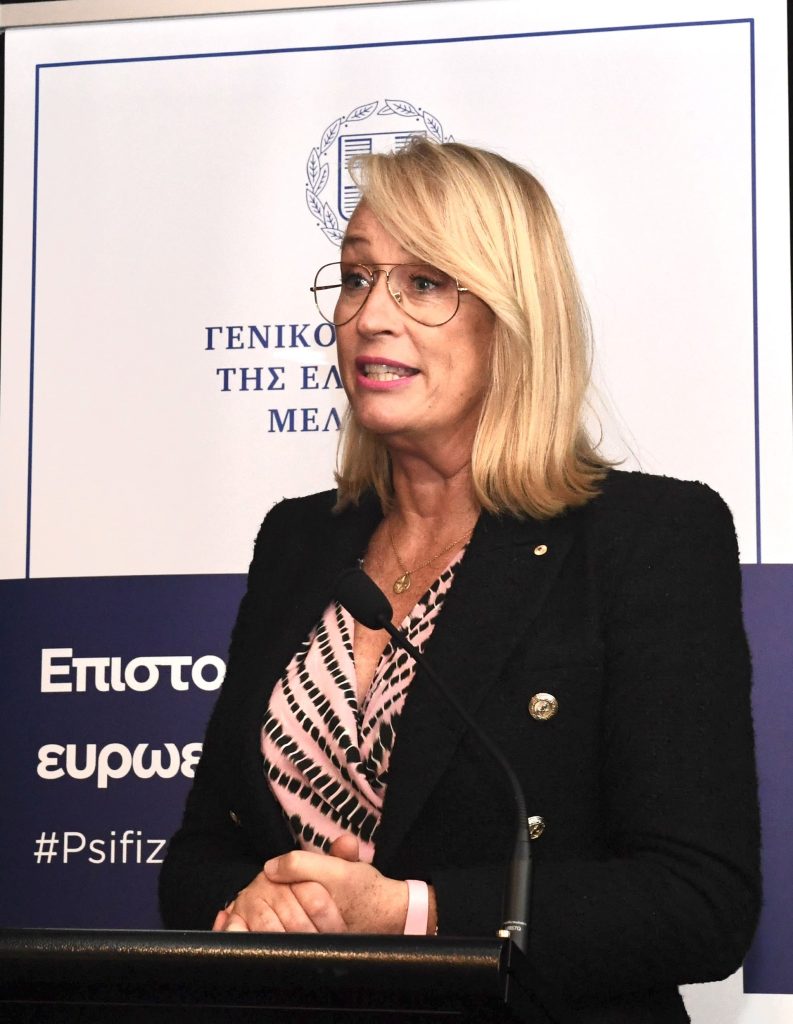
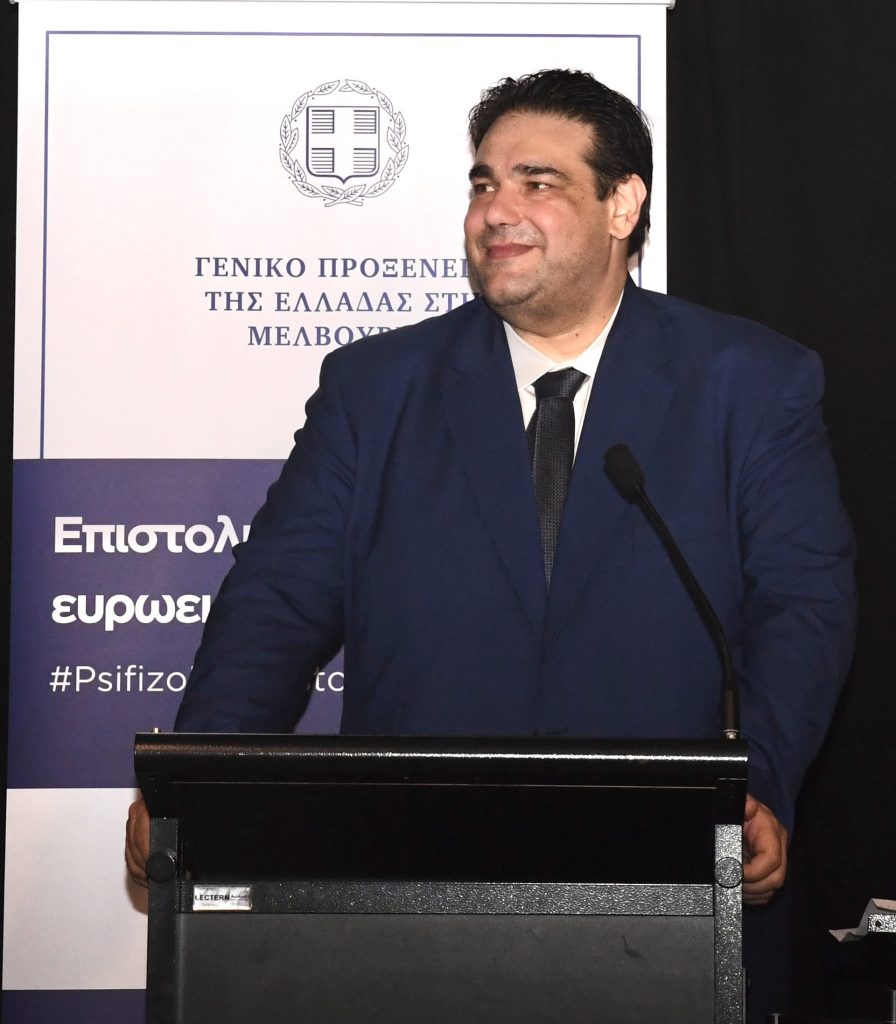
Greece’s Alternate Interior Minister talks with Melbourne Greeks about postal voting

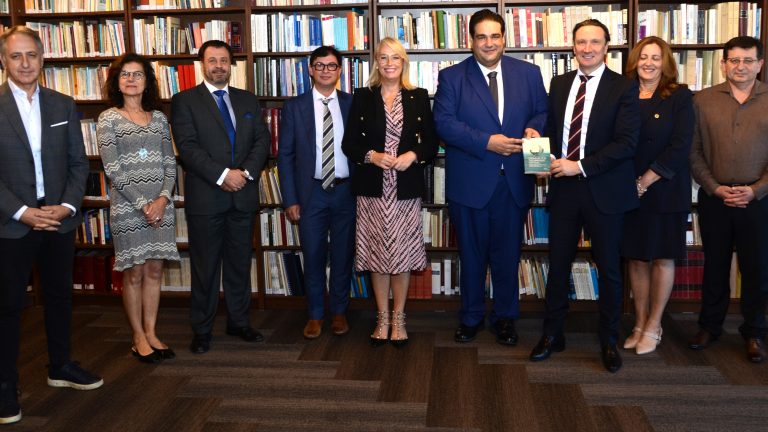
The Greek Community of Melbourne (GCM), along with the Greek Consulate of Melbourne, welcomed Greece’s Alternate Interior Minister, Theodoros Livanios, at the Greek Centre to discuss matters affecting the diaspora and the postal vote. Also in attendance was Melbourne’s Lord Mayor, Mrs Sally Capp AO.

GCM President Bill Papastergiadis OAM welcomed the Minister at the Library, along with Vice President Dr Jim Bossinakis, the Board of Directors, and GCM members Dr Nick Dallas, Dr Spyridoula Demetriou, Helene Hiotis, and Leonidas Vlahakis.

In his opening speech, Mr Papastergiadis stated, “It is our pleasure to host a historical event for the GCM and the Greek diaspora globally regarding the important step by the Greek Government to bestow the postal vote to its citizens globally.”

theodoros livanios greek community of melbourne
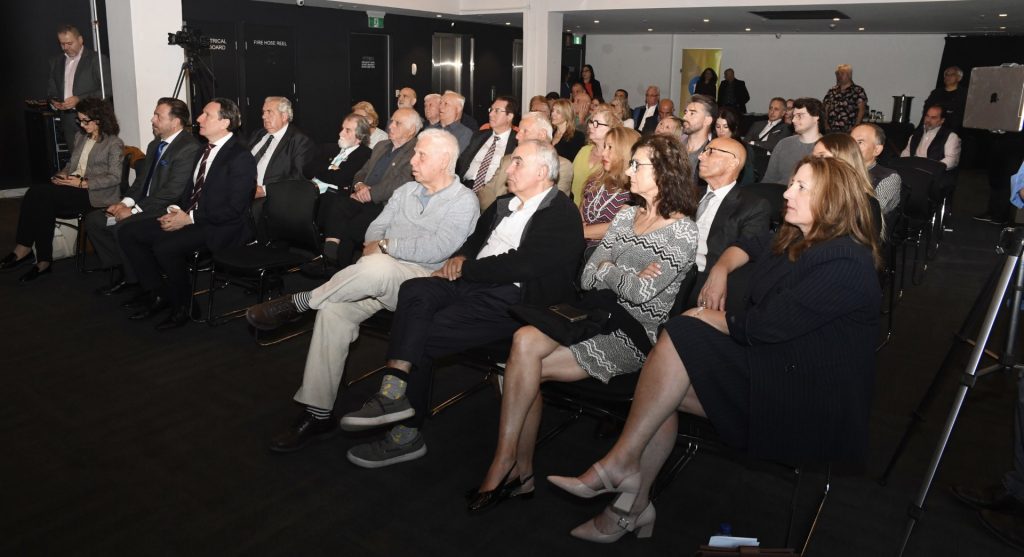
There were numerous attendees. Photo: Michael Profyris / Kostas Deves.

“Allowing citizens to vote is a critical part of any democracy. We need to embrace this step but at the same time it needs to be acknowledged that a deeper connection and conversation is required between Greece and the diaspora,” Mr Papastergiadis added.

“Hopefully, the engagement through this open meeting today helps to facilitate the ongoing conversation that is needed. The diaspora is multi-faceted and constantly changing. The Greek Government needs to acknowledge this so that its programs and actions reflect this global changing environment.”

Lord Mayor Cap thanked Mr Papastergiadis for his warm welcome and emphasised the importance of the Minister’s presence for the Greek community.

theodoros livanios greek community of melbourne
Lord Mayor Sally Capp. Photo: Michael Profyris / Kostas Deves.

“Melbourne is the third biggest Greek city community in the world, and we’re very proud of that. 44 per cent of Greek Australians choose to live in Melbourne. I reflect as well on the 36th Antipodes Festival recently, with over 100,000 people in the streets celebrating culture, history, contribution, and also reminding us of the leadership that our Greek community plays in shaping our future here in this city. We hope that you enjoy the unique elements of Melbourne. Thank you for honouring us with your presence,” the Lord Mayor said.

Mr Livanios emphasised the pivotal role of the Greek diaspora and their significant contribution to strengthening the bonds between Greece and Australia.

He expressed a strong desire for the diaspora’s active participation in shaping the future of Greece, stating, “We value your opinion, your vote, and your choice to be part of Greece’s future. Greece stands beside you, and we are committed to bridging the gap with the diaspora.”

theodoros livanios greek community of melbourne
Theodoros Livanios. Photo: Michael Profyris / Kostas Deves.

Furthermore, he highlighted the importance of the diaspora’s voice, stating, “We want you to have a strong presence and influence in the decisions that shape our nation. Your Greek community is resilient and influential, and we want you to play a part in crucial decision-making processes.”

He also mentioned efforts to simplify the voting process for diaspora members in upcoming elections, reflecting responsiveness to the community’s needs and desires for easier participation in democratic processes.

theodoros livanios greek community of melbourne
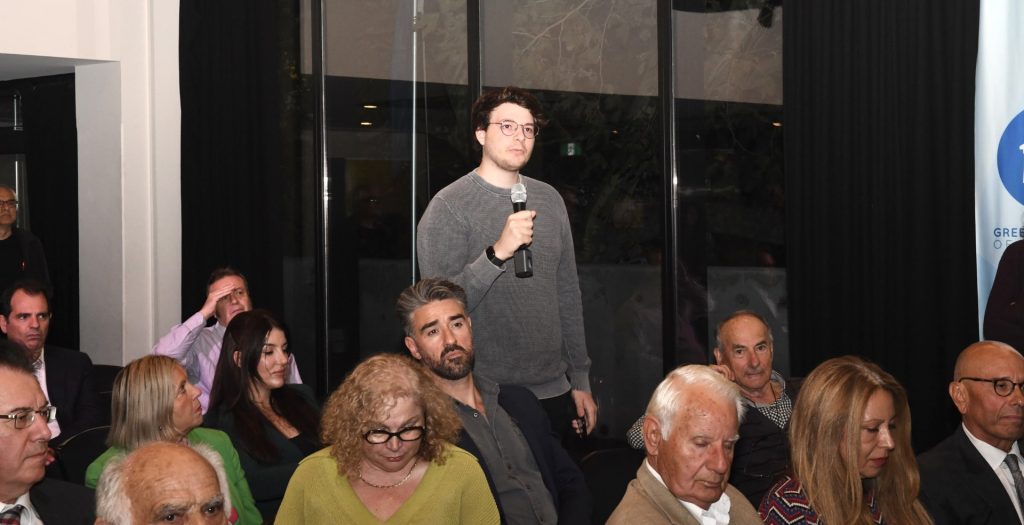
Question time. Photo: Michael Profyris / Kostas Deves.

During the session, Greece’s Alternate Minister explained in detail the postal voting procedure, providing a step-by-step explanation to ensure clarity, and understanding among diaspora members. He also addressed questions and feedback from the audience, emphasising that their concerns and suggestions would be taken into consideration, further demonstrating a commitment to inclusivity and responsiveness to the diaspora’s needs and preferences.

The Hellenic Initiative Australia celebrates a decade of achievements in Greece

On Monday, March 18, at ANZ’s Melbourne headquarters, The Hellenic Initiative Australia (THI Australia) held its first in a series of events to celebrate a decade of remarkable achievement in Greece.

Special guests and supporters heard messages from distinguished speakers including the Prime Minister of Greece, Kyriakos Mitsotakis, and THI’s Global Chair, Andrew N Liveris AO.

melbourne guests
Melbourne guests. Photo: THI Australia.

Speaking from Greece, the Prime Minister noted that Greek Australians were an integral part of Hellenism and among Greece’s best ambassadors by upholding and projecting the culture, values and traditions of Greece throughout Australia.

The Hellenic Initiative has assembled among the most prominent members of the Greek Australian diaspora and I send you my heartfelt thanks for the generous support of crisis relief and development programs in Greece,” the Greek Prime Minister said.

THI Australia could not have asked for a stronger endorsement on the occasion of its 10th anniversary. THI Australia also wishes to acknowledge the achievements of the Greek Government for repositioning Greece on the world stage.

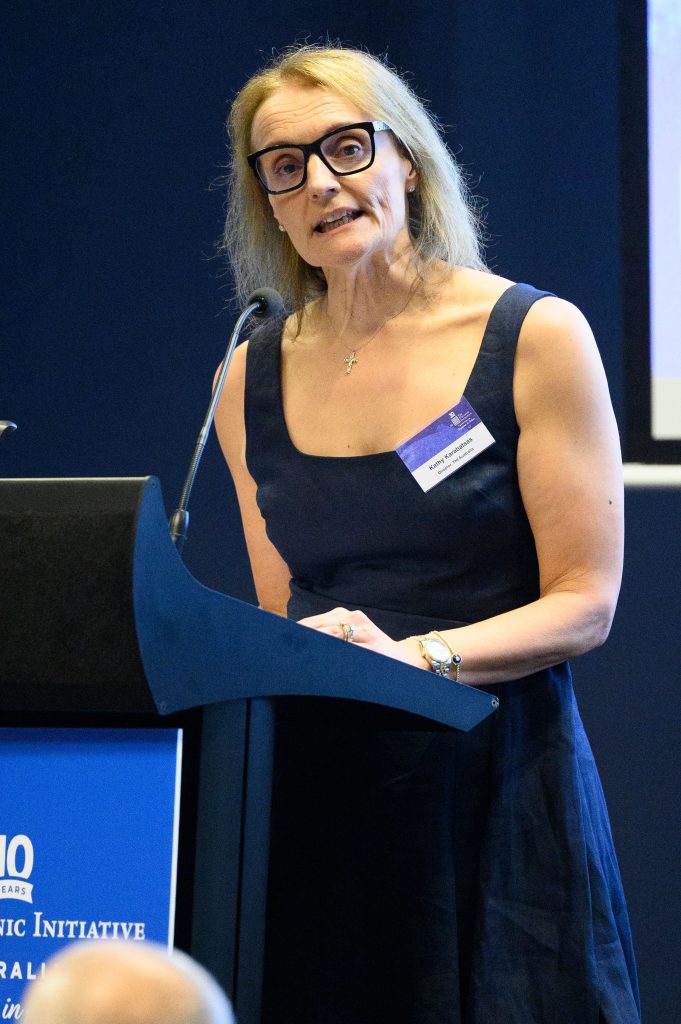
Kathy Karabatsas
Kathy Karabatsas, the MC of the event. Photo: THI Australia.

It was on the invitation of Andrew N Liveris AO that more than 150 leaders of the Greek Australian community first assembled in March 2014 to discuss how to best mobilise support for Greece in that nation’s moment of acute need. Mr Liveris emphasised that THI would continue to unite the global Greek diaspora in support of Greece and that there was much more to be done.

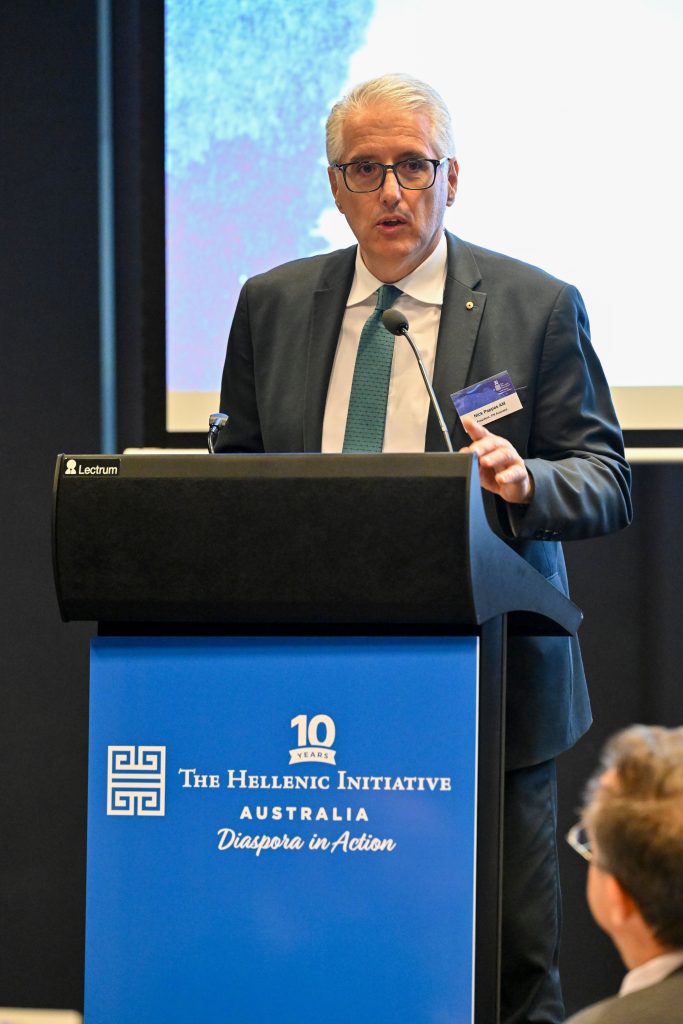
Nick Pappas AM, THI Australia’s President, spoke passionately about the motivation that underpinned THI and reiterated the importance of uniting the Greek diaspora.

Nick Pappas
Nick Pappas. Photo: THI Australia.

“The Hellenic Initiative was born of crisis relief, and that is still one of its essential drivers to this day, but it has become much more than that. THI has become a sturdy, transnational plank upon which diaspora Hellenism may now rest, upon which it may be nurtured, from which it may be drawn upon and through which it may be expressed,” he noted.

“Ten years on, that commitment and passion across the globe has not waned; rather, it has blossomed. Particularly in Australia, and even more so in Melbourne, Greece’s antipodean epicentre.”

An important corporate supporter of THI’s journey over the past 10 years has been ANZ and Tammy Medard, Managing Director Institutional Australia & PNG, ANZ, spoke about the importance of this relationship.

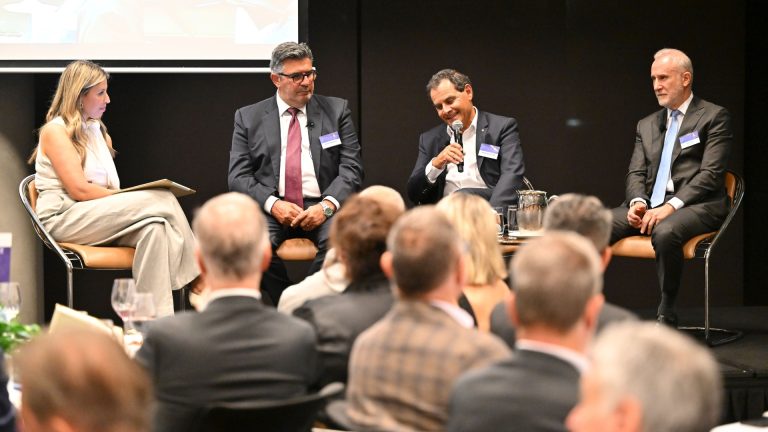
Later in the evening, guests heard from an eminent panel of Greek Australian leaders comprising George Savvides AM, Chair SBS, Andrew Demetriou, former AFL CEO, and Terry Paule, Chairman Findex.

Tammy Medard, ANZ
Tammy Medard, ANZ. Photo: THI Australia.

The inspiring discussion on Greece, Philanthropy and the Diaspora was moderated by Helen Mantzis, Director of the Hellenic Museum in Melbourne.

A highlight of the discussion was hearing the panellists share the profound impact of their Greek heritage on their personal and professional lives.

The event provided an opportunity for guests to support one of THI Australia’s trusted partner charities in Greece, Pediatric Trauma Care, and the organisation sincerely thank all guests who purchased the identified medical equipment for several hospitals in Greece on the night. Equipment ranged from neonatal cribs, defibrillators and a portable ultrasound scanner.

HACCI hosts meeting with Ambassador-Designate of Greece to Australia

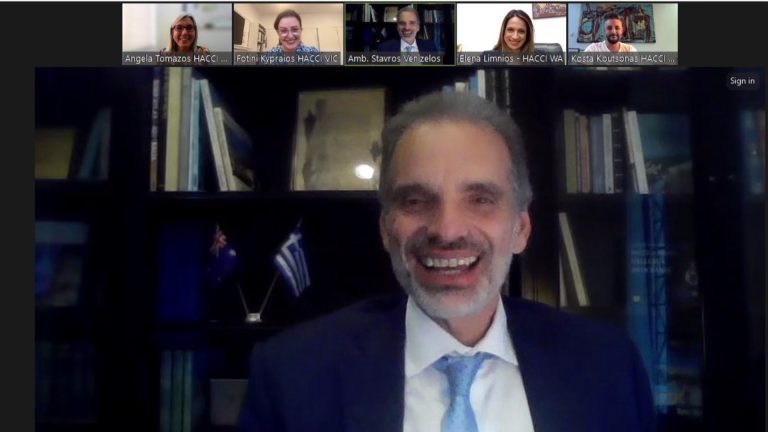
The HACCI National Federation had a very warm and fruitful video meeting with Stavros Venizelos, Ambassador-Designate of Greece to Australia, this week.

HACCI National Federation council (and HACCI Victoria Board) chair Fotini Kypraios, and council members Angela Tomazos (Chair of HACCI NT), Elena Limnios (Chair of HACCI WA), and Kosta Koutsonas (Chair of HACCI SA) took the opportunity to confirm their commitment to working closely with the Greek government, ministries and other trade and industry bodies, facilitating communication and bilateral relations and trade opportunities between Australia and Greece.

Among the issues discussed was the need for greater resource allocation to the state-based consulates across Australia, and particularly for additional online services, as well the new strategic plan of the Greek Government for the Greeks of the Diaspora.

HACCI National Federation thanked Ambassador-Designate Venizelos for his commitment to addressing the issues discussed, and wished him the best in his new duties.

READ MORE: Strength in sisterhood: HACCI celebrates women’s power on IWD.

Meet the Australians of Greek heritage who just missed the Richest 250

Following this year’s edition of Australia’s Richest 250 people, The Australian has now revealed the 15 names who just fell short of being on the list.

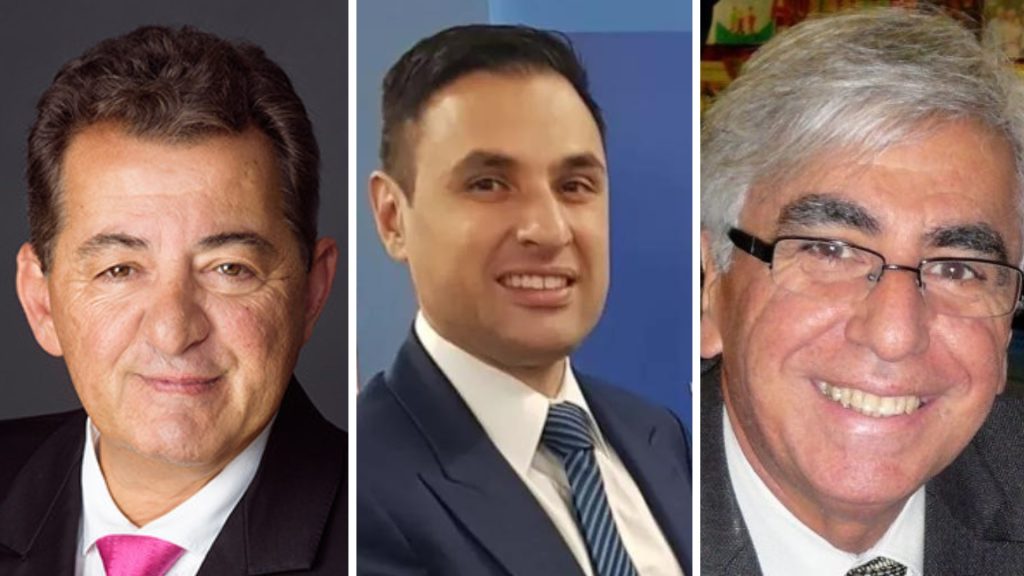
Amongst the names are three Australians of Greek heritage. We find out who they are.

George Stamas ($531 million)

George Stamas is the owner of GJK Facility Services. He began his career as a part-time cleaner and worked his way through to management before becoming owner of GJK in 1987.

The business has annual revenue of $233 million and made a net profit of $39 million.

George Stamas, Theo and Paul Kristoris
(L-R) George Stamas, Theo and Paul Kristoris didn’t make the cut.

Theo and Paul Kristoris ($507 million)

The principals of the Adelaide-based Leader Computers wholesalers oversee a business with annual revenue of $564 million and net profit of $25 million.

Source: The Australian.

Australian MPs back call for recognition of Greek, Armenian, Assyrian genocides

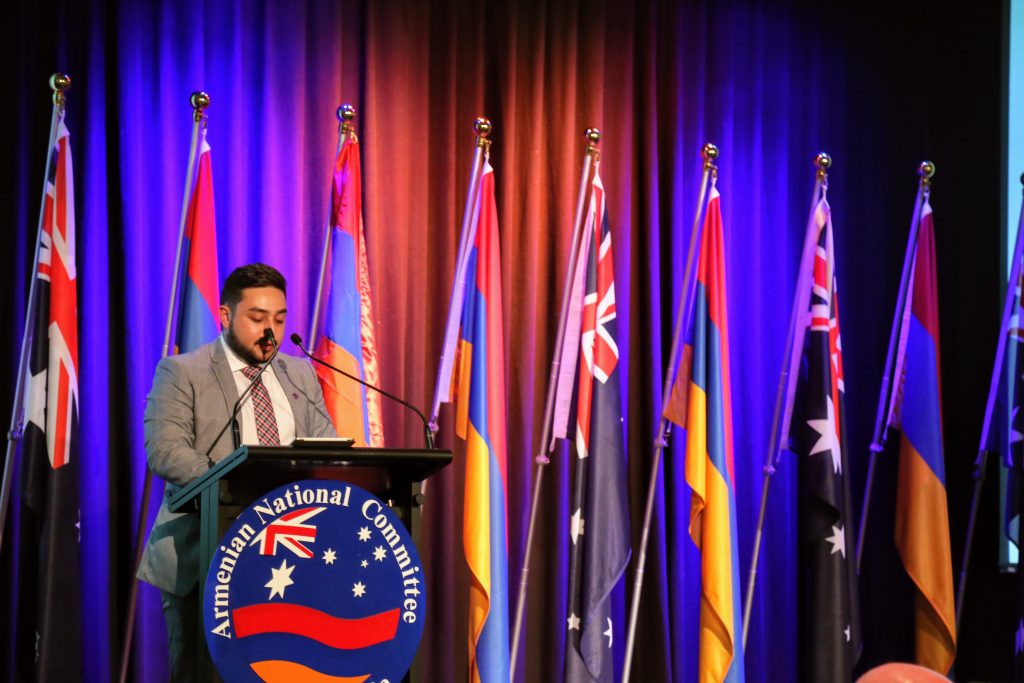
The Joint Justice Initiative secured support in 2023 from 19 Federal Parliamentarians, who have officially signed the Joint Justice Initiative’s Affirmation of Support Document calling for Australian recognition of the 1915 Armenian, Assyrian and Greek Genocides, reported the Armenian National Committee of Australia (ANC-AU).

In total, nine Parliamentarians elected to the House of Representatives signed the support document, including Sophie Scamps MP – Member for Mackellar, Allegra Spender MP – Member for Wentworth, Jerome Laxale MP – Member for Bennelong, Zali Steggall MP – Member for Warringah, Henry Pike MP – Member for Bowman, Stephen Bates MP – Member for Brisbane, Max Chandler-Mather MP – Member for Griffith, Gavin Pearce MP – Member for Braddon and Elizabeth Watson-Brown MP – Member for Ryan.

A total of 11 Senators met with representatives of the Joint Justice Initiative in 2023 who agreed to support the Armenian, Assyrian and Greek communities, including Senator Jonathon Duniam – representing Tasmania; Senator Mathew O’Sullivan – representing Western Australia; Senator Wendy Askew – representing Western Australia; Senator Lidia Thorpe – representing Victoria; Senator David Shoebridge – representing New South Wales; Senator Dorinda Cox – representing Western Australia; Senator Penny Allman-Payne – representing Queensland; Senator Dave Sharma – representing New South Wales and Senator Maria Kovacic – representing New South Wales.

Of significance, the latest cohort of signatories also includes Senator Claire Chandler – Senator for Tasmania and Assistant Shadow Foreign Affairs Minister and Senator Jordon Steele-John – Senator for Western Australia and Australian Greens Spokesperson for Foreign Affairs.

As a result of the Joint Justice Initiative’s advocacy efforts across 2023, 47 sitting elected representatives are now calling for official recognition of the 1915 Genocide, the largest cohort since the group’s establishment in February 2020.

Michael Kolokossian
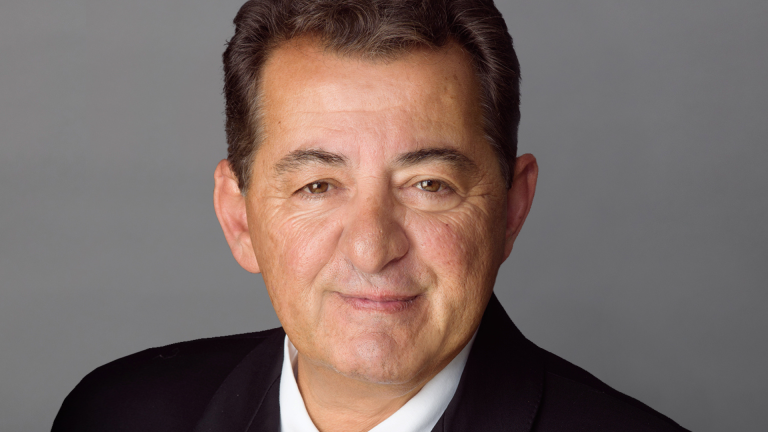
Michael Kolokossian. Photo: Armenian National Committee of Australia.

Executive Director of the ANC-AU, Michael Kolokossian, said the Joint Justice Initiative was proud to have an additional 19 allies supporting national recognition of the genocides.

“These principled parliamentarians are demonstrating the will of the Australian people who elect them. They are our three communities’ greatest assets in our struggle for truth and justice,” Kolokossian said.

On 25th February 2020, over 100 Federal Australian parliamentarians, diplomats, departmental officials, political staffers, academics, media and community leaders were treated to cultural performances, food, wine and brandy, as well as the historic signing of a Memorandum of Understanding, which affirmed that the signatory public affairs representatives of the three communities were jointly committed to seeing Australia recognise the Turkish-committed Genocides against the Armenian, Greek and Assyrian citizens of the Ottoman Empire during World War I.