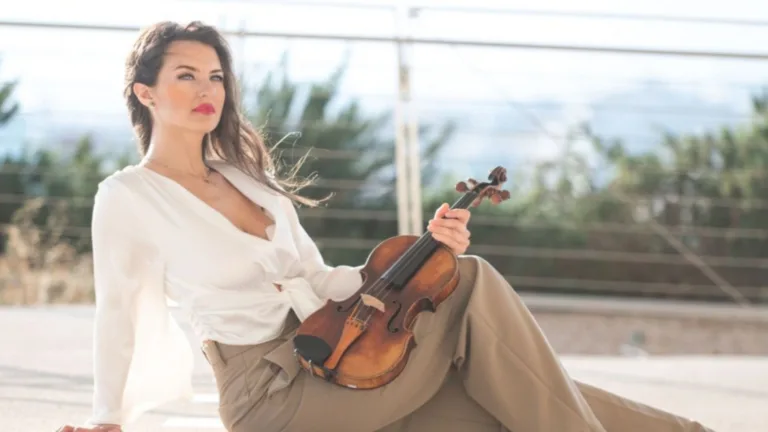
Katerina Chatzinikolau has made history by being appointed as the first woman Concertmaster of the Athens State Orchestra. This landmark achievement is a testament to Katerina’s extraordinary talent, dedication, and leadership in the world of classical music.
Katerina Chatzinikolau’s appointment marks a significant milestone not only for her career but also for the Greek classical music community, as she becomes the first woman to hold this prestigious position in any Greek orchestra. Her role as Concertmaster will see her leading the violin section and playing a crucial part in shaping the orchestra’s artistic direction and performance excellence.
In addition to her groundbreaking new role, Katerina is renowned for her exceptional soloist career and numerous acclaimed performances both in Greece and internationally. Her appointment is expected to inspire and empower the next generation of female musicians, fostering greater gender diversity and inclusion in classical music.
About Katerina Chatzinokolau
Praised by the Rheinische Post as a musician of “sparkling vitality and virtuosity,” violinist Katerina Chatzinikolau captivates with her variety of sound, which testifies to an intense work with historical performance practice as well as contemporary music.
In the recent years Katerina has established a rapid career as a soloist and has performed in renowned concert halls such as the Philharmonie Cologne, Carnegie Hall, Tonhalle Düsseldorf, rbb-Rundfunksaal Berlin, Royal Theatre Thessaloniki, Beethovenhalle Bonn, Laeiszhalle Hamburg, Liederhalle Stuttgart, Musiktheater im Revier Gelsenkirchen and at the Ruhrtriennale.
She shared the stage with orchestras such as the Deutsches Symphonie-Orchester Berlin, the Philharmonie Südwestfalen, the Thessaloniki State Symphony Orchestra, the New Rheinisches Kammerorchester Köln and the New Philharmonie Westfalen. Katerina is a first prize winner of the Golden Classical Music Awards 2020, the London International Music Competition, the eMuse International Music Competition and Alois Kottmann Prize. In 2015 she won the 1st prize at the Thöne International Competition, as well as the prize for the best interpretation of the contemporary commissioned work.
Katerina studied in Pre-College at RSH Düsseldorf with Prof. A. Kramarov and is a Master’s graduate of HfMT Cologne, where she studied “Violin Solo” with Prof. A. Daskalakis and Musicology with a focus on “Artistic Development and Reflection”.
She received further musical impulses at international master classes with Leonidas Kavakos, Pavel Vernikov, Andres Cardenes, Mauricio Fuks, Ida Kavafian, Barnabas Kelemen, Mihaela Martin, Pierre-Laurent Aimard, Evgueni Sinaiski and Anthony Spiri at the Kronberg Academy and at the Darmstadt Summer Courses for New Music, among others.
Mboura me Ricotta (Ricotta cigars) is a very easy dessert to make or even freeze to have on hand on busy days or nights when you fancy something sweet or unexpected guests drop in. Five ingredients, quick to make and delicious.
Niki Louca from My Greek Kitchen shares her favourite recipe with The Greek Herald. You can follow her on Instagram @mygreekkitchen for more!
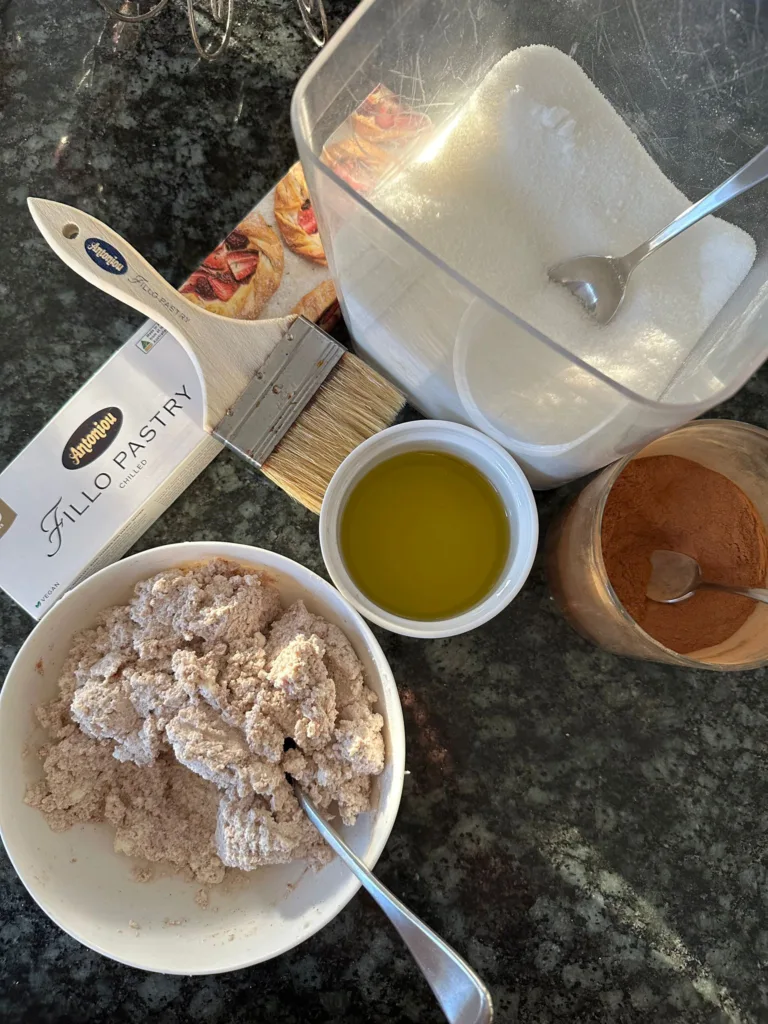
Ingredients:
1 packet Antonio filo pastry
cinnamon to taste
700-800 grams fresh ricotta
6 tablespoons sugar
½ cup of light olive oil or vegetable oil
icing sugar for dusting
Method:
Break ricotta with a fork and add the sugar and cinnamon. Mix well and set aside.
Have your oil and pastry brush ready along with your baking tray. Line tray with baking paper and preheat your oven to 170C.
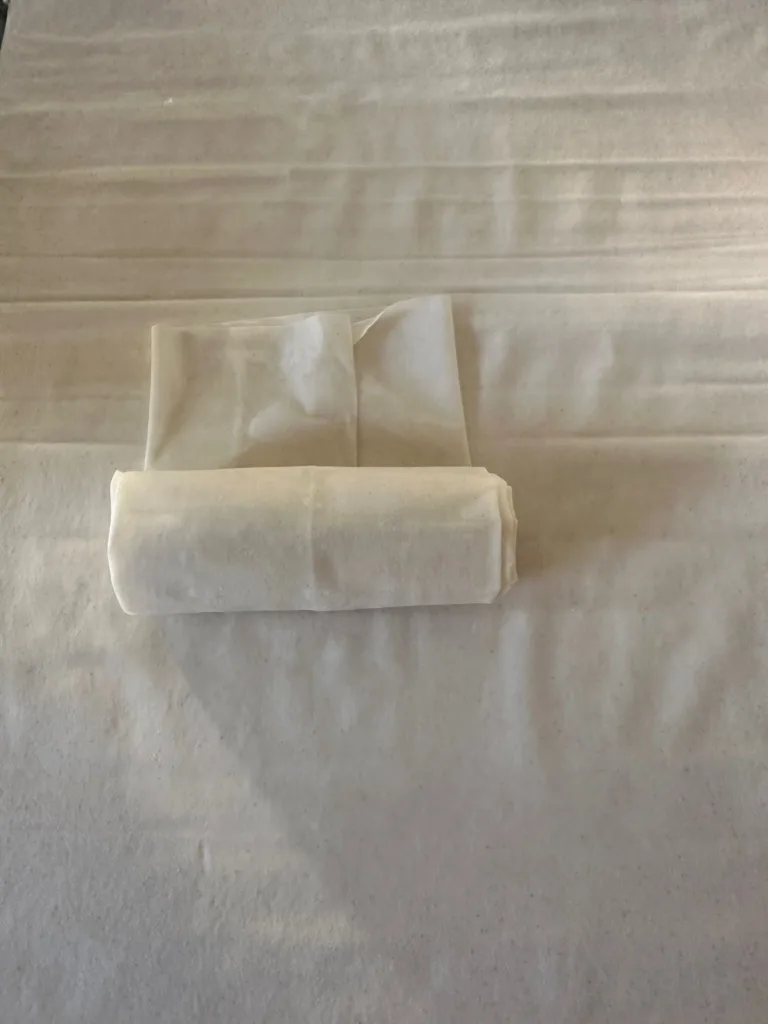
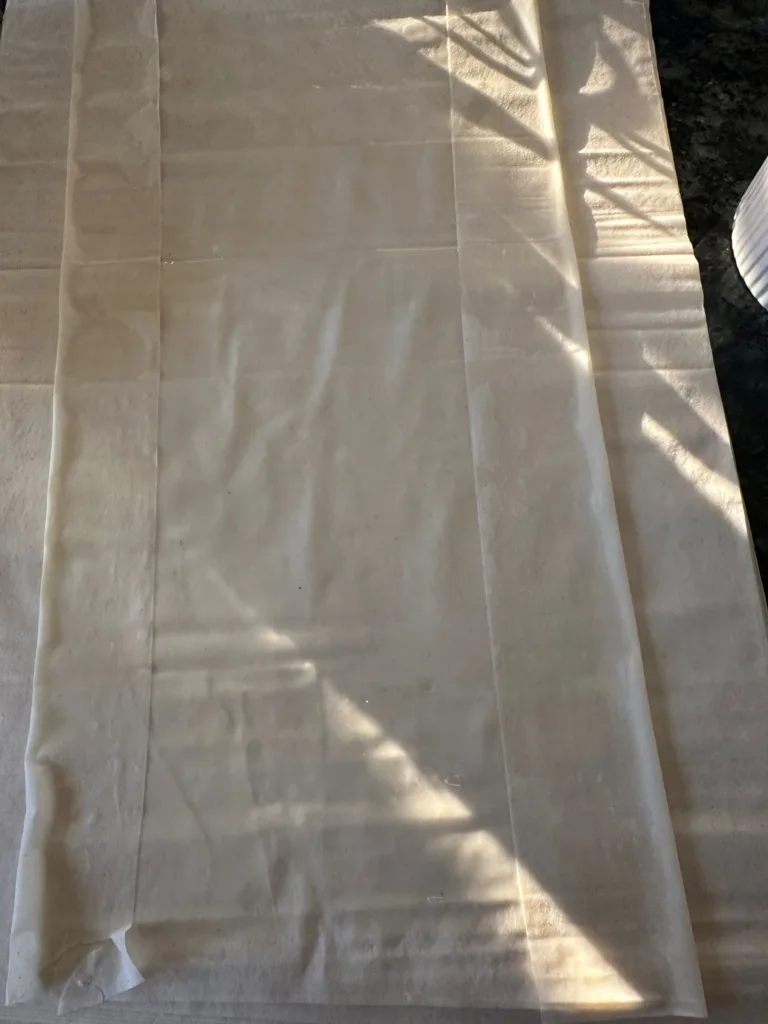
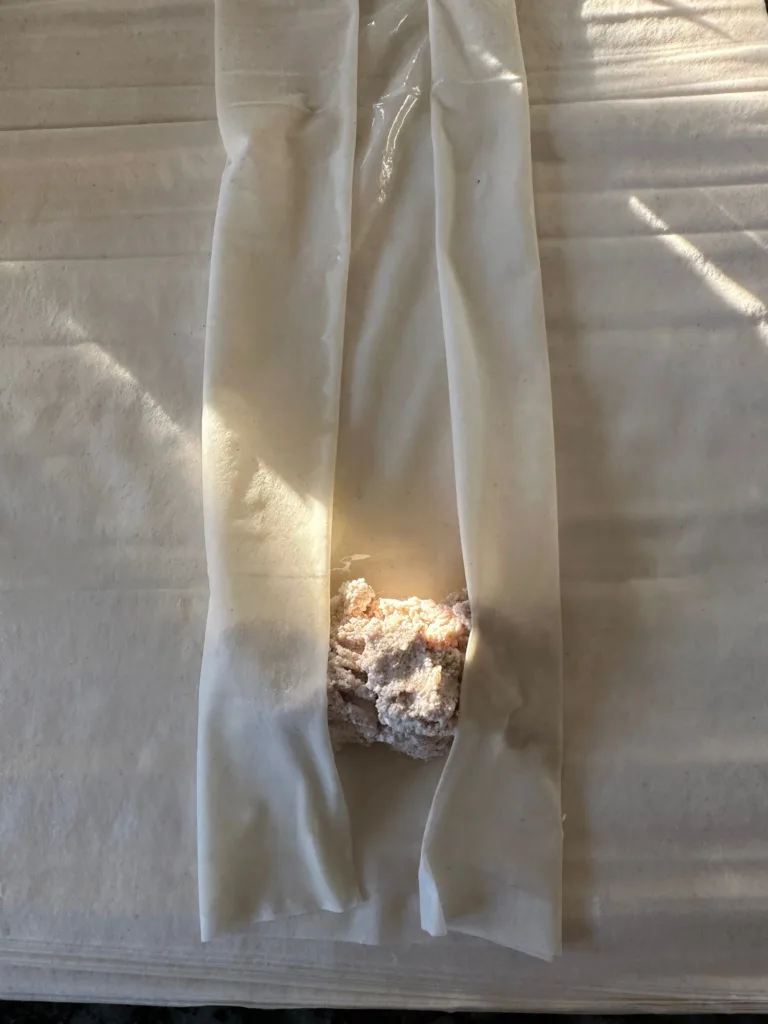
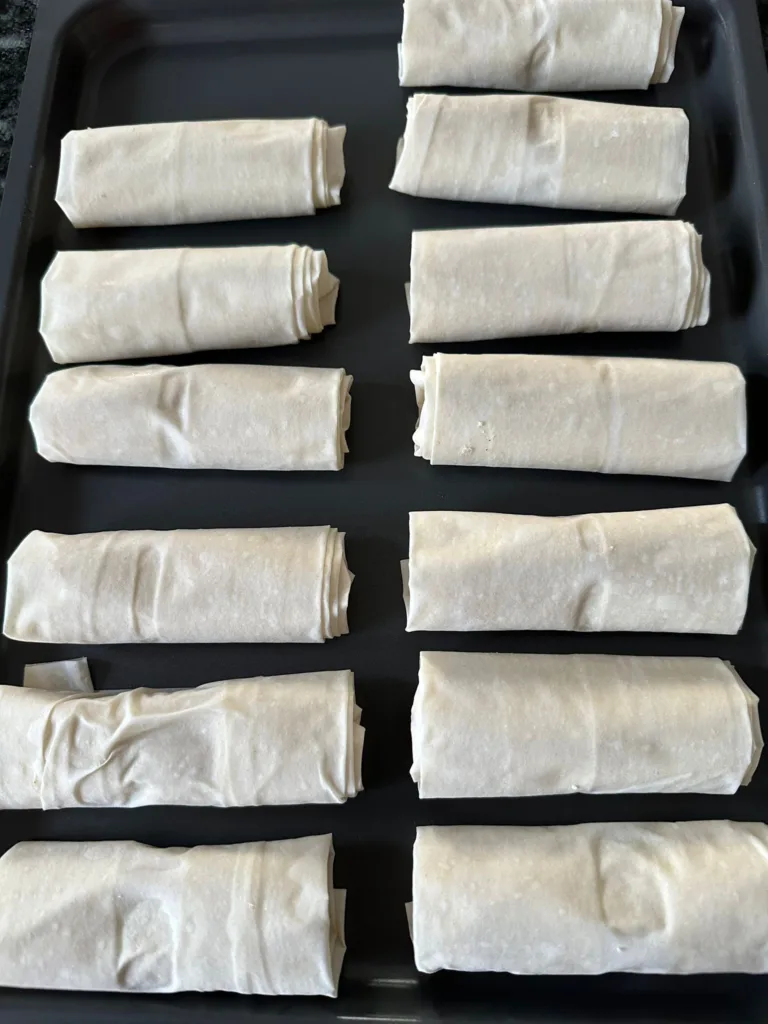
Working with filo pastry requires you to work fast otherwise the pastry will dry out. Place the pastry long side facing you, take a table spoon of the ricotta mixture and place in the middle of the bottom part of pastry. Fold both sides of pastry inwards to cover the ricotta, then slowly roll upwards, away from you to form a cigar.
Repeat process till all the pastry/custard is used. At this stage if you don’t want to cook all of the cigars, you can freeze them and bake them at a later date (frozen). They will keep in the freezer up to a month.
Brush the tops of the cigars with oil and place in the hot oven.
Once golden brown, remove from the oven and dust with icing sugar. Serve warm.
Greece has been honored with a European Heritage Award (European Heritage Awards/Europa Nostra Awards) by the European Commission and Europa Nostra for the interdisciplinary collective “Boulouki,” which is dedicated to studying traditional building materials and techniques.
Accorind to tovima.gr, Boulouki, a versatile group of architects, engineers, and heritage professionals, focuses on revitalizing traditional craftsmanship for contemporary construction needs. Their mission is to promote a renewed building culture in Greece and worldwide by leveraging traditional knowledge and techniques.
Since its establishment in 2018 as a non-profit organization, Boulouki operates on four pillars: education, research, practice and public dialogue. It is the only organization in Greece that develops and implements professional apprenticeships, combining restoration projects with vocational training. They employ an itinerant approach, travelling around Greece, to conduct workshops that draw from, and respond to, the specific characteristics of every place.
The European Heritage Awards celebrate the highest standards in heritage interventions, research, education, training, and awareness-raising, as well as the dedication of professionals and volunteers. These awards are recognized as Europe’s most prestigious honor in the heritage field, bringing local, national, and European visibility and recognition to the winners.
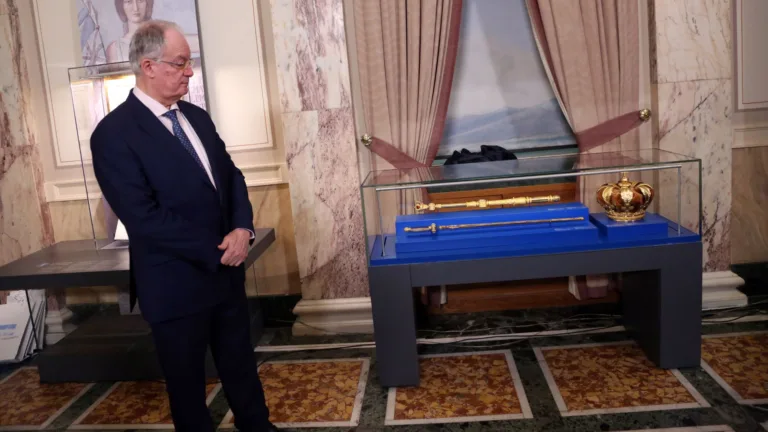
The royal regalia of King Otto, discovered by the Ministry of Culture in 2023 at the former summer palace in Tatoi, are now on display in the Greek Parliament until 2073. These historical artifacts, including the king’s crown, scepter, and sword, can be viewed in the Hellenic Parliament’s Trophies Hall ‘Eleftherios Venizelos.’
According to amna.gr, in a special ceremony, Minister of Culture Lina Mendoni presented the regalia to Parliament President Constantine Tassoulas.
Photo: amna.gr
“History passes through regimes, passes through political systems, and does what is most valuable: it teaches. That is why these unveilings here today are not only unveilings of emblematic memories but also unveilings of history teaching,” emphasized Tassoulas during the unveiling of the regalia.
He stressed that they are “three new exciting, historical, and aesthetic exhibits that enrich the precious arc of memory contained in the ‘Eleftherios Venizelos’ Hall and are related to historical phases of the modern Greek state.” Mendoni provided an extensive description of the valuable regalia and their journey until they arrived in Greece after the fall of the dictatorship. “The royal distinctive emblems of Otto, beyond any doubt, constitute historical treasures of the Greek people and the Greek nation and they must be treated as such,”she stressed.
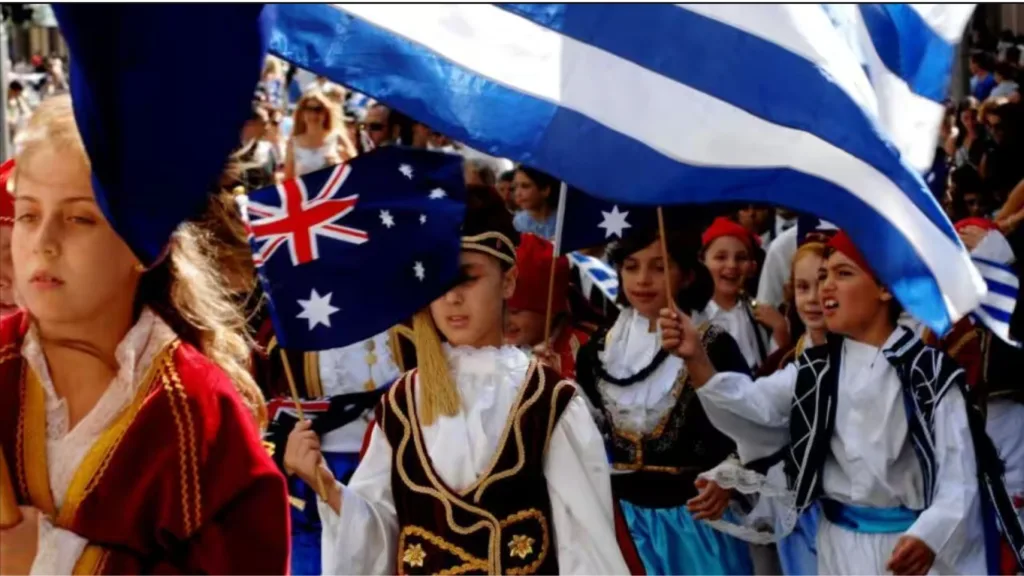
Thirty years ago, in research and publications, I argued that after 2035, the communities of Greeks in Australia will have completed their first cycle and will be led to another long period, of regrouping and readjustment, which will not have the characteristics of settlement and development, as we know them. This conclusion was not the fruit of a psychic or a prophet of decline. It was the product and outcome of scientific and documented analysis of the data and was based on the analysis of the basic socio-economic variables of Hellenism.
Social structures and their state, in a specific time and space, are measured by independent, as well as dependent variables, and changes that occur or can be mitigated, depending on the data that constitute a group, which in our case is that of Greek Australians.
Let us be more specific about where the findings and speculations of the change that lead precisely, in eleven years, to the community were based and are being based. Of course, we will not have a dissolution of Hellenism; the existing communal thrust will not be levelled and the systems of containment and support of Hellenism, will continue to operate. What is certain is that, after 2035, the shrinkage and decline of institutions, as they were created in the 1960s and 1970s, will be catalytic and irreversible. This is because we have not anticipated the tremendous change that awaits us, as a structured Diaspora. We have not created cohesion and restraint mechanisms, nor wheels and safety belts that could correct the situation. The Greek communities will look like the “crazy truck”, running downhill with the brakes broken.
Greek Australian
During the period 1946-1976, 270,000 Greeks and Cypriots arrived in Australia and were united, under difficult intra-communal conditions and discriminations, with the Greeks of the pre-war period who numbered 14,000. Prejudices and serious differences have arisen between the old and new settlers, resulting in new immigrants being distanced or even excluded from the manifestations and tolerance of the old. Pre-war families were conservative, ecclesiastical-centric, integrated into the Australian social fabric, committed and bigoted to the way of life of the society in which they lived.
The new immigrants, emerging from the spectrum of a perpetual war from 1940 to 1949, were overworked, had lived through the torment of civil war, were progressive and demanded radical changes, as well as their own organisation. The distancing of the two elements/currents did not allow the expected cooperation and cohesion of Hellenism and prevented mechanisms of union or joint action. This rupture continued in various forms until the early 1970s, often even provoking the intervention of the consular authorities and the Church, as well as the Greek-language newspapers, which highlighted the division.
In our days and in the next ten years, the difficult years of the next decade, Hellenism and its organised community organisations will face the adverse demographic consequences. In the meantime, ethnologists, anthropologists, aspiring historians of Hellenism, chroniclers, journalists, sociologists, leaders of Hellenism, community and ecclesiastical leaders, will attempt their own speculations, will approach the problem of 2035, each with its own typology, its own ideology, its own interpretation.
However, despite the inexorable reality of numbers, the changing demographic characteristics, the impacting demographic changes and the biological death of the first generation of Greek immigrants, who had laid the foundations and lifted on their shoulders what constitutes today, the political rulers in Greece remain pressing and unyielding, continuing to falsely refer “to a thriving Hellenism of Australia.” Naturally, they fail to define what they think is thriving? If they mean the socio-economic integration of Hellenism, its successful networking, its economic development, its political integration, they owe this almost exclusively to the Greek immigrants of the first generation. This progress was created and sustained by the young immigrants, children of the 1950s and 1960s, who worked and sacrificed themselves so that their children and grandchildren today have the prosperity and success they enjoy.
The vast majority of established factories, restaurants and hospitality units, industries, sources of wealth were achieved by first-generation Greek immigrants and less by their Australian-born successors. The immigrants of the first generation, the brilliant proletarians, herders and peasants, who sought fate under the sun of Australia, were the ones who built the churches of Orthodoxy, the ones who supported their priests and hierarchs. They organised their unions and communities, they supported the teaching and learning of their language. On their shoulders fell the national issues of Hellenism; in the streets of Australian cities fought the Cypriot, Macedonian, Epirotes, and the Dodecanese national issues, promoting the unredeemed historical, political and cultural values.
It was the Greek immigrants of the first generation who took to the streets to claim equality in Australia in order to defeat prejudice and racism. They were the ones who faced the contempt of the racist, xenophobic and ignorant Australian, who could not make more positive use of the presence of the immigrant. It was the Greeks of the first generation who put their successors, their children, in the parliaments of Australia, who were elevated to become parliamentarians and senators, who were distinguished as ministers and great directors and composers and academics and researchers and doctors and judges. They owe all their successes to their parents, as well as to the sacrifices of all the Greek immigrants of the first generation, who, as successors, deservedly honoured the memory of their parents. They were the women, mothers of first-generation immigrants who suffered in the factories, who bled in the kitchens of restaurants and working alternating “shifts” with their husbands and raised their children with sacrifices.
However, in 2035, these first-generation Greeks, the pioneers and creators of Australian Hellenism will not be around. They will not be among their successors to show them the way, to admonish them and to advise them.
Next week, I will refer with official and scientific data what awaits Hellenism in Australia in the years after 2035, and why I set 2035 as the limit. Two more articles will follow on the consequences of the biological exodus of first-generation Greek immigrants.
*Professor Anastasios M. Tamis taught at Universities in Australia and abroad, was the creator and founding director of the Dardalis Archives of the Hellenic Diaspora and is currently the President of the Australian Institute of Macedonian Studies (AIMS).
Australian children can explore Greek language and culture thanks to a landmark collaboration between South Australia’s Hellenic Studies Foundation and beloved children’s entertainment supergroup The Wiggles.
‘Learning Greek with Lucia’, which launches today, is an innovative new educational initiative which aims to inspire and encourage future generations of Greek language learners in Australia – and beyond.
The initiative has been funded with the help of a $2 million funding commitment made by the Malinauskas Labor Government before the last election to assist the Foundation with developing ways to teach modern Greek across early learning, primary, high school and tertiary levels.
‘Learning Greek with Lucia’ – hosted by new generation ‘Blue Wiggle’ Lucia Field, daughter of original Blue Wiggle Anthony Field – provides an immersive and interactive experience that celebrates the richness of Greek heritage, mixing the Wiggles’ trademark singalong musical numbers with interactive activities.
Established in 2005, the Hellenic Studies Foundation is dedicated to promoting Greek language and culture through innovative educational initiatives.
SA Member for West Torrens Tom Koutsantonis MP welcomed the collaboration.
“The Wiggles have helped redefine early learning and engagement for successive generations of children both in Australia and across the world, and this innovative collaboration with South Australia’s Hellenic Studies Foundation is a fantastic way to inspire new generations to engage with the Greek language and culture,” Minister Koutsantonis said.
“I congratulate the Foundation and Lucia Field on developing this program, which I’m confident will help strengthen cultural bonds for Greek Australians, which in turns enriches our broader cultural fabric.”
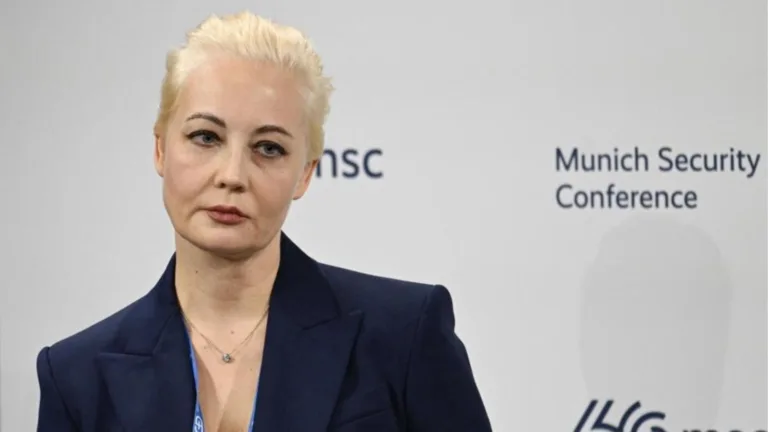
The Archons of the Ecumenical Patriarchate (AEP) have announced that Yulia Navalnaya, widow of Russian opposition leader Alexei Navalny, will receive the 2024 Athenagoras Human Rights Award.
The prestigious award will be presented at the AEP’s annual black-tie banquet on Saturday, October 19, 2024, at the New York Hilton Midtown Hotel.
The Athenagoras Human Rights Award, established in 1986, honours Ecumenical Patriarch Athenagoras.
Patriarch Athenagoras, who served as Archbishop of the Americas for 18 years before becoming Ecumenical Patriarch in 1948, was renowned for his visionary leadership and dedication to peace among Churches and people.
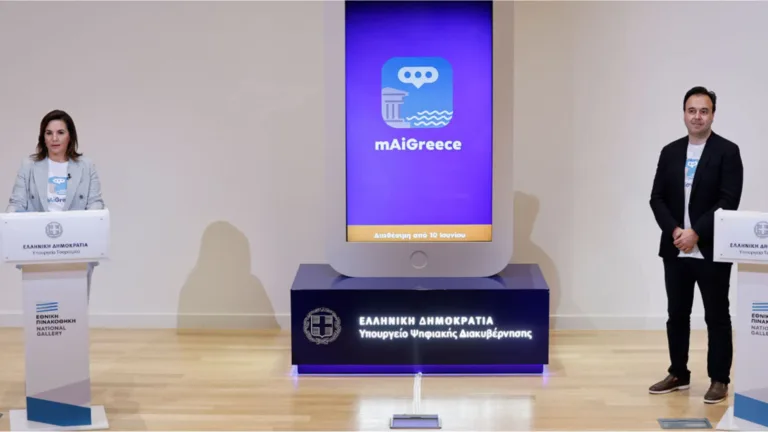
Tourism Minister Olga Kefalogianni unveiled “mAIGreece,” a new digital travel assistant app, at the National Gallery of Greece.
Supported by the Ministry of Digital Governance, the “mAIGreece” app uses artificial intelligence to provide travelers with a wealth of useful information.
According to amna.gr, it is initially available in 31 languages, and it ensures global travelers can get help in their native language.
In particular, “mAIGreece” is a Digital Assistant, which with the use of Artificial Intelligence will act as a personalised travel “companion” for all visitors to the country. It aims to provide them with all the information they need to enjoy their stay in Greece.
It is an easy-to-use application, which will go live on June 10, 2024. Travelers will be able to chat with “mAiGreece” by submitting their question in natural language, written or spoken. Using geo-location technology (GPS) “mAIGreece” will offer information depending on the area in which the visitors are located.
In her speech, Kefalogianni underlined that this is a tool that, among other things, will help the visitor to feel more secure in Greece, with the Minister of Digital Governance Dimitris Papastergiou adding that this digital application will be there in difficult times. For example, it will give clear answers about what to do if a visitor loses their passport or wallet. In the first phase, this application will be promoted by the Greek National Tourist Organisation (GNTO) offices abroad, while there will also be a special event at the Athens airport.
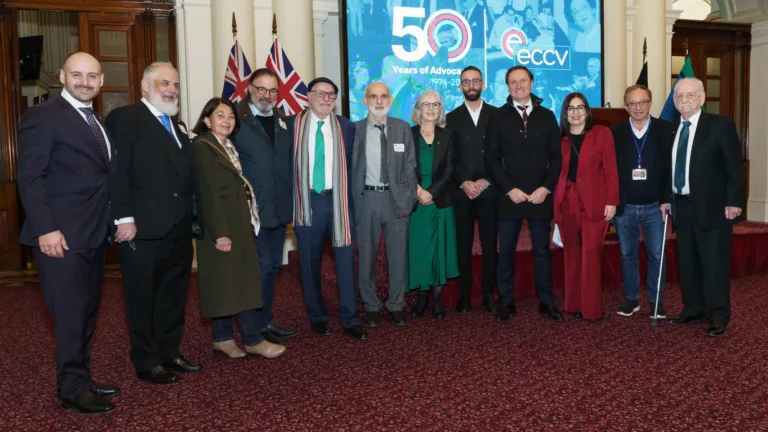
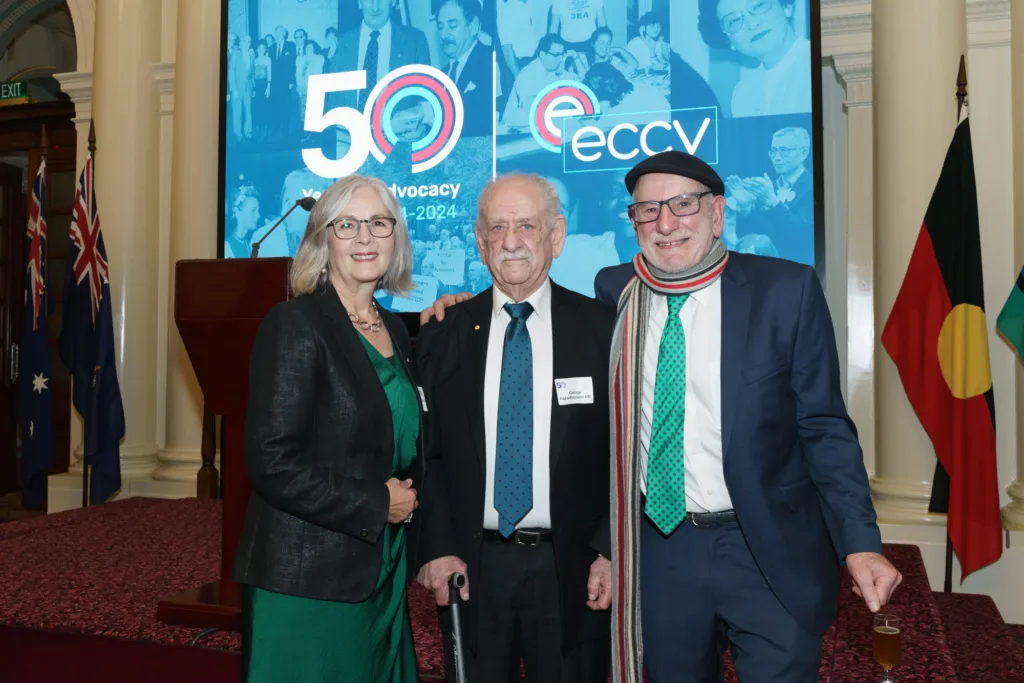
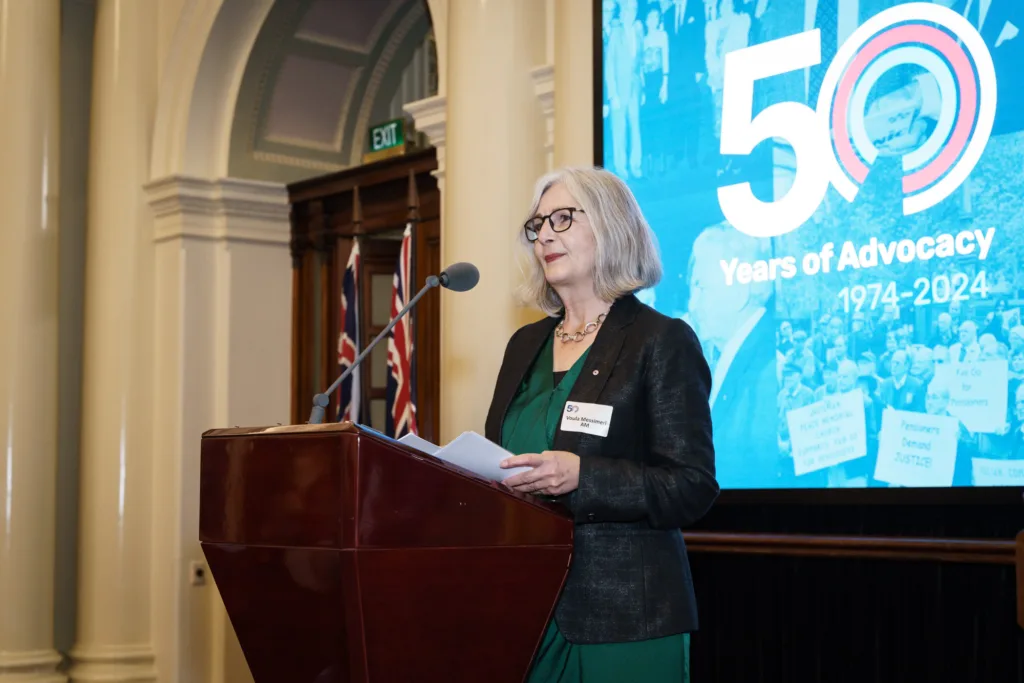
On 3 June, the Ethnic Communities’ Council of Victoria (ECCV) held its 50th anniversary celebration at Parliament House. More than 130 guests gathered in the majestic Queen’s Hall to reflect on and commemorate what ECCV has achieved over the past half-century as Victoria’s peak body for migrants and refugees.
Speakers included the Minister for Multicultural Affairs Ingrid Stitt MP, Leader of the Opposition and Shadow Minister for Multicultural Affairs John Pesutto MP, Greens Spokesperson for Multiculturalism Samantha Ratnam MP and First Peoples’ Assembly of Victoria co-chairperson Rueben Berg.
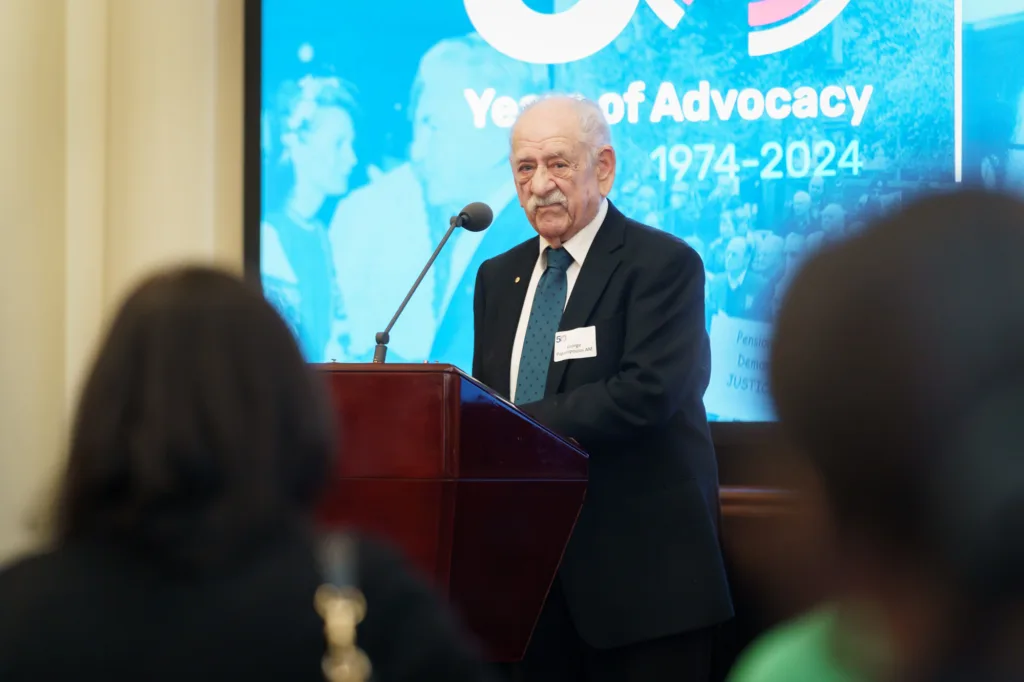
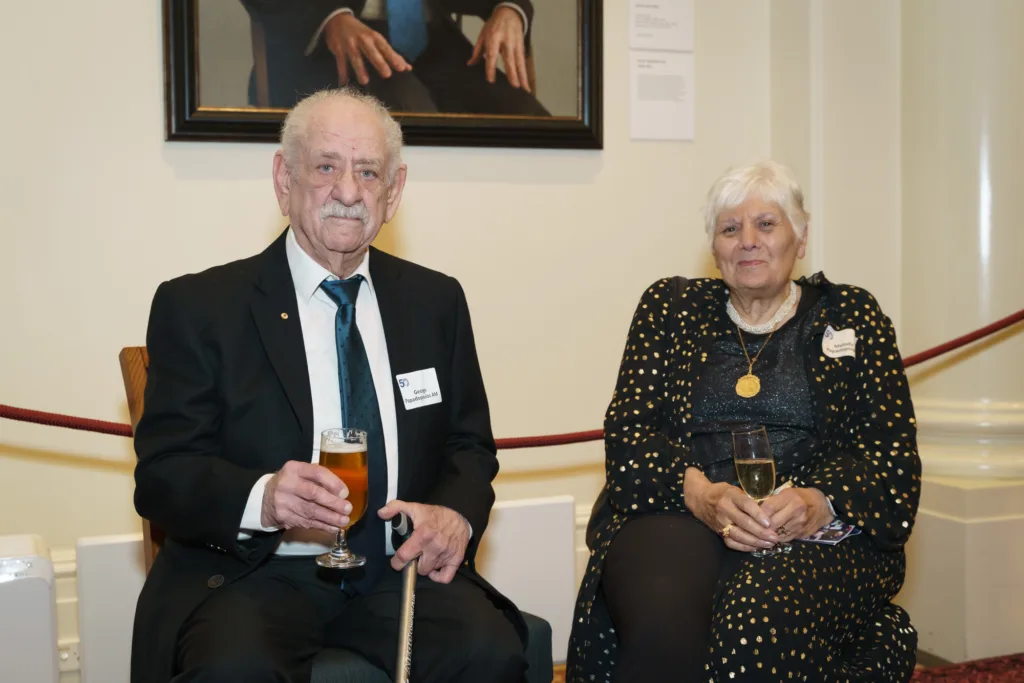
A highlight of the evening was a speech by ECCV co-founder George Papadopoulos, who spoke about his pride in seeing the organisation he helped establish not only “survive but flourish” in its mission to advocate for the rights and interests of Victoria’s diverse communities.
ECCV Co-founder George Papadopoulos AM.ECCV Co-founder George Papadopoulos and wife Melody.
ECCV Chairperson Eddie Micallef paid tribute to the tireless efforts of community leaders who fought for multiculturalism throughout the decades, helping set up not only ECCV, but the multicultural sector as a whole.
ECCV CEO Mo Elrafihi echoed this sentiment, stating that he stood “on the shoulders of giants” who were instrumental in paving the way for the “vibrant multicultural state” we live in today. He also highlighted the significance of Rueben Berg’s presence at the event, which he described as “illustrative” of ECCV’s commitment to strengthening engagement between multicultural and First Nations communities.
Minister Stitt elaborated on these ideas, praising the “trailblazers” who generously gave their time and energy to building ECCV into a “bastion of strength for multicultural and multifaith communities.”
“I want to acknowledge the huge role ECCV has played in the last 50 years, but particularly in the current climate, in advocating for harmony and social cohesion across our great state,” Minister Stitt said.
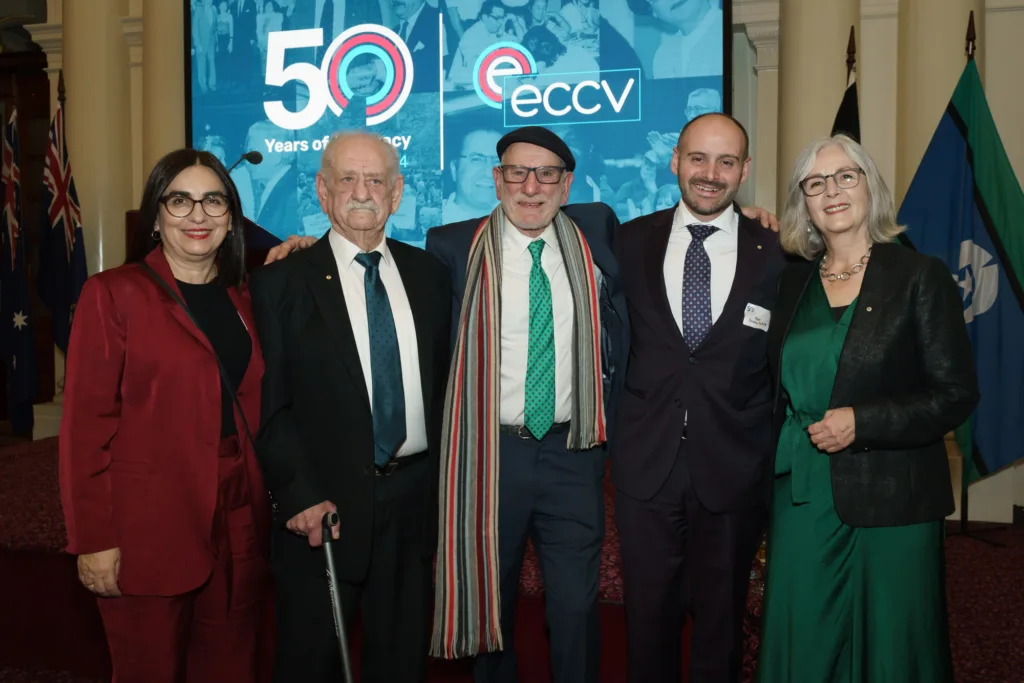
ECCV Director of Advocacy & Strategic Communication, Victoria Kyriakopoulos. George Papadopoulos, ECCV Chair, ECCNSW Chair Peter Doukas, and Voula Messimeri.
In his inspiring address, Rueben Berg highlighted the common experiences and goals shared between First Nations and multicultural communities, and called on all Victorians to continue working together to “create a society where every culture is celebrated and every individual can thrive.”
Samantha Ratnam drew attention to the profound impact ECCV’s work has had in promoting cross-cultural understanding and “collective power.”
“Congratulations to ECCV on 50 years of shaping Victoria and helping to make multiculturalism possible here and our communities stronger for it,” Samantha Ratnam said.
Voula Messimeri, George Papadopoulos and Eddie Micallef.
John Pesutto similarly expressed his admiration for Victoria’s “multicultural success” story and named ECCV as one of the key players in making this a reality.
ECCV patron, The Hon Steve Bracks AC, was unable to attend, but addressed guests in a video message which emphasised his pride in delivering, during his time as Premier, landmark reforms that ECCV had advocated for, including the first Multicultural Act for Victoria.
MC for the event was Voula Messimeri AM, who is a long-time supporter and friend of ECCV, having served for 27 years as CEO of the Australian Greek Welfare Society, one of the organisation’s founding members.
MC – Voula Messimeri.
The event was attended by the Federation of Ethnic Communities’ Councils of Australia Chairperson Carlo Carli, Ethnic Communities’ Council of NSW Chairperson Peter Doukas OAM, Ethnic Communities’ Council of Queensland Chairperson Elijah Buol OAM, Victorian Multicultural Commission Chairperson Vivienne Nguyen AM and Deputy Chairperson Bwe Thay, Victorian Equal Opportunity and Human Rights Commissioner Ro Allen, parliamentarians including Sheena Watt MP and Lee Tarlamis MP, and many others.
ECCV is currently producing a digital exhibition to commemorate our 50th anniversary, which will be launched in the latter half of 2024.
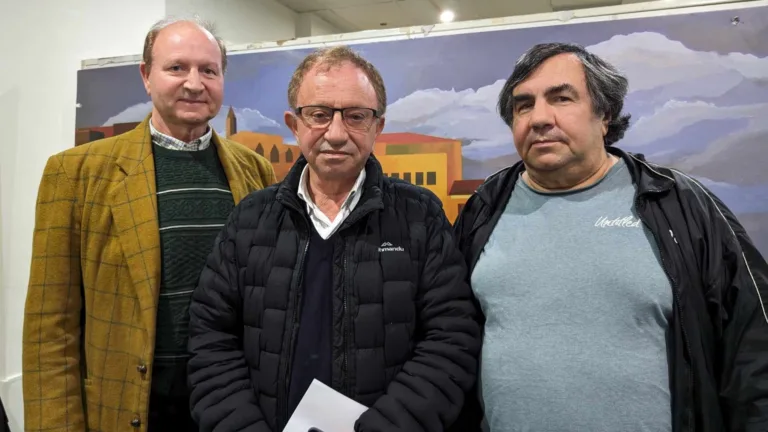
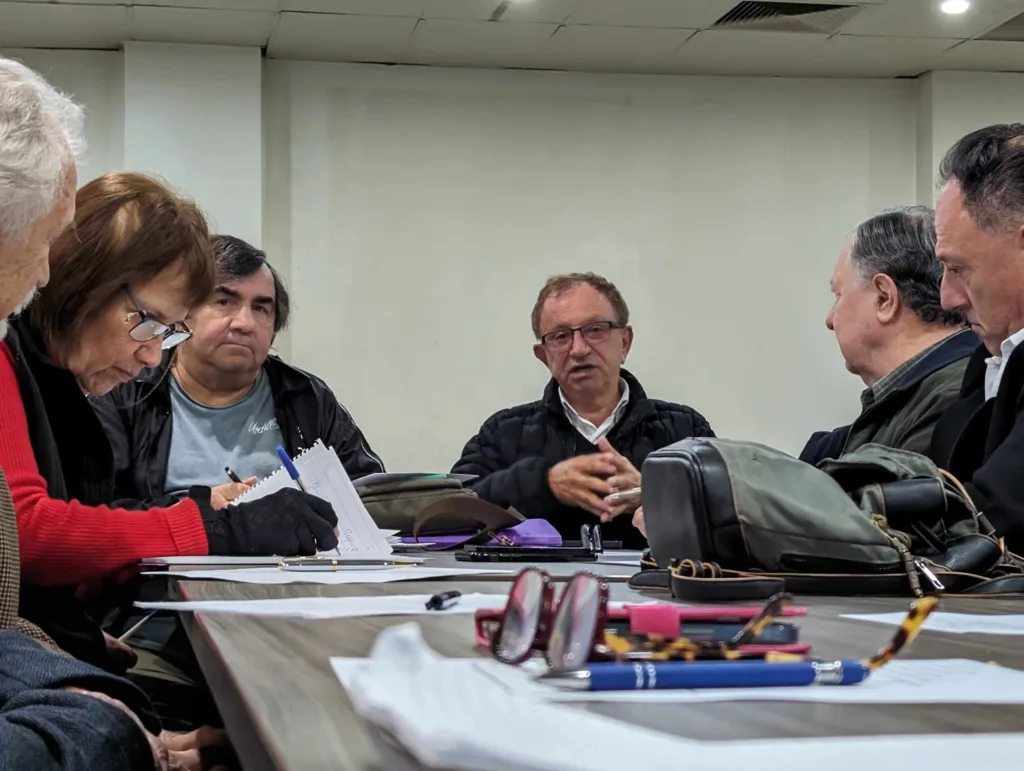
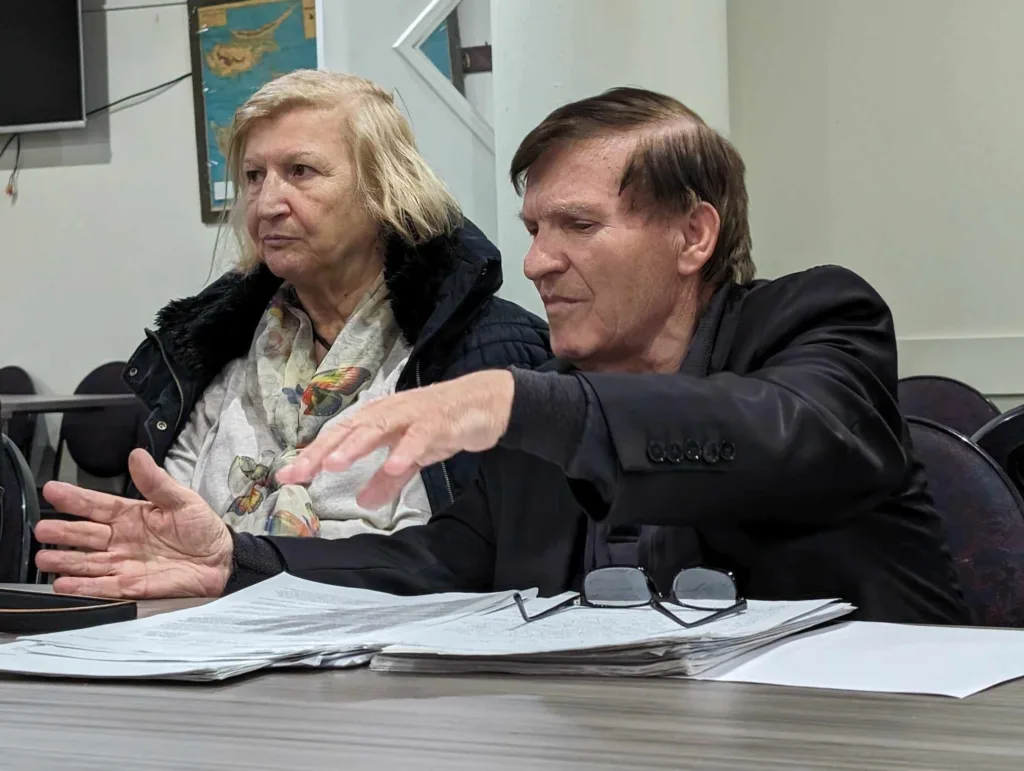
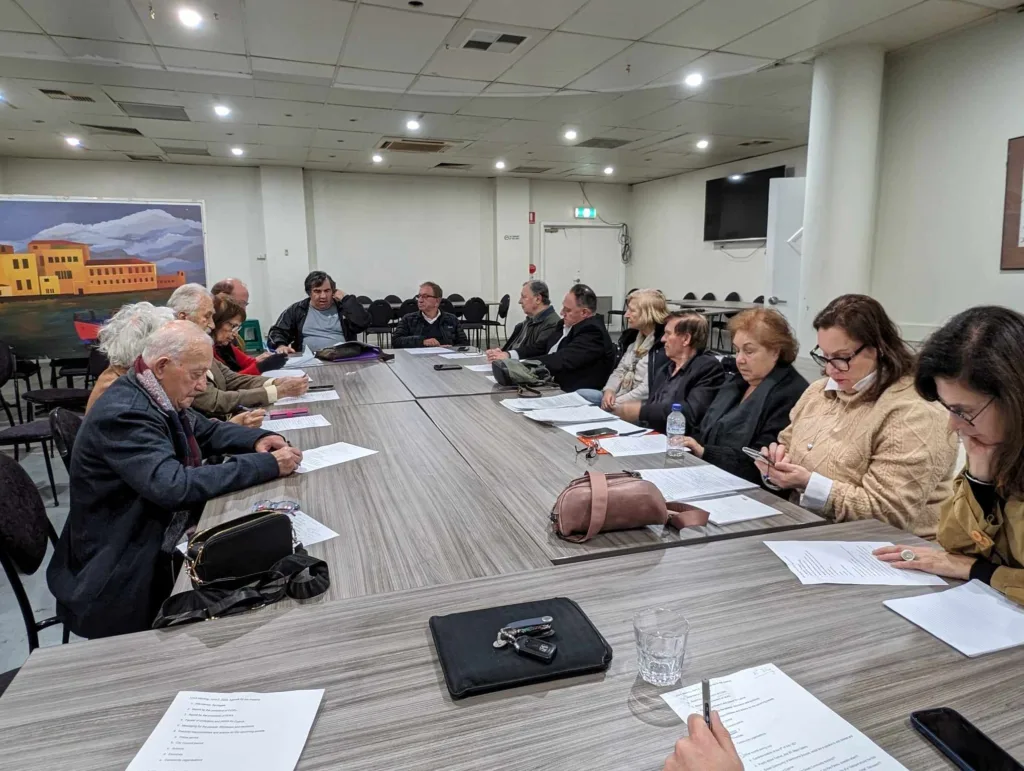
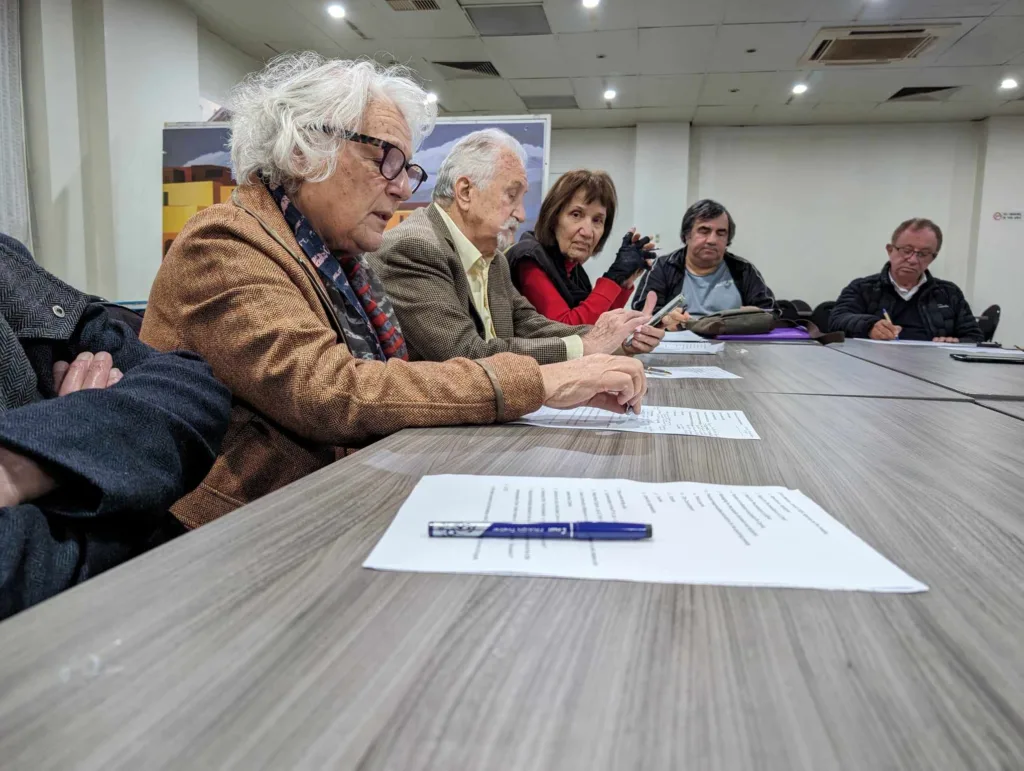
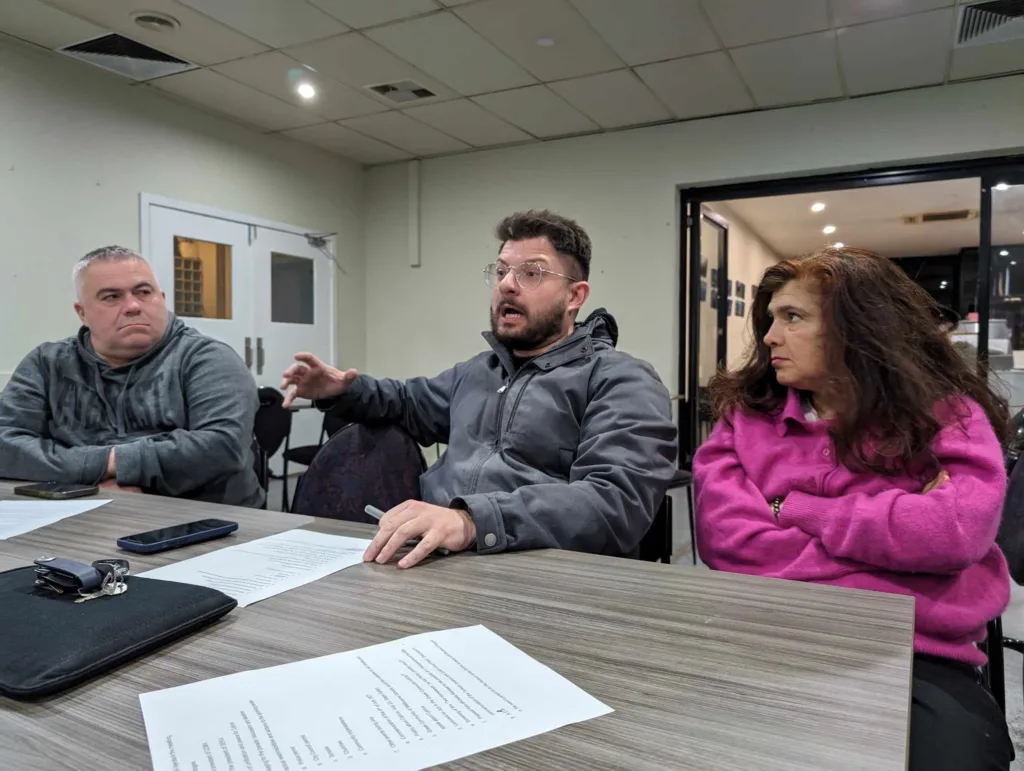
A group dedicated to Cypriot reunification held a meeting on Thursday, June 6, at the Cyprus Community of Melbourne and Victoria (CCMV). The Justice for Cyprus Coordinating Committee (SEKA Victoria) brought together around 16 members who continue to dream, advocate and wait for a unified Cyprus since Turkey’s invasion in 1974.
“I think the visit [of Tatar] was designed to create conflict, but we didn’t take the bait,” said CCMV President Theo Theophanous.
Prior to the visit, Prime Minister Anthony Albanese informed state and territory leaders that Tatar shouldn’t receive official recognition or meetings, as Australia doesn’t recognise the de-facto state.
“We attempted to warn as many people as possible regarding the potential dangers of this visit,” Theophanous explained.
Cypriot Community of Melbourne and Victoria President Theo Theophanous spoke of his recent visits abroad and updated everyone on upcoming events. All photos copyright The Greek Herald / Mary Sinanidis.
“This was an embarrassment,” Theophanous said. “The RSL was notified and removed the ribbon, but not before it was displayed for a period, creating a misleading impression on Tatar’s social media.”
Christos Violaris has spent many years drawing attention to the invasion and is frustrated by all the missed opportunities.
Plans for the 50th anniversary
With 40 days until the anniversary, there’s much to organise for events commemorating the Turkish invasion. The focus will not be on violent imagery or trauma, but on promoting the message of Cypriot unification and the Cypriot people’s resilience and desire for a lawful solution.
“Our primary goal is to advocate for a reunified Cyprus,” Theophanous said. “However, there’s a significant amount of work to be done in terms of promotion, media outreach, and preparing informational materials.”
Members looked at the events and messaging behind them.
Theophanous met with Cypriot Foreign Minister Constantinos Kombos to discuss the possibility of a video message. The Minister is also considering a visit to Australia in late September or early October.
“He expressed his appreciation for our efforts and urged us to continue,” Theophanous relayed.
GACL President Cathy Alexopoulos will hold a Cypriot Australian poetry evening.Kristian Raspa of St John’s College gave input on how to help younger people understand their identity and history.
The committee is presently working on logistics, security, and event costs. They welcome volunteers who can contact Anastasia Sarakinis on 0416 098 162 or at admin@cypruscommunity.com.au to assist with preparations. Everyone is encouraged to participate.
Additional events
A church service commemorating the July 9th, 1821 revolution, will be held at the Presentation of Our Lady to the Temple Church in Balwyn, attended by Archbishop Makarios on July 7th.
The Greek Australian Cultural League (GACL) is dedicating this year’s Antipodes Magazine to Cyprus and is organising a Greek-Cypriot poetry event at Steps Gallery in Carlton on July 20th, 1.30pm.
A screening of “Two Homelands” by director Kay Pavlou is also planned.