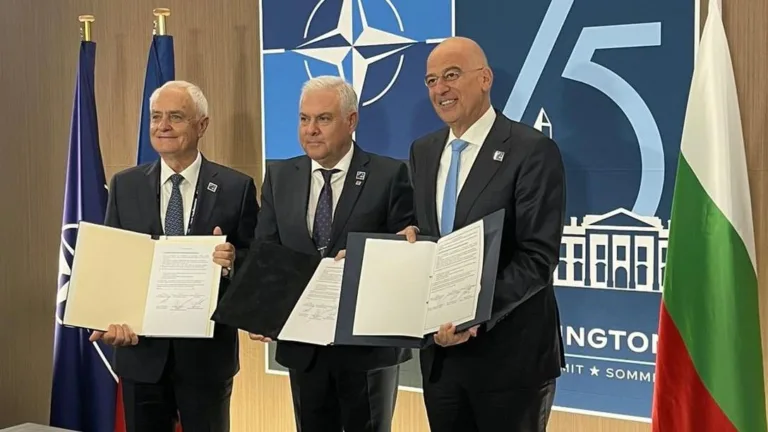
Greece, Romania and Bulgaria signed a deal on Thursday, July 11 to enable fast cross-border movement of troops and weapons to NATO’s eastern flank.
The deal comes after Russia’s 2022 invasion of Ukraine increased pressure on both NATO and the European Union to be better prepared to quickly send reinforcements in case of a sudden conflict with Moscow.
Today my Bulgarian and Romanian counterparts, Mr. Atanas Zaprianov and Mr. @AngelTilvar respectively, and I, signed a Letter of Intent (LoI) regarding the establishment of a Harmonized Military Mobility Corridor, in the margins of the #NATO Summit in Washington DC.
In a statement, Romania’s Defence Ministry said the military corridor with Greece and Bulgaria aims “to optimise transport corridors to respond to military mobility needs by creating road and rail supply lines between the participating states, reducing peace time bureaucracy and maximising efficiency in case of emergency situations.”
The three states could also connect their ports in the Aegean and Black seas.
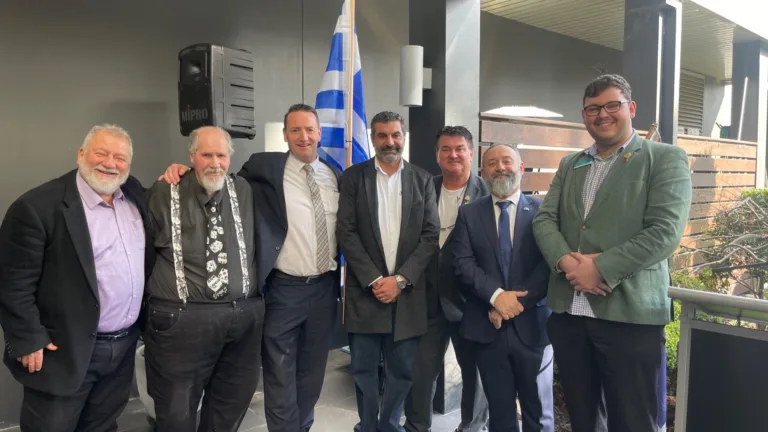
On Wednesday, July 10, the current committee, past members, and supporters of the Macarthur Greeks organisation in Sydney’s south-west gathered to celebrate a decade of community and cultural enrichment.
The event, organised by the Campbelltown Council, took place at the local arts centre and was marked by heartfelt speeches, the exchange of gifts, and recognition of the contributions made by the Greek community.
The formalities included a keynote speech by Macarthur Greeks founding President John Tsekas, who reflected on the journey and achievements of the organisation over the past 10 years. Current President Eric Kontos also addressed the attendees, highlighting the importance of unity and cultural preservation.
Macarthur Greeks Patron Pat Duffy spoke about the significant contributions Greeks have made to modern Australia, underscoring the lasting impact of the Greek community on the nation’s development.
The event was well-attended by notable figures, including the Mayor of Campbelltown, George Greiss, Council General Manager Lindy Deitz, deputy General Managers Jai Rowell and Ben Hoyle, and Councillors Riley Munro and Warren Morrison. Dr. Mike Freelander, the President of the Narellan Business Chamber, Anne Parnham, and other distinguished guests were also present to show their support.
One of the highlights of the event was the presentation of a community service award to Mr Tsekas, recognising his dedication and efforts in founding and nurturing Macarthur Greeks. In a symbolic gesture, Mr Tsekas presented a book gift to Lambros Papadopoulos, symbolising the exchange of knowledge and culture that has been a cornerstone of the organisation.
The celebration was a testament to the strength and resilience of the Macarthur Greeks community, showcasing the vibrant culture and unity that has flourished over the past decade. The event concluded with a renewed commitment to continue fostering cultural heritage and community spirit for years to come.
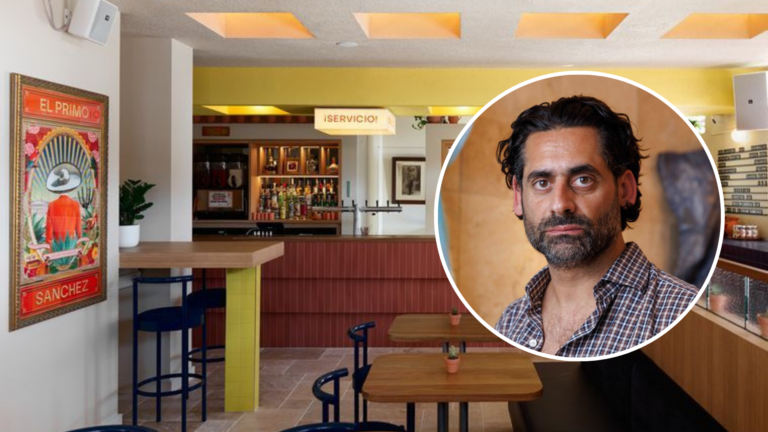
Australia Pacific Mortgage Fund, a lender to embattled publican Jon Adgemis, has put one of his Public Hospitality Group’s flagship venues up for sale – the home of the El Primo Sanchez bar in Sydney’s eastern suburbs.
El Primo Sanchez is a Mexican cocktail bar that PHG has been running jointly with the group behind Maybe Sammy and is located in Paddington’s historic Rose, Shamrock and Thistle Hotel.
According to The Australian Financial Review, Andrew Jolliffe and Dan Dragicevich’s HTL Property listed the pub for sale on Wednesday, with expressions of interest closing on August 7.
Other properties of Mr Adgemis’ have also been seized by lenders. In Sydney’s Potts Point, Bank of Queensland has taken charge of one of his properties in Ward Avenue.
Jon Adgemis owns Public Hospitality Group. Photo: Development Ready.
This news comes after Adgemis struck a $400 million refinancing deal in May 2024 with Deutsche Bank, Gemi Investments, Archibald Capital and Muzinich & Co, to save his PHG from collapse.
ABC News anchor George Stephanopoulos, also a former Democratic advisor who interviewed Joe Biden after a recent presidential debate, revealed his true thoughts on the US President in a leaked video that went public on July 7.
According to The Guardian, the video was published by TMZ and featured a ‘passer-by’ questioning Stephanopoulos on the street: “Do you think Biden should step down? You’ve talked to him more than anybody else has lately.”
“I don’t think he can serve four more years,” Stephanopoulos replied in the video.
Later Stephanopoulos issued a statement of regret, declaring “[he] shouldn’t have [responded].”
This statement comes amidst a heated debate regarding whether steadfast Biden is fit to be running in this year’s Presidential election, let alone serve another four years.
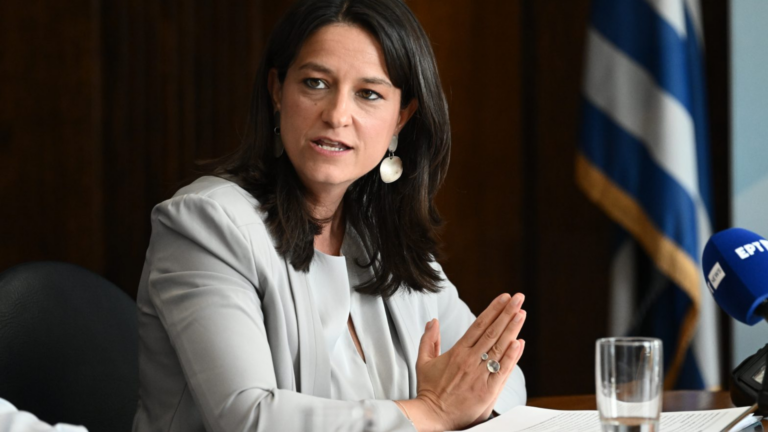
With the introduction of a new six-day work week in Greece, Labour and Social Security Minister Niki Kerameus reassured citizens amid confusion regarding the new arrangement.
According to HCA Mag, Kerameus stressed that pre-existing work laws have not altered. Rather, this 6-day work policy offers the option to extend one’s work week under certain conditions.
“It is important to note that this new regulation does not in any way affect the established five-day/40-hour working week mandated by Greek law, nor does it establish a new six-day working week,” the minister told CNBC.
✅ Υπάρχουν θεωρώ οι κατάλληλες συνθήκες για να δημιουργήσουμε ένα νέο κοινωνικό σύμφωνο εργασίας, να βρούμε σημεία σύγκλισης κράτος-εργαζόμενοι-εργοδότες.
✅ Η Ψηφιακή Κάρτα Εργασίας ήταν αίτημα των εργαζομένων το οποίο αυτή τη στιγμή εφαρμόζεται σε περίπου 750.000… pic.twitter.com/h1FqQK8x4R
“All it does is provide only in limited circumstances for the option of an additional working day, as an exceptional measure.”
These ‘limited circumstances’ demand a business operates 24 hours a day, seven days a week with rotating shifts, or 24 hours a day for five or six days of the week, also under rotating shifts.
The option has emerged in Greece in an attempt to counter unjust working measures and ensure payment for overtime.
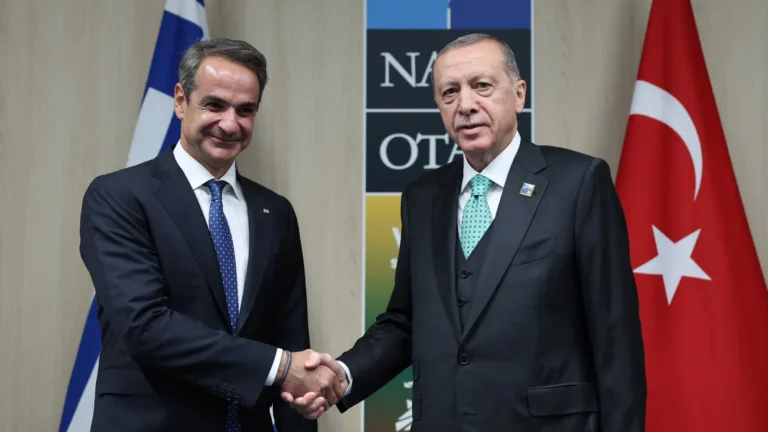
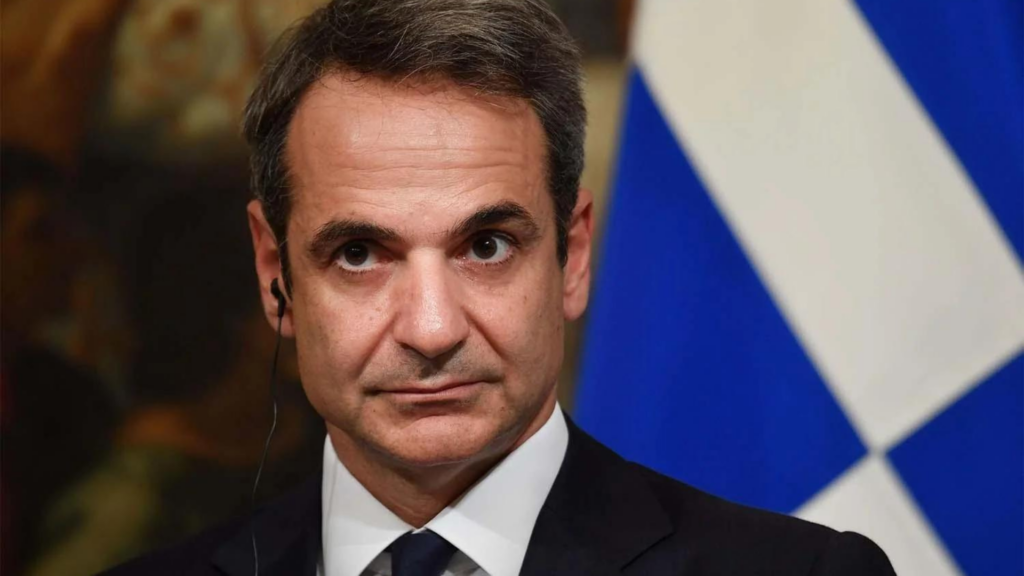
Greek Prime Minister Kyriakos Mitsotakis met with Turkish President Recep Tayyip Erdogan on Wednesday during the NATO Summit in Washington.
Government sources reported that the leaders discussed various international and regional issues, focusing on recent developments in the Middle East and Ukraine.
They also reviewed their bilateral relations following their latest meeting in Ankara in May. Mitsotakis expressed satisfaction with the collaboration between Greek and Turkish authorities in combating illegal migration.
Greek Prime Minister Kyriakos Mitsotakis (above) met with Turkish President Recep Tayyip Erdogan on Wednesday during the NATO Summit in Washington.
Both leaders agreed on the mutual benefits of maintaining a calm climate in their bilateral relations. They also committed to enhancing cooperation to double the value of their bilateral trade exchanges.
Additionally, Mitsotakis addressed the Cyprus issue, emphasising that 50 years after the 1974 conflict, it is unacceptable for Cyprus, an EU member state, to remain divided. He reiterated the need to restart talks to resolve the situation.
The final matchup is set for UEFA Euro 2024 on Sunday, July 14 at Berlin’s historic Olympiastadion as England will face Spain.
This is just the second time that England has reached the final of the Euro. The other time came at the previous tournament in 2021, when England lost a heartbreaker in the final at home at Wembley Stadium to Italy in a penalty shootout. England will be attempting to win its first major international tournament since the 1966 World Cup.
Spain’s players celebrate their win over France in the UEFA Euro 2024 semifinals.
Spain will attempt to win a record fourth European Championship, with a win Sunday breaking a tie with Germany for the most titles in tournament history. Spain previously won the Euros in 1964, and again in back-to-back tournaments in 2008 and 2012 (which sandwiched a win at the 2010 World Cup for one of the all-time great championship runs in international soccer history). In addition to its three Euro titles, Spain has one runner-up finish, in 1984 when it lost to France in the final.
The UEFA Euro 2024 final will be able to be watched on Monday, July 15 in Australia at 5am.
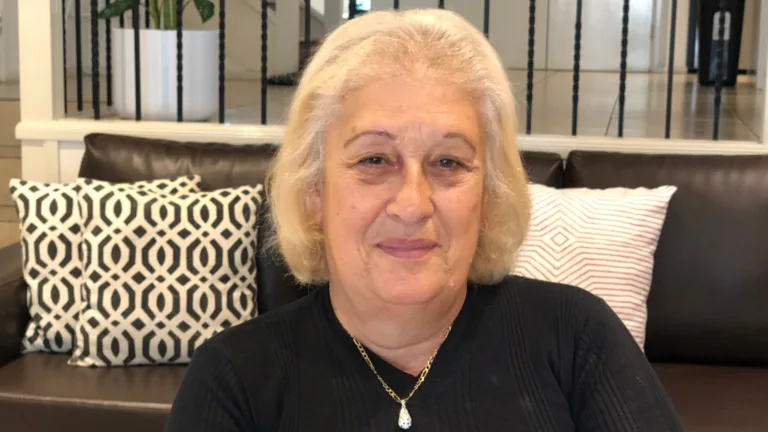
Greek Cypriot refugee Stella Papavasilliou was pregnant when Turkey invaded Cyprus in 1974. As the 50th anniversary of that occupation approaches on July 20 this year, she will never forget her beloved Cyprus.
Stella was born in 1954 in Kythrea, 10 kilometres north of Nicosia, the capital of Cyprus.
“We were poor but we had a good life. We were a loving family and my village was a beautiful – full of fruit trees and a natural spring,” she said.
When the Turkish army invaded her village in 1974, her fiancé immediately enlisted.
“It was a Saturday, they invited the reserve soldiers and my fiancé, Iacovos, volunteered.
On the first day, he was injured. By the time they took him to hospital, he lost of lot of blood and we lost him. I was five months pregnant. In one week, I was to marry, I had my house, the baby was on the way. My world was upside down,” Stella explained.
Iacovos.
“They came and removed us – we had no money, no clothes. I had my nightie when I left, carrying a coat. The Red Cross took me and my mother to a Turkish hospital. They told me I had to leave because if my child is a boy, they would take him for their army. But I was lucky, some people helped me to escape. After a month I gave birth to my son.”
After Stella safely gave birth to her son, she faced the challenges of survival as a single mother in a war zone.
“We couldn’t go back to our houses. How can you live as a refugee with a small child?” she asked rhetorically.
Stella as a bride.The wedding.
Three years later, she was offered an unexpected opportunity to start a new life.
“When I was 25, Vasos, a man from my village living in Australia, was approached by some of my relatives and he offered to bring me to Australia,” she explained.
When Stella was not granted a visa, Vasos travelled to Cyprus where they were soon married.
“We came here and created our family. I brought my son and we had a daughter together. Vasos was very good with the kids. Doesn’t matter that Iacovos wasn’t his son, he brought him up as if he was his own. Unfortunately, Vasos got sick and we lost him three years ago,” she said.
Jack as a baby.
“I gave my son the name of his father, Iacovos Theothorou. Even though we lost him, his name would remain.”
Iacovos uses the English version of his name, Jack.
“My mum was pregnant with me when the invasion occurred. I didn’t really know until I was 15-16 that my father got shot in Cyprus. I was under the impression that my mum’s second husband was my biological father. It was shock. But I take a lot of sense of pride out of that. I had a father who was prepared to defend his country and his family,” Jack jumped in.
Jack and his sister.
“I love Cyprus. There’s a lot of trauma there. Even though they have lost everything, lost family members, they are still they able to show love towards people. They are just so resilient.”
“For me, I have Turkish Cypriot friends. They had nothing to do with what happened, so I don’t hold any grievances or ill will against anyone. For mum, it’s different because she went through a lot over there.
“For me, Cyprus is beautiful but very far away. I remember when we had a good life. It was in our dreams, and they are still our dreams. As long as I breathe, I will be waiting. To see a solution before we close our eyes. I don’t forget Cyprus. But I live here, this is my home now. That’s how it is.”
* Stella Papavasilliou’sstory features in Kay Pavlou’s new one-hour documentary Two Homelands. In the documentary, six elderly Greek Cypriots reflect on their war-torn homeland and life in Australia. Find out where you can view the documentary here.
Two Homelands showcases the journey of six elderly Greek Cypriots who reflect on their war-torn homeland and life in Australia.
The Cypriot director of ‘Two Homelands,’ Kay Pavlou. Photo: Supplied.
“I interviewed six Greek Cypriot elders aged 70 to 102. Three of them came here after WWII in the ‘50s and three came in the ‘70s as refugees from the Turkish war,” Pavlou said in a previous interview with The Greek Herald.
“These migrants are torn between where they came from, and the place they’ve migrated to. I’m hoping people will be able to come and watch the documentary and see that their story still matters, and it hasn’t been forgotten.”
Notably, Pavlou has previously produced Cyprus: A People Divided in 1990 and Ghost Town in 2022.
The screening dates for her new documentary Two Homelands are:
July 14 at the Cyprus Community of South Australia from 3pm
July 20 at the Cyprus Community Club of NSW from 7pm
August 4 at the Hellenic Club of Canberra from 3pm
August 24 at the Mercury Cinema in Adelaide, South Australia from 7pm
September 17, 18 and 19 in Cyprus at the K Cineplex in Nicosia, Larnaca, Limassol and Paphos
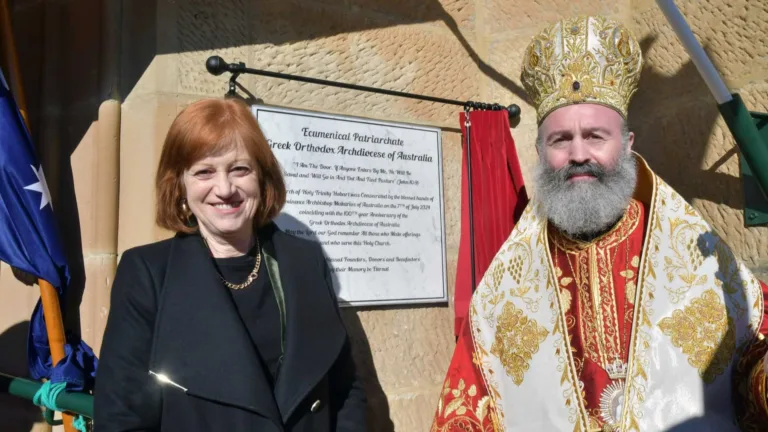
Special mentions were also made of the pioneers at the Hobart parish and those who worked overtime for its development and progress.
“We turn our thoughts with deep gratitude to all those who contributed to the founding of this Parish, many of whom are no longer with us, but participate in this sacred mystery, which transcends the dimensions of time and space,” Archbishop Makarios said.
After the ceremony, Archbishop Makarios also announced parish priest Father Irinaios Koikas would be leaving his ministry and succeeded by Father Andreas Ioannou.
The church was filled with parishioners and a number of official guests, including the Governor of Tasmania, Barbara Baker, the State Minister Madeleine Ogilvie, representing the Premier of Tasmania, the State Minister and Speaker of Parliament, Eric Abetz, and the Honorary Consul of Greece in Tasmania, Ekaterina Skalidis.
The Archbishop was visiting Tasmania from July 6 to July 8, accompanied by Bishops Kyriakos of Sozopolis and Bartholomew of Charioupolis.
During his visit, the Archbishop also attended an event marking the 100th anniversary of the establishment of the GOAA, held in the presence of representatives of the state.