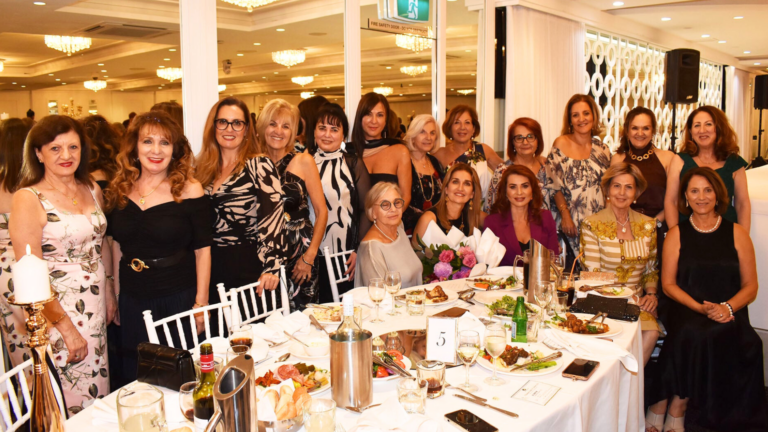
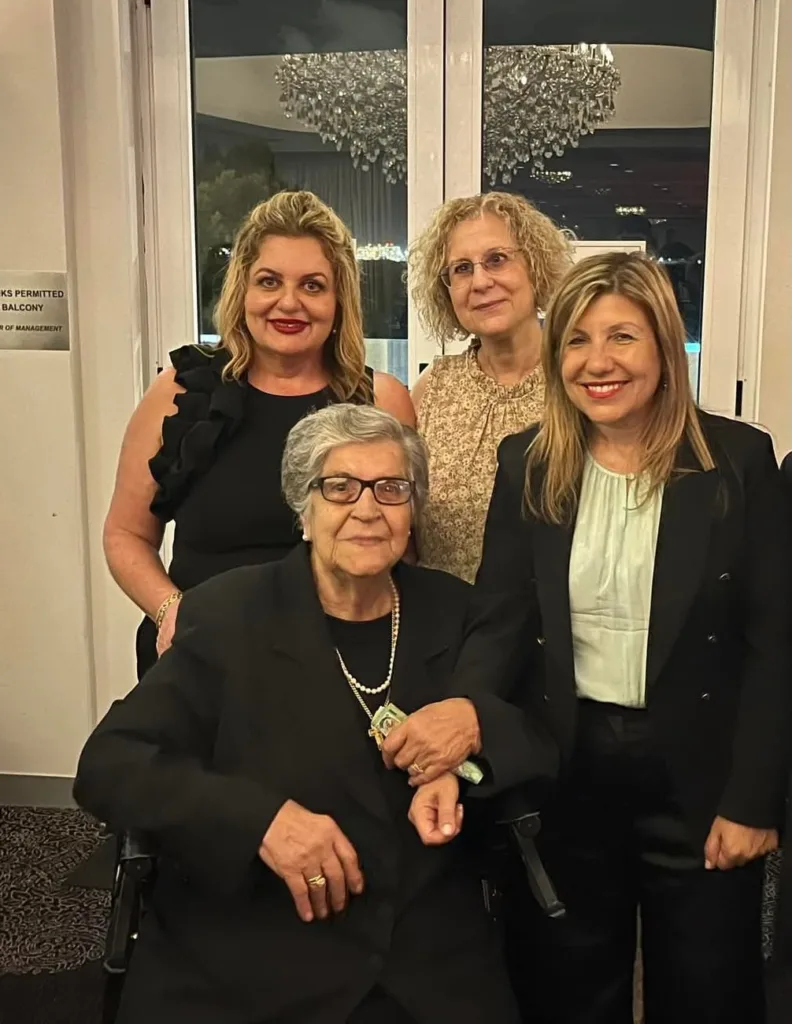
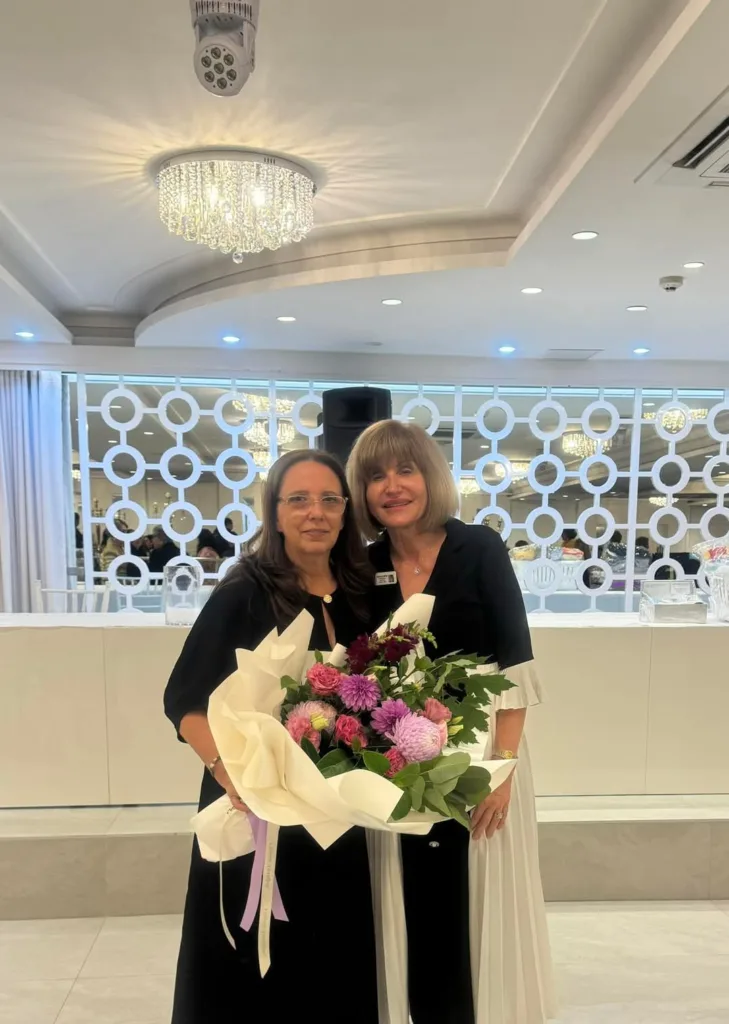
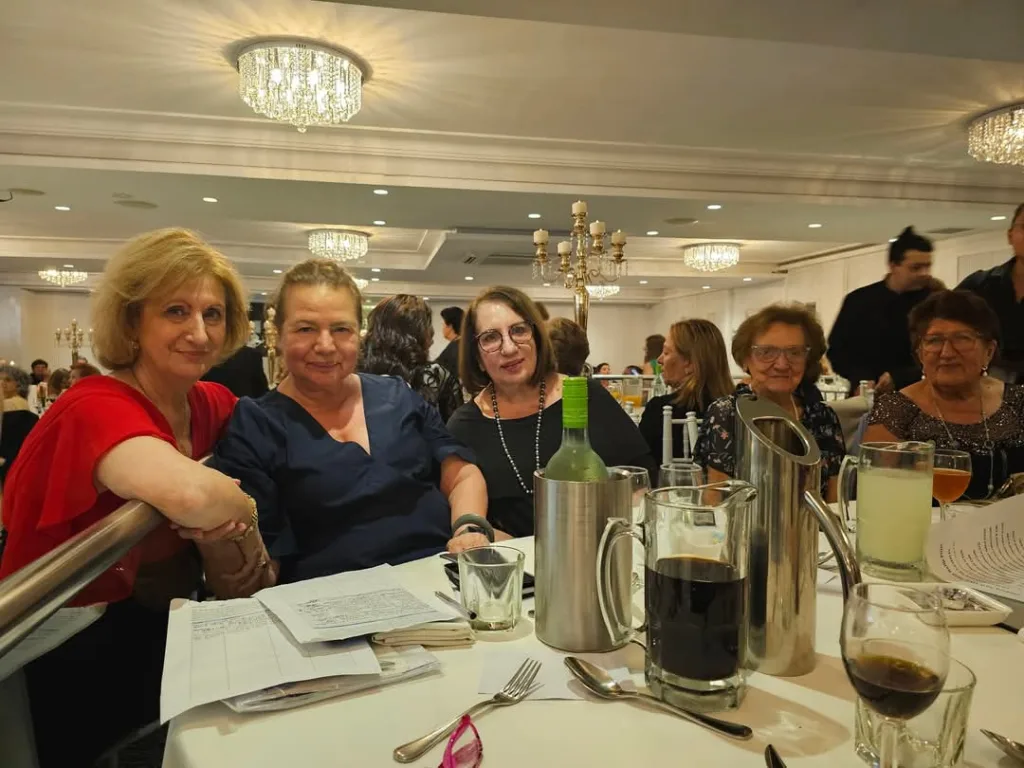
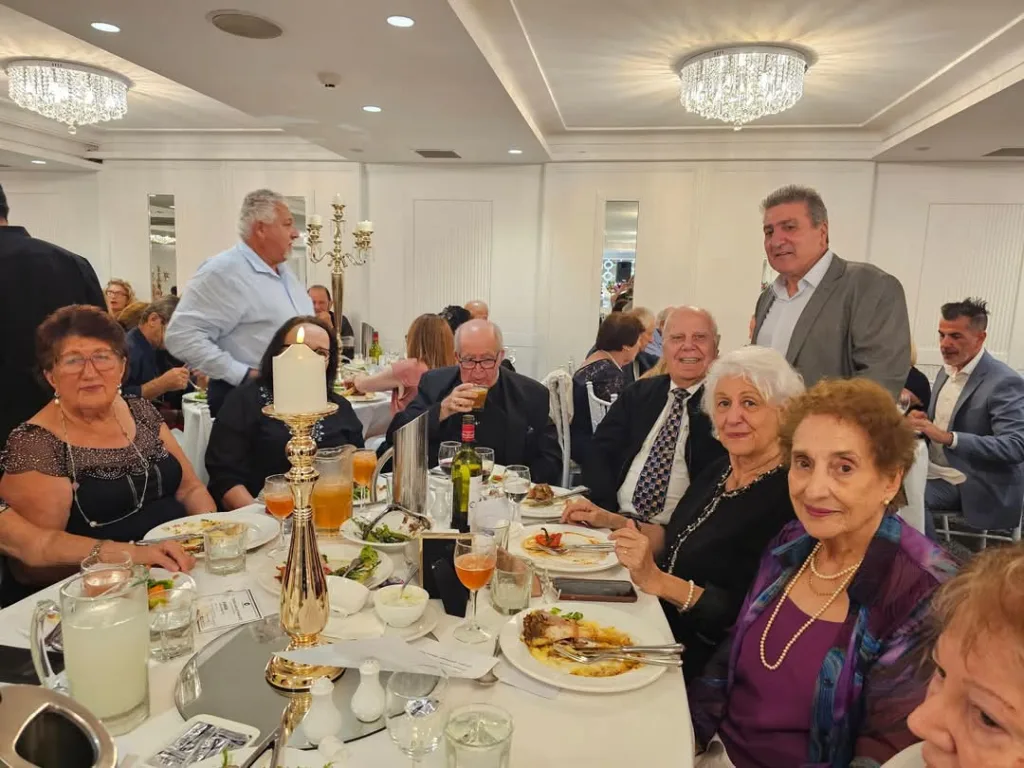
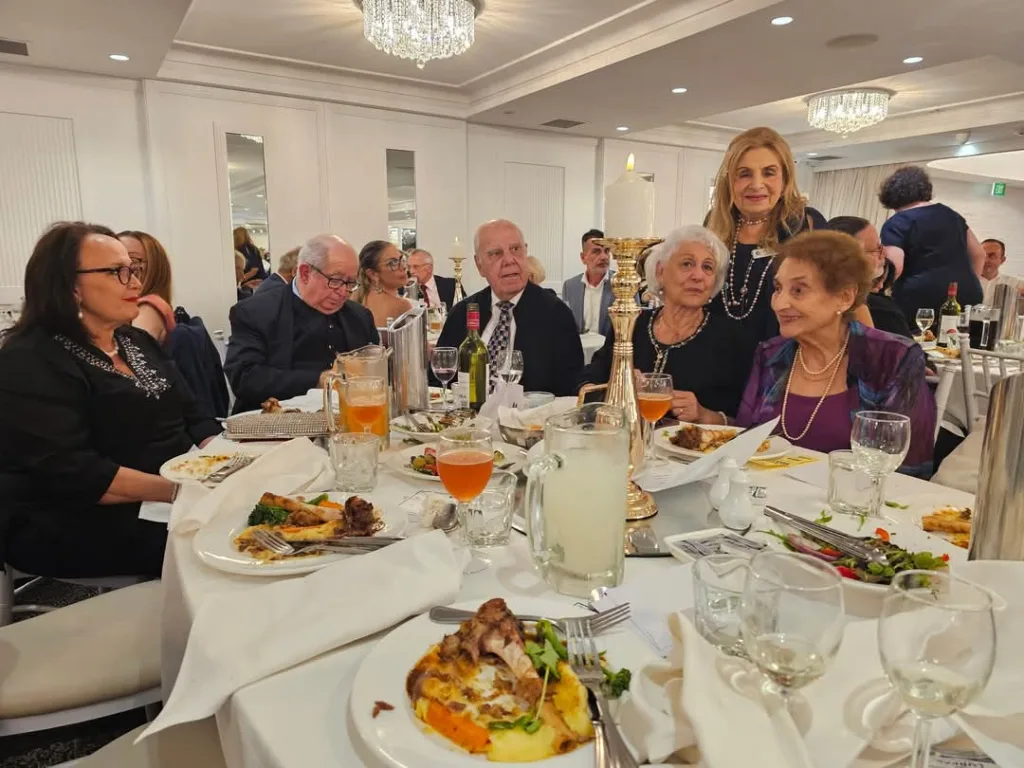
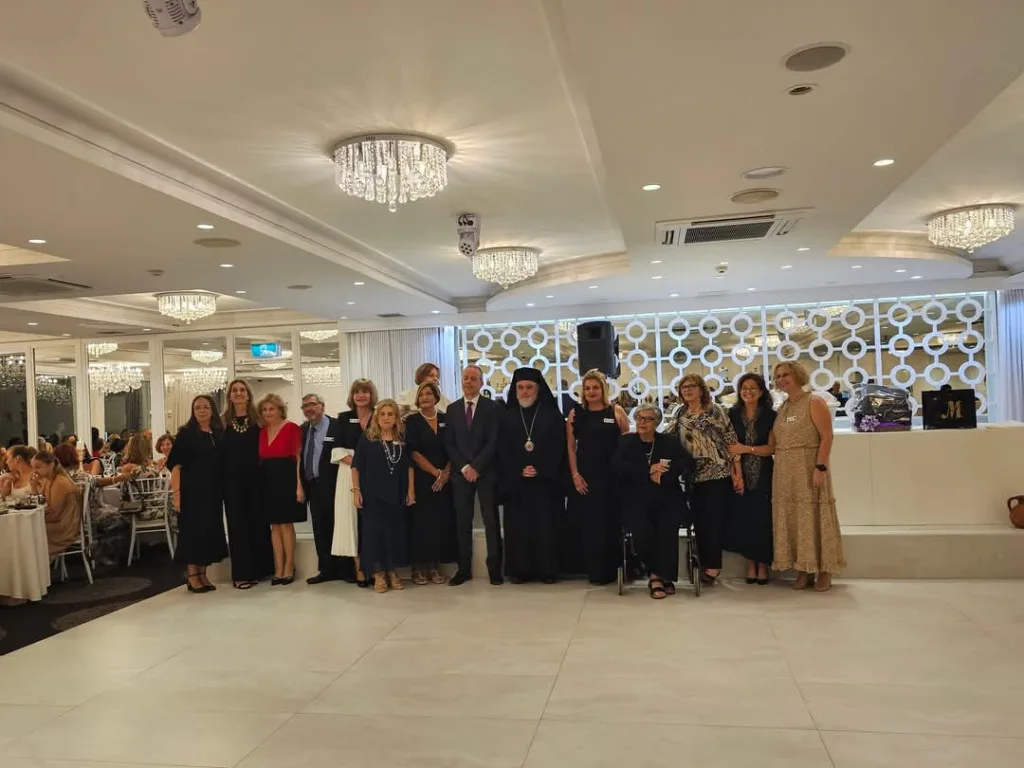
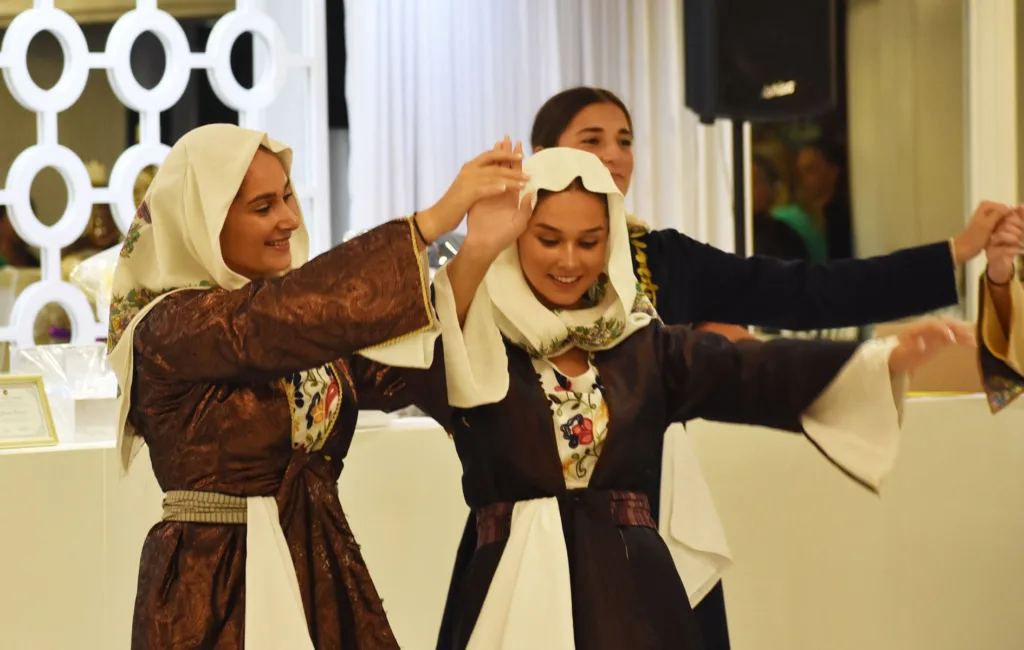
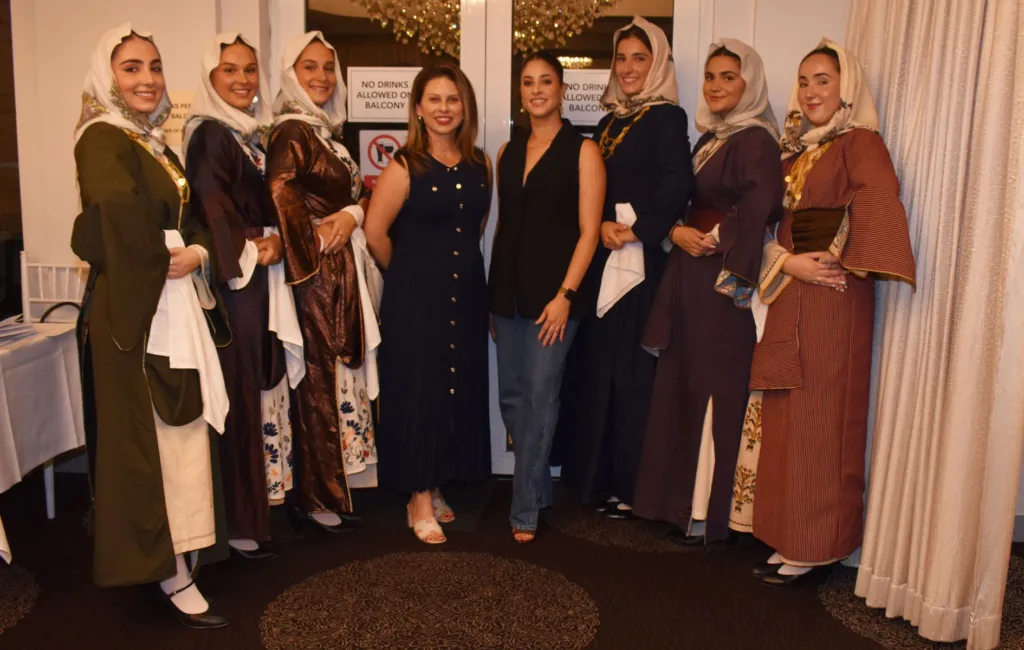
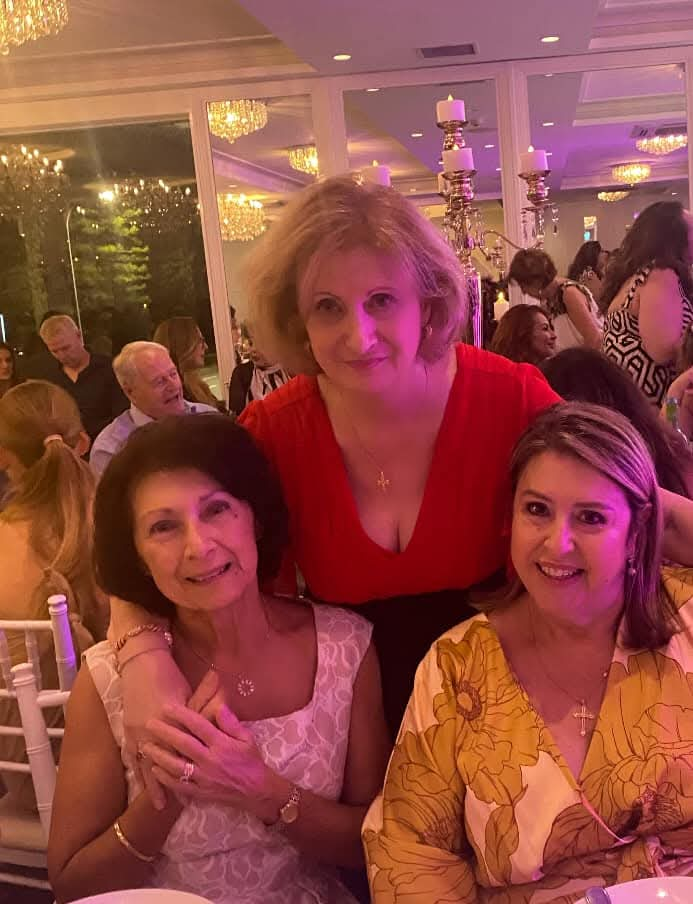
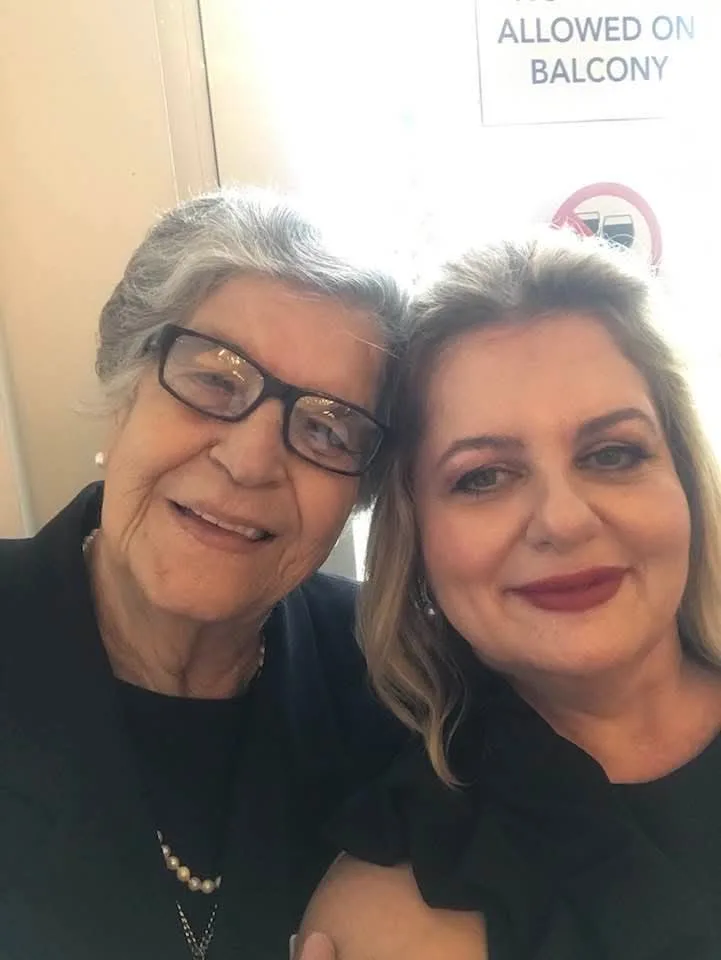
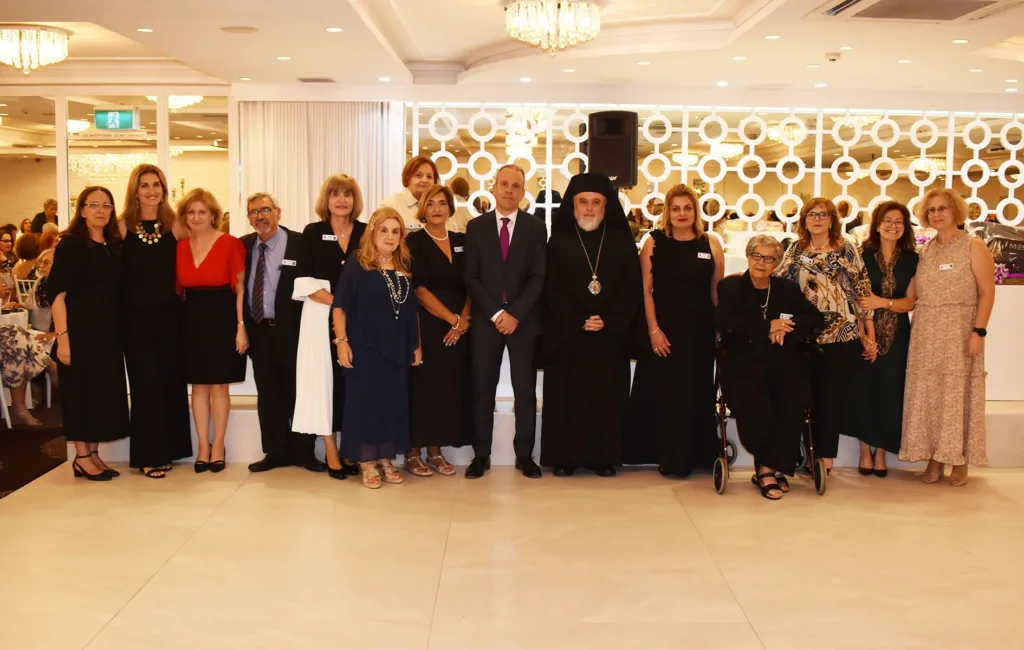
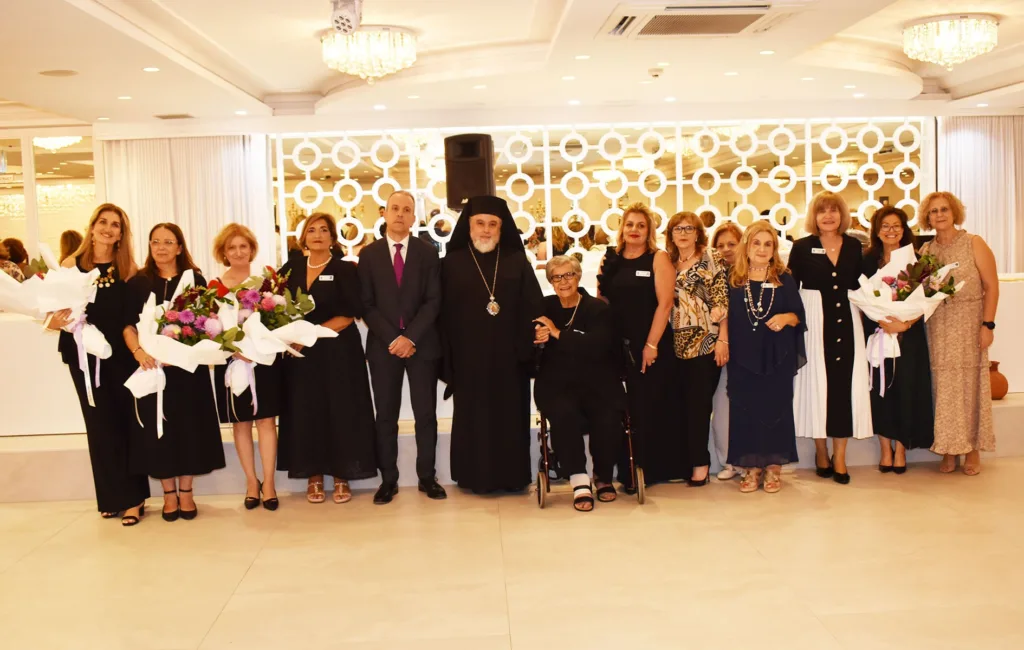
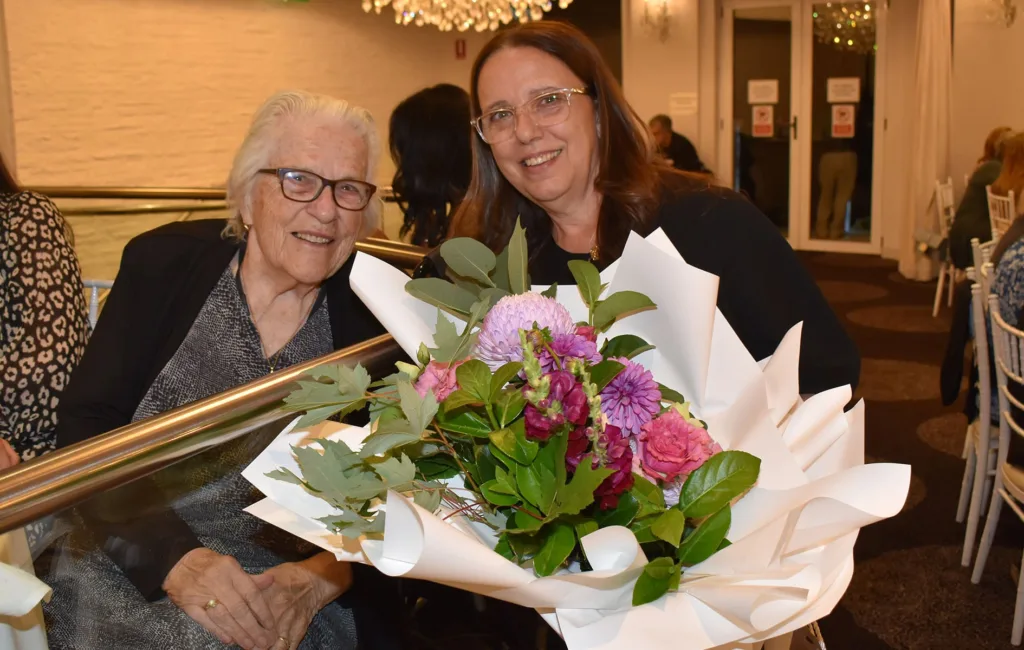
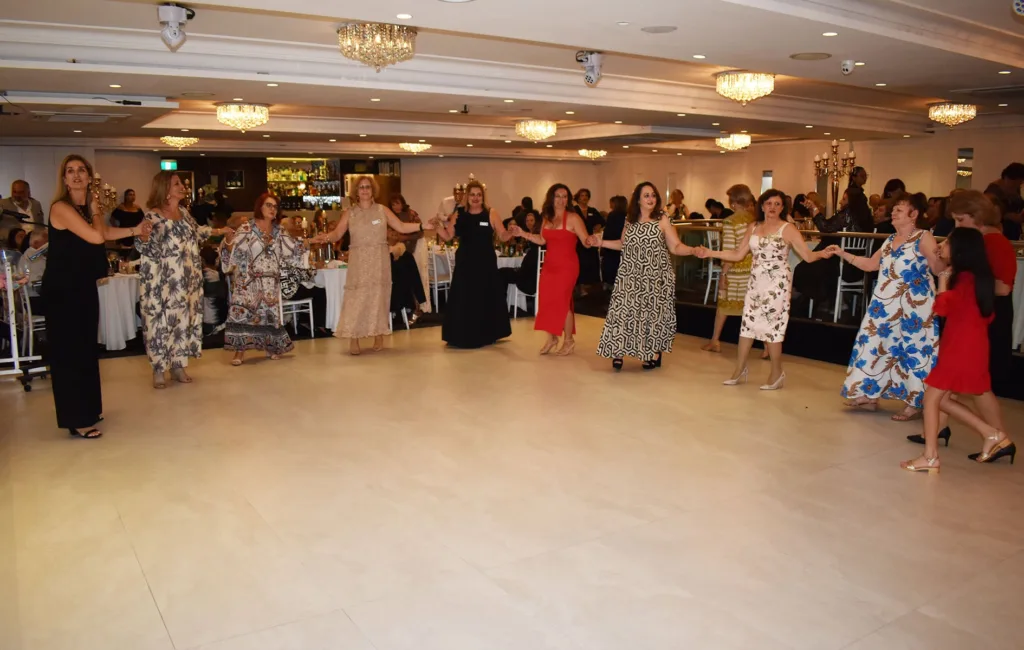
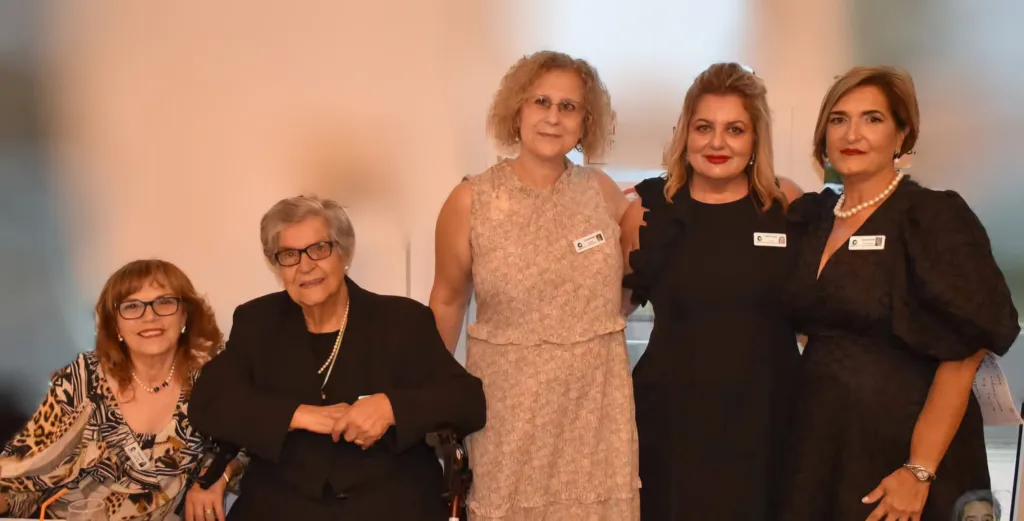
The crowd participated in a sit-down meal as the Organisation’s president, Christine Manolakos, made a speech, setting the tone for the evening.
“The contribution of women is great, we should recognise their strength and their many roles… as mothers, wives and professionals. Not only on March 8, but every day of the year,” Ms Manolakos said.
“We honour the female personality that proves to us that leadership characteristics are not a male privilege… A shining example is the current Greek mother, for the vindication of the 57 souls in Tempi, Maria Karistinou, who stirred up all of Greece on February 28.”
The event also celebrated outstanding individuals who have made significant contributions in various professional fields, with a series of prestigious awards recognising their dedication.
The first award was presented to philanthropist Theodora Giakoumidis in recognition of her remarkable efforts and dedication to charitable causes. Alongside her philanthropic work, Giakoumidis has had a highly successful career in banking and finance, which has earned her widespread respect and admiration.
The next award went to artist and Hellenic Lyceum of Sydney member, Maritsa Micos Dragonas, in honour of her diverse career and multifaceted talents in promoting cultural and artistic expression.
Maritsa’s exceptional commitment to charitable causes, combined with her family’s legacy of philanthropy, has left a lasting impact across generations.
Another award was given to Effy Alexakis, a documentary researcher and photographer, for her invaluable contribution to the cultural aspects of the Greek community.
Alexakis was praised for her works, dedication, and enthusiasm in documenting the community’s rich history through photography and research.
The final award was presented to Dr Yvonne Belessis, a distinguished physician in paediatric medicine, in recognition of her extensive research and achievements in the field.
Dr Belessis was recognised for her contributions to Australian Paediatrics and is a member of the international Oesophageal Atresia Steering Committee. She has also co-authored the International Respiratory Care for Children.
Manolakos concluded the night with a warm expression of gratitude for the committee’s support. Namely Vice President Despina Kekatos, Treasurer Chrisanthi Petridis, Public Officer Christina Calligas, Secretary Evi Georgakakos, Public Relations Officer Dimitra Skalkos, Committee members Litsa Diakovasilis and Cathy Valis, and Acting Honorary Manager George Giakoumidis.
A champion for culturally diverse arts, a passionate advocate for women in refugee communities and a multicultural sports innovator are some of the people recognised at the Premier’s Harmony Dinner last night.
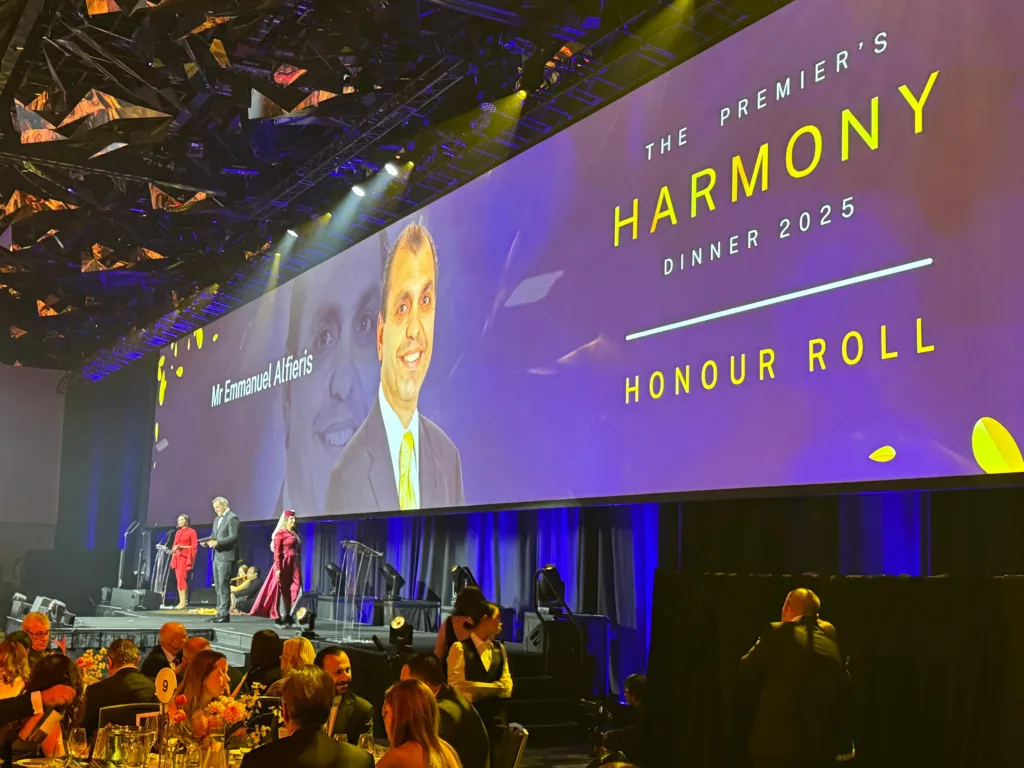
Hosted by the NSW Minister for Multiculturalism Steve Kamper, the dinner was attended by more than 1,600 community members. As part of the event, Mr Kamper announced the winners of the 2025 Multicultural Community Medals and inductees into the NSW Multicultural Honour Roll.
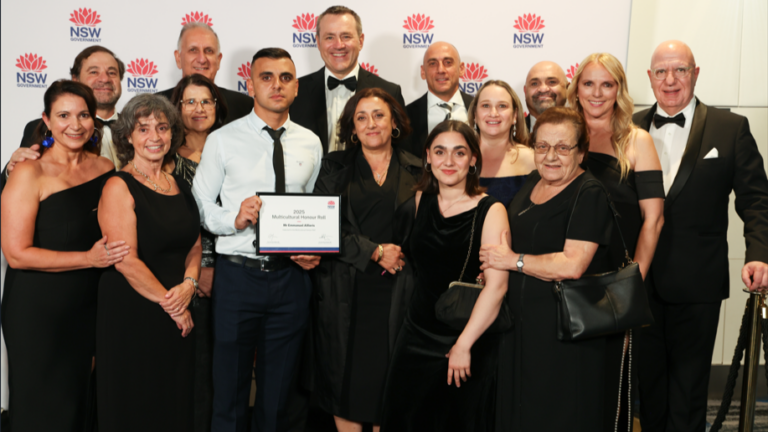
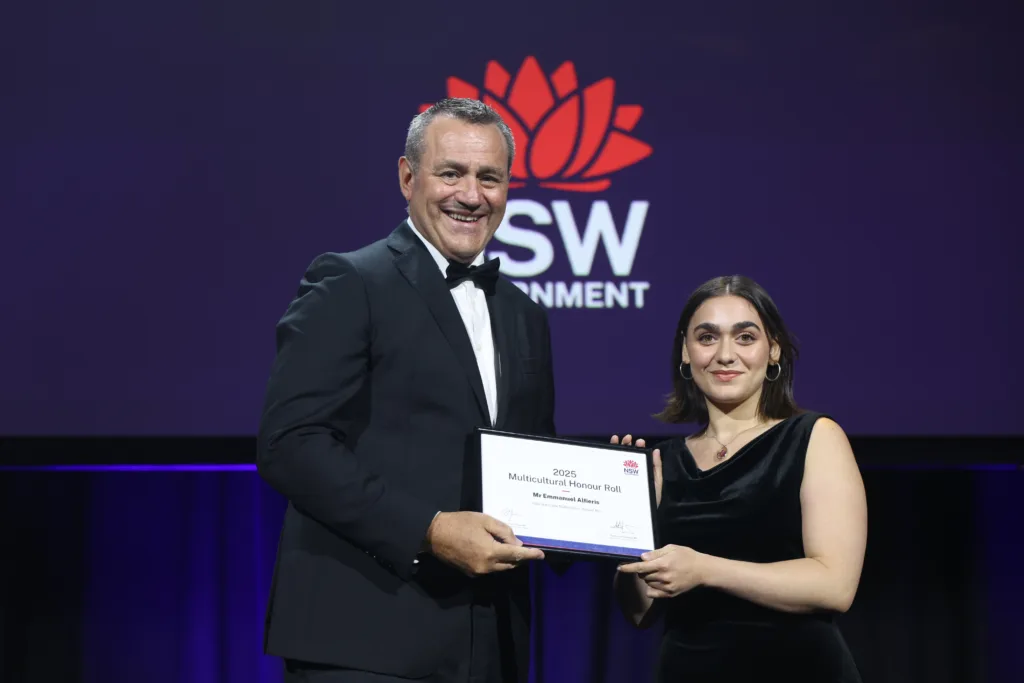
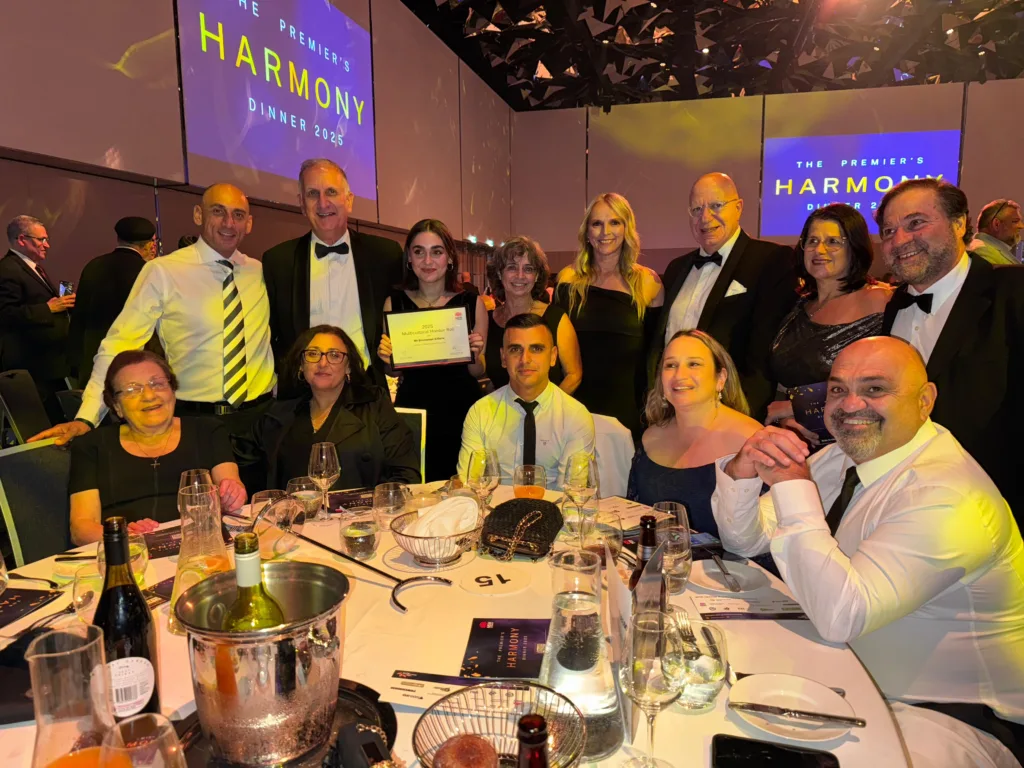
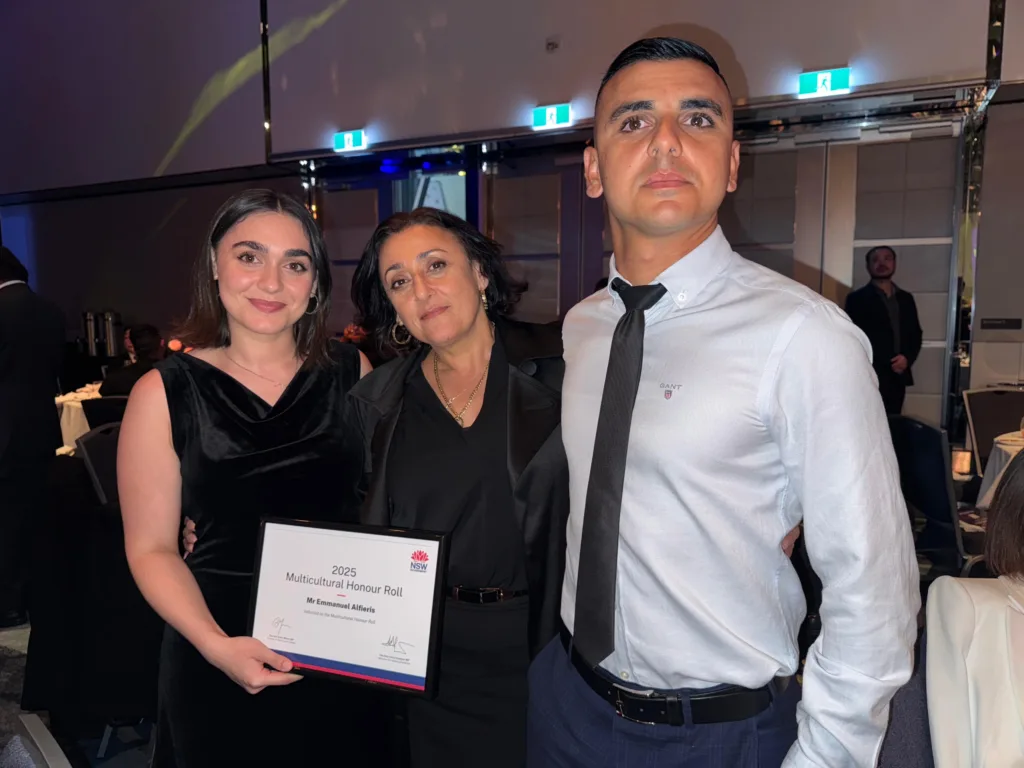
Emmanuel Alfieris’ daughter collected the award on his behalf. Photo: Salty Dingo 2025
Five people were posthumously inducted into the Multicultural Honour Roll, for their lasting impact on fostering an inclusive, resilient and peaceful society. Among them were two Australians of Greek heritage who passed away in 2024:
Emmanuel Alfieris: Past President of the Kytherian Association of Australia, and
Jack Passaris OAM: Founding and Life Member of the Ethnic Communities’ Council of NSW (ECCNSW).
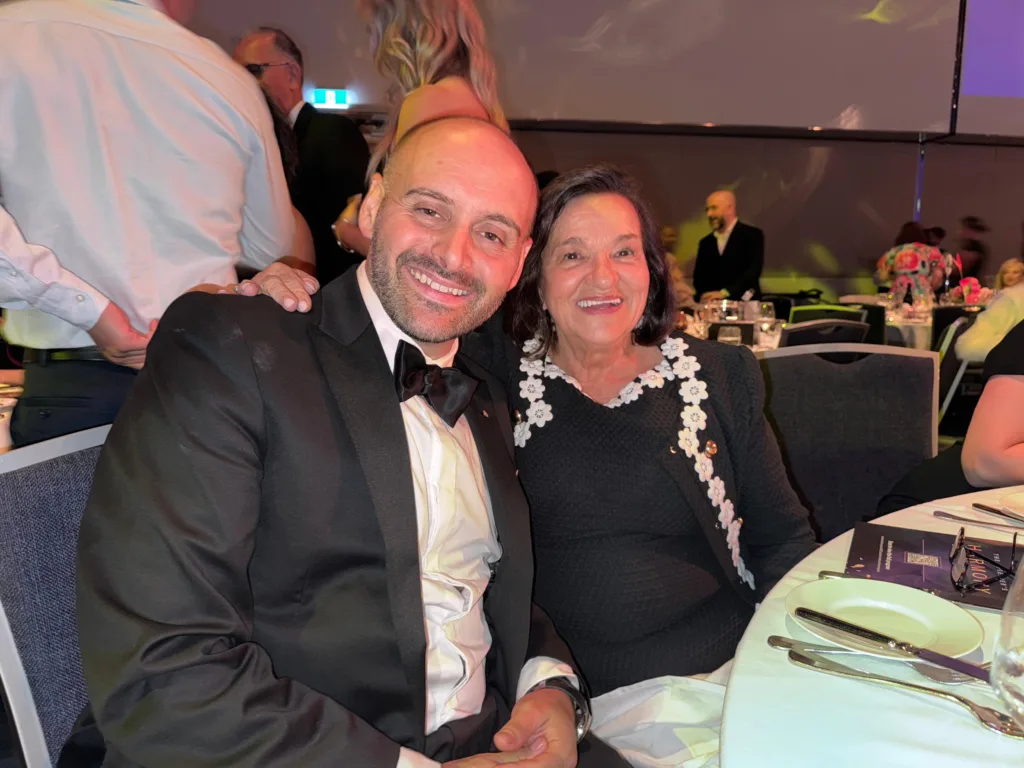
Jack’s wife Irene Passaris (right) with Peter Doukas.
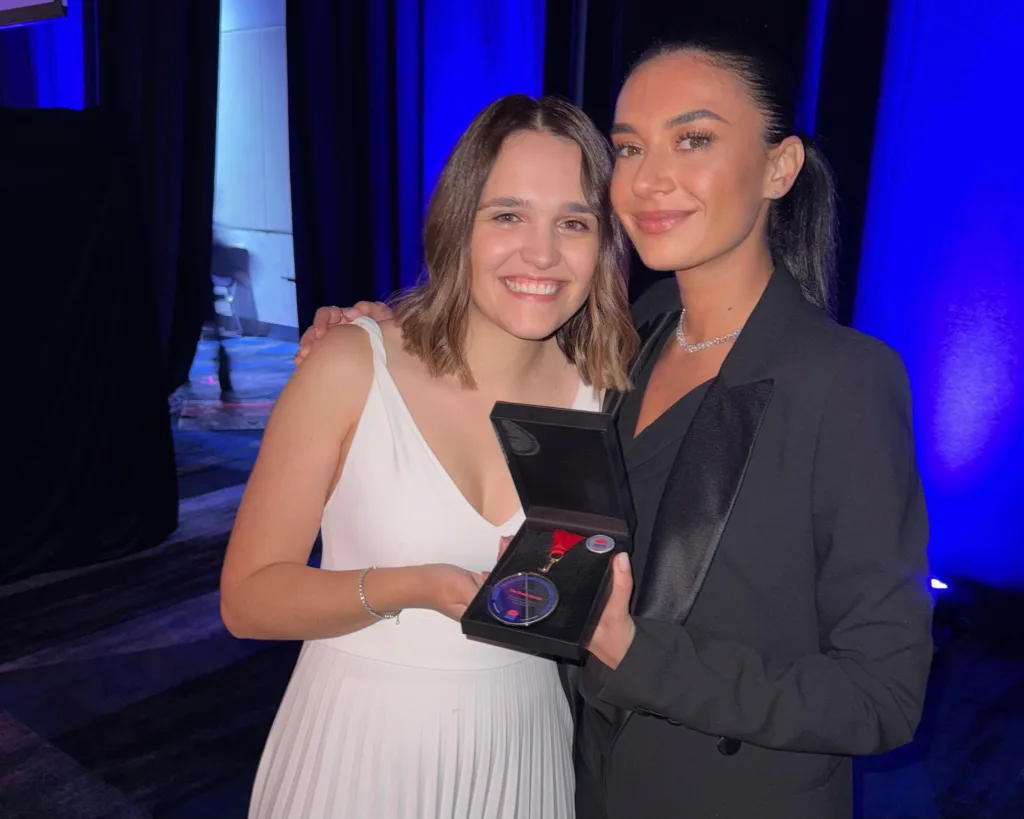
Meanwhile, the Multicultural Community Medals recognised 13 individuals and organisations for their role in strengthening NSW’s diverse and inclusive society. Amongst the winners were:
The Greek Herald, who won Multicultural Publication of the Year sponsored by Village Place
Sandra Morales, who founded Heartdancers, an organisation solely focused on artists from First Nations and culturally diverse backgrounds in the Central Coast and Hunter areas
Dr. Astrid Perry-Indermaur OAM who has dedicated over 40 years of her career and life to advancing human rights and social justice for women and children from migrant and refugee backgrounds
Syed Sibtain, founder of Sydney Cricket League, a competition with over 1,000 players from diverse backgrounds, and a community touchpoint for newly arrived migrants to NSW.
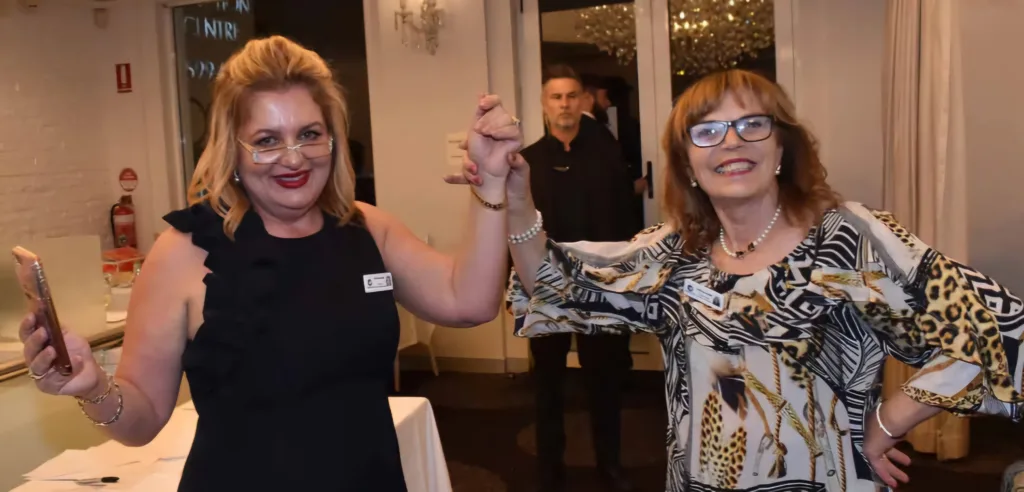
Digital Editor at The Greek Herald, Andriana Simos (left) and Publisher Dimitra Skalkos were present at the Premier’s Harmony Dinner to accept the award.
Minister Kamper said, “The Premier’s Harmony Dinner is an opportunity to say thanks to the people and organisations who give their time and energy to make NSW more inclusive and connected.”
“This is one of the largest multicultural celebrations in the state, bringing together people from different cultures to celebrate, find common ground and maintain a strong foundation for social cohesion in NSW,” Minister Kamper added.
Multicultural NSW Chief Executive Officer Joseph La Posta said, “The individuals and organisations we celebrate tonight are the heart and soul of multiculturalism in NSW.”
“Their unwavering commitment to diversity and inclusion makes our state stronger, more vibrant, and more connected than ever before,” Mr La Posta added.
“In addition to celebrating the stellar contributions of these worthy winners, this event is a reminder of the rich contribution of migrants to the everyday lives of everyone in our great state.”
2025 Multicultural Community Medal winners
Medal
Winner
Bio
Arts and Culture Medal in honour of Carla Zampatti AC sponsored by Powerhouse
Sandra Morales
Sandra founded Heartdancers – the only organisation in the Central Coast, Hunter and Newcastle areas that solely focuses on collaborating with artists from First Nations and culturally diverse backgrounds.
Dr G.K. Harinath OAM Sports Medal sponsored by Sydney Thunder
Syed Sibtain
Syed founded Sydney Cricket League (SCL) in 2016. SCL has over 1000 players from diverse backgrounds and acts as a community touchpoint for people new to Australia.
Human Rights Medal sponsored by SSI Equality for Life
Sabrina Khan
Sabrina is an international human rights lawyer and an advocate of women and children’s rights. Herself a survivor of domestic violence, she worked with Afghan, Palestinian, and Iranian women refugees to foster respectful and meaningful cross-cultural dialogue through the arts.
Lifetime Community Service Medal sponsored by SBS
Dr. Astrid Perry-Indermaur OAM
Dr. Astrid Perry-Indermaur OAM is an Australian women’s rights activist and a passionate advocate for multicultural communities. She has dedicated over 40 years of her career and life to advancing human rights and social justice for women and their children, from migrant and refugee communities.
Multicultural Not for Profit Medal sponsored by NSW Department of Communities and Justice
Dubbo Nepalese Community Australia
Dubbo Nepalese Community Australia is a not-for-profit organisation dedicated to cultural preservation and community unity in Dubbo. Established to serve as a cultural bridge, DNCA enhances social cohesion through various initiatives that celebrate Nepalese heritage while promoting multiculturalism. It organised the Nepali Language School, volunteer initiatives, support during crisis.
Multicultural Youth Support Medal sponsored by STARTTS
Ahmad Zarar
Ahmad is a coach and mentor at Melrose Park Football Club. He arrived in Australia from Afghanistan in 2022 on a humanitarian visa. He is now an inspiration to the young Afghan refugees he coaches.
Regional Unity Medal sponsored by My Guardian
Ashley Young
Ashley Young is a passionate leader in the delivery of equitable and accessible healthcare. He led statewide reforms in Aboriginal Health, Disability Funding, Emergency Department Access, and Immunisation Services.
Stepan Kerkyasharian AO Community Harmony Medal sponsored by Commonwealth Bank of Australia
Syed Shah Khan Amin Zada
Syed is an Afghan refugee who is a passionate advocate for social cohesion in New South Wales. He organised multicultural festivals, art exhibitions, and food fairs, and established mentorship programs that connect young people with community leaders and professionals.
Community Languages Teacher Medal sponsored by NSW Department of Education
Maida Kulic Vugdalic
Maida is principal and teacher at Bosnian Ethnic School. Under her guidance, the school has connected people with their Bosnian heritage. She has also led the strategies to heal intergenerational trauma from the war in Bosnia in the 1990s.
Interpreters and Translators Medal sponsored by NAATI
Neena Sinha
Neena started interpreting and translating in the 1980s. During her career she helped improve cultural awareness of issues relating to domestic violence. She was one of the founders of Indian Women’s Social Organisation which gave a social outlet to Indian women in Sydney.
Multicultural Marketing Campaign of the Year sponsored by Anti-Discrimination NSW
CulturalPulse
CulturalPulse’s Multicultural Fan Engagement Program for the 2023 FIFA Women’s World Cup set a new standard for sports marketing. The campaign drove record match attendance, overcame language barriers, and reached communities previously unfamiliar with women’s sports.
Best Report in Multicultural Media
The Jewish Independent
‘Generation Change’ is a monthly column that elevated and represented the experiences of young Australian Jews. The report profiles community leaders under 40 who are creating a positive impact and addressing often taboo social issues.
Multicultural Publication of the Year sponsored by Village Place
The Greek Herald
The Greek Herald has been the voice of the Greek-Australian and Cypriot-Australian community since its establishment in 1926. It is the largest and only daily Greek newspaper in Australia, and has an international readership.
2025 Multicultural Honour Roll inductees
Inductee
Bio
Ms Nadia Lozzi Cuthbertson OAM
Nadia was the first head of the newly created Ethnic Affairs Commission serving as Executive Officer until 1985. She was considered the ‘right hand’ of Ethnic Affairs Commissioner Dr Paolo Totaro’s in the formative years of the agency and an influential figure in early ethnic affairs policy in NSW.
Mr Mohmad El Dana
Mr El Dana founded Al Amanah College in Bankstown and Al Amanah College in Liverpool in 2002 and supported the creation of sister schools—Salamah College and Glenroy Private in Melbourne. In 2008, Mr El Dana led the Building Identity and Resisting Radicalisation (BIRR) Initiative.
Mr Emmanuel Alfieris
Emmanuel Alfieris was a passionate advocate for the Greek Australian community, known for his unwavering dedication, leadership, and generosity. His deep connection to his roots inspired his lifelong efforts to unite empower the Greek Australian community.
Mr Den Chen
After fleeing Cambodia, Mr Chen and his family settled in Australia, where he became an active volunteer with the Salvation and Cambodian Culture Association from 2000. He worked tirelessly to help refugees and migrants in similar situations. He was also an active fundraiser for Cambodian Buddhist organisations.
Mr Jack Passaris OAM
A Founding and Life Member of the Ethnic Communities’ Council of NSW (ECCNSW), Mr. Passaris remained deeply involved with the organisation from its establishment in 1975 until his passing. His commitment never wavered, and his contributions were instrumental in shaping its success.
On Sunday, March 9, in Meredith, Victoria (an hour out of Melbourne), Adriana Lazaridis, dance-music DJ and former PBS community radio presenter, performed at Melbourne’s iconic Golden Plains festival.
This festival is held at the same site as Meredith [music festival] and is one of the most historical and diverse music festivals in the southern hemisphere bringing acts like Liam Gallagher (OASIS), Bon Iver, The National, Four Tet and Jamie xx over the years.
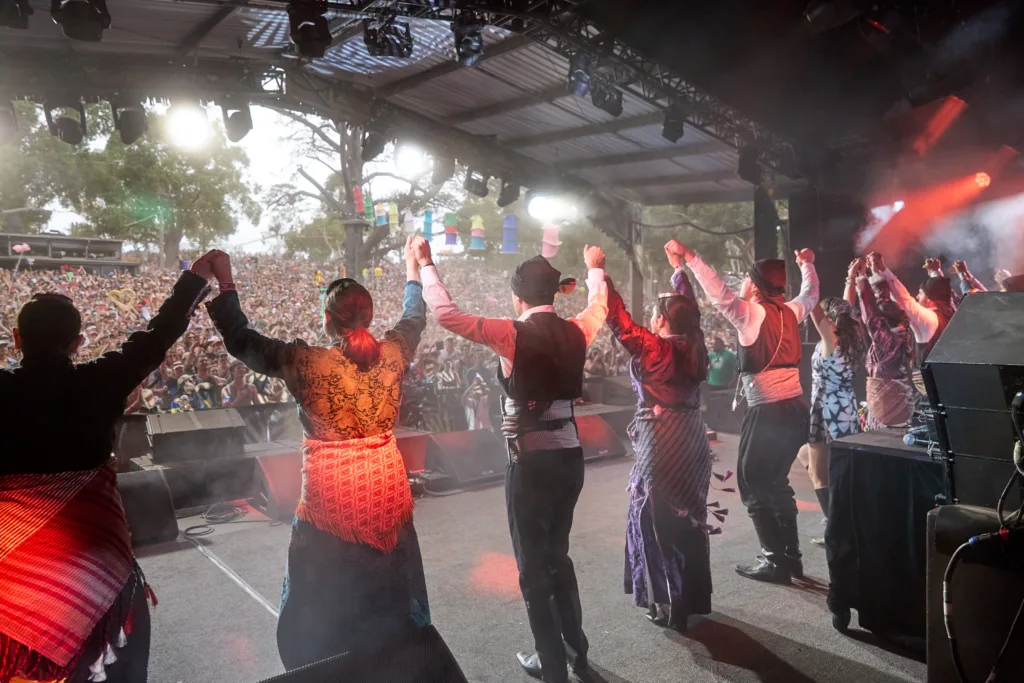
Attracting 15,000 people to the site where people camp and spend the long weekend away, the festival is always a sell out. Adriana’s set took place on the Sunday, between 5-6pm, which is typically reserved for the biggest names in dance music.
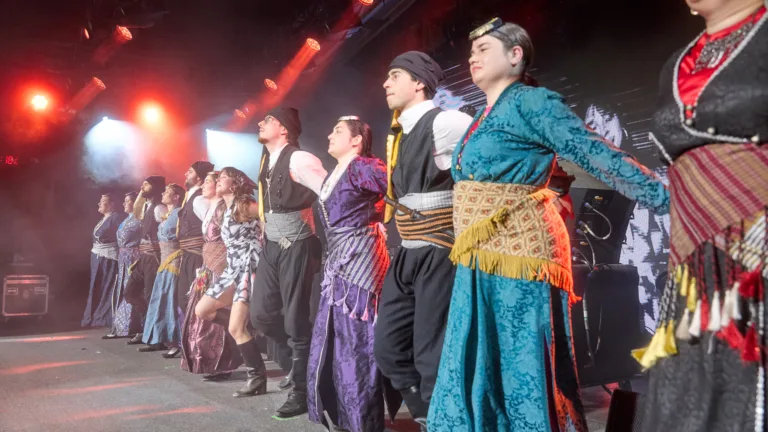
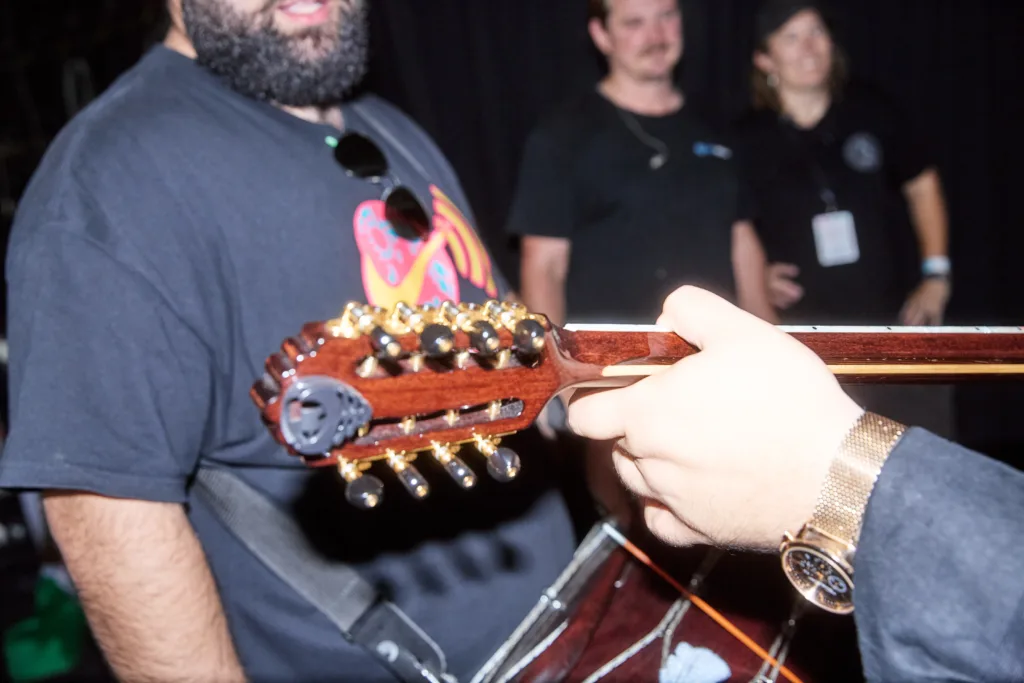
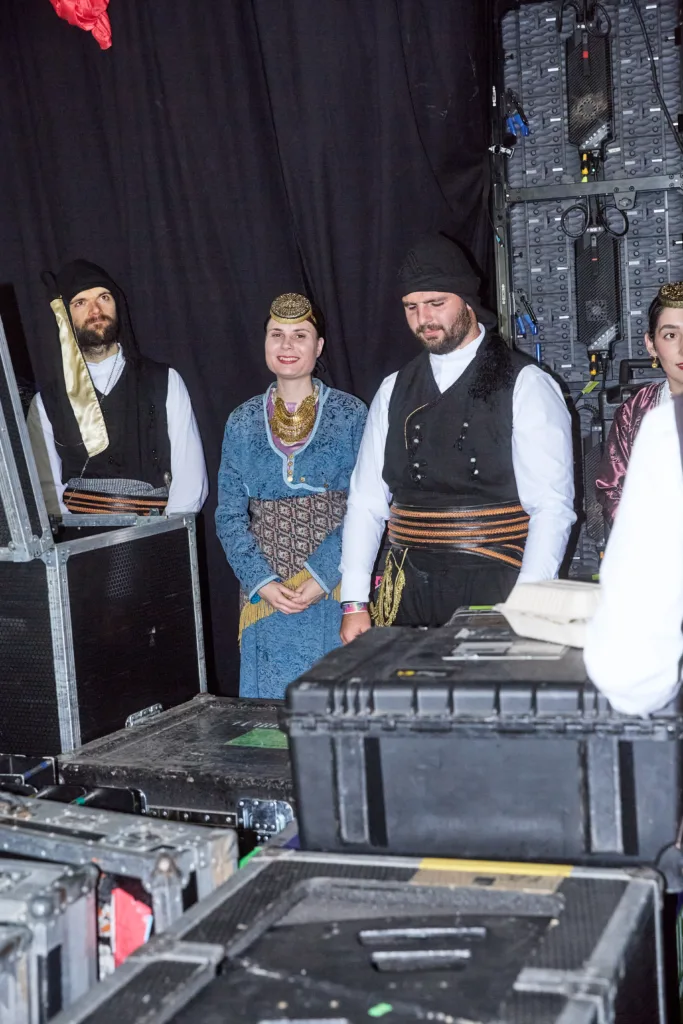
Opening and closing her maiden set (which consisted of house music, European dance music and the occasional Despina Vandi remix), were local Pontian dance troupe Akrites tou Pontou.
Performing the Kotsari and Seranitsa, their shoulder tremors, synchronised arm swings, jolts and precise steps entranced the diverse Australian audience in a culturally rich and energetic performance that the 30 year old festival never imagined it’d see.
Having worked together to activate nightclubs, raves and discos, this was not the first collaboration between Adriana and the Akrites, however this remains (perhaps forever) their most significant and applauded work.
Adriana’s family hails from Northern Greece and she dedicated the performance to her late father, who also shared a passion for his Greek culture and migrant community identity.
This collaboration has caused large reverberations amongst the global online music community and endless messages of thanks and intrigue have flooded her social media.
For a significant Australian festival to embrace these cultural displays show an appetite for cross cultural sharing and resonate with evolutions of multiculturalism.
This is also symbolic of the role played by third generation Greek Australians in the broader representation of their culture amongst peers and the industries they occupy.
Adriana returns to her ‘Spasta series’ of day party series in April, where audiences can see more.
Stefanie Costi is a 34-year-old lawyer, speaker, and writer, but above all, she is an advocate for workplace safety and inclusion. Having personally experienced bullying and harassment in the legal profession, Stefanie chose to speak out rather than stay silent, launching a movement that has since helped countless individuals navigate similar challenges.
Her advocacy has taken her to major conferences, universities, and legal summits, as well as Parliament, where her work was referenced in a 2024 speech by the NSW Parliamentary Secretary for Industrial Relations, Work Health and Safety, and Multiculturalism, Mark Buttigieg.
In April 2024, she launched Bona Fide Workplaces, a movement pushing for legislative change to address workplace bullying. You can sign the petition and share your story at www.bonafideworkplaces.com.
This International Women’s Day (IWD), Stefanie will be on the panel at The Greek Festival of Sydney’s ‘Hellenic Horizons’ event, supported by The Greek Herald. In this interview, she discusses her Greek-Cypriot roots, the impact of her activism, and how others can find the courage to speak out.
Tell us a bit about yourself and your heritage. How has your upbringing and heritage inspired your career path and life in general?
I grew up in a Greek-Cypriot family where family, hard work and doing the right thing were always at the core of everything we did. From a young age, I was taught to never back down when it came to standing up for what’s right, even when it wasn’t easy. That mindset has stuck with me and it is what drives me today as a lawyer.
Your journey from experiencing workplace bullying to becoming an advocate is inspiring. What personal turning point made you decide to step forward and fight for change?
The turning point for me came when I realised how common bullying and harassment was in the legal profession. After speaking to others, I found out many felt too scared to speak up because of their careers, money and job security. I could not ignore how many people in my profession and elsewhere were quietly suffering. That’s when I knew I had to speak out, not just for myself, but for everyone else going through the same thing.
What were some of the biggest personal or professional hurdles you faced after speaking out, and how did you navigate them?
After speaking out, one of the biggest hurdles I faced was the fear of what would come next. It was hard to know how others would perceive me, and there was a lot of uncertainty. Professionally, there was the challenge of potentially jeopardising my career but I knew I couldn’t put my integrity aside for the sake of comfort. Navigating those hurdles meant leaning on the people who believed in me, trusting my values and keeping my eye on the bigger picture: creating a positive change for myself and others.
What was the response from your family, friends and colleagues after you spoke out?
The response was overwhelmingly supportive. My family, friends and colleagues rallied around me and showed nothing but understanding and encouragement. Their support made a huge difference and I’ll always be grateful for it. It reminded me that, even when things feel tough, having a solid support system makes all the difference. The people who matter will always stand by you when you make the right choices.
What has been the most rewarding part of your advocacy journey so far, and how has it changed your perspective on resilience and leadership?
The most rewarding part of this journey has been seeing the impact on others. Knowing that my decision to speak out has helped others feel empowered to do the same is incredibly fulfilling.
What advice would you offer to women currently experiencing workplace bullying, particularly those who may feel apprehensive about speaking out due to potential career repercussions?
Going to work is a choice. Putting up with mistreatment is also a choice for money, validation, career progression or anything else. Work should add to your life not drain it. Your wellbeing and mental health should always come first.
This year’s International Women’s Day theme, ‘March Forward,’ emphasises progress and empowerment. How do you see this theme aligning with your work as an anti-bullying lawyer?
“March Forward” is a theme that really resonates with me because it’s all about taking action and not remaining trapped in a system that isn’t working. This is exactly the kind of change I’m committed to driving as an anti-bullying lawyer. My work is all about helping individuals break down barriers, stand up from themselves and move forward from toxic and harmful environments.
What can people expect from you at the upcoming IWD event by the Greek Festival of Sydney, supported by The Greek Herald?
At the IWD event, you can expect me to be raw and real. I’m not about sugarcoating things. I’ll talk about the hard truths of what it’s like to experience bullying, what it took to speak out and why we need to be brave enough to make noise. But most importantly, I’ll be sharing how we all have the power to create change, even when it feels like we’re up against the world.
Looking ahead, what is your vision for the future of workplace culture, and how can we ensure lasting change in how bullying and harassment are addressed?
I envision a future where workplaces are a place of respect and empowerment, not fear. It’s going to take all of us – leaders, employees, HR departments – facing the uncomfortable truths, holding each other accountable and committing to building a culture where bullying is not tolerated. We need policies that do more than just check a box. We need real systems of support, education and action.
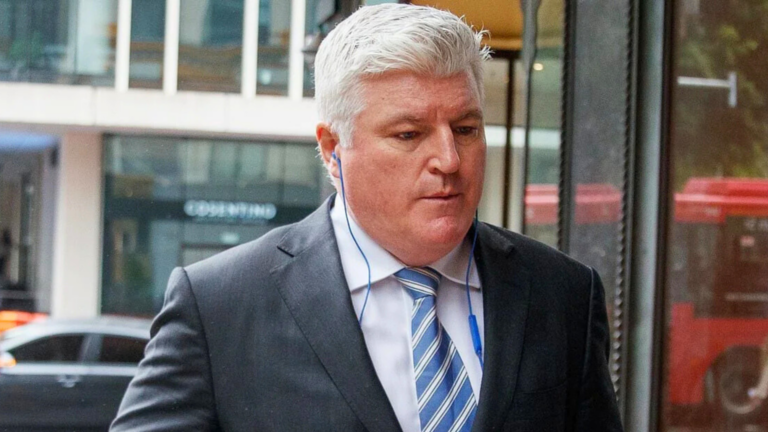
Cricketing legend Stuart MacGill has been found guilty of facilitating a cocaine deal between his partner’s brother, Marino Sotiropoulos, and a street-level drug dealer after a jury rejected his claim that he was merely an introducer.
The guilty verdict was returned after an eight-day trial in the NSW District Court, with MacGill convicted of the lesser charge of taking part in the supply of a prohibited drug.
He was acquitted of taking part in the supply of a large commercial quantity of the drug.
MacGill was accused of assisting in the setup and attending a meeting between Sotiropoulos and a drug dealer, known only as Person A, under his Neutral Bay restaurant in April 2021.
The Crown Prosecutor alleged that the two men agreed to exchange $330,000 for 1kg of cocaine, a transaction that MacGill helped facilitate by introducing them.
During the trial, MacGill denied any involvement in the deal, claiming he only introduced the two men to “palm off” Sotiropoulos.
He said he was unaware of any drug exchange and was only present for a brief introduction. However, the jury found his version of events unconvincing.
MacGill, who had a regular relationship with Person A, was also alleged to have complained about the quality of cocaine and suggested Sotiropoulos could provide better drugs.
Despite his defence, the jury found him guilty of facilitating the drug supply.
The case also involved two further alleged drug deals, including one where Person A fled with the drugs after handing over fake money, leading to MacGill being kidnapped.
MacGill will face sentencing proceedings later this year.
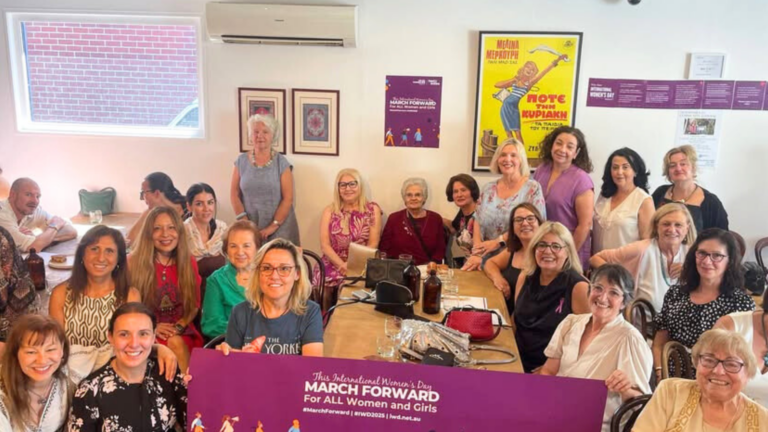
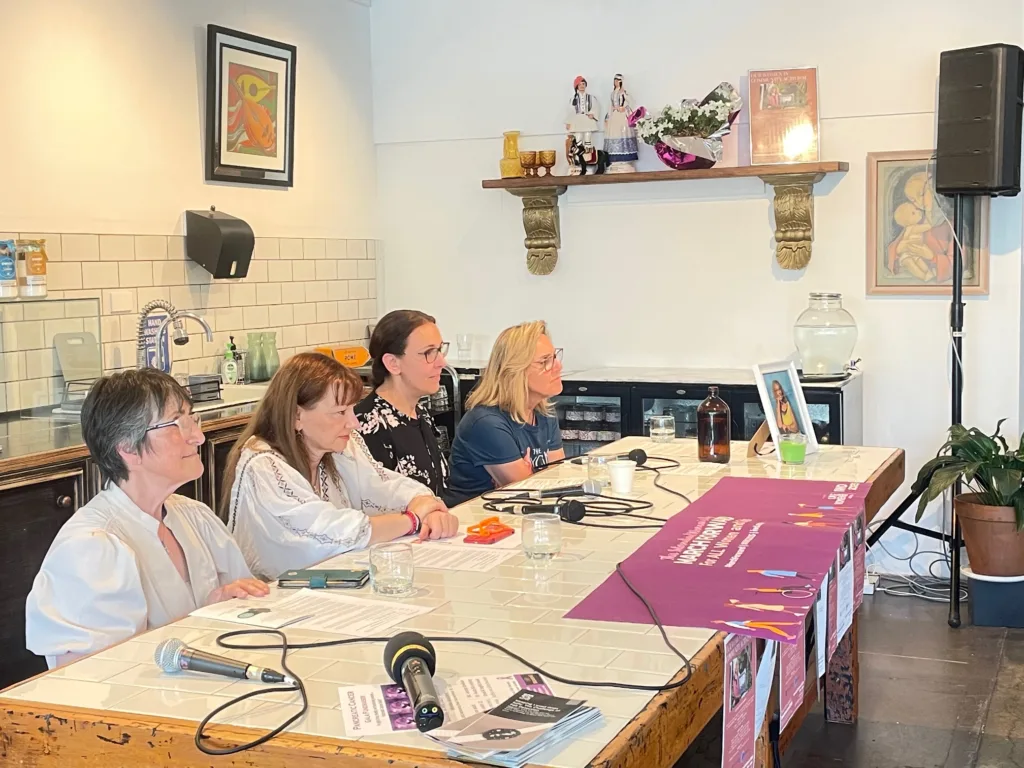
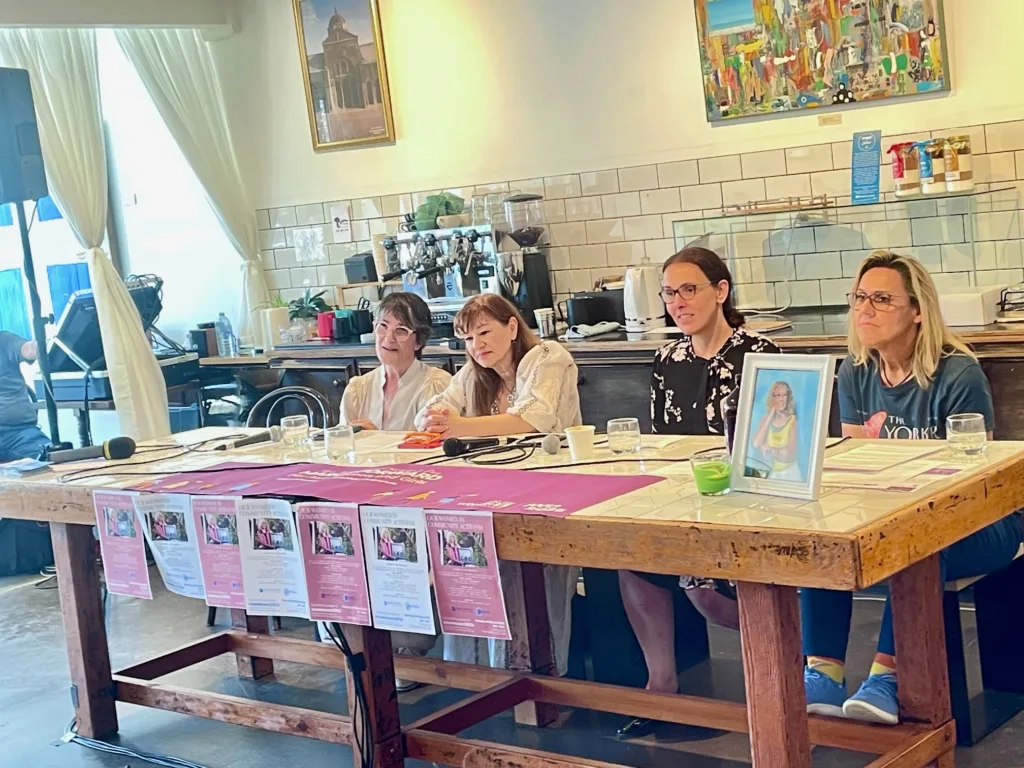
On Saturday, March 8, International Women’s Day was commemorated with a heartfelt event at The Patris, a newly opened café in Brunswick, Victoria.
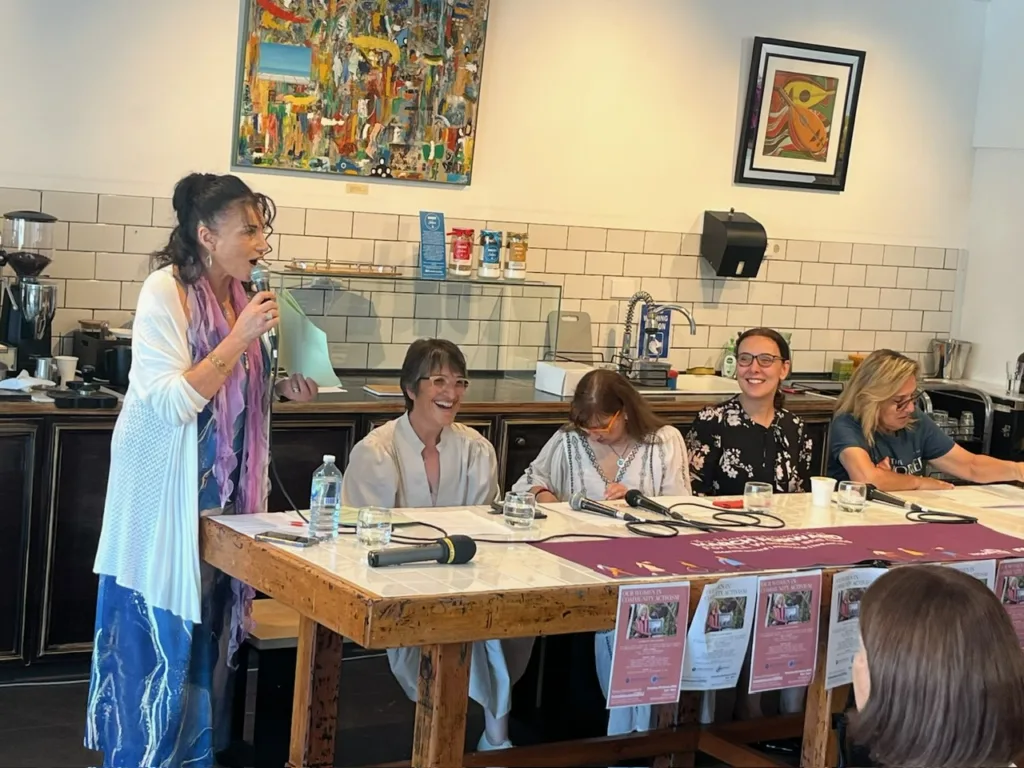
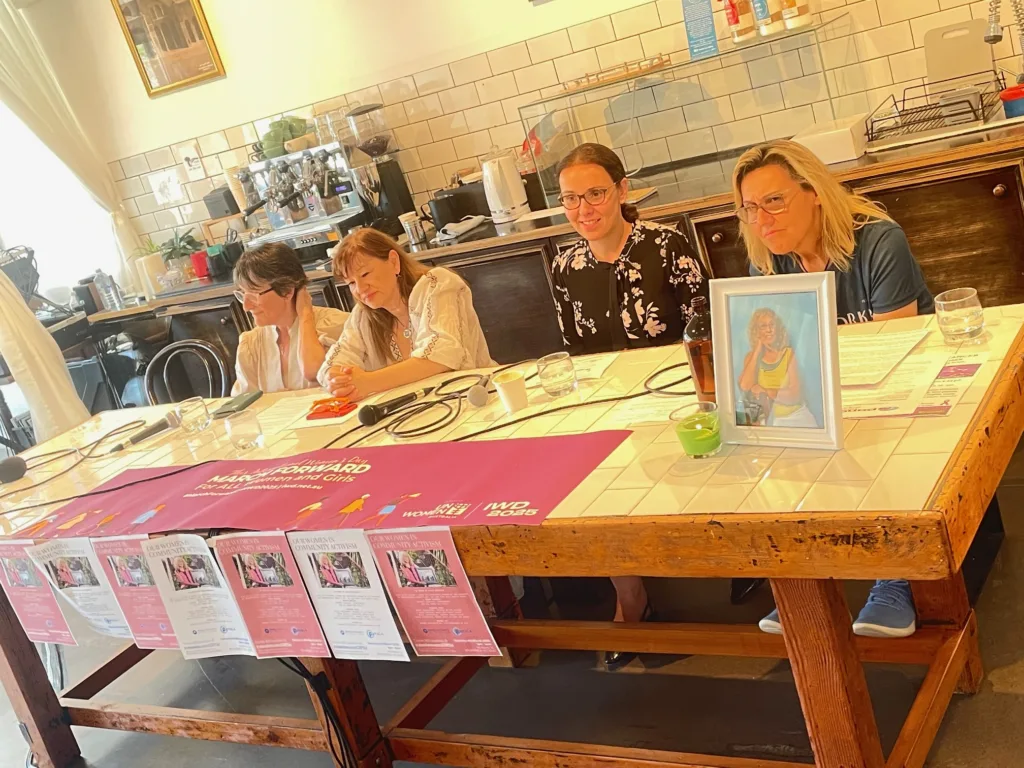
The gathering was more than a celebration – it was a tribute to one of the Greek community’s most pioneering activists in the North, Sofia Mastoris OAM, and a symposium on “Women in Community Activism.” The event brought together an inspiring group of women, each dedicated to their communities, who shared their personal stories, challenges, and triumphs.
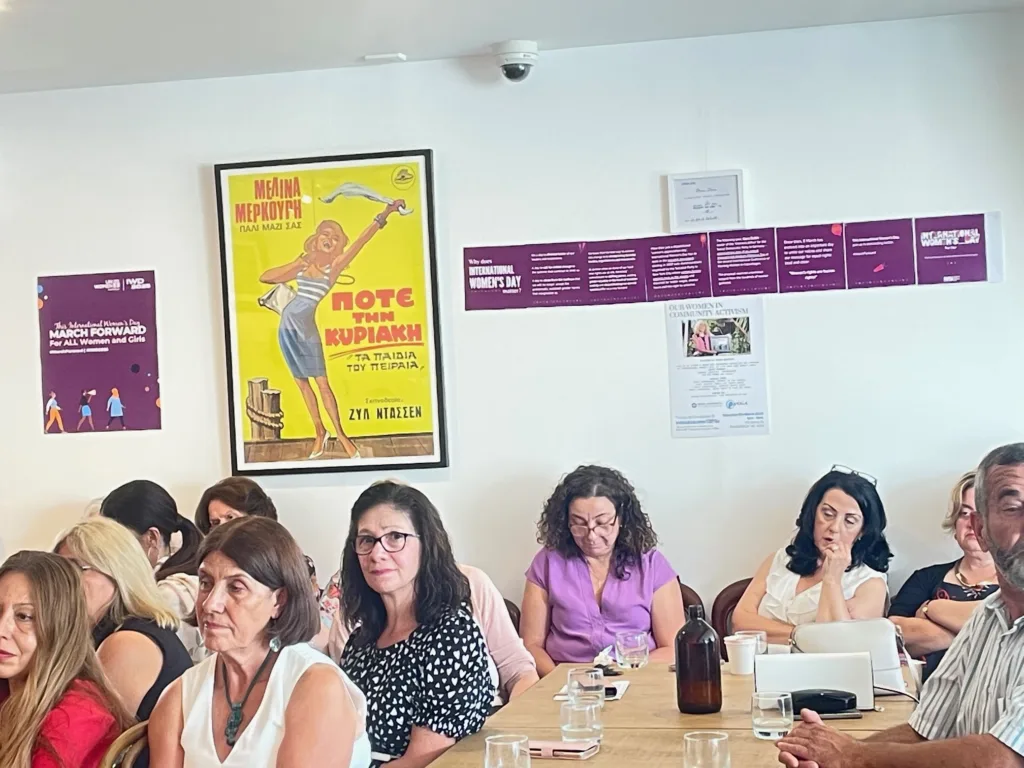
The atmosphere at The Patris was nothing short of welcoming. As soon as I stepped into the venue, I felt the warmth of camaraderie and excitement. It was clear that this was more than just an event; it was a safe space for learning, sharing, and reflection. The space echoed with stories of dedication, strength, and resilience. It was indeed a symposium – a term I learned describes a meeting with several speakers discussing a particular topic before an audience. This event embodied that definition perfectly.
Hosted by Anthea Sidiropoulos, Co-Vice President of the Greek Community of Melbourne, and presented under the auspices of the Greek Community of Melbourne, the event showcased four incredible women who have shaped their communities through activism. The symposium, which unfolded with a mix of personal stories and powerful messages, was a profound exploration of the heart of community work.
The Acknowledgment of Country and Sofia’s legacy
The afternoon began with a heartfelt acknowledgment of country by Sidiropoulos, followed by a special welcome to the guests, speakers, and, notably, the many women in the audience who hold leadership roles within the Greek community. Sidiropoulos took a moment to reflect on her own journey – how the loss of her father led her to seek comfort in the Greek community, where she became more deeply involved as a volunteer, honouring his memory through service.
Sidiropoulos acknowledged the presence of several remarkable women in attendance, including Mary Elizabeth Calwell, daughter of Australia’s first immigration minister Arthur Calwell; Cathy Alexopoulos, President of the Greek Australian Cultural League; Roma Siachos, Founder and President of the Maria Callas Australian Society; Dr Christos Fifis, academic and author; Whittlesea Councillor Ms Christine Stow; media representatives; and several other community leaders and educators.
But the most moving tribute was saved for Sofia Mastoris OAM, who was honoured posthumously by the President of the Hellenic Women’s Federation of Victoria, former Mayor of Whittlesea and Municipal Association of Victoria, Mary Lalios, who delivered a touching tribute to Sofia’s extraordinary life. Lalios reflected on Sofia’s tireless advocacy for women’s rights, her commitment to social justice, and her ability to unite people from all walks of life.
“Sofia’s vision and guidance helped shape the Federation, which she founded, into the strong and supportive network it is today,” Lalios said. “Her legacy will continue to inspire and guide us for generations to come.”
Sofia was remembered as a role model for many, especially for her work in advocating for Greek Australian women. Her involvement in the community and her focus on equality and representation inspired countless individuals to follow in her footsteps. Lalios shared a powerful anecdote, recalling how Sofia, at the age of 85, continued to attend multiple events throughout the day, embodying tireless energy and dedication to her cause.
An afternoon of empowering stories
The symposium was not just a look back at Sofia’s legacy but an opportunity to hear from modern-day activists who continue her work. The panel included:
Maria Vamvakinou MP – The first Greek-born woman to serve in Australia’s Federal Parliament, Vamvakinou delivered a heartfelt speech about her journey into politics. She spoke candidly about the challenges she faced and how she rose to prominence as an advocate for multiculturalism and women’s rights. Her message to the audience was simple but powerful: “You can do it. If you tell yourself you can’t, you won’t. But if you believe in yourself, you will.”
Helen Politis, Deputy Mayor of Merri-Bek City Council, shared her story of growing up with a deep sense of empathy for others. Politis reflected on how her childhood experiences shaped her commitment to public service. She shared her dedication to ensuring her community remains safe, fair, and inclusive. “As a lifelong local,” Politis said, “I’m immensely proud to work towards making our community a place where everyone belongs.”
Emily Dimitriadis, as the Deputy Mayor Darebin, she is a passionate advocate for public health and safety, who spoke about her work with the elderly and vulnerable communities. As a lawyer and pharmacist, she has become an influential figure in her local council. Dimitriadis emphasised the importance of not letting gender hold anyone back from pursuing their dreams. “We must support and nurture women to achieve everything they are capable of,” she said. “If you’re thinking of running for city council, I highly recommend it. Just do it.”
Maria Dimopoulos AM, is a human rights advocate and Board Chair at Safe and Equal, and organisation predominately working for women in domestic violence and gender injustice. Along with all the speakers, Dimopoulos opened with a powerful Acknowledgement to Country, passionately letting everyone know that “their rights are indeed, our rights” and we need to continue discussing the importance of standing up for human rights and equality. She shared her personal journey, which was marked by love, loss, and resilience. Dimopoulos also expressed concern about the erosion of women’s rights on a global scale, particularly as she was attending the 30th anniversary of the Beijing Platform for Action in the New York. “We must create a future that embraces justice, equality, and human rights,” she said, urging the audience to continue the fight for gender equality.
A heartfelt conclusion
The afternoon concluded with a Q&A session, where the audience was able to interact directly with the speakers and ask questions about their experiences and views on community activism. As the event wrapped up, Sidiropoulos took a moment to reflect on the profound impact of the day. She spoke about the importance of standing in solidarity and supporting one another.
“If you feel uncomfortable to speak out, stand up and speak out, or sing out!” she urged the audience, adding a touch of humour to break the tension that often accompanies taboo topics.
Sidiropoulos shared an insightful metaphor drawn from her visit to Dodoni, Greece, where she learned about the Oracle of Dodona. She likened each speaker to a part of an oak tree, whose leaves whisper wisdom.
“Each of you,” she said, “is part of that tree. You are all part of something greater than yourselves, shaping a better and fairer society.”
The event ended with a moment of collective reflection, where attendees were invited to close their eyes and give thanks to the speakers, the venue, and themselves for being a part of this powerful gathering. It was a subtle yet profound reminder of the importance of community, activism, and the legacy of women like Sofia Mastoris OAM – a legacy that lives on in every woman present that day.
It is important to note that a portion of the ticket sales was donated to Sophia’s chosen charity the Pancare Foundation, represented by Ms Christine Constantinou a survivor of pancreatic cancer who also attended the event.
Conclusion: A Living Tribute to Sofia Mastoris OAM Our Women in Community Activism was a reminder of the incredible power of women working together to create change. It was a celebration not only of Sofia Mastoris’ remarkable contributions but also of the women who continue to build on that legacy. The event, full of inspiration, solidarity, and a call to action, proved that the fight for women’s rights and equality is ongoing – and it’s a fight we must all continue to champion, together.
By Michael Peters Kyriacou, President of the Cyprus Community of NSW
The idea of being forced out of your home, fleeing your family ancestral lands and sacred sites never to return is foreign to most Australians. This is not so in the Cyprus Community of NSW.
As a Community made up of refugees and their families, the 1974 Turkish invasion and occupation of Cyprus is still fresh in the minds of many.
Recently, Chrystalla Stasos, the mother of the well-known member of our Community Michael Stasos, passed leaving a legacy for our Community, her family and her ethnos.
Chrystalla was from Agios Ambrosios – a village located in the Kyrenia District of Cyprus, east of Kyrenia, occupied by Turkish troops since 1974.
The village is dedicated to Saint Ambrose and is well known for having the largest church on the island, now converted into a mosque.
Chrystalla left her home at the age of 18 in 1951. She embodied the typical Australian story.
At the time Chrystalla left her village it was effectively under British occupation and the struggle to liberate the island was to be long and difficult. But so was settling into a new land.
Chrystalla married Kyriacos (also from Agios Ambrosios) in 1952 and raised two children, Michael and Angelo.
What makes Chrystalla’s story so poignant is that she came to Sydney, Australia as an economic refugee and then in 1974 became a refugee, a displaced person never to return to her ancestral lands. She worked hard alongside her husband with a dream of returning to their land in Agios Ambrosios.
Although she did not witness the invasion and pillage of her village, the murder and suffering of her people, she lamented about her siblings’ struggles and opened her house in Australia for refuge.
Chrystalla, like thousands of refugee families, was robbed of her identity, her property, her history and the legacy of her ancestors.
Typical of her generation, Chrystalla’s devotion to family is legendary, promoting her culture, her identity and passing it on to her children and beyond was a major part of her character.
Like all our refugees, Chrystalla carried her ancestor’s hopes, memory, and the just cause of Cyprus alive.
Our Community is now going through a seismic demographic shift, literally a generation of refugees is disappearing, who never to have walked on their country, touch the sacred soil of their roots or pass on the story of 1974 to all of us.
Our refugees are passing, and so is our collective memory of occupation and a liberated Cyprus.
As a Community we owe it to people like Chrystalla to keep their memory of the events of 1974 alive and their dedication to the cause, their family, their Community and our ethnos.
The Community is in deep gratitude to all our refugee families for keeping their story and the struggle in the minds and hearts of all. We cannot let them down.
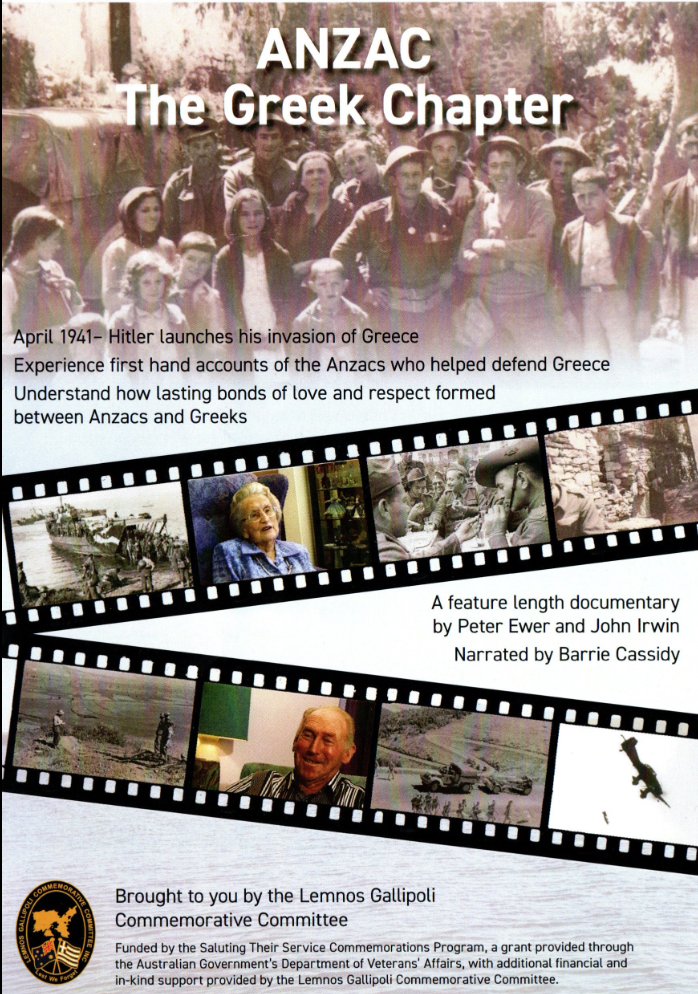
The highly anticipated documentary ANZAC: The Greek Chapter will be screened for the first time in Adelaide on May 4, 2025, as part of the Festival Hellenika.
The event will take place at the Henley and Grange RSL from 2-5 pm, celebrating the rich history of the Hellenic culture in Adelaide.
Renowned historian and filmmaker Dr Peter Ewer, who contributed to the documentary, will attend the screening and participate in a discussion about the film.
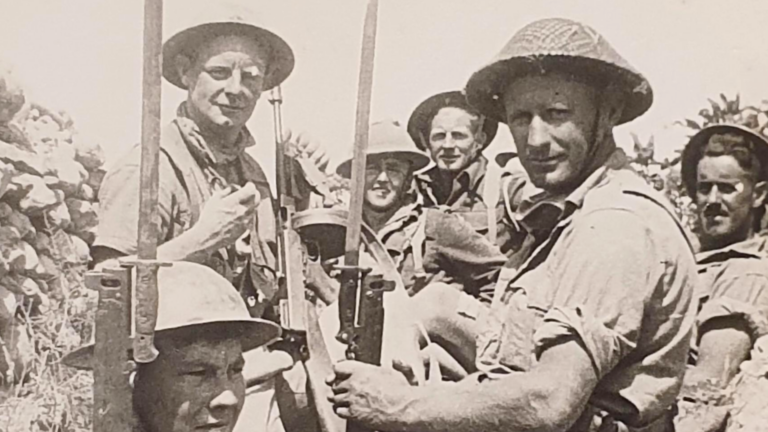
The documentary shares the ANZACs’ experiences in Greece and Crete, showcasing their courage and resilience.
Funded by the Australian Government and supported by Melbourne’s Lemnos Gallipoli Commemorative Committee, the film was created by Dr Ewer and filmmaker John Irwin assisted by Jim Claven OAM and Vicki Kyritsis on behalf of the Committee.
The screening is part of Festival Hellenika, a long-standing celebration of Hellenic culture in Adelaide. For more information on the event, contact Dr Adoni Fotopoulos at adoni@dealwithit.com.au.
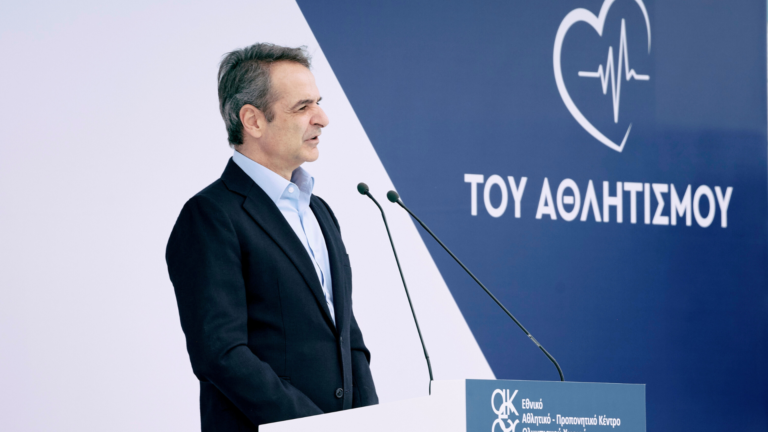
Greek Prime Minister Kyriakos Mitsotakis attended the reopening of the Olympic Village swimming pool on Wednesday, March 12, emphasising the significance of restoring the facility 21 years after the 2004 Olympics.
“Today we are here at a very pleasant moment, 21 years after that unique event that raised Greece so high and made us all so proud,” he said.
He praised the renovation, noting it provides the local community, particularly young children, with the opportunity to engage in sports, especially swimming.
Το κολυμβητήριο του Ολυμπιακού Χωριού επαναλειτουργεί! Αποδίδουμε πάλι στην τοπική κοινωνία, στους κατοίκους του Ολυμπιακού Χωριού, αλλά και στα αθλητικά σωματεία της ευρύτερης περιοχής αυτήν την πλήρως ανακατασκευασμένη ολυμπιακή πισίνα. https://t.co/XUOT4cWEEhpic.twitter.com/3gEWWQIGgP
Mitsotakis highlighted the importance of maintaining sports infrastructure, acknowledging that while Greece excels at building facilities, it has struggled with upkeep.
He commended the government’s efforts to restore and maintain Olympic facilities, ensuring they benefit society.
“Every government is judged not by its intentions but by its results,” he concluded.
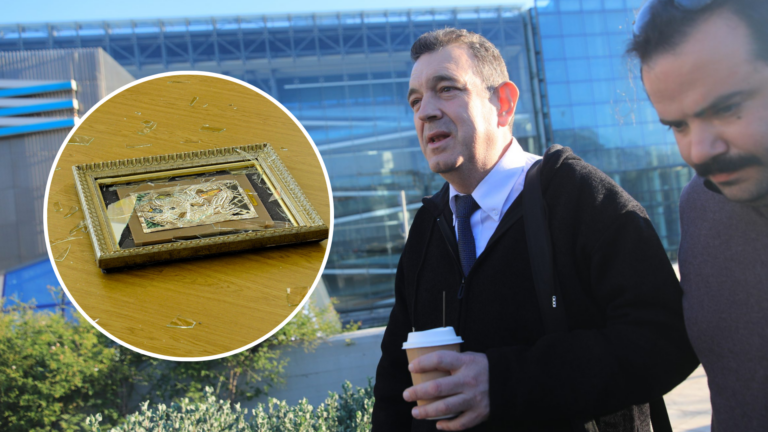
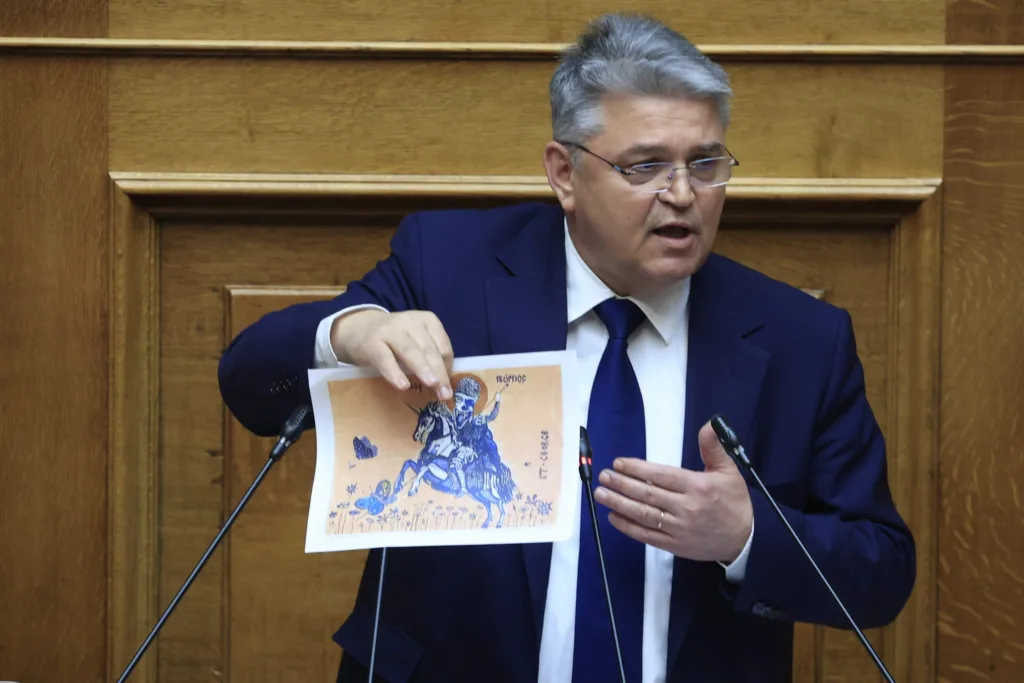
Greek MP Nikos Papadopoulos has been censured by Parliament following his vandalism of artworks at the National Gallery in Athens.
Speaker of Parliament Nikitas Kaklamanis announced that Papadopoulos would face a 50% reduction in his parliamentary salary for one month due to his anti-parliamentary behaviour.
Papadopoulos, a member of the Niki party, damaged four religious-themed artworks by Christoforos Katsadiotis on Monday, claiming they were blasphemous.
He had previously demanded the removal of the pieces, arguing they insulted religious figures.
The National Gallery condemned the vandalism, emphasising the importance of protecting artistic freedom.
Following his arrest, Papadopoulos was released due to the misdemeanour nature of the offence, but his case will be referred to Parliament to determine whether his immunity should be lifted for further prosecution.
Political parties, including PASOK and New Left, condemned the act as an attack on free expression and a dangerous step toward censorship.
The Association of Greek Archaeologists also denounced the vandalism as “brutal” and “uncivilised.”
Papadopoulos defended his actions, questioning the use of public funds for the exhibition.