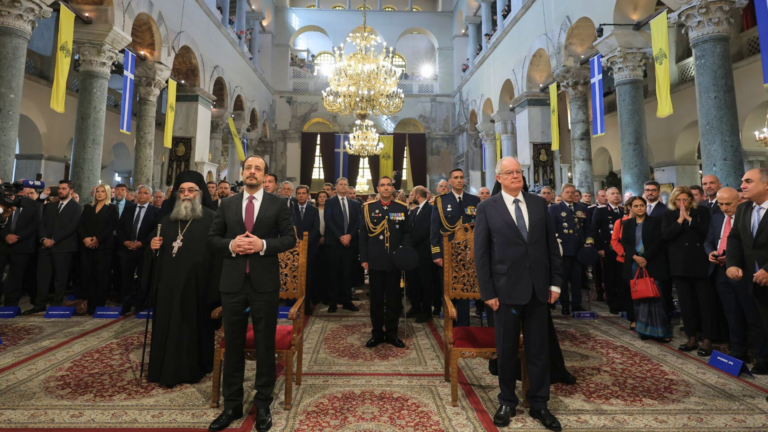
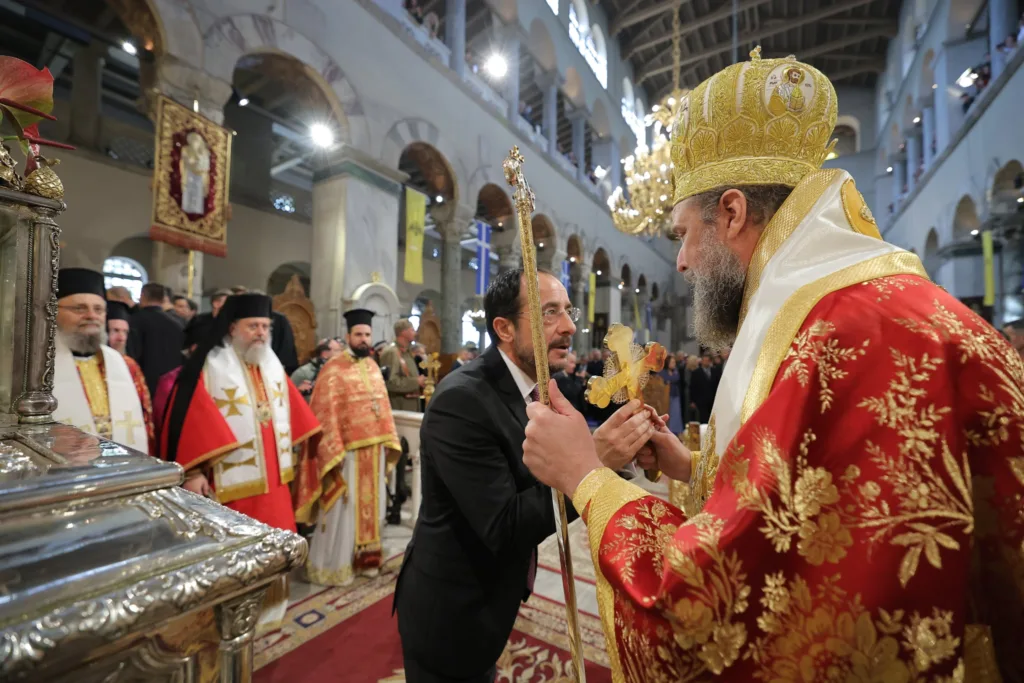
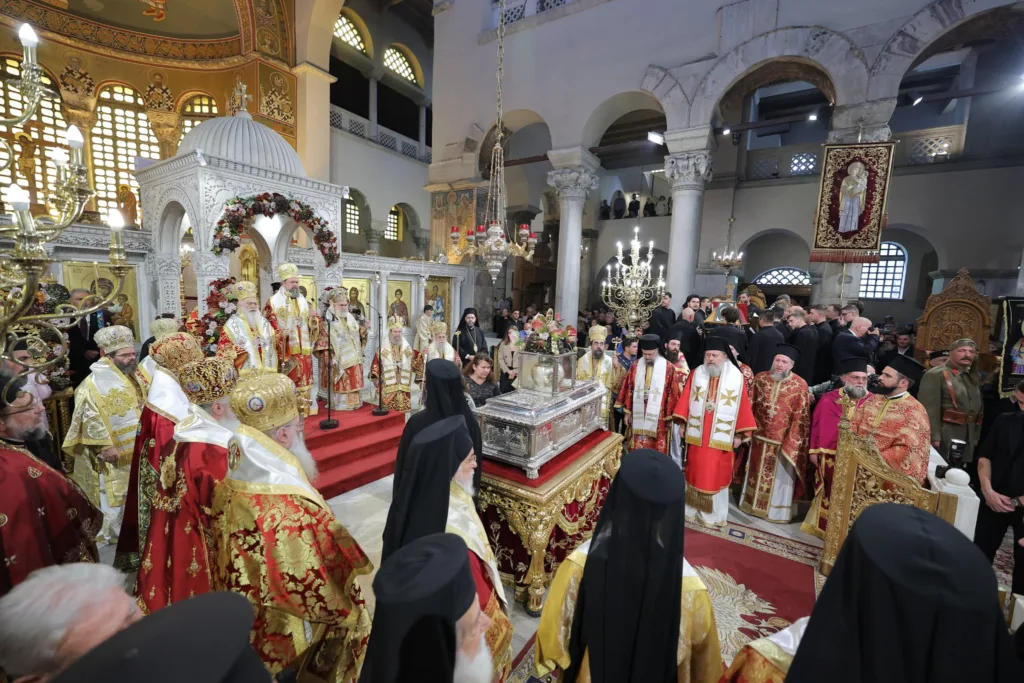
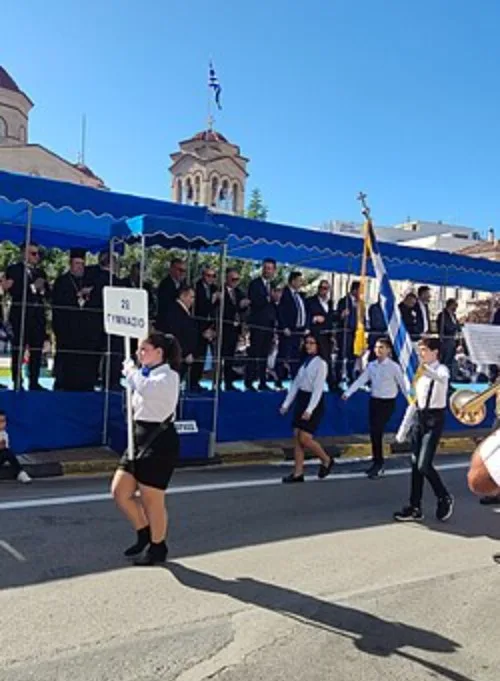
An official Doxology took place at the Church of St Demetrios in Thessaloniki on Sunday, attended by the President of the Hellenic Republic, Konstantinos Tasoulas, to mark the double celebration of the city’s patron saint and the 113th anniversary of Thessaloniki’s liberation.
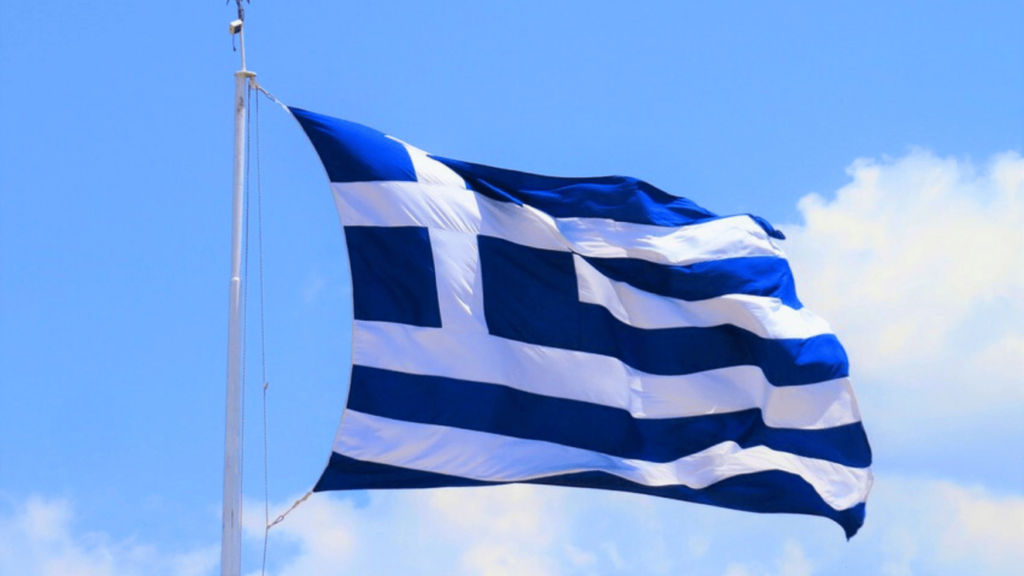
The morning began with the raising of the national flag at the White Tower and a 21-gun salute.
President Tasoulas was received by Chief of the Hellenic National Defence General Staff, General Dimitrios Choupis, before being greeted by government representatives including Deputy Minister Kostas Gioulekas, Regional Governor Athina Aidona, Mayor Stelios Angeloudis, and Metropolitan Philotheos of Thessaloniki.
Together, they welcomed Cypriot President Nikos Christodoulides before entering the church for the service.
Cyprus’s President Nikos Anastasiades was present at the celebration. Photo: Raphael Georgiadis / EUROKINISSI.
The Doxology was presided over by Metropolitan Philotheos of Thessaloniki, with Metropolitan Panteleimon of Veria leading the Orthros and sermon, joined by numerous hierarchs and bishops from across Greece.
The ceremony was also attended by political leaders and dignitaries, including SYRIZA’s Sokratis Famellos, NIKI’s Dimitris Natsios, PASOK’s Rania Thraskeia, EU Commissioner Apostolos Tzitzikostas, MEPs, MPs, local officials, and senior members of the Armed Forces and Security Corps, reflecting the national significance of Thessaloniki’s feast day.
Born in 280 AD, Saint Demetrios was martyred in 306 AD after being sentenced to death by Emperor Galerius for his Christian faith. His relics, once kept in San Lorenzo, Italy, were returned to Thessaloniki in 1980, where they remain enshrined in the Church of Saint Demetrios.
Revered as the protector and miracle-worker of Thessaloniki, Saint Demetrios is closely linked to the city’s liberation, which occurred on his feast day, October 26, 1912.
Photo: Raphael Georgiadis / EUROKINISSI.
On that day, Hasan Tahsin Pasha, commander of the Ottoman forces, surrendered Thessaloniki to the Greek Army, represented by Lieutenant Colonel Victor Dousmanis and Captain Ioannis Metaxas.
Over 26,000 Ottoman troops laid down their arms, handing Greece a pivotal victory in the First Balkan War.
Greek forces entered the city the following day to jubilant crowds, while Crown Prince Constantine and later King George I led celebrations marked by parades, church services, and a 21-gun salute at the White Tower.
Today, the historic Topsin residence, where surrender negotiations took place, houses the Military Museum of the Balkan Wars, displaying relics, uniforms, and weapons from the conflict.
The museum’s courtyard also contains the tomb of Hasan Tahsin Pasha and his son Kenan Mesare, underscoring the enduring legacy of the events that shaped Thessaloniki’s modern history.
The world’s current state of geopolitical affairs is interesting, to say the least. In this context, a purportedly Chinese saying comes to mind: “May you live in interesting times”, which in its English rendition denotes the phrase’s inherent irony – wishing the recipient to live in times of unrest and disorder.
It is in such an environment, where we may be close to another world war, that I and many others seek rectification – researching and examining facts and propaganda as to why and how wars occur.
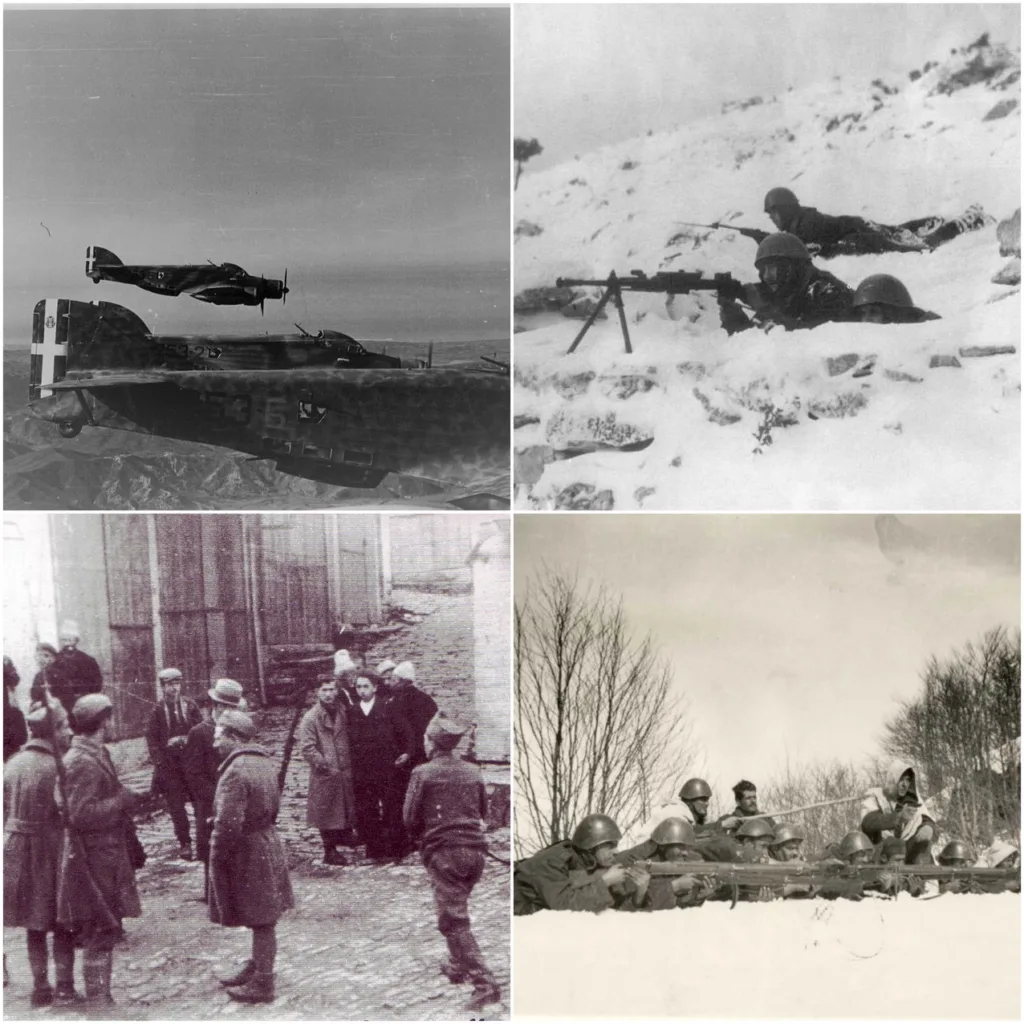
Such pondering lately leads me to examine the 28 October 1940 “OHI (NO) Day” in a broader context. The annual homage to “OHI” Day stems from Greece’s Prime Minister Metaxas firmly stating “OHI” (NO) to Mussolini’s request for his Italian Fascist army to pass through Greece on the above-mentioned date.
Metaxas’ poignant utterance – “So this is war!” – to Mussolini’s messenger, preceded his explanation to the Greek people shortly after, on the same day, 28 October 1940:
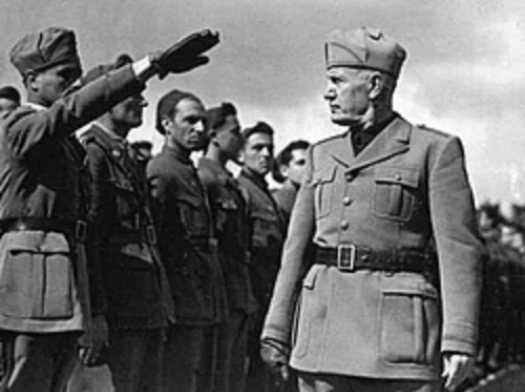
Mussolini Army
“The moment has come for us to fight for the independence of Greece, its integrity, and its honour. Although we have demonstrated the strictest neutrality and equality towards all, Italy, not recognising our right to live as free Greeks, demanded from me today at 3 o’clock in the morning the surrender of parts of the national territory according to her own will, that the movement of her troops to occupy them should begin at 6 o’clock in the morning. I replied to the Italian Ambassador that I consider both this request in itself and the manner in which it is being made as a declaration of war by Italy against Greece. Greeks, now we will prove whether we are worthy of our ancestors and the freedom that our forefathers secured for us. Let the entire nation rise up together, fight for the homeland, your women, your children, and our sacred traditions. Now the struggle is above all.” – Address of Ioannis Metaxas to the Greek People, 28-10-1940
Metaxas, an experienced politician and skilled diplomat aiming to keep Greece neutral, evocatively describes the why of his “OHI” to the press a few days later:
“To avoid war we would have to become willing slaves and pay by extending Greece’s right hand for amputation by Italy, and Bulgaria would cut off our left hand. Of course, it is not difficult to predict that in such a case, the English would cut off Greece’s legs. And rightly so. As they are sovereign at sea, they would not fail, after seeing the enslavement of Greece, to occupy Crete and other of our islands, defending their interests.” – Announcement by Prime Minister Metaxas to the owners and editors-in-chief of the Athenian press at the General Headquarters [Hotel “Great Britain”] on October 30, 1940.
I recently conversed about 28 October 1940 with an Italian gentleman in his 50s who has been living “happily” in Greece for almost two decades. Not wishing to be named, he felt that reciting some Italian history was necessary: “Around a million Italians died in WWI, due to being betrayed by the Allied forces – like Great Britain and France. At the end of WWI and beyond, Italy was in great debt with huge inflation, whereby more than half a million people died due to food shortages and poor harvests in 1918 – apart from the Italians who died fighting this first world war.”
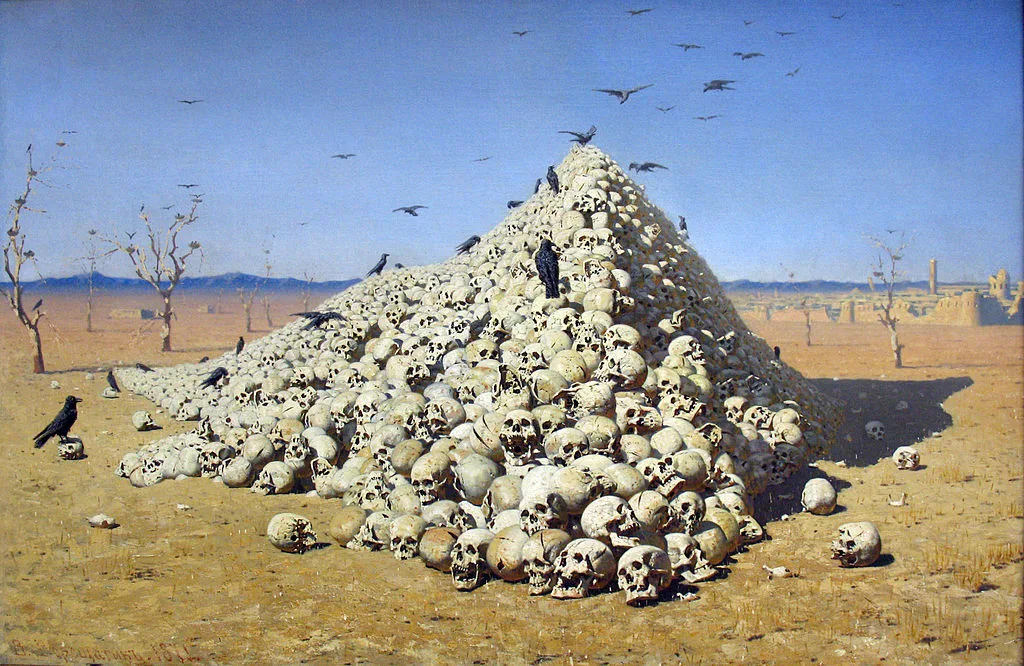
1871. Artist Vasily Vereshchagin. The Apotheosis of War
He then declared with indignation: “The Allies lied to us. We were betrayed at the Treaty of Versailles in 1919, and the Italian people were hurting and angry, and this led to Mussolini and fascism.”
I didn’t point out that Italy involved Greece in World War II by invading her on 28 October 1940. That the failures of Mussolini’s fascist army in Greece forced Hitler to send German troops to Greece in April 1941 – an Axis occupation that lasted until 1944, with much suffering, to say the least, for the Greek people.
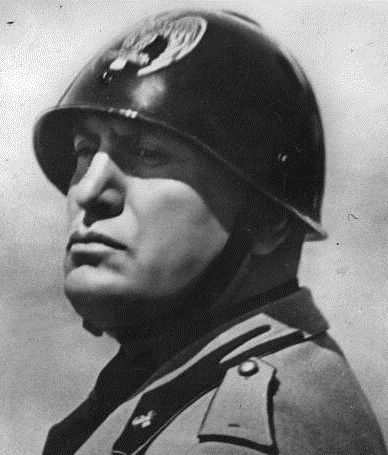
Benito Mussolini Portrait
With documented sources now more accessible, prompting research and discussion in this era where a lack of overall trust towards global establishments’ narratives seems prevalent, I came across surprising information. For example, the “una faccia, una razza” – “one face, one people” saying, referring to a fraternal bond between the Greek and Italian people, was used as exaggerated propaganda by the “Western Allies”.
When Italy switched sides away from the Axis and sided with the Allies in a secret truce in 1943, “una faccia, una razza” was apparently pushed by the Allies as post-war propaganda to cover many atrocities enacted by Mussolini’s fascist army.
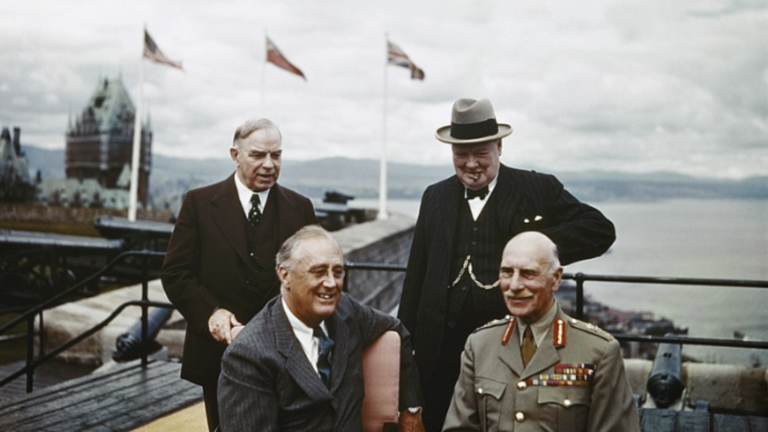
Researcher Spyros Ionas, for example (with sources), writes of the Italian army’s abuses and war crimes in Greece. He further elaborates that Italy was involved by Churchill and Roosevelt in the First Quebec Conference of 1943, whereby her surrender and changing of sides to the Allies included “shaping a new democratic image of the country, covering up and erasing its past”… a “clean-up operation” reinforced in the 1947 Paris Peace Treaty.
Academic Ioannis Kotoulas (PhD in History, PhD in Geopolitics) states that an overall view of the Italian army in Greece from 1940 onwards as humane, compared to the German army, is “a largely post-war construction… the artfully promoted myth of noble behaviour.” He adds, “the coexistence of the Italian soldiers with the subservient Greek population was not a harmonious experience.”
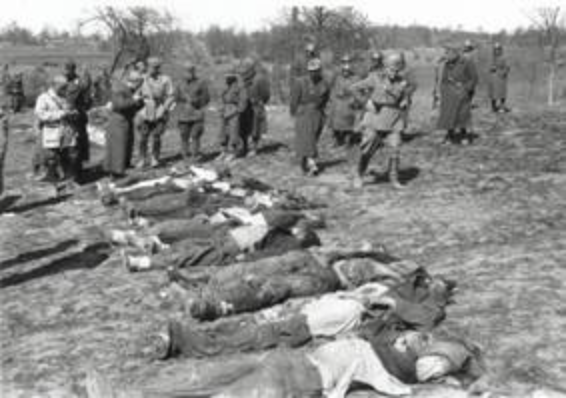
Kotoulas explains that during the Italian army’s 29-month (until September 1943) invasion of Greece, many executions and massacres occurred, such as the 1943 Domenikon massacre in Thessaly. He also mentions that the Greek famine in the winter of 1941–42 and immediately after, where “it is estimated that at least 100,000 people died… was a consequence of the general occupation of the Italians.” Furthermore, Kotoulas attributes the belief of the “good-natured” Italian soldier versus the “merciless German soldier” as “constructions that are due to the simple change of camp on the Italian side in 1943 and the alignment with the victors of war.”
Domeniko, 1943
Let’s hope that Greece today will not be in the position that Metaxas was on 28 October 1940; nor, for that matter, in that bizarre turn of events when, in the 2015 referendum regarding “The Crisis” bailout, we the Greek people saw our ‘NO’ vote become an apparent ‘yes’.
May we now have the insight and clarity to demand “OHI – NO” to propagandistic lies and a consequent NO to the continuation of wars where neither Greek, Italian, nor any of the world’s people be at war. May our civilised, peace-loving selves reign, bearing this saying in mind perhaps: “Of all manifestations of power, restraint impresses men the most.” – By F. B. Jevons, A History of Greek Literature: From the Earliest Period to the Death of Demosthenes, 1886.
The Master Miller’s mission has its roots in a philosophy that begins at the olive tree and reaches the heart of those who seek quality.
From the root of the tree to the heart of the vision
The story of The Master Miller does not begin with a product, but with a need: to build a world where the grower has a voice, the consumer has knowledge, and olive oil once again receives the respect it deserves.
Born from the experience and values of Papadopoulos Olive Oil Mill – Mediterre, The Master Miller was created as an evolution — a bold new expression of a long-standing family legacy in Greek olive oil.
It is a brand built on love for the land, commitment to quality, and the desire to share a deeper truth about the significance of olive oil in today’s world.
“We’re not just building a brand,” explains Konstantinos Papadopoulos, CEO at The Master Miller. “We are creating a quality ecosystem that connects the land, the grower, and the consumer, with trust and transparency at every step.”
Behind this mission stands a family with deep roots in Greek agriculture, one that dared to look toward the future with open eyes and a heart grounded in tradition.
Master Growers: The power of the land. The power of the people.
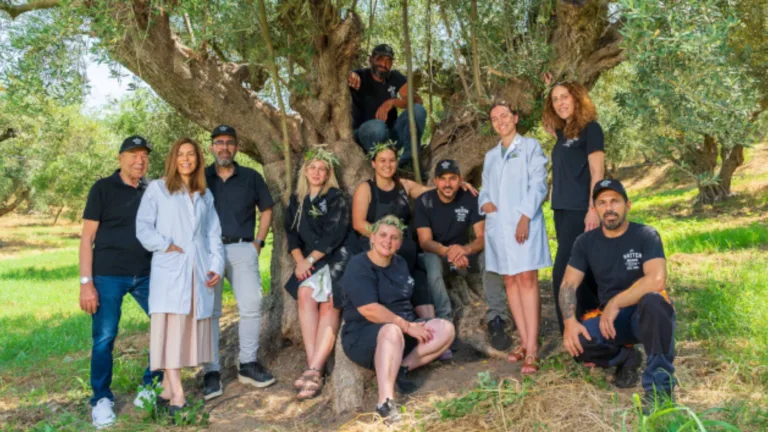
The most valuable investment of The Master Miller is in its people, the Master Growers — a community of farmers who cultivate not just olives, but culture.
They receive training and scientific support, and they participate equally in the creation of the final product.
“Being part of this team means you’re never alone,” according to Dimitris Kanellopoulos, Master Grower. “There’s support, shared experience, and the exchange of knowledge. You grow better, but most importantly, you grow with greater confidence.”
The Master Growers Certified Seal accompanies every bottle of olive oil, ensuring its journey is traceable from grove to shelf. It is the voice of a community and the mark of a noteworthy kind of agriculture: one that respects the land and those who care for it.
Vertical thinking at The Master Miller. From nature to the future.
We support the philosophy of holistic integration, from cultivation, milling, and storage to packaging and distribution. Every stage, every hand, every step is guided by shared values, strategy, and purpose.
“Every drop of olive oil produced within our community carries a story, a sense of care, and a clear identity,” says Giannis Nikolopoulos, The Master Miller’s Head of Production. “We support a kind of production that respects the product and honors the people behind it.”
Quality backed by proof — not promises
The Master Miller is proud of its distinctions, which come to Greece from New York to Japan, from London to Argentina.
“Awards are important. Not only because they recognize quality, but also because they give voice to the effort, the team, and the hard work behind every bottle,” remarks Eva Papadopoulou, COO of The Master Miller.
But for us, the greatest award is trust.
With certifications such as IFS, HACCP, PGI Olympia, BIO Hellas, and USDA Organic, as well as an unsurpassed traceability system, high quality is not merely a marketing slogan. It is our well-documented commitment.
A new chapter in the story of Greek olive oil
The Master Miller is more than a product. It is a platform for growth. A movement. A confirmation that Greek olive oil can face the future with confidence, strength, and elegance. We don’t just export olive oil. We export philosophy.
*Originally published on Greek Liquid Gold: Authentic Extra Virgin Olive Oil (greekliquidgold.com). See that site for recipes with olive oil, photos from Greece, agrotourism and food tourism suggestions, and olive oil news and information.
For the first time in over a decade, Greece is witnessing a positive migration balance as more Greeks return home than emigrate. During the Open Assembly of the Hellenic Federation of Enterprises (SEV), President Spyros Theodoropoulos highlighted this shift while emphasizing productivity as the foundation for sustainable growth, according to eprotothema.gr
“Average annual productivity in Greece has remained almost stagnant over the last 30 years… We have proven that we can improve in many areas when the state, society, and businesses work together,” he said. “In 2023, the net migration balance was positive by 15,000 Greek citizens—that is, more people returned than emigrated abroad.”
Labor Minister Niki Kerameus also reported progress before Parliament, noting, “We have a 64% reversal of the brain drain… aiming to attract even more Greeks back home.” This translates to over 422,000 Greeks who have returned, compared to the 659,000 who left between 2010 and 2022.
Research by the National Documentation Centre (EKT) shows that returning professionals bring valuable expertise gained abroad—three in four say their overseas experience boosted their skills and competitiveness. Forty-four percent now earn over €1,500 per month, while 84% say tax incentives did not significantly influence their decision to return.
Rebrain Greece offers a 50% income tax exemption for seven years to repatriates, and the initiative’s roadshows—in cities like Amsterdam, London, and soon New York—are connecting thousands of Greek expatriates with top employers.
Surveys reveal that most returnees cite family ties (49%) or love for their homeland (39%) as their main motivation. Yet, 33% identify lower Greek wages as the main deterrent to coming back.
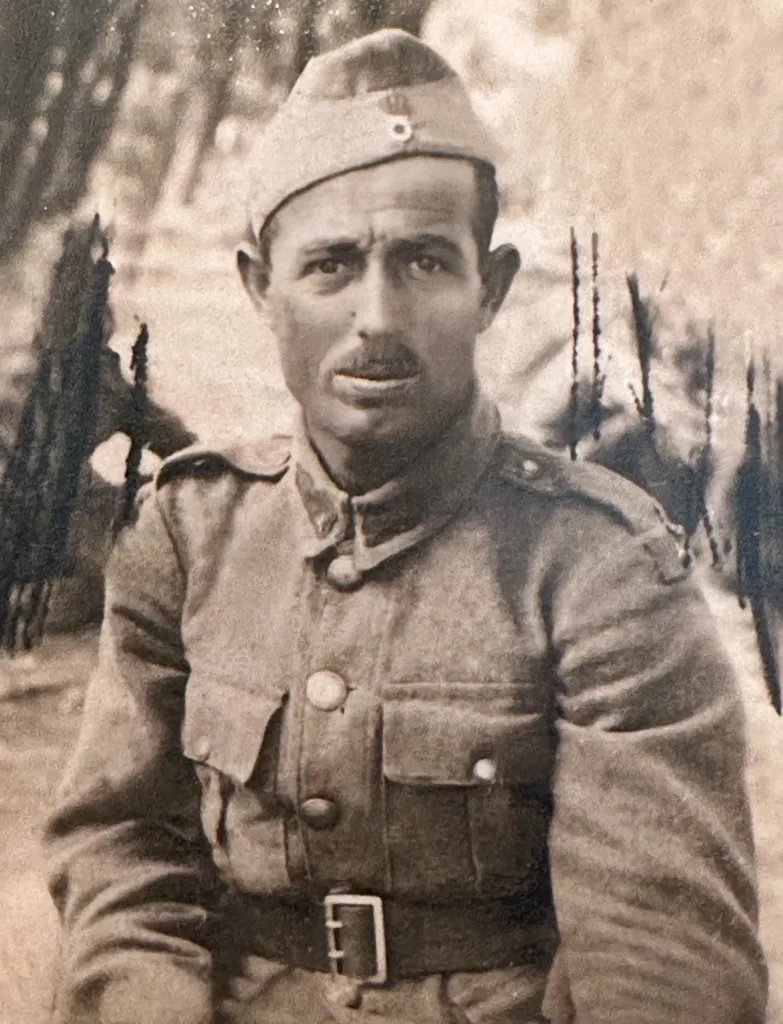
“Aera!” (Air!) roared Greek soldiers as they clawed over jagged rocks on the brutal Pindus Mountains of northern Greece during Italy’s 1940 invasion. My grandfather, Evangelos Kritikakos, fought alongside everyday men, farmers, and shopkeepers.
Evangelos Kritikakos, serving with the Greek Army, World War II
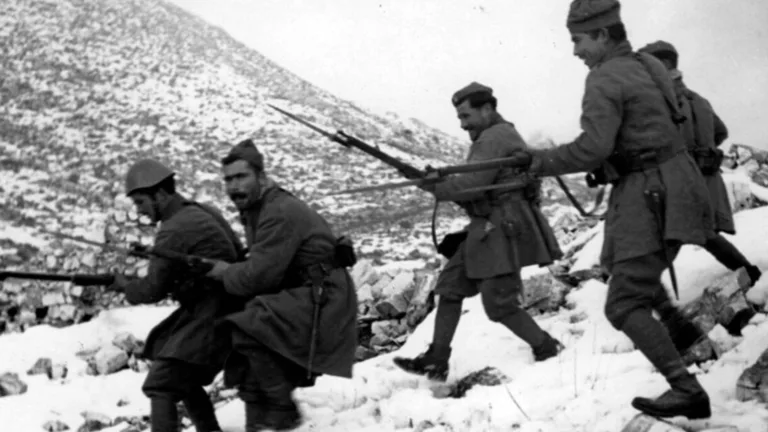
Torrential rain turned narrow mountain tracks into rivers of mud, where a single misstep could mean death. As October gave way to November, icy rain turned to heavy snow on the highest peaks. The cold cut through their threadbare clothing. With every charge toward Italian positions across this unforgiving terrain, they roared “Aera,” a war cry meaning to sweep the enemy away like the wind.
The cry of “Aera” rolled like thunder through mist-covered valleys as waves of Greeks surged over rocks and snowdrifts, pushing back invading troops stunned by their relentless force. Greek forces, familiar with the terrain, blocked and outflanked Italian troops advancing toward the strategic Metsovo Pass.
The Italians, mostly reluctant conscripts, poorly equipped and fighting for Mussolini’s imperial ambition, were increasingly demoralised. The elite Julia Alpine Division of the Italian army, trained for mountain warfare, was stunned by the Greek army’s refusal to fight against overwhelming odds.
October 1940 – March 1941: Defying Mussolini
At 3:00 a.m. on 28 October 1940, Italian ambassador Emanuele Grazzi delivered Mussolini’s ultimatum to Prime Minister Ioannis Metaxas demanding occupation rights across Greece. Mussolini reportedly boasted he would soon be drinking coffee at the Acropolis. Metaxas is said to have replied in French, “Alors, c’est la guerre” (“Then it is war”). Greeks in spontaneous unity embraced the symbolic “Oxi!” (No!).
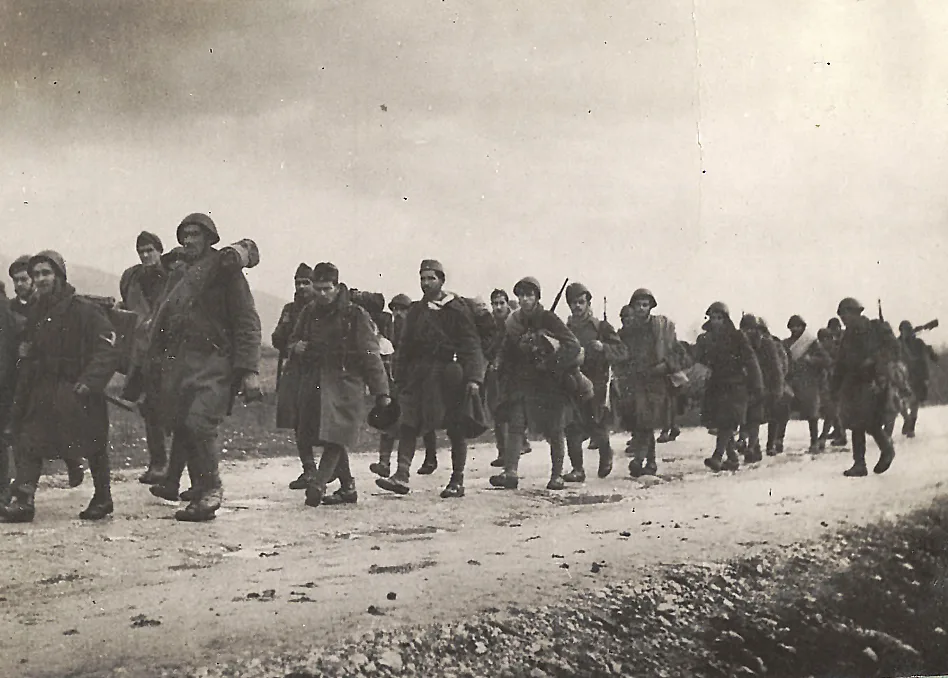
By 13 November 1940, Greek forces had pushed Italian troops out of most frontier positions. Women and children from mountain villages transported supplies to the front along treacherous paths, often under fire. The Greek counteroffensive pushed deep into Italian-controlled Albania, capturing key cities such as Korçë (Korytsa), Pogradec, Sarandë (Agioi Saranta), and Gjirokastër (Argyrokastro).
Greek counter-offensive of 1940. Photo- General Staff of the Army
Metaxas died on 29 January 1941 from terminal illness and was succeeded by Alexandros Koryzis, a former banker. When Mussolini personally supervised a final Italian offensive in March 1941, Greek defenders held firm across the Albanian front. Everyday Greeks had achieved one of the first Allied land victories in Europe during the war. Mussolini would never drink that coffee in Athens.
April–May 1941: German Invasion and Occupation
The Greek victory forced Hitler to intervene through Operation Marita to secure the Balkans and suppress British influence. Nazi Germany invaded from Bulgaria and Yugoslavia on 6 April 1941, and Greek troops in Albania were forced to evacuate.
On 18 April, as German forces closed in on Athens with overwhelming numerical and material advantage, Prime Minister Koryzis took his own life. King George II and his government fled to Crete on 23 April, and then to Egypt in late May, forming a government-in-exile.
Athens fell on 27 April 1941. As German troops entered the city, a story circulated: when soldiers ordered the Acropolis flag guard to surrender the Greek flag and raise the Nazi swastika, the young soldier Konstantinos Koukidis reportedly wrapped the flag around himself and leapt to his death, becoming a legendary symbol of defiance.
During the German advance, my grandfather fought against the Nazis. As gunfire erupted, a bullet meant for him ricocheted off his helmet just as he fell. His captain had pulled him down in time, saving his life. Around them lay the bodies of their fellow Greeks.
The Axis powers divided Greece into German, Italian, and Bulgarian zones of control. A collaborationist government was established in Athens. While parts of the Greek military in northern and central regions were forced to formally surrender to the overwhelming German advance by late April 1941, many soldiers evaded capture, went into hiding, or fled to join resistance groups. Greek resistance continued in numerous forms across the country, from guerrilla warfare to civilian-led sabotage.
On 20 May 1941, German paratroopers faced fierce resistance in Crete. Australian and New Zealand forces fought alongside Greek soldiers and civilians against the Nazis. Villages such as Kandanos and Kondomari were destroyed in reprisals, setting a pattern that would recur across Greece.
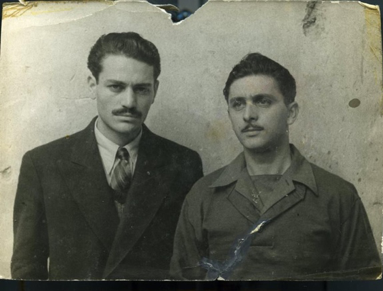
On the night of 30 May 1941, two students, Apostolos Santas and Manolis Glezos, climbed the Acropolis and tore down the Nazi flag. The act symbolised the resistance: spontaneous, civilian-led, and determined. Greeks fought in the mountains and countryside against the occupiers. Some historians argue that the resistance of Greece forced Hitler to divert forces to the Balkans, delaying Operation Barbarossa, Germany’s invasion of the Soviet Union, by several weeks.
Manolis Glezos and Apostolos Santas
Winter 1941–1942: The Great Famine
The first winter of occupation (1941-1942) was catastrophic. Axis forces seized agricultural production and the Allied naval blockade prevented food imports. Distribution systems collapsed. Around 200,000–300,000 Greeks died from famine. People perished in the streets of Athens, families traded heirlooms for a piece of bread, and gaunt children scavenged for wild greens. Diseases, including tuberculosis and typhus, spread through malnourished populations. Nazi Germany forced Greece to fund its own occupation, draining the country’s resources, and triggering hyperinflation.
1942–1944: Resistance and Terror
Resistance emerged quickly. The National Liberation Front (EAM) and its armed wing, the Greek People’s Liberation Army (ELAS), expanded rapidly from 1942, while other groups such as the National Republican Greek League (EDES) also fought the occupiers. The most famous act of sabotage came on 25 November 1942, when resistance fighters and British agents blew up the Gorgopotamos Bridge, cutting the railway between Athens and Thessaloniki.
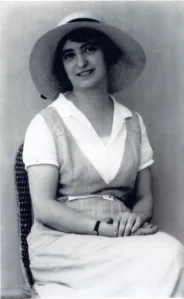
Greek women played a crucial role. They smuggled food, organised soup kitchens, maintained households, and served in resistance networks as couriers, nurses, and intelligence agents. Lela Karagianni, a mother of seven, founded the Bouboulina network, providing forged documents and safe passage for Allied soldiers and Jewish families until her execution in September 1944.
Lela Karagianni
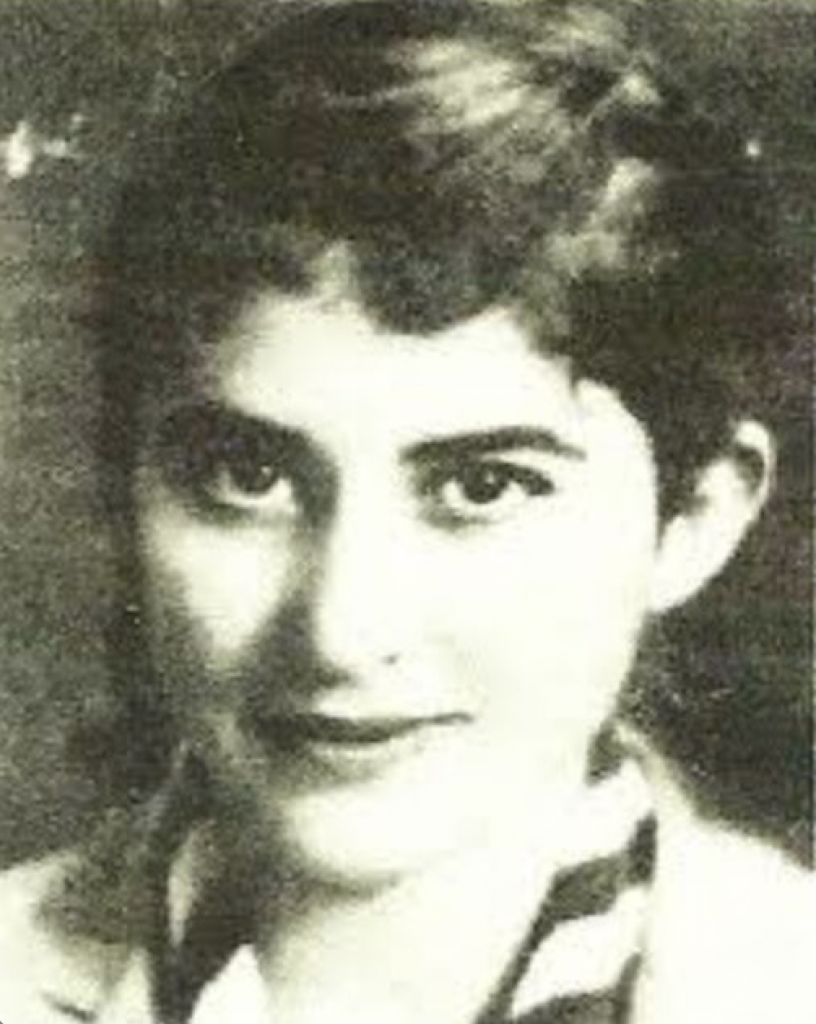
Iro Konstantopoulou joined the resistance at 14, sabotaged German ammunition trains, and was executed at 17 after weeks of torture, refusing to betray fellow fighters.
Iro Konstantopoulou
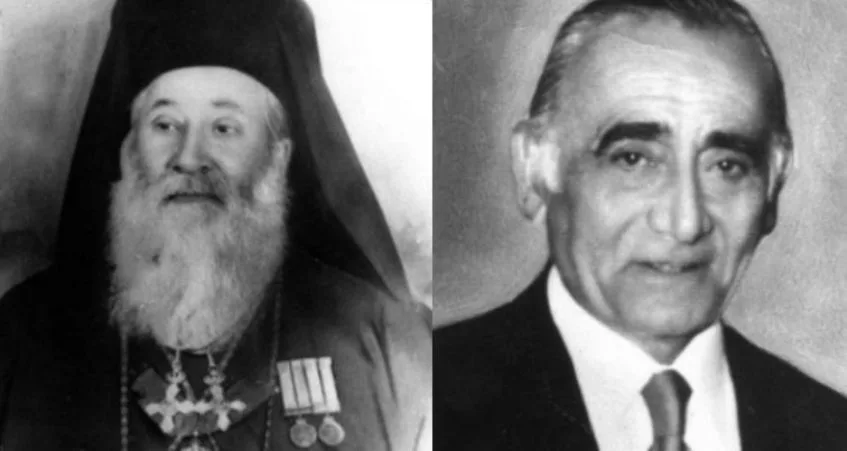
Before the war, approximately 75,000 Jews lived in Greece, including 50,000 in Thessaloniki. Between March and August 1943, Nazi authorities deported nearly all to Auschwitz-Birkenau. Fewer than 10,000 survived, among them about 1,800 from Thessaloniki. Across occupied Greece, clerics and civilians risked their lives to save their Jewish compatriots. Metropolitan Gennadios of Thessaloniki appealed in vain to halt the deportations, while Archbishop Damaskinos of Athens instructed priests to issue false baptismal certificates. Chief Rabbi Elias Barzilai of Athens destroyed community records to protect his congregation. On the island of Zakynthos, Metropolitan Chrysostomos and Mayor Loukas Karrer refused to surrender a list of the island’s Jewish population, instead submitting only their own names. With the quiet cooperation of civilians who hid and sheltered Jewish families, the Jewish community of Zakynthos survived the Holocaust.
Metropolitan Chrysostomos and Mayor Loukas Karrer
Following Italy’s surrender to the Allies in September 1943, German forces occupied former Italian-controlled territories, including the Dodecanese. Italian troops were ordered to join Germany or face imprisonment or execution. On Cephalonia, over 5,000 Italian soldiers were massacred after resisting for over a week. Some survivors escaped to join Greek partisans.
By late 1943, much of rural Greece was under partisan control, with resistance networks numbering 1–1.5 million. The Nazis responded with brutal reprisals: around 1,600 villages in Greece were destroyed. In Kalavryta (December 1943), hundreds of men and boys were executed, and the town burned; nearly 700 civilians were killed overall. At Distomo (10 June 1944), over 200 civilians were killed. Similar atrocities occurred at Viannos, Kandanos, and Chortiatis. Greeks persisted in resistance until the German withdrawal.
Liberation and Aftermath
Athens was liberated on 12 October 1944, but for most Greeks, liberation brought exhaustion rather than celebration. In December 1944, violent clashes broke out in Athens between the forces of EAM–ELAS and British troops supporting the government of Georgios Papandreou, which had returned from exile. The Dekemvriana left thousands dead, exposing political divisions. Occupation and war had already claimed hundreds of thousands of lives in a nation of seven million. Civil war erupted between 1946 and 1949, claiming over 100,000 more lives and deepening political divisions for generations. Economic devastation forced mass emigration.
My father, like many Greeks of his generation, grew up amid the horror of occupation and war. My grandfather rarely spoke of those years. When he returned home, my grandmother barely recognised him: his hair and beard had grown wild, his frame hollowed by war. He had missed the early years of his children. The family understood he had witnessed horrors few could imagine, but no one pressed for details. My brother once asked him about the war when visiting him in our village of Elos in Laconia. His eyes fixed on something ever-present—the weight of memories he could not fully share. And yet, in the shadows of those memories, the cry of “Aera” endured, a symbol of the courage and resilience that carried him and many others through the war.
Surviving did not mean forgetting. The same men who had roared “Aera!” across the mountains of Pindus and resisted the Nazi occupation returned home in silence. This silence was shared with civilians, including women and children, who had endured the occupation, famine, and loss. Their traumatic experiences were passed on to the next generation, imprinted not in stories but in the silences between them.
Coming the week of November 3: The next article explores how the war reached Greece’s remotest islands, the Dodecanese, focusing on Kastellorizo.
*Dr. Themistocles Kritikakos is a Greek-Australian historian and writer. He holds a PhD in History from the University of Melbourne. His forthcoming book, Armenian, Greek, and Assyrian Genocide Recognition in Twenty-First Century Australia, will be published by Palgrave Macmillan in December 2025.
In 2003, a wildfire propelled by strong, hot winds from Africa destroyed thousands of ancient olive trees in Crete. Destructive wildfires are tragically common in the dry Greek summers, but the response of one family who lost all their trees is inspiring. On their burnt land, they created the Botanical Park of Crete, a fruitful celebration of nature.
In 2010, following seven years of hard work, the Botanical Park and Gardens opened to the public, along with a restaurant featuring local products. After lunch there one day last spring, Petros Marinakis, founder and managing director of the park, told me how burnt olive groves were transformed into a botanical wonderland.
A Fiery Beginning: The History of Crete’s Botanical Park
The October 2003 fire started with electrical cables in a village near the Marinakis family’s olive groves. Strong winds blowing from Africa at the extreme level of 11 on the Beaufort scale swiftly spread the flames. As Marinakis explains, “in 24 hours we lost everything around us—thousands of olive trees, most of them thousands of years old, from the Minoan, Venetian, and Ottoman periods.”
Tragically, “we lost many trees the same size and age as the Vouves tree”—the 3,000 to 5,000 year old monumental olive tree visited by thousands annually in the village of Ano Vouves. “The disaster after the fire was economic, environmental, and cultural,” Marinakis observed, as some of “the oldest olive groves on the planet were lost.”
“After this catastrophe,” Marinakis said, “I thought about how people in our day live totally differently from the previous thousand years, totally disconnected from the natural environment. It’s the first time people are living in boxes in a technological environment. Young people don’t know how an olive tree looks, or an orange tree.”
Marinakis had grown up in a farming family with a love for nature, then studied tourism business management. He wanted to help the area and his family get back on their feet. “I wanted to do something for the area. I wanted to do something for society.”
Building the Botanical Park of Crete: Vision, Roots, and Ecological Design
Working with two of his three brothers, Kostas and Stratis, Petros Marinakis decided to “create a garden where people can learn” on his family’s 20 hectares of burnt land. His focus was “not a business; it’s more philosophy, to try to connect people with nature. We don’t use chemicals. We have an ecosystem totally balanced, in harmony.”
He also wanted to “be connected with society, promoting everything the area produces. Only coffee and sugar come from abroad. The rest is from the area. We promote the local tastes, connect visitors with the natural environment and our flavors, our products, our economy.”
How did he create that amazing garden? “First,” Marinakis reports, “I studied the property’s temperature, soil, morphology, and peculiarities. I determined where I would plant the tropical, Mediterranean, and alpine plants. I made lists of plants. I found many plants from Greece and the European Union. I brought the tropical and rare plants from Asia, Africa, and America through nurseries in Europe that have a special license to import plants from other continents. For the last 20 years, my mind has been in the botanical garden 24 hours a day.”
Where Three Climate Zones Meet: The Botanical Park of Crete’s Global Garden
Marinakis emphasizes that the uniqueness of the Botanical Park and Gardens of Crete extends beyond its history. “First, it is the only garden in Europe that specializes in spices, herbs, and medicinal plants.” Moreover, “the microclimate is unique,” with surprising variations in a relatively small area. “In the flat area in the valley you see avocadoes and citrus. We grow mangoes and lychee from a tropical environment.”
Higher up, outside the garden, we can see olive trees growing on the hillsides of the foothills of the White Mountains. That is a Mediterranean zone. Above that, where the olive trees stop and little can grow, there is an alpine zone. So in addition to the island being located between Africa, Europe and Asia, with the tall mountains near the garden, there are ideal conditions to grow almost everything from around the world.
Exploring Crete with Kids: Discovering the Botanical Park’s Animals, Nature Trails, and Local Food
As some of the park’s earliest visitors, my family and I have returned regularly, watching the little trees grow as our children did. We introduced friends and family to the Botanical Park and Restaurant. When our children were small and easily tired, the distractions of the ducks, peacocks, donkeys, and other creatures that lived on the garden’s hillsides, valley, and pond were helpful. Our children’s pace eventually exceeded ours, so they reached the hilltop restaurant before we did.
The restaurant became known not only for its lovely view and excellent local products, but also its creative take on Cretan cuisine and attention to artistic detail. Its food features local extra virgin olive oil, mostly from the Tsounati variety. Thirty percent of the olive oil comes from the Marinakis family’s own production, with the rest from small Cretan producers. (Olive oil and other local products are available in the restaurant’s spacious shop.)
As our children grew, the garden’s trees began to provide more shade, and plants filled in the empty spaces. Every year, we noticed new plantings, new rest stops and benches, and other improvements and additions. We spotted Greek pottery and garden ornaments, a whimsical doorway, garden implements hung in a line from a tree, old farming tools and machines among herbs and fruit trees, different bridges positioned over the brook, tunnels of trees and bamboo, even a stone throne where we could sit to survey the lush valley, and a cooling shower for summer walkers.
From Wildfire to Wonder
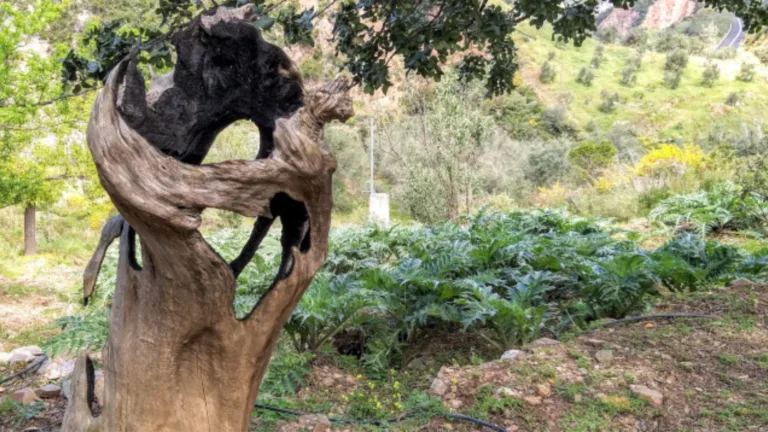
As their website says, “amidst the vibrant, colorful landscape stands a burnt, ancient olive tree, a poignant memorial and reference point to the devastating 2003 fire, marking the history and origin of the Garden.” Beyond the tree, paths wind up and down hills and through the valley, among vibrant orchards and herb gardens, past striking Mediterranean and tropical flowers. Come to admire, observe, exercise, learn, meditate, relax, photograph, eat, drink, and commune with nature. Born from the ashes, this ever-evolving park impresses both locals and visitors from around the world.
*Originally published on Greek Liquid Gold: Authentic Extra Virgin Olive Oil (greekliquidgold.com). See that site for recipes with olive oil, photos from Greece, agrotourism and food tourism suggestions, and olive oil news and information.
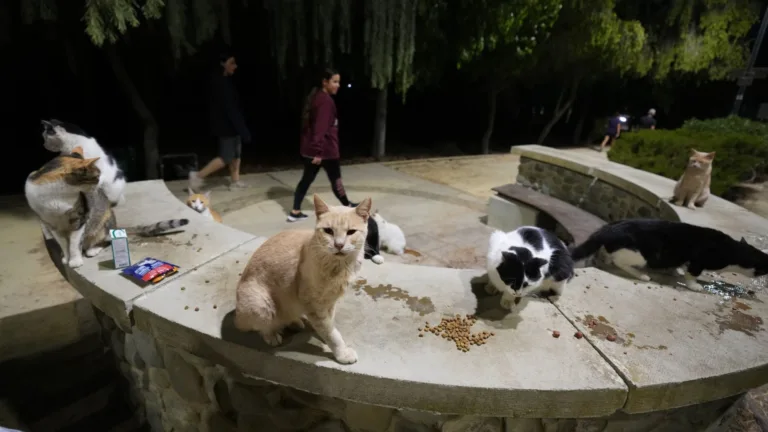
Cyprus, long known as the “island of cats,” is struggling with an estimated one million felines roaming its streets – roughly one for every resident. Activists believe the actual number could be far higher, ekathimerini.com, has reported.
In late September, the parliamentary environment committee was told that the current sterilization program is insufficient to manage the growing population. “It’s a good program, but it needs to expand,” said Environment Commissioner Antonia Theodosiou, noting that only 2,000 cats are sterilized annually on a €100,000 budget.
Marking World Animal Day on October 4, Environment Minister Maria Panayiotou announced that funding would triple to €300,000 a year – a move welcomed by animal advocates. Yet Parliamentary Environment Committee chair Charalambos Theopemptou warned, “There has to be a plan… We can’t just go ahead with sterilizations without having a plan.”
The island’s large cat population poses ecological risks and raises welfare concerns for thousands of strays scavenging for food. Cyprus’s bond with cats runs deep: a 9,500-year-old burial found by French archaeologists showed an early human-cat companionship, while legend says Saint Helen brought cats to combat snakes in the 4th century AD.
Experts blame unchecked breeding and ineffective coordination between state and local authorities. The Veterinary Services admit the program’s reach is “lesser than the real need.” Animal welfare groups argue that without involving conservationists skilled in trapping and neutering cats, extra funding will fall short.
Veterinary Association president Demetris Epaminondas believes the population could be controlled within four years through a unified national plan, greater public participation, and incentives for private clinics. “People will be more motivated to get cats neutered if we make it easier for them to do so,” he said.
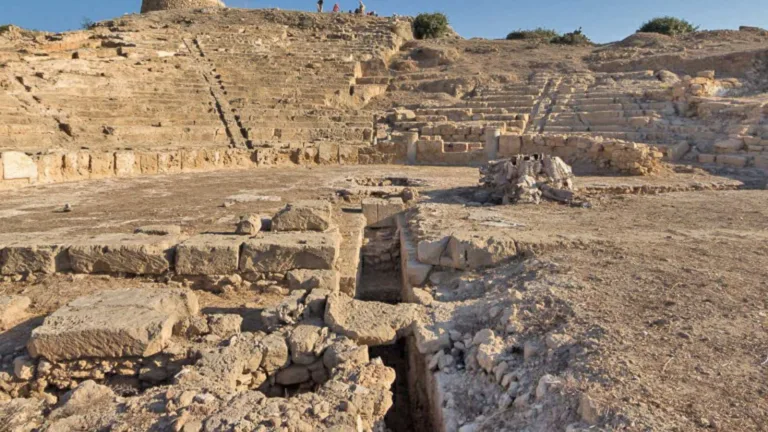
Excavations at the ancient Hellenistic–Roman theatre of Nea Paphos are set to resume, following discussions on Friday between Paphos Mayor Phedonas Phedonos and Professor Craig Barker of the University of Sydney, cyprus-mail.com, has reported.
As part of the Paphos Theatre Archaeological Programme, the meeting focused on promoting the site’s cultural importance and planning the first excavation since 2023. “The aim of the programme is to uncover, document and showcase one of the most important monuments of ancient Cypriot and wider Hellenistic cultural heritage,” the municipality stated.
The theatre, first excavated in 1955 under the Cyprus Department of Antiquities, was active for over six centuries—from its construction around 300 BC until it was destroyed by an earthquake in 365 AD. Originally built for theatrical performances, it was later transformed in the Roman era into an arena capable of hosting water spectacles.
The 2023 excavation uncovered one of the site’s most notable discoveries: the remains of a royal box, a central seating area offering shade and comfort for distinguished guests. A previous dig in 2019, involving more than 70 archaeologists and students from Australia, revealed several ancient and medieval structures, including an eight-metre-wide Roman road with an advanced drainage system leading to the city’s north-eastern gate. Evidence of wheel ruts indicated both pedestrian and vehicle use, and a second limestone road highlighted the area’s historical infrastructure.
During their meeting, Phedonos and Barker reviewed progress and discussed future collaborations. Phedonos praised the University of Sydney’s long-term contribution, while Barker thanked the municipality for its ongoing support, emphasizing that the project enhances Paphos’s and Cyprus’s international cultural profile.
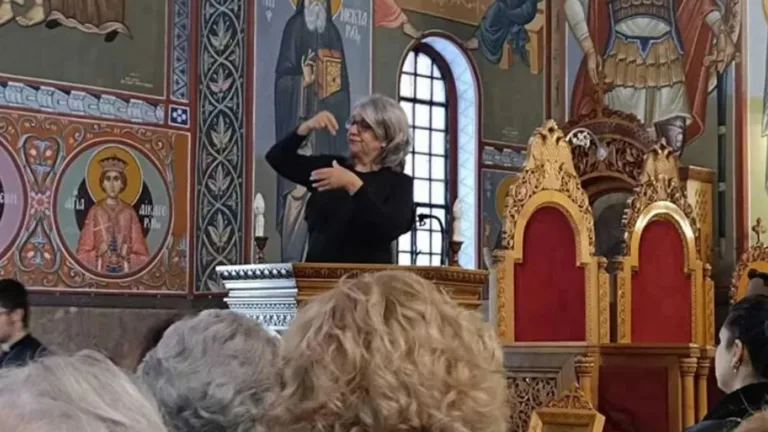
At the Metropolitan Church of Saint Nicholas in Volos, the Divine Liturgy was celebrated for the first time with simultaneous interpretation in sign language, kathimerini.gr.
As previously announced by the Holy Metropolis of Demetrias and Almyros, this initiative is directed toward fellow citizens with hearing difficulties, aiming to facilitate their participation in the liturgical life of the Church and to enhance their understanding of the sacred texts.
According to ERT, about thirty people with hearing impairments attended the service. The interpretation was provided by Dr. Galini Sapountzaki, Assistant Professor of Linguistics at the Department of Special Education of the University of Thessaly, who is also a certified sign language interpreter.
Father Epiphanios, head priest of the Metropolitan Church of Saint Nicholas in Volos, told ERT3 that the goal is for a Divine Liturgy with sign language interpretation to be held once a month, specifically on the second Sunday of each month.
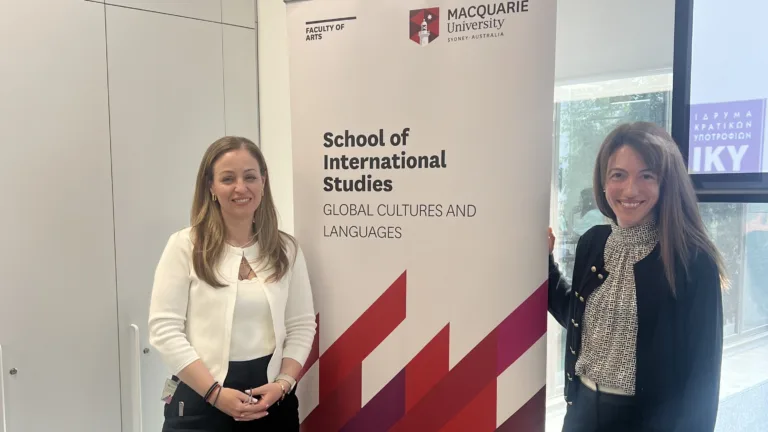
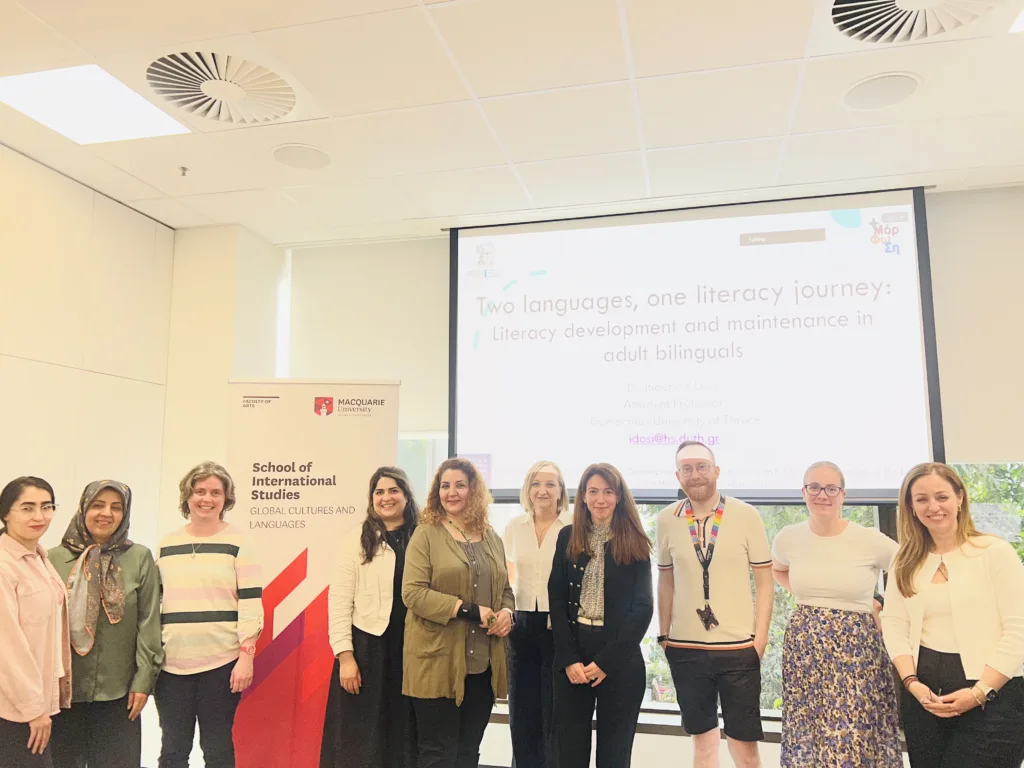
Macquarie University’s School of International Studies recently welcomed Dr Ifigeneia Dosi, Assistant Professor of Applied Linguistics at the Democritus University of Thrace, for a two-week research visit held from 6 to 18 October 2025.
The visit, fully funded by the IKY Scholarship Programme for the Development of Collaboration with Education Institutions or Bodies Dispersing Hellenic Culture Abroad, further strengthened educational and cultural ties between Greece and Australia.
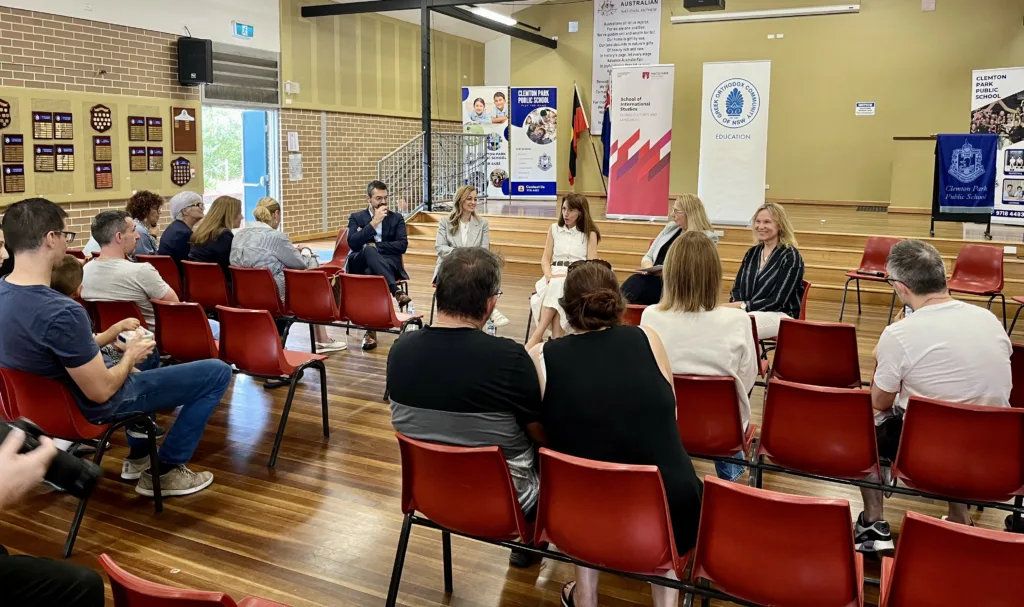
Throughout her stay, Dr Dosi participated in a series of academic, educational and community-engagement activities, including guest lectures, teacher-training seminars, and meetings with students from the Modern Greek Studies Program and members of Sydney’s Greek community, reinforcing the shared commitment of both nations to promoting Hellenic culture and bilingual education.
What is the aim of your research, and why did you choose to study the Greek diaspora in Australia?
The primary goal of my research is to explore the language development and literacy skills of bilingual children within the Greek diaspora, with a particular emphasis on Modern Greek as a heritage language. I chose to focus on the Greek community in Australia because it is one of the most historically established and vibrant Greek diasporic communities worldwide, offering a rich context for examining long-term language maintenance and intergenerational transmission and, paradoxically, one of the least studied.
Moreover, Australia’s multicultural education policies and community-based language schools provide a valuable framework for investigating how heritage languages like Greek are supported or challenged across home, school, and community settings.
In your view, what is the significance of Modern Greek as a heritage language for children in the diaspora? What are the key factors influencing its maintenance?
Modern Greek, as a heritage language, plays a critical role in shaping children’s cultural identity, emotional connection to their ancestry, and cognitive flexibility. It provides them with a deeper understanding of their roots and enables meaningful intergenerational communication within families.
The maintenance of the language is influenced by a range of factors, including parental attitudes and practices such as the consistent use of Greek at home access to quality heritage language education, community support and cultural engagement, the availability of developmentally appropriate and culturally relevant resources and teaching methods, as well as the perceived status and value of the language within both the family and the wider society. Without active and coordinated support across these domains, the intergenerational transmission of Greek remains at risk.
During your stay in Sydney, you engaged with members of the Greek community. Can you tell us about the activities you participated in with Dr. Patricia Koromvokis during your time there?
During my stay in Sydney, I had the privilege of collaborating closely with Dr. Patricia Koromvokis in a series of academic, educational, and community-oriented activities that strengthened both my research and engagement with the Greek diaspora.
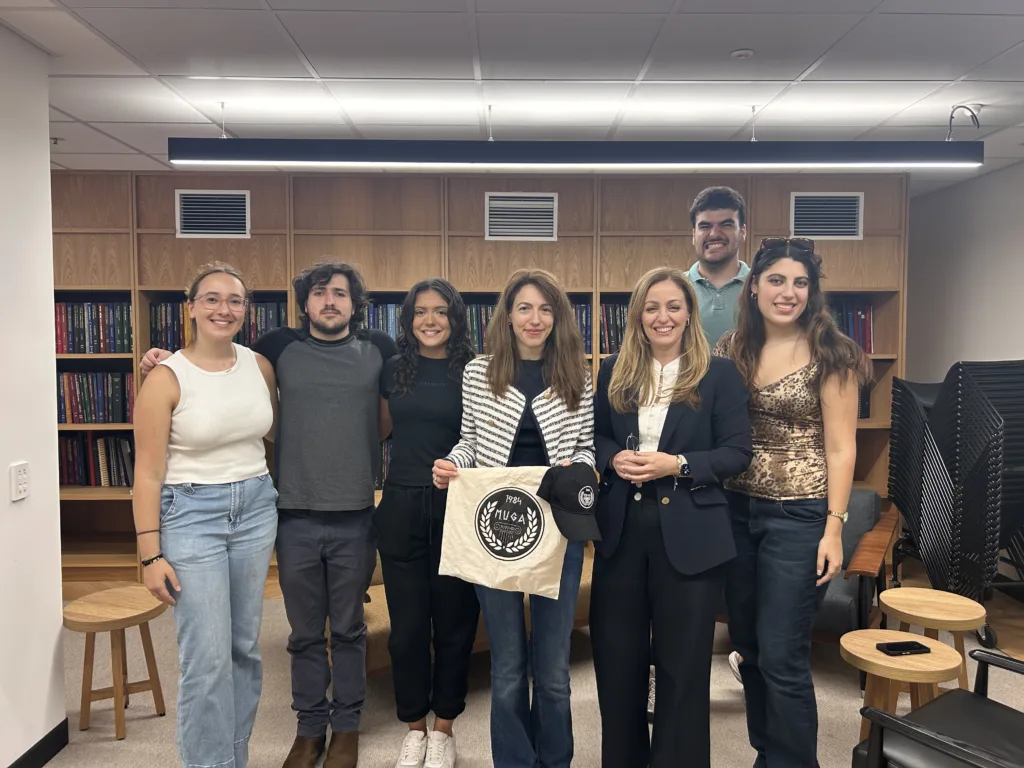
At Macquarie University, I presented a guest lecture at the School of International Studies, titled “Two Languages, One Literacy Journey: Literacy Development and Maintenance in Adult Bilinguals,” focusing on bilingual literacy development and maintenance. Additionally, I met with students from the Modern Greek Program (MUGA).
Together with Dr. Koromvokis, we developed a joint research proposal examining the written narrative abilities of bilingual children in the Greek diaspora. As part of this project, we will undertake data collection from students in Greek community schools to support ongoing research on heritage language development.
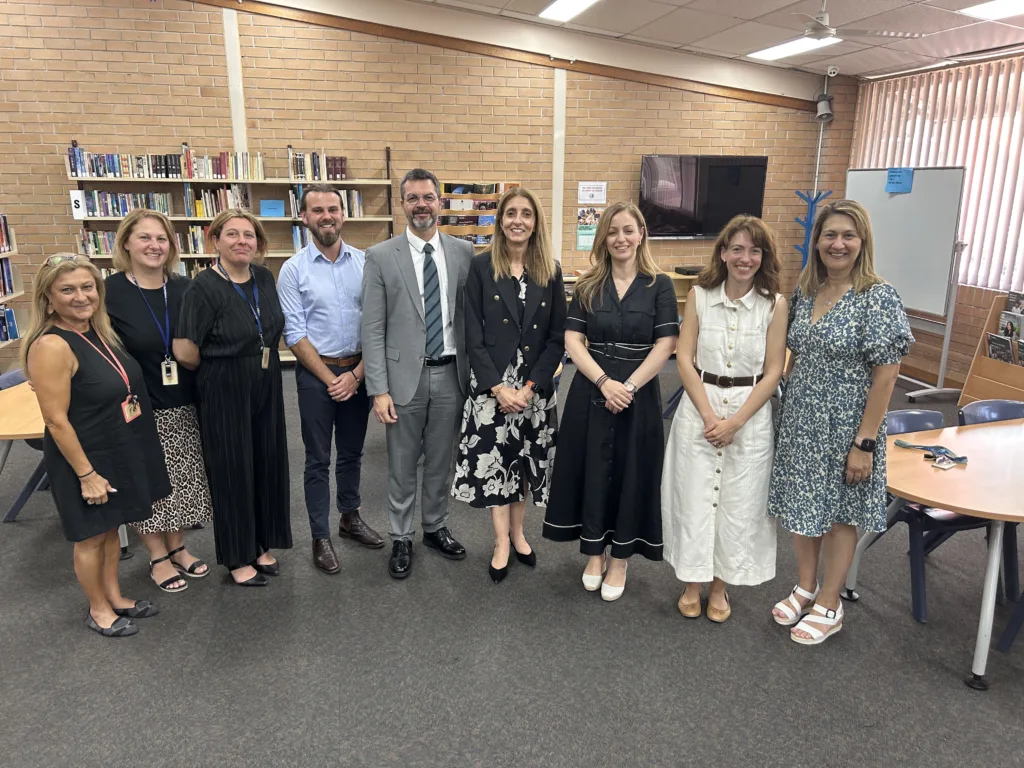
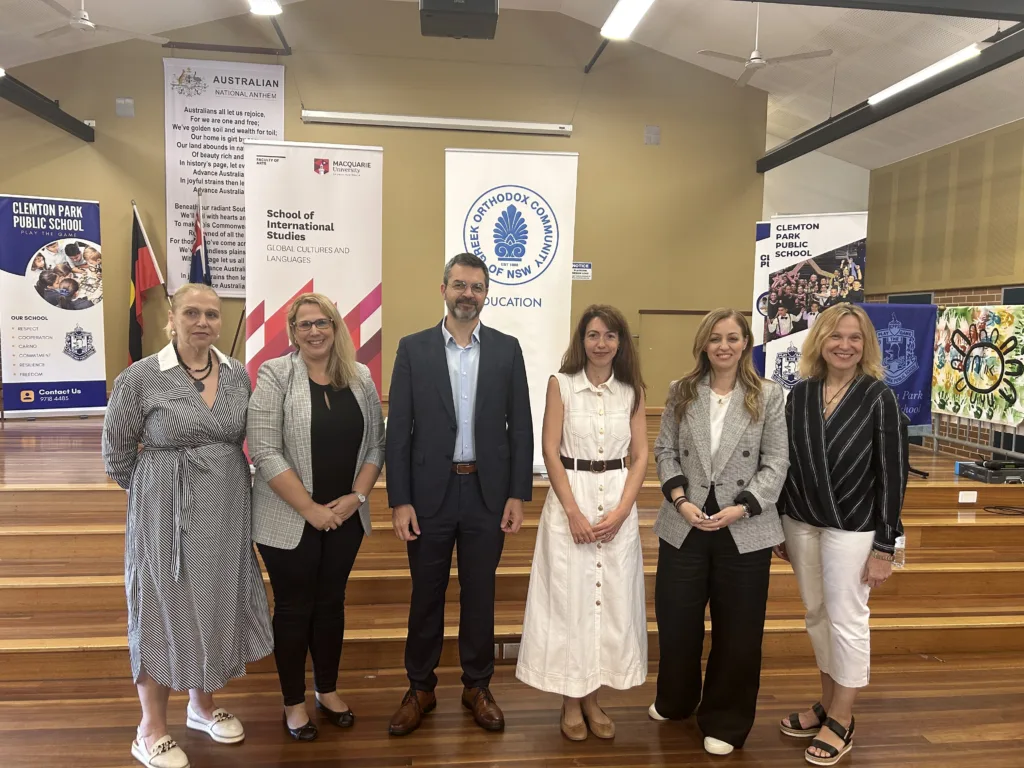
Beyond the university setting, we co-organised and facilitated a total of nine professional development seminars for teachers and parents across Greek community schools and organizations. These included workshops at All Saints Grammar School, St Spyridon College, St Euphemia College, and the Greek Orthodox Community of NSW School, focusing on practical classroom strategies for supporting Greek as a heritage language.
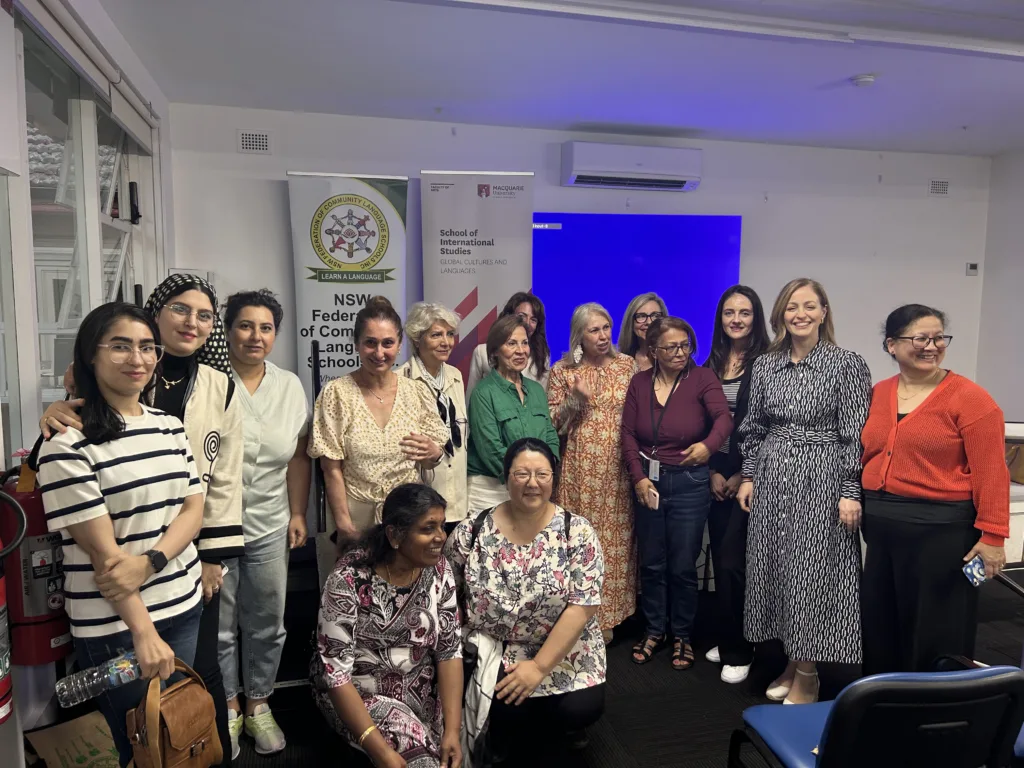
I also delivered seminars through the NSW Federation of Community Language Schools and the Sydney Institute for Community Languages Education (SICLE), addressing topics such as “Supporting Minority Languages in Bilingual Children: Practical Strategies for the Classroom.”
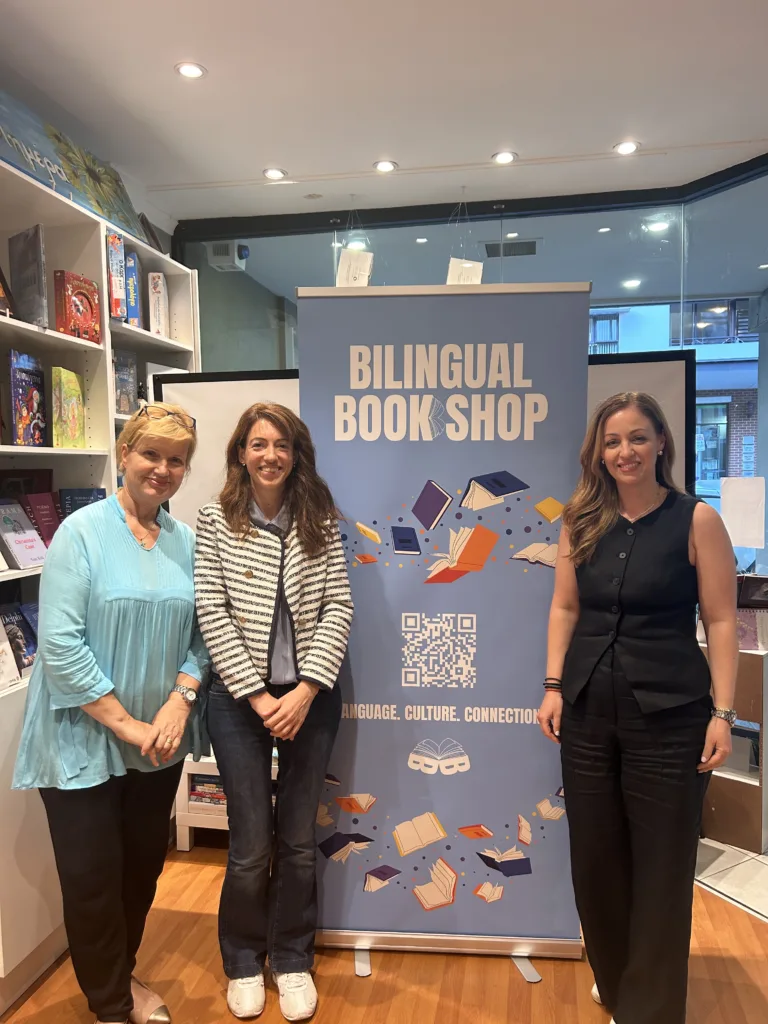
Further sessions included a workshop at the Bilingual Bookshop, titled “Teaching Greek as a Heritage Language: Theory and Practice,” and a community seminar for parents entitled “The Benefits of Speaking Greek at Home with Your Children,” which was accompanied by the distribution of informational materials offering practical guidance for language use in the home environment.
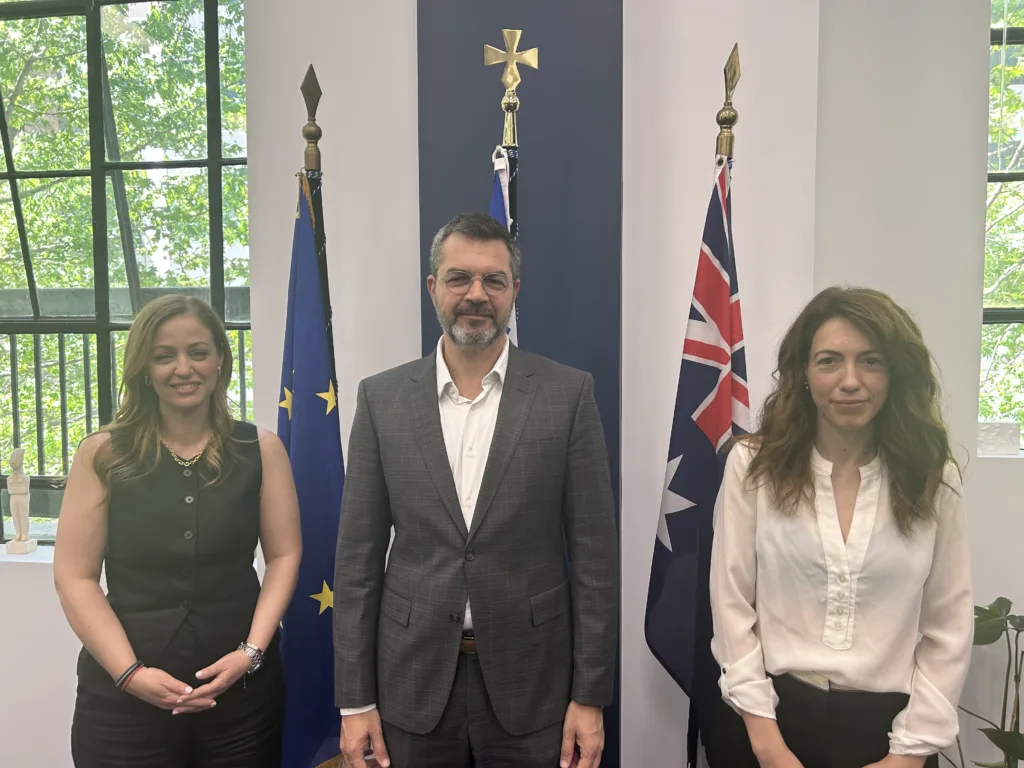
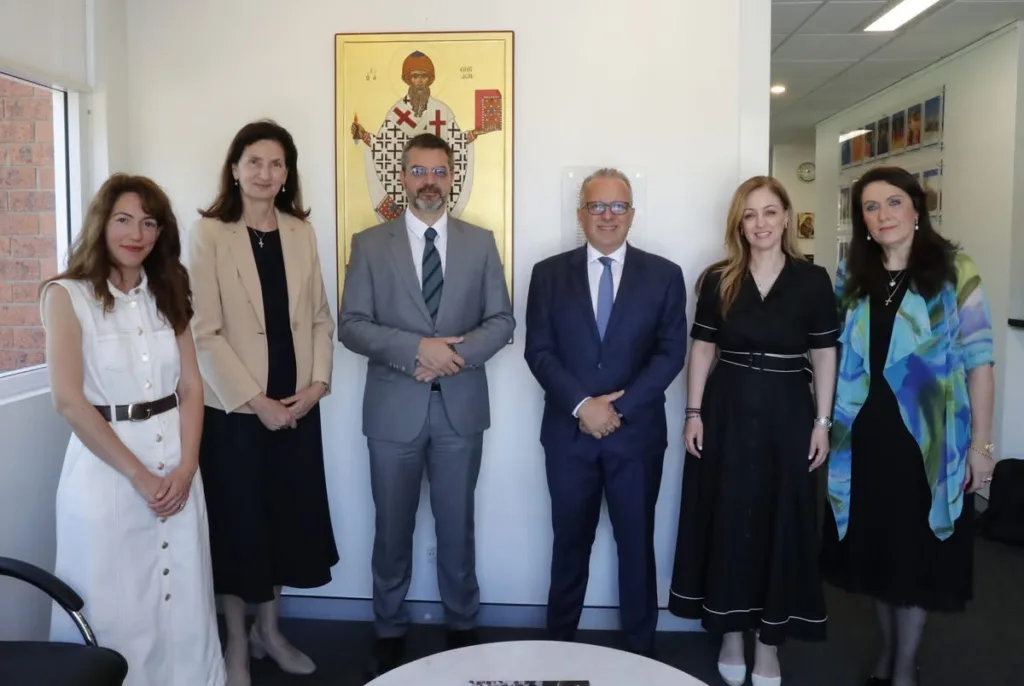
In addition, Dr Koromvokis and I engaged in networking and outreach activities, including meetings with the Consul General of Greece in Sydney, George Skemperis, to discuss ways of promoting Greek as a heritage language, and with representatives of Greek Australian organisations such as PHAROS NSW and members of the wider Greek community, to explore possibilities for future collaborative educational initiatives.
How can the education sector, parents, and cultural organisations within the diaspora more effectively support the bilingual development of children?
Effective support for heritage language maintenance requires a holistic and collaborative approach. Educational institutions should provide systematic, research-informed instruction in heritage languages, integrate culturally responsive pedagogies, and ensure that teachers receive adequate training in bilingual education.
Parents also play a vital role by consistently using the heritage language at home, fostering positive attitudes toward bilingualism, and engaging children in authentic Greek literacy experiences such as reading books, watching media, and sharing stories in Greek.
Likewise, cultural organisations contribute by creating immersive, intergenerational, language-rich environments through events, clubs, religious services, and summer programs that strengthen both linguistic competence and cultural identity. Moreover, joint initiatives such as parent–teacher workshops, bilingual educational resources, and community-led campaigns can further enhance children’s motivation, engagement, and exposure to Greek across multiple contexts.
Based on your experience, how do you see the future of the Modern Greek language within the diaspora, and what are the next steps in your research in this field?
The future of Modern Greek within the diaspora presents both challenges and opportunities. While there is an evident risk of language attrition and potential loss, particularly among third- and fourth-generation speakers, there is also a growing recognition of the cognitive, cultural, and emotional benefits of bilingualism. Community-driven initiatives, research-informed educational practices, and the use of technological tools such as digital learning platforms and Greek language apps offer innovative pathways for maintaining interest, proficiency, and intergenerational transmission.
The next phase of our research with Dr Koromvokis will focus on conducting empirical studies that examine the linguistic development of bilingual children in the diaspora, as well as implementing and evaluating classroom practices that support the development of Greek oral and written skills. Finally, we plan to develop practical toolkits for educators and parents designed to strengthen the use and sustainability of Greek in bilingual contexts.