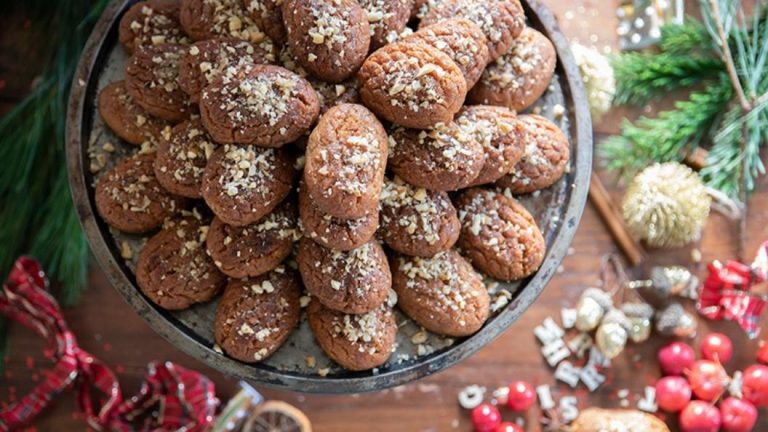
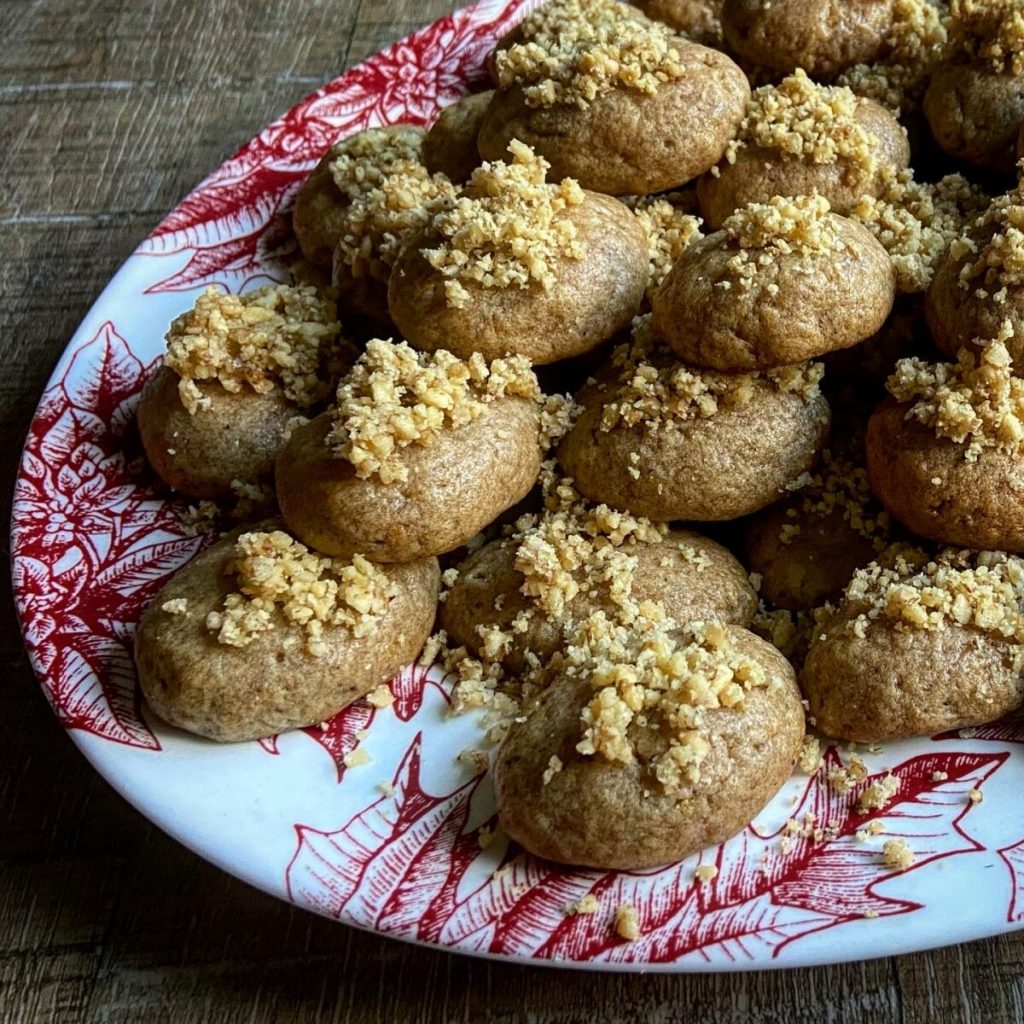
Melomakarona are a classic Greek traditional delicacy, filled with flavours of cinnamon, orange and walnut.
They are a popular treat throughout the year but especially during Christmas their sweet aroma fills the house with an intensely sweet smell.
Ingredients
For the syrup:
500 g water
800 g granulated sugar
150 g honey
3 stick(s) cinnamon
3 cloves
1 orange, cut in half
For the biscuits:
First mixture
400 g orange juice
400 g seed oil
180 g olive oil
50 g icing sugar
1/2 teaspoon(s) cloves
2-3 teaspoon(s) cinnamon
1/4 teaspoon(s) nutmeg
1 teaspoon(s) baking soda
Orange zest of 2 oranges
Second mixture
1 kilo all-purpose flour
200 g semolina, fine
For the garnish:
100g crushed walnuts
Cinnamon
Instructions:
Preheat oven to 180 degrees celsius and line two baking trays with parchment paper
Boil all of the syrup ingredients apart from honey. When it has melted, remove from the heat, add honey and mix until combined.
Let the syrup cool for 3-4 hours or even overnight so that it cool by the time the cookies are ready
To make the biscuits, you need to prepare two separate mixture
For the first mixture, add all of the first mixture ingredients into a large bowl and mix using either an electric or hand whisk
In a separate bowl, mix together the flour and semolina
Combine the first and second mixture together in a large bowl and very gently mix by hand for a short time to avoid the mixture splitting or curdling
Shape the batter into oval shapes and place onto the baking tray
Bake the biscuits for about 20-25 minutes or until golden brown
When the melomakarona comes out of the oven, begin soaking the hot biscuits in the cold syrup. This is best done by placing an individual biscuit onto a slotted spoon and dip into the syrup for about 10 seconds
Remove the cookies using the slotted spoon and place onto a wire rack to drain
Once drained, you can top the biscuits with crush walnuts and a sprinkle cinnamon and they are ready to be served!
The decision on Friday by the Parliamentary Assembly of the Council of Europe’s Culture Committee condemning Turkey’s move to convert Hagia Sophia in Istanbul from a museum into a mosque was hailed by the Greek delegation head, Dora Bakoyannis, as Europe’s response to Turkey’s “systematic violations of democratic principles and values.”
In a Facebook post, Bakoyannis said both Greek and Cypriot delegations have been raising awareness and mobilizing members of the Parliamentary Assembly for months.
“Turkey’s unilateral decision was condemned as unacceptable and incomprehensible, as a divisive move of discrimination contrary to all the principles of the Council,” she said.
Hagia Sophia was built in the 6th century as a Greek Orthodox Christian cathedral and was converted into a mosque after the Ottomans conquered Constantinople, now Istanbul, in 1453. The Turkish government turned it into a museum in 1934.
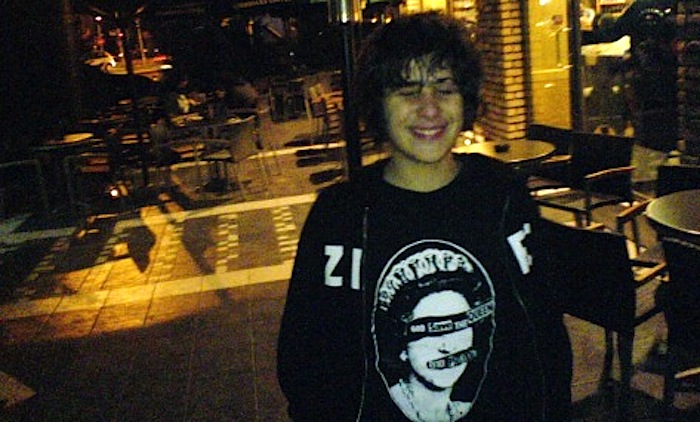
On December 6th 2008, 15-year-old student Alexandros Grigoropoulos was shot and killed by a police officer in Exarchia, Greece. The murder triggered a wave of riots across the nation and eventually the incident took on international proportions and events of solidarity and support were organized in many major cities around the world.
On the evening of December 6th, at around 9pm, Grigoropoulos and his friends were sitting in a corner in Exarchia, where they exchanged swear words with two policemen in a patrol car that was passing by.
Later, Epaminondas Korkoneas and Vasilis Saraliotis returned to the scene on foot. Here, the verbal confrontation continued, when suddenly, Alexandros Grigopoulos was fatally shot by officer Epaminondas Korkoneas, a member of the special guard unit of the Greek police.
The two policemen returned to their station and informed their service of the incident, however they claimed that the shooting was in response to a renewed attack by the youths. Eye witnesses, however, invalidated this claim, reporting that the children did not ambush the officers.
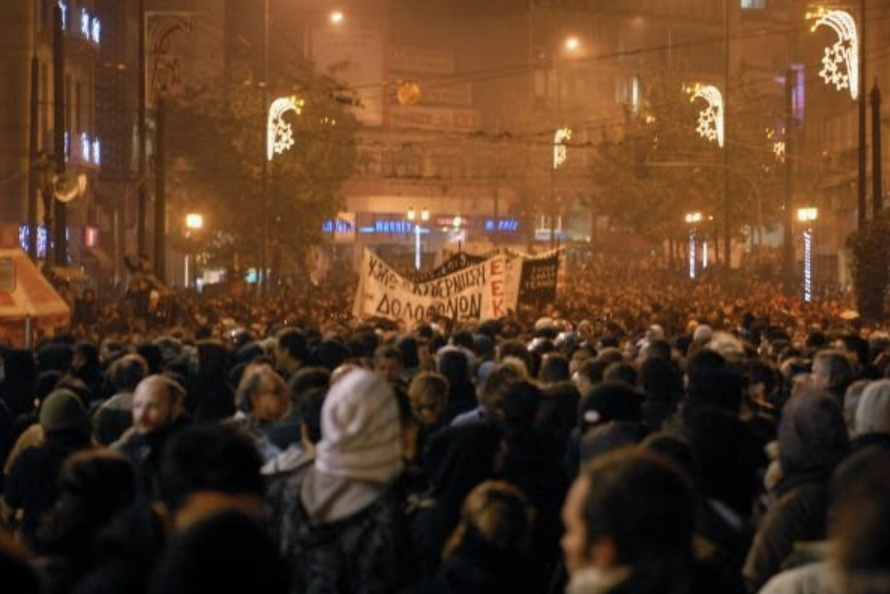
(Protests in Athens)
Immediately following the shooting, young Grigorpoulos was transported to the nearby Evangelismos Hospital where he was pronounced dead.
Within just an hour of the shooting, the news began to spread like wildfire. Angry demonstrators took to the streets of Exarchia and started burning trash containers, cars, bus stops and anything else they could. Soon more fires broke out all over Athens as more and more people clashed with the riot police. Overnight, similar demonstrations started to rise in many other Greek cities, and eventually, the riots took over the country.
The next day, Karolos Papoulias, the President of the Republic released a telegram of condolences to the student’s family. In this, he described the death as a “trauma to the rule of law” and expressed his determination and confidence to punish those responsible.
The large protest marches continued from December 7 – 10, as thousands of people came out to demonstrate their anger and disappointment in the Federal policing system. According to EVEA estimates, the damage caused in Athens alone exceeded 50 million euros.
The trial for the case of murder of Alexandros Grigorpoulos was set for December 15, 2009, and in the meantime, the defendents were held in custody, as officer Kornoeas was to be tried for manslaughter, and officer Saraliotis was to be tried for conspiracy to commit a crime. The mixed jury in Amfissa decided that Korkoneas was guilty of premeditated murder and the policeman received a life sentence. Saraliotis received ten years for accessory to murder.
Every year, on December 6th, the people of Athens mourn and remember the innocent life that was lost.
Following the recent internal conflict within the Macquarie University Greek Studies Foundation, The Greek Herald spoke exclusively with the Head of Modern Greek Studies at the university, Dr Patricia Koromvokis.
Dr Patricia Koromvokis was able to provide a clear explanation of the changes to the Greek Studies Program in 2020, along with how these changes may affect future enrolment for next year.
How has Macquarie University’s Greek Studies Program progressed coming into the end of 2020? With reference to enrolment numbers (compared to previous years etc) and active engagement in the Modern Greek courses.
The enrolments of 2020 reflect the results of the new curriculum architecture, which was implemented for the first time in 2020. The number of enrolments in Modern Greek Studies Program of Macquarie University was very good across all language and cultural units. In fact, enrolments increased in language units in both semesters. One of the cultural units, convened by Modern Greek Studies Program in conjunction with the Ancient History Department, had a slight decrease in number due to the change of mode offering in the new curriculum of 2020.
The rapid transmission into remote learning (online delivery) did not have a negative impact in the engagement of language learning, as Macquarie University has been offering online learning across all courses years now. I have to mention that I feel every proud of all the students’ excellent performance and achievements especially under these unique and challenging conditions.
What changes have been made due to the financial difficulties that the Australian universities are facing due to pandemic?
Given the current pressures on university’s finances and operations, Macquarie University has made difficult and challenging decisions concerning the viability of some courses aiming to mitigate the impact on staff and students. The Faculty of Arts is in a good position in order to deliver a more sustainable suite of offerings and contributing to the financial remediation the University needs to undertake. Regarding Modern Greek Studies Program, some courses have been rested only for 2021. More specifically, for 2021 study options are:
– For Macquarie students: Minor in Modern Greek and elective units
– Students of other Australian universities: cross-institutional study (elective or minor)
– Everyone else (+18 years old): Non-award
All courses are offered on-campus in our new language labs, fully online and blended tutorials (no difference in the content between the cohorts) with best available resources, online lectures by guest lecturers from Greece and Australia and peer-led extracurricular activities aiming at an effective and engaging language learning experience.
Do you expect the enrolments in the Modern Greek Studies Program will be affected by these aforementioned changes in 2021?
It is unavoidable that enrolments, especially in the Humanities, will be affected by these changes. However, taking into consideration the current difficult financial situation which has drastically affected all languages and departments in the Humanities across all Universities in Australia (staff and course/ program cuts), I am still confident that the transformation that Macquarie University needed to undertake in different areas, helps to secure the future sustainability of the Modern Greek Studies Program. The most vital thing right now is to continue offering Modern Greek courses at tertiary level!
Are we as a community promoting Greek enough?
I strongly believe that the Greek community has always promoted the Greek language in different ways. What I would suggest is, that more promotion should be done in the primary and secondary education sectors, which will enhance Greek language learning at tertiary level. This can be succeeded only by a fruitful collaboration between teachers and academics. Taking the opportunity of this question, I would like to express my sincere gratitude to all the MUGA (Macquarie University Greek Association) committee, and especially to the President, Sam Giovas and the Vice-President, Zoe Re, who have done a remarkable job under unique conditions. Working behind the scenes takes a lot of effort –which is sometimes not obvious to the community.
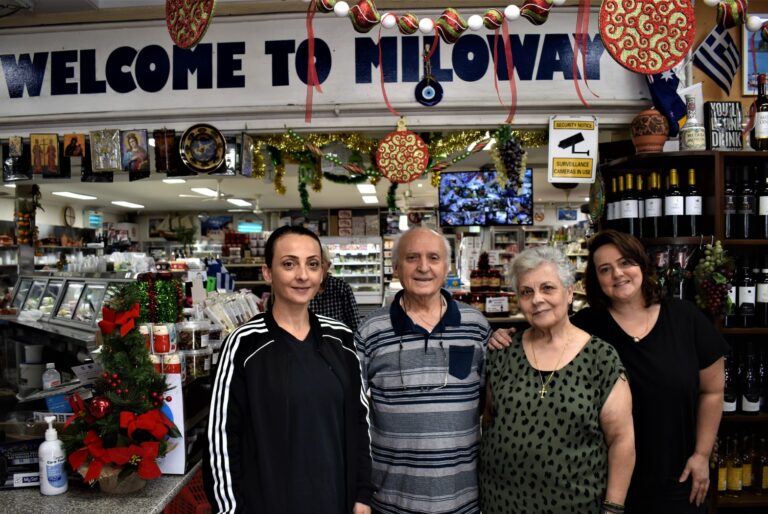
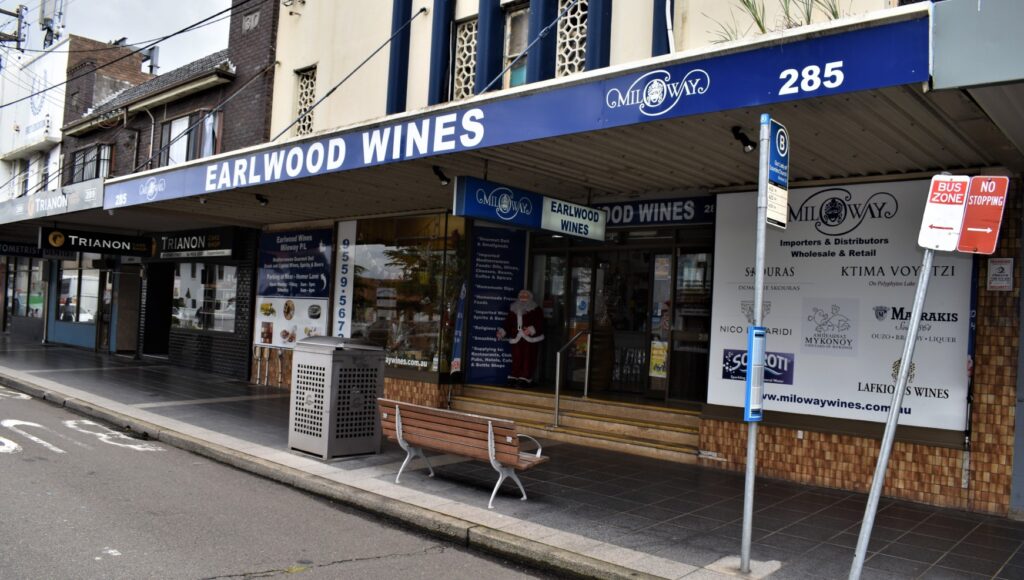
What is so fascinating is how small businesses become part of lives with the passing of time? Whether it is our familiarity or trust with them, we develop such a strong connection with them; although the decades may pass, and people’s tastes may change too, such successful small businesses are not affected- in fact, they just continue to develop and grow. Miloway Earlwood Wines, run by the Ipermachou family, is one such business; for locals it seems to have always been there but its strong reputation for its diverse range of high-quality Greek and Cypriot products and great service has broadened their customer base nationwide.
Although the Ipermachou family has been running Miloway Earlwood Wines for forty, the family story goes back to Dierona, Cyprus, where Harry (Ipermachou) was one of twelve siblings and he wrapped up a short-sleeve shirt and shorts, and set off for Limassol to look for work… at the age of eight years old!
With his brother, Panayioti, already in Sydney, Harry joined him in 1968 and his first job was at British Motor Company, or as it was known by so many migrants, Morris, where he had to fit the carpet in the cars on the process line. Having married Loula, also from Dierona, Cyprus, and finding work at Cinzano (Beverages), they initially settled in Mascot. Over the next eight years, Harry became leading hand, union delegate and then promoted to production foreman and then Penfold Wines approached and invited him to work for them.
Photo: Supplied
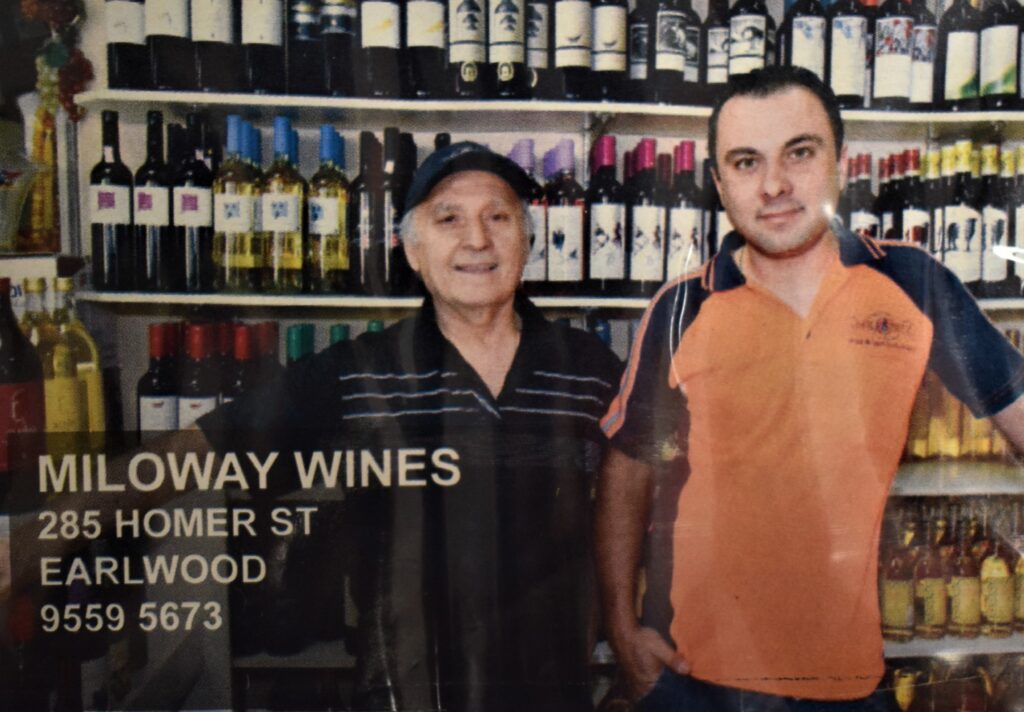
Being a regular customer of Antoniou Wines, Earlwood, its owner Andreas Antoniou informed Harry of his intentions of selling the business; having dreamt to run his business, Harry grabbed this opportunity in 1980. Asked what the difference between being an employee and running his own business, Harry humorously states, ‘When you have your own business, there is no watch or clock to look at the time because you do not go home until you finish what you start. I remember one time, in those early years, where I unloaded a truck of all these products on my own- I did not go home until it was done.
‘Secondly, there are so many sacrifices, over a long period of time, that are made for a business to grow. People may admire a successful business but they do not realise the enormous efforts and sacrifices that were made to achieve that success.’
Photo: Supplied
Highly motivated by their great love for their growing family and yearning for what their homeland could offer, Harry and Loula quickly expanded the delicatessen side of business, diversifying range of products. Harry recalls the challenges of importing Cypriot and Greek products, ‘In the 1980s, we were unknown and Cypriot and Greek companies were reluctant to deal with us. They would often say, “Australia? Why would I want to export to Australia?” and I would be back-and-forth from Greece and Cyprus to Australia, to make proposals, try their products, discuss how I wanted things adone and then make a decision. It was a very long process, that took many, many years to build that relationship between Greek and Cypriot companies and Miloway.
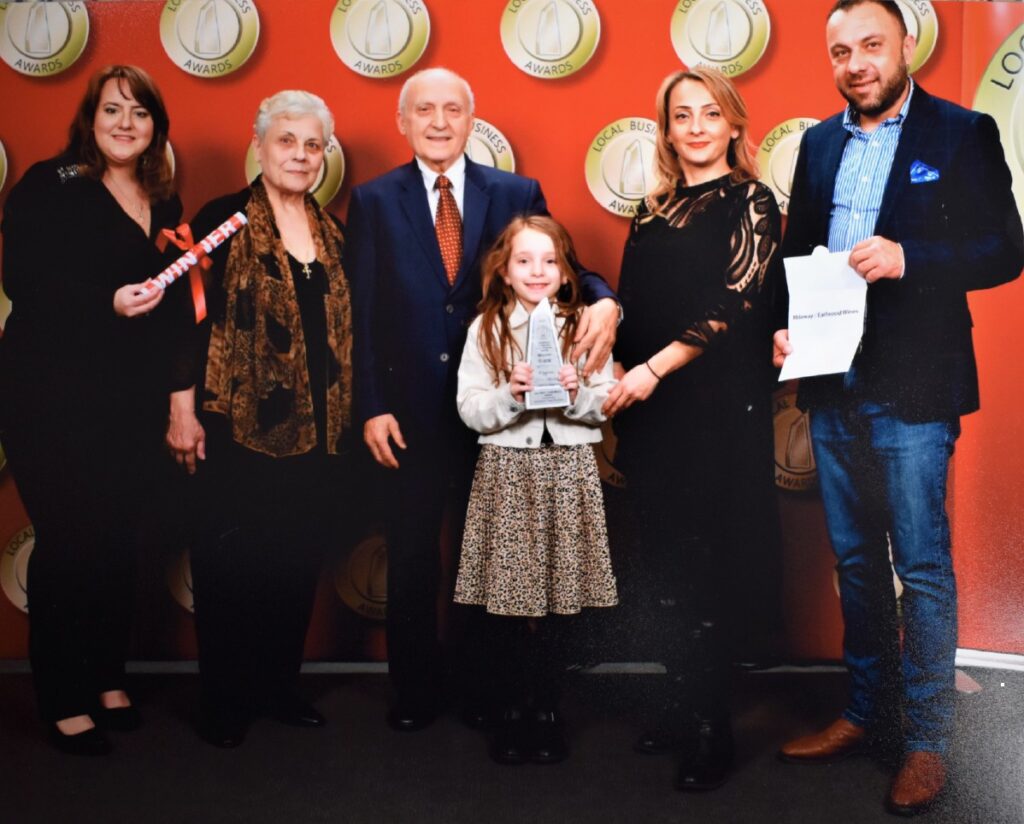
‘Nowadays, Cypriot and Greek companies seek us out (Harry laughs); Miloway has a strong network across Australia for their products to be promoted and distributed. In 2015, Miloway was recognised by the Greek Government for its wide variety of imported Greek products.’
Harry and Loula’s children. Kostas and Maria, grew up in the family business; despite having their own careers, they officially joined business in the 1990s.
Photo: Supplied
After all these decades and success, Harry’s love for the business has not waned at all; as he explains to Loula. ‘Our business is like our third child; we have spent my time here than our house,’ and this love is reinforced by Harry’s daily routine, ‘Every morning, I come to Miloway and I heat up the water for my coffee and light up the vigil lamp (kandili). After my coffee, I will do- what I call- my tour of the shop and I look at all the shelves and products, and I correct anything that is out of place.
We may be closed on Sundays but I still come in and check over the business- and have my coffee. If I do not do this, then there is something missing in my day (laughs).’
But what bring Harry great joy is- what he calls- the lure of Miloway’s front steps, ‘So many people come up our stairs and it is only after they are in our store for some time that they make a decision on what they want to buy. This is very special because it shows our store draws customers
Imagine this. You are learning Spanish or Chinese for the very first time and at your first lesson you are shown a beautiful storybook, which the teacher reads in Spanish and then a song.
The lesson is a lot of fun but when you leave the class and your mum asks you what have you learnt? You do not remember a thing.
Welcome to the world of most children beginning Greek in Kindergarten.
Even an adult would be lost.
So let’s rewind and maybe the first day was filled with a short story reading, a simple song or some background music and lots of playing games using words.
Maybe you can learn to pick out your name in Greek from a table with many names on it. Maybe you can pick out your friends’ names too!
Maybe the teacher has given you some stickers with words and a picture on them so you can label your pencil case, your book and your pencil. Maybe you can play a game with your friends and see who can copy the teacher’s voice and say these things in Greek.
These are tags. Maybe you have a picture of mum and dad and your sisters and brothers and your favourite pet or animal. All have a tag or word attached.
Sometimes, Kindergarten pre-school children cannot write at all. They are still learning to draw a straight line. How can they write their name in Greek when they haven’t even mastered a straight line or a circle yet.
Isn’t it more important they learn to recognise whole words that are relevant to them first?
So, reading often comes before writing and speaking sometimes comes before reading for native speakers. For our children it may come as they see the word for the first time. Especially for children of mixed marriages.
This is where reading to your children in as many languages as possible comes in.
The more books you read to your children the better. More about books later!
The Ladies European Tour (LET) confirmed on Monday that the 20-year-old from Sydney had followed in the distinguished footsteps of major championship winners Annika Sorenstam, Suzann Pettersen and Anna Nordqvist by winning the title.
The accolade completes a superb debut year as a professional for Kyriacou, who won the title by 92 points from England’s Alice Hewson.
Kyriacou was left anxiously waiting to hear whether she had landed the prize while in quarantine back in Australia following her European trip.
She had been forced to miss the last event of the season in Marbella because she couldn’t afford to turn down the rare chance of a flight home.
“It was one of my goals at the beginning of the year so I am glad that I could tick this one off the list,” said a delighted Kyriacou.
“There are some big names on the trophy and one of my friends has been updating me every week on my progress and as the season went on, I started to think I had a good chance.”
🇦🇺🏆 Stephanie Kyriacou 🏆🇦🇺
Australian amateur @Stephkyriacou2 wins the Geoff King Motors Australian Ladies Classic Bonville by 8⃣ shots.
Kyriacou made an extraordinary breakthrough as a teenage amateur at the start of this year, winning the Australian Ladies Classic Bonville, before immediately turning professional and joining the Tour.
Despite the fact that the points she gained with her breakthrough win did not count towards the title race, it did not stop the youngster proving herself the best new talent on the LET.
On a four-month, five-country, eight-tournament trip to Europe and the Middle East, while accompanied by her dad Nick who acted as her caddie, she gained five top-10 and two runner-up finishes.
She becomes the third Australian to win the Rookie award following Rebecca Stevenson (2003) and Nikki Garrett (2006).
“When I was playing amateur events, I thought I was ready but then I was so nervous in the first few events as a professional. Once I had made a few mates on Tour though, I started to feel more comfortable,” Kyriacou said.
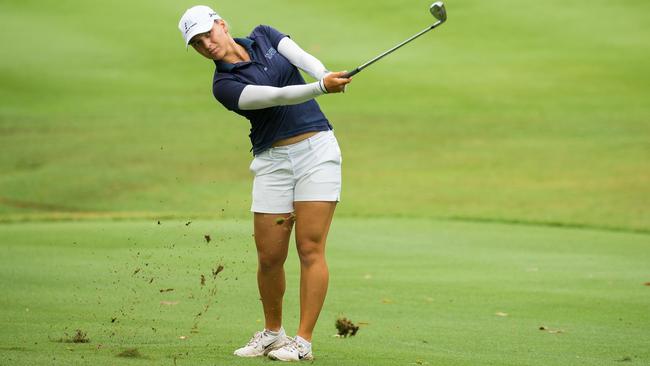
NSW amateur Stephanie Kyriacou in action during the final round of the Australian Ladies Classic at Bonville GC near Coffs Harbour. Picture: Tristan Jones/The Australian
“People think I look calm out there, but I am feeling the nerves just as much as anyone. I am so happy to win this title.”
Alexandra Armas, the Ladies European Tour’s CEO, said: “Stephanie has shown tremendous resilience in her first year as a professional.
“She has taken quickly to life on tour and kept us entertained with her exciting play on the course and easy-going attitude off it. She should be incredibly proud of her achievement.”
Next year, Kyriacou has the chance to make a unique piece of golfing history.
As there will be no 2020 LET Qualifying School and, for the first time, this year’s first-year professionals will again be considered as “rookies” in 2021, she has a chance to become the first-ever two-time Rookie of the Year.
Nikos Kourkoulos was a highly respected Greek theatrical and film performer, who left an enduring impact on the Greek culture of performing arts. Kourkoulos had exceptional talent and his work in the theatrical industry is still recognised to this day.
Early life
Nikos Kourkoulos was born on December 5th, 1934 in Athens and grew up in the district of Zografou. Growing up, Kourkoulos had a great passion for sports and became a Panathinaikos football player while in high school. Unexpectedly, he later turned his interest to the theatre, as he himself claimed that he took the plunge to become an actor after reading books on theatre.
Greek actor Manos Katrakis played a crucial role in this decision, as Kourkoulos looked to him as a role model. Katrakis guided Nikos to take exams at the Drama School of the National Theatre, from where he eventually graduated in 1958.
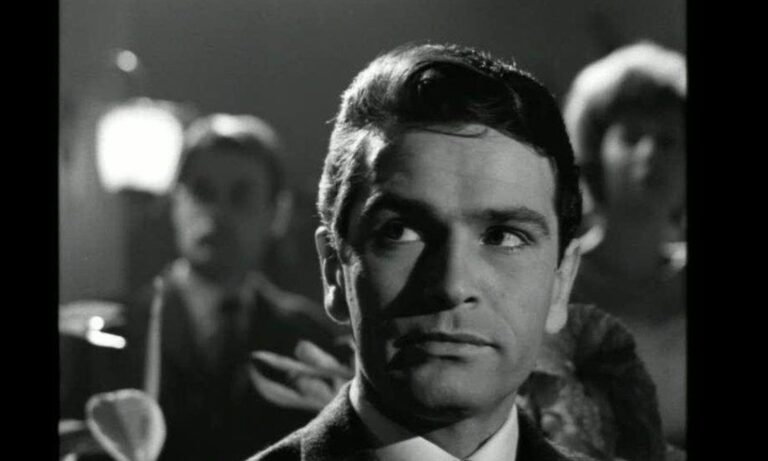
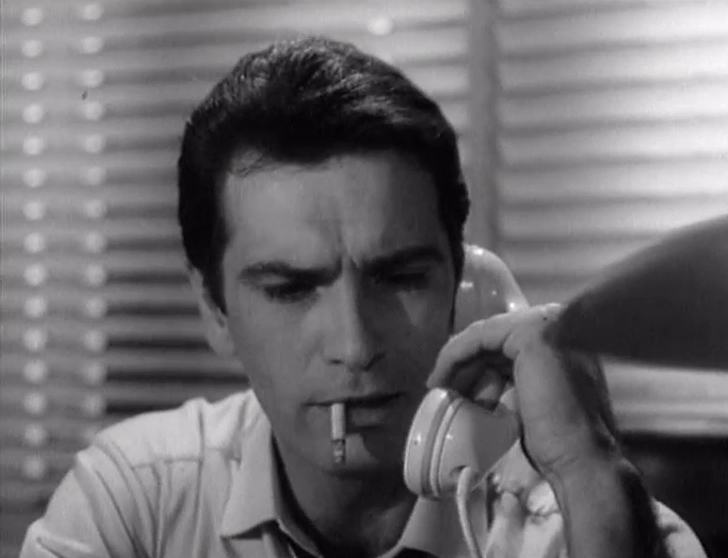
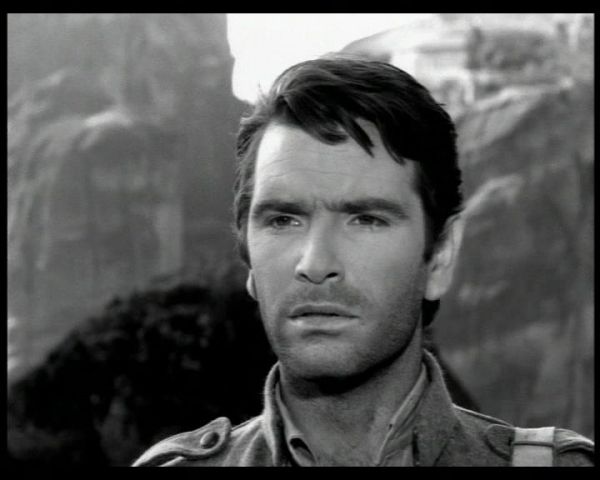
Screenshot taken from Amfivolies (1964.
Career
Nikos Kourkoulos made his official acting debut in the year he graduated from Drama School, performing in an Athens production of Alexandre Dumas, fils’ La dame aux camélias.
Kourkoulos quickly became a national star, being cast in several leading roles in ancient Greek dramas and in major classical and contemporary works of American and European theatre. He delved into many challenging and unique roles, both in theatre and in cinema.
As a leader of troupes and also of his own theatre, Kourkoulos experience was vast and diverse. During his tenure, Kourkoulos starred in over 20 theatre shows and over 40 films, making his career an undoubtedly successful one. He is best known for playing Angelos Kreouzis in ‘Oratotis miden’, a famous Greek melodrama with a social background. Kourkoulos also spent some time directing theatrical performances, where he was able to expand his repertoire.
Further, he was also the president of the president of the Union of theatricals of the Greek Theatre (PEETH) for many years.
In 1994, he also took on the role of artistic director of the National Theatre. In this role, Kourkoulos made a substantial impact, as he introduced the Children’s Hangout, the Experimental Stage, the Empty Space, the Acting and Directing Workshop, the International Stage and the Summer Theatre Academy. Each of these new divisions immensely improved the national theatre, increasing its inclusivity and accessibility.
Legacy
Nikos Kourkoulos had an extremely successful and remarkable career, which extended from acting, to directing and teaching. His work in the theatrical industry in Greece will forever be honoured and valued.
His work was recognised twice at the Thessaloniki Film Festival, as he was awarded the Best Actor Prize for his performance in ‘Adistaktoi’ 1965, and again in 1970 for his work in ‘Astrapogiannos’.
Nikos Kourkoulos sadly passed away in 2007, aged 72 after a long battle with cancer.
On Wednesday (2 December) Greece’s parliament passed a new law allowing digital nomads to half their income tax. This makes Greece the latest European country to try and woo the new work-from-home workforce, Forbes reports.
“If you can work from anywhere, why not work from Greece?” asks a promotional document seen by Greece’s parliament this week. Amid dreamy images of whitewashed farmhouses and deep-blue seascapes, it sets out a new law that allows newly settled foreigners to pay half their income tax over the next seven years.
From January 2021, the scheme will be open to both employed and self-employed workers as long as they have not previously been a tax resident of Greece, or replace an existing job in the country.
Kyriakos Mitsotakis’s government hopes the tax break will attract the newly empowered ‘work-from-anywhere’ digital nomad, which Alex Patelis, chief economic advisor to the prime minister, describes as “the person who’s three months in Thailand, two months in Jamaica, and so on. We want them to be two months in Greece, and why not?”
A tender for rolling out 5G closes in Greece this month, and coverage is expected to be in major towns and cities in early 2021.
“This place is a paradise especially if you make good money,” says Taki Despo from his new home in Athens. He moved from New York after his firm, the design retailer Moro.com, allowed him to do his job as market relations director remotely.
“Covid didn’t really do much it just gave me a little courage to make this move.”
Kate Silcox, originally from the U.K. but now working as a photo editor for GQ Dubai from Athens, has spent a decade working remotely from various countries but thinks she will now stay in Greece if she can save on taxes. “It would encourage me to be fully committed and settle down there for longer in Greece.”
Greece is hoping that tax perks will make more expats like Kate stay.
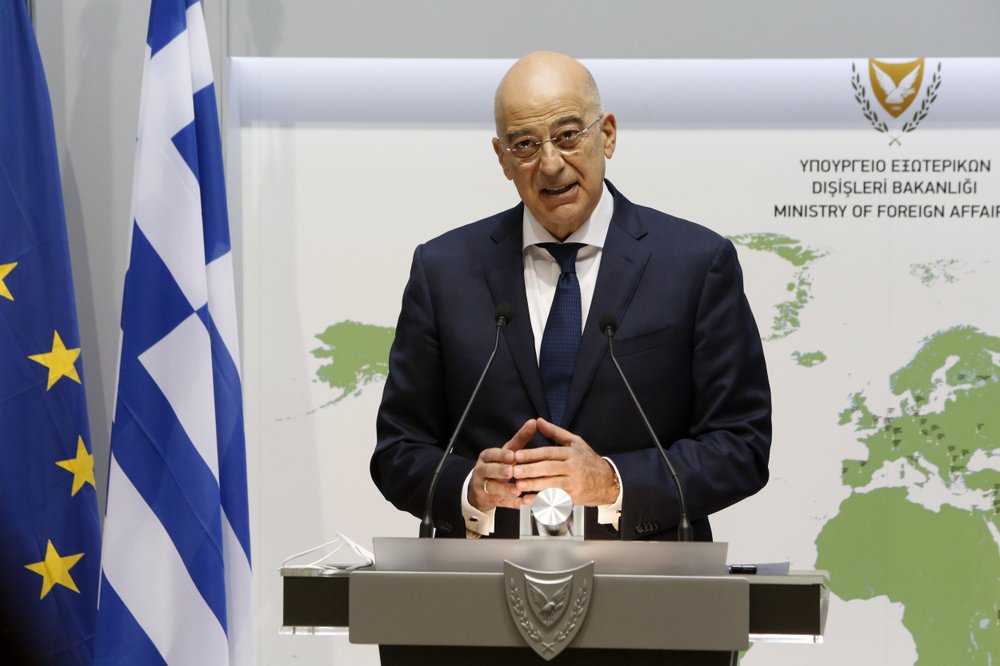
Turkey’s recent moves to de-escalate a clash with Greece and Cyprus over east Mediterranean energy reserves are “unconvincing” and European Union leaders need to take action that will prompt Ankara to heed international law, Greece’s foreign minister said on Friday.
Nikos Dendias said Turkey opted not to seize an opportunity that European Union leaders offered it in October to ease tensions in the region so that the 27-member bloc could start reshaping its fraught relations with Ankara.
Turkey last week ordered the research vessel Oruc Reis back to port after completing what it said was seismic research in east Mediterranean waters. The warship-escorted vessel’s activities in waters where Greece asserts jurisdiction prompted a military build-up between the two neighbors and nominal NATO allies.
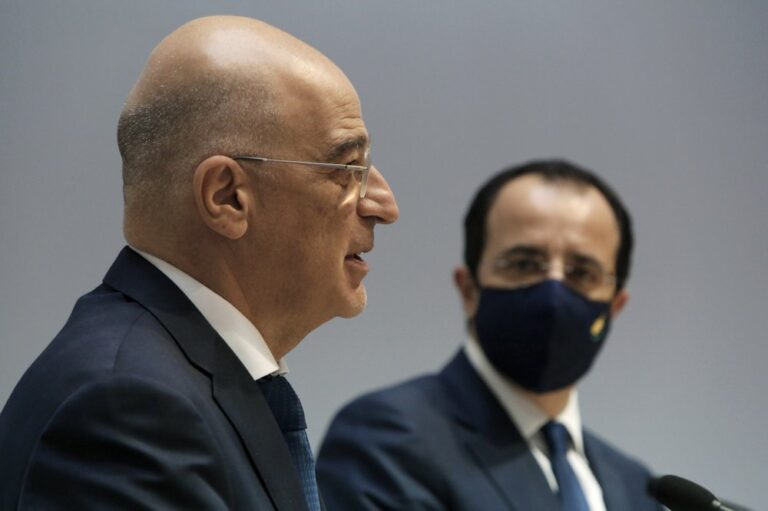
Greek Foreign Minister Nikos Dendias talks to the media during a press conference after a meeting with his Cyprus counterpart Nicos Christodoulides at the foreign ministry house in divided capital Nicosia, Cyprus, Dec. 4, 2020. (AP Photo/Petros Karadjias, Pool)
Greece countered by also sending its warships, and both countries conducted military exercises to assert their claims. NATO stepped in to prevent a potential armed conflict.
But Dendias said the ship’s return to port wasn’t enough.
“Turkey’s belated moves in recent days to supposedly de-escalate tensions are not convincing.” Dendias said after talks with his Cypriot counterpart, Nikos Christodoulides. “That’s why we have jointly asked all other European Union member states to live up to their responsibilities.”
“These decisions are significant not only as a clear message to Turkey, but also to prove the European Union’s credibility.”