Turkey’s state-run news agency claimed on Sunday that Greek surface-to-air missiles locked on to Turkish F-16 fighter jets carrying out a reconnaissance mission in international airspace.
Citing Turkish Defence Ministry sources, Anadolu reported that the radar of a Greek S-300 missile system based on the Greek island of Crete locked on to the Turkish jets on August 23.
The F-16s were at an altitude of 10,000 feet to the west of Greece’s Rhodes island when the Russian-made S-300’s target tracking radar locked on, the report added.
The Turkish planes completed their mission and returned to their bases “despite the hostile environment.”
Radar lock-ons are considered an act of hostility under NATO rules of engagement, according to AlJazeera.
Turkish jets carrying out missions over the Aegean and Eastern Mediterranean were harassed by a Greek S-300 air defense system and “radar locked,” Turkish Defense Ministry sources say https://t.co/N0Xo3DHdS5pic.twitter.com/kNq3o0L03z
“Greece’s S-300 missile system has never put a lock on Turkish F-16 jets,” the sources said, according to state-run ERT television.
“There is a lot of experience in broadcasting fake news from Turkey.”
The allegation is the latest claim from Turkey that its neighbour and fellow NATO member Greece has been targeting its aircraft above the eastern Mediterranean and Aegean Seas.
Just last week, Turkey summoned the Greek military attaché and filed a complaint with NATO after Greek F-16s allegedly harassed Turkish F-16s conducting a mission for the alliance.
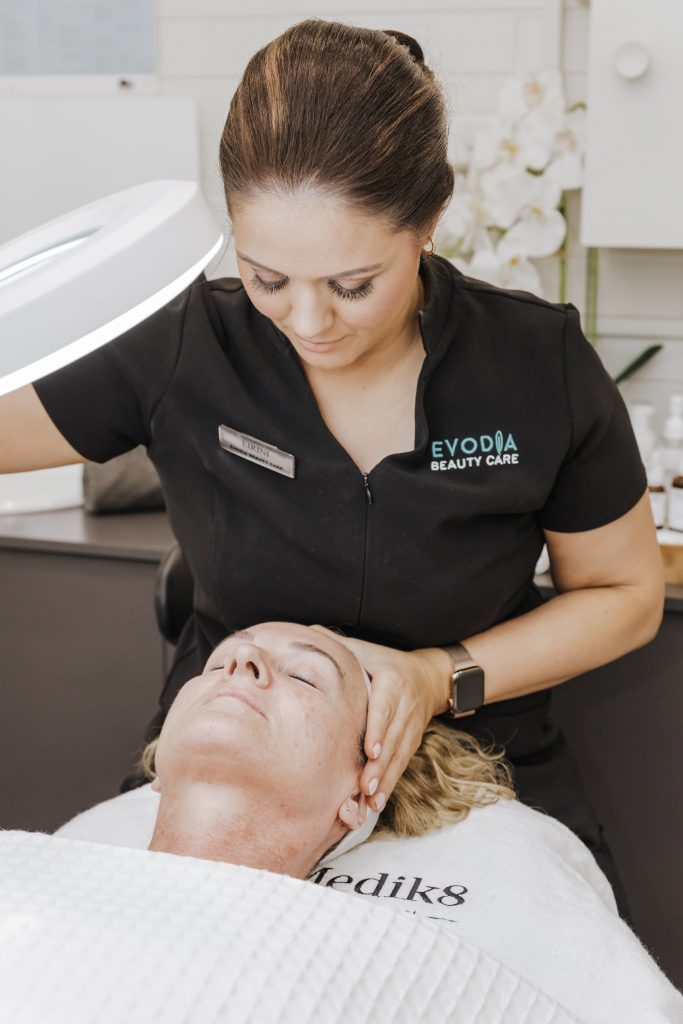
Greek Australian-owned Evodia Beauty Care in Melbourne’s eastern suburb of Camberwell took out a key award at the illustrious Australian Beauty Industry Awards 2022 (ABIA) on Sunday.
The small business won the Victorian, Tasmanian and South Australian Salon of the Year with four treatment rooms or less.
Speaking exclusively with The Greek Herald, owner Eirini Tzortzis describes the win as “a wonderful surprise” and a “huge honour.”
“It was a very special win for our small business considering the many closures we endured during the lockdowns of 2020 and 2021,” she says.
“I am so very proud of our team for their dedication, hard work and bringing so much passion and care every day to work. We are so proud to represent Camberwell and Victoria on a national stage.”
The ABIA’s provide a benchmark of excellence across both specialist and individual categories in beauty and make-up, with a wide variety of categories highlighting the leaders and experts in their fields.
This year, and before 500 beauty specialists at The Star in Sydney, Eirini’s salon was amongst 44 recipients of an ABIA at the annual gala event.
ABIA 2022 award winners.
Being in the skin and beauty industry for over 18 years, Eirini describes opening Evodia Beauty Care six years ago as a “dream come true”.
“I initially started Evodia in 2016 by renting out a small room at the back of a hair salon,” she says.
“Within a few months the business outgrew the space and then we moved to a larger room at another salon until the business outgrew that space as well. Finally, in 2018 we opened up our current space in Camberwell.”
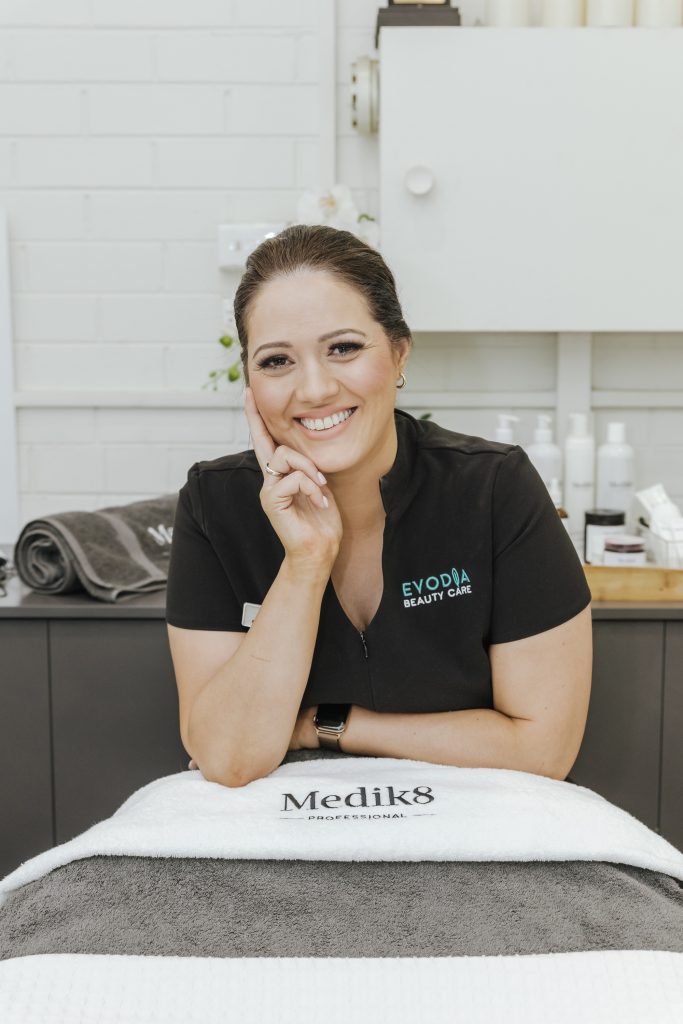
Owner of Evodia Beauty Care, Eirini Tzortzis at her Camberwell salon. Photo: Supplied to TGH
Founder of ABIA, Linda Woodhead, congratulated Eirini on the win, saying: “Eirini and the Evodia Beauty Care team are the perfect examples of industry leaders and excellent ambassadors for the awards program and local area.”
“The Camberwell community should be so proud of this achievement!” she added.
Whilst Eirini says being recognised by her peers is an incredible honour, nothing can compete with the feeling of empowering her clients.
“We empower our clients to be the best versions of themselves and without them, we wouldn’t be here today. In a big way, we owe this award to them,” she concludes.
*Please note: If you are a Greek-owned business who won in the Awards, please send us an email to info@foreignlanguage.com.au.
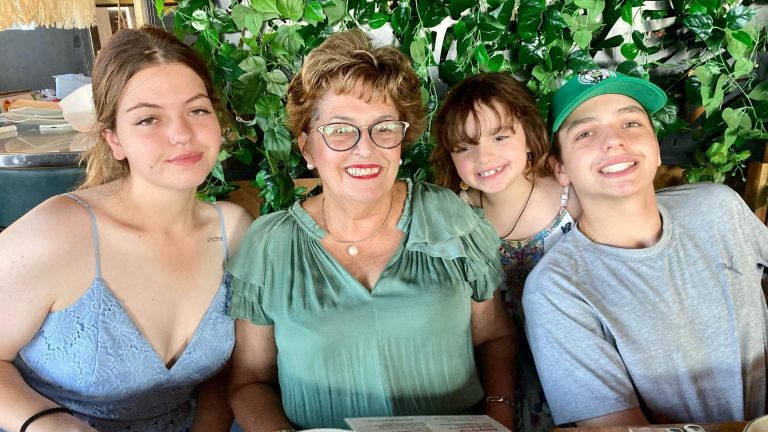
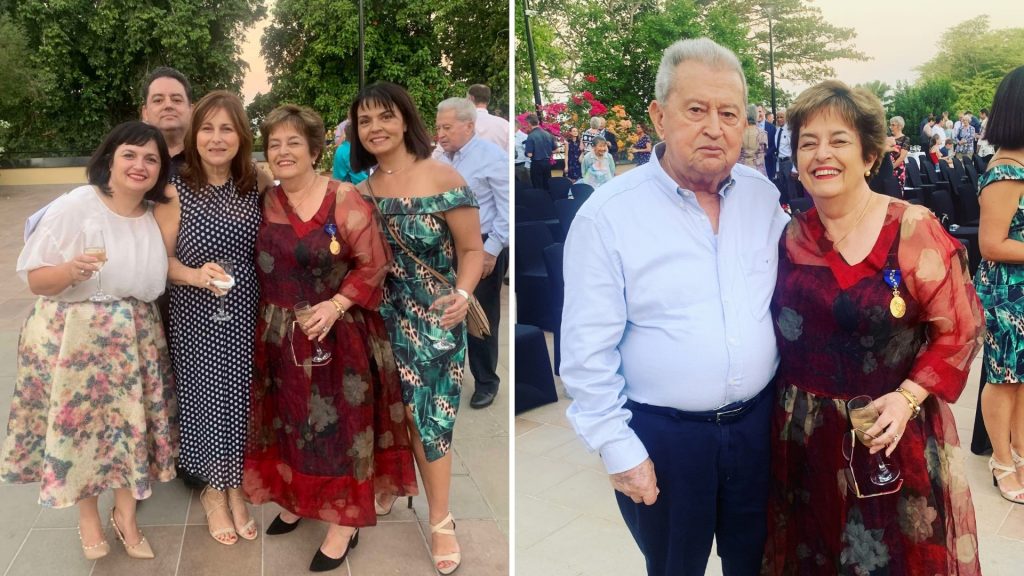
“Home. When I say I’m Greek, I always think of Kastellorizo,” Lilliane Gomatos who was recently named Kastellorizian of the Year 2022, tells The Greek Herald.
“I was born in Australia, I’m third generation but it was always important to my mother that she embeds the Greek origins and ethnicity into us so we do not forget our roots.”
“I just feel so proud to say that my grandfather came from Kastellorizo,” she tells of her maternal ancestor who migrated to Australia from one of the smallest islands of the Dodecanese in the early 1900s.
In 2019, Gomatos received a Member of the Order of Australia (AM) for her contribution to multiculturalism and the Greek community and has also been awarded from the Hellenic Australian Chamber of Commerce and Industry (HACCI) but she says the latest recognition is one she values deeply.
“I am honoured and humbled. I feel proud that they have chosen me,” she says speaking warmly about her family’s support over the years and her late husband, Theofilos.
“My husband was from Sparta but was converted to a Kastellorizian. He always told people that if they want to relax and enjoy the peace, they should go to the isnland,” she says warmly.
The couple settled in Darwin in 1967 and nearly two decades later Lilliane Gomatos became the first female president of a Greek community in Australia. As president of GOCNA, she assisted with the completion of the Greek Orthodox School’s third stage and the upgrade of the church while she also co-founded the Greek Glenti festival.
“My husband was emergency captain and when we settled in Darwin, he got involved with the community. He was asked to assist with the Greek consulate, because he was the only one that knew how to do speak the language fluently.
“He was the main reason that I got pulled into community work and I have to say I did enjoy it,” she says.
“Lilliane epitomises the importance of grassroots welfare of Kastellorizians and Greeks in Darwin, personifying the spirit of the original Kazzie philotimo – brotherhood,” reads the announcement shared by the Kastellorizian Association of Victoria (KAV).
The mother of three and grandmother to four says she is committed to instil her passion and values to the future generations.
We ask her for a piece of advice.
“Just keep going. Never give up on your origins and be proud of your forefathers,” she says.
“Even though we are Australians of Greek origins, we must blend our two ethnicities and instil in them the pride of Greece.”
Lilliane’s achievements will be celebrated at the Kastellorizian of the Year (KOY) Gala Dinner on Saturday 15 October 2022.
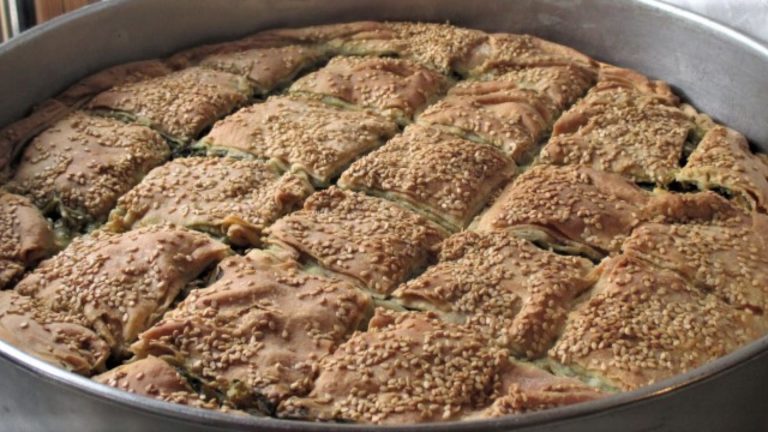
If you know anything about Greek food, you’ve probably heard of spanakopita, the classic spinach pie with feta cheese and phyllo (or filo) pastry. My Cretan neighbour’s recipe is especially rich in leeks, onion, herbs and olive oil, which blend beautifully with the spinach and feta. You can buy your phyllo or make your own, like Arhontoula always does.
Ingredients:
For the Horiatiko (Village) Phyllo Dough
for Spanakopita and Other Savory Pies
This recipe makes more than you need for one pie—possibly enough for two, depending on the size of your pan. Extra dough can be refrigerated for a few days or frozen for months, or you can cut all the amounts in the dough recipe in half.
1/2 cup Greek extra virgin olive oil
2 cups lukewarm water
2 tablespoons vinegar
1 teaspoon powdered yeast (approximately 4 grams)
1 teaspoon salt
approximately 6 1/2 cups of flour, as needed to make dough that’s not sticky
2 leeks, with roots and dry green ends cut off, and dry outer leaves removed
1 onion, peeled
1 bunch parsley (about 1/2 cup when chopped and packed, without the harder stems)
1 bunch spearmint (about 3/4 cup when chopped and packed, without the harder stems)
1 bunch dill (about 1/2 cup, when chopped and packed, without the harder stems)
250-300 grams (2/3 pound, or a bit more or less, to taste) feta cheese, crumbled
1 teaspoon salt (to taste) and pepper to taste
3 tablespoons uncooked oatmeal
1/2 cup Greek extra virgin olive oil
more olive oil to pour onto the dough and grease the pan
Directions:
Unless you are using store-bought phyllo, start preparing the dough. Put ½ cup olive oil and the water, vinegar, yeast, and salt in a medium-large bowl. Stir to blend. Add a cup of flour at a time, stirring to mix it in after each cup. As the dough thickens, blend in the flour and knead the dough with your hands, scraping the sides of the bowl as you work. When the dough no longer sticks to your hands, stop adding flour, and knead it for another minute or so.
Set aside the dough to rest for half an hour or more while preparing the ingredients for the pie filling. The dough can even rest up to a few days in a closed container in the fridge, if you want to make it in advance.
If you are using fresh spinach, cut off the spinach roots and discard them. Then cut off the stems to wash and set aside for other purposes, such as spanakorizo (spinach and rice). Wash the spinach leaves well. Cut large spinach leaves into 5 to 10 centimetre (2 to 4-inch) pieces (holding a bunch together and cutting with scissors or a knife).
Put the spinach in a large, deep, dry pot, then turn on the stove to high heat for about 10 minutes, stirring the spinach occasionally after it heats up. After 10 minutes, turn off the stove, strain off the liquid in the pot, and set the spinach aside in a colander to continue draining.
Wash and chop the leeks, onion, and herbs, removing the hard stems from the herbs. Place the onions and leeks in a large pot with ¼ cup of the olive oil. Sauté on medium high heat for 5 minutes, stirring occasionally. After that, add the chopped parsley, stir, and cook 2 more minutes. Then add the dill, stir, and turn off the stove, without removing the mixture from the stove. Stir in the spearmint 2 minutes later.
Remove as much of the remaining water as possible from the cooked spinach by pushing down on it with a spoon in the colander. Then add the well-strained spinach to the herb and onion mix. Add a teaspoon or so of salt and pepper to taste (not too much salt, given the saltiness of feta) and mix.
Add the remaining 1/4 cup of olive oil, oats, and crumbled feta, and blend well. Taste the mixture and add more salt and pepper if desired.
Grease a large round oven-proof pan (about 14 inches diameter–35 centimeters, or a comparable rectangle) with olive oil.
Divide about half of the dough (if using the recipe above) into three unequal parts and pat each one into a flattened circle (or rectangle, depending on your pan). Roll out the dough on a well floured surface with a spoonful or two of cornstarch sprinkled on and under the dough (to make it more elastic and easier to roll without tearing or sticking). Use the largest chunk of dough for the bottom, the smallest for the middle, and the second largest for the top.
Roll out the largest chunk of dough until it’s very thin—about 1/8 of an inch thick (about 3 millimeters)—for the bottom layer. You can use even thinner dough—1/16 of an inch—for the top two layers. The bottom and top layers should be large enough to climb up the sides of the pan and hang over a bit to make your work easier; the middle layer doesn’t need to be bigger than the bottom of the pan.
Place the largest layer of phyllo on the bottom of the pan (up the sides and hanging over the edge). Spread the spinach mixture on top of it.
Roll out a second layer of dough and lay it out on top of the spinach mixture. Pour or brush some olive oil on it. (You don’t need a solid lake of olive oil; various criss-crossing lines covering most of the surface will do.)
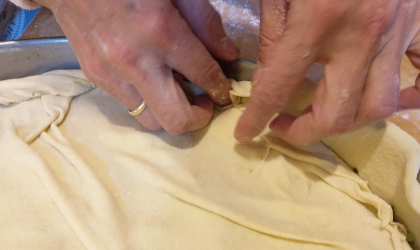
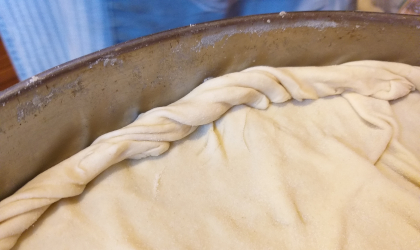
Roll out the third layer of dough, and position that layer on top of the pie. Cut off the sections of dough that are hanging over the edge of the pan, so what remains is level with the top of the pan. (You can save those dough bits to make other mini pies.) Roll the top two layers of dough together toward the top of the pie, twisting and folding under small sections at a time to seal the edges of the crust.
Photos by Lisa Radinovsky.
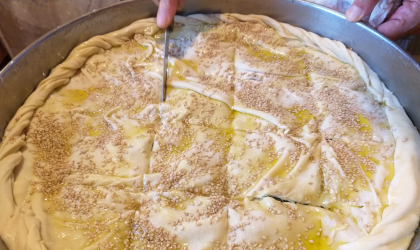
Pour a bit more olive oil on top of the phyllo. Then sprinkle water and sesame seeds on top of the phyllo.
Cut through the top two layers of phyllo (and perhaps a bit of the filling), but not the bottom crust, marking out rectangular pieces of the pie in the desired serving size. (This will let the pie breathe so it doesn’t form bubbles, as well as making it easier to cut after it’s baked.)
Photo by Lisa Radinovsky.
Bake the pie a bit lower than the center of a preheated oven at 200 degrees Celsius (almost 400 degrees Fahrenheit) for about one hour, until the top is golden brown. The bottom of the pie may need extra time to brown at a lower level in the oven; lift the pie a bit with a spatula to check the bottom.
*Originally published on Greek Liquid Gold: Authentic Extra Virgin Olive Oil (greekliquidgold.com). See that site for recipes with olive oil, photos from Greece, agrotourism and food tourism suggestions, and olive oil news and information.
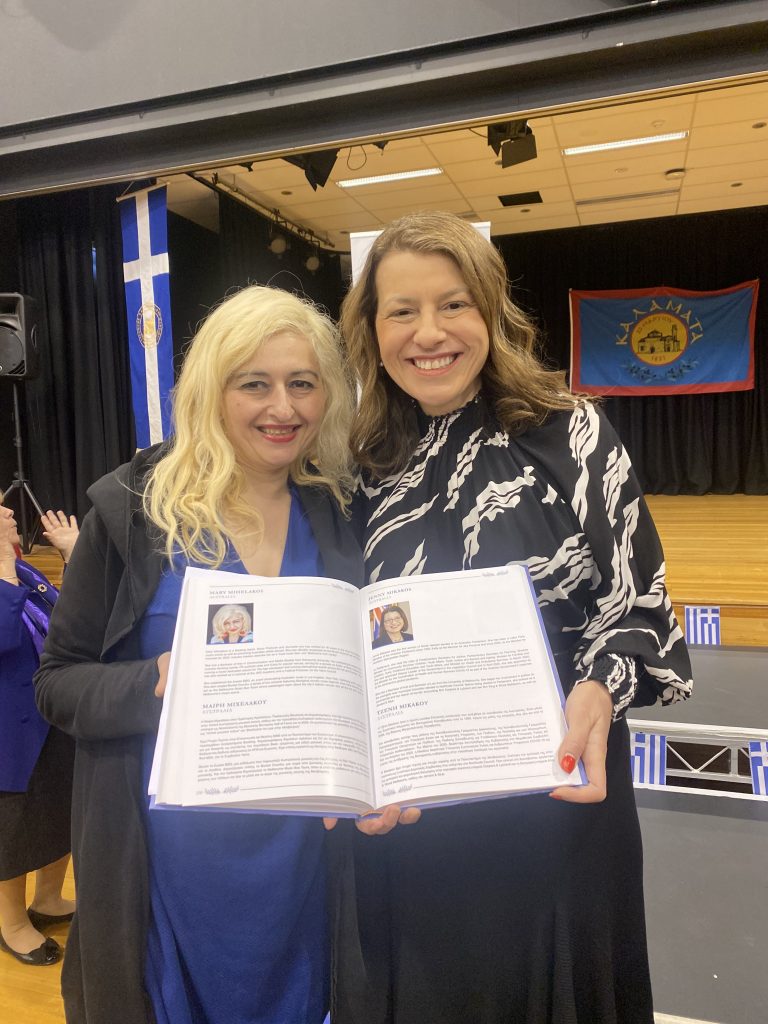
From humble beginnings as a volunteer at a local radio station to DJ’ing on stage with American singer Iggy Pop, Mary Mihelakos has had a wild ride with her career in music.
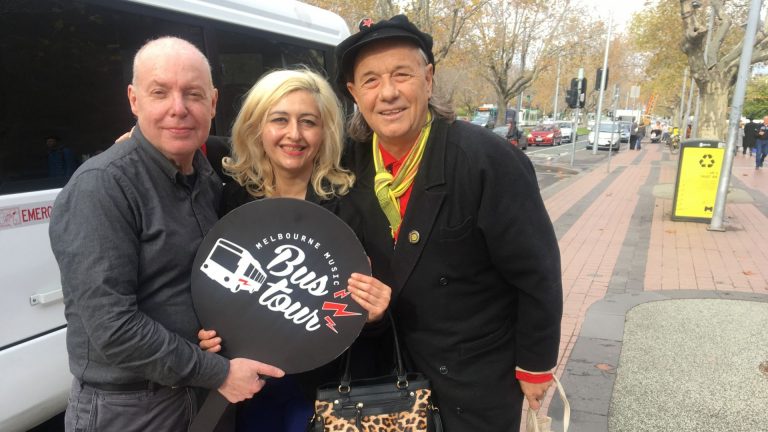
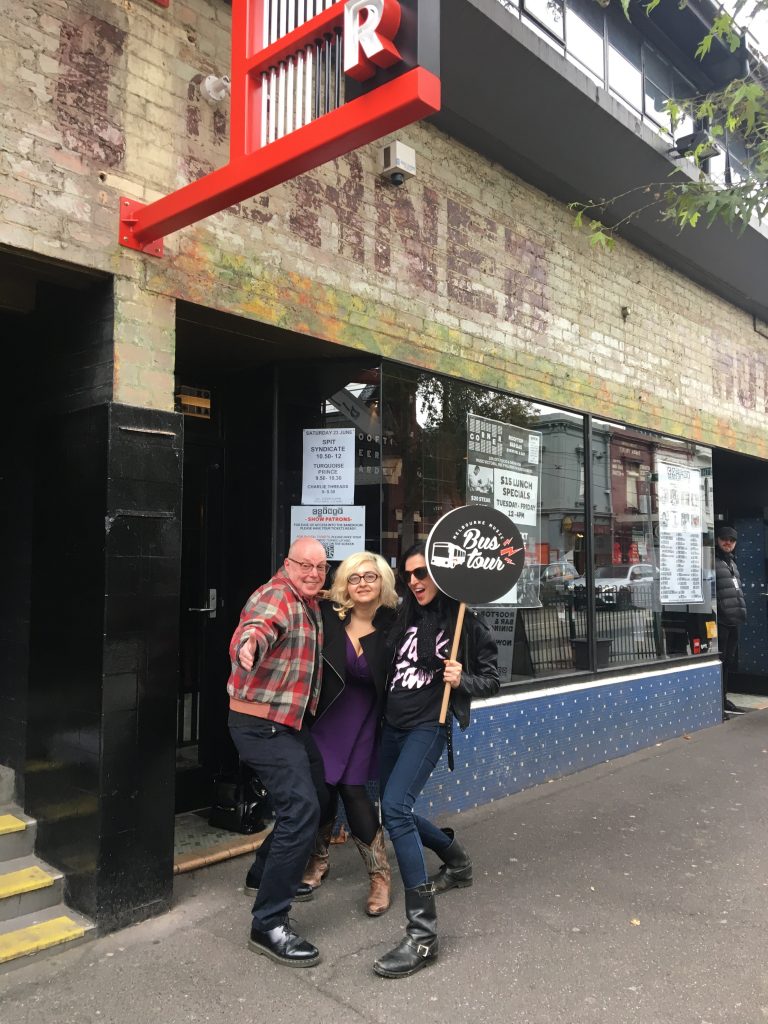
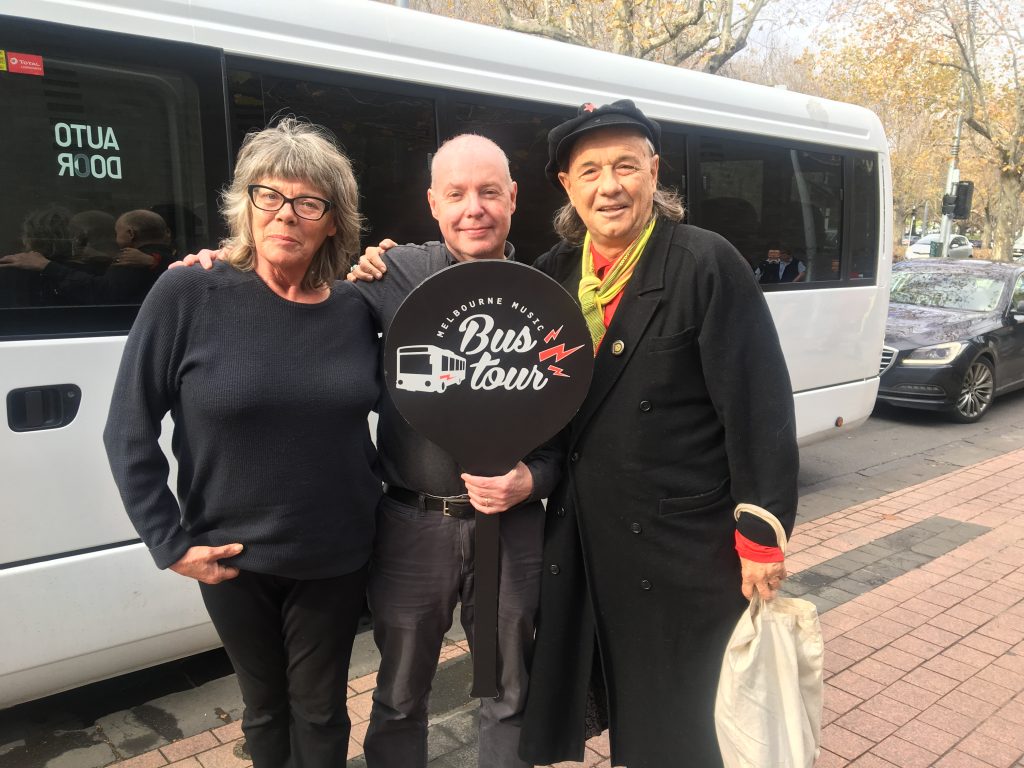
It’s a career so wild it led to the establishment of Melbourne Bus Tours – a tour service that travels across Melbourne for two hours with a tour guide and a special guest musician sharing stories about local sites.
In an interview with The Greek Herald, Mary tells us all about the tour and her relationship with music.
Tell us about yourself.
I am a music lifer who began volunteering at community radio as a teen. I went on to manage bands and book live music venues while studying media at university. I edited Beat Magazine (1995 – 2005), and for six years contributed to the weekly ‘Sticky Carpet’ column in The Age newspaper covering Melbourne’s live entertainment scene. I went on and founded the Aussie BBQ at SxSW in 2003, now a global showcase for Australian music managed by Sounds Australia. I have also produced the stage show of Buried Country – Live in Concert based on Clinton Walker’s book and documentary telling the untold story of Aboriginal country music.
I established the Melbourne Music Bus Tours which run regularly from the Australian Music Vault at the Arts Centre Melbourne sharing local music history. In recent years I returned to live music bookings for venues such as the Spanish Club, Prince Band room, Yah Yahs Bella Union, Thornbury Theatre, the Spotted Mallard, Brunswick Ballroom and Federation Square. I also work closely with a number of musicians and individuals who she believes in as a manager and a mentor.
I have been DJing for over 20 years all over Melbourne and inspired the Jet song “Roll Over DJ” and have also jumped on stage to dance with Iggy Pop and the Stooges 6 times in 3 different continents. In December 2020, I was honoured by being inducted into the Music Victoria Hall of Fame for my services to Australian music.
How has your Greek Australian heritage influenced your work?
Although my parents were very protective of me, they never stopped me from attending concerts or being involved with the community radio station. They facilitated it so I was always safe. I was a sensible teenager and not interested in drinking or partying – I just followed the music. I often went to concerts with my older sisters and spent a lot of time in record shops.
When I first started going to see bands, it was a happy coincidence that some of the venues were places like the Old Greek Theatre in Richmond, which was also a Greek cinema, so they were familiar with the venue I was going to and often dropped me off and picked me up. Both of my parents are hardworking and involved with their community so perhaps that has influenced me.
I am no longer working as a music writer. I am now booking a live music venue called the Brunswick Ballroom on Sydney Road which is still owned by the Apostolakos family and used to be a wedding reception and Greek events space called Metropolis House.
What are the Melbourne Music Bus Tours?
The Melbourne Music Bus Tour initially started as part of the City of Yarra’s music festival – Leaps and Bounds in 2013 and we shared stories about historical music sites around Fitzroy, Collingwood, Abbotsford and Richmond.
When the Australian Music Vault opened in 2018, I proposed expanding the tours to depart from the Arts Centre Melbourne and expanding the bus route to also include St Kilda, Albert Park, South Yarra, Carlton and the CBD.
The idea is simple, we travel on a bus across Melbourne for two hours with a tour guide (Bruce Milne) and a special guest musician who shares stories about Melbourne locations. There is no performance on the bus – we share sites.
I have done similar bus tours overseas about the Beatles in London and Liverpool, a grunge music bus tour in Seattle, as well as The Sopranos and Sex in the City-themed bus tours in New York – and decided to set up the Melbourne Music Bus Tour.
What is next for you?
We are about to begin the fifth season of the Melbourne Music Bus Tours in conjunction with the Arts Centre Melbourne, the Australian Music Vault and Always Live from October 15 through to December 10, after stopping in March 2020 when the pandemic hit.
In April and May this year I also produced the Geelong Music Bus Tour as part of the inaugural Surround Sounds festival. I have a lot of ideas which I combine with my passion for music. I always keep myself busy and hope I have created events and projects that others appreciate too.
Next year, the Greek Orthodox Community of Oakleigh and District will celebrate its 60th anniversary and its flagship school, Oakleigh Grammar, will celebrate its 40th anniversary.
To mark these significant milestones, it was announced yesterday at the School’s Conference Centre that 10 buildings on the Oakleigh Grammar School grounds will be named after Hellenes who have become successful since migrating to Australia.
“These significant anniversaries present a fitting opportunity to celebrate our School’s Hellenic foundation by honouring Hellene leaders that have positively impacted our local community and our Australian nation more broadly”, President and Chairman of the Oakleigh Grammar Board, Chris Damatopoulos said.
“By naming our School buildings after inspirational leaders and members of our community, we hope to inspire thousands of students and families for generations to come”, he continued.
The first building to be named is the Centre for Academic Excellence which is still under construction and scheduled for opening on the Feast Day of Saint Anargiri on November 1 this year.
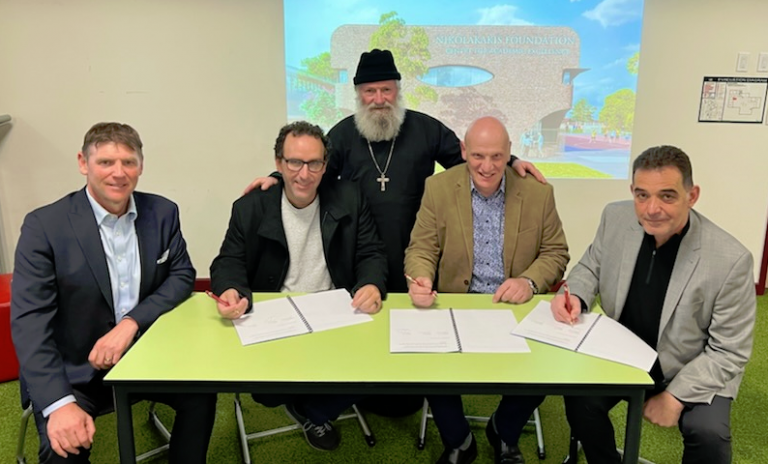
The building will be called the ‘Nick and Poly Nikolakakis Foundation Centre for Academic Excellence’ in a sponsorship deal with the highly successful Nikolakakis family.
The building is named in commemoration of Nick and Poly Nikolakakis who established their business Nikpol as a small two-man operation in 1978, and which is now an Australian market-leading renovation and commercial joinery supplier with over 140 employees in three locations.
Oakleigh Grammar’s Nikolakakis Centre for Academic Excellence will be named after Nikpol founders Nick and Poly Nikolakakis in a sponsorship deal brokered with sons John and Spiro Nikolakakis.
The recruitment of Nick and Poly’s first son, John followed later by son Spiro, saw Nikpol undertake substantial expansion into total kitchen solutions adding a wide range of hardware as well as post-formed laminate benchtop production.
Having secured distribution deals with many of Europe’s leading manufacturers including Grass, Egger, Motivi, Renolit and Metakor, the Nikpol name is now synonymous with the best in European design and innovation.
“Nick and Poly Nikolakakis were most faithful parishioners of our Church since its inception, and they were outstanding and inspiring role models for their family and our community, so it is a fitting tribute,” Mr Damatopoulos said.
Sons John and Spiro Nikolakakis said the decision to take up naming rights of the Nick and Poly Nikolakakis Foundation Centre for Excellence was an easy one.
“Our parents were strong advocates for Oakleigh and the School, and we know they would have been really pleased for us to be involved,” Spiro Nikolakakis said.
“My mother especially would have loved it – she left Crete for Australia in 1964, and was one of the few of that generation that finished high school. She always emphasised the importance of a strong education.
Greek migrants leave Greece to find a new life in Melbourne circa 1950s
“My parents started Nikpol, and John and I started after we finished our studies. The business of course has changed and grown a lot, products have changed, and as have our customers, but we have tried our best to keep our culture constant.”
As for John, he said: “While the business is a functioning embodiment of my parents’ legacy, there is something very special about having the family name recognised in this way.
More than just a tribute, the brothers believe in giving back and helping their community.
“John and I are idealists, we like to dream. We asked ourselves, ‘Why can’t Oakleigh Grammar be as good, or better than the best schools in Melbourne?’,” Spiro said.
“In our business, the most rewarding thing for us is seeing our people grow and develop.
“We hope that our sponsorship of the Nikolakakis Centre for Academic Excellence helps in some small way to provide the infrastructure and support for Oakleigh Grammar students to further grow and develop, and like us, to face challenges and stay ahead.”
“We have a real love for Oakleigh. Our kids spent time at the School, and we have built some strong relationships with the Church and School administrators. We are proud that to have made this step into serious philanthropy”, concluded John.
In concluding, Damatopoulos noted that naming rights to a further four of the remaining nine buildings on the Oakleigh Grammar campus are under negotiation with community leaders.
Ingleburn Public School in Sydney’s southwest is home to a purpose-built playroom facilitating a treatment founded by Professor Eva Kimonis called ‘Parent-Child Interaction Therapy’.
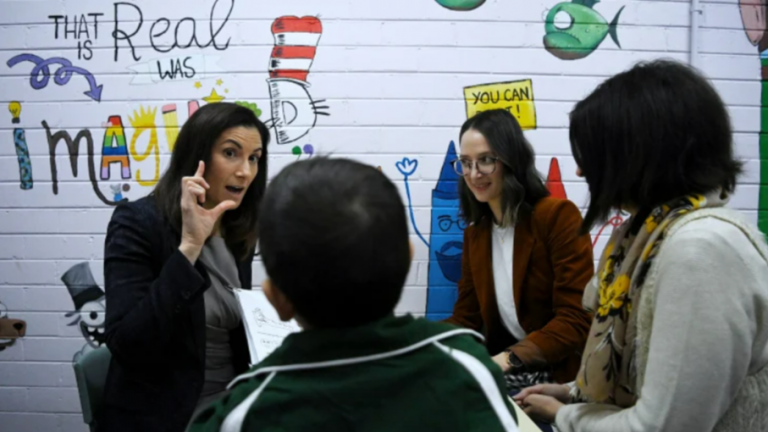
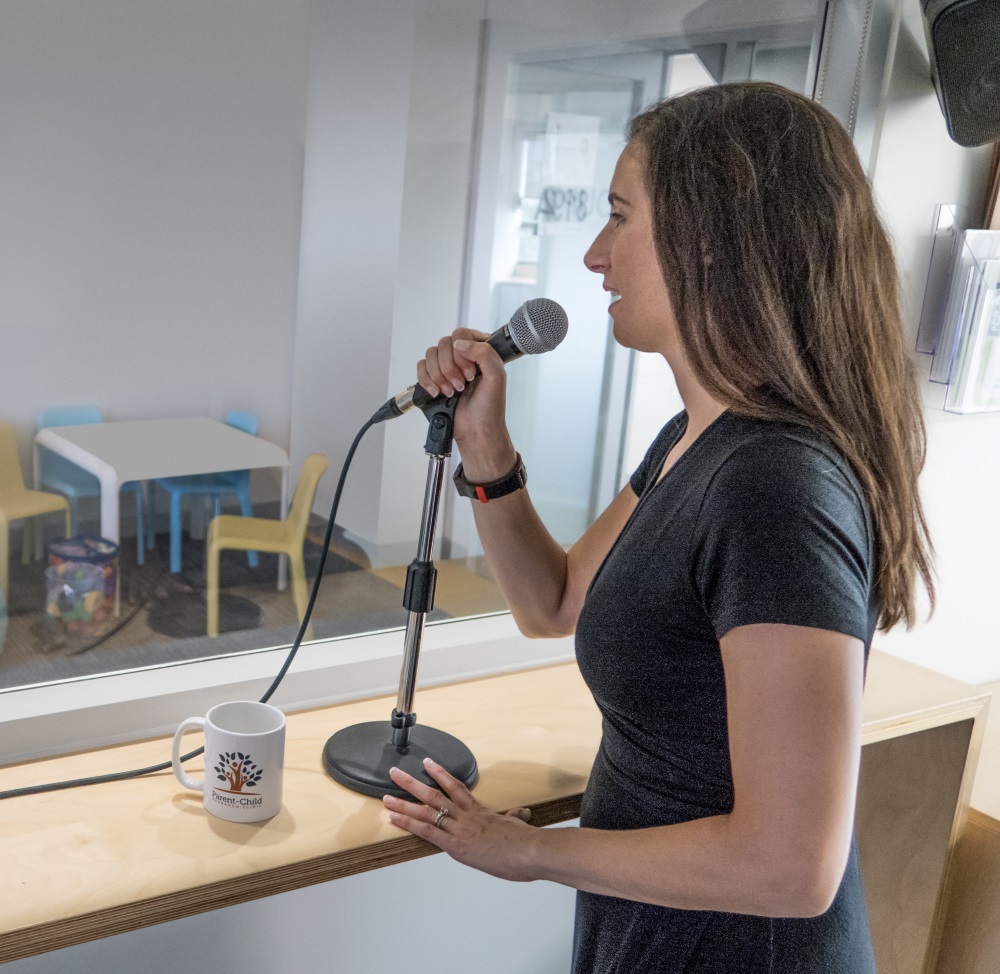
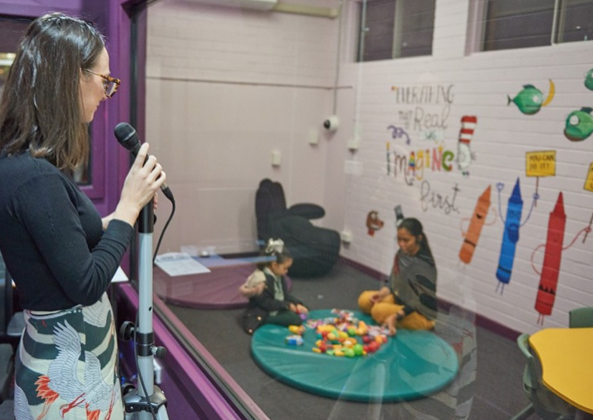
In this first-of-a-kind clinic, parents of children who display “callous-unemotional traits” are coached through each interaction with their child by a trained therapist. The therapist is concealed behind a one-sided mirror and delivers the coaching via a wireless earpiece.
Callous-unemotional traits are a set of characteristics that can be an early warning sign for psychopathy and the clinic is giving parents the skills to bond with these misunderstood children.
Defining characteristics of children with callous-unemotional traits include remorselessness and a lack of empathy alongside verbal and physical aggression and a tendency to lie, steal and destroy belongings.
A therapist watches behind a one-sided mirror as a parent and child interact as part of Kimonis’ therapy for children with callous-unemotional traits.
“Not every child who has these traits will grow up to be a psychopath,” Professor Eva Kimonis at UNSW’s School of Psychology told The Sydney Morning Herald.
“This is the first trial that takes this group of kids and says, ‘we can make things better for them and keep them off that pathway down the track’.”
Clinical psychologist, Dr Georgette Fleming, who is working and studying the results of Kimonis’ therapy, spoke of the need for the clinic.
“Their parents are exhausted, they’re at their wit’s end. They have tried so many things that haven’t worked,” she told The Sydney Morning Herald.
“It’s a matter of the system failing these kids and these families, rather than there being something innately wrong or bad about them.”
Kimonis said that children as young as two can show early signs of callous-unemotional traits, which can influence the way their parents interact with them. She explained that as infants they are less likely to look at their parents’ faces, which can lead to a colder parenting style.
Dr Georgette Fleming delivering a treatment session of enhanced Parent-Child Interaction Therapy (PCIT) in the clinic at Ingleburn Public School. Photo: Ingleburn Public School
When Fleming coaches parents at the clinic, she emphasises the need for affection.
“Things like sitting closer to their child during play, putting the ‘smile’ into their voice … doing things to make the child laugh,” she said.
Kimonis and Fleming hope the therapy is available to those in areas that have little access to child psychological support.
Assistant Principal of Ingleburn Public, Rebecca Dao has praised the program, saying: “We wanted to be part of this trial because we saw there was a need, particularly in the south-west area, where there is a lack of child psychology services.”
“To have this free service within the school breaks down the barriers that stop these families from getting help,” she said.
Renzo Piano Building Workshop have joined forces with the Stavros Niarchos Foundation (SNF) Health Initiative to design and unveil three new hospital concepts in Thessaloniki, Komotini and Sparta in Greece.
The three facilities intend to provide new hospital infrastructure and improve access and quality of care in regions that are underserved.
Every design concept for these hospitals is fuelled by the proposed intention of each hospital, for example, the hospital in Thessaloniki will serve as a paediatrics facility and will be the largest of the three hospitals named the New University Paediatric Hospital.
The new hospital in Thessaloniki will be organised as a campus that provides tertiary paediatric services for all of Northern Greece, secondary paediatric services for greater Thessaloniki and a new national Referral Centre for Children and Adolescent Mental Health.
The SNF General Hospital of Sparta will support a network of local health units and health centres across the region of Laconia. The new hospital will be a combination of the existing General hospital of Sparta and the Hospital of Molai to become the General Hospital of Lakonia. The main building will be a single three-story volume above ground, emerging from the park’s tree canopy out front.
The hospital’s relationship with nature is also a key aspect of this hospital’s design. In Sparta, similar to the hospitals in Komotini and Thessaloniki, trees will be an important design feature, making it a special place within the immediate rural context.
The design concept is to create a hospital immersed in nature, fostering a peaceful and calming environment for patients, their relatives, and medical staff. The new park will be an integral part of the design, featuring protected areas for patients, interactive playgrounds for children, and routes under the trees.
The SNF General Hospital of Komotini will be an improved secondary hub for the Greek region of Eastern Macedonia and Thrace, supporting a network of local health units and health centres across the region.
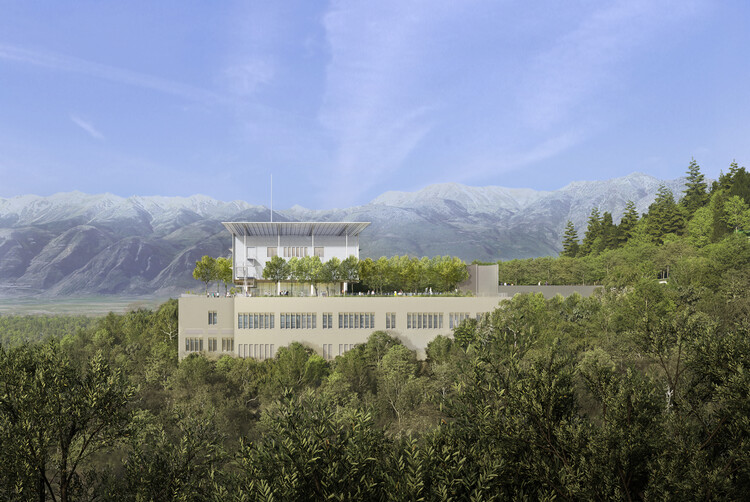
The structure is designed as a three-story building surrounded by an extensive park about 70,000 square metres. Only two stories of the new hospital will be visible from the surroundings due to the sloped contours of the site and greenery, making the hospital building appear lower, and more domestic in scale as it hovers at the same height as the tree canopies.
Driven by a sustainable approach, the hospital will use the right materials and resources, incorporating strategies to reduce energy consumption as much as possible, recycling materials, and using the roof to generate energy.
The Greek Community of Melbourne’s Board of Management welcomed the newly appointed Hellenic Senior Lecturer of Global Diasporas at the University of Melbourne, Dr Andonis Piperoglou, at the Greek Centre on Monday.
After the welcoming, the Board had a discussion on the importance of his role and GCM’s future plans. President Bill Papastergiadis stressed that “this position at Melbourne University solidifies the role of the GCM at all four levels of education, being early learning, primary, secondary, and tertiary. Hopefully, the position will deliver over time well needed research into the issues confronting our broader Greek community and the mechanisms to identify appropriate responses. The GCM appreciates the pre-election commitment by both major parties to help fund this position as it demonstrates the strong support by our governments for the work undertaken by the GCM”.
Education convenor Dr Nick Dallas added, “we shouldn’t underestimate the importance of this position, not only because it goes against the global trend in humanities investments but it’s a chance to put migrant history on the map, it’s an opportunity to reflect upon and critically examine the evolution and complexity of the Greek diasporic experience”.
New Board and education committee member, Dr Spiridoula Demetriou remarked “I find it exciting that notions of the diaspora are finally going to be afforded diversity, his ideas have sprung others in me. Namely, of responses to the homeland becoming part of the definition and narrative of Greek identity in Australia today”.
After giving a background on his life journey, Dr Piperoglou proceeded by giving an overview of the subjects he has committed to teach in the near future.
First of the rank in 2023, will be ‘The Long History of Globalisation’, a fourth year Honours subject. This is an important subject for graduating and aspiring post-graduate students who want to understand the complexities and diverse trajectories of the History of our globalized world.
Also in 2023, Dr Piperoglou will be teaching Migrant Nation, a second year Australian History subject offered as a breadth subject that should appeal to those with an interest in immigration, multiculturalism, refugee studies, ethnic and national identity, and those who seek to understand how history continues to shape contemporary society. From 2024 onwards, ‘Global Diasporas, Hellenic Cultures’, a third year Global History breadth subject will be on offer. It will bring students into contact with the diversity of diaspora histories, theories, and experiences across the globe, emphasizing the plurality of Hellenic diaspora experiences. The subject will also have a comparative and interdisciplinary dimension.
Dr Piperoglou was also keen to stress that his role and responsibility went beyond teaching and research at the university, there’s a large community engagement component and he looks forward to working on projects with the Greek Community of Melbourne and other associated entities. He commended the GCM for the initiatives and investments in Greek language education.
Other responsibilities include developing collaborative partnerships with overseas universities and convening international symposiums on global diasporas. Andonis was also keen to stress that the diaspora experience was very multifaceted, even in specific and relatively uniform communities, there still existed a plurality of experiences, and everyone negotiated and engaged identity differently.
For most people, making sure that their golden years are set for them are a major priority when it comes to family and financial planning.
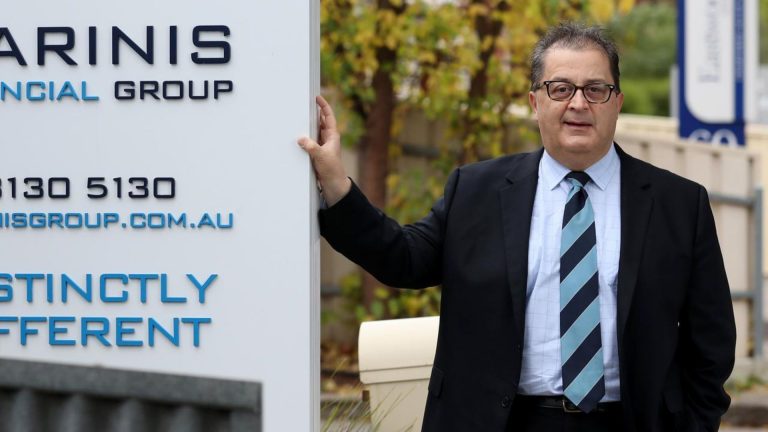
Financial strategist, Theo Marinis gives families advice to make sure they are taking the right steps to benefit from their superannuation.
Couples and families can substantially reduce their tax bills, receive government bonuses or boost age pension payments by working together on their superannuation.
In an article from the Daily Telegraph, Marinis discusses the multiple reasons that a couple might split their super contributions between them.
Maintaining life insurance for someone with a low balance, helping your partner access age pension payments and keeping both partners’ balances within superannuation caps to receive benefits or avoid penalties are just one of the very many reasons that a couple could choose to split their super contributions.
The Australian Taxation Office says people can split up to 85 percent of certain contributions including employer contributions, salary sacrifice and personal tax-deductible contributions.
Marinis says his firm often does super splitting strategies at the end of a financial year, but warns it can be complex, including potentially setting up a spouse account.
“If you have low balances and can’t afford an adviser but are in an industry fund, speak to your industry fund,” he says.