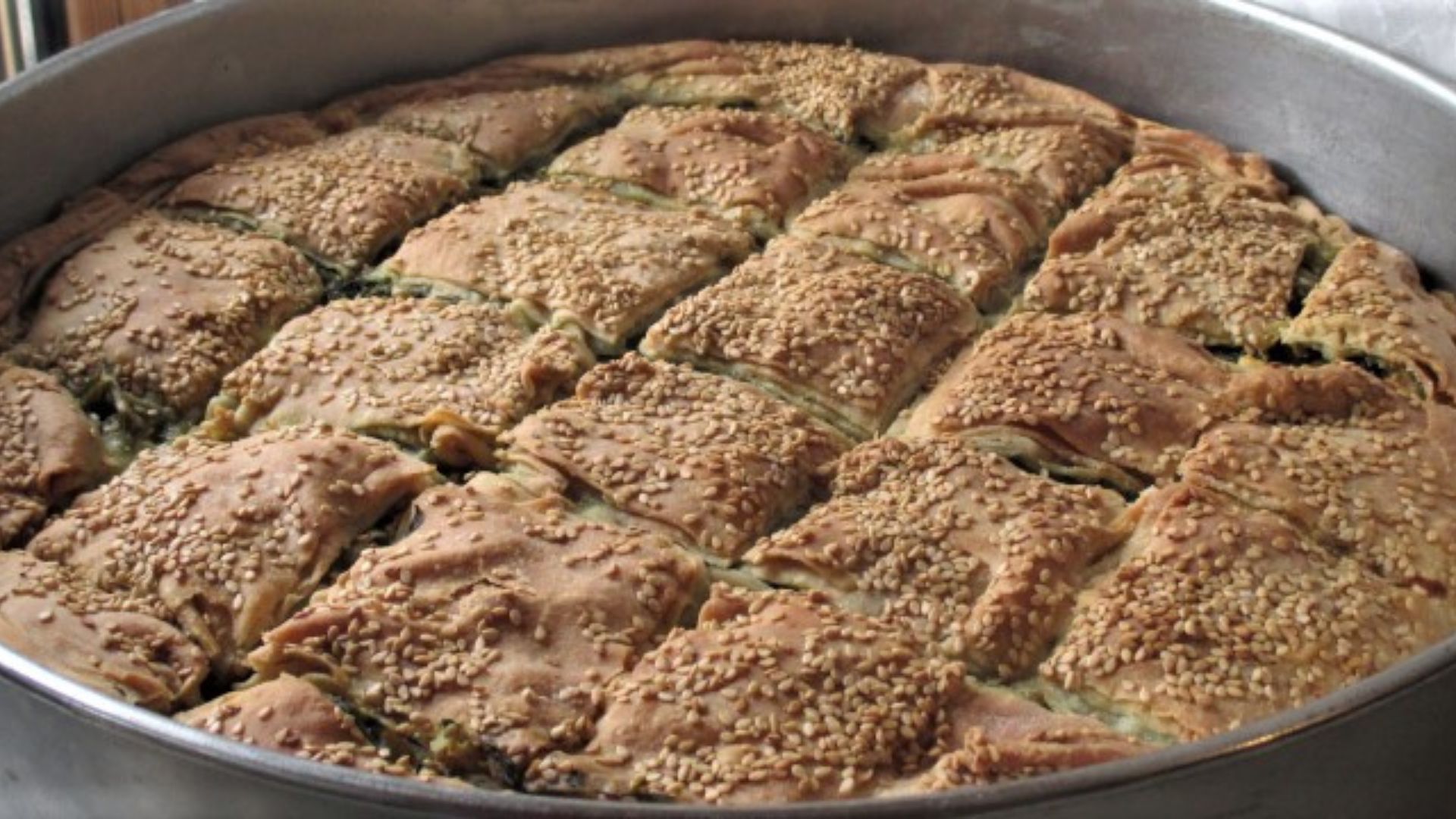
By Lisa Radinovsky from Greek Liquid Gold.
If you know anything about Greek food, you’ve probably heard of spanakopita, the classic spinach pie with feta cheese and phyllo (or filo) pastry. My Cretan neighbour’s recipe is especially rich in leeks, onion, herbs and olive oil, which blend beautifully with the spinach and feta. You can buy your phyllo or make your own, like Arhontoula always does.
Ingredients:
For the Horiatiko (Village) Phyllo Dough
for Spanakopita and Other Savory Pies
This recipe makes more than you need for one pie—possibly enough for two, depending on the size of your pan. Extra dough can be refrigerated for a few days or frozen for months, or you can cut all the amounts in the dough recipe in half.
- 1/2 cup Greek extra virgin olive oil
- 2 cups lukewarm water
- 2 tablespoons vinegar
- 1 teaspoon powdered yeast (approximately 4 grams)
- 1 teaspoon salt
- approximately 6 1/2 cups of flour, as needed to make dough that’s not sticky
- more flour for rolling out the dough
- cornstarch for rolling out dough
- 2 tablespoons sesame seeds
For the Spanakopita Filling
- 1 1/2 kilograms (3.3 pounds) fresh spinach, or 1 kilogram (2.2 pounds) frozen spinach leaves
- 2 leeks, with roots and dry green ends cut off, and dry outer leaves removed
- 1 onion, peeled
- 1 bunch parsley (about 1/2 cup when chopped and packed, without the harder stems)
- 1 bunch spearmint (about 3/4 cup when chopped and packed, without the harder stems)
- 1 bunch dill (about 1/2 cup, when chopped and packed, without the harder stems)
- 250-300 grams (2/3 pound, or a bit more or less, to taste) feta cheese, crumbled
- 1 teaspoon salt (to taste) and pepper to taste
- 3 tablespoons uncooked oatmeal
- 1/2 cup Greek extra virgin olive oil
- more olive oil to pour onto the dough and grease the pan
Directions:
Unless you are using store-bought phyllo, start preparing the dough. Put ½ cup olive oil and the water, vinegar, yeast, and salt in a medium-large bowl. Stir to blend. Add a cup of flour at a time, stirring to mix it in after each cup. As the dough thickens, blend in the flour and knead the dough with your hands, scraping the sides of the bowl as you work. When the dough no longer sticks to your hands, stop adding flour, and knead it for another minute or so.
Set aside the dough to rest for half an hour or more while preparing the ingredients for the pie filling. The dough can even rest up to a few days in a closed container in the fridge, if you want to make it in advance.
If you are using fresh spinach, cut off the spinach roots and discard them. Then cut off the stems to wash and set aside for other purposes, such as spanakorizo (spinach and rice). Wash the spinach leaves well. Cut large spinach leaves into 5 to 10 centimetre (2 to 4-inch) pieces (holding a bunch together and cutting with scissors or a knife).
Put the spinach in a large, deep, dry pot, then turn on the stove to high heat for about 10 minutes, stirring the spinach occasionally after it heats up. After 10 minutes, turn off the stove, strain off the liquid in the pot, and set the spinach aside in a colander to continue draining.
Wash and chop the leeks, onion, and herbs, removing the hard stems from the herbs. Place the onions and leeks in a large pot with ¼ cup of the olive oil. Sauté on medium high heat for 5 minutes, stirring occasionally. After that, add the chopped parsley, stir, and cook 2 more minutes. Then add the dill, stir, and turn off the stove, without removing the mixture from the stove. Stir in the spearmint 2 minutes later.
Remove as much of the remaining water as possible from the cooked spinach by pushing down on it with a spoon in the colander. Then add the well-strained spinach to the herb and onion mix. Add a teaspoon or so of salt and pepper to taste (not too much salt, given the saltiness of feta) and mix.
Add the remaining 1/4 cup of olive oil, oats, and crumbled feta, and blend well. Taste the mixture and add more salt and pepper if desired.
Grease a large round oven-proof pan (about 14 inches diameter–35 centimeters, or a comparable rectangle) with olive oil.
Divide about half of the dough (if using the recipe above) into three unequal parts and pat each one into a flattened circle (or rectangle, depending on your pan). Roll out the dough on a well floured surface with a spoonful or two of cornstarch sprinkled on and under the dough (to make it more elastic and easier to roll without tearing or sticking). Use the largest chunk of dough for the bottom, the smallest for the middle, and the second largest for the top.
Roll out the largest chunk of dough until it’s very thin—about 1/8 of an inch thick (about 3 millimeters)—for the bottom layer. You can use even thinner dough—1/16 of an inch—for the top two layers. The bottom and top layers should be large enough to climb up the sides of the pan and hang over a bit to make your work easier; the middle layer doesn’t need to be bigger than the bottom of the pan.
Place the largest layer of phyllo on the bottom of the pan (up the sides and hanging over the edge). Spread the spinach mixture on top of it.
Roll out a second layer of dough and lay it out on top of the spinach mixture. Pour or brush some olive oil on it. (You don’t need a solid lake of olive oil; various criss-crossing lines covering most of the surface will do.)
Roll out the third layer of dough, and position that layer on top of the pie. Cut off the sections of dough that are hanging over the edge of the pan, so what remains is level with the top of the pan. (You can save those dough bits to make other mini pies.) Roll the top two layers of dough together toward the top of the pie, twisting and folding under small sections at a time to seal the edges of the crust.
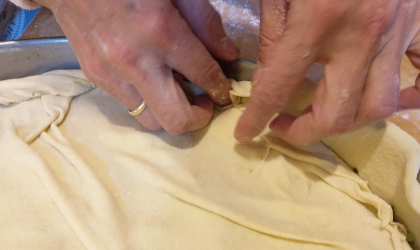
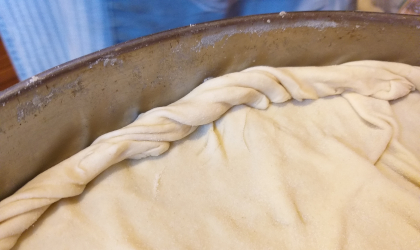
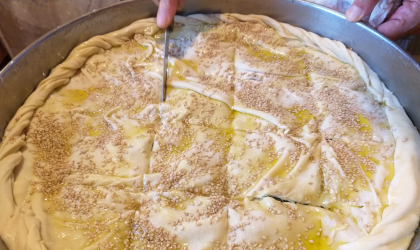
Pour a bit more olive oil on top of the phyllo. Then sprinkle water and sesame seeds on top of the phyllo.
Cut through the top two layers of phyllo (and perhaps a bit of the filling), but not the bottom crust, marking out rectangular pieces of the pie in the desired serving size. (This will let the pie breathe so it doesn’t form bubbles, as well as making it easier to cut after it’s baked.)
Bake the pie a bit lower than the center of a preheated oven at 200 degrees Celsius (almost 400 degrees Fahrenheit) for about one hour, until the top is golden brown. The bottom of the pie may need extra time to brown at a lower level in the oven; lift the pie a bit with a spatula to check the bottom.
*Originally published on Greek Liquid Gold: Authentic Extra Virgin Olive Oil (greekliquidgold.com). See that site for recipes with olive oil, photos from Greece, agrotourism and food tourism suggestions, and olive oil news and information.

 pastry.)