By Lisa Radinovsky from Greek Liquid Gold.
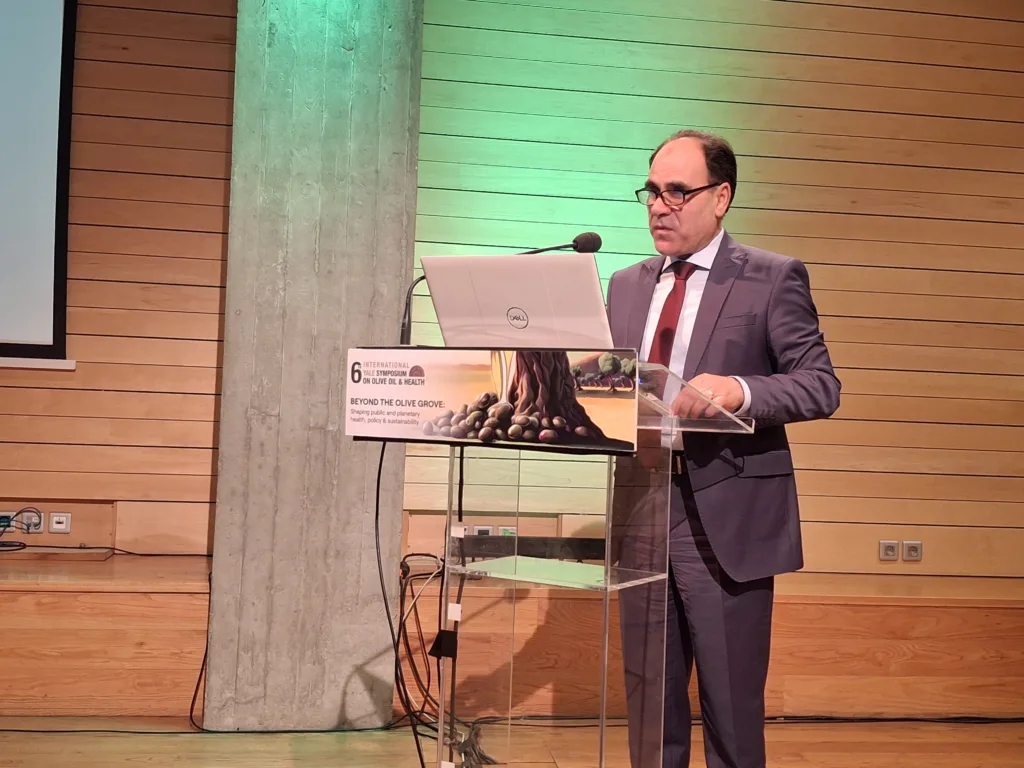
At the 6th International Yale Symposium on Olive Oil & Health, Dr. Abderraouf Laajimi, deputy executive director of the International Olive Council, gave a presentation on olive cultivation as a strategy to combat climate change. In an interview with Greek Liquid Gold, Laajimi also discussed ways to communicate with consumers about olive oil’s benefits.
According to its website, “the International Olive Council is the world’s only international intergovernmental organization in the field of olive oil and table olives. It was set up it Madrid, Spain, in 1959, under the auspices of the United Nations.” Among other services, the IOC provides regularly updated statistics on olive oil and table olive production, prices, consumption, and trade worldwide.
As Laajimi pointed out, there has been a general upward trend in olive oil production in recent decades, except for the last few years. However, climate change has resulted in early flowering and an increase in disease and drought that seriously affect the olive sector. Olive oil production is still concentrated in the Mediterranean region, although it is expanding to other areas. Unfortunately, “the Mediterranean is a hotspot for climate change,” as Laajimi observed. So “rising temperatures and decreased water availability pose serious challenges for olive growers.”
At the same time, Laajimi explained, “olive groves are now recognized as part of the solution against climate change.” Olive oil, he said, can contribute to both human and planetary health, as long as it is produced sustainably. This is true because of olives trees’ resilience, and because olive groves prevent soil erosion, thus serving as barriers to desertification. Moreover, olive groves act as a carbon sink. “Producing one liter of olive oil,” Laajimi said, “captures 10.65 kg CO2 from the atmosphere. World olive oil production absorbs the emissions of a city of 9,000,000 inhabitants.”
Traditional vs. Intensive Olive Cultivation in the Face of Climate Change
Some cultivation methods are more sustainable than others, as a question about the difference between super intensive and traditional olive cultivation suggested. As olive producer Antonis Tirpintiris explained to another audience member in the question and answer period, with super intensive cultivation there is a higher level of production, but “you don’t see a tree; you see a fence.” The tree roots grow together, and the trees need a lot of fertilizer and irrigation. In contrast, Tirpintiris added, with traditional cultivation there are 8 meters between the trees, which do not need intensive irrigation or much fertilizer.
Conference co-organizer Dr. Tassos Kyriakides asked, “if we double the average [olive oil] consumption in the U.S., where is that going to come from? Super intensive?” The question of how the olive oil sector could meet potentially increasing demand worldwide with sustainable cultivation was on many minds as Symposium speakers discussed a number of reasons olive oil appeals to consumers, environmentalists, and healthcare professionals.
Laajimi pointed out that traditional production, being mainly rainfed, tends to make better use of water and protect the soil more. However, he also suggested that intensive cultivation can play an important role in carbon sequestration when it is well managed, especially in terms of water use. The result depends on the systems of cultivation and irrigation, and what is appropriate and workable varies in different countries, with different olive varieties and water needs. Since intensive systems last only 15 to 20 years, Laajimi encouraged preservation of traditional cultivation and consideration of authentic varieties.
How the Olive Oil Sector Can Adapt to a Changing Climate
In an interview with Greek Liquid Gold, Laajimi called for more scientific research on genetic resources to identify olive “varieties resistant to drought, disease, and high temperature, and authentic varieties better adapted to the territory where they are planted.” He returned to the point that the olive tree has proven to be “among the most resilient” trees in the face of climate change. “We have to defend it,” he urged, since “it uses less water and energy, and helps a lot to sequester carbon.” In his presentation, Laajimi mentioned several ways the olive and olive oil sector could adapt to climate change. He encouraged a focus on “plant genetic improvement, resource use optimization, digital transformation, [and] by-product valorization.”
The defense of olive trees is especially important, as Laajimi told Greek Liquid Gold, since olives provide a crucial income source to low-income farmers “in marginal areas [where] only the olive tree can resist and be planted,” especially in the Mediterranean region. He reminded the audience that the olive tree is “an essential icon of the Mediterranean” that “symbolizes an environment, a climate, and a way of life.”
Familiarising Consumers with Olive Oil and Its Benefits As the Climate Changes
Laajimi discussed with Greek Liquid Gold the importance of conveying this information, and more, to consumers in countries “where the habit of consuming olive oil is not well rooted. For this kind of consumer,” we should emphasize that olive oil is “full of health benefits, because consumers will try to compare olive oil with other oils and see the price difference. Consumers convinced about health benefits may be willing to pay more.” We should emphasize that it has been “scientifically proven that the Mediterranean diet has many benefits for consumers all over the world, with olive oil at its center.”
At the same time, Laajimi said, we should help consumers become familiar with olive oil’s flavors and the way tastes and aromas differ, depending partly on the location where olives grow. Laajimi also believes olive sector marketing should inform environmentally conscious consumers about the olive’s eco-friendly profile, to further “improve the image of olive oil.”
Commenting on the Yale Symposium on Olive Oil & Health, Laajimi told Greek Liquid Gold he considers “this type of forum important in linking scientists, traders, organizations, and farmers” in discussion. This enables us to consider “how to bring this information to consumers and institutions.” With a diverse audience contributing various viewpoints, such events help to identify important issues that deserve the International Olive Council’s attention and assistance.
All businesses, organizations, and competitions involved with Greek olive oil, the Mediterranean diet, and/or agrotourism or food tourism in Greece, and others interested in supporting Greeks working in these sectors, are invited to consider the advertising opportunities on the Greek Liquid Gold: Authentic Extra Virgin Olive Oil website. The only wide-ranging English-language site focused on news and information from the Greek olive oil world, it has helped companies reach consumers in more than 220 countries.
*Originally published on Greek Liquid Gold: Authentic Extra Virgin Olive Oil (greekliquidgold.com). See that site for recipes with olive oil, photos from Greece, agrotourism and food tourism suggestions, and olive oil news and information.
