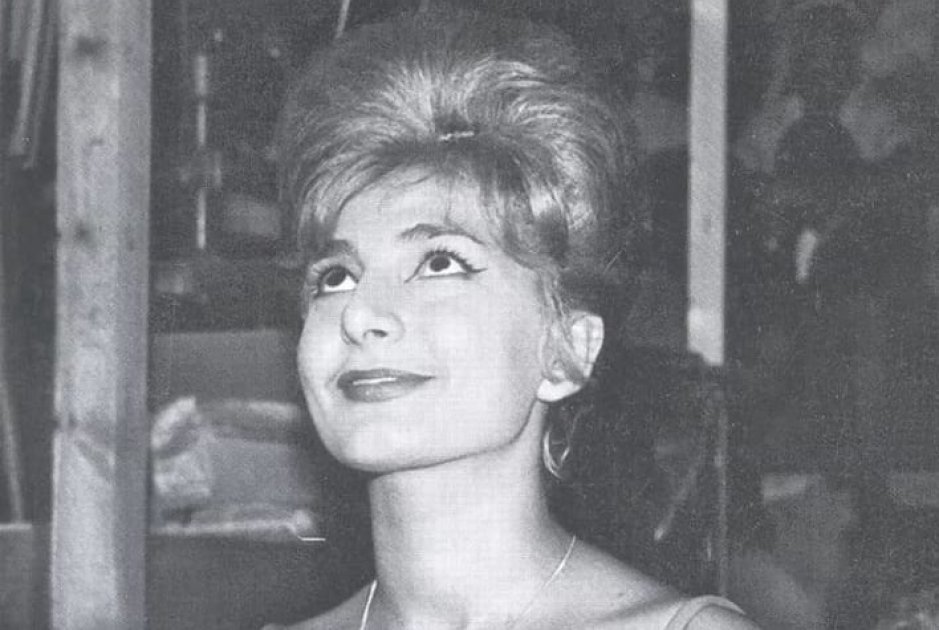
Tzeni Vanou was a famous Greek singer renowned for her unique hoarseness and jazz voice, as well as her ‘larger than life’ character.
Eugenia Vrachnou, as her real name was, was born in Athens on February 10, 1939. She had a difficult childhood after the separation of her parents and grew up with her grandmother. She said that at the age of 14 she tried to commit suicide because her father did not allow her to see her mother.
Tzeni first intended to study at the School of Physics and Mathematics. However, after her acquaintance with the composer Mimis Plessas, whom she considered her mentor, she decided to take up singing. At the urging of Plessas, she took an exam at the EIR and was hired in 1959 as a singer in the light music orchestra of the state radio station.

The artistic nickname with which she built her career was the idea of the conductor and composer Gerasimos Lavranos, with whom she collaborated in her first steps.
Her first hit song was ‘If I Deny You My Love’ and later signed her first big album, which included her great success'”I see you in my glass’. Her song ‘Tora’, developed in collaboration with Mimis, won first prize at the Thessaloniki Festival in 1964.
She soon established herself as a singer of light song and duettist, collaborating mainly with Giannis Vogiatzis. In the late 60’s, Nikos Mamagakis asked her to sing “I love you” (“The sun rises in your eyes”) for Nikos Foskolos’ film “Avenue of Hate”. The song was a great success and Manos Hadjidakis suggested that they collaborate. She refused because she did not want to betray Mimis Plessas, who promoted her.

In the early 70’s her career took a turn towards folk. She had just returned from America, where she worked for two years, separated and alone with two young children (Michalis and Athena from her marriage to businessman Vassilis Rigopoulos). In this difficult phase of her life, one day she met Tolis Voskopoulos, who helped her start all over again. He wrote her two folk songs (“My boy” and “Please, get up and leave”), which became great hits. Plessas wrote her the hit “I see you in my glass” and in 1984 she got a gold record with “Train of life”.
Tzeni Vanou passed away from cancer at the ‘Metaxa’ hospital in Piraeus on February 5, 2014. During her last few months of life, she had undergone a surgery to remove a tumour in the larynx.
Sourced By: San Simera
