From the cult sanctuary at ancient Palaepaphos (at the modern village of Kouklia), pilgrims would travel across the eastern Mediterranean to pay homage to an ancient female goddess of fertility. The sanctuary was active from at least 1200 BCE right into later Roman periods.
At some point in deep time, the ancient goddess morphed into the worship of Aphrodite, goddess of love and beauty, as we know her from her classical form. It was believed that she was born in the coast of Cyprus near the rocks now known as Petra tou Romiou.
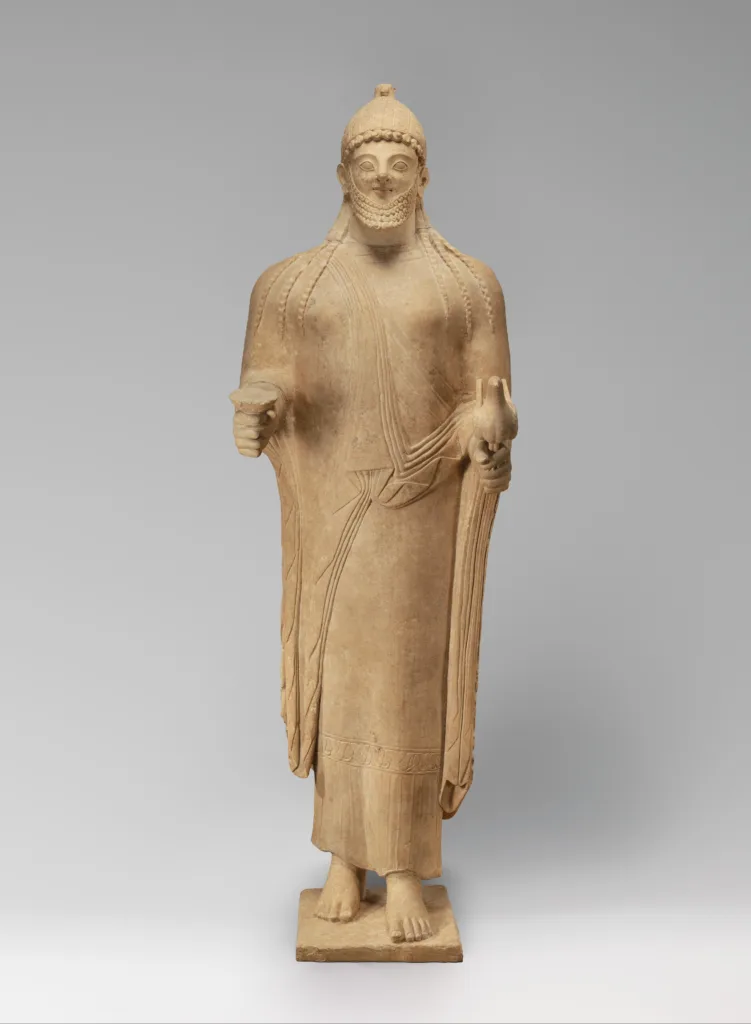
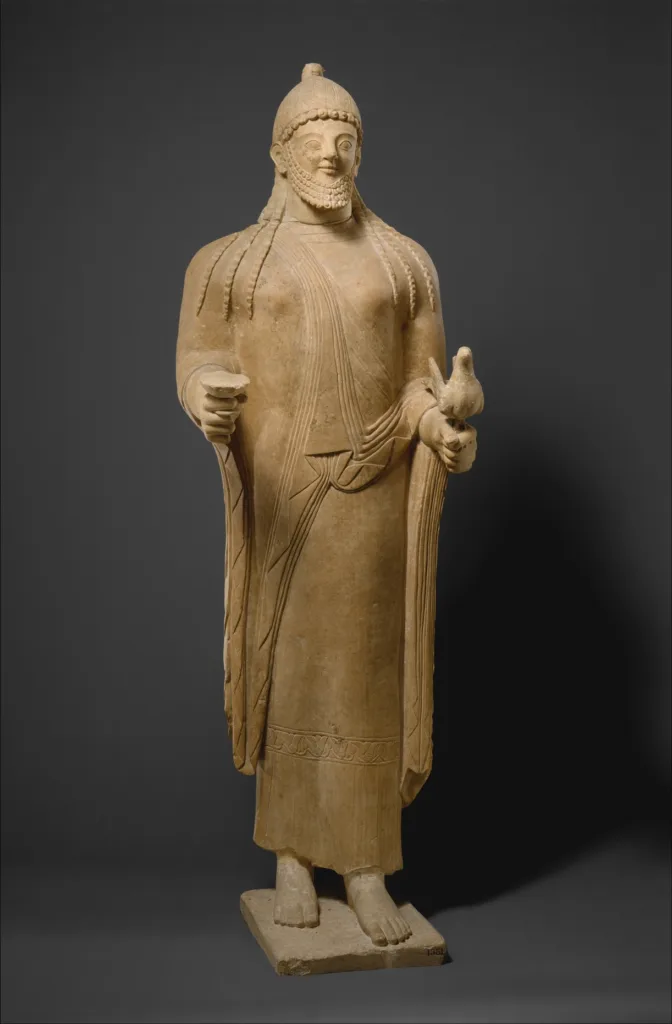
The goddess required priests and priestesses to serve her and to operate the sanctuary site. Carved from local Cypriot limestone, this statue of the late sixth century BCE gives us a hint as to what a priest looks like.
The “Archaic smile” (a slight smile on his lips), the long tresses of hair and the drapery are all heavily influenced by sculptural styles in Greece, yet the pose and the head-dress are very common Cypriot forms that have been influenced by Middle Eastern traditions such as Assyrian headgear. We see the remarkable mixing of cultural traditions that informed Cypriot art for millennia.
He holds a bird in his left hand and a phiale (libation bowl) in his right, both common symbols in ancient Cyprus associated with the goddess. He stands over two metres tall.
Traces of paint remain on the statue which remind us that in antiquity statues were painted brightly. It is particularly visible on his lips, but traces are across his drapery. Vertical lotus designs and the head of a bull are carved into the statue to show us the patterning on his drapery, with the folds also carefully carved into stone.
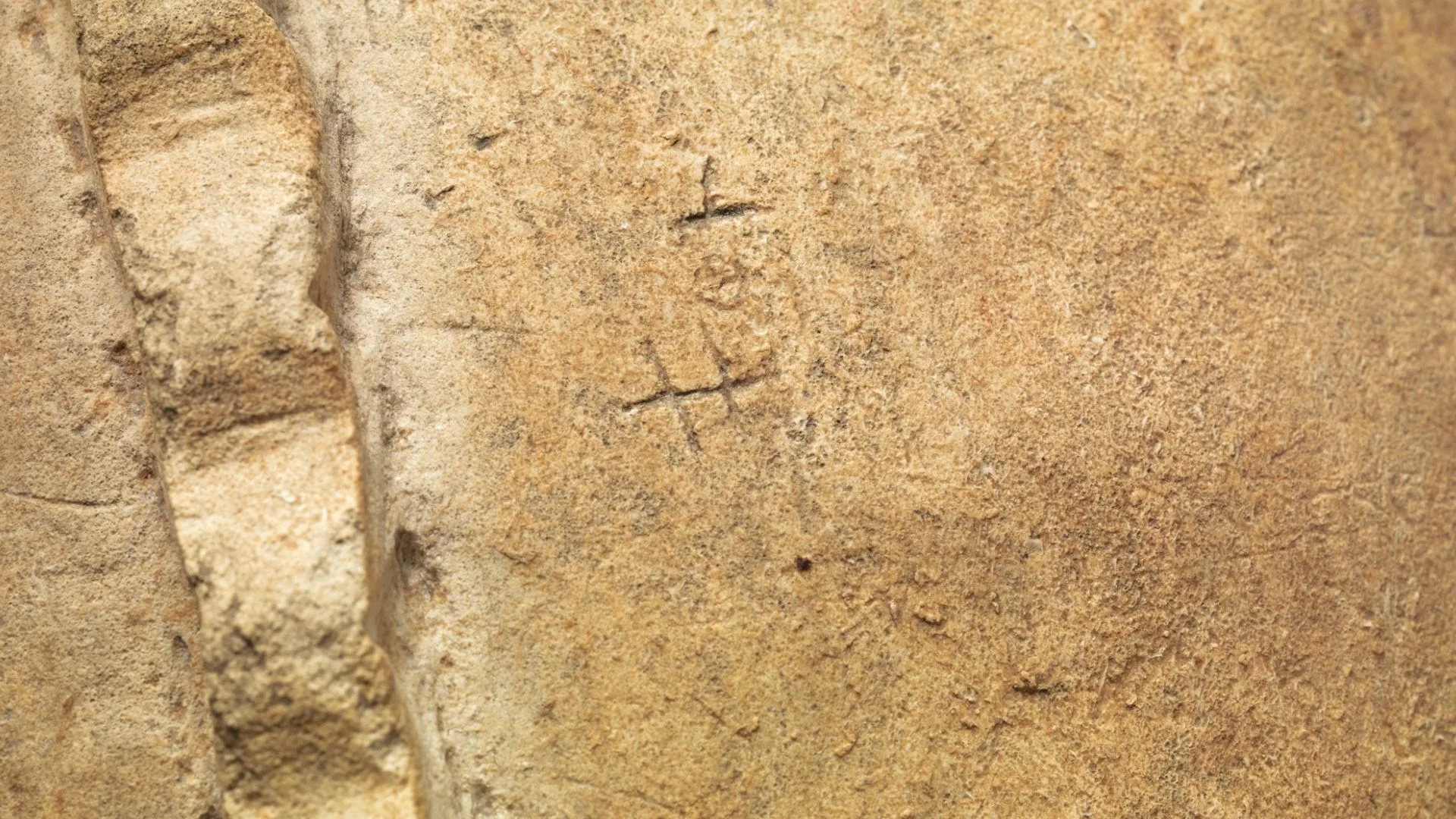
If one looks at his left shoulder, one can see the faint remains of an inscription in Cypriot syllabic (the ancient written language of the island throughout the Iron Age until the adoption of the Greek alphabet in the fourth century BCE). It seems to read “of the Paphian goddess”.
Where this statue was found is not known. It was collected by the American consul Luigi Palma di Cesnola (1832-1904) who oversaw hundreds of illicit excavations across the island in the 1860-70s. Cesnola rarely kept notes and when he did, he often falsified evidence. We know his workers dug at Palaepaphos which is where presumably this statue was found.
When Cesnola left Cyprus in 1877 he took with him more than 35,000 ancient objects, including this. Those objects would form the basis of the Metropolitan Museum of Art. It was an incredible loss of culture heritage for Cyprus.
The base and feet are modern reconstructions and the bird is heavily restored.
Here we can see the influence of the goddess of love herself even in modern New York.
See more here: https://www.metmuseum.org/art/collection/search/242019
