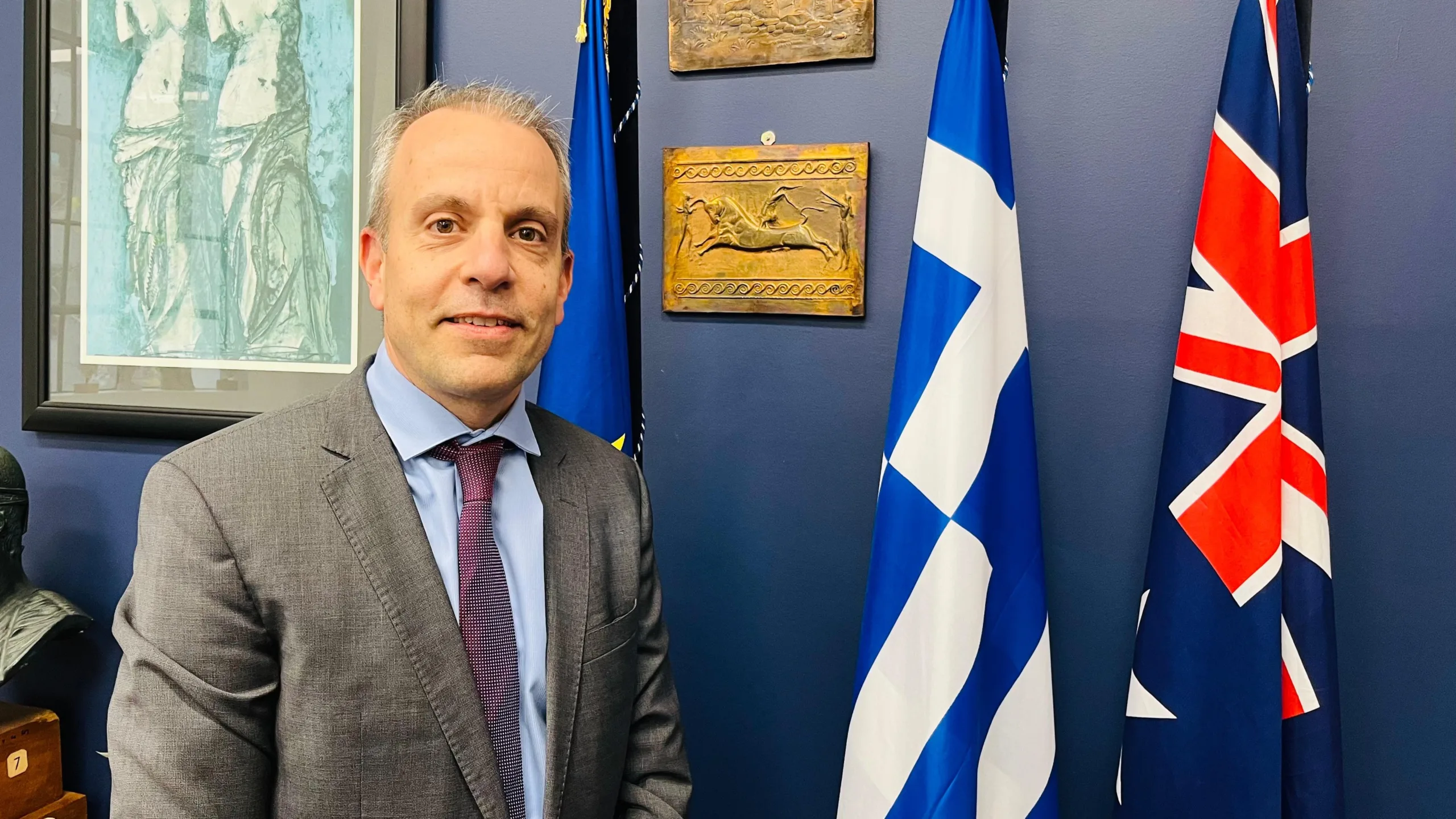
As Yannis Mallikourtis concludes his three-year term as Consul General of Greece in Sydney, he departs with vivid memories and a new understanding of what it means to be Greek in the modern world. It was his first appointment to a city with such a vast and dynamic diaspora – and it left a lasting impression.
“It has been a unique experience,” Mr Mallikourtis tells The Greek Herald. “Because it was the first time in my career that I was called upon to serve such a large Greek community. And I leave with many vivid memories that I will always treasure.”
One of the most striking things he noticed early on was the strength of connection Greek Australians have to their ancestral towns and villages.
“What surprised me most,” he reflects, “was the strong connection to their geographic place of origin – not the country as a whole, but the fact that they’re so attached to their village or their town. Maybe because I’m Athenian… we don’t have that. We’re all from somewhere in Athens, but we’re not so closely attached to our place of origin.”
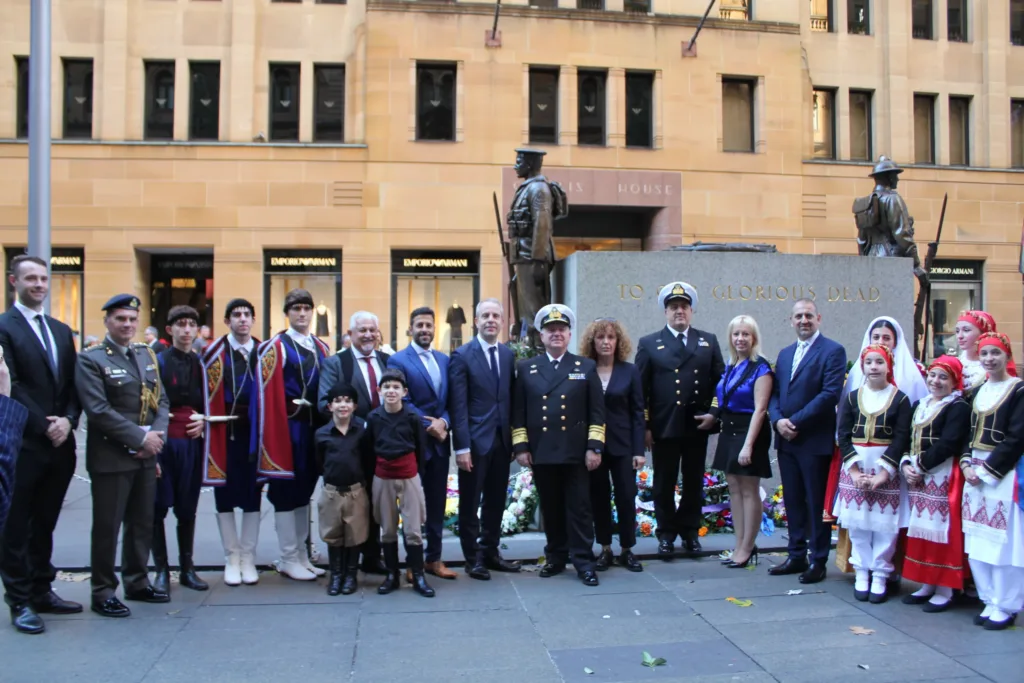
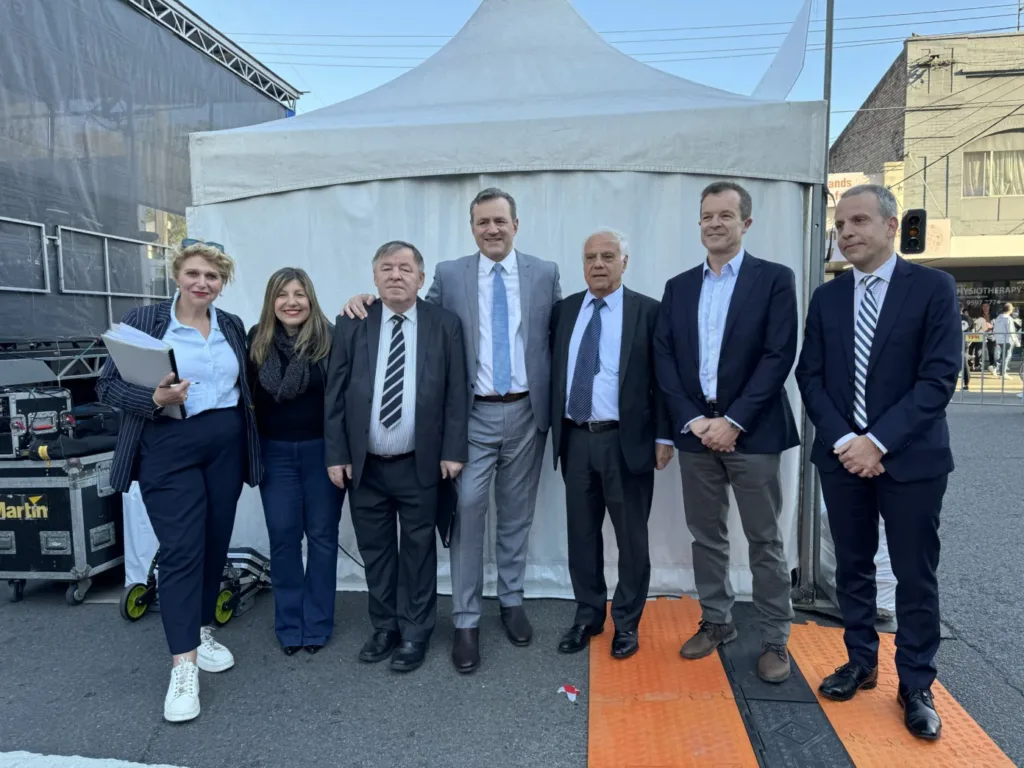
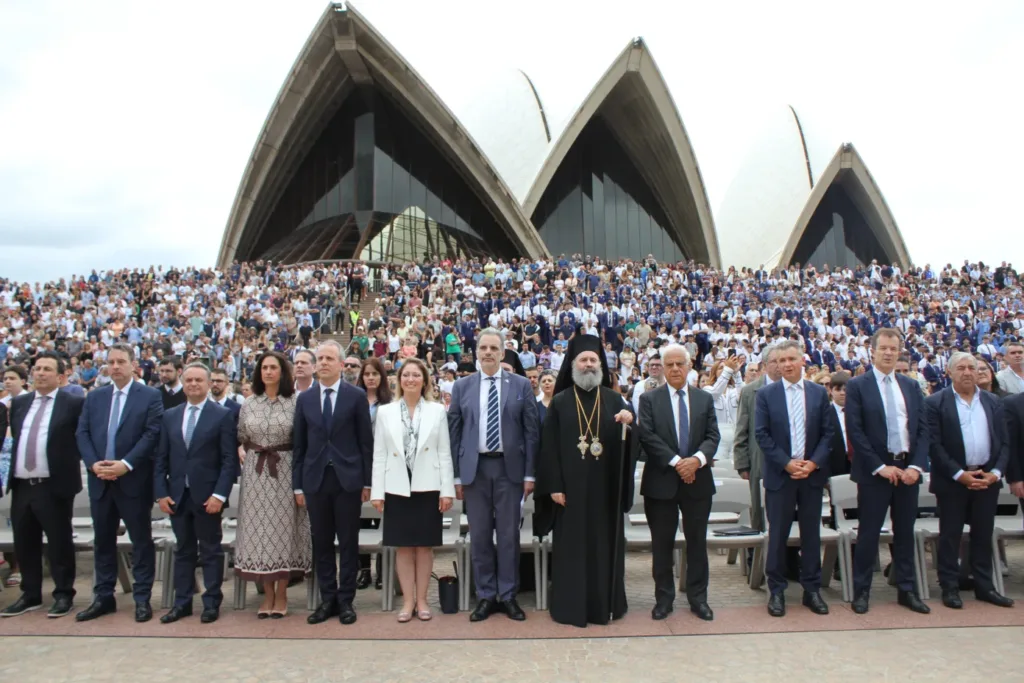
In his time as Consul General, Mallikourtis attended hundreds of events, engaged with the full spectrum of Greek community organisations, and witnessed the diaspora in action. Those experiences, he says, helped broaden his view of Hellenism and its place in diplomatic life.
“When you see that, for example, in New South Wales, you’ve got dignitaries – parliamentarians of Greek origin, many Greek Australians in influential positions – you realise that Greece’s clout locally is very strong,” he explains.
“It’s different to read about it and different to live it every day. Greeks are everywhere – in the public sector, business, politics and civil service – and in influential positions.”
That immersion changed the way he now sees his own country.
“I feel Greece is broader now compared to when I came here,” he says. “The diaspora is a key component of Greekness, of Hellenism. I think I will see my own country differently from now on.”
One of the key pillars of his work in Sydney has been the preservation of the Greek language and engaging younger generations.
“Language is one of the means to maintain the culture,” he says. “It’s not the only one, but it is an important one. I don’t see language as an indicator of someone’s level of Greekness, but I see it as a good tool to maintain the connection.”
He points out that Greek can be found “everywhere – in music, in traditional dancing, even when you read a menu in a Greek restaurant,” adding, “language is overarching. That’s why I think it’s important to promote it.”
Youth programs in Greece, such as the recent Youth Forum in Athens which 14 Greek Australians from Sydney attended, are another area he views as a meaningful way to maintain cultural ties.
“When they came back, they saw things differently,” he says. “They were very enthusiastic about learning the language, about going back again. So this is a typical example of a tangible measure which can make a difference.”
When asked what he sees as the defining strength of Sydney’s Greek community, Mr Mallikourtis doesn’t hesitate.
“It’s vibrant, it’s active in many different fields. It’s like a mosaic with different tiles. There’s everything – from dancing to music to restaurants, to different associations, to business networking organisations,” he says. “I would say omnipresent and very, very vibrant. And very strong in business and the service sector.”
On the flip side, he believes there is still work to be done when it comes to language retention.
“Language would be a field where we could perhaps do a bit more and get more organised,” he says plainly.
Looking to the future, Mallikourtis sees a community in transition – shaped by generational shifts and changing forms of engagement.
“It is going through gradual transformation,” he observes. “Those who arrived here – their numbers are obviously falling. One in five Greek Australians in New South Wales has been born in Greece. The other four have been born here. That will have an impact on how the community in Sydney sees itself.”
He foresees a move away from community organisations defined by geographic origin, and toward structures based on professional identity or broader Greek Australian interests.
“We’ll probably see Greek Australians moving from the local association to something broader,” he says. “You see that in the age composition of some of the associations… whereas in other organisations where the subject is different, you see stronger presence of the youth.”
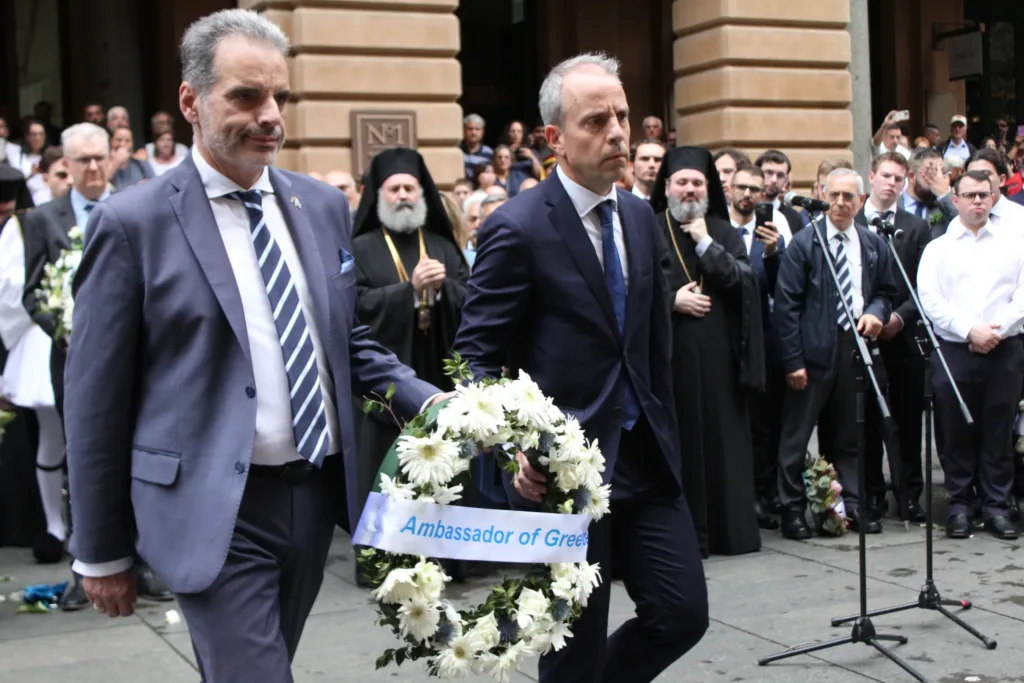
Among his proudest achievements as Consul General, Mr Mallikourtis cites improvements in service delivery.
“We improved the service of the Consulate General in the sense that we increased the numbers of Greek citizenships granted,” he says. “Internal changes and more local staff during the end of my term… this has increased substantially the number of Greek citizenships granted since January.”
His successor, George Skemperis, will inherit a strengthened post. And while Mr Mallikourtis doesn’t offer specific advice, he does have a few words of wisdom.
“Every Consul General has his own stigma and wants to leave his own footprint,” he says. “So I don’t think I would give him some special advice. I would probably just say in the beginning to observe, and he will draw his own conclusions.”
As for his parting message to Sydney’s Greek community, it’s one rooted in hope and adaptability.
“They should continue to be inventive in the ways they connect to their homeland – to one of their homelands, because there are two homelands for them,” he says. “To improvise and find new channels of maintaining that connection. If 20-year-olds feel they can achieve that through music and Greek dancing, so be it. Whatever everyone feels. But at least make the effort. And modernise, if that’s what they want… adaptability, I would say.”
As he prepares to leave, it’s clear Mr Mallikourtis departs not only with professional accomplishments but with a deeper personal appreciation of Greece – as seen through the lens of its diaspora.
