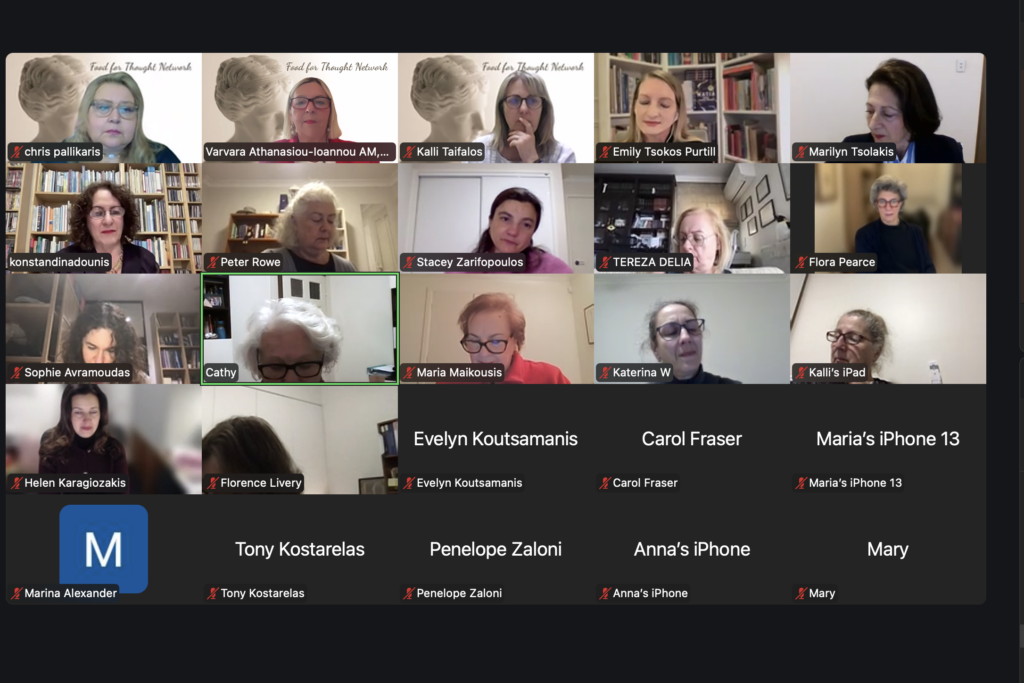
The Food for Thought Network (FFTN) in collaboration with the Greek Australian Cultural League (GACL) continued its 25th anniversary celebrations with a compelling online event, Voices of Many worlds: Greek Women Authors and the Reimagining of Hellenism, bringing together participants from Australia, Greece, USA and beyond for an enriching discussion on identity, migration, memory, womanhood, language and belonging.
Held as part of FFTN’s year-long anniversary program, the event featured introductions from both FFTN Founder Varvara Athanasiou-Ioannou AM and GACL President Cathy Alexopoulos and an engaging conversation between award-winning author Emily Tsokas-Purtill and Marilyn Tsolakis, former Head of English at Methodist Ladies’ College and co-author of Castellorizo, My Odyssey, skilfully moderated bycultural historian and literary translator Dr Konstandina Dounis.
The enthusiastic response to the event reaffirmed something deeply important: conversations about identity, migration, memory and cultural belonging continue to resonate across generations and across continents.
Through literature and personal storytelling, the discussion explored how young Greek women writers are sustaining, reshaping and reimagining Hellenism in the twenty-first century.
Emily Tsokas-Purtill’s debut novel Matia, winner of the 2025 Western Australian Premier’s Literary Award for an Emerging Writer, provided the focal point for the discussion.
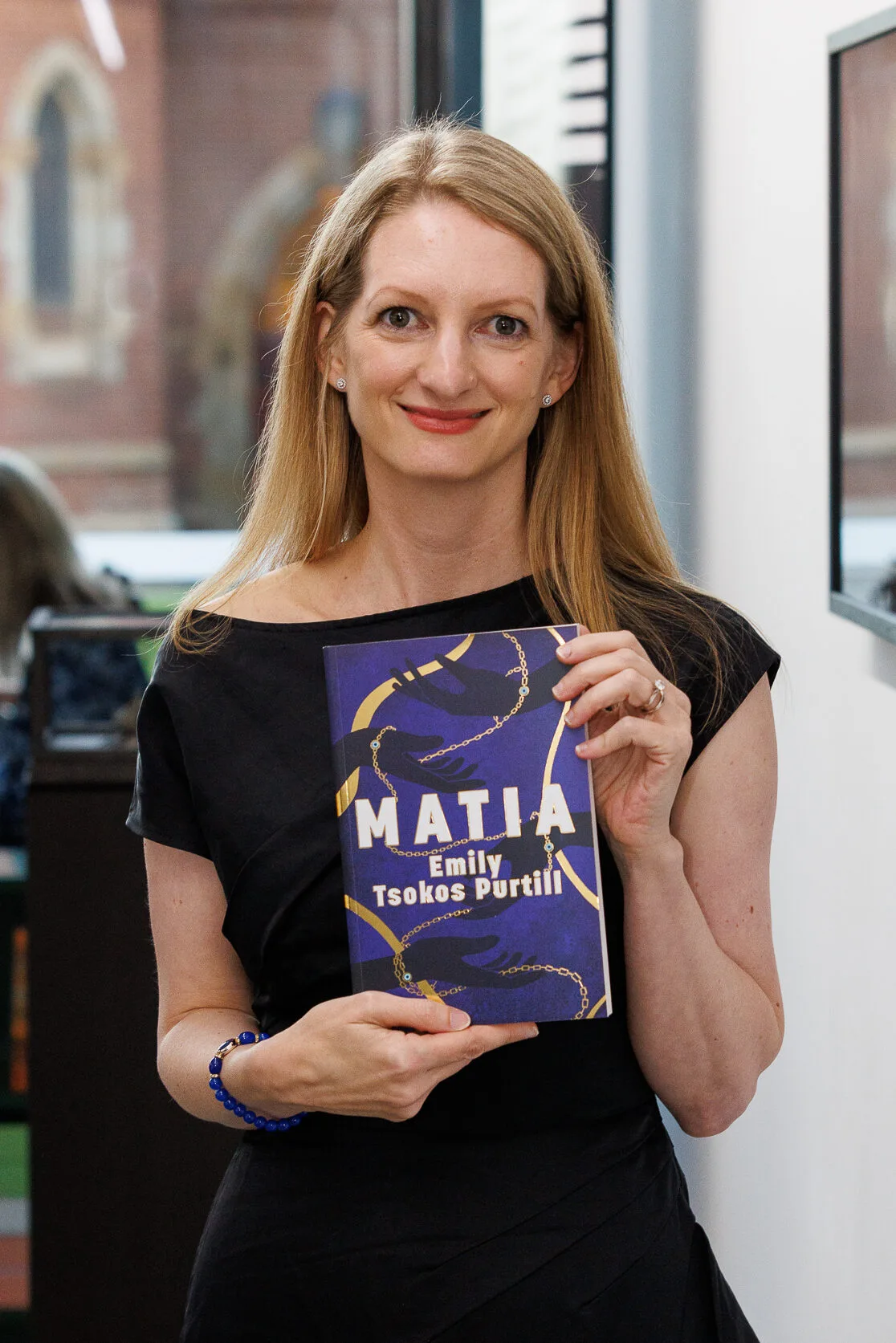
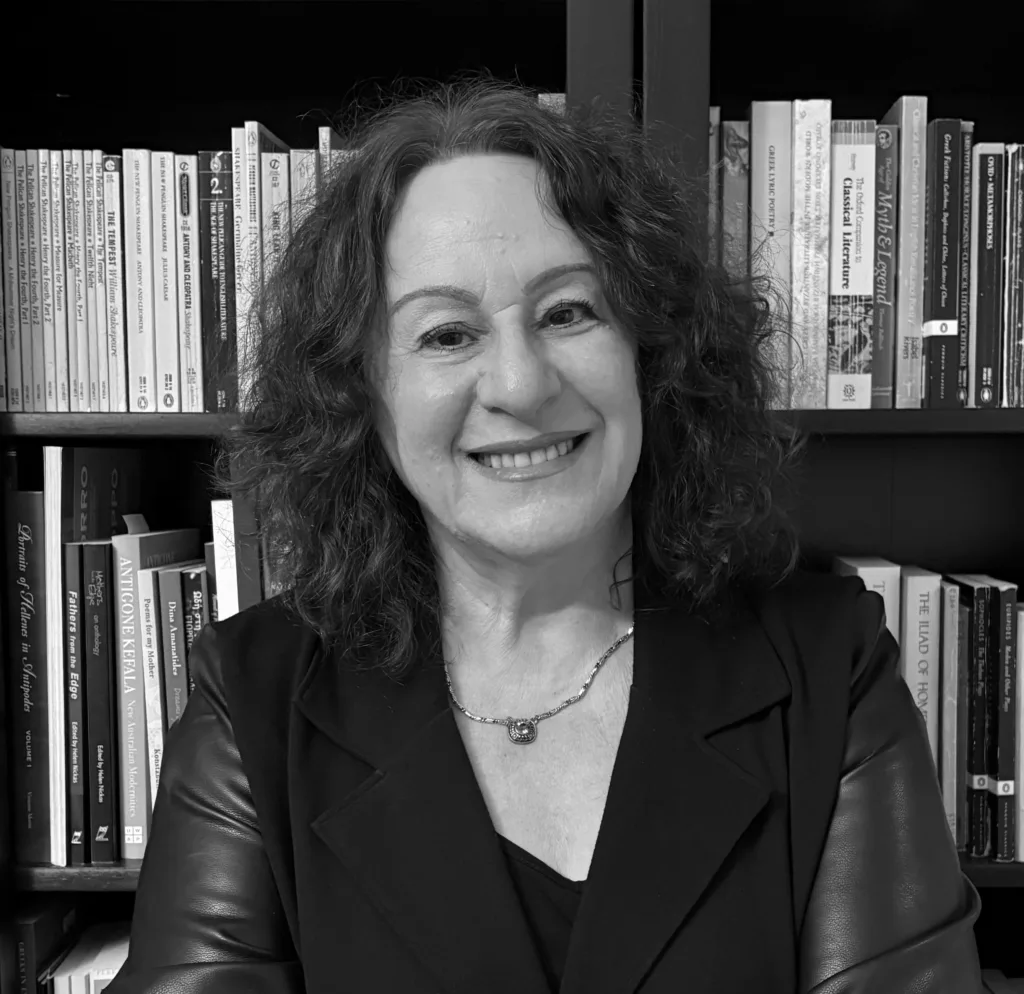
Dr Dounis highlighted the novel’s powerful dialogue and innovative narrative structure, which moves seamlessly between past, present and future while bringing to life four generations of Greek women, over a 125-year period.
Drawing on her own Greek Australian heritage, Emily reflected on the questions that inspired her writing: How is cultural identity sustained across generations? What does it mean to remain connected to one’s heritage in a rapidly changing world?
She spoke about the influence of her family history, including grandparents who migrated from different parts of Greece following the Second World War, and how their experiences informed the development of her characters.
At the heart of Matia are four generations of Greek women whose lives illuminate the complexities of family, migration, identity and belonging. Emily explained that she deliberately sought to create emotionally authentic characters rather than stereotypes, drawing inspiration from real experiences while maintaining the fictional nature of the story. Among them, the character of Sia held particular significance, inspired in part by the lives of her grandmother and great-grandmothers in Greece.
The conversation explored the ongoing tension between tradition and modernity, a theme familiar to many members of the Greek diaspora. Through characters such as Sia, Athena, Koula and Clara, the novel examines the different ways women respond to cultural expectations. Some challenge and redefine traditional roles, while others seek to preserve customs and values passed down through generations.
Marilyn observed that these tensions create much of the novel’s richness and mirror the lived experiences of many Greek Australians navigating multiple identities.
A particularly thought-provoking aspect of the discussion focused on Greek women across generations and the impact of patriarchal structures on their lives.
Emily reflected on her own experiences of working in a male-dominated legal environment despite having been raised in a supportive family. The conversation highlighted both the progress achieved by women over recent decades and the challenges that continue to shape their personal and professional lives.
The discussion also underscored the importance of diverse voices within migration literature. Emily spoke candidly about the challenges she encountered in getting her novel published, including questions about whether another Greek Australian story was needed.
She argued passionately that migration stories do not end with the first generation but continue to influence the lives, identities and aspirations of subsequent generations. By focusing on women’s experiences, she sought to bring visibility to stories and issues that have often remained hidden, including domestic violence, intergenerational trauma and the silent burdens carried by many women.
During the lively Q&A session that followed, participants reflected on the changing nature of Greek identity, the responsibility of writing family stories and the role of literature in preserving cultural memory.
Emily spoke about pivotal experiences that deepened her connection to Greece, including university visits and family connections that helped shape her understanding of identity and belonging. She encouraged aspiring writers to approach family narratives with honesty, sensitivity and courage.
Audience members contributed their own insights and experiences, enriching the conversation further.
Ms Athanasiou-Ioannou AM commented on Emily’s balanced portrayal of characters and reflected on the challenges she herself encountered in publishing stories about professional Greek Australian women, whilst acknowledging and thanking all past and present committee members, sponsors, speakers, attendees, supporters, media, family and friends.
“FFTN has no paid staff. Everything we have achieved over the past quarter century has been made possible through the passion, generosity, and Herculean efforts of volunteers,” she said.
The discussion also highlighted the importance of ensuring that women’s voices and experiences remain visible within broader narratives of migration and community life.
The event concluded with recognition of the many individuals who continue to strengthen Greek language, culture and identity across generations, including educators such as Effie Asvesti, whose work inspires young people around the world to engage with their Hellenic heritage.
This event forms part of a remarkable journey for the FFTN. Founded 25 years ago to create supportive and empowering networks for women of Greek heritage and their friends, addressing issues of leadership, relationships, wellbeing and language and culture. The FFTN has grown into a global community fostering dialogue, inclusion, leadership and lifelong learning.
Over the years, the network has delivered more than 160 events, established a Philosophy Café, published Her Voice: Greek Women and Their Friends, and created the Greek Women and Friends Global Forum, an online community that became a vital space for connection during the COVID pandemic and supported young women financially and with mentoring.
These initiatives ultimately led to what many considered impossible: the First Global Women and Hellenism Conference, held in Ioannina, Greece, 6-9 September 2024. The conference brought together approximately 200 participants and 44 speakers from around the world to explore the meaning of Hellenism, the multifaceted identity of Greek women and the sustainability of Hellenism for future generations.
As the FFTN continues its 25th anniversary celebrations throughout the year, events such as Voices in Many Lands demonstrate the enduring power of conversation, storytelling and collective reflection. They remind people that identity is not static but constantly evolving, shaped by memory, migration, language, family and lived experience.
Most importantly, they affirm that the voices of Greek women—wherever they may live in the world—remain essential to the ongoing story of Hellenism.
Find out more about the Food for Thought Network here: www.fftn.org.au.
