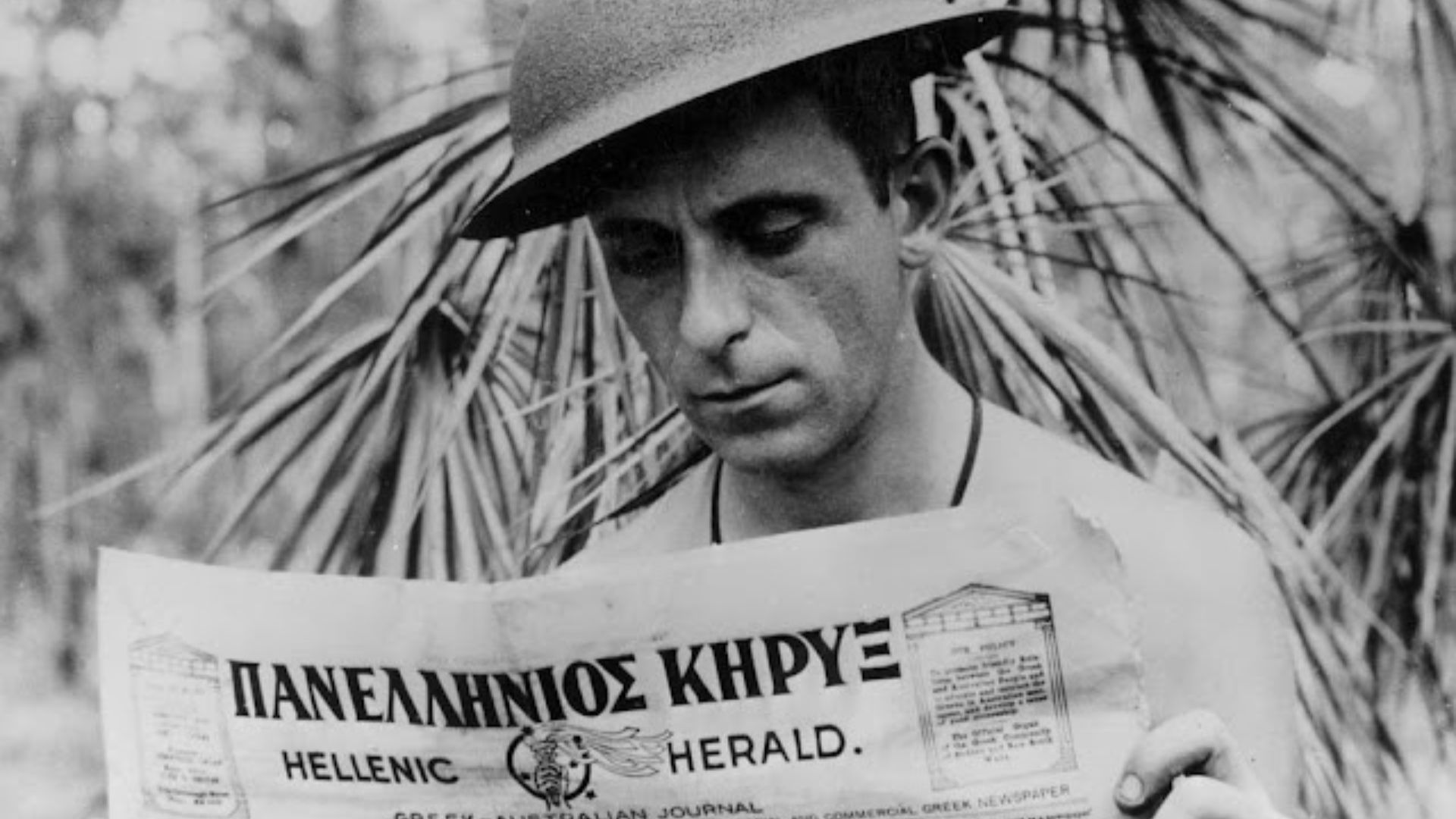
Xenophon Castrisos’ life was brought to light many years ago when the State Library of Queensland released an iconic image of him from their archive.
In the image, the Greek Australian, who was an aerial photographer with the Royal Australian Air Force at the time, is shirtless, wearing a soldier’s helmet and intently reading The Greek Herald on the battlefield during WWII. Back then, the newspaper was known as The Hellenic Herald.

After seeing this image, The Greek Herald did some investigating and managed to contact Harry Notaras, a relative of Xenophon who shared a few stories from his life.
“Xenophon’s mother was my grandfather Spyro Castrisos’ first cousin,” Harry explains to The Greek Herald, while recalling many past encounters with Xenophon.
“I met him several times as a young boy and he was just so dignified and polished.”

According to Harry’s mother, Xenophon was an extremely refined, well-educated and worldly man with impeccable manners.
Information from the State Library of Queensland reveal that Xenophon’s full name was Xenophon Haralambous Castrisos and he was born in Lourenco Marques (now Maputo), Mozambique on January 1, 1912.
He was the son of Maria Castrissios, née Freeleagus, nephew of Christy Freeleagus, the Greek Consul for Brisbane, and grandson of Kosma Anthony Freeleagus of Kythera.
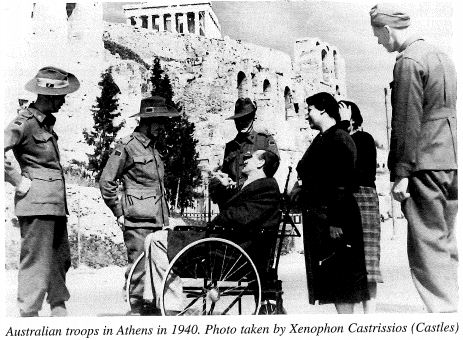
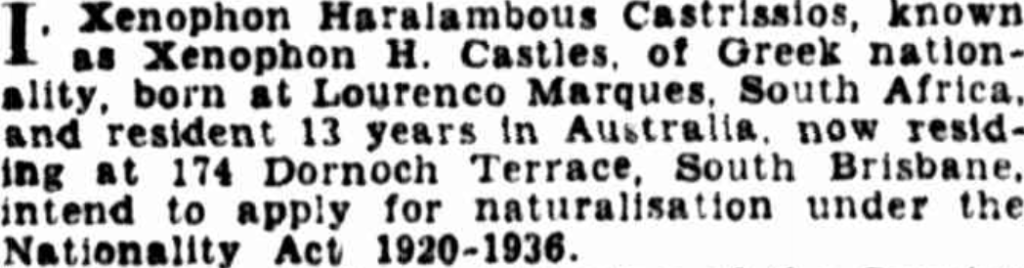
Xenophon was naturalised on September 26, 1941. He enlisted with the Royal Australian Air Force on December 31, 1941 in Brisbane and served as a leading aircraftman in the 12th squadron. He was discharged on December 21, 1945.
“Xenophon served as a reconnaissance photographer and had also taken aerial photographs of early Canberra,” Harry says, while explaining that he has a photograph taken by Xenophon hanging on his office wall.
“He also corresponded with Gough Whitlam and had once shown us a letter from him. For simplicity he sometimes adopted the moniker Rex Castles.”
Xenophon died on November 2, 2000. According to Harry, his wake “was held at the home of Lady Rene George (née Freeleagus), the wife of Sir Arthur George.”

