There are moments when the world seems to stand still amid the constant motion of daily life, often born out of anxiety.
In Bahrain, such moments have become routine. The sky has turned into a space where fears intersect with the sounds of interceptions and silent prayers. The war in Iran has cast a shadow, like a shroud, over people’s hopes – people who, until a month ago, were living peaceful lives.
In this dystopian reality, Greeks in the region have sought a point of stability to dispel the uncertainty surrounding them.
One such presence is Aliki Chatzara, Honorary Consul of Greece in Bahrain, a figure with deep knowledge of the region, having lived in the Gulf for the past fifteen years.
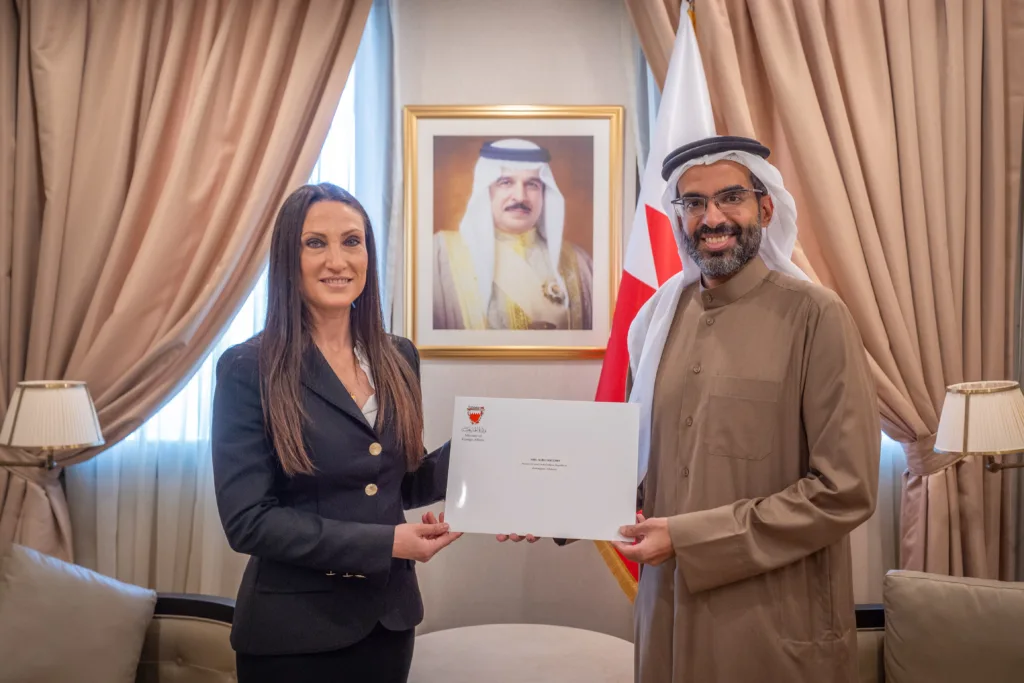
Also known by her writing name “Valores,” reflecting spiritual and human values, and with a multifaceted career as an author, teacher, radio producer and athlete, she found herself on the front line of a demanding effort of coordination and support.
Through constant communication and practical solutions, she helped many Greeks return safely home, overcoming obstacles such as closed airspace and complex transit procedures through third countries. It was an effort that tested endurance while also highlighting the importance of solidarity and composure.
As Easter approaches, the circumstances take on particular symbolism. In a region shaken by violence and uncertainty, the anticipation of the Resurrection serves as a reminder that even in the most difficult moments, hope persists. The light of Easter becomes a symbol of a return to safety and normality.
In this complex and charged environment, Ms Chatzara speaks to The Greek Herald about the critical moments experienced by the Greek community, the challenges of repatriation, and what lies ahead in Bahrain.
What is the situation in Bahrain at the moment? How concerned are residents about strikes from Iran, and were such developments expected?
Although there were indications since the summer, no one wanted to expect such an outcome. Residents remain calm, though there are many questions about how the situation will evolve.
Bahrain itself has recently been affected by attacks and wider instability in the Gulf. How concerned are Greeks living there, and what was your first priority as Honorary Consul when the crisis began?
It was something that shocked us all. From Bahrain’s side, there was absolute professionalism and immediate handling of risks, giving us a sense of security. It was natural, especially in areas where interceptions were more intense, for Greeks—particularly those with children—to feel concerned. My first priority was their safety and addressing their concerns so we could find solutions.
How was the repatriation of Greek citizens organised? What role did you play and what were the main challenges?
Repatriation was organised using a C-130 Hercules aircraft once citizens expressed their wish to return. The Greek Ministry of Foreign Affairs, in cooperation with embassies in Riyadh, Doha and Kuwait—under which the Honorary Consulate in Bahrain falls—coordinated the effort.
As Honorary Consul and a resident of Bahrain, I handled coordination locally and remained in constant communication with our embassy. I had already created a WhatsApp group including all Greeks in Bahrain, where I shared official and urgent updates and maintained communication day and night.
The main difficulties were the closure of airspace and the need to cross into Saudi Arabia, which required visas. For those with pets, the paperwork was especially complex. Additionally, the fact that our embassy is based in Kuwait made some bureaucratic procedures more challenging.
For those who remain, how safe is life in Bahrain today?
Life has become somewhat routine as risks are managed, though people miss loved ones who have left. It is understandably unsettling to hear interceptions at intervals. There is some risk, including from debris. The continued closure of airspace makes travel difficult. Shops are operating normally, but morale has changed; some people work from home while others go in as usual, and schools are operating online.
Have you experienced such a tense period before?
In my fifteen years in the Middle East, I experienced something similar during the coronavirus period. There was the same anxiety and uncertainty, though airspace remained open, even if flights were difficult.
Do you see hope for de-escalation?
There will always be “light on the horizon,” though this is a complex issue. I hope it ends soon, as Bahrain is a beautiful place where daily life once felt like a small haven of safety.
What did this experience teach you about the Greek community?
It showed me that with proper guidance, even very different personalities can unite and achieve anything. I was moved by everyone’s willingness to communicate, share their concerns, and come closer together like a large family.
I would also like to thank the Bahraini authorities for the safety they provide day and night, not only now but throughout the years. I thank the Greek government, the Ministry of Foreign Affairs and the Ministry of National Defence for their professionalism and support during critical moments.
Finally, I commend the courage of the families who travelled overland through Saudi Arabia and, despite many difficulties, managed to return home. I followed the same route and know well the hardship, anxiety and exhaustion they endured, especially those travelling with young children.
