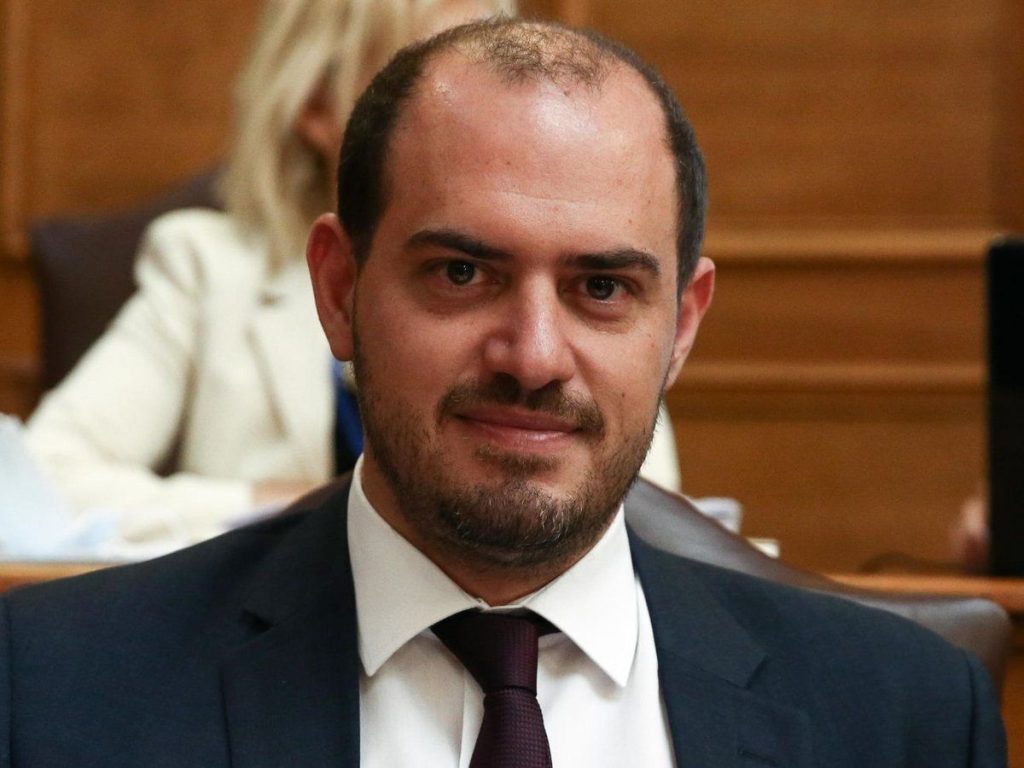
In an exclusive statement to The Greek Herald, Greece’s Deputy Foreign Affairs Minister Giorgos Kotsiras has expressed his hope that the government will secure the required parliamentary majority to pass the proposed bill aimed at easing voting restrictions for Greeks abroad.
At only 38 years of age, Mr Kotsiras took over the portfolio for Greeks Abroad as Deputy Foreign Affairs Minister. Immersed in politics from an early age, he holds a doctorate from the Law School of the University of Athens, specialising in European Law.
He was elected for the first time as an MP with New Democracy in July 2019 in Western Attica.
In January 4, 2021, Mr Kotsiras was promoted to the position of Deputy Minister of Justice, responsible for International Cooperation and Human Rights.
In his statement to The Greek Herald, Mr Kotsiras said his priority as minister was to strengthen Greece’s ties with the diaspora.
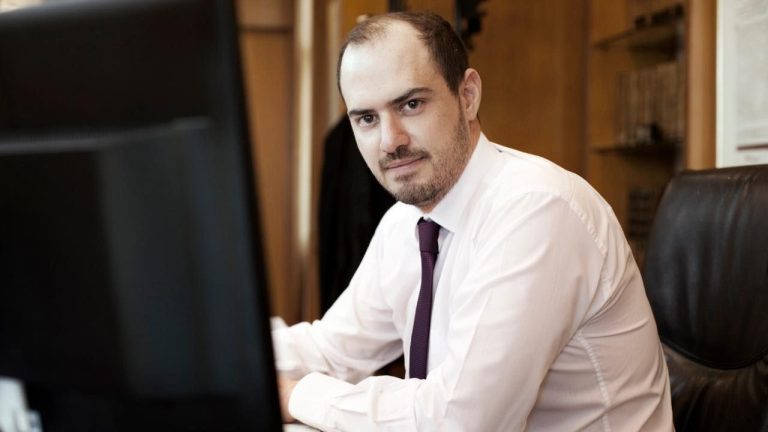
Giorgos Kotsiras.
“It is a special honour for me to serve Greece from the position of Deputy Minister of Foreign Affairs, taking on the issues of Greeks Abroad and Public Diplomacy,” Mr Kotsiras said and thanked Greece’s Prime Minister Kyriakos Mitsotakis for entrusting him with the role.
“My main priority will be the further strengthening of Greece’s ties with its active diaspora. I will make every effort so that the voice of Greeks everywhere continues to be heard loudly.”
To apply the legislation at the next election, over 200-MP votes in favour of the bill are required (two thirds of the total MPs in Parliament).
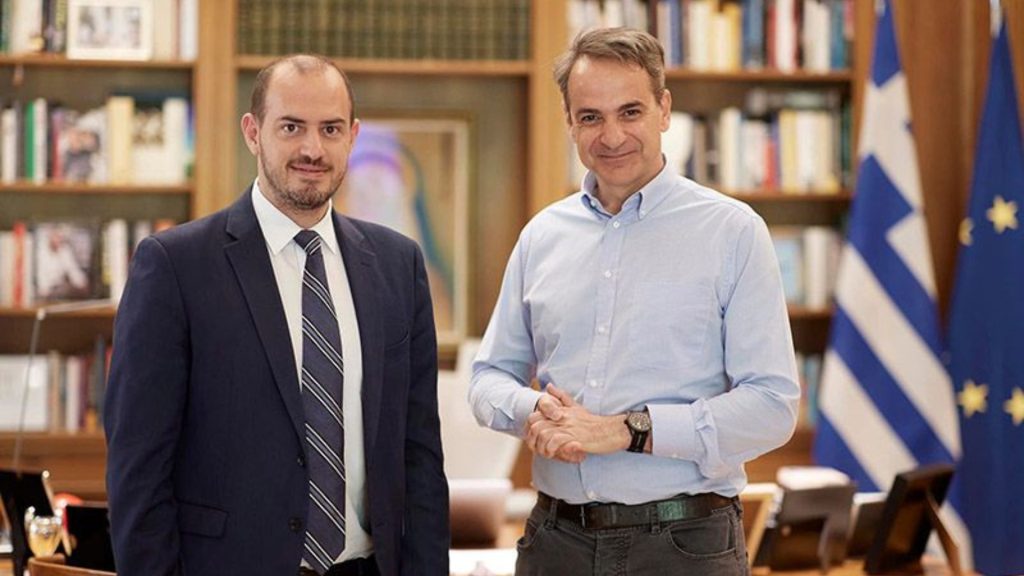
Deputy Minister of Foreign Affairs, Giorgos Kotsiras (L) and Prime Minister, Kyriakos Mitsotakis (R).
According to Ekathimerini and based on the initial positions of the parties in Parliament, a majority of 220 MPs appear to be agreeing with the legislation.
In his statement, Mr Kotsiras expressed the Greek government’s hope that “the required parliamentary majority will be secured.”
The Deputy Minister also praised the Greek diaspora in Australia for their achievements and for continuing to bring important issues of concern to the attention of the Greek government.
“Australian Hellenism, with its significant achievements and its strong presence in the political, economic and social life of the country, is one of the most alive and dynamic cells of our homogeneity worldwide,” Mr Kotsiras said.
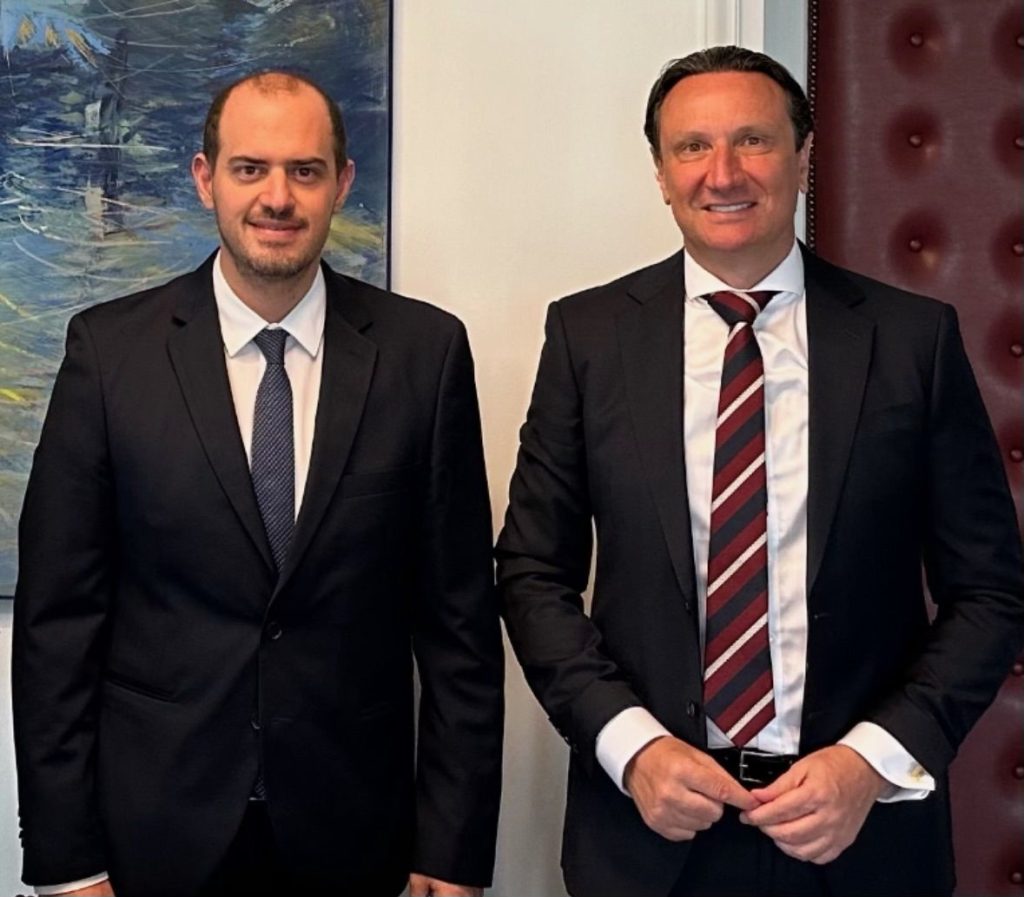
Giorgos Kotsiras (L) and President of the Greek Community of Melbourne, Bill Papastergiadis (R).
He also expressed his hope for “fruitful collaborations” with the Greek community in Australia and said he hopes to visit Australia soon.
“I aim to continue the important work that has already been done in the last four years in the field of the diaspora and with a strong sense of responsibility, we are setting the bar even higher. I am sure that we will have a substantial and effective cooperation with Greeks everywhere,” Mr Kotsiras concluded.
“Addressing, especially, my compatriots in Australia, I look forward to our systematic and fruitful communication, and hope to meet you all in person as soon as possible.”
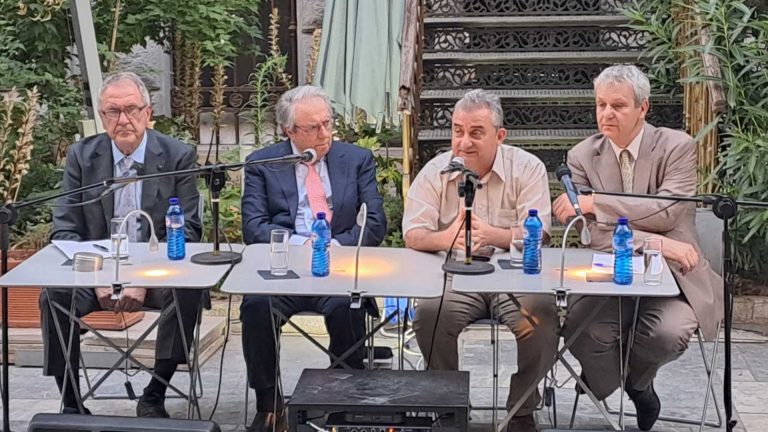
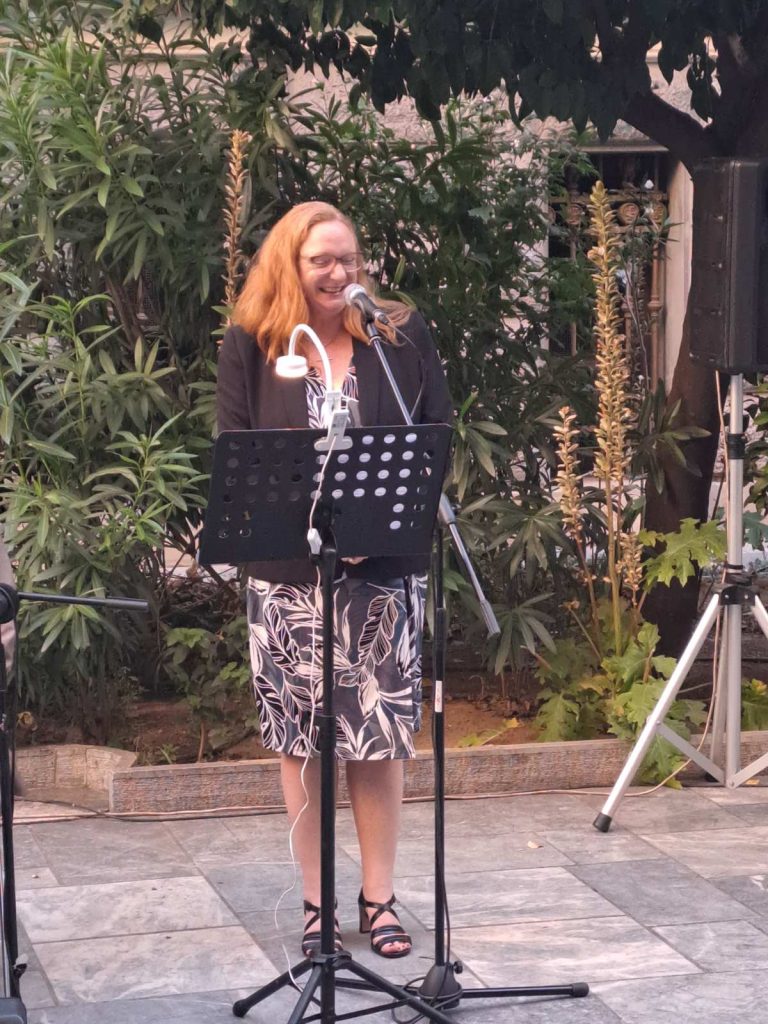
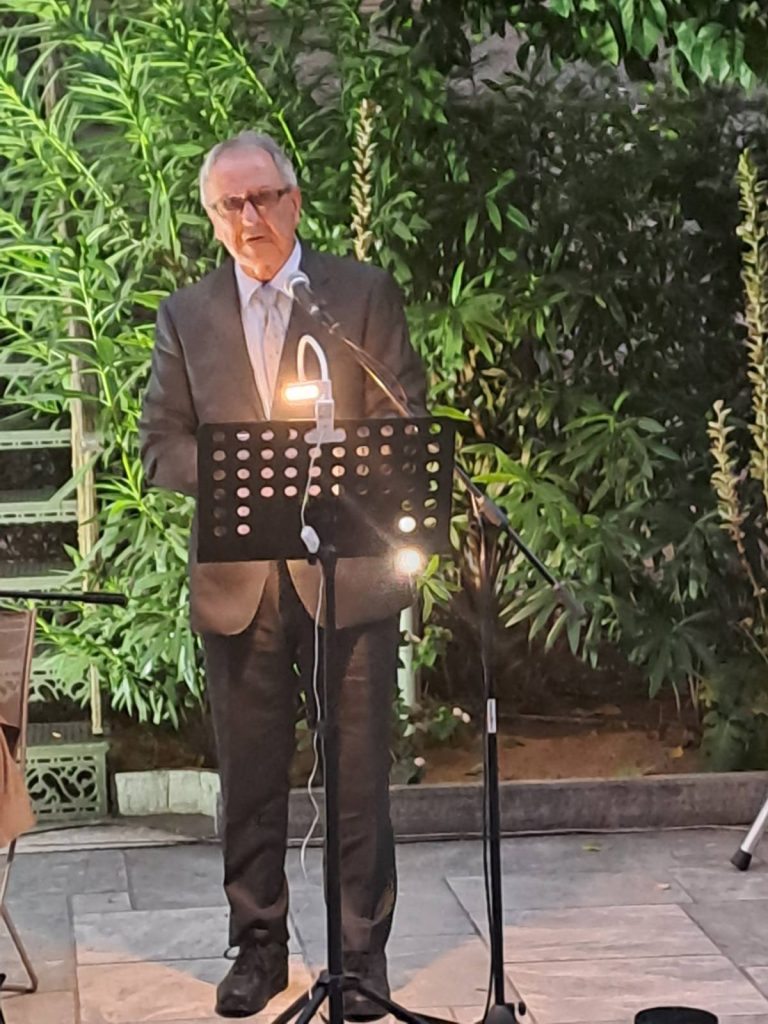
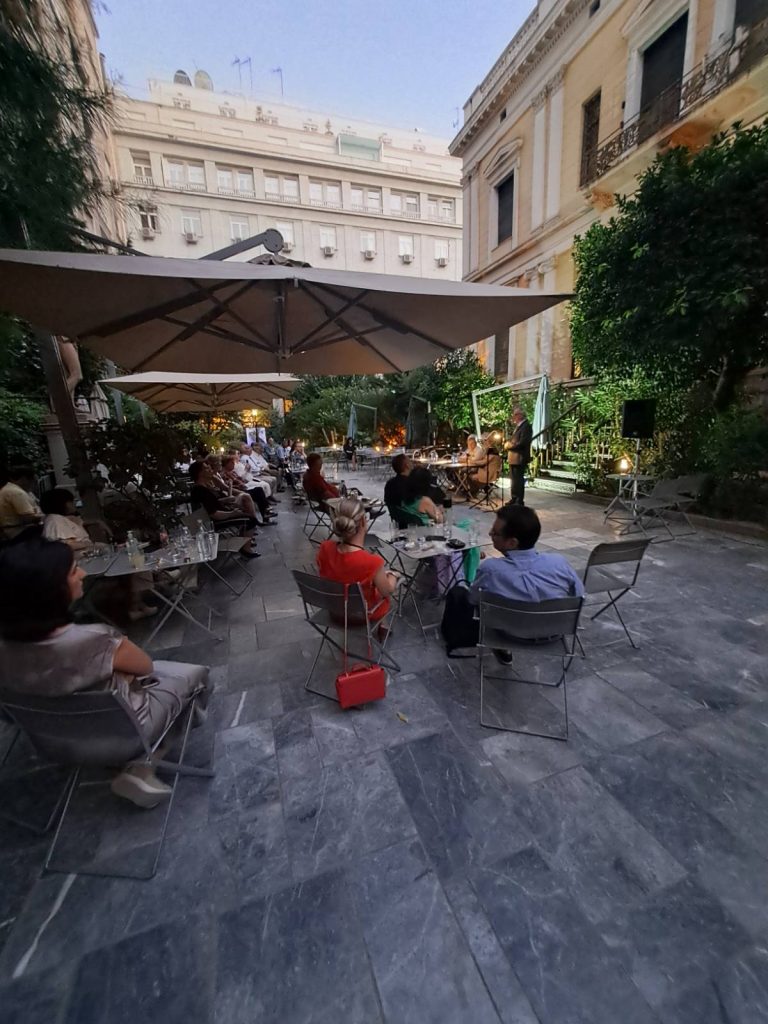
Professor Anastasios Tamis’ new book The Aegis of Hellas: Continuing vigour of Philhellenism was launched by The Hellenic Parliament Foundation on Monday, July 17 at 7.30pm (Greek time) at the cafe in the garden of the Numismatic Museum of Athens (12 Panepistimiou Street).
The launch occurred in the presence of a number of distinguished guests including the Australian Ambassador to Greece, Alison Duncan; the Consul General of Greece in the Northern Territory, John Anitomatis AM; the General Secretary of the Hellenic Parliament Foundation, Professor Evanthi Hadjivassiliou; Members of Parliament; the Director General of the National Hellenic Research Foundation “Eleftherios K. Venizelos,” N. Papadakis-Papadis; the former Rector of the National and Kapodistrian University, Professor George Babiniotis; as well as a large number of Greek Australian leaders.
It was a historic day for Greeks abroad as “the presence of Professor Tamis and with the printing and circulation of his most important book on modern philhellenism, we essentially honor the struggles and contribution of expatriate Hellenism”, stressed in his greeting the Secretary General of the Foundation of the Hellenic Parliament, an eminent Professor with extensive work in the study of modern history of Greece, Mr. Evanthi Chatzivassiliou.
Mr Hadjivassiliou then invited Australia’s Ambassador to Greece, His Excellency H. E. Alison Duncan, who welcomed the hostage initially in Greek.
Mrs. Alison Duncan referred to the common struggles of Greece and Australia during the two World Wars and especially the Battle of Crete, the sacrifices of Greeks to defend and rescue hundreds of Australians from the Germans and highlighted the enormous contribution of Australians of Greek descent to the advancement of the economy and culture of modern Australia.
Mrs. Dr. Duncan spoke enthusiastically about Professor Tamis’ book and initially stressed the great contribution of the author to the recording and promotion of the history of Greeks in Australia and the Eastern Hemisphere in general, referred to the contribution of Australian Philhellenes from the world of politics, the Church and the spirit mentioned in Mr. Tamis’ work and stressed the importance of reading the book by a large number of readers.
Then the floor was given to the most eminent Greek lexicographer and hierophant of linguistics, and former Rector and Minister of National Education, Professor George Babiniotis, who referred to the academic and national contribution of A. M. Tamis, “whose work I have followed closely for the last forty years and who connects us with creative friendship”, clarified our reputable linguist (the full content of Mr. Babiniotis’ speech is published separately).
Mr. Babiniotis outlined the evolution of Mr. Tamis’ studies at the University of Melbourne, “one of the twenty most important and best universities in the world”, then referred over time to his teaching as a Lecturer and later Professor at the Universities of Melbourne, Monash, La Trobe and Notre Dame, starting his systematic tertiary studies at the School of Journalism of the Royal Technical University (RMIT) between 1972 and 1974.
“It was a school with high demands: daily language exercises in class to write and analyse news with different topics and different kinds of journalism. The practice of writing the news in a short period of time and even the formulation of its abstract was a valuable preparation for all subsequent writing activity.
In February 1975 he enrolled at the University of Melbourne where he continued his studies until 1986. He followed classical studies (Ancient Greek, Philosophy and History), next to great Hellenists (Homericists and Professors of Epigraphy and Philosophy), as well as Modern Greek studies.”, stressed the eminent Linguist and Lexicographer.
Professor Babiniotis then referred to the most important phases of Professor Tamis’ development, his academic and writing role, and spoke briefly about the establishment and operation of EKEME: “In July 1997, he was appointed Professor and founded the National Centre for Hellenic Studies and Research (EKEME).
It is a university research and study institution, which operates intensively and becomes internationally known. The University cedes six of its buildings for the next 99 years. The Centre also achieves significant self-financing.
The Archives of the Greek Diaspora are transferred there and renamed the Dardalis Archives of the Greek Diaspora.
A team of 12 researchers led by Professor A. Tamis undertakes the digitization of the millions of original and rare documents that he began to collect, later adding rich material from the world of the Eastern Hemisphere.
Original documents of Greek diplomats, documents of Onassis, Konialidis, Greek Kings and Prime Ministers, Presidents of the Hellenic Republic, politicians and influential personalities, are analysed into keywords and made accessible worldwide, with the collaboration of American and Australian electronic companies, as well as a five-year collaboration with the National and Kapodistrian University of Athens, to create an Index mechanism and over 300,000 documents to be stored and accessible internationally on EKEME’s servers” to conclude:
“The thirty years 1993-2023 define the admirable research, writing and publishing activity of Professor Anastasios Tamis, very important in extent, depth and quality for the issues of the Greek Diaspora.
Apart from the familiar area of Australia and New Zealand in Tamis, it also systematically and methodically organizes research programs related to the language, identity and history of Hellenism in the Eastern Hemisphere.
These are original field research, reference books in countries of Central and South America, the Pacific, the Philippines, East and South Asia, including China, Japan and Korea.
His thirty monographs, as well as the eight collective volumes he edited, as well as the dozens of chapters and articles in scientific journals, focus on expatriate Hellenism, its contribution, its ethnolinguistic and religious identity, its relations with other cohabiting nationalities and the major society of the host countries”, Mr. Babiniotis pointed out.
This was followed by the presentation of the book by the Professor of Modern and Contemporary History of Greece, Professor Iakovos Michaelides, who proceeded to a thorough analysis of the project per chapter, building the main thematic pillars of the project.
Mr. Michaelides referred to the importance of philhellenism and the importance of the study to highlight contemporary Philhellenism, a pioneering and extremely important work for the literature, but also for the dynamics of the relationship between Hellenism and the global Diaspora.
He stressed the virtues of the book and its innovation, praised the thorough analysis of the various manifestations of philhellenism as expressed in the first two chapters and touched on the uniqueness of the next four chapters in which A. Tamis developed and highlighted the various forms, as well as the persons and institutions that compose and build the spectrum of Modern Philhellenism.
“The large number of informants, the huge scope of the study, the very adequate documentation, the presence and role of the Greek Diaspora, with its institutions, the organized philhellenism expressed through the struggle for the reunification of the Parthenon Marbles and which took on global dimensions, having Australia as its starting point.
The struggle of expatriate Hellenism to constantly win fans and lovers of the Greek way of life in its host countries, the selfless contribution of the Diaspora at the same time to give birth to new friends in Oceania, Asia and America, the revival of classical Greece by foreign philhellenes, are processes and issues that are highlighted and documented in this work of inspiration of Professor A. Tamis”.
Then, after making a general constructive critique of the book, the Secretary General of the Hellenic Parliament Foundation, Professor Evanthi Chatzivassiliou, as coordinator of the event, pointed out the main thematic axes of the book and the areas of knowledge added by the study.
“It is a record and analysis of multiple forms of interest in Greek culture – from ancient times to the present day – around the world. The book examines not only the Greek Diaspora, but also the various cultural networks formed by people who study Greek culture as a spiritual point of reference. Of course, the scope of this research effort is enormous.
It is a testimony to the resilience, strength, modern character, radiance of Greek culture and communities of the Greek Diaspora.
On the other hand, it examines this radiation as one of the many factors shaping the modern world and seeks to place the influence of global Greek culture and heritage in their appropriate context, temporally, geographically and historically,” said Professor Hadjivassiliou.
The last speaker was the author, Mr. Tamis, who, after thanking all those who collaborated in the publication of the book, sponsors and researchers, informants, then briefly referred to the two types of philhellenism, namely Classical Philhellenism and Modern Philhellenism, briefly analysing their differences.
“I identify these two main aspects and note that sometimes there can be overlap and divergence between their respective objectives. By Classical Philhellenism I mean the study and appreciation of ancient Greek society – its history, literature, art and philosophy. However, classical Philhellenism also has the dimension that ancient Greece remains timelessly relevant and a source of ideas and values of a past that continues to inspire, influence and guide.”
Mr. Tamis stressed that there is, of course, a wider problem for the Humanities, because governments increasingly discredit and trivialize the Arts and Classics and Humanities, insisting that universities need to be much more attuned to the needs of the economy and the workforce and devote much more time to teaching (without learning literacy, without man), and training – and this has already brought about the abolition or marginalization of many old fields of study (Schools of Art Aesthetics, Departments of Education, Music, Theology, Language and Linguistics, Philosophy), which inform us about the foundations and history of Western civilization.
Let me add that learning, not teaching, should certainly be the primary characteristic of a university, and teaching should only be an element of this, a simple process, not the replacement for learning, because it is knowledge that leads to education and man.
Societies without learning, societies trained by technocrats but without education are societies without sensitive citizens, without participating citizens, societies with qualified individuals who will be the first to be levelled by the coming storm of robotics.
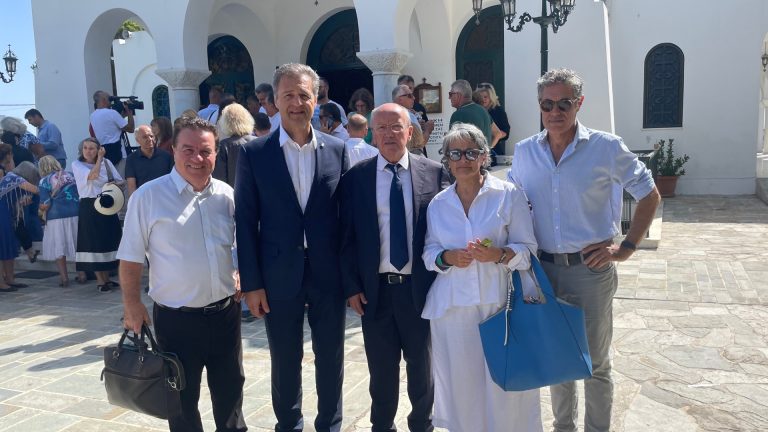
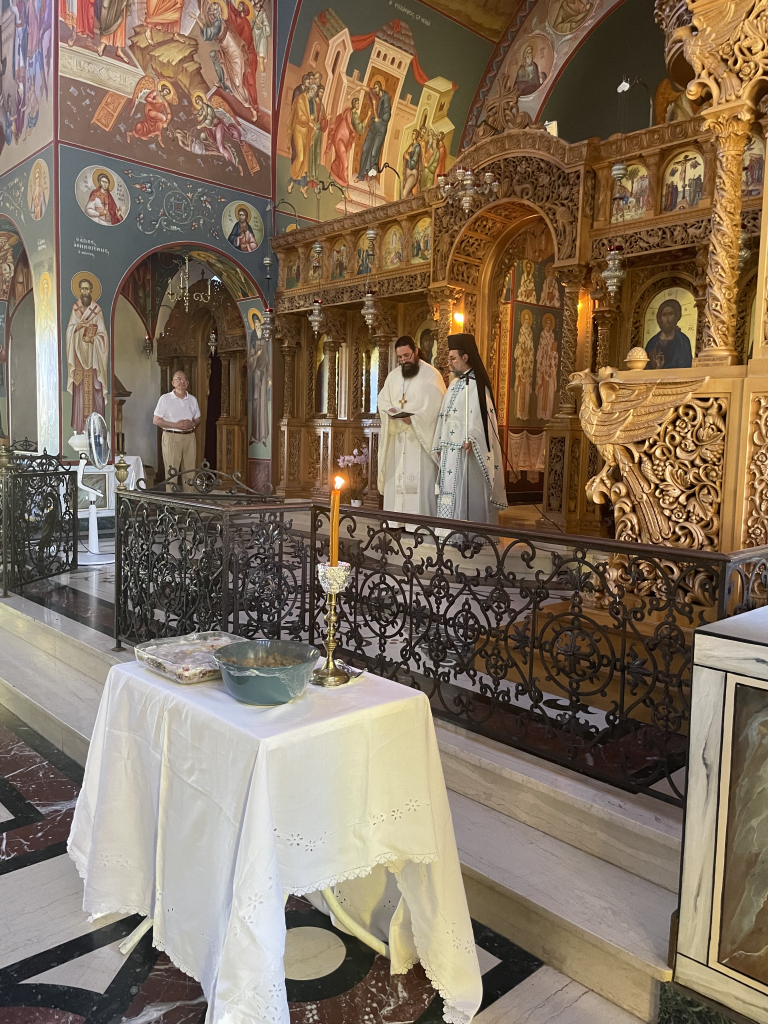
On the 5th anniversary of a deadly wildfire that devastated east Attica, Greece, in 2018, the President of the Greek Orthodox Community of South Australia (GOCSA), Peter Gardiakos, and SA-BEST MLC Frank Pangallo attended a memorial service held at the seaside town of Mati on Sunday, July 23, to commemorate the 103 victims of the blaze.
“We came here to pay our respects and pray for the souls of the people who lost their lives in Greece’s worst natural disaster. We will ensure they will not be forgotten,” Mr Gardiakos said.
“No matter how far away from our homeland, South Australia’s Greek diaspora will be on the side of our compatriots whenever they need us.”
The memorial was held at the Koimisis tis Theotokou Church, Mati.
Following the service, Mr Gardiakos and Mr Pangallo, with Marathonas Council Mayor Stergios Tsirkas and local visual artist Calliope Iconomacou visited the site where a monument for the victims of the wildfires will be erected.
The project has progressed to the foundations and structural base and is expected to be completed in September 2023.
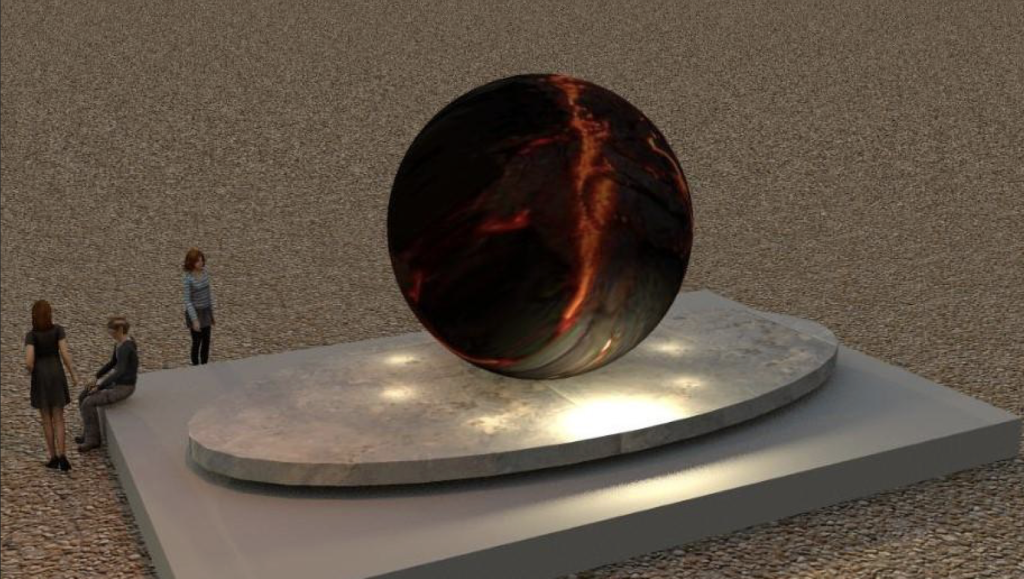
The design of the Memorial as conceptualised by project manager Calliope Iconomacou and the The Cargo Team.
The monument entitled ‘Memory’ (Μνήμη) and designed by Ms Iconomacou, project manager of The Cargo Team, will depict a large sphere three meters in diameter made of dark metal sheets. Inside the sphere, a sound installation will be broadcasting music composed especially for this project by composer Constantinos Michailidis. On the outside, water will flow slowly and continuously.
A large portion of this project (AUD$109,000) is being funded by money raised through the Greek and Cypriot Communities of South Australia, under the auspices of the Greek Fires Appeal Committee, the Australian Hellenic Medical Charity Inc, and a significant contribution by the South Australian state government.
Mayor Tsirkas said that “South Australia’s support is much appreciated” and thanked Mr Gardiakos and Mr Pangallo for attending the service.
At the site where the monument will be erected.
Mr Gardiakos placed a white orchid on the site of the monument and said that “GOCSA is proud to be a part of such an important project that will remind us of those who lost their lives but will also be a place where families will be able to gather and remember their loved ones.”
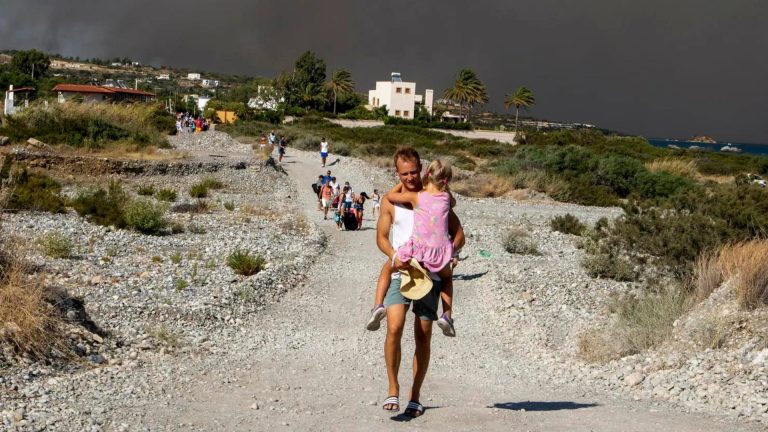
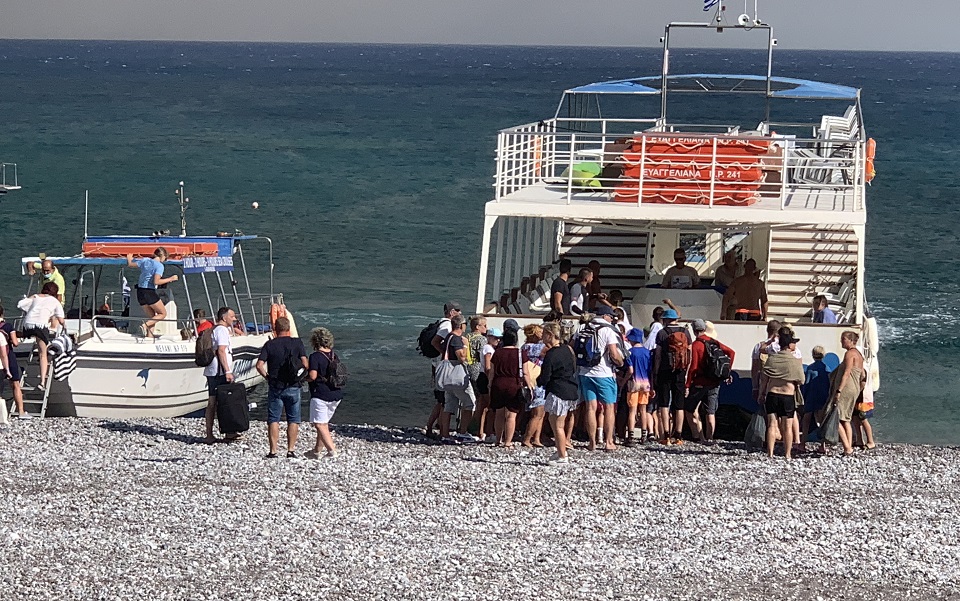
Amy, a lady on holiday in Rhodes from the United Kingdom with her partner and 11-year-old daughter, detailed how they fled a local hotel as fire blazed “behind us.”
According to NY Post, while running from the blaze, a Greek man gave them a lift in the back of his truck to a beach where rescue boats transported them and other stranded tourists to a nearby school for shelter.
“He saved our lives,” Amy said.
“People were screaming hanging off the sides, children were screaming and we didn’t know if we’d get on in time.
“The gratitude I have in my heart for that man who saved us, I will never put into words.”
Rescue boats transport stranded tourists to a nearby school for shelter.
Tourist Laura Bentley, her Australian husband, and five-year-old daughter also sought refuge, finding a hotel in the heat as they fled Princess Andriana Resort, near Kiotari.
In an interview with Adelaide Now, Mrs Bentley describes running on foot in 40 degree Celsius heat, leaving everything behind.
Amid the ‘war zone,’ Greek locals provided Australians and tourists from around the world with food and shelter while helping them to safety.
Evacuated from #Lindos last night — slept at a school staffed by local volunteers who brought us food, water, mattresses, then helped to find us a room and gave us a lift into #Rhodes town. Unbelievable hospitality and kindness. ❤️🇬🇷✊
Matthew Ward from Leeds took to Twitter to express his gratitude to local volunteers for their “unbelievable hospitality” and “kindness.”
“Evacuated from Lindos last night,” Mr Ward wrote.
“Slept at a school staffed by local volunteers who brought us food, water, mattresses, then helped to find us a room and gave us a lift into Rhodes town. Unbelievable hospitality and kindness.”
The local Australian Ambassador to Greece has also issued advice to Australians in need of consular assistance in Greece affected by wildfires, urging them to call +61 2 6261 3305 and follow the advice of local authorities.
Australia’s women’s water polo team defeated Greece by one goal in a close battle at the quarter finals of the World Aquatics Championships in Japan on Monday.
The Ord Minnett “Aussie Stingers” beat the Greek team 9-8 on Monday, pushing the team into the semi-final against Spain, which is underway in Fukuoka from July 14 to 30.
Australia’s captain Zoe Arancini said in an interview after the win: “It was hugely intense.”
Australia verse Greece FINA1908 World Championships 2022. Photo: Water Polo Australia.
Stingers coach Paul Oberman applauded his team in the defeat against Greece.
“They [Greece] are a very good team, they are going to score goals,” he said, but the Stingers “defence was working really well” remaining composed “in attack as well.”
“But we still kept going and we ground it out.”
The Australian Stingers will play their semi-final on Wednesday night.
Sydney man, Abdul Karaali, was sentenced on Monday to 28 years in prison for the murder of Ross Houllis, over a pair of fake AirPods sold on Facebook Marketplace.
Karaali, 29, was found guilty in March 2023 for the murder of Houllis, 28, at Wakeley on Valentine’s Day, February 2020.
Houllis was allegedly ambushed by Karaali and another man, Sam Hamdach, while trying to sell a set of fake Apple AirPod earphones he had listed on Facebook.
Hamdach, 30, was jailed for the murder of Houllis in April this year.
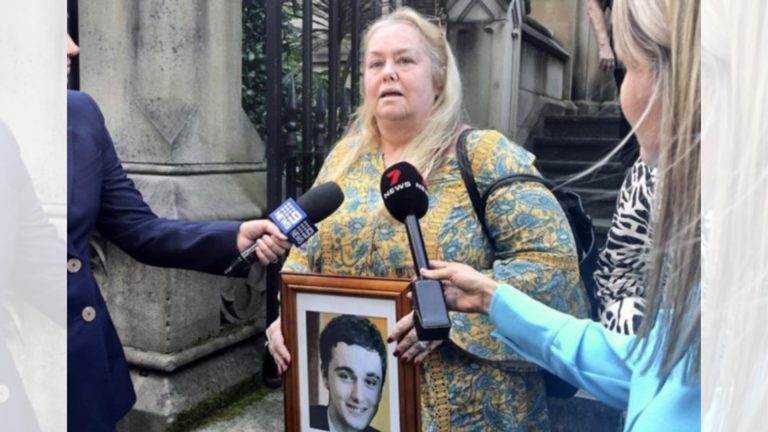
Ross Houllis.
In the NSW Supreme Court on Monday, Karaali was sentenced to 28 years in prison with a non-parole period of 21 years.
“(Karaali) was a willing recruit,” Justice Stephen Campbell said in court on Monday, according to 7News.
“It is no easy thing to kill another human being by punching, kicking and stomping.”
Houllis’ mother Janet Houllis said in a victim impact statement: “It seems to me [Karaali] did not care that he had taken another’s life over something that didn’t really have anything to do with him.”
“How can someone kill my son over AirPods and money?” she added.
Karaali will first be eligible for parole in July 2041.
Greek Prime Minister Kyriakos Mitsotakis has hinted at deepening cooperation between Greece and Australia during wildfire seasons.
Speaking in Greece’s Parliament on Monday, Mitsotakis said that due to limited resources in Europe to help deal with wildfires, his government would consider cooperating with “countries in the Southern Hemisphere like Australia.”
“As there aren’t many aerial firefighting resources in Europe in general, we think we can cooperate with countries in the Southern Hemisphere such as Australia,” Mitsotakis stressed.
“We can share our fire resources with them during winter, and they can share theirs with Greece in summer so we have them at our disposal during the fire season.”
This statement by Mitsotakis comes as Australian specialist fire fighting helicopters from the Sunshine Coast in Queensland are currently in Greece fighting wildfires ravaging the country this week.
The Bell214ST helicopters have been contracted by McDermott Aviation and were captured helping fight recent fires in Mandra, Attica.
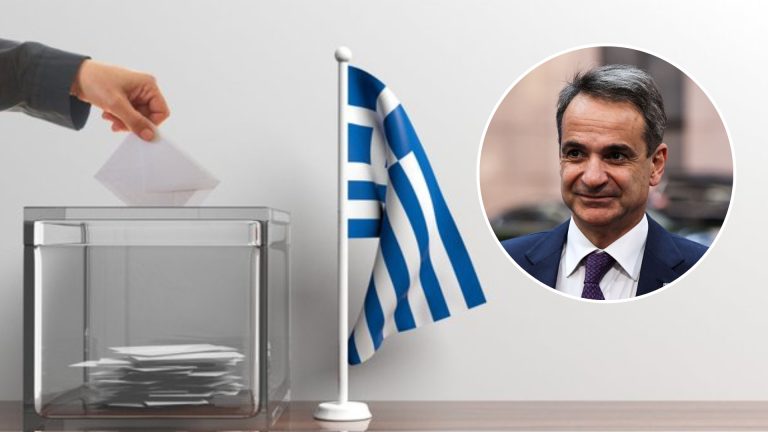
Greece’s Prime Minister Kyriakos Mitsotakis addressed Parliament on Monday and said the proposed bill to lift restrictions for Greeks abroad to vote in national elections, is an “issue that should unite us.”
“We have the opportunity to promote a bold measure without party colours and a national stamp. A victory of parliament, a victory of democracy,” Mitsotakis said.
In his address, the Prime Minister called on Parliament to “approve the lifting of all obstacles to voting by registered voters abroad from their place of residence.”
Ψηφίζοντας την άρση των εμποδίων, ώστε οι Έλληνες του εξωτερικού να ψηφίζουν από το τόπο κατοικίας τους, γεφυρώνουμε τη σχέση μας με την ελληνική διασπορά σε κάθε γωνιά της υφηλίου. Ενώνουμε τις παρούσες, τις μελλοντικές γενιές με τη γλώσσα, με την ιστορία, με τις παραδόσεις μας. pic.twitter.com/ByPSnDeHeF
— Prime Minister GR (@PrimeministerGR) July 24, 2023
Mitsotakis said the restriction on Greek residents abroad to vote from their place of residence is an area where Greece falls behind compared to other “advanced countries.”
The time to “make the great leap forward” is now, Mitsotakis said.
To apply the legislation at the next election, over 200-MP votes in favour of the bill are required (two thirds of the total MPs in Parliament).
Some of the restrictions the bill abolishes include the length of stay in Greece (2 years during the last 35 years) before voting, and to have filed taxes during the current year or the previous one from the year of elections.
Prominent Greek philanthropist and UNESCO Goodwill Ambassador, Marianna Vardinogiannis, has died aged 80, Ekathimerini reported.
Vardinogiannis, who is also the wife of shipping magnate Vardis Vardinogiannis, dedicated herself to the protection of human rights in education, health, climate change and culture. She was active in providing for children and vulnerable groups in Greece and abroad.
As an UNESCO Goodwill Ambassador, Vardinogiannis served in various institutions, foundations and organisations in Greece and globally. Some of the organisations include, the Library of Alexandria’s Board of Directors, the International Women’s Movement for Peace, the International Center for Mentor Foundation against Drugs, and the Foundation “Light of Africa.”
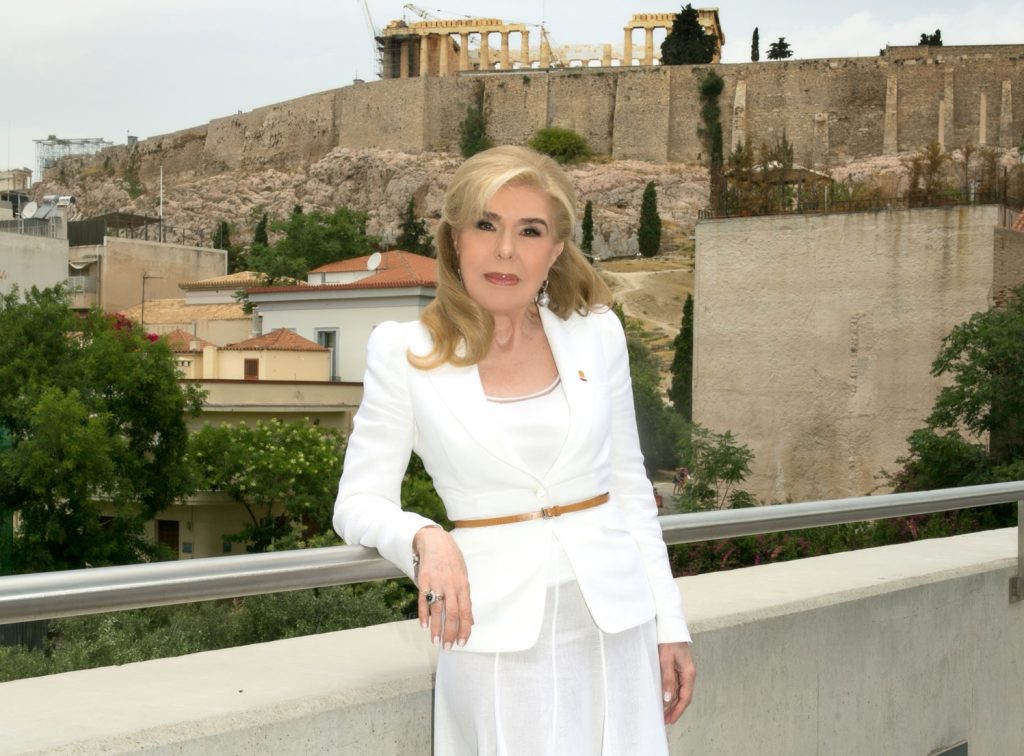
Marianna Vardinoyannis at the Acropolis Museum. Photo: Marianna V. Vardinoyannis.
Among many initiatives aimed at helping sick children and their families, Vardinogiannis also sought to fight against childhood cancer for more than 25 years, and was the creator of the ELPIDA Home.
As President of ELPIDA Association of Friends of Children with cancer, Vardinogiannis founded the first Pediatric Bone Marrow Transplant Unit in Greece, which would save 860 children from Greece and neighbouring countries.
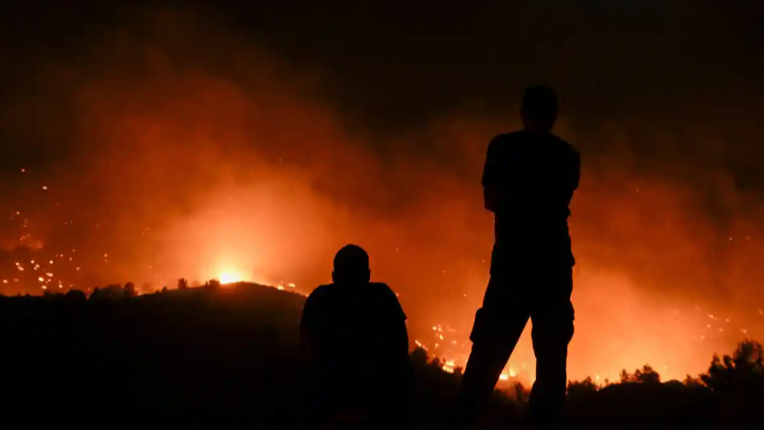
The wildfire racing across the Greek island of Rhodes for a week now continued to rage uncontained on Monday evening, Ekathimerini has reported.
The wildfire has so far burned an estimated 34,200 hectares.
Things took a turn for the worse on Monday as the fire tore past defences and more evacuations were ordered, in the central and southern parts of the island.
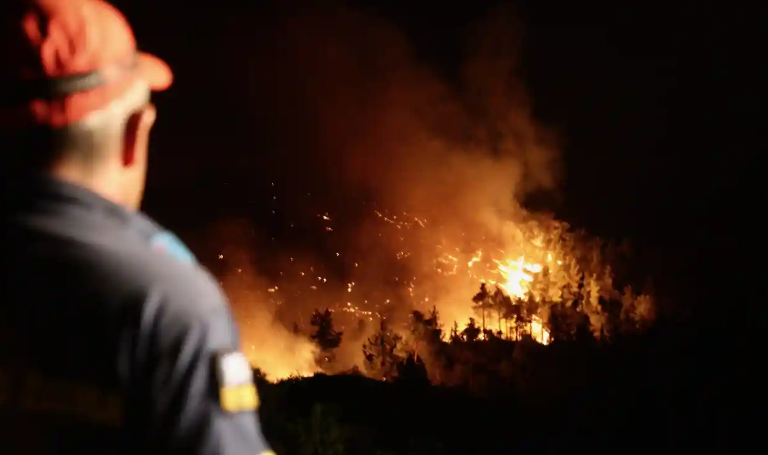
A firefighter tries to extinguish a wildfire in Asklipio village on Rhodes island. Photo: Aristidis Vafeiadakis/Zuma/Shutterstock.
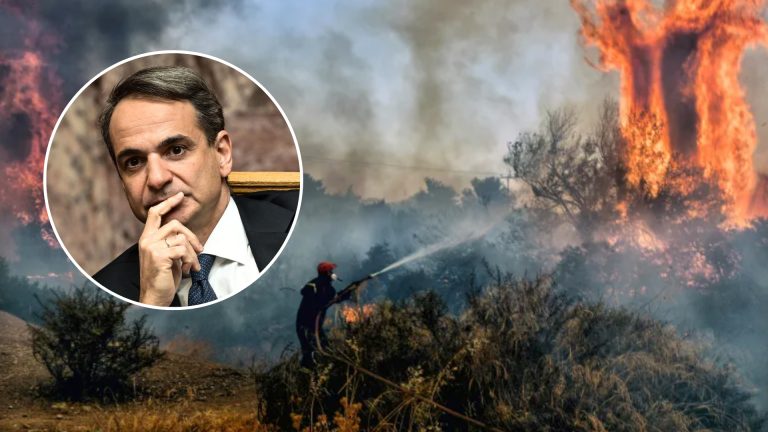
“We are at war – completely focused on the fires,” Greece’s Prime Minister Kyriakos Mitsotakis said during a debate in Parliament. “Over the coming days and weeks, we must remain on constant alert.”
Overnight, an estimated 2,466 citizens had fled dwellings in 17 villages along Corfu’s northern coast, while hundreds had been forced to evacuate communities on Evia.
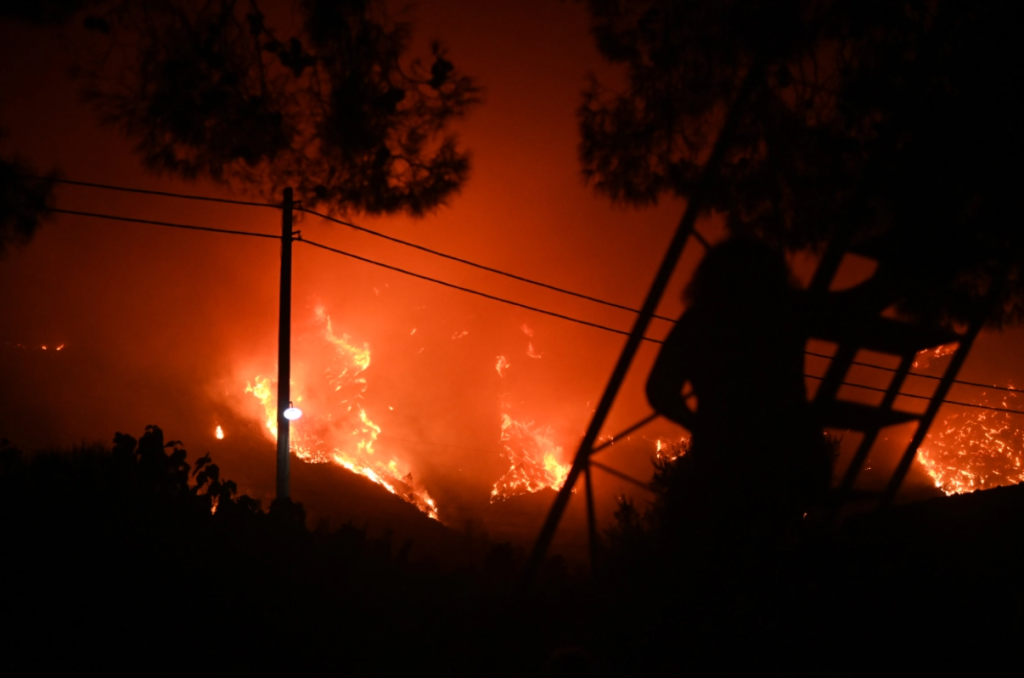
A wildfire burns at the Trapeza village, in Achaia in the Peloponnese. Photo: Giota Lotsari/EPA.
Temperatures are set to climb again on Tuesday after a day of relative respite.
The Fire Service has announced that most of the island of Crete, with the exception of the regional unit of Hania, as well as Rhodes and the nearby islands, are facing an extreme risk (Category 5, the highest) of new fire outbreaks.