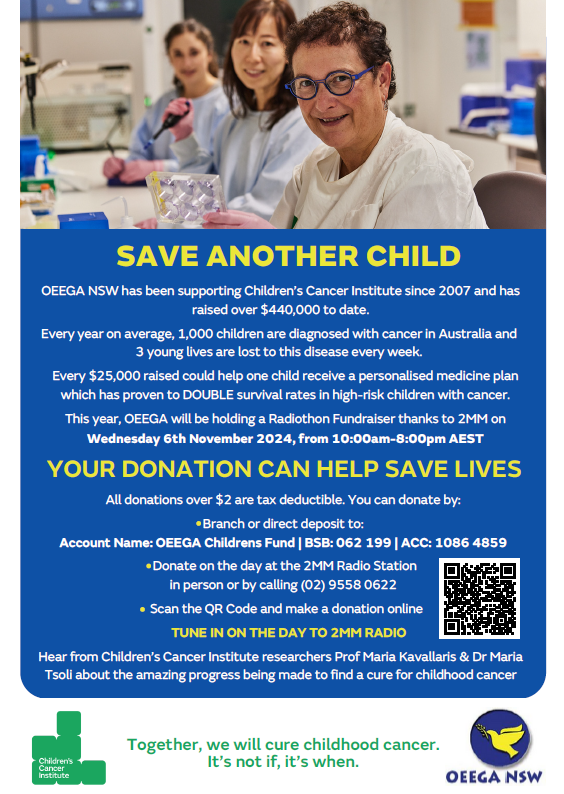
The New South Wales branch of the Organisation of Hellene and Hellene-Cypriot Women of Australia (OEEGA NSW) will be holding their annual Radiothon on Wednesday, November 6 to raise funds for the Children’s Cancer Institute in Sydney.
From 10am to 8pm on Wednesday, people must tune into 2MM Radio Station to take part in the Radiothon. They will have the opportunity to hear the incredible progress being made in childhood cancer research at the Institute by Professor Maria Kavallaris and Dr Maria Tsoli.
Along with these stories, listeners will be able to tune in and hear personal stories from families impacted by childhood cancer.
OEEGA NSW is a not-for-profit organisation consisting of Greek and Cypriot Australian women and mothers who have dedicated themselves to supporting medical researchers in eliminating childhood cancer.
Since 2007, OEEGA NSW has raised over $440,000 for the Children’s Cancer Institute in Sydney, which has gone towards purchasing vital equipment for specialised scientific research.
If you would like to make a donation, you can do so in two main ways:
Branch or Direct Deposit to: Account name: OEEGA Childrens Fund; BSB: 062 199; Account No: 1086 4859.
On the day at the 2MM Radio station either in person or by calling (02) 9558 0622.
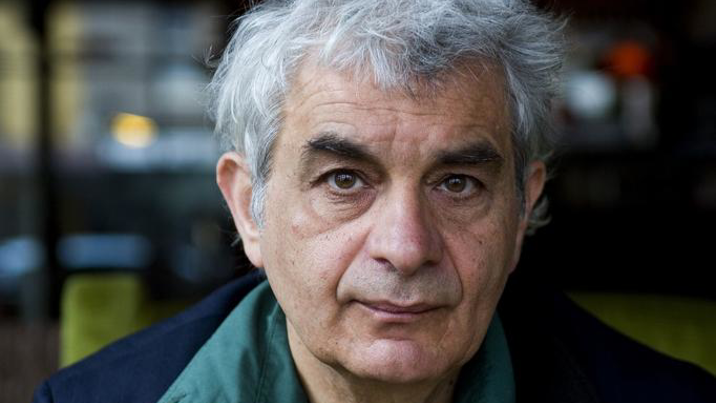
Greek Australian anarchist poet Π.O. (Pi.O.) has won the $20,000 Patrick White Literary Award in recognition of his outstanding contribution to Australian literature.
Π.O. grew up in Fitzroy after his parents moved to Australia from Greece in the 1950s.
Π.O.’s poetry is often written in a phonetic vernacular, which can appear challenging on the page, but which springs to life when read aloud.
Legendary Melbourne poet π.O. (Pi.O.) has been announced the winner of the 2024 Patrick White Literary Award!
In a statement to Artshub, Π.O. couldn’t contain his excitement at the recognition.
“I’ve only won one award before this so it was gobsmacking to receive the accolade,” he said.
Π.O.’s Heide collection won the 2020 Judith Wright Calanthe Prize in the Queensland Premier’s Literary Awards and was shortlisted in the 2020 Prime Minister’s Literary Awards
He is already in the process of writing a fourth epic poem, this time about the gentrification of Fitzroy and inner city Melbourne.
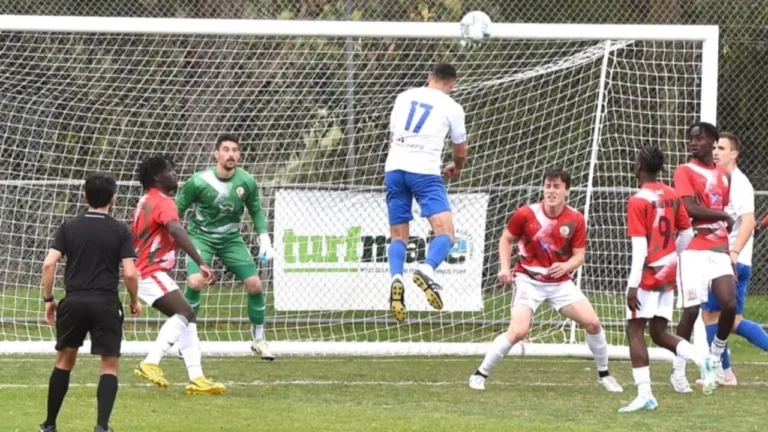
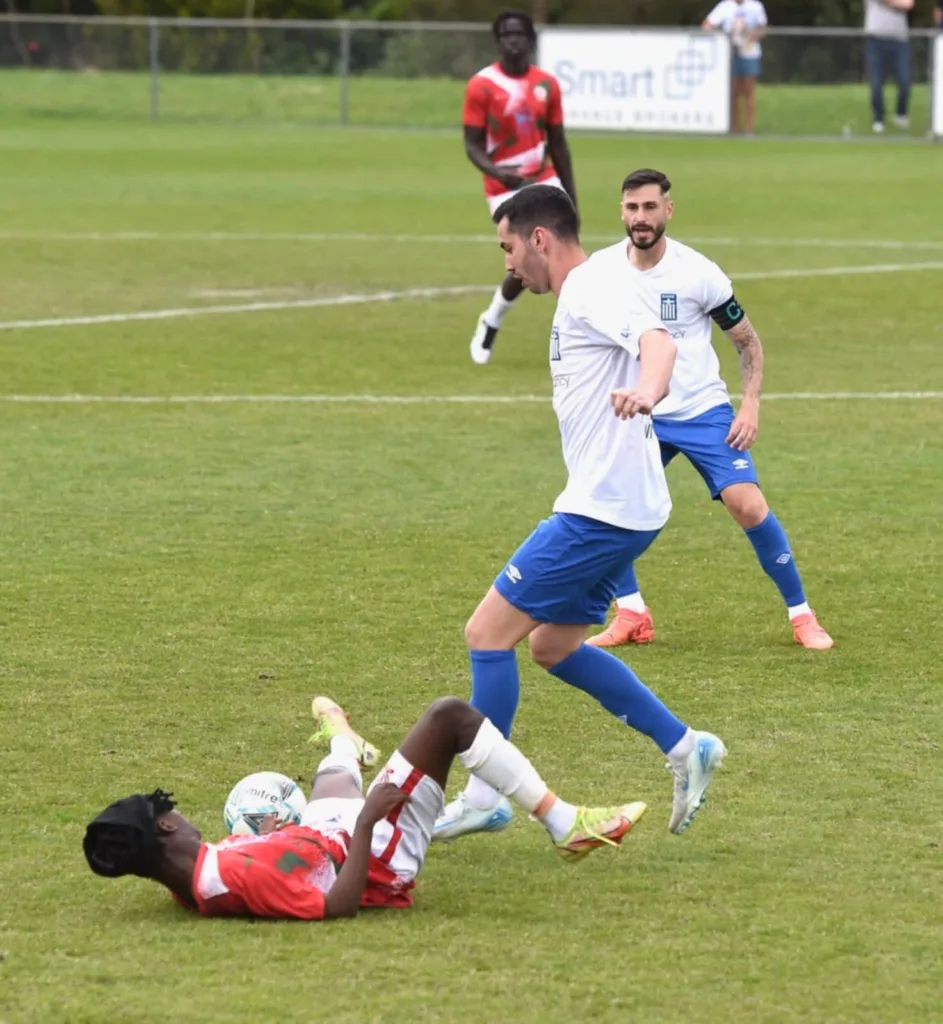
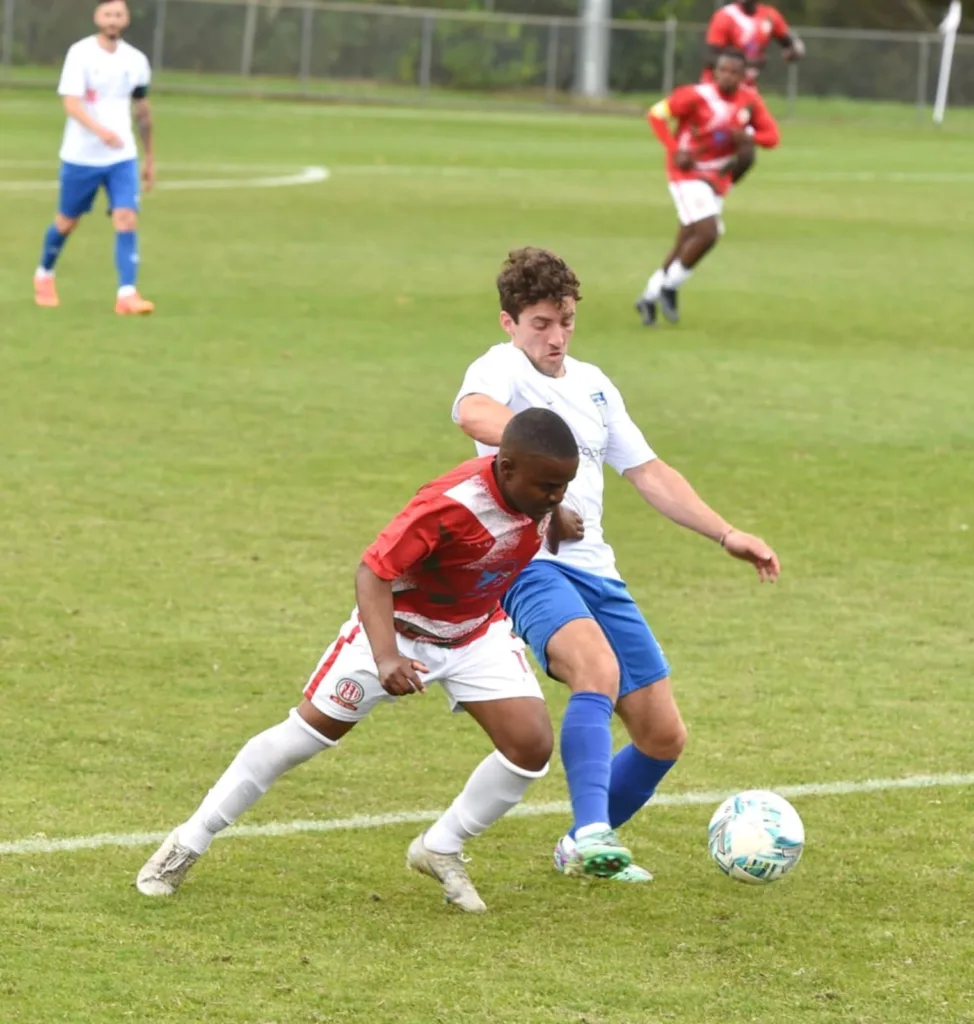
Team Greece defeated Burundi 2 – 1 in a pulsating football match to qualify for the quarterfinals of the All Nations Cup.
Greece finished on top of Group A and will play Zimbabwe in the quarters.
George Mells scored a brace either side of halftime to give Greece a 2 nil lead however, Burundi scored with 20 minutes left on the clock to setup a nail biting finish. Greece eventually claimed the very important 3 points to secure their qualification.
Bill Papastergiadis, President of the Greek Community of Melbourne (GCM), was ecstatic following the win.
“Today’s game proved that these group of boys love playing for the jumper. Their passion and determination was immense and we as a community are super proud of their achievements so far. We look forward to what’s to come in the quarters and encourage as many people as possible to come and support our boys,” Mr Papastergiadis said.
Coach George Katsakis had this to say following the win: “We had no choice but to win today otherwise we would’ve been eliminated from the tournament. The boys responded in true Greek fashion and I’m super proud of their commitment and passion. We now reset and get ready for the quarterfinals in what I’m sure will be a difficult game against Zimbabwe but one we are really looking forward to. The boys will be ready to go.”
Dates and times for the quarterfinals will be confirmed shortly.
Although Stefanos Tsitsipas (No. 11) found himself losing to Roberto Carballes Baena (No. 55) in his premiere at the Paris Masters tournament on Monday night, he kept his composure and claimed victory 4-6, 6-3, 6-3.
At the beginning of the match, the Greek tennis player looked nervous and lost the first set 6-4, but then he made up for it.
In the second set he prevailed comfortably with 6-3, while in the third and last set Tsitsipas was the absolute ruler and with the same score he started his duties at the Paris Master on a positive note.
He is now waiting for the winner of the Borges-Tambilo pair to find out his opponent for the next phase.
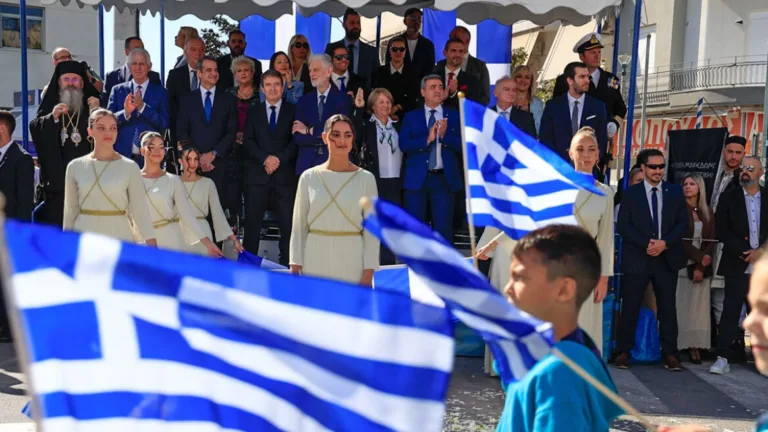
Greece celebrated OXI Day on Monday, October 28 with a number of military and student parades across different cities.
OXI Day marks Greece’s entry into World War II on 28 October 1940 after it defied an Italian ultimatum and the Axis occupation.
On Monday, Greek President Katerina Sakellaropoulou laid a wreath at a war memorial in Thessaloniki and attended the large military parade in the northern port city.
Στην παρέλαση για την Εθνική Επέτειο της 28ης Οκτωβρίου 1940 στη #Θεσσαλονίκη.
Υπερήφανοι για τις γυναίκες και τους άνδρες των Ενόπλων Δυνάμεων που υπερασπίζονται την εθνική κυριαρχία και τα κυριαρχικά δικαιώματα της Πατρίδας μας και παρέλασαν σήμερα με τιμή και υψηλό φρόνημα.… pic.twitter.com/wuGNGrLRqZ
President Sakellaropoulou was accompanied by Greece’s Defence Minister Nikos Dendias and other officials at the annual military parade in downtown Thessaloniki, which is also celebrating its patron, Saint Dimitrios.
In Athens, meanwhile, schools held student parades, with the biggest taking place in front of Parliament on Syntagma Square and attended by several ministers and other officials.
Η 28η Οκτωβρίου είναι μια μέρα τιμής και αναστοχασμού. Θυμόμαστε αυτούς που πριν από 84 χρόνια θυσίασαν τη ζωή τους για να μπορέσουμε εμείς σήμερα να είμαστε ελεύθεροι. Εύχομαι σε όλες τις Ελληνίδες και όλους τους Έλληνες, απανταχού της Γης, χρόνια πολλά! https://t.co/e0GTErNZB8pic.twitter.com/6A1km5Rc4Z
Greece’s Prime Minister Kyriakos Mitsotakis presided over the student parade in the western Athens suburb of Peristeri. He gave a brief address and described today’s youngsters as the country’s greatest “strength.”
“It is our duty to provide these children with the necessary tools so they can live a better life than that of their parents. But they must always remember that democracy is a form of government that requires constant attendance, active participation and a civil and respectful dialogue,” Mitsotakis said.
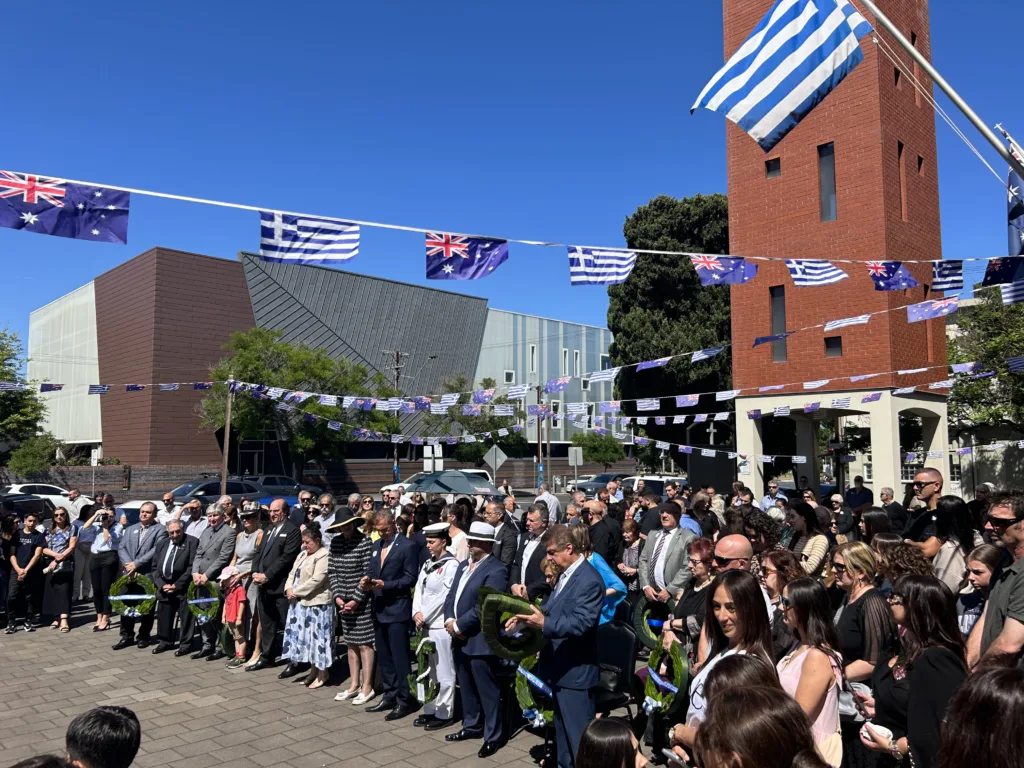
The 84th anniversary of OXI (“NO”) Day was marked with a commemoration in South Australia on Sunday, October 27, 2024, at the Cathedral of Archangels Michael and Gabriel on Franklin Street, Adelaide.
Organised by the Greek Orthodox Community of South Australia (GOCSA), this event honoured one of the most significant holidays in the modern Greek calendar — when, on October 28, 1940, then-Greek Prime Minister Ioannis Metaxas defiantly rejected Benito Mussolini’s ultimatum demanding access for Italian forces to occupy Greek territory. This resistance marked by the response “OXI” (No) sparked Greece’s entry into World War II alongside the Allied forces.
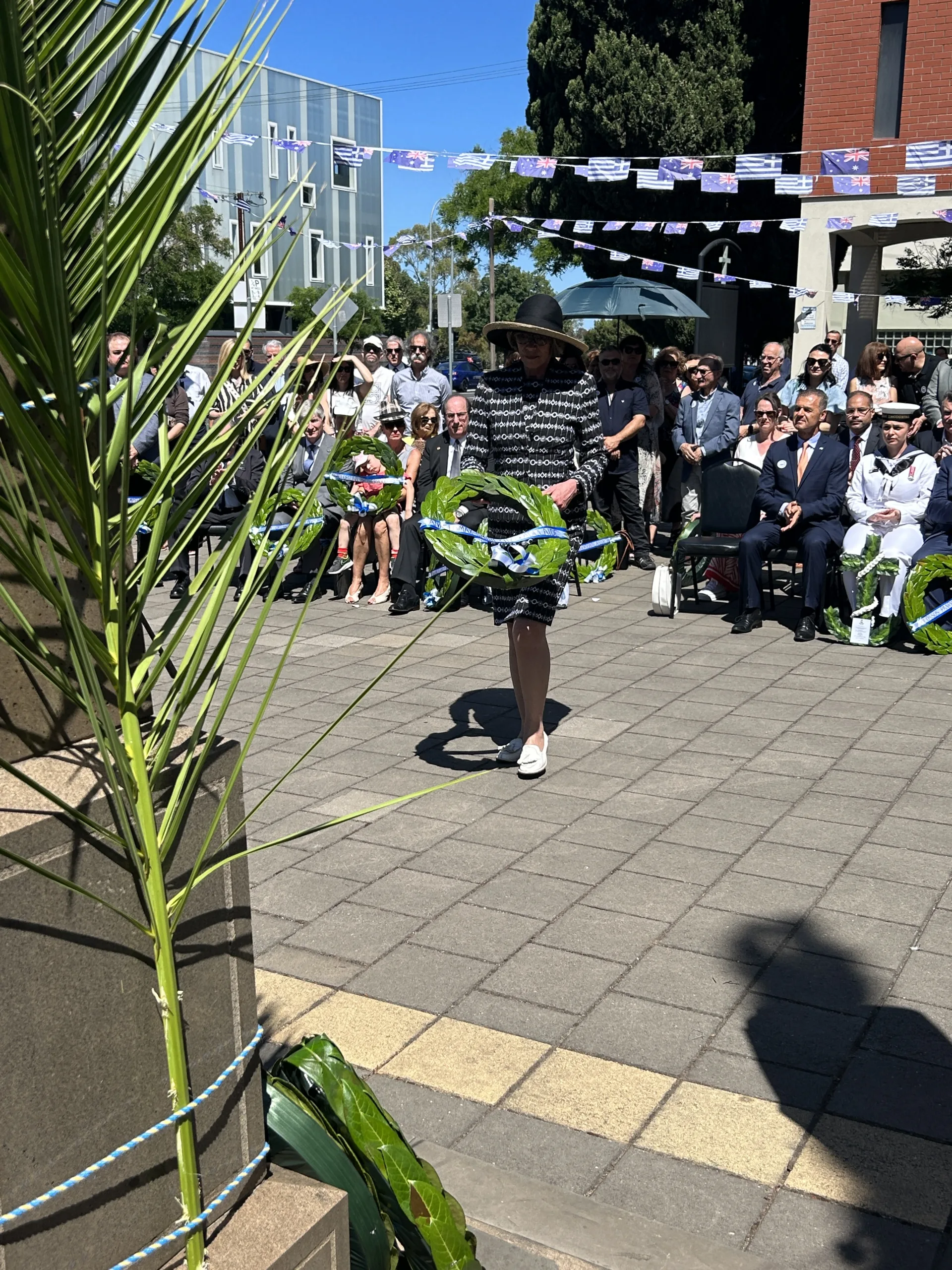
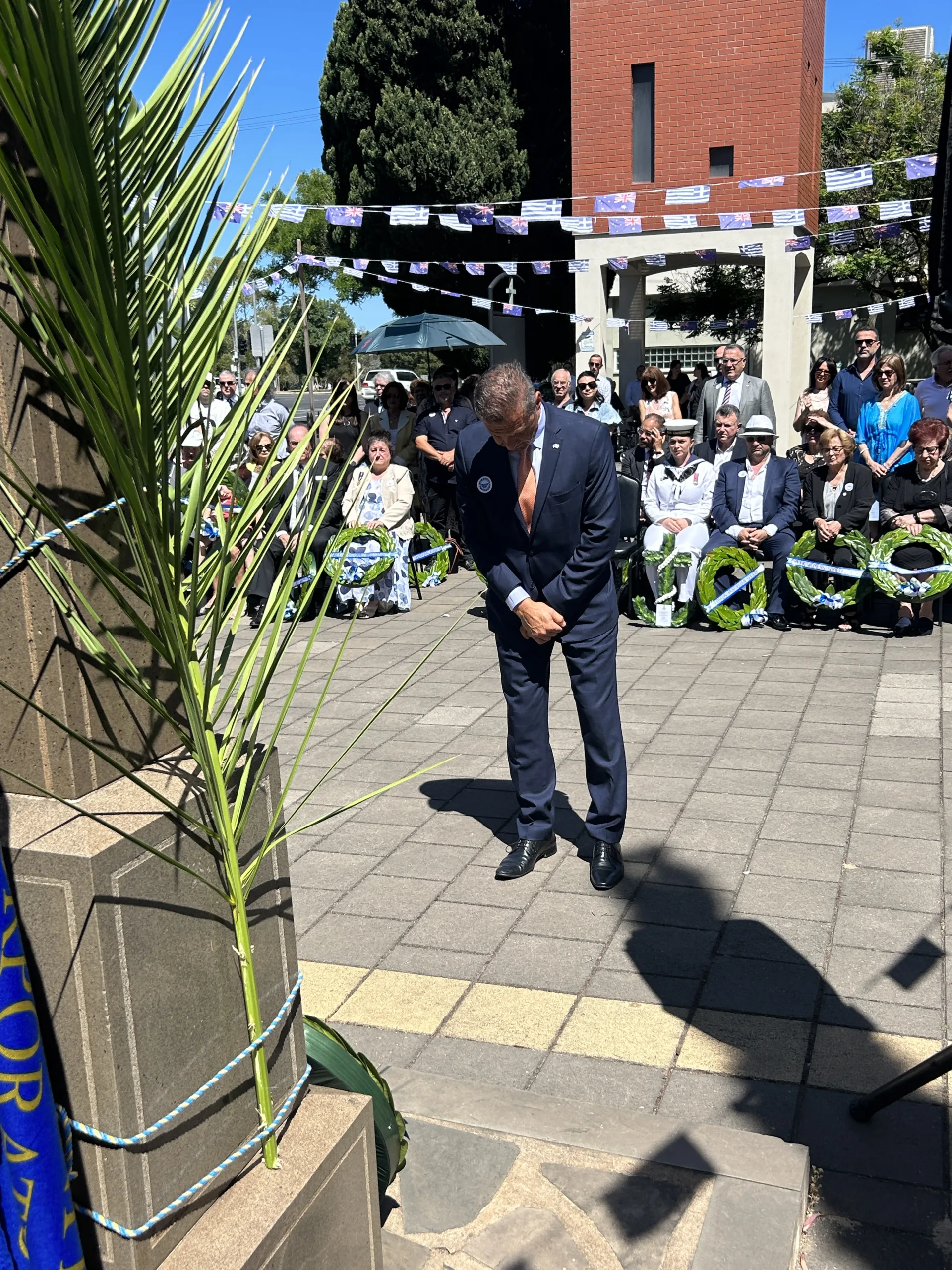
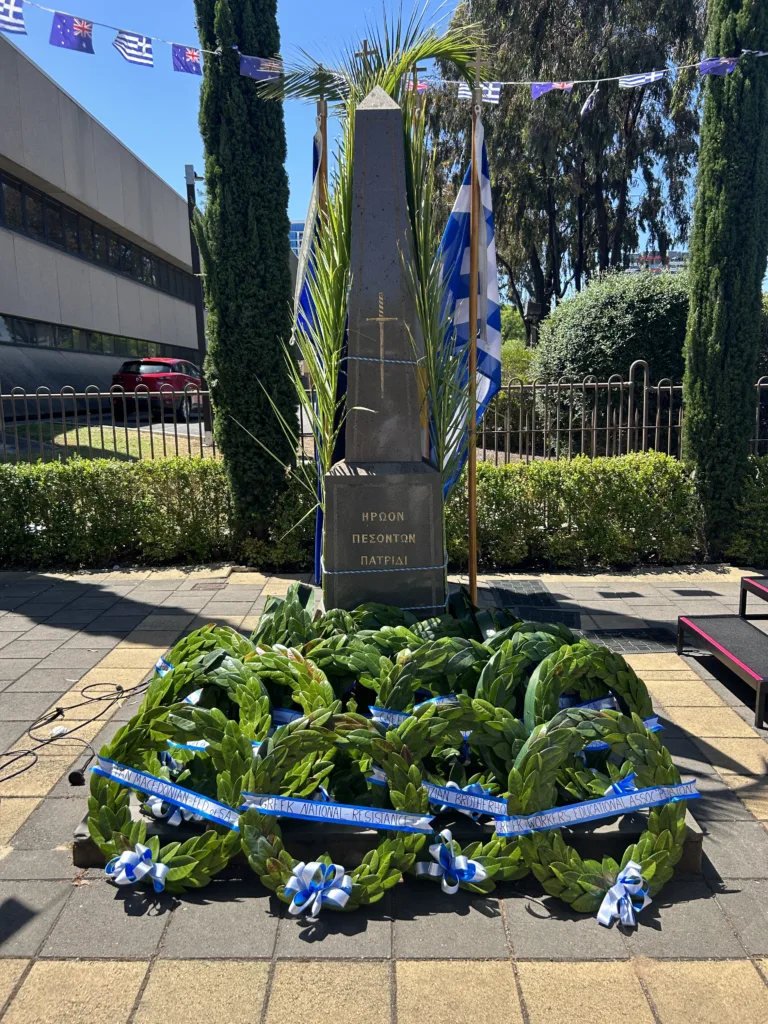
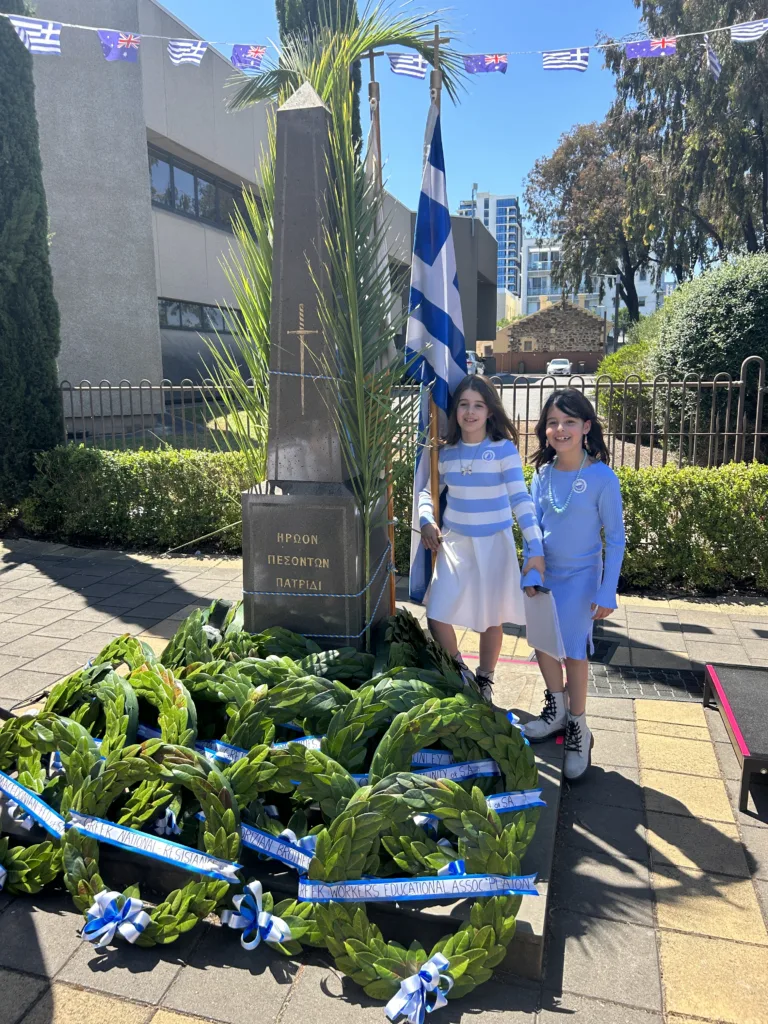
The GOCSA event began with a doxology service, bringing together dignitaries, community leaders, and families to pay tribute to the heroes of World War II. Following the doxology, attendees gathered outside for the wreath-laying ceremony in remembrance of the fallen.
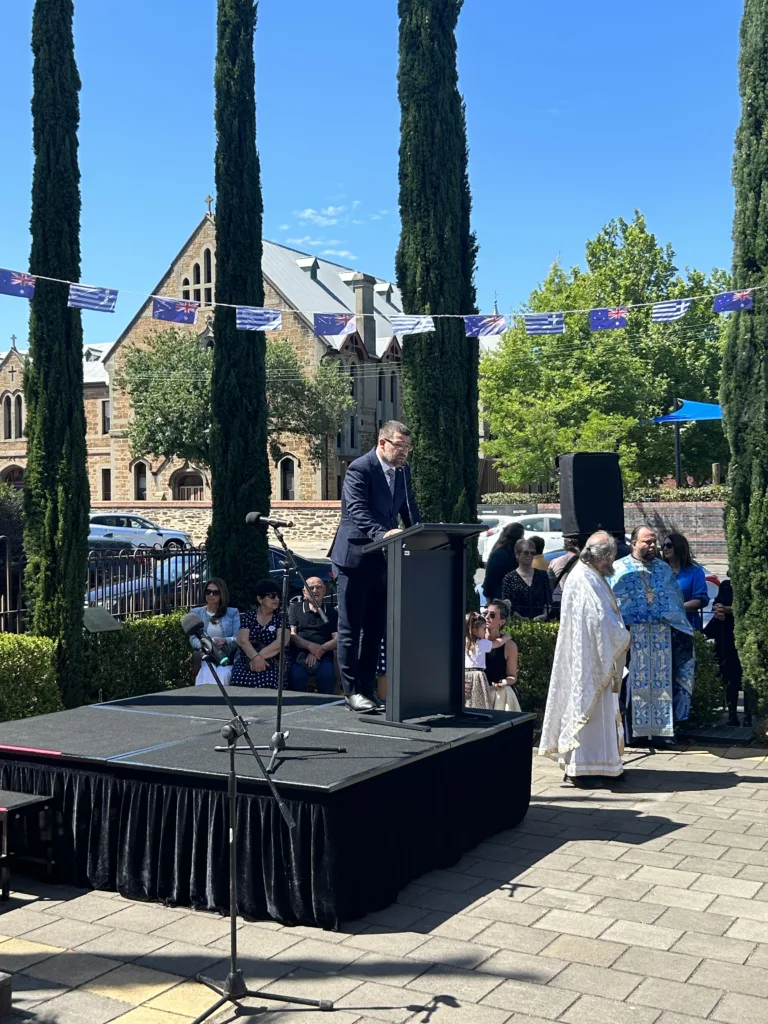
Vice-President of GOCSA, Peter Gonis, began proceedings by explaining that the “courageous declaration [of OXI] ignited a fierce resistance against the invading forces, ultimately leading to Greece’s victory. It is a day of profound significance… that symbolises resilience, courage, the unwavering spirit of a nation as well as the ties that connect our two countries together in their quest for freedom and democracy.”
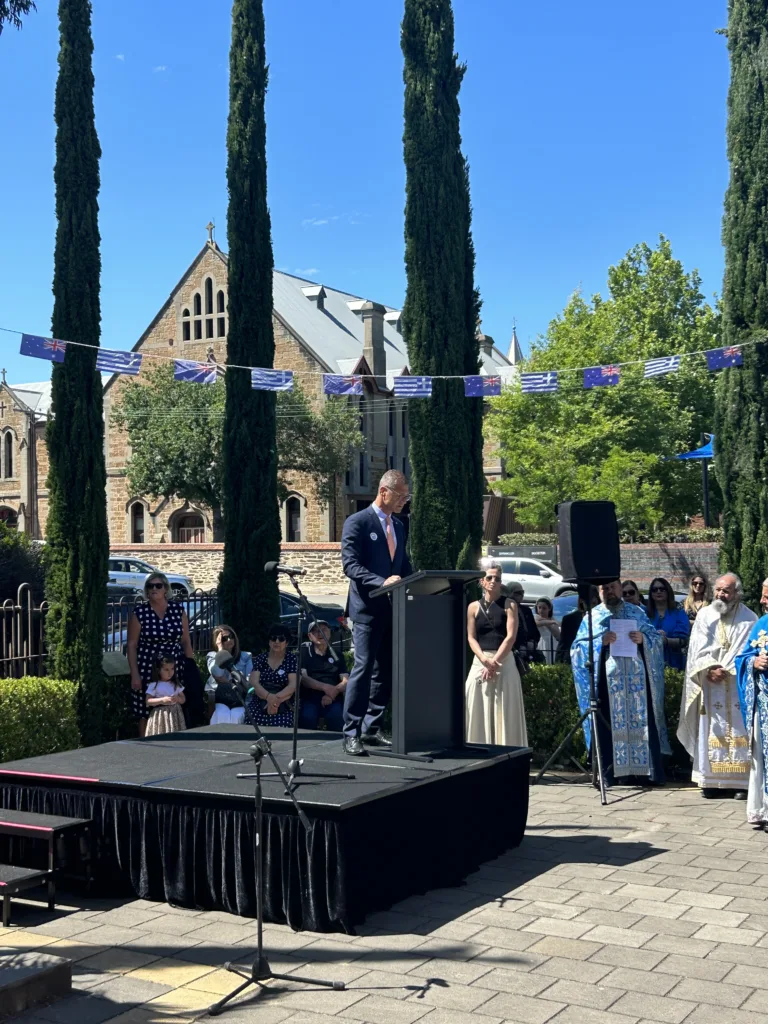
GOCSA President Peter Gardiakos expanded on Mr Gonis’ comments by emphasising that “…OXI day holds a special place in our hearts, as a symbol of courage, resilience and unwavering commitment for freedom. It is a day that reminds us of all the sacrifices made by our ancestors and the price they were willing to pay to defend our beloved homeland, Greece.”
Vice-President of GOCSA, Mr Peter Gonis, addressing attendees.President of GOCSA, Mr Peter Gardiakos, addressing attendees.
Mr Gardiakos also conveyed a message that was provided by the Premier of South Australia Peter Malinauskas, co-signed by the Minister for Multicultural Affairs Zoe Bettison MP.
Both the Premier and the Minister sent their “best wishes to the community” and stated that: “on this special occasion, we honour courageous Greek and Cypriot men and women in the early 1940’s, who stood together against a formidable enemy and changed the course of history.”
“OXI day is a reminder of what can be achieved when a community stands up for their shared values… these were the very same freedoms and values that Australian soldiers fought for and alongside Greek and Cypriots soldiers in the second world war. This day is a reminder of our long-standing relationship with Greece and Cyprus and allows us to acknowledge the strengthening of our State through the contribution of Greek and Cypriot migration…” the message added.
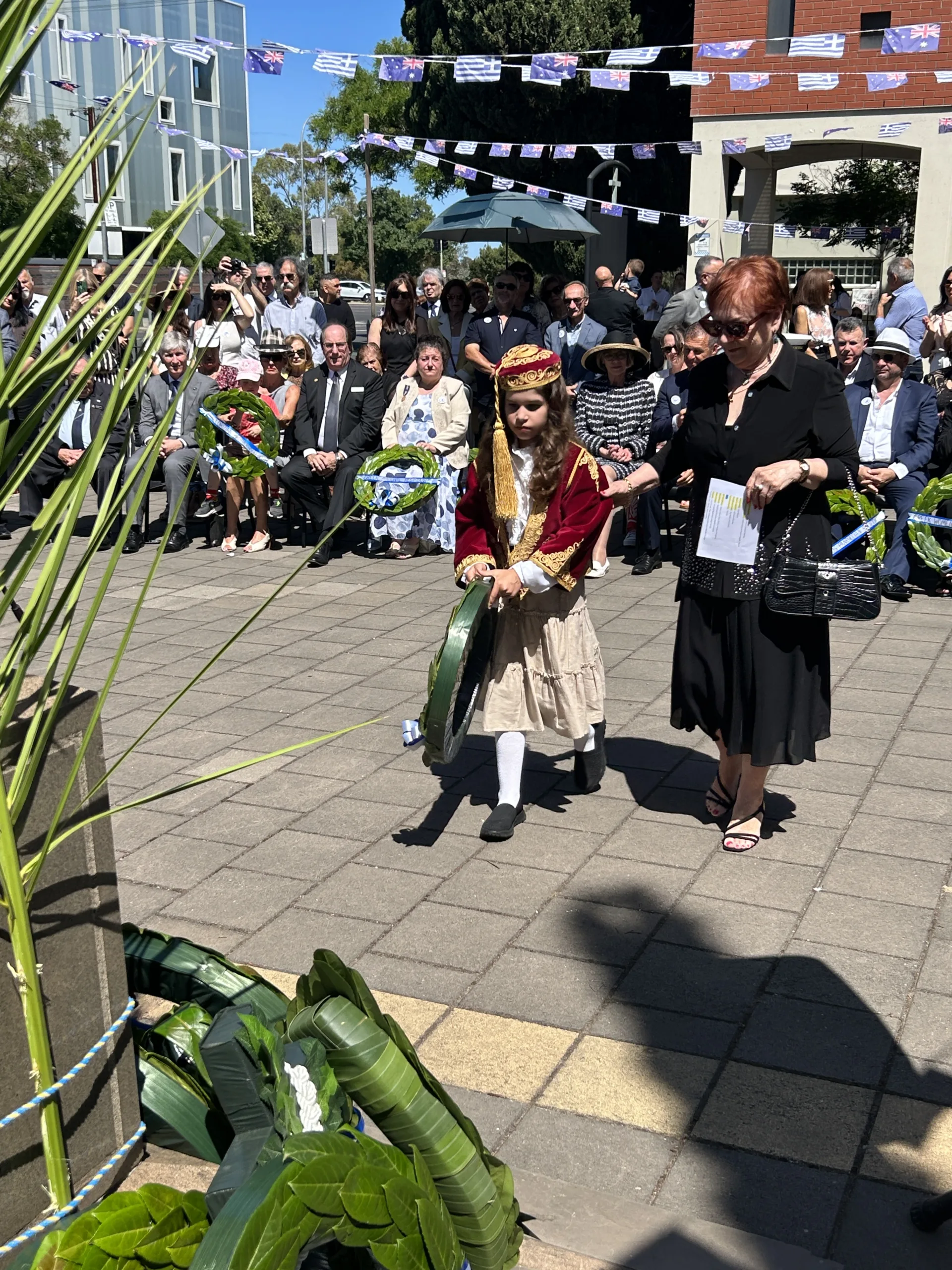
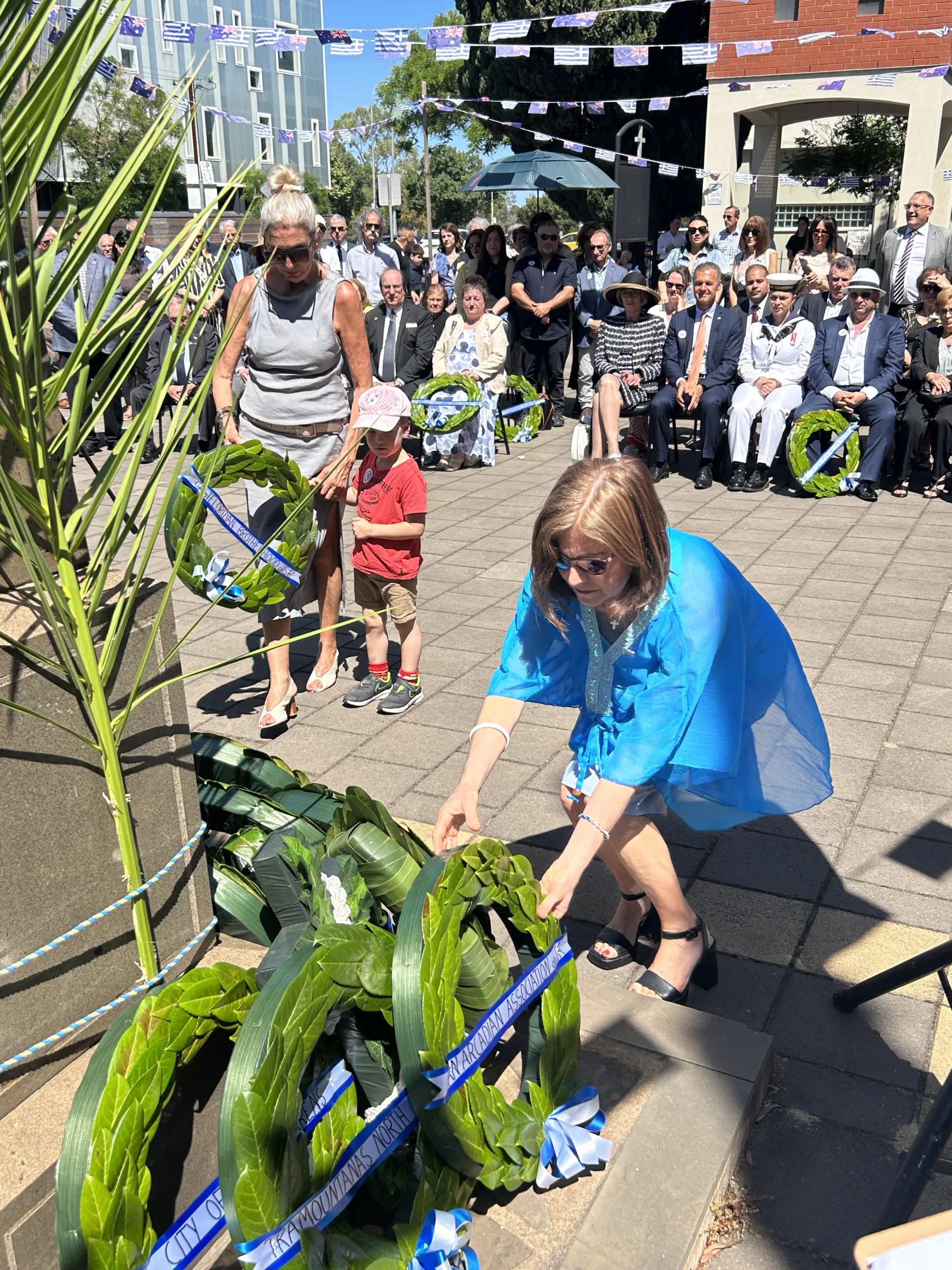
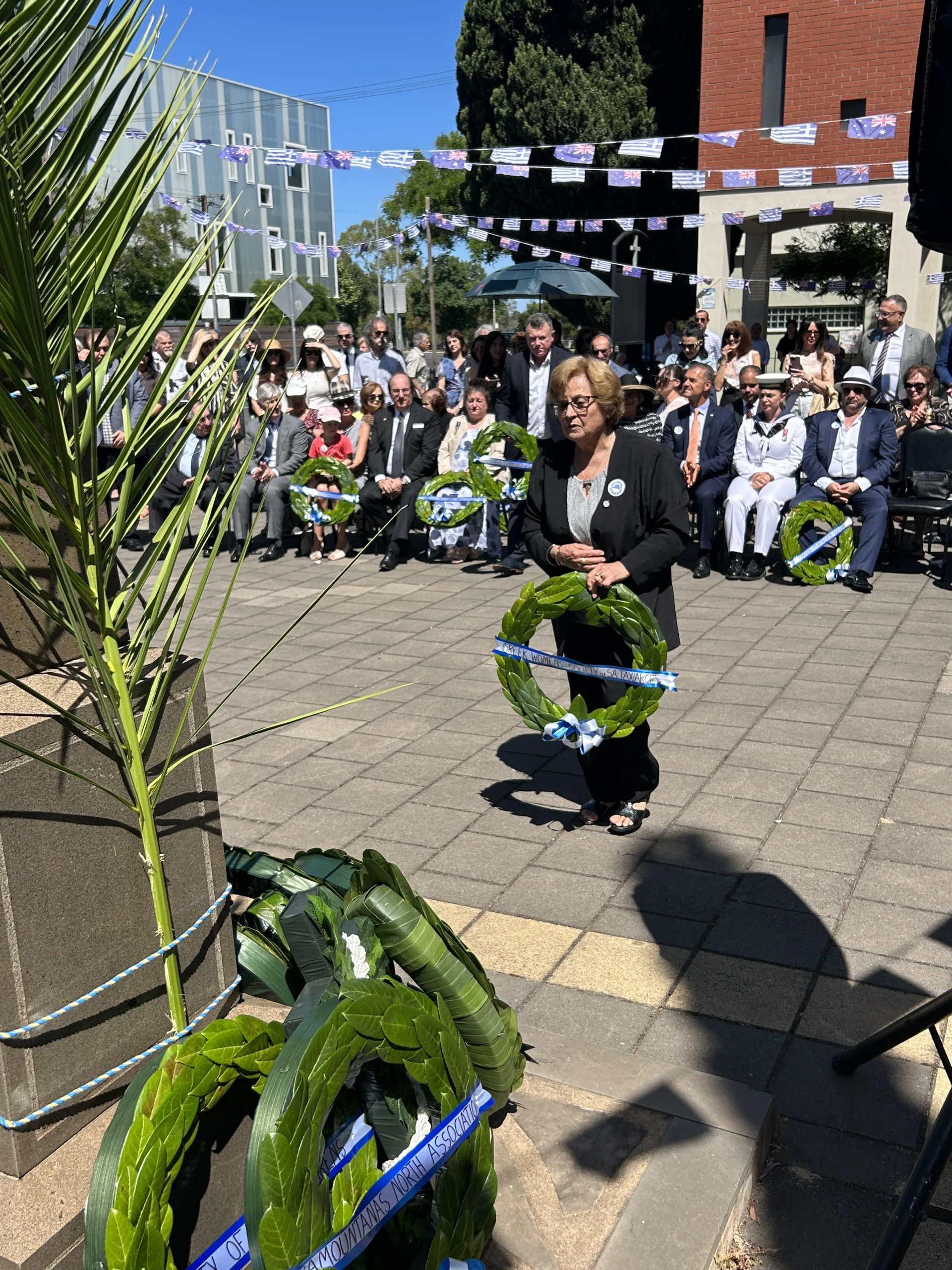
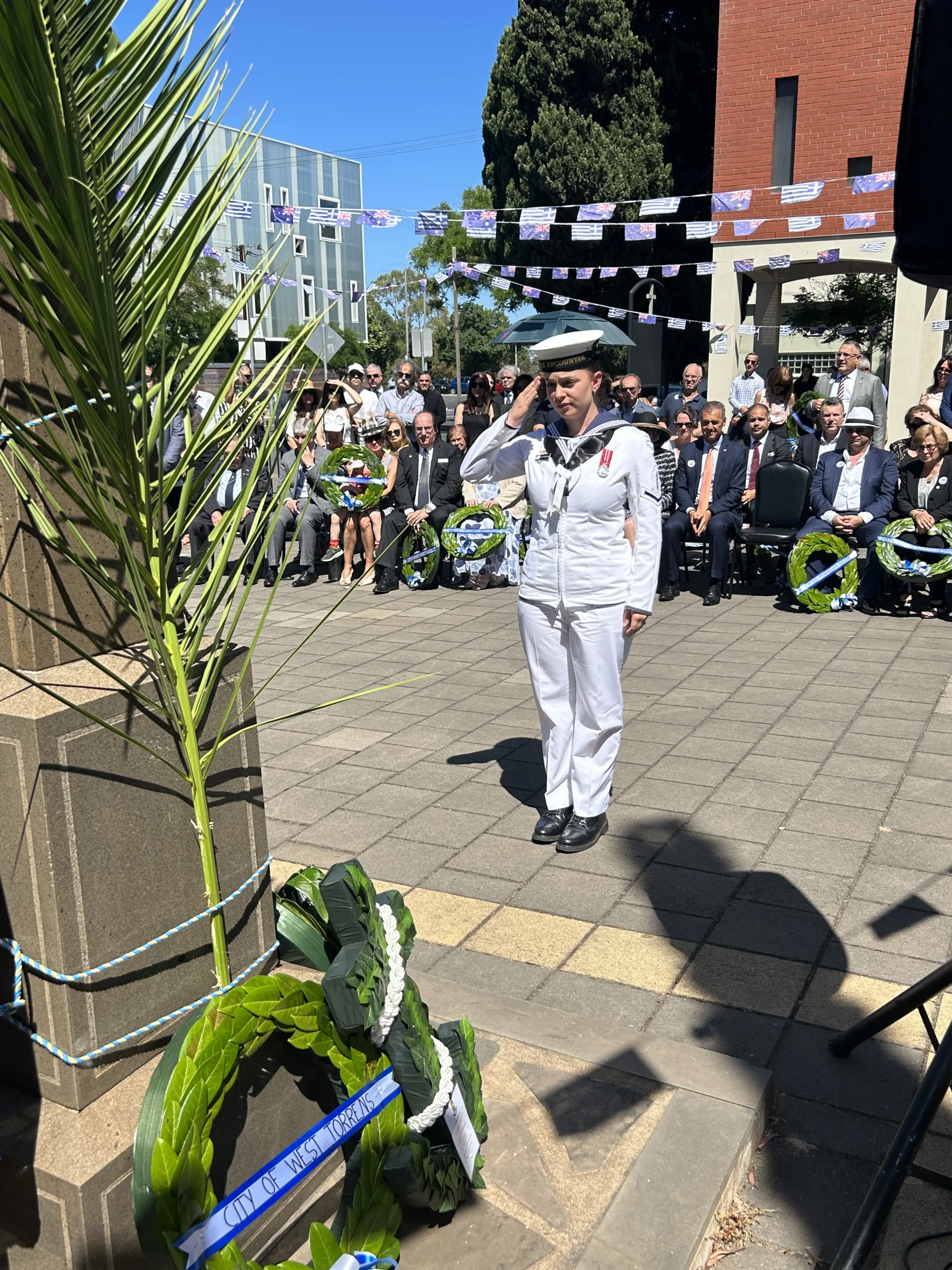
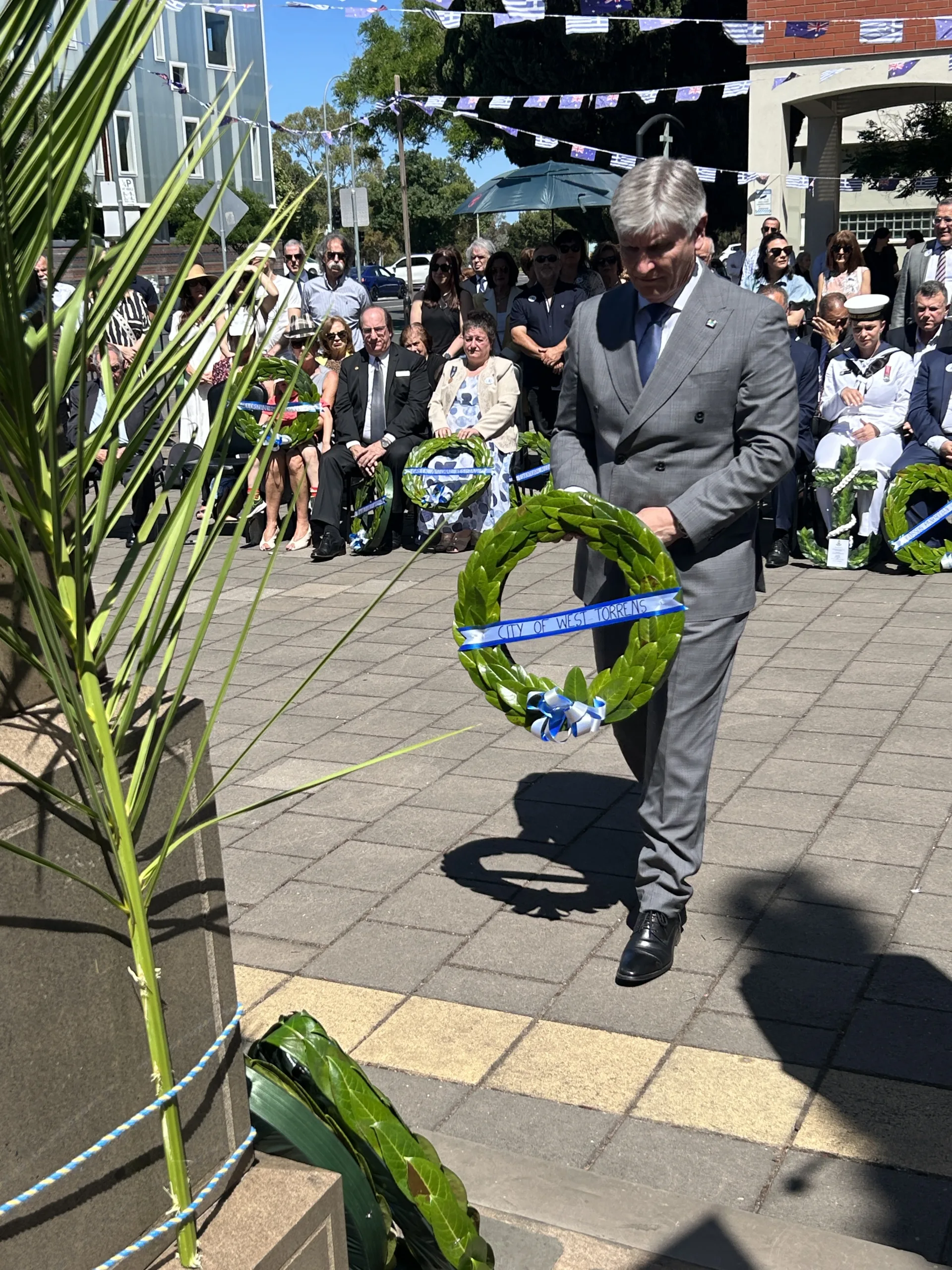
Wreaths adorned with blue and white ribbons were laid in honour of the Greek soldiers, the brave ANZAC’s who stood side by side with the Greeks, and all the civilians whose bravery shaped the outcome of the war.
Wreaths were laid by dignitaries including Mr Matthew Marozzi, representing the Hon. Peter Malinauskas MP, Premier of South Australia and the Hon. Zoe Bettison MP, Minister for Multicultural Affairs; Trian Gonis, representing Steve Georganas MP, Federal Member for Adelaide; The Right Honourable Dr Jane Lomax Smith, Lord Mayor of the City of Adelaide; the Mayor of West Torrens, Michael Coxen; Able Seaman Irene Charalampakis of the Royal Australian Navy; Councillor Stephen Finos of the City of Unley; and Councillor Peter Ppiros of the City of Charles Sturt. Wreaths were also laid by the Cyprus Community of SA, the Greek Womens Society of SA Taxiarchis, the Pan-Arcadian Association of SA, amongst other community organisations.
People who laid wreaths.
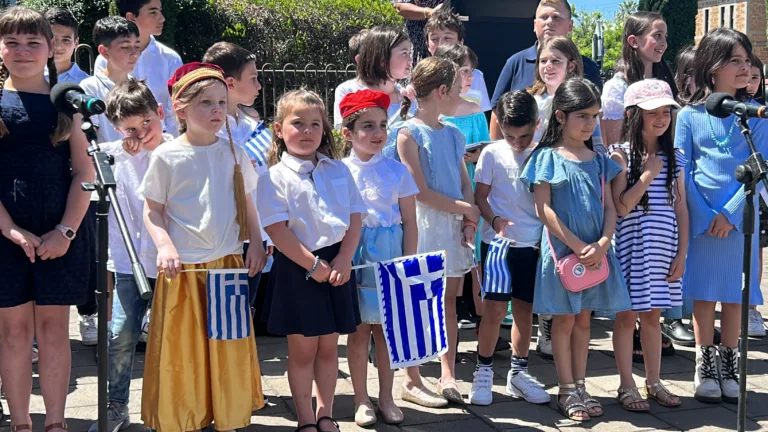
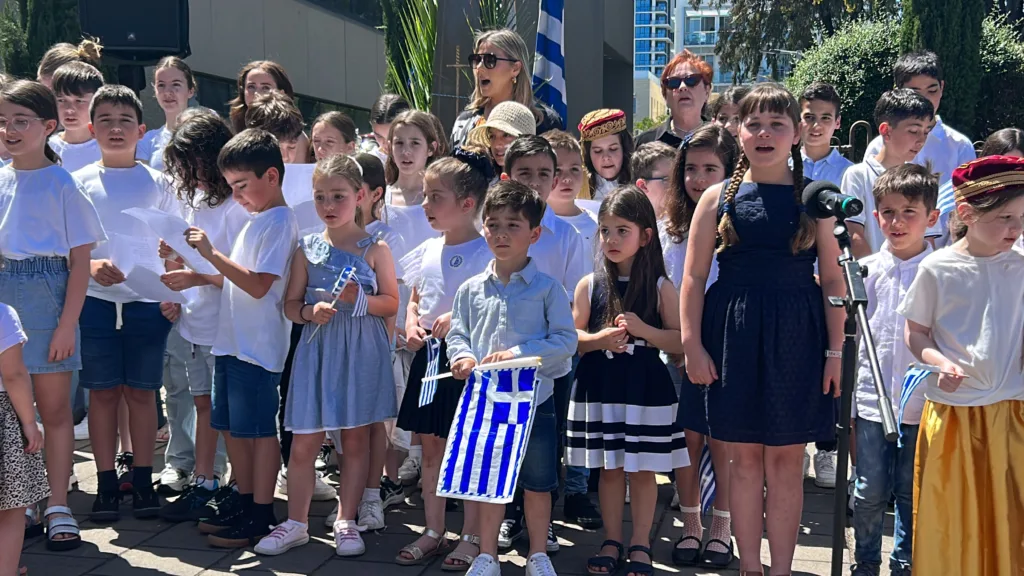
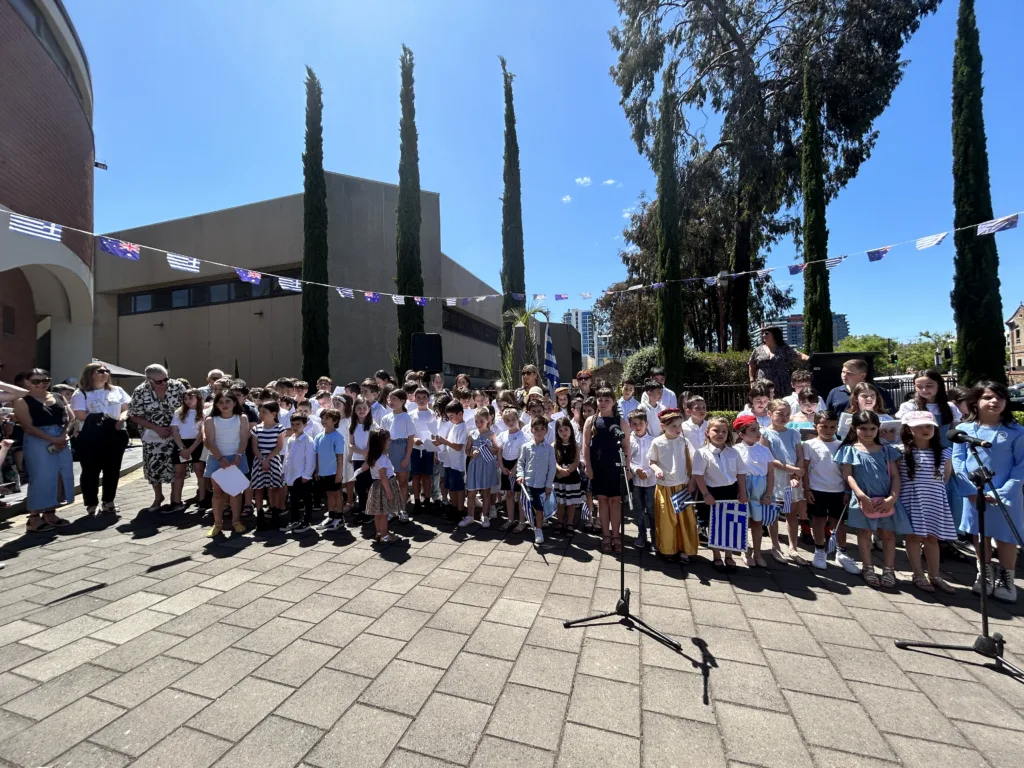
A major feature of the commemoration was the active participation of students from GOCSA’s Greek language schools. These young participants, some dressed in traditional Greek costumes, recited patriotic poems and sang a song that celebrated the spirit of resistance and national pride.
Their performances reflected the enduring legacy of OXI Day and demonstrated how the GOCSA is ensuring, through their Greek language programs, that younger generations remain connected to their Greek heritage.
*All photos copyright The Greek Herald / Peter Tantalos.
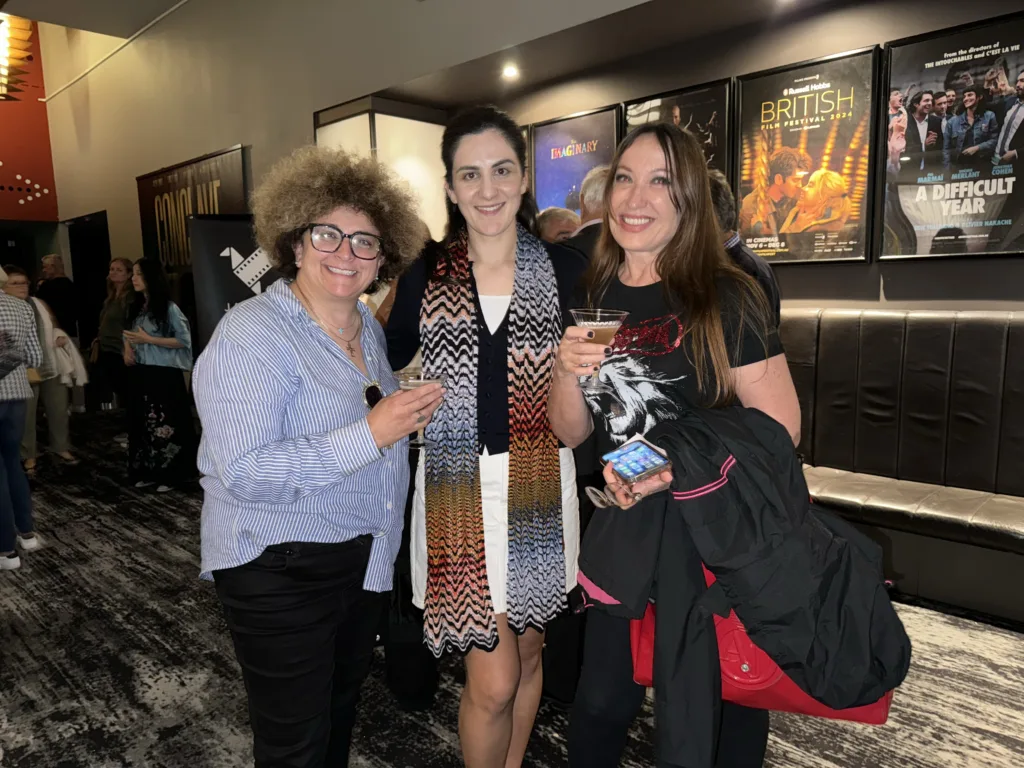
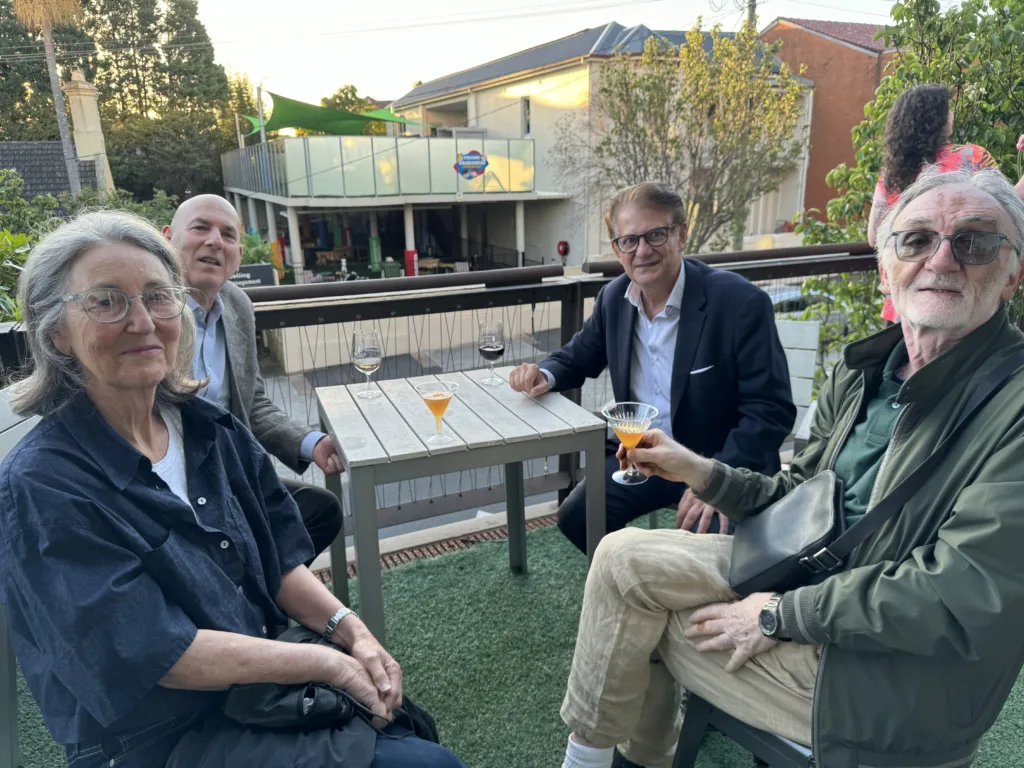
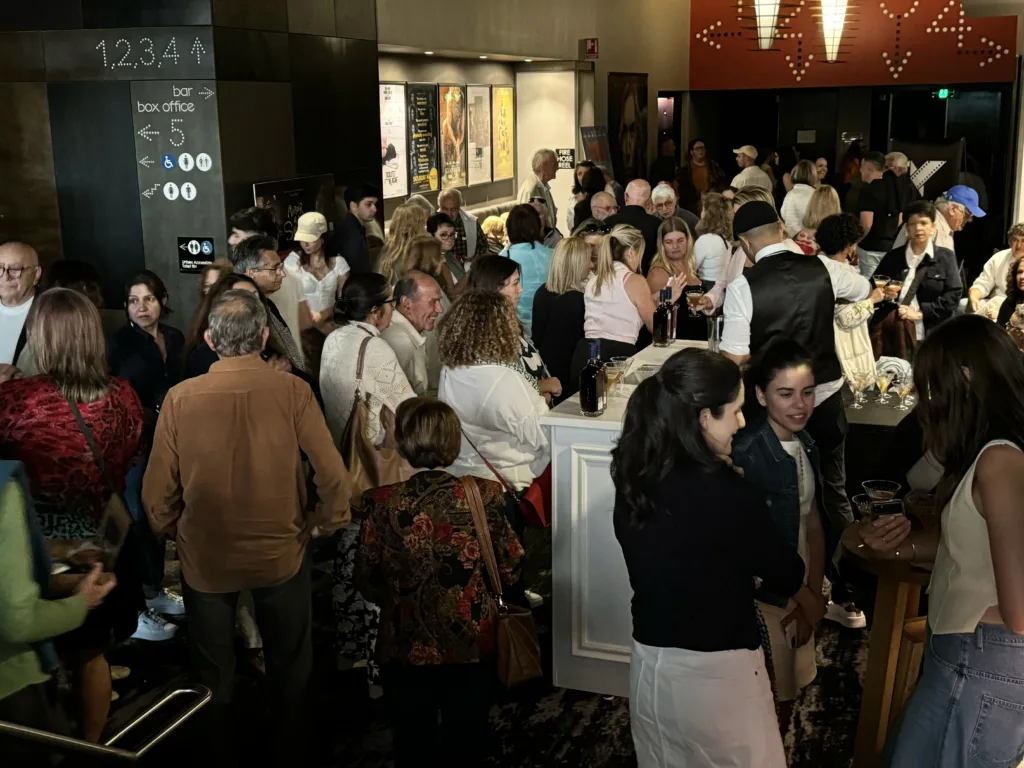
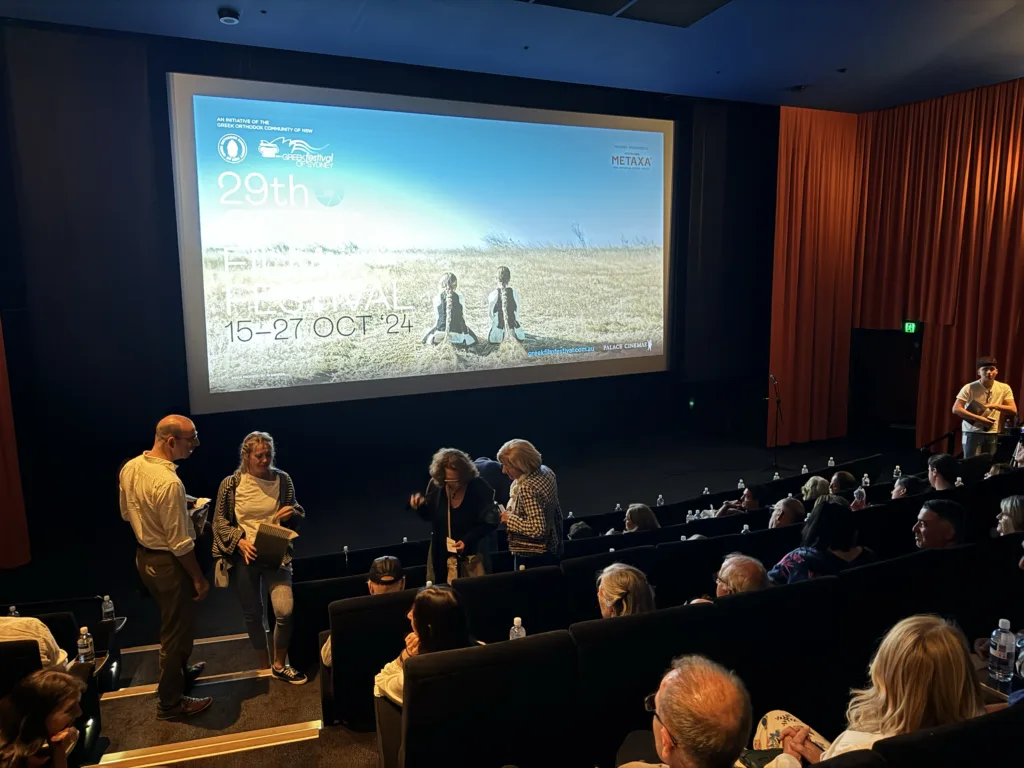
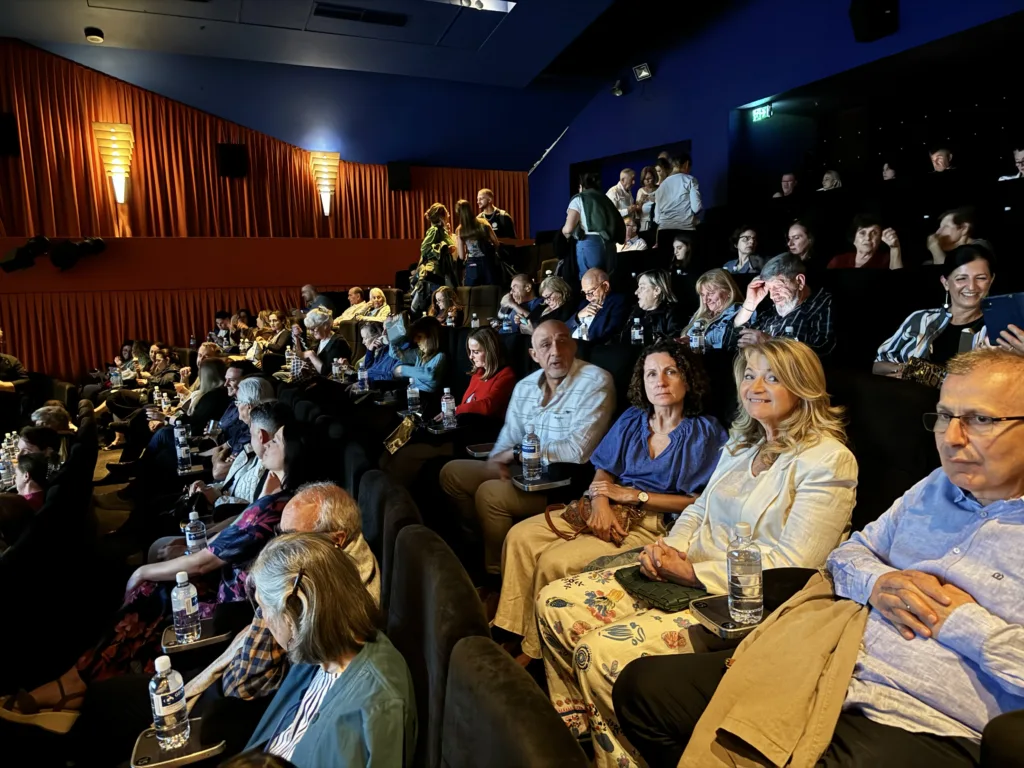
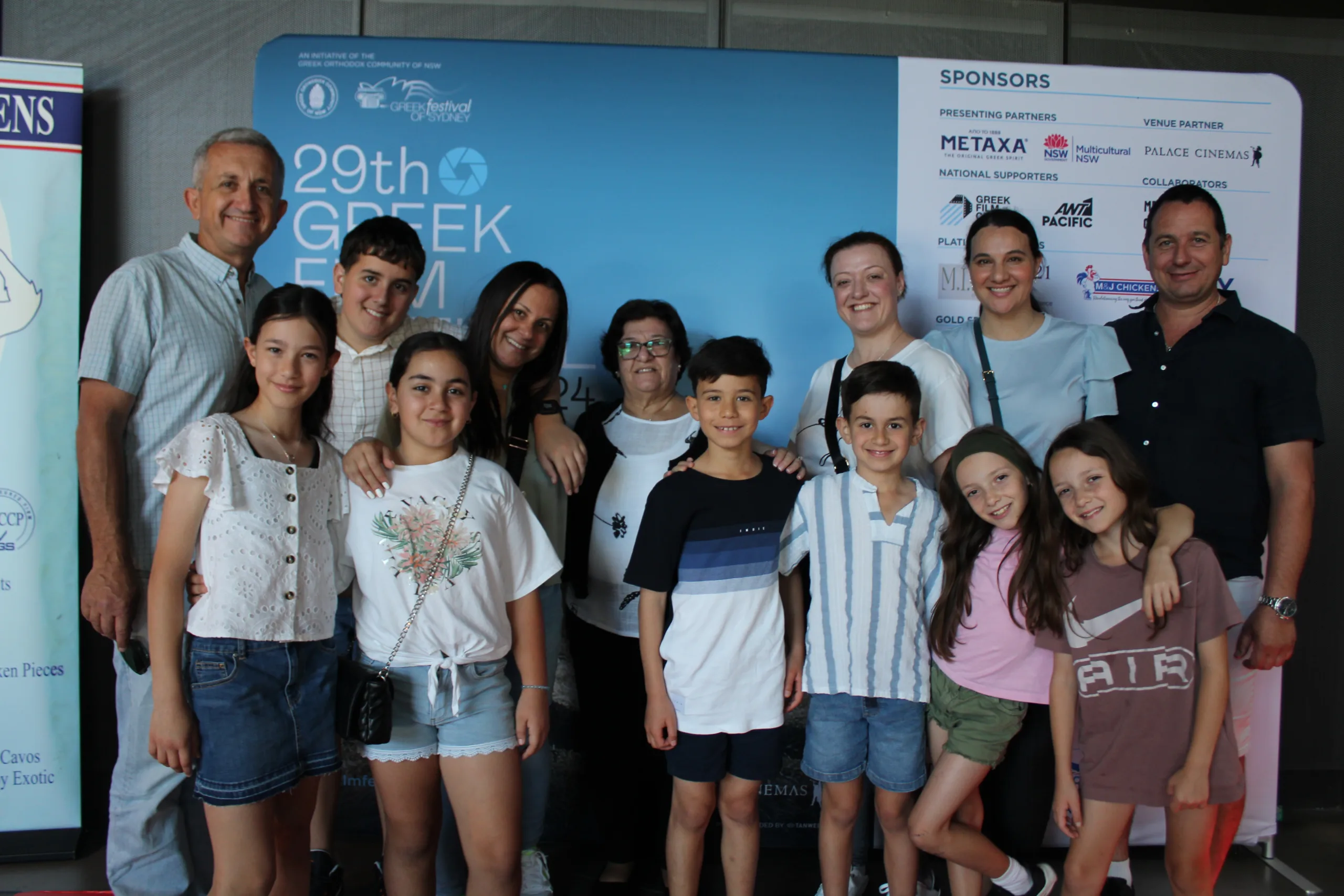
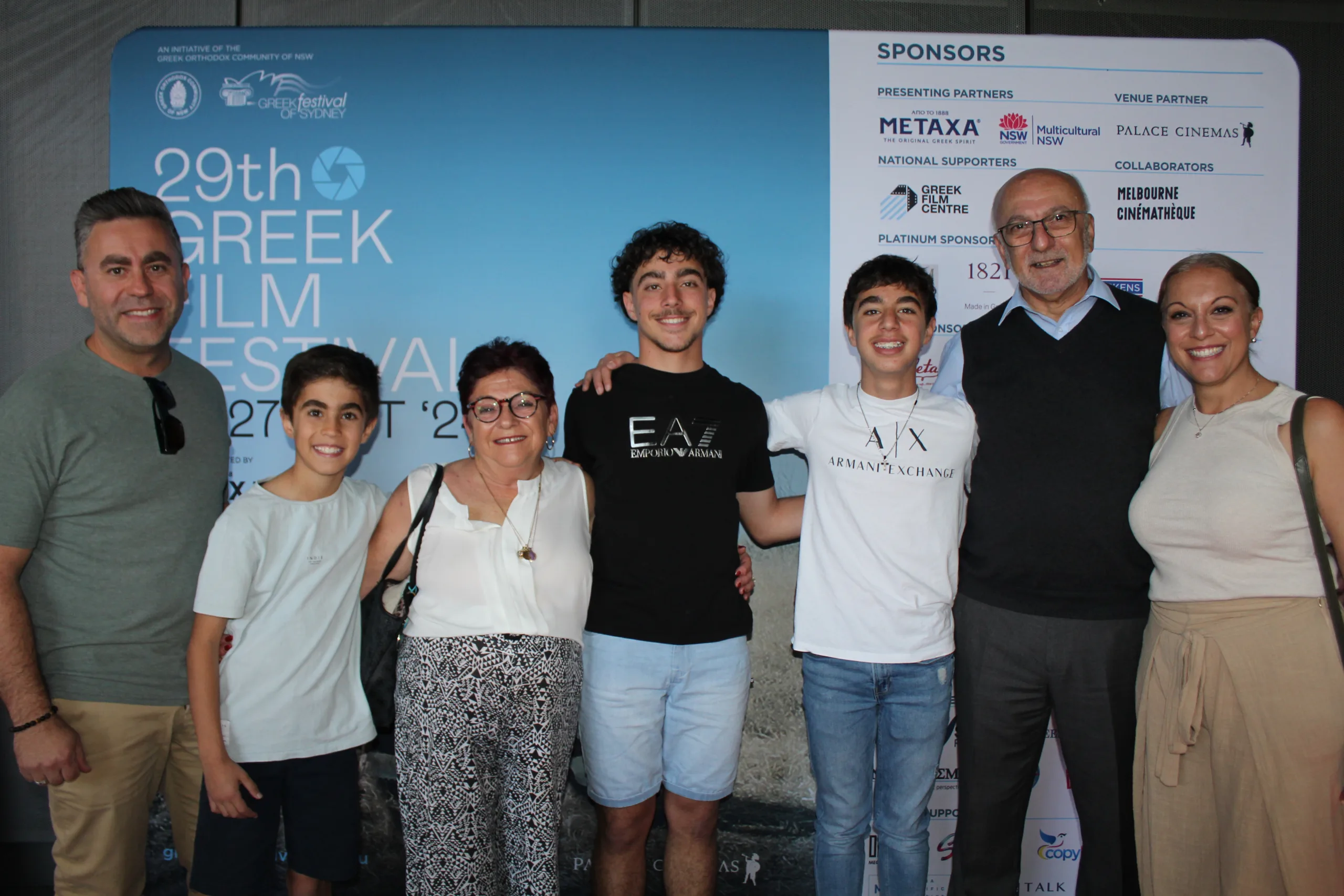
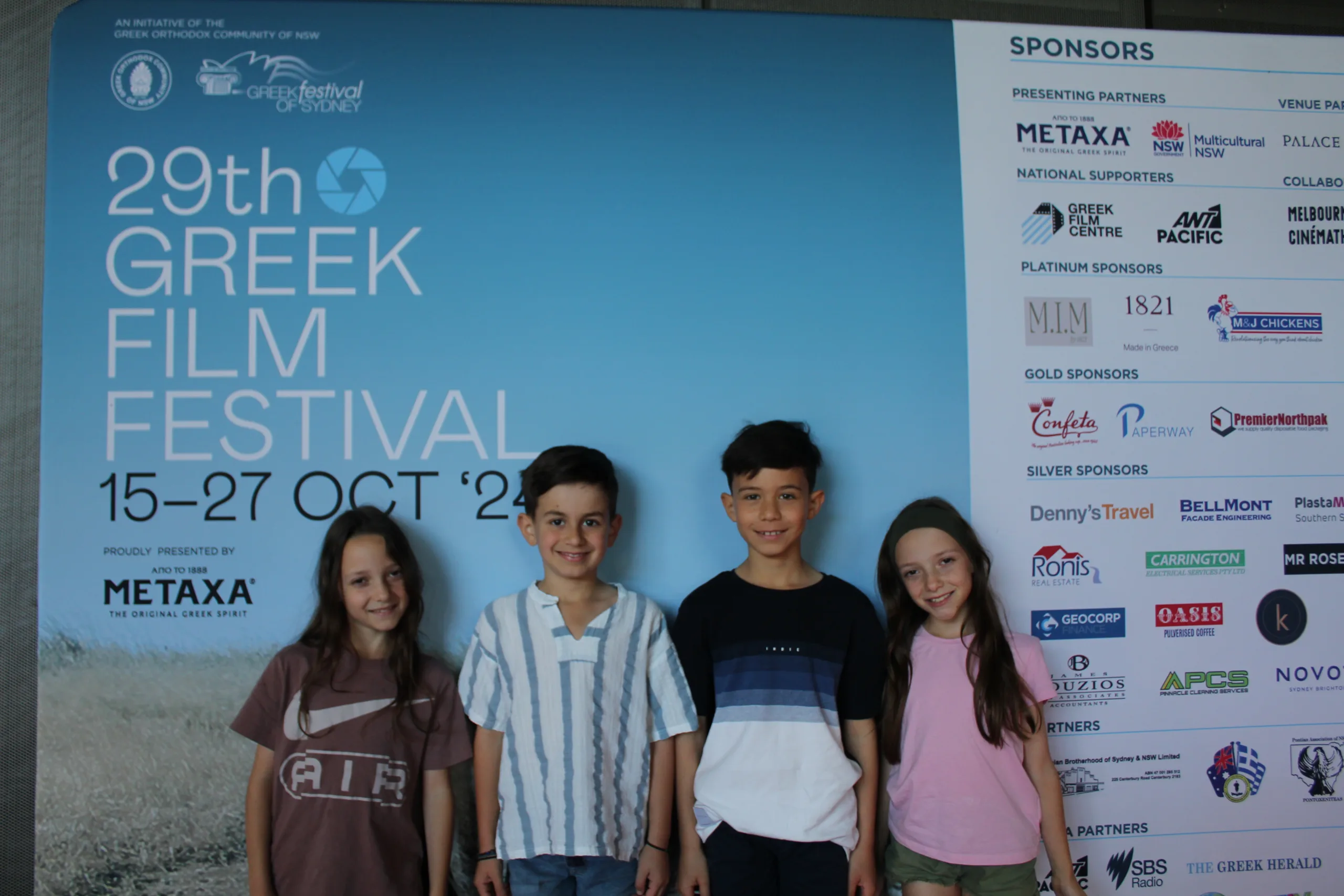
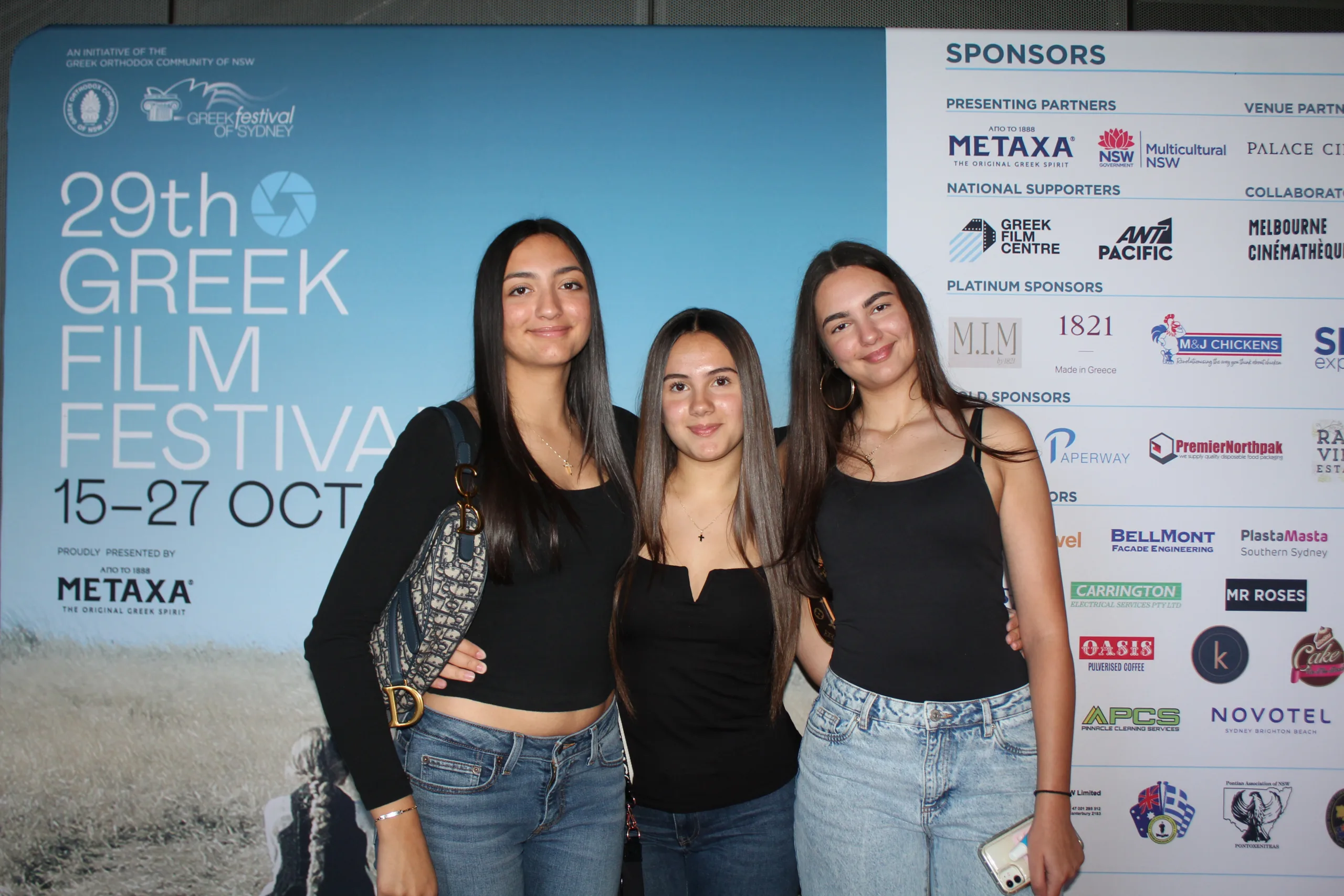
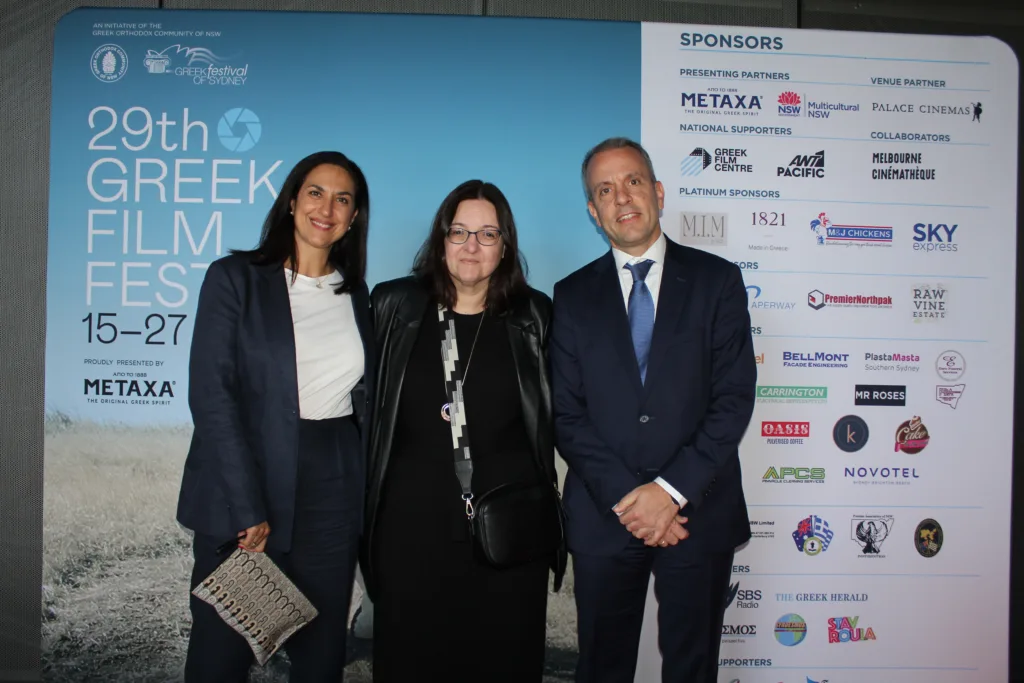
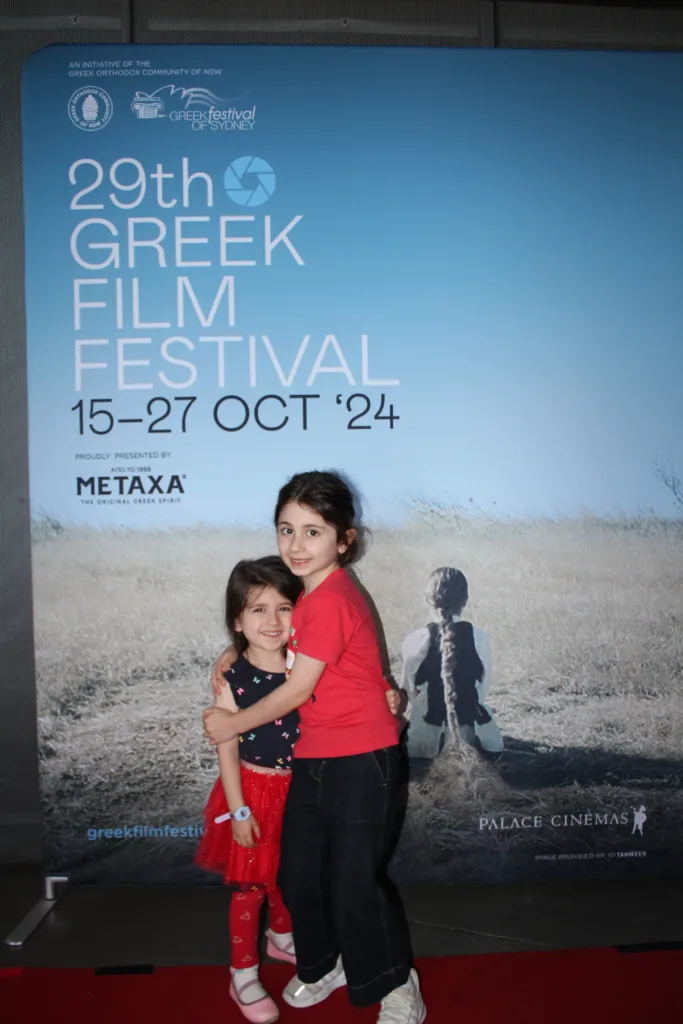
The 29th Greek Film Festival of Sydney came to a spectacular close on Sunday, October 27, with a sold-out crowd enjoying a memorable night of celebration, fine cocktails, and captivating cinema at Palace Cinema Norton Street.
Proudly presented by Metaxa, the closing night featured a special screening of The Aegean, an Australian film by Jacob Richardson set against the breathtaking backdrop of Kythera, Greece.
The event kicked off with a lively Metaxa Cocktail Party, where guests indulged in signature Metaxa cocktails, mingling among friends and fellow film enthusiasts. The cinema was at full capacity across multiple screening rooms, with attendees soaking in the festive atmosphere and excitement surrounding the final night of the festival.
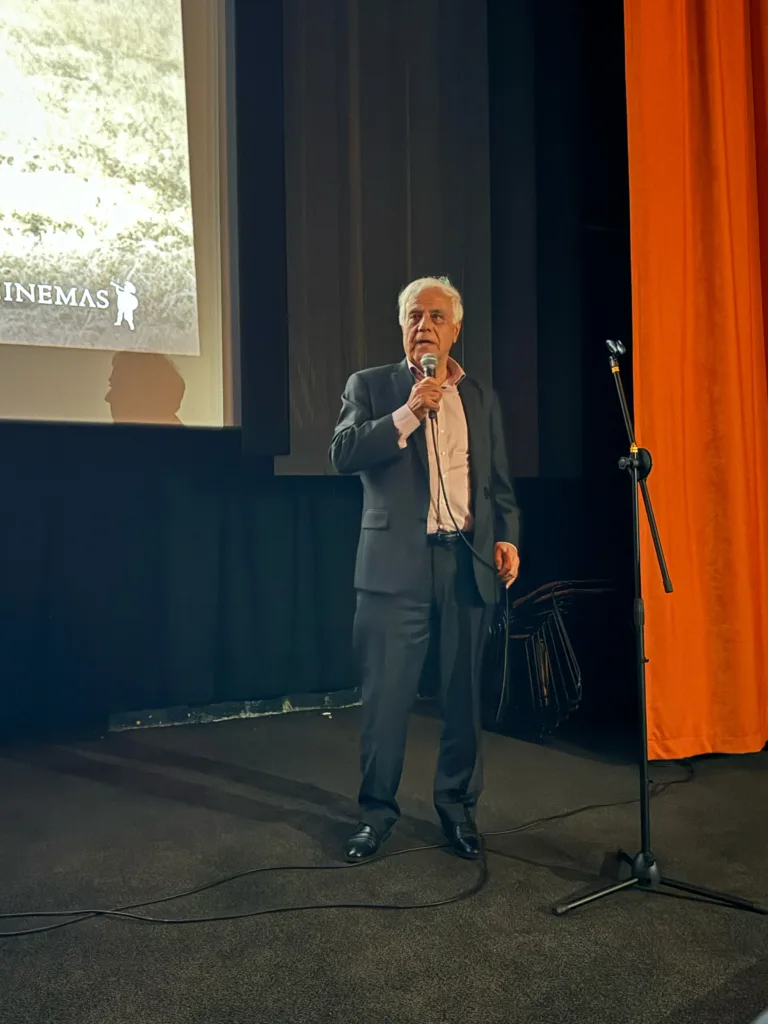
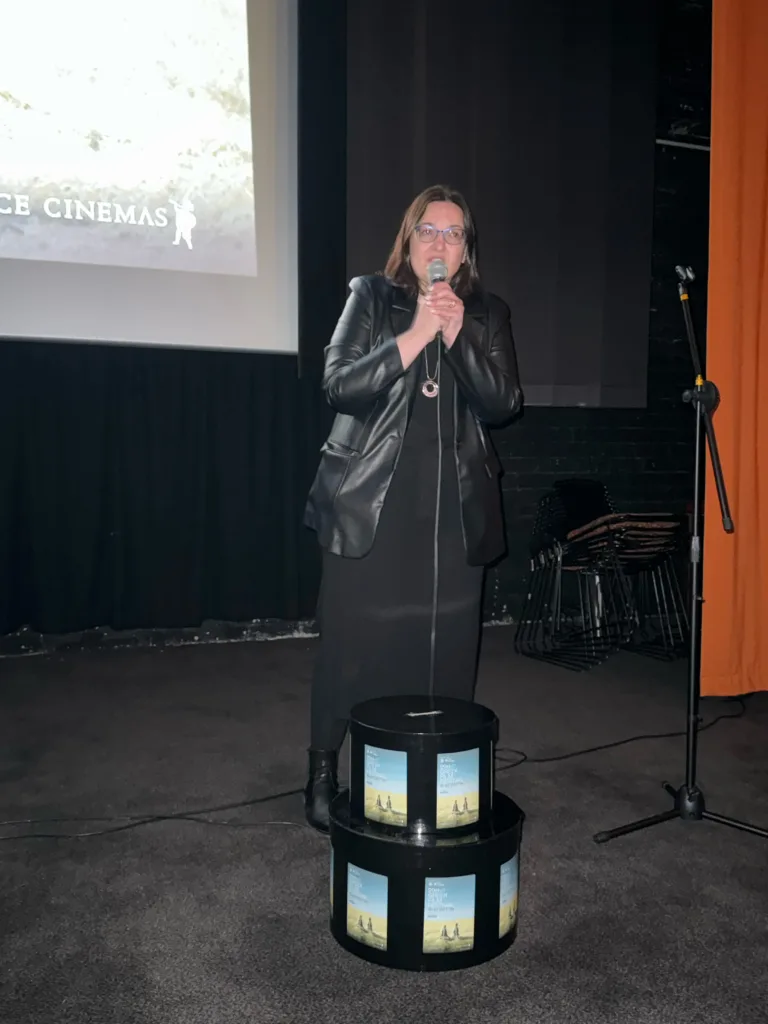
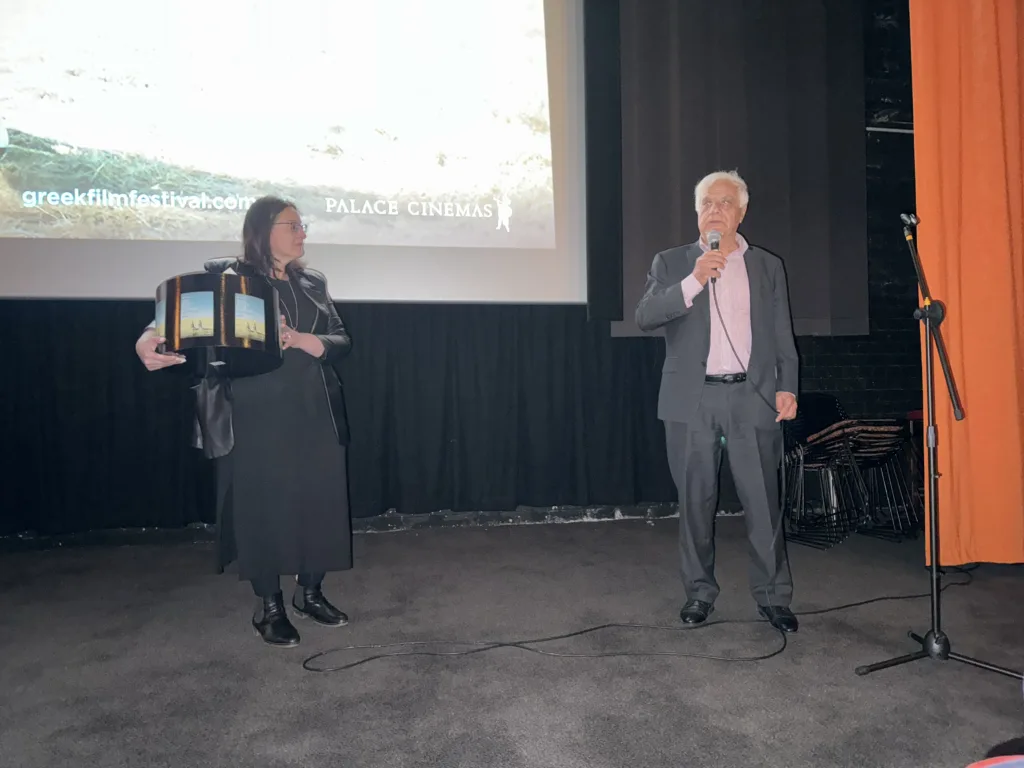
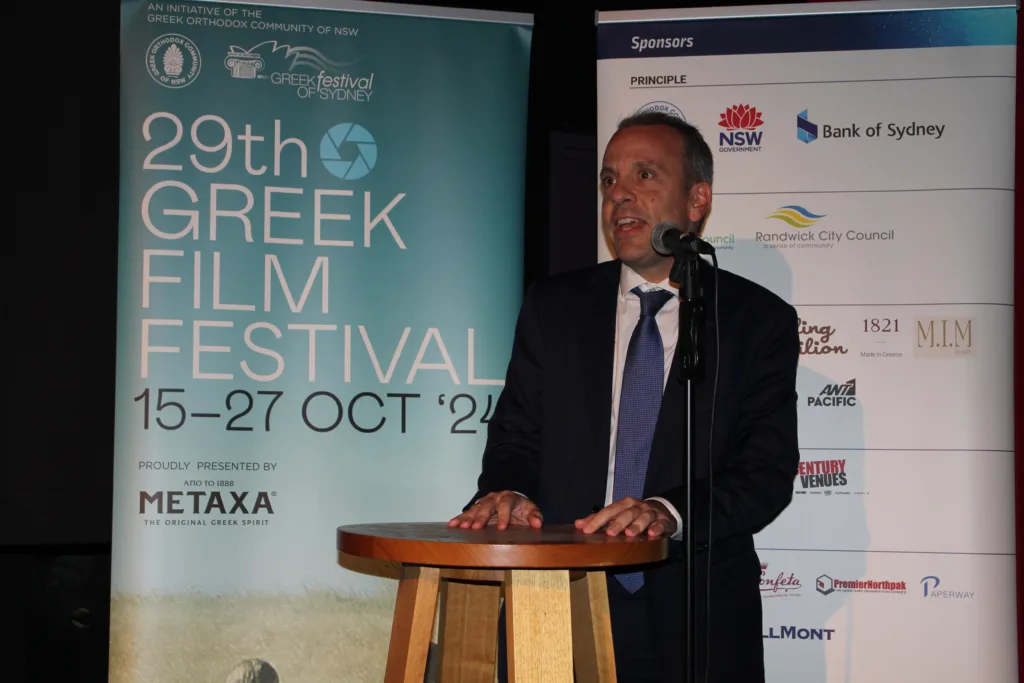
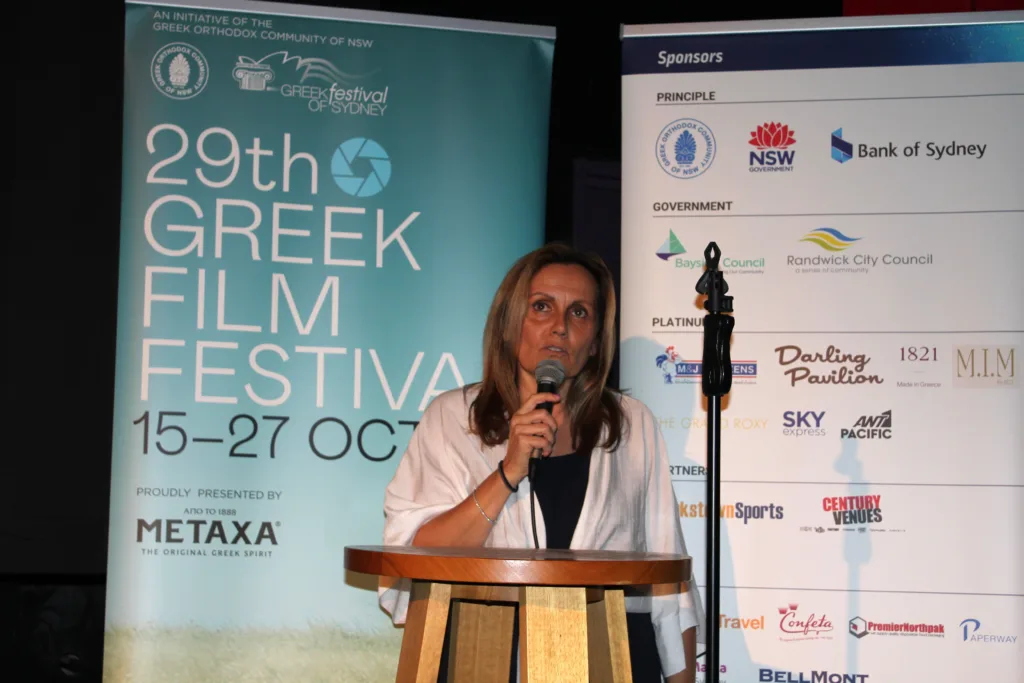
As the festival drew to a close, special speeches were delivered by Festival Coordinator Chryssa Karagiannidou and President of the Greek Orthodox Community of NSW (GOCNSW), Harry Danalis.
Ms Karagiannidou spoke on behalf of Festival Chair Nia Karteris, who was unable to attend. She expressed gratitude for the strong turnout, remarking that the high attendance “says something about all who actually support whatever has to do with our great culture.”
Mr Danalis also highlighted the festival’s “gaining popularity” over its impressive 49-year history and its recent expansion to Canberra, Perth, and Adelaide. He thanked the sponsors who make the festival possible and acknowledged the audiences across Australia who eagerly attend, driven by a “thirst for anything that comes out of Greece” and a desire to “experience life as it is in Greece today.”
President of the Greek Orthodox Community of NSW (GOCNSW), Harry Danalis.Festival Coordinator Chryssa Karagiannidou.
Following the speeches, the audience was treated to the screening of The Aegean. The film follows the journey of Hector, a widowed fisherman, and Theodore, a troubled teenager, as they navigate their way across the stunning Aegean Sea in search of solace and connection. With the beautiful island of Kythera as its backdrop, The Aegean was a fitting conclusion to the festival, embodying the spirit of Greek culture and storytelling.
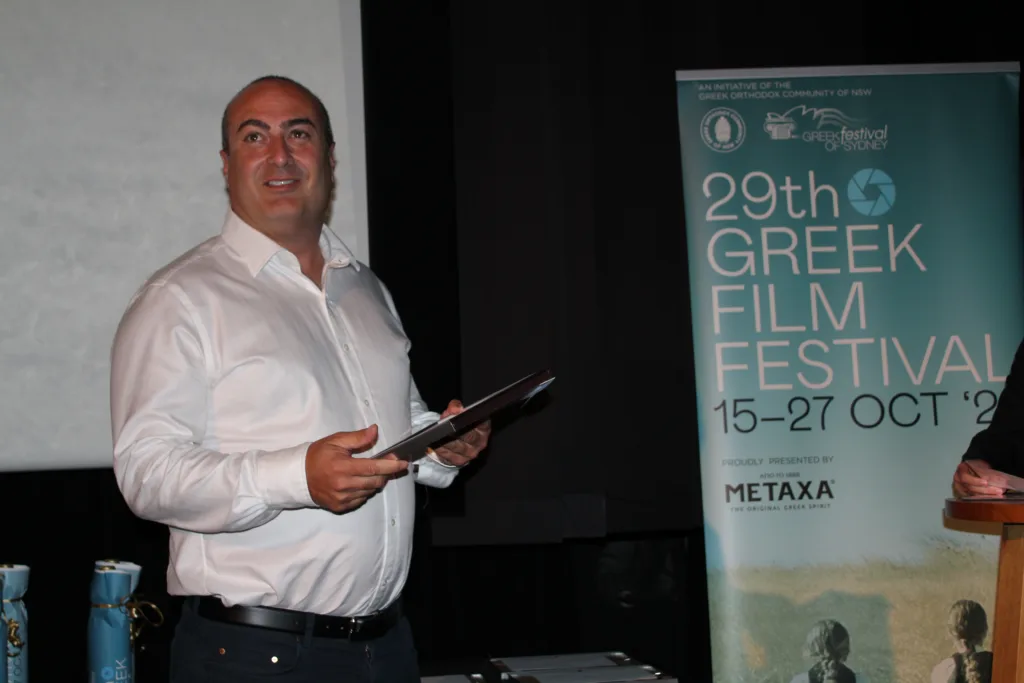
As the night came to an end, excitement reached its peak with the announcement of the festival’s much-anticipated prize draw. One lucky attendee won a luxury holiday package for two, sponsored by Denny’s Travel Centre, Sky Express, Myconian Collection, and Secrets of Santorini. The prize includes travel to the stunning islands of Mykonos and Santorini, offering a dream getaway to experience the magic of Greece firsthand.
Drawing the prize winner.
The 29th Greek Film Festival of Sydney has once again proven to be a cornerstone of cultural celebration in Australia, bringing together people from all walks of life to share in the richness of Greek cinema, heritage, and community. The festival’s remarkable success, with full-house screenings and an unforgettable closing night, ensures that the tradition will continue to flourish in the years to come.
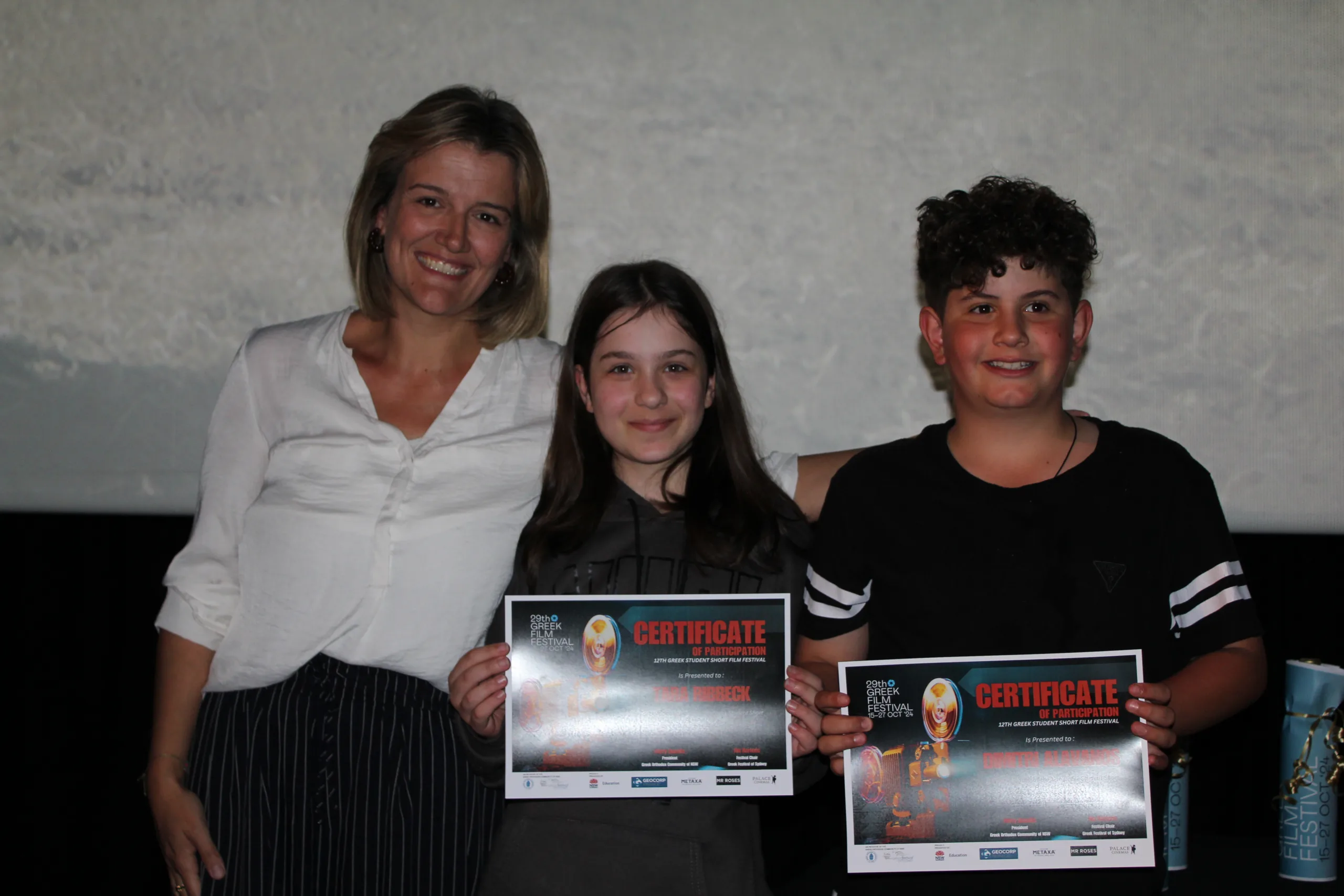
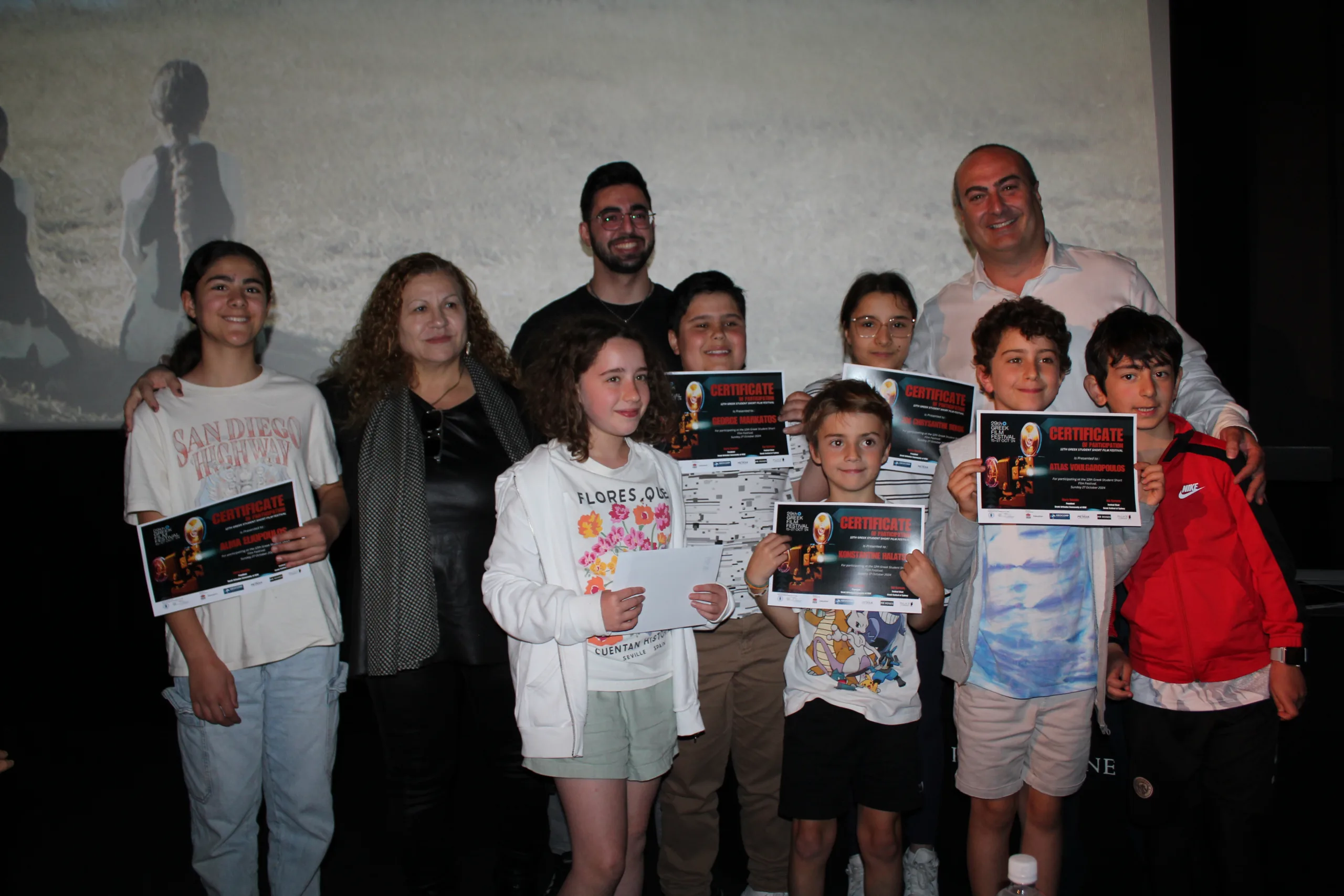
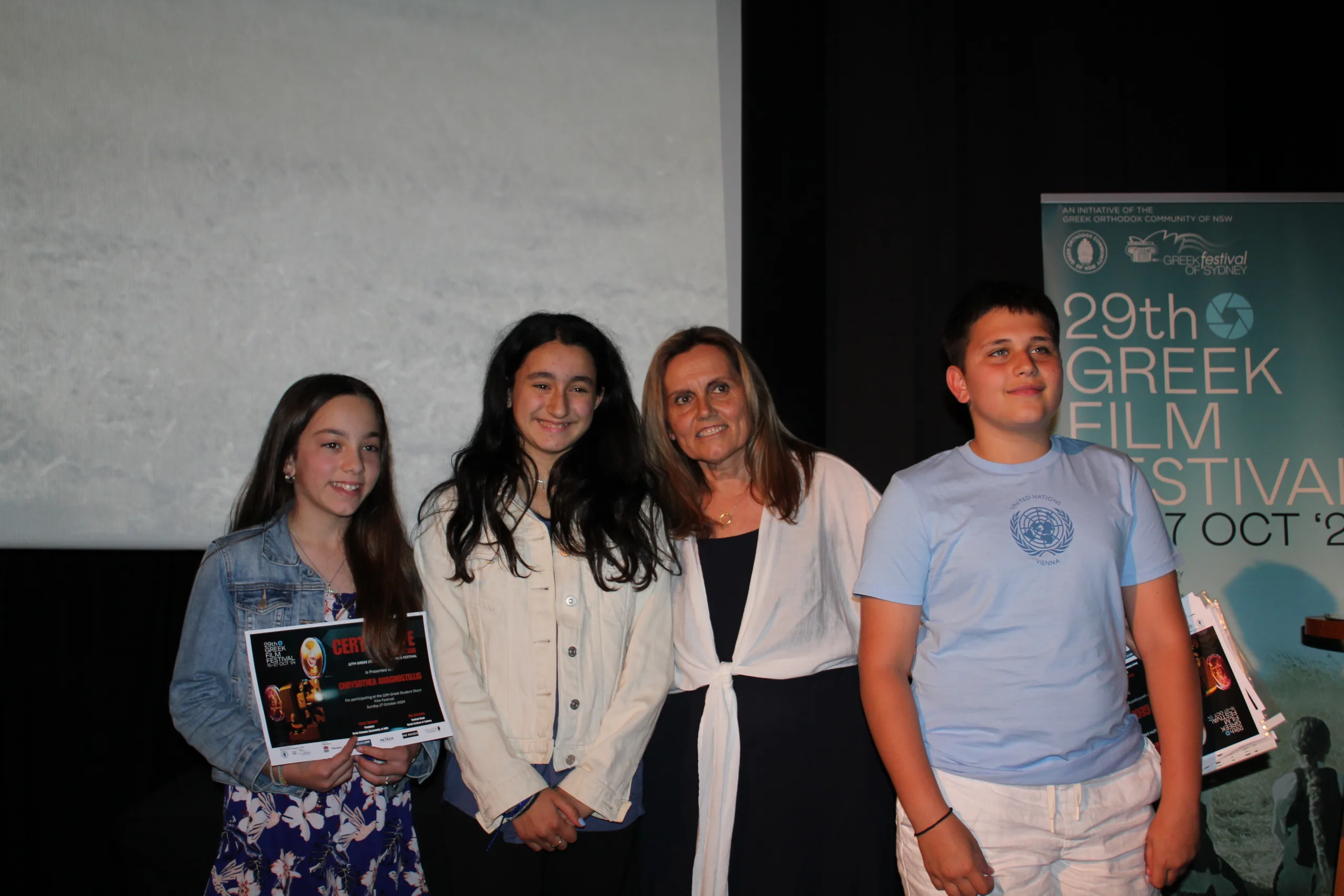
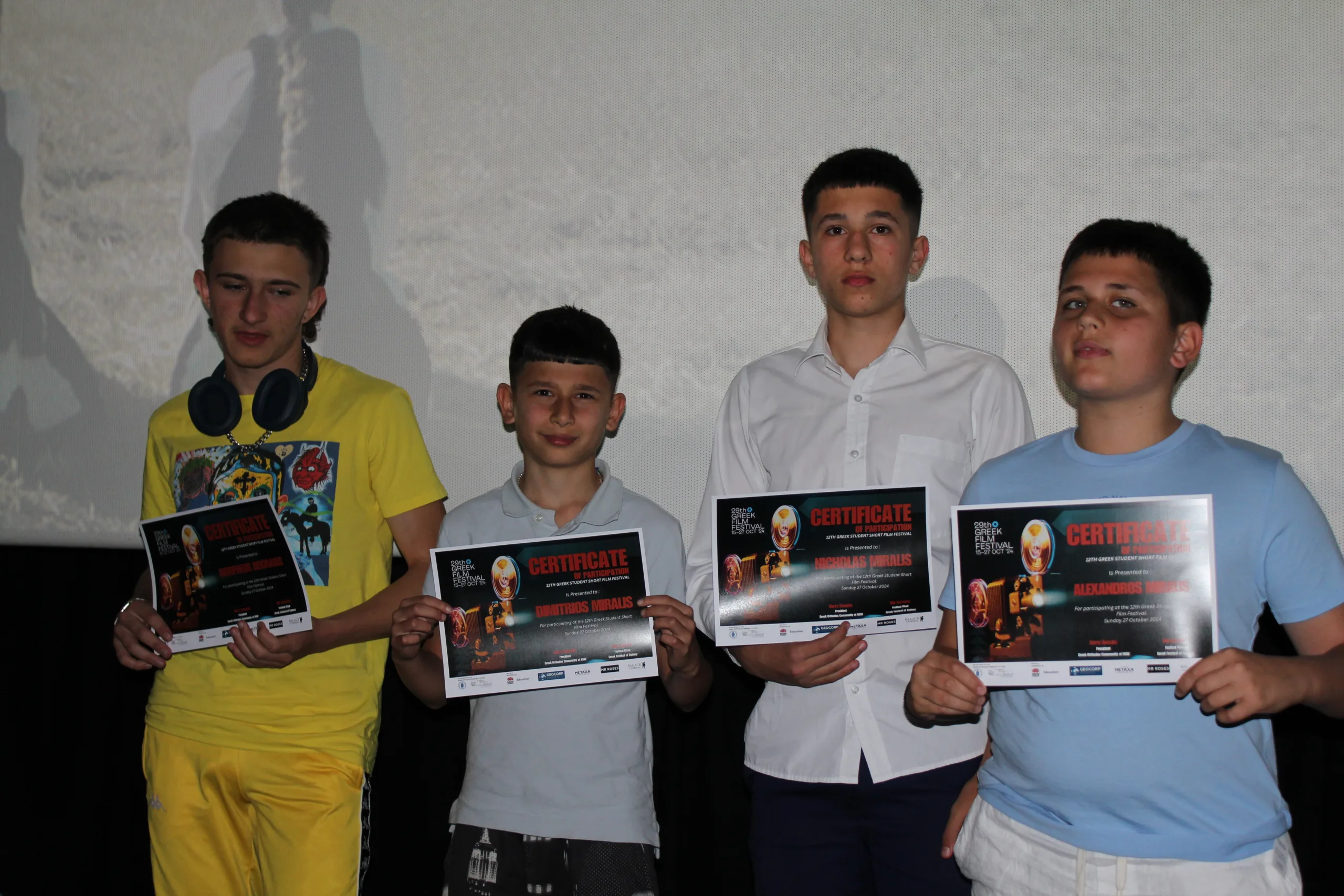
The 12th Greek Student Film Festival returned to Sydney on Sunday, October 27, showcasing the creativity and talent of young filmmakers studying and speaking the Greek language.
Held at Leichhardt’s Palace Norton Street Cinema as part of the 2024 Greek Film Festival, the event once again celebrated the best in student filmmaking, providing a unique platform for students to express their cultural identity through film.
Presented by Metaxas, the Greek Orthodox Community of New South Wales (GOCNSW), and the Greek Festival of Sydney, this year’s festival saw proud families and teachers gather at the cinema to watch a selection of films created by primary and secondary students.
Attendees from the Greek Student Film Festival. All photos copyright The Greek Herald / Andriana Simos.
Each film was inspired by this year’s theme, “Young Hearts & Wise Tales,” which encouraged students to explore storytelling through a youthful yet wise perspective. The films also creatively incorporated this year’s signature item, a “Window,” as a visual or symbolic element.
Distinguished guests at the festival included the Consul General of Greece in Sydney, Ioannis Mallikourtis, who gave an inspiring speech about the significance of the Greek language and the arts in keeping Greek heritage alive for future generations. He praised the students for their innovative use of film to tell stories that reflect their Greek roots while also engaging with modern ideas.
Vicki Tomaras, GOCNSW Greek Language Schools Coordinator, also delivered a heartfelt speech, emphasising the importance of using creative platforms like the film festival to connect young people with their Greek heritage. She thanked everyone for attending, and encouraged more students to take part in the festival next year.
Greek Consul General Ioannis Mallikourtis.Vicki Tomaras.
The screenings featured a diverse range of short films, from fiction to animation, all of which demonstrated the students’ impressive creativity and dedication. Their films reflected their interpretation of this year’s theme, with many delving into the connection between youth and wisdom, as well as the symbolic use of the “Window” as a metaphor for new perspectives.
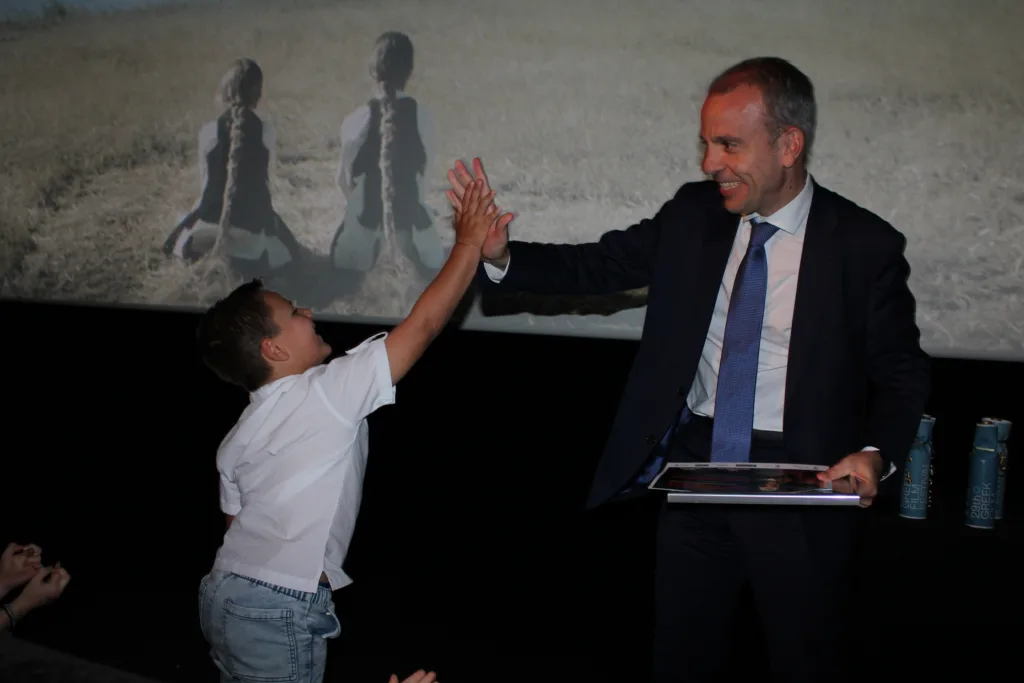
After the screenings, emcee Dimitris Kallos invited Paris Georgiades from Geocorp Finance, the Consul General, and the President of GOCNSW Harry Danalis to the stage to present awards to the winners.
Paris Georgiades from Geocorp Finance.
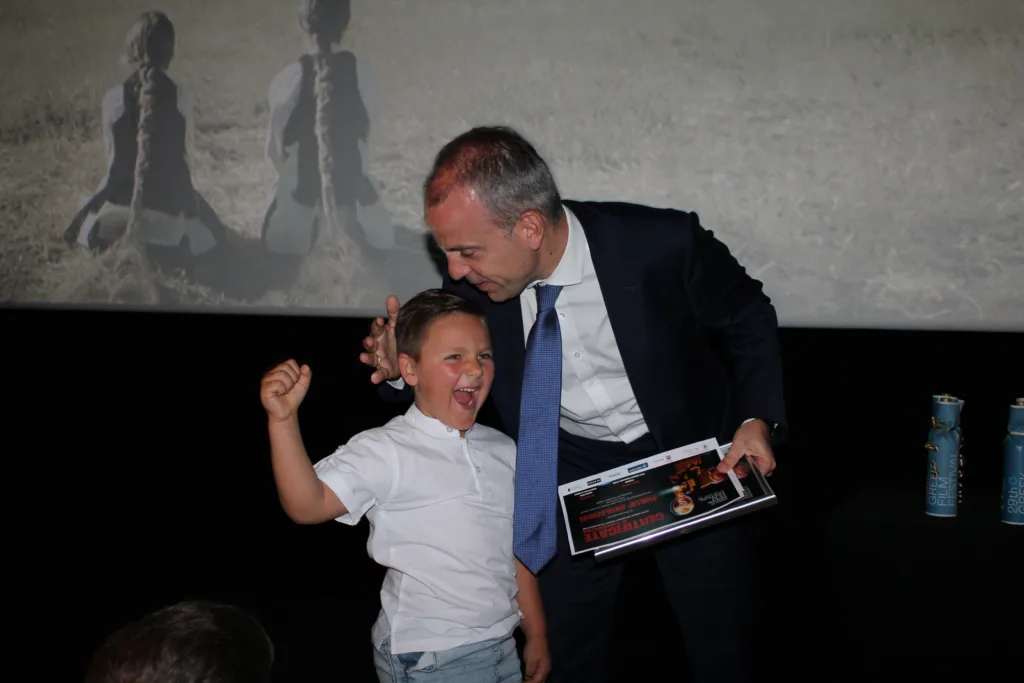
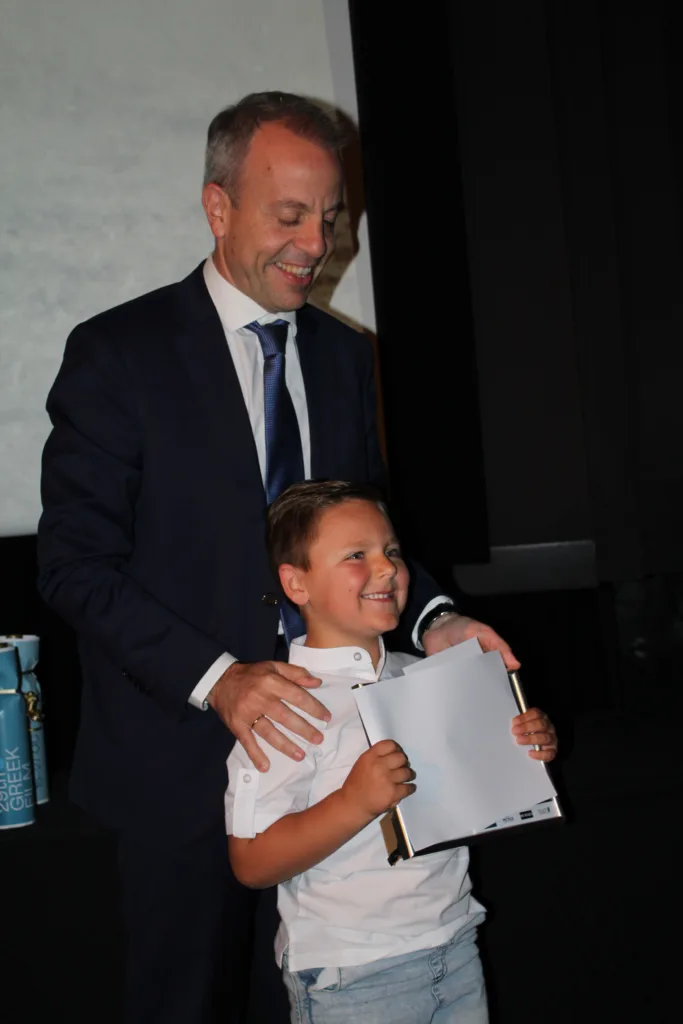
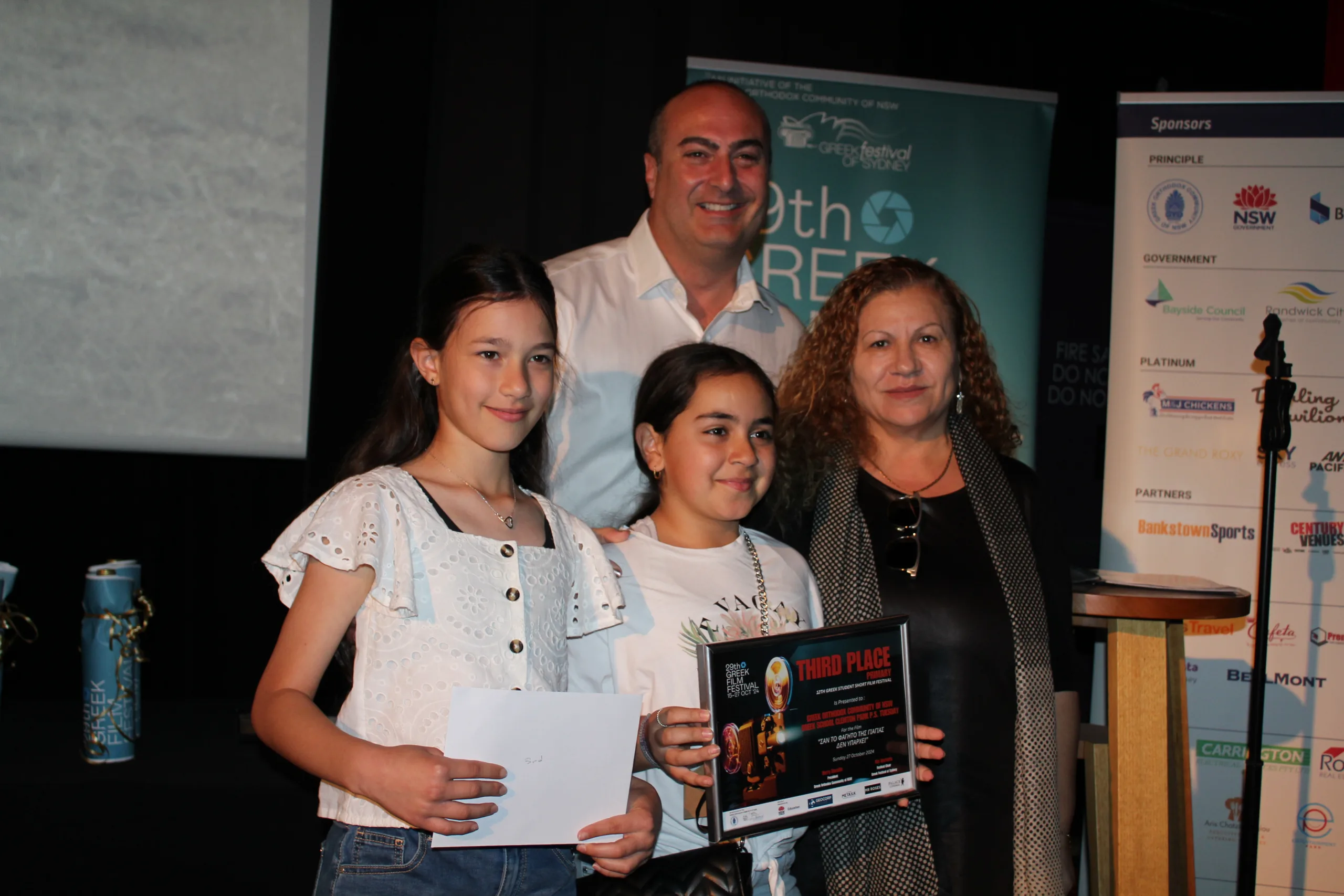
The ‘First Prize for Primary School’ category was awarded to Phillip Skolarikis from St Spyridon College. This year, a second prize was also given to students from the GOCNSW Afternoon and Saturday Greek School, Summer Hill campus. Third prize went to students from the GOCNSW Afternoon and Saturday Greek School, Clemton Park campus (Year 5).
Phillip Skolarikis celebrating his win.
In the ‘First Prize for Secondary School’ category, students from the GOCNSW Afternoon and Saturday Greek School, Clemton Park campus, took out the top prize.
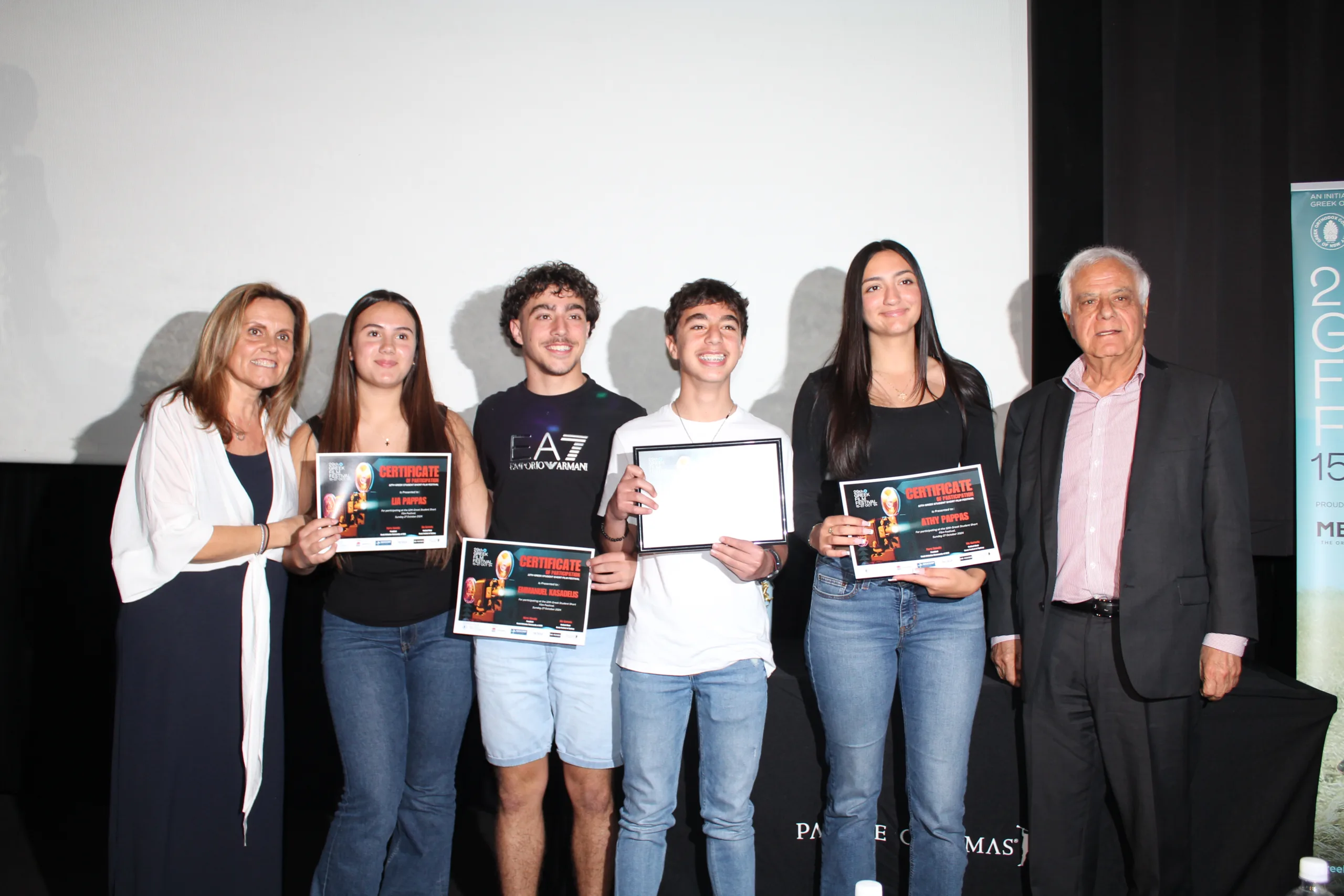
In addition to these top awards, Certificates of Participation were handed out to all students, in recognition of their efforts and contributions to the festival.
All of the award winners.
Speaking with The Greek Herald after the event, winning student Phillip Skolarikis expressed his pride in using the Greek language in such a creative way. His film focused on Corfu and his visits to the island every year and how it fostered a strong connection to Greece and his family. His mum Dimitra Chalikia was credited with helping him create the film.
“It feels very good to win. I wasn’t expecting this to happen. I’m very proud of myself,” the six-year-old said.
The Greek Student Film Festival continues to offer young filmmakers a platform to explore the Greek language in innovative ways while encouraging the preservation of Greek culture in Australia. Looking ahead, the festival promises to return with more inspiring films that reflect the voices of the next generation of Greek Australians.
*All photos copyright The Greek Herald / Andriana Simos.
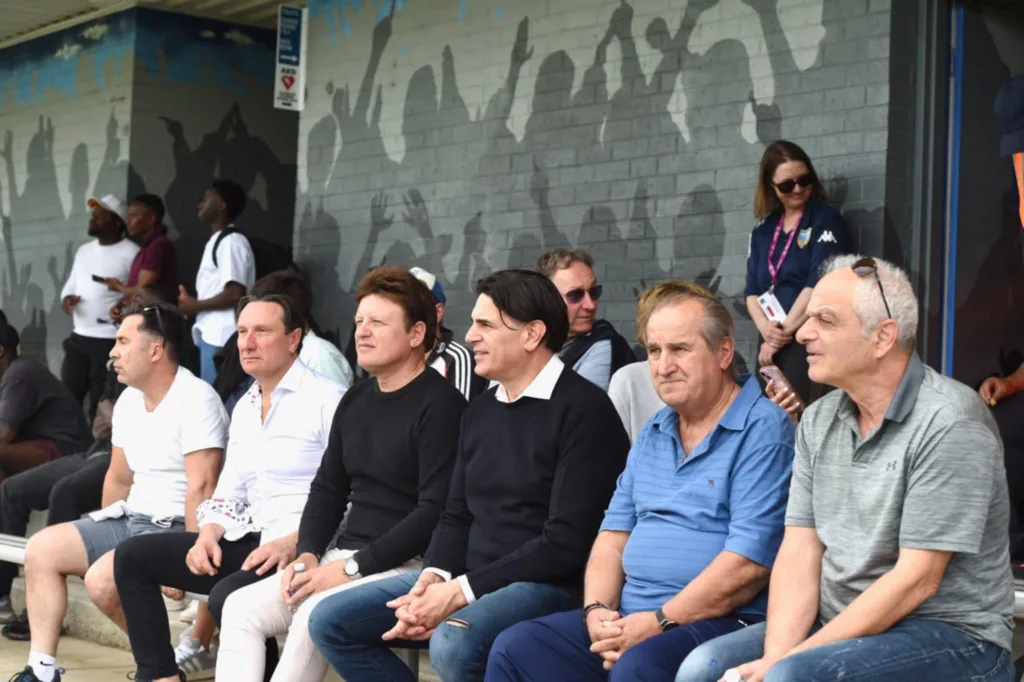
The President of the Greek Orthodox Community of South Australia (GOCSA), Peter Gardiakos, has issued a statement after members voted against a motion aimed at reunifying with the Greek Orthodox Archdiocese of Australia (GOAA) after a 64-year schism.
500 community members met on Sunday, October 27 for an Extraordinary General Meeting (EGM) to determine the future of GOCSA – with a vote of this kind not being brought to members in 60 years.
The proposed changes that would have marked the end to a 64-year schism between GOCSA and the GOAA did not pass, despite 61% of support from members.
In the statement, Mr Gardiakos said he was “disappointed by the outcome,” but “it was encouraging to see more than 60% of members wanting change in our community.”
Full statement in English:
My thanks are due to the nearly 500 members of the Greek Orthodox Community of South Australia who came out last night to decide on an issue that has impacted us all.
Thank you to the Electoral Committee for ensuring the voting process ran smoothly, to our wonderful staff who went above and beyond and to the Administrative Council who have dedicated time, effort and have shown willingness to embark on this challenging journey to put more than six decades of division behind them and grant future generations the opportunity to move forward as one Greek community.
We did the best we could thus far to put the decision-making process in members’ hands.
I am most grateful to all of you who expressed your opinions and reached out with words of support. I know how hard it was for some of you to come out yesterday, and I only wish I could thank you individually.
Whilst I am disappointed with the outcome, it is encouraging to see more than 60% of members wanting change in our community. For as long as I am serving as President, I will ensure that all our membership base get a fair say, and I will work particularly hard for the majority of our members who want to build a united, stronger Greek community.
We will leave yesterday to the past, keep building up this organisation, and continue receiving feedback from our members on how to better serve them with trust and transparency.
We have our eyes firmly on the future whilst acknowledging and safeguarding all that wehave inherited from the founders of the Greek Orthodox Community of South Australia.
On 26–27 April 1941, the Battle of the Corinth Canal took place, marking the penultimate military engagement of the British Expeditionary Force in Greece during World War II. It was a German airborne operation involving elite German paratroopers targeting the strategically vital maritime passage, which was bravely defended by the Commonwealth “Isthmus Detachment.”
From the onset of the German invasion, the Corinth Canal had been a focal point for the enemy, deemed crucial for their complete domination in Greece, as well as being an important conduit for fuel supply lines from the Black Sea to Axis forces operating in North Africa. To secure it, the airborne Operation Hannibal was planned, which aimed for the vertical encirclement of the retreating British Expeditionary Force, with the objective of capturing the transportation bridge over the Corinth Canal to disrupt the withdrawal of Allied formations from designated evacuation ports in the Peloponnese to Crete.
The daring undertaking was assigned to the battle-hardened 7th Parachute Division, commanded by Major General Wilhelm Süssmann, stationed near Plovdiv, Bulgaria.
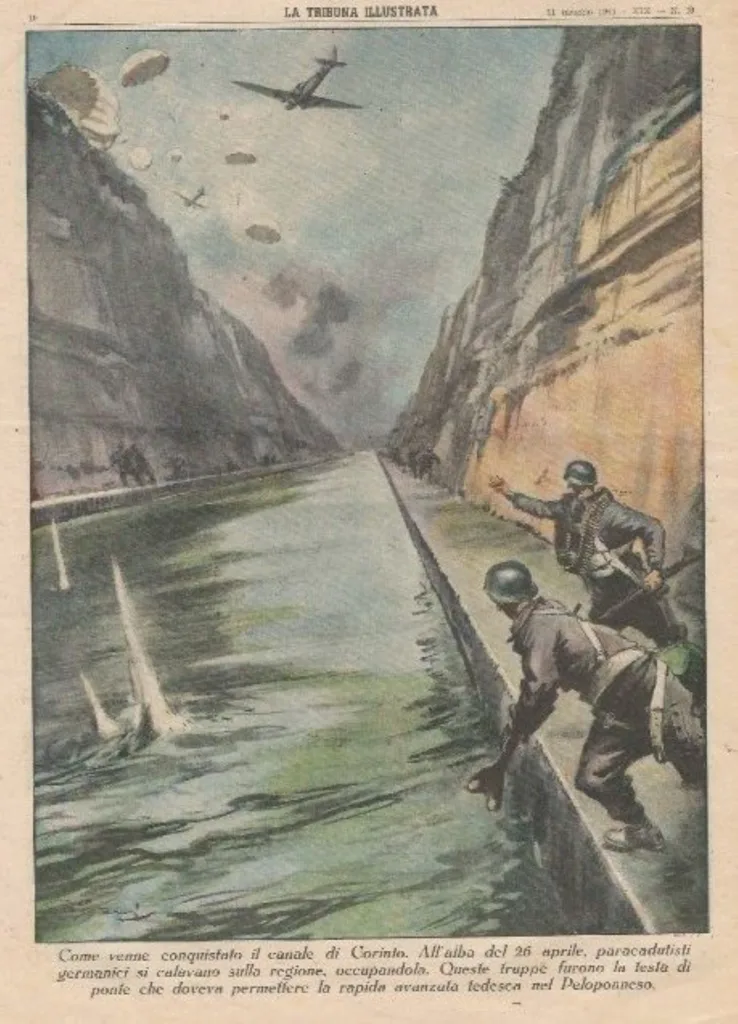
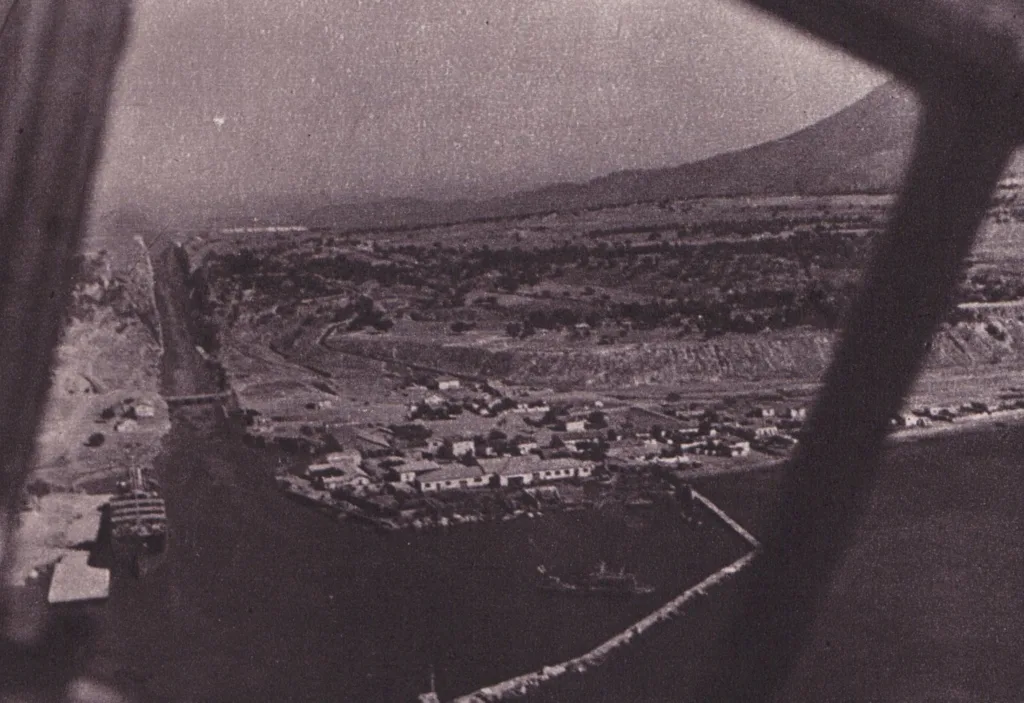
Propaganda depiction of the German paratroopers’ seizure of the Corinth Canal on 26 April 1941. Published in the Italian weekly magazine “La Tribuna Illustrata.”The southeast end of the Corinth Canal with the settlement of Kalamaki, in a German aerial photograph, likely taken in May 1941.
Having intercepted some intelligence about German intentions, British command decided to swiftly organise a defensive setup in the Corinth Canal area on 24 April 1941, hastily forming the Commonwealth “Isthmus Detachment.” This eclectic force consisted mainly of disparate British, Australian, and New Zealand sub-units (ANZAC), of reduced composition, drawn from various Allied units as they passed through the Peloponnese.
Specifically, on the night of 25 April, their deployment at the Isthmus was as follows:
– The Command Post of the British 4th Armoured Hussars was located east of Corinth, with a Rifle Section oriented towards the northwestern end of the canal. The commanding officer, Lieutenant Colonel Edward Lillingston, was in charge of the “Isthmus Detachment.”
– The A and B Companies of the Australian 2/6 Infantry Battalion were stationed defensively on either side of the canal bridge.
– The British 16th Heavy Anti-Aircraft Battery and the 122nd Light Anti-Aircraft Battery were primarily positioned along the canal and on the Corinth–Argos route, along with a Greek anti-aircraft detachment.
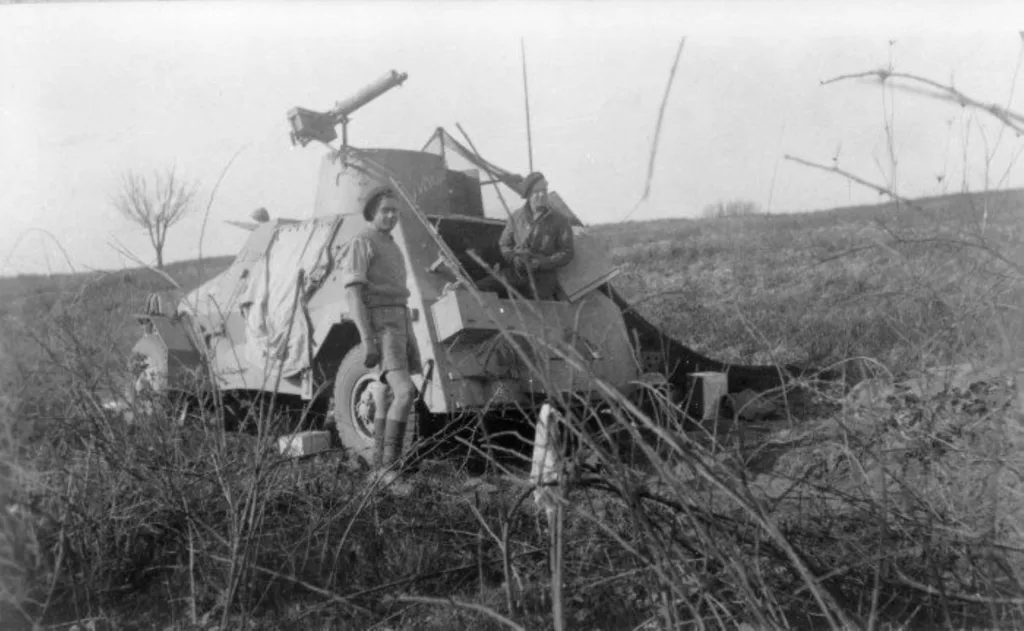
Marmon-Herrington MK I armoured vehicle during the retreat of the New Zealand Mounted Rifle Brigade in Greece, April 1941.
– The C Troop of the New Zealand Mounted Rifles and the Carrier Platoon of the New Zealand 28th Infantry Battalion (Māori) were stationed southeast of Corinth.
– The New Zealand 6th Field Company was deployed south of Corinth, with a section of sappers near the western side of the canal, which had been undermined with explosives.
– The independent B Company of the New Zealand 19th Infantry Battalion was fortified on a hill approximately 800 m northeast of the bridge, with a platoon in reserve 5 km north of Loutraki.
The total estimated strength of the personnel in the above Commonwealth units was around 41 officers and 770 soldiers. However, the troops were extremely fatigued from three days of retreat, and their ammunition, heavy weapons, and available mechanised combat resources were very limited. The Australian and New Zealand officers were not professional soldiers but reservists who left their peaceful civilian lives to enlist and fight against a foreign enemy thousands of miles away from their homelands.
Moreover, the day of 25 April held particular significance for Commonwealth forces, as it was the anniversary of ANZAC Day, established to honour the Australian and New Zealand soldiers who fought at Gallipoli against the Turks during World War I, precisely 26 years earlier. Surely, that night, the men of the Australian A and B Companies and the New Zealand B Company must have been emotionally charged as they prepared psychologically for an expected enemy airborne assault in the coming hours.
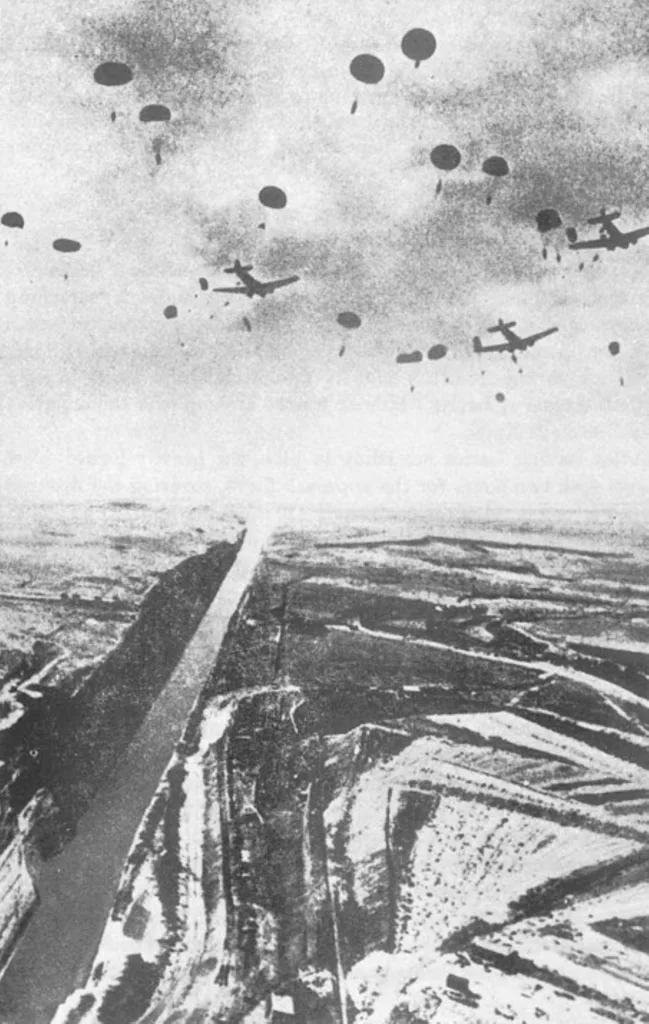
Three Junkers 52 transport aircraft in arrow formation dropping German paratroopers and loads of military equipment over the Corinth Canal on 26 April 1941.
On that day, the German 7th Parachute Division was airlifted from Plovdiv to the captured military airfield at Larissa, which had been selected as a launch base for the upcoming Hannibal operation due to its proximity to the Corinth Isthmus area. The mission of the airborne assault on the canal was assigned to the well-trained 2nd Parachute Regiment under Colonel Alfred Sturm, to which were attached special engineering and combat support detachments. The unit organised two assault groups, each at the reinforced battalion level, and a command group that would be dropped on either bank of the canal.
The total strength of the German assault force was approximately 105 officers and 2,100 soldiers. It was noted that 270 Junkers 52 transport aircraft and about 60 DFS 230 gliders were required for the airborne transport of the German paratroopers and their equipment. The offensive operation would be supported by 20–30 Junkers 87 (Stukas) dive bombers, an unknown number of Junkers 88 fighter-bombers, and 80–100 Messerschmitt Bf 110 fighter aircraft.
The German airborne Operation Hannibal commenced at 06:30 on Sunday, 26 April 1941, when the first Stuka bombers appeared over the Corinth Canal, completely surprising the men of the Commonwealth “Isthmus Detachment,” as they emerged suddenly from the unusual morning fog, flying silently just 30 m above the sea surface. From that moment, a relentless bombing campaign began, targeting artillery and defensive positions. The British gunners returned fire en masse, firing incessantly, but soon many of their guns were rendered inoperable.
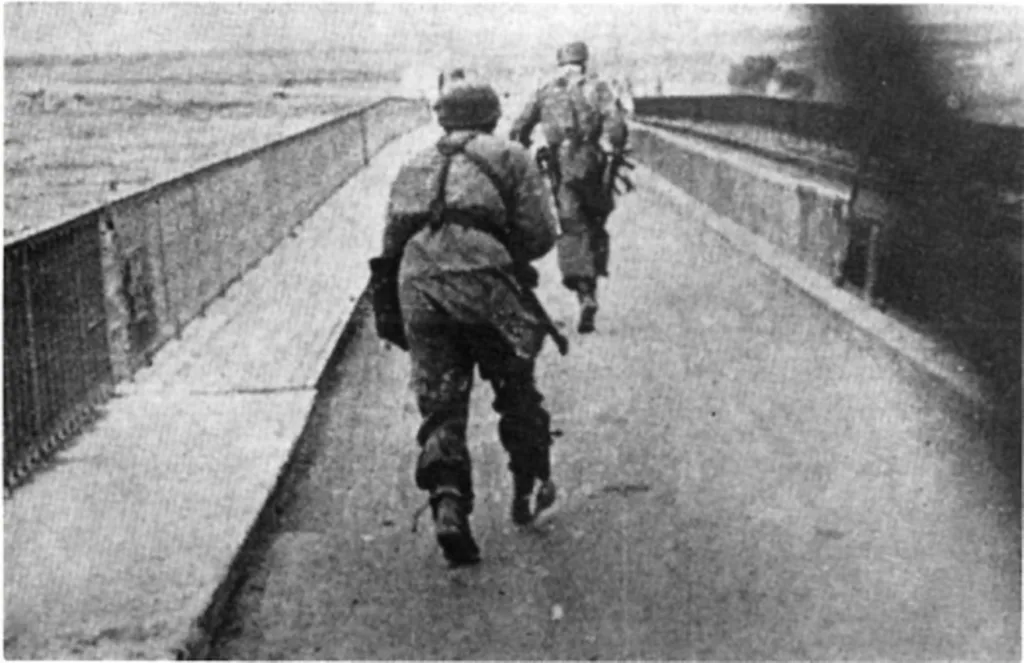
German paratroopers, likely members of an engineering company, capturing the bridge of the Corinth Canal on 26 April 1941.
Around 07:10, six gliders landed near both ends of the bridge, disembarking a German Engineering Section aiming to seize it intact and remove the explosives from its metal framework. Shortly thereafter, around 07:25, the first wave of transport aircraft arrived, delivering the main German assault force to the designated drop zones. Slowing their speed and descending to a height of just 90–100 m, they opened their side doors and began the jumps of the German paratroopers. In the following minutes, the sky above the canal filled with strange coloured “umbrellas,” from which armed fighters and other items hung. The Commonwealth soldiers looked on in shock, having never witnessed such a bizarre sight before.
Suddenly, between 08:00 and 08:30, the bridge over the canal was blown up, and its debris cascaded into the canal, taking with it the German soldiers working on it. According to the official account, the terrible explosion was triggered by two officers of the New Zealand Engineers, who were hidden in a makeshift shelter. Among them, Captain J. P. Phillips aimed with a rifle from a distance of 150 m at the deactivated explosives stacked in the middle of the deck, managing to detonate them with his second shot, assisted by observer Lieutenant J. T. Tyson. In the post-war period, both were awarded the Military Cross for their actions.
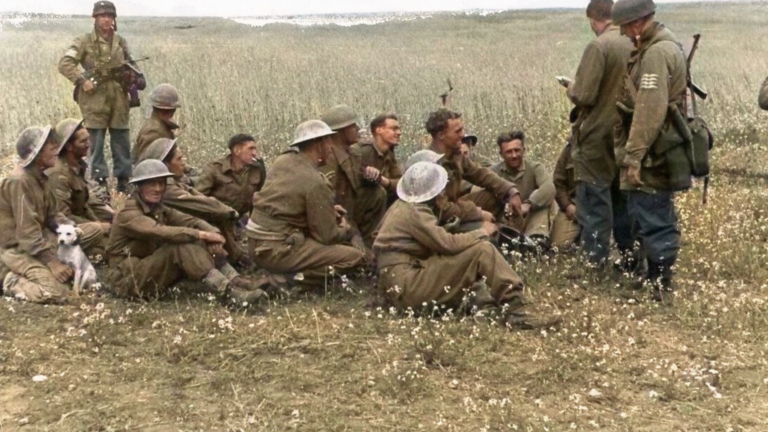
To the east of the blown-up bridge, the soldiers of the Australian A Company were desperately fighting against the German paratroopers of the I Battalion, who were suddenly attacked by the New Zealand B Company. However, due to their numerical superiority, the enemy overwhelmed the stubborn resistance of the ANZACs between 11:00 and 11:30, capturing many prisoners, except for a detachment of New Zealanders who managed to withdraw towards Megara.
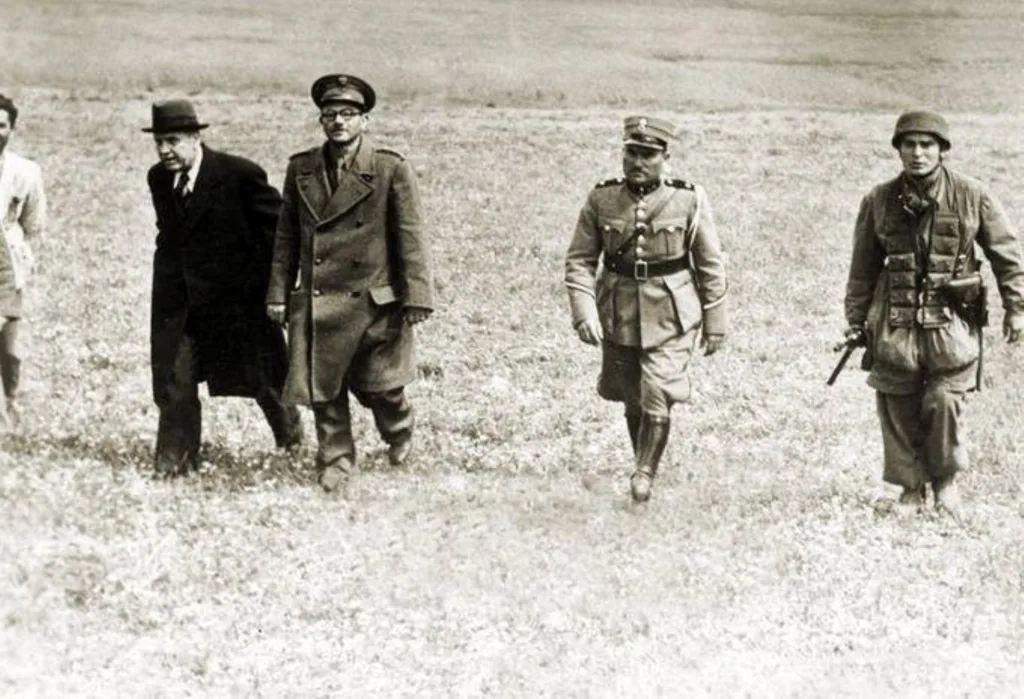
The Mayor of Corinth, Andreas Markellos, with the Greek Commander and a police lieutenant, being led before Colonel Sturm to negotiate the surrender of the city to the German paratroopers on 26 April 1941.
To the west of the canal, the landed companies of the II Parachute Battalion virtually annihilated the British 4th Armoured Hussars, pushing back the sections of the Australian B Company, which managed to partially regroup on a hill north of the village of Examilia, under continuous enemy pressure. During their rapid advance, the Germans swiftly attacked the weakened New Zealand C Troop and the Carrier Platoon of the Māori. Although they fought heroically, the ANZACs were forced to retreat. Along the way, they abandoned the Bren Carrier vehicles after pushing them into a deep ravine to disable them, while most escaped on foot towards Argolis, guided by local Corinthian villagers.
The 6th Field Company mounted a stout defence, locally repelling the German paratroopers. The New Zealand sappers would fight with unmatched bravery until 16:00, when, due to a severe shortage of ammunition, they dispersed into small groups towards the south; unfortunately, many were captured in their escape attempts. Around the same time, the remaining soldiers of the Australian B Company withdrew in the same direction, leaving their occupied positions in the Examilia area.
Earlier, at 13:00, Mayor Andreas Markellos had surrendered Corinth to Colonel Sturm without resistance, under the threat of a devastating bombing of the city by Stuka aircraft.
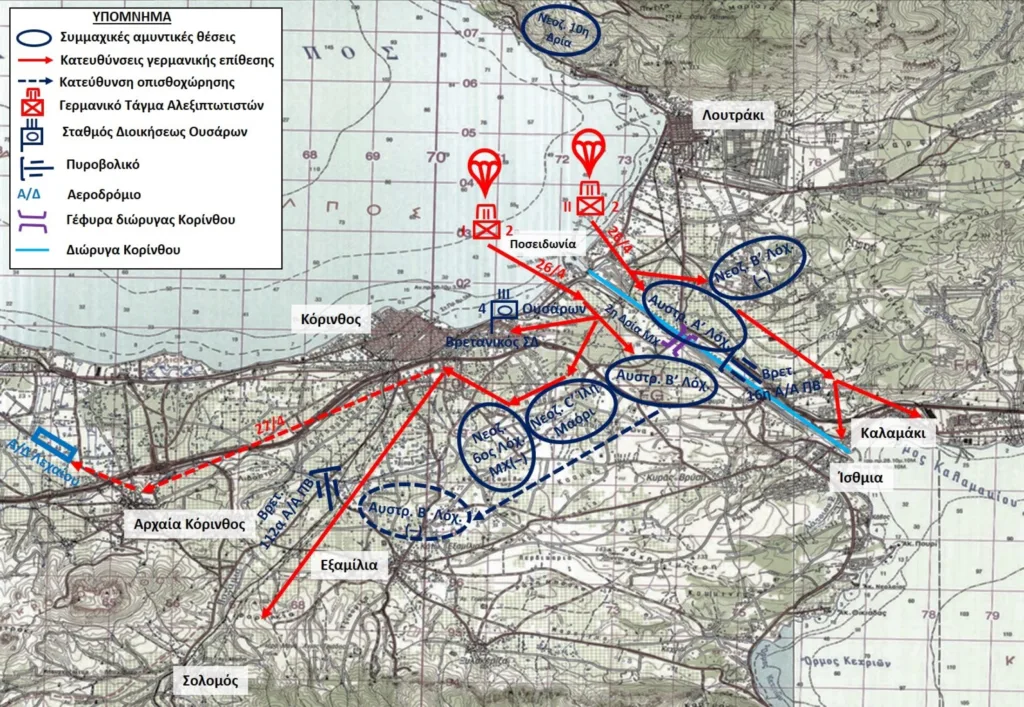
Diagram of the battle of the Corinth Canal, fought on 26–27 April 1941.
The tactical situation changed momentarily when the A and D Companies of the New Zealand 26th Infantry Battalion arrived from Tripoli as reinforcements for the “Isthmus Detachment.” However, their vehicle columns were halted around Solomos, coming under heavy air attack. They continued on foot and eliminated a forward German patrol while moving to the heights north of the village, where they clashed with a strong unit of German paratroopers. Eventually, just before sunset, the two New Zealand companies disengaged from Solomos and returned, realising they had no chance of reaching Corinth and faced the risk of being outflanked by the enemy.
In the eastern sector, the German paratroopers captured the village of Kalamaki after occasional skirmishes with small armed groups of retreating Greek soldiers and built a makeshift pontoon bridge at the southeastern entrance of the canal, using boats, suitable for infantry and light vehicles.
The next day, Saturday, 27 April 1941, the German invaders conducted a sweep of the wider area, overrunning an unidentified ANZAC unit that had remained in the archaeological site of Ancient Corinth after a bloody clash, and subsequently reached the military airfield at Lechaion.