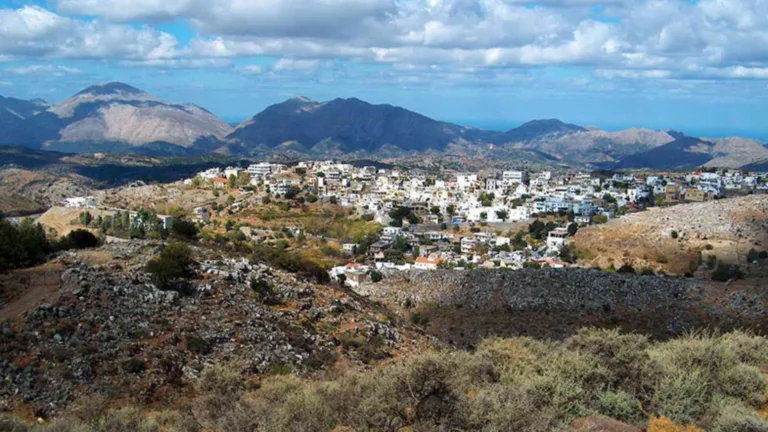
The World Tourism Organisation (UNWTO) has named Anogia, Crete, one of the 55 Best Villages of the World for 2024, recognising it as an Outstanding Destination for Rural Tourism.
According to protothema.com, this accolade highlights the village’s commitment to innovation, sustainability, and preserving its cultural heritage while fostering tourism that supports its community and environment.
Anogia’s Mayor, Socrates Kefalogiannis, emphasized the award’s significance, stating it underscores how rural communities like Anogia are shaping sustainable travel by balancing tradition, development, and biodiversity protection. “The award is for a global initiative through which the Villages where tourism does not become a hindrance to their cultures, their traditions, while investing in sustainable development by providing opportunities and protecting biodiversity are highlighted,” he said.
Selected from over 260 nominations across 60 countries, Anogia was evaluated on nine criteria, including cultural and natural resource preservation, economic and social sustainability, tourism integration, and environmental stewardship. UN Secretary-General Zurab Pololikashvili praised tourism as a tool for empowering rural communities, enabling them to preserve their cultural heritage while fostering sustainable development.
Anogia now joins the global Best Tourism Villages Network, connecting it to 254 rural destinations that share best practices in tourism-driven rural development. The initiative also combats desertification and supports local traditions and community prosperity.
The next evaluation for this prestigious network is set for 2025, offering more rural destinations a chance for global recognition.
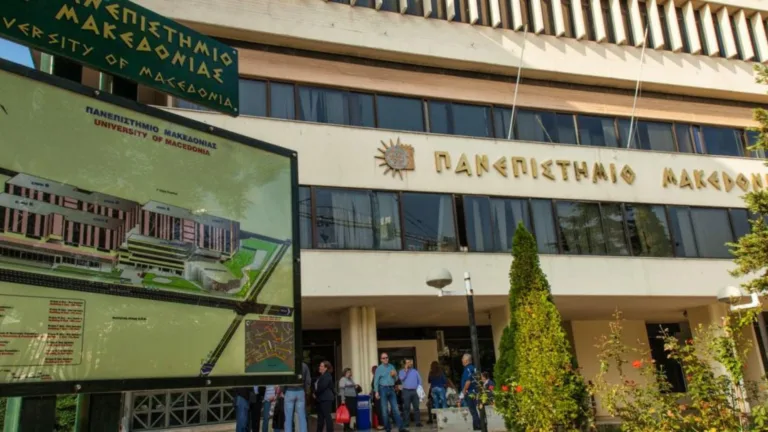
For the first time, Asia Minor studies will have a dedicated role in Greek higher education through a new endowed chair at the University of Macedonia’s Department of Balkan, Slavic, and Oriental Studies.
According to ekathimerini.com, the chair, focusing on Asia Minor—modern-day Anatolia in Turkey—aims to connect Balkan and Middle Eastern research. Professor Dimitris A. Stamatopoulos noted it will address gaps in studying critical events like the Asia Minor Catastrophe (Greek-Turkish War of 1922) and its lasting impact.
Funded by companies like Alumil and Optima Bank, the initiative will delve into the region’s multicultural legacy, including interactions among Greeks, Armenians, Turks, and others. The official launch will take place Friday at Thessaloniki City Council Hall, featuring speeches from the university rector and academics like Helene Glykatzi-Ahrweiler.
The university aims to spotlight Asia Minor’s historical importance and promote interdisciplinary research.
In his seaside workshop on the Greek island of Lesvos, Dimitris Kouvdis preserves ancient pottery-making traditions, earning a place in UNESCO’s National Inventory of Intangible Cultural Heritage.
According to an article by Elias Marcou in ekathimerini.com, Kouvdis, 70, works near Mandamados, a historic pottery hub where traditional methods are disappearing due to industrialization. His family continues to craft pottery using clay from local soil, firing pieces in a traditional kiln fueled by olive pits, and painting them with natural lime.
“It’s an honoUr for me,” Kouvdis said about the UNESCO recognition of his work.
He highlights the challenges facing traditional potters, noting that mechanized presses work ten times faster, making it difficult for artisanal methods to survive. “There’s no continuity. There’s no space for (our) method to continue,” he lamented.
Despite the challenges, Kouvdis remains dedicated to his craft, creating individual pieces in his workshop overlooking the Aegean Sea.
“Above all, it’s a passion – trying to create something that fulfils you,” he said.
Greece, our poor and martyred homeland, the once called “Psorokostena,” the country with successive bankruptcies and unstable party formations, the small and faltering country of the Balkans, managed to compete with itself and surpass it. Despite the fact that the so-called “transition to democracy” by politicians and journalists never took place in Greece, since the same ideological movements continued to influence the country, whilst the same political families continue to play their dominant role before the junta and after, and the same abysmal hatred and toxic climate prevail in political life.
However, broadly speaking, there has been political stability. Among the achievements of the last forty years, there was an economic improvement of the Greek citizen, his Europeanisation, since, normally, the Greek people did not always see their identity as European (and they are right to a point), the development of a social system, which, despite its shortcomings and weaknesses, the social system remains one of the best in Europe. Richer countries, even those related to colonialism, do not have social welfare and progress comparable to Greece. Greek nationals and foreigners, immigrants and new settlers, enjoy a social state welfare that is more generous and humane than the welfare shown in most other countries of Europe. The benefits, the medical health care, hospital health, pharmaceutical care of the state, the benefits, the allowances to the unemployed and needy, the pensions, the provision of free health are comparatively among the best in Europe and certainly in the USA.
Despite the achievements, complaints and protests are not lacking. Many Greeks complain that foreigners, who do not contribute to the national economy, who do not pay taxes, should be treated in the same way as citizens who support the national economy. Many of the complaints are legitimate, but they are assessed differently by legislators and officials within the wider European area. They take into account that these social welfare benefits may seem unfair, but the factor of humanism, solidarity for all those in Greece towards social and cultural integration applies.
And this is happening in Greece and frankly makes us feel proud of the brave stance of the Greek state and its functionaries, revives our national feeling and forms a consciousness of honest dependence.
In Australia – the vast Commonwealth with its bottomless economic powers, with its massive exports of wealth and minerals – the welfare system, despite the abundance of wealth, capital, strong budgets, investment and the availability of sources of financial support, remains with many weaknesses.
Unfortunately, in many parts our Australian social welfare system remains weak, with terrible deficiencies, under-functions, and even hundreds of cases where social welfare is openly grazed as a vector of corruption and mismanagement. Let me explain, with concrete examples, reflecting hundreds of similar cases. I am sure that there is no reader who has not witnessed or been aware of similar cases in his neighbourhood, in his clan, in the place where he lives.
Dimitris happened to be born in Sydney sixty years ago. In the 1970s, when Dimitris was seven years old, his parents returned home to pursue their dreams there, having secured a small fortune with bloody savings and selling their house in Newtown. In Lamia, where they settled, his parents opened a tailor’s shop (his mother was a machinist in Australia) and his father joined the local municipality as a worker. Dimitris and his sisters, when they reached adulthood, left for Athens. There, this little born Australian worked in various companies in Greece, made sure to continue his English, which was almost his mother tongue, started a family and educated his children. Fifty years later he remembered that he had been born in Australia. They were therefore entitled to the relevant old-age pension. He returned to Australia for a few months, sat with his parents’ relatives, and when he was granted the “entitled” pension he took it and returned to Lamia or Athens so that Australian taxpayers’ money could come to him there. Dimitris, who did not work a single day in Australia, who never beat a card for a daily wage, is entitled by the “corrupt” system, because he was born in Australia, to come for a while, get his old-age pension and have a good time in Greece.
Mrs Maria who lives in Melbourne, who worked all her life and paid hundreds of thousands of taxes to the Australian state because her husband was a small businessman and has a car, a house and a caravan for their cottage, Mrs Maria I repeat, passed the relevant test and was disowned by state officials from the public purse, did not give her a pension, because they were “not entitled to a pension.”
Dimitris, who was born in Australia but didn’t offer a dime to the state in taxes to support government spending, enjoys his Australian pension in Greece. Mrs Maria, who paid well for the state and contributed to the national economy, receives pocket money from her husband in order to live. This is not my friends, state corruption, it is a state disaster. Let’s go to a second case.
Dionysis, who worked all his life, and Marianna, his wife, who took her eyes off the needle, managed to buy two houses and a European car, a 2005 model, with bloody savings. This man, Dionysis, paid with his own money, in addition to his taxes, and acquired an insurance fund. Today they both live at the age of 80 in an Adelaide suburb. Neither is entitled to a pension. None of them enjoys the social assistance of the state by granting an old-age pension, because they have, says the legislator, property. Dionysis and Marianna, who are not entitled to a pension, have paid over two million in taxes to the Australian state over the past sixty years.
Mrs Calliope, their neighbor, had taken only four houses with her late husband and had their savings. When her husband passed away, she moved three of the four houses to their children, handed over the car to the grandchildren because she had glaucoma, and the assessment officials of the state came and offered her a generous pension, and in addition $55,000 an annual budget to spend as “old age welfare,” to mow her grass, clean her roof, offered her permission to take the taxi voucher and go where she wants and charge her government bill, to wash and clean her house, to put bars on the stairs, to change the bathroom and toilet…
Marianna, who was honest and declared everything, stayed bottled. Mrs Calliope, who deceived the public sector with the complicity of her children, has it all, even a taxi driver with a hat and gloves… Well done, governors.
*Professor Anastasios M. Tamis taught at Universities in Australia and abroad, was the creator and founding director of the Dardalis Archives of the Hellenic Diaspora and is currently the President of the Australian Institute of Macedonian Studies (AIMS).
Once upon a time, we were all children getting lost in the magic of fairy tales or “paramythia.”
Most of these magical and mythical tales were narrated through the voice of a grandparent or parent, passing on secret wisdoms and dreamlike lessons, all in the pursuit of comforting the listener.
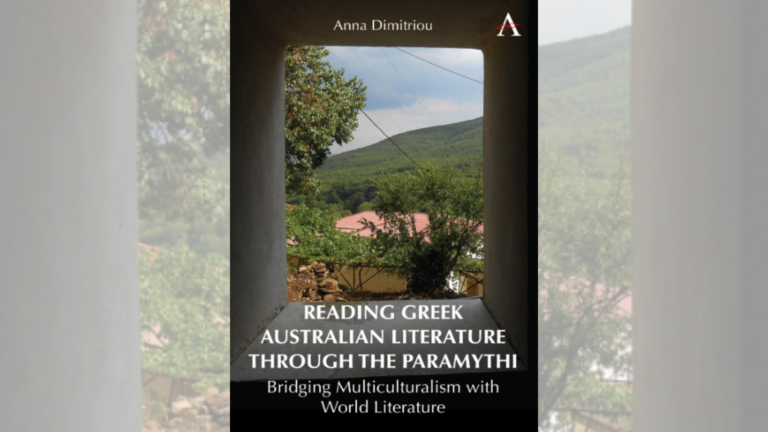
In a dedication to her father – her very own storyteller – author Anna Dimitriou unearths the power of the “paramythic voice” in her most recent title – ‘Reading Greek Australian Literature through the Paramythi – bridging multiculturalism with world literature.’
Immediately, readers are drawn in from the cover of the book, which suggests that the picturesque Greek landscape itself is being observed by Dimitriou through the window of another lens.
Thorough in her approach and observations, she prefaces her comparative textual analysis by diving deep into diasporic transformations and narrative evolutions.
Dimitriou vividly explores how the “paramythic voices” of the past have subconsciously influenced the works of Australian writers of Greek descent including: Antigone Kefala, Dimitris Tsaloumas, Stylianos Charkianakis, Christos Tsiolkas, Dean Kalymnios, Fotini Epanomitis and Helen Koukoutsis.
“Cultural otherness” and the migrant experience remain important themes throughout, where a dual focus helps to exemplify the role of multiculturalism in the authors’ attempts to transcend national scales with their literature, whether written in Greek, English, or a mix of both.
From Kefala’s memory-bound “culturally induced dyslexia” to Kalymnios’ paradoxical works that “read like a puzzle,” Dimitriou intricately examines how each author has drawn inspiration from the tropes of the oral paramythi in both traditional and non-traditional forms.
Each chapter’s title either foreshadows an author’s battle with cultural identity and religion, or a seemingly “untranslatable” inevitably ambivalent development – ‘Dimitris Tsaloumas – Visionary Poet or Disillusioned exile?’
Tsiolkas’ gothic novel ‘Dead Europe,’ and Epanomitis’ ‘The Mule’s Foal,’ Dimitriou notes, embody a similar “paramythic presence” between their use of “exotic” and “impure” elements of the paramythi, signifying the relevance of the “Greek version of ‘vernacular cosmopolitanism’.”
Interweaving actual poems and stories from the authors, not only assists in balancing the concise presentation of her academic research, it steadily satisfies the bibliophile in all of us. Compelling readers through constant reflections and explorative methods, Dimitriou doesn’t miss a detail as she meticulously delivers the underlying elements, “transmitted rhythms” and intended literary techniques deployed by all of the authors within their varying texts.
She sways between an investigative and philosophical tone, using her own library of thoughts in conjunction with scholarly references, enlightening readers to the “paramythic experience – when vivid stories enable dreams and wishes to become a ‘real’ possibility.”
“Silenced histories” that reside within the “neglected corpus” of Greek Australian literature are re-awakened and unmuted through Dimitriou’s avid interpretations of subversive styles including “irony,” “carnivalesque” and “transgression.” Adding to the volume of her research, post-cultural writers like Sneja Gunew and Stuart Hall have also been incorporated alongside scholars of Greek and world literature as points of reference, helping to capture the synchronicity and accuracy of her findings.
It is Emily Apter’s “untranslatability” however, that is key to Dimitriou’s eloquent depiction of the authors’ relationship with Europe and their ability to reach global audiences despite their experiences of either “inclusion” or “exclusion.”
A special spotlight is placed on each authors’ multicultural journey, where for some, their background has imprisoned them in feelings of exile and isolation, and for others, serviced in freeing them from unbearable trauma. “The paramythi is an indicator of ‘foreignness’ and is also the common denominator among all seven writers,” Dimitriou discovers, which, coincidentally helps them find somewhere to belong.
Ultimately, readers are inspired to revisit the spiritual shelves of their own generational roots in order to ensure a patient, authentic revelation of self.
Despite the differences it might have to our current reality, the paramythi’s polyphonic purpose appears to be never-ending, like a bookmark placed in both the past and present, reminding us of how far we have come.
Perhaps, the paramythi itself is the hero of everyone’s story, giving us space to dream and create, to heal and to hope. Perhaps it isn’t myth at all when they say, irrespective of the trials and tribulations faced, “Kαι έζησαν αυτοί καλά και εμείς καλύτερα.”
Tension is mounting among many members of the Greek diaspora in Australia as the final deadline of 30 November 2024 for registering properties with the Hellenic Cadastre approaches. The countdown now stands at just over one week.
Numerous Greek expatriates living in Australia are expressing concerns over the possibility of losing their properties in Greece if they fail to complete the required procedures in time. The Greek Herald has received several calls from its readers, highlighting this critical issue and noting a lack of sufficient information about the upcoming deadline.
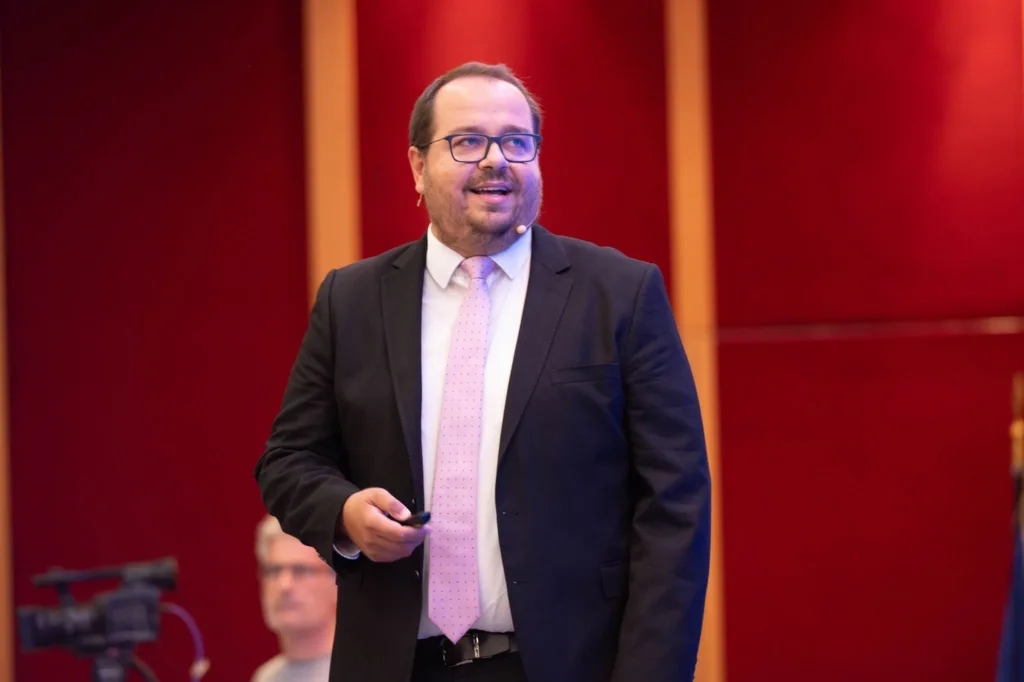
Prompted by the concerns of our readers, The Greek Herald secured an exclusive interview with Stelios Sakaretsios, President of the Hellenic Cadastre, who readily agreed to address our questions.
Mr Sakaretsios discusses the necessary steps property owners need to take, debunks rumours of property loss, stresses the importance of timely compliance, and rules out the possibility of extending the deadline. Additionally, he acknowledges that communication with Greeks living abroad could have been more effective and outlines the measures that have been implemented to simplify the registration process.
Stelios Sakaretsios, President of the Hellenic Cadastre.
In recent days, we have received numerous calls from concerned expatriates who have only just learned that November 30 is the final deadline to register their properties or land with the Hellenic Cadastre. Many are worried they will lose their property in Greece if they fail to register in time. Is such a scenario possible?
First of all, I would like to assure all expatriates that it is not our intention for anyone to lose their property. On the contrary, our goal is to protect it and safeguard their rights. Participation in the Hellenic Cadastre process is crucial to ensure the protection of each owner’s property.
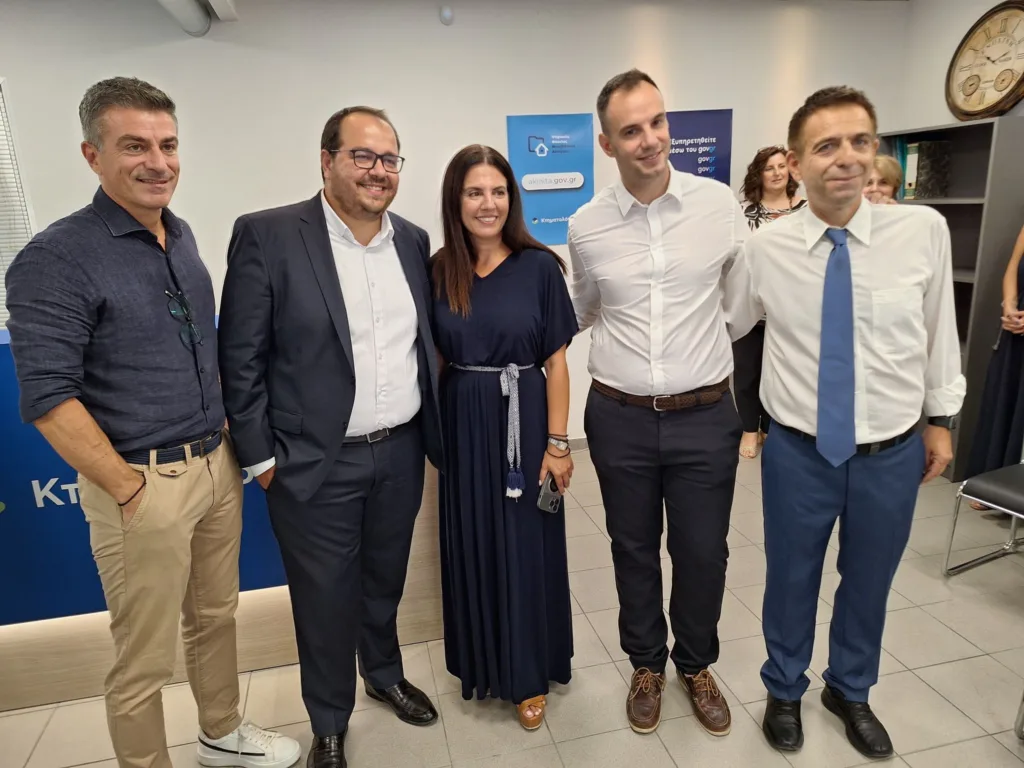
We understand that, especially for those living abroad, gathering the necessary documentation can be time-consuming. For this reason, in areas such as Corfu, Thesprotia, and Crete, where participation has been lower, we have activated a new digital tool available at https://dilosi.ktimatologio.gr. Using this platform, property owners can simply start their application by November 30 and be granted additional time to complete it.
Furthermore, the government, through a recent legislative initiative by the Ministry of Digital Governance, has established procedures that allow for the declaration of rights even after the completion of the cadastral process, as well as the correction of errors in most cases.
However, I would like to emphasise the importance of participating now. We have seen cases where, due to inactivity, neighbours or third parties attempted to claim properties that did not belong to them. Timely registration is the best shield of protection for your property. Therefore, we urge everyone to participate in this process to secure their rights.
Could a special extension be granted for Greeks living abroad, and if so, under what conditions?
I know from personal experience that Greeks abroad, particularly those in Australia, honour and cherish their homeland in a unique way, even while living far from Greece’s daily realities. We fully understand that the distance and different life priorities may have prevented many from taking steps to register their property with the Cadastre.
Throughout the various phases of this project, multiple extensions have been granted to complete the process, and from the outset, expatriates were given more time than residents of Greece. At present, there is no provision for yet another extension.
However, as I mentioned earlier, unlike in the past, we now have the legislative and technological tools to ensure that even after November 30, property owners will have opportunities to protect their assets. Procedures are in place for the declaration of rights even after the completion of the cadastral process, as well as extrajudicial mechanisms for correcting errors. These options, however, are subject to specific conditions, as outlined earlier.
While immediate participation remains the best course of action, I want to reassure everyone that the state has taken measures to protect the rights of Greek expatriates even after the deadline, under the terms already established.
The public awareness campaign in Greece lasted for many years, with continuous updates provided to citizens. Although you are relatively new to this vital role, do you believe there was a similar campaign abroad? For example, The Greek Herald did not receive material from consulates or the Embassy in recent years.
I would like to clarify that our communication strategy does not include the distribution of printed materials through consulates or embassies. Due to limited resources and the need for their most effective utilisation, we have prioritised digital platforms and social media, which allow us to communicate more swiftly, accurately, and to a broader audience.
While this approach has proven effective in most cases, we acknowledge that there is room for improvement, particularly regarding informing Greeks abroad. For 2025, when we will initiate new actions to raise awareness about procedures for correcting errors and additional features of the Cadastre, we plan to expand our strategy to include traditional communication channels.
What should our compatriots in Australia do now to avoid the hassle and, even at the last minute, manage to register their property with the Land Registry? Is there a list of deadlines by region available anywhere? Some of our readers mentioned that the deadlines by region weren’t very clear.
They should immediately take the necessary steps to register their property with the Land Registry. The first and most important step is to visit the platform https://dilosi.ktimatologio.gr, and if it’s not possible to complete the process fully by November 30, they should at least begin an application. This will allow them to secure additional time to complete the process, in accordance with the law’s provisions.
As for the deadlines by region, detailed information is provided through two official sources:
Immediate action is crucial to secure property rights, and we urge all property owners to utilise the available tools and information provided. The state has made all necessary resources available to facilitate this important process.
We have also received some calls mentioning that IP addresses from abroad were being blocked. Additionally, many of our older compatriots are struggling with new technology. Do they have an alternative?
We understand the concerns being raised, particularly regarding the challenges faced by our older citizens or those who are not familiar with using technology. However, I would like to clarify that the submission of declarations can only be done via the digital platform, and there is no option for in-person submissions.
To facilitate all citizens, we have developed user-friendly digital tools, such as the platform https://dilosi.ktimatologio.gr, which is designed to be simple and intuitive. If some older property owners are struggling to use it, we recommend seeking help from family members, friends, or others in their community who can support them through the process.
Regarding IP addresses, there is no block for users from abroad. If some have encountered such issues, they were likely related to temporary technical problems, which have already been resolved.
The Prime Minister recently mentioned that the Land Registry will be completed by the end of 2025. Do you believe this will be achievable by that specific date, and are you satisfied with the pace of the process?
After three decades of efforts, the Land Registry, a milestone project of national importance, is now on track for completion. The Prime Minister’s commitment to completing it by the end of 2025 is entirely realistic, and we are working with determination to make it a reality.
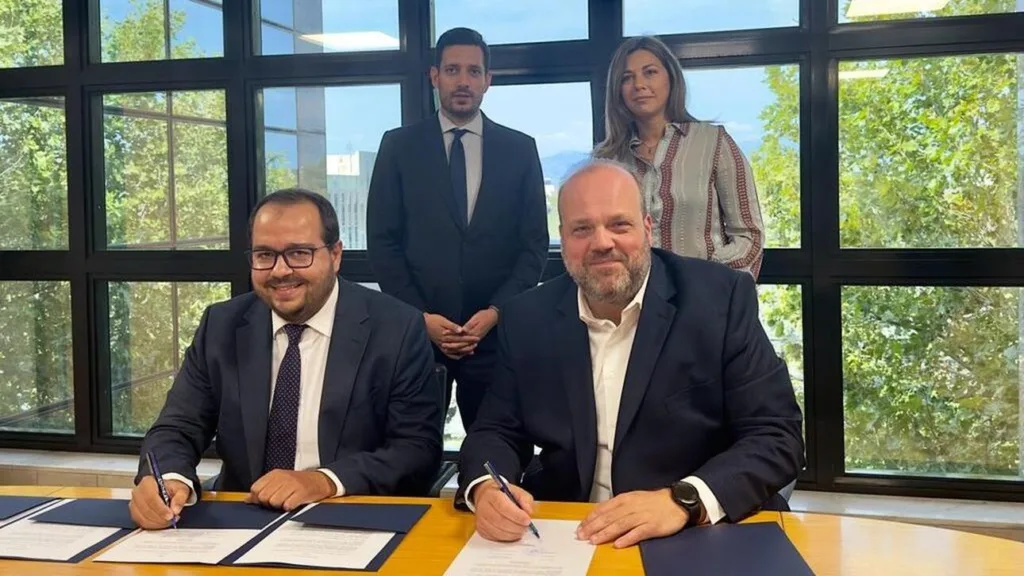
When last year, the Deputy Minister of Digital Governance, Konstantinos Kyranakis, took on the Land Registry project and I, together with Olympia Markellou, the General Director of the Land Registry, took over the management of the organisation, the registration completion rate was only at 39%. In less than a year, thanks to targeted acceleration initiatives we implemented, this percentage rose to 52%. By the end of January 2024, it will reach 75%, and by the end of 2025, we will have completed the Land Registry across the entire country.
Completing the Land Registry is not just an administrative achievement. It is the protection of property rights for every Greek citizen, the simplification of real estate transactions, and the assurance of transparency in one of the most important aspects of economic life. This project will provide a developmental boost to the country, strengthen confidence in the real estate market, and improve the daily lives of citizens.
With enthusiasm, commitment, and the dedication of a team working methodically, we are confident that our country will have a fully integrated Land Registry by 2025. This is not just a goal; it is a historic step that will shape a new reality for Greece.
“Do you consider Kythera to be just a small rocky island off the coast of Cape Malea?”
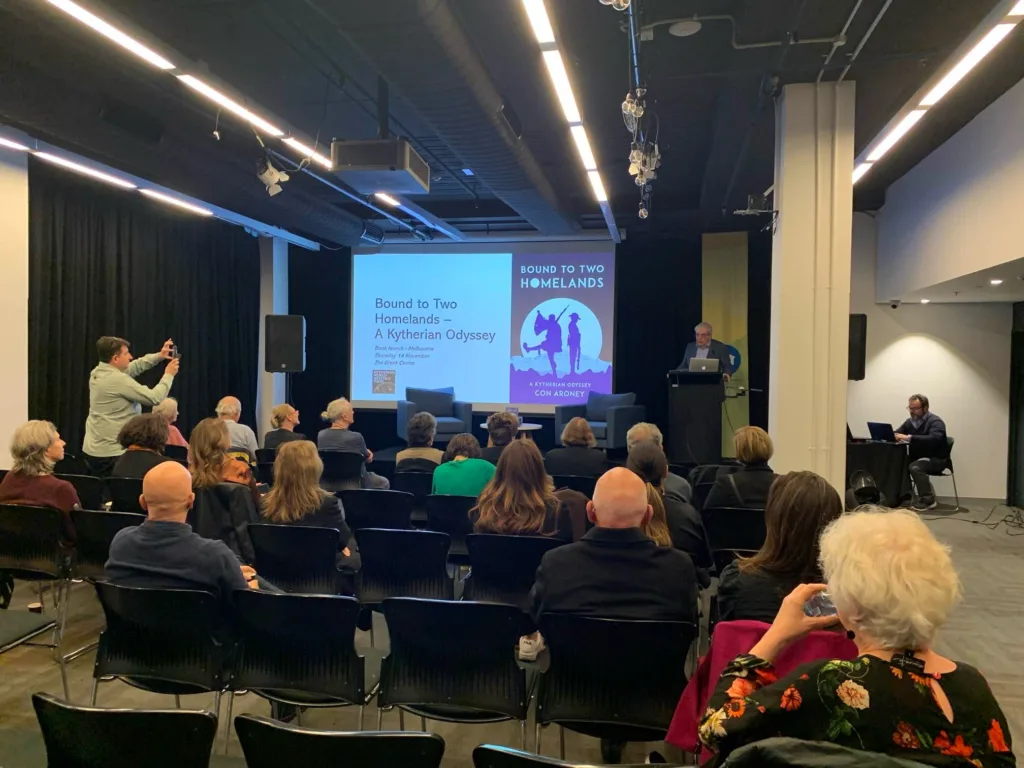
This was the opening question posed by author, Associate Professor Con Aroney, to captivated audiences last week in both Canberra and Melbourne who had come along for the launch of his second historical novel, Bound to Two Homelands – A Kytherian Odyssey.
By the end of the evening, this question had been emphatically answered – Kythera is much more than a rocky outpost, it is an incredible island that has produced brave and resilient people with a revolutionary spirit, including two of its outstanding sons on which the book is based.
In the book, Dr Aroney, an interventional cardiologist and cardiac research scientist who is also a keen historian and loves to research and write, captures the extraordinary lives of two Kytherian immigrants – one the author’s paternal grandfather, Peter Aroney MBE, who fought bravely for his homeland and the other Constantine Aroney BEM, the only Kytherian-born dual ANZAC having fought in both world wars, including at Gallipoli, Greece and Crete for which he was awarded the British Empire Medal.
Dr Aroney plans on launching Bound to Two Homelands on Kythera in early June 2025, which can be described as a ‘nostos’ of his own to bring the poignant story of his grandfather, Peter Aroney, and Peter’s childhood friend, Constantine Aroney, full circle.
Presentation in Canberra.
Audience members were riveted by the author’s presentation and depiction of life on Kythera and Australia in the early 20th century, and amazed by the fact Kythera ‘broke-away’ from Greece in 1917, and established the Autonomous Administration of Kythera to declare war on the Axis Powers, and the role Peter Aroney played in not only the ‘revolution,’ but also his pivotal role in the establishment of AHEPA in Australia.
The Canberra launch was held at the Hellenic Club in Woden on November 13 in conjunction with the Kytherian Association of Canberra and Districts, with a number of esteemed guests including the Ambassador of Greece to Australia, Stavros Venizelos; the High Commissioner of the Republic of Cyprus to Australia, Antonis Sammoutis; AHEPA Australia’s Supreme President Sophia Notaras; the former Chief of the Australian Defence Force, Admiral Chris Barrie AC; ACT Liberal politician and Member for Ginninderra, the Hon. Peter Cain; President of the Kytherian Association of Canberra and Districts, Fotis Samios; and the KWHF committee comprising Matina Zervos, George Vardas and Barbara Zantiotis.
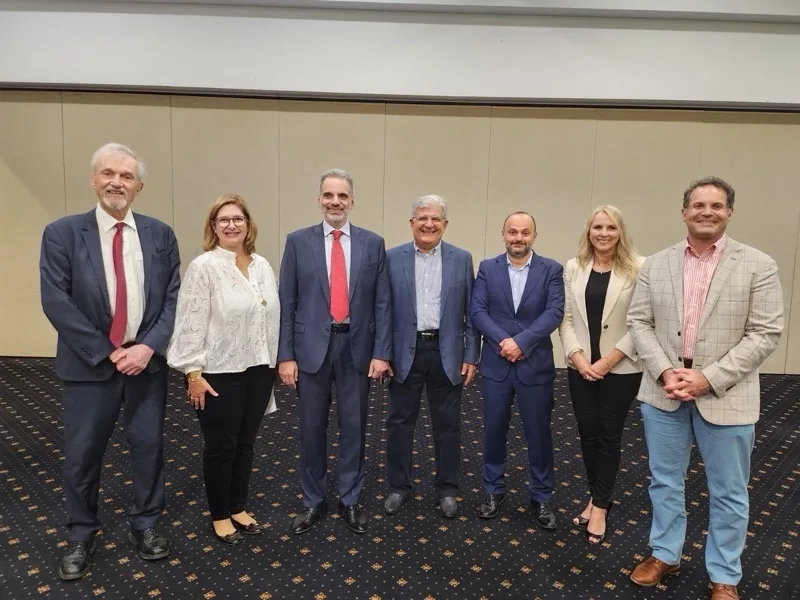
L-R: George Vardas, Matina Zervos, Ambassador Stavros Venizelos, Michael Mekanikos, High Commissioner Antonis Sammoutis, Barbara Zantiotis and Fotis Samios.
Mr Samios welcomed guests and attendees and shared how much he enjoyed Bound to Two Homelands and the emotional effect it had on him, especially reading it on Kythera. Following Mr Samios, the emcee for the evening, Ms Zervos, chair of the KWHF committee and who was involved in editing the book, introduced the publishing project, and invited Admiral Barrie, who wrote the foreword, to share his thoughts.
Admiral Barrie described how, as a Kytherian (through marriage), a military man and someone who left home at an early age to seek his future, he identified with these characters and encouraged the audience to “buy this book” as it’s a great story, and as he wrote in the foreword ‘an indomitable spirit shines through in the narrative… I hope this book finds its place in people’s hearts.”
Finally, Professor Aroney took to the lectern and presented this story of bravery, pathos, enduring love and tragedy to an enthralled audience. The discussion explored how Dr Aroney’s years of research wove actual historical events, archival records and documentary evidence together with the author’s imagination to bring to life the extraordinary lives of these courageous souls.
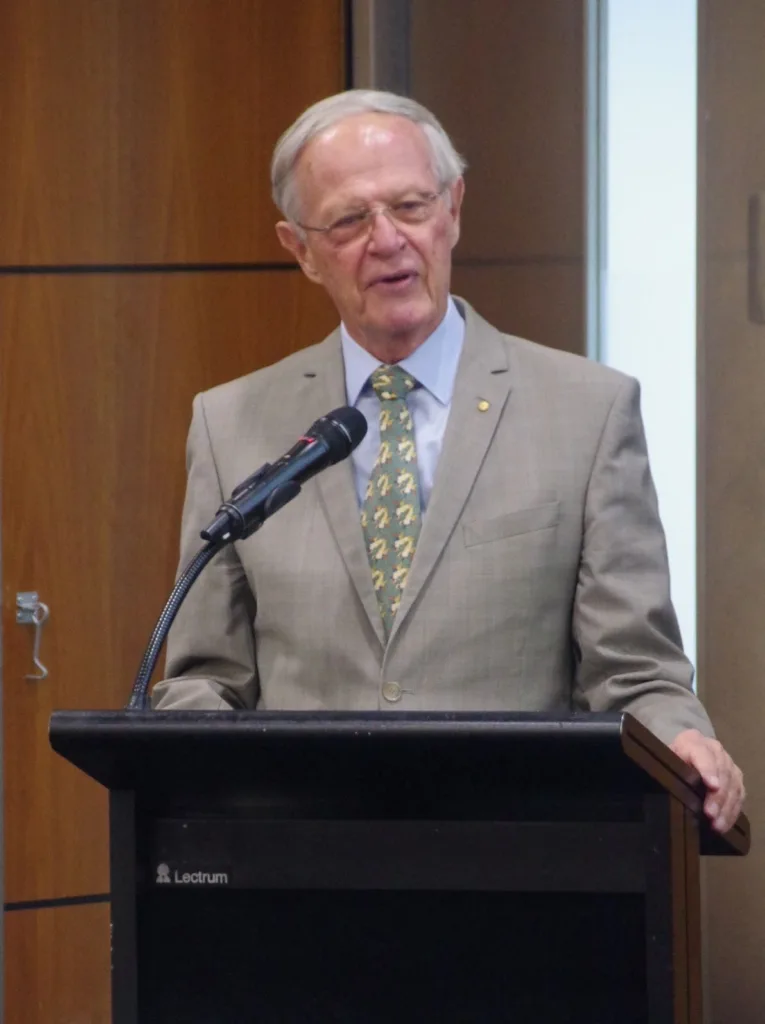
Admiral Chris Barrie AC (Retd).
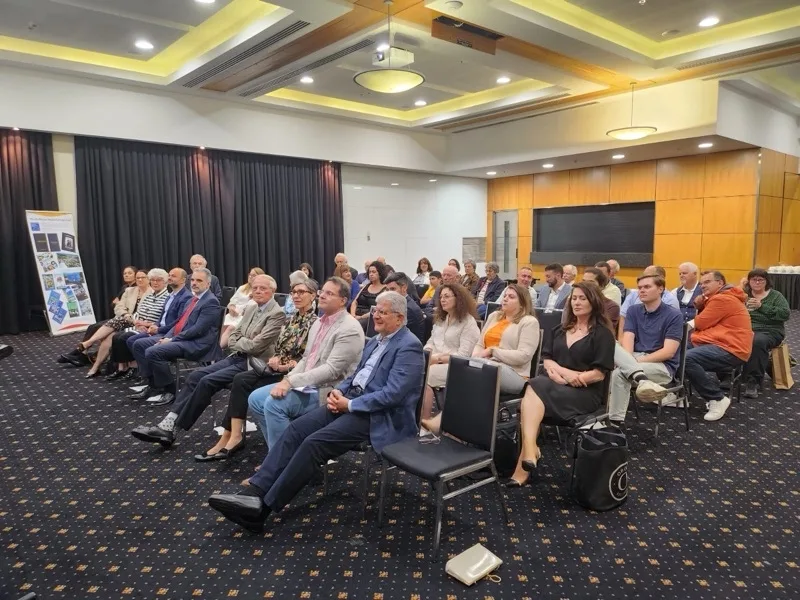
Dr Aroney, his wife Trish, and Ms Zervos travelled to Melbourne the next day to host the final event of the Australian book tour. Held at The Greek Centre on Lonsdale Street, the intimate evening was co-hosted with the Greek Community of Melbourne.
A contingent of the small Melbourne-Kytherian community was in attendance, which was a delightful surprise considering the vast majority of the Kytherian diaspora settled in New South Wales and Queensland.
Ms Zervos was again emcee and welcomed special guests including the leader of the Kytherian Society of Melbourne, Dr Melina Mallos; Greek Community of Melbourne Board Member and Hellenic Chair at the University of Melbourne, Dr Nick Dallas, and Kalie Zervos, of the Kytherian Genealogy Project by Amalia & Kalie, the forerunners of Kytherian family history worldwide, whose research into Constantine Aroney spurred the KWHF’s involvement in publishing Bound to Two Homelands.
Ms Zervos and Amalia Samios also featured in Dr Aroney’s presentation as they had been invited earlier in the year to a graveside flag raising ceremony at Brighton Cemetery, Melbourne as part of ANZAC Day commemorations.
“It is particularly moving to be in Melbourne, the city Constantine Aroney emigrated to, he lived in and died in, sadly in obscurity” explained Ms Zervos in her introduction.
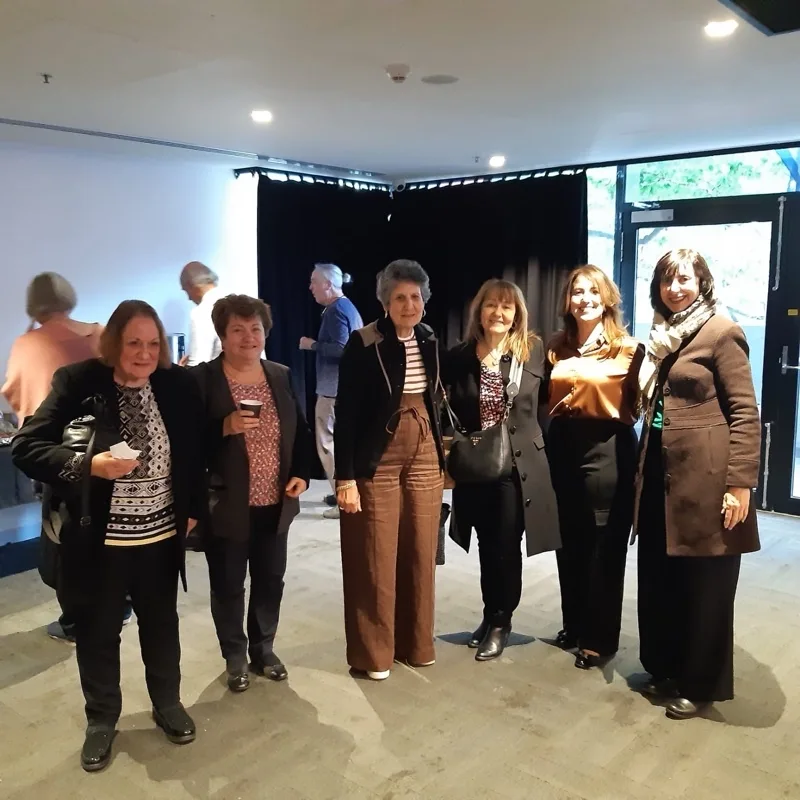
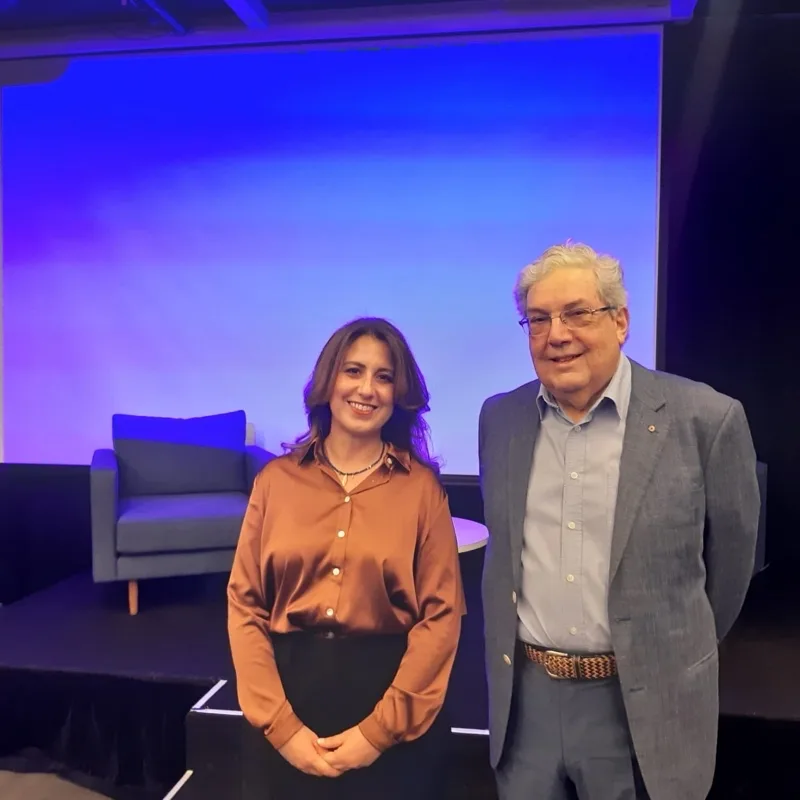
Members of Melbourne Kytherian Community and Kalie Zervos.Dr Melina Mallos and Associate Professor Con Aroney.Con Aroney presenting.
Dr Aroney presented and then Dr Dallas facilitated a Q&A with the author and the audience. An engrossing discussion ensued as audience members shared fascinating and thought-provoking questions ranging from whether Constantine Aroney engaged in the burgeoning Greek community when he first arrived, to Greek identity and how to keep the language alive in future generations.
Dr Dallas gave the vote of thanks and the evening closed with the serving of refreshments, lots of mingling and the author personally signing all copies sold.
Bound to Two Homelands is a compelling read and captures the essence of two great Kytherian lives, the role they played in securing a better future for subsequent generations, and is a testimony to the immigrants who transformed Australia in the 20th century.
Bound to Two Homelands – A Kytherian Odyssey is also available for purchase at: https://shorturl.at/2NztY
Giannis Antetokounmpo has stepped into the world of film production. The Greek basketball superstar, already known for his ventures in energy drinks, vineyards, and wineries, is now adding cinema to his business repertoire.
According to protothema.com, his production company, Improbable Media, has co-produced its first feature film in collaboration with Studio Galazio, an international film production studio.
Titled Mykonos, the film is a heist comedy set on the iconic Greek island. It tells the story of a quirky group of noble thieves who target arrogant tourists disrupting the island’s tranquility every summer.
Filming for the project, which highlights a distinctly Greek cultural element, has recently been completed.
The cast features a mix of international and Greek actors. Rising star Klelia Andriolatou (Netflix’s Maestro in Blue) leads the ensemble, joined by Riccardo Scamarcio (John Wick 2), Andrew Georgiades, Vito Schnabel (The Trainer), and Julia Fox (Uncut Gems) in major roles. Other cast members include Panos Koronis (The Lost Daughter), Makis Papadimitriou (Suntan), Giorgos Pyrpassopoulos (Crimes of the Future), Maria Kavoyianni (Maestro in Blue), Alan Asaad (Black Mirror), and Christos Passalis (Dogtooth).
A single-family home on Dionysiou Areopagitou Street, directly across from the Acropolis and near the entrance of the Odeon of Herodes Atticus, appeared to be on the market for €300 million on Wednesday morning.
According to an article of Elias Bellos in ekathimerini.com this price made it the most expensive residence in Greece and one of the priciest worldwide, both in total value and price per square meter.
The 3,300 m² property, notable for its distinctive architectural style, was built by the late Elias Barbalias, founder of the company Elias G. Barbalias – Special Construction & Real Estate Development. The property remains under the ownership of his family.
The home, which boasts a prime location with views of the Acropolis, was marketed by specialized real estate firms targeting both domestic and international buyers. However, as reported by ekathimerini.com, soon after the listing was made public, the owners firmly denied authorizing the sale of the residence, reportedly considering legal action against the real estate agencies that posted the sale listing for the property, according to information shared with Kathimerini.
The advertisement appeared, on prominent real estate websites in Greece and internationally, including jamesedition.com and the Metro One Real Estate site. However, the listing has since been removed.
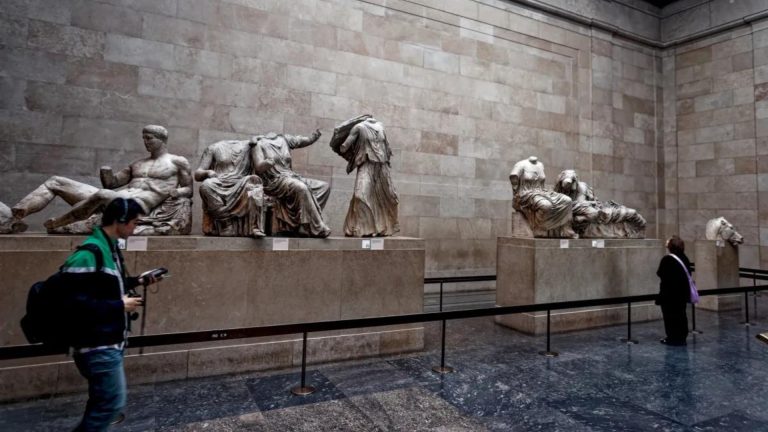
The long-standing dispute over the Parthenon Sculptures, also known as the Elgin Marbles, may see significant progress by 2025, according to The Economist.
Removed from Greece’s Parthenon in the early 19th century by Lord Elgin, the sculptures have been housed in the British Museum since 1816. Greece, accusing Elgin of theft, has repeatedly called for their return, but efforts have stalled for decades.
According to ekathimerini.com, recent developments suggest a shift. Public opinion in Britain is now leaning toward repatriation, with a 2023 poll showing 49% in favor. The British Museum’s credibility has also been shaken by a scandal involving the theft of thousands of antiquities by its staff.
Institutionally, British Museum leaders, including chair George Osborne, have expressed openness to a long-term loan arrangement with Greece, potentially involving artifact exchanges. While UK law prohibits permanent transfer, loans provide a possible solution.
Although Greece insists on full ownership, temporary agreements—such as a 2022 loan of a marble fragment from a Sicilian museum—offer a precedent. Politically, UK Prime Minister Keir Starmer has indicated he wouldn’t oppose progress on the issue.
As The Economist notes, “The marbles may finally be on the move—or at least, negotiations about their status might take a big step forward.”