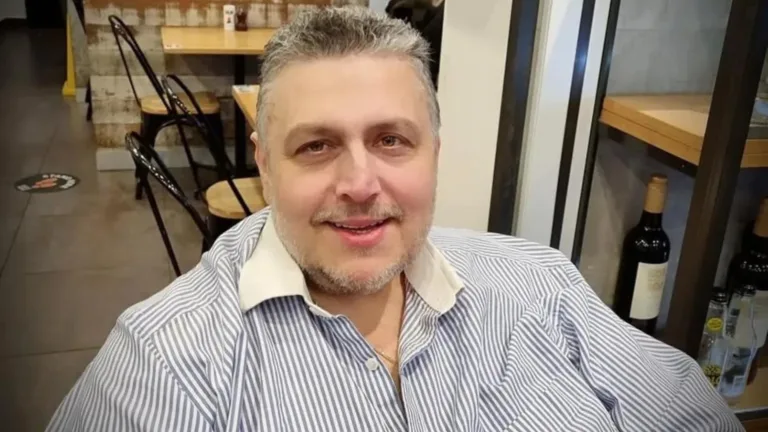
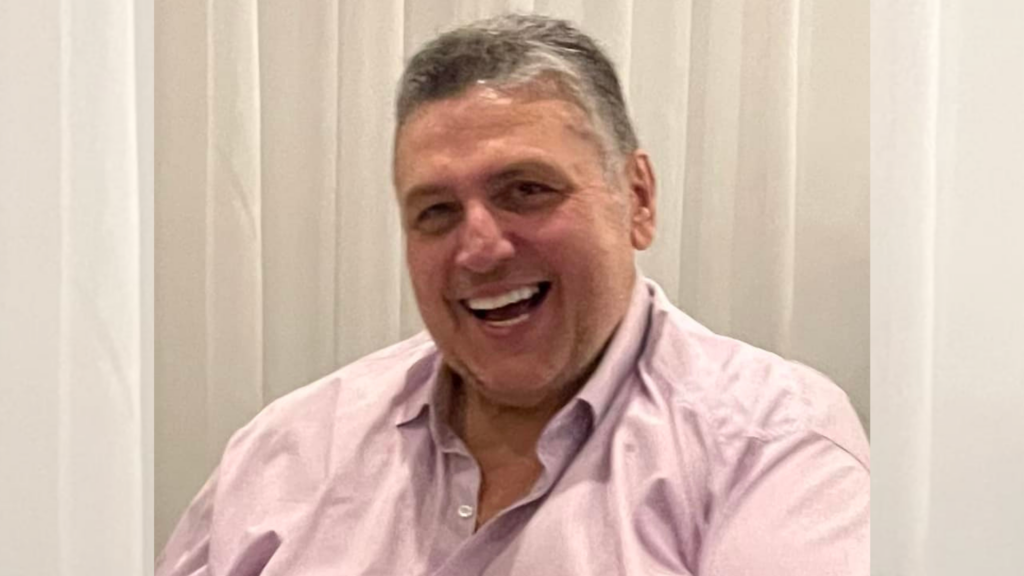
Leonidas Varagiannis, 21, a US citizen living in Thessaloniki and known online as “War,” has been arrested in Greece for his alleged role in a global child exploitation ring linked to the extremist group “764.”
According to an affidavit unsealed in the District of Columbia, Varagiannis and co-defendant Prasan Nepal, 20, of North Carolina, ran a criminal enterprise exploiting children online. Nepal was arrested in the US on April 22. Varagiannis was taken into custody in Greece yesterday, April 30.
The 764 network, described by authorities as a nihilistic violent extremist (NVE) group, aims to destabilise society by targeting vulnerable populations, including minors, with disturbing acts of abuse.
The group’s accelerationist ideology promotes social collapse and the destruction of governments, including that of the United States.
“These defendants are accused of orchestrating one of the most heinous online child exploitation enterprises we have ever encountered — a network built on terror, abuse, and the deliberate targeting of children,” said Attorney General Pamela Bondi.
The Justice Department alleges Varagiannis was a core leader of a subgroup called “764 Inferno,” which used encrypted platforms to direct, produce, and distribute child sexual abuse material (CSAM).
The affidavit details how Varagiannis and others coerced minors into creating graphic content, often involving self-harm, extreme violence, and psychological torment.
Victims were reportedly forced to carve symbols into their bodies, perform sexual acts, and endure escalating abuse under threats.
FBI Director Kash Patel said, “The FBI and our partners are determined to protect juveniles from predators, and we will track down and hold accountable those who engage in these criminal activities.”
Authorities say the network created digital “Lorebooks” from CSAM and violent material, which were traded within the 764 group as a form of currency and used to recruit or elevate members.
Varagiannis also allegedly instructed others in grooming techniques and demanded specific content from new recruits.
US Attorney Edward R Martin Jr. called the case “every parent’s nightmare,” noting the “staggering” scale of abuse and number of victims—at least eight minors, some as young as 13, across multiple jurisdictions.
If convicted, Varagiannis faces a maximum sentence of life in prison.
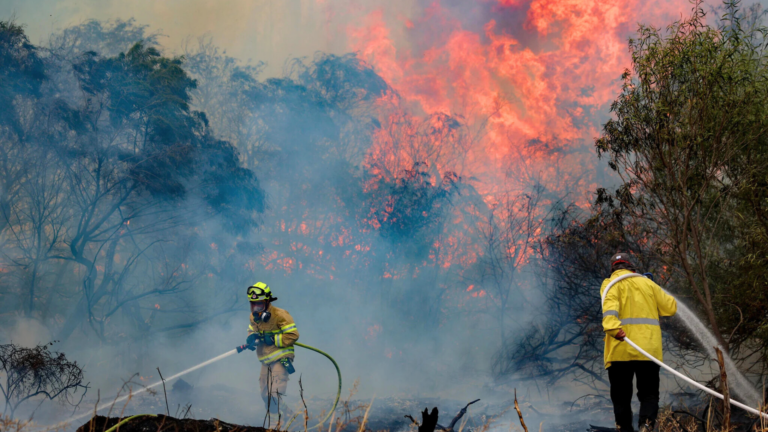
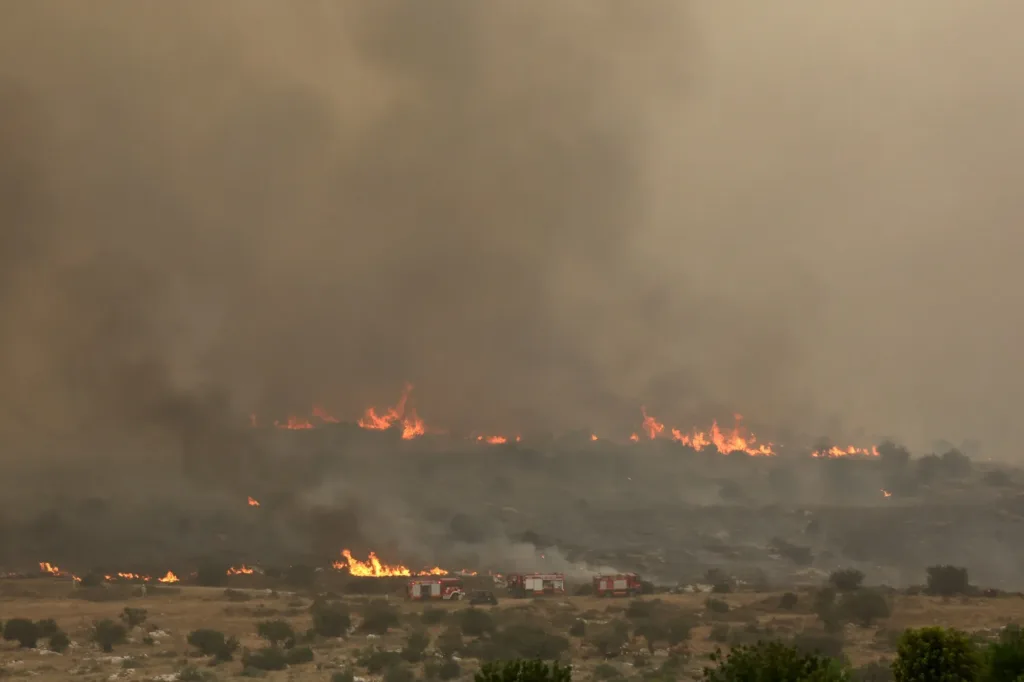
Wildfires swept through the outskirts of Jerusalem on Wednesday, April 30, forcing the evacuation of three communities, injuring at least 13 people, and prompting Israel to appeal for international assistance — including from Greece — as flames spread rapidly due to strong winds.
Fires ignited near the Eshtaol Forest and along the main Route 1 highway between Jerusalem and Tel Aviv, where people were seen abandoning vehicles as thick smoke engulfed the area. Authorities closed the highway and urged the public to avoid the region.
Prime Minister Benjamin Netanyahu confirmed that firefighting aircraft from Italy and Croatia are expected to assist, while Israel has formally requested aid from Greece, Cyprus, and Bulgaria. International assistance is not expected to arrive until Thursday morning.
“By order of Deputy Prime Minister and Minister of Defence Ivan Anušić, a Canadair CL-415 aircraft from the Croatian Air Force with two crews, a total of 11 members of the Croatian Armed Forces, will be sent to the State of Israel to assist in extinguishing the fire,” Croatia’s Defence Ministry stated.
Photo: Ahmad Gharabli / AFP / Getty Images.
Cyprus is expected to send aid first, with Spain and France also pledging aircraft to support efforts. Foreign Minister Gideon Sa’ar has contacted several European and global counterparts — including officials from the UK, France, Czech Republic, Sweden, Spain, and Argentina — to seek further assistance.
Israel deployed 119 fire crews, 10 aircraft, and one helicopter to fight the blaze. Military search and rescue units, including the Israel Air Force and Unit 669, are on standby. Rescue teams pulled nine people from smoke-filled vehicles; three cars were reported burning with no one trapped inside.
The wildfire broke out on Israel’s Memorial Day for fallen soldiers, prompting the cancellation of numerous ceremonies, including the main Independence Day event in Jerusalem. A Remembrance Day ceremony at the Latrun memorial site was also stopped as police cleared the area.
The blaze comes one week after another wildfire scorched approximately 10,000 dunams (2,470 acres) of nearby forest. Firefighting teams from the KKL-JNF are working to prevent the current fire from reaching local settlements.
Prime Minister Netanyahu is reportedly en route to assess the situation as emergency operations continue.
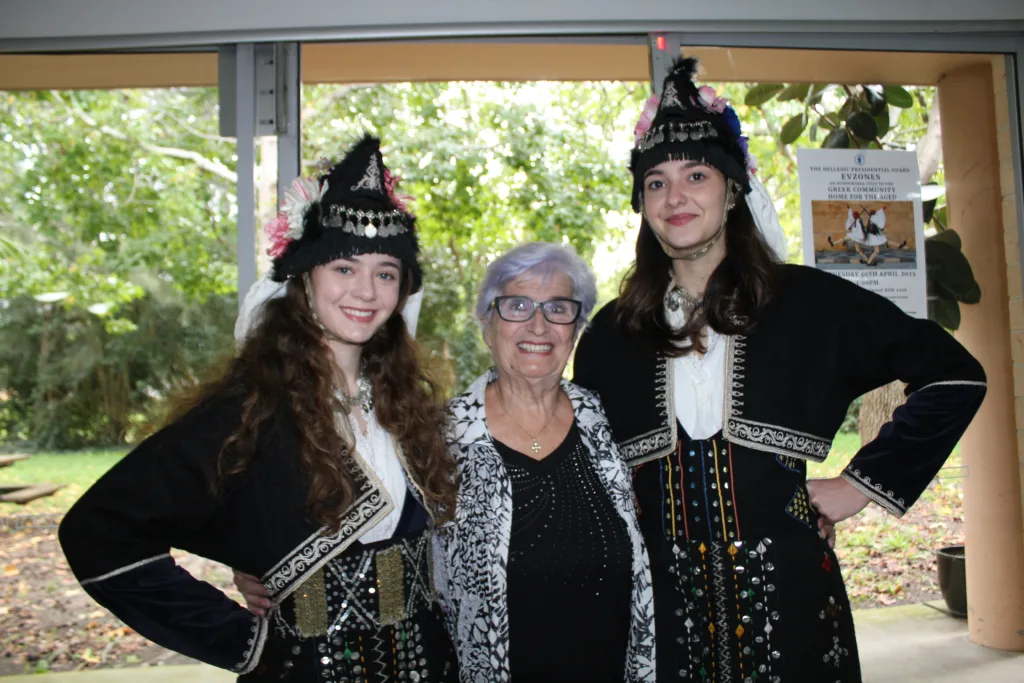
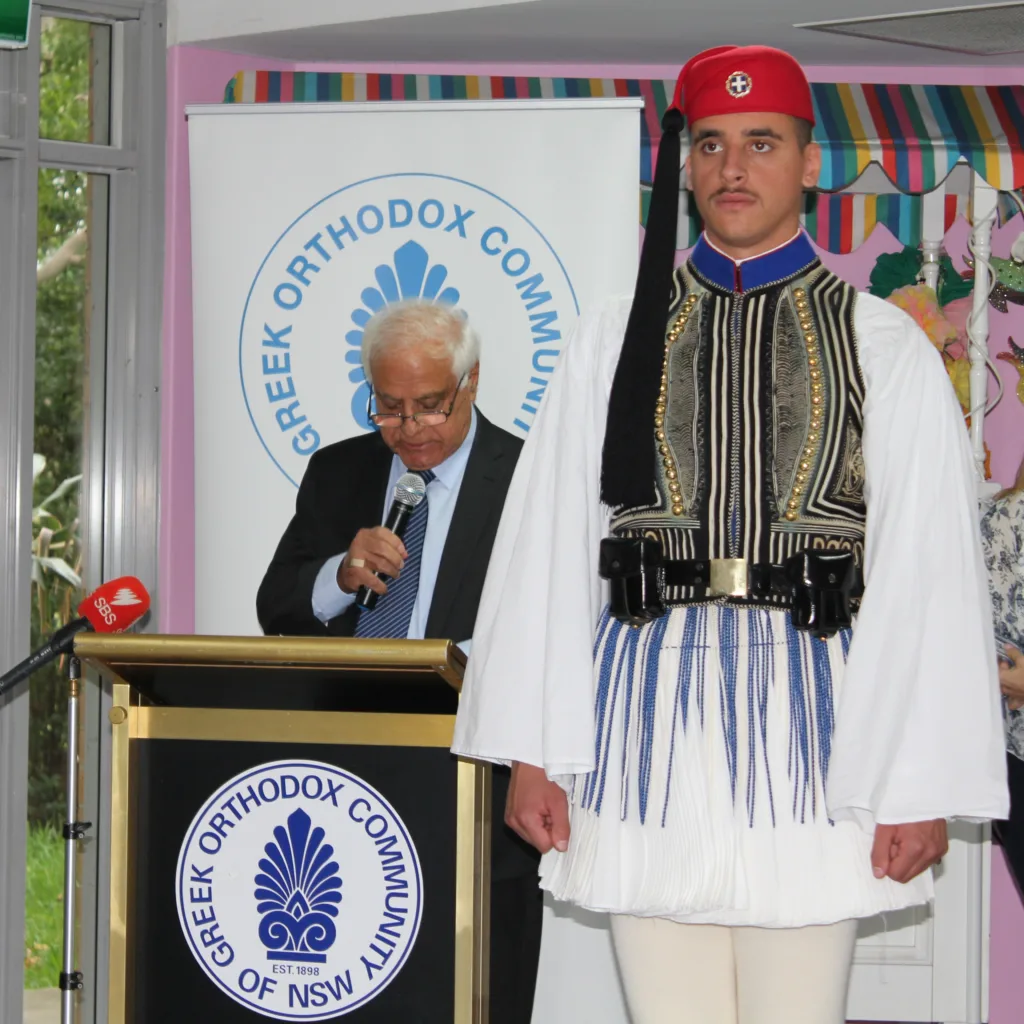
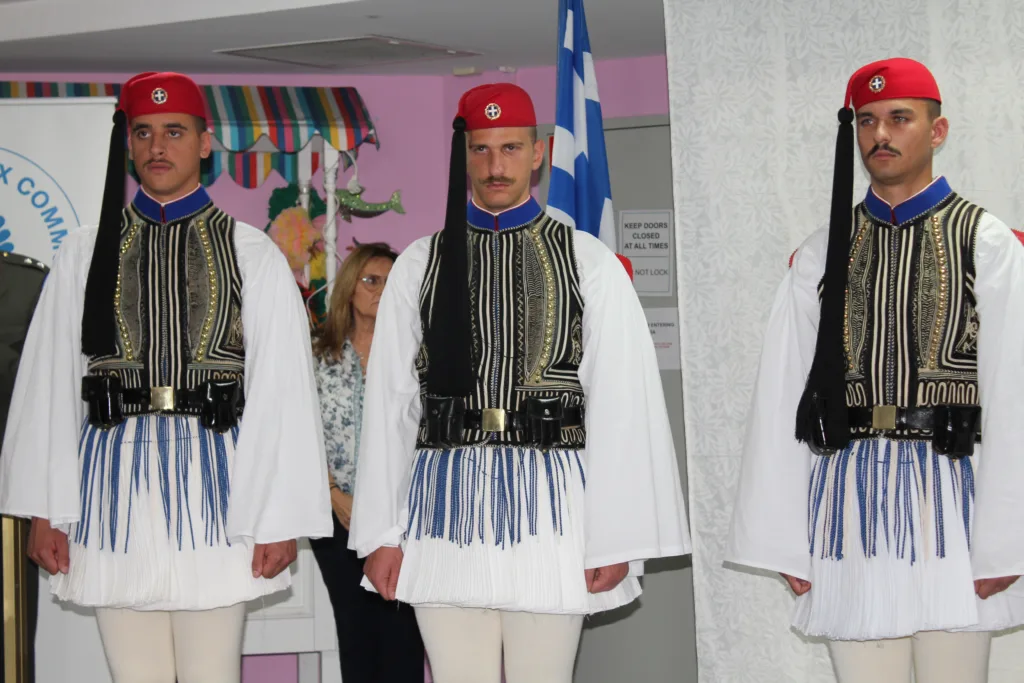
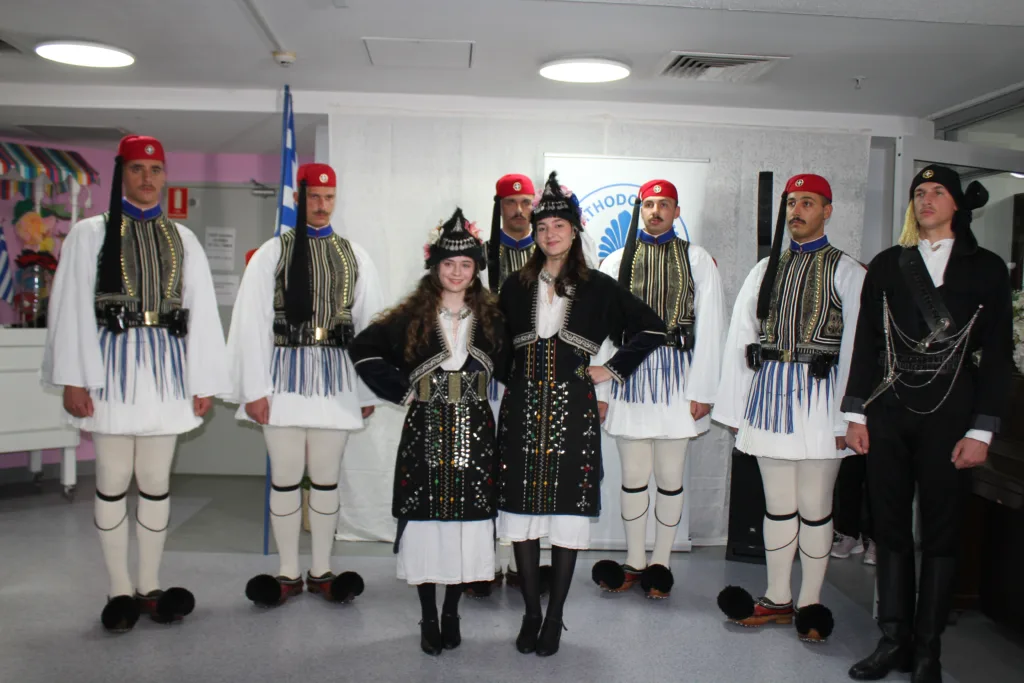
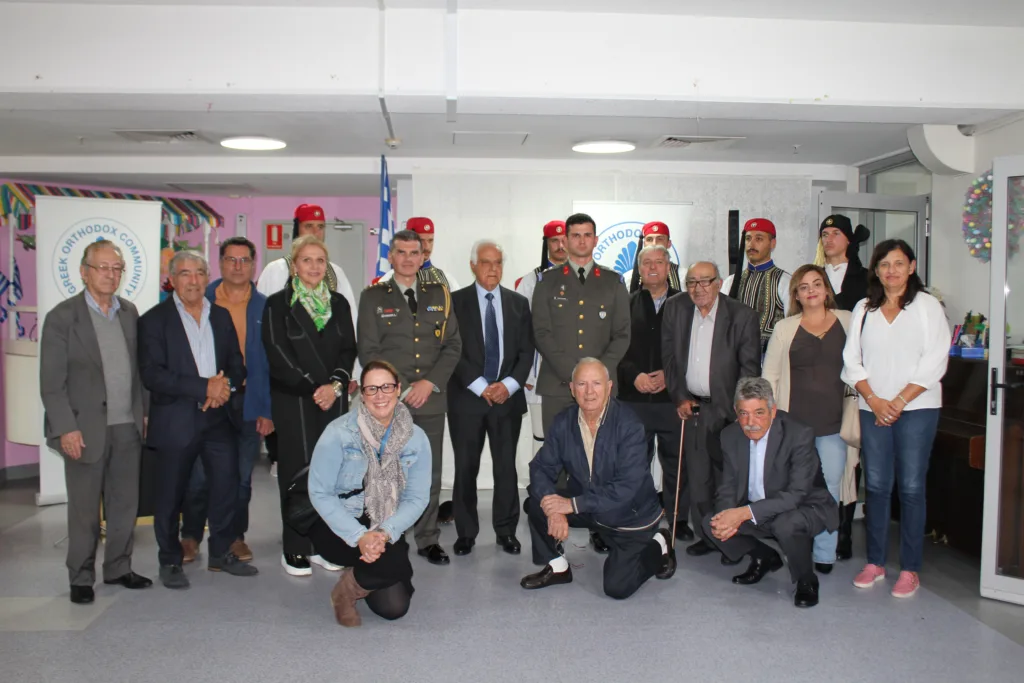
The atmosphere at the Greek Orthodox Community Home for the Aged in Earlwood, Sydney, was filled with joy and pride as the Hellenic Presidential Guard – the Evzones – paid a visit on Wednesday, April 30.
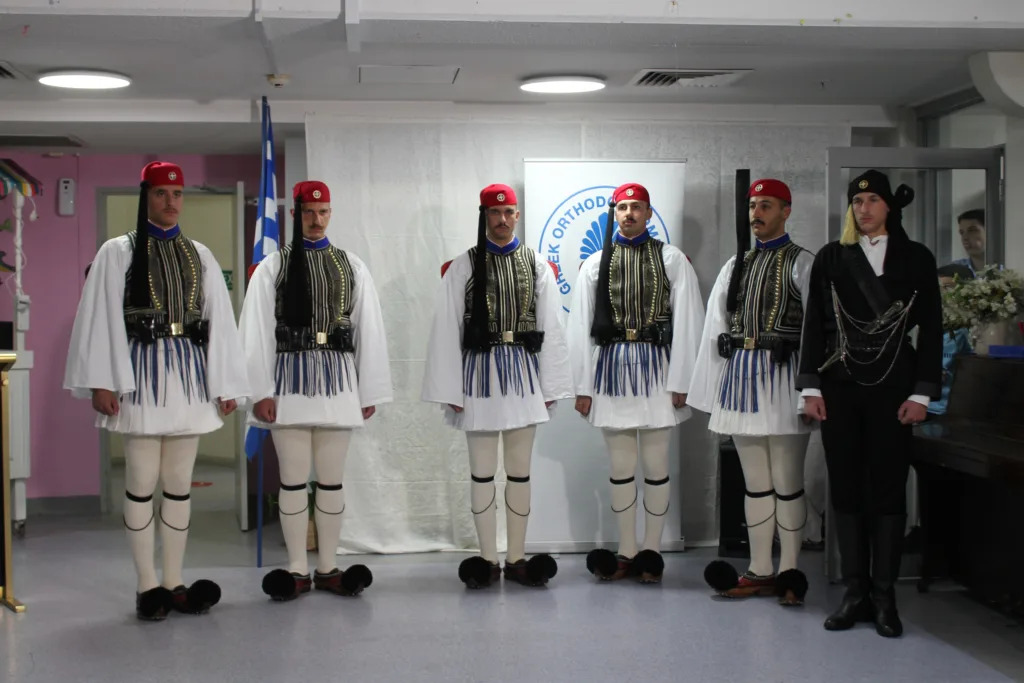
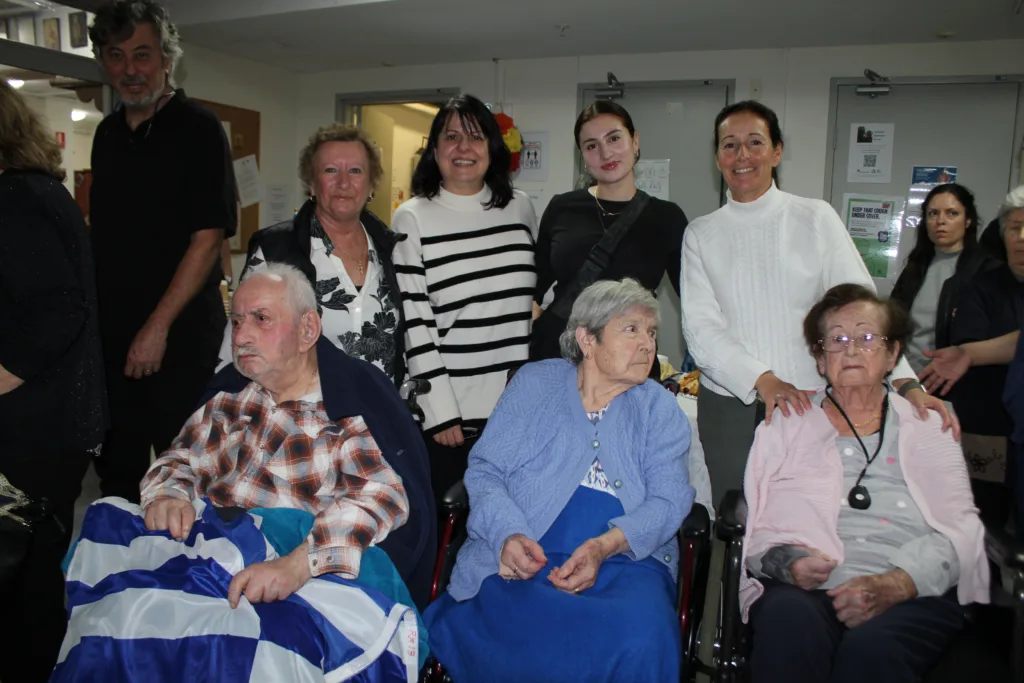
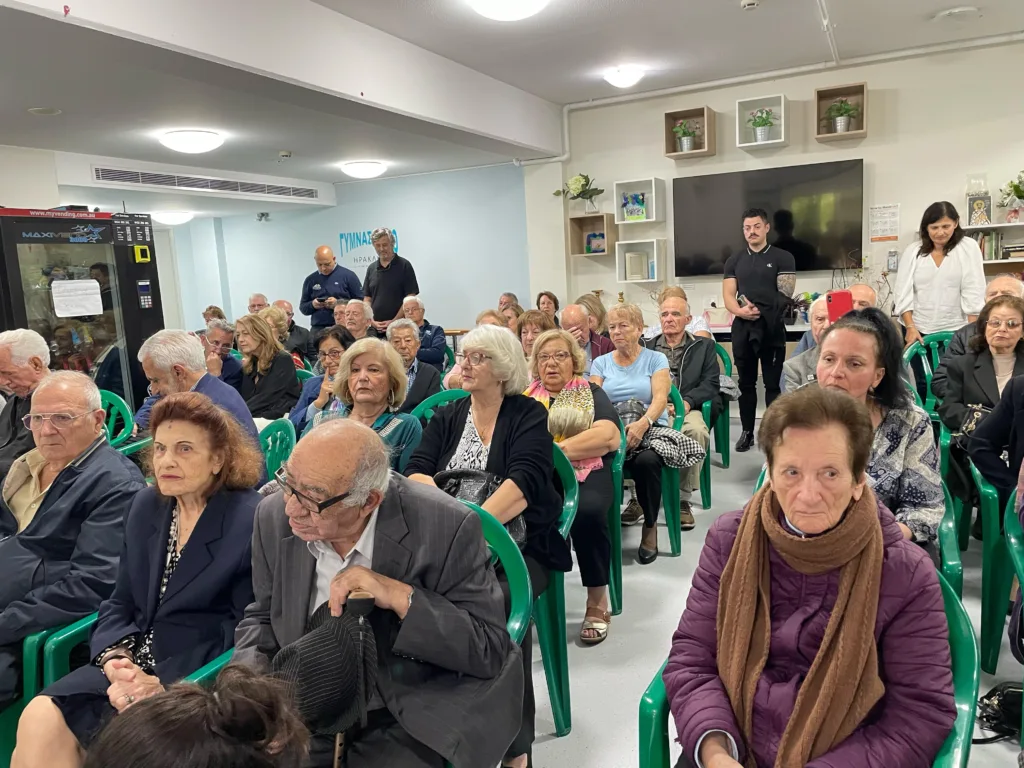
The elderly residents of the aged care facility, many in wheelchairs and supported by their families, greeted them with enthusiastic claps and cheers as the Evzones, clad in their iconic traditional uniforms, walked into the room.
Evzones at the aged care home. All photos copyright The Greek Herald / Andriana Simos.Emotions were high as the Evzones entered the room.
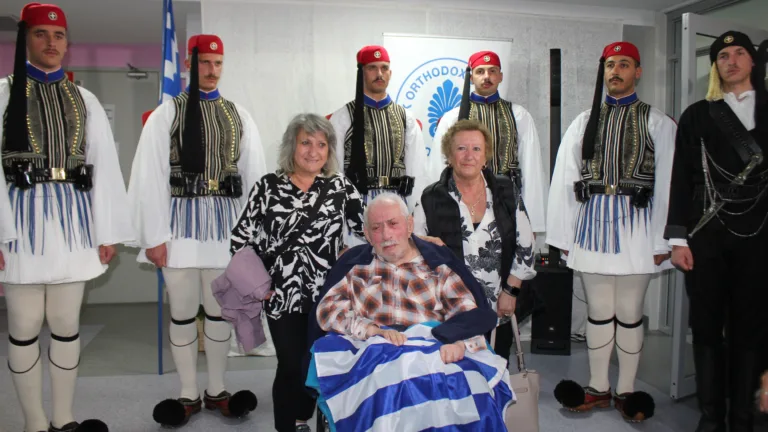
For many, the moment was an emotional one. 96-year-old male resident Triantafyllos, who was surrounded by his two daughters Poppy Iakovidis and Kim Koutsioukis, burst into tears as he saw the Evzones. His daughters recalled how their father was overcome with pride, unable to contain his emotions at the sight of these guardians of Greek history.
“It’s lovely. It brings back memories and we are very proud of our country and our culture,” Poppy told The Greek Herald.
Kim added, “Dad is so proud of the Greeks and anything Greek.”
96-year-old Triantafyllos (left) with his family and friends.
The event, which was part of the Evzones’ week-long tour of Sydney to coincide with ANZAC Day commemorations, was made even more special by the speeches delivered by key figures from the Greek Orthodox Community of New South Wales (GOCNSW) and the Hellenic Presidential Guard.
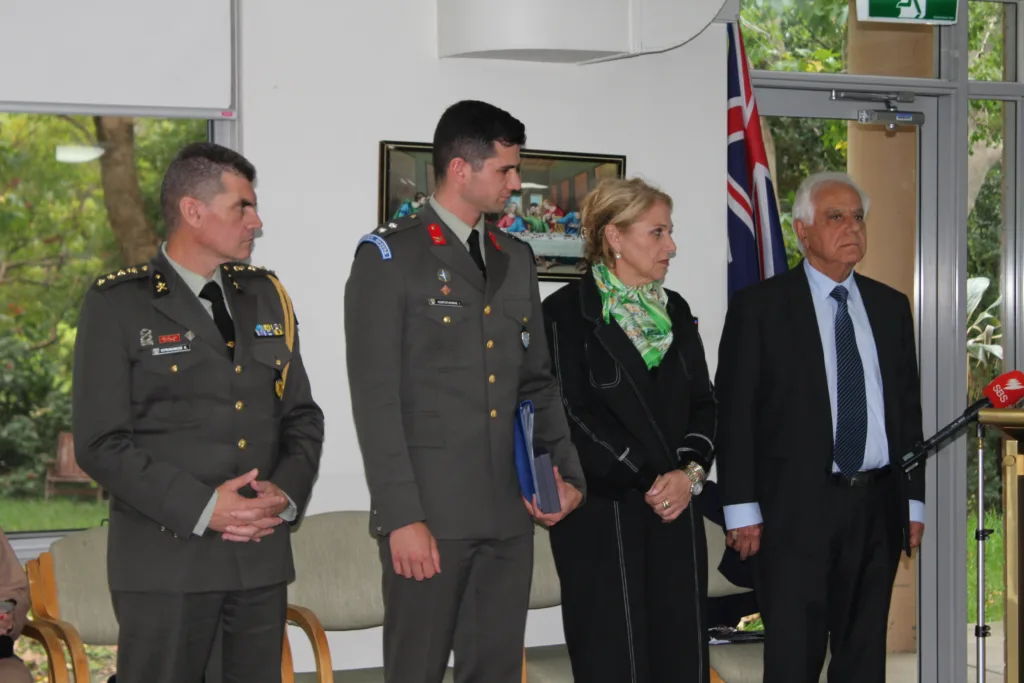
Emcee Vicki Tomaras opened the event by expressing heartfelt appreciation for the presence of the distinguished guests, Lieutenant Ioannis Kontoyiannis of the Hellenic Presidential Guard, Colonel Kyriakos Kyriakakos, Defence Attaché of the Hellenic Republic in Canberra, Harry Danalis, President of the GOCNSW, and Nia Karteris, Vice President and Secretary of the GOCNSW.
Mr Danalis, in his address, spoke of the significance of the visit not only as a cultural moment, but also as a celebration of Greek heritage.
“This is a moving day for us with the visit of the Evzones to the Greek Home for the Aged. This facility was built many years ago and, as you know, it only has residents of Greek heritage. That’s why it is an honour that the Evzones visited us here today,” he said.
Harry Danalis.
Lieutenant Kontoyiannis also took to the stage, offering a detailed explanation of the history behind the Evzones and their iconic uniform, which symbolises the struggles and sacrifices made by Greece during its War of Independence.
“The long history of the Presidential Guard begins on the 12th of December, 1868, with the establishment of a combat and, at the same time, ceremonial unit for the Hellenic Army called ‘Agema.’ Since 1974, when democracy was installed in Greece, the unit has ultimately been named the Presidential Guard, retaining a purely ceremonial character,” he explained.
Lieutenant Ioannis Kontogiannis.
The Lieutenant later recited a quote by Greek poet Kostis Palamas: “The Presidential Guard proudly continues the national tradition of the Agema, demonstrating the nation’s gratitude, paying tribute to our fallen heroes, and serving as a reminder that the greatness of nations is not measured by land, but by the strength of their hearts and by their blood.”
The emotional tone of the event was heightened by a gift exchange at the end, where Mr Danalis, Lieutenant Kontoyiannis, and Colonel Kyriakakos exchanged tokens of appreciation.
This gesture of goodwill was met with applause and cheers from the residents, who felt honoured to be part of this memorable occasion.
As the event came to a close, the community was left with a sense of pride, connection, and deep gratitude.
This special visit to the Greek Orthodox Community Home for the Aged in Earlwood was more than just an event; it was a moment of cultural pride, joy, and shared history that will be remembered by all who were fortunate enough to witness it.
*All photos copyright The Greek Herald / Andriana Simos.
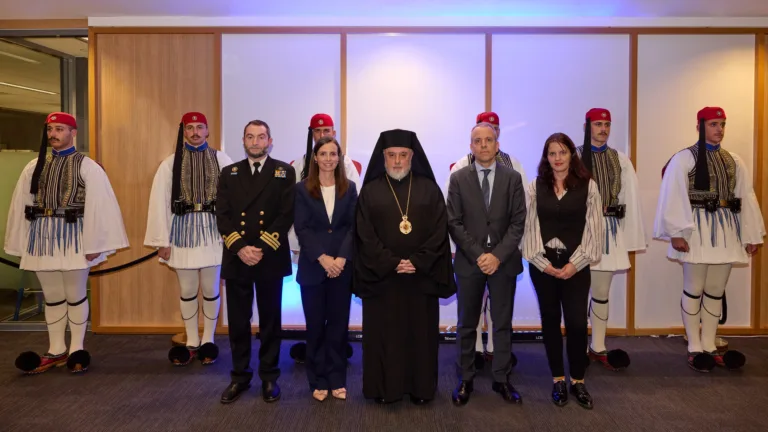
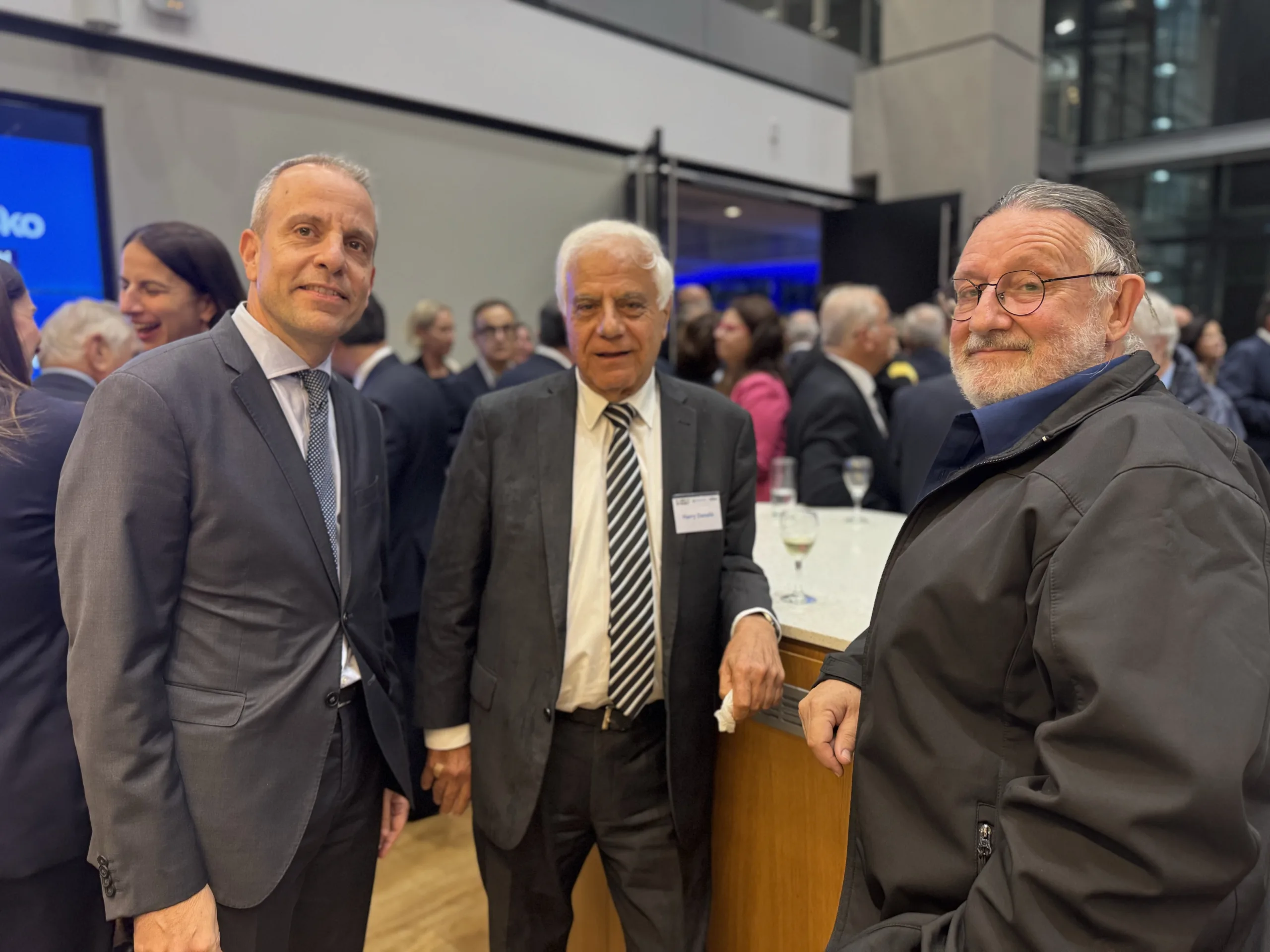
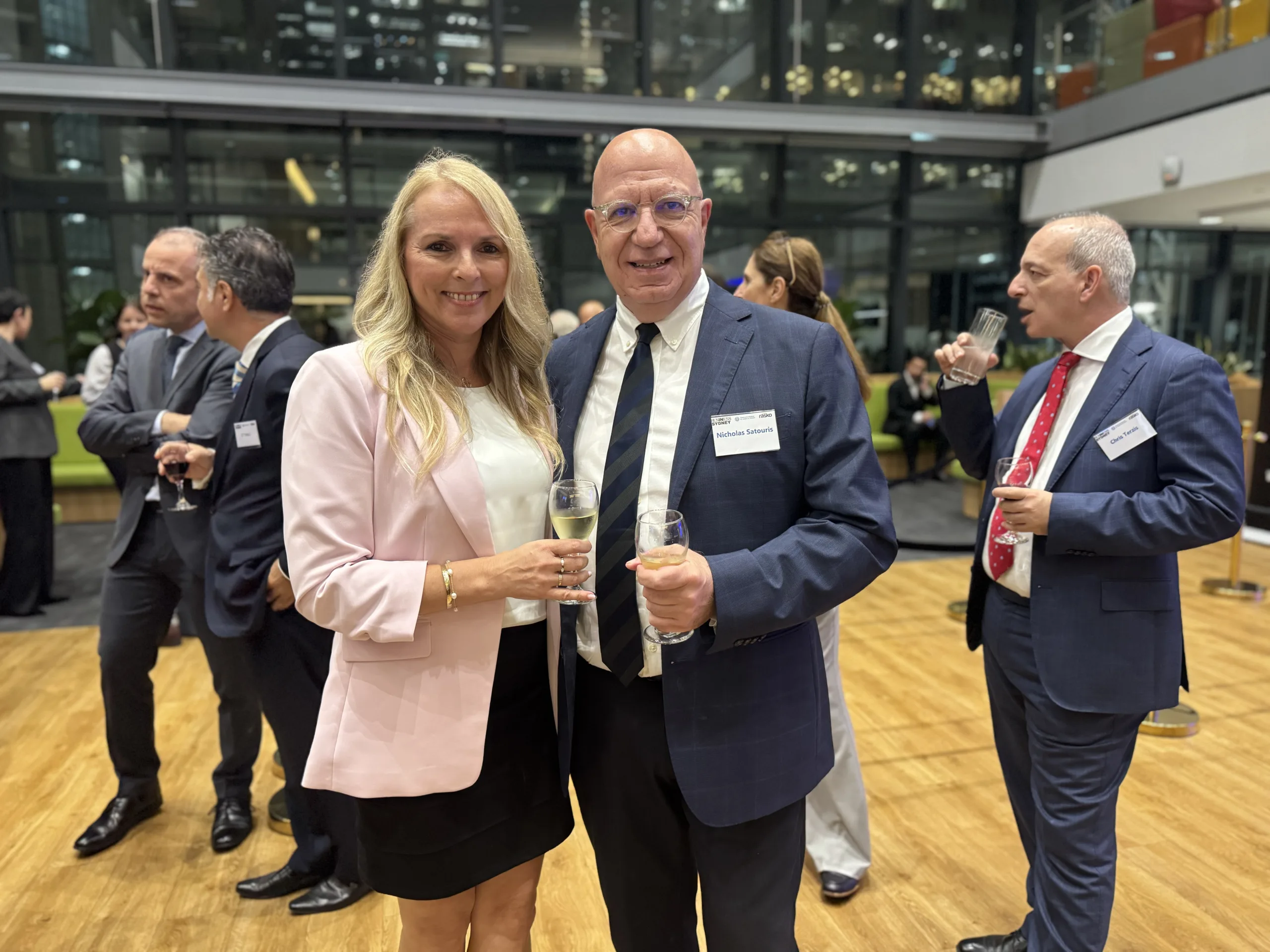
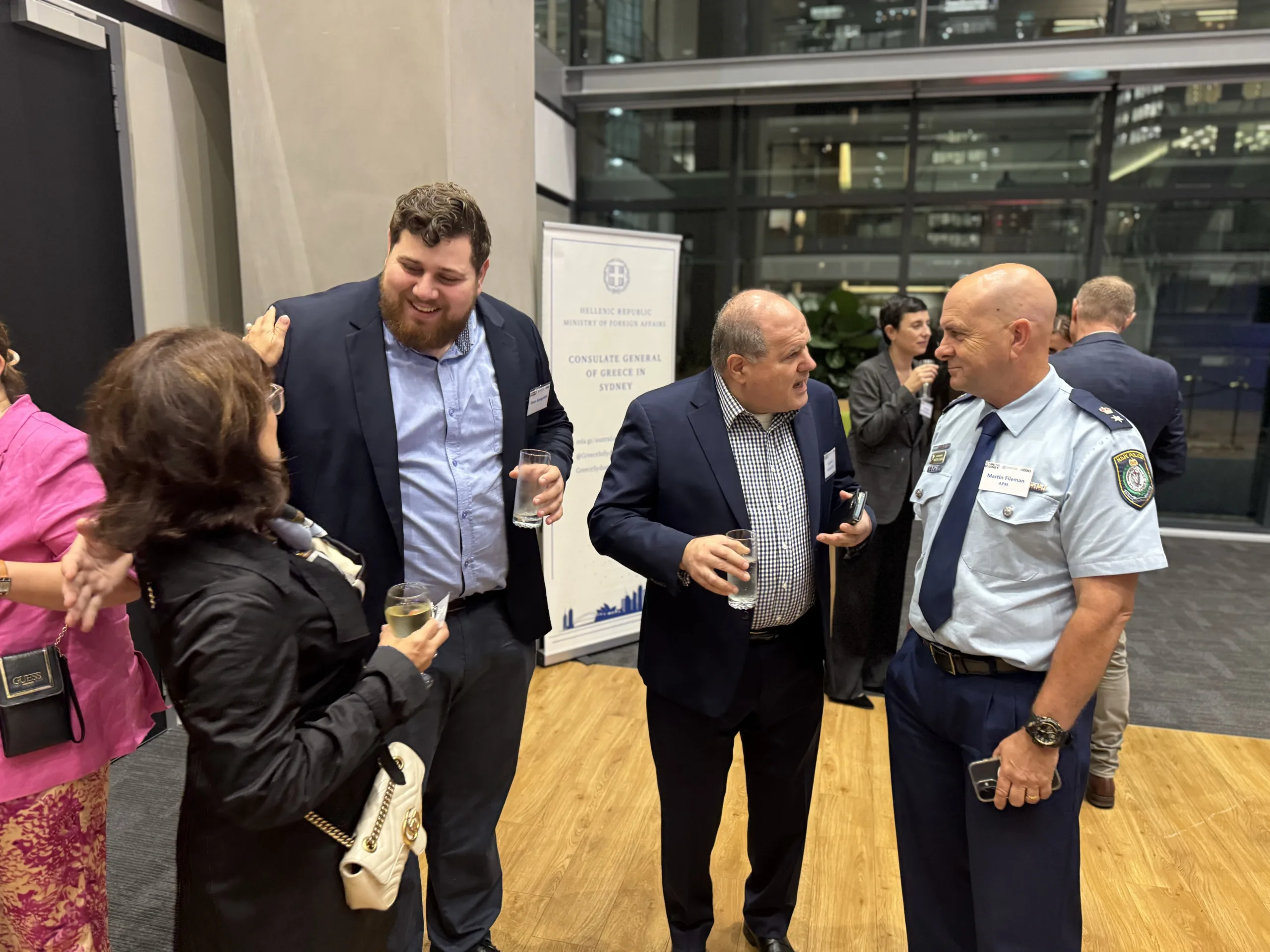
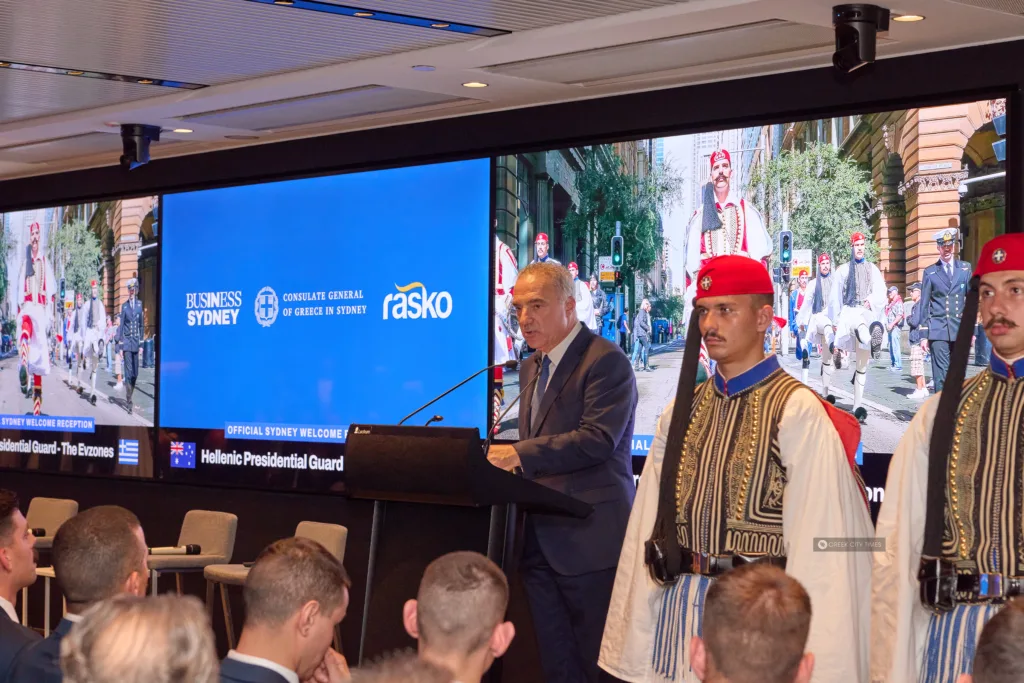
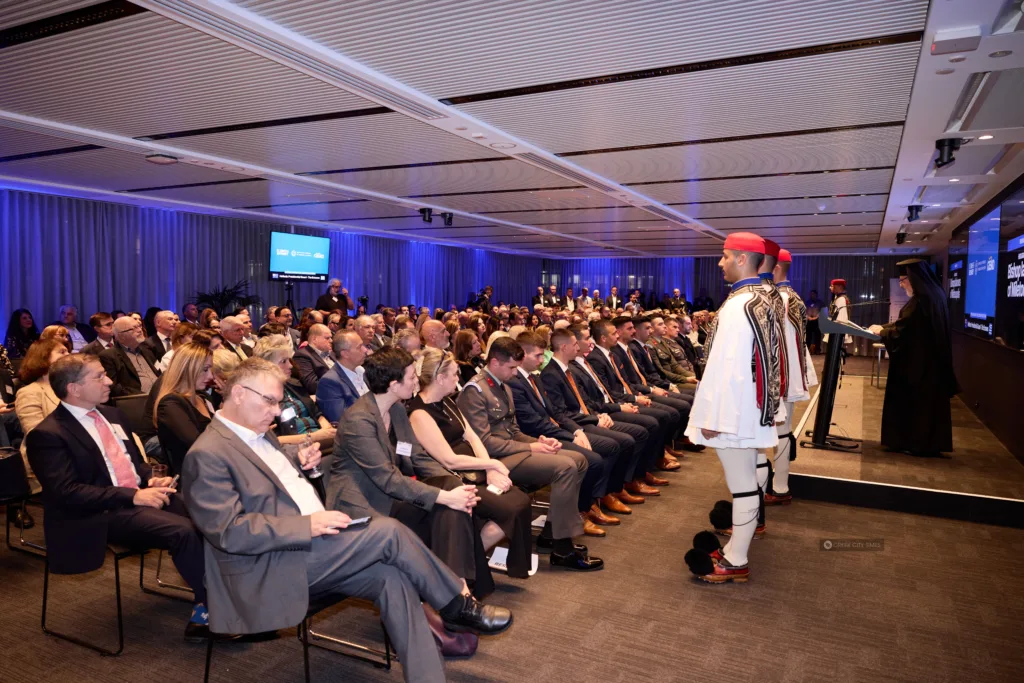
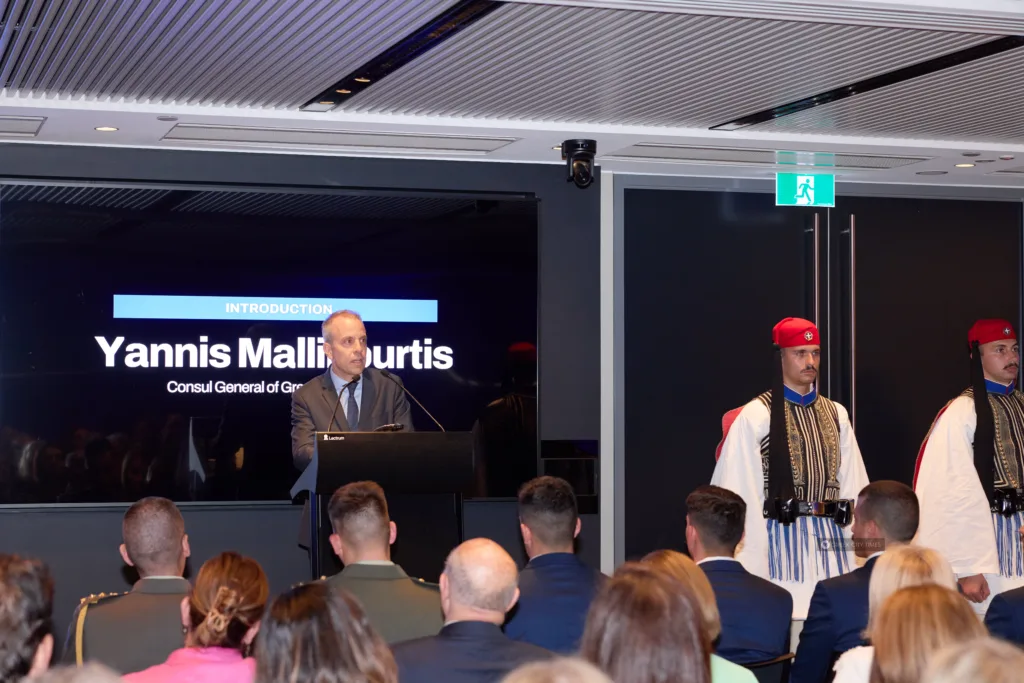
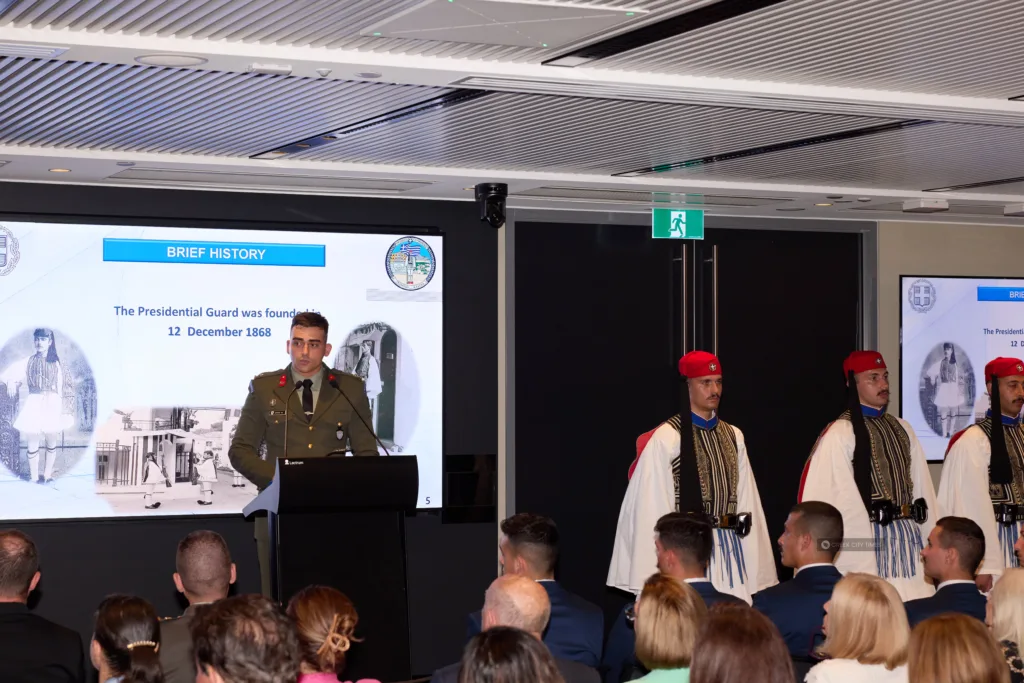
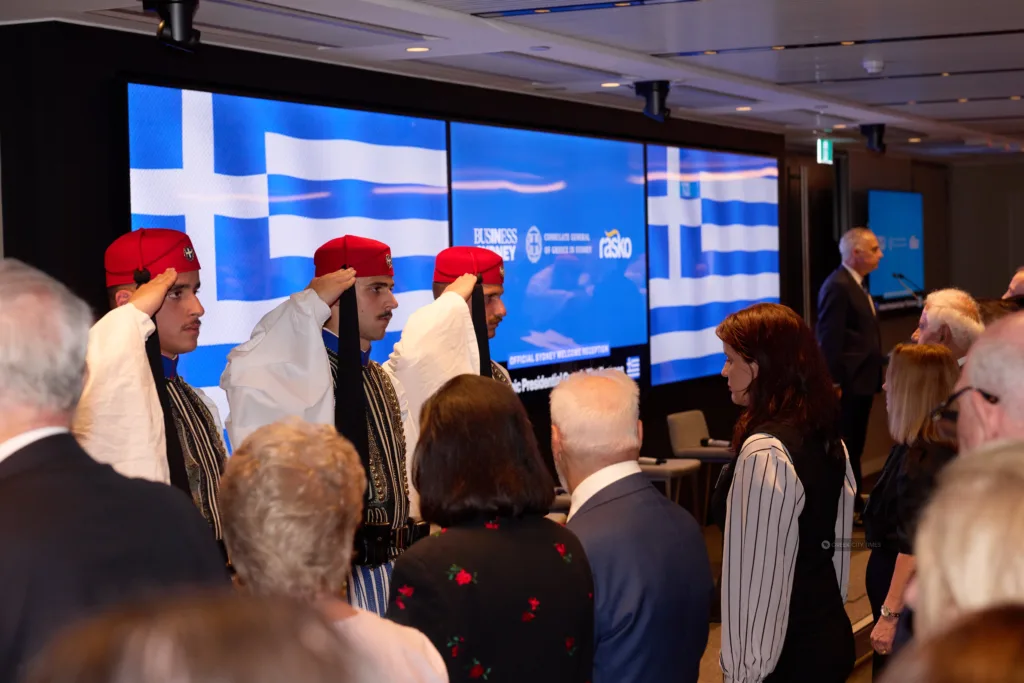
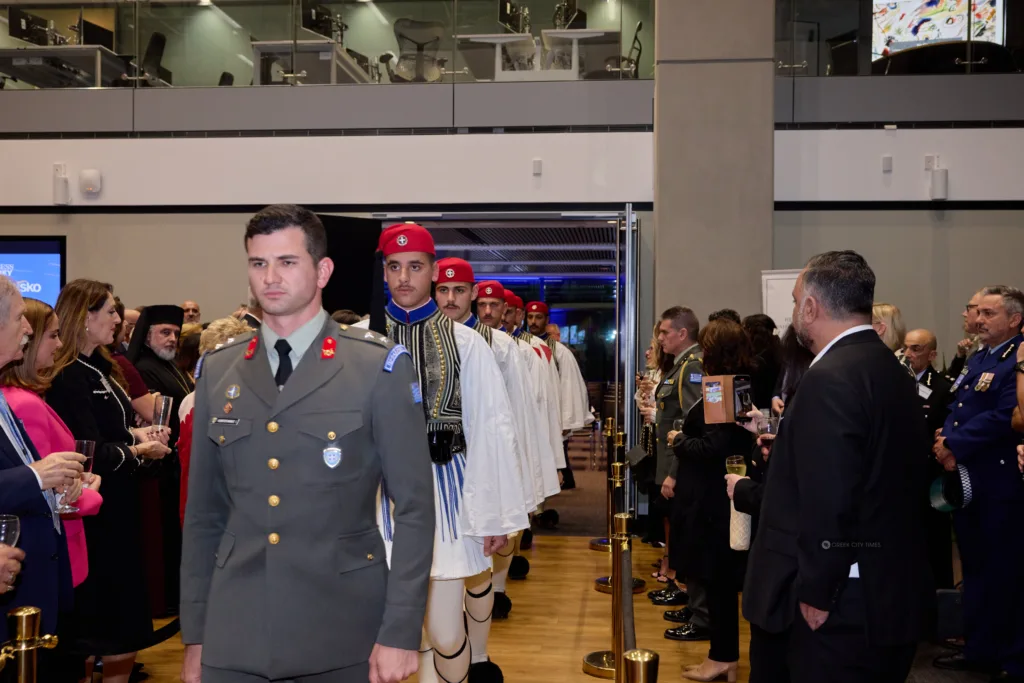
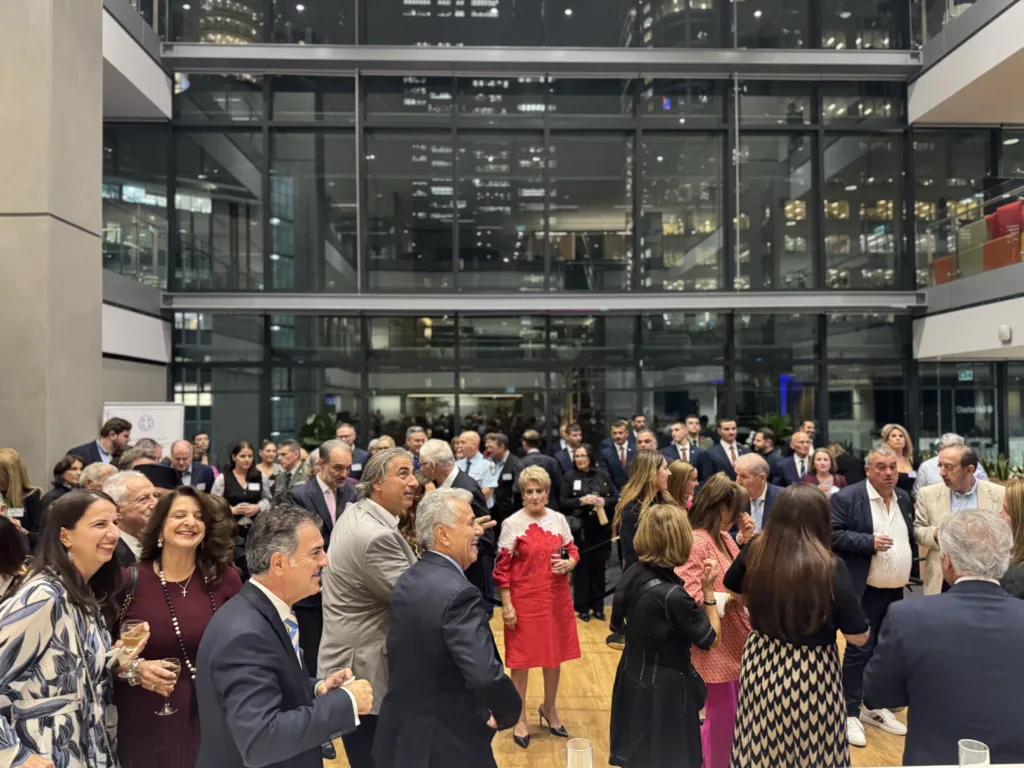
More than 250 guests from across Sydney’s Greek Australian community and business sector gathered at Business Sydney Events Centre on Tuesday, April 29 to officially welcome the Hellenic Presidential Guard, known as the Evzones, in a ceremony that combined military pride, cultural heritage and heartfelt reflection on the enduring ties between Greece and Australia.
Hosted by Business Sydney in partnership with the Consul General of Greece in Sydney, Ioannis Mallikourtis, the welcome reception featured speeches, formal presentations, and a panel discussion exploring the historical bonds between the two nations.
More than 250 guests from across Sydney’s Greek Australian community and business sector gathered at Business Sydney Events Centre. All photos copyright The Greek Herald.
Guests were treated to drinks, canapés and the opportunity to take photos with the Evzones before being seated for the formal proceedings.
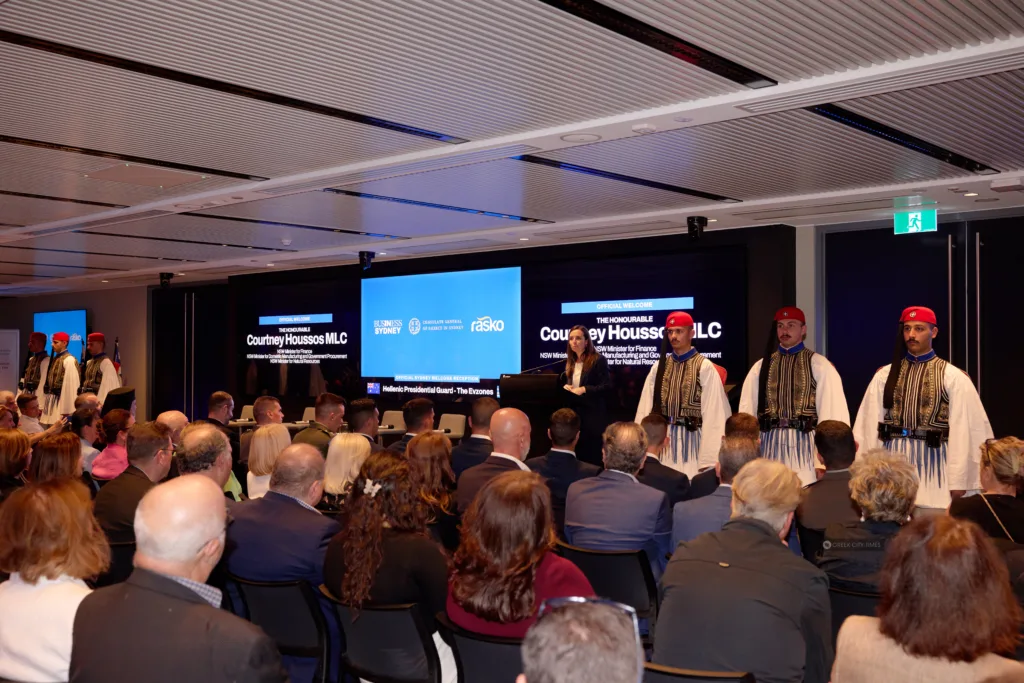
Business Sydney’s Executive Director Paul Nicolaou opened the event by highlighting the symbolic importance of the evening. He welcomed a long list of dignitaries including His Grace Bishop Iakovos of Miletoupolis, representing His Eminence Archbishop Makarios of Australia, the Trade Commissioner of Greece in Australia, Chrysa Prokopaki, the Hon. Courtney Houssos MLC, NSW Minister for Finance, representing the Premier of NSW, the Hon. Chris Minns, and Colonel Kyriakos Kyriakakos, Defence Attaché of the Hellenic Republic in Canberra.
Business Sydney’s Executive Director Paul Nicolaou.
In his address, Bishop Iakovos conveyed the blessings of Archbishop Makarios and noted, “It is indeed a great honour for all of us as Greek Australians to experience the prestige and might of the Evzones who are not merely a distinguished and historical military unit of the Hellenic Army, but moreover, constitute a living symbol of the eternal ideals of faith in God, love of our Hellenic motherland, courage, determination, freedom and self-sacrifice.”
His Grace Bishop Iakovos of Miletoupolis speaks.
Speaking on behalf of the NSW Government, Minister Houssos reflected on the strong emotional impact of the Evzones’ visit.
“Visits like this from the iconic symbols of Greece mean so much to us as parents, to our kids, and particularly to members of the Greek diaspora who perhaps are not able to go back to Athens and visit and see them firsthand,” she said.
“We are inspired by their incredible discipline, by their beautiful and immaculate uniforms, but it’s the deep symbolism that we see — even down to the fustanella — that’s just inspiring for all of us.”
The Hon. Courtney Houssos MLC, NSW Minister for Finance, represented the Premier of NSW, the Hon. Chris Minns.
The Minister also shared a personal story of marching alongside the Evzones at Bondi Beach in 2018, calling it “something that will certainly stay with me for the rest of my life.”
In his formal welcome, Consul General Mr Mallikourtis offered a reflection on the historic and symbolic role of the Presidential Guard.
“In modern Greek history, the term Evzonos, denoting the lightly armed soldier in traditional national dress, has appeared since 1864… They were the Special Forces of the time,” he said.
“Their presence here in Australia is relevant, especially during the ANZAC Day commemorations… For Greek Australians, it maintains the connection to the ancestral homeland, and it gives us the opportunity to reflect on the relations between our two countries.”
Consul General of Greece in Sydney, Ioannis Mallikourtis, gives and address.
Mr Mallikourtis added, “Australians are buried in Faliro, in Crete and elsewhere. They have shed their blood in Vevi, Thermopylae, Kalamata and in Crete. The least we can do is to remember them and to honour their legacy.”
Lieutenant Athanasios Loulas of the Presidential Guard followed with a detailed and powerful address on the Evzones’ history, selection process and ceremonial responsibilities.
Lieutenant Athanasios Loulas of the Presidential Guard.
“The Presidential Guard proudly continues the national tradition of the Evzones, demonstrating the nation’s gratitude, paying tribute to our fallen heroes and serving as a reminder that the greatness of a nation is not measured by land, but by the strength of their hearts and by their blood,” Lieutenant Loulas said.
The Lieutenant also explained the symbolism of the Evzones’ uniform, noting that the fustanella has “400 pleats symbolising the 400 years of Ottoman occupation” and that their heavy red shoes (tsarouchia) are “entirely handmade… weighing about 2.5 kilos.”
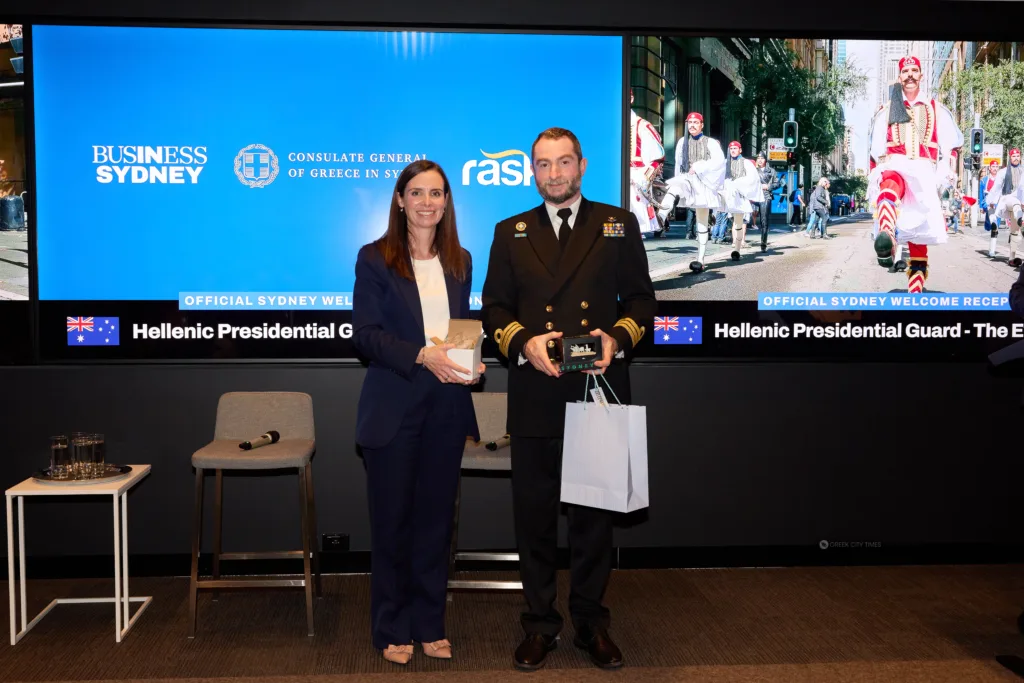
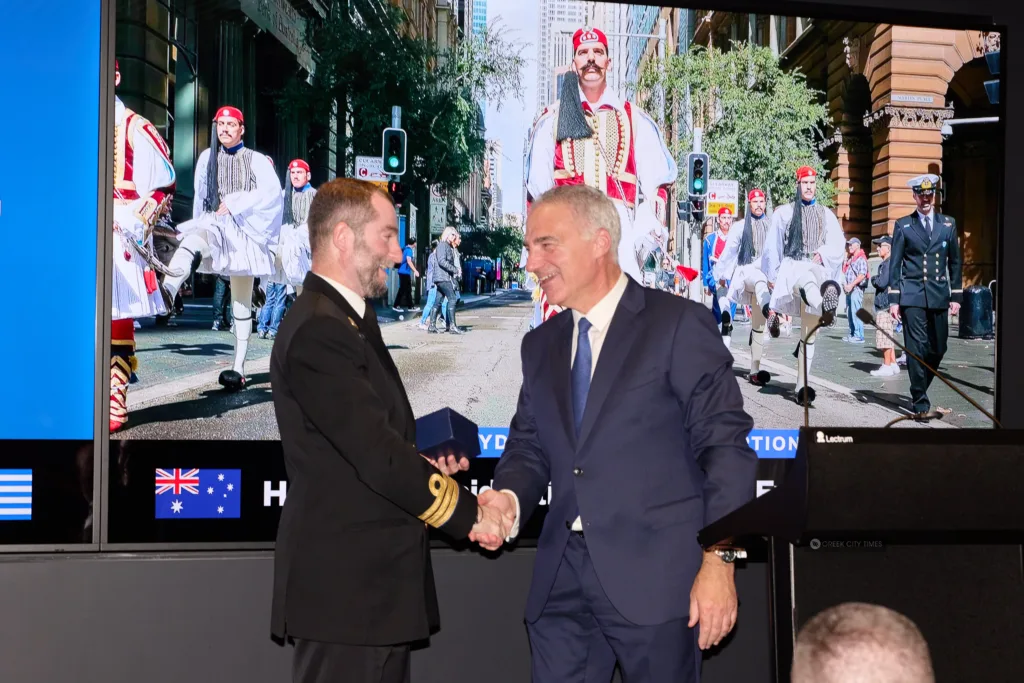
Following the speeches, a series of gift exchanges took place. Minister Houssos presented a gift on behalf of the NSW Government to the commander of the Presidential Guard, Michalis Tzinieris, which was reciprocated with a commemorative gift to the Minister. Mr Nicolaou also received a personal gift from the Guard and, in return, presented a photographic book of Sydney to each of the Evzones as a memento of their visit.
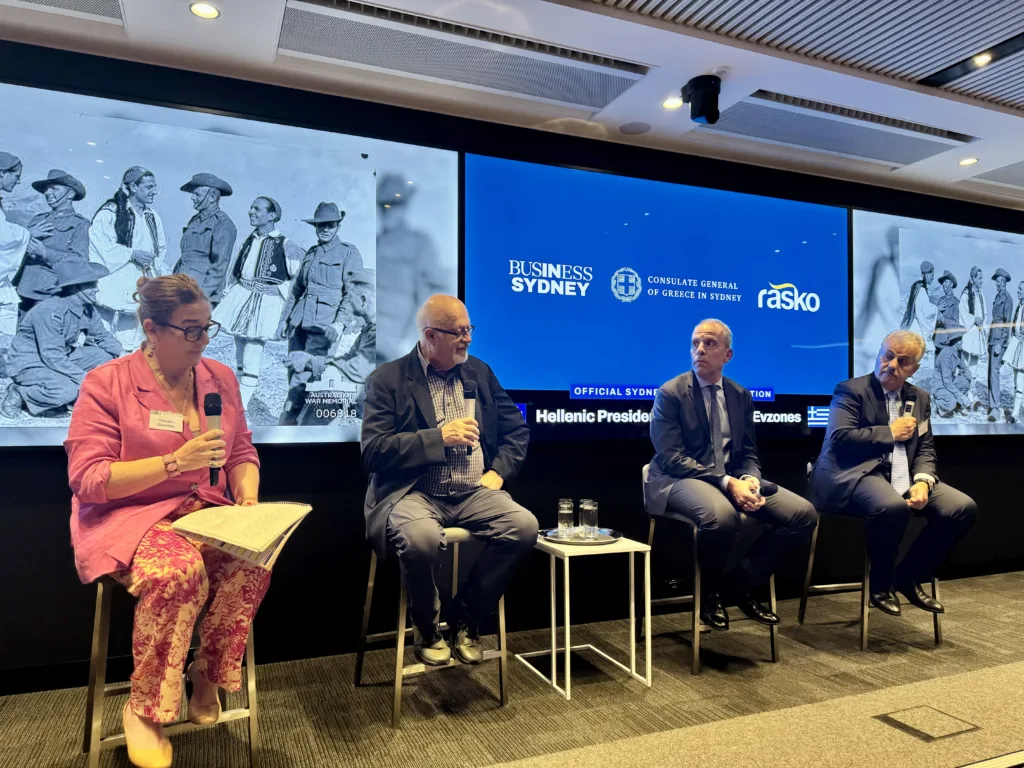
The evening concluded with a panel discussion on the shared history and future of Greek and Australian relations. The discussion featured the Consul General, author and former TV producer Craig Collie, and Nick Andriotakis, Secretary of the Joint Committee for the Commemoration of the Battle of Crete and the Greek Campaign. It was facilitated by Theodora Minas Gianniotis, Director of Built Environment Heritage Group.
The panel explored the importance of intergenerational storytelling and preserving collective memory through both military and cultural traditions.
The panel discussion.
Special thanks were extended to former Socceroo Peter Raskopoulos from Rasko Group for supporting the event, along with coordinators Nick Bourdaniotis and Sophie Balayannis, whose efforts helped ensure the successful visit of the Evzones to Sydney.
As the crowd stood in applause to farewell the Presidential Guard, the mood in the room was one of deep pride and connection — a shared reminder of sacrifice, identity, and community.
*All photos supplied by Bourdo Photography (unless specified otherwise).
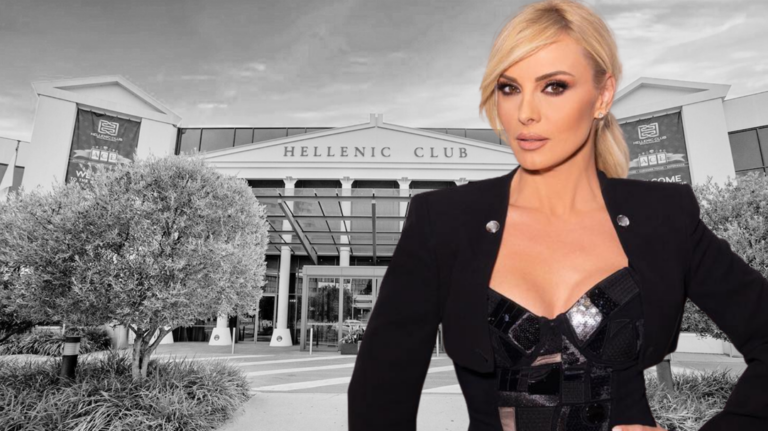
Greek music icon Peggy Zina is set to make her long-awaited debut performance at the Hellenic Club of Canberra on May 2, 2025. Ahead of her performance, she spoke exclusively with The Greek Herald about her deep connection with the Greek community in Australia, her musical journey, and what fans can expect at the upcoming concert.
How is Australia?
I have been here many times since 2006 until today. I have a close relationship with the Greeks of Australia and I feel that they are a little more Greek than those of us who live in Greece.
You have been singing for over 30 years and have left your own mark on Greek music. What inspires you to continue, especially in countries like Australia?
The only thing that inspires me is the love of the people. What makes me continue is neither showbiz nor readership nor the glory and lights that our work has. The only thing that moves me is that if you can touch people’s souls with your song and keep them company from one end of the world to the other, that for me is therapy, it is a purpose. Knowing that you are keeping someone company even though you don’t know them personally. That is the main reason I do this job. That I help some people to externalise their emotions, to laugh, to dance, to cry. Emotions are life and they have to come out of us and we have to live them all.
It will be the first time you will sing at the Hellenic Club in Canberra. What can your fans expect on the night?
We will ‘inaugurate’ Canberra. My program will be exactly the same. In the era we live in, what we do is greatly influenced by social media. So, we must not present anything less anywhere. That’s why wherever I sing, I have my entire team, musicians, singers and sound engineers with me so that the show comes out the way I present it in Greece.
Has your music changed over the years? Which songs would you most like to sing to the Australian audience?
We made a selection of my own songs that have been loved the most by the world. They haven’t changed too much, they are just now in a more emotional and popular style.
We have great songs and we must pass them on to the new generations. Especially to the generations that have been born in Australia, in America… They have them in their DNA, but they don’t yet know them from their parents. We must pass on our great composers and singers. What we have done, therefore, is to include great, old Greek songs and make them known to the new generations: Mitropanos, Kazantzidis, Moscholiou, Sakellariou, Vanou, and Poulopoulos.
Greeks abroad have a deep love for your music. How is it to sing for the Greek community and especially in cities like Canberra compared to Greece?
It is very moving because it is like meeting an audience for the first time, to which you have to reintroduce yourself. This renews you and makes you feel like you are taking your first steps. It has a sweet anxiety, a sweet anticipation to create a relationship that will last for many years. We have built this with Sydney, Melbourne and Adelaide for at least 20 years. Now we will build it with both Canberra and Brisbane.
Event Details:
Date: Friday, 2nd May 2025
Doors Open: Show starts at 8:30pm – doors open from 8pm. Arrive early to enjoy dinner and drinks before the show.
Venue: Hellenic Club of Canberra, 1 Matilda Street, Woden
Accommodation: Official ABODE HOTELS CANBERRA – promo code for 15% discount from Fri 2nd May until Sunday 4th May – promo code is PEGGY.
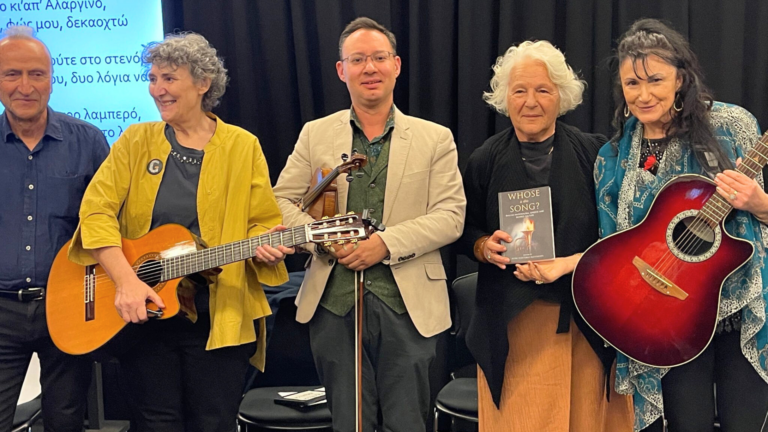
The launch featured speeches and performances, with thanks extended to speaker Con Pakavakis for his thoughtful contribution and to Dean Kalymniou for his musical performance on the violin.
Anthea Jewels Sidiropoulos served as MC and also joined in song, sharing her English version of the featured folk tune.
The event was jointly organised by Cathy Alexopoulos of the Greek Australian Cultural League and the Greek Community of Melbourne.
Attendees also enjoyed screenings of two trailers from the documentary Whose is this Song? by Adela Peeva.
The gathering offered guests a chance to engage with the topic of Balkan cultural intersections while enjoying live music and community spirit.
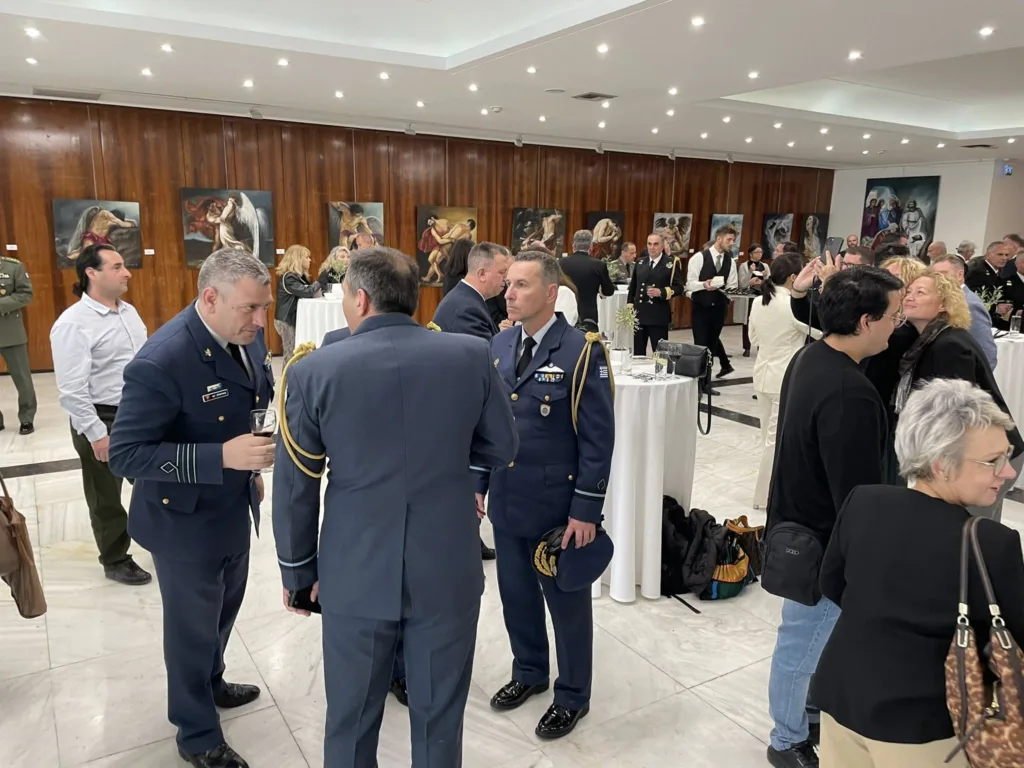
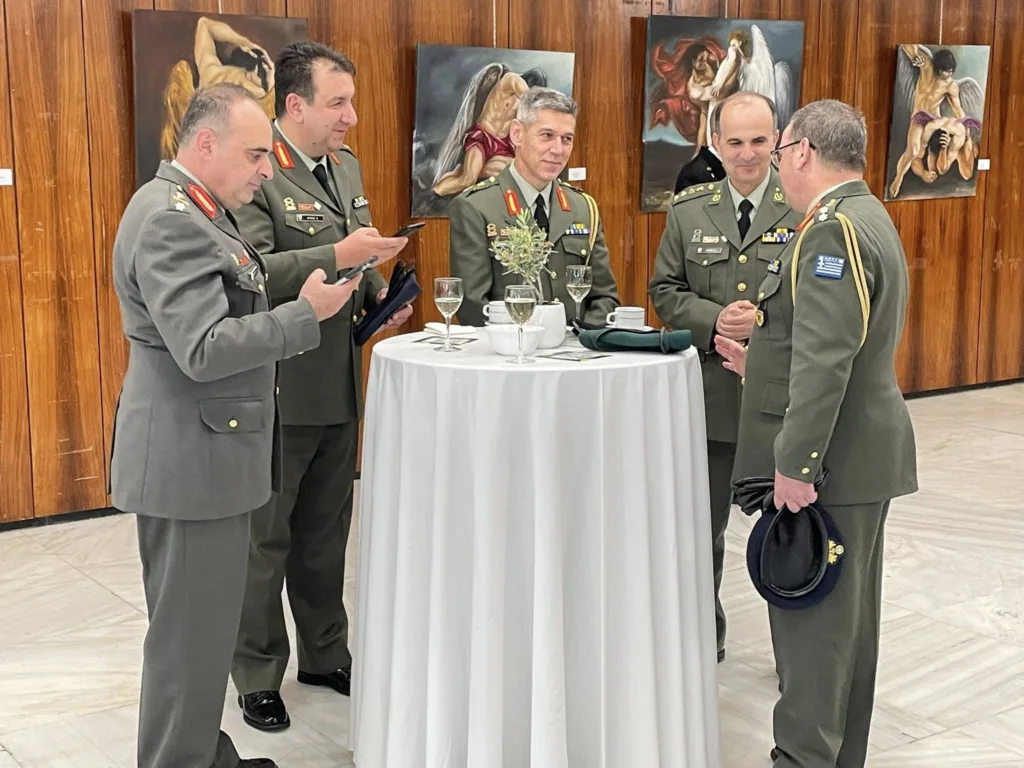
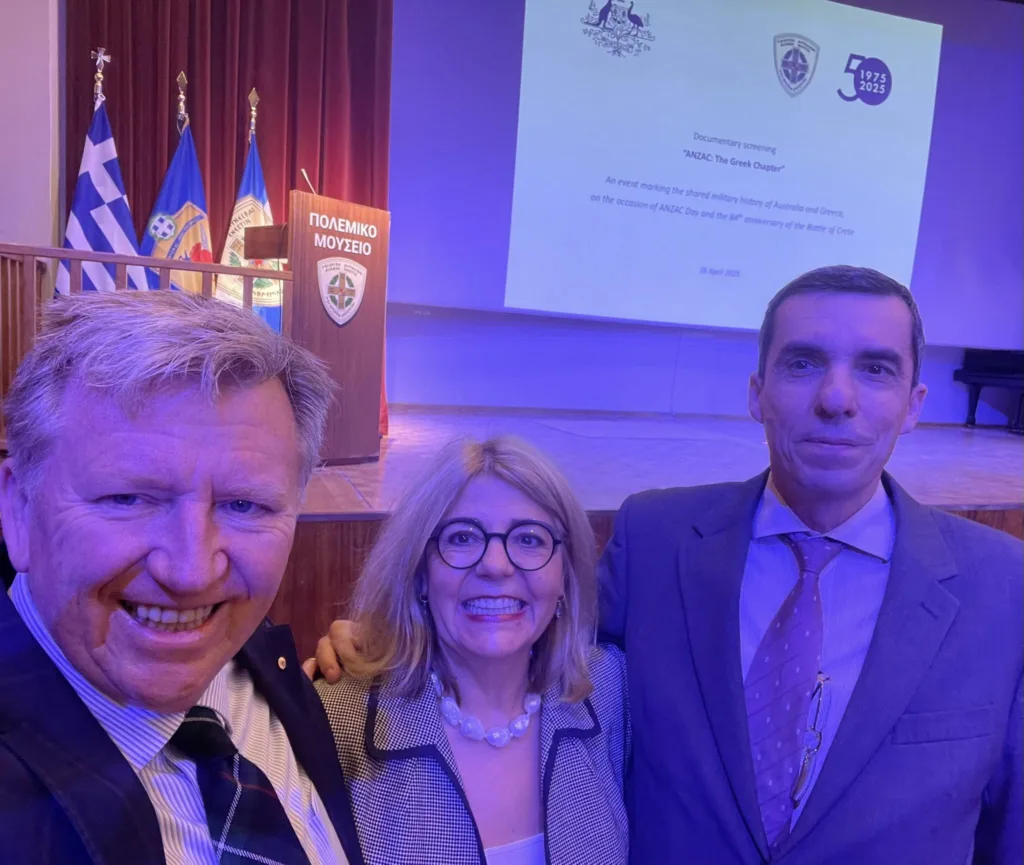
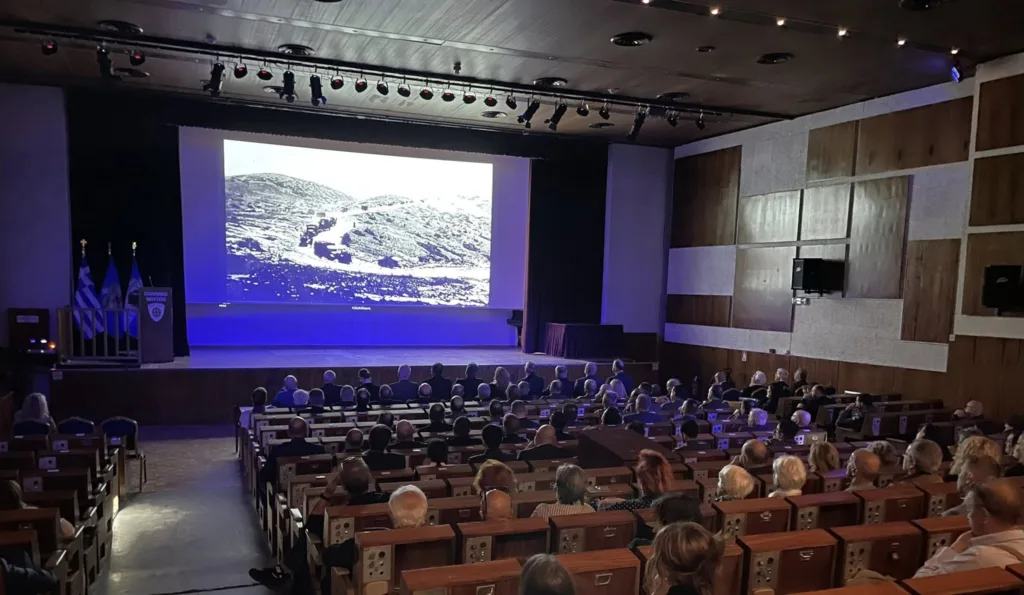
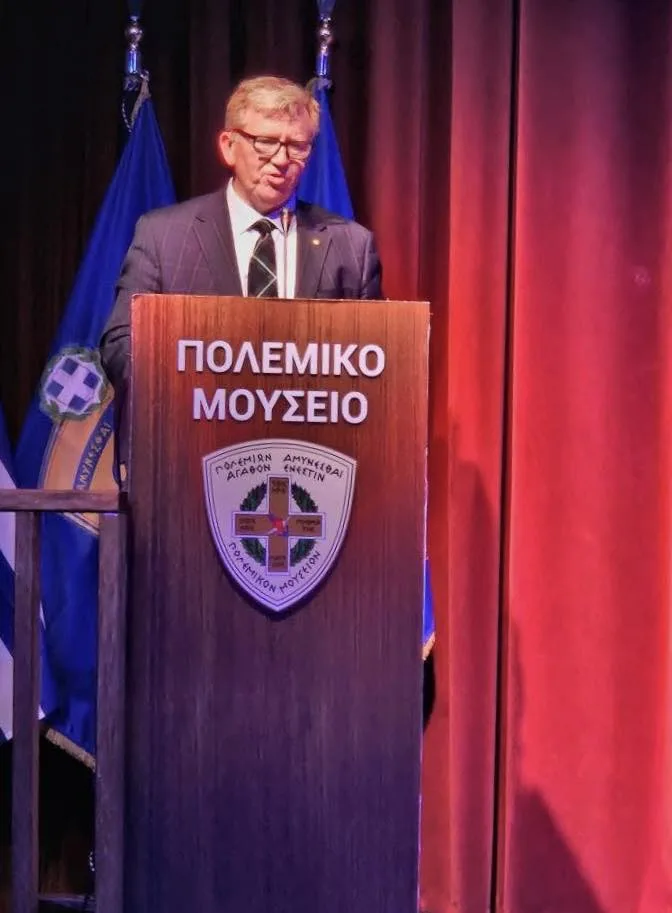
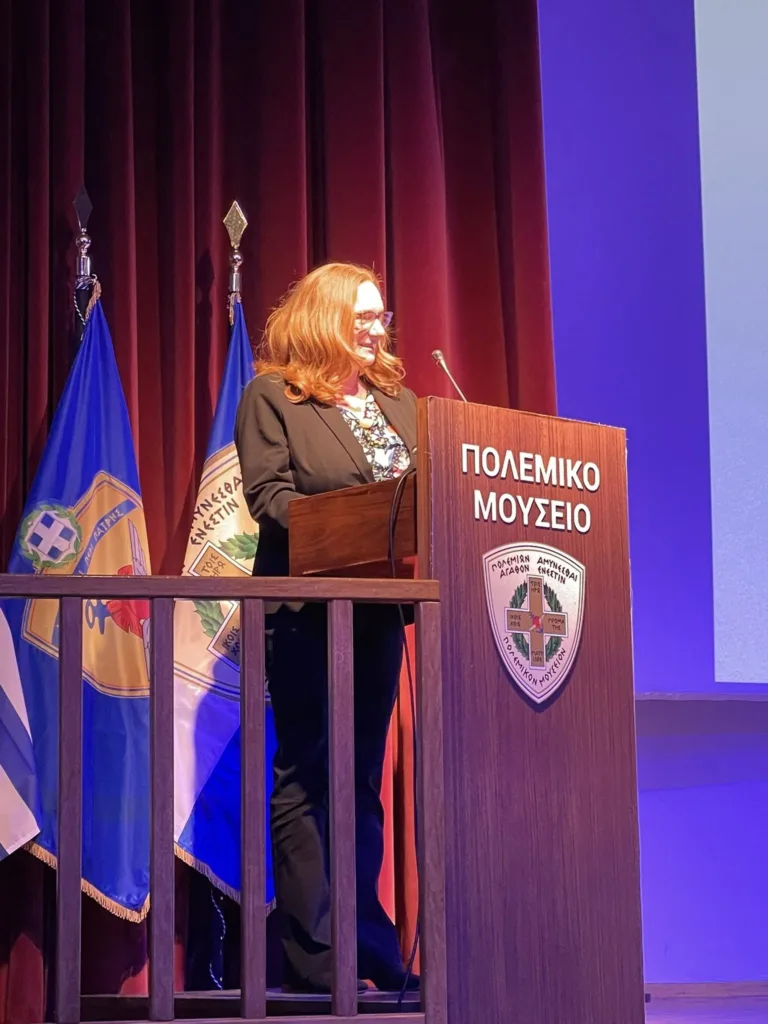
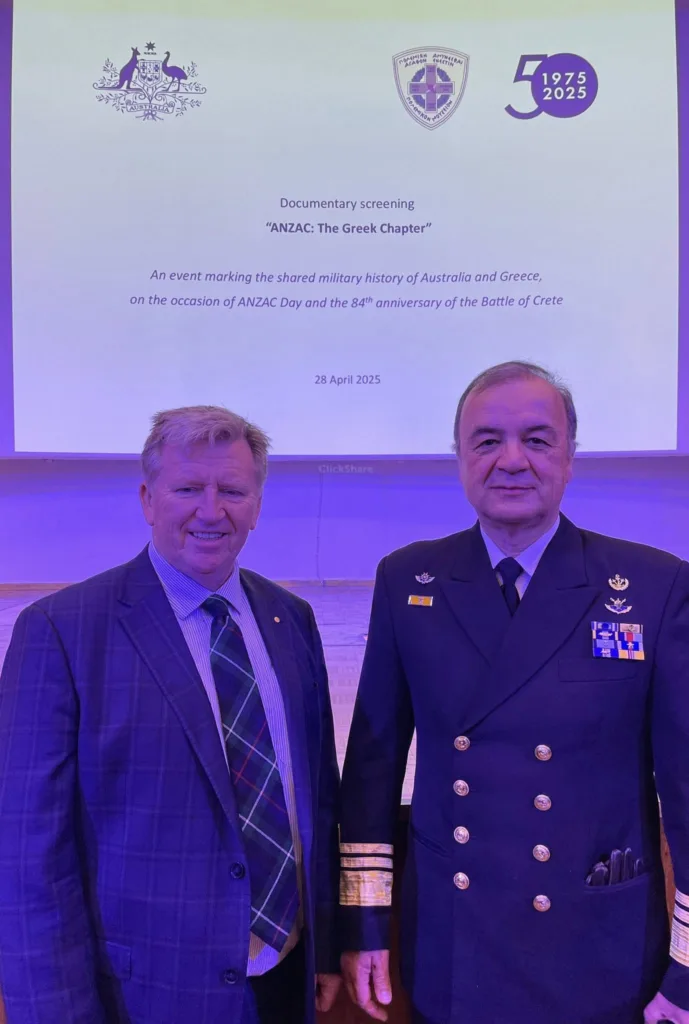
The documentary ANZAC: The Greek Chapter premiered at the Athens War Museum this week, drawing over 200 guests to an invitation-only event co-hosted by the Australian Embassy in Greece, the Australian Defence Force, and the War Museum.
The screening marked the first presentation of the film in Greece and was delivered in partnership with the Lemnos Gallipoli Commemorative Committee.
All photos by Jim Claven OAM.
The film explores the ANZACs’ role in the 1941 Greek Campaign, including battles in Vevi, mainland Greece, and Crete. It was funded by the Australian Government and produced by historian Dr Peter Ewer and filmmaker John Irwin, with support from Jim Claven OAM and community liaison Vicki Kyritsis.
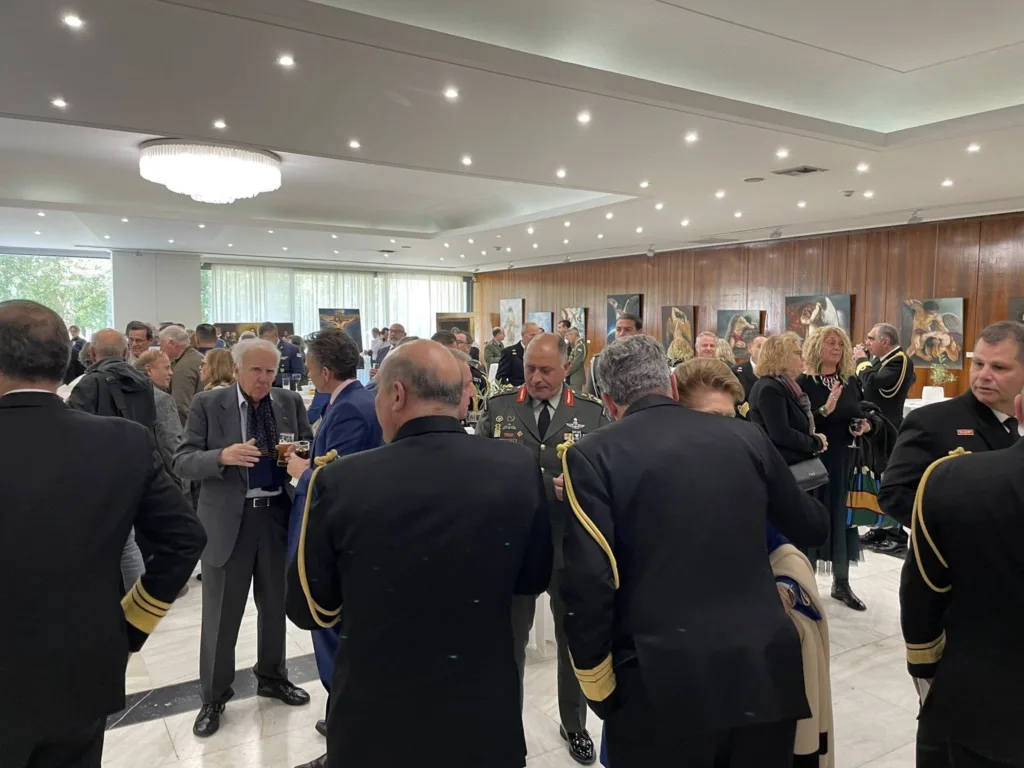
The premiere attracted dignitaries from diplomatic and military circles, veterans’ families, academics, and members of the Greek Australian community.
Among those in attendance were Vice Admiral Christos Sasiakos of the Hellenic Navy, former Melbourne Greek Consul Dimitrios Michalopoulos, MP Athanasios Papathanasios, Mr Claven and Ms Kyritsis, representatives of the Benaki Museum, and members of the British Greek Campaign Veterans Brotherhood.
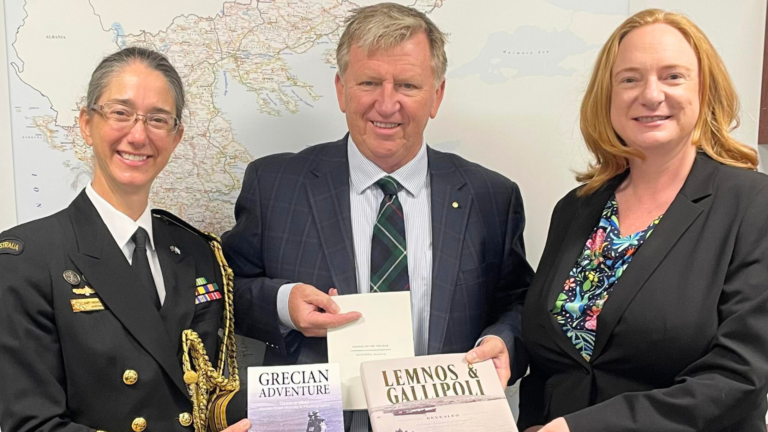
Australian Ambassador to Greece Alison Duncan and War Museum President Lieutenant General Konstantinos Karamesinis delivered welcome remarks, while Captain Rachel Jones CSC RAN acted as emcee.
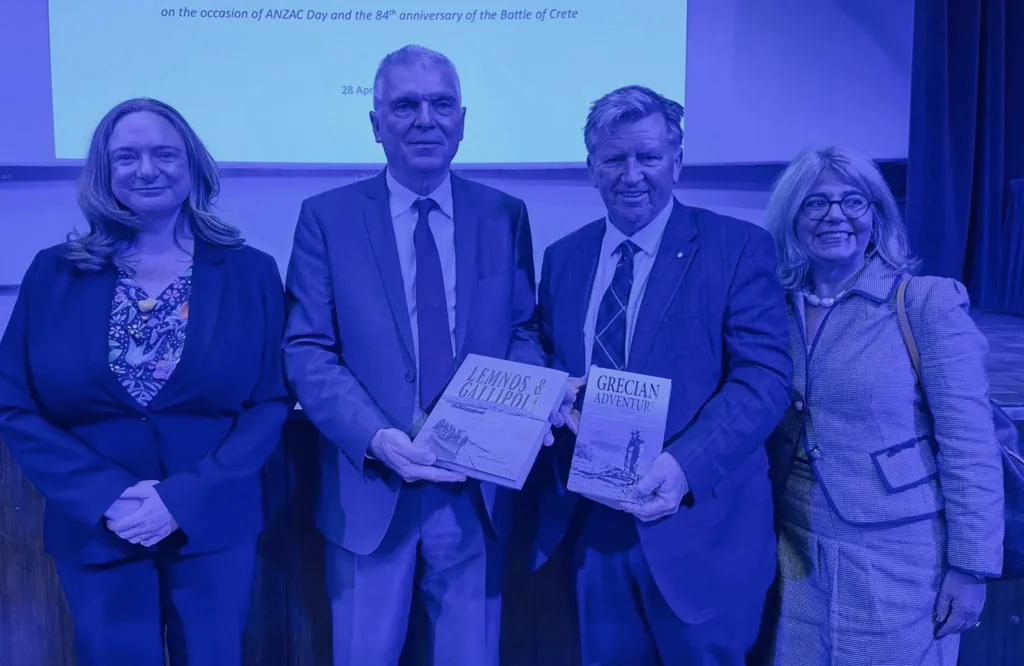
During the event, commemorative publications including Lemnos & Gallipoli Revealed, Grecian Adventure, and the Major George Treloar Memorial booklet were presented to the War Museum library.
The screening generated strong interest in further Greek showings and potential broadcasts. Organisers hope it will contribute to growing awareness of the Hellenic link to the ANZAC legacy, complementing the ongoing development of the Lemnos Remembrance Trail.
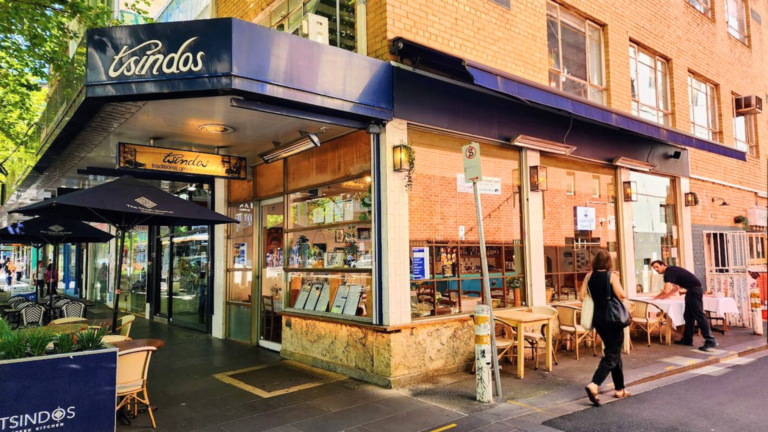
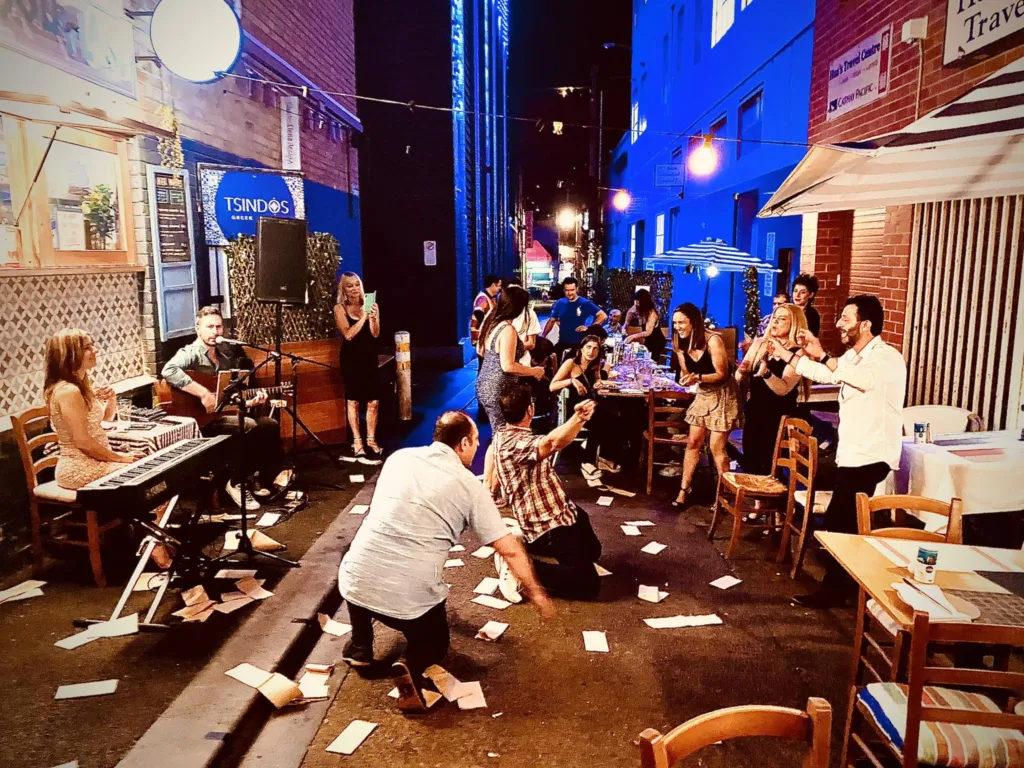
Tsindos Greek Restaurant, a long-standing fixture of Melbourne’s Greek precinct on Lonsdale Street, has entered voluntary liquidation after more than 40 years of operation.
A notice filed with the Australian Securities and Investments Commission on Monday confirmed the appointment of insolvency expert Mark Brereton of HoganSprowles as liquidator.
Photo: Facebook.
Established in 1970 by Harry and Eleni Tsindos and officially opened in 1983, the family-run restaurant has been managed by Eleftheria and Fred Tsindos since 1984, with their son Harry Tsindos Jnr overseeing operations for the past decade.
Known for its traditional Greek cuisine, including banquets, seafood, meats, mezes and salads, the venue operated from a three-level building that sold in 2019 for around $8.1 million to a Taiwan-based buyer.
The restaurant’s closure marks another loss for Melbourne’s once-thriving Greek precinct, following the closure of International Cakes, the last remaining bakery in the area.
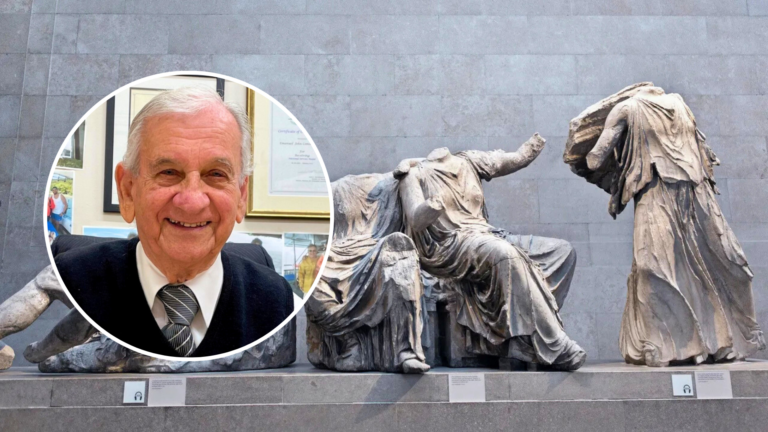
Renowned cultural heritage advocate Emanuel J. Comino AM will deliver a public lecture on Thursday, 15 May 2025, at 7pm at the Hellenic Club of Canberra at Woden, sharing insights from nearly five decades of campaigning for the return of the Parthenon Marbles to Greece.
Mr Comino, Founder and Chairman of the International Organising Committee – Australia – for the Restitution of the Parthenon Marbles, established in 1981, has dedicated over 49 years to global advocacy on the issue.
His efforts were formally recognised during the 1981 National Convention of AHEPA Australia, where the first committee for the Marbles’ return was formed.
The upcoming lecture, hosted in the Apollo Room and presented by AHEPA Canberra and the Hellenic Club, offers attendees a chance to hear directly from Mr Comino about his international campaign and the cultural significance of the Marbles.
Those requiring assistance with booking can speak to staff at the Hellenic Club reception. A live stream will also be available here for those unable to attend in person.
Event Details:
What: Parthenon Marbles talk by Emanuel Comino
When: Thursday, 15 May 2025 at 7pm
Where:Hellenic Club of Canberra at Woden, Apollo Room
The Australian Institute of Macedonian Studies (AIMS) is organising on Friday, July 11, 2025, at the Lyceum Theatre, Alphington Grammar, at 6.30 pm, a special Philological Memorial Ceremonyto honour the memory of its first founding Secretary, Peter Jasonides.
The Memorial ceremony for the late Peter, one year after his death, will include a 20-minute lecture by historian Terry Stavridis on Hellenism of Asia Minor.
This will be followed by a salutation by the President of AIMS, Professor Anastasios Tamis, who will refer to the life and contribution of this enthusiastic and energetic leader, who served Hellenism as a leader of the Pontians, as President of the Pan-Macedonian Association, as a leader of the Greek Australian Students, as a founding Secretary of AIMS, as director of the Welfare Program of the Greek Orthodox Archdiocese of Australia in Victoria, as an initiator and communion of Pontian Greek culture and an honourer of its traditions.
The Peter Jasonides Awardwill then be presented to the student with the highest performance in the Modern Greek course at Alphington Grammar, while a special music group will perform traditional Pontian rhythms during the reception.
Although official invitations will be sent, the Memorial ceremony is open to all those who wish to attend and remember the great contribution of this tireless patriot.
The national and social worker of the Greek community:
Naturally and irrevocably, all those who leave the earthly things, throw relatives, descendants and friends into orphans, deprive all those who have had the happiness to live with them of the right to experience, leave an irreplaceable void that cannot be filled with the tears and sorrow sown by their loss. Their loss throws the people around them into an intense mental and physical test. Fear, irresistible sadness, anger, despair and denial, are some of the emotions experienced by all those left behind to mourn them.
All those who pass away have their own people to weep for them, mourn them and respectfully honour their memory. All those who pass away have their own, unique value, their own sign of dignity and their share of appreciation and respect. All people have their diversity, their otherness, which makes them all important and unique.
However, some transcended personal and family boundaries. They worked and were socially active. They felt that they were serving a debt to the society they were called to serve, or as they matured, they found themselves in various public positions or finally they chose as a purpose in life to serve the commons. Sensitive citizens emerged, people who felt that they were serving specific goals assigned to them by their fellow citizens. And it was this creative and participatory contribution that made them the pioneers of Hellenism. When death comes and deprives these individuals of their presence, then the void outweighs the family dividend, and their loss affects the events of a society.
The saying that no one is irreplaceable is a myth and a grim fallacy. This is a deliberately erroneous assessment, aimed at devaluing the work of posterity for these personalities. The history and evolution of humanity have shown that each of the individuals with giving is indeed unique, authentic, and irreplaceable. No one filled Thucydides’ void, no one replaced Phidias, no one filled Aristotle’s void, nor the thousands of men and women who, with their uniqueness, left their own distinct imprint on life. And to come to our own world and our own time, neither new prime ministers, nor new church fathers, nor spiritual men, nor intellectuals and philosophers, nor poets and writers, painters and artists who were able to replace older figures were born. Like those who will follow, they cannot be considered to have filled a gap and replaced their predecessors in art, power, style, quality and vigour.
Thus, the loss of public figures, leaders of communalism, citizens with sensitivities, as in the case of Peter Jasonides, takes on a tragic dimension, precisely because there is no way to find a replacement for him. His action and contribution remained and will continue to remain exclusive, without precedent or next contender. This is because he had a pioneering character, he was authentic, the product of selflessness and patriotism. He had as his source the unwavering love he felt for Greece, a country he did not experience, and for Pontus, an idealised axiom of homeland, in which he studied as a child. The Pontic dialect, the musicality of the dialect, the singing, the rhythm of the lyre and their dances he lived from his cradle, they were native sounds. Inside him lived the historical course of his Pontian ancestors, their testimonies, their tragic journey.
He knew up close and from the inside all those who governed Pontian Hellenism, in Greece, in Europe, in America, their executives and leaders. He was familiar with the actions taking place, the campaigns for domination, the struggles for supremacy. He had direct communication with them.
Galantomos (generous) and master of behaviour, he organised a plethora of cooperative lunches and dinners, visits and consultations, met and co-decided, disagreed and agreed. He was the Archon from Australia. Humble where it should be, strict and compelling, again, where it should be. He had his own opinion and ideas about collegiality, friendship, amity and partisanship.
From a high school student, he still taught the Pontian dances. As a tertiary student, he upgraded culturally the student conferences, which, until he took over the leadership, had only a social role. Assemblies focusing on social wellness and entertainment. Mr Jasonides gave these student gatherings a cultural and historical dimension. He was interested in the promotion of Greek culture and language. He wanted to highlight the cultural role of children born in Australia. He was one of them.
With visibility in management, newspapers, symposia, he won all the leading positions in the Pontian and Macedonian community organisations of Australia. In their Federations, he worked pro bono in dozens of charitable organisations, in unions and associations, even in political party committees. He has delivered decades of service and civic engagement. How many are the young people of the second generation, the Australian born who gave their time and passion for Greece, the Greek communities, the unions, our national issues? Minimum. How many of them reached the entire contribution of Mr Jasonides, who had just begun to turn his hair white, before the psychopomp Hermes took him?
He contributed to the Greek Orthodox Archdiocese of Australia, our historical communities, the student movement, our cultural tradition, education, arts and letters, Greek letters, Australian and Greek organisations, our Cyprus. His vacuum cannot be filled. Mr Jasonides, as well as some special figures who were fortunate enough to live among us, were and will remain irreplaceable and unique.