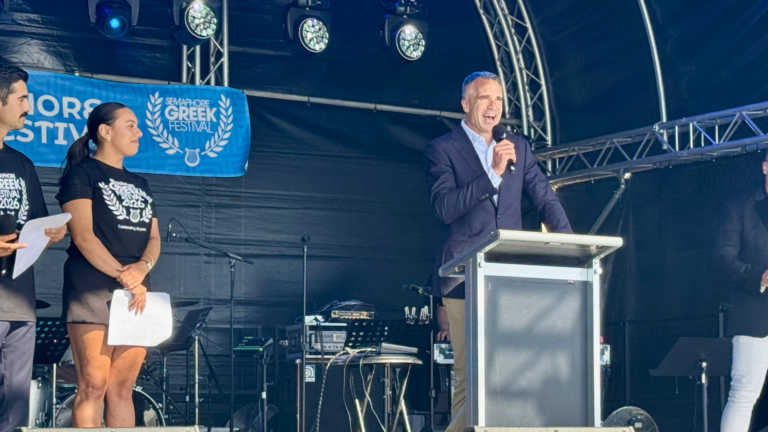
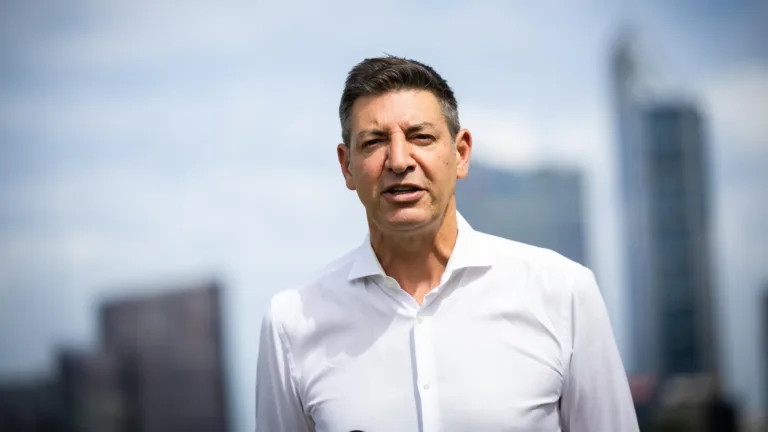
A proposed increase in state government funding for the Semaphore Greek Festival was announced on Saturday, January 17, during the festival’s official opening ceremony at the Semaphore foreshore.
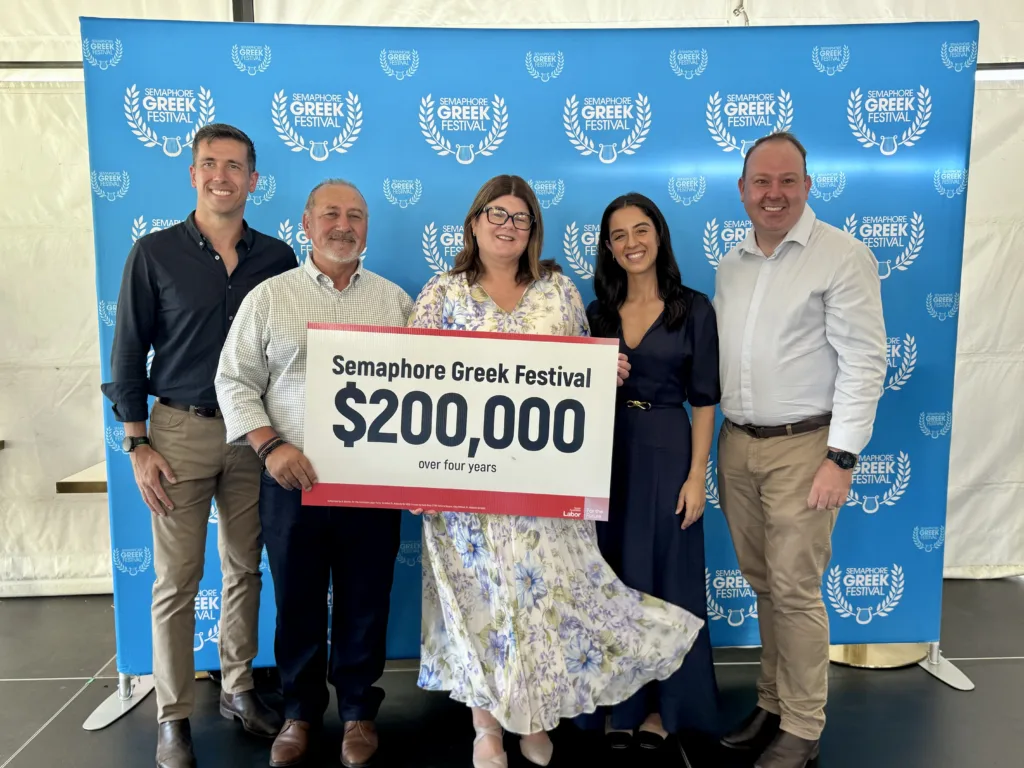
Speaking to the crowd, Peter Malinauskas outlined a plan to increase annual funding for the festival from $30,000 to $50,000, alongside a four-year funding commitment valued at $200,000, subject to the government being re-elected.
“So tonight, I’m very pleased to announce that the Labor Government, if we’re re-elected at the election, we’re going to increase the funding for this festival from $30,000 a year to $50,000 a year,” Mr Malinauskas said.
Festival organisers welcomed the proposed $200,000 four-year funding commitment announced during the Semaphore Greek Festival’s official opening.
“And then what we’re going to do is we’re going to give you a once-off. So we’re going to provide guaranteed funding over the four-year cycle… for $200,000.”
The Premier praised the scale of the community effort behind the event, noting the strong intergenerational involvement of volunteers.
“I was just getting around with John, talking with the volunteers, with the leader of this event,” he said. “It always impresses me the way that we see out here not just volunteers working, but families of volunteers.”
He also highlighted the broader social value of multicultural festivals at a time of global uncertainty.
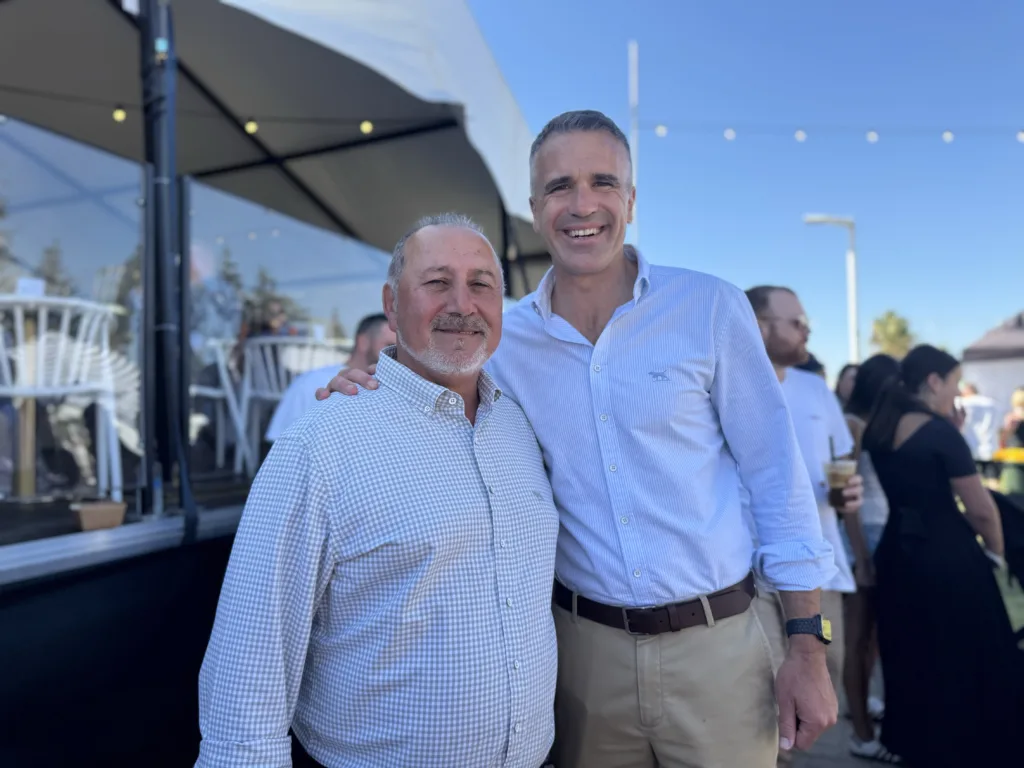
Peter Malinauskas with President of the Port Adelaide Greek Orthodox Community, John Douvartzidis, at the Semaphore Greek Festival.
“At a time around the world where we see so many communities being torn apart, people racing trying to find differences with one another, I’ve got to say I think there’s a value in something very special about multicultural communities opening up their hearts with warmth and generosity,” he said.
“When we invest in that, when we make these things happen, what we’re really choosing to do is make sure that South Australia remains not just one of the most prosperous societies anywhere in the world, but one of the most inclusive and one of the most peaceful.”
President of the Port Adelaide Greek Orthodox Community, John Douvartzidis, welcomed the funding announcement, thanking the South Australian Government for its continued support and acknowledging the importance of long-term backing for a volunteer-run community festival.
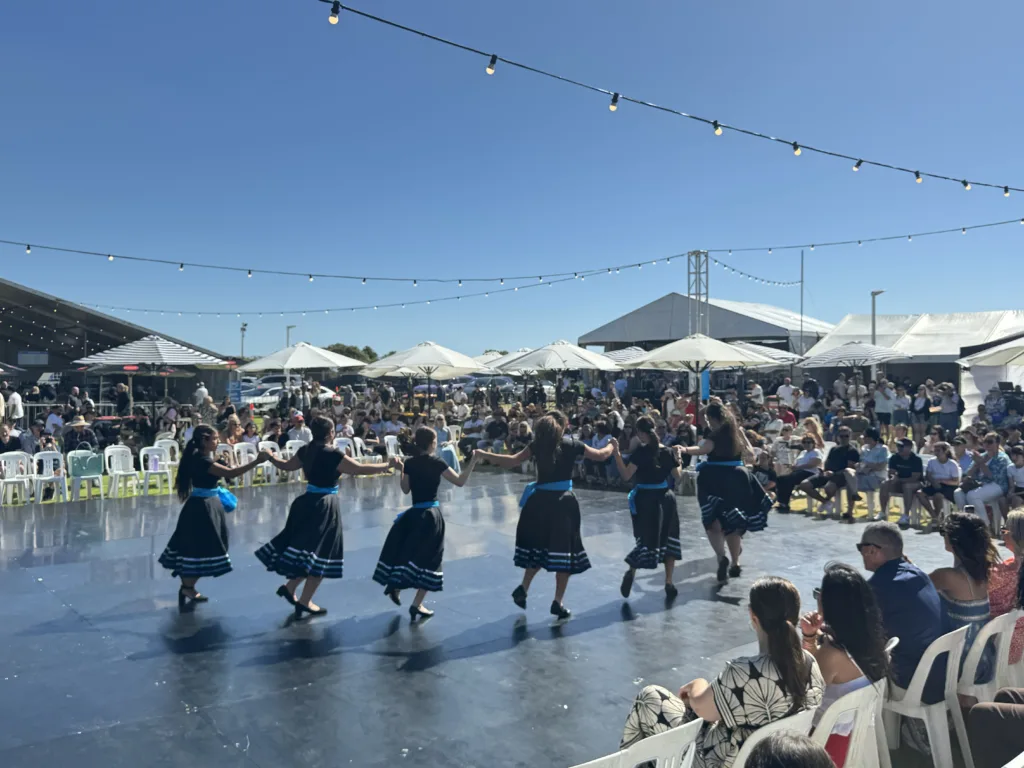
Crowds gather along the Semaphore foreshore as the Semaphore Greek Festival celebrates its milestone 45th year, with food, music and dance drawing families and visitors across the weekend.
The Semaphore Greek Festival, now in its 45th year, is organised by the Port Adelaide Greek Orthodox Community and delivered by more than 300 volunteers, drawing thousands of visitors to the Semaphore foreshore each January for traditional food, music and dance.
The funding announcement was made as the South Australian Government approaches the end of its current term, with the next state election scheduled for March 21, 2026. Any funding increase would be subject to the outcome of that election.
The proposed commitment would provide increased financial support for one of South Australia’s longest-running multicultural festivals, which continues to play a prominent role in celebrating Greek culture while welcoming the wider community.
His Eminence Archbishop Makarios of Australia has underscored the central role of Greek Orthodox education in safeguarding the future of the Greek-Australian community, describing schools as “our most precious treasure.”
The remarks were delivered during the official dinner held in honour of his name day on Saturday, 17 January, at the Pullman Melbourne Albert Park, which brought together hundreds of clergy, faithful, and representatives from political and diplomatic circles across Victoria.
Despite the ballroom being filled to capacity, the evening retained the character of a warm and familial gathering, marked by a prevailing spirit of unity and fraternity within the Greek Orthodox community.
At the heart of his address, Archbishop Makarios emphasised that it is within the classroom that the future of the diaspora is shaped – where the Greek language, customs, traditions and the heritage of forebears are cultivated and preserved.
“Our schools are the most precious thing we have,” he said, noting that education remains fundamental to sustaining Greek identity and faith across generations.
In line with this vision, and at the Archbishop’s request, the proceeds from the name day dinner will be directed towards supporting the ongoing needs of St John’s College, Preston, reaffirming the Holy Archdiocese’s commitment to strengthening both Greek and theological education throughout Australia.
Earlier in the evening, a visibly moved Archbishop Makarios thanked attendees for their presence and offered praise to God for the blessings bestowed upon the Greek Orthodox Archdiocese of Australia.
“The glorification of God, in word and in deed, is the quintessence of our life within the Church,” he said. “It is the foundation of our spiritual life and existence.”
Reflecting on the role of faith in daily life, His Eminence noted that God works through people, urging the faithful to remain open to one another.
“May our hearts and our very being always be open and receptive to the presence of our neighbour,” he said.
Archbishop Makarios also expressed gratitude for the service of Bishop Kyriakos of Melbourne and Bishop Evmenios of Chora, describing both hierarchs as “a gift and a blessing of God” for Victoria and Australia more broadly.
He further acknowledged the tireless efforts of the clergy and laity, many of whom contribute voluntarily to the life of the Church. As a formal expression of gratitude, His Eminence conferred the Medal of the Order of the Philochristoi upon 39 individuals who have distinguished themselves through their service to the local Church.
In closing his address, Archbishop Makarios conveyed the patriarchal blessings and warm wishes of Ecumenical Patriarch Bartholomew, noting the significance of his spiritual guidance.
“It is now self-evident to all of us that whatever takes place in the Holy Archdiocese of Australia bears the blessing and approval of our Patriarch,” he said, adding that this support provides confidence as the Archdiocese looks to the future.
One of the most moving moments of the evening came with a fraternal address by Bishop Prodromos of Toliara, who presented the missionary work being undertaken in Madagascar with the support of the Orthodox Church in Australia. As a token of gratitude, Bishop Prodromos bestowed upon Archbishop Makarios the highest distinction of the Holy Diocese of Toliara and Southern Madagascar, together with an icon of Saints Constantine and Helen.
The program was further enriched by hymns, songs and traditional Macedonian dances, with performances by a student choir, the choir of the School of Byzantine Music, and the Florina Dance Ensemble “Aristotelis.”
Among those present at the official dinner were Metropolitan Ezekiel of Dervis; the High Commissioner of Cyprus to Australia, Antonios Sammoutis; the Consul General of Greece in Melbourne, Dimitra Georgantzoglou; Archons of the Ecumenical Patriarchate; Victorian State MP David Davis, representing the Leader of the Opposition Jess Wilson; and Nikolaos Archontonis, brother of the Ecumenical Patriarch, accompanied by his wife Aikaterini.
Recipients of the Medal of the Order of Philochristoi: Nikolaos Avramopoulos, Ioannis Anagiannis, Genovefa Vlachou, Theodosia Vlachou, Kalliopi Vraka, Anastasia Gelli, Georgia Georgiou, Christos Dimitriou, Pavlos Douvartzidis, Konstantinos Emmanouil, Georgios Kailis, Dimitrios Karavasios, Stefanos Karamoschos, Matthaios Karakinos, Ioannis Kargas, Christos Koniditsiotis, Konstantinos Kolokythas, Petros Kotopoulos, Sofia Koutoula, Androula Leria, Maria Moutafi, Vasileios Bereveskos, Athanasios Binios, Martha Bitsola, Spyridon Bouziotis, Michail Xafis, Andreas Panagias, Theodora Panagiotou, Efthymios Paronis, Theodoros Politakis, Athanasia Tzimou, Panagiotis Tziotzis, Efstatios Tsalikidis, Anastasios Philippou, Georgios Charalambopoulos, Christodoulos Charalambous, Eleftheria Chatzipanagiotou, Georgios Christofis and Christos Christofis.
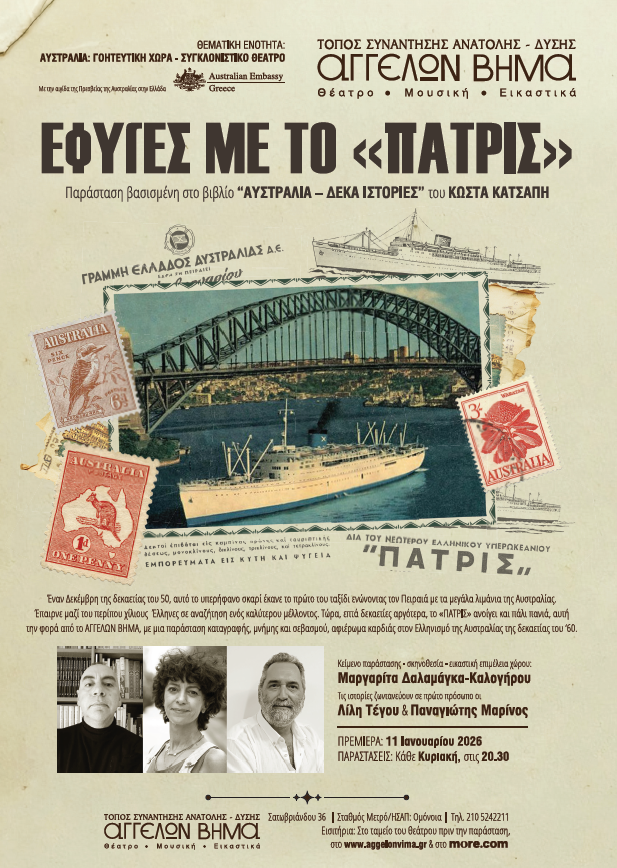
Yet another play at the Aggelon Vima Theatre in Athens prompted me. The theatre’s November 2025–April 2026 season, dedicated to Australia, features award-winning plays about Australia, performed in Greek and written mainly by Australians.
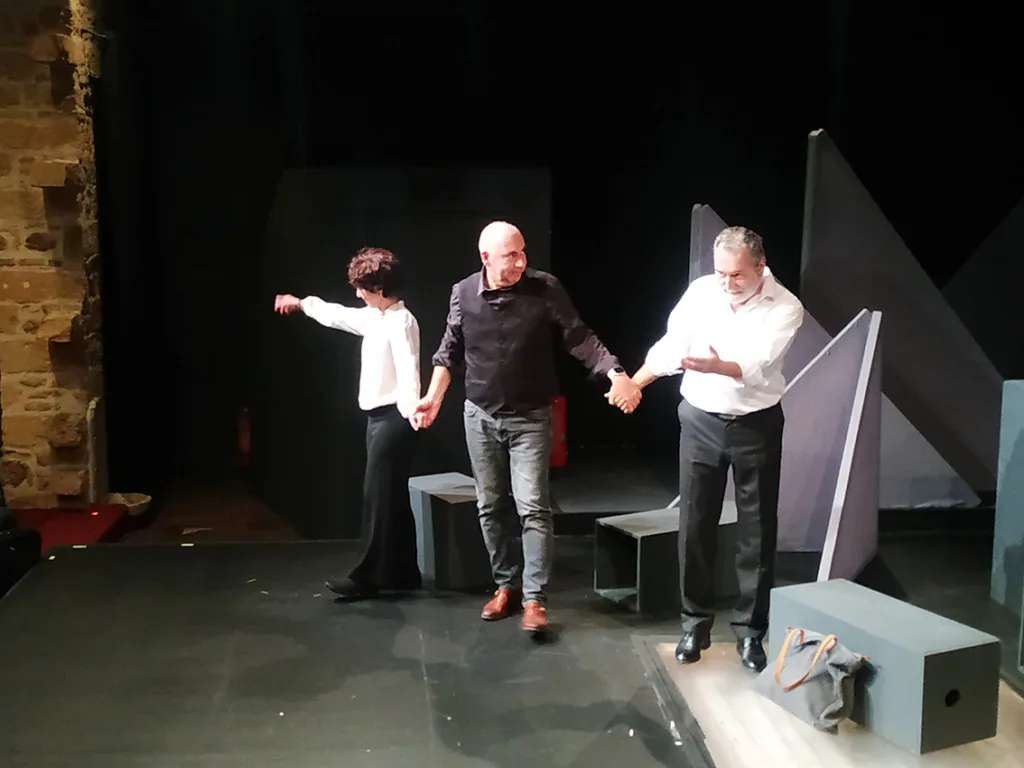
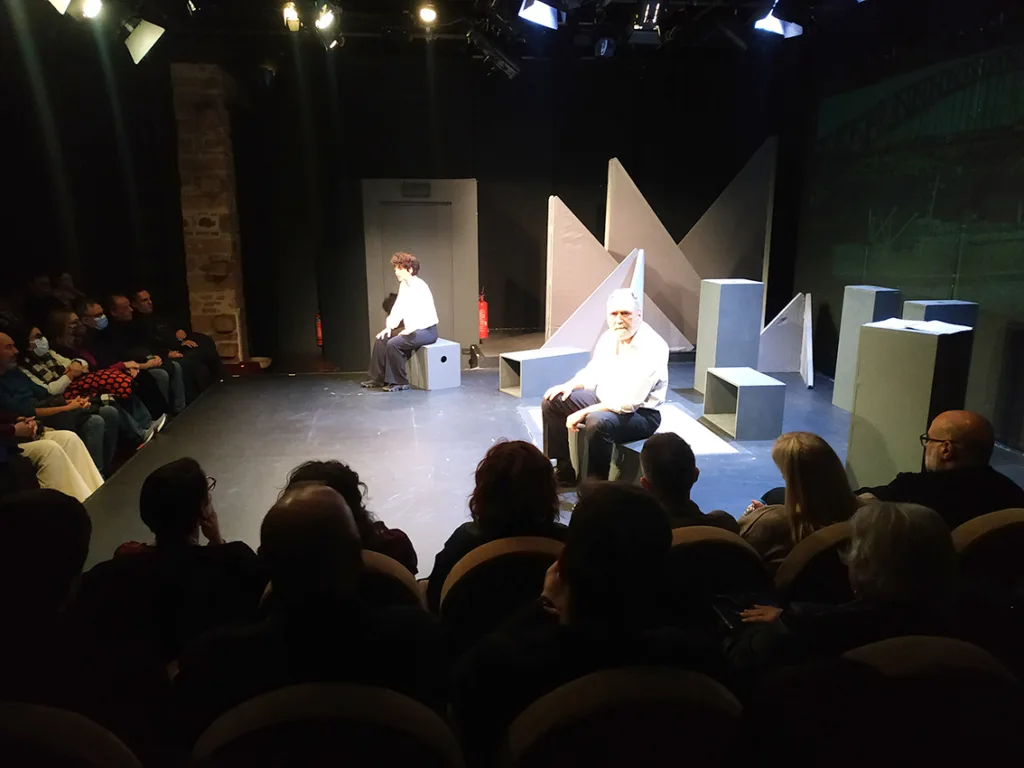
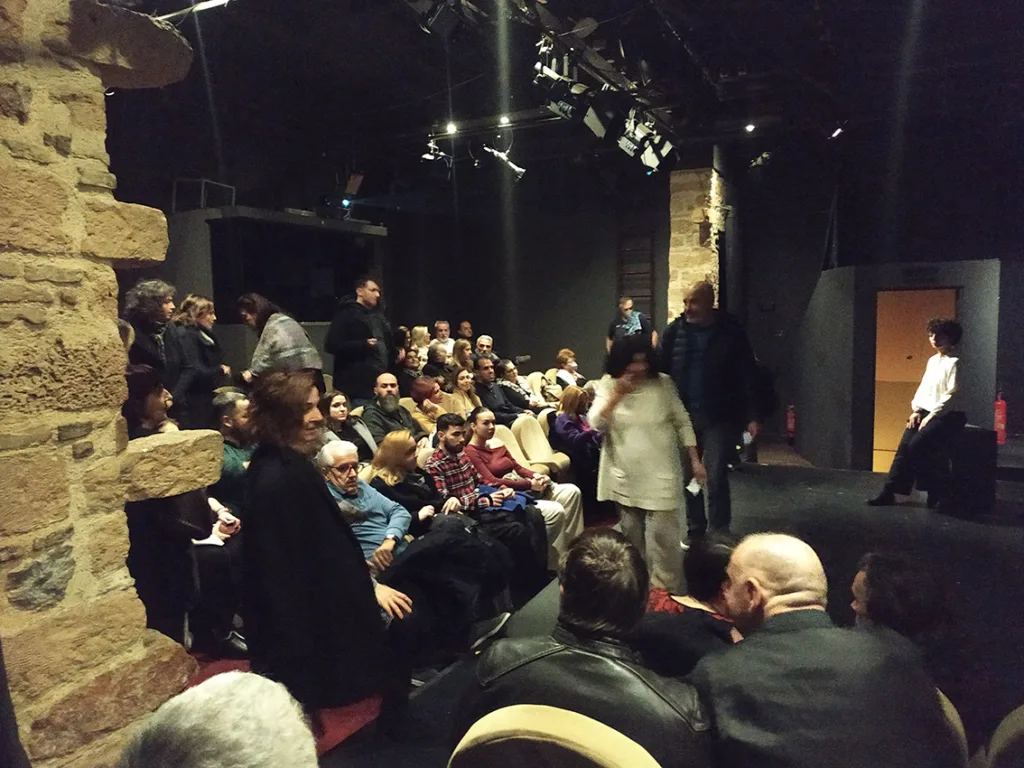
This time though, there was an extra spring in my step upon attending the Aggelon Vima Theatre’s opening-night premiere, no less, of the play Efiges Me To Patris (You Departed On Board the Patris).
Incorporating this specifically Greek-Australian-themed play within the theatre’s Australian repertoire more than complements the rounded picture of Australia aimed at in this dedicated series – it is a necessity, as so many Greeks left for Australia post-1950 in the hope of a decent livelihood. They – and we – deserve this homage.
And so, I breathed not only a sigh of relief but also felt a sense of pride at Greek-Australian cultural recognition in Greece when, last week, I noticed this important play – Efiges Me To Patris – listed within the theatre’s Australian-themed programme.
As the play’s title specifies, the familiar historical theme of immigration from Greece to Australia in the 1950s and 1960s forms the basis of this theatrical work’s anthology, made up of seven separate vignettes or embedded stories. Representing the time when the majority of our parents, grandparents and even great-grandparents arrived from Greece to Australia aboard ocean liners such as the Patris and Ellinis, the play skilfully delves into heartfelt themes such as hope, as well as trauma stemming from pre- and post-migration experiences.
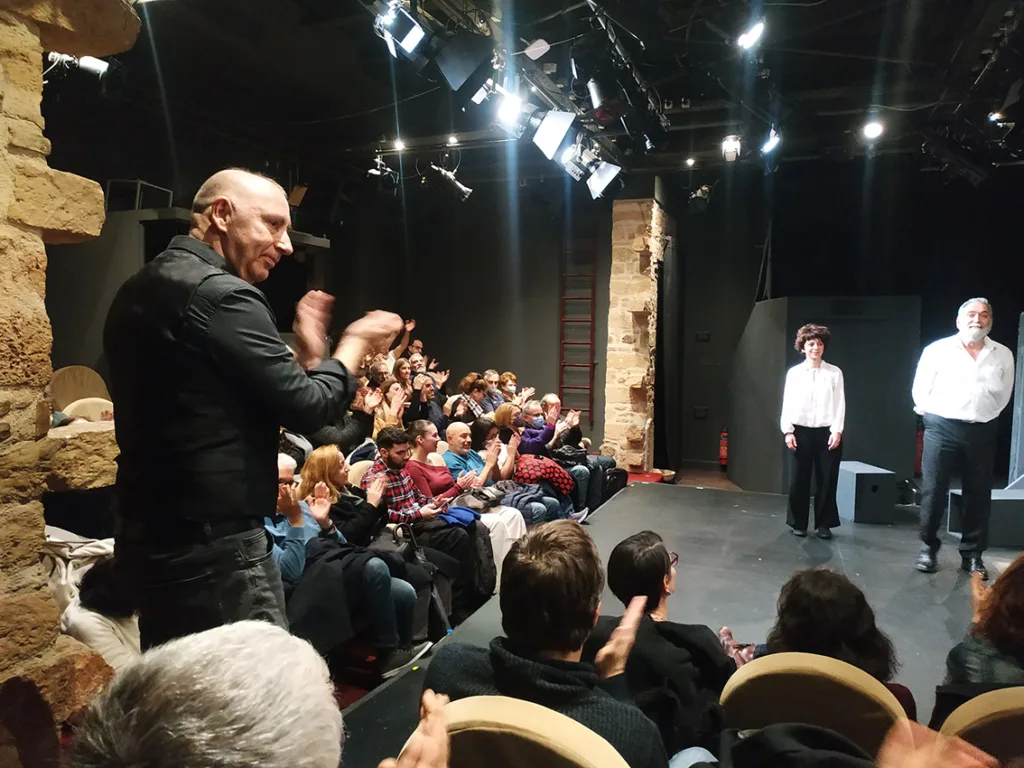
Seeing Efiges Me To Patris certainly did not disappoint. Often moving me to both tears and laughter, each of the play’s seven vignettes incorporated different characters and themes, many of them overlapping. Its demanding acting was executed to perfection by just two performers — the extremely talented Greek actors Lily Tegou and Panagiotis Marinos.
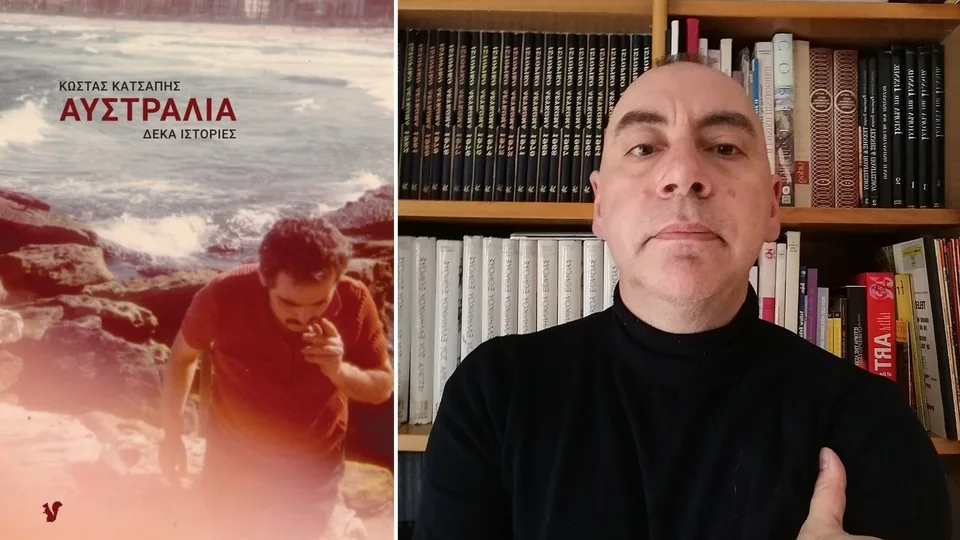
The book’s author, Mr Katsapis, is an academic and historian teaching at Panteion University in Athens. Born in 1973, his parents migrated to Australia in the 1960s and returned to Greece a year before his birth. Even so, Mr Katsapis lived – and continues to live – within the milieu of the Greek-Australian migration experience.
Born, growing up and living in Greece, Mr Katsapis finally went to Australia in 2011 and 2012. He says, “I grew up surrounded by Australia, through my parents’ migration experience from 1964 till 1972. My sister was also born there in 1966. So even now, when we have family get-togethers, our chats revolve around Australia – including debating whether it was the right decision to come back to Greece, etc.”
Meeting up with him recently, among the many topics we discussed was how the book inevitably highlights non-fiction within fiction, and how this manifests through geopolitical and historical influences. Even though major life events like migration impact individuals uniquely, it is one’s cultural and ensuing social environment that tends to ‘nurture’ ideas and behaviour.
Despite being primarily a historian, Mr Katsapis’ decision was to write this book as fiction, with a few juxtaposed biographical themes as well as official Greek-Australian archival sourcing. His work results in more personal and relatable access for both the reader and, in this case, theatrical audiences.
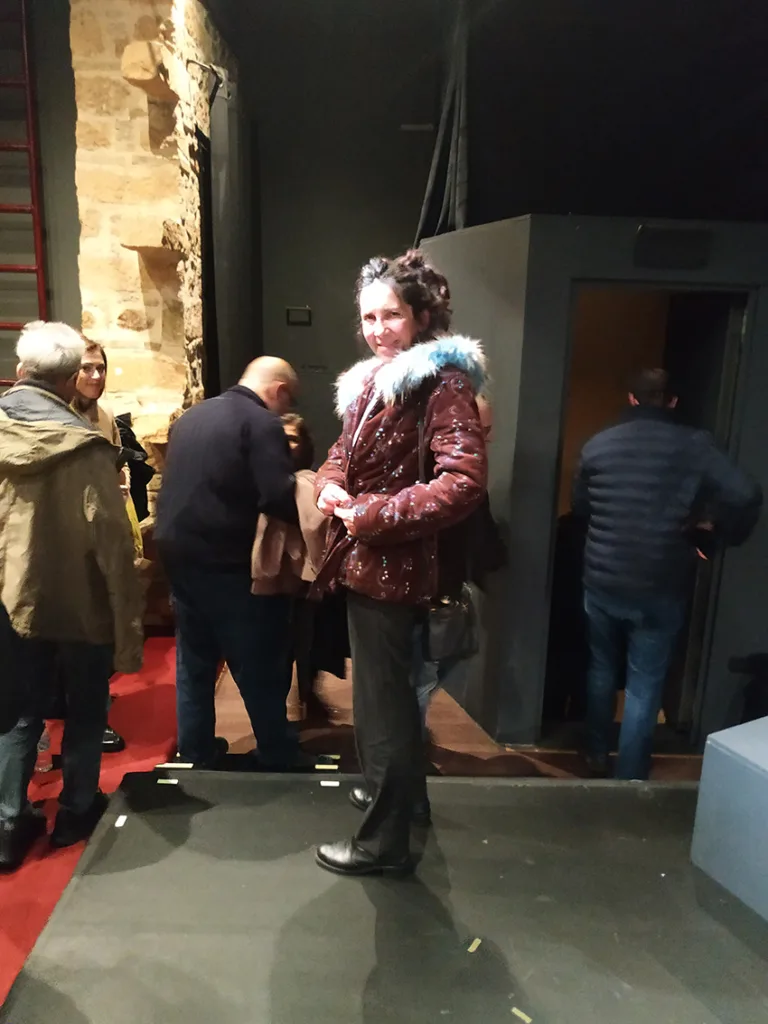
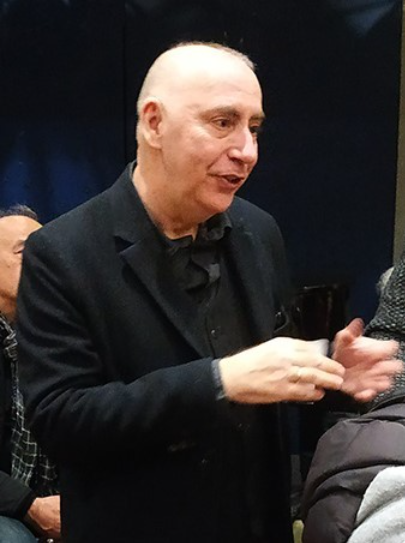
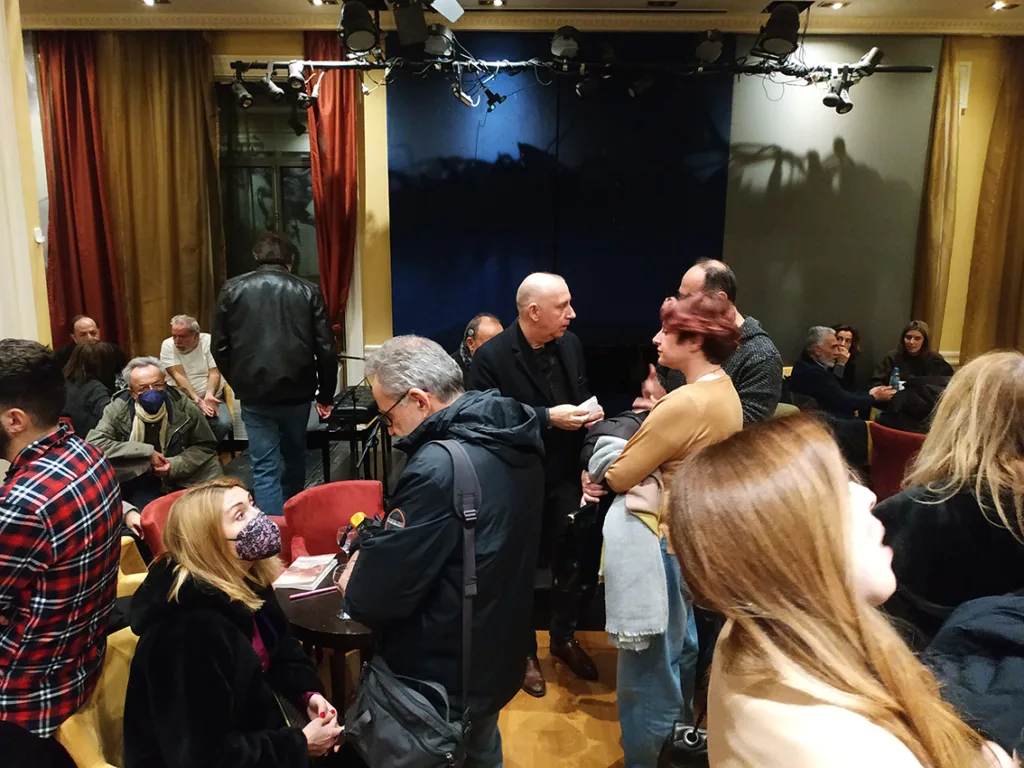
On attending the premiere of Efiges Me To Patris as an author seeing his work performed theatrically for the first time, Mr Katsapis exclaimed: “The play was better than I could’ve even hoped or imagined.” In fact, when I also briefly saw him at the theatre immediately after the play ended, he said sygkinithika (“I was very moved”) in response to my tearful “congratulations”.
Now to the “guts” of the play… One theme enacted in the play’s separate stories is that of two Greek parents perceiving their son as being “turned homosexual” by a “non-Greek”, and the mother’s angst over how to “stop him”.
Another scenario depicts an extremely depressed, middle-aged Greek woman. She tells a doctor that she “wants pills” because she has done – and continues to do – her duty as a wife and mother and, although she wants to change her life, feels powerless to do so.
A further issue enacted in the play refers to poorer young women from Greek rural areas, showing how some were often forced by their parents to either go to Athens to work as servants (psyhokores) or migrate to Australia to a future husband who, via a photograph of himself, seeks a wife.
In our meeting, Mr Katsapis mentioned: “It seems that women suffered a lot more in the migration experience than men.” We discussed how, apart from the majority working in factories or doing seamstress work at home, they also carried the additional responsibilities of domestic chores and child-rearing.
Quite a few of the play’s vignettes refer to Greek political persuasions being brought to Australia, highlighting inter-Greek community conflicts. Intergenerational conflict is also portrayed through a father and son-in-law, and their right- and left-wing – or “communist” versus “fascist” – politics. We even see a comic-tragic scenario of a spy who had not intended on such a ‘career path’. There are also references to the proika (dowry) system, portraying the binds inherent in cultural traditions.
To me, the word Patris – the final word of the play’s title – is key, in that it can also represent old-school Greece, including its use of older formal grammar (for example, Patris instead of Patrida). The play shows the 1950s predominantly rural mentality that constituted Greece’s formal values of family, nation and religion. These notions were transported to Australia and often exaggerated there, in fear of losing one’s culture within such a distant land and an ensuing different host culture.
Time transforms – including both Greece and Australia, and us. The play Efiges Me To Patris is a moving snapshot into first-generation Greek migration history. The play’s director, Ms Margarita Dalamaga-Kalogirou, extends this view, describing it as a mirror of all people, even today, regardless of age, who wish to change their lot in life, as those aboard the Patris once did. And they certainly succeeded in their new country, Australia.
The author Mr Kostas Katsapis’ message to Greeks in Australia at the end of our discussion was simple and heartfelt: “Tell them I love them very much, and I love Australia very much and look forward to visiting again ASAP.”
Former Whyalla steelworks owner OneSteel Manufacturing, part of Sanjeev Gupta’s GFG Alliance, owed $18.5 million in state royalties when the plant was forced into administration last year, SA Treasurer Tom Koutsantonis allegedly confirmed.
According to ABC, the debt included payments for iron ore processed and exported from the facility.
Koutsantonis said disclosure was previously restricted by law but could now be made public.
The company had faced ongoing operational challenges, including a four-month blast furnace halt and market disruptions, which contributed to delayed royalty payments.
Despite the debts, the federal government had pledged $63.2 million to support the plant’s green steel upgrades, a move questioned by former SA Senator Rex Patrick.
Koutsantonis defended the timing of the administration and stressed the government’s priority remained the long-term security of Australian steelmaking.
Administrators are now seeking a new owner, with Bluescope leading an international consortium, while other GFG businesses remain under financial pressure.
Ballajura’s The Candy Station was set on fire early Thursday, the fourth arson attack in a year linked to illegal tobacco sales, following last month’s shooting at the neighbouring Firkin pub.
According to The Sydney Morning Herald, local business owner Harshal Patel said the violence has driven customers away.
WA Health and emergency officials noted legal and logistical challenges in tackling the illicit trade, while Opposition Leader Basil Zempilas urged immediate legislation, saying it is “not good enough” for the government to delay.
Residents reportedly voiced safety concerns for nearby schools and families.
The attacks have renewed calls for swift government action to prevent further harm and curb illegal tobacco activity.
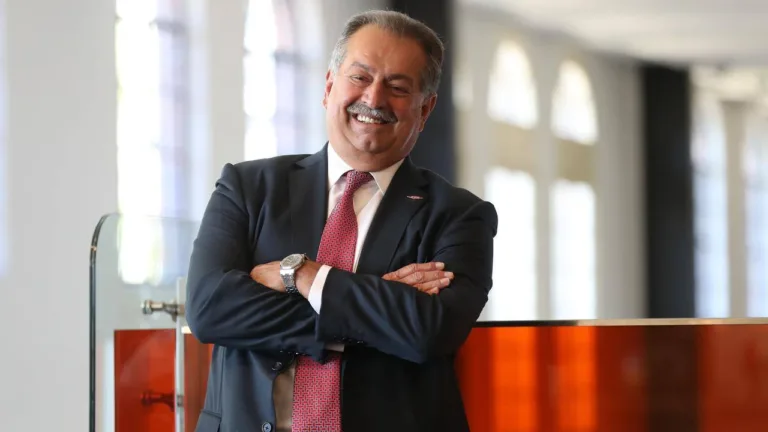
Andrew Liveris AO has been appointed chair of the American Australian Association (AAA), marking a leadership transition for the organisation.
A dual Australian–American citizen and former chairman and CEO of The Dow Chemical Company, Liveris succeeds Craig Chapman, who stepped down after 23 years on the board, including six years as chair.
Liveris also serves as President of the Brisbane 2032 Olympic and Paralympic Games Organising Committee, a role expected to strengthen links between Australia and the United States as preparations for the Games accelerate.
The AAA is anticipated to play a key role in facilitating US investment and corporate partnerships for Brisbane 2032, following a model similar to engagement ahead of the LA28 Games.
Announcing the appointment, the AAA described Liveris as “a titan of global industry whose career has been defined by the intersection of business, government, and society.”
“His leadership of the Brisbane 2032 Games, combined with his deep roots in both the American and Australian corporate sectors, makes him the ideal architect for the next chapter of our alliance,” the organisation said.
Police are continuing to appeal for information in the unsolved 1993 murder of Melbourne taxi driver Emanuel Sapountzakis, more than 30 years after his death.
The 26-year-old’s Ford Falcon taxi was found abandoned on Mountain Highway in Bayswater one March morning, locked with its roof lights on and the meter still running at $127.80. Sapountzakis had last logged a fare at 3.29am.
Just over an hour later, his body was discovered in scrubland at “Police Paddocks” in Endeavour Hills, more than 15 kilometres away. He had been shot several times, including in the head. His wife and two-year-old daughter were waiting for him to return home in Clayton.
Photo: Victoria Police.
The motive for the killing remains unknown, but investigators say they are particularly interested in reports that Sapountzakis had, on several occasions, been seen carrying large sums of US currency.
Sapountzakis, whose family migrated to Australia from Brazil in 1971, was working as a taxi driver while studying chemical engineering at Monash University.
Despite a public appeal in 2015, no arrests have been made. Police say they remain hopeful that someone with knowledge of who was responsible, and why, will come forward.
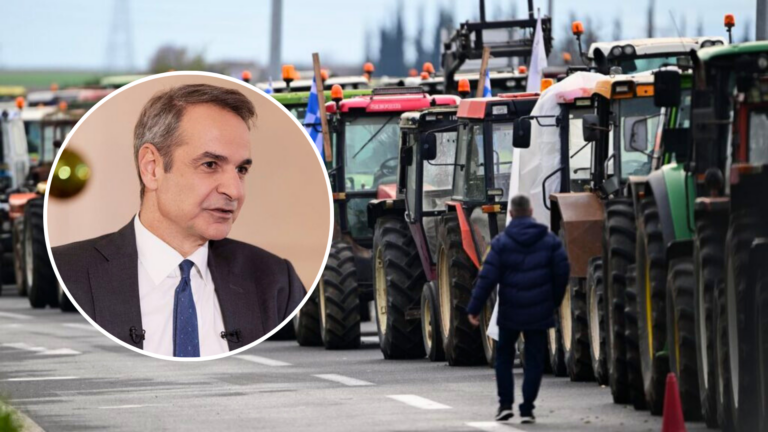
Greek Prime Minister Kyriakos Mitsotakis will host a new round of talks on Monday with a 25-member committee representing farmers, amid ongoing protests over lost income, delayed subsidies and rising costs.
The meeting follows weeks of demonstrations that have included tractor blockades on major roads.
Mitsotakis held initial talks last Tuesday at the Maximos Mansion, indicating possible improvements to existing support measures, particularly on electricity and fuel costs.
The government has set conditions for Monday’s discussions, requiring tractors to be sidelined and customs offices to remain open.
Six additional farmers’ representatives will attend as observers to report back to local assemblies, which will decide whether protests continue.
Major roads, including the Thessaloniki–Athens highway and the Egnatia Odos motorway, are currently open, while farmers continue to press for reduced production costs, compensation for crop losses, support for livestock breeders and measures to address livestock diseases.
Thessaly farmers are also seeking compensation for failed cotton and wheat crops and a fuel tax exemption.
The council is part of the second phase of Trump’s Gaza peace plan under UN Security Council Resolution 2803 and will oversee the transitional process and stabilisation efforts.
Former Bulgarian diplomat Nickolay Mladenov has been appointed High Representative to coordinate the council and related transitional bodies.
South Melbourne scored a dramatic 98th minute free-kick to ensure they overcame a dogged Tahiti United on Match Day 2 of the OFC Pro League.
After the excitement of the opening day on Saturday, it was finally time for the sides from French Polynesia and Australia respectively to stake their claim.
South Melbourne FC especially were of interest, as the only non-OFC representative. The Oceania Club of the Century keen to make their presence felt.
Certainly making his presence felt was South Melbourne’s Max Mikkola, whose impressive long throws were the highlight of a quiet opening period and of some concern to the Tahiti United backline.
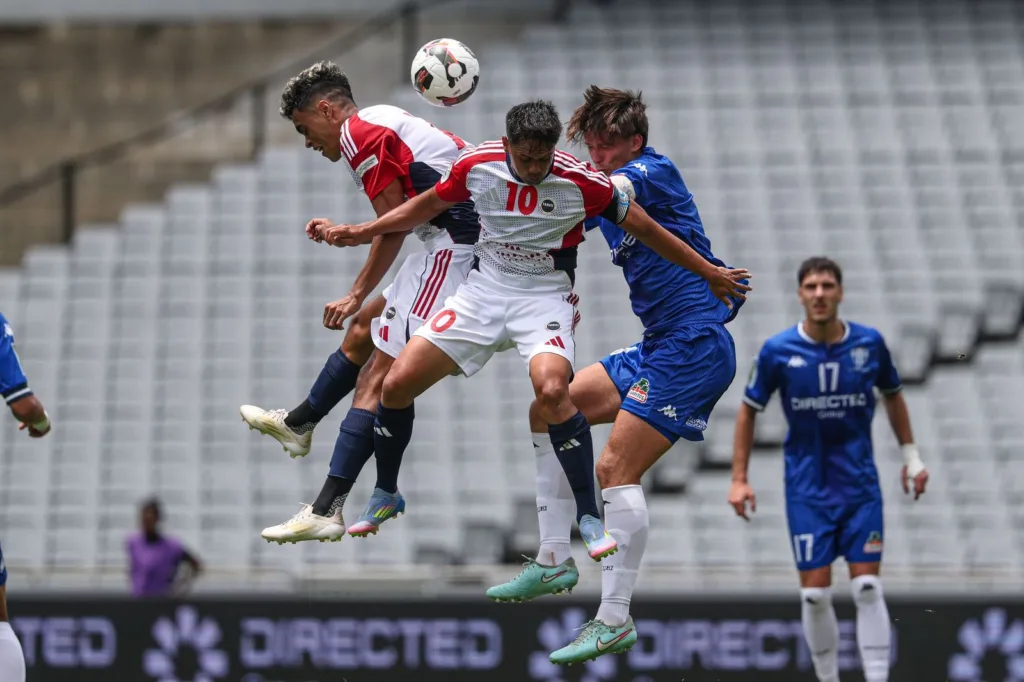
South Melbourne FC and Tahiti United contest a tense midfield battle during their Match Day 2 clash at the OFC Pro League. Photo Credit: OFC Media via Phototek.
The Australians were in charge for most of the opening period but despite their dominance, it was Tahiti United who opened the scoring and in spectacular fashion.
Manuarii Shan stood over a free-kick almost 30 yards from goal and his whipped left-footed effort was too much for goalkeeper Ilia Shalamanov-Trenkova, as the ball nestled in the corner.
Whatever head coach Sinisa Cohadzic said to his charges during the break certainly worked, as South Melbourne came out of the blocks at full tilt for the second-half.
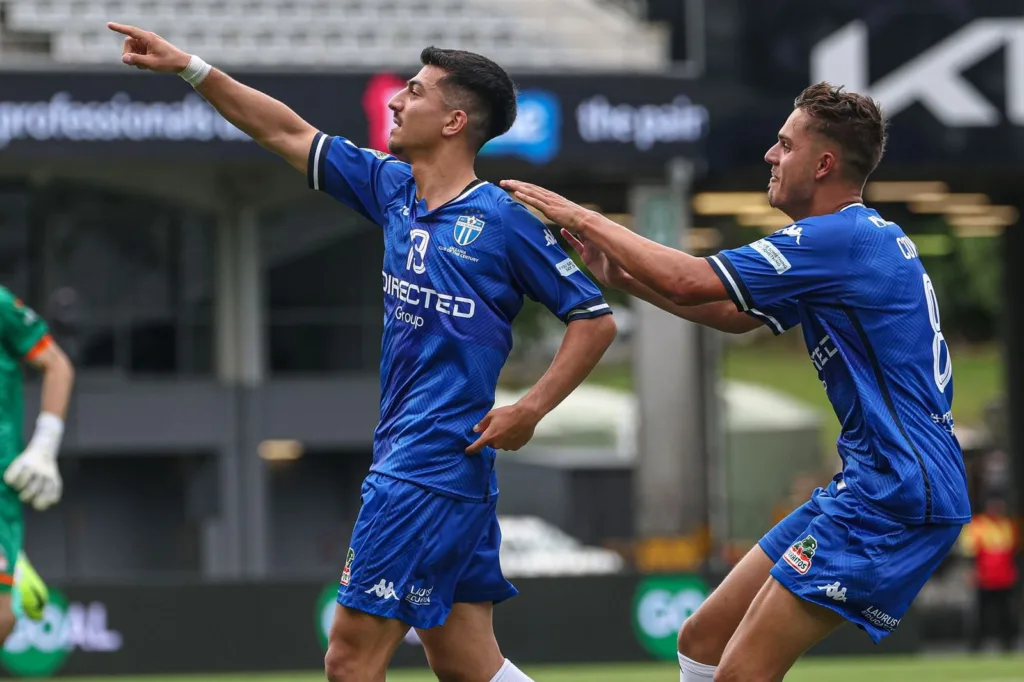
Less than two minutes were on the clock when they found a deserved equaliser. Japanese forward Yuki Uchida taking advantage of Tahiti United’s inability to clear from a corner, firing low past a thicket of bodies and past Jackson Gardner.
Gardner unfortunately wouldn’t last the distance, the ‘keeper suffering an injury than saw him replaced by Teave Teamotuaitau. Head coach Samuel Garcia will be hoping it’s not a long-term absence for his no.1 stopper.
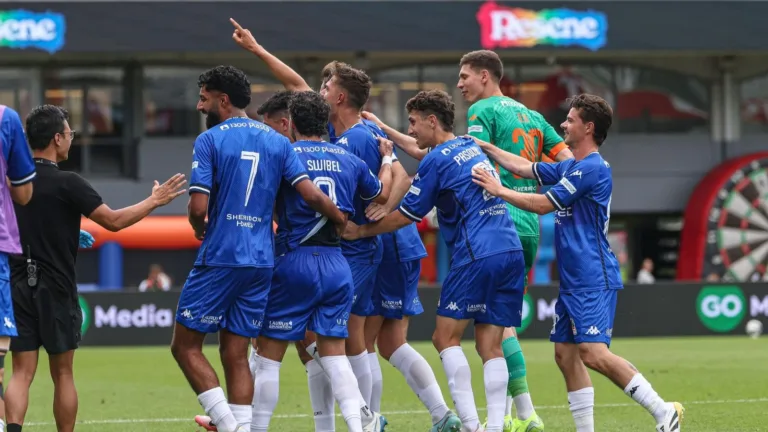
South Melbourne FC’s Andrew Mesourouni curls a stoppage-time free-kick past the wall to secure a dramatic 2–1 victory over Tahiti United in the OFC Pro League. Photo credit: OFC Media via Phototek.
Both sides threatened to take the lead, but chances were limited as a draw appeared inevitable.
Due to a number of injuries, ten additional minutes were signalled by referee Calvin Berg and it was in the eighth of these that South Melbourne found the winner.
Substitute Andrew Mesourouni was given the chance from a free-kick just outside the box and he matched Shan’s earlier effort, curling the ball up and over the wall and past Teamotuaitau to clinch a dramatic victory for Hellas.
Tahiti United: 1 (Manuarii SHAN 36′) South Melbourne FC: 2 (Yuki UCHIDA 47′, Andrew MESOUROUNI 90+8′)