A lecture on the uncharted similarities between Ancient Greek myths and Indigenous Australia Dreaming was held at the University of Sydney’s Madsen Building on Wednesday, March 8.
During his lecture, Dr Adrahtas focused on how although Ancient Greece and Indigenous Australia are geographically and historically far apart, they present an amazing array of similarities in their underlying hierophanics.
The room was filled with interested attendees including the Consul General of Greece in Sydney, Ioannis Mallikourtis; the Trade Commissioner of Greece in Australia, Chrysa Prokopaki; Aunty Glenda Humes, the daughter of Indigenous ANZAC Captain Reginald Saunders; and renowned author Kate Forsyth.
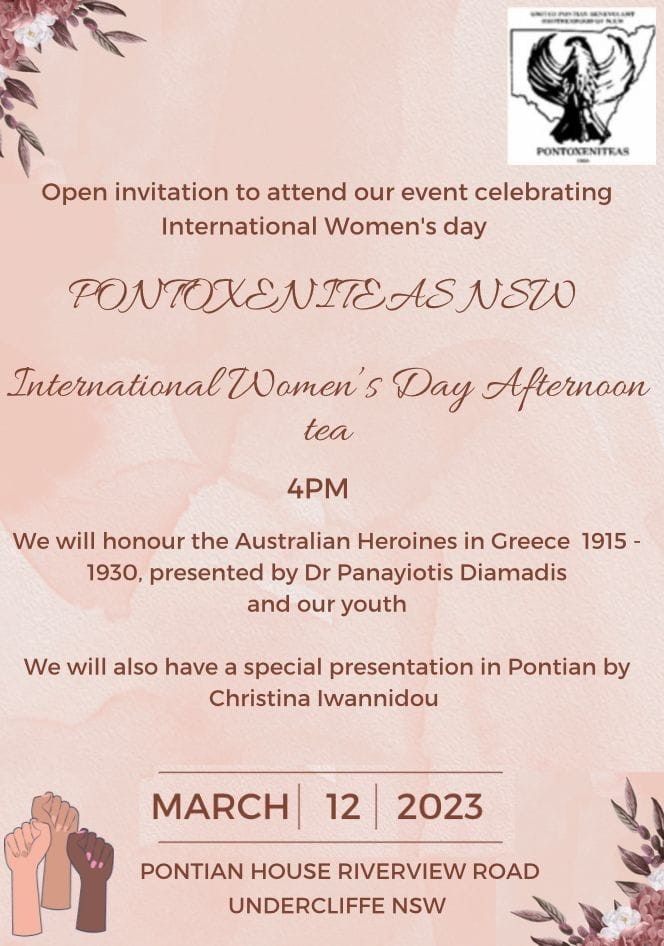
Pontoxeniteas NSW are celebrating International Women’s Day on Sunday, March 12 with an afternoon tea at the Pontian House in Undercliffe, Sydney.
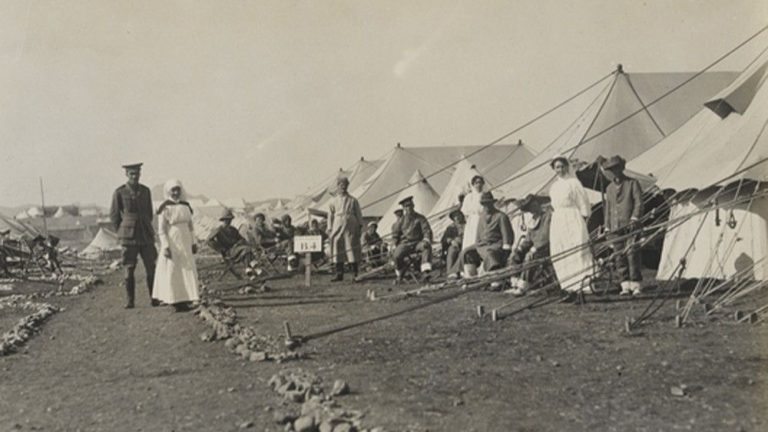
During the event, which is free and open to the public, Pontoxeniteas NSW will honour the Australian Heroines in Greece 1915 – 1930 with a special presentation by Dr Panayiotis Diamadis and the Pontian youth.
On the day, guests will also have the opportunity to enjoy a special presentation in Pontian by Christina Ioannidou.
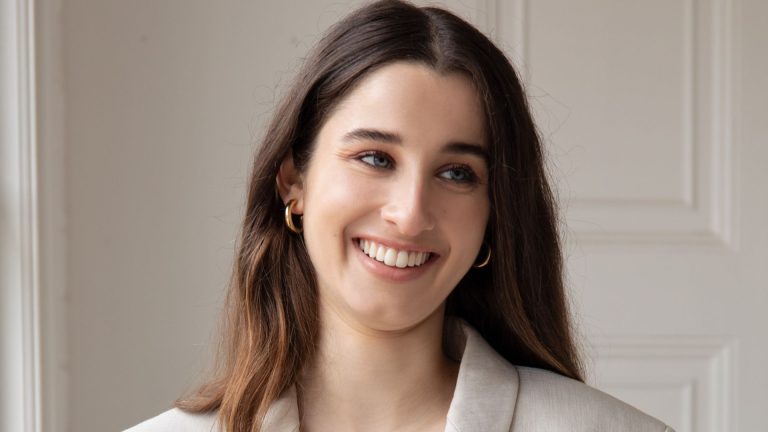
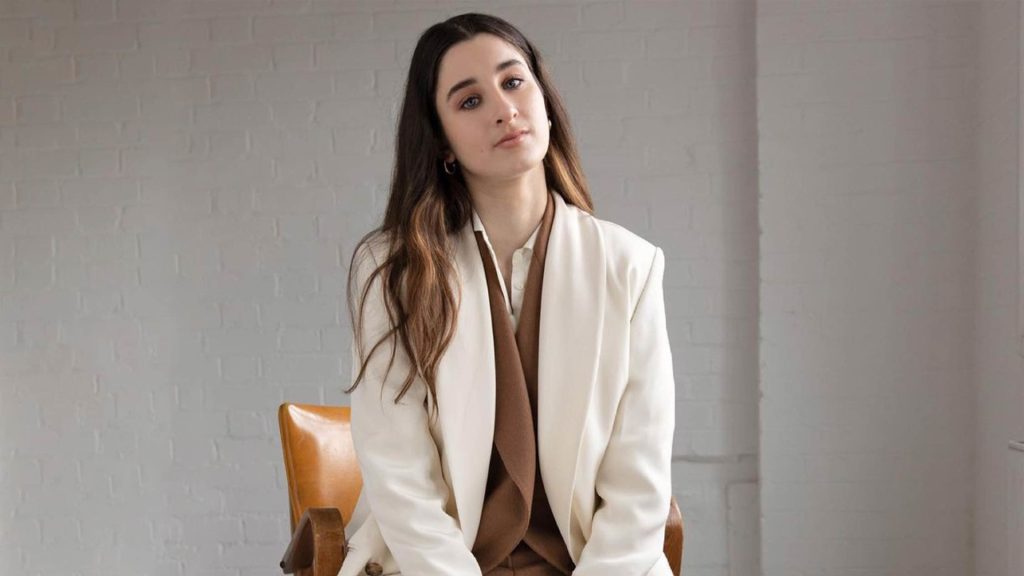
Chanel Contos has been named the 2023 NSW Young Woman of the Year in recognition of her work as an advocate for consent at the NSW Women of the Year Awards.
Chanel Contos is the founder of the “Teach Us Consent” movement, promoting the importance of sexual consent education in schools. As a result of her work, consent education has been mandated in all Australian schools from Kindergarten to Year 10.
NSW Minister for Women, Bronnie Taylor, congratulated Ms Contos on her award stating it was deserved recognition of her commitment to reduce sexual violence and domestic violence towards young girls and women in Australia.
“Congratulations to Chanel – an inspirational leader who empowers young women and girls to have confidence in speaking up about consent and helping to build a safer future for women,” Mrs Taylor said.
NSW Minister for Women’s Safety and the Prevention of Domestic and Sexual Violence, Natalie Ward, said Ms Contos has initiated one of Australia’s most successful education campaigns.
“Sexual assault is not an easy topic to talk about, but Chanel’s positive campaign has managed to break down those barriers and raise awareness within the community about safer behaviours,” Mrs Ward said.
“Chanel’s initiative highlights that just one idea from an Instagram post can start a powerful conversation to drive positive change within our society.”
Chanel Contos.
The NSW Young Woman of the Year is awarded to a NSW woman aged 18-30 years who has demonstrated incredible potential or achievement in her chosen field, passion, or area of interest.
The NSW Liberal and Nationals Government is committed to supporting women’s economic opportunities, health and wellbeing, and participation and empowerment.
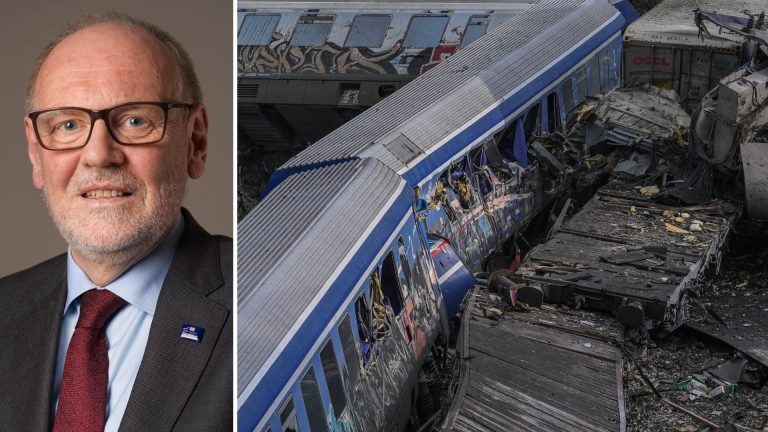
Mr Doppelbauer, one of the most qualified experts in railway safety, understood at the time that more work was needed in Greece to improve train travel safety. This was a point he confessed to The Greek Herald in an interview.
“First of all, I would like to express my sincere condolences to the families of the victims and to the citizens of Greece. Such accidents are always a sad tragedy,” Mr Doppelbauer said in the interview.
“My first thoughts were that we as a railway safety organisation have a key priority to contribute to improving the safety of the railway network in Greece and Europe. My reaction was that we still have a lot of work ahead of us and we are ready to help the Greek authorities when asked.”
Why such an accident happened in Greece in 2023 is on everyone’s lips and Mr Doppelbauer calls for an independent investigation that will clarify the causes of the accident.
Executive Director of the European Union Agency for Railways (ERA), Josef Doppelbauer.
“The first priority should be to ensure an independent investigation to shed light on the causes of the accident. This is the highest priority for me. We must learn from every accident the direct cause and the indirect causes. Then let’s take care to prevent future accidents as much as possible,” he said.
“The first step is to understand what happened and then take the appropriate measures to mitigate the risk. If we find in the independent investigation that something is wrong, we must fix it immediately. And then we need to ensure that a long-term plan is put in place that reduces the threat of such accidents across the country.”
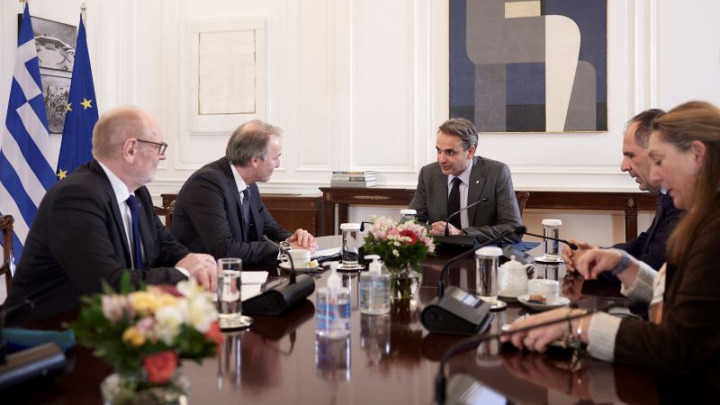
At the moment, there are ongoing discussions between the Greek government, the European Commission and the “ERA.” In fact, at the time of writing and after this interview, Mr Doppelbauer himself had arrived in Greece and held a meeting with the country’s Prime Minister Kyriakos Mitsotakis.
“We will discuss with the government the possible actions that can be taken and then the Greek government can ask for our help if it is needed. Of course we are ready to help.” But we will see more during the debates this week.”
Executive Director of the European Union Agency for Railways (ERA), Josef Doppelbauer, meeting with Kyriakos Mitsotakis.
The European management system and security gaps highlighted
The Greek Herald asked Mr Doppelbauer if the remote control system recently mentioned by Mitsotakis could have prevented the accident.
“Without having the results of the investigation into what caused the accident, without knowing its root causes, it is very difficult to tell you,” he answered.
“But what I can say from my side is that with technical systems, such as the European Rail Traffic Management System (ERTMS), we could have reduced the possibility of human error. We can say that. But I want to say again that without the results of the investigation we cannot be sure that the accident could have been prevented.”
We pressed this issue further with the EU official and he said: “The purpose of the system is to reduce the possibility of human error. So, if the system was installed, then the level of safety in Greece would improve. I want to repeat, however, that without knowing the exact causes of the accident, we cannot yet say more.”
The Executive Director of the ERA said, however, that safety gaps in Greece’s rail system were pointed out even in their most recent study at the end of 2022.
“We, as an organisation, receive information on railway safety from European Union member states at an aggregated level,” he said.
“That way, from the Greek authorities we received what we call the ‘sum’ of the mutual indicators of safety – which are based on the number of casualties. That number was always quite high in the past few years.
“So we are aware of the fact that there is a fairly significant level of fatalities in Greece but we do not have research that determines the conditions under which these incidents occur. It is something that we have proposed to start at the level of the EU. To receive more detailed information so that we can more accurately analyse the causes of accidents.”
European Union Agency for Railways (ERA), Josef Doppelbauer.
“The ERA’s main task is to record and publish data on the safety of rail networks in Europe. From 2019, we have the obligation to supervise the safety authorities of each member state.
“So, in this case, we control the Railway Regulatory Authority (RAS) of Greece. In 2022, we completed our second RAS audit and submitted our report on December 22.
“We documented a number of safety gaps and made recommendations to which RAS responded with a specific action plan.
“Now, we have a duty to oversee the implementation of this action plan. So this is one area where we have specific powers so that we can monitor the Rail Regulator and be able to highlight any deficiencies.
“Then we go to the European Commission and if the actions have not been fulfilled then the Commission can take legal action.”
“I cannot speak, as you understand, on behalf of the European Commission. As far as I know this referral to the European Court had nothing to do with railway safety. It involved legal issues and therefore cannot be linked to the accident,” Mr Doppelbauer said.
We ended the interview with a provocative question. We asked Mr Doppelbauer which means of transport he would choose during his visit to Greece if he needed to travel from Athens to Thessaloniki. Train, plane or car?
“I would still use the train today. Despite the rare accidents that occur, it remains a very safe means of transport,” he answered.
“In general, trains are a safe means of transport. Such accidents are rare. For this reason they cause shock. Unlike car accidents that happen every day on the roads and rarely reach the media.
“But what I must emphasise is that even though the train is a safe means of transport, it does not mean we should stop trying to improve the safety of travel. There is always the risk of an accident and the key to the rail network is managing the potential risk.”
Labor unions and student associations organised the demonstrations, while strikes halted ferries to the islands and public transportation services in Athens.
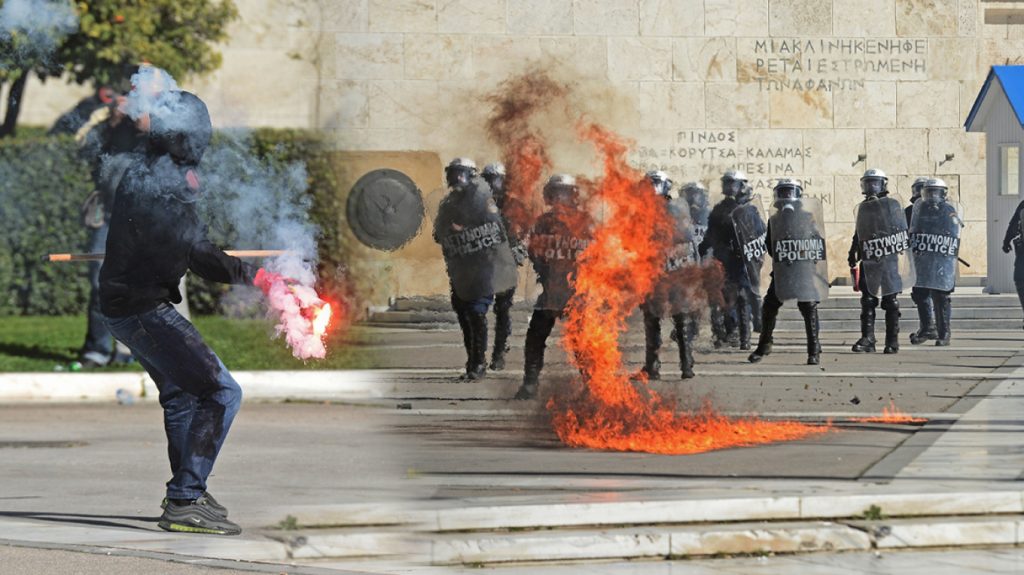
Demonstrators gathering in front of the Parliament at Syntagma square on Wednesday. Photo: AP Photo/Petros Giannakouris.
Demonstrators marching to parliament in Athens waved signs reading, “It’s not an accident, it’s a crime” and “It could have been any of us on that train.” Others chanted “Murderers!” and “We are all in the same carriage.”
Violence briefly broke out when a group of protesters clashed with riot police, who fired tear gas at the crowd. Protesters hurled petrol bombs in front of parliament and set a van and rubbish bins on fire.
GREECE — Thousands rally in Thessaloniki to demand justice for 60 people who died during a train crash in February.pic.twitter.com/SOSAcCyBRQ
— Citizen Free Press (@CitizenFreePres) March 8, 2023
In Thessaloniki, more than 20,000 joined rallies and clashes broke out when youths challenged a police cordon.
In the central city of Larissa, near the scene of the train collision, students holding black balloons chanted “No to profits over our lives!”
Protests in Athens. Photo: Protothema.
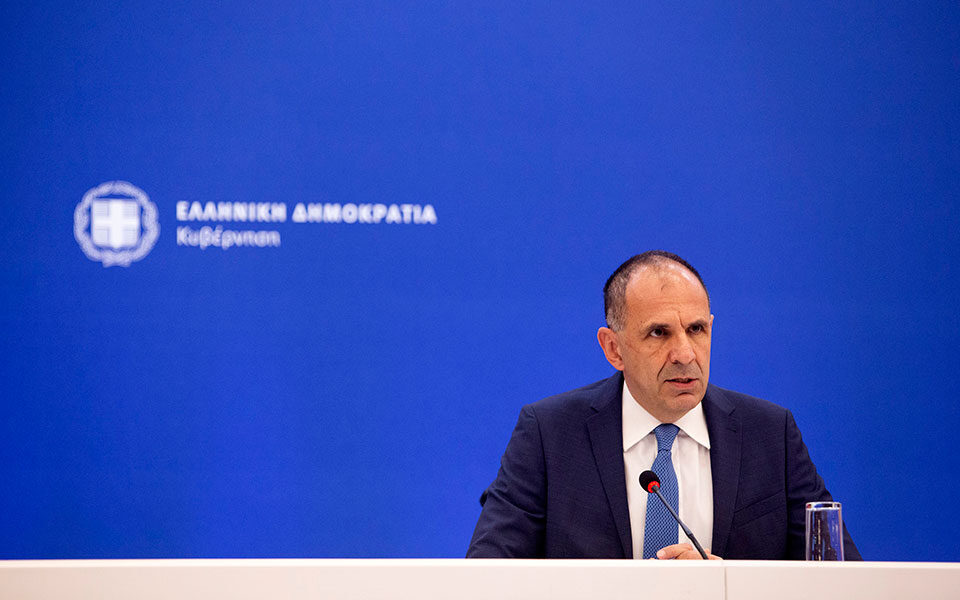
Amid these protests, Greece’s new Transport Minister, Giorgos Gerapetritis, pledged on Wednesday to have the railroads up and running again, saying it was vital that the public regain its trust in a mode of travel that was both popular and inexpensive.
Rail services in Greece have been suspended since the train crash which saw a high-speed passenger train with more than 350 people on board crash head-on with a freight train near the city of Larissa last Tuesday.
Greece’s new Transport Minister, Giorgos Gerapetritis. Photo: InTime.
Gerapetritis said the government will also step up the implementation of a contract for the automatic operation and signalling of the railway network. He said Greece’s Prime Minister, Kyriakos Mitsotakis, has contacted the head of French train maker and manufacturing group, Alstom, over the issue.
They set out some suggestions that could be used in drawing up a plan to improve the railroad network’s operation and safety, upgrading infrastructure, adopting best practices, and using EU funding most efficiently, noted government sources.
Mitsotakis underlined that he will fully utilise the expertise and experience of European services in the context of the fully transparent investigation into the Tempi train disaster.
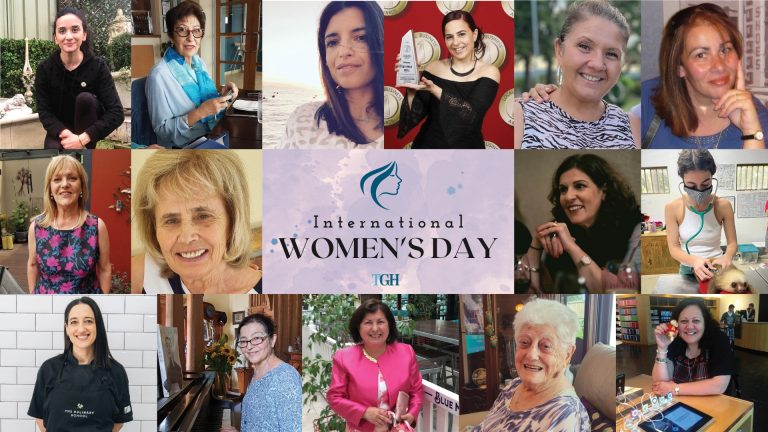
Each year, International Women’s Day (IWD) is celebrated globally on March 8 and this year’s theme is #EmbraceEquity. The Greek Herald chose to celebrate IWD 2023 by recognising the achievements of ‘unsung heroines’ in Australia’s Greek community.
We would like to thank our readers for taking part in our IWD campaign. The nominations we received truly showcased the diverse women in Australia’s Greek community who are worth knowing.
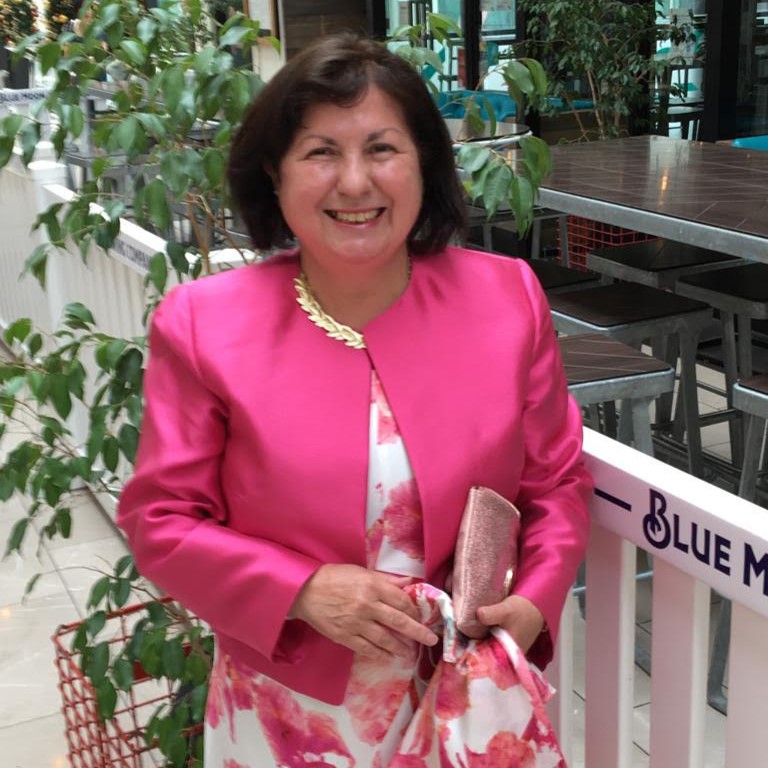
From a young female PhD research student to a 96-year-old yiayia who has devoted her life to her family – The Greek Herald truly uncovered the ‘unsung heroines’ of our local Greek community. They are:
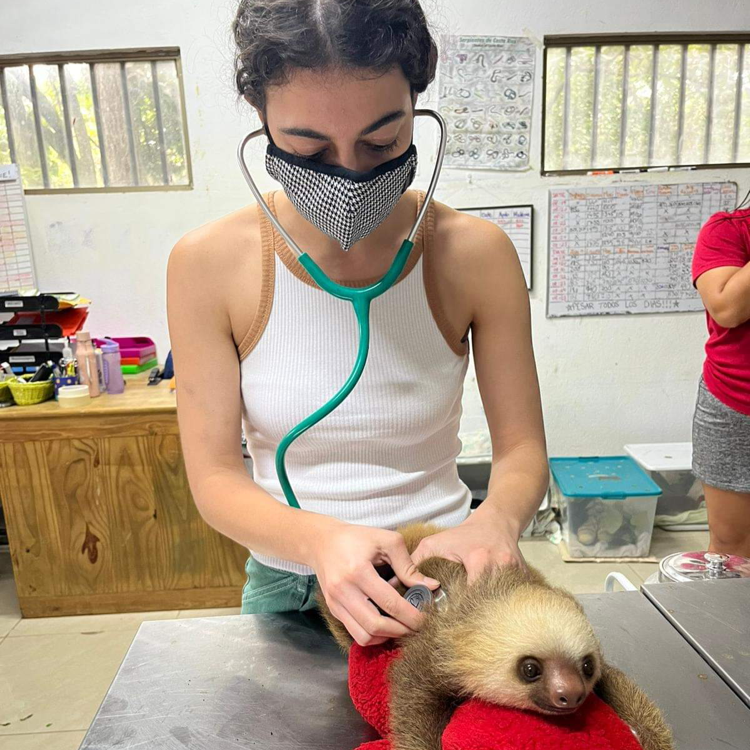
21-year-old Melina Haritopoulou-Sinanidou arrived in Australia during Greece’s brain drain in mid-2017 after finishing high school in Athens. Most people she impacts don’t even know her name (though someday they will). When she was a second year student, she met with success when analysing viral datasets to infer rates of mutation at the Doherty and published her first paper in Virus Evolution. Her research was utilised during the COVID outbreak. She worked on GenV, a sophisticated Murdoch Children’s Research Institute project to better approach child development.
She received an academic scholarship for her Honours at the Diamantina Institute finding cancer treatment boosters, while also collaborating with Victoria University and the Mater. Her grandfather, a migrant, had damaged his spinal cord during a Holden workplace accident and now she has a PhD scholarship analysing spinal cord injury. When she isn’t saving people, she volunteers to save animals at the Costa Rica Animal Rescue Centre.
Pat (Panagiota) Bollard, Teacher, Victoria
Pat is the Chair of Thalassaemia and Sickle Cell Australia (TASCA). TASCA is a not-for-profit organisation based in Melbourne which supports patients living with blood conditions in Australia.
Pat gives up her time to advocate, support and provide awareness of the condition. She leads a team of nine on the committee. Pat also provides counselling to help patients struggling or who require support with their condition. She is compassionate, empathetic and has a huge heart.
Maria Makris, Retired teacher, Victoria
My mother Maria sacrificed her teaching career to care for my first-born son Chris who was born with profound hearing loss. Using her skills as a professional teacher, she has played an active role in his development and is a major reason why Chris is able to lead a happy and normal life today. Maria volunteers for the Rotary Club of Richmond, helping local students participate in science and leadership programs at a National and International level. Maria assists not just Chris but also offers her time to help other children at his school, whether that be through reading programs or extracurricular activities.
In recent times, Maria has found a passion empowering Greek Australian women through the Food for Thought Network, where she serves as Vice Chairperson. She has a love for education and advocates for keeping the Greek language alive.
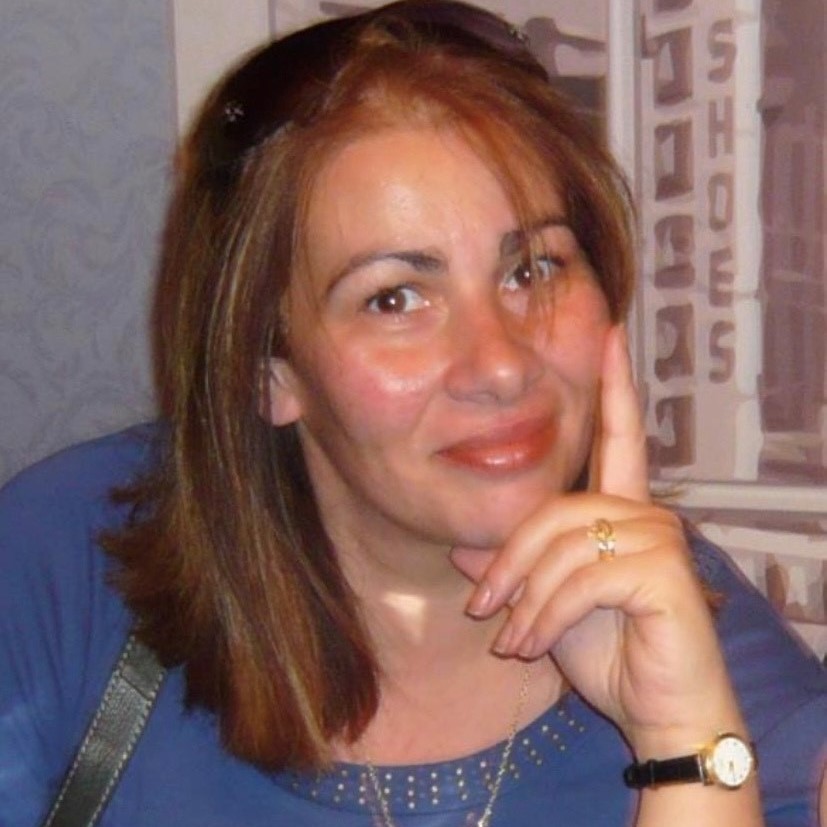
Anna Imvriotis, Grandmother, NSW
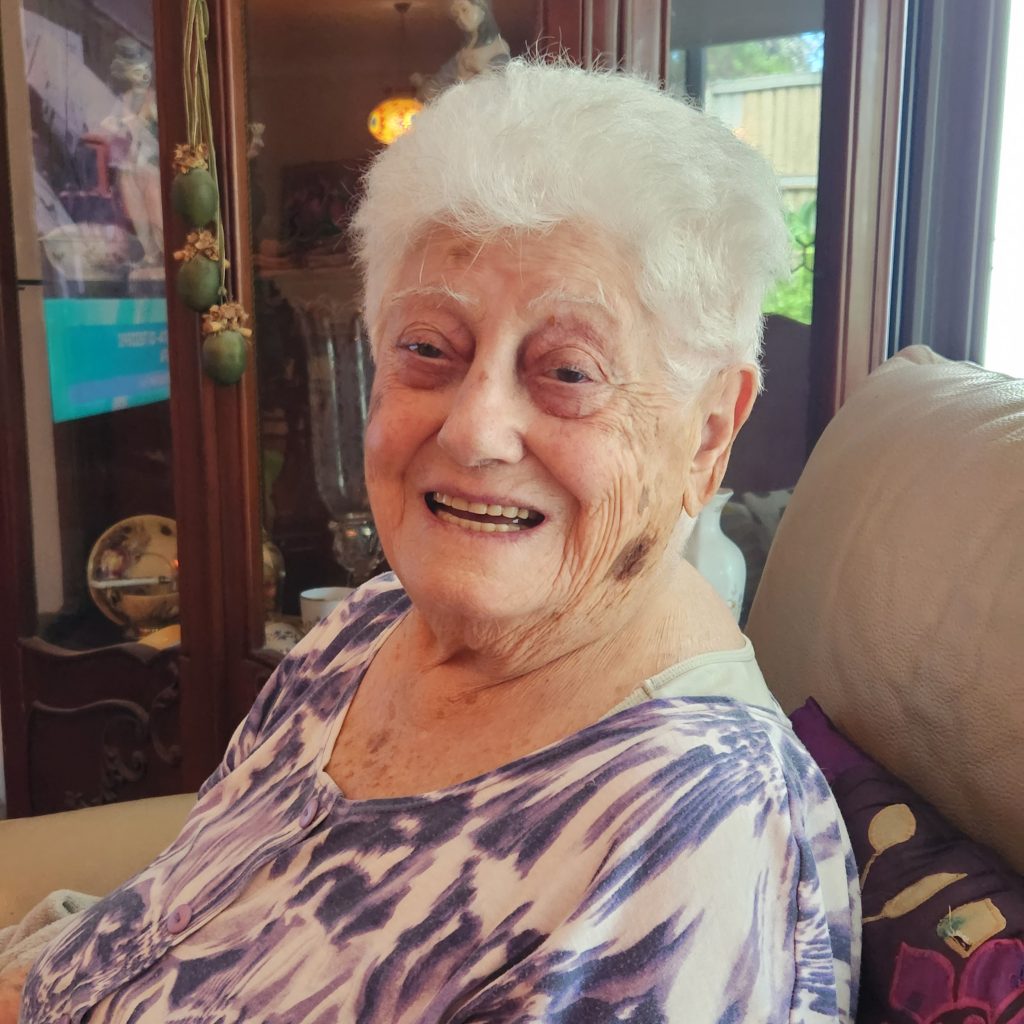
Anna Imvriotis and her husband John lived on the island of Tenedos off the coast of Asia Minor. The burning of Smyrni in 1922 and the constant political unrest made this family, now refugees, move to Constantinople with their daughter Litsa hoping for a new start. This wasn’t to be. So again, because of the political unrest, they moved to Australia in 1960. In Australia, they wanted to move forward with their family, which now included their son Alex who was born in Sydney.
John and Anna worked together in their shoe store in Bondi, with John repairing shoes while Anna repaired clothing. Anna is now 96 years old and reflects on the fact that she values her past very strongly and hasn’t forgotten her life from Asia Minor. She has taught her children, grandchildren and great grandchildren the importance of living together with many other cultures and striving to respect and value all people.
Alexis Varvodic, Retired, Victoria
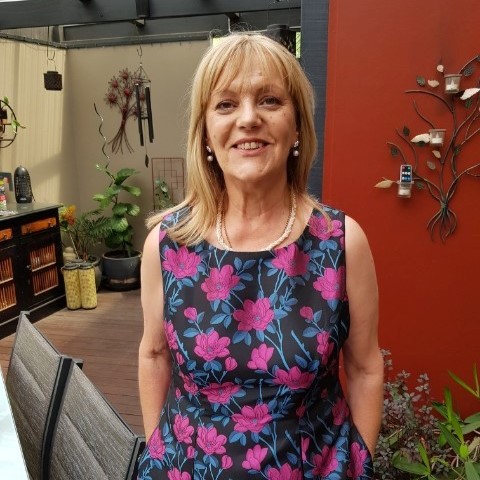
Alexis Gillard was born in Australia with a mother descended from Scottish ancestry and a father from Greek ancestry. Alexis has always felt comfortable within the Greek environment. She has performed many tasks of community involvement including several years on the administrative committee of the Kastellorizian Association. During this time on the committee, she became well-liked and valued by all. This was in no small part because of her commitment to be without prejudice, to be inclusive to all, and to hold aloft in her actions the Kastellorizian ethos of faith, hope and charity. Lately, she has been instrumental in helping to organize a return to the island of her ancestors by many Australian-raised descendants, thus maintaining this valuable connection to the past. Alexis is the embodiment of the multicultural society that Australia has become and shows how ordinary people can make a difference.
Helena Kollias, Family therapist, South Australia
Helena Kollias grew up in the Riverland about 300 kms from Adelaide. Her family relocated to Adelaide so she could receive specialist help for her diagnosis of lupus nephritis when she was a teenager. It was considered a rare condition for someone that young. Since 2019, at the height of the pandemic, Helena began fundraising for Kidney, Transplant and Diabetes Research Australia.
To date she has raised $127,932. As an example of her dedication, last year she raised more than $22,000 by holding a Vintage High Tea. At the moment, together with her volunteers, she is planning a Ball in September. Helena works as a family therapist part-time while raising funds to help medical research.
Sue-Ellan Vasiliou, Charity, NSW
Sue-Ellan lost her eldest daughter to brain cancer in 2017. Alegra was just six years old. She made a promise to her daughter the day she was born that she was going to be the best mum to her and so even in her passing, she has created a legacy for her daughter. She has founded the Little Legs Foundation, raising funds and awareness for childhood brain cancer. Currently funding over $1.5 million in research.
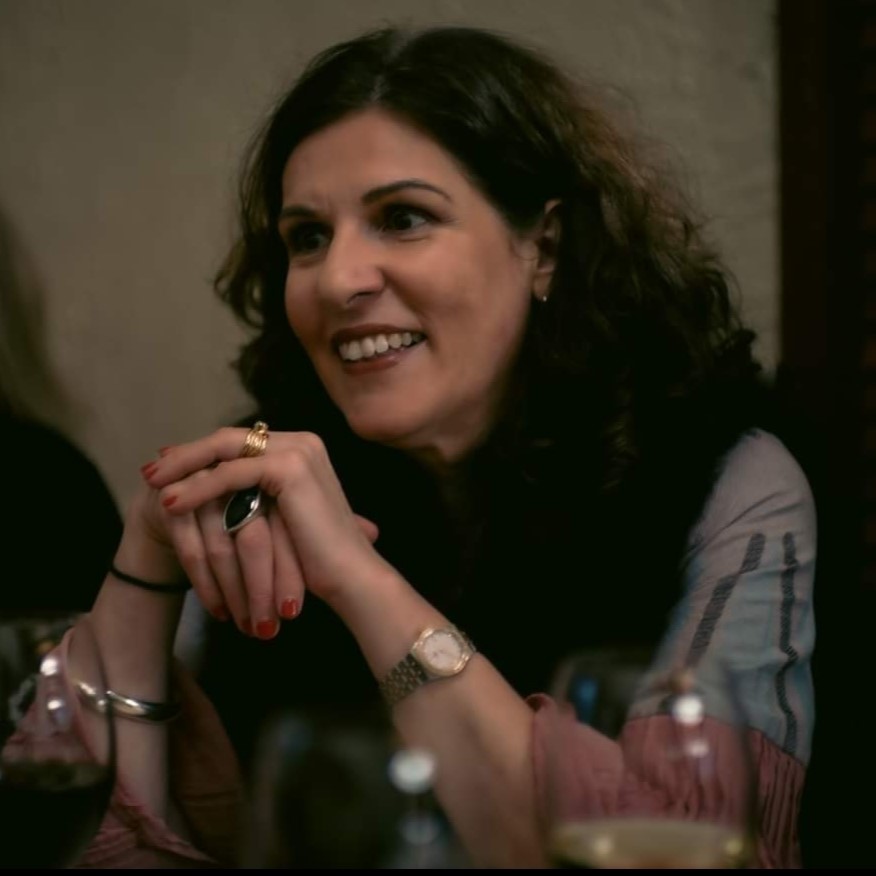
Tammy Iliou, Economist, Victoria
Tammy Iliou was the first female Chair of the Antipodes Festival in Melbourne. She was the first female Vice President of the Greek Community of Melbourne. In 2022, she was inducted in the Victorian Multicultural Honour Roll for her dedication and passion to community affairs for over two decades.
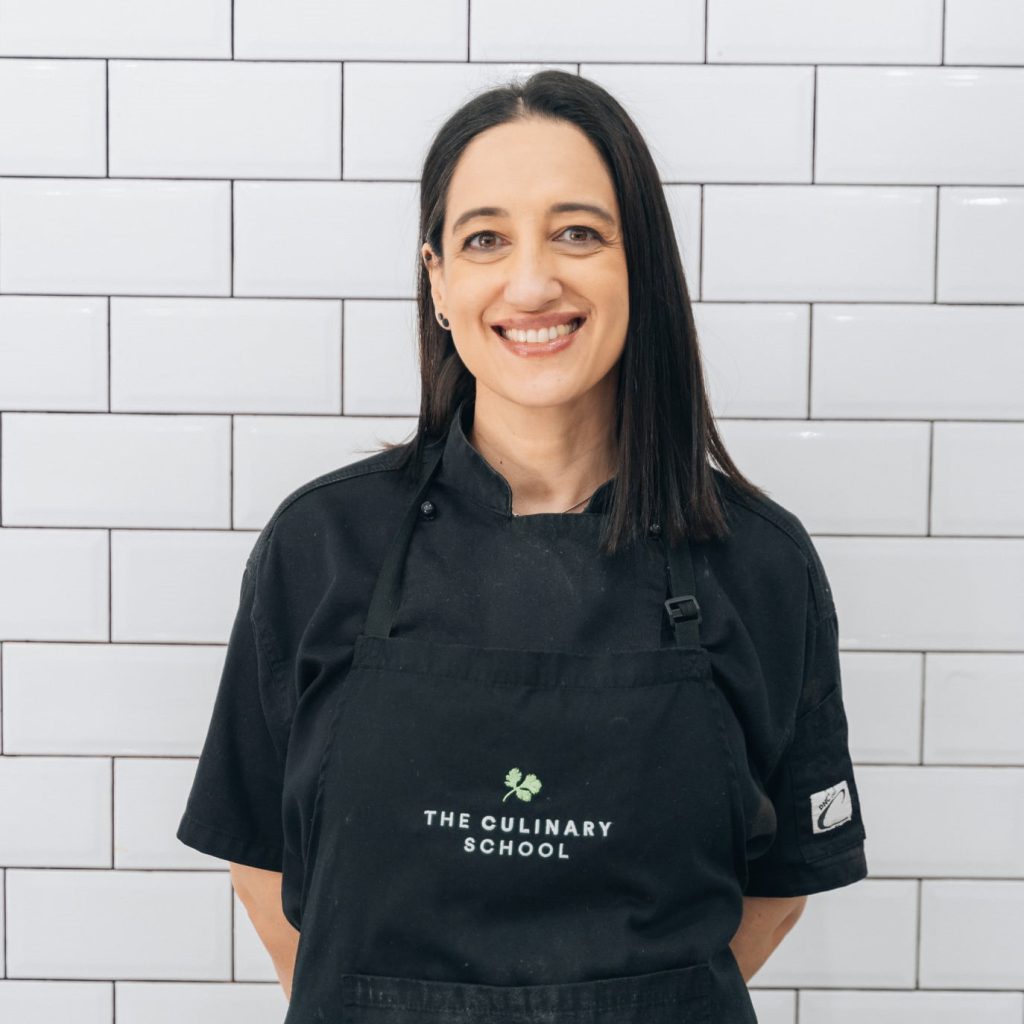
Voula Bourdantonakis, Chef, NSW
Voula is unsung heroine. She cooks to fill hundreds of food containers for the homeless. As a chef at The Culinary School, she works with local charities to host a ‘Soup Kitchen’ program where volunteers cook and prepare food to be delivered to homeless people on the streets of Sydney. She is amazing!
Helen Synodinos, Retired, NSW
My mother Helen is a super woman. She has always been a selfless person. She is always there for her children and grandchildren. She’s always supporting her friends and the Greek community. My mother has always been an active member of the Greek Orthodox Community of NSW and also gives up her time for fundraisers for various organisations such as Doctors Without Borders and The Heart Foundation. Both causes are very close to her heart.
Mary Tsaganas, Director of Convido Corporate Housing, Victoria
Mary always supports Greek social clubs, such as the Pallaconians, and is always looking for ways to increase their popularity and their financial situation. She fights hard for the betterment of the Greek community, clubs, churches and all that need support. She is events manager for the Papaflessas ‘Social Club’ in Victoria.
Evelyn Tsavalas, Business Owner, NSW
Born in Sydney to Greek Cypriot immigrant parents, Evelyn joined the Hellenic Art Theatre (HAT) in 1997 and ultimately became Production Manager. The theatre keeps the Greek culture alive and without Evelyn and Stavros (Director), it would not be standing. She inspires Australian-born Greeks to immerse themselves in the Greek language and rich culture. HAT has produced acts that highlight the significance of real issues, as well as the value of our rich heritage. During COVID-19, she remained positive and conscientious about preserving our heritage and has demonstrated how essential art, music and literature are.
Tina Photakis, Teacher, South Australia
Tina is a very dedicated Primary Teacher. She teaches Modern Greek, Geography/History, Choir (Senior/Junior) Master and IT. Her students have made every second Thursday ‘Miss Tina Day’ and everyone wants to be in her room that day. She is very popular with everyone, staff, parents and students. She is also the last to leave the school. Tina has been given many awards from the Education Department and the highest award in Computer Education (Making it Happen) by ESTI, only 300 educators have this Jacket World Wide. She a loving mother to our two boys, Emmanuel and George.
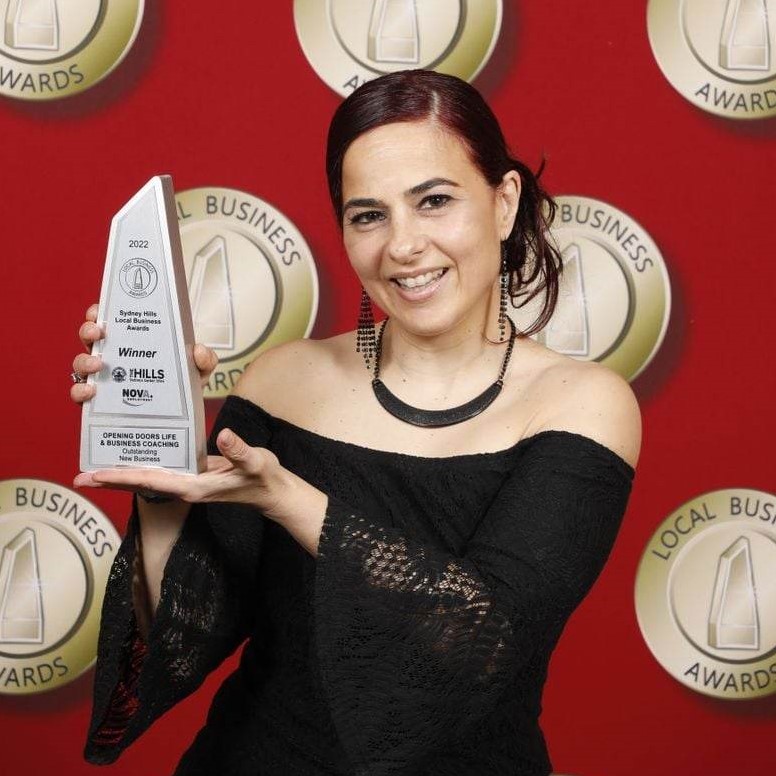
Connie Theodoridis, Life and Business Coach, NSW
Connie’s biggest asset is the ability to elevate and make others shine through her unique coaching style and extraordinary gift as a life and business coach. Her greatest achievement thus far has been her current role as a professional business advisor (through NSW Government), where she has helped countless business owners who were on the brink of collapse due to the effects of COVID-19. Connie has given them the opportunity to rise, re-establish and taken them to the next level through her mentoring and coaching. Her biggest purpose in life is to serve others because that gives her the greatest satisfaction.
Eva Korkidas, Teacher, NSW
Eva is the kindest, most thoughtful and caring teacher with years of experience in leading students to success. Eva now leads a team of professionals who are shaping the way of the future in education in NSW. Eva has a passion for her Greek heritage. She is a mother of four and works tirelessly for her family. She has touched many people over her many years of working so hard to achieve goals in Technology and in directing schools into the future of this dynamic field.
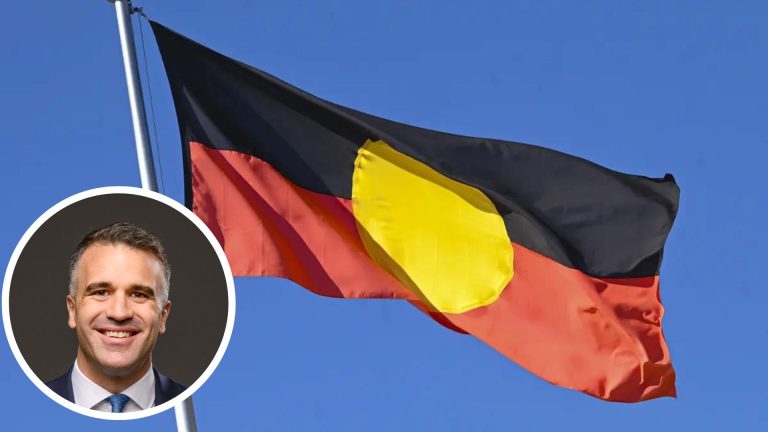
“We must have humility enough to say that what we have been doing has not been working well enough,” South Australia’s Premier Peter Malinauskas said, while introducing a bill to enshrine an SA First Nations Voice to Parliament.
According to The Advertiser, after two rounds of consultation and engagement with Aboriginal communities across the state by Commissioner for a First Voice, Dale Agius, the details of the Bill were addressed.
The definitions of ‘Aboriginal person and country’ have been replaced with ‘First Nations person’ and ‘traditional owner.’
“The definition of First Nations persons adopts the tripartite test, as stated by Justice Brennan in Mabo v Queensland number two, and is commonly used by governments all around Australia,” Mr Malinauskas said.
“The Voice does not limit or otherwise affect the functions of any First Nations persons or bodies under any other act of war, or an agreement or arrangement entered into or relating to First Nations persons or bodies, such as Native Title agreements.”
Mr Malinaukas also named the three key principles in which the Voice would abide and function by.
He said that representatives must be chosen by First Nations communities themselves, and that the Voice must come from the grassroots level and must be able to speak for local issues. He finally stated that the Voice must reflect the diversity of First Nations communities.
Shadow Minister for Aboriginal Affairs Josh Teague called the Bill a “defective model” which would not bring the outcome hoped for by the Indigenous people.
Liberal MLC Dennis Hood expressed his disagreement with the model of the Bill, but said that ultimately he wanted better outcomes for Aboriginal people in SA.
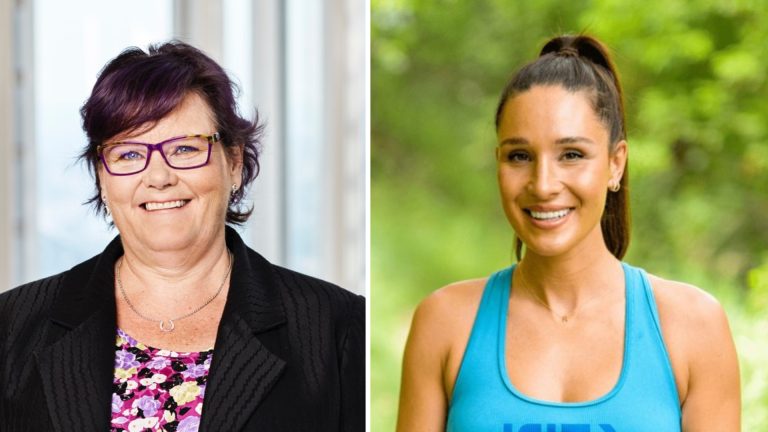
The 2023 Rich Women List by the Australian Financial Reviewhas been published and the names of two Australian women of Greek heritage are on it. They are Debbie Kepitis and Kayla Itsines.
49. Debbie Kepitis
The director of Ingham Property is placed at number 49 of the rich list with a $300 million fortune.
Debbie is the daughter of legendary racehorse owner-breeder Bob Ingham and is continuing her father’s legacy in business and racing.
64. Kayla Itsines
Fitness queen Kayla Itsines, who co-founded and later sold the Sweat fitness app, re-joins the rich list this year and stands at place 64 with a $165 million fortune.
Itsines and her ex-fiance Tobi Pearce became globally recognised when their workout e-book, Bikini-body Guide, shot to popularity in 2014 and soon after SWEAT was launched in 2015.
Itsines and Pearce continued in their existing roles at SWEAT with the company headquarters remaining in Adelaide, South Australia. Eventually they sold the app, which went into an $80 million loss in its first year under foreign ownership.
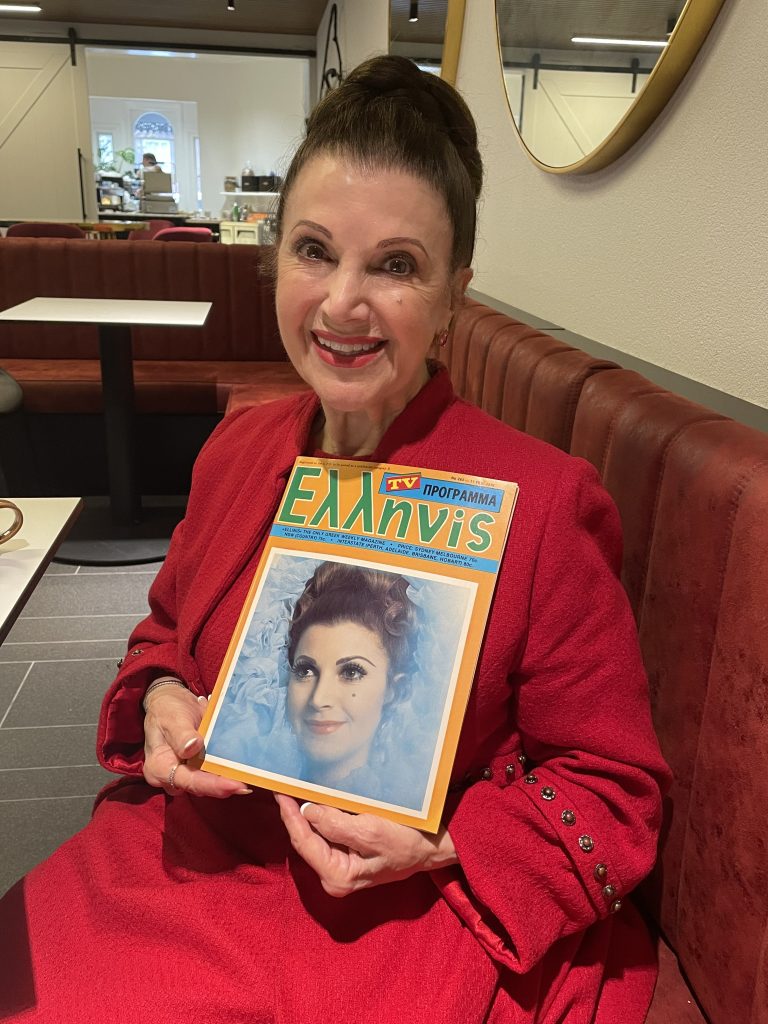
When Helen Zerefos OAM walks into the Kogarah café in Sydney where we had planned to meet for our interview, I’m instantly struck by her charism and beauty. Wearing flawless makeup and a bright red high-neck dress, she quickly draws the attention of the café’s patrons. This isn’t a surprise though as Australia’s award-winning soprano singer had just walked into the room.
Born in the rural New South Wales town of Scone in 1937, Ms Zerefos was the eldest daughter of two Greek migrants – Katina Andronicos from Avlemona on the Greek island of Kythera, and Paul Zerefos from Neapolis Vion, Laconia. The family was complete with a son, Bill, and second daughter, Fotini.
When Ms Zerefos was three years old, the family moved to Glenn Innes. Paul was a fruiterer and owned two shops, one in Glenn Innes and the other in Moree, providing fruit and vegetables to locals until they eventually left for Sydney after World War Two and settled in Sylvania.
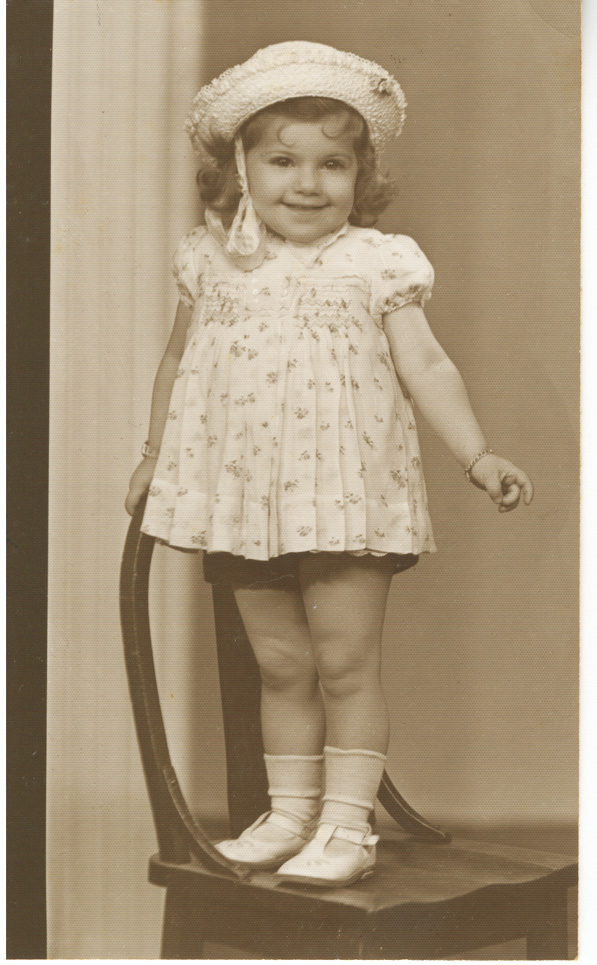
Helen Zerefos at 2 years old.
Ms Zerefos tells The Greek Herald it was in this tiny Sydney suburb where her parents’ idea to open Paul’s Hamburgers was born.
“We went to Sylvania and my dad bought a block of land there and built this shop… it was a mini-market and a milk bar,” Ms Zerefos explains.
“While they were building the shop, my father was at the races one day and my mother said to the builder, ‘I want you to measure seven feet from that wall in and put a wall there.’ The builder goes, ‘Mr Zerefos didn’t say that’ and she said, ‘But I am.’
“That night when my father came home he said, ‘What’s the wall doing up in the middle of my shop?’ and mum replied, ‘I’m going to put a lunch bar over there… I think I’ll sell hamburgers.’ My dad said, ‘But you’ve never made a hamburger in your life,’ and she said, ‘I know but I’ll learn.’ So that’s how it all started.
“The rest of the shop was a milk bar, with fruits and groceries because at that time, there were no other shops around. It was a very busy shop. But as time went on, the hamburger shop, a little tiny corner, took off.”
Crowds outside Paul’s Famous Hamburgers.
Ms Zerefos says the success of the shop is tied to her mother’s cleverness and “unlimited energy.”
“I couldn’t do what she did,” the 85-year-old singer says with a fond smile.
The soprano going her own way:
In a way, Ms Zerefos did live up to her mother. She was ground-breaking and fiercely independent in her own right.
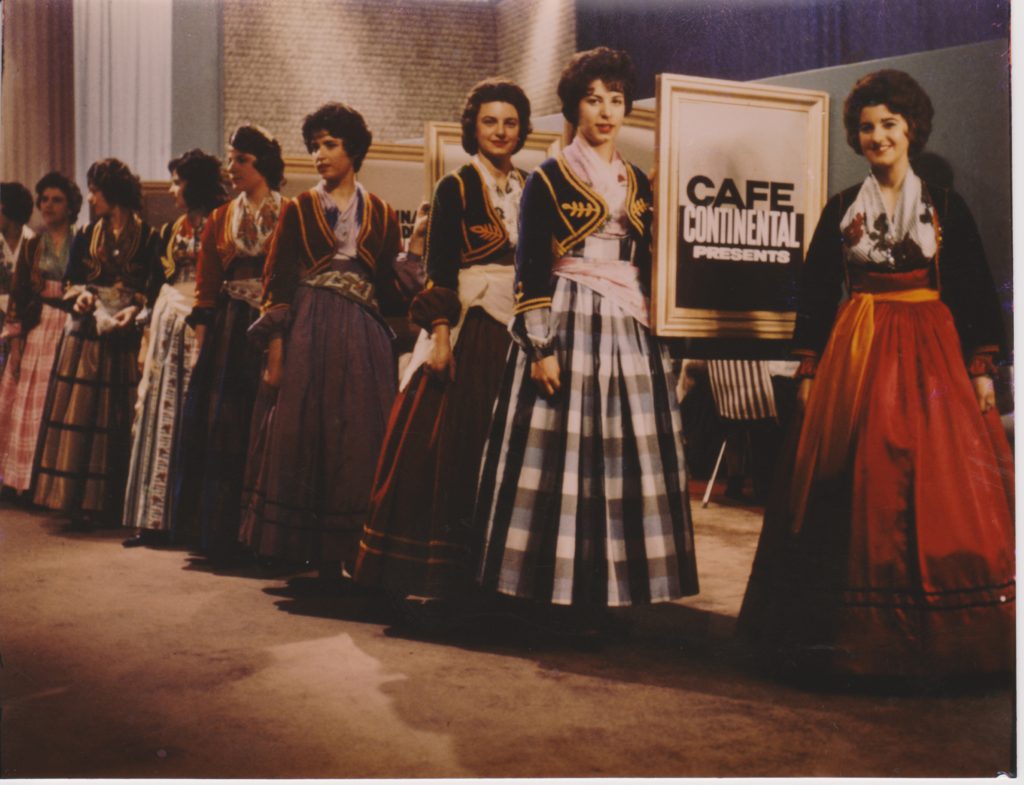
Knowing she had a strong soprano voice, and having learnt to play the piano, Ms Zerefos took it upon herself to audition for Channel 7 and never looked back.
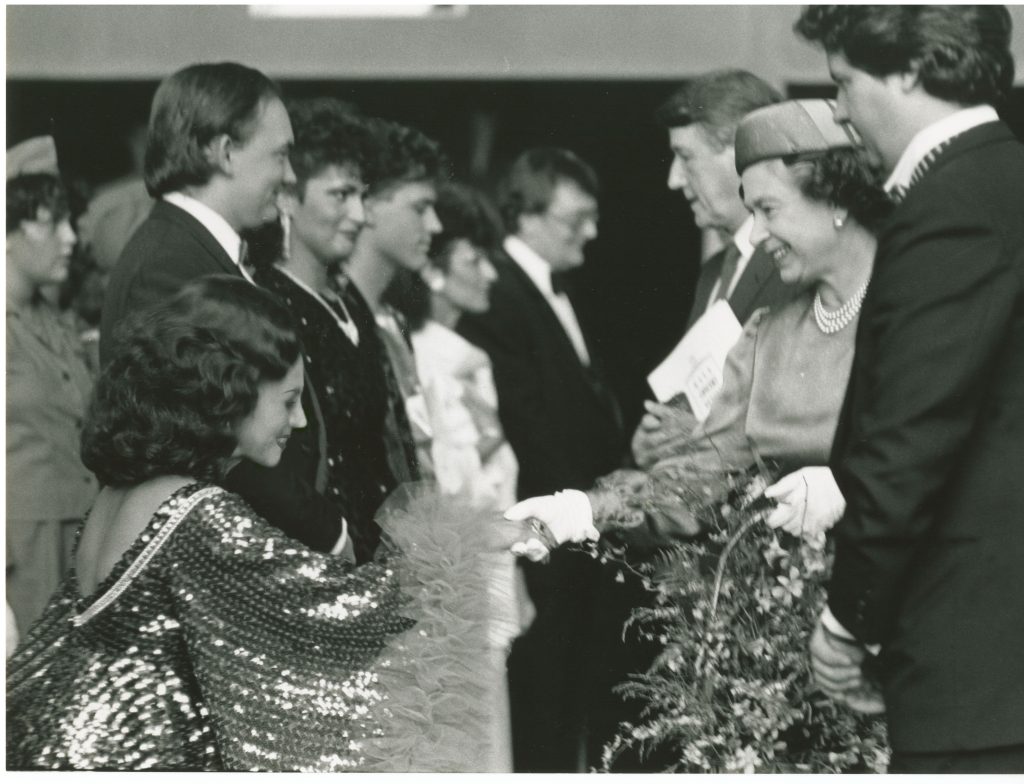
She spent three years singing in the elite choir known as Revue 20 and performed Greek music for the first time on Australian television. Later, from the 1970s to the 1990s, Ms Zerefos grew her solo career and sung in over 600 television shows including The Don Lane Show and The Midday Show, among many others. In 1986, she also performed in a Royal Gala Concert for the late Queen Elizabeth and Prince Phillip at Sydney Entertainment Centre.
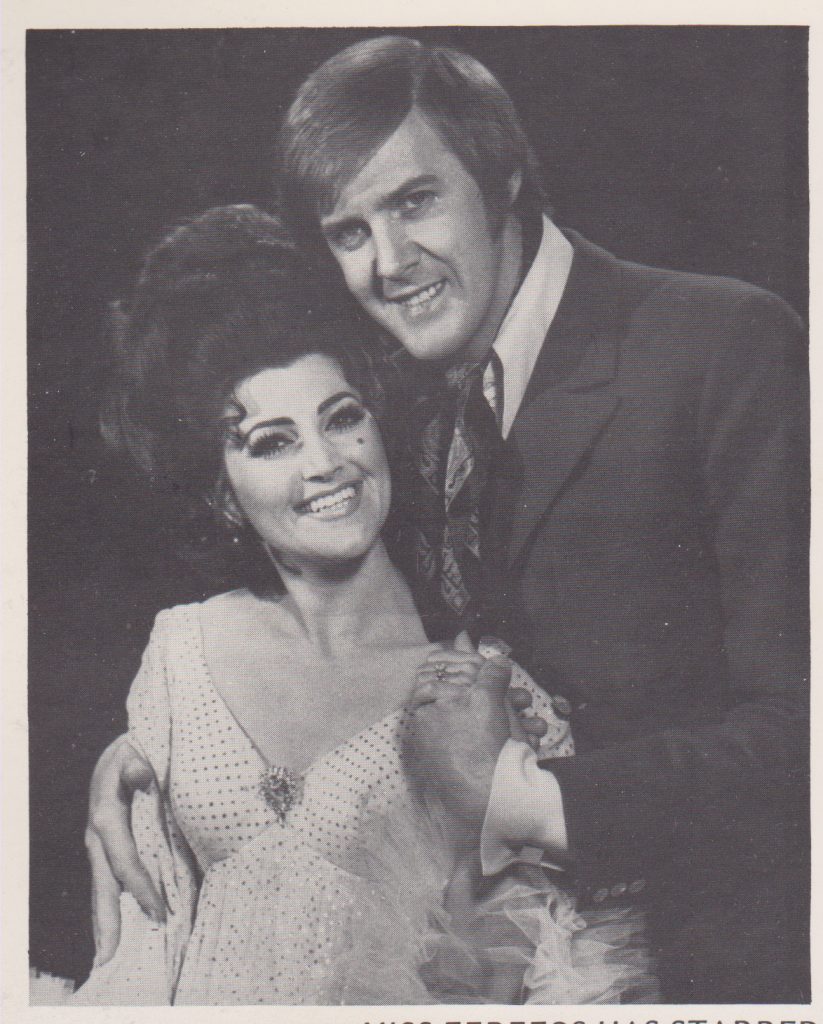
The Queen meeting Helen Zerefos, 1986.Barry Crocker & Helen Zerefos 1968, National TV, Channel 10.Cafe Continental, Helen Zerefos, ABC Channel 2, 1961.
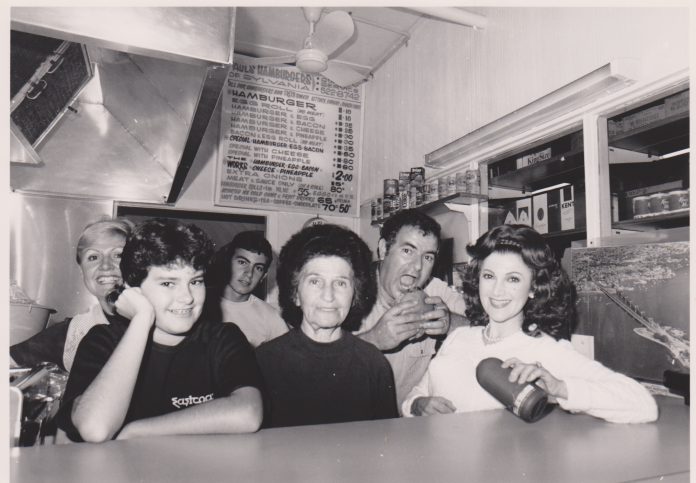
In between all these singing commitments, Ms Zerefos says she still had to fulfill her Greek family duties and help out at Paul’s cooking hamburgers. She remembers fondly one particular memory where she was heading to a performance at the Sydney Opera House when she received a call from her mum asking for help.
“So I’ve raced across through the back [of the shop] and I’ve got full make up, my hair up, and I’m making hamburgers. One man in the crowd said, ‘Now that’s what I think a hamburger lady should look like’,” Ms Zerefos says with a laugh.
“They all knew I was doing shows but it was a bit of a joke in the area – ‘oh Helen’s back at the shop’.”
Helen Zerefos (front right) in the shop. Photo courtesy of the St George Leader.
‘Something I’ll never forget’:
Despite these familial commitments, Ms Zerefos still made time for her singing and philanthropic work in neuroscience research. Her philanthropic work is tied to her mother, who was diagnosed with Alzheimer’s after the sudden death of Ms Zerefos’ father.
She was recognised in 1996 with a Medal in the Order of Australia (OAM) for her work and musical career.
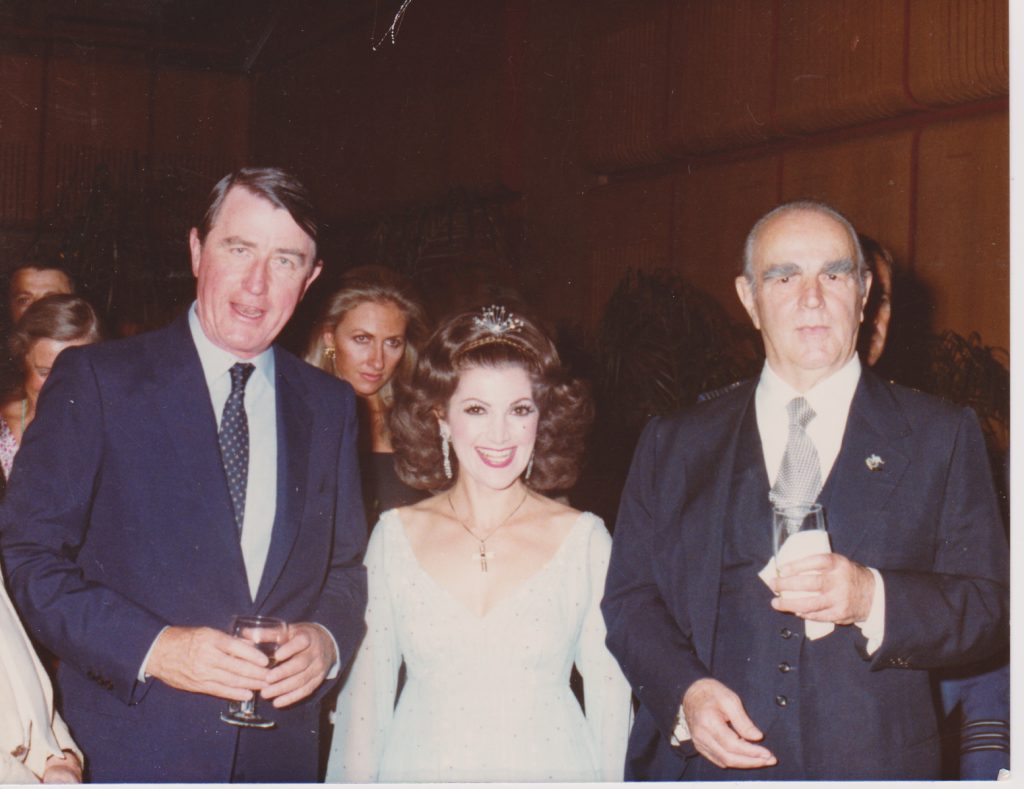
Former Greek President Karamalis, NSW Premier Wran, and Helen Zerefos, 1982.
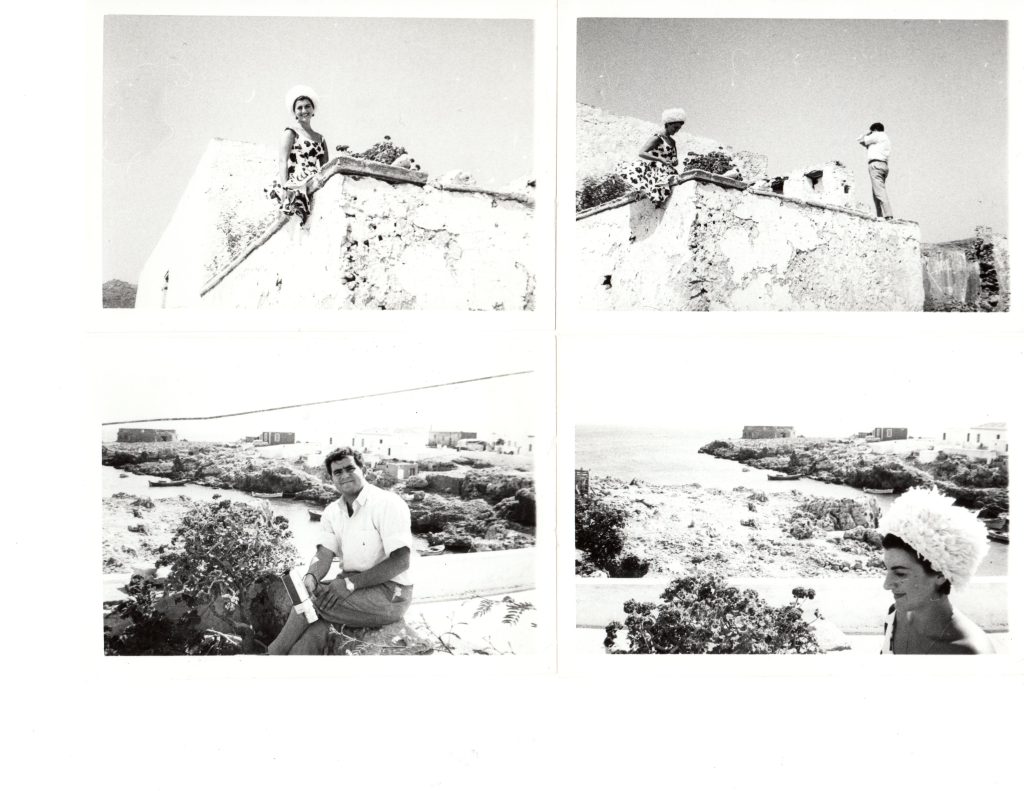
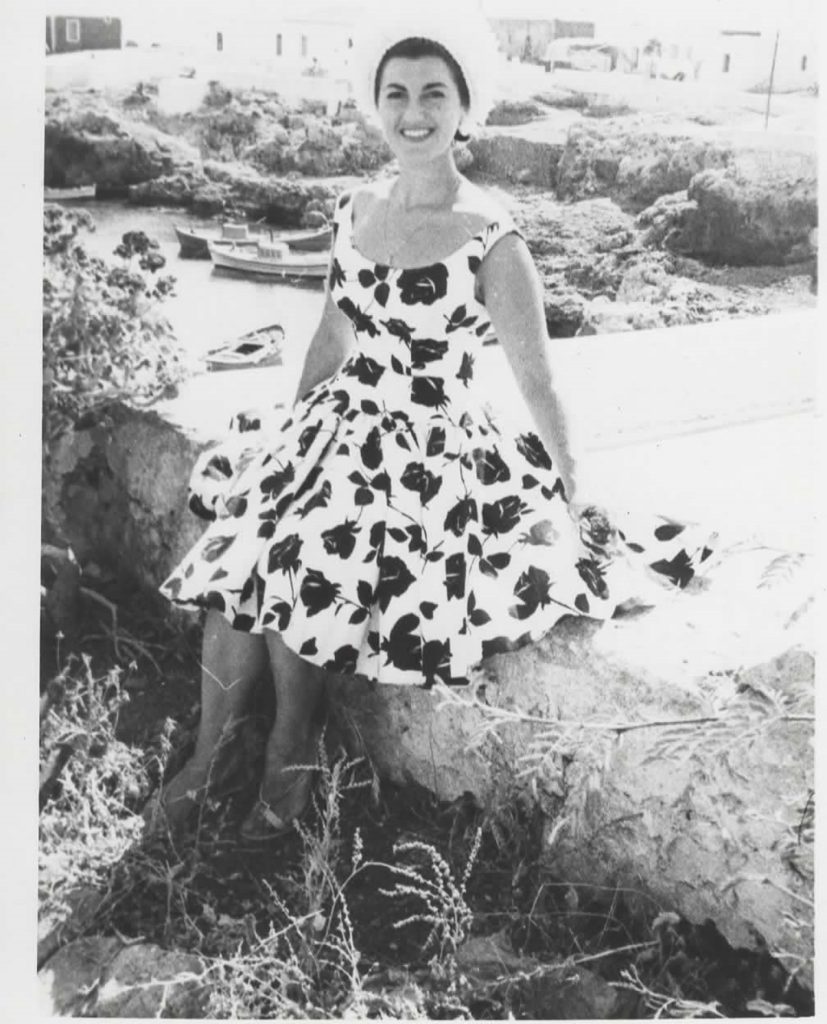
The Greek Australian soprano also managed to squeeze in an around-the-world trip in 1965 with her brother. This trip was something she has never forgotten, especially after she was asked by the Mayor of Neapolis Vion to give a concert for the locals at an open-air cinema.
Helen and Brother Bill Zerefos, Avlemonas, 1965.Helen Zerefos Mother’s Balcony Avlemonas Kythera 1965
“When I looked outside [at the cinema] there was 283 people and there were over 1,000 people all the way around standing on the road and on their balconies watching me,” Ms Zerefos explains.
“It was unbelievable. It was something I shall never, ever forget. I was in tears most of the time.”
When I ask how it feels to be able to have these experiences and a successful career, Ms Zerefos says she was lucky to have the support of her family and never takes anything for granted.
Helen Zerefos today. Photo copyright: The Greek Herald / Andriana Simos.
“To get the respect of others, you had to be good at what you did… My parents were both very proud of the fact I could sing and play the piano and so they were very supportive,” Ms Zerefos concludes.
“I just feel very privileged that I can do what I’m doing.”
Crooner Johnny Cash sang of “A boy named Sue” who had to come to terms with his character-building, female-sounding name.
Well, the opposite is the case when it comes to my surname. And I’m not alone.
When Greek migrant women came to Australia, they had to discard their female-gendered surname. For instance, in Greece, Mr Pappas’ wife is not Mrs Pappas but Mrs Pappa (feminine). And Mr Kyrgios’ wife is Mrs Kyrgiou (feminine). Had I grown up in Greece, I would have been known as Sinanidou – the feminine of Sinanidis.
Interestingly, this feminine version is the possessive case of the family name to show the clan belongs to the woman’s father or husband. So, in my case, I am Sinanidou, a woman belonging to Sinanidis (dad).
Once in Australia, however, families had to adapt to a non-gendered society and pick one unified surname for their clan. In those days, the masculine form had the most legitimacy, though some changed their names altogether so that Stephanopoulos would be Stevens, Karpouzis would be Karp, all for the sake of convenience or to just fit in.
Much has been made of how the shortening of our hard-to-pronounce surnames has affected our identities. Little has been said, however, of the loss of the feminine surnames and what this has meant for women.
At Greek school, I could still enjoy my female-gendered surname. Kyria Polydoropoulou (belonging to Polydoropoulos) would call out “Sinanidou” and I’d say “Parousa” (Present). I knew it was me and not my hypothetical male twin in the same class. In our English school class, the teacher would say “Sinanidis” and it could be either one of us.
The Greek women with masculinised surnames.
This was no big deal, however, until I went to live in Greece for a few decades.
Suddenly, I had multiple identities which confounded the Greek Tax Office and Aliens Residence Bureau. Was I Maria (official first name in the books but not my life) Sinanidis (masculine gendered name), Maria Sinanidou, Mary Sinanidis or Mary Sinanidou?
Why so many aliases? What was I hiding? Or was I just some random weird feminist abandoning the possessive case of my female-gendered name to make a point?
And so, with my tax agent at hand, and to put an end to confusion and allay suspicions of fraud, I came to be known as Mary Sinanidis on official documents – always written in Latin characters, regardless of whether the document was in Greek. Quite often, I’d be corrected: “Learn Greek, your name is Sinanidou (feminine), not Sinanidis (masculine).”
And then I’d need to explain English grammar, migration and why we have male-gendered family surnames in the Antipodes.
But wait, there’s more
And I thought that the problem would end with me. Until I got married.
In Greece, feminist legislation passed in 1983 requires women to keep their maiden name after marriage. (Though bearing in mind that maiden names are still possessives conferring to the male of the clan, I’m not sure what difference it makes in the grand scheme of things.)
Interestingly, children’s surnames are also selected before marriage.
“Usually, the father’s name is chosen as the family name,” said the priest doing the paperwork ahead of our nuptials.
We were just two crazy people in love and hadn’t even begun to think of having babies let alone choosing baby names. And, as if choosing first names wasn’t hard enough, we hadn’t even contemplated the predicament of a surname.
“Well, what if the dad’s silly, and the mother does all the work? Besides, if you travel alone, people may think you kidnapped the kids,” he said.
“It makes sense,” I said. “And I’m the last of my bloodline, so my dad will most certainly be pleased his surname will get to live on!”
So we hyphenated!
Two years later that split-second decision came back to bite us (and our kids). Our firstborn daughter bore the feminine version of both our names: Haritopoulou-Sinanidou.
The Australian Embassy insisted Sinanidou (female-gendered version on the official marriage documents) would have to remain Sinanidou in English, regardless of the masculinity of my name on which it was based. So much for easing things at the passport checkouts.
Our second child, also a daughter, followed in her sister’s footsteps. Had she been a son, they would have had different suffixes to their surnames adding even more to the confusion.
As it stands, however, I am Sinanidis, my daughters are Haritopoulou-Sinanidou and their father is Haritopoulos.