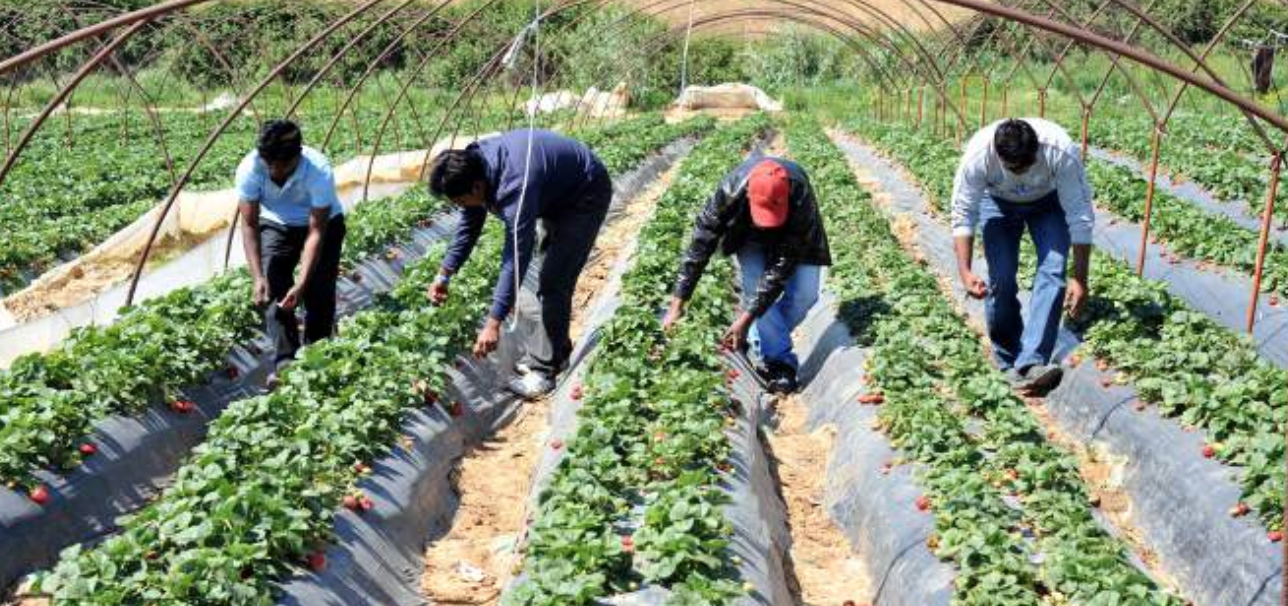
The Greek government is planning to create a “job vacancy” scheme where refugees and migrants can find seasonal work in the agriculture fields. The scheme aims to revitalise the countryside and the rural economy.
According to an exclusive report by daily ‘Ta Nea‘, the government plans a “migrants’ job agency” for farmers, a so-called “migrants’ OAED” for farmers so that they can find workers for their fields.
“Workers for seasonal jobs and for various crops are sought all over the county,” the daily notes adding that the government and the relevant ministries have set up a committee assigned to find a solution to the problem.
The “migrants’ jobs agency” is scheduled to be implemented initially as a pilot program and thus in the Prefecture of Imathia in West Macedonia, a region with rich agriculture.
About 80 cooperatives will have a list of the number of employees they need for seasonal work and the needed working time and will work with the local OAED agencies.
The plan is being developed by the Ministry for Rural Development in collaboration with the Ministries of Migration Policy, of Labor and the state “Employment Agency” (OAED.)
“The idea is simple and can bring things upside down, both in terms of the management of Refugee-Migration, as well as in revitalising the countryside and the rural economy,” the daily notes.
According to the daily, “there are currently about 66,000 refugees and immigrants in Greece who are registered, are legal and have social security number AMKA.”
Employed from this manpower tank” will be those who are needed for agricultural work throughout Greece. From harvesting olives in Crete, to the production of citrus fruits, cotton etc.
The advantage with respect to workers from Albania or other countries is that they will be registered and officially insured at the unified social security fund EFKA, so that farmers can register the salaries expenses at their tax declaration, ‘Ta Nea‘ stresses.
It is noted that according to the newspaper, Greek producers are unable to find cheap labor hands. That’s why they bring workers from Albania for 2-3 months, but as they say, there is a problem with both consulate procedures and visas as well as with the workers’ insurance rights.
The government plan can solve several problems of the local farming sector, boost the Greek countryside and the agricultural economy, ‘Ta Nea‘ notes.
Sourced via Keep Talking Greece.
